Normal view

Colombia’s Central Bank to Lift Interest Rates Amid Inflationary Pressure

31 March 2026 at 00:58

Monetary tightening impacts investment outlook in Colombia.

Colombia’s Banco de la República is preparing for a significant shift in monetary policy as inflationary risks deteriorate. According to the latest report from the Dirección de Investigaciones Económicas, Sectoriales y de Mercados at Bancolombia (NYSE: CIB), persistent internal pressures and a less favorable external environment are driving the need for a more restrictive stance.

Bancolombia’s analysts expect the Junta Directiva of the Banco de la República to increase its policy interest rate by 100 basis points, bringing it to 11.25 percent. This forecast suggests that the first half of 2026 will be characterized by a more aggressive tightening cycle than previously anticipated, with the rate potentially reaching 12.75 percent.

The international landscape is playing an increasingly decisive role in these local policy configurations. A recent week of central bank decisions globally revealed a shift in tone among major financial institutions, primarily due to rising uncertainty stemming from the conflict in Iran. This geopolitical tension has directly impacted costs for energy, transportation, and agricultural inputs.

“The increase responds to the need to send a clear signal of commitment to price stability.” — Dirección de Investigaciones Económicas, Sectoriales y de Mercados at Bancolombia.

In the US, economic activity shows signs of moderation, yet producer price inflation in February exceeded expectations. The yield curve for US Treasuries, managed by the US Department of the Treasury, has shown mixed behavior as the conflict escalates, with the spread between 10-year and 3-month bonds reaching levels not seen since 2023. Inflation expectations in the US have rebounded in the short term, though they remain anchored over longer horizons.

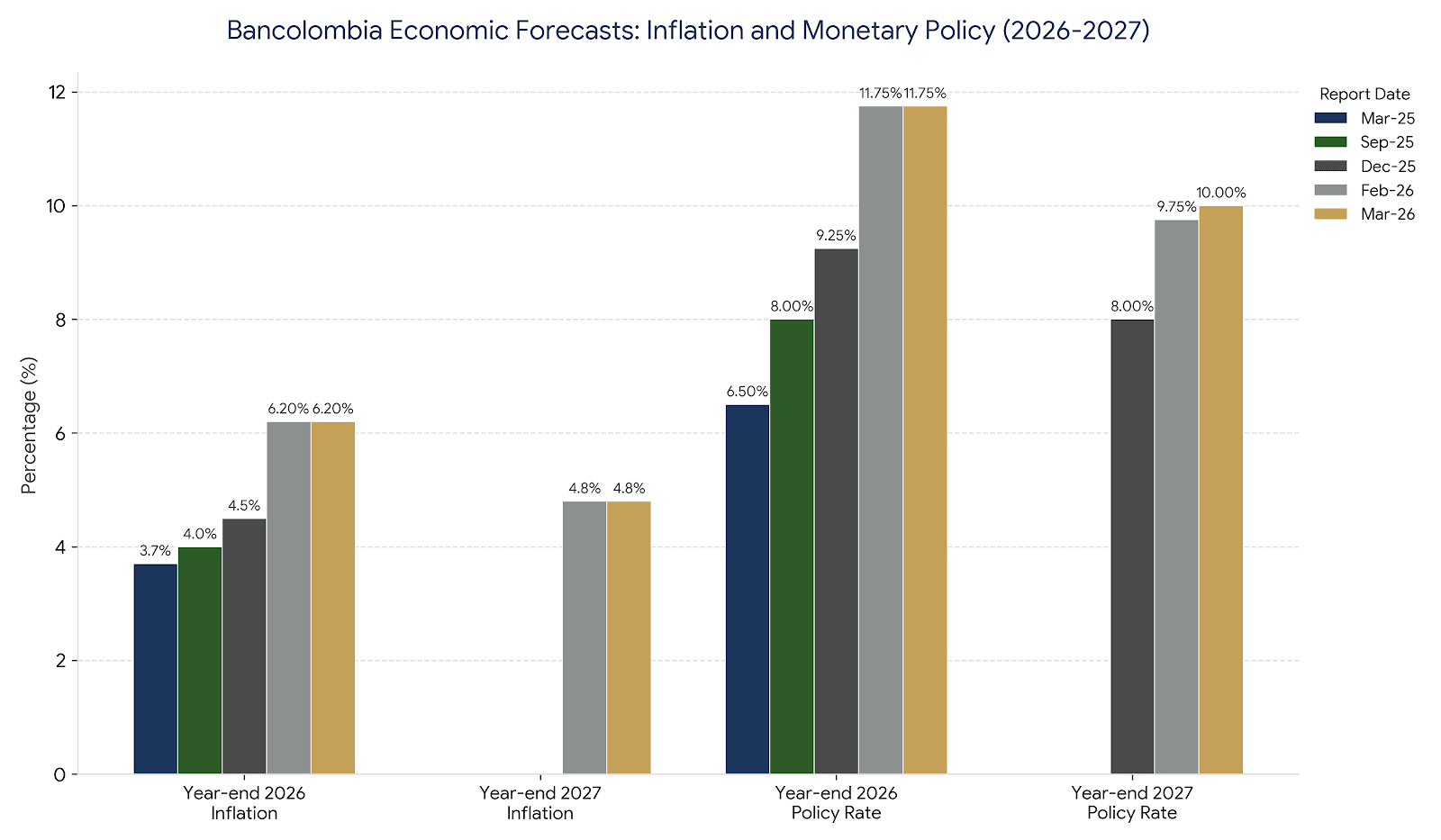
Forecast Category Mar-25 Sep-25 Dec-25 Feb-26 Mar-26
Year-end 2026 Inflation 3.7% 4.0% 4.5% 6.2% 6.2%
Year-end 2027 Inflation 4.8% 4.8%
Year-end 2026 Policy Rate 6.50% 8.00% 9.25% 11.75% 11.75%
Year-end 2027 Policy Rate 8.00% 9.75% 10.00%

Domestically, the business indices from think-tank Fedesarrollo showed mixed results for February. However, there are positive indicators in the labor market, as the urban unemployment rate across the 13 primary metropolitan areas continued its downward trend. Additionally, goods exports recorded an advance during the same period.

In the local fixed-income market, the TES fixed-rate curve saw a recovery last week. However, the March Financial Institutions Survey suggests that devaluations of TES may persist in the short term. Long-term TES Class B placements in the first quarter reached 1.0 percent of the GDP.

Chart based on data from Grupo Cibest & the Banco de la República.

Chart based on data from Grupo Cibest & the Banco de la República.

Energy markets remain volatile as crude oil inventories in the US increased beyond expectations in the third week of March. Despite this, the price of Brent crude rose toward the end of the week, driven by skepticism regarding a potential ceasefire in the Middle East. The Colombian peso appreciated over the past week, tracking the intensity of the regional conflict.

The equity market results for the fourth quarter of 2025 remained neutral and aligned with market expectations. Global volatility continues to be shaped by energy shocks, geopolitical strife, and a cautious approach toward investments in artificial intelligence.

The projected rate hike by the Banco de la República is intended to send a definitive signal of commitment to price stability. This adjustment reflects not only recent inflation trends but also a strategic effort to prevent the further deterioration of expectations in a high-risk environment.

Headline image: Bogotá headquarters of Banco de la República (Banrepublica). Photo credit Juan Enrique Rodríguez, courtesy Banrepublica

Editorial: Gustavo Petro’s “Total Peace” Has Led to Total Chaos in Colombia

23 March 2026 at 22:44

Colombia’s President Gustavo Petro ran for president on a campaign promising Paz Total—Total Peace. He promised to give the FARC dissidents, the vicious ELN guerillas, and mafias like the Clan del Golfo a good talking to, and with that, they will just lay down their weapons and become model citizens. Petro promised that through dialogue with bloodthirsty kidnappers and extortionists, they would be willing to stop being bloodthirsty kidnappers and extortionists; as if they are just misunderstood little muffins who only need a hug.

Nubia Carolina Córdoba, governor of Chocó, Colombia (photo from her Twitter account)

Nubia Carolina Córdoba, governor of Chocó, Colombia (photo from her Twitter account)

According to figures compiled by the Universidad Externado and reported by The City Paper Bogotá, Colombia has recorded 40,663 homicides during the first three years of the Petro presidency. Over 400 human rights defenders have been slaughtered between 2022 and 2025 according to the United Nations Office of the High Commissioner on Human Rights. Human Rights Watch reports that the ELN and FARC dissidents have expanded their territories by up to 55%. They are taking back over Colombia.

Under Gustavo Petro’s watch, Colombia has returned to the Institute for Economics and Peace’s Global Terrorism Index top ten list of countries impacted by terrorism, along with Total Peace destinations like Democratic Republic of Congo, Somalia, and Syria. Just this past week, a Clan del Golfo poster was put up within walking distance from the Aeropuerto Internacional José María Córdova just outside of Medellín. This Total Peace nonsense is a failure.

Right now, in the neglected Pacific department of Chocó, the ELN has kidnapped whole communities. Petro ran a campaign promising that he was going to embrace these historically neglected communities—places like Chocó, Nariño, La Guajira, and Norte de Santander—but insecurity is increasing. Chocó’s governor, Nubia Carolina Córdoba, says 6,047 people are trapped inside of their homes because the ELN has announced an illegal armed curfew in the municipality of Bajo Baudó. Most of these people are already poor, and now they have been kidnapped en masse by this guerilla group that operates with impunity because Gustavo Petro coddles them with “dialogue.”

According to Governor Córdoba, they attacked the police station in the village of Santa Rita using grenades attached to drones. It has gotten so bad that Colombia has restricted the entry of drones into the country. These people are calling out for help, but the president insists on talking as the ELN grows and continues to menace the police forces, the Colombian military, and, most importantly, the innocent public.

There is currently public disorder where belligerents have completely blocked the roads in the north of Antioquia, in the region called Bajo Cauca, and also in the neighboring department of Córdoba. The city of Caucasia is under curfew. Antioquia’s Governor, Andrés Rendón, has urgently called on the national government to stop the talk and take action. Groups are attacking ambulances and burning people’s motorcycles as they try to get by the roadblocks, regardless of the emergency.

Governor Rendón stated: “There can be no dialogue amidst blockades and human rights violations. It’s been seven days now with the Bajo Cauca region paralyzed and the country held hostage by chaos.” He called on the Fiscalía General de la Nación to bring those responsible to justice and challenged the Minister of Defense, Pedro Sánchez, to order the immediate reopening of the roads. “We’re not talking about small-scale miners here; behind this are criminal structures, as everyone knows, that finance themselves through illegal mining and move billions of pesos,” Rendón added, demanding full authority against the criminals who use communities as a shield.

El gobernador de Antioquia, @AndresJRendonC, se pronunció sobre la situación de orden público en el Bajo Cauca, en medio de los bloqueos que ya completan varios días y afectan la movilidad y la seguridad en la región. @GobAntioquia pic.twitter.com/4SPQgTa68r

— MiOriente (@MiOriente) March 22, 2026

The current situation with these organized criminal groups—whether regular mafias like the Clan del Golfo or murderous Marxist guerillas like the ELN and the FARC dissidents—is reminiscent of a classroom where a substitute teacher has lost all control. Petro promised Total Peace, but the result has been Total Chaos. Investors do not want to deal with this mess. While the Petro government claims they want tourism to be a major economic driver, road blocks make many areas look like scenes out of Mad Max: Road Warrior. Whole zones of the Pacific coast are unsafe even for residents, met with pure impotence from the regime.

Ten years ago, it was safe to drive from Medellín to the beachside town of Coveñas in Sucre, but that is no longer the case. While it remains safe to visit Colombia for business or tourism in major hubs like Bogotá, Medellín, Santa Marta, or the San Andrés islands, the long-term outlook is concerning. My hope is that Colombians choose a future leader serious about law and order as a prerequisite for human rights. It is not only the government that we need to protect human rights from; those who kill, steal, kidnap, and forcibly recruit children are violating those rights as well.

Colombian anti-explosives experts inspect propaganda by the Clan del Golfo mafia group just minutes away from Medellin's international airport in March, 2026 (image from Facebook).

Colombian anti-explosives experts inspect propaganda by the Clan del Golfo mafia group just minutes away from Medellin’s international airport in March, 2026 (image from Facebook).


Colombian Voters Elect New Congress for 2026-2030 Legislative Term; Party With Largest Senate Block Still Only 26%

9 March 2026 at 22:29

The new members of Congress will take office on July 20, the official start of the new legislative term.

On March 8, Colombia elected the Congress that will exercise legislative authority during the 2026–2030 term. From more than 3,200 candidates, voters chose the 102 senators (upper house) and 182 members of the House of Representatives (lower house) who will make up the country’s legislative branch.

According to preliminary reports from the Registraduría Nacional del Estado Civil (RNEC), with 98.4% of polling stations counted, equivalent to 19,220,365 votes tallied, the new Congress has been defined electorally, however, it should be noted that these seat projections correspond to the official preliminary count, which still must go through several formal procedures before the final results are certified.

How the Senate Race is Shaping Up?

The Pacto Histórico, the party of current President Gustavo Petro, obtained around 22% of the vote (4,402,601), which would allow it to increase its representation from 20 senators in the current legislature to approximately 25 seats in the next term.

In second place is the Centro Democrático, the party of former President Álvaro Uribe, with about 15% of the vote (3,020,459), potentially increasing its representation from 13 to 17 seats.

The Partido Liberal would rank third with 13 seats (2,268,658 votes). It would be followed by the Alianza por Colombia, led by the Green Party, with 10 seats (1,899,096 votes), and the Partido Conservador, also with 10 seats (1,859,493 votes).

Other wins in the Senate include Party of La U (9 seats), Cambio Radical (7), the Ahora Colombia coalition (5), which backs presidential candidate Sergio Fajardo, and Salvación Nacional (4), the movement of presidential candidate Abelardo de la Espriella. The two remaining seats correspond to the special indigenous constituency.

In terms of losses in representation, the Partido Conservador would be the most affected, losing five of its current 15 seats. Cambio Radical would lose four, the Greens three, La U two, while Liberals and Ahora Colombia would each lose one seat.

Among the prominent figures who would be left out of the new Senate is former President Álvaro Uribe, who occupied position number 25 on his party’s list and would not obtain a seat if the Centro Democrático secures only 17 seats. Green Party senator Angélica Lozano, known for promoting legislation related to transparency, would also lose her seat.

Likewise, movements such as the coalition that supported Juan Daniel Oviedo and the Partido Oxígeno, led by former presidential candidate Ingrid Betancourt, who was kidnapped for years by the now-defunct FARC guerrilla group, would fail to surpass the minimum threshold required to obtain Senate representation (3% of the total vote).

On the other hand, the performance of the Salvación Nacional movement, led by presidential candidate Abelardo de la Espriella, stands out. In its first participation in a congressional election, the party would surpass the electoral threshold and secure four senators.

What About the House of Representatives?

The allocation of seats in the House of Representatives follows a different process from that of the Senate, making it difficult to project the final distribution in the early stages of the vote count.

This is because the calculation is conducted department by department, once the RNEC determines the seat allocation formula and electoral quotient in each of the 32 States and the Capital District of Bogotá.

According to report number 45 from the RNEC, with 99.03% of votes counted, the main parties have obtained the following preliminary nationwide results:

  • Centro Democrático: 2,551,706 votes.
  • Partido Liberal: 2,101,877 votes.
  • Partido Conservador: 1,967,996 votes.
  • La U: 1,044,778 votes.
  • Pacto Histórico: 913,990 votes.
  • Cambio Radical: 803,721 votes.
  • Alianza Verde: 654,071 votes.
  • Salvación Nacional: 436,365 votes.

Because the House of Representatives elections involve parties, movements, and coalitions with strong local and regional influence, several smaller political organizations are expected to win seats, as they must surpass regional thresholds rather than a national one.

The Highlight: a Fragmented Congress that Will Require Coalitions

With the preliminary distribution of seats in both the Senate and the House of Representatives, projections suggest that Colombia’s next president will need to govern through legislative coalitions, as has occurred under President Gustavo Petro and his predecessors.

Presidential candidates Iván Cepeda, of the Pacto Histórico, and Paloma Valencia, of the Centro Democrático, would begin the next political phase with the largest congressional blocs, although neither would have enough seats to govern alone.

Traditional parties such as the Liberal, Conservador, Cambio Radical, and La U, which together could account for more than 40% of the new congress, have not yet decided which presidential candidate they will support, a situation similar to what occurred in the previous election. These parties could therefore become kingmakers, capable of facilitating, or blocking, governability depending on the alliances and coalitions they choose to form.

For that reason, the coming weeks are expected to be marked by intense political negotiations, as presidential contenders attempt to build alliances that would allow them to secure legislative support.

For candidates such as Sergio Fajardo, whose Ahora Colombia coalition would obtain only five senators, or Abelardo de la Espriella, whose Salvación Nacional movement would have four, the challenge will be significantly greater.

Above photo: Polling station during Colombia’s congressional elections. Photo courtesy of the Registraduría Nacional del Estado Civil.

Sunday’s Colombian Presidential Primary Election Results Were Full of Surprises

9 March 2026 at 22:13

Colombia’s presidential race has entered a new phase following the interparty primaries held on March 8. Three major coalitions selected their candidates ahead of the first round scheduled for May 31: Paloma Valencia (48 years) will represent the right, Claudia López (56) the center, and Roy Barreras (62) a segment of the left.

They will join three candidates who did not participate in the primaries because they already hold the official endorsement of their parties: Iván Cepeda (63) of the Pacto Histórico (left), Sergio Fajardo (69) of Dignidad y Compromiso (center), and Abelardo de la Espriella (47) of the Salvación Nacional (far right).

Beyond their immediate results, Colombia’s interparty primaries typically serve two main purposes: reducing the number of contenders and selecting the flagbearers of each coalition, while also measuring the electoral strength of political figures ahead of potential negotiations among parties and candidates. With 99% of polling stations counted, and preliminary results rapidly released by the Registraduría Nacional del Estado Civil, several political consequences of the vote are already emerging.

Paloma Valencia to Lead the Uribista Right

The right-wing consultation brought together nine candidates from different center-right and conservative currents. One of its main goals was to secure a strong turnout that could consolidate the sector in public opinion and counter the rise of far-right candidate Abelardo de la Espriella, who seeks to capture a portion of Colombia’s traditional conservative electorate.

The winner was Senator Paloma Valencia, who has campaigned nationwide alongside former President Álvaro Uribe Vélez, the leading figure of the Centro Democrático party.

Although polls had already projected her victory, the surprise was the scale of the result. With 99% of polling stations counted, Valencia secured 3,212,528 votes, representing more than 45% of the total votes cast across the three primaries.

She now faces three major challenges. The first will be unifying the right behind her candidacy and preventing conservative voters from drifting toward De la Espriella. In this context, the selection of her vice-presidential running mate will be crucial.

Among the names circulating is Juan Daniel Oviedo (48), a former Bogotá city councilor who unexpectedly finished second in the consultation with more than 1,200,00 votes, despite his well-known ideological differences with the Uribista movement.

The second challenge is symbolic: no woman has ever reached the second round of Colombia’s presidential election, making it difficult to break that historical barrier even with the political backing of Uribe, who still maintains strong favorability ratings.

Finally, Valencia will attempt to channel the anti-Petro vote, capitalizing on public dissatisfaction with the policies of President Gustavo Petro and his close political ally Iván Cepeda, who currently appears as the frontrunner in most polls for both the first and second rounds.

The Center Cools Around Claudia López

With 99% of votes counted, the centrist consultation recorded the lowest turnout among the three coalitions. Former Bogotá mayor Claudia López received more than 572,000 votes, representing just 8.14% of the total, well below polling projections that placed her above 12%.

For López, the result follows a long campaign that began more than a year ago, during which she sought to challenge Sergio Fajardo, the former mayor of Medellín who already holds the endorsement of the Dignidad y Compromiso party.

The key question now is her next political move: whether to remain in the presidential race or eventually join forces with Fajardo, whose polling numbers also remain modest, hovering around 5%.

The weak result may reflect the fragmentation of Colombia’s political center, often criticized for positions perceived as moderate or ambiguous. It may also indicate that Juan Daniel Oviedo attracted part of the centrist electorate within the right-wing consultation.

In any case, the outcome suggests the presidential campaign could once again polarize around two main narratives: “with Petro,” led by Iván Cepeda and the Pacto Histórico, or “against Petro,” a space still contested between Paloma Valencia and Abelardo de la Espriella.

Roy Barreras Wins the Left Consultation, but Momentum Favors Cepeda

In Roy Barreras’s case, two key factors appear to have contributed to his limited result. First was his decision to maintain a primary that many within the left considered unnecessary, given that much of the progressive sector had already rallied behind Iván Cepeda.

Second is his long political trajectory across multiple governments and ideological camps, from the right to the left, which has led some voters to view him as a traditional establishment politician.

With 99% of votes counted, Barreras secured just over 255,000 votes, less than 4% of the total. During the campaign, Barreras had stated he expected to surpass 1,500,000 votes in order to negotiate a stronger position within the left-wing coalition. Following these results, his most likely option may be withdrawing his candidacy and endorsing Cepeda, signaling unity within the progressive camp.

Other Highlights from the Electoral Day

One of the most striking outcomes was the performance of Juan Daniel Oviedo, who finished second among the 18 candidates participating in the primaries with 1,251,428 votes. With this electoral capital, Oviedo has become one of the most sought-after figures for potential alliances.

His political alignment remains uncertain. It is unclear whether he will fully integrate into Paloma Valencia’s campaign and the Centro Democrático, with whom he has ideological differences, or attempt to move closer to the weakened political center.

Unlike many traditional politicians, Oviedo has built a relatively short but distinctive political career based on his technocratic profile, his experience in economic policy, and his attempt to position himself outside the traditional Petro-Uribe political divide.

Meanwhile, journalist Vicky Dávila (52), who has run a campaign with populist elements inspired by figures such as Javier Milei in Argentina and Donald Trump in the United States, received more than 236,000 votes, around 3.3% of the total, leaving her with limited negotiating leverage.

A similar outcome affected Daniel Quintero (45), the former mayor of Medellín, who received just over 226,000 votes (around 3.2%), with his campaign likely hurt by controversies linked to alleged corruption during his administration.

Under Colombia’s electoral law (Law 1475 of 2011), political parties may still modify or withdraw candidates until March 20. After that date, the presidential campaign will move toward the first round scheduled for May 31. If no candidate obtains an absolute majority (50% plus one), the two candidates with the highest vote totals will compete in a runoff election on June 21.

For now, the race appears likely to center on a left-wing coalition led by Iván Cepeda with the backing of President Gustavo Petro, and a divided right contested between Paloma Valencia and the ultraconservative Abelardo de la Espriella.

Above photo: Claudia López, candidate in the centrist primary, casting her vote in Bogotá. Photo courtesy of Claudia López’s campaign team.


Op-Ed: Latin America’s Air Cargo Hubs Are Engines For Economic Growth

3 March 2026 at 01:05

Freight forwarders and logistics companies serving the Americas no longer think of the region’s air network as a peripheral add-on to ocean freight. Latin American airports now handle everything from export flowers and pharmaceuticals to e-commerce parcels on overnight schedules. With volumes showing a steady growth path—and with governments racing to upgrade runways, cold-chain rooms, and free-trade zones—these gateways are transforming how independent forwarders plan routings, price capacity, and promise lead-times to customers.

The Latin American air freight market, valued at $1.04 billion USD in 2025, is projected to experience sustained growth, driven by expanding e-commerce, increasing cross-border trade, including inter-Latin American trade. Key growth drivers include the rising demand for more reliable and quick turnaround delivery services, particularly for perishable goods and high-value products.

Global air cargo demand rose by 3.4% in 2025 compared with the previous year, according to data released by the International Air Transport Association (IATA).

At the same time, total capacity, measured in available cargo ton-kilometers (ACTK), increased by 3.7% year on year. For international operations, demand rose by 4.2%, while capacity increased by 5.1%.

Latin America Air Freight Industry Concentration & Characteristics

The Latin American air freight industry has been defined by a moderate level of concentration, with a few large global players dominating but now also including several significant regional carriers. While FedEx, UPS, and DHL hold substantial market share, particularly in international freight, regional players like LATAM Cargo, Avianca Cargo (Tampa Air), and Aeromexico maintain strong positions in domestic and regional routes.

Other leading players in the Latin American airfreight industry include IAG Cargo (UK), Copa Airlines (Panama), American Airlines, Delta Airlines, Azul Cargo Express (Brazil) and Emirates Skycargo.

Nicholas Sutherland’s opinions and claims are his own, and not necessarily those of Finance Colombia.

Regional Growth Drivers

  • E-commerce explosion – Same-day and next-day service expectations are migrating south, driving express integrators to expand cargo terminals in Latin America and sign block-space agreements with regional carriers.
  • Perishables dominance – Colombia, Ecuador, Peru, and Chile collectively ship more than 1.5 million tons of flowers, fruit, seafood, and pharma each year—commodities that depend on airport infrastructure for freight with reliable 2-8 °C corridors.
  • Pharmaceuticals – Colombia, Mexico and Brazil stand out as not only having large national companies, but also some of the largest pharma companies in the world have factories in these countries.

Electronics, jewelry, auto parts, specialized machine parts, and high-value textiles are also driving increased traffic.

Latin America’s Hub Status

For years, Latin America has been spoken of primarily as a supplier, a hub for perishables, electronics, and auto parts feeding the U.S. and Europe. Fast forward to 2025 and something is unmistakably clear: the region is no longer merely sourcing for the world. It is becoming one of the most strategically viable air cargo growth engines, driven by nearshoring, rising consumer markets, and accelerated infrastructure investment.

Leading Locations

Mexico

 Since 2023 the Felipe Ángeles International Airport, also within the Greater Metropolitan Area of Mexico City, has now surpassed the Benito Juarez airport for air cargo with 2025 figures showing 413,224 metric tons in air cargo traffic.

The International Airport of Mexico City, known officially as Benito Juárez International Airport, stands out as the largest airport in the country and is now the second busiest air cargo hub in Mexico and number three in the LATAM region. The figures underline the importance of this hub. In January 2022, the air terminal managed a total of 41,650 tons. In 2023, this number rose to 47,206.8 tons, reflecting an important increase of 5,556.8 tons. It is important to mention that this airport also acts as a center of operations and connections (HUB) for the Mexican airline Aeroméxico, further strengthening its strategic position in the airport and logistics scenario in the region.

The International Airport of Cancun (CUN), located in the Mexican Caribbean, is a major hub in cargo handling in Latin America. With leading-edge facilities and advanced systems for the processing of goods, the airport handles a diversity of products, including consumer goods, textiles, electronic parts and pharmaceutical products. Its strategic location makes it crucial for trade routes between North America, Latin America and Europe and it has undergone constant growth in its volume of cargo.

Colombia

El Dorado International Airport is in Colombia’s capital city, Bogotá, and stands out as the third most important airport in Latin America in terms of freight volume. It registered a 2024 throughput of 809,00 tons, with flowers, perishables and pharma being the main categories.

Colombia has consolidated its position as a world leader in the export of a wide range of products, including products derived from agriculture, foodstuffs and chemical products. The airport has also been consolidated as the center of strategic operations (HUB) for international airline, Avianca.

Two 3,800 m runways at 8,360 ft elevation make BOG a purpose-built wide-body freighter hub. Cargo airlines position here to bridge east-west schedules across the Caribbean, giving forwarders same-night connections into MIA, AMS, and DOH.

Panama

Tocumen International Airport (PTY), Panamá City handled 216,653 tons in 2024 (a 4% increase over 2023). PTY sits astride the Colón Free Zone and the Panamá Canal rail link; a third runway is budgeted for development in 2027 to future-proof capacity.

A new development project called “Tocumen Cargo City”, with an area of 124 hectares, which includes the concession for the development of the cargo terminal and logistics zone, was announced in 2024. This project will take advantage of Tocumen’s competitive advantages as the region’s main air hub that connects daily more than 80 commercial destinations, and more than 50 air cargo destinations integrating a multimodal axis with the country’s maritime and land transport operations,

 Peru

Jorge Chávez International Airport is in the region of Callao, outside of the metropolitan area of Lima (Peru). It stands out as the center of operations and connections for LATAM Airlines.

In 2023 the airport handled 230,993 tons of air freight. The largest quantities of air export products were fresh asparagus, blueberries, salmon and other seafood. In 2024, the airport also added another runway and a new passenger terminal with an adjoining logistics park.

Brazil

São Paulo-Guarulhos International Airport (GRU) had a throughput of 235,600 tons in 2024. Air-sea multimodality is boosted by a 90-minute drive to the Port of Santos. Automotive, machinery, pharma cold-chain (largest airport cool-store in Brazil) are the highest categories of products.

Campinas Viracopos (VCP) airport, in Sao Paulo state (not the city) handles roughly one-third of Brazil’s imported air freight and was voted 2024 Cargo Airport of the Year by routesonline.com . It boasts a 90,000 m² cargo terminal with 11 dedicated cold rooms and a live-animal zone.

 Looking Forward

Governments are aware that there is now fierce rivalry to attract air cargo logistics operations and several have identified the sector as a key segment which would improve the competitiveness of their economies and stimulate economic growth and create skilled employment opportunities. Integration of air cargo, ports, incentives and free zones have become a cornerstone for attracting logistics and manufacturing companies.

Cargo airports in Latin America are writing the next chapter in hemispheric logistics. For independent freight forwarders, and other investors, these hubs are not just transit points, they are strategic pivot points to shorten lead times, diversify modal risk, and command premium margins in niche verticals. Airports are emerging as focal points in this new logistics landscape. Policy support, geography, and international partnerships are essential to attracting international operators and service providers.

Several countries have made successful initiatives to increase investment in the multimodal logistics space including the Dominican Republic, El Salvador (with a focus on increasing Maintenance Repair and Overhaul operations) Ecuador and La Aurora International Airport in Guatemala becoming a major hub, with LAATS, a Guatemalan logistics and freight company, managing all regular cargo flights there.

Attracting Investment in the Caribbean

For countries in the Caribbean to consider becoming air cargo logistics locations, they require international operators to view them as viable long-term locations, therefore several factors need to be considered.

Cold-Chain certification is a cornerstone for diversified airfreight operations. Pharma shippers demand IATA CEIV or WHO GDP accreditation. GRU, VCP, and LIM all hold multiple certifications, allowing forwarders to move temperature-controlled cargo without auxiliary containers significant cost saving.

Customs & Free-Zone Synergy have been the defining characteristics of a country’s success. Many airports interface directly with bonded zones or inland ports. Panama’s Tocumen International Airport’s on-airport logistics park and Panama Pacifico free zone cut transfer times by 24 hours compared with off-site warehousing.

Customs Harmonization and Focused Incentives

Caribbean countries must consider integration of the electronic DUCA-F, a fundamental document for the export of products originating in a Central American country to other countries in the region, within the framework of current trade agreements. It integrates and connects the customs systems of the six countries that make up the Central American region. This interconnection significantly improves customs controls, allowing for the automatic validation of declared data and real-time verification of approvals issued by the single windows and customs authorities of each country.

Airports may waive or discount landing fees for 1–2 years to attract new carriers or new routes. Sao Paulo’s Viracopos International Airport in Brazil runs an incentive program for cargo carriers as it looks to strengthen international hub’s cargo activities. The program aims to develop Viracopos as an international cargo hub, and the gateway’s operator – Aeroportos Brasil Viracopos – wants to increase the number of international flight routes and cargo frequencies. Some of these incentives include 100% exemption of landing fees for operations at the airport’s cargo terminal for the first 24 months of a carrier’s cargo operation.

Like landing fees, building rents can be discounted for air cargo carriers. For example, St. Louis International Airport offers 18 months of waived terminal building rents and landing fees for new transoceanic service and related logistics. Income tax exemptions for the first four (4) years of operation and reduced tax rates (sub 10%) for air cargo-related logistics operations are other ways to compete with nearshore rival locations. Income tax exemptions on rental for developers are essential for infrastructure development. These exemptions can be for twenty years, combined with a reduced tax rate for the following years.

Several Caribbean countries have declared intentions to compete for investment in air logistics, however very few (except for the Dominican Republic) have made it a priority with an accompanying tactical and focused execution plan. Caribbean countries who wish to position themselves as an air cargo hub need to have feasibility studies done by internationally recognized logistics companies along with a well-defined plan for what reasonable short-term and long-term success looks like. It’s also essential to have a realistic outlook of what each country can offer, rival strengths and incentives and a clear understanding of any deficiencies which may pose headwinds to their stated goals.

What Jumps Out: 7 Days, 7 Questions

7 February 2026 at 03:06

Welcome to the weekend one and all. A week dominated, or at least that was the perception, by politics. Who will be standing in which primary and who will choose / have to go direct to Round 1 in May. Aside from that, the debate over the impact of the 23% minimum wage increase, continues.

1. How was January inflation from Departamento Administrativo Nacional de Estadística – DANE Colombia ?

2. Is the full impact of the Minimum Wage increase now baked in according to Bancolombia ?

3. How were Exports for December from Departamento Administrativo Nacional de Estadística – DANE Colombia ?

4. How many Presidential candidates do we expect to see on the ballot in May ?

5. Why is Petro again discussing Emergency Economic powers ?

6. What are FENALCO & ANDI – Asociación Nacional de Empresarios de Colombia saying about vehicle sales in 2026 ?

7. How have the markets been this week ?

That is our lot for this weekend. Wherever you are, please have a relaxing and peaceful day.

my regards

Rupert

❌