
Normal view

Colombia’s Three Presidential Front-Runners Draw Divergent Maps for Foreign Capital, Security, and Rule of Law

25 May 2026 at 22:03

Colombians face three sharply different futures in May 31 vote

Colombia votes on May 31 with its presidential race concentrated around three candidates whose platforms diverge on nearly every dimension of economic and security policy relevant to foreign investors. For corporate executives, institutional investors, and multinational operations with Colombian exposure, the choice between senator Iván Cepeda, senator Paloma Valencia, and defense attorney Abelardo de la Espriella carries direct, measurable implications for the regulatory environment, foreign direct investment (FDI) conditions, energy sector licensing, and geopolitical alignment through at least 2030.

No candidate is projected to clear the 50%-plus-one threshold required to win outright on May 31, making a runoff election on June 21 the expected outcome. The question that will determine the direction of that runoff — and by extension the next administration — is which of the two opposition candidates finishes second.

Click above to play the video!

A Race Reshaped by Late Polling

The final-week polling picture shifted substantially, and the trajectory matters as much as the snapshot. The CONDOR weighted aggregate — which incorporates surveys from six polling firms and applies greater weight to more recent data — placed the race as of May 23 at: Cepeda 36.3%, De la Espriella 29.1%, Valencia 16.7%.

Invamer, one of Colombia’s most established polling firms, surveyed 3,800 respondents across 152 municipalities between May 13 and May 20, registering Cepeda at 44.6%, De la Espriella at 31.6%, and Valencia at 14.0%. The Centro Nacional de Consultoría (CNC) published a survey conducted May 22 and 23 showing Cepeda at 33.4%, De la Espriella at 30.9%, and Valencia at 12.6%.

Comparing those figures to the Fundación Génesis Crea survey from May 4 through May 11 — which placed Cepeda at 35.1%, Valencia at 25.4%, and De la Espriella at 21.6% — indicates a multi-poll trend of De la Espriella gaining approximately nine to ten percentage points in three weeks while Valencia shed a comparable share. AS/COA’s poll tracker confirms the directional consistency across firms.

Atlas Intel, which published figures more favorable to De la Espriella, is currently under investigation by Colombia’s Consejo Nacional Electoral (CNE) for potential methodology violations and could face suspension of its operations. Those figures are treated with caution in this analysis.

Runoff modeling diverges between firms. Fundación Génesis Crea showed Valencia defeating Cepeda 49.1% to 44.7% in a second-round matchup — meaning she was the stronger opposition candidate in that scenario. The Guarumo/Ecoanalítica survey found Cepeda losing all hypothetical runoff scenarios, including against De la Espriella. Two minor candidates — former senator Clara López and former Chocó governor Luis Gilberto Murillo — withdrew and endorsed Cepeda before the first round, a consolidation that appears to have had limited effect on his polling numbers.

Finance Colombia reported in May that the campaign has been marked by an unusual absence of traditional televised debates. Cepeda declined to participate in events organized by major media outlets, stating that proposed formats lacked neutrality. Former Bogotá Mayor Claudia López, herself a candidate, said publicly that Cepeda’s refusal was motivated by an unwillingness to defend his record as the architect of President Gustavo Petro‘s Paz Total security negotiation strategy.

Security Policy: The Three Approaches to Armed Groups

Public security is the top voter concern heading into the election. InSight Crime documented that the Ejército de Liberación Nacional (ELN) launched a major offensive against FARC dissident factions in Norte de Santander in early 2025, resulting in mass civilian casualties in the Catatumbo region. In Chocó and Antioquia, the ELN and the Autodefensas Gaitanistas de Colombia (AGC), commonly known as the Clan del Golfo, are competing for control of illegal gold mining corridors and drug trafficking routes. In Cauca, FARC dissident factions have established territorial control in areas where state presence has collapsed.
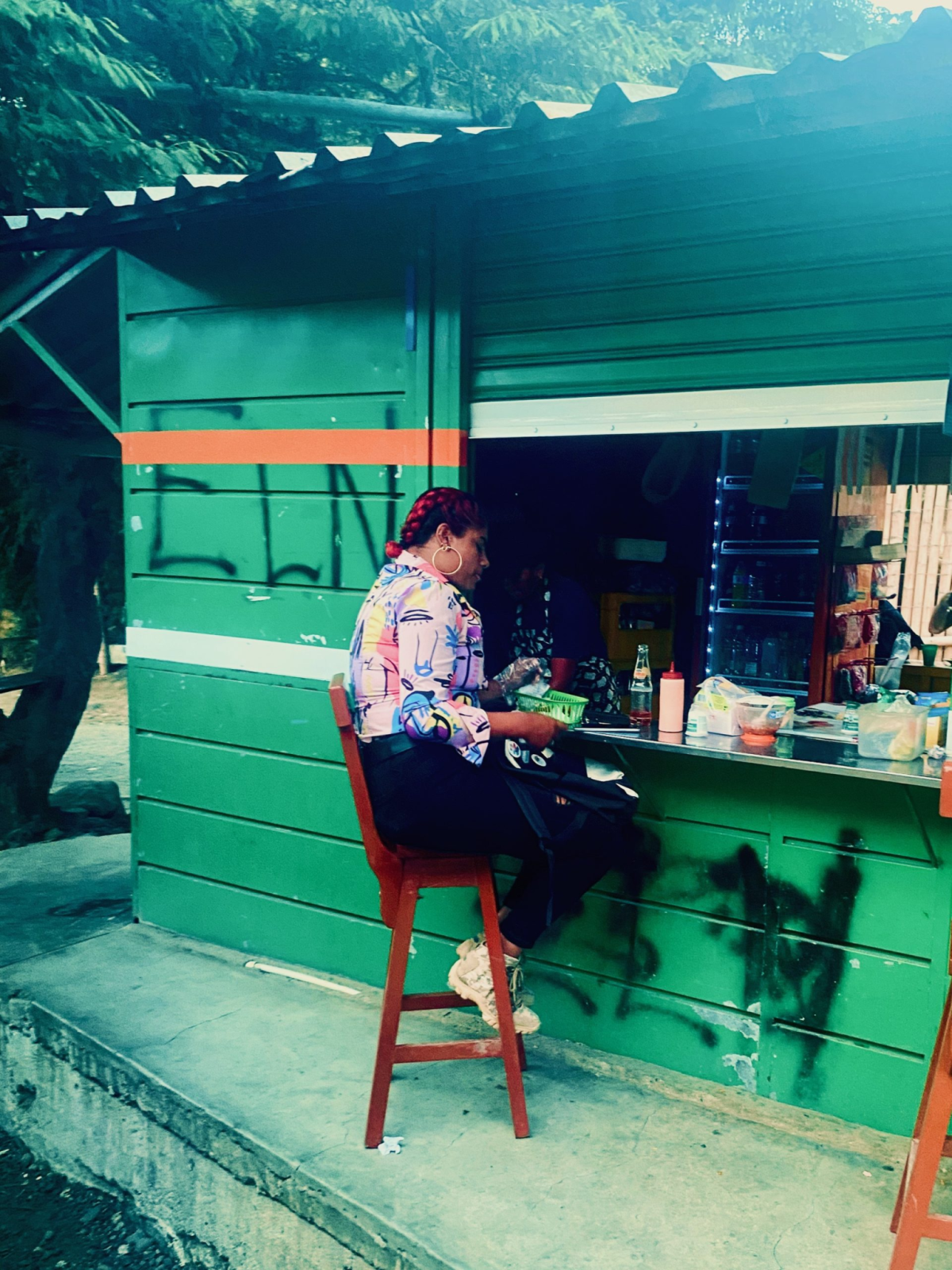
Grafiti of the ELN and ex-FARC Mafia near Corinto, Cauca (Credit: Henry Shuldiner)Cepeda’s approach to security is defined by his role as the principal legislative architect of Paz Total. As chair of the Senate‘s peace commission, he designed the framework that extended negotiating status to the ELN, FARC dissident groups, and the Clan del Golfo. His stated rationale is that targeting the financial leadership of drug networks rather than foot soldiers produces more durable results — a position that has academic backing in narcotics policy literature. In practice, Paz Total produced ceasefires that were repeatedly violated, and security indicators in conflict-affected departments deteriorated during the Petro administration. A Cepeda presidency is expected to continue the negotiated settlement model, with the military operating under political constraints.

Valencia’s security platform is based on reinstating Seguridad Democrática, the doctrine associated with former president Álvaro Uribe’s administrations from 2002 to 2010. The core elements are expanded military presence in rural conflict zones, dismantling of rural criminal networks, and resumption of extradition agreements with the United States — which Petro suspended, effectively shielding cartel leadership from US federal prosecution. The Uribe-era approach resulted in measurable reductions in homicide rates, forced displacement, and ELN and FARC territorial control, though human rights organizations documented serious abuses by security forces during that period.

De la Espriella has stated explicitly that his government would have no peace process. He advocates for a model similar to El Salvador’s under President Nayib Bukele: mass incarceration, construction of high-security prison facilities, classification of guerrilla and cartel organizations as foreign terrorist organizations, and broad military offensives. He has not detailed how such operations would be financed or how the mass detention model would interact with Colombia’s Constitutional Court, which has repeatedly constrained executive security powers.

For the armed groups operating in Norte de Santander and Cauca, the historical record indicates that Colombia’s criminal organizations respond more acutely to sustained, institutionally grounded military pressure and functioning extradition pipelines than to political rhetoric. By that measure, Valencia’s platform — which rebuilds the institutional security apparatus incrementally — represents a more structurally credible threat to the ELN and the Estado Mayor Central (EMC) FARC dissidents. For the Clan del Golfo leadership, extradition to the United States has historically been the principal deterrent, and Valencia’s program explicitly restores it.

Business Climate and Employment Conditions

The Petro administration enacted a series of minimum wage increases totaling more than 60% over four years — including a 16% increase for 2023, the largest single-year hike in Colombian history, and a 23.78% increase for 2026 — restructured labor regulations to expand premium pay requirements for night, weekend, and holiday shifts, and raised corporate tax rates to fund social spending programs. The Asociación Nacional de Empresarios de Colombia (ANDI) characterized the regulatory environment as adverse to private investment. Finance Colombia tracked a material decline in FDI in the extractive sector over the same period.

Cepeda supported those labor and fiscal reforms throughout their legislative passage. His platform extends the Petro model: increased state social spending, continued land redistribution programs, and maintenance of the current wage and labor cost structure. For companies with established Colombian operations, the regulatory environment is manageable; for companies evaluating market entry or operational expansion, the cost structure adds friction.

Valencia’s economic program emphasizes corporate stability and private sector investment as the primary mechanisms of job creation. Her vice-presidential running mate, Juan Daniel Oviedo — former director of DANE, Colombia’s national statistics agency — represents a technocratic orientation focused on reducing structural market distortions, streamlining public procurement, and scaling back state administrative overhead. Oviedo’s appointment is a direct signal to the business community that economic management would be data-driven rather than ideologically directed. Oviedo also publicly identifies as a member of the LGBTQ+ community, a departure from the traditional social conservatism of Centro Democrático.

De la Espriella’s economic orientation is pro-business with protectionist elements. His vice-presidential candidate, José Manuel Restrepo — who served as Colombia’s Finance Minister and Commerce Minister — provides institutional credibility on fiscal and trade policy. Restrepo’s presence on the ticket signals commitment to fiscal discipline and regulatory reduction in the extractive and commercial sectors. De la Espriella’s personal style, however, introduces operational uncertainty; his campaign has generated multiple high-profile controversies, including a public altercation with Caracol Noticias journalist María Lucía Fernández during a live broadcast and a formal apology following misconduct allegations by journalist Laura Rodríguez of Piso 8 FM.

Foreign Investment, Oil, and Mining

Ecopetrol holds a 31.5% stake in the Gunflint oil field in the Gulf of Mexico.

Ecopetrol holds a 31.5% stake in the Gunflint oil field in the Gulf of Mexico.

The extractive sector is the most consequential economic policy dimension for international capital. Ecopetrol (NYSE: EC; BVC: ECOPETROL) — Colombia’s state-controlled energy company and the largest corporation in the country — has operated under exploration restrictions during the Petro administration, which has opposed new fossil fuel contracts on climate grounds.

Cepeda’s position extends the Petro framework: mandatory transition away from fossil fuels, heavy restrictions or outright prohibitions on new oil and gas exploration contracts, and stringent environmental licensing requirements for open-pit mining operations. Foreign investment would be directed by policy toward green hydrogen, ecotourism, and smallholder agriculture. For the multinational oil majors with Colombian operations and for institutional investors in the mining sector, a Cepeda presidency represents a continuation of the current constraints and, in some contract scenarios, an accelerated wind-down of Colombian portfolios.

In a related development, Finance Colombia reported in May that Ecopetrol’s president, Ricardo Roa, has been formally charged in connection with alleged campaign spending violations during Petro’s 2022 presidential campaign. The case will be inherited by whoever takes office in August.

Valencia’s position is that hydrocarbon revenues are essential to Colombia’s macroeconomic stability and that the country cannot exit the sector before alternative revenue structures exist. Her platform actively encourages FDI in petroleum exploration, is open to regulated fracking, and commits to clearing the environmental licensing backlog that has stalled multiple large-scale gold and copper mining projects. For energy and mining companies currently blocked by administrative delays, this represents the most direct path to project advancement.

De la Espriella’s position goes further: essentially deregulating the environmental licensing process for major extraction projects on the grounds that Colombia’s economic sovereignty takes precedence over environmental restrictions he characterizes as externally imposed. The practical constraint is whether a De la Espriella administration would have the institutional coherence and congressional support to deliver regulatory rollback, given that his movement has no established political party structure and entered the race through an independent signature campaign.

Foreign Policy: Washington Alignment vs. Multipolar Strategy
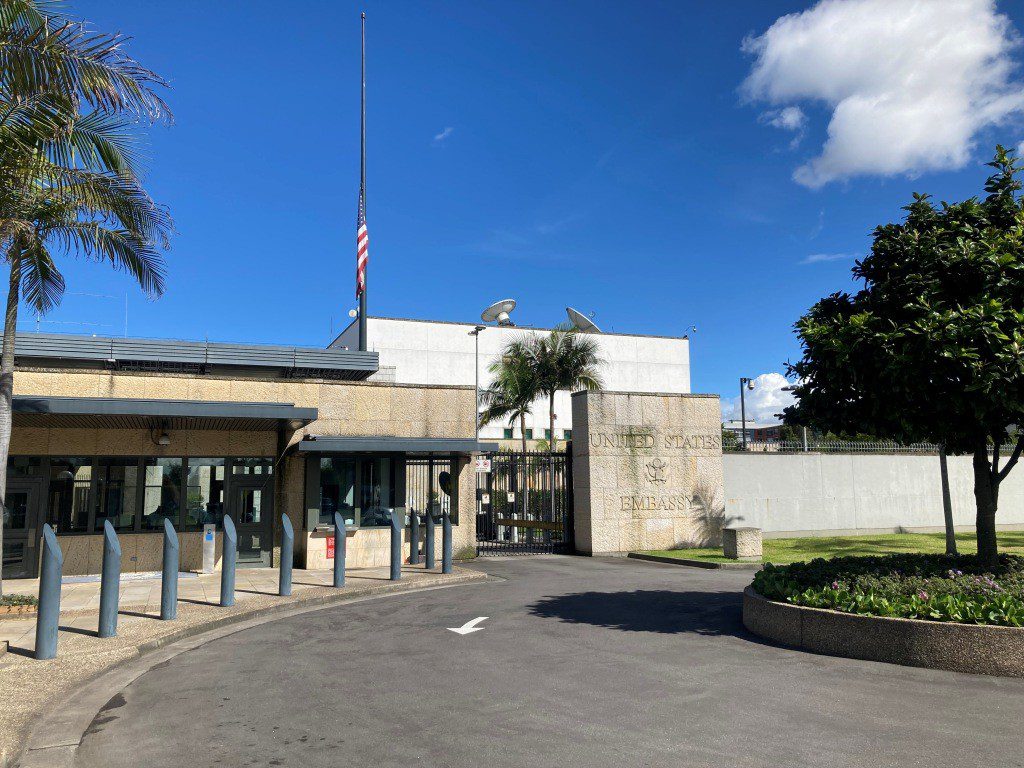
The US Embassy in Bogotá is said to be the 3rd largest US mission in the world (photo: Loren Moss)

The US Embassy in Bogotá is said to be the 3rd largest US mission in the world (photo: Loren Moss)

Colombia’s relationship with the United States deteriorated materially under Petro, who aligned Colombia with Venezuela’s Nicolás Maduro, pursued closer ties with China and Russia, and suspended extradition agreements. US counternarcotics cooperation was strained throughout the period.

Cepeda is committed to what he describes as a multipolar foreign policy — maintaining functional diplomatic channels with Washington and Brussels while deepening strategic and commercial relationships with China and Russia. His alignment with regional left-of-center governments in Mexico, Brazil, and Bolivia would position Colombia as part of a Latin American bloc that has grown increasingly skeptical of US regional leadership. For US companies operating in Colombia, this trajectory does not mean immediate operational disruption, but it reduces Colombia’s utility as a reliable counterpart on security cooperation, counter-narcotics intelligence sharing, and trade dispute resolution.

Valencia positions a return to the Western alignment as a core objective. She would prioritize restoring the US-Colombia relationship, reinforcing the bilateral Free Trade Agreement, and reestablishing intelligence-sharing mechanisms that were reduced under Petro. Her framing positions Colombia as a democratic anchor in a region experiencing authoritarian pressures.

De la Espriella takes the most explicit pro-US position in the race. La Silla Vacía reported that De la Espriella or entities linked to his campaign donated more than $90,000 USD to the US Republican Party, a fact that raises questions about the nature and expectations of those relationships. He has publicly aligned himself with the populist right in the United States, takes a hostile posture toward China, Russia, and Venezuela, and has characterized his security approach as consistent with a transactional alliance with Washington focused on counter-narcotics enforcement and cartel designation as foreign terrorist organizations.

“Ese pisco robó a 200 mil colombianos.” — Claudia López, former Mayor of Bogotá, referring to presidential candidate Abelardo de la Espriella’s legal representation of DMG pyramid scheme founder David Murcia Guzmán, during a presidential campaign event.

Corruption and Judicial Independence

All three candidates have stated commitments to fighting corruption, though their approaches and focal points differ in ways that are material to the institutional environment for business operations.

Cepeda’s legislative record includes serious, documented work investigating paramilitary infiltration of Colombia’s political institutions — the period known as parapolítica — and pursuing accountability for those cases. His blind spot, his critics argue, is corruption within the current administration. When Ecopetrol’s Ricardo Roa was formally charged in connection with Petro’s 2022 campaign, the response from the Pacto Histórico coalition was subdued. Cepeda has been Álvaro Uribe’s primary judicial antagonist in the Senate; a Cepeda administration would offer no institutional protection to Uribe and would be expected to support the full progress of judicial proceedings against him. For left-wing politicians facing legal exposure, including former Medellín mayor Daniel Quintero, a Cepeda administration would be expected to be more receptive to amnesty frameworks.

Valencia’s approach to anti-corruption is structural rather than prosecutorial: strengthening the independence of the Contraloría General de la República and the Fiscalía General de la Nación, implementing digital transparency in public procurement, and reducing informal executive influence over judicial processes. She would be expected to apply political and rhetorical pressure on behalf of Uribe — her political mentor and a close ally — though her legislative track record indicates a degree of institutional independence from Centro Democrático party orthodoxy.

De la Espriella’s anti-corruption rhetoric centers on severe criminal penalties for corrupt officials. The credibility of that position is complicated by his professional history, which is examined in detail below.

De la Espriella’s Legal Career: The Documented Record

De la Espriella’s campaign has faced sustained scrutiny over his client history as one of Colombia’s highest-profile criminal defense attorneys. The record is documented in reporting by El Colombiano, El Espectador, and the investigative outlet Corrupción al Día.
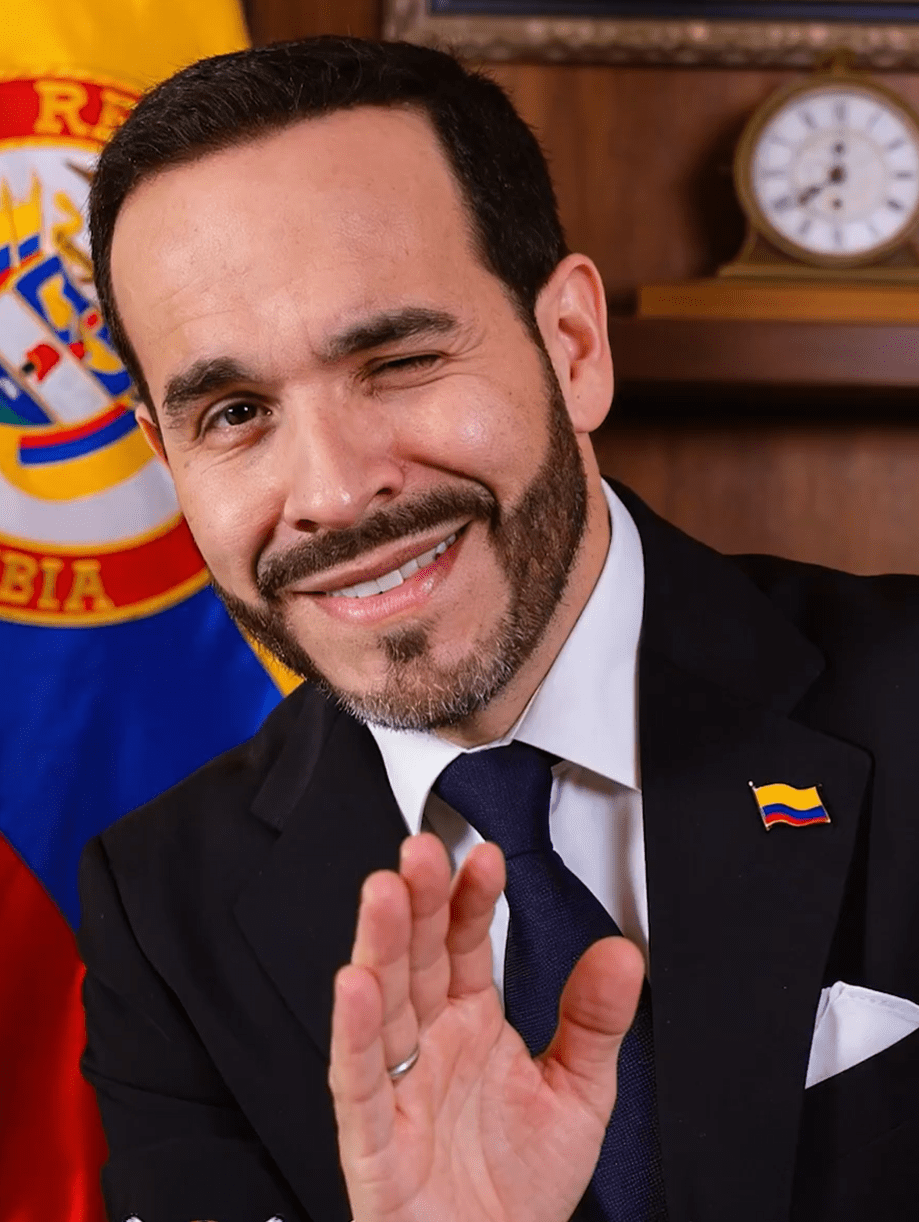
Abelardo de la Espriella (screen capture from Twitter video)

Abelardo de la Espriella (screen capture from Twitter video)

His documented client roster includes Salvatore Mancuso, the former supreme commander of the Autodefensas Unidas de Colombia (AUC) paramilitary network; multiple legislators convicted in the parapolítica scandal, which established systematic infiltration of Colombia’s congress by paramilitary organizations; David Murcia Guzmán, the operator of the DMG pyramid scheme that defrauded an estimated 200,000 Colombian investors; the Nule Primos, convicted of large-scale public contract fraud; and Álex Saab, the Colombian businessman extradited to the United States on charges of acting as the primary money launderer for the Maduro government in Venezuela. According to Corrupción al Día, De la Espriella’s legal fees from Saab reportedly reached $12 million USD and included private aircraft travel.

De la Espriella’s response to this line of criticism rests on due process principles: that every accused person is entitled to vigorous legal defense regardless of the charges, and that his ability to navigate Colombia’s criminal code at its most complex levels demonstrates the expertise required to enforce the law from the executive branch. The argument has legal validity as a principle. The specific issue for foreign compliance officers and US government counterparts is the Saab representation: the same Nicolás Maduro whose regime De la Espriella’s campaign now characterizes as an ideological enemy received legal services from De la Espriella’s firm when the representation was commercially available.

The Fiscalía investigated De la Espriella in connection with alleged paramilitary links in 2009 and again in 2012; both investigations were dismissed for insufficient evidence, and he carries no convictions or active investigations on those matters.

Cepeda’s Family History and Ideological Background
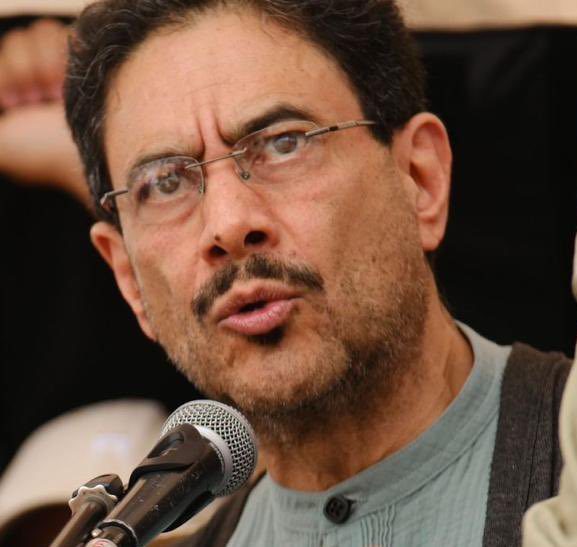
Iván Cepeda (from Twitter)

Iván Cepeda (from Twitter)

Critics of Iván Cepeda, including Enrique Gómez of the Salvación Nacional party, have argued that his family background constitutes evidence of structural alignment with guerrilla movements. The record on this point merits examination.

Cepeda is the son of Manuel Cepeda Vargas, who served as Secretary-General of the Colombian Communist Party and as a senator for the Unión Patriótica (UP), a left-wing political movement that was systematically exterminated by a combination of state actors and paramilitary organizations during the 1980s and 1990s. Manuel Cepeda Vargas was assassinated on August 9, 1994. The Inter-American Court of Human Rights subsequently found the Colombian state responsible for his murder. The FARC-EP named its Frente Urbano Manuel Cepeda Vargas — an urban front operating within the Bloque Occidental — in the elder Cepeda’s honor.

The Fundación Paz y Reconciliación (PARES) has documented that Iván Cepeda’s relationship with his father’s political positions was more complex than the family lineage alone suggests. After studying in Bulgaria in 1981, Cepeda broke from his father’s Soviet-oriented communist framework and aligned with democratic leftists including Bernardo Jaramillo Ossa, who publicly rejected the FARC’s armed strategy. Cepeda has repeatedly stated his repudiation of the FARC’s use of his father’s name. No documented evidence connects him to operational coordination with current armed groups.

What the family history does establish is the ideological framework through which Cepeda processes security policy: a belief, grounded in personal and political experience, that the Colombian state’s institutional violence has been as destructive as guerrilla violence, and that negotiated settlements are structurally preferable to military solutions. That framework generates Paz Total. It also generates a posture toward ELN and FARC dissident negotiators that prioritizes process continuity over verified compliance — a disposition that armed groups have demonstrably exploited to maintain territorial and operational positions while negotiation frameworks provided legal cover.

Paloma Valencia (image Twitter)

Paloma Valencia (image Twitter)

Valencia and the Uribe Question

The comparison to former president Iván Duque (2018–2022) comes up regularly in discussions of Valencia’s political independence. Duque, who had limited independent political standing before Uribe selected him, was perceived throughout his term as governing within constraints set by his patron — a dynamic that Colombian political cartoonists characterized as ventriloquism.

Valencia’s profile differs materially. She is the granddaughter of former Colombian president Guillermo León Valencia, carries her own political lineage, and has served in the Senate for over a decade, building positions on agrarian reform, judicial modernization, and indigenous land rights that have placed her at variance with standard Centro Democrático positions on those issues. She won the Gran Consulta por Colombia primary on March 8 with more than 45% of the vote — over 3.2 million Colombians — establishing a democratic mandate distinct from any party endorsement.

She would be expected to use institutional and rhetorical channels to support Uribe in the ongoing judicial proceedings against him, and to apply pressure on the trajectory of those cases. Whether that constitutes political interference with judicial independence or normal advocacy within democratic norms is a question on which observers disagree. What the legislative record does not support is the characterization of Valencia as incapable of independent governance.

Press Freedom and the Media Environment

Press freedom carries an indirect but measurable correlation with rule-of-law quality, which in turn affects operational risk for companies that rely on regulatory predictability and transparent legal processes.

Cepeda has maintained a posture toward critical media that mirrors President Petro’s practice of characterizing adversarial outlets as acting in the interests of economic elites. Under Petro, this produced a systematic exclusion of critical media from official information flows and persistent rhetorical delegitimization of independent journalism, though the press remained legally free to operate. A Cepeda administration would be expected to continue this pattern.

Valencia’s background in Colombia’s traditional political and intellectual establishment, combined with a decade in a party that has faced sustained critical coverage from Colombia’s major outlets, points toward a conventional institutional relationship with the press — adversarial at times, but within professional norms.

De la Espriella’s conduct during the campaign provides direct evidence of his approach. He publicly called Caracol Noticias journalist María Lucía Fernández “ignorant” in a live interview. He issued a formal apology after journalist Laura Rodríguez of Piso 8 FM made allegations of inappropriate conduct. His campaign strategy has drawn comparisons to the approach of Argentine president Javier Milei and US president Donald Trump in its use of direct digital channels to circumvent traditional media while publicly attacking outlets that publish critical coverage. The press would remain legally protected under a De la Espriella administration, but the operational environment for investigative journalism would be hostile.

The Ideological Spectrum: Market Liberalism to State Direction

The question of which candidate is most aligned with free-market principles requires a distinction that the international business press frequently elides: the difference between economic deregulation and political authoritarianism. These can, and in this election do, exist independently.

De la Espriella’s platform is often described in international coverage as the most pro-market. His deregulation proposals for the extractive sector and his corporate tax rhetoric support that reading in the economic domain. His security platform, however, involves a substantial expansion of state coercive power: mass detention operations, a mega-prison construction program, and the suspension of standard due process protections to facilitate rapid incarceration of criminal suspects. The Cato Institute‘s framework of economic freedom as inseparable from civil liberties would categorize a state powerful enough to detain people without standard procedural protections as a state that represents an institutional risk to property rights and contract enforcement as well.

Valencia’s platform, anchored by Oviedo’s technocratic program of structural market reform — reduced administrative barriers, streamlined procurement, smaller state overhead, maintained civil liberties — represents the closest approximation to coherent market liberalism available in this field. It does not carry the rhetorical force of De la Espriella’s deregulation proposals, but it has more institutional grounding.

Cepeda’s platform is the furthest from market liberalism by any standard measure: state-directed investment allocation, wealth redistribution through tax and transfer mechanisms, state expansion in healthcare and pension administration, and agrarian land redistribution. His program is continuous with the Petro administration’s economic framework.

Minor Candidates: The Rest of the Ballot

Claudia López, senator of Colombia. (Credit: Patty Suescún)

Claudia López, senator of Colombia. (Credit: Patty Suescún)

Several other candidates remain on the ballot and are drawing small but potentially consequential vote shares in a first round where the margin between second and third place could be narrow.

Claudia López, former mayor of Bogotá running under the Con Claudia Imparables coalition, positions herself as a progressive centrist with a documented anti-corruption record. Her polling has not broken 3.5% in major surveys, and her high polarization ratings from her mayoral term limit her growth ceiling. Her attacks on De la Espriella during the campaign — she publicly called him a “defender of the mafia” in reference to his client history — have been among the most pointed in the race, and factually grounded on the public record.

Sergio Fajardo, making his third consecutive presidential run under Dignidad y Compromiso, continues to represent a technocratic, education-focused centrism grounded in his work transforming Medellín in the early 2000s. He has not broken 3.5% in any major poll in this cycle.

Roy Barreras, running under La Fuerza de la Paz following his Frente por la Vida primary victory, is one of the most experienced political operatives in Colombia, having been part of multiple coalition governments across ideological lines over two decades. He polls below the threshold for meaningful first-round impact.

Miguel Uribe Londoño, running under Partido Demócrata, represents a younger-generation conservative platform emphasizing fiscal discipline and private sector growth, broadly consistent with Valencia’s program. He also polls below 3.5%.

Carlos Caicedo, running on a regionalist platform emphasizing decentralization away from Bogotá, draws support primarily from the Costa Caribe. His structural argument about Colombia’s administrative over-centralization is substantively grounded, though his national profile is insufficient to affect the first-round outcome.

Investment Implications

For international capital with Colombian exposure, the three-way race produces three materially different operational scenarios.

A Cepeda victory — which remains the single most likely first-round outcome based on available polling — would signal continuity of the Petro-era regulatory framework: sustained capital outflow pressure, high corporate tax rates, no new fossil fuel exploration contracts for Ecopetrol (NYSE: EC; BVC: ECOPETROL) or private operators, continued labor cost escalation, and a foreign policy trajectory away from Washington. Colombian equity valuations would be expected to remain under pressure. The mining licensing backlog would continue to accumulate. A Cepeda administration would not replicate Venezuela’s economic trajectory — Colombia’s independent central bank, Banco de la República, its functioning constitutional court, and its institutional depth provide meaningful buffers — but the investment headwinds would be structural rather than cyclical.

A Valencia victory would represent the sharpest regulatory reversal available in this field. Ecopetrol exploration contracts would be expected to advance. The mining licensing backlog would be addressed. US bilateral relations would be restored, reactivating security intelligence cooperation and trade facilitation mechanisms. The Colombian peso would be expected to strengthen as country risk premium declined. The path to that outcome now requires her to either close the gap significantly on De la Espriella in the first round or rely on runoff polling that showed her as the stronger second-round candidate — data that predates the most recent polling shift.

A De la Espriella victory introduces the widest distribution of possible outcomes. The upside scenario involves Restrepo managing fiscal and trade policy competently, genuine regulatory rollback in the extractive sector, aggressive extradition resumption, and security operations that reduce the physical risk premium in conflict-affected departments including Cauca, Norte de Santander, and Chocó. The downside scenario involves recurring crises generated by De la Espriella’s personal conduct, conflicts of interest arising from his former client relationships, and authoritarian security measures that attract international human rights attention and complicate bilateral relationships. Restrepo’s presence on the ticket reduces the probability of the downside scenario but does not eliminate it.

The current polling trend indicates that right-wing voters are consolidating around De la Espriella at Valencia’s expense. Whether that consolidation produces a runoff between De la Espriella and Cepeda — and whether the runoff produces a left or right-wing government — remains uncertain. What the polling data does not support is the scenario, widely assumed until recently, of a Cepeda-Valencia runoff in which Valencia was positioned as the structurally stronger opposition candidate.

Subscribe to Finance Colombia to remain updated on key developments and impartial analysis.


Venezuela contradicts Colombia cooperation claims about military strikes near border

14 May 2026 at 22:59
Delcy Rodríguez and Gustavo Petro pictured at a meeting in Caracas in April. Image credit: Colombia President’s Office.

The Venezuelan government on Wednesday published a declaration saying it regretted recent violence in the Catatumbo region of Colombia just days after Bogotá announced bombing in cooperation with Caracas.

The statement muddies the waters about whether or not Venezuela was involved in the military operations against the National Liberation Army (ELN) rebels near the two countries’ joint border, which allegedly killed 7 guerrilla fighters. 

“The Bolivarian Republic of Venezuela expresses its profound concern and regrets the escalation of violence in the border region of Catatumbo,” read a statement shared on X by Foreign Minister Yvan Gil.

The declaration came after Colombian President Gustavo Petro said on Monday that he had ordered the bombing in cooperation with Venezuela. 

“I gave the order to bomb the ELN camp in accordance with the agreement reached with the Bolivarian government of Venezuela,” wrote Petro on X.

Petro appeared to allude to an agreement with Caracas to cooperate on tackling cross-border crime following his visit to Venezuela in April. 

But Caracas appeared to wash its hands of the recent bombing operation; while it did not directly acknowledge the bombing or Petro’s statement, its declaration said that it “rejects any armed action that compromises the peace, stability, and security of border communities.” 

It added that the only way to preserve peace and stability in the region is through “mechanisms of understanding and mutual respect, avoiding actions that can aggravate tensions or generate greater risks for border populations, who for decades have faced the consequences of a conflict out of their control.”

Since last year, Catatumbo has been the site of what has been described as “the most serious humanitarian crisis of recent times” in Colombia. In January 2025, a family of three, including a nine-month-old baby, was killed, marking the collapse of fragile peace pacts between the ELN and the Frente 33 – a dissident faction of the demobilized FARC rebels – and triggering a humanitarian crisis on a scale not seen in the country for over a decade.

The Red Cross said that 2025 was one of the most complicated years for humanitarian conditions in Colombia: more than 235,000 people were individually displaced, over 176,000 people have been unable to move freely because of armed conflict, and there has also been a sharp increase in cases of mass displacements.

Venezuela’s statement highlights the cross-border nature of the conflict, noting that the country “has historically suffered the consequences of Colombian internal conflict.” Colombian armed groups like the ELN and dissident FARC factions have traditionally had a significant presence in Venezuela and were known to have ties to the Nicolás Maduro regime.

But both the interim government under Delcy Rodríguez and Petro have been under pressure from the White House to confront guerrilla groups.

The post Venezuela contradicts Colombia cooperation claims about military strikes near border appeared first on The Bogotá Post.

Petro to meet Venezuela’s Delcy Rodríguez in Caracas, focus on border security

24 April 2026 at 16:08

Colombian President Gustavo Petro will meet Venezuela’s interim leader Delcy Rodríguez in Caracas on Friday to address security challenges along the shared border, marking their first official encounter since Nicolás Maduro was captured by U.S special forces on January 3, 2026.

The meeting, to be held at the Miraflores presidential palace, is expected to center on coordination between the two countries to tackle armed groups, drug trafficking and other cross-border threats that have long destabilized frontier regions.

Colombia’s presidency said the talks aim to “strengthen bilateral cooperation, territorial control and coordination on security matters,” following the cancellation of a previous meeting scheduled for March 13 at the border due to security concerns cited by Caracas.

Friday’s talks come after Rodríguez assumed power earlier this year following the capture of former Venezuelan dictator Nicolás Maduro during Operation Absolute Resolve.

Petro is expected to travel to Caracas after holding meetings earlier in Bogotá. The leaders will first hold a private discussion to outline joint actions addressing border instability, followed by a broader metting between their respective delegations aimed at formalizing institutional commitments.

Officials from both countries are also expected to sign the final act of the III Commission on Neighborhood and Integration, with foreign ministers participating, before delivering statements to the media.

The Colombia–Venezuela border stretches more than 2,200 kilometers (1,367 miles) from the Caribbean coast to the Amazon basin and has long been a hotspot for illegal activity, including the presence of the National Liberation Army (ELN) guerrilla, as well as drug trafficking and smuggling networks.

Petro said earlier this week that the talks would place particular emphasis on the Catatumbo region, one of the most volatile areas along the frontier, where violence linked to armed groups and illicit economies has intensified.

“If we go, Catatumbo is a key issue to discuss with President Delcy,” Petro said during a cabinet meeting on April 21, adding that his delegation would include military and police officials to coordinate security strategies.

He said the goal is to develop a joint security plan, improve coordination between the two countries’ armed forces and police, and deepen intelligence-sharing, warning that a lack of cooperation could lead to operations that harm civilian populations.

The meeting also comes against the backdrop of a rebound in bilateral trade between the two countries following years of strained relations.

Trade flows have increased significantly in recent years, rising from around US$200 million three years ago to more than $1 billion, representing an increase of roughly 600%, according to official figures.

Colombia recorded a trade surplus of US$1 billion with Venezuela in 2025, underscoring the economic incentives for both governments to maintain stable ties despite ongoing political uncertainties.

Petro first announced the trip last week during an interview in Spain, referencing the earlier failed meeting and signaling his willingness to travel to Caracas to advance talks.

The visit marks a key test of Colombia’s role in engaging with Venezuela’s transitional leadership, as both countries seek to stabilize their shared border while cautiously rebuilding diplomatic and economic relations in the post-Maduro era.

ELN planned to send cocaine to Syria in exchange for military-grade guns

17 April 2026 at 13:22
The ELN, Colombia's oldest rebel group, has been trying to source weapons from Syria. Photo: Youtube screenshot.
The ELN, Colombia’s oldest rebel group, has been trying to source weapons from Syria. Photo: Youtube screenshot.

A plan to swap Colombian cocaine for guns was exposed last week when a Lebanese-Syrian smuggler Antoine Kassis – a cousin of deposed Syrian dictator Bashir al-Assad – faced trial for his attempt to send Russian-made armaments to ELN guerrillas.

The failed plot, which played out in a U.S. federal courtroom last week but seemed more suited to a Hollywood movie, risked putting military-grade weapons sourced from Syrian arsenals in the hands of the Colombian rebels.

In exchange, the ELN planned to send 500 kilos of cocaine disguised in a cargo container of Colombian fruit, according to U.S. Justice Department documents.

A federal jury convicted Antoine Kassis on charges of narco-terrorism conspiracy and conspiracy to provide material support to a designated foreign terrorist organization after a five day hearing. He now faces at least 20 years in a U.S. prison.

Kassis, 59, who had links to proscribed organizations such as Hamas and Hezbollah, offered the ELN drones, grenades, assault rifles, missiles, mortars and heavy machine guns in exchange for the cocaine smuggled to a Syrian port.

He eventually hoped to sell the Colombian-supplied narcotics throughout the Middle East.

Captured in Kenya

The deal was initially brokered in 2024 before the fall of al-Assad but unraveled after a sting operation mounted by the U.S. Drug Enforcement Administration (DEA) in 2025.

As court documents revealed, Kassis traveled to Africa in February last year after reassuring the Colombian guerrillas that the cocaine swap was still on – even after the unexpected fall of his cousin’s brutal dictatorship in Syria at the end of 2024.

Kassis claimed he could bribe Syrian port staff US$10,000 per kilo of cocaine to import the illicit drug through Latakia, a well-known route for drugs in and out of the eastern Mediterranean.

Despite the fall of al-Assad, he could still access “all the toys”, he told the Colombians, referring to the military-grade weapons.

Unknown to Kassis, DEA investigators had already infiltrated the Colombian end of the deal and sent an undercover agent posing as an ELN weapons expert to the crucial meeting in Nairobi, Kenya.

Kassis was arrested with the help of Kenyan police and extradited weeks later to the U.S.

Meanwhile the suspected ELN counterparts, named by news website Infobae as Alirio Rafael Quintero and Wisam Kherfan Okde, were arrested in Colombia. They are currently detained in Bogotá’s La Picota prison pending extradition requests from the U.S.

Missed missiles

Evidence from the Kassis investigation pointed to a vast money-laundering operation based in Colombia that shifted million-dollar drug profits in cryptocurrencies across four continents. According to court documents, the plot roped in Palestine’s Hamas, Lebanon’s Hezbollah and Mexico’s Sinaloa drug cartel.

Syrian-Lebanese smuggler Antoine Kassis. Photo: Kenya Police.

The Kassis case also showed that the ELN was attempting to upgrade its weapons arsenal even as the armed group was engaged in on-off peace negotiations with Colombia’s Petro government. Talks are currently on hold.

The Marxist rebel group, properly known as the Ejército de Liberación Nacional, has been fighting the Colombian state since 1964 and is currently said to have 3,600 armed combatants, many based in neighboring Venezuela where it controls drug routes and illegal mining camps.

The latest round of peace talks, under Petro’s controversial Paz Total initiative, has seen the ELN expand in both territory and numbers within Colombia, with an estimated growth of 9 per cent in the last two years. Attempts to obtain Russian-made weapons via Syria are likely linked to that expansion.

See also: Peace Plan has caused more conflict, says thinktank.

Of note was the missiles included in the thwarted Syrian cargo. Though exact details were not given in the court documents, these could refer the portable shoulder-fired anti-aircraft weapons, highly coveted by Colombia’s armed groups for their ability to down helicopters and small attack aircraft used by state forces against insurgent groups.

In recent months Colombian armed forces have returned to aerial bombing of suspected guerrilla camps, a controversial practice that risks killing or injuring civilians and children. Bombing campaigns against dissident FARC groups in Guaviare late last year left at least 15 minors dead, according to news reports from the time.

And on February 4 this year, an air attack ordered by President Petro on an ELN camp in the Catutumbo region left seven ELN fighters dead, with no reports of child victims.

The ELN have in the past experimented with home-made anti-aircraft missiles, such as found in a hidden cache in Cauca in 2018, and some of their combatants are thought to have been trained in the use of Russian-made Igla-S missiles, of which 5,000 are used by state forces in Venezuela.

Hezbollah’s Latin American hubs

The Kassis case highlighted links between Colombian armed groups and the Middle East that include designated terror groups such as Lebanon-based Hezbollah.

According to expert testimony at a U.S. senate caucus on narcotics in October last year, groups like Hezbollah received funds via drug trafficking and money laundering in Latin America, with hubs in Brazil, Paraguay, Venezuela and Colombia.

“Hezbollah capitalized on a combination of weak local governance, corruption, and the presence of sympathetic diaspora communities to create cells and recruit financial facilitators,” former treasury official Marshall Billingslea told the caucus in October last year.

Billingslea suggested that Hezbollah could source up to a third of its income from Latin America, and until recently had close links through its Iranian backers Venezuela, now in flux with the forced removal of former president Nicolás Maduro to the U.S. in January this year.

Hard pivot to Colombia

But while its Venezuelan ties were more often reported, the Lebanese Shi’ite group had also made inroads into Colombian crime circles with a long history of deals, such as cocaine shipments sent by the Oficina de Envigado cartel, and drugs-for-weapons swaps with the former FARC guerrillas, he said.

In 2016, U.S. prosecutors brought charges against a Hezbollah laundering ring based in Medellín, according to reports in the Miami Herald at the time. Funds were connected to jailed Mexican kingpin Joaquín “El Chapo” Guzmán.

Billingslea explained that groups like Hezbollah also saw Colombia as a refuge for foreign operatives who obtained fake passports and ID cards. Recent turmoil in the Middle East could stimulate armed groups there to increase their interests in countries like Colombia, he said.

 “Now, with their Lebanese infrastructure in shambles, and with robust financing from Iran again in doubt, I believe Hezbollah will make a hard pivot to Latin America and to the drug trade in particular.”

The post ELN planned to send cocaine to Syria in exchange for military-grade guns appeared first on The Bogotá Post.

Editorial: Gustavo Petro’s “Total Peace” Has Led to Total Chaos in Colombia

23 March 2026 at 21:44

Colombia’s President Gustavo Petro ran for president on a campaign promising Paz Total—Total Peace. He promised to give the FARC dissidents, the vicious ELN guerillas, and mafias like the Clan del Golfo a good talking to, and with that, they will just lay down their weapons and become model citizens. Petro promised that through dialogue with bloodthirsty kidnappers and extortionists, they would be willing to stop being bloodthirsty kidnappers and extortionists; as if they are just misunderstood little muffins who only need a hug.

Nubia Carolina Córdoba, governor of Chocó, Colombia (photo from her Twitter account)

Nubia Carolina Córdoba, governor of Chocó, Colombia (photo from her Twitter account)

According to figures compiled by the Universidad Externado and reported by The City Paper Bogotá, Colombia has recorded 40,663 homicides during the first three years of the Petro presidency. Over 400 human rights defenders have been slaughtered between 2022 and 2025 according to the United Nations Office of the High Commissioner on Human Rights. Human Rights Watch reports that the ELN and FARC dissidents have expanded their territories by up to 55%. They are taking back over Colombia.

Under Gustavo Petro’s watch, Colombia has returned to the Institute for Economics and Peace’s Global Terrorism Index top ten list of countries impacted by terrorism, along with Total Peace destinations like Democratic Republic of Congo, Somalia, and Syria. Just this past week, a Clan del Golfo poster was put up within walking distance from the Aeropuerto Internacional José María Córdova just outside of Medellín. This Total Peace nonsense is a failure.

Right now, in the neglected Pacific department of Chocó, the ELN has kidnapped whole communities. Petro ran a campaign promising that he was going to embrace these historically neglected communities—places like Chocó, Nariño, La Guajira, and Norte de Santander—but insecurity is increasing. Chocó’s governor, Nubia Carolina Córdoba, says 6,047 people are trapped inside of their homes because the ELN has announced an illegal armed curfew in the municipality of Bajo Baudó. Most of these people are already poor, and now they have been kidnapped en masse by this guerilla group that operates with impunity because Gustavo Petro coddles them with “dialogue.”

According to Governor Córdoba, they attacked the police station in the village of Santa Rita using grenades attached to drones. It has gotten so bad that Colombia has restricted the entry of drones into the country. These people are calling out for help, but the president insists on talking as the ELN grows and continues to menace the police forces, the Colombian military, and, most importantly, the innocent public.

There is currently public disorder where belligerents have completely blocked the roads in the north of Antioquia, in the region called Bajo Cauca, and also in the neighboring department of Córdoba. The city of Caucasia is under curfew. Antioquia’s Governor, Andrés Rendón, has urgently called on the national government to stop the talk and take action. Groups are attacking ambulances and burning people’s motorcycles as they try to get by the roadblocks, regardless of the emergency.

Governor Rendón stated: “There can be no dialogue amidst blockades and human rights violations. It’s been seven days now with the Bajo Cauca region paralyzed and the country held hostage by chaos.” He called on the Fiscalía General de la Nación to bring those responsible to justice and challenged the Minister of Defense, Pedro Sánchez, to order the immediate reopening of the roads. “We’re not talking about small-scale miners here; behind this are criminal structures, as everyone knows, that finance themselves through illegal mining and move billions of pesos,” Rendón added, demanding full authority against the criminals who use communities as a shield.

El gobernador de Antioquia, @AndresJRendonC, se pronunció sobre la situación de orden público en el Bajo Cauca, en medio de los bloqueos que ya completan varios días y afectan la movilidad y la seguridad en la región. @GobAntioquia pic.twitter.com/4SPQgTa68r

— MiOriente (@MiOriente) March 22, 2026

The current situation with these organized criminal groups—whether regular mafias like the Clan del Golfo or murderous Marxist guerillas like the ELN and the FARC dissidents—is reminiscent of a classroom where a substitute teacher has lost all control. Petro promised Total Peace, but the result has been Total Chaos. Investors do not want to deal with this mess. While the Petro government claims they want tourism to be a major economic driver, road blocks make many areas look like scenes out of Mad Max: Road Warrior. Whole zones of the Pacific coast are unsafe even for residents, met with pure impotence from the regime.

Ten years ago, it was safe to drive from Medellín to the beachside town of Coveñas in Sucre, but that is no longer the case. While it remains safe to visit Colombia for business or tourism in major hubs like Bogotá, Medellín, Santa Marta, or the San Andrés islands, the long-term outlook is concerning. My hope is that Colombians choose a future leader serious about law and order as a prerequisite for human rights. It is not only the government that we need to protect human rights from; those who kill, steal, kidnap, and forcibly recruit children are violating those rights as well.

Colombian anti-explosives experts inspect propaganda by the Clan del Golfo mafia group just minutes away from Medellin's international airport in March, 2026 (image from Facebook).

Colombian anti-explosives experts inspect propaganda by the Clan del Golfo mafia group just minutes away from Medellin’s international airport in March, 2026 (image from Facebook).


Colombia Defense Minister questions ELN election ceasefire pledge

6 March 2026 at 17:01
ELN fighters. Image credit: Brasil de Fato via Flickr

Colombian Defence Minister Pedro Sánchez urged the public not to trust the National Liberation Army’s (ELN’s) promise to observe a ceasefire during elections this weekend.

In a speech on Monday, Sánchez cast doubt on the ELN’s pledge last month to not launch any attacks during the election period, saying: “It is very easy for them to lie.”

The defense minister reiterated calls for the public to remain vigilant ahead of the legislative elections and presidential primaries scheduled for Sunday, which have been overshadowed by the threat of violence.

“The ELN recently distributed a pamphlet stating that it will not interfere with the elections,” Sanchez said at a press conference in Bogotá on Monday. “Let us remember what happened in December, when they said they would not harm any Colombian,” continued the minister, referring to the deaths of Colombian soldiers during an ELN Christmas ceasefire. 

Sánchez also highlighted additional potential threats to the electoral process coming from dissident factions of the now-defunct Revolutionary Armed Forces of Colombia (FARC). 

He said the groups led by Calarcá and Mordisco, as well as criminal organizations such as Los Pachenca and Los Conquistadores de la Sierra, should be closely monitored due to their past acts of violence, particularly interference in efforts to maintain a peaceful electoral environment.

To prevent any possible guerrilla attacks, Sánchez said the government has enacted extraordinary security measures across the country. 

“In response to these threats, we have deployed offensive operations and a security deployment that has allowed us to establish operational control of the area, without denying that the threat persists, but also without denying our will and our capacity to neutralize it,” added Sanchez.

The government has mobilized 246,000 members of the security forces, who will protect more than 13,000 polling stations across the country, according to the minister. Enhanced training is also taking place along with special measures such as drone‑jamming systems. 

Ahead of the elections, Sánchez reported that four ELN members, including one nicknamed “El Mono”, were arrested on March 1 for planning and carrying out terrorist actions against civilians as well as extortion. 

A Colombian Army report from 2025 recorded 165 ELN-related captures, 47 voluntary surrenders, and 15 minors recovered from armed groups during military operations.

Yet, the ELN’s stance toward the election remains unchanged, with its national leadership declaring unilateral ceasefires and emphasizing that it will continue acting in accordance with its policy in favor of the people and their freedom to act.

Previous attacks by the ELN

In the past, the ELN, officially recognized as a terrorist organization in Colombia and the United States, has carried out attacks on security forces, violence towards civilians, and kidnappings for political purposes.

Notably, the group has also launched attacks while engaging in peace negotiations, such as the car bomb at a police academy in Bogotá in 2019, one of the deadliest terrorist attacks in modern Colombian history, which killed 22 people and injured 66. 

President Ivan Duque, who was in office at the time, condemned the attack as a “miserable terrorist act” and vowed to bring those responsible to justice.

Fresh peace talks between the Gustavo Petro administration broke down in early 2025 when the ELN was blamed for violent clashes in the Catatumbo region which affected more than 90,000 people, according to the United Nations. 

The post Colombia Defense Minister questions ELN election ceasefire pledge appeared first on The Bogotá Post.

Suspected drone attack disrupts high-level visit to Colombia’s Hidroituango

Colombia’s security forces alerted late Sunday Medellín Mayor Federico Gutiérrez and Antioquia Governor Andrés Julián Rendón to cancel a planned visit to the Hidroituango hydroelectric complex for Monday, March 2, after intelligence warnings of a possible drone attack and credible terrorist threat.

The visit, which included a press conference expected to draw around 100 journalists, was intended to showcase progress at the country’s largest hydroelectric project, now reported to be 95% complete. Instead, regional officials said army security recommendations prompted an abrupt suspension after the detection of unauthorized drone activity over the area.

“The recommendation of the National Army is that the trip be postponed given the detected presence of large, unauthorized drone overflights,” the Antioquia governor’s office said in a statement, adding that the devices were believed to be operated by the 36th Front of dissident Revolutionary Armed Forces of Colombia (FARC) guerrilla.

Officials said the threat was not speculative. Security teams warned that an attack could materialise during the public event, raising concerns not only for the two high-profile politicians but also for members of the press corps and technical staff.

Rendón told Caracol Radio that the drones had been observed manoeuvring persistently over the precise location where the press conference was scheduled to take place. The activity coincided with a recent military operation in the nearby municipality of San Andrés de Cuerquia, where troops seized a drone, explosives, detonators, radios and military-style clothing from the same dissident group.

“All of this is highly coincidental,” Rendón said, adding that authorities were analyzing whether the overflights formed part of reconnaissance ahead of a planned attack.

Gutiérrez said armed groups were seeking to destabilize the country and disrupt key infrastructure. “These terrorist groups want to shut down the country, to generate damage,” he said, pointing to ongoing threats against Empresas Públicas de Medellín (EPM), the state-owned utility responsible for the project.

The cancelled visit had both symbolic and operational significance. In addition to reviewing construction progress and the installation of four turbines, officials were expected to outline new revenue flows generated by the project for Medellín and the wider Antioquia department.

Hidroituango has long been a flagship infrastructure initiative, though it has also faced years of engineering setbacks, financial strain and political scrutiny.

The press event has been rescheduled to take place in Medellín’s La Alpujarra administrative complex under heightened security.

The incident underscores growing concern over the rapid adoption of drones by illegal armed groups. Once limited to reconnaissance, commercially available drones modified to carry explosives are now being used in targeted attacks across conflict-prone regions of the country, including the southwest departments of Nariño, Cauca and Valle del Cauca.

According to military data, more than 400 drone-related attacks have been recorded in Colombia over the past two years, reflecting a sharp escalation in both frequency and sophistication. Analysts say such devices offer armed groups a low-cost, high-impact means of striking military, civilian and infrastructure targets while reducing direct exposure.

Recent attacks in Antioquia highlight the trend. In rural Segovia, a drone-delivered explosive killed three members of a family and displaced more than 100 households amid clashes between FARC dissidents and the Gulf Clan criminal group last week. In Ituango, the nearrest municiplity to the power-generating damn, another drone attack targeted a fuel station using improvised explosives.

On Saturday, in southern Bolívar, a military helicopter was struck in a drone attack attributed to the National Liberation Army (ELN) guerrilla, leaving 14 soldiers injured. Colombian military officials say some armed groups may have received external training in the use of drones for covert operations.

Colombia’s armed forces are moving to adapt to the emerging threat, announcing last October the creation of a specialized “Drone Battalion” aimed at strengthening aerial surveillance and counter-drone capabilities. However, security experts warn that defending against small, low-flying devices — some costing as little as US$600 — remains a significant challenge, particularly in mountainous terrain like that surrounding Hidroituango.

The alleged plot has also raised concerns about a possible shift in targeting strategy by armed groups, from rural security forces to high-profile political figures and critical infrastructure ahead of the May 31 presidential elections.

While no attack ultimately took place, authorities say the decision to cancel the visit reflects the seriousness of the threat.

For now, officials are treating the incident as a direct warning of how Colombia’s long-running conflict is evolving – increasingly shaped by technology, and capable of reaching beyond traditional conflict zones into strategic economic and political targets.

SATENA flight carrying 15 loses contact over Colombia’s Catatumbo

28 January 2026 at 20:17

A Beechcraft 1900 aircraft operating a domestic flight for Colombia’s state-owned airline SATENA lost contact with air traffic control on Wednesday while flying over the Catatumbo region in the northeastern department of Norte de Santander, an area heavily affected by armed conflict and the presence of illegal armed groups.

In an official statement, SATENA said Flight NSE 8849/ 9R-8895, covering the Cúcuta–Ocaña route, departed from Camilo Daza Airport in Cúcuta at 11:42 a.m. local time and was scheduled to land in Ocaña at around 12:05 p.m. The airline said the aircraft made its last radio contact at 11:54 a.m., while flying at an altitude of 7,900 feet.

The aircraft, a Beechcraft 1900 with registration HK-4709, was operated by the company SEARCA on behalf of SATENA. It was carrying 13 passengers and two crew members, SATENA said. Among those on board were Congressman Diógenes Quintero and Carlos Salcedo, a candidate for Colombia’s House of Representatives, according to official information.

The plane was last tracked between the municipalities of Ábrego and Hacarí, in a mountainous zone of Catatumbo known for ongoing clashes between the ELN guerrilla group and FARC dissidents, as well as for drug trafficking routes and other illicit economies that have fueled violence in the region for decades. The rugged terrain and persistent insecurity could complicate both civilian movement and emergency response operations.

SATENA said it had activated all available resources to locate the aircraft and was coordinating search and rescue efforts with the Colombian Aerospace Force’s Command and Control Center and the Civil Aviation Authority’s Technical Accident Investigation Directorate. The airline did not comment on possible causes for the loss of contact.

Colombia’s Civil Aviation Authority said emergency protocols had been triggered shortly after communication was lost, while military and civilian aircraft were deployed to assist in the search. Local authorities said ground teams were also being mobilized, though access to parts of the region remains limited.

There was no immediate confirmation of the aircraft’s location or the condition of those on board. SATENA said it would continue to issue official updates as information becomes available and urged the public to rely on verified sources while search operations continue.

UPDATE: At 4:26 Colombian authorities confirmed that SATENA flight NSE 8849/ 9R-8895 covering the Cúcuta–Ocaña route, crashed near Curasica, Playa de Belén, Norte de Santander. No survivors have been found among the wreckage.  

Remains of rebel priest set to return to Bogotá

27 January 2026 at 02:24

ELN guerrillas have announced the recovery of iconic revolutionary Camilo Torres. They now want his body returned to Bogotá’s National University.

Camilo Torres mural at the Universidad Nacional. Photo: Steve Hide
Mural of priest and professor Camilo Torres at the Universidad Nacional. Photo: Steve Hide

Colombia’s largest rebel army, the ELN – at war with the state since 1964 – have alerted the world to the likely discovery of the long-lost remains of Camilo Torres.

The fighting priest, killed in combat with the army 60 years ago, has been found by government forensic teams in the department of Santander, the ELN said in a press statement this week.

The ELN leaked the news before the Unidad de Búsqueda de Personas Dadas por Desaparecidas (UBPD) could finalize technical tests, but it was widely expected that the search is now ended for the respected cura and university professor who became a revolutionary martyr.

The ELN said they hoped his remains “would be respected and returned to the Bogotá campus of the National University”.

In the early 1960s, the young Torres was a chaplain, professor and founder of the faculty of sociology at the tempestuous Universidad Nacional. Today, the charismatic priest still figures strongly in campus iconography with his image and quotes decorating many walls.

From priest to combatant

An exponent of liberation theology – a strand of Catholicism calling for social justice in an era of extreme poverty in Latin American – Torres took to the hills in 1965 with the ELN, then a fledgling guerrilla group aligning itself with Marxist ideology.

Camilo Torres as a priest. Photo: National Archive
Camilo Torres. Photo: National Archive

Calling himself Argemiro, the priest quickly became an influential link between the rebels and the church, respected across the political spectrum, and a spiritual influence on socialist movements across the continent.

His most famous quote, still echoing through liberation theology, was: “If Jesus were alive today, he would be a guerrillero”.

A photo of Torres appeared in a flyer printed by the ELN in January 1966, with the academic pictured in uniform clutching a rifle alongside the words: “From the mountains of Colombia, I intend to continue the fight, weapons in hand, until I achieve power for the people. Not one step back! Liberation or death!”.

Friends divided

The latter came quicker than expected. Torres was killed in combat aged 37 on February 15, 1966, in his first action against state forces. The firefight took place in the rugged terrain around El Carmen de Chucurí, Santander.

Ironically, the army operation that killed Torres was led by General Álvaro Valencia Tovar, a childhood friend of the rebel priest. In an old article on Las 2 Orillas, the general described the pair’s friendship over many years, even while taking separate political paths; a potent reminder of personal ties tested by Colombia’s civil conflict.

According to Valencia Tovar, the ELN had prepared a deadly ambush in a jungle gorge with 35 fighters – including Torres – lying in wait for an army patrol. But the soldiers, even while taking heavy fire, outflanked the guerrillas and killed five of the ELN fighters. Torres was among the dead.

Thereafter the story was muddled: according to Valencia Tovar, the general himself took Torres’ remains to a military pantheon close to Bucaramanga, the regional capital of Santander, perhaps a form of honour for his former friend. But the exact location was never disclosed, a bone of contention with the guerrilla group who wanted to mourn their martyr.

In another historical twist, years later a video emerged of a young Juan Manual Santos – the future centre-right president of Colombia – declaring he was an “acolyte” of Torres, who was in fact his uncle.

In 2016, the then president Santos, perhaps as a gesture towards his own deceased uncle, but also as a signg of good faith during a peace process with the ELN, promised a state search for the remains of his fallen uncle. That peace process failed, like many others.

Playing for time

Over 70 years of conflict the Ejército de Liberación Nacional has proved hard to pin down: the on-off negotiations with the current Petro government mark the seventh cycle of peace talks spanning seven presidential terms since 1992, with the guerrillas still fighting.

Today, many observers see these negotiation cycles as cynical ploys by the Marxist-Leninist rebels to hold off military pressure while expanding their own territory and illicit activities, which today extends to cocaine production, illegal gold mining, extortion, kidnapping and human trafficking.

According to a profile by thinktank InsightCrime, in the last 20 years the ELN have become increasingly active in neighbouring Venezuela where they act as a mercenary army for the Chavista regime with a strong role on controlling the borders.

That dynamic shifted after the U.S. military operation in early January in Venezuela to detain autocratic leader Nicólas Maduro.

Now less welcome in Venezuela, and facing an increasingly hostile Petro government, even while entangled in a turf war with dissident FARC groups in northeast Colombia, the ELN fighters are feeling the pressure.

Blood and fire

On January 12 this year, the ELN proposed another bite at the peace apple with a new ‘national accord’. This though was quickly rejected by President Petro, who wrote on X that the guerrillas had to renounce their illicit activities – primarily gold and cocaine – before coming to the table.

During the first three years of his term, Petro suffered several perfidies by the ELN such as their surprise attacks on rival groups in the coca enclave of Catatumbo last year that left hundreds dead and thousands displaced.

Responding to the ELN offer Petro, said he had “already offered an agreement, but they destroyed it with blood and fire, and by killing humble peasants”.

It is likely the Colombian president is now holding off until after his meeting with the Trump administration in Washington scheduled for February 3.  Any reconciliation between Petro and the U.S. president – their relationship has been rocky – could open the door for increased military support to combat the ELN, designated as a terrorist organization by the U.S. State Department since 1997.

Colombia’s ‘Che

Such a deal, combined with changes in Venezuela, could tilt the conflict in favour of Colombian state forces. And while still a potent fighting force, the ELN could prefer an escape route via the negotiation table in 2026 if talks open up with Petro or his successor.

Evolution of an icon: mural of Torres at Bogotá's Universidad Nacional.
Evolution of an icon: mural of Torres at Bogotá’s Universidad Nacional.

With that in mind, it is probable that finding of Camilo Torres – miraculously close to the 60th anniversary of his death – is no coincidence, but rather a strategy in the poker game between state and guerrillas.

The wait now is for final confirmation of the remains by the UBPD.  Meanwhile the search unit is keeping mum on how, where, and when the body was found.

And if the ELN are claiming Torres as their own, then so is Petro: “The body of Father Camilo Torres Restrepo will be respected and laid to rest with honours,” he said on X this week, painting the priest as a national hero.

Perhaps putting him in the spotlight is a nod to Petro’s own rebel credentials as a former member of M-19 guerrilla group. And Torres is a timely reminder of how the ELN rebels – recently accused of human slavery in illicit mining camps  – are far removed from their ideological roots.

Where both sides agree is that his final resting place should be the National University campus in Bogotá. That´s a start. Sixty years after his death the fighting priest, seen by some as Colombia’s Che Guevara, could have a new role in bringing peace.

The post Remains of rebel priest set to return to Bogotá appeared first on The Bogotá Post.

ELN armed strike in Colombia ends with at least 3 dead, 13 departments affected

17 December 2025 at 23:59
Colombian army officers frustrate an ELN cylinder bomb attack in Antioquia. Image credit: @COL_EJERCITO via X

The National Liberation Army (ELN), a Colombian guerrilla group, concluded its 72-hour armed strike this morning, putting an end to days of tension in many parts of the country. 

The action –a common tactic in Colombia which aims at paralyzing movement by threatening violence against those who do not stay home – left at least three people dead, with incidents registered in 13 departments across the country.

The ELN declared the strike to oppose United States “imperialism” and military threats in the region, with analysts warning White House aggression in the region could empower the guerrillas.

What happened during the strike?

Police attributed various violent actions over the weekend to the ELN. Shortly after the strike began on Sunday, cylinder bombs appeared on key roadways across the country, disrupting land travel.

While over a dozen departments registered incidents, transport in Norte de Santander was particularly affected, with the main road from the capital, Cúcuta, to Pamplona closed due to a bomb.

An attack on a police station in Norte de Santander also claimed the life of an ambulance driver, who reportedly got caught in the crossfire. Two more corpses were found in a Cúcuta neighborhood near the Venezuelan border, which are being investigated as linked to the strike.

In addition to police stations, the rebels attacked other government installations, blowing up a toll booth in Barrancabermeja, Santander, and injuring a worker.

In a particularly grim incident, two policemen in Cali, Colombia’s third city, were killed in a bomb attack on Tuesday morning.

The ELN also burned an intercity bus in the Antioquia department.

‘On the offensive’

The ELN’s actions over the weekend marked the group’s first national-level armed strike since early 2022.

While its leaders signalled an openness to resume peace talks with the state just months ago, the rebels’ actions this week suggest a renewed aggression towards the government.

“The ELN is quite literally on the offensive. It is difficult to know what they want at this time,” said Laura Bonilla, deputy director of the Colombian Peace and Reconciliation Foundation (Pares). 

The analyst explained that the actions highlighted a shift in the methods used by the ELN, notably an increase in the use of indiscriminate explosives like cylinder bombs and drones. 

“The implication of this is that these are weapons that produce a greater effect on civilians,” Bonilla told The Bogotá Post.

In 2024, there was an 89% increase in the number of victims of explosive attacks in Colombia, according to the International Committee for the Red Cross.

Bonilla also noted that the ELN is growing more aggressive as the White House ramps up pressure in the region. 

The group declared the strike to “protest the threat of imperialist intervention in our country as a new phase of Trump’s neo-colonial plan.”

According to Bonilla, the ELN has been “paradoxically empowered” by Washington’s growing militancy, as it fuels their claims to be an anti-imperialist bastion. As Trump promises land strikes on Venezuela, where the ELN has a stronghold, the group may grow more active and more aggressive in Colombia.

The post ELN armed strike in Colombia ends with at least 3 dead, 13 departments affected appeared first on The Bogotá Post.

Colombian guerrillas declare nationwide armed strike to protest US aggression

12 December 2025 at 22:36
ELN fighters. Image credit: Brasil de Fato via Flickr

The Colombian National Liberation Army (ELN) has declared a 72-hour nationwide armed strike beginning on Sunday in protest against increased US military activity in Latin America.

In a statement, the group warned Colombians not to travel via the country’s roadways or navigable rivers during the three day window; while the group said it would not harm civilians, armed strikes are enforced through violence, with previous iterations involving vehicle burnings and civilian casualties.

The action will be the first national-level armed strike since 2022 and comes amid an ongoing U.S. boat bombing campaign – which the Pentagon says has targeted ELN members – as well as White House threats of further intervention, including land strikes in Colombia.

“We, the peoples’ forces of Colombia, protest the threat of imperialist intervention in our country as a new phase of Trump’s neo-colonial plan, which aims to sink its claws even deeper into Latin American and Caribbean territories,” read a decree emitted on Friday by the ELN.

On multiple occasions, U.S. President Donald Trump has floated the idea of striking drug production targets within Colombian borders; Colombia is the world’s largest producer of cocaine and the ELN is known to be a key actor in the drug trade.

The communiqué said the strike would begin at 6:00 AM on Sunday, December 14 and last until the same time on Wednesday. 

While it instructed civilians not to travel by road or river during the three day window, it maintained that its “road control units will respect civilians and their property,” but advised regular people not to mix with soldiers in order to “avoid accidents.”

Although the measures are purportedly national, analysts say they are unlikely to affect the whole country.

“In practical terms, this is a national announcement, but it has a limited impact because the ELN does not have a national presence,” Gerson Arias, investigator at the Ideas for Peace Foundation (FIP), a Colombian think-tank, told The Bogotá Post.

Arias said the bulk of the effect will be seen in areas of ELN control, especially in Colombia’s northeast and in the western departments of Cauca, Nariño and Chocó.

The last time the ELN implemented a nationwide armed strike was in 2022, with incidents across 17 departments including vehicle burnings and road blockages intended to protest the Ivan Duque administration (2018-2022).

But the ELN regularly uses smaller scale armed strikes to exert control over specific areas, usually in rural regions. Experts say that the guerrillas often use the actions as a guise to secure drug transit corridors and facilitate the movement of soldiers and contraband.

Rights groups criticize armed strikes for producing a host of deleterious effects on affected populations, with forced confinement impeding access to education, food, and healthcare. 

While the ELN’s decree did not explicitly mention U.S. threats against Venezuela, the group is known to have a presence in the country and has recorded ties with the Nicolás Maduro regime.

Much of the guerrilla group’s territory lies on the border with Venezuela and any U.S. attack on Colombia’s neighbor would also threaten the ELN, according to FIP’s Arias. 

“The ELN is well aware that it may be affected by some of the measures taken by the United States,” said the analyst.

The group has already been directly impacted by Trump’s boat bombing campaign, with U.S. Secretary of War Pete Hegseth saying an October 17 strike on an alleged drug vessel had killed three ELN members. The rebels denied the claim, insisting they do not smuggle drugs. 

The ELN’s armed strike declaration underscores the complex panorama of armed groups in the region and their ties to government, drug trafficking, and border zones. While the impact of the action is yet to be seen, the announcement shows the far-reaching consequences of the White House’s mounting military pressure in the region.

The post Colombian guerrillas declare nationwide armed strike to protest US aggression appeared first on The Bogotá Post.

Colombia records 40,663 murders under Petro, surpassing Santos and Duque

9 December 2025 at 21:00

Colombia has recorded 40,663 homicides during the first three years of President Gustavo Petro’s government, surpassing the totals reported under the administrations of Iván Duque and Juan Manuel Santos, according to a report published Tuesday by the Centro de Paz y Seguridad of Universidad Externado. The report documents killings between August 2022 and August 2025, a period that encompasses Petro’s “Total Peace” agenda with illegal armed groups. According to the data, Colombia registered a 7.59% increase in homicides compared with the same timeframe under Duque, who reported 37,795 cases, while Santos’ second term saw 36,646.

“During the first three years of Gustavo Petro’s administration, violence did not decrease under the banner of ‘Paz Total’. On the contrary, homicides continued to rise,” the study states. Petro’s annual average now stands at 13,554 murders per year, compared with 12,598 under Duque and 12,215 under Santos. Nationally, investigators estimate one person is killed every 39 minutes, a faster rate than during the two previous governments.

The findings, compiled by researchers Andrés González Díaz, Diego Rodríguez Pinzón and Carolina Saldaña, present a wide set of indicators showing the acceleration of lethal violence. Monthly murders during Petro’s term average 1,130 cases — compared with 1,050 under Duque — while daily homicides rose from 34.5 to 37 per day.

The authors also document a territorial reconfiguration of violence. Their analysis identifies rapidly shifting hotspots driven by disputes among armed groups, expanding drug economies and the weakening of state authority in several regions.

The study found the Caribbean region registered the steepest increases, displacing historically violent departments in the southwest. Six departments account for the largest share of the national rise when compared with Duque’s tenure, including Bolívar with 870 homicides, Magdalena: (811), Atlántico: (803) and Santander (530).

Researchers said these spikes coincide with the emergence of new criminal alliances, intensified disputes over drug-trafficking corridors and the collapse of informal ceasefires amid the government’s stalled negotiations with armed groups.

In Catatumbo, one of Colombia’s most unstable border regions, killings rose sharply due to clashes between the National Liberation Army (ELN) and FARC dissidents. “The increase in violence in Norte de Santander — 141 additional homicides — reflects escalating confrontations, particularly in Tibú, Ocaña, El Tarra and Cúcuta,” the report said. Rising attacks on social leaders and former FARC peace signatories further contributed to what analysts describe as an “acute humanitarian risk.”

Bogotá becomes a “critical node”

Despite being the country’s most heavily policed territory, Bogotá recorded one of the most significant increases in homicide volume. Murders rose from 3,198 to 3,427, an increase of 229 cases (7.16%), making the capital the single largest contributor to the regional rise in central Colombia.

The department of Cundinamarca added 139 cases, rising from 1,111 to 1,250 homicides (+12.51%), while Boyacá registered the steepest proportional jump in the region — +17%, from 247 to 289 cases — despite being one of the country’s historically safest departments.

The report concludes that identifying and intervening in these “critical territorial nodes” is essential to reversing the national upward trend. It also adds that the shifting geography of violence reflects a broader proliferation of armed groups and illicit economies fueled by kidnapping, drug trafficking and illegal mining, during Petro’s final months in office.

Child Recruitment in Colombia Surges 300 Percent Warns UNICEF

21 November 2025 at 12:48

Every 20 hours, somewhere in Colombia, a child vanishes into the ranks of an illegal armed group. That is the grim calculation released this week by UNICEF and the United Nations, which warn that the forced recruitment of minors has surged to levels not seen in decades, undermining Colombia’s efforts to contain its internal conflict.

The report, published on World Children’s Day and marking the anniversary of the 1989 Convention on the Rights of the Child, claims that more than 1,200 children and adolescents have been recruited in the last five years. According to the U.N., the practice has risen 300 percent since 2019, with a steep 64 percent jump between 2023 and 2024 alone. In the first ten months of 2025, Colombia’s Ombudsman’s Office registered 162 new cases – though the numbers is likely much higher.

“These numbers should horrify us,” said Tanya Chapuisat, UNICEF’s representative in Colombia. “They are not just statistics. They are children taken from their homes, their schools, their communities — used to carry weapons, gather intelligence, or exploited in ways no child should ever face.”

For many families, reporting a child’s disappearance is unthinkable. Fear of retaliation is overwhelming, particularly in remote Indigenous and Afro-Colombian territories where state institutions are scarce and illegal armed groups exert full control. “What is happening is extremely serious,” said Iris Marín, Colombia’s national ombudsman. “Parents tell us, ‘If I report it, they will come back for my other children.’ How can any mother step forward under such threats?”

That silence means most cases remain unrecorded – one reason the United Nations insists its figure of 1,200 children over five years represents only “a fraction” of a crisis spreading across some of Colombia’s most isolated and neglected regions.

At the center of the surge is the Estado Mayor Central (EMC), the largest faction of FARC dissidents, under command of alias ‘Iván Mordisco’. The EMC controls drug-trafficking corridors in the southwest and along of the porous 1,800-kilometer border with Venezuela. According to the U.N., the group is responsible for roughly 40 percent of all verified child recruitment cases, using minors to transport weapons, staff checkpoints, cultivate coca crops, and, increasingly, to fight. Girls face even greater risks: many are subjected to sexual violence or forced relationships with combatants. Others are killed for attempting to flee.

Unlike earlier periods of the conflict, today’s recruitment crisis is driven less by ideology than by the expansion of lucrative criminal economies – cocaine trafficking, illegal mining, extortion – that demand a steady supply of young, disposable labor. Children living in deep poverty are easily coerced with promises of money, food, or protection. Others are abducted outright.

The departments with the highest number of cases – Cauca, Nariño, Chocó, Arauca and Norte de Santander – are also those where the state is weakest and armed groups have consolidated territorial control. The Pacific coast, plagued by violent disputes between the National Liberation Army (ELN) guerrilla and Gulf Clan cartel, has seen a particularly sharp spike. In Cauca alone, authorities have recorded 37 minors forcibly recruited this year. Antioquia registered 20 cases; Chocó 16; Nariño 13; Huila 11; and Norte de Santander 8. Indigenous and Afro-Colombian communities account for more than half of all victims in the last two years.

UNICEF and the Canadian Government, which co-sponsored this year’s report, called for urgent action not only from the state but from schools, civil society and the private sector. “The State must strengthen prevention and protection,” Ms. Chapuisat said. “Schools and employers must create more opportunities. The best way to prevent recruitment is to allow children to enjoy their rights.”

Canada’s Ambassador to Colombia, Elizabeth Williams, said the rising figures reflect a crisis too often hidden from national debate. “No child should be forced into war – not for ideology, not for economics,” she said. “We cannot allow this to remain invisible.”

To pierce that silence, UNICEF and the Canadian Embassy launched a new campaign, “Desarma tu Indiferencia” – “Disarm Your Indifference.” The initiative highlights what recruitment leaves behind: the empty desk in a classroom, the bed that stays cold at dawn, the household routines quietly abandoned. The campaign’s message is blunt: child recruitment is neither inevitable nor distant, and ending it requires collective and sustained attention.

For thousands of families in some of Colombia’s hardest-hit conflict zones, the suffering remains intensely personal. “Parents live in permanent uncertainty,” Ms. Chapuisat said. “They do not know if their children are alive, if they have eaten, if they will ever return home.”

❌