Medical leave, vacation time and unpaid leave will keep Ricardo Roa away from Ecopetrol through late July
The board of directors of Ecopetrol, Colombia’s largest oil and energy company, announced the postponement of unpaid leave previously granted to its president, Ricardo Roa Barragán, due to a 30-day medical leave taken by the executive. The decision was disclosed by the state-controlled company in an official statement issued May 27, 2026.
According to the company, the unpaid leave, initially scheduled to begin May 26 for a 30-day period, will take effect once both Roa’s medical leave and his remaining vacation period have concluded, meaning it is now expected to begin June 27.
If the schedule remains unchanged, Roa Barragán would return to Ecopetrol in late July, just one week before Colombia’s next president is sworn in on August 7, 2026, and gains the authority to appoint new leadership at the state-owned oil company.
The rescheduling extends Roa Barragán’s temporary absence during a sensitive period for Colombia’s largest state-controlled company, amid a government transition and growing scrutiny over its corporate stability.
The vacations and unpaid leave had previously been approved by Ecopetrol’s board as an institutional response to tensions surrounding Roa Barragán’s continued tenure. While labor unions, minority shareholders and various public voices had called for his removal, President Gustavo Petro publicly maintained his support.
The board also decided to keep Juan Carlos Hurtado as acting president of Ecopetrol. Hurtado has served as executive vice president of hydrocarbons since November 2025.
So far in 2026, Colombia’s Attorney General’s Office has formally charged Roa Barragán in two separate cases: one involving alleged influence peddling by a public official, linked to purported benefits obtained in the purchase of an apartment in Bogotá, and another involving alleged violations of campaign spending limits in the 2022 “Petro Presidente” presidential campaign, for which he served as campaign manager.
So far, no judicial conviction has been issued in either case, and the executive retains the presumption of innocence.
Under the revised schedule, Roa Barragán is expected to remain away from Ecopetrol’s presidency during part of the electoral period and presidential transition, ahead of the eventual handover to the administration elected in Colombia’s May 31 elections.
Twenty-Year Debt Arc Resets Colombia’s Sovereign Risk Outlook
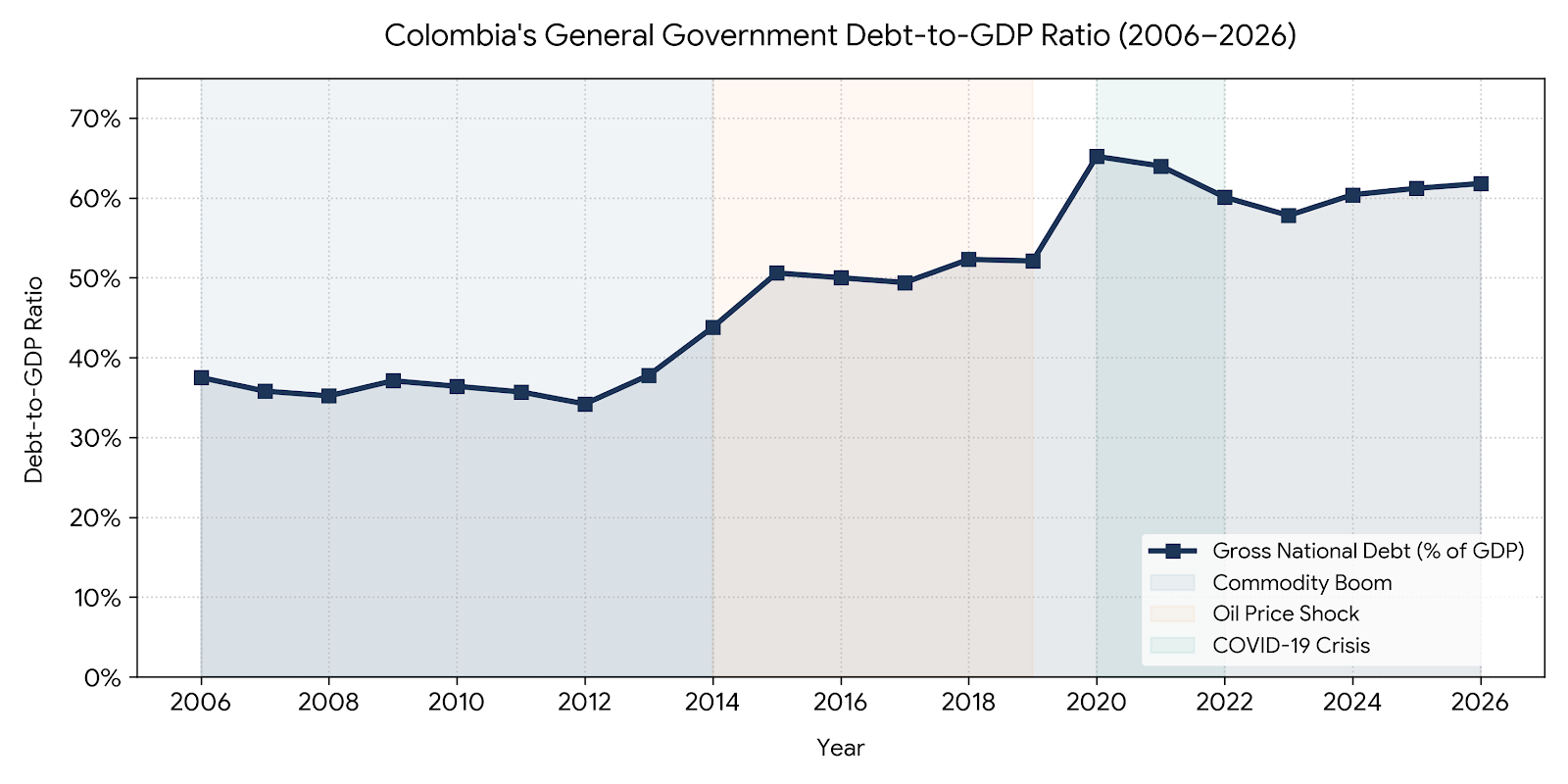
Two decades of fiscal data show that Colombia’s gross general government debt has moved through four distinct macroeconomic phases, ending the current cycle at a level that is materially higher than its pre-pandemic baseline. Persistent annual fiscal deficits, currency volatility, an emergency spending shock and weaker-than-projected tax revenues have combined to push the ratio of public debt to gross domestic product from the mid-30s percent range in the mid-2000s to a band of roughly 60 to 62 percent at the start of 2026, according to figures published by the Ministerio de Hacienda y Crédito Público and the Banco de la República.
The shift carries direct implications for sovereign bondholders, multinationals operating in Colombia and any investor pricing country risk in the Andean region. All three major rating agencies — S&P Global Ratings, Moody’s Ratings and Fitch Ratings — now place Colombia in speculative-grade, or junk, territory, with consecutive downgrades through 2025 and into early 2026.
“The activation of the escape clause confirms that the deterioration observed in 2024 will not be corrected in 2025.” — Renzo Merino, sovereign analyst, Moody’s Ratings
The commodity cushion: 2006 to 2014
During the global commodity supercycle, Colombia benefited from sustained gross domestic product growth and steady government revenue. Hydrocarbon and mining receipts — channeled through Ecopetrol (NYSE: EC; BVC: ECOPETROL) and the broader extractive sector — supplied a substantial share of national tax intake. The debt-to-GDP ratio remained relatively stable during this period, generally hovering between 34 and 38 percent. Even with chronic primary deficits, nominal growth in the denominator absorbed new borrowing, masking the underlying structural imbalance that the Comité Autónomo de la Regla Fiscal (CARF) would later flag as the persistent driver of fiscal stress.
The currency and revenue shock: 2014 to 2019
The mechanics of the ratio changed sharply when Brent crude prices collapsed in late 2014. Reduced hydrocarbon royalties widened the fiscal gap just as the Colombian peso depreciated against the US dollar. Because a significant share of Colombia’s sovereign liabilities is denominated in foreign currency, the peso’s slide automatically inflated the local-currency value of outstanding external debt when measured against domestic GDP. The combined effect — wider deficits funded by new borrowing, plus a valuation effect on existing dollar-denominated obligations — pushed the ratio steadily higher through the late 2010s.
The structural revenue weakness that surfaced during this period has remained a recurring theme in subsequent fiscal assessments from Fedesarrollo and the Pontificia Universidad Javeriana Observatorio Fiscal, both of which have noted that successive tax reforms failed to fully close the gap between commitments and ordinary income.
The pandemic ceiling: 2020
The combination of emergency social spending under the Ingreso Solidario program, expanded health outlays and a sharp contraction in nominal GDP drove the ratio to a historic peak above 65 percent in 2020. The Ministerio de Hacienda reports the all-time high at 65.3 percent of GDP that year. The government activated the escape clause of the regla fiscal — Colombia’s fiscal rule, codified in Law 1473 of 2011 and modified by Law 2155 of 2021 — to accommodate the spending response, suspending the rule for 2020 and 2021.
That episode also triggered the first sovereign downgrade cycle: S&P Global Ratings cut Colombia’s long-term foreign currency rating to BB+ from BBB- in May 2021 after the administration of then-president Iván Duque withdrew a tax reform bill following street protests, costing the country its investment-grade status with that agency.
The new baseline: 2023 to 2026
Strong post-pandemic nominal growth briefly pulled the debt ratio down toward 57 percent in 2023. The decline did not hold. Structural spending pressures, elevated international interest rates and tax collections below budgeted projections pushed the ratio back up, establishing a new operating band around 60 to 62 percent of GDP. The Ministerio de Hacienda reported government debt to GDP at 61.3 percent for 2024.
The administration of President Gustavo Petro and Finance Minister Germán Ávila Plazas activated the regla fiscal escape clause for a second time in June 2025, with the Consejo Superior de Política Fiscal (Confis) approving a three-year suspension covering 2025 through 2027. The decision came despite an unfavorable technical opinion from the Comité Autónomo de la Regla Fiscal, which concluded that legal conditions for activating the clause were not met outside of a national emergency. The clause had previously been invoked only during the COVID-19 pandemic.
According to the Marco Fiscal de Mediano Plazo (MFMP) presented by the Ministerio de Hacienda, net public debt to GDP is projected to rise from 53 percent in 2023 to 61.3 percent in 2025 and approximately 63 percent in 2026. The fiscal deficit for 2025 was initially projected at 7.1 percent of GDP and later revised to roughly 6.2 percent of GDP, with the administration targeting a deficit below 6 percent of GDP for 2026.
Debt service consumes a larger share of the budget
The cost of servicing this debt has reshaped the structure of the national budget. The 2026 draft budget presented by Minister Ávila totals $557 trillion COP, equivalent to roughly $134.7 billion USD, and represents 28.9 percent of GDP. Of that, debt servicing costs are projected at $102.5 trillion COP, or 5.3 percent of GDP, down from 6.2 percent of GDP in 2025.
The figures published by the Ministerio de Hacienda for domestic debt service in 2026 are higher when measured against tax intake alone: of an estimated $130 trillion COP in domestic debt service, $79 trillion COP corresponds to principal that can be rolled over through new issuances, while $51 trillion COP represents interest payments funded directly from the budget. Against projected tax revenue of approximately $300 trillion COP, that implies roughly one in every three pesos collected by the central government is allocated to interest on existing debt.
Rating agencies reprice the sovereign
The rating cycle has accelerated alongside the fiscal trajectory. Moody’s Ratings downgraded Colombia to Baa3 and subsequently into junk territory in 2025, citing the suspension of the fiscal rule. S&P Global Ratings issued a further downgrade in April 2026, its second cut in less than a year, on the same persistent deficit and debt concerns. Fitch Ratings also moved Colombia deeper into speculative grade in December 2025.
The Banco de la República reported external debt — combining public and private liabilities — at $238.7 billion USD at the close of November 2025, equivalent to 54.8 percent of GDP, an increase of $15.8 billion USD from January of the same year. The Colombian economy is currently valued at approximately $435 billion USD.
What investors are watching next
The Comité Autónomo de la Regla Fiscal has stated in its most recent reports to Congress that the 2025 primary balance target was missed by a wide margin even after the escape clause was activated, and that incoming projections for 2026 raise the bar for any return to the original fiscal rule by 2028. Business groups including Fenalco and the Consejo Gremial Nacional have publicly opposed the suspension and signaled potential legal challenges.
The 2026 financing plan disclosed by the Ministerio de Hacienda includes approximately $4.6 billion USD in global bond issuances, primarily to refinance a one-year Swiss-franc Total Return Swap operation valued at roughly $9.3 billion USD. The ministry has stated that the issuance does not constitute net new external debt. Updated debt and deficit targets are scheduled for release in the next iteration of the Plan Financiero.
For executives operating in Colombia or evaluating new investment, the baseline shift from a mid-30s to a low-60s debt-to-GDP environment alters several variables simultaneously: peso volatility tied to refinancing cycles, the trajectory of corporate tax policy as Congress weighs successive reform proposals, and the path of domestic interest rates set by the Banco de la República as it manages inflation alongside elevated sovereign funding costs. Detailed historical and forward-looking debt data is published by the Investor Relations Colombia office of the Ministerio de Hacienda.
Colombia’s General Government Debt-to-GDP Ratio (2006-2026) (image: Google)
Families move closer to justice over the downing of Avianca Flight 203, blamed on Pablo Escobar.
Avianca Boeing 727-21 HK-1803, which was downed in 1989. Image credit: Richard Vandervord via Wikimedia Commons.
Colombia’s Congress held a hearing on Wednesday on the bombing of Avianca Flight 203 for the first time since it happened on November 27, 1989.
The explosion killed all 107 people on board shortly after take-off from Bogotá on its way to Cali, and has been widely attributed to Pablo Escobar’s Medellin Cartel.
Families have long demanded truth, justice and reparations for the attack, considered one of Colombia’s deadliest acts of narco-related violence.
The hearing, held as a political oversight session, focused on truth, justice, memory and reparations for victims of narcoterrorism.
The Attorney General’s Office has led the investigation for decades, but families say the process has been “painfully slow.”
“It is a case that remains in a preliminary stage, as if it had happened this morning,” Gonzalo Enrique Rojas Peña, son of one of the victims, told The Bogotá Post.
Rojas was 10 years old when his father, Gonzalo Hernán Rojas Castro, was killed. He now represents families of victims of the bombing.
Gonzalo Rojas alongside his late father. Image credit: Catherine Ellis.
“Many aspects have not been clarified by the state, particularly regarding who planned and carried out the attack, and the possible involvement of other actors,” he explained.
The hearing highlighted questions that remain unanswered, including the identity of all those responsible and the current status of investigations.
Authorities initially attributed the attack to an assassination attempt on presidential candidate César Gaviria, who did not board the plane on the advice of his security team.
Later investigations concluded that a young man boarded the plane with explosives under orders from the Medellín Cartel, one of the most violent drug trafficking organisations in Colombia’s history. Questions around the case, however, persist, and victims continue to seek justice.
Just one person was jailed for the attack: Dandeny Muñoz Mosquera, known as “La Quica”, who was sentenced to three life terms in the United States, although he has repeatedly denied involvement.
The session was convened by the Human Rights Commission of the Chamber of Representatives and led by Representative Juan Daniel Peñuela. The National Centre for Historical Memory, the Victims’ Unit and the Ministry of the Interior were present, alongside families of victims, many of whom spoke about their loved ones.
However, two key institutions — the Attorney General’s Office and the Special Jurisdiction for Peace (JEP) — did not attend, despite being formally invited.
“On one hand we had two national institutions, but on the other it was unfortunate that the Fiscalía and the JEP did not attend. It is unfortunate that responses remain very ambiguous,” Gonzalo said.
Gonzalo Rojas at the hearing on May 27. Image credit: Catherine Ellis.
The hearing also addressed the issue of reparations, which families say they have spent decades waiting for.
The Victims’ Unit said it will convene working groups to address long-standing gaps in registration and documentation that affect families’ access to reparations under Colombia’s 2011 Victims Law. The law provides recognition, financial compensation, symbolic measures and psychosocial support for victims of armed conflict.
Claudia Peñón was 17 years old when her father was killed on the flight in 1989.
“He was an excellent man and a hardworking man. He had the hope of seeing me graduate from high school, and he never got to do that,” she told The Bogotá Post, adding so many people’s lives were shattered that fateful day. “One hundred and seven families’ lives were left shattered. One hundred and seven families had their dreams destroyed.”
Her mother always expected answers, but died ten years ago without receiving them or reparations.
“She never got to see real restitution, never got to see justice in that situation. And honestly, so many other families have been failed too — and we’re still fighting,” she said.
Families are also pushing for stronger memory-building efforts.
While there have been initiatives to recognize victims of armed conflict, the history of narcoterrorism has often been marginal in official narratives.
During the hearing, the National Centre for Historical Memory said the case has not yet been developed as a dedicated exhibition in Colombia’s planned Museum of Memory. It is included in broader reports and timelines, but could still be incorporated through a future “memory initiative”.
The hearing triggered formal follow-up steps from state institutions.
Congress will send official requests to the Attorney General’s Office over its absence and may refer the matter to the Procuraduría for review.
But for many families, the session underscored a deeper reality: after 37 years, there has been no new judicial breakthrough and no clear path to resolution.
“I think the day was partially positive,” said Gonzalo. “I feel calm that other families were able to have a space to receive more information about the case. But there is still more to do.”

 Login
Login