Reading view

Bogotá’s murder mosaic

We analyse recent homicide figures in Colombia’s capital.

Anti-extortion police arrest a suspected member of las Satanás crime gang. Photo. Sec. de Seguridad.
Anti-extortion police arrest a suspected member of the Satanás crime gang, linked to a rash of extortion and killings in Bogotá during 2025. Photo. Secretaria de Seguridad.

Last month we looked at the latest homicide data for the city: in 2025 violent deaths went down 3.4% on the previous year. These 1,165 killings gave Bogotá – with a population of around 8 million – a homicide rate of 14.8 deaths per 100,000 of the population.

This month we look deeper into this statistic.  Why homicides? Though an imperfect indicator, murder rates do give an insight into insecurity in a zone as they are often the extreme outcome of robberies gone wrong, gang feuds, political violence, domestic violence, fights, targeted killings, drugging of victims and bungled kidnappings. Put simply, the number of bodies means the amount of crime.  

Crime patchwork

Where are homicides happening? In our own analysis of Bogotá’s 20 districts (see map below) the gritty downtown area of Sant Fe has the highest rate of 54 killings per 100,000 inhabitants, followed by nearby Los Martíres with 47, and Ciudad Bolívar with 33.

Sant Fe, like many Bogotá districts, is a patchwork of agreeable barrios, such as the touristy Las Aguas for example, and historic La Candelaria (with just three homicides last year) juxtaposed with crime-ridden neighborhoods.

Heat map of current homicide rates adjusted for population size in Bogotá districts. Graphic: S. Hide

But in the southwest corner of Santa Fe lies San Bernardo, or ‘Samber’ as it is known locally, generally recognized as the most dangerous barrio in Bogotá, a hub for gangs selling drugs to street people and the scene of several fatal grenade attacks in 2025.

Santa Fe is a reminder that in Bogotá safer streets are often just a block away from no-go zones. Rolos and long-term residentslearn to navigate these invisible barriers.

To emphasize this point, Santa Fe, statistically the most dangerous district in the city, lies adjacent to the leafy district of Teusaquillo with a homicide rate of 5 per 100,000 in 2025 (amounting to nine deaths), which according to this metric makes it the safest district in Bogotá.

Less grim up north

Other districts registering less than 10 killings per 100,000 in 2025 are the more upmarket northern districts of the city: Chapinero, Usaquén, Suba, Fontibón and Engativá. And as in most years, there is a gradient towards safer barrios in the north, with the dividing line running roughly along the Avenida El Dorado (Av Calle 26).

But in terms of reducing crime, there are success stories in the south. While still the most dangerous district, Santa Fe has reduced its homicide rate by 28 per cent in 2025 alongside Bosa, Usme and Antonio Nariño, all with reductions in double digits.

These results are hard to assess; organized criminal gangs are present in all these areas, so the peace could be transitory and a result of rival gangs declaring a truce, or one gang leveraging control, rather than societal shifts or better policing.
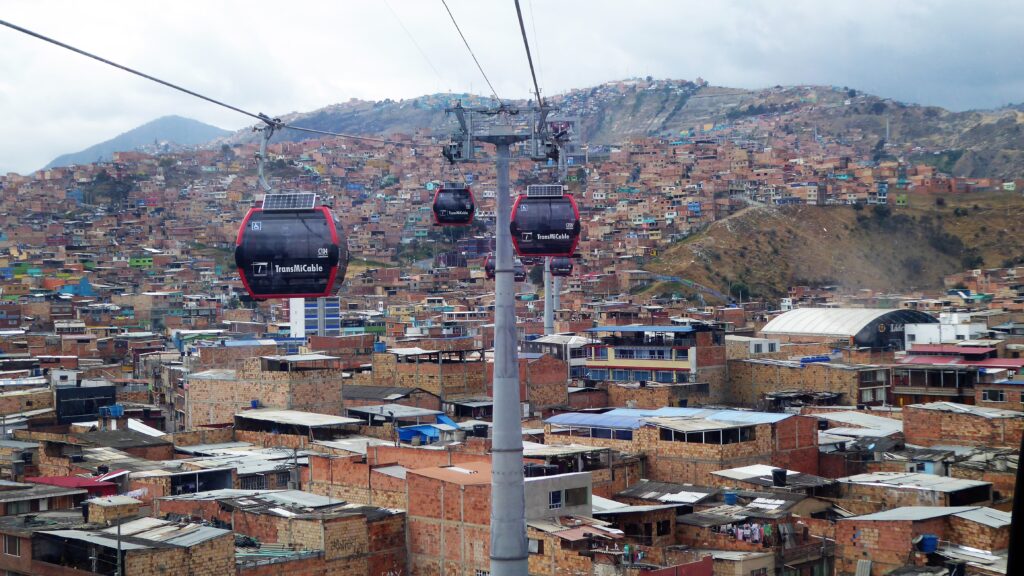
Ciudad Bolívar, a southern city district with high rates of poverty and crime. There were 218 homicides reported in this sector of the city during 2025. Photo: S. Hide

In some cases, large-scale operations have had an impact, combing security and social services in a carrot and stick approach called megatomas. In Santa Fe, for example, following the grenade attacks, the Bogotá administration both militarized the barrio and flooded it with development programs to support the huge homeless population there. This approach seems to have worked, at least temporarily.

On the negative side, three central districts (Puente Aranda, San Cristóbal and Rafael Uribe Uribe) have seen a spike in killings, a reminder of the balloon effect; pushing down on crime in one zone just forces it to pop up somewhere else.

Sicario scenarios

What’s behind the killings? Police databases do not reveal motives, but media coverage and occasional analyses by Bogotá’s Secretaría de Seguridad give insights into the city’s mean streets. 

Targeted killings, usually carried out by paid hitmen (sicarios), are for the city the visible tip of an underworld iceberg of organized crime. Hits are carried out often on the street or public spaces against identified victims by professional gunslingers sometimes recruited specifically for the job with promises of cash.

Clear-up rates are low: in June last year city councilors complained that in the first half of 2025 out of 521 homicides, 156 were targeted hits, for which only 16 people had been arrested. “In other words, 90 per cent of assassinations on Bogotá go unpunished,” pointed out councilor Julián Espinosa in one debate.

This was despite the city police’s vaunted Plan Candado – Padlock Strategy – of mobile rapid response teams and drones to quickly catch perpetrators by locking down zones within minutes of a major crime.
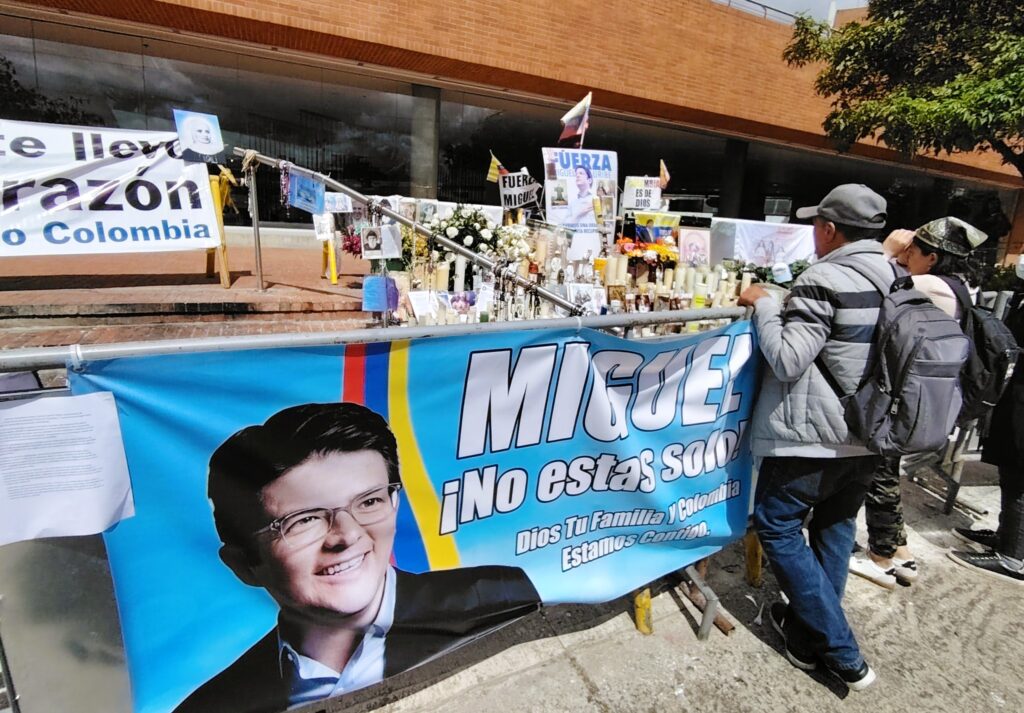
Vigil for Miguel Uribe, the young politician shot by a 15-year-old hitman in a Bogotá park in June 2025. He survived the initial attack but died from his wounds two months later. Photo: S. Hide.

The most high-profile killing was the gunning down of senator and presidential candidate Miguel Uribe, shot in the head during a walkabout in a Bogotá park. The police quickly apprehended the small-time gangsters behind the shooting in June 2025, including the 15-year-old shooter, but today despite nine arrests are no closer to revealing the paymasters behind the hit.

Another unsolved assassination was the targeted killing of emerald czar Hernando Sánchez, shot dead while walking with his family in a leafy northern suburb of Usaquén in April last year. The military-style killing, by a sniper hiding in nearby woodlands, was identical to the mysterious murder nine months before of a fellow emerald baron, known as Pedro Pechuga, also unresolved.

Weapons of choice

Despite Colombia having restrictions for private ownership of firearms, the majority of 2025 killings were with guns, at 703, according to the police database. Other weapons recorded were knives (304), blunt objects (84) and grenades (6).

This pattern has persisted for decades; Colombia, and its capital, are flooded with illegal firearms, many of them from the estimated 600,000 guns smuggled south across the border from the U.S. each year.  Just in the first four months of 2025, police confiscated 8,466 illegal weapons across the country

According to Carolina Ortega, a political scientist at the National University, and quoted by  UPI, illegal guns were used in 78 per cent of killings in Colombia.

Easy access to guns also raised the risk of spontaneous killings, according to data from the Secretaria de Seguridad which showed that40 per cent of Bogotá homicides followed a dispute, argument or scuffle.

Most of these happened outside on the street, late in the evening, and “amidst scenes of revelry and excessive alcohol consumption”, said the report, released as part of a media campaign called “Take a second before you shoot…”.

Violent machismo

Femicides went down on 2025, both in Bogotá and at national level, according to data released this week by the Observatorio de Mujeres y Equidad de Género de Bogotá.

In Bogotá during 2025 there were 97 females killed, around 8% of total violent deaths. Of these, 20 were classified as femicides. This was slightly less than in 2024 (22 deaths) and mirrored a similar reduction (7%) nationally. Nationally, approximately one killing in five of a female was later classified as a femicide, the “violent expression of machismo”, said the study.  

A study by Bogotá’s Secretaria de la Mujer found that in 49 per cent of cases in the capital, the women had suffered physical violence in the weeks before the murder, and 40 per cent had previously sought help from the police.

According to observatory data, last year Secretaria staff supported 142,688 women, of which 48% were facing violence, a slight reduction on the previous years. The 2025 figures were a reminder that although more warning signs were being detected, timely intervention was not always possible, said the report.

“Femicide does not arise from nothing: it is foreshadowed, repeated, and often normalized before reaching its most tragic outcome,” it concluded.

Pay up – or pay the price

In 2025 many Bogotá murders were linked to extortion demands, with gangs ruthlessly gunning down small business owners if they failed to pay protection money. Sometimes shop staff or a passerby were also killed or injured, in some case with grenades or explosives.

Protection rackets are nothing new in the city, but cases and killings skyrocketed post-pandemic partly because of turf wars between gangs diversifying from the drug trade and Venezuelan gangs linked to the transnational group Tren de Aragua with names like Las Satanás and Los Coyotes.

Extortion reached epidemic proportions in 2024, with an average of 200 cases a month, and continued into 2025 with a rash of crimes such as the killings of informal minibus drivers in the south of Bogotá.

Overall, Bogotá in 2025 saw extortion go down by 20 per cent compared to 2024, though it was still higher than any year during the previous decade. And already in the first month of 2026 there have been several murders linked to extortion demands including a grenade attack on a nightclub in Los Mártires last week which killed one and injured a dozen more.

Millionaire’s ride

Another death last week, that of a university professor found dead and incinerated on the outskirts of the city, highlighted increased cases of Bogotá’s infamous Paseo Millonario, where armed gangs working with taxi drivers attack and extort passengers, often torturing them to reveal bank details while they empty their accounts.

Victims are often targeted late at night leaving bars or restaurants. In a chilling twist, recent cases pointed to victims being subdued with ketamine, with the drug either killing or severely incapacitating the victim.

According to data from the GAULA (Anti-Kidnapping and Extortion Group), 40 Paseo Millonario cases were reported in 2025, a rise of 207 per cent on the previous year. Even that figure was thought to be a huge underestimate since many victims were too scared to come forward. Hotspots were in Chapinero, Kennedy, Bosa, Ciudad Bolívar, and Fontibón.

In one case a taxi gang held a victim for 19 hours, prompting the Attorney General’s Office to reclassify such crimes as “kidnapping” with a potential 42-year prison sentence. In theory this prompted the police to start responding more robustly to a crime that has plagued Bogotá for decades.

Perpetrators of these high-impact crimes were also more likely now to get locked up, with 47 imprisoned last year out of the 52 captured, which was way above average jailing rate of 6 percent of criminals arrested, according to Bogotá police chief Giovanni Cristancho, talking to RCN News last week.

But he also admitted that the understaffed police force was struggling to keep up with constantly emerging kidnap gangs, usually small teams of four or five people which could easily move around the city.

“As soon as we reinforce one area, such as around Calle 85, the modus operandi shifts to other zones,” he told RCN.

It’s that randomness, and the risk of being drugged – or worse – that makes the Paseo Millonario one of the most feared crimes in Bogotá. And for 2026, the one to watch.

The post Bogotá’s murder mosaic appeared first on The Bogotá Post.

  •  

Commercial plane crash in Colombia kills 15 people, including lawmaker 

A Satena aircraft. Credit: Wikimedia Commons

Bogotá, Colombia – 15 people were killed in a place crash in eastern Colombia on Wednesday morning, including a lower house lawmaker and a political candidate.

The aircraft, operated by government airline Satena, was flying from Cúcuta to Ocaña, two cities in the North Santander department in eastern Colombia, when it disappeared from radar roughly eleven minutes before landing.

After an initial search and rescue effort, authorities were alerted to the wreckage site by local farmers.

“The national government, through the Ministry of Transport and Civil Aviation Authority, confirm with deep pain the deaths of the people who were on board the HK-4709 plane from Cúcuta to Ocaña,” read a government statement on Wednesday afternoon.

The confirmation came some five hours after the plane left radar coverage; it was due to land at 12:05PM but last made contact with air traffic control at 11:54AM.

On board the plane was Diogenes Quintero, who holds a “peace seat” in the Congress, reserved for victims of the armed conflict. Also on the flight was ​​Carlos Salcedo Salazar, a candidate for the same seat in upcoming elections.

The cause of the plane’s disappearance is unclear, but local authorities have pointed to adverse weather conditions. However, investigations remain ongoing.

The route from Cúcuta to Ocaña was inaugurated last year and welcomed as a symbolic step forward in conflict-struck Catatumbo, long disconnected by air from major cities.

The post Commercial plane crash in Colombia kills 15 people, including lawmaker  appeared first on The Bogotá Post.
  •  

Remains of rebel priest set to return to Bogotá

ELN guerrillas have announced the recovery of iconic revolutionary Camilo Torres. They now want his body returned to Bogotá’s National University.

Camilo Torres mural at the Universidad Nacional. Photo: Steve Hide
Mural of priest and professor Camilo Torres at the Universidad Nacional. Photo: Steve Hide

Colombia’s largest rebel army, the ELN – at war with the state since 1964 – have alerted the world to the likely discovery of the long-lost remains of Camilo Torres.

The fighting priest, killed in combat with the army 60 years ago, has been found by government forensic teams in the department of Santander, the ELN said in a press statement this week.

The ELN leaked the news before the Unidad de Búsqueda de Personas Dadas por Desaparecidas (UBPD) could finalize technical tests, but it was widely expected that the search is now ended for the respected cura and university professor who became a revolutionary martyr.

The ELN said they hoped his remains “would be respected and returned to the Bogotá campus of the National University”.

In the early 1960s, the young Torres was a chaplain, professor and founder of the faculty of sociology at the tempestuous Universidad Nacional. Today, the charismatic priest still figures strongly in campus iconography with his image and quotes decorating many walls.

From priest to combatant

An exponent of liberation theology – a strand of Catholicism calling for social justice in an era of extreme poverty in Latin American – Torres took to the hills in 1965 with the ELN, then a fledgling guerrilla group aligning itself with Marxist ideology.

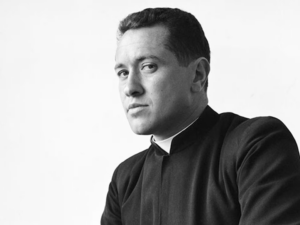
Camilo Torres as a priest. Photo: National Archive
Camilo Torres. Photo: National Archive

Calling himself Argemiro, the priest quickly became an influential link between the rebels and the church, respected across the political spectrum, and a spiritual influence on socialist movements across the continent.

His most famous quote, still echoing through liberation theology, was: “If Jesus were alive today, he would be a guerrillero”.

A photo of Torres appeared in a flyer printed by the ELN in January 1966, with the academic pictured in uniform clutching a rifle alongside the words: “From the mountains of Colombia, I intend to continue the fight, weapons in hand, until I achieve power for the people. Not one step back! Liberation or death!”.

Friends divided

The latter came quicker than expected. Torres was killed in combat aged 37 on February 15, 1966, in his first action against state forces. The firefight took place in the rugged terrain around El Carmen de Chucurí, Santander.

Ironically, the army operation that killed Torres was led by General Álvaro Valencia Tovar, a childhood friend of the rebel priest. In an old article on Las 2 Orillas, the general described the pair’s friendship over many years, even while taking separate political paths; a potent reminder of personal ties tested by Colombia’s civil conflict.

According to Valencia Tovar, the ELN had prepared a deadly ambush in a jungle gorge with 35 fighters – including Torres – lying in wait for an army patrol. But the soldiers, even while taking heavy fire, outflanked the guerrillas and killed five of the ELN fighters. Torres was among the dead.

Thereafter the story was muddled: according to Valencia Tovar, the general himself took Torres’ remains to a military pantheon close to Bucaramanga, the regional capital of Santander, perhaps a form of honour for his former friend. But the exact location was never disclosed, a bone of contention with the guerrilla group who wanted to mourn their martyr.

In another historical twist, years later a video emerged of a young Juan Manual Santos – the future centre-right president of Colombia – declaring he was an “acolyte” of Torres, who was in fact his uncle.

In 2016, the then president Santos, perhaps as a gesture towards his own deceased uncle, but also as a signg of good faith during a peace process with the ELN, promised a state search for the remains of his fallen uncle. That peace process failed, like many others.

Playing for time

Over 70 years of conflict the Ejército de Liberación Nacional has proved hard to pin down: the on-off negotiations with the current Petro government mark the seventh cycle of peace talks spanning seven presidential terms since 1992, with the guerrillas still fighting.

Today, many observers see these negotiation cycles as cynical ploys by the Marxist-Leninist rebels to hold off military pressure while expanding their own territory and illicit activities, which today extends to cocaine production, illegal gold mining, extortion, kidnapping and human trafficking.

According to a profile by thinktank InsightCrime, in the last 20 years the ELN have become increasingly active in neighbouring Venezuela where they act as a mercenary army for the Chavista regime with a strong role on controlling the borders.

That dynamic shifted after the U.S. military operation in early January in Venezuela to detain autocratic leader Nicólas Maduro.

Now less welcome in Venezuela, and facing an increasingly hostile Petro government, even while entangled in a turf war with dissident FARC groups in northeast Colombia, the ELN fighters are feeling the pressure.

Blood and fire

On January 12 this year, the ELN proposed another bite at the peace apple with a new ‘national accord’. This though was quickly rejected by President Petro, who wrote on X that the guerrillas had to renounce their illicit activities – primarily gold and cocaine – before coming to the table.

During the first three years of his term, Petro suffered several perfidies by the ELN such as their surprise attacks on rival groups in the coca enclave of Catatumbo last year that left hundreds dead and thousands displaced.

Responding to the ELN offer Petro, said he had “already offered an agreement, but they destroyed it with blood and fire, and by killing humble peasants”.

It is likely the Colombian president is now holding off until after his meeting with the Trump administration in Washington scheduled for February 3.  Any reconciliation between Petro and the U.S. president – their relationship has been rocky – could open the door for increased military support to combat the ELN, designated as a terrorist organization by the U.S. State Department since 1997.

Colombia’s ‘Che

Such a deal, combined with changes in Venezuela, could tilt the conflict in favour of Colombian state forces. And while still a potent fighting force, the ELN could prefer an escape route via the negotiation table in 2026 if talks open up with Petro or his successor.

Evolution of an icon: mural of Torres at Bogotá's Universidad Nacional.
Evolution of an icon: mural of Torres at Bogotá’s Universidad Nacional.

With that in mind, it is probable that finding of Camilo Torres – miraculously close to the 60th anniversary of his death – is no coincidence, but rather a strategy in the poker game between state and guerrillas.

The wait now is for final confirmation of the remains by the UBPD.  Meanwhile the search unit is keeping mum on how, where, and when the body was found.

And if the ELN are claiming Torres as their own, then so is Petro: “The body of Father Camilo Torres Restrepo will be respected and laid to rest with honours,” he said on X this week, painting the priest as a national hero.

Perhaps putting him in the spotlight is a nod to Petro’s own rebel credentials as a former member of M-19 guerrilla group. And Torres is a timely reminder of how the ELN rebels – recently accused of human slavery in illicit mining camps  – are far removed from their ideological roots.

Where both sides agree is that his final resting place should be the National University campus in Bogotá. That´s a start. Sixty years after his death the fighting priest, seen by some as Colombia’s Che Guevara, could have a new role in bringing peace.

The post Remains of rebel priest set to return to Bogotá appeared first on The Bogotá Post.

  •  

US strikes in Venezuela: what does it mean for Colombia and what happens next?

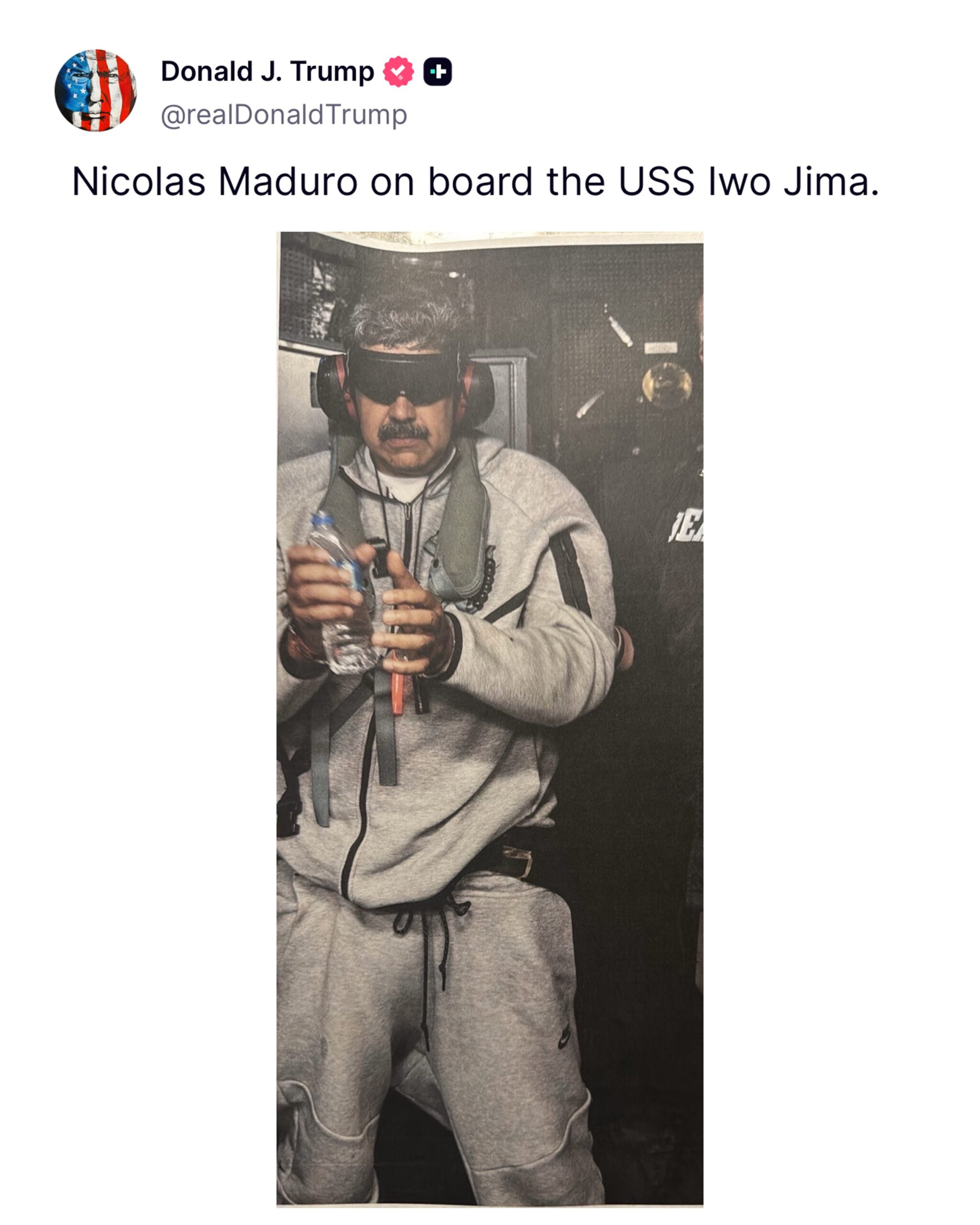
Arrested president of Venezuela Nicolás Maduro. Photo courtesy of X

The US carried out limited airstrikes in Venezuela this morning and claim to have captured Nicolás Maduro. Colombia has reacted with strong condemnation.

Colombia this morning woke to the news that US forces had attacked the neighbouring capital Caracas. President Donald Trump claimed via Truth Social that Maduro had been captured and extricated from the country, with the airstrikes necessary for that operation to take place.

It later emerged that the attack and capture was an arrest. The US has confirmed Maduro’s indictment in New York and that he will stand trial for narcotrafficking and potentially other offences. This dates back to 2020, although it was not widely known that Maduro’s wife Cilia, captured with him, had also been part of that case.

What is Colombia’s position?

Unsurprisingly, President Gustavo Petro is firmly against US action in general and particularly in the neighbouring country. In the short term he has sent troops to the border in preparation for a possible surge in refugees. Interestingly, it seems that the Colombian government may have had advance warning, as his security meeting started at 3AM.

Acabamos de terminar consejo de seguridad nacional desde las 3 am.

Se despliega la fuerza pública en la frontera, se despliega toda la fuerza asistencial que dispongamos en caso de entrada masiva de refugiados.

La embajada de Colombia en Venezuela está activa a llamadas de…

— Gustavo Petro (@petrogustavo) January 3, 2026

Petro rejects all US actions that violates the sovereignty of Venezuela and Latin America. He has said already that he will use his position on the UN security council to discuss this matter and search for a solution. In this, he will find support domestically and internationally.

For many in Colombia, and indeed Latin America in general, this brings memories of US interventionism during the Cold War. From helping to topple Allende in Chile, supporting dictatorships across the Southern Cone and the Sandinista affair, there is a long history of meddling in regional politics.

Equally, there is no love for Nicolás Maduro in Colombia. That is shared across the political spectrum for different reasons and comes through solidarity with the Venezuelan people, a dislike of the immigration wave he caused or a fierce disagreement with leftwing politicians in general.

However little sympathy there is for Maduro, that does not equate to support for direct military action from the US in foreign territory. Many Colombians have fears that similar might happen to their country. While that seems unlikely, Donald Trump is at best unpredictable and few would have seen today’s actions coming a year ago.

Colombia is also likely to have strained relations with the incoming administration in Caracas. Petro and many on his side are no fans of Machado, who they see as a classic representative of the Latin rightwing oligarchy.

Petro will be wary of supporting the notion that presidents can be toppled in this manner and regime change forced upon a nation by foreign forces. At the least, he will call for free and fair elections to be held sooner rather than later.

Relations with the USA have significantly deteriorated, for obvious reasons, but Colombia is very much with international feeling on this one, with Trump the pariah. A number of world leaders have issued statements decrying and condemning the US actions. Only Machado, Netanyahu and Argentina’s Milei have departed from the consensus, unsurpisingly.

ELN held a short-lived paro armado in December warning against foreign interference in the region, so it’s entirely likely that they might announce similar measures in the next few weeks. It’s unclear how or if groups such as the gaitanistas may react, given that they were recently declared terrorist organisations by the US State department.

What happens next?

For Colombia, the three biggest fears for the future are the probability of refugees fleeing across the border; the possibility that similar will happen here; the effects on this year’s election. This might have been a relatively quick operation, but its effects will linger for months at bare minimum and likely years.

Venezuela itself will have to work out who is going to replace Maduro in the presidential Palacio Miraflores. That could well be recent Nobel Peace Prize winner María Corina Machado, or could be a general stepping up to lead an interim government while elections are organised.

It could even be a continuation government, refusing to give in after the loss of Maduro and daring further strikes. US Secretary of State Marco Rubio has ruled out further actions for the time being now that Maduro has been captured.

The likelihood of large scale US actions within Colombian territory is very low, despite Trump’s rhetoric that Petro might be next in line. The country has just assumed a position on the UN security council and is a member of NATO. Having said all that, focused operations targeting terrorists are certainly possible and Trump is often hard to predict.

Even smaller, focused operations would be incredibly controversial within Colombia and Petro would be pushed to respond strongly, not only by his own supporters. However, his options are relatively limited. He does not have the firepower to make serious counterattacks and is unlikely to want to do so outside of Colombian territory, for example against carriers in international waters.

Any operation involving boots on the ground within Colombia would be a very different story and the military would be more or less forced to intervene. That would push tensions to boiling point with the White House.

Venezuelan immigrants to Colombia already number around two million or more and this action is likely to see increased travel across the borders. Colombia has sent troops to the border in order to attempt to maintain order. Cities such as Cúcuta in Norte de Santander and Riohacha in La Guajira are already under strain and will struggle to absorb further numbers.

It is entirely possible that serious criminal elements and/or government or armed fores members will try to cross within the chaos, putting added pressure on the Colombian government. They may be destabilising elements and there may be pressure from the US not to harbour who they see as essentially international criminals.

For the upcoming election, candidates are already in a difficult position on this topic and things are likely to get harder. Rightwingers have spent years railing against the Venezuelan regime, but will be aware that most Colombians oppose this action.

The added complication is the possibility of Trump supporting one side or another, even making remarks like he did before the Guatemalan election or even offering financial support as he did in the Argentinian elections.

That will be tricky – being on Trump’s side will alienate enough voters to make victory unachievable, yet coming into office in conflict with the leader of the USA will make governing difficult. Candidates have a fine line to walk in terms of balancing electoral rhetoric with diplomacy.

Then there’s the question of who is in the Palacio Miraflores in Caracas. Hard leftwingers will start off on a bad footing with a Machado government or similar, whereas rightwingers will chime with her politically. If there is a sort of continuity, expect the opposite.

Given the surprise, if not shock, of this morning’s actions, it is hard to predict exactly what will happen next, other than there will be short term chaos at least. Trump, of course, thrives on chaos and has a gift for navigating uncertain times. He described this as a “brilliant operation” but few in the region will be in agreement. After all, he is not the one who has to live with the consequences.

The post US strikes in Venezuela: what does it mean for Colombia and what happens next? appeared first on The Bogotá Post.

  •  

BREAKING: Venezuela’s Maduro captured after U.S strikes Caracas

The United States has captured Venezuelan dictator Nicolás Maduro, along with his wife Cilia Flores, after a series of targeted military strikes on Caracas at 1:30 am on Saturday, January 3, 2026.

In a statement posted on his Truth Social platform, U.S President Donald J. Trump said U.S. forces, working with U.S. law enforcement, conducted a “large scale strike” that resulted in the capture of Maduro and his wife, Cilia Flores. Trump said both were flown out of Venezuela, without providing details on where they were taken or the legal basis for their detention.

“The United States of America has successfully carried out a large scale strike against Venezuela and its leader, President Nicolas Maduro,” Trump said, adding that more information would be released at a news conference scheduled for 11 a.m. ET at his Mar-a-Lago residence in Florida.

Explosions were reported across parts of Caracas in the early hours of Saturday, according to witnesses and videos posted on social media, which showed flashes in the sky, fires and power outages in several areas of the capital. One of the main targets appeared to be Fuerte Tiuna, the country’s largest military base and a key command center for Venezuela’s Bolivarian Armed Forces.

The extent of damage and possible casualties could not be independently verified. Venezuelan authorities did not immediately confirm whether senior military officials, including Defense Minister Vladimir Padrino, were injured or killed in the strikes.

In Washington, Republican lawmakers were quick to praise President Trump’s decisive action. Representative Mario Díaz-Balart praised the operation, saying it demonstrated decisive leadership against what he described as an illegitimate regime that posed a threat to U.S. and regional security. Other lawmakers raised questions about the legality of the strikes and whether Congress had authorized the use of force.

In Colombia, Medellín Mayor Federico Gutiérrez expressed support for Venezuelans living abroad, saying millions had fled repression and economic collapse under Maduro’s rule. Venezuelan migrants make up a significant share of Medellín’s population, local authorities say.

It remains unclear how Venezuela’s armed forces will respond or whether Maduro’s removal will lead to a peaceful transition of power with the return of President-elect Edmundo González and opposition leader Maria Corina Machado, both currently out of the country.

Developing News Story….

  •  

Colombian minimum salary rockets

An extraordinary leap of 23.78% in the Colombian minimum salary per month brings it to a symbolic COP$2,000,000

A wallet with money and cards to illustrate the Colombian minimum salary 2026

Courtesy of Oliver Pritchard
More money in many wallets with the Colombian minimum salary 2026

An unprecedented hike in the Colombian minimum salary for 2026 was announced on Monday 29 December, bringing the rate to two million pesos per month. That represents an increase of 23.78% on the 2025 number. That’s the biggest jump ever – only 1997 comes close in recent years with 21.02%.

The minimum salary itself (SMMLV or Salario Mínimo Mensual Legal Vigente) has gone up to COP$1,750,905. There is also a transport subsidy (COP$249,095) which brings the effective minimum salary in Colombia for 2026 to two million on the nose.

Business leaders had suggested a rise of around 7.21%, keeping it above annual inflation (5.3% as of November), while trade unions and syndicates had called for an optimistic 16%. Both were left in the dust by Petro’s extraordinary decision.

The extraordinary rise is not due directly to inflation, nor to the rising cost of living, but represents a fundamental change in the rationale behind the number. Colombian president Gustavo Petro explained that the minimum salary should be considered a household income, not individual. He calls this salario vital, or salario digno.

Whether the household basis for the minimum salary holds up to scrutiny is hard to say. It certainly was the case, but like most other middle-income countries Colombia is rapidly changing. The idea of a single income supporting a family is less true every year, with Colombian households under 3.5 people on average and with 1.5 workers. That means a true dependency ratio of nearly one to one.

It was calculated by working around the price of a basket of goods for the average family (canasta básica), logged at nearly 3 million pesos for four people. Using that number of 1.5 workers gave the convenient round number of two million.

The minimum salary (not including the transport subsidy) is the baseline number that in turn influences a whole lot of other values in Colombia, such as fines and public salaries which are counted as multiples of the SMMLV. That includes, happily for Congress, politicians’ pay.

What does the increase in the Colombian minimum salary mean for the economy?

Far harder to work out is the long term impact of this rise in the Colombian minimum salary. Petro claims it will further stoke private spending in the country as the increased wages percolate throughout the economy and allow continued growth.

MinTrabajo explain the rise

It will increase labour costs for a number of businesses, especially small companies, some of which will struggle to keep their heads above water with such a sudden rise in payroll. For medium and larger size businesses, this includes mandatory SENA apprentices.

Note that payroll costs for employers will increase by more than the 23.78% headline figure, as they have to make social security payments based on an employee’s wage as well as the wage itself.

Massive firms who are liquid enough to be able to absorb costs will likely be absolutely fine, even if there are a couple of high-profile exceptions. Companies that are dodging the system, either through informal working or false self-employment, will also likely thrive.

Of course, the new reforma laboral promises to regularise and/or eliminate such practices. On paper, that is. In reality, these are the potential counterintuitive effects that could be the legacy of this increase in the Colombian minimum salary.

Colombia saw a sharp downtick in the number of employees on minimum salary this year, while informal work and self-employment has risen to around 55% of the workforce. This trend could continue much more rapidly with companies unwilling to pay the high new Colombian minimum salary.

A further issue is how close the minimum salary is now to the average. This will particularly affect smaller businesses and recent graduates. The former will find it hard to offer salaries that are significantly above minimum to attract quality employees, while the latter will find themselves often close to minimum salary and waiting longer for a return on their studies.

It is worth remembering that both minimum salaries themselves and increases to them are often bitterly opposed the world over and predictions of chaos are frequently sown. In most cases there is short term turbulence followed by long term stability. 

Is this a political power play?

Despite Petro’s official line about household incomes, many will see this as a nakedly political move ahead of next year’s elections. It certainly will play well among the Colombia Humana base and potential voters as a reason to keep faith with the left and cast their vote accordingly next year. 

A more charitable view would be to say that it’s one of the last significant acts that Petro can take before leaving office, so he’s gone big to deliver an achievement. Those have been in short supply over his time in the Palacio Nariño.

What’s undoubtable is that this creates a massive headache for next year. Regardless of who takes power, they won’t be expected to deliver quite such a large rise. However, they will have to be careful how far they go below it.

Any successor to Petro will at least be able to say their allies prepared the ground and maybe get away with a modest increase. An incoming fiscal conservative will be under pressure to deliver another big increase against their natural instincts and take heat for not doing so, while actually cutting the rate would be close to political suicide.

While a lot of candidates in the 2026 election might say that this was a fiscally imprudent move, they will have to be careful how far they push it. Many in Colombia will agree with them, but those same people are also likely benefiting from the increase. 

There are also the optics of a rich politician arguing against the very many voters who are on minimum wage or even those who aspire to earn minimum wage. It’s not a good look to argue against giving stuff to the people whose vote you want.

Short term gains, but long term problems?

So in the end this is a huge play from Petro, which has won him a useful political victory for today. It backs up his rhetoric, as he can easily claim he’s acting on behalf of the workers. There’s plenty of truth in that, as many Colombians work on minimum wage.

It may be a bribe to the electorate, but many will claim that no one else has at least offered them anything like this ever before, so good on him. Going into the 2026 election candidates on Petro’s side will be able to point to this achievement, while opposition candidates face pressure to offer at least something similar or be painted as rich folk denying the poor.

It’s hard to see a short term in which we won’t see a lot of businesses go bankrupt. The longer term is harder to read, as most companies will be unhappy but able to keep going. The effect on public salaries is potentially alarming with the state already running a deficit, unable to achieve fiscal reform and still expanding.

Ironically, it’s entirely possible that the increase in the Colombian minimum salary for 2026 might lead to more informality and less dynamism in the economy. However, it’s also completely believable that the economy is resilient enough to handle it with ease. This may be Petro’s biggest gamble yet and even he doesn’t know how it’ll play out. 

The post Colombian minimum salary rockets appeared first on The Bogotá Post.
  •  

Airlines suspend Bogotá – Caracas routes over military build-up in the region.

Electronic jamming and missiles are two of the risks identified by US regulators.

Latam airlines suspended its Bogota´- Caracas route this week after FAA advice. Photo: CD Dobelli

Major airlines cancelled flights from Bogotá to Caracas this week after US regulators warned of “heightened military activity” around Venezuela.

Avianca and LATAM suspended flights through Venezuelan airspace, along with at least five other airlines, as a response to a Federal Aviation Authority NOTAM (Notice to Airmen) that reported “Global Navigation Satellite System (GNSS) interference” around Maiquetía “Simón Bolívar” International Airport, which serves nearby Caracas.

The warnings were linked to military exercises under way in Venezuela, a response to threats from US forces massing in the Caribbean and aerial attacks on suspect drug boats, some originating from Venezuelan waters.

Colombia’s own airline regulator, Aeronáutica Civil de Colombia, repeated the FAA’s warning but said that air operators in Colombia could take “autonomous decisions” over flights to Venezuela.

On Monday several airlines were continuing direct flights from Bogotá, such as Wingo, Avior (a Venezuelan airline) and Satena (a commercial airline linked to the Colombian Ministry of Defense). Copa offered connections via Panama.

Mobile missiles

The list of airlines suspending flights continued to grow on Monday night with TAP, Turkish Airlines, Iberia and GOL being joined by Air Europa and Plus Ultra.

This came despite pushback from Venezuela’s Instituto Nacional de Aeronáutica Civil (INAC) which threatened to punish airlines for following the FAA’s recommendations.  According to a report in Aviation Online, airlines avoiding Caracas could in the long term lose access to the country’s airspace.

INAC also issued an ultimatum for airlines suspending flights “to resume services within a 48-hour period” or risk losing their landing permits.

Meanwhile the US FAA issued a more detailed FAA backgrounder clarifying that Venezuela had “at no point expressed an intent to target civil aviation”.

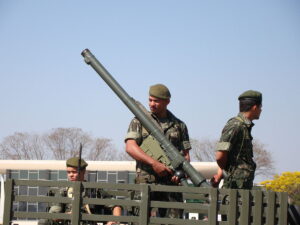
Portable Russian anti-aircraft missile similar to those used in Venezuela. Photo: André Gustavo Stumpf

It did, however, seem concerned that the current context could trigger an air accident.

Venezuela, it said, had mobilized “thousands of military and reserve forces” with access to shoulder-mounted anti-aircraft missiles, or MANPADs (man-portable air defense systems), capable of downing low-altitude aircraft.

This followed comments by Maduro last month that his military were in possession of Russian-made Igla-S missiles “with no fewer than 5,000 of them in key anti-aircraft defense positions to guarantee peace, stability, and tranquility”.

Jammers and spoofers

The more immediate risk was to electronic systems, said the FAA documents, with several civil aircraft recently reporting interference while transiting Venezuela, in some cases causing “lingering effects throughout the night”.

“GNSS jammers and spoofers can affect aircraft out to 250 nautical miles [450 kilometres] and can impact a wide variety of critical communication, navigation, surveillance, and safety equipment on aircraft.”

The FAA said it would “continue to monitor the risk environment for US civil aviation operating in the region and make adjustments, as appropriate, to safeguard U.S. civil aviation”.

In fact, the US airlines stopped all direct commercial and cargo flights into Venezuela as part of an order issued in 2019, related to sanctions against the Maduro regime, widely seen as illegitimate, with the US State Department offering a bounty of US$50 million “for information leading to the arrest and / or conviction” .

The rule of Venezuelan leader Nicolás Maduro is widely seen as illegitamate. Photo: Steve Hide
Venezuelan leader Nicolás Maduro has a US$50 million bounty on his head. Photo: Steve Hide

Open to talks

Commentators on US – Venezuelan relations this week said that FAA announcement was not necessarily a sign of imminent US military action. Former Associated Press analyst Dan Perry told News Nation that the FAA warning was “a message that they [the FAA] expected the country to become unstable”, but did not point to a ground invasion.

For most observers, the NOTAM was a continuation of the maximum pressure strategy pursued by Washington against the Maduro regime, including a recent decision to declare the Cártel de los Soles — a disconnected group of corrupt military officers who facilitate drug shipments — as a Foreign Terrorist Organization.

Last week Maduro said he was open to talks with Washington, according to AP News, though US President Trump underscored that military action was “still on the table”.

In recent months the US has sent eight navy ships, a submarine, an aircraft carrier and 10,000 service members to the Caribbean. And since August, US firepower has killed at least 83 people in aerial attacks on speedboats suspected of running drugs; for anyone arriving in Venezuela, air is still safer than sea.

The post Airlines suspend Bogotá – Caracas routes over military build-up in the region. appeared first on The Bogotá Post.

  •  
❌