Reading view

Colombia, Ecuador in trade and energy spat after Noboa announces 30% “security” tariff

Colombia and Ecuador have started exchanging trade retaliations after Ecuadorian President Daniel Noboa announced a 30% “security” tariff on imports from Colombia, escalating tensions between Andean neighbours over border security cooperation.

Noboa said the measure would take effect on Feb. 1 and would remain in place until Colombia shows “real commitment” to jointly tackle drug trafficking and illegal mining along the shared frontier. He made the announcement from Davos, where he is attending the World Economic Forum.

“We have made real efforts of cooperation with Colombia… but while we have insisted on dialogue, our military continues facing criminal groups tied to drug trafficking on the border without any cooperation,” Noboa said in a post on X, citing an annual trade deficit of more than $1 billion.

Colombia’s foreign ministry rejected the tariff in a formal protest note, calling it a unilateral decision that violates Andean Community (CAN) rules, and proposed a ministerial meeting involving foreign affairs, defence, trade and energy officials on Jan. 25 in Ipiales, Colombia’s southern border city.

The government of President Gustavo Petro also announced a 30% tariff on 20 products imported from Ecuador in response, though it has not specified the items. Diana Marcela Morales, Colombia’s Minister of Commerce, Industry and Tourism (MinCIT) said Ecuador’s exports covered by the retaliatory measure total some $250 million, and described the policy as “temporary” and “revisable.”

Fedexpor, Ecuador’s exporters federation, said non-oil exports to Colombia rose 4% between January and November 2025, and that the Colombian market receives more than 1,130 Ecuadorian export products. The top exports include wood boards, vegetable oils and fats, canned tuna, minerals and metals, and processed food products.

The dispute has also spread into the energy sector. Colombia’s Ministry of Mines and Energy said on Thursday it had suspended international electricity transactions with Ecuador, citing climate-related pressure on domestic supply and the need to prioritise national demand amid concerns over a possible new El Niño weather cycle.

Ecuador has struggled with severe droughts in recent years, triggering long power cuts in 2024 and 2025 in a country where roughly 70% of electricity generation depends on hydropower, while Colombia has supplied electricity during periods of shortage.

President Petro noted that Colombia acted in solidarity during Ecuador’s worst drought in 60 years. “I hope Ecuador has appreciated that when we were needed, we responded with energy,” Petro said on Wednesday.

Following Colombia’s electricity suspension, Ecuador announced new tariffs on transporting Colombian crude through its heavy crude pipeline system. Environment and Energy Minister Inés Manzano said the oil transport fee through the OCP pipeline would reflect “reciprocity,” without giving details.

Colombia and Ecuador share a 600-kilometre border stretching from the Pacific coast to the Amazon, where Colombian armed groups and criminal networks operate, including organisations involved in drug trafficking, arms smuggling and illegal mining. Relations between Petro and Noboa, who sit on opposite ends of the political spectrum, have frequently been strained.

  •  

Vocal on Gaza, Petro’s Silence on Iran Is Hypocrisy Incarnate

Colombian President Gustavo Petro has made Gaza the moral centerpiece of his foreign policy. Since the October 7, 2023, Hamas terror attacks, he has devoted extraordinary political capital to denouncing Israel, questioning its right to self-defense, and framing the Gaza war as a singular global emergency.

He summoned “Free Palestine” marches, spent public funds hosting solidarity concerts in Bogotá’s Plaza de Bolívar, donned a keffiyeh near Times Square alongside Roger Waters, branded Israeli Prime Minister Benjamin Netanyahu a “war criminal,” labeled Gaza a “genocide,” and even urged U.S. military personnel to disobey orders from President Donald Trump over Middle East policy.

The performance was theatrical, relentless – and costly. Petro’s visa to the United States was revoked. Months later, he was placed on the U.S. Treasury’s OFAC sanctions list alongside his close political ally and interior minister Armando Benedetti, as well as his wife – or estranged wife – Verónica Alcocer, whose marital status, according to Petro himself, remains mysteriously unresolved.

Yet for all this moral fervor, Petro has remained conspicuously silent on one of the gravest human rights catastrophes unfolding today: Iran’s brutal suppression of nationwide protests.

His silence is deafening.

Since protests erupted across Iran in late December 2025, the regime has responded not with reform but with terror. Demonstrators demanding economic relief, dignity, and political change have been met with live ammunition. Militiamen aligned with the Revolutionary Guards have swept through cities on motorbikes, firing automatic weapons into crowds. Snipers reportedly aim at faces and genitals. Morgues are overflowing. Bodies are stacked in blood-soaked streets.  More than 12,000 are believed dead. Thousands more have been dragged from hospital beds into prisons, many never to be seen again.

This is not metaphorical violence. These are not contested narratives. These are crimes against humanity carried out by a theocracy against its own citizens.

And yet – nothing from Petro.

The Iranian regime insists the unrest is a foreign-engineered plot: psychological warfare orchestrated by hostile powers to destabilize the Islamic Republic. The opposition, by contrast, sees a nationwide rupture—an uprising rooted in decades of repression, economic collapse, and the severing of legitimacy between rulers and ruled.

Narrative control matters. In modern conflict, perception is a battlefield. As scholars Ihsan Yilmaz and Shahram Akbarzadeh have noted, authoritarian regimes increasingly rely on Strategic Digital Information Operations—psychological warfare designed not merely to suppress dissent, but to reshape reality itself. The objective is cognitive: to induce fear, discredit opponents, and convince societies that resistance is futile.

Petro’s brand of performative moralism has not been cost-free. His compulsive need to condemn Israel – and, by extension, the United States – was read in Washington not as symbolism but as direct provocation. It coincided with a marked deterioration in U.S.–Colombia relations, freezing high-level dialogue, undermining security cooperation, and contributing to the unprecedented decision to revoke his U.S. visa. For a country whose military, intelligence, and counter-narcotics apparatus remains deeply intertwined with American support, the damage was neither abstract nor symbolic – it was strategic.

The rupture with Israel was even more explicit. By publicly referring to Prime Minister Benjamin Netanyahu as a “Nazi,” Petro crossed a diplomatic red line that few world leaders have dared approach. The comparison – historically illiterate, morally inflammatory, and deeply offensive- effectively severed Colombia–Israel relations. Defense cooperation was halted, diplomatic channels collapsed, and decades of bilateral engagement in security, technology, and trade were sacrificed to rhetorical escalation. Whatever one’s view of Israel’s conduct in Gaza, equating the Jewish state with the architects of the Holocaust is not principled criticism; it is diplomatic arson.

In both cases, Petro appeared less concerned with consequences than with signaling ideological virtue to a global activist audience. The result has been the erosion of Colombia’s standing with two key partners—one its most important ally, the other a longstanding strategic collaborator—while yielding no tangible benefit to the civilians whose suffering he claims to champion.

What makes Petro’s silence on Iran so damning is not merely its contrast with his Gaza activism; it is the exposure of a deeper incoherence. For years, leftist politicians, celebrities, and fringe groups have flooded streets in capitals around the world denouncing Israel’s war as “genocide.” Now, when protesters are machine-gunned in Iran, hospitals are raided, and young people are summarily executed, this outrage dissipates.

As Allister Heath wrote recently in The Telegraph, this is “pure, unadulterated evil… a stain on humanity.” And yet where are the chants? Where is the flotilla? Where are the luvvies? One might also ask: where is the Colombian president who claims human rights as his moral compass?

The answer is uncomfortable. Gaza became a performative ritual of sit-ins and campus “occupations.” The tragedy of Iran exposes the hollowness of that performance.

When Iran’s protests began in Tehran’s Grand Bazaar, authorities initially assumed they were manageable. Bazaar merchants—traditionally conservative and closely linked to the state—were seen as transactional actors seeking economic relief, not regime change. Even Supreme Leader Ali Khamenei acknowledged their grievances, a rare concession.

But the regime miscalculated. Protests spread to more than 25 provinces. Ethnic minorities—Kurds, Baluch, Arabs, and Azeris—joined despite deep skepticism about the opposition and fears of what might follow. The unrest evolved from economic protest into an existential challenge to the state, triggering a massacre reportedly claiming more than 6,000 lives.

Meanwhile, fears of chaos loom. Exiled figures such as Reza Pahlavi position themselves as transitional leaders, even as their proposed roadmaps concentrate power in ways eerily reminiscent of the current theocracy. The Syrian precedent—where Western intervention elevated jihadist actors rather than democratic forces—haunts the region.

None of this excuses silence.

President Petro has every right to condemn injustice – especially on his own soil, where human rights abuses by FARC dissidents and the ELN guerrilla continue to inflict immense suffering on Colombia’s most vulnerable. Yet here, too, the silence has been deafening: soldiers kidnapped, children cowering under desks amid gunfire in Cauca, an ongoing humanitarian catastrophe in Catatumbo that has displaced more than 60,000 people and quietly slipped from the government’s agenda.

For Petro, moral leadership is selective. If civilian lives matter, they matter everywhere. If state violence is intolerable, it is intolerable whether committed by an ally, an adversary, or a regime ideologically convenient to ignore.

Silence in the face of mass murder is not neutrality. It is complicity by omission.

Petro’s foreign policy has become a study in selective empathy – loud where ideology demands it, louder still on social media, but mute where principle requires courage. That is not moral clarity. It is hypocrisy incarnate.

  •  

Beatriz González: The Artist of Colombia’s Political Memory (1932-2026)

Beatriz González, one of Latin America’s most influential contemporary artists, whose boldly colored, deliberately unrefined paintings and installations confronted Colombia’s long history of political violence, public mourning and social inequality – while also reshaping the country’s most important public art collection – died on Jan. 9, 2026, at her home in Bogotá. She was 93.

Her death was announced by the Banco de la República, Colombia’s central bank, where for more than four decades she played a decisive role in shaping the institution’s cultural mission and its vast art collections. In a statement, the bank described her as “an essential figure in Colombian art and culture” and “a masterful narrator of memory.”

González was not only a prolific artist but also a historian, curator, educator and critic — a rare figure who helped define how Colombia would see its art, its past and, ultimately, itself. “Artists exist so that memory is not thrown in the trash,” she once said, a line that came to stand as a quiet manifesto for a career devoted to preserving what official histories often erased.

Born in Bucaramanga in 1932, González came of age during La Violencia, the brutal civil conflict that engulfed Colombia between 1948 and 1958. That formative experience would leave an indelible mark on her work. After briefly studying architecture, she enrolled at the University of the Andes in Bogotá, graduating with a degree in fine arts in 1962. She later studied printmaking in Rotterdam and counted among her teachers the influential critic Marta Traba, who helped shape modern art discourse in Latin America.

González’s early work drew attention for its irreverent treatment of European art history and Colombian popular imagery. Her critical view of “good taste” led her to reject academic refinement in favor of what the art critic Germán Rubiano described as an approach that was consciously unpolished and deliberately opposed to sophistication.

She appropriated masterpieces by Manet, Leonardo da Vinci and Raphael, flattening their compositions and translating them into the visual language of curtains, furniture and household objects. Armoires, beds, trays and even wallpaper became supports for paintings marked by compressed figures and bold color palettes — a strategy that blurred the boundary between high art and domestic life.

One of her earliest and most discussed works, The Sisga Suicides (1965), reimagined a newspaper photograph of a young couple who drowned themselves in a dam outside Bogotá. Rendered in vivid, almost cheerful colors, the painting exposed the uneasy coexistence of tragedy and banality in Colombian public life — a theme that would recur throughout her career.

By the 1980s, González’s art took on an increasingly overt political tone. Press photographs of presidents, massacres and grieving families became central to her work. She painted them repeatedly, transforming news images into objects of repetition and contemplation, as if to ask how a society becomes accustomed to its own suffering. “It’s been a critique of power that has permeated my work,” she told ArtReview in 2016. “For that very reason, I don’t think of it as ‘political’; it has an ethical commitment.”

Her focus on mourning was particularly stark in works depicting mothers weeping after the 1996 Las Delicias massacre, in which dozens of Colombian soldiers were killed by the FARC guerrilla. These images, stripped of sentimentality, confronted viewers with grief as a collective, inescapable condition. The depth with which González addressed both individual and collective mourning stands among her most significant contributions to contemporary art.

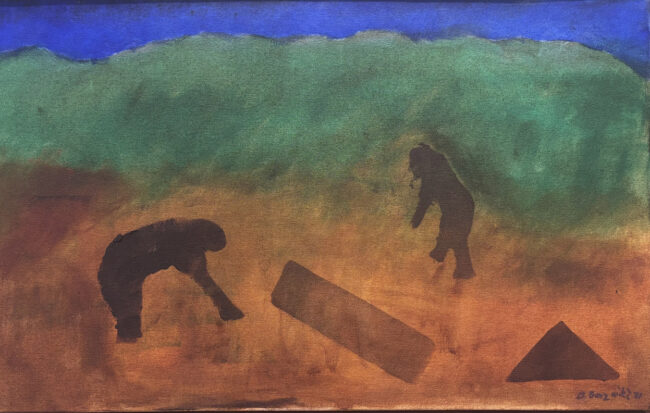
The Burial. Beatriz González/Private Collecion

That macabre clarity intensified in the 2000s. In Anonymous Auras (2023), one of her final major works, González installed more than 8,000 printed silhouettes of workers carrying corpses across the wall niches of Bogotá’s Central Cemetery. The figures – anonymous, repetitive and almost ritualistic – transformed the cemetery into a monumental archive of loss, honoring victims whose names were never recorded.

“Artists exist so that memory is not thrown in the trash”

Parallel to her artistic production, González exerted extraordinary influence as a curator and cultural policymaker. Beginning in the 1980s, she became a close collaborator of the Banco de la República’s cultural division, serving as a researcher, curator and longtime member of its advisory committee on visual arts. In that role, she helped guide the formation of a national art collection with a distinctly Colombian focus, while insisting on dialogue with international works of the highest quality.

Few individuals knew the Central Bank’s art collection as intimately as González. Over more than forty years, she worked alongside successive generations of curators, historians and collectors, helping to consolidate one of the most important public art collections in Latin America.

In 2020, she donated her personal archive and library — nearly 100,000 documents — to the Banco de la República to ensure free public access. The archive documents not only her artistic practice but also her work as an educator, curator and historian, and provides an unparalleled record of Colombian art, politics and visual culture.

Her institutional impact reached beyond the Central Bank. At the Museo de Arte Moderno de Bogotá (MAMBO), she founded the influential School of Guides, a pioneering program for museum education that trained figures who would later become leading artists and curators. From 1989 to 2004, she served as chief curator of the Museo Nacional de Colombia, where she reorganized the permanent collection and helped redefine the country’s historical narrative through art.

International recognition came steadily. Her work appeared in Documenta 14, the Berlin Biennale and the landmark exhibition “Radical Women: Latin American Art, 1960–1985.” Major retrospectives were held at the Pérez Art Museum Miami, the Museum of Fine Arts, Houston, and the CAPC in Bordeaux. In 2026, the Barbican Centre in London is set to host her first major retrospective in the United Kingdom.

González received numerous honors, including Colombia’s Premio Vida y Obra and honorary doctorates from the University of the Andes and the University of Antioquia. In 2025, the city of Bogotá awarded her the Civil Order of Merit, recognizing her invaluable legacy and profound influence on the nation’s cultural life.

Yet she remained skeptical of accolades. She preferred to speak of discipline, research and responsibility — and of the obligation, as she saw it, to bear witness. From a childhood habit of collecting film-star postcards to a lifetime spent gathering images of state violence, Beatriz González devoted herself to the stubborn preservation of memory and to an unapologetic voice in Colombian contemporary art.

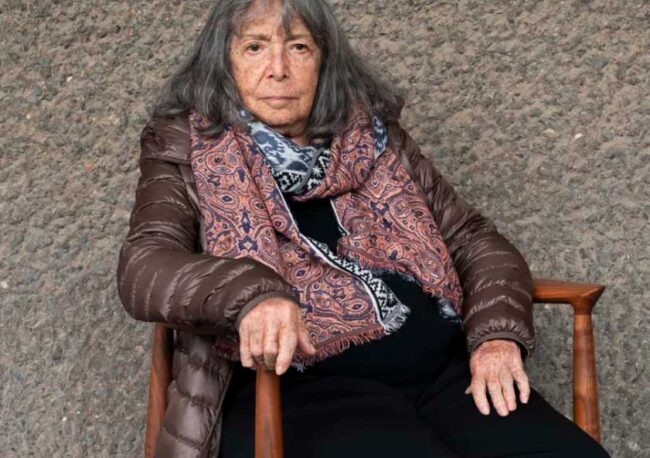
Portrait of Beatriz González, photographed at the Barbican, London, September 2024, ahead of a major retrospective of her work. © Louise Yeowart Barbican Art Gallery. Courtesy of the Barbican Centre.

Read the Banco de la República’s tribute (in Spanish) to Beatriz González, written by Claudia Cristancho Camacho of the Cultural Section and Art Collection. 

https://www.banrepcultural.org/noticias/despedimos-la-maestra-beatriz-gonzalez-figura-esencial-del-arte-y-la-cultura-en-colombia

  •  

Right-wing candidate De la Espriella leads Colombia presidential race, shows latest poll

Far-right independent candidate Abelardo De la Espriella, widely known by the nickname “El Tigre” (The Tiger), has taken the lead in Colombia’s presidential race five months ahead of the election, according to a new poll by AtlasIntel published by Semana magazine.

The survey places De la Espriella, founder of the pro-democracy movement Defensores de la Patria, at 28% of voting intentions, narrowly ahead of left-wing senator Iván Cepeda at 26.5%. Former Antioquia governor Sergio Fajardo ranks third with 9.4%, once again failing to surpass the 10% benchmark that has long eluded his centrist candidacies.

A corporate lawyer by training, De la Espriella rose to prominence as a high-profile legal advocate for conservative causes and a vocal critic of President Gustavo Petro’s reform agenda. His political ascent has been driven by hardline law-and-order rhetoric, a confrontational style and an aggressive use of social media, allowing him to position himself as an outsider channeling anti-establishment sentiment and opposition to the left.

In a hypothetical second-round runoff, De la Espriella would defeat hard-leftist Cepeda by 9.3 percentage points, the poll found, consolidating his status as the best-positioned opposition figure at this early stage of the race.

AtlasIntel also projected a runoff between De la Espriella and Fajardo. In that scenario, De la Espriella would secure 37.9% of the vote, compared with 23.2% for Fajardo — a margin of 14.7 points.

Fajardo, a mathematician and former governor of Antioquia from 2012 to 2016, has struggled to expand his electoral base beyond a narrow segment of moderate voters. His current polling echoes his performance in the first round of the 2022 presidential election, when he placed fourth with just over 800,000 votes, equivalent to 4.2% of the total, despite entering that race as a well-known national figure.

Further down the field, Juan Carlos Pinzón and Paloma Valencia each registered 5.1% support, followed by Claudia López (2.6%), Enrique Peñalosa (2.3%), Juan Daniel Oviedo (1.8%) and Aníbal Gaviria (1.3%). Several other candidates polled below 1%.

The survey found that 7.2% of respondents would vote blank, 5.7% remain undecided, and 1.1% said they would not vote.

Valencia, a senator from the right-wing Centro Democrático party, could nonetheless emerge as a pivotal figure in the race. Former president Álvaro Uribe Vélez, Colombia’s most influential conservative leader, has named Valencia as the party’s official presidential candidate, formally placing the weight of his political machine behind her campaign.

Uribe, who governed Colombia from 2002 to 2010, retains significant influence, particularly in his home region of Antioquia and in the country’s second-largest city, Medellín, long considered a stronghold of uribismo. Analysts say Valencia’s numbers could rise sharply as party structures mobilise and undecided conservative voters coalesce around an officially endorsed candidate.

In other simulated second-round matchups, Valencia would narrowly defeat Cepeda by 2.4 points, while Cepeda would beat former defence minister Pinzón by 4.5 points, according to the poll.

AtlasIntel also measured voter intentions ahead of Colombia’s interparty primaries scheduled for March 8, to be held alongside congressional elections. About 18.7% of respondents said they plan to participate in the “Gran Consulta por Colombia,” while 29.8% expressed interest in voting in the leftist “Pacto Amplio”. Former Colombian Ambassador to the United Kingdom and insider of the Petro administration, Roy Barreras, is seen as a leading contender to the clinch the consultation.

Within the Gran Consulta, Valencia leads with 19.1% among likely participants, followed by Pinzón (13.1%), Aníbal Gaviria (11.1%), Juan Daniel Oviedo (10.6%) and former Semana director  Vicky Dávila (7%).

The poll results reinforce a broader pattern of fragmentation across the centre and right, even as opposition voters increasingly focus on preventing a left-wing victory. With five months to go before the May 31 election, an emerging landscape of “all against Cepeda” has appeared on the horizon, in which disparate conservative and centrist forces could eventually rally behind a single contender in a runoff scenario on June 19, 2026.

In this context, De la Espriella — himself a close ideological ally of Uribe — could seek to consolidate all right-wing factions by selecting Valencia as a potential vice-presidential running mate,  move that would unite his strong support on the Colombian coast, with the  strength of Centro Democrático and Uribe’s loyal political base in conservative departments.

According to AtlasIntel’s CEO Andrei Roman, the contest is being shaped by persistent ideological polarisation, internal divisions within the opposition, and the growing dominance of social media.

“The race is structured around the continuity of Petro-style progressivism versus a broad anti-Petro front,” Roman said. “At the same time, digital presence has become decisive, allowing outsider figures to gain traction quickly and redefine political mobilisation.”

  •  
❌