Reading view

Beatriz González: The Artist of Colombia’s Political Memory (1932-2026)

Beatriz González, one of Latin America’s most influential contemporary artists, whose boldly colored, deliberately unrefined paintings and installations confronted Colombia’s long history of political violence, public mourning and social inequality – while also reshaping the country’s most important public art collection – died on Jan. 9, 2026, at her home in Bogotá. She was 93.

Her death was announced by the Banco de la República, Colombia’s central bank, where for more than four decades she played a decisive role in shaping the institution’s cultural mission and its vast art collections. In a statement, the bank described her as “an essential figure in Colombian art and culture” and “a masterful narrator of memory.”

González was not only a prolific artist but also a historian, curator, educator and critic — a rare figure who helped define how Colombia would see its art, its past and, ultimately, itself. “Artists exist so that memory is not thrown in the trash,” she once said, a line that came to stand as a quiet manifesto for a career devoted to preserving what official histories often erased.

Born in Bucaramanga in 1932, González came of age during La Violencia, the brutal civil conflict that engulfed Colombia between 1948 and 1958. That formative experience would leave an indelible mark on her work. After briefly studying architecture, she enrolled at the University of the Andes in Bogotá, graduating with a degree in fine arts in 1962. She later studied printmaking in Rotterdam and counted among her teachers the influential critic Marta Traba, who helped shape modern art discourse in Latin America.

González’s early work drew attention for its irreverent treatment of European art history and Colombian popular imagery. Her critical view of “good taste” led her to reject academic refinement in favor of what the art critic Germán Rubiano described as an approach that was consciously unpolished and deliberately opposed to sophistication.

She appropriated masterpieces by Manet, Leonardo da Vinci and Raphael, flattening their compositions and translating them into the visual language of curtains, furniture and household objects. Armoires, beds, trays and even wallpaper became supports for paintings marked by compressed figures and bold color palettes — a strategy that blurred the boundary between high art and domestic life.

One of her earliest and most discussed works, The Sisga Suicides (1965), reimagined a newspaper photograph of a young couple who drowned themselves in a dam outside Bogotá. Rendered in vivid, almost cheerful colors, the painting exposed the uneasy coexistence of tragedy and banality in Colombian public life — a theme that would recur throughout her career.

By the 1980s, González’s art took on an increasingly overt political tone. Press photographs of presidents, massacres and grieving families became central to her work. She painted them repeatedly, transforming news images into objects of repetition and contemplation, as if to ask how a society becomes accustomed to its own suffering. “It’s been a critique of power that has permeated my work,” she told ArtReview in 2016. “For that very reason, I don’t think of it as ‘political’; it has an ethical commitment.”

Her focus on mourning was particularly stark in works depicting mothers weeping after the 1996 Las Delicias massacre, in which dozens of Colombian soldiers were killed by the FARC guerrilla. These images, stripped of sentimentality, confronted viewers with grief as a collective, inescapable condition. The depth with which González addressed both individual and collective mourning stands among her most significant contributions to contemporary art.
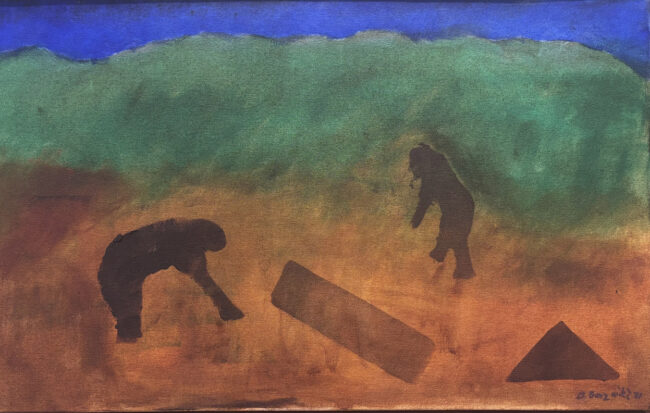
The Burial. Beatriz González/Private Collecion

That macabre clarity intensified in the 2000s. In Anonymous Auras (2023), one of her final major works, González installed more than 8,000 printed silhouettes of workers carrying corpses across the wall niches of Bogotá’s Central Cemetery. The figures – anonymous, repetitive and almost ritualistic – transformed the cemetery into a monumental archive of loss, honoring victims whose names were never recorded.

“Artists exist so that memory is not thrown in the trash”

Parallel to her artistic production, González exerted extraordinary influence as a curator and cultural policymaker. Beginning in the 1980s, she became a close collaborator of the Banco de la República’s cultural division, serving as a researcher, curator and longtime member of its advisory committee on visual arts. In that role, she helped guide the formation of a national art collection with a distinctly Colombian focus, while insisting on dialogue with international works of the highest quality.

Few individuals knew the Central Bank’s art collection as intimately as González. Over more than forty years, she worked alongside successive generations of curators, historians and collectors, helping to consolidate one of the most important public art collections in Latin America.

In 2020, she donated her personal archive and library — nearly 100,000 documents — to the Banco de la República to ensure free public access. The archive documents not only her artistic practice but also her work as an educator, curator and historian, and provides an unparalleled record of Colombian art, politics and visual culture.

Her institutional impact reached beyond the Central Bank. At the Museo de Arte Moderno de Bogotá (MAMBO), she founded the influential School of Guides, a pioneering program for museum education that trained figures who would later become leading artists and curators. From 1989 to 2004, she served as chief curator of the Museo Nacional de Colombia, where she reorganized the permanent collection and helped redefine the country’s historical narrative through art.

International recognition came steadily. Her work appeared in Documenta 14, the Berlin Biennale and the landmark exhibition “Radical Women: Latin American Art, 1960–1985.” Major retrospectives were held at the Pérez Art Museum Miami, the Museum of Fine Arts, Houston, and the CAPC in Bordeaux. In 2026, the Barbican Centre in London is set to host her first major retrospective in the United Kingdom.

González received numerous honors, including Colombia’s Premio Vida y Obra and honorary doctorates from the University of the Andes and the University of Antioquia. In 2025, the city of Bogotá awarded her the Civil Order of Merit, recognizing her invaluable legacy and profound influence on the nation’s cultural life.

Yet she remained skeptical of accolades. She preferred to speak of discipline, research and responsibility — and of the obligation, as she saw it, to bear witness. From a childhood habit of collecting film-star postcards to a lifetime spent gathering images of state violence, Beatriz González devoted herself to the stubborn preservation of memory and to an unapologetic voice in Colombian contemporary art.
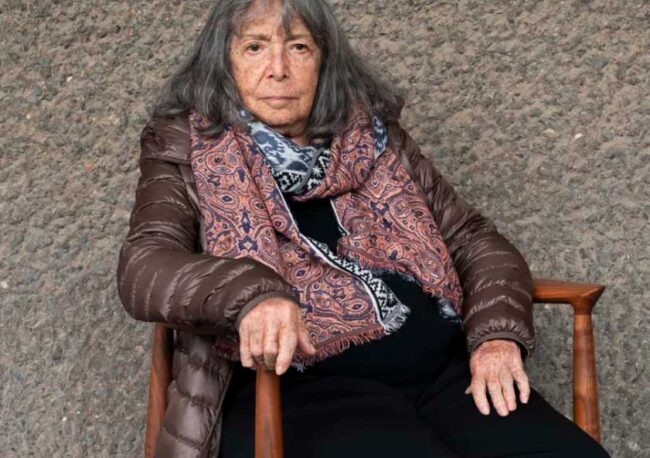
Portrait of Beatriz González, photographed at the Barbican, London, September 2024, ahead of a major retrospective of her work. © Louise Yeowart Barbican Art Gallery. Courtesy of the Barbican Centre.

Read the Banco de la República’s tribute (in Spanish) to Beatriz González, written by Claudia Cristancho Camacho of the Cultural Section and Art Collection. 
https://www.banrepcultural.org/noticias/despedimos-la-maestra-beatriz-gonzalez-figura-esencial-del-arte-y-la-cultura-en-colombia

  •  

Right-wing candidate De la Espriella leads Colombia presidential race, shows latest poll

Far-right independent candidate Abelardo De la Espriella, widely known by the nickname “El Tigre” (The Tiger), has taken the lead in Colombia’s presidential race five months ahead of the election, according to a new poll by AtlasIntel published by Semana magazine.

The survey places De la Espriella, founder of the pro-democracy movement Defensores de la Patria, at 28% of voting intentions, narrowly ahead of left-wing senator Iván Cepeda at 26.5%. Former Antioquia governor Sergio Fajardo ranks third with 9.4%, once again failing to surpass the 10% benchmark that has long eluded his centrist candidacies.

A corporate lawyer by training, De la Espriella rose to prominence as a high-profile legal advocate for conservative causes and a vocal critic of President Gustavo Petro’s reform agenda. His political ascent has been driven by hardline law-and-order rhetoric, a confrontational style and an aggressive use of social media, allowing him to position himself as an outsider channeling anti-establishment sentiment and opposition to the left.

In a hypothetical second-round runoff, De la Espriella would defeat hard-leftist Cepeda by 9.3 percentage points, the poll found, consolidating his status as the best-positioned opposition figure at this early stage of the race.

AtlasIntel also projected a runoff between De la Espriella and Fajardo. In that scenario, De la Espriella would secure 37.9% of the vote, compared with 23.2% for Fajardo — a margin of 14.7 points.

Fajardo, a mathematician and former governor of Antioquia from 2012 to 2016, has struggled to expand his electoral base beyond a narrow segment of moderate voters. His current polling echoes his performance in the first round of the 2022 presidential election, when he placed fourth with just over 800,000 votes, equivalent to 4.2% of the total, despite entering that race as a well-known national figure.

Further down the field, Juan Carlos Pinzón and Paloma Valencia each registered 5.1% support, followed by Claudia López (2.6%), Enrique Peñalosa (2.3%), Juan Daniel Oviedo (1.8%) and Aníbal Gaviria (1.3%). Several other candidates polled below 1%.

The survey found that 7.2% of respondents would vote blank, 5.7% remain undecided, and 1.1% said they would not vote.

Valencia, a senator from the right-wing Centro Democrático party, could nonetheless emerge as a pivotal figure in the race. Former president Álvaro Uribe Vélez, Colombia’s most influential conservative leader, has named Valencia as the party’s official presidential candidate, formally placing the weight of his political machine behind her campaign.

Uribe, who governed Colombia from 2002 to 2010, retains significant influence, particularly in his home region of Antioquia and in the country’s second-largest city, Medellín, long considered a stronghold of uribismo. Analysts say Valencia’s numbers could rise sharply as party structures mobilise and undecided conservative voters coalesce around an officially endorsed candidate.

In other simulated second-round matchups, Valencia would narrowly defeat Cepeda by 2.4 points, while Cepeda would beat former defence minister Pinzón by 4.5 points, according to the poll.

AtlasIntel also measured voter intentions ahead of Colombia’s interparty primaries scheduled for March 8, to be held alongside congressional elections. About 18.7% of respondents said they plan to participate in the “Gran Consulta por Colombia,” while 29.8% expressed interest in voting in the leftist “Pacto Amplio”. Former Colombian Ambassador to the United Kingdom and insider of the Petro administration, Roy Barreras, is seen as a leading contender to the clinch the consultation.

Within the Gran Consulta, Valencia leads with 19.1% among likely participants, followed by Pinzón (13.1%), Aníbal Gaviria (11.1%), Juan Daniel Oviedo (10.6%) and former Semana director  Vicky Dávila (7%).

The poll results reinforce a broader pattern of fragmentation across the centre and right, even as opposition voters increasingly focus on preventing a left-wing victory. With five months to go before the May 31 election, an emerging landscape of “all against Cepeda” has appeared on the horizon, in which disparate conservative and centrist forces could eventually rally behind a single contender in a runoff scenario on June 19, 2026.

In this context, De la Espriella — himself a close ideological ally of Uribe — could seek to consolidate all right-wing factions by selecting Valencia as a potential vice-presidential running mate,  move that would unite his strong support on the Colombian coast, with the  strength of Centro Democrático and Uribe’s loyal political base in conservative departments.

According to AtlasIntel’s CEO Andrei Roman, the contest is being shaped by persistent ideological polarisation, internal divisions within the opposition, and the growing dominance of social media.

“The race is structured around the continuity of Petro-style progressivism versus a broad anti-Petro front,” Roman said. “At the same time, digital presence has become decisive, allowing outsider figures to gain traction quickly and redefine political mobilisation.”

  •  

Democracy Deferred: Did Washington Abandon María Corina Machado?

The extraction of Nicolás Maduro on Saturday was meant to signal the end of an era. Instead, it has exposed an uncomfortable truth that may loom over Washington weeks and months after the “shock-and-awe” attacks in central Caracas have waned from headlines: was Venezuela’s democratic opposition sidelined at the very moment it appeared closest to victory?

Just weeks earlier, María Corina Machado, the 2025 Nobel Peace Prize laureate and the symbolic leader of Venezuela’s opposition, had laid out her Freedom Manifesto — a sweeping blueprint for a Venezuelan-led democratic transition rooted in dignity, elections, free markets and the return of millions of exiles. She framed the coming moment not as an American intervention, but as a national rebirth steered by Venezuelans themselves.

That vision now appears to be colliding with a far more transactional reality.

Following Maduro’s capture in a U.S.-led operation, President Donald Trump declined to elevate Machado or her movement into any formal role. Instead, senior U.S. officials have coalesced around Delcy Rodríguez – Maduro’s longtime lieutenant and overseer of the oil sector — as Washington’s primary interlocutor in Caracas. Trump publicly praised Rodríguez’s cooperation while dismissing Machado as a “very nice woman” who “lacks the support” to lead the country.

On Monday, Delsy Rodríguez took the oath of office in the presence of the Ambassadors to China, Iran and Russia. The scene from the National Assembly recalls the sham investiture of Maduro on January 10, 2025,  and sends a dire signal to the internationl community:  Does oil security matter more than a secure democracy?

White House insiders told U.S. media that Trump had never warmed to Machado, “because his feelings got hurt”, reads the Daily Beast. According to an article on Monday in The Washington Post, the president declined to pick Machado because she committed the “ultimate sin” of offending his pride, after receiving the Nobel Peace Prize. “If she had turned it down and said, ‘I can’t accept it because it’s Donald Trump’s,’ she’d be the president of Venezuela today,” cites the newspaper’s sources.

Having lost the Oslo podium as the world’s “peace president,” personal grievance and strategic calculation have marked the White House’s decision to annoint a “moderate” in Miraflores. But Rodríguez is no moderate, and her penchant for state repression remains intact. A  recent article in the Wall Street Journal affirms that Washington is willing to tolerate a Maduro 2.0 — a Chavista continuity government — so long as it cooperates on oil, narcotics enforcement and geopolitical alignment.

On the ground in Caracas, the mood reflects that ambiguity. There have been no mass celebrations, no release of political prisoners, and no clear roadmap. Power remains concentrated within the same military-backed elites that have pillaged Venezuela for over three decades, even as Maduro himself awaits trial in New York on charges expected to exceed those once brought against Joaquín “El Chapo” Guzmán.

U.S. officials insist this is realism, not betrayal. Secretary of State Marco Rubio has argued that squeezing the regime economically and forcing compliance on security and oil will eventually produce leverage. But he has stopped short of demanding immediate elections — a notable omission given that the opposition already won one.

Machado’s Freedom Manifesto now reads less like a transition plan and more like a rebuke. It imagined a Venezuela where sovereignty flowed from the ballot box, not from foreign capitals; where dignity, not expediency, guided reconstruction; and where Venezuelans — not external powers — chose their leaders.

Instead, Trump has suggested that the United States will “run” Venezuela, even as it leaves the same repressive security apparatus intact. The contradiction is stark: maximum news coverage abroad, minimal transformation on the ground.

The question, then, is not only whether Trump sidetracked María Corina Machado, but whether the United States has traded a rare democratic opening for short-term gains. If Chavismo survives without Maduro — its prisons full, its generals untouched, its oil flowing under U.S management — the Nobel laureate’s blueprint may yet stand as the document of a revolution deferred.

And history may judge that Venezuela was not lost for lack of courage at home, but for lack of conviction abroad. In the words of Mexican historian Enrique Krauze, the end-game is inevitable: “If geopolitics seeks to turn Venezuela into a pawn on its chessboard, the people will take to the streets. They have chosen a legitimate president: Edmundo González. And they have a moral leader: María Corina Machado. Obstacles may arise, but Venezuela’s liberation is irreversible.”

  •  

Trump: U.S. partnership to make Venezuelans “rich, independent and safe”

U.S. President Donald Trump said on Saturday that the United States would “run” Venezuela until a “safe, proper and judicious transition” of power is completed, following a U.S. military operation that resulted in the capture of Venezuelan dictator Nicolás Maduro and his wife, Cilia Flores.

Speaking at a press conference at his Mar-a-Lago residence in Florida, Trump described the operation as a “spectacular assault” and “one of the most stunning, effective and powerful displays of American military might and competence in American history.”

“This was overwhelming military power,” Trump said, praising U.S. forces for what he called their “breathtaking speed, power, precision and competence.” He said the operation involved close coordination between the U.S. military, intelligence agencies and law enforcement.

Trump said Venezuelan forces had been “waiting for us” and were in a “ready position,” but were “completely overwhelmed and very quickly incapacitated.” He said no U.S. servicemembers were killed and no equipment was lost.

According to Trump, U.S. forces struck what he described as a “heavily fortified military fortress” in the heart of Caracas, disabling Venezuelan military capabilities and temporarily cutting power to the capital. “The lights went out due to a certain expertise that America has,” he said.

U.S. military officials said the operation, dubbed “Operation Absolute Resolve,” relied on months of intelligence gathering and the deployment of more than 150 aircraft. General Dan Caine said the mission maintained “total surprise,” dismantling Venezuelan air defense systems before U.S. helicopters arrived at Maduro’s compound shortly after 1:00 a.m. Eastern Time.

The helicopters came under fire, Caine said, prompting a response with “overwhelming force.” One aircraft was hit, but all returned safely. Maduro and his wife “gave up” and were taken into custody by the U.S. Department of Justice, boarding the USS Iwo Jima at 3:29 a.m., he added.

Trump said Maduro and Flores are being taken to New York to face drug trafficking-related charges. Maduro has repeatedly denied U.S. accusations that he leads a drug cartel.

Trump said the United States was prepared to carry out a second wave of attacks if necessary, adding that Washington was “not afraid of boots on the ground” and that U.S. forces had operated “at a very high level” inside Venezuela.

Asked how the United States would govern Venezuela during the transition, Trump offered few specifics, saying only that officials were “designating people right now.” He gestured toward himself and Secretary of State Marco Rubio, saying that for a period of time “it’s largely going to be the people standing right behind me.”

Rubio described Maduro as a “fugitive of American justice” with a US$50 million reward on his head. “I guess we saved ourselves $50 million,” Rubio said, prompting Trump to add: “We should make sure nobody claims it.”

Rubio said Maduro had been given “multiple opportunities” to avoid confrontation but instead chose to “act like a wild man,” accusing him of inviting Iran into Venezuela and allowing criminal gangs to send migrants into the United States. “President Trump is not a game player,” Rubio said.

Trump also said U.S. companies would be allowed to enter Venezuela to repair its oil infrastructure and “start making money for the country,” framing the intervention as the beginning of a “partnership” that would make Venezuelans “rich, independent and safe.” He referred to Maduro as an “illegitimate dictator.”

Trump confirmed that Rubio had been in contact with Delcy Rodríguez, Venezuela’s vice president and one of Maduro’s closest allies. Rodríguez issued an audio statement after the strikes urging the United States to provide proof of life for Maduro and Flores, sparking speculation that she may no longer be in Venezuela.

Trump said Rodríguez had expressed a willingness to do “whatever the U.S. asks,” though analysts say she would struggle to gain credibility as an agent of political change after years of defending the Maduro’s regime.

Opposition leader and Nobel Peace Prize laureate María Corina Machado has hailed the operation as a turning point for the country.

“The hour of freedom has arrived,” Machado said in a statement, declaring that Maduro is now facing international justice for “atrocious crimes” committed against Venezuelans and foreign citizens. She said the time had come for “popular sovereignty and national sovereignty” to prevail.

Machado called for the immediate recognition of opposition-backed Edmundo González Urrutia as Venezuela’s legitimate president and commander-in-chief of the armed forces, urging military officers to recognize his authority.

“We are prepared to enforce our mandate and take power,” she said, calling on Venezuelans inside the country to remain organized and on those abroad to mobilize international support for rebuilding Venezuela.

“Venezuela will be free,” Machado said. “Hand in hand with God, until the very end.”

  •  

Trump praises “brilliant” military operation against Venezuela’s Nicolás Maduro

U.S. President Donald Trump has hailed as “brilliant” the U.S. military operation that resulted in the capture of Venezuelan dictator Nicolás Maduro, as explosions were reported in Caracas early Saturday. Governments across the Americas and Europe are reacting to the arrest of the Maduro and his wife Cilia Flores.

In a brief telephone interview with The New York Times hours after the strikes, Trump praised the planning and execution of the operation. “A lot of good planning and a lot of great, great troops and people,” Trump said. “It was a brilliant operation, actually.”

Trump said U.S. forces carried out a large-scale strike against military targets in Venezuela and captured Maduro and his wife, Cilia Flores, who were flown out of the country. He has not disclosed where they are being held. The U.S. administration claims there were no American casualties in the operation but declined to comment on Venezuelan casualties.

Venezuelan authorities have yet to confirm Maduro’s capture. Vice President Delcy Rodríguez said on state television that the whereabouts of Maduro and Flores were unknown and demanded “proof of life” from Washington.

Interior Minister and the regime’s henchman Diosdado Cabello urged calm, telling Venezuelans not to “make things easier for the invading enemy,” and alleged without evidence that civilian buildings had been hit.

In a separate statement broadcast on state television VTV, Venezuela’s Attorney General Tarek William Saab formally requested proof of life for Maduro and Flores. Saab condemned the U.S. action as a shift “from rhetoric to direct violence” and described the strikes as a premeditated act of terrorism. He said the operation left an unspecified number of people injured and killed, without providing figures or evidence.

Explosions were reported across Caracas in the early hours of Saturday, with power outages affecting several districts, according to witnesses and local media. Venezuelan state outlets reported strikes on major military and government sites, including Fuerte Tiuna, the country’s largest military base, and the La Carlota air base in heart of the capital.

According to sources inside Venezuela, pro-opposition supporters aligned with Venezuela’s legitimate president-elect Edmundo González and Nobel Peace Prize laureate María Corina Machado have begun mobilizing to secure government buildings and institutions and are preparing steps toward a political transition. Sources claim to be preparing the groundwork for what they describe as a interim administration, though no formal announcement has been made.

The U.S. embassy in Bogotá issued a security alert urging American citizens in Venezuela to shelter in place, citing “reports of explosions in and around” Caracas. The United States suspended operations at its embassy in Caracas in 2019.

Bogotá Mayor Carlos Fernando Galán called for calm and announced increased security measures near the U.S. and Venezuelan diplomatic missions in the Colombian capital.  “It is clear that a new stage is opening today for Venezuela, which should be oriented toward the return of democracy. That process must be peaceful and with full respect for the civilian population and international law. At this moment, the protection of Venezuelan citizens, both within their country and abroad, is a priority. Bogotá is home to hundreds of thousands of Venezuelan citizens, and our responsibility is to ensure their safety, their rights, and coexistence in the city,” he said.

Maduro was indicted in the United States in 2020 on corruption and drug trafficking charges, which he has repeatedly denied. The U.S. State Department has offered a $50 million reward for information leading to his arrest or conviction.

U.S. Attorney General Pamela Bondi said Maduro and Flores had been indicted in the Southern District of New York on charges including narco-terrorism conspiracy and cocaine importation conspiracy, adding that both would face U.S. justice.

Republicans react to Venezuela strikes

U.S House Representative María Elvira Salazar, a Florida Republican and outspoken critic of the Maduro government, said the strikes represented “the fall of a criminal structure masquerading as a government.” She said Maduro’s removal opened the door for “a real democratic transition led by Venezuelans who have resisted tyranny for years.”

Republican Senator Carlos Gimenez affirmed that “President Trump has changed the course of history in our hemisphere. Our country and the world are safer for it. Today’s decisive action is this hemisphere’s equivalent to the Fall of the Berlin Wall.”

Senator Rick Scott announced “A new day for Venezuela and Latin America. The United States and our hemisphere are safer because of President Trump’s leadership!”

U.S. Deputy Secretary of State Christopher Landau said in a social media post that Maduro had been removed from power and would be put on trial or punished, without providing further details.

Reactions from Latin America

Former Colombian President Álvaro Uribe Vélez defended the U.S. action as legitimate self-defense, arguing that Venezuela had for years harbored armed groups and facilitated drug trafficking. Uribe said that when a country becomes “a sanctuary for narco-terrorism,” it inevitably triggers consequences. He accused Venezuela’s leadership of destroying democratic institutions and fueling an exodus of millions across the region, urging Venezuelans to pursue freedom and institutional reconstruction.

Former Colombian President Iván Duque also welcomed the development, calling Maduro’s capture “the beginning of the end of the narco-dictatorship in Venezuela.” Duque said the moment opened a path toward democratic reconstruction with international support, while emphasizing the need to protect regional security.

Colombia’s current President Gustavo Petro took a sharply different view, rejecting what he called aggression against Venezuela’s sovereignty. Petro said Colombia had deployed security forces to its border and activated contingency plans in case of a mass influx of refugees, while seeking to convene the United Nations Security Council. “Internal conflicts between peoples are resolved by those same peoples in peace,” Petro said.

Argentina’s President Javier Milei struck a celebratory tone, posting on “X”: “Long live freedom, carajo!”

Ecuador’s President Daniel Noboa voiced support for Venezuela and the opposition. “To María Corina Machado, Edmundo González and the Venezuelan people, it is time to recover your country,” Noboa wrote, adding that what he called “narco-Chavista criminal structures” would continue to fall across the continent.

Colombian presidential candidate Paloma Valencia of the Centro Democrático party was among the first to react to the breaking news, stating: “Free Venezuela. The illegitimate dictator who usurped power, and subjugated Venezuela and the Venezuelans, has fallen. Democrats yearned for an opportunity for the return of democracy and freedom.”

Medellin Mayor Federico Gutiérrez also celebrated the arrest of the regime leader, saying: “Dictator Nicolás Maduro has been captured. Every tyrant’s time comes. Venezuela Free.”

Spain’s Prime Minister Pedro Sánchez has urged restraint and respect for international law, while Cuba’s President Miguel Díaz-Canel condemned the  “criminal attack” by the United States.

As of Saturday morning, no senior Venezuelan military official, including Defense Minister Vladimir Padrino, had appeared publicly, and it remained unclear who controlled key state institutions or how Venezuela’s armed forces would respond as the crisis continued to unfold.

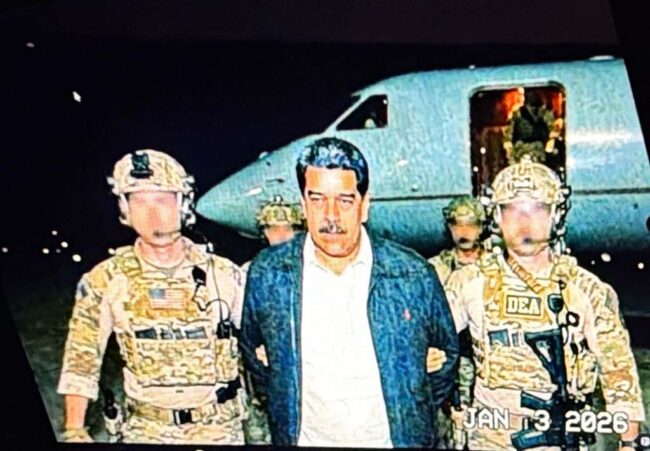
Screen capture from television shows DEA agents escorting Venezuela’s Nicolás Maduro.
  •  

Stain on Hay: Should María Corina Machado Refuse the Literary Festival?

For a literary festival, silence can be more revealing than speech. The decision by three writers to withdraw from the 2026 Hay Festival in Cartagena over the presence of María Corina Machado, this year’s Nobel Peace Prize laureate and the most prominent figure in Venezuela’s democratic opposition, has exposed a paradox at the heart of contemporary literary culture: a professed devotion to free expression that falters when confronted with an inconvenient voice.

Hay Festival Cartagena, now in its 21st edition, is scheduled to take place from 29 January to 1 February 2026, with parallel events in Barranquilla, Medellín and a special edition in Jericó, Antioquia. Founded three decades ago in Wales and once described by Bill Clinton as “the Woodstock of the mind,” Hay has built its global reputation on the premise that literature flourishes in the presence of disagreement. Its stages have hosted figures as diverse – and divisive – as Salman Rushdie, Jonathan Safran Foer and David Goodhart, writers whose ideas have unsettled orthodoxies across continents.

Yet in Cartagena, dialogue has been recast as contamination.

The Colombian novelist Laura Restrepo, the Barranquilla-born writer Giuseppe Caputo and the Dominican activist Mikaelah Drullard announced they would not attend in protest at Machado’s invitation. Restrepo, winner of the 2004 Alfaguara Prize, had been scheduled to participate in several events, including a conversation with Indian novelist Pankaj Mishra and a session devoted to her most recent book, I Am the Dagger and I Am the Wound. In a public letter addressed to festival director Cristina de la Fuente, Restrepo described Machado’s presence as “a line” crossed.

“I must cancel my attendance at Hay Festival Cartagena 2026,” Restrepo wrote. “The reason is the participation of María Corina Machado, an active supporter of United States military intervention in Latin America.” Granting her a platform, Restrepo argued, amounted to facilitating positions hostile to regional autonomy.

Caputo echoed his reasoning on social media, announcing that “in the current context of escalating imperial violence, it is better to withdraw from a festival taking place opposite the bombarded waters of the Caribbean Sea.” Drullard, five days earlier, said she could not attend an event that “supports pro-genocide and interventionist positions through the mobilisation of those who promote them,” citing Machado’s proximity to the administration of US President Donald Trump.

What remains striking, however, is not merely the severity of these accusations but their selectivity. None of the boycott statements devotes comparable moral energy to denouncing the documented human rights abuses of Nicolás Maduro’s regime: arbitrary detentions, enforced disappearances, torture of political prisoners, or the systematic dismantling of democratic institutions. One is left to ask whether the authors’ moral outrage extends to the lived realities of Venezuelans themselves, or whether it finds expression only when filtered through the optics of geopolitics.

The irony is sharpened by the fact that the same US administration helped secure Machado’s escape from Venezuela on December 8, enabling her to arrive in Oslo hours after her daughter Ana Corina Sosa received the Nobel Peace Prize on her behalf. “When the history of our time is written, it won’t be the names of the authoritarian rulers that stand out – but the names of those who dared resist,” noted the Nobel Foundation. 

The arguments from Machado’s detractors  warrant scrutiny – and above all, debate. What they do not justify is refusal from Latin America’s self-entitled literati. A boycott replaces argument with absence, moral reasoning with pantomime. It is a gesture that confers ethical purity upon the boycotter while foreclosing the very exchange that literature has traditionally claimed to defend. This is the “line” that cannot be crossed.

The Hay Festival’s response has been characteristically diplomatic In a statement following the cancellations, organisers reaffirmed their commitment to pluralism: “We reaffirm our conviction that open, plural and constructive dialogue remains an essential tool for addressing complex realities and for defending the free exchange of ideas and freedom of expression.” They stressed that Hay “does not align itself with or endorse the opinions, positions or statements of those who participate in its activities,” while respecting the decisions of those who chose not to attend.

That insistence on neutrality, however, also reveals a deeper unease. If a literary festival must repeatedly assert its impartiality, it may be because neutrality itself has become suspect. Increasingly, festivals are asked to function as courts of moral arbitration, conferring legitimacy on some voices while quietly disqualifying others. The result is not a more just cultural sphere, but a narrower one—policed less by argument than by consensus.

The controversy has unfolded at a particularly volatile moment for Venezuela’s eight-million diaspora. Machado’s invitation coincides with a renewed escalation in US pressure in the Caribbean Sea. On Tuesday, President Trump ordered a “total and complete blockade” of all sanctioned oil tankers entering or leaving the country, targeting Caracas’s principal source of revenue. His administration also designated Maduro’s government a Foreign Terrorist Organization, accusing it of using “stolen US assets” to finance terrorism, drug trafficking and organised crime.

“Venezuela is completely surrounded by the largest armada ever assembled in the history of South America,” Trump wrote on Truth Social. “It will only get bigger, and the shock to them will be like nothing they have ever seen before – until such time as they return to the United States all of the oil, land and other assets they previously stole from us.”

Against this backdrop, Machado’s high-profile presence at Hay has acquired a symbolic weight that far exceeds literary stages. Yet it is precisely at such moments that intellectual forums are tested. Fiction, after all, teaches empathy, complexity and the capacity to hold contradiction without retreat. To boycott rather than engage is to abandon that lesson – and, with it, democratical ideals.

The reputational cost to Hay Festival Cartagena may prove lasting – not because Machado was invited, but because the limits of reason and tolerance have been publicly exposed. A gathering that once prided itself on hosting difficult conversations now finds itself unsettled by the very principle on which it was founded.

And there is a final inflection. If Hay’s commitment to dialogue is grounded in a leftist agenda – if certain voices render discussion impossible – then Machado herself should reasonably question the value of her remote participation at the festival on January 30, for a scheduled conversation with Venezuelan journalist and former minister Moisés Naím.

In Cartagena, it is not Machado’s words that should concern audiences, but the intellectual impoverishment by those who chose not to speak to her at all.

  •  

Hard-Left Candidate Iván Cepeda Leads Poll for Colombia’s 2026 Election

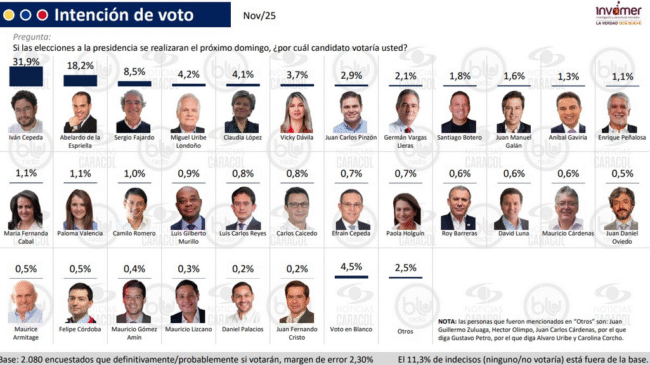
Senator Iván Cepeda of the ruling Historic Pact coalition has emerged as the early front-runner in Colombia’s 2026 presidential race, according to a nationwide Invamer poll released Sunday by Caracol TV and Blu Radio. The survey – the first major measurement since the lifting of Colombia’s recent polling restrictions – places the left-wing candidate at 31.9% of voting intention, six months ahead of the first round.

The results position Cepeda well ahead of candidate Abelardo de la Espriella of Defensores de la Patria, who received 18.2%, and independent centrist Sergio Fajardo, who registered 8.5%. Miguel Uribe Londoño, running for the leadership of  President Álvaro Uribe Vélez’s Centro Democrático party, follows with 4.2%. Uribe Londoño is the father of Senator Miguel Uribe Turbay, victim of an assassination attempt on June 7, and who died two months later at the Santa Fe Hospital in Bogotá.

The findings come amid broad public dissatisfaction with the country’s direction and with the administration of President Gustavo Petro, who leaves office on August 7, 2026. According to the poll, 56% of respondents disapprove of Petro’s administration, while 37% approve. Although disapproval has dipped slightly from previous months, nearly six in ten Colombians remain critical of the government. National sentiment is similarly pessimistic: 59.8% believe Colombia is “on the wrong track,” compared with 34.4% who feel otherwise.

Internal security stands out as the leading concern. Asked whether Petro’s “Total Peace” policy had made them feel safer, 66.2% claim it made them feel more insecure. Nearly 65% believe the initiative is moving in the “wrong direction”, and 73% say the government has lost territorial control to illegal armed groups. Only 20% expressed confidence in the government’s peace and security approach.

The Invamer survey, conducted between November 15 and 27 among 3,800 respondents in 148 municipalities, does not include public reaction to the latest scandal involving alleged infiltration of state institutions by FARC dissidents. The poll has a 1.81% margin of error and a 95% confidence level.

Cepeda’s lead reflects firm support among left-leaning voters and measurable gains among independents and left-leaning centrists. Though only 24% of those polled identified themselves as “left-wing”, the senator’s 31.9% support suggests he is drawing backing among younger voters. He also carries a relatively high rejection rate: 23.9% said they would “never” vote for him.

The survey challenges the perception that Cepeda lacks room to grow beyond the left, even as 50% expressed that they would prefer to vote for a candidate opposed to Petro. Analysts believe the Historic Pact’s decision to hold its internal consultation last month helped consolidate support within the coalition and gave Cepeda a strategic advantage.

The Invamer poll of Colombia’s of 30 presidential candidates. Photo: Caracol/Blu Radio.

Despite his lead, Cepeda could face voter rejection should Petro’s disapproval ratings continue to climb. The candidate’s current negative rating is among the highest of any public figure, and his pro-Petro agenda on security, economy, and U.S relations could push the center closer to the moderate right. Still, the poll indicates Cepeda would win a runoff against De la Espriella with a wide margin, but face a “technical tie” with the mathematician and former Governor of Antioquia.

De la Espriella, meanwhile, has quickly consolidated the anti-Petro vote, emerging as a “dark horse” at the extreme right of the spectrum. Once absent from early electoral projections, the lawyer now surpasses established Centro Democrático politicians – including senators María Fernanda Cabal, Paola Holguín, and Paloma Valencia.

Former defense minister under President Juan Manuel Santos and ex-Ambassador to Washinton, Juan Carlos Pinzón, is in seventh place (2,9%), but these early numbers are likely to increase, given that he maintains a close relationship with three ideological camps (Centro Democrático, La U, Cambio Radical) represented in Presidents Uribe and Juan Manuel Santos, and German Vargás Lleras.

 Even though the poll found that 63% of eligible voters know who De la Espriella is, there is room for continued growth for the five candidates who marked above 2% in the poll, among them, Vargas Lleras in fifth place (2.1%).

The centrist bloc, historically influential in Colombian politics, appears fragmented. Fajardo, once considered a reliable alternative to both left and right, no longer polls in double digits. While he maintains a lower rejection rate than most rivals and doubles the numbers of former Bogotá mayor Claudia López (4.1%), analysts say the proliferation of centrist candidates could dilute Fajardo’s base. Combined, these candidates would outpace De la Espriella’s support, but the numbers suggest this does not translate into a cohesive electoral force.

Foreign policy is also shaping voter priorities. A large majority – 78% – said maintaining strong relations with the United States is essential for the next administration. Respondents widely rejected Petro’s decision to use a megaphone in New York to urge U.S. soldiers not to follow orders from former President Donald Trump; 78% disapproved of the act, even though half of respondents hold an unfavorable view of Trump.

President Petro reacted to the poll on social media, framing the electoral landscape as a struggle between entrenched elites and what he described as a “powerful people” seeking to reclaim the state. Referring implicitly to Uribe and Fajardo, the president said Colombia must reject “mafioso elites” and work toward a “free and educated” society.

The Centro Democrático announced it will conduct an internal vote among more than 4,000 active party members to select two candidates for a March 2026 primary. The contenders are senators Cabal, Holguín, and Valencia, and Miguel Uribe Londoño.

With six months until the first round on May 31, 2026, the Invamer poll highlights a polarized electorate, deep concerns over security and corruption, and an early advantage for the ruling coalition’s candidate — with substantial uncertainty and new political alignments spearheaded by former presidents, especially Álvaro Uribe.

  •  

Lines on Stone: The Millennial Rock Art of the La Lindosa Range

At the eastern fringes of the Andes, where the Orinoco River Basin unfurls in an ondulating canvas of green, punctuated by majestic rivers and sandstone mesas, lies one of the world’s most astonishing open-air galleries of human existence.

The Serranía de La Lindosa, in the department of Guaviare, is a monumental tableau carved by nature and painted by hands that may have been among the earliest storytellers on the planet. For centuries, these walls stood largely hidden to the world, known only to Indigenous communities and a handful of intrepid explorers. Today, they form the heart of a groundbreaking exhibition in Bogotá’s Museo del Oro: Trazos sobre piedra: Pinturas milenarias en la serranía de La Lindosa, an ambitious, year-long showcase hosted by Banco de la República.

The exhibition that opens on November 28 is the most extensive institutional undertaking yet to unravel the symbols, narratives, and cosmologies that animate a rock-art tradition stretching back tens of millennia. Far from a display of a lost civilization, the Central Bank’s ambition matches that of the cliffs themselves – massive escarpments where hunters, shamans, and master painters returned generation after generation to leave visual testaments of their world.

The story of La Lindosa begins, in many ways, with a single mark. A red smear – thin, elongated, always intentional – painted on the rough face of a stone wall deep in an expanse of canopy and tropical rainforest. To an untrained eye, the pigment blends with natural iron deposits. But to archaeologists who have studied the region for years, it marks the threshold of an extraordinary visual universe. That smear belongs to a constellation of tens of thousands of pictograms across Guaviare and neighboring Amazonian massifs, including the monumental cliffs of the PNN Chiribiquete National Park. Together, they form one of the world’s oldest and largest rock-art traditions.

Archaeologists describe La Lindosa as a cultural landscape, a place where art, geology, ecology, and spirituality intertwine. The Serranía’s towering sandstone walls were formed by tectonic forces millions of years ago, creating natural canvases that humans began to paint long before the earliest agricultural societies emerged.

Only recently have researchers begun to grasp the full temporal depth of these murals. While Europe’s famed Lascaux cave contains roughly 600 images dating to the Upper Paleolithic (between 15,000 and 13,000 BC), the paleo-Indian paintings of Colombia could be far older. In Chiribiquete, analysis of natural dyes, superimposed layers, and stylistic continuity suggests that some images may date back as far as 35,000 BC. La Lindosa shares many of these motifs and techniques, hinting at a cultural horizon that may reach back to the earliest chapters of human imagination.

Details on the rock face of La Lindosa. Photo: Federico Ríos/Banco de la Repúblics

This immense chronology is not just a scientific revelation – it is a window into a world where every figure, every line, carries meaning. The murals of La Lindosa are filled with scenes of ritual dances, hunting parties, geometric patterns, spirit beings, and animal-human hybrids. They depict jaguars, monkeys, fish, snakes, birds, and the silhouettes of humans with outstretched arms. In some panels, the figures appear in motion; in others, they stand in tight, nearly choreographed formations that suggest communal ceremony. The dazzling variety of imagery points to a worldview rooted in transformation, reciprocity, and ecological intimacy.

One of the most compelling findings to emerge from recent research is the specialized nature of the painting tradition. Archaeologists believe that the most experienced storytellers – shamans, ritual specialists, or highly trained painters – scaled treacherous escarpments to reach spaces associated with spirits and cosmic forces.

These elevated murals often contain the most complex iconography, executed with astonishing precision. Younger or less experienced painters worked closer to the ground, contributing simpler figures or layering their work atop earlier compositions. Over centuries, entire cliffs became palimpsests: surfaces where multiple generations added, corrected, reinterpreted, and echoed the narratives of their ancestors.

The Banco de la República’s exhibition, under Judith Trujillo’s curatorship, mirrors this layered history. Visitors encounter immersive installations, high-resolution photographic panels, pigment analyses, and interactive 3D reconstructions that recreate the sense of standing before the colossal walls themselves. Rather than isolating images, the exhibition places each pictogram within the broader landscape – its geology, myths, and ecological rhythms.

To step inside the exhibition is to enter a world where the boundaries between art and survival dissolve. The rock art of La Lindosa was not decorative; it was a method of world-making. It engaged with spirits, conveyed moral codes, transmitted ecological knowledge, and anchored communities in a landscape that could be both bountiful and unforgiving. Many murals appear near water sources, ancient pathways, or natural shelters – places where human life pulsed most intensely.

Just as telling is the continuity these images embody. Despite colonization, displacement, and the fragmentation of Indigenous territories, the symbolic vocabulary of the Amazon endures. Elements of this cosmology survive in the ritual practices of several Indigenous groups today, whose elders regard the panels not as archaeological remains but as living documents.

As Colombia confronts the pressures of illegal mining, deforestation, and climate change, the need to protect sites like La Lindosa has become urgent. These walls hold traces of human existence long before national borders or written histories were printed. They extend the timeline of pre-Columbian identity back tens of thousands of years, reminding visitors that the Amazon and Orinoco watersheds have always been at the center of innovation, imagination, and spiritual awakening.

Inside the Gold Museum’s hallowed halls, visitors will pause before the vivid reds – their unexpected brightness, their persistence through rain, wind, time. These pigments, ground from seeds, minerals, and endemic plants, were not chosen at random; they were sacred. They signaled life, danger, transformation. They were meant to endure.

Whether the ancient painters imagined their work surviving 30,000 years is just one of many unsolved mysteries. Their names may be lost, but their visions endure – a vast, breathing archive that continues to astonish and challenge us.

Guests to this landmark exhibition are not mere spectators either, but participants in La Lindosa’s vast “Sistine Chapel” – an offering handed-down to generations, and carried forward through the endless corridors of time.

Visitor Information – Museo del Oro

Museo del Oro, Banco de la República
Cra. 6 No. 15-88.

Exhibition runs until November 27, 2026.

Opening Hours

  • Tuesday–Saturday: 9:00 a.m. – 7:00 p.m.
  • Sunday: 10:00 a.m. – 5:00 p.m.
  • Monday: Closed

Admission: COP $5,000

Follow the exhibition on social media: Instagram @MuseoDelOro #LaLindosa #MuseoDelOro

  •  

María Corina Machado Issues Post-Maduro “Freedom Manifesto”

As the USS Gerald R. Ford navigates uncomfortably close to the Venezuelan coastline and some 15,000 U.S. Marines remain stationed across Caribbean waters, Venezuela’s political crisis has entered a volatile new phase. In Caracas, Nicolás Maduro is publicly calling for peace and dialogue — even quoting John Lennon’s “Imagine” and delivering rally slogans in English — while the country’s most prominent opposition figure, Nobel Peace Prize laureate María Corina Machado, has issued an expansive “Freedom Manifesto” envisioning a democratic rebirth after the collapse of Maduro’s rule.

Both gestures — Maduro’s unusually soft-spoken overtures and Machado’s sweeping declaration of national principles — arrive just days before a major U.S. decision that could redefine Washington’s policy toward Venezuela. On November 24, the State Department is expected to designate the Cartel de los Soles, a Venezuelan military-linked drug trafficking network allegedly headed by Maduro, as a Foreign Terrorist Organization (FTO).

Secretary of State Marco Rubio reiterated that the group “has corrupted the institutions of government in Venezuela and is responsible for terrorist violence conducted by and with other designated FTOs, as well as for trafficking drugs into the United States and Europe.”

Yet even as Washington prepares its most severe sanction to date, President Donald Trump has said he is open to speaking directly with Maduro. “I would probably talk to him, yeah,” Trump said. “I talk to everybody.”

That combination — tightening pressure paired with a sudden willingness to talk — has created what regional observers describe as an unprecedented moment of strategic ambiguity. Across Latin America, many now wonder whether the United States has a coherent plan for Venezuela or whether it is improvising amid escalating military preparations.

Maduro appears intent on exploiting that ambiguity. In recent public appearances, he has addressed the U.S. public directly, shifting between Spanish and English, at one point even singing. Over the weekend, he declared he wanted a “face-to-face” with Trump, urging: “Dialogue, call, yes; peace, yes; war, no — never, never war.”

In a televised address Monday, he warned that any U.S. military intervention would mark the “political end” of Trump’s leadership, accusing advisers around the U.S. president of “provoking” an armed conflict for political gain.

But even while denouncing Washington’s “hawks,” Maduro simultaneously extended yet another olive branch: he was willing to speak, he said, “with anyone in the Trump administration who wants to talk to Venezuela.”

This duality – hostility mixed with conspicuous calls for peace – reflects the delicate position Caracas faces as U.S. firepower mounts offshore and covert options reportedly expand.

According to a report published Tuesday by The New York Times, Trump has authorized the CIA to prepare potential covert operations inside Venezuela, part of a broader pressure campaign to weaken Maduro’s government. The same report said the White House has quietly reopened back-channel communications with Caracas, during which Maduro suggested he might consider stepping aside after a negotiated transition.

The State Department has also fueled speculation by delaying the FTO designation until November 24 — a move some analysts view as an ultimatum: enter negotiations or face an escalation that could sever what remains of Venezuela’s diplomatic and economic links to the outside world.

Vision for “The New Venezuela”

While Maduro navigates the diplomatic minefield, María Corina Machado is attempting to position herself — and the opposition — for a post-Maduro future. On Tuesday, Machado released her “Freedom Manifesto,” a sweeping philosophical and political declaration, that lays out a roadmap for what she calls “a Venezuela reborn from the ashes.”

The document is sharply moral in tone. It presents Venezuelans as having endured “chains of tyranny” and calls for the restoration of dignity, property rights, free markets, unrestricted speech, secure voting, institutional reform, environmental protection, and the return of nine million exiles forced abroad.

“We stand at the edge of a new era – one where our natural rights will prevail,” Machado writes. She envisions a country with a revitalized energy sector, a diversified high-tech economy, demilitarized institutions, and a reinvigorated place in the “international community of democracies.”

Her manifesto is both a political program and a counterpoint to the perception  prevalent in several Latin American capitals – that Washington’s next steps, not Venezuela’s internal politics, may determine the timing and nature of Maduro’s exit.

Even before the FTO designation, the United States had already escalated its military posture. Since early September, U.S. forces have carried out 21 strikes on boats in the Caribbean Sea and eastern Pacific, killing 83 people, in what the administration describes as anti-narcotics operations. Trump has hinted that known trafficking sites within Venezuela are potential targets.

The prospect of further strikes has unsettled the region’s leftist governments, most notably Colombia, under Gustavo Petro. While Washington is willing to keep the door to dialogue open with Maduro, it remains water-tight shut to a democratically-elected president described by President Turmp as an “illegitimate drug leader”.

For Maduro, calling for dialogue may be a defensive tactic — an effort to avoid isolation at a moment when Washington appears to be tightening multiple pressure channels at once. For Machado, the combination of international pressure and internal exhaustion presents a rare opportunity to present the blueprint for a new Constitution.

Yet the central question remains whether the United States has a clear strategy for a peaceful transition to democracy. A show of overwhelming force without a defined political horizon could embolden Maduro’s close allies – including Russia and Colombia’s Petro – to argue that Washington lacks staying power in the hemisphere. Should the military arsenal in the Caribbean fail to deliver tangible results – from regime transition to a negotiated exile for Maduro – the Chavista leadership will feel emboldened to stay the course.

The next ten days, leading to the November 24 FTO designation, will prove decisive. Either Maduro exits quietly – triggering the removal of the U.S. government’s $50 million bounty for his arrest – or the United States crosses a legal and diplomatic threshold that could redefine the region for decades to come.

  •  

USS Gerald Ford Enters the Caribbean: What Next for Venezuela?

The arrival of the USS Gerald Ford in Caribbean waters has raised the stakes in the tense relationship between the United States and Venezuela. The aircraft carrier – the most advanced and powerful in the U.S. Navy – traveled for more than two weeks from the Mediterranean to take up position near South America, joining a growing naval presence under the Pentagon’s Southern Command.

Washington insists the deployment supports anti-narcotics operations aimed at curbing the flow of cocaine and other drugs from Latin America into the United States. Yet the timing and scale of the buildup have raised questions among America’s allies over whether it signals a shift toward a more confrontational posture against the regime of Nicolás Maduro.

Since early September, U.S. forces have carried out at least 19 strikes against small vessels in international waters near Venezuela and Colombia – operations the Trump administration says were targeting “cartel terrorists.” According to Pentagon announcements, some 76 people have been killed since the first narco-boat was destroyed by a missile strike on September 2.

Secretary of Defense Pete Hegseth – branded as “Secretary of War” following President Donald Trump’s renaming of the Defense Department – has become the public face of the campaign. “We’re protecting the homeland and taking out the cartel terrorists who wish to harm our people,” Hegseth said in late October, describing the strikes as “a message of deterrence.”

Trump has claimed that some of the targeted vessels were manned by members of the Venezuelan criminal network Tren de Aragua (TdeA), while others were moving narcotics for Colombia’s illegal armed groups, including Gulf Clan and National Liberation Army (ELN) guerrilla.

As the U.S. Navy reinforces its presence in the Caribbean with fighter jets, Marines, and drones, the deployment of the Ford marks the most significant show of American force in the region since the 1989 invasion of Panama. Venezuela, in turn, is on high alert, mobilizing the Bolivarian Armed Forces, National Guard, and civilian militia recruits in preparation for a potential confrontation.

The prospect of an assault on Venezuelan territory no longer feels entirely remote, even though Trump has publicly downplayed any immediate plans for direct intervention. “I wouldn’t be inclined to say that I would do that… I’m not gonna tell you what I’m gonna do with Venezuela,” he stated recently to CBS’s 60 Minutes.

After the Senate voted down a measure that would have required congressional authorization for military action, Republican lawmakers described the result as a “green light” to strike land targets within Venezuela. The Gerald Ford’s presence suggests Washington may not simply be policing drug routes – it is projecting supremacy. With such immense firepower now concentrated near Venezuela, retreating without one tangible result – the arrest of Maduro – could prove politically costly for The White House.

If the ultimate objective is regime change – hoping that Maduro’s government will implode under pressure – the warship could soon find itself running out of steam to remain in the Caribbean. For the Trump administration, time and strategy are now of the essence. Deploying billion-dollar hardware to capture a leader with a US$50 million bounty on his head risks appearing, to Maduro’s allies in Moscow, as an expensive bluff – or hollow show of force.

Should the so-called “Trump Doctrine” falter in the Caribbean, Latin America’s leftist leaders, most notably Colombia’s Gustavo Petro, will capitalize on Washington’s setback, using it to galvanize domestic support ahead of the 2026 elections.

International reaction to the missile strikes has ranged from muted concern to outright condemnation. The United Nations High Commissioner for Human Rights, Volker Türk, warned that the attacks “have no justification in international law,” echoing similar criticisms from close U.S. allies including the United Kingdom, France, Netherlands, and to a tarnished degree, Colombia.

CNN reported on Wednesday that the United Kingdom has suspended certain intelligence-sharing with the Pentagon fearing “complicity” in the Caribbean operations. London’s official response – “it is our longstanding policy not to comment on intelligence matters” – only underscores the unease. Both the  Netherlands and France maintain a military presence in the Antilles, and claim that shared data could be used in operations that violate human rights.

In Bogotá, President Gustavo Petro, one of Washington’s fiercest critics on drug policy, announced that Colombia would follow the UK’s example and suspend communications between its security forces and U.S. agencies “as long as missile attacks on boats in the Caribbean persist.” Petro added that “the fight against drugs must be subordinated to the human rights of the Caribbean people.”

On Wednesday, U.S Secretary of State Marco Rubio rebuked the European position, stating: “I find it interesting all these countries want us to send nuclear-capable Tomahawk missiles to defend Europe. But when the United States positions aircraft carriers in our hemisphere, where we live, somehow that’s a problem.” He went on to affirm that the European Union does not get to “determine what international law is.”

While Washington frames the campaign as a continuation of the now centuries-old “War on Drugs,” Latin America’s left-leaning governments warn that it risks destabilizing the region and alienating partners at a moment when cooperation is crucial to tackle migration, organized crime, and environmental issues.

For now, the USS Gerald Ford will remain in the Caribbean – a floating fortress and symbol of American deterrence. Its presence projects strength but also uncertainty. Unless Washington clarifies its endgame, its most powerful warship could end up reviving an old question: how far is the United States willing to go in its pursuit of democracy beyond its shores – and at what cost to the stability of a hemisphere it has long abandoned?

  •  
❌