Reading view

Petro under fire in ‘cash for diplomas’ scandal
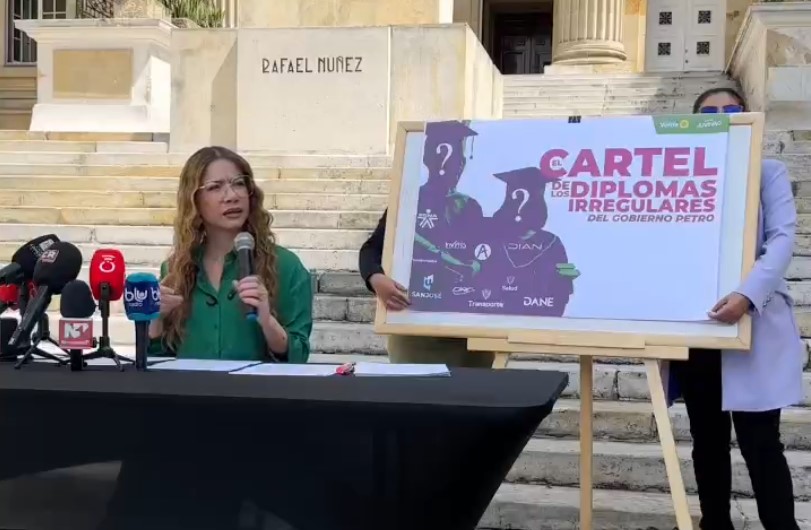
Representative Catherine Juvinoa at a press conference in Bogotá this week. Photo: X

A simmering spat over candidates for government posts boiled up this week with revelations that a Bogotá university was faking professional titles for workers in Petro’s administration.

According to congress members revealing the scandal, 24 public servants got top contracts using dodgy titles from Universidad Fundación San José, a mold-breaking higher education institute once famed for accessible courses, but now under scrutiny for selling degrees.

They also accused Petro and his education chiefs of dragging their feet in investigating the university for the suspected fraud case.  

“Petro’s promises for education come to nothing,” said house representative Catherine Juvinao after she claimed to have identified 24 cases where officials and contractors in top government entities appeared to have been hired with diplomas from the Univerisity Foundation San José without all the tests.

One stand-out case was a government functionary who, according to university records, graduated in four quite different degrees – Business Administration, Industrial Engineering, Public Accounting and International Marketing – on the same day.

“This is one of the most serious cases. Who graduates with four degrees on the same day?,” the representative said in an interview with Semana magazine.

According to Juvinoa, the university handed out diplomas to students who had failed to complete the independent technical tests, known as PruebaPro, and in some cases had not studied at all.

Fake titles for plum jobs?

Although academic fraud has occured regularly in Colombia – and similar scandals have rocked previous governments – the investigations by Juvinao and her team are targeting an administration that promised to turn its back on corruption.

This week’s revelations followed last year’s political dogfight over the proposed appointment of 23-year-old Juliana Guerrero as vice-minister of youth. The candidate, who was close to both Petro and his education minister, was already embroiled in controversies over private use of police planes. Then in September she was found to have falsified her accounting qualifications at the university.

After public pressure the university rescinded the degree, and Guerrero herself told Caracol news that she intended to take the independent exams to regain her title in November.

Juliana Guerrero, the candidate accused of faking her qualifications. Photo: Interior Ministry

Further investigations revealed a bigger suspicion: that the Petro government was routinely using the university – with which it had contracts – to fudge academic requirements for candidates favoured for plum jobs.

This week Juvinao accused  Petro government or running a “Cartel of Dodgy Diplomas” in cahoots with the San José university. “It’s bad news that our first left-wing government ended up being a monument to mediocrity, captured by an institution,” she said.

The state was “closing the door to those who studied hard by merit,” she said, while calling for a probe by the Attorney General’s office, adding that: “we have all the evidence to support any investigation”.

Political Attacks

For its part, the Ministry of Education announced this week it was investigating the University Foundation San José related to the case of Guerrero, Petro’s preferred candidate for the Ministry of Youth.

In the same communication, the ministry strongly denied it had any link to “illicit activities related to the expedition of academic titles”.

The Colombian president repeatedly defended Guerrero’s nomination for the post last year even after her degree was pulled by the university. Her only error was to claim her title before taking the final exam, he said, suggesting a storm in a teacup. The attacks were personal and political, he added.

“So, Juliana’s graduation exam, after completing her studies, was registered for in July and is scheduled for next November. Is that the summary of this scandal?” he wrote on X.

At first view Petro’s gesture seemed on target; young candidates, particularly female, get torrents of abuse in the rough-and-tumble of Colombian politics, often facing a public scrutiny less applied to old-school politicos.

But looking back that defence now seems misplaced: financial data revealed this month showed Guerrero had paid for her degree course long after receiving her diploma – almost unheard of in Colombia – while the university itself confirmed that she “never went to classes or presented exams nor complied with the accounting program”.

Doubling down

This week Petro doubled down on his defense of the University Foundation San José, claiming the accusations by the opposition unfairly focused on “poor single mothers” trying to get ahead.

“Private universities…allow these working women to study faster,” he said. “[Politicians] to gain votes shouldn’t destroy working women. I expect a public apology from these congresswomen to the working women of Colombia.”

To complicate the president’s narrative, referring to the Guerrero case, the university announced it had “detected and denounced a fraud” and had itself requested the attorney general’s office to investigate. It also promised to “stregthen internal audits” to prevent future cheating.

Representative Juvinao told Semana told Semana magazine that the Guerrero case suggested corruption in the form of cash for qualifications, and was likely “the tip off an iceberg”.

“There is a deliberate strategy to fabricate qualifications to fit the needs of Petro’s government departments,” she said.

In a country where people struggle for further education – and value highly their hard-earned academic qualifications – what started as an online spat over a youth representative is becoming a scandal with much more scope.

The post Petro under fire in ‘cash for diplomas’ scandal appeared first on The Bogotá Post.
  •  

Bogotá reduces homicides in 2025

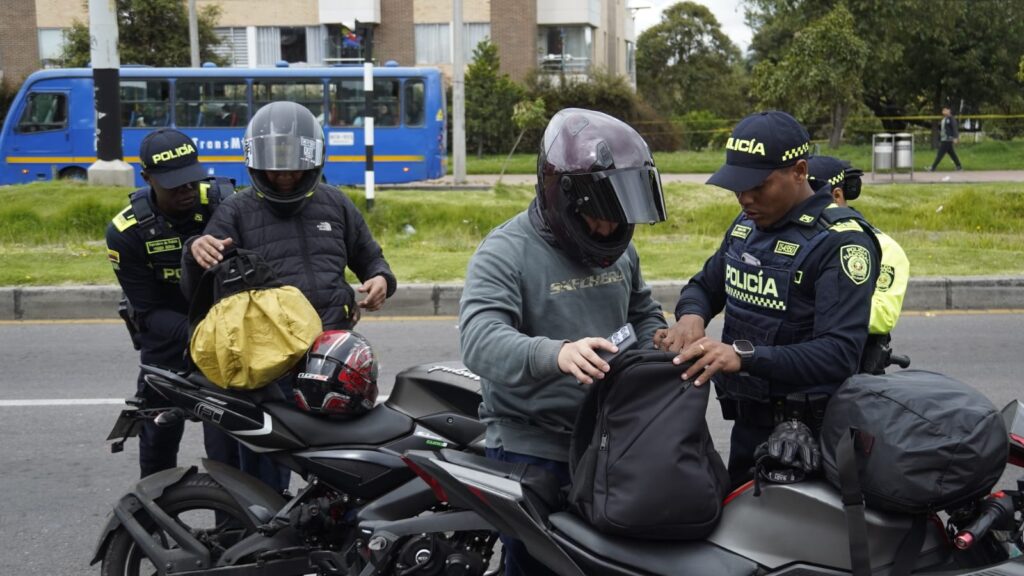
Police hunting suspected gang members on the streets of Bogotá. Photo Secretaría de Seguridad.

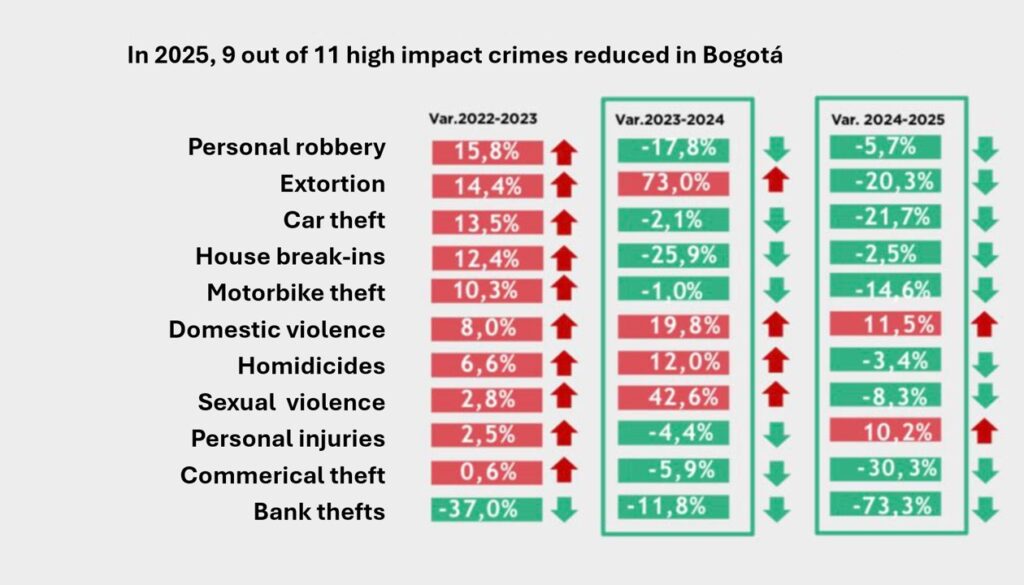
Bogotá’s mayor and security chiefs celebrated some positive results last week with stats showing an overall reduction of high-impact crimes in the city during 2025, with the murder rate dropping in the city even as violent deaths increased across Colombia.

“In Bogotá in 2025, there were fewer homicides robberies, fewer vehicle thefts, fewer motorcycle thefts, fewer cases of extortion, more drug seizures, more weapons seizures, and more arrests,” said Bogotá´s mayor Carlos Galán, presenting a security scorecard showing security shifts in the first two years of his administration.

Some decreases were significant, such as extortion cases dropping by 20 per cent, stolen car cases by 22 per cent and commercial theft by 30 per cent. Others were less impressive: street robberies only reduced by 6 per cent, and cases of sexual violence by 8 per cent.

Official data presented by Bogotá's mayor this week shows an overall reduction in high impact crime.  Source:  Secretaría de Seguridad
Official data presented by Bogotá’s mayor this week shows an overall reduction in high impact crime. Source: Secretaría de Seguridad

Homicides, perhaps the most significant metric, reduced last year by just 3.4%, with 1,165 killings recorded on the national police database compared to 1,214 in 2024. This gave Bogotá – with a population of around 8 million – a current homicide rate of 14.8 deaths per 100,000 of the population, according to the standard formula used to compare deaths across varying population sizes.

Limited success

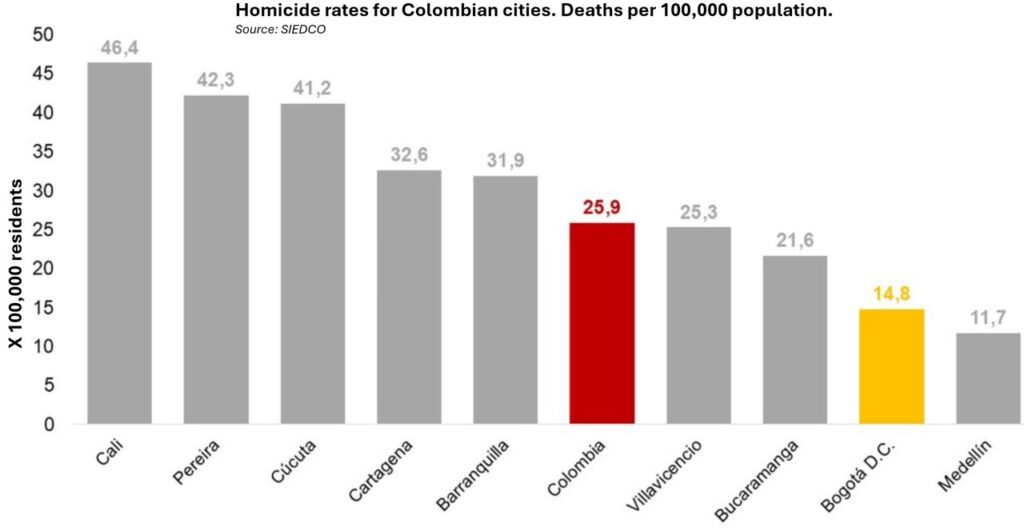
This was way short of Mayor Galán’s stated goal of 8 deaths per 100,000 during his four-year tenure, but a better result than the national one. At 14.8, Bogotá’s homicide rate was considerably lower than Colombia’s national figure of 25.9 deaths per 100,000 of the population, based the alarming total of 12,484 violent deaths reported nationwide – a two per cent increase on the previous year.

City security secretary César Restrepo also pointed out that Bogotá had proportionally less murders than other major cities such as Bucaramanga, Cartagena, Barranquilla, Pereira and Cali (see table below). Medellín, however, bested the capital with a reduced rate of 11.7 per 100,000.

Comparison of homicide rates across Colombia. Adapted from Secretaría de Seguridad

And in our own comparison with cities worldwide, Bogotá’s homicide rate was lower than Washington D.C. (17 per 100,000) Baltimore (23 per 100,000) or New Orleans (33 per 100,000) but much higher than most European cities such as London (currently at 1 per 100,000) or Berlin (3 per 100,000).

Backdrop of violence

The challenges facing Bogotá in reducing violence against a national backdrop of increasing insecurity were highlighted in a recent study by think tank Centro de Paz y Seguridad Externadista which compared homicides rates between recent national governments.

The current Petro government reported 40,633 violent deaths during its first three years, an increase of 11 per cent over the same period for the Juan Manuel Santos government (2014 to 18) and seven per cent higher than during Ivan Duque’s tenure from 2018 to 2022.

The data pointed to a failure of the Petro’s Paz Total (‘Total Peace’) process which reduced military pressure on illegal armed groups allowing them to expand their range and illegal activities in the last three years, concluded the report.

“Although the government insists that the national conflict is de-escalating, the figures point to another scenario: homicidal violence remains at high levels,” said study leader Andrés González in December presenting the findings on YouTube.

González also pointed out that while most territorial battles took place in rural areas, the effects reflected in urban hubs where local crime groups – often with links to larger armed groups – used lethal violence in conflicts linked to extortion and micro trafficking.

Catch and release

Another challenge for Bogotá’s security was the low conviction rate for captured criminals, according to city police chief Giovanni Cristancho in an interview with El Tiempo. Out of 33,000 criminals arrested in the city in 2025, less than 10 per cent ended up in jail, he said.

Criminals showed little fear of the justice system, and many caught by the police were multiple offenders, said Christancho, with the police having to “catch the same person 20 times”.

Recycling criminals back on the streets was “outside the control of the district government”, security chief Restrepoalso told  El Tiempo last week, but recognised it reflected badly on the city administration.

“Most citizens express their annoyance because criminals are either released or not convicted. As long as these other conditions remain unresolved, all the results we announce will continue to generate frustration among the public,” he said

This chimed with a common perception in Bogotá that even if the police are clamping down, the justice system as a whole is failing the city. Those concerns were echoed in a recent public survey by city watchdog Bogotá Como Vamos that found that a  62% of respondents perceived Bogotá as less secure, the highest figure recorded since 2008.

Catch and kill

Low conviction rates could explain the resurgence of vigilante justice being meted out by frustrated rolos in recent years, with groups of citizens organizing to capture and beat offenders, sometimes tying them to lampposts or parading them naked through neighborhood and posting videos on social media.

Barrio justice has long been a problem in Bogotá; a study from 2016, reported in The Bogotá Post, showed an average of one lynching death every three days over a 12 month period in the city.

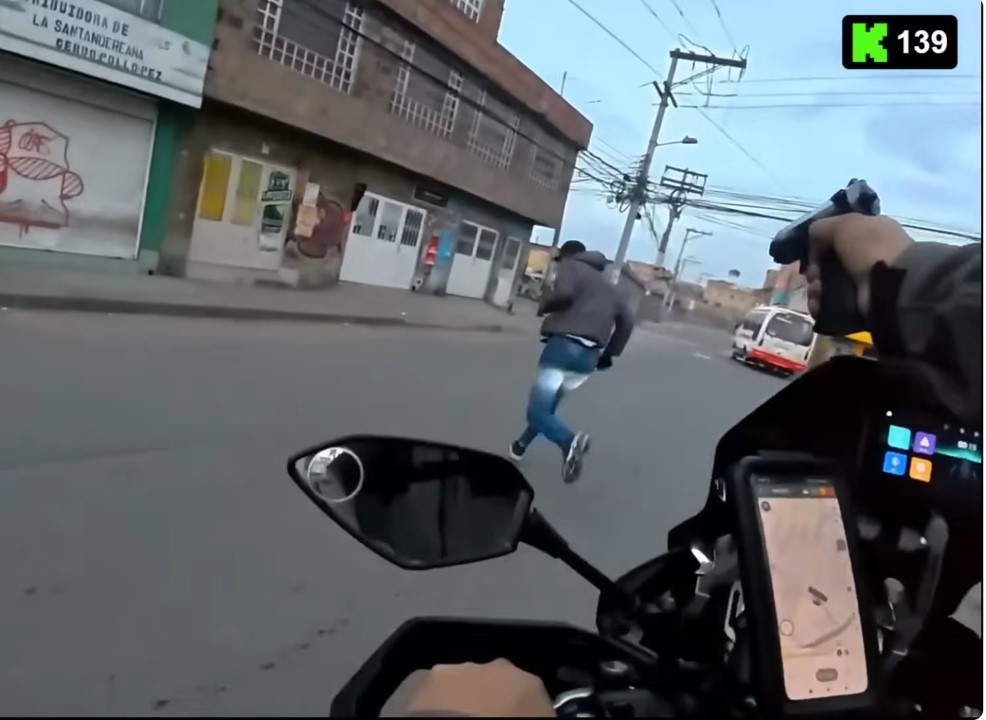
A more recent phenomenon in the city is the rise of fleets of armed private security guards mounted on motorbikes chasing down stolen vehicles.

Screenshot from Youtube video of private security guard opening fire on suspect car thief in downtown Bogotá. Vigilante firms are increasingly acting as law enforcement, often at risk to the public
Screenshot from Youtube video of private security guard opening fire on suspect car thief in downtown Bogotá. Vigilante firms are increasingly acting as law enforcement, often at risk to the public.

One company, Self Security GPS, uses satellite tracking and immobilizer devices to recover stolen vehicles, but also regularly posts alarming videos of their ‘commandos’ taking down car thieves, sometimes with dramatic shoot-outs on the street with passers-by diving for cover.

According to data from the mayor’s office, at the last count, there were 150,000 private security guards “supporting security in Bogotá” – far outnumbering the 17,500 uniformed police.

Increasingly though, frustration among everyday citizens has boiled over into drastic reactions to street crime. Such an attempt at instant justice ended in tragedy last week with three deaths after a Bogotá driver was robbed at gunpoint by two masked robbers on a motorbike; the victim gave chase and crushed the fleeing assailants with his pick-up truck. In the ensuing multi-vehicle crash one of the robbers was killed, along with two innocent travelers who also lost their lives.   

Statistically, not a good start to 2026.  

The post Bogotá reduces homicides in 2025 appeared first on The Bogotá Post.
  •  

Vocal on Gaza, Petro’s Silence on Iran Is Hypocrisy Incarnate

Colombian President Gustavo Petro has made Gaza the moral centerpiece of his foreign policy. Since the October 7, 2023, Hamas terror attacks, he has devoted extraordinary political capital to denouncing Israel, questioning its right to self-defense, and framing the Gaza war as a singular global emergency.

He summoned “Free Palestine” marches, spent public funds hosting solidarity concerts in Bogotá’s Plaza de Bolívar, donned a keffiyeh near Times Square alongside Roger Waters, branded Israeli Prime Minister Benjamin Netanyahu a “war criminal,” labeled Gaza a “genocide,” and even urged U.S. military personnel to disobey orders from President Donald Trump over Middle East policy.

The performance was theatrical, relentless – and costly. Petro’s visa to the United States was revoked. Months later, he was placed on the U.S. Treasury’s OFAC sanctions list alongside his close political ally and interior minister Armando Benedetti, as well as his wife – or estranged wife – Verónica Alcocer, whose marital status, according to Petro himself, remains mysteriously unresolved.

Yet for all this moral fervor, Petro has remained conspicuously silent on one of the gravest human rights catastrophes unfolding today: Iran’s brutal suppression of nationwide protests.

His silence is deafening.

Since protests erupted across Iran in late December 2025, the regime has responded not with reform but with terror. Demonstrators demanding economic relief, dignity, and political change have been met with live ammunition. Militiamen aligned with the Revolutionary Guards have swept through cities on motorbikes, firing automatic weapons into crowds. Snipers reportedly aim at faces and genitals. Morgues are overflowing. Bodies are stacked in blood-soaked streets.  More than 12,000 are believed dead. Thousands more have been dragged from hospital beds into prisons, many never to be seen again.

This is not metaphorical violence. These are not contested narratives. These are crimes against humanity carried out by a theocracy against its own citizens.

And yet – nothing from Petro.

The Iranian regime insists the unrest is a foreign-engineered plot: psychological warfare orchestrated by hostile powers to destabilize the Islamic Republic. The opposition, by contrast, sees a nationwide rupture—an uprising rooted in decades of repression, economic collapse, and the severing of legitimacy between rulers and ruled.

Narrative control matters. In modern conflict, perception is a battlefield. As scholars Ihsan Yilmaz and Shahram Akbarzadeh have noted, authoritarian regimes increasingly rely on Strategic Digital Information Operations—psychological warfare designed not merely to suppress dissent, but to reshape reality itself. The objective is cognitive: to induce fear, discredit opponents, and convince societies that resistance is futile.

Petro’s brand of performative moralism has not been cost-free. His compulsive need to condemn Israel – and, by extension, the United States – was read in Washington not as symbolism but as direct provocation. It coincided with a marked deterioration in U.S.–Colombia relations, freezing high-level dialogue, undermining security cooperation, and contributing to the unprecedented decision to revoke his U.S. visa. For a country whose military, intelligence, and counter-narcotics apparatus remains deeply intertwined with American support, the damage was neither abstract nor symbolic – it was strategic.

The rupture with Israel was even more explicit. By publicly referring to Prime Minister Benjamin Netanyahu as a “Nazi,” Petro crossed a diplomatic red line that few world leaders have dared approach. The comparison – historically illiterate, morally inflammatory, and deeply offensive- effectively severed Colombia–Israel relations. Defense cooperation was halted, diplomatic channels collapsed, and decades of bilateral engagement in security, technology, and trade were sacrificed to rhetorical escalation. Whatever one’s view of Israel’s conduct in Gaza, equating the Jewish state with the architects of the Holocaust is not principled criticism; it is diplomatic arson.

In both cases, Petro appeared less concerned with consequences than with signaling ideological virtue to a global activist audience. The result has been the erosion of Colombia’s standing with two key partners—one its most important ally, the other a longstanding strategic collaborator—while yielding no tangible benefit to the civilians whose suffering he claims to champion.

What makes Petro’s silence on Iran so damning is not merely its contrast with his Gaza activism; it is the exposure of a deeper incoherence. For years, leftist politicians, celebrities, and fringe groups have flooded streets in capitals around the world denouncing Israel’s war as “genocide.” Now, when protesters are machine-gunned in Iran, hospitals are raided, and young people are summarily executed, this outrage dissipates.

As Allister Heath wrote recently in The Telegraph, this is “pure, unadulterated evil… a stain on humanity.” And yet where are the chants? Where is the flotilla? Where are the luvvies? One might also ask: where is the Colombian president who claims human rights as his moral compass?

The answer is uncomfortable. Gaza became a performative ritual of sit-ins and campus “occupations.” The tragedy of Iran exposes the hollowness of that performance.

When Iran’s protests began in Tehran’s Grand Bazaar, authorities initially assumed they were manageable. Bazaar merchants—traditionally conservative and closely linked to the state—were seen as transactional actors seeking economic relief, not regime change. Even Supreme Leader Ali Khamenei acknowledged their grievances, a rare concession.

But the regime miscalculated. Protests spread to more than 25 provinces. Ethnic minorities—Kurds, Baluch, Arabs, and Azeris—joined despite deep skepticism about the opposition and fears of what might follow. The unrest evolved from economic protest into an existential challenge to the state, triggering a massacre reportedly claiming more than 6,000 lives.

Meanwhile, fears of chaos loom. Exiled figures such as Reza Pahlavi position themselves as transitional leaders, even as their proposed roadmaps concentrate power in ways eerily reminiscent of the current theocracy. The Syrian precedent—where Western intervention elevated jihadist actors rather than democratic forces—haunts the region.

None of this excuses silence.

President Petro has every right to condemn injustice – especially on his own soil, where human rights abuses by FARC dissidents and the ELN guerrilla continue to inflict immense suffering on Colombia’s most vulnerable. Yet here, too, the silence has been deafening: soldiers kidnapped, children cowering under desks amid gunfire in Cauca, an ongoing humanitarian catastrophe in Catatumbo that has displaced more than 60,000 people and quietly slipped from the government’s agenda.

For Petro, moral leadership is selective. If civilian lives matter, they matter everywhere. If state violence is intolerable, it is intolerable whether committed by an ally, an adversary, or a regime ideologically convenient to ignore.

Silence in the face of mass murder is not neutrality. It is complicity by omission.

Petro’s foreign policy has become a study in selective empathy – loud where ideology demands it, louder still on social media, but mute where principle requires courage. That is not moral clarity. It is hypocrisy incarnate.

  •  

Trump and Petro: Eagle Vs Jaguar

A week on from the extraordinary events of the third of January, where does Colombia stand, what happens next and what do people think?

Despite aggressive rhetoric, Colombian president Gustavo Petro and US president Donald Trump have ended up on relatively good terms over the last week after Maduro’s capture, and for now there appears to be a wary calm between the Palacio Nariño and the White House. It’s too early to talk of a bromance, but there’s certainly been a rapid de-escalation.

The US president pointedly praised Petro’s tone in his tweet after they spoke over the phone on Wednesday, indicating that the Colombian president had been rather less bullish one on one compared to his public speeches and tweets.

Petro also seems happy with the conversation, saying that he had cleared the air and underlining that he is not connected to the illegal drug trade. He pointed out that he has stepped up seizures of drugs and has in fact been threatened various times over his life by drug cartels.

Esto es Histórico.

Hablaremos con Trump, de la Paz del Continente, de la soberanía , de un Pacto por la Vida basado en las energías limpias. Se puede descarbonizar la matriz de EEUU si se vuelve real el potencial de energías limpias de Suramérica pic.twitter.com/0bqPP2lAYe

— Gustavo Petro (@petrogustavo) January 8, 2026

Petro had criticised his counterpart in the White House all week, convened protests against the US military’s actions in Venezuela and called an emergency meeting of the UN Security Council, of which Colombia is a temporary member.

However, Petro appears to have struck a far more conciliatory note when actually talking to the US president on Wednesday. For his part, Donald Trump also turned down the heat, saying it was a great honour to speak with the Colombian president and that they would talk further in person at the White House.

Petro has confirmed that this will take place in the first week of February. He’s also invited interim Venezuelan president Delcy Rodríguez to visit the Palacio Nariño for talks.

Alongside his usual flurry of tweets, Petro had been setting this in motion, with his Interior Minister (and former ambassador to Venezuela) Armando Benedetti sending a memo to the US underlining their commitment to fighting drug production.

Antagonism serves both sides

Petro has been highly critical of Trump’s actions in the Caribbean from the outset. He has warned Trump “not to wake the jaguar” and denounced his strikes on boats over the last few months.

Bad blood between the pair goes back a long way, but has really ramped up in recent weeks. Even before the extraordinary events of last weekend, Petro’s fierce criticism of the military build up in the Caribbean had led to him and his estranged wife Veronica Alcócer being stuck on the Clinton List.

The truth is that antagonistic public rhetoric plays well for both Petro and Trump, regardless of how much damage it may do to the reputation of either country. They both get to play the big man and impress their base, which both need right now in the face of domestic woes.

Presidente Donald J. Trump sobre la llamada con el Presidente Gustavo Petro: https://t.co/1lTgSYF8hb

— US Embassy Bogota (@USEmbassyBogota) January 8, 2026

Trump doesn’t seem to mind Petro’s words, as long as he gets his way. That fits with his previous actions, including his fallout when running against current Secretary of State Marco Rubio. He says Petro’s been very hostile, but that’s all in the past.

For Petro, this also sets him up nicely for his post-presidential life. In an interview this week he expressed a desire to tour the world speaking at conferences and the international exposure this week has been good for that. On top of that, Trump will likely lift the restrictions on him and his family as a reward for toeing the US line.

What’s the feeling in the calles?

One could have been forgiven for not noticing the midweek protests. Despite the best efforts of hyperbolic foreign journos, Bogotá has been far from a seething cauldron of dissent. In reality, a few hundred Petro diehards trooped out as expected.

Most Colombians are well aware of the reality of Maduro’s rule and the abuses carried out in its name. Apart from a very few outliers, there is no love lost for Nicolás Maduro and an overwhelming satisfaction that he’s no longer Venezuelan president.

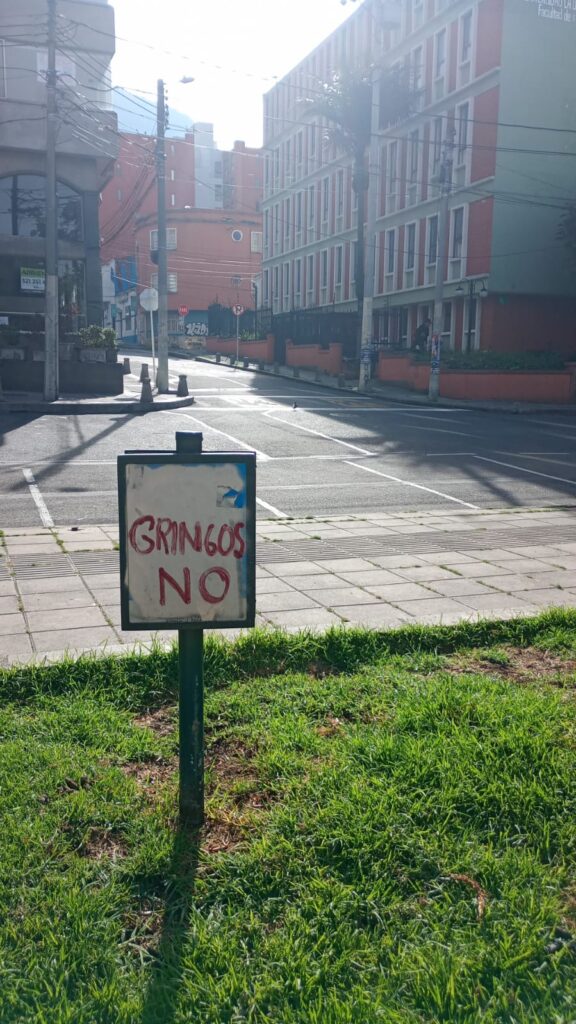
Not the most welcoming sign in Chapinero

That’s not to say, though, that Colombians are wildly happy about the current situation. Colombia is a very different country to her neighbour, but there remains a relatively well-founded concern among many that there may be attacks on Colombian territory.

Anti-American sentiment is not exactly thriving, but graffiti and the like is already going up in certain parts of the city. There’s little to no appetite in the country for any US military activity in Colombia, even against cartels or guerrillas.

Worries still linger over the possibility of other repercussions. The waits for American visas have only just started to come down, with new appointments a year hence. Many worry that will increase again and that extant visas for expat Colombians may be affected too.

Tariffs, too, are never far from people’s minds, although Trump’s current position towards Colombia seems to be benign. Tourism will possibly be affected, both in the short and medium term.

Of course, Bogotá has a thriving Venezuelan expat community as well. While there is general delight at Maduro being arrested, there remain justifiable fears over what comes next. Delcy Rodríguez is seemingly no-one’s first choice and most hope for the promise of free and fair elections.

The Plaza de Bolívar and many others around both Bogotá and Colombia have seen large groups of Venezuelans gathering both to celebrate Maduro’s fall and to call for a transition towards a proper democracy. Most, however, are just getting on with life and wary of reading too much into things at present.

A particular trend has been for exiled Venezuelans to take to social media in order to decry what they often see as ‘Venezuelasplaining’. Many accounts are keen to point out that while the US might only be interested in oil, neither were China, Russia and Iran after arepa recipes.

Venezuelan man:

“Those who say that the U.S. is only interested in our oil, I ask you: What do you think the Russians and the Chinese wanted here?

The recipe for arepas?" pic.twitter.com/BWpCmCxFGI

— Visegrád 24 (@visegrad24) January 4, 2026
Obviously they’d go to Boyacá for arepa recipes

As for other Colombian politicians, there’s been a mixed reaction. The Centro Democrático has had a well-coordinated and fierce response, aggressively trying to connect Petro and his allies to Maduro, with some success.

Others are resisting the temptation to use Venezuela as a political football, preferring to cautiously celebrate Maduro’s capture while expressing concern both about the manner it was done and the current political inclarity in the country.

What happens next?

For now, Delcy Rodríguez appears to be in control of Venezuela. She’s been sworn in as president and Trump says she’s committed to working with Washington. That means allowing US oil companies in, buying American goods and stopping shadow fleet sales.

While Trump had initially been dismissive of Maria Corina Machado, saying she had little support or respect in Venezuela, he’s changed his position a little and has a meeting lined up with her soon. This may be connected to her apparent offer to share her Nobel Peace Prize with him.

Regime enforcers have been on maneuvers throughout the past week to quieten internal dissent and quell momentum towards thoughts of a full democratic transition. The ELN has stepped up operations near to the Venezuelan border and Iván Mordisco has suggested a coalition of guerrillas to fight interventionism.

Plenty remains unclear about the whole situation. Trump has expressed a lot of opinions and thoughts but hasn’t elaborated on what the details behind any of it might be. There’s also a worrying lack of corroboration from other players. 

Rodríguez and Petro haven’t really confirmed his takes on their talks, nor have oil companies definitively committed to full investment. At the moment, it seems like all parties are reasonably happy with the state of play but keeping options open. 

Petro gets to play the plucky leader standing up to US imperialism, shoring up his party’s base at home ahead of coming elections while burnishing his reputation overseas. Trump gets to be the decisive commander in chief that took out a rival, while Rodríguez has received a promotion.

For now, it really could go in a number of different directions and small actions might be the things that push the country in certain directions. There are lots of cards on the table and plenty of big decisions to be taken.

Worryingly, the most likely scenario at the moment seems to be that the regime continues in power, just with a new leader and a new-found willingness, however reluctant, to work with the USA. For the ordinary Venezuelan, tragically, little much has changed as things stand.

The post Trump and Petro: Eagle Vs Jaguar appeared first on The Bogotá Post.

  •  
❌