Reading view

Colombia, Ecuador in trade and energy spat after Noboa announces 30% “security” tariff

Colombia and Ecuador have started exchanging trade retaliations after Ecuadorian President Daniel Noboa announced a 30% “security” tariff on imports from Colombia, escalating tensions between Andean neighbours over border security cooperation.

Noboa said the measure would take effect on Feb. 1 and would remain in place until Colombia shows “real commitment” to jointly tackle drug trafficking and illegal mining along the shared frontier. He made the announcement from Davos, where he is attending the World Economic Forum.

“We have made real efforts of cooperation with Colombia… but while we have insisted on dialogue, our military continues facing criminal groups tied to drug trafficking on the border without any cooperation,” Noboa said in a post on X, citing an annual trade deficit of more than $1 billion.

Colombia’s foreign ministry rejected the tariff in a formal protest note, calling it a unilateral decision that violates Andean Community (CAN) rules, and proposed a ministerial meeting involving foreign affairs, defence, trade and energy officials on Jan. 25 in Ipiales, Colombia’s southern border city.

The government of President Gustavo Petro also announced a 30% tariff on 20 products imported from Ecuador in response, though it has not specified the items. Diana Marcela Morales, Colombia’s Minister of Commerce, Industry and Tourism (MinCIT) said Ecuador’s exports covered by the retaliatory measure total some $250 million, and described the policy as “temporary” and “revisable.”

Fedexpor, Ecuador’s exporters federation, said non-oil exports to Colombia rose 4% between January and November 2025, and that the Colombian market receives more than 1,130 Ecuadorian export products. The top exports include wood boards, vegetable oils and fats, canned tuna, minerals and metals, and processed food products.

The dispute has also spread into the energy sector. Colombia’s Ministry of Mines and Energy said on Thursday it had suspended international electricity transactions with Ecuador, citing climate-related pressure on domestic supply and the need to prioritise national demand amid concerns over a possible new El Niño weather cycle.

Ecuador has struggled with severe droughts in recent years, triggering long power cuts in 2024 and 2025 in a country where roughly 70% of electricity generation depends on hydropower, while Colombia has supplied electricity during periods of shortage.

President Petro noted that Colombia acted in solidarity during Ecuador’s worst drought in 60 years. “I hope Ecuador has appreciated that when we were needed, we responded with energy,” Petro said on Wednesday.

Following Colombia’s electricity suspension, Ecuador announced new tariffs on transporting Colombian crude through its heavy crude pipeline system. Environment and Energy Minister Inés Manzano said the oil transport fee through the OCP pipeline would reflect “reciprocity,” without giving details.

Colombia and Ecuador share a 600-kilometre border stretching from the Pacific coast to the Amazon, where Colombian armed groups and criminal networks operate, including organisations involved in drug trafficking, arms smuggling and illegal mining. Relations between Petro and Noboa, who sit on opposite ends of the political spectrum, have frequently been strained.

  •  

Trump floats U.S. military action against Colombia after Maduro capture

U.S. President Donald Trump escalated rhetoric toward Colombia on Sunday, suggesting that a U.S. military operation against the country — which he said could be dubbed “Operation Colombia” — was a possibility following Washington’s capture of Venezuelan dictator Nicolás Maduro.

Speaking to reporters aboard Air Force One, Trump described Colombian President Gustavo Petro as “a sick man” and accused him of overseeing cocaine production destined for the United States.

“Colombia is run by a sick man who likes making cocaine and selling it to the United States,” Trump said. “And he’s not going to be doing it very long. Let me tell you.”

When asked directly whether he meant a U.S. military operation against Colombia, Trump replied: “Sounds good to me.”

Trump’s remarks came a day after the United States announced it had captured Maduro in a military operation in Caracas, an unprecedented move that has sent shockwaves across Latin America and raised fears of further U.S. interventions in the region.

Trump said the United States could also consider military action against Mexico if it failed to curb the flow of illicit drugs into the country. He added that Venezuelan migrants in the United States were among the factors considered in the raid against Maduro.

Trump also warned that Cuba, a close ally of Venezuela, was “a failing nation” and said its political future was “something we’ll end up talking about.”

Maduro is currently being held in a New York detention center and is expected to appear in court on Monday on drug trafficking charges. Trump said his administration would seek to work with remaining members of the Venezuelan government to crack down on drug trafficking and overhaul the country’s oil sector, rather than push immediately for elections.

Despite Maduro’s capture, Venezuela’s Vice President and oil minister, Delcy Rodríguez, has assumed interim leadership with the backing of the country’s top court. Rodríguez has insisted that Maduro remains Venezuela’s legitimate president and has denied Trump’s claim that she is willing to cooperate with Washington.

In an interview published by The Atlantic on Sunday, Trump warned that Rodríguez could “pay a bigger price than Maduro” if she failed to cooperate with the United States. Venezuela’s communications ministry did not immediately respond to a request for comment.

Petro denounces U.S. threats

Trump’s comments prompted an immediate and forceful response from Petro, who accused the U.S. president of slander and warned that Latin America risked being treated as “servants and slaves” unless it united.

“Stop slandering me,” Petro said, calling on regional leaders to close ranks in the face of what he described as renewed U.S. imperial aggression.

In a series of lengthy posts on X, Petro said the United States had crossed a historic line by bombing Caracas during the operation to capture Maduro.

“The United States is the first country in the world to bomb a South American capital in all of human history,” Petro wrote. “Neither Netanyahu, nor Hitler, nor Franco, nor Salazar did it. That is a terrible medal, one that South Americans will not forget for generations.”

Petro said revenge was not the answer but warned that the damage would be long-lasting.

“Friends do not bomb each other,” he said, likening the attack on Caracas to the Nazi bombing of Guernica during the Spanish Civil War.

Instead, Petro urged deeper regional integration, arguing that Latin America must look beyond alignment with global powers.

“We do not look only to the north, but in all directions,” he said. “Latin America must unite or it will be treated as a servant and not as the vital center of the world.”

In a separate post, Petro issued a stark message to Colombia’s armed forces, ordering commanders to immediately remove any officer who showed loyalty to the United States over Colombia.

“Every Colombian soldier has an order from now on,” Petro wrote. “Any commander of the public forces who prefers the U.S. flag over the Colombian flag must immediately leave the institution.”

Petro said the armed forces were under orders not to fire on civilians but to defend Colombia’s sovereignty against any foreign invasion.

“I am not illegitimate. I am not a narco,” Petro wrote, rejecting Trump’s accusations. “I trust my people and the history of Colombia.”

Colombia’s first leftist president and a former member of the M-19 guerrilla movement also raised the spectre of a return to armed struggle, saying that while he had sworn under the 1989 peace pact never to take up weapons again, he would do so if Colombia’s sovereignty were threatened.

“I am not a military man, but I know war and clandestinity,” Petro wrote. “I swore never to touch a weapon again, but for the homeland I would take up arms once more, even though I do not want to.”

Rising fears of wider intervention

Trump’s warnings to Colombia were not his first. In the immediate aftermath of Maduro’s capture, he said Petro needed to “watch his ass” and suggested that Cuba’s political collapse was imminent.

The comments have heightened anxiety across the region, where governments are closely watching Washington’s next moves following the Caracas operation.

In Venezuela, a state of emergency has been in force since Saturday. A decree published on Monday ordered police to “immediately begin the national search and capture of everyone involved in the promotion or support for the armed attack by the United States,” according to the text.

Caracas remained largely quiet on Sunday, though residents reported a tense atmosphere as uncertainty mounted over the country’s political future and the possibility of further U.S. action.

For Colombia – a key U.S. ally that shares a 2,000-kilometre border with Venezuela, a country the Trump administration has said it will “run” in the aftermath of Saturday’s seizure of Maduro – the remarks mark the most explicit threat of U.S. military action in more than two centuries of diplomatic relations, and an ominous deterioration in already strained ties between Washington and Bogotá.

  •  

Trump praises “brilliant” military operation against Venezuela’s Nicolás Maduro

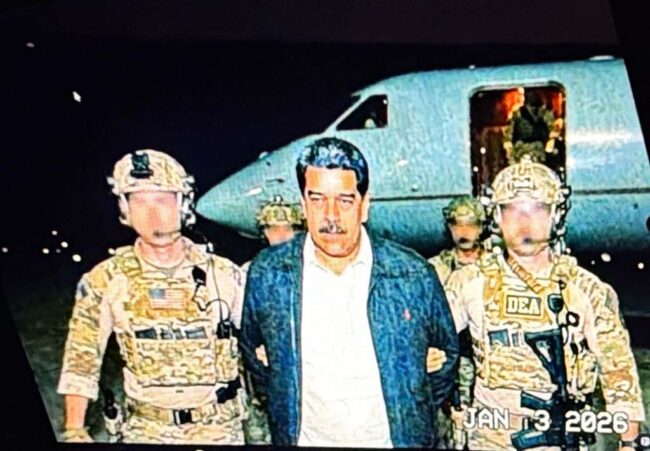
U.S. President Donald Trump has hailed as “brilliant” the U.S. military operation that resulted in the capture of Venezuelan dictator Nicolás Maduro, as explosions were reported in Caracas early Saturday. Governments across the Americas and Europe are reacting to the arrest of the Maduro and his wife Cilia Flores.

In a brief telephone interview with The New York Times hours after the strikes, Trump praised the planning and execution of the operation. “A lot of good planning and a lot of great, great troops and people,” Trump said. “It was a brilliant operation, actually.”

Trump said U.S. forces carried out a large-scale strike against military targets in Venezuela and captured Maduro and his wife, Cilia Flores, who were flown out of the country. He has not disclosed where they are being held. The U.S. administration claims there were no American casualties in the operation but declined to comment on Venezuelan casualties.

Venezuelan authorities have yet to confirm Maduro’s capture. Vice President Delcy Rodríguez said on state television that the whereabouts of Maduro and Flores were unknown and demanded “proof of life” from Washington.

Interior Minister and the regime’s henchman Diosdado Cabello urged calm, telling Venezuelans not to “make things easier for the invading enemy,” and alleged without evidence that civilian buildings had been hit.

In a separate statement broadcast on state television VTV, Venezuela’s Attorney General Tarek William Saab formally requested proof of life for Maduro and Flores. Saab condemned the U.S. action as a shift “from rhetoric to direct violence” and described the strikes as a premeditated act of terrorism. He said the operation left an unspecified number of people injured and killed, without providing figures or evidence.

Explosions were reported across Caracas in the early hours of Saturday, with power outages affecting several districts, according to witnesses and local media. Venezuelan state outlets reported strikes on major military and government sites, including Fuerte Tiuna, the country’s largest military base, and the La Carlota air base in heart of the capital.

According to sources inside Venezuela, pro-opposition supporters aligned with Venezuela’s legitimate president-elect Edmundo González and Nobel Peace Prize laureate María Corina Machado have begun mobilizing to secure government buildings and institutions and are preparing steps toward a political transition. Sources claim to be preparing the groundwork for what they describe as a interim administration, though no formal announcement has been made.

The U.S. embassy in Bogotá issued a security alert urging American citizens in Venezuela to shelter in place, citing “reports of explosions in and around” Caracas. The United States suspended operations at its embassy in Caracas in 2019.

Bogotá Mayor Carlos Fernando Galán called for calm and announced increased security measures near the U.S. and Venezuelan diplomatic missions in the Colombian capital.  “It is clear that a new stage is opening today for Venezuela, which should be oriented toward the return of democracy. That process must be peaceful and with full respect for the civilian population and international law. At this moment, the protection of Venezuelan citizens, both within their country and abroad, is a priority. Bogotá is home to hundreds of thousands of Venezuelan citizens, and our responsibility is to ensure their safety, their rights, and coexistence in the city,” he said.

Maduro was indicted in the United States in 2020 on corruption and drug trafficking charges, which he has repeatedly denied. The U.S. State Department has offered a $50 million reward for information leading to his arrest or conviction.

U.S. Attorney General Pamela Bondi said Maduro and Flores had been indicted in the Southern District of New York on charges including narco-terrorism conspiracy and cocaine importation conspiracy, adding that both would face U.S. justice.

Republicans react to Venezuela strikes

U.S House Representative María Elvira Salazar, a Florida Republican and outspoken critic of the Maduro government, said the strikes represented “the fall of a criminal structure masquerading as a government.” She said Maduro’s removal opened the door for “a real democratic transition led by Venezuelans who have resisted tyranny for years.”

Republican Senator Carlos Gimenez affirmed that “President Trump has changed the course of history in our hemisphere. Our country and the world are safer for it. Today’s decisive action is this hemisphere’s equivalent to the Fall of the Berlin Wall.”

Senator Rick Scott announced “A new day for Venezuela and Latin America. The United States and our hemisphere are safer because of President Trump’s leadership!”

U.S. Deputy Secretary of State Christopher Landau said in a social media post that Maduro had been removed from power and would be put on trial or punished, without providing further details.

Reactions from Latin America

Former Colombian President Álvaro Uribe Vélez defended the U.S. action as legitimate self-defense, arguing that Venezuela had for years harbored armed groups and facilitated drug trafficking. Uribe said that when a country becomes “a sanctuary for narco-terrorism,” it inevitably triggers consequences. He accused Venezuela’s leadership of destroying democratic institutions and fueling an exodus of millions across the region, urging Venezuelans to pursue freedom and institutional reconstruction.

Former Colombian President Iván Duque also welcomed the development, calling Maduro’s capture “the beginning of the end of the narco-dictatorship in Venezuela.” Duque said the moment opened a path toward democratic reconstruction with international support, while emphasizing the need to protect regional security.

Colombia’s current President Gustavo Petro took a sharply different view, rejecting what he called aggression against Venezuela’s sovereignty. Petro said Colombia had deployed security forces to its border and activated contingency plans in case of a mass influx of refugees, while seeking to convene the United Nations Security Council. “Internal conflicts between peoples are resolved by those same peoples in peace,” Petro said.

Argentina’s President Javier Milei struck a celebratory tone, posting on “X”: “Long live freedom, carajo!”

Ecuador’s President Daniel Noboa voiced support for Venezuela and the opposition. “To María Corina Machado, Edmundo González and the Venezuelan people, it is time to recover your country,” Noboa wrote, adding that what he called “narco-Chavista criminal structures” would continue to fall across the continent.

Colombian presidential candidate Paloma Valencia of the Centro Democrático party was among the first to react to the breaking news, stating: “Free Venezuela. The illegitimate dictator who usurped power, and subjugated Venezuela and the Venezuelans, has fallen. Democrats yearned for an opportunity for the return of democracy and freedom.”

Medellin Mayor Federico Gutiérrez also celebrated the arrest of the regime leader, saying: “Dictator Nicolás Maduro has been captured. Every tyrant’s time comes. Venezuela Free.”

Spain’s Prime Minister Pedro Sánchez has urged restraint and respect for international law, while Cuba’s President Miguel Díaz-Canel condemned the  “criminal attack” by the United States.

As of Saturday morning, no senior Venezuelan military official, including Defense Minister Vladimir Padrino, had appeared publicly, and it remained unclear who controlled key state institutions or how Venezuela’s armed forces would respond as the crisis continued to unfold.

Screen capture from television shows DEA agents escorting Venezuela’s Nicolás Maduro.
  •  

Daniel Giraldo of FTI Consulting Unpacks The Significance of Colombia Joining China’s Belt & Road Initiative

In an era of shifting global economic alliances, few countries find themselves more strategically positioned than Colombia. Caught between the massive state-backed investment initiatives of China and the established political and economic influence of the United States, Bogotá’s policy decisions have never held higher stakes for investors, the region, or especially, the country’s own citizens.

At the 2025 Colombia Gold Summit, Finance Colombia Executive Editor Loren Moss spoke with Daniel Giraldo, a Managing Director at FTI Consulting (NYSE: FCN), a global business advisory firm specializing in cross-border investment and corporate finance. Giraldo offered his perspective on the geopolitical chessboard, examining what Colombia’s recent decision to join the Belt and Road Initiative means for its future relationship with its largest long-standing ally, the United States.

Finance Colombia: I’m here with Daniel Giraldo of FTI Consulting. So we’re here at the 2025 CGS, Colombia Gold Summit, where we also talk about other precious metals, we talk about silver, we also talk about metals like copper, molybdenum, things like that. You gave an interesting talk yesterday, I don’t want to steal your thunder. Why don’t you summarize your discussion?

Daniel Giraldo: Well, if I could summarize my lecture yesterday, I think there’s a chessboard, a giant global chessboard right now. And there are two main players: US and China. And Colombia is one key figure, a key part of this chessboard. Right now, Colombia is in a key position with lots of opportunities between Chinese investment and the US investment. However, which decisions Colombia takes right now will shift the entire game for the coming years.

Finance Colombia: So we are in the last few months of a government that has been relatively friendly or biased towards China. And hostile might be too strong of a word, but relatively cold towards the United States, talking about the Petro government. Colombia, under Petro, just signed up for the Belt and Road Initiative. What is the significance of that for Colombia, not just in its relationship with the United States, but what does that do or change for Colombia?

Daniel Giraldo: Well, what we are seeing right now is that Colombia signed formally the Belt and Road Initiative earlier this year. And there’s been a lot of tensions with the Trump government. At the same time, the US is the main investor in Colombia. And what we’re seeing is how China, through different initiatives, wants to have a bigger long-term influence in the region. And Colombia is, in a soft way, saying, “We want that for us.” However, that’s not a shift that can be made automatically. That’s not made in a single signature by one president. It takes years and years to forge a relationship. And although the government of Petro, President Petro is showing how they’re very interested in the Chinese investment, and to have a strong relationship with the Chinese government, it’s not the way, to just step out of their major alliances throughout years with the US

Finance Colombia: The way that investment is done in China is fundamentally different than the way investment is done from places like the US or Canada or many European countries. In the US, if you’re going to attract investment in Colombia, it’s going to be with some company. And that company is going to do what it wants to do within the law but not really giving a damn about what Washington says or what Washington wants or what Ottawa says or wants. Whereas in China, it’s very much a government-to-government thing. You have state-owned enterprises, and Xi Jinping or the Communist Party says, “we’re going to invest in this,” whether it’s profitable or not, for whatever kind of geopolitical reasons that they want to do things. So it’s a fundamentally different thing.

If you do a deal with a company in the US, you’re doing a deal with that company. Now, yes, you have to make sure that regulatory things go through. Trump is a little bit more of a patronage type of president where he wants to get involved with things so he can find benefit for himself or his administration. But generally speaking, even still, if we look at investors, if you’re going to bring in someone to invest in one of these mining companies here or exploration, it’s a company. In China, it’s going to be a state-backed company. Now, what does that imply, then, for the way business would be done going forward, number one? And number two, Petro’s on his way out, and maybe there will be another left-wing government to continue his project, it doesn’t look like it at this point. But do you see continuity in that affinity or that participation in the Belt and Road Initiative? Like you mentioned, it’s not a treaty, it’s more of like a memorandum of understanding, like the diplomats like to call it. But what do you foresee over the next two or three years?

Daniel Giraldo: Yeah, I believe every tactic has been launched in a very moderate way somehow. So, of course, Belt and Road is just a framework, and every project that could be contemplated by Chinese government, depending on the feasibility of each one of these projects. So they’re not basically getting married yet, they’re just dating.

They’re just on their first dates. However, we’re married to the US We’ve had a long-standing marriage, and what we are seeing right now is that how investment works for both countries is different. However, for both countries, there are more and more, basically, things they require to be approved.

So in order to achieve this, the US is not being indirect about it. They require trusted partners. They require trusted allies, which get what’s at stake right now. So, Petro’s government has one year left. We are expecting a shift. However, even if Colombia gets a left-wing government or a right-wing government, it doesn’t change the fact that investment in the latest years has been in a rough place.

So Colombia requires this investment, and the country requires a very stable policy framework, regulatory framework, legal framework, in order to get investors feeling safer, with more appeal. And, yes, of course, it’s not the same as an SOE (State Owned Enterprise) Chinese company that wants to invest, that needs the approval of Beijing and all this. In contrast, we have the US. Of course, Washington can say whatever they want. They can say Petro is now on the Clinton list, and they can sanction him personally. But a company, a US company, can still invest here; it changes how they see Colombia in the long run.

Finance Colombia: I think one of the things that is very notable is that the Trump government sanctioned Petro, his son, his wife, and his interior minister personally, rather than imposing sanctions on the country or doing, like, I don’t know, tariff things. Actually, by the time we publish the video, we might know what happens, but right before the Supreme Court right now, actually as we speak, there is a challenge to Trump’s ability to circumvent congressional law. And so if we have a trade pact, like free trade agreement or something like that, a lot of businesses in the US have challenged Trump’s ability to just… you can’t just cancel a law. Congress passed a law, and it’s in effect, and you can’t just cancel it. Well, that’s what they’re arguing. And all of these kind of unilateral, discretionary tariff moves that affect entire economies and entire industries, there’s some uncertainty that is going to be settled there.

“However, we’re married to the US We’ve had a long-standing marriage, and what we are seeing right now is that how investment works for both countries is different.” – Daniel Giraldo

But it’s interesting because it seems that with them sanctioning Petro and Benedetti directly as individuals, they’re saying that they want to maintain some predictability and constancy in the bilateral economic relationship with Colombia. And I think that there have been a lot of missions. Fico, the mayor here in Medellin, some of the other mayors and Colombian congressional people have visited Washington and met with senators and met with people in the State Department and said, “Look, you know, we disagree with what the president’s doing. Wait a few months.” And it seems like Washington has heard that and is not acting too rashly towards Colombia as a country but rather decided to take their ire out directly on the president and his consigliere Armando Benedetti.

Daniel Giraldo: What I believe of this is that Trump’s government can say like, “We’re not afraid. We are not afraid of imposing sanctions. We’re not afraid of not conducting business in the way we used to do it anymore.” And it’s been shown, for example, in the relationship with China, for example, with the Chinese government, with Xi Jinping. And there’s been like an escalation of tariffs, for example, I think up to 130%. I can’t remember the exact number. And then last week they say, “let’s stop this. Let’s trade the sequels.” And it’s also their way of showing the carrot and then showing the mace or bat, this metaphor.

Finance Colombia: Yeah, the stick.

Daniel Giraldo: And with Colombia, I believe it is the same. It’s like we could, if we wanted, to give some sanctions and they will have great consequences in terms of our bilateral trade. However, they’re aware of their position. They’re our main investor. We have a very good relationship in bilateral trade. There’s been years and there’s been decades of both countries benefiting from each other. We have a great position in one of the closest countries to enter South America. And they know this government is just ending. So why would they give us, like give the left-wing parties an opportunity to just bash them and say, “Oh, Trump’s government can’t be trusted.” Whereas if you take another position and say, “Look, this is personal, this is just these individuals, not the whole country.” You still have ground to negotiate, to renegotiate, to benefit. So I believe it is quite tactical.

Finance Colombia: Another thing that you mentioned is the difference on the ground. When you look at, for example, if we talk about the mining sector, not just on the ground, but literally in the ground, the US right now, the Trump administration, and really just the US more broadly, is very concerned about rare earths. And Colombia, even though there’s not yet a lot of mining activity, Colombia does have rare earth potential. There’s already been illegal coltan, cobalt ore mining taking place down in the Amazon, things like that. But it would seem that further damaging relationships with Colombia right now would contravene the political strategy in the US to strengthen its rare earth mineral supply chain.

Daniel Giraldo: Yes, it is completely true. The US has shown how important it is for them to be less dependent on the supply chains of the Chinese government, specifically in terms of their rare earths and critical minerals refining processes. So the US has been in recent weeks signing lots of memorandums of understanding and bilateral agreements with Australia, with Japan, with Malaysia, with Thailand. And they already have very good deals with Argentina, with the Mineral Security Partnership, for example, Mexico, Peru, Argentina. And the Dominican Republic. And Colombia could be in the radar as well. And what Colombia requires to be here and to benefit with the US as well is just to be patient, to get the best and the highest standards of ESG, and to reassure the different governments that it is safe to trade minerals with Colombia. That if they purchase Colombian minerals, they explore the region and they trade with us, they will find quality, they will find high standards of minerals, without assuming lots of risks that these markets don’t want to assess anymore.

Finance Colombia: So longer term, looking out three to five years, are you optimistic or pessimistic about the bilateral relationship between the US and Colombia?

Daniel Giraldo: I feel optimistic, not only because it’s the most comfortable answer, but I do feel optimistic because I believe there is a lot of potential. And right now, the sector is not in its best place. But I believe that sometimes you just have to grit your teeth, take the punch, and then stand up again and do everything that’s in your power to just become better. And Colombia has a history of learning, and the sector will learn as well how to be more competent, how to attract investors, and how to get to the highest standard and quality of their bilateral trade with different countries.

Finance Colombia: Great. Well, Daniel Giraldo from FTI Consulting, you guys are one of the leading strategic consulting firms globally, especially when you look at things like cross-border investment. That seems to be your strong suit, even though you guys are a large firm and you guys do a lot of different things. Always great to see your presence here at CGS, at Colombia Gold Summit. And thanks for your insights.

Daniel Giraldo: It’s a pleasure, thanks for having me.

  •  

Colombia’s Petro Calls Chile’s President-Elect José Kast a “Nazi”

Colombia’s president, Gustavo Petro, triggered yet another diplomatic rupture in South America on Sunday after denouncing Chile’s president-elect, José Antonio Kast, as a “Nazi,” rejecting the legitimacy of Chile’s democratic choice and sharply diverging from the cautious language typically observed between regional leaders.

Petro’s remarks came within hours of Kast’s decisive victory in Chile’s presidential runoff, in which the conservative candidate secured more than 58 per cent of the vote, defeating hard-left contender Jeannette Jara. Jara conceded promptly, saying that “democracy has spoken loud and clear” and wishing Kast success “for the good of Chile.”

Petro, however, used his social media platform X to frame Kast’s victory as evidence of an advancing wave of fascism in Latin America. “Fascism advances. I will never shake hands with a Nazi or a Nazi’s son, nor will I; they are death in human form,” the Colombian president wrote.

In a retort that called for Chileans to “take care of Neruda’s tomb,” Petro went on to equate Kast’s electoral mandate with the legacy of former dictator Augusto Pinochet. “It’s sad that Pinochet had to impose himself by force, but sadder now is that the people choose their Pinochet: elected or not, they are sons of Hitler and Hitler kills the people,” Petro said, adding that Latin Americans “know how to resist.”

The language marked one of the most explicit attacks by a sitting South American president on a democratically elected counterpart in recent years and raised immediate concerns about the state of Colombia – Chile relations, historically among the region’s most stable.

Kast’s victory completes a broader rightward shift in South American politics, following the election of Javier Milei in Argentina, Daniel Noboa in Ecuador and Nayib Bukele in El Salvador, while Bolivia recently ended nearly two decades of socialist rule with the election of centrist Rodrigo Paz. Petro, the region’s most unhinged left-wing leader, with just eight months remaining in his presidential term, appeared to ignore the potential diplomatic fallout of his remarks.

Within hours of Petro’s statement, US Republican Congressman Carlos Gimenez responded sharply, writing: “This guy (Petro) went too far with the drugs and alcohol. This is the real Gustavo Petro: incoherent, hateful, and schizophrenic.”

Former Colombian president Álvaro Uribe Vélez praised Chile’s electoral process and congratulated Kast, saying the vote had taken place peacefully and reflected citizens’ concerns about security and institutional stability. Uribe described Kast as “a guarantee for democratic institutions” in Chile and the wider region.

Another former president, conservative Andrés Pastrana, issued a sharply worded rebuke of Petro, saying the comments were “inappropriate and irresponsible” and did not represent Colombians nor the long-standing spirit of cooperation between Bogotá and Santiago.

Criticism also came from current lawmakers. Federico Hoyos, a congressman from the department of Antioquia, said Petro had “abandoned his role as head of state” and was acting instead as an “ideological agitator “unwilling to engage with leaders who do not share his views. Andrés Forero, a House representative from the opposition Centro Democrático party, accused Petro of disrespecting the sovereign will of Chilean voters, telling Colombians: “Let’s not fool ourselves, Petro is not a democrat.”

While Petro reviles diplomacy, Kast received public congratulations from international figures across the hemisphere. María Corina Machado, Venezuela’ opposition leader and 2025 Nobel Peace Prize Laureate, praised Chile’s election as “an extraordinary electoral day, an example for many nations of Latin America and the world.”

Addressing Kast directly, Machado wrote: “To the president-elect of Chile, José Antonio Kast, I send my affection and congratulations for the trust he has received. In the name of the Venezuelans, I wish him great success in his government.” She added that Venezuelans hoped to count on Kast’s support “to ensure an orderly transition to democracy in Venezuela” and to help build “a safe, prosperous and free hemisphere.”

Machado’s intervention was notable given her continued persecution by the regime of Nicolás Maduro and her public appearance at the Nobel ceremony last week in Oslo, her first in more than a year.

The United States also welcomed Kast’s victory. Secretary of State Marco Rubio said Washington looked forward to working with the incoming administration “to strengthen regional security and revitalise our trade relationship.”

Kast’s transition team said the president-elect would travel to Argentina this week to meet President Javier Milei, signalling an intention to align closely with like-minded governments in the region.

For Petro, the episode reinforces international perceptions that he has become an anachronism of regional politics — reliant on social-media provocation and historical revisionism.

For all the historical accuracy that seems to elude Petro, membership in Adolf Hitler’s National Socialist Party was not voluntary. While many Germans joined out of conviction, others were pressured or effectively compelled to enrol, particularly to obtain employment, documentation or travel permits. During and immediately after the Second World War, Germans seeking to live or work abroad — including in South America — were often required to disclose or document prior party affiliation to secure passports and legal work status, complicating later assessments of individual responsibility.

Michael Kast, born in 1924 in Thalkirschdorf, Bavaria, emigrated in Chile in 1946. His youngest son, José Antonio Kast (born 1966, Santiago) has repeatedly claimed his father was a Third Reich conscript.

Whether the outburst leads to lasting diplomatic consequences remains uncertain. But it has underscored how electoral change in Latin America is now accompanied not only by sharp policy shifts, but by open rhetorical conflict by a Colombian leader increasingly isolated among his regional peers, except for one ally, Venezuelan dictator Nicolás Maduro.

On Monday afternoon, Chile’s Minister of the Interior, Álvaro Elizalde, confirmed that a Letter of Protest will be sent to President Petro, stating in no uncertain terms that: “A decision has been made to uphold the point of view that has to do with Chilean democracy. Ultimately, the people of Chile decide, and we all have to respect that outcome”.

  •  

Colombia’s FM Snubs Machado’s Nobel Peace Prize After Daring Escape

Colombia’s Foreign Minister Rosa Villavicencio declared Thursday that the Government of President Gustavo Petro is “not in agreement” with the Nobel Peace Prize awarded to Venezuelan opposition leader María Corina Machado – a position that signals how Colombia remains a close ideological ally of one of the hemisphere’s most authoritarian states.

In remarks that were evasive at best and obtuse at worst, Villavicencio told Caracol Radio that Colombia did not send a delegation to the ceremony in Oslo because the prize “should not be granted to someone who incites aggression.” She accused Machado of having previously endorsed the possibility of foreign intervention to restore democracy in Venezuela — a talking point aligned with Maduro’s narrative but at odds with the reality of Machado’s persecution and exile.

The foreign minister tried to soften the blow by reminding listeners that the Norwegian Committee is “autonomous,” line repeated several times as if to imply Colombia’s hands were tied. But the message was unmistakable: Colombia has chosen the comfort of accommodating a dictatorship over defending a peaceful transition to democracy in Venezuela.

The Petro administration’s stance also signals how a government that claims to champion human rights now shows deference to regimes that imprison, torture, censor, and force political opponents into hiding. Colombia has deliberately refused to stand with a woman who risked her life to defend the most essential freedoms for all Venezuelans.

The contrast between Colombia’s silence and the global celebration of Machado cannot be more glaring. Leaders across Europe, Latin America, and the United States praised her courage, while King Harald of Norway presided over a ceremony attended by Argentina’s Javier Milei, former Colombian president Iván Duque, Panama’s José Raúl Mulino, Ecuador’s Daniel Noboa, and Paraguay’s Santiago Peña.

Machado’s Escape Exposes Bogotá’s Moral Vacuum

While Colombia questions the legitimacy of the award, Machado herself undertook a dramatic escape that underscored the brutality of the regime she confronts – and the grotesque irony of Bogotá’s position.

According to a Wall Street Journal investigation, Machado disguised herself with a wig, crossed ten military checkpoints, boarded a fishing boat to Curaçao, and flew to Oslo on a private jet. After more than a year in hiding, she emerged publicly in Norway. Her daughter, Ana Corina Sosa, accepted the Nobel Prize on her behalf during a emotional ceremony on Wednesday, December 10.

Machado’s audacity – and the global admiration it generated – stands in stark contrast to Colombia’s  political miscalculations.

Villavicencio justified Colombia’s position by claiming Machado had “accepted any kind of military intervention” in Venezuela. But the remark functioned less as diplomacy and more as justification for a government unwilling to break ranks with a regime that operates as the “criminal hub of the Americas”.

Machado told reporters on Thursday, that Venezuela “has already been invaded” by Russian agents, Iranian agents, and terrorist groups Hezbollah and Hamas.  “What sustains the regime is a very powerful and strongly funded repression system. Where do those funds come from? Well, from drug trafficking, from the black market of oil, from arms trafficking and from human trafficking. We need to cut those flows,” stated the Laureate next to Norway’s Prime Minister Jonas Gahr Stoere.

Machado has pledged to return to Venezuela with her Nobel Prize and insists her country will become democratic and free. She has denounced the criminal structures that sustain the Maduro regime and highlighted the broader regional security threat it poses.

Meanwhile, Colombia – critical of Israel’s human rights abuses in the Gaza Strip – has yet to condemn the October 7 massacre committed by Hamas, and remains notably quiet on Maduro’s sprawling torture centre, El Helicoide, in central Caracas.

Petro’s increasingly toxic foreign policy with the Trump administration has now crossed an indelible moral line.  Latin America’s oldest continuous democracy is now publicly undermining a woman targeted by a dictatorship. In doing so, Colombia has distanced itself from other Western nations defending democratic ideals and aligned itself more closely with those eroding them.

The foreign ministry insists its position is based on principle. But to much of the international community, and to a majority of Colombians, the reality is unavoidable: the Petro government is no longer neutral, no longer cautious, and no longer a credible defender of democratic values. It has willingly taken Maduro’s side – and revealed a profound lack of moral courage on the world stage.

  •  

Colombia records 40,663 murders under Petro, surpassing Santos and Duque

Colombia has recorded 40,663 homicides during the first three years of President Gustavo Petro’s government, surpassing the totals reported under the administrations of Iván Duque and Juan Manuel Santos, according to a report published Tuesday by the Centro de Paz y Seguridad of Universidad Externado. The report documents killings between August 2022 and August 2025, a period that encompasses Petro’s “Total Peace” agenda with illegal armed groups. According to the data, Colombia registered a 7.59% increase in homicides compared with the same timeframe under Duque, who reported 37,795 cases, while Santos’ second term saw 36,646.

“During the first three years of Gustavo Petro’s administration, violence did not decrease under the banner of ‘Paz Total’. On the contrary, homicides continued to rise,” the study states. Petro’s annual average now stands at 13,554 murders per year, compared with 12,598 under Duque and 12,215 under Santos. Nationally, investigators estimate one person is killed every 39 minutes, a faster rate than during the two previous governments.

The findings, compiled by researchers Andrés González Díaz, Diego Rodríguez Pinzón and Carolina Saldaña, present a wide set of indicators showing the acceleration of lethal violence. Monthly murders during Petro’s term average 1,130 cases — compared with 1,050 under Duque — while daily homicides rose from 34.5 to 37 per day.

The authors also document a territorial reconfiguration of violence. Their analysis identifies rapidly shifting hotspots driven by disputes among armed groups, expanding drug economies and the weakening of state authority in several regions.

The study found the Caribbean region registered the steepest increases, displacing historically violent departments in the southwest. Six departments account for the largest share of the national rise when compared with Duque’s tenure, including Bolívar with 870 homicides, Magdalena: (811), Atlántico: (803) and Santander (530).

Researchers said these spikes coincide with the emergence of new criminal alliances, intensified disputes over drug-trafficking corridors and the collapse of informal ceasefires amid the government’s stalled negotiations with armed groups.

In Catatumbo, one of Colombia’s most unstable border regions, killings rose sharply due to clashes between the National Liberation Army (ELN) and FARC dissidents. “The increase in violence in Norte de Santander — 141 additional homicides — reflects escalating confrontations, particularly in Tibú, Ocaña, El Tarra and Cúcuta,” the report said. Rising attacks on social leaders and former FARC peace signatories further contributed to what analysts describe as an “acute humanitarian risk.”

Bogotá becomes a “critical node”

Despite being the country’s most heavily policed territory, Bogotá recorded one of the most significant increases in homicide volume. Murders rose from 3,198 to 3,427, an increase of 229 cases (7.16%), making the capital the single largest contributor to the regional rise in central Colombia.

The department of Cundinamarca added 139 cases, rising from 1,111 to 1,250 homicides (+12.51%), while Boyacá registered the steepest proportional jump in the region — +17%, from 247 to 289 cases — despite being one of the country’s historically safest departments.

The report concludes that identifying and intervening in these “critical territorial nodes” is essential to reversing the national upward trend. It also adds that the shifting geography of violence reflects a broader proliferation of armed groups and illicit economies fueled by kidnapping, drug trafficking and illegal mining, during Petro’s final months in office.

  •  

Hard-Left Candidate Iván Cepeda Leads Poll for Colombia’s 2026 Election

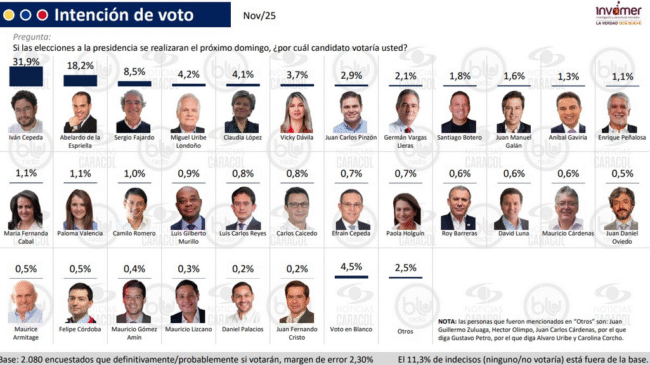
Senator Iván Cepeda of the ruling Historic Pact coalition has emerged as the early front-runner in Colombia’s 2026 presidential race, according to a nationwide Invamer poll released Sunday by Caracol TV and Blu Radio. The survey – the first major measurement since the lifting of Colombia’s recent polling restrictions – places the left-wing candidate at 31.9% of voting intention, six months ahead of the first round.

The results position Cepeda well ahead of candidate Abelardo de la Espriella of Defensores de la Patria, who received 18.2%, and independent centrist Sergio Fajardo, who registered 8.5%. Miguel Uribe Londoño, running for the leadership of  President Álvaro Uribe Vélez’s Centro Democrático party, follows with 4.2%. Uribe Londoño is the father of Senator Miguel Uribe Turbay, victim of an assassination attempt on June 7, and who died two months later at the Santa Fe Hospital in Bogotá.

The findings come amid broad public dissatisfaction with the country’s direction and with the administration of President Gustavo Petro, who leaves office on August 7, 2026. According to the poll, 56% of respondents disapprove of Petro’s administration, while 37% approve. Although disapproval has dipped slightly from previous months, nearly six in ten Colombians remain critical of the government. National sentiment is similarly pessimistic: 59.8% believe Colombia is “on the wrong track,” compared with 34.4% who feel otherwise.

Internal security stands out as the leading concern. Asked whether Petro’s “Total Peace” policy had made them feel safer, 66.2% claim it made them feel more insecure. Nearly 65% believe the initiative is moving in the “wrong direction”, and 73% say the government has lost territorial control to illegal armed groups. Only 20% expressed confidence in the government’s peace and security approach.

The Invamer survey, conducted between November 15 and 27 among 3,800 respondents in 148 municipalities, does not include public reaction to the latest scandal involving alleged infiltration of state institutions by FARC dissidents. The poll has a 1.81% margin of error and a 95% confidence level.

Cepeda’s lead reflects firm support among left-leaning voters and measurable gains among independents and left-leaning centrists. Though only 24% of those polled identified themselves as “left-wing”, the senator’s 31.9% support suggests he is drawing backing among younger voters. He also carries a relatively high rejection rate: 23.9% said they would “never” vote for him.

The survey challenges the perception that Cepeda lacks room to grow beyond the left, even as 50% expressed that they would prefer to vote for a candidate opposed to Petro. Analysts believe the Historic Pact’s decision to hold its internal consultation last month helped consolidate support within the coalition and gave Cepeda a strategic advantage.

The Invamer poll of Colombia’s of 30 presidential candidates. Photo: Caracol/Blu Radio.

Despite his lead, Cepeda could face voter rejection should Petro’s disapproval ratings continue to climb. The candidate’s current negative rating is among the highest of any public figure, and his pro-Petro agenda on security, economy, and U.S relations could push the center closer to the moderate right. Still, the poll indicates Cepeda would win a runoff against De la Espriella with a wide margin, but face a “technical tie” with the mathematician and former Governor of Antioquia.

De la Espriella, meanwhile, has quickly consolidated the anti-Petro vote, emerging as a “dark horse” at the extreme right of the spectrum. Once absent from early electoral projections, the lawyer now surpasses established Centro Democrático politicians – including senators María Fernanda Cabal, Paola Holguín, and Paloma Valencia.

Former defense minister under President Juan Manuel Santos and ex-Ambassador to Washinton, Juan Carlos Pinzón, is in seventh place (2,9%), but these early numbers are likely to increase, given that he maintains a close relationship with three ideological camps (Centro Democrático, La U, Cambio Radical) represented in Presidents Uribe and Juan Manuel Santos, and German Vargás Lleras.

 Even though the poll found that 63% of eligible voters know who De la Espriella is, there is room for continued growth for the five candidates who marked above 2% in the poll, among them, Vargas Lleras in fifth place (2.1%).

The centrist bloc, historically influential in Colombian politics, appears fragmented. Fajardo, once considered a reliable alternative to both left and right, no longer polls in double digits. While he maintains a lower rejection rate than most rivals and doubles the numbers of former Bogotá mayor Claudia López (4.1%), analysts say the proliferation of centrist candidates could dilute Fajardo’s base. Combined, these candidates would outpace De la Espriella’s support, but the numbers suggest this does not translate into a cohesive electoral force.

Foreign policy is also shaping voter priorities. A large majority – 78% – said maintaining strong relations with the United States is essential for the next administration. Respondents widely rejected Petro’s decision to use a megaphone in New York to urge U.S. soldiers not to follow orders from former President Donald Trump; 78% disapproved of the act, even though half of respondents hold an unfavorable view of Trump.

President Petro reacted to the poll on social media, framing the electoral landscape as a struggle between entrenched elites and what he described as a “powerful people” seeking to reclaim the state. Referring implicitly to Uribe and Fajardo, the president said Colombia must reject “mafioso elites” and work toward a “free and educated” society.

The Centro Democrático announced it will conduct an internal vote among more than 4,000 active party members to select two candidates for a March 2026 primary. The contenders are senators Cabal, Holguín, and Valencia, and Miguel Uribe Londoño.

With six months until the first round on May 31, 2026, the Invamer poll highlights a polarized electorate, deep concerns over security and corruption, and an early advantage for the ruling coalition’s candidate — with substantial uncertainty and new political alignments spearheaded by former presidents, especially Álvaro Uribe.

  •  

María Corina Machado Issues Post-Maduro “Freedom Manifesto”

As the USS Gerald R. Ford navigates uncomfortably close to the Venezuelan coastline and some 15,000 U.S. Marines remain stationed across Caribbean waters, Venezuela’s political crisis has entered a volatile new phase. In Caracas, Nicolás Maduro is publicly calling for peace and dialogue — even quoting John Lennon’s “Imagine” and delivering rally slogans in English — while the country’s most prominent opposition figure, Nobel Peace Prize laureate María Corina Machado, has issued an expansive “Freedom Manifesto” envisioning a democratic rebirth after the collapse of Maduro’s rule.

Both gestures — Maduro’s unusually soft-spoken overtures and Machado’s sweeping declaration of national principles — arrive just days before a major U.S. decision that could redefine Washington’s policy toward Venezuela. On November 24, the State Department is expected to designate the Cartel de los Soles, a Venezuelan military-linked drug trafficking network allegedly headed by Maduro, as a Foreign Terrorist Organization (FTO).

Secretary of State Marco Rubio reiterated that the group “has corrupted the institutions of government in Venezuela and is responsible for terrorist violence conducted by and with other designated FTOs, as well as for trafficking drugs into the United States and Europe.”

Yet even as Washington prepares its most severe sanction to date, President Donald Trump has said he is open to speaking directly with Maduro. “I would probably talk to him, yeah,” Trump said. “I talk to everybody.”

That combination — tightening pressure paired with a sudden willingness to talk — has created what regional observers describe as an unprecedented moment of strategic ambiguity. Across Latin America, many now wonder whether the United States has a coherent plan for Venezuela or whether it is improvising amid escalating military preparations.

Maduro appears intent on exploiting that ambiguity. In recent public appearances, he has addressed the U.S. public directly, shifting between Spanish and English, at one point even singing. Over the weekend, he declared he wanted a “face-to-face” with Trump, urging: “Dialogue, call, yes; peace, yes; war, no — never, never war.”

In a televised address Monday, he warned that any U.S. military intervention would mark the “political end” of Trump’s leadership, accusing advisers around the U.S. president of “provoking” an armed conflict for political gain.

But even while denouncing Washington’s “hawks,” Maduro simultaneously extended yet another olive branch: he was willing to speak, he said, “with anyone in the Trump administration who wants to talk to Venezuela.”

This duality – hostility mixed with conspicuous calls for peace – reflects the delicate position Caracas faces as U.S. firepower mounts offshore and covert options reportedly expand.

According to a report published Tuesday by The New York Times, Trump has authorized the CIA to prepare potential covert operations inside Venezuela, part of a broader pressure campaign to weaken Maduro’s government. The same report said the White House has quietly reopened back-channel communications with Caracas, during which Maduro suggested he might consider stepping aside after a negotiated transition.

The State Department has also fueled speculation by delaying the FTO designation until November 24 — a move some analysts view as an ultimatum: enter negotiations or face an escalation that could sever what remains of Venezuela’s diplomatic and economic links to the outside world.

Vision for “The New Venezuela”

While Maduro navigates the diplomatic minefield, María Corina Machado is attempting to position herself — and the opposition — for a post-Maduro future. On Tuesday, Machado released her “Freedom Manifesto,” a sweeping philosophical and political declaration, that lays out a roadmap for what she calls “a Venezuela reborn from the ashes.”

The document is sharply moral in tone. It presents Venezuelans as having endured “chains of tyranny” and calls for the restoration of dignity, property rights, free markets, unrestricted speech, secure voting, institutional reform, environmental protection, and the return of nine million exiles forced abroad.

“We stand at the edge of a new era – one where our natural rights will prevail,” Machado writes. She envisions a country with a revitalized energy sector, a diversified high-tech economy, demilitarized institutions, and a reinvigorated place in the “international community of democracies.”

Her manifesto is both a political program and a counterpoint to the perception  prevalent in several Latin American capitals – that Washington’s next steps, not Venezuela’s internal politics, may determine the timing and nature of Maduro’s exit.

Even before the FTO designation, the United States had already escalated its military posture. Since early September, U.S. forces have carried out 21 strikes on boats in the Caribbean Sea and eastern Pacific, killing 83 people, in what the administration describes as anti-narcotics operations. Trump has hinted that known trafficking sites within Venezuela are potential targets.

The prospect of further strikes has unsettled the region’s leftist governments, most notably Colombia, under Gustavo Petro. While Washington is willing to keep the door to dialogue open with Maduro, it remains water-tight shut to a democratically-elected president described by President Turmp as an “illegitimate drug leader”.

For Maduro, calling for dialogue may be a defensive tactic — an effort to avoid isolation at a moment when Washington appears to be tightening multiple pressure channels at once. For Machado, the combination of international pressure and internal exhaustion presents a rare opportunity to present the blueprint for a new Constitution.

Yet the central question remains whether the United States has a clear strategy for a peaceful transition to democracy. A show of overwhelming force without a defined political horizon could embolden Maduro’s close allies – including Russia and Colombia’s Petro – to argue that Washington lacks staying power in the hemisphere. Should the military arsenal in the Caribbean fail to deliver tangible results – from regime transition to a negotiated exile for Maduro – the Chavista leadership will feel emboldened to stay the course.

The next ten days, leading to the November 24 FTO designation, will prove decisive. Either Maduro exits quietly – triggering the removal of the U.S. government’s $50 million bounty for his arrest – or the United States crosses a legal and diplomatic threshold that could redefine the region for decades to come.

  •  

Colombia Confirms 15 Minors Killed in Army Bombings Against FARC Dissidents

The Colombian government of President Gustavo Petro has acknowledged that at least 15 minors recruited by illegal armed groups were killed in four military operations carried out between August and November, after a report by the National Institute of Forensic Medicine revealed a higher number of child casualties than initially disclosed by the Defence Ministry.

The deaths occurred during a series of bombings and clashes in the departments of Guaviare, Amazonas and Arauca, according to the forensic agency. The figures have intensified scrutiny of President Gustavo Petro’s security decisions and the conduct of the Armed Forces under a government that has repeatedly pledged to uphold human rights protections while pursuing its “total peace” agenda.

Defence Minister Pedro Sánchez said the military was aware of the probability that minors were present in the camps targeted during the operations but insisted all actions were carried out in accordance with the principle of distinction under International Humanitarian Law (IHL), which obliges armed actors to differentiate between combatants and civilians.

The revelation comes a week after an operation in Calamar, Guaviare, on November 10, that left seven minors dead in a bombing against dissident factions of the FARC. The incident prompted a wave of criticism and forced the government to respond publicly to accusations that it had failed to take sufficient precautions to avoid killing children forcibly recruited by armed groups.

According to the forensic report, the first of the four operations took place on August 24 in the rural village of Nueva York, in El Retorno, Guaviare. The agency received eight bodies from the site — seven men and one woman. Three of them were minors: two boys and one girl. The institute did not provide ages or identities.

The second operation occurred in Puerto Santander, Amazonas, where four bodies were transferred to the forensic institute on October 7. All four — three males and one female — were identified as minors. The bombing, reported earlier this month by local media, targeted structures allegedly belonging to the FARC dissident group led by alias ‘Iván Mordisco’ .Military intelligence believed Mordisco might have been in the area, but he later escaped, officials said.

The most lethal operation occurred on November 10 in Calamar, Guaviare, where 20 bodies were recovered from a bombing site and transported to forensic authorities on November 12. Sixteen have been identified, while four remain unidentified. Thirteen of the victims were male and seven female. Of the total, seven were minors, Forensic Medicine said.

The fourth incident took place on November 13 in Puerto Rondón, Arauca. Eight people were killed there – three men and five women – including one girl.

The forensic report has deepened the political crisis surrounding the deaths of children in military operations, a long-standing and highly sensitive issue in Colombia’s armed conflict. It has also revived long-running questions about the state’s responsibility to ensure the protection of minors, even when they have been forcibly recruited by illegal armed groups.

The Public Ombudsman’s Office, which monitors human rights violations, reiterated after the latest bombings that the presence of minors in illegal armed groups does not justify attacks that could endanger them, stressing that the Armed Forces must adopt “all possible precautions” to protect children, who are guaranteed special protection under both domestic and international law.

The warning underscores concerns that date back years. In 2019, then-Defence Minister Guillermo Botero resigned after revelations that a military bombing in Caquetá killed eight minors. At the time, opposition senators – including Gustavo Petro, Iván Cepeda and Roy Barreras – sharply criticized the government for failing to prevent avoidable child deaths.

Now in power, Petro faces similar criticism over what rights groups describe as a recurring pattern: intelligence-driven bombardments aimed at neutralizing armed groups, but which result in the deaths of children who have been forcibly recruited and used as human shields by illegal organizations.

Defence Minister Sánchez rejected accusations that the government attempted to conceal the new information. He said the operation on August 24 in El Retorno was not a bombing but a ground confrontation, disputing suggestions that authorities had misrepresented the conditions under which the minors were killed.

Minister Sánchez now faces a no confidence vote in Congress following the Guaviare incident in which seven minors were killed. The no-confidence vote comes as the Petro government is as odds with the United Nations over cocaine productions figures. According to the UN, 3,000 tons of the illegal narcotic were produced in 2024, and number the leftist leader refutes.

  •  

USS Gerald Ford Enters the Caribbean: What Next for Venezuela?

The arrival of the USS Gerald Ford in Caribbean waters has raised the stakes in the tense relationship between the United States and Venezuela. The aircraft carrier – the most advanced and powerful in the U.S. Navy – traveled for more than two weeks from the Mediterranean to take up position near South America, joining a growing naval presence under the Pentagon’s Southern Command.

Washington insists the deployment supports anti-narcotics operations aimed at curbing the flow of cocaine and other drugs from Latin America into the United States. Yet the timing and scale of the buildup have raised questions among America’s allies over whether it signals a shift toward a more confrontational posture against the regime of Nicolás Maduro.

Since early September, U.S. forces have carried out at least 19 strikes against small vessels in international waters near Venezuela and Colombia – operations the Trump administration says were targeting “cartel terrorists.” According to Pentagon announcements, some 76 people have been killed since the first narco-boat was destroyed by a missile strike on September 2.

Secretary of Defense Pete Hegseth – branded as “Secretary of War” following President Donald Trump’s renaming of the Defense Department – has become the public face of the campaign. “We’re protecting the homeland and taking out the cartel terrorists who wish to harm our people,” Hegseth said in late October, describing the strikes as “a message of deterrence.”

Trump has claimed that some of the targeted vessels were manned by members of the Venezuelan criminal network Tren de Aragua (TdeA), while others were moving narcotics for Colombia’s illegal armed groups, including Gulf Clan and National Liberation Army (ELN) guerrilla.

As the U.S. Navy reinforces its presence in the Caribbean with fighter jets, Marines, and drones, the deployment of the Ford marks the most significant show of American force in the region since the 1989 invasion of Panama. Venezuela, in turn, is on high alert, mobilizing the Bolivarian Armed Forces, National Guard, and civilian militia recruits in preparation for a potential confrontation.

The prospect of an assault on Venezuelan territory no longer feels entirely remote, even though Trump has publicly downplayed any immediate plans for direct intervention. “I wouldn’t be inclined to say that I would do that… I’m not gonna tell you what I’m gonna do with Venezuela,” he stated recently to CBS’s 60 Minutes.

After the Senate voted down a measure that would have required congressional authorization for military action, Republican lawmakers described the result as a “green light” to strike land targets within Venezuela. The Gerald Ford’s presence suggests Washington may not simply be policing drug routes – it is projecting supremacy. With such immense firepower now concentrated near Venezuela, retreating without one tangible result – the arrest of Maduro – could prove politically costly for The White House.

If the ultimate objective is regime change – hoping that Maduro’s government will implode under pressure – the warship could soon find itself running out of steam to remain in the Caribbean. For the Trump administration, time and strategy are now of the essence. Deploying billion-dollar hardware to capture a leader with a US$50 million bounty on his head risks appearing, to Maduro’s allies in Moscow, as an expensive bluff – or hollow show of force.

Should the so-called “Trump Doctrine” falter in the Caribbean, Latin America’s leftist leaders, most notably Colombia’s Gustavo Petro, will capitalize on Washington’s setback, using it to galvanize domestic support ahead of the 2026 elections.

International reaction to the missile strikes has ranged from muted concern to outright condemnation. The United Nations High Commissioner for Human Rights, Volker Türk, warned that the attacks “have no justification in international law,” echoing similar criticisms from close U.S. allies including the United Kingdom, France, Netherlands, and to a tarnished degree, Colombia.

CNN reported on Wednesday that the United Kingdom has suspended certain intelligence-sharing with the Pentagon fearing “complicity” in the Caribbean operations. London’s official response – “it is our longstanding policy not to comment on intelligence matters” – only underscores the unease. Both the  Netherlands and France maintain a military presence in the Antilles, and claim that shared data could be used in operations that violate human rights.

In Bogotá, President Gustavo Petro, one of Washington’s fiercest critics on drug policy, announced that Colombia would follow the UK’s example and suspend communications between its security forces and U.S. agencies “as long as missile attacks on boats in the Caribbean persist.” Petro added that “the fight against drugs must be subordinated to the human rights of the Caribbean people.”

On Wednesday, U.S Secretary of State Marco Rubio rebuked the European position, stating: “I find it interesting all these countries want us to send nuclear-capable Tomahawk missiles to defend Europe. But when the United States positions aircraft carriers in our hemisphere, where we live, somehow that’s a problem.” He went on to affirm that the European Union does not get to “determine what international law is.”

While Washington frames the campaign as a continuation of the now centuries-old “War on Drugs,” Latin America’s left-leaning governments warn that it risks destabilizing the region and alienating partners at a moment when cooperation is crucial to tackle migration, organized crime, and environmental issues.

For now, the USS Gerald Ford will remain in the Caribbean – a floating fortress and symbol of American deterrence. Its presence projects strength but also uncertainty. Unless Washington clarifies its endgame, its most powerful warship could end up reviving an old question: how far is the United States willing to go in its pursuit of democracy beyond its shores – and at what cost to the stability of a hemisphere it has long abandoned?

  •  
❌