
Reading view

Editorial: Gustavo Petro’s “Total Peace” Has Led to Total Chaos in Colombia

Colombia’s President Gustavo Petro ran for president on a campaign promising Paz Total—Total Peace. He promised to give the FARC dissidents, the vicious ELN guerillas, and mafias like the Clan del Golfo a good talking to, and with that, they will just lay down their weapons and become model citizens. Petro promised that through dialogue with bloodthirsty kidnappers and extortionists, they would be willing to stop being bloodthirsty kidnappers and extortionists; as if they are just misunderstood little muffins who only need a hug.

Nubia Carolina Córdoba, governor of Chocó, Colombia (photo from her Twitter account)

Nubia Carolina Córdoba, governor of Chocó, Colombia (photo from her Twitter account)

According to figures compiled by the Universidad Externado and reported by The City Paper Bogotá, Colombia has recorded 40,663 homicides during the first three years of the Petro presidency. Over 400 human rights defenders have been slaughtered between 2022 and 2025 according to the United Nations Office of the High Commissioner on Human Rights. Human Rights Watch reports that the ELN and FARC dissidents have expanded their territories by up to 55%. They are taking back over Colombia.

Under Gustavo Petro’s watch, Colombia has returned to the Institute for Economics and Peace’s Global Terrorism Index top ten list of countries impacted by terrorism, along with Total Peace destinations like Democratic Republic of Congo, Somalia, and Syria. Just this past week, a Clan del Golfo poster was put up within walking distance from the Aeropuerto Internacional José María Córdova just outside of Medellín. This Total Peace nonsense is a failure.

Right now, in the neglected Pacific department of Chocó, the ELN has kidnapped whole communities. Petro ran a campaign promising that he was going to embrace these historically neglected communities—places like Chocó, Nariño, La Guajira, and Norte de Santander—but insecurity is increasing. Chocó’s governor, Nubia Carolina Córdoba, says 6,047 people are trapped inside of their homes because the ELN has announced an illegal armed curfew in the municipality of Bajo Baudó. Most of these people are already poor, and now they have been kidnapped en masse by this guerilla group that operates with impunity because Gustavo Petro coddles them with “dialogue.”

According to Governor Córdoba, they attacked the police station in the village of Santa Rita using grenades attached to drones. It has gotten so bad that Colombia has restricted the entry of drones into the country. These people are calling out for help, but the president insists on talking as the ELN grows and continues to menace the police forces, the Colombian military, and, most importantly, the innocent public.

There is currently public disorder where belligerents have completely blocked the roads in the north of Antioquia, in the region called Bajo Cauca, and also in the neighboring department of Córdoba. The city of Caucasia is under curfew. Antioquia’s Governor, Andrés Rendón, has urgently called on the national government to stop the talk and take action. Groups are attacking ambulances and burning people’s motorcycles as they try to get by the roadblocks, regardless of the emergency.

Governor Rendón stated: “There can be no dialogue amidst blockades and human rights violations. It’s been seven days now with the Bajo Cauca region paralyzed and the country held hostage by chaos.” He called on the Fiscalía General de la Nación to bring those responsible to justice and challenged the Minister of Defense, Pedro Sánchez, to order the immediate reopening of the roads. “We’re not talking about small-scale miners here; behind this are criminal structures, as everyone knows, that finance themselves through illegal mining and move billions of pesos,” Rendón added, demanding full authority against the criminals who use communities as a shield.

El gobernador de Antioquia, @AndresJRendonC, se pronunció sobre la situación de orden público en el Bajo Cauca, en medio de los bloqueos que ya completan varios días y afectan la movilidad y la seguridad en la región. @GobAntioquia pic.twitter.com/4SPQgTa68r

— MiOriente (@MiOriente) March 22, 2026

The current situation with these organized criminal groups—whether regular mafias like the Clan del Golfo or murderous Marxist guerillas like the ELN and the FARC dissidents—is reminiscent of a classroom where a substitute teacher has lost all control. Petro promised Total Peace, but the result has been Total Chaos. Investors do not want to deal with this mess. While the Petro government claims they want tourism to be a major economic driver, road blocks make many areas look like scenes out of Mad Max: Road Warrior. Whole zones of the Pacific coast are unsafe even for residents, met with pure impotence from the regime.

Ten years ago, it was safe to drive from Medellín to the beachside town of Coveñas in Sucre, but that is no longer the case. While it remains safe to visit Colombia for business or tourism in major hubs like Bogotá, Medellín, Santa Marta, or the San Andrés islands, the long-term outlook is concerning. My hope is that Colombians choose a future leader serious about law and order as a prerequisite for human rights. It is not only the government that we need to protect human rights from; those who kill, steal, kidnap, and forcibly recruit children are violating those rights as well.

Colombian anti-explosives experts inspect propaganda by the Clan del Golfo mafia group just minutes away from Medellin's international airport in March, 2026 (image from Facebook).

Colombian anti-explosives experts inspect propaganda by the Clan del Golfo mafia group just minutes away from Medellin’s international airport in March, 2026 (image from Facebook).
 

  •  

Colombia Confirms 14 Candidates for 2026 Presidential Election

Though surprises are possible, polling says the front runners are Iván Cepeda, Abelardo de la Espriella, and Paloma Valencia.

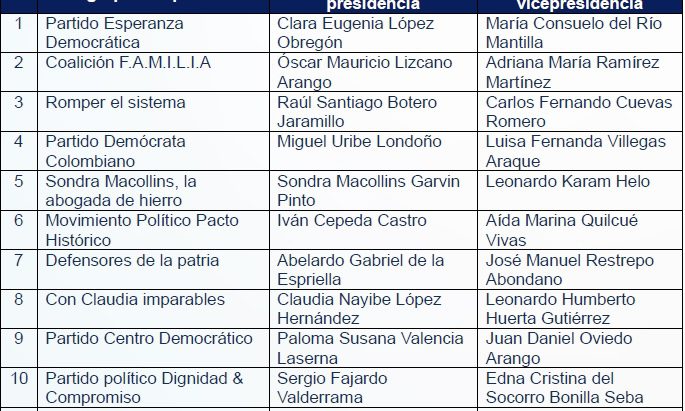
The Registraduría Nacional del Estado Civil of Colombia (RNEC), the entity responsible for organizing elections in the country, reported that a total of 14 candidates have officially registered to run in the country’s presidential elections, scheduled for May 31, 2026. In this vote, citizens will elect the President and Vice President of the Republic for the 2026–2030 term.

According to the electoral authority, the candidates represent a wide range of political perspectives, from left to right, including independent candidacies running through political movements. Here the list and brief profile of the candidates:

  1. Clara Eugenia López Obregón, currently a senator for the Esperanza Democrática She has served as Minister of Labor (2016–2017), acting mayor of Bogotá (2011–2012), and Bogotá’s secretary of government (2008–2010). She has been affiliated with left-wing parties and was Gustavo Petro’s vice presidential running mate in the 2010 election.
  2. Óscar Mauricio Lizcano, from the FAMILIA coalition. He served as Minister of Information Technologies (2023–2025), was a senator (2010–2018), and a member of the House of Representatives (2006–2010).
  3. Raúl Santiago Botero, candidate of the “Romper el Sistema” movement (Break the Establishment). An agronomist engineer and businessman from Medellín, he presents himself as an independent candidate with no prior political experience.
  4. Miguel Uribe Londoño, father of the slain presidential candidate Miguel Uribe Turbay. He is running under the Colombian Democratic Party and previously served as president of the Centro Democrático party founded by Álvaro Uribe Vélez.
  5. Sondra Macollins Garvin, from the movement “La Abogada de Hierro” (The Iron Lawyer) A criminal lawyer and psychologist, she presents herself as an independent candidate without political affiliations. She ran for the House of Representatives in 2022 and is known for her work in narcotrafficking and corruption cases.
  6. Iván Cepeda Castro, a senator since 2014 and the official candidate of the Pacto Histórico, the same party as President Gustavo Petro. Polls project he will receive the highest vote share in the first election round. He is aligned with left-wing political ideas.
  7. Abelardo de la Espriella, a lawyer with far-right positions, running for the first time under the Defensores de la Patria movement. Recent polls place him as a likely second or third contender in voter preference.
  8. Claudia López Hernández, former mayor of Bogotá (2020–2023) and former senator (2014–2018), running under the centrist movement “Imparables con Claudia.” She is known for her anti-corruption agenda and secured her candidacy with more than 570,000 votes (about 9%) in recent interparty primaries.
  9. Paloma Valencia Laserna, current senator and candidate of the Centro Democrático party led by Álvaro Uribe Vélez. She won the right-wing interparty primary on March 8 with more than 3 million votes. Polls place her among the top three contenders, and if she reaches a runoff, she would become the first woman in Colombia’s history to do so.
  • Sergio Fajardo Valderrama, an academic and mathematician running for the Dignidad y Compromiso He served as mayor of Medellín and governor of Antioquia and is running for president for the third time.
  • Roy Barreras, from the political party La Fuerza (The Force). He won the left-wing coalition primary on March 8 with the lowest vote total (257,000 votes, about 3.6%). Although currently aligned with left-wing movements and part of the Petro administration, he has previously been affiliated with right- and center-leaning parties.
  • Gustavo Matamoros Camacho, of the Colombian Ecologist Party. He served in the Colombian Army for 43 years. With no prior political experience, his campaign focuses on public security.
  • Luis Gilberto Murillo, who served as Minister of Foreign Affairs (2024–2025) and Colombia’s ambassador to the United States (2022–2024). A human rights advocate and Afro-Colombian leader from Chocó, he presents himself as an independent, moderate, centrist candidate.
  • Carlos Eduardo Caicedo, running under the independent movement “Con Caicedo.” He was mayor of Santa Marta (2012–2015) and governor of Magdalena (2020–2023), where he built a strong base as a left-wing political leader.

The RNEC also reported that “the draw to determine the position of presidential candidates on the ballot will take place on March 25 at the Ágora Bogotá Convention Center.”

This process marks the formal start of the final phase of the presidential campaign, during which candidates will seek to consolidate support ahead of the first round on May 31. If no candidate secures an absolute majority, a runoff between the two leading candidates will be held on June 21.

List of registered candidates for Colombia’s presidency. Photo courtesy of the Registraduría Nacional del Estado Civil.

List of registered candidates for Colombia’s presidency. Photo courtesy of the Registraduría Nacional del Estado Civil.

Headline photo: Polling station in Colombia during last Congress elections in March 8, 2026. Photo courtesy of the Registraduría Nacional del Estado Civil.

  •  

UN report warns Colombia faces worsening human rights crisis

Colombia is at risk of sliding back into one of the darkest chapters of its recent history, according to a stark new report by the United Nations, which warns that escalating violence, territorial control by illegal armed groups and political instability are eroding hard-won human rights gains.

The annual assessment by the Office of the High Commissioner for Human Rights paints a troubling picture of 2025: a country where armed actors have deepened their grip over rural regions, civilians are increasingly trapped in conflict zones, and the implementation of the 2016 peace accord is under growing strain.

At the heart of the report lies a central warning — Colombia faces the “possibility of reverting” to pre-peace agreement levels of violence, particularly in territories where the state remains weak or absent.

Armed groups expand control

Across large swathes of the country — from the Catatumbo in Norte de Santander to the Pacific coast — non-state armed groups and criminal organizations have consolidated control over vulnerable populations, imposing what the report describes as “illegal armed governance”.

The criminal groups mentioned- Clan del Golfo, ELN, FARC dissidents – are responsible for a wide range of abuses: forced displacement, confinement, selective killings, sexual violence and the recruitment of children. Entire communities, especially Indigenous and Afro-Colombian populations, are subjected to coercion and forced participation in illicit economies. “Afro-descendant communities, particularly in regions such as Chocó, continue to face severe human rights violations due to the presence and social control exercised by non-state armed groups,” claims the report.

Even in areas where a single armed group dominates and overt violence is less visible, the UN notes that civilians live under strict systems of control, with basic freedoms curtailed and fear pervasive.

The UN documented 53 verified massacres in 2025, leaving 174 victims, the vast majority attributed to armed groups fighting over control of illegal economies such as drug trafficking.

The report also highlights a disturbing increase in indiscriminate attacks, including the use of explosives and drones in populated areas. Cities such as Cali were directly affected, with civilian casualties mounting as conflict spills into urban spaces.

In one incident in the southern department of Huila, a motorcycle bomb targeting a police station killed civilians and injured dozens, underscoring the growing risks faced by ordinary Colombians.

Child Recruitment

One of the report’s most alarming findings is the worsening situation for children.

The UN verified 150 cases of child recruitment in 2025, though it warns this represents only a fraction of the true scale due to underreporting and fear of retaliation. Armed groups are increasingly using social media platforms to lure minors, glamorising violence and illegal economies.

In some cases, children recruited into armed groups were later killed during military operations, raising further concerns about protection mechanisms.

Schools have also become battlegrounds. Armed groups have occupied educational spaces, disrupted classes and used them as recruitment grounds, particularly among Indigenous communities at risk of cultural and physical extinction.

Gender-based violence

The report details systematic patterns of sexual violence, exploitation and coercion, particularly against women and girls in conflict zones.

Armed groups have imposed control over reproductive rights, restricted access to healthcare and, in some cases, forced pregnancies. Girls are often recruited through manipulation and emotional coercion, only to face abuse, forced labour and sexual violence once under the control of armed actors.

Indigenous, Afro-descendant and migrant women are disproportionately affected, facing layered vulnerabilities exacerbated by institutional absence.

Pre-Election violence

As Colombia moves through a politically sensitive period, the report identifies a sharp rise in preelectoral violence.

The killing of the right-wing presidential candidate Miguel Uribe Turbay in August 2025 marked a dramatic escalation, while the UN recorded 18 assassinations and 126 attacks or threats against political leaders and candidates.

Nearly 650 municipalities were classified as high-risk zones by Colombia’s Ombudsman, raising concerns about the integrity of democratic participation.

The report also points to a surge in digital harassment. “Violence has also extended into the digital space, with an increase in hate speech and discriminatory discourse on social media platforms.”

Humanitarian conditions have deteriorated significantly. According to UN data, mass forced displacement rose by 85% compared with 2024, driven largely by clashes between armed groups. In Catatumbo alone, nearly 90,000 people were displaced, alongside a wave of killings, kidnappings and child recruitment.

Confinement — where communities are effectively trapped by armed actors — has also increased, restricting access to food, healthcare and livelihoods, particularly in departments such as Chocó and Cauca.

Despite these challenges, the report acknowledges partial progress in implementing the 2016 Final Accord with the ex-Revolutionary Armed Forces of Colombia (FARC) guerrilla.

While land reform initiatives have advanced, delays in formal land titling and uneven territorial implementation continue to limit impact of the 2016 agreement. The killing of 45 former FARC combatants in 2025 — a 36% increase from the previous year — highlights ongoing security gaps in reintegration efforts. “The United Nations Verification Mission documented the continued killing of former FARC, underscoring persistent security risks despite a peace agreement.”

A recurring theme throughout the United Nations report is the insufficient presence of the state in conflict-affected regions. It warns that weak institutional reach continues to limit protection for civilians and the effective implementation of security and development policies. The report also notes that “coca cultivation rose by 3% to 262,000 hectares in 2024,” although growth has slowed for a third consecutive year, cautioning that underfunded substitution programmes risk undermining efforts to transition to legal economies.

In many cases, responses by security forces have been too slow or insufficient to prevent abuses or protect communities.

A critical moment for Colombia

The UN concludes that Colombia stands at a pivotal juncture.

Without stronger coordination, sustained investment and a renewed focus on protecting civilians, the country risks undermining nearly a decade of peacebuilding.

“The persistence of violence and the strengthening of armed groups continue to gravely affect the civilian population,” the United Nations warns — a stark signal that security conditions are deteriorating across Colombia. As the country enters a polarised election season, the report suggests the stakes are no longer confined to preserving the 2016 peace accord, but to preventing a broader erosion of state authority and civilian protections in territories most at risk.

  •  

Child Recruitment in Colombia Surges 300 Percent Warns UNICEF

Every 20 hours, somewhere in Colombia, a child vanishes into the ranks of an illegal armed group. That is the grim calculation released this week by UNICEF and the United Nations, which warn that the forced recruitment of minors has surged to levels not seen in decades, undermining Colombia’s efforts to contain its internal conflict.

The report, published on World Children’s Day and marking the anniversary of the 1989 Convention on the Rights of the Child, claims that more than 1,200 children and adolescents have been recruited in the last five years. According to the U.N., the practice has risen 300 percent since 2019, with a steep 64 percent jump between 2023 and 2024 alone. In the first ten months of 2025, Colombia’s Ombudsman’s Office registered 162 new cases – though the numbers is likely much higher.

“These numbers should horrify us,” said Tanya Chapuisat, UNICEF’s representative in Colombia. “They are not just statistics. They are children taken from their homes, their schools, their communities — used to carry weapons, gather intelligence, or exploited in ways no child should ever face.”

For many families, reporting a child’s disappearance is unthinkable. Fear of retaliation is overwhelming, particularly in remote Indigenous and Afro-Colombian territories where state institutions are scarce and illegal armed groups exert full control. “What is happening is extremely serious,” said Iris Marín, Colombia’s national ombudsman. “Parents tell us, ‘If I report it, they will come back for my other children.’ How can any mother step forward under such threats?”

That silence means most cases remain unrecorded – one reason the United Nations insists its figure of 1,200 children over five years represents only “a fraction” of a crisis spreading across some of Colombia’s most isolated and neglected regions.

At the center of the surge is the Estado Mayor Central (EMC), the largest faction of FARC dissidents, under command of alias ‘Iván Mordisco’. The EMC controls drug-trafficking corridors in the southwest and along of the porous 1,800-kilometer border with Venezuela. According to the U.N., the group is responsible for roughly 40 percent of all verified child recruitment cases, using minors to transport weapons, staff checkpoints, cultivate coca crops, and, increasingly, to fight. Girls face even greater risks: many are subjected to sexual violence or forced relationships with combatants. Others are killed for attempting to flee.

Unlike earlier periods of the conflict, today’s recruitment crisis is driven less by ideology than by the expansion of lucrative criminal economies – cocaine trafficking, illegal mining, extortion – that demand a steady supply of young, disposable labor. Children living in deep poverty are easily coerced with promises of money, food, or protection. Others are abducted outright.

The departments with the highest number of cases – Cauca, Nariño, Chocó, Arauca and Norte de Santander – are also those where the state is weakest and armed groups have consolidated territorial control. The Pacific coast, plagued by violent disputes between the National Liberation Army (ELN) guerrilla and Gulf Clan cartel, has seen a particularly sharp spike. In Cauca alone, authorities have recorded 37 minors forcibly recruited this year. Antioquia registered 20 cases; Chocó 16; Nariño 13; Huila 11; and Norte de Santander 8. Indigenous and Afro-Colombian communities account for more than half of all victims in the last two years.

UNICEF and the Canadian Government, which co-sponsored this year’s report, called for urgent action not only from the state but from schools, civil society and the private sector. “The State must strengthen prevention and protection,” Ms. Chapuisat said. “Schools and employers must create more opportunities. The best way to prevent recruitment is to allow children to enjoy their rights.”

Canada’s Ambassador to Colombia, Elizabeth Williams, said the rising figures reflect a crisis too often hidden from national debate. “No child should be forced into war – not for ideology, not for economics,” she said. “We cannot allow this to remain invisible.”

To pierce that silence, UNICEF and the Canadian Embassy launched a new campaign, “Desarma tu Indiferencia” – “Disarm Your Indifference.” The initiative highlights what recruitment leaves behind: the empty desk in a classroom, the bed that stays cold at dawn, the household routines quietly abandoned. The campaign’s message is blunt: child recruitment is neither inevitable nor distant, and ending it requires collective and sustained attention.

For thousands of families in some of Colombia’s hardest-hit conflict zones, the suffering remains intensely personal. “Parents live in permanent uncertainty,” Ms. Chapuisat said. “They do not know if their children are alive, if they have eaten, if they will ever return home.”

  •  
❌