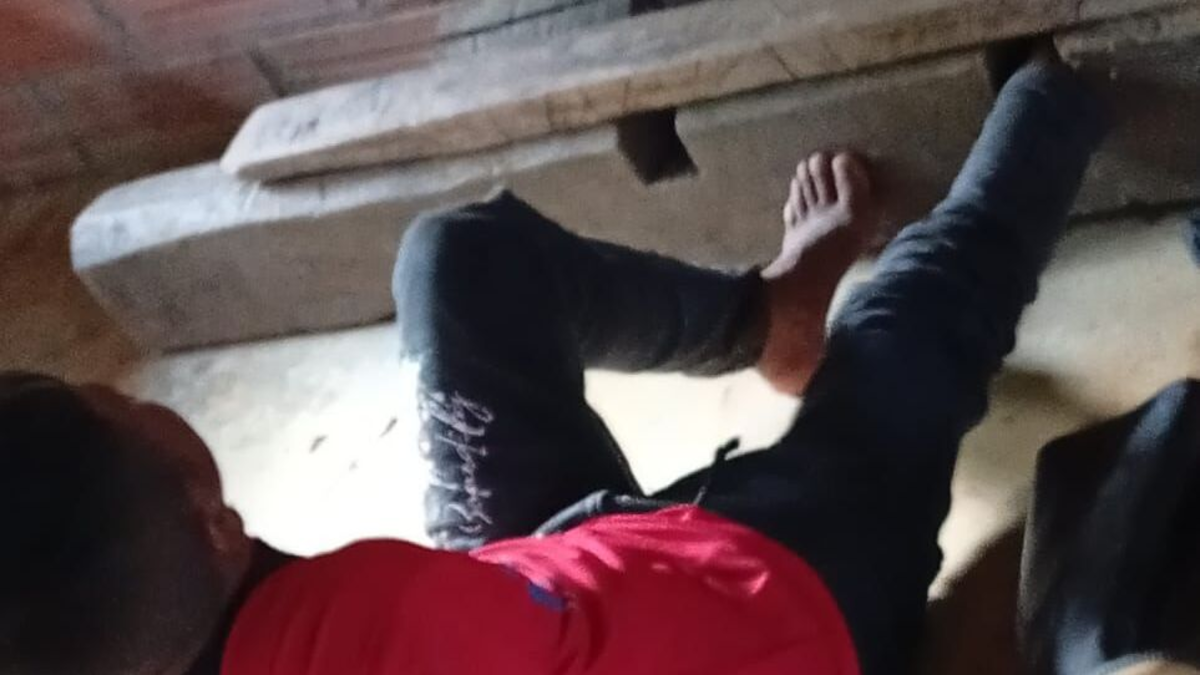
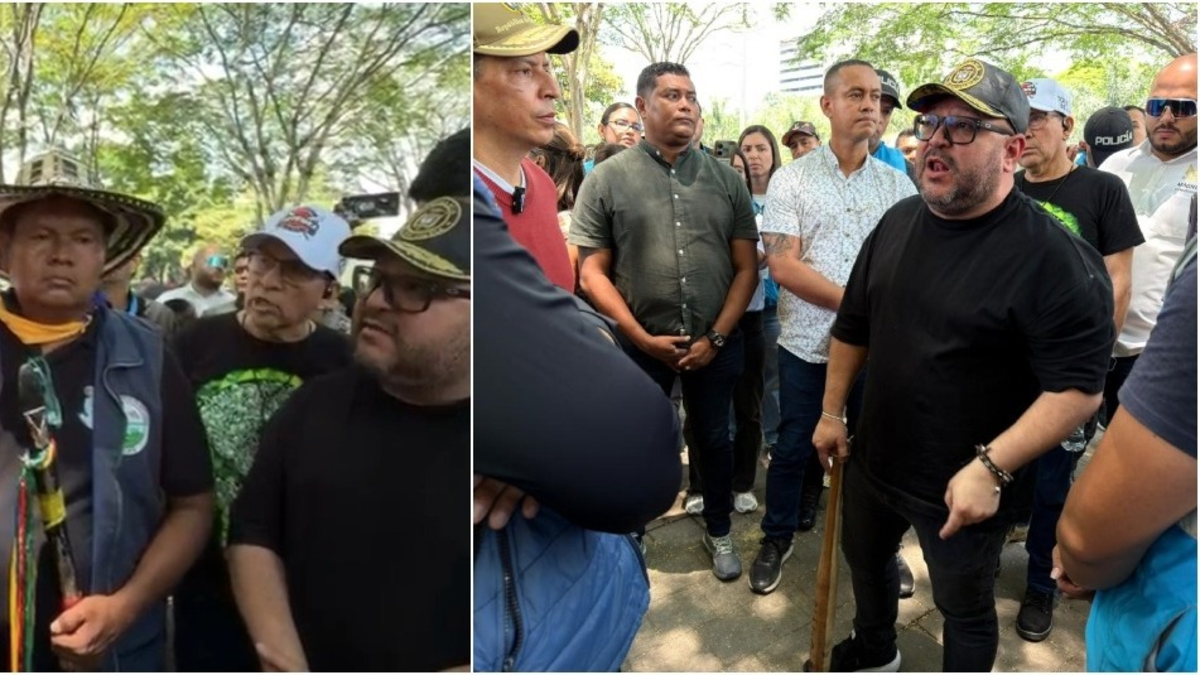
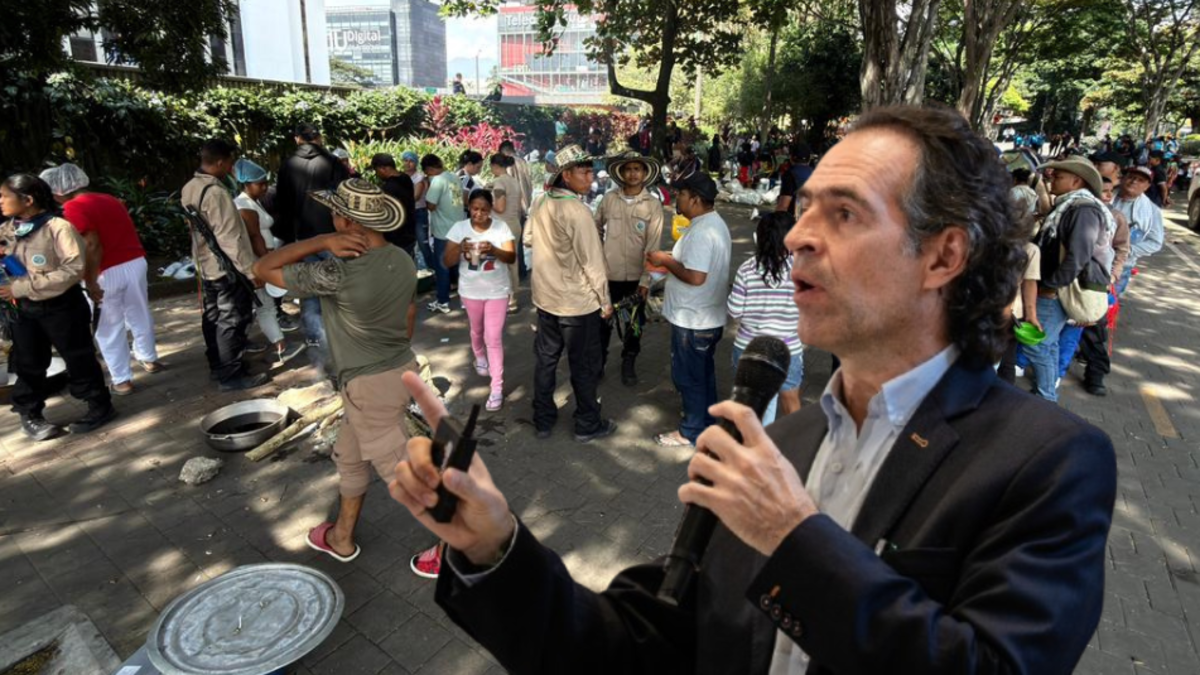
Levantan el cepo a un indígena que es padre de familia y a quien un resguardo de Antioquia le había impuesto el castigo por reabrir un salón de clases


MEDELLÍN — The mobile film festival SMARTFILMS announced the launch of its third edition in the “City of the Eternal Primavera” on March 17, 2026. The initiative aims to democratize cinema and foster local creative talent through technology and audiovisual narratives. The program’s goal is to train 4,000 participants in the technical skills required to produce films using mobile devices.
The launch is supported by the Alcaldía de Medellín (Medellín mayor’s office), which is providing 3,300 training slots, the Área Metropolitana del Valle de Aburrá (Aburrá Valley metropolitan area) with 300 slots, and the Cámara de Comercio de Medellín para Antioquia with 250 slots. Additional strategic partners include EPM and Fenalco Antioquia, organizations that focus on regional innovation and commercial development. The official opening, led by CEO Yesenia Valencia, took place at the Poblado branch of the Chamber of Commerce,
“SMARTFILMS is not just a festival; it is a platform that demonstrates that to tell a great story, one only needs a good idea and the device everyone carries in their pocket.”
The 2026 program utilizes a four-phase methodology designed to transition creators into digital entrepreneurs. The first phase involves mass training for 4,000 individuals in mobile audiovisual production. In the second phase, 400 selected participants will attend a specialized bootcamp at the Cámara de Comercio de Medellín para Antioquia featuring industry experts. The third phase focuses on business skills for 40 finalists, covering marketing, digital advertising, budgeting, and legal contracts.
In the final stage, participants must produce advertising content for three local neighborhood businesses to assist in their digital transition. Financial incentives include prizes of $10 million COP for first place, $5 million COP for second place, and $3 million COP for third place. Additionally, finalists receive seed capital of $1.5 million COP per person for recording equipment. Registration is managed through the cineconcelular.com platform.
The festival reports a significant regional economic impact, generating 115 direct jobs and over 300 indirect jobs. The direct positions include 33 payroll staff and 82 contractors based in Medellín. Since its inception, the model has trained 8,000 people and led to the creation of 120 businesses nationwide. These creative enterprises currently report monthly revenues ranging from $2 million COP to $10 million COP.
The 2026 version of the project seeks to expand its reach across all districts of the metropolitan area to stimulate the development of cultural companies and social transformation. Documentation from the organizers highlights a 0% desertion rate among participants over the last two years.
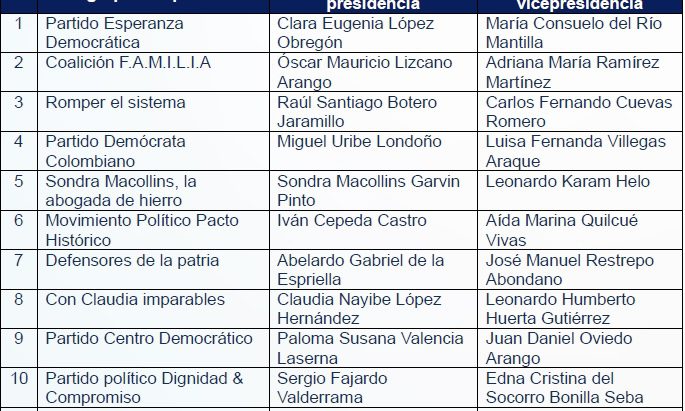
The Registraduría Nacional del Estado Civil of Colombia (RNEC), the entity responsible for organizing elections in the country, reported that a total of 14 candidates have officially registered to run in the country’s presidential elections, scheduled for May 31, 2026. In this vote, citizens will elect the President and Vice President of the Republic for the 2026–2030 term.
According to the electoral authority, the candidates represent a wide range of political perspectives, from left to right, including independent candidacies running through political movements. Here the list and brief profile of the candidates:
The RNEC also reported that “the draw to determine the position of presidential candidates on the ballot will take place on March 25 at the Ágora Bogotá Convention Center.”
This process marks the formal start of the final phase of the presidential campaign, during which candidates will seek to consolidate support ahead of the first round on May 31. If no candidate secures an absolute majority, a runoff between the two leading candidates will be held on June 21.

List of registered candidates for Colombia’s presidency. Photo courtesy of the Registraduría Nacional del Estado Civil.
Headline photo: Polling station in Colombia during last Congress elections in March 8, 2026. Photo courtesy of the Registraduría Nacional del Estado Civil.
Medellín, Colombia’s second-largest city, is often cited globally as a textbook example of urban transformation. Central to this evolution is ACI Medellín, the city’s specialized Agency for Cooperation and Investment. By fostering a unique “triple helix” collaboration between the public sector, private enterprise, and academia, the agency has managed to maintain a stable environment for capital even during periods of national political volatility.
In this exclusive interview, Loren Moss, Executive Editor of Finance Colombia, speaks with Cristina Zambrano Restrepo, the Executive Director of ACI Medellín. They discuss how the city nearly tripled its investment attraction over the past year, reaching over $400 million USD, and the strategies used to reassure international investors during a complex electoral landscape in Colombia.
Finance Colombia: I’m here with Cristina Zambrano Restrepo, the Executive Director of ACI Medellín. It’s always a pleasure to be with you. Thank you for the invitation. I know you’re extremely busy, so thank you for making the time to speak with Finance Colombia. How have you been?
Cristina Zambrano Restrepo: Very well, thank you very much. Truly happy to be here with you. Thank you for accepting this invitation. Without a doubt, we work to bring good and positive news to this city, and thank you for being here and for sharing and conveying all of these good things.
Finance Colombia: Yes, today you talked about the successes that ACI Medellín and the city have had this year in attracting investment. Tell us a bit about some of those successes. I think it’s going to be another large business hotel, and tell us a little about how you’ve kept busy.
Cristina Zambrano Restrepo: Of course. A major focus for us is job creation through investment attraction. So, what did we achieve this year? We went from USD 150 million generated last year to more than USD 400 million this year. As I’ve mentioned, this is reflected in the creation of more than 11,500 formal, high-quality jobs generated by this investment attraction. We have major allies and players here, such as Renault-Sofasa, Rivana Business Park, SoftServe, and POMA. A great deal of companies, some already established, others newly arriving in the region. TaskUs too, which is also extremely important and has made major commitments to us. These are the companies that manage to generate that employment.
Finance Colombia: Excellent, that’s fascinating. I have a history with Colombia of about 20 years, and here in Medellín of about 11 years, and it’s truly wonderful to see how the city has grown—not only in population, but in investment and innovation. However, we’re living in a time of high uncertainty around the world—not just in Colombia, not just in the United States, but globally. Especially when we talk about the sector, not in general terms, but politically and economically. Has this made attracting investment more difficult or more challenging over the past year? How has this affected efforts to attract FDI, like, foreign investment, and what strategies have you used to overcome this challenge?
Cristina Zambrano Restrepo: Here, clearly, the political landscape affects and directly impacts confidence, right? The stability of a region, how we present ourselves to the world and to those very large capital investments, showing that we are a stable region, that we believe in them, and that we will support them. So, what strategies do we have? Without a doubt, it has been very challenging. We would like, for example, to be able to offer a range of benefits, extensions, fast-track processes in permitting and such, but in that sense we depend heavily on the national government. But we don’t stop there. We work from the regional level and have a firm commitment locally, focusing on what we ourselves can support, contribute, and manage from this area, the private sector. Which also helped sustain the region during the previous administration, and the academic sector, all the universities, and that ecosystem, which have been fundamental. And now the public sector as well, we are all working together specifically from this region to demonstrate that we are a region that inspires confidence, offers stability, and has all the right conditions for investment to continue to arrive.
Finance Colombia: One thing you’ve mentioned that’s very important, and something Medellín is known for, is the collaboration between the private and public sectors. In many other places, without naming names, it’s an endless war. But in Medellín it has always felt like it’s everybody. That’s why Medellín has always had the Metro and continues to have major projects here, because the private sector has a strong sense of civic ownership. People talk about the GEA, but from a foreign perspective, what I’ve seen is that companies like Grupo Argos, SURA, Bancolombia, and more recently Nutresa, and many smaller ones that aren’t international names, have a sense of belonging and work hand in hand with the government. Speaking of that, for example, Mayor Federico Gutiérrez has traveled to the United States and other places to maintain those good relationships, despite what may be happening in Bogotá or at the Casa de Nariño. What is the importance of the efforts made by the metropolitan government and the city government of Medellín, not only at the ACI level, but also at the level of Alpujarra? How important is this in maintaining a long-term course so that foreign investors continue to see Medellín as a destination, no matter how much may be happening 400 kilometers away?
“We went from USD 150 million generated last year to more than USD 400 million this year… reflected in the creation of more than 11,500 formal, high-quality jobs.” — Cristina Zambrano Restrepo
Cristina Zambrano Restrepo: I think what you’re pointing out is fundamental, and it’s specifically how we’ve achieved this model in Medellín. In a way, when we go out into the world and explain how we work hand in hand, as you said, there are cities and countries that react like, “Why do we need to sit at the same table? I’m very clear about my purpose, and you’re very clear about yours.” Here, the real history of what this city lived through 40 years ago made all of us sit at the same table, and we realized that the efforts of the three actors are always aligned toward the same goals. What always matters to us is citizens’ well-being, quality of life, economic and social development, many things. So when we were going through our hardest moments, we managed to set aside egos, agendas, and competing visions. We sat down, we talked, and we’ve continued to work under that model ever since.
As for what’s happening and what lies ahead in the future: clearly, having a political leader like Federico Gutiérrez, with those strategies and international connections, matters greatly. Countries trust leaders who have demonstrated stability and very clear commitments throughout their governing trajectory, and that’s what our mayor has done. Because of that, they continue to seek us out as a region and want to work with us as a region. As we were just discussing, the investment world is very accustomed to government cycles, more than people might think. They know how to manage political and public-sector issues and how to make bold bets at certain moments. We work on this, and together with the mayor we focus on those countries where we need them to keep believing in us and trusting us. The United States is Colombia’s partner par excellence, that is not going to change. It is the largest market in the world. So the mayor’s strategy of being very close to that government, of working with a binational chamber like AmCham Colombia, which always helps us continue attracting investment and fostering exchanges, is exactly how we work hand in hand.
Finance Colombia: Well, you’ve been very generous with your time. Just two more questions. One is that in the United States, we have a saying: “Nothing happens before the elections.” That big companies are always waiting to see what’s going to happen, what’s going to unfold. Is it the same here in Colombia? I know in Colombia, even more than in the U.S., there’s a law—well, speaking of public contracting, where nothing can really happen. But aside from that, not talking about selling food to a school or something like that—do investors or multinational companies see this as a challenge? Are they ready to sign contracts, or are they waiting to see what happens?
Cristina Zambrano Restrepo: Of course, without a doubt it’s a challenge. And it’s not a minor one. It’s a challenge that forces us to work even harder to demonstrate, from the regional level, just how stable we can continue to be so that investment keeps coming. There are many companies that make their decisions regardless of the electoral period we’re in, largely because, as I mentioned, they know how to manage political risk. But there are certainly many others that are on pause, waiting to see what happens in the upcoming elections. So yes, in that sense, it does present significant challenges. Even so, we are still projecting USD 400 million for next year despite the elections, and we continue to work toward and commit to that goal. And regarding what you mentioned about contracting, specifically public-sector contracting; a city cannot come to a halt just because there is a law on guarantees, right? All of that is already anticipated. Contracts need to be signed and put in motion ahead of time. Everyone here knows how to operate during a six-month guarantees-law period, so everything has to keep moving and functioning.
Finance Colombia: The last question, I’ve known ACI, even from before I was living in Colombia. I’ve now been in Colombia for 12 years, and I’ve known Juan since I was living in Miami. They were always calling me, saying, “Look, come see what we have in Medellín. Come, let us show you something beautiful we have, or an investment opportunity here.” And that was truly a big part of why, when I was living in Bogotá, I decided to move to Medellín. It was exactly like that, maybe not as a major investor, but that attitude, that paisa pride.
Cristina Zambrano Restrepo: Paisa pride, yes, I was just going to say.
Finance Colombia: Exactly, exactly. Like my wife, who’s paisa, when we’re abroad and someone asks her, “Are you Colombian?” she says, “I’m paisa.”
Cristina Zambrano Restrepo: More than Colombian, I’m paisa.
Finance Colombia: What is the “secret hogao” of ACI Medellín? Because regardless of the government in power, regardless of what happens under your leadership, and even looking at the long term, what is the secret sauce behind the success ACI has had as an investment promotion agency? You have a strong global reputation in the FDI space, Foreign Direct Investment. You, as director, as someone who knows how the internal plumbing works, what is the key to the success ACI has achieved?
Cristina Zambrano Restrepo: Well, I think without a doubt it’s our long-term planning. It’s a vision we have for the city, a vision for the territory—a clearly defined commitment. Every time we come in, there’s no need to reinvent things; we need to keep working on what already works. We have a technical team, and this is something I really want to highlight: this is a highly technical organization. While it does, of course, depend on electoral and government cycles, it has a well-trained staff that has been working in these areas for many years, and thanks to them we’ve been able to maintain the stability this institution has. So I would emphasize that, in addition to what you mentioned about paisa pride—which is an identity that characterizes all of us from Medellín. We truly like to see our city doing well; we fight for it, we defend it, we work for it. That paisa pride ensures that everyone who passes through this institution clearly understands the vision and works toward it, regardless of how long they remain here.
Finance Colombia: Yes, it’s true—you have a world-class team, so I know they make your job much easier. Thank you very much for your time; it’s always an honor to see you and to speak with you, and know you can always count on Finance Colombia for anything.
Cristina Zambrano Restrepo: Thank you as well, truly, for being here and for always supporting ACI Medellín. Indeed, you and Finance Colombia have been great partners for us in continuing to share and convey all the news that’s happening.
Finance Colombia: We will, thank you.



Colombia’s migration authority Migración Colombia denied entry last week to 10 foreign nationals suspected of seeking sex tourism, marking the largest single-day refusal of its kind at Medellín’s main international gateway, officials said.
The individuals — nine from the United States and one from Anguilla — were stopped at José María Córdova International Airport on March 11 after migration officers concluded their travel did not correspond to legitimate tourism.
Authorities said the group arrived on a flight from Miami with a stopover in Panama and voluntarily allowed inspections of their luggage. Officials reported finding sex toys and large quantities of condoms which, along with interview responses, raised suspicions about the purpose of their visit.
In a separate case the same day, the Anguillan national, arriving from the Dominican Republic, told officials he intended to “select women to have sexual relations” in his home country, prompting his immediate inadmission.
The measures form part of a broader government effort to curb human trafficking and sexual exploitation, following directives issued by President Gustavo Petro to strengthen migration controls.
“This is about protecting local communities and preventing Colombia from being used as a destination for illicit activities,” said Gloria Esperanza Arriero, director of Migración Colombia, praising officers in the Antioquia–Chocó regional unit for their rigorous enforcement.
The agency said the refusals were applied as a preventive measure under existing migration law, which grants authorities discretion to deny entry to foreigners who fail to meet requirements or pose risks to public safety or human rights.
The latest cases bring to 26 the number of foreign nationals denied entry in 2026 at the Rionegro airport for suspected links to sexual exploitation. In 2025, authorities recorded 110 such inadmissions nationwide, with roughly 80 occurring at the same terminal, the principal international gateway to Medellín.
Officials say the figures underscore the airport’s strategic importance in detecting early attempts to enter the country for illicit purposes, particularly in a city whose nightlife districts have drawn increasing international scrutiny in recent years.
Migration enforcement has also expanded beyond airports. Authorities reported recent operations in Medellín targeting suspected criminal networks linked to sexual exploitation, drug trafficking and theft in nightlife areas such as Parque Lleras.
In one case, two foreign nationals with criminal records in Venezuela were located in the El Poblado district. One of them, a Venezuelan woman known as “Kata,” had been sentenced to nine years in prison for human trafficking by a court in Caracas. She was expelled after officials confirmed the ruling through Venezuela’s consulate.
Investigators said she had operated in Colombia using falsified documents and was allegedly involved in prostitution networks and drug distribution in Medellín’s nightlife zones, highlighting the challenges authorities face in monitoring transnational criminal activity.
A second suspect, identified as “Gokú,” a dual Colombian-Venezuelan national, was wanted in Venezuela for charges including aggravated robbery, homicide and illegal possession of firearms. Authorities said he posed as a tourist while facilitating theft operations tied to criminal groups.
Separately, migration officials in Bogotá located a French national subject to an Interpol red notice in a hotel near the U.S. Embassy district. The individual was wanted for child abduction and document falsification and was handed over to the relevant authorities following verification of the international warrant.
Migración Colombia said the case was one of nearly 40 alerts recorded so far in 2026 across multiple regions, including Bogotá, Boyacá, Caquetá, Huila and Tolima, involving migration violations and international judicial requests.
The agency added that these operations have led to arrests and more than ten expulsions of foreign nationals this year, underscoring an intensification of enforcement efforts across the country.
In a separate incident underscoring authorities’ concerns, Colombian police arrested a 46-year-old U.S. citizen in Medellín after he was found with a 14-year-old girl in a short-term rental apartment in the El Poblado area, according to local media reports.
The case was triggered by an anonymous tip to the emergency line, prompting officers from the police child protection unit to respond. Authorities said the minor, still in her school uniform, told investigators the man had contacted her through social media to solicit sexual services.
The suspect was detained and faces charges related to the commercial sexual exploitation of a minor under 18, police said. Authorities did not immediately release further details on his identity or legal status.
Officials say the inadmissions at Rionegro reflect a broader trend seen in 2025, when most of the 110 foreigners denied entry over suspected sex tourism were U.S. nationals, reinforcing concerns about the international dimension of the issue.
Authorities say they will continue strengthening coordination with international bodies to prevent Colombia from being used as a destination for sexual exploitation or as a refuge for individuals attempting to evade justice.


Dominican airline Arajet has launched a “Hot Sale Colombia” promotion, offering discounted base fares for international travel originating from major Colombian hubs. The campaign targets passengers departing from El Dorado International Airport in Bogotá, José María Córdova International Airport in Medellín, and Rafael Núñez International Airport in Cartagena.
The promotional window is scheduled to run from March 16 through March 22, 2026. During this period, the airline is offering base fares starting at $1 USD. These rates apply to international routes within the carrier’s network and are available across all four of the airline’s service tiers: Basic, Classic, Comfort, and Extra.
According to the carrier, the travel window for tickets purchased under this promotion extends from April 15, 2026, to September 30, 2026. The availability of these fares is subject to seat capacity on specific flights. The initiative follows the carrier’s broader strategy to increase its market share in the Colombian aviation sector, which is regulated by the Unidad Administrativa Especial de Aeronáutica Civil (Aerocivil) under the Ministerio de Transporte.
Arajet commenced operations in September 2022 and currently maintains its primary hubs at Las Américas International Airport in Santo Domingo and Punta Cana International Airport. The airline utilizes an all-Boeing fleet, consisting of 14 Boeing 737 MAX aircraft (NYSE: BA). The carrier’s network connects the Dominican Republic with various destinations across North America, Central America, South America, and the Caribbean. In 2023, the airline was recognized as the “Best New Airline in the World” at the CAPA Aviation Trust Summit. The airline’s operations are overseen by the Instituto Dominicano de Aviación Civil (IDAC) in its home jurisdiction. Detailed pricing and baggage policies for the current promotion are available through the company’s digital booking platform.


According to the latest connectivity report for the second half of 2025 released by Ookla, the Colombian telecommunications market has seen specific performance leaders in both mobile and fixed broadband sectors. The data, which tracks network performance across the country, identifies Claro (NYSE: AMX, BMV: AMX) and Movistar (NYSE: TEF, BMEX: TEF) as the primary benchmarks for speed and user experience during this period.
In the mobile sector, Claro was identified as the provider with the highest network performance. The operator recorded a median download speed of 44.26 Mbps and a median upload speed of 14.03 Mbps. These figures contributed to the company securing the highest rankings for mobile connectivity metrics in the Colombian market for the latter part of the year.
The report also evaluated the fixed internet market, where Movistar maintained a significant lead in throughput. The Telefónica-owned provider registered a median download speed of 308.37 Mbps and a median upload speed of 291.3 Mbps. This performance distinguishes Movistar as the fastest Internet Service Provider (ISP) in the country for fixed line connections.
Colombian carriers continue to deploy fiber optic fixed internet, and 5G wireless throughout the country.
In terms of specific user applications, Claro led the gaming category. The provider recorded the highest metrics for mobile gaming and also achieved the top score for gaming experience among fixed internet providers. This metric typically accounts for latency, jitter, and packet loss, which are critical for real-time interactive applications.
Geographic analysis of the data revealed that Envigado, a municipality located just sout of Medellín in the Antioquia Department, outperformed other major urban centers. Among the most populous cities in Colombia, Envigado recorded the fastest median download speeds for both mobile and fixed connections, reaching 54.76 Mbps and 269.9 Mbps, respectively.
The findings from Ookla provide an objective overview of the infrastructure performance as the Colombian government and private entities continue to expand 5G and fiber optic deployment. While Claro leads in mobile and gaming, Movistar maintains the highest speed profile for fixed residential and business internet.