Apple has released iOS 26.3.1 for iPhone and iPadOS 26.3.1 for iPad. The new software updates include support for the new Apple Studio Display and Studio Display XDR. There are also unspecified bug fixes included in the small software updates. Separately, Apple has also released macOS Tahoe 26.3.1 update with support for the same displays, ... Read More
Apple has released macOS Tahoe 26.3.1 with support for the newly updated Apple Studio Display and Studio Display XDR. The update also apparently includes bug fixes, though none are specified in release notes. No security patches are included in this update. Unless you plan on getting one of the new Apple Studio Displays for your ... Read More
Apple has introduced the much-anticipated MacBook Neo, a colorful light and affordable 13″ Mac laptop, that starts at $599 retail, or just $499 for students. The MacBook Neo runs on the A18 Pro chip, which is the same chip the iPhone 16 Pro runs on, which is apparently faster than the M1 chip. Base models ... Read More
JEP magistrates addressing an audience in Villavicencio as part of the Case 07 on child recruitment. Photo: JEP
Former Revolutionary Armed Forces of Colombia (FARC) commanders have for the first time in Colombian history freely admitted the armed group’s role in recruiting more than 18,677 children during five decades of their armed conflict with the state.
In a five-page document signed by Rodrigo Londoño, alias ‘Timochenko’, and five other demobilized senior leaders, the former fighters recognized their role in forcing minors into a life under arms.
Colombia’s peace court, known as the Special Jurisdiction for Peace (JEP), had previously determined that the six defendants, all former members of the FARC secretariat, carried responsibility for the crimes of recruitment of minors under 15 years of age, mistreatment torture and murder of children, sexual and reproductive violence, and prejudice against minors with diverse sexual orientations or gender identities.
In the letter to the court the six defendants admitted the acts and asked for forgiveness.
“There are no words to repair these deeds,” said Londoño in a televised address widely circulated this week. “Today with honesty and clarity we recognize our role.”
“We ask forgiveness from direct and indirect victims, and from society in general.”
Londoño, who was the FARC’s last field commander up until the peace signing, said he recognized that the rebel’s actions had “stolen childhoods” as young combatants faced constant fear and death.
Historical whitewashing
Londoño also acknowledged that “the homicides, forced abortions, acts of gender-based violence, and reproductive violence caused serious physical and psychological damage that still persists”.
The statement was a milestone in Case 07 of Colombia’s JEP, the special court charged with untangling crimes committed by all sides during the state conflict with the FARC.
Case 07 was opened in 2019 and has since officially recognized 18,677 victims, of which 54 per cent are children themselves recruited, and 46 per cent families who lost children to the conflict.
Other actors in Colombia’s armed conflict have used minors as well. According to Crisis Group, “right-wing paramilitary groups” counted some 2,800 children within their ranks when they demobilized in the mid-2000s.
Historically the FARC whitewashed their role in the recruitment of minors, and during the 2016 peace process vigorously denied accusations of abducting children or threatening families to hand over their children.
According to the FARC’s own narrative, many young recruits joining the Marxist guerrilla group were “volunteers escaping poverty”. The leadership traditionally downplayed reports of sexual abuse, forced abortions and the murders and disappearances of children as political propaganda.
As recently as 2015, FARC commanders were claiming that the armed group “under no circumstance recruited children, or anyone else, forcefully,” according to a Human Rights Watch report critical of the guerrilla’s position.
Indigenous community members joining the consultations over Case 07. Photo: JEP
Never coming home
HRW’s own investigations had identified victims as young as 12 who were tied up by the guerrillas and threatened to be killed if they tried to resist. In other cases, kids were tricked with offers of presents or cash before being forced to fight under arms.
The report also cited cases of older commanders abusing girls as young as 12 in some incidents forcing them to use contraception or to have abortions.
According to JEP data presented under Case 07, child victims were present in the FARC ranks across 16 departments of Colombia, almost the whole territory controlled by the guerrilla group at its peak. Recruitment peaked between 1999 and 2013 but continued to 2016, the year of the peace accord between the rebels and the state.
Accredited to the case were 2,000 individual victims recruited as children but now adults, the JEP announced this week.
Also part of the group were families of 485 children recruited into the ranks who “never returned home”. The JEP had joined with the UPBD (Unidad de Búsqueda de Personas dadas por Desaparecidas) missing persons unit to try and locate the remains of those missing persons.
Details from Case 07 also highlighted the large numbers of minors taken from indigenous and Afro-Colombian communities, with 9,000 registered victims from six ethnic groups.
Restorative Justice
According to JEP proceedures, FARC leaders’ statements this week were an important step forward in the restorative justice process. The special peace court works with a system of dialogues between accused perpetrators and victims.
Information released by the court this week defined Case 07 as still in the dialogue phase with both private and public audiences were expected in the future where victims would given the opportunity to recount their experiences.
Data from an infographic presented by the JEP this week (translation by The Bogotá Post).
In line with previous cases, the former FARC leaders, could chose to respond to the crimes in front of the victims. Any punishment could come in the form of an eight-year sentence of restricted liberties for the former FARC leaders, though not jail time.
As part of the sentence the JEP might recommend restorative programs – a form of social work – in agreements made with the victims.
For its part, the former FARC secretariat announced its full support for this process. In a taped statement former commander Julián Galló also accepted his role in the crimes.
“Our compromise is to work in the future so that hopefully these cases don’t keep on occurring,” he said.
Circular problem
Repetition was already happening, according to a report published last month by Crisis Group called Kids on the Front Lines: Stopping Child Recruitment in Colombia. According to the Brussels-based think tank, the practice had “boomed in the last decade” even since the FARC demobilized under the peace process in 2016.
A new generation of armed groups still relied on minors to maintain territorial control, said the report, with 620 cases reported in 2024: “Children carry out high-risk tasks, suffer abuse, and are punished with death if caught escaping.”
Ruthless gangs were using social media posts to reel vulnerable youngsters into the conflict with false promises of wealth, status and protection, said Crisis Group. Families faced reprisals if they spoke out, the report added.
And with increased competition between fractionated armed groups, minors were being pushed to the front lines: “Kids now fight in high-risk combat roles.”
Colombia’s circular problem of child recruitment was highlighted this week by JEP magistrate Lily Rueda, presiding over Case 07, in conversation with El Espectador. The message from the peace courts was “more relevant then ever” after data from UNICEF showed that the recruitment of children in Colombia had increased by 300% in the last five years.
“This is an opportunity to reiterate our commitment to investigating and prosecuting these acts of violence against children, which constitute war crimes and are not subject to amnesty, not even in the context of peace agreements,” she said
“Victims who survived recruitment in the past should not be victimized again by the recruitment of their own sons and daughters in the present day.”
Colombia’s transitional justice system has reached a morally charged milestone. The seven former commanders of the Revolutionary Armed Forces of Colombia (FARC-EP) guerrilla have formally accepted responsibility for the recruitment of 18,677 minors during the country’s decades-long internal conflict, acknowledging not only the scale of the practice but also the sexual and reproductive abuses that accompanied it.
The admission, submitted to the Special Jurisdiction for Peace (JEP), marks a shift in tone from earlier, more defensive statements. It comes as the country approaches the tenth anniversary of the 2016 peace agreement, signed between President Juan Manuel Santos and Rodrigo Londoño, and at a moment that has opened a more complex struggle over truth and accountability.
The signatories of the letter are Rodrigo Londoño Echeverry, known by his wartime alias “Timochenko”, along with Pastor Alape Lascarro, Julián Gallo Cubillos, Milton de Jesús Toncel Redondo, Pablo Catatumbo Torres, Rodrigo Granda Escobar and Jaime Alberto Parra Rodríguez.
In a video delivered to the tribunal’s Chamber for Acknowledgment of Truth, the seven former members of the guerrilla’s last Secretariat “ask forgiveness from the victims and society for the recruitment and use of girls and boys,” as well as for “cruel treatment, homicides, sexual, reproductive and prejudice-based violence” inflicted within their ranks.
The language is unusually direct. The tribunal, in turn, has accepted these declarations as “a starting point for designing direct restorative encounters with victims,” emphasizing that the process remains ongoing and conditional. This is not, it insists, “a conclusion but the beginning of a more demanding phase” of recognition.
The figures involved are stark. The JEP has identified 18,677 victims of child recruitment between 1996 and 2016, number that exposes what it calls a “violence that was invisible, even to the state itself.” Prior to the tribunal’s investigation, official records had produced only 387 cases and 45 sentences, five of them acquittals – a gap that hints at the scale of impunity.
The crimes extend far beyond recruitment. The tribunal has organized its findings into five “macro-criminal patterns”: the enlistment of minors, including those under 15; mistreatment, torture and killings within the ranks; sexual violence; reproductive violence, including forced contraception and abortions; and persecution based on sexual orientation or gender identity.
Particularly striking is the acknowledgment of reproductive control. The former commanders concede that the imposition of contraceptive methods and the forced termination of pregnancies constituted forms of violence that “violated the dignity and integrity” of those affected – most of them girls and adolescents. Such practices, long alleged by victims, had previously been downplayed or denied.
The JEP’s statement underscores the scale and diversity of those harmed. More than 11,000 victims are formally accredited in Case 07, including some 2,000 individuals and over 9,000 members of Indigenous and Afro-Colombian communities. For these groups, the consequences were not merely individual but collective. The recruitment of children, the tribunal notes, “aggravated the risk of physical and cultural extinction” for several communities.
The social geography of the crime is also revealing. Recruitment thrived in peripheral regions where state presence was weak and armed actors exercised de facto authority over vulnerable populations. Children were drawn in through coercion, deception or, in some cases, the promise of protection in violent environments. Once inside, many encountered a regime of discipline and control that blurred the line between indoctrination and abuse.
The tribunal is explicit about the enduring damage. Victims, it says, continue to live with “profound emotional, psychological and physical harm,” often compounded by stigma and exclusion. Many are still reconstructing “their life projects and identities,” a process that has stretched into adulthood.
Crucially, the JEP frames the former commanders’ admission not as an act of closure but as an invitation—to victims and to society. In its words, “this is not a point of arrival, but the beginning of an encounter” between those responsible and those who suffered. Whether that encounter leads to reconciliation or renewed grievance remains uncertain.
Under Colombia’s transitional justice model, such acknowledgments carry legal consequences. Full and truthful admissions can lead to alternative sentences for reparations and restorative measures rather than prison. The tribunal is now assessing whether the former commanders’ statements meet that threshold. Victims, for their part, are being asked to “read, listen and weigh” the declarations and decide what they mean for their own processes.
Early reactions have been met with skepticism and resignation. Some victims’ representatives have described the statements as a “first step toward dialogue,” while noting that they fall short of a complete account.
The broader political context complicates matters. Colombia’s security situation has deteriorated in large swathes of the country, with dissident factions and other armed groups recruiting minors even as the state grapples with the legacy of past conflicts. The JEP itself alludes to this continuity, calling on “society as a whole, including new structures of violence,” to ensure non-repetition.
That appeal highlights the paradox at the heart of Colombia’s peace process. The country has made significant strides in uncovering the truth about past atrocities, yet struggles to prevent their recurrence. Transitional justice, in this sense, is both retrospective and urgently contemporary.
The former FARC leaders, for their part, have pledged to remain on the “dialogical and restorative path” and to participate in encounters with victims. They speak of the “deep and lasting damage” caused by their actions and express willingness to contribute to guarantees of non-repetition. Whether these commitments translate into tangible repair will depend on what follows.
For now, the significance of the moment lies less in what has been resolved than in what has been acknowledged. The recruitment of children – once a peripheral issue in public debates – has been placed at the center of Colombia’s reckoning with its violent past.
As the JEP puts it, recognizing these crimes “enables a broader reflection” on how to ensure that childhood is never again sacrificed to war. It is a sober ambition. Colombia has, at last, begun to confront one of the conflict’s darkest truths. Whether it can fully reckon with it remains an open question.
Apple has released spec-bumps to the MacBook Air and MacBook Pro lineup, bringing all of the laptops into the M5 chip world, with faster memory and storage. Additionally, the company has released two new 27″ Apple Studio Display models. The updated Macs include nice new internal specs and options but are not redesigned, so the ... Read More
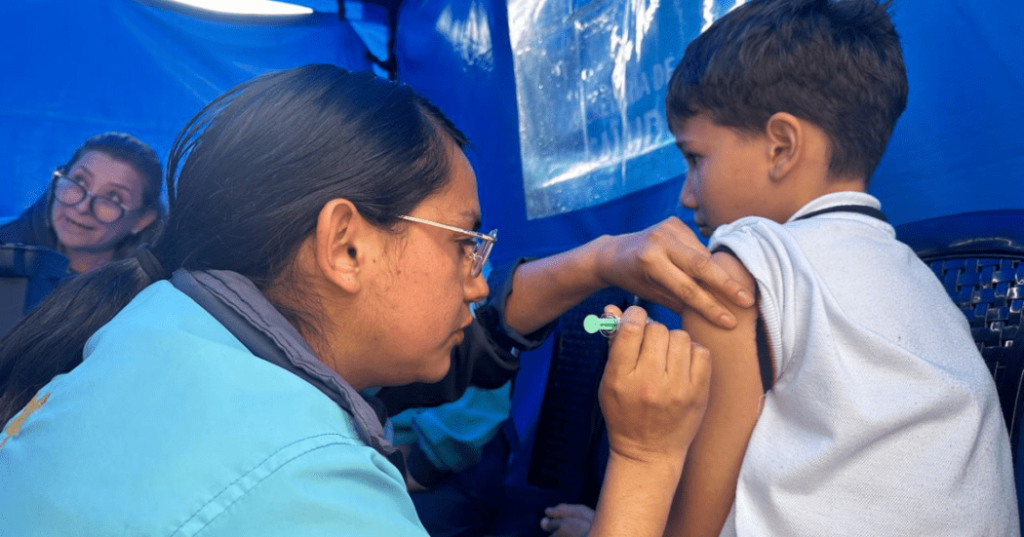
Vaccinator at work in Bogotá last week. Photo: courtesy Secretaria de Salud Bogotá.
Health authorities have activated over 200 free vaccination points across the city this week after two measles cases were reported.
The highly contagious virus, which is airborne and can cause serious health problems for young children, was detected in travelers from Mexico who had arrived in Bogotá and then fallen ill. Another imported case was found outside the capital.
In response the city’s District Health Secretariat said it had activated protocols to isolate the cases and had laboratories on hand to help with tracking any potential spread in the city.
Bogotá’s health secretary Gerson Bermont emphasized the need for a swift response: “Bogotá has all the infrastructure and human resources to provide technical support for diagnostic processes, he said. “The key is to act promptly to reduce local transmission.”
Measles was one of the most contagious viruses in existence and could be transmitted even by breathing, he warned. The best protection was with the MMR (measles, mumps, and rubella) vaccine, with two doses 97% effective at preventing the disease. The three people reported this week were unvaccinated.
In June last year U.S. embassies around the world took the unusual step of issuing a warning that measles was an “ongoing global risk” and advised citizens going abroad to get jabbed.
“Travelers can catch measles in many travel settings including travel hubs like airports and train stations, on public transportation like airplanes and trains, at tourist attractions, and at large, crowded events,” said the notice.
“Infected travelers can bring the disease back to their home communities where it can spread rapidly among people who are not immune.”
Good coverage
Recent data from the U.S. Centre for Disease Control (CDC) showed outbreaks in every region of the world with high caseloads in Mexico, Yemen, Indonesia, Pakistan, India, Angola and Laos.
The World Health Organization (WHO) declared Colombia free of measles in 2014, after intensive campaigns across the country by vaccination teams brought MMR to remote corners of the country.
Vaccinator in El Encanto, Amazon region of Colombia. Immunization coverage for measles is 93% according to WHO statistics, thanks to teams deployed to remote areas. Photo: S Hide.
Measles vaccine coverage in the country was 93 per cent for the first dose, according to data on the WHO immunization dashboard, a reasonable result for a country with access challenges for health teams
Bogotá last saw cases in 2019, when 11 persons were affected by the disease, according to data from the city’s Observatorio de Salud.
To avoid local spread from the imported cases this week, more than 200 vaccination points were activated across the city, with details in this link of locations and opening times. Most of the sites are in existing health facilities though all are welcome and the measles vaccine is free.
The city health authorities were offering free immunization with the triple MMR vaccines (measles, mumps and rubella) known in Colombia as SRP (sarampión, rubéola y paperas) or a double vaccine of SR (just measles and rubella). Any unvaccinated or partially vaccinate person between six months old and 60 years old was encouraged to get jabbed.
The risk to Colombia “could not be underestimated” Bermont told Blu Radio this week.
“It’s bad news what’s happening in the Americas,” he said. “Last year there were 15,000 measles cases across the region. Just in Mexico there were 32 deaths”.
Bermont said mass immunization was the best method to avoid an outbreak, but region had become vulnerable from anti-vax messaging by pressure groups that gained influence during the Covid-19 pandemia.
“We have to also recognize that today there are also health authorities in the world that throw doubt on the effectiveness of the vaccine.”
Colombians head to the polls on March 8 for what is, formally, a legislative election. In practice, it is something more consequential: a stress test of the country’s political coalitions ahead of the May 31 presidential race already defined by fragmentation – and by mounting security concerns for right-wing candidates.
The vote for Congress matters. But the country will be watching the consultas presidenciales—three parallel primaries that function as a de facto first round. In them, Colombians vote less for programs than for trajectories: continuity, rupture, or something in between.
On the right, Paloma Valencia is poised to dominate La Gran Consulta, a coalition spanning moderate conservatives, independent liberals, and slate of well-known political leaders. Polling places her far ahead of her rivals, with margins large enough not merely to win, but to define the bloc itself. In a pre-Petro era, such a coalition might have fractured under its contradictions, but today, it coheres around one single objective: opposition to the government of Gustavo Petro and the restoration of order- political, fiscal, and territorial.
Valencia’s strength is not only electoral; it is structural. She inherits the Centro Democrático machinery and the disciplined base loyal to former two-term president Álvaro Uribe, whose legacy continues to shape Colombia’s right. But her challenge begins the moment she wins. The right is not unified—it is merely aligned. To convert alignment into victory, she will need to reach out to Abelardo de la Espriella, a pro-Bukele, pro-Milei, lawyer whose mass appeal is rooted in a more visceral, anti-left electorate. If Valencia succeeds in clinching La Gran Consulta, the right could reach May 31 not only united, but energized. If she fails, she risks replaying a familiar Colombian pattern: ideological proximity undone by personal rivalries.
With “El Tigre” de la Espriella lurking in the shadows, the right looks ascendant. Uribe Vélez now faces the daunting challenge of fusing his CD base with Espriella’s fervent Defensores de la Patria.
A Spectral Center
Claudia López is expected to win her consultation comfortably, aided as much by the absence of strong rivals as by the presence of loyal supporters. Her likely vote total- perhaps around one million—will be spun as a comeback. In reality, it reflects the residual strength of her partisan mayoralty and Bogotá-based electorate.
The absence of Sergio Fajardo from the Consulta de las Soluciones underscores the fragmentation of Colombia’s center. A strong showing by López will force a choice: seek alliances quickly or face marginalization after March 8. Even a López–Fajardo ticket would face sharp criticism from within their respective bases, and risk a repeat of the 2022 election season in which Sergio Fajardo’s campaign imploded under the weight of Petrismo or Uribismo.
On the left, the situation is more fluid – and more revealing.
The exclusion of Iván Cepeda has transformed the Frente por la Vida into a contest between two practitioners of political adaptation: Roy Barreras and Daniel Quintero. Neither represents the ideological hardline of Petrismo. Both instead offer variations of what might be called continuity without commitment – a “Petrismo 2.0” calibrated for chaise-lounge socialists.
Barreras relies on organization, his tenure as a loyal Petro “insider”, and the quiet efficiencies of Colombia’s territorial elites. Quintero counters with a direct, anti-Uribe narrative amplified through social media. Each seeks not to replace Petro, but to reinterpret him. Yet the Barreras-versus-Quintero contest feels less like a continuation of an embattled political project than an attempt for both candidates to repackage their political futures.
The most important actor on the left may be Petro himself – precisely because of his absence. By declining to endorse the consultation, he has deprived it of coherence. The result is a referendum on his government without his direct participation, and turnout that may struggle to reach even one million voters. In political terms, that is not a mobilization. It is a warning.
What emerges from these three contests is not a country coalescing, but one sorting itself into sharper, more disciplined minorities. The right is concentrated and motivated. The left is divided and improvisational. The center is present, but peripheral.
Then there is the largest bloc of all: those who will not participate. Polling suggests that a majority of Colombians will abstain from the primaries altogether. This is not apathy in the conventional sense. It reflects something more structural – a growing distance between citizens and political mechanisms that no longer seem to mediate power so much as ratify it.
In that respect, March 8 clarifies less about who will win than about how Colombia now conducts politics. Elections no longer aggregate a national will; they stage competitions between organized intensities. Victory belongs not to the broadest coalition, but to the most cohesive one.
By Sunday night, the candidates will claim momentum. Some will have earned it. Others will have inherited it. But all will confront the same reality: the path to the presidency no longer runs through the mythical Colombian center. It runs through blocs – disciplined, polarized, and increasingly unwilling to transcend partisan loyalties for the greater good.

 Login
Login