Reading view

Global airlines return to Venezuela, Avianca restores Bogotá–Caracas flight

International airlines are rapidly re-establishing services to Venezuela, signalling a cautious but commercially significant reopening of the country’s aviation market. On Thursday, February 12, Colombia’s Avianca resumed a daily direct flights between Bogotá and Caracas.

The move restores one of the most important air corridors in northern South America and comes amid a flurry of announcements from carriers across Europe, the Americas and the Middle East seeking to regain access to a market that has been largely closed since 2019.

The flagship carrier claims that this key route was restored after a “comprehensive evaluation of operational conditions and aviation safety,” carried out in coordination with Colombian and Venezuelan authorities.

Avianca’s daily round trip flight will operate with an A320 aircraft, departing Bogotá (AV142) at 07:40 a.m. and returning from Caracas (AV143) at 12:10 p.m.

The resumption reflects the strong commercial ties between Colombia and Venezuela, as well as growing confidence among airlines that operational, regulatory and security conditions now allow for a gradual return.

For Avianca, which has operated in Venezuela for more than 60 years, the route carries both symbolic and strategic weight. The carrier said the service would strengthen regional connectivity and support trade, tourism and business travel between the two countries, which share deep economic and social ties disrupted during years of political confrontation and border closures.

Avianca’s return is part of a broader recalibration by the global aviation industry following Venezuela’s political transition and the end of Nicolás Maduro’s rule. Airlines had largely withdrawn from the country after the suspension of international flights, currency controls, safety concerns and U.S. sanctions made operations increasingly unviable.

Now, with demand for travel surging among Venezuela’s large diaspora and regional business community, carriers are moving quickly to reclaim market share — albeit cautiously, with a close eye on regulatory approvals and security assessments.

In January, American Airlines said it was ready to resume daily service to Venezuela, positioning itself as the first U.S. carrier to formally announce plans to return after nearly seven years. The airline said flights would remain subject to U.S. government approval and security evaluations, and has not yet announced a launch date.

“We have a more than 30-year history connecting Venezuelans to the U.S., and we are ready to renew that relationship,” said Nat Pieper, American’s chief commercial officer, underscoring the airline’s focus on family reunification, business travel and trade.

Before suspending operations in 2019, American was the largest U.S. airline serving Venezuela, having entered the market in 1987. The carrier said it remains in close contact with federal authorities and is working with regulators, unions and internal teams to ensure a compliant return.

While direct U.S.–Venezuela flights remain pending, regional alternatives are already expanding. Panama-based Copa Airlines has enabled ticket sales since late January allowing passengers to travel between Caracas and Miami via Panama under a single reservation, restoring a key transit option for Venezuelan travellers.

European and Latin American airlines have moved faster, with firm restart dates announced over the next six weeks. Spain’s Air Europa will resume Madrid–Caracas flights on February 17, followed by Laser Airlines the next day. LATAM Airlines plans to restart flights from Bogotá on February 23, while Colombian low-cost carrier Wingo will relaunch Medellín–Caracas services on March 1.

Further afield, Turkish Airlines will begin flights between Istanbul and Caracas on March 3, marking the return of a long-haul intercontinental connection. Spain’s low-cost Plus Ultra will also start services that same day, while Brazil’s GOL plans to resume flights from São Paulo on March 8.

TAP Portugal is scheduled to restore Lisbon–Caracas flights by the end of March.

The pace of announcements reflects both pent-up demand and a race among carriers to secure early-mover advantage in a market that, while still fragile, offers long-term potential. Venezuela’s population of more than 28 million, combined with millions of citizens living abroad, represents a sizeable base for leisure, family and humanitarian travel.

Yet challenges remain. Airlines face currency risks, infrastructure constraints and the possibility of renewed political or regulatory instability. Industry executives say most carriers are returning with limited capacity and flexible schedules, allowing them to scale operations up or down as conditions evolve.

For now, the reopening of Venezuela’s airspace is being driven less by optimism than by calculated risk-taking. Airlines are betting that gradual political normalization and the easing of restrictions will allow them to rebuild routes profitably — without repeating the costly exits of the past decade.

Avianca’s daily Bogotá–Caracas service may therefore serve as an early test case. If demand proves resilient and operations remain stable, more capacity is likely to follow. If not, airlines may once again find themselves navigating turbulence in one of Latin America’s most complex markets.

Still, after years of near-total isolation, Venezuela’s reappearance on international departure boards marks a turning point — one that global airlines are keen not to miss

  •  

Colombian Elections 2026: How do they work?

Colombia is off to the polls in a little under a month, but what’s at stake and what could happen? And why can’t you have a drink while watching results roll in?

Sunday March 8th will be the first of three elections in Colombia. Photo: Element5 Digital on Unsplash

Every Colombian over the age of majority (18) and with a correctly registered cédula ciudandanía can vote. In return, each voter gets a half day off work. Non-citizens are not eligible to vote in national elections, but holders of resident visas will be able to vote in next year’s local elections.

The polls are open from 8am until 4pm and counting is usually very fast with the first results coming in just an hour or so later. Due to the PR system (see below), final results come through in the week. 

Land and fluvial borders will be closed for Colombian nationals on the day of the election, although foreigners can cross. From the Saturday afternoon before voting until the Monday morning, ley seca will apply, meaning no alcohol sales in bars, restaurants or shops. That applies for everyone, so no representation or boozing.

Oversight is carried out by the CNE (Consejo Nacional Electoral). In order to do this over the vast territory and number of stations, over 800,000 citizens are selected to be vote-counters. This is similar to jury duty in other countries and is compensated with a day off as well as a compulsory day of training a couple of weeks beforehand.

As the electorate is growing, there are now some 13,000 voting sites across the country, most with multiple voting tables. Colombians have to vote where their cédula is registered, so don’t be surprised to see some people trekking to other cities if they forgot to update their registration.

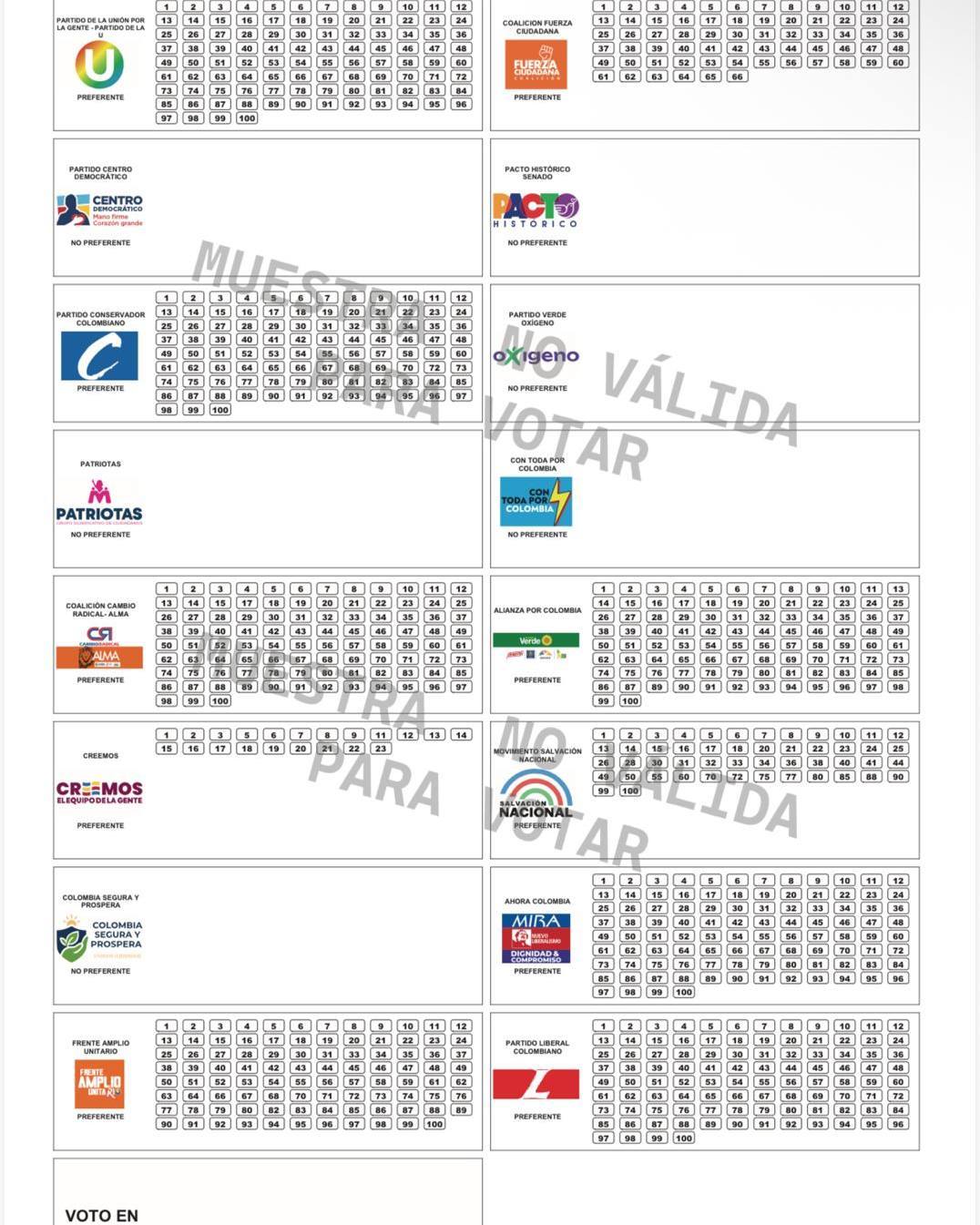
Some parties run a closed list system, meaning you simply vote for them, whereas others have open lists, meaning you vote for the party and can also vote for your preferred candidate within the party. For closed lists, the party will decide who enters congress, with an open list it will be done in order of preference.

A smidgen under 50% turnout is common for house elections, with higher figures expected for the presidential elections later this year. The Colombian parliament is a bicameral system with the Senate acting as the upper and more powerful house and the Cámara the lower house.

Most parties do not really have well-defined manifestos as such, although better-funded candidates will give a range of positions on matters. In general, there will simply be slogans and general aims that give voters an idea of where their candidates stand.

Who’s up for election?

With a PR system in place there are a plethora of parties to peruse. The country was dominated for decades by the Conservadores and Liberales and both remain strong across the country. In recent years they’ve been joined by the Centro Democrático as the third force. Expect all three to do well.

Mid-level parties include the likes of the right-wing Cambio Radical, particularly strong on the Caribbean, centrist (and not ecologically centred) Alianza Verde and ex-president Santos’ centrist partido de la U. The last election saw the leftist Colombia Humana rocket up to join these blocs.

Then there are the smaller parties, often operating essentially as almost one-man-bands. These usually have an enormous amount of support in a particular area or for a certain candidate but fail to translate this to a wider audience. It’s common to see them banding together, as with the governing coalition Pacto Histórico.

Finally, there are guaranteed seats in both the Senate and Cámara for certain groups and people. This year sees the Comunes party no longer receiving an automatic five seats in both houses that they had in the last two votes as part of the peace process. 

If you are a fan of PR, this system allows a diverse number of voices to be heard and limits the power of government, especially when there is opposition to their plans. For those more cynically-minded, it is a way to make sure that little gets done and few significant bills are passed.

There’s also the curious option of voto en blanco. Different from a spoiled vote, which is simply disregarded, this is an active protest. If it ranks highest in any race, then a rerun of the election must take place within a month with entirely new candidates and/or party lists. 

Colombian Senate Elections 2026

The Senate now has 103 seats (known as curules) and is the upper house in the bicameral system. Of those, a straight 100 are chosen by the electorate as a whole, while Indigenous communities select a further two and the runner-up in the presidential election will receive the final seat.

The voting list for elections in Colombia in 2026
The tarjetón for voting in the Senate. Photo courtesy of the Registraduría via Facebook

The Senate currently boasts a whopping 17 parties, but only six of those have double figure representation with the Conservadores’ 15 being the biggest single group. 26 parties are running 1,000 candidates between them this time. Voting is done on a national basis and tallied up across the territory, meaning this takes a little while to work out.

While there is a diverse group of parties, they hang together in loose blocs roughly delineated as government, opposition and neutral. With the government only controlling 34 curules and the opposition 24, the neutrals are incredibly important for horse-trading.

This will be a huge litmus test for the ruling leftist bloc. They will lose their guaranteed  Comunes seats, so any further losses will be highly problematic. On the other hand, gaining curules would be a huge shot in the arm in terms of public support, hence why they are campaigning in places like Huila, outside of their traditional strongholds.

The most likely outcome is that there will be little change in the makeup of the Senate, with neither the government nor opposition likely to take outright control or make large gains. Whichever of those two groups increases their representation will quickly turn it into a sign that they are on the right track and use that as support for their presidential campaign.

Cámara de Representantes election Colombia 2026

The lower chamber, too, is also up for election. It is significantly larger, with 188 seats and 23 parties. The government is also in a minority here and relies on support from independents to get things done. There are over 2,000 candidates representing nearly 500 parties, or listas of similar candidates.

The key difference in voting here is that it is largely territorial, with 161 seats divided between the departments and Bogotá, DC. The latter returns the most seats, with 18, closely followed by Antioquia with one fewer. Colombians living abroad and voting in embassies get one between them

However, these are not equal, as departments receive at least two seats, meaning Vaupés gets one representative for every 20,000 or so people, while the national average is more like 300,000. Changes in population have led to odd situations like Caldas returning more representantes (5) than Cauca (four) despite only having ⅔ of its population.

Then there are the special seats. Again, the Comunes party will lose their five extra seats in this term and it is also the last election to feature the 16 seats reserved for conflict victims. Colombians of Afro descent get two seats, while Indigenous Colombians and raizales from San Andres and Providencia have one apiece and the VP runner-up rounds it out.

Consultas for the presidential election

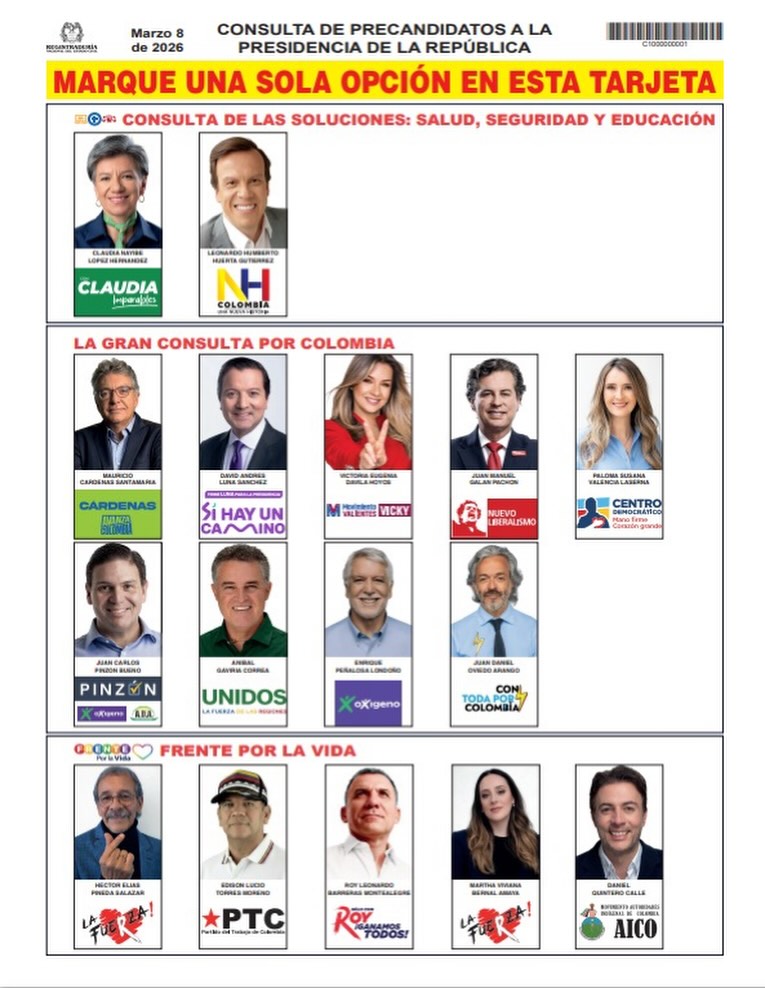
Just in case you thought there was enough on the plate, there are further considerations at stake. To avoid spreading the vote, various presidential candidates with similar positions group together for a preliminary vote. The losers in each consulta will drop out on March 9th. This year there are three on the voting card.

The voting list for consultas in Colombia elections 2026
The tarjetón for voting in the Senate. Photo courtesy of the Registraduría via Facebook

The biggest of these with 9 names is the Gran Consulta Por Colombia, which stretches the credibility of political similarity. It’s nominally centrist but features prominent rightists Vicky Dávila and Paloma Valencia alongside traditional centre voices such as Enrique Peñalosa and Juan David Oviedo. The latter is also the Centro Democrático candidate. 

The leftist consulta is under intense scrutiny as candidate Iván Cepeda, currently leading the polls, was blocked from taking part. That led to further withdrawals and angry denunciations from Cépeda and sitting president Gustavo Petro. Roy Barreras is now the favourite to win this five person race.

Then there’s a centrist competition between former Bogotá mayor Claudia López and little-known candidate Leonardo Huerta. López is the clear favourite here after perennial runner Sergio Fajardo chose to go directly to the first round of presidential voting.

At the moment, the presidential campaign is very unclear. Iván Cepeda leads polling and is extremely unlikely not to make the second round. Who joins him is hard to see at this point, so the consultas will trim that field significantly.

While the Senate and Cámara will be decided by mid-March, this is only the first lap of the field for the presidential candidates. Some will fall out, others will consolidate their position and things will start changing throughout the spring until the May 31st first round.

The post Colombian Elections 2026: How do they work? appeared first on The Bogotá Post.

  •  

Extreme flooding in northern Colombia triggers humanitarian crisis

Unseasonal heavy rains and severe flooding across northern Colombia have created a full-blown humanitarian crisis, displacing hundreds of thousands, destroying homes and farmland, and pushing local infrastructure and health systems to breaking point.

The disaster has hit hardest in the department of Córdoba, where officials say 156,000 people have been affected and 80% of the territory remains underwater following rainfall that broke historical records for February, traditionally one of the region’s driest months.

“In one day we received the amount of rain expected for an entire month,” Ghisliane Echeverry, director of the Institute of Hydrology, Meteorology and Environmental Studies (Ideam), told ministers during a government emergency council meeting.

The flooding has spread across multiple departments, including Sucre, Magdalena, La Guajira, Chocó and Antioquia, but Córdoba — a key agricultural and cattle-raising hub — has borne the brunt of the devastation.

“This is much more serious than even the most pessimistic scenarios we expected,” Carlos Carrillo, director of the National Unit for Disaster Risk Management (UNGRD), said. “We are facing a severe climate crisis that has overwhelmed traditional coping mechanisms.”

Displacement and extensive damage

Preliminary government assessments report at least 14 confirmed deaths linked to flooding and landslides, while thousands of families have been forced into temporary shelters as floodwaters inundate entire neighborhoods.

In Córdoba’s rural areas, officials estimate that around 157,000 hectares of agricultural land are submerged, affecting crops such as plantain, yucca and watermelon as well as commercial monocultures like African palm. Livestock losses are mounting, with local authorities reporting that more than 5,500 animals have been affected.

“We have 1,700 homes already destroyed and 4,000 more uninhabitable,” Carrillo said, though he cautioned that final figures are expected to change once waters recede and damage is fully assessed.

The United Nations Office for the Coordination of Humanitarian Affairs (OCHA) said more than 27,000 families have been impacted by flooding across the Caribbean departments, with thousands more indirectly affected as access roads and bridges have been reduced to rubble.

Public health officials warn that overcrowded shelters are becoming hotspots for disease, exacerbated by lack of access to clean water, sanitation and essential medical care.

“We are seeing extreme levels of waterborne and respiratory illnesses among displaced families,” said a health official in Montería, the capital of Córdoba. “The combination of stagnant water, cramped conditions and limited resources is a ticking time bomb.”

Essential supplies including food, mattresses and personal hygiene products are in critically short supply in many shelters, officials said.

Cold front and climate pressures

Meteorologists have attributed the extreme rainfall to an atypical cold front entering from the Caribbean, which has pushed precipitation far above normal levels. Rainfall in some areas has been measured at more than 64% above average for January and February.

“The water levels we are witnessing have never been recorded in February,” Carrillo said. Ideam has maintained high-level yellow and red alerts for at least 16 departments as flooding and landslide risks persist.

Typically dry early months of the year have instead seen consistent rains, and meteorologists warn that March and April could bring the usual seasonal rains, compounding the already dire situation.

Local officials across affected regions reported severe disruptions to vital road networks, bridges and public services, isolating some communities entirely. In the Urabá Antioqueño in western Antioquia, authorities said more than 9,000 families were left displaced in 13 municipalities that declared calamity.

Despite the scale of the disaster, the national government has not formally declared an economic emergency, a move that would unlock additional disaster funds and expedite aid. President Gustavo Petro, who convened a council of ministers in Montería, has signaled that such a declaration is under consideration.

“The magnitude of these floods demands a national response,” one government official said. “We are mobilizing resources but the scale of the crisis is beyond anything we normally plan for.”

The response has also brought renewed scrutiny to long-standing water management challenges in the region. Carrillo and other government officials have criticized decades-old hydraulic works, including reservoirs and levees, for altering natural water flows and potentially exacerbating flooding.

President Petro echoed these concerns on social media, singling out infrastructure such as the Urrá hydroelectric reservoir — built in the 1990s — as part of the region’s broader hydrological challenges.

“These reservoirs were not designed to manage excess water but to drain lands and disrupt natural flow patterns,” Petro wrote, arguing that such interventions may have contributed to current conditions.

Communities struggle amid uncertainty

In two coastal departments – La Guajira and Magdalena – continuous rainfall has caused streams to overflow and paralyzed mobility, while in the colonial port city of Santa Marta, strong winds and currents drove a cargo vessel ashore, highlighting the intensity of the storms.

For residents in isolated rural towns, the toll is deeply personal. Entire families have lost homes and livelihoods, and many are now waiting for relief that has been slow to reach remote areas.

“We’ve never seen water this high,” said a farmer in northern Córdoba. “We are afraid of what comes next — we don’t know how we will recover.”

With rains expected to continue over the coming weeks, authorities and humanitarian organizations warn that the full scale of the disaster may not be known for months, and that recovery will require sustained national and international support.

  •  

Petro and Trump: What next in U.S.–Colombia relations?

Nearly a week after Donald Trump hosted Colombia’s president, Gustavo Petro, at the White House, calm has returned to a bilateral relationship that only recently appeared headed for rupture. The insults have stopped. The social media theatrics have faded. Diplomacy, not spectacle, is back in charge.

This alone tells us that both governments have agreed to “disagree” and agree again.

The meeting itself produced no headline agreements. Instead, it marked something more consequential and less dramatic – a quiet end to illusions. In Washington, Petro’s flagship policy of “Total Peace” is now widely regarded as exhausted, if not outright discredited. What replaces it is a far more traditional, conditional partnership: security cooperation first, democracy under scrutiny, and patience in short supply.

The timing matters. Within days of the White House meeting, the U.S. State Department announced that John McNamara, Washington’s chargé d’affaires in Bogotá, will leave his post on February 13. McNamara arrived a year ago at a moment of open hostility between Trump and Petro, when the relationship was being tested not only by policy disagreements but by personal antagonism. His task was not to advance grand initiatives, but to prevent a collapse. That he succeeded says much about the value of professional diplomacy in an era of impulsive politics.

His departure now marks the end of a holding pattern. What comes next will be harder, more explicit, and less forgiving.

The Trump – Petro encounter was cordial, almost surprisingly so. Trump praised Petro as “terrific.” Petro shared a handwritten note from Trump declaring his affection for Colombia. The optics were deliberate. But the substance lay elsewhere.

According to officials and lawmakers briefed on the talks, Washington’s message was blunt: negotiations without consequences have failed. Petro’s Paz Total—a strategy built on ceasefires, open-ended negotiations, and the assumption that armed groups could be coaxed into disarmament—has not reduced violence. In many regions, it has coincided with territorial expansion by FARC dissidents, rising extortion, and a deepening humanitarian crisis. From Washington’s perspective, it has blurred the line between peace realpolitik and paralysis.

U.S. cooperation with Colombia is now explicitly conditioned on key demands. First, decisive military action against armed groups, especially the ELN along the Venezuelan border, where insurgents have long enjoyed sanctuary. Second, ironclad guarantees that Colombia’s upcoming electoral processes will be free, fair, and transparent ahead of a high-stakes 2026 presidential race.

This is not ideological hostility. It is strategic calculation – from Bogotá to Caracas, and ultimately, the Oval Office.

Colombia remains indispensable to U.S. interests: a capstone of regional security, a key counter-narcotics partner, and a democratic anchor in a hemisphere unsettled by authoritarian drift and Venezuelan instability. But indispensability does not mean indulgence. Washington’s conclusion is that leverage must now be used, not deferred.

The shift was visible almost immediately. Colombian forces bombed ELN encampments in the Catatumbo region near the Venezuelan border, killing several fighters and seizing weapons. The strikes signaled a return to military pressure after months of restraint under Paz Total.

Yet they also exposed the moral and political cost of the new course. According to Colombia’s forensic authorities and reporting by El Colombiano, one of those killed in Catatumbo was a child. Seven bodies were recovered after the operation, including that of a minor. The incident echoed last November’s bombing in Guaviare that killed seven minors, among them an 11-year-old girl.

Shift in tone and strategy

Petro, in the aftermath of the Trump encounter, has responded with a stark argument: armed groups recruit children precisely to deter military action. Halting airstrikes, he said, would reward a “cowardly and criminal” strategy and accelerate forced recruitment. It is a grim logic, but not an implausible one—and it illustrates the impossible trade-offs now confronting the Colombian state.

Peace negotiations have not been spared. The Clan del Golfo, one of the country’s most powerful criminal organizations, suspended talks with the government after reports that Colombia and the United States discussed targeting “high-value” leaders. From Washington’s perspective, this reaction only reinforces its skepticism: armed groups talk peace when it buys time, not when it requires surrender.

None of this suggests enthusiasm in Washington for a militarized Colombia. It suggests resignation. The United States has seen this cycle before – in Colombia and throughout the hemisphere. Negotiations without enforcement are a contradiction. Ceasefires without verification entrench armed actors. Elections held amid coercion corrode democratic legitimacy from within.

Which brings us to the second pillar of the new relationship: electoral transparency.

U.S. officials have made clear that Colombia’s democratic processes will now be watched closely – not as a moral abstraction, but as a strategic necessity. A Colombia that cannot guarantee free elections is not a reliable ally, no matter how aligned its security policies may be.

This is the bargain now on offer. Not a reset. No rupture. Conditional coexistence.

John McNamara’s departure symbolizes the transition. His tenure was about keeping the peace between governments. The next phase will be about enforcing terms.

For Petro, the challenge is severe. He must deliver security results demanded by Washington without losing legitimacy at home, where skepticism of militarization runs deep. He must demonstrate democratic integrity while navigating a polarized political landscape. And he must do so knowing that Total Peace, once his signature promise, no longer commands confidence abroad.

The calm in U.S.–Colombia relations is real- but it is not comfort. It is the quiet before accountability.

  •  
❌