
Reading view

Analysis: In Sunday’s Election, Many Colombians Rejected The Political Status Quo. A Stark Right-Left Choice Remains

Colombia’s Runoff Could Reshape Investment, Energy, and Labor Policy

Colombia’s first-round presidential election, held Sunday, May 31, 2026, produced a result that crystallizes the country’s political exhaustion with both the governing left and the traditional right. Criminal defense attorney and political outsider Abelardo de la Espriella placed first with more than 10.3 million votes. Leftist Senator Iván Cepeda, a close ally of outgoing President Gustavo Petro and the lead architect of the administration’s Paz Total peace policy, finished second with just under 9.7 million votes. The two will face each other in a runoff election on June 21.

Senator Paloma Valencia, the candidate backed by former President Álvaro Uribe and the standard-bearer of his Uribismo movement, placed a distant third, receiving less than 7% of the vote — fewer than 1.7 million ballots. Former Medellín mayor and Antioquia governor Sergio Fajardo received just over one million votes, while former Bogotá mayor Claudia López finished below 1%, with approximately 225,000 votes. The remaining minor candidates combined for just over 1% of the total.

Under Colombia’s electoral system, the top two finishers advance to a runoff if no candidate surpasses 50% in the first round. The June 21 vote will determine who assumes the presidency on August 7.

Click above to watch the video!

The Candidates: Background and Context

Abelardo de la Espriella, 47, has never held elected office. He built a national profile over more than two decades as a high-profile defense attorney, founding De La Espriella Lawyers in 2002, with offices in Colombia and the United States. His client roster has included controversial figures: he represented Alex Saab, a Colombian-born businessman who became a close associate of Venezuelan President Nicolás Maduro and was implicated in a scheme to launder proceeds from Venezuela’s food-assistance program, the Comité Local de Abastecimiento y Producción (CLAP). Saab was extradited to the United States, convicted, and later granted clemency before being re-arrested in Venezuela in early 2026. De la Espriella also represented members of the Nule family in connection with the Carrusel de Contratos — a major contracting scandal tied to infrastructure works at Bogotá’s El Dorado airport corridor. He has additionally been reported to have represented individuals linked to organized crime.

De la Espriella has drawn comparisons to figures such as US President Donald Trump and El Salvador’s Nayib Bukele. His campaign has centered on hard-line security policy, including proposals for large-scale incarceration, expanded military operations against armed groups, and the rejection of negotiations with guerrilla organizations. He is reported to hold Italian and US citizenship in addition to his Colombian nationality, and is said to own property in Florida.

In a notable departure from his defense work, de la Espriella took the side of a victim in a high-profile acid-attack case, acting as a private prosecutor to secure a stronger sentence for the perpetrator — an episode that raised his public profile beyond the defense bar.

Iván Cepeda, 63, enters the runoff as the consolidated candidate of the Colombian left and Petro’s Pacto Histórico coalition. He is the primary legislative architect of Paz Total, the Petro administration’s policy of negotiating simultaneously with multiple armed actors, including the ELN and FARC dissident factions. Cepeda’s family background includes deep ties to the Colombian left: his father was secretary general of the Communist Party, and was assassinated. Cepeda himself studied in communist Bulgaria during the soviet era. The two finalists have an established legal and political history: Uribe attempted to bring criminal charges against Cepeda while both served in the Senate, but the Supreme Court determined that Uribe had fabricated the accusations and attempted to bribe witnesses — a case that resulted in Uribe’s criminal conviction.

“If nothing changes, Abelardo wins.” — Loren Moss, Finance Colombia

The Electoral Map

The geographic distribution of the vote reflects deep regional divisions. Cepeda carried Bogotá, which has trended left for years, particularly in lower-income districts on the city’s south and west sides. Antioquia — historically the heartland of Uribismo and home to Medellín, the country’s second-largest city — voted more than two to one for de la Espriella, a result that signals the weakening grip of Uribe’s movement even in its traditional stronghold.

The heart of coffee-growing country — the departments of Caldas, Risaralda, and Quindío also went to de la Espriella. Caquetá, a sparsely populated department in southern Colombia that has suffered sustained guerrilla violence from both the ELN and FARC dissident groups, voted for de la Espriella as well, a result we may interpret as a direct rejection of Petro and Cepeda’s Paz Total.

Cepeda carried Colombia’s Pacific coast, including the chronically neglected department of Chocó, as well as the sparsely populated Amazonas and Putumayo departments bordering Peru and Brazil, and the northern Caribbean coast. The Caribbean coast result is notable, as the region has historically suffered from underdevelopment, infrastructure deficits, and significant income inequality. Norte de Santander with its Catatumbo region on the Venezuelan border and experiencing severe armed-group activity — voted for de la Espriella, a result consistent with public exhaustion over security policy.

The Political Context: From Uribe to Petro and Beyond

Colombia’s current political trajectory is rooted in decisions made across the past two decades. President Uribe served two terms in the early 2000s and, together with then-Defense Minister Juan Manuel Santos, mounted a sustained military campaign against the FARC that significantly weakened the insurgency. Santos later broke from Uribe after assuming the presidency, governing independently and ultimately negotiating a peace agreement with the FARC — a deal that Uribe actively opposed. A plebiscite on the accord failed, but Santos used legislative maneuvering to implement it anyway.
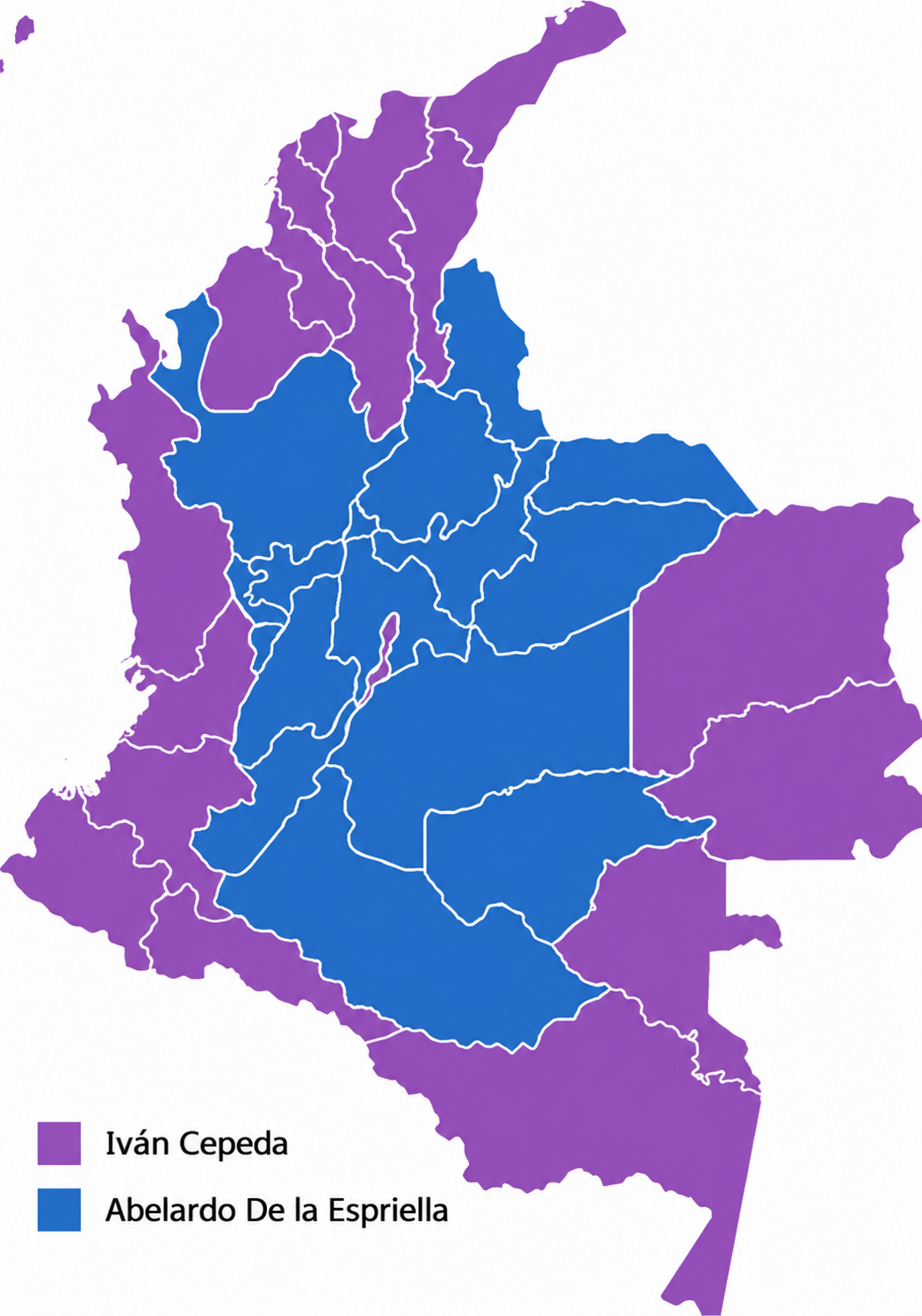
Colombia 2026 1st round top two (Graphic: Sofi Imfeld for Finance Colombia)

Colombia 2026 1st round top two (Graphic: Sofi Imfeld for Finance Colombia)

Uribe’s next handpicked candidate, Iván Duque, won the 2018 election but finished his term with approximately 30% approval. Members of his own party publicly distanced themselves from him — Senator María Fernanda Cabal, a staunch Uribista, called Duque a “mamerto” (leftist idiot) while he was still in office. Under his administration, indicators on crime and guerrilla activity worsened, and armed groups including the ELN rebuilt operational capacity that had been degraded under Uribe and Santos.

Petro’s administration has not met initial fears of a Venezuelan-style democratic breakdown: Congress has largely blocked the most radical components of his agenda, including attempts to nationalize the private pension system and convert the healthcare system to a single-payer model. However, crime has increased, armed groups have expanded their operational footprints, and the security situation in several regions has worsened. Paz Total is widely seen as having produced few tangible results.

Uribe himself was convicted of witness tampering and attempted bribery in the case he had brought against Cepeda. Though released from house arrest after conviction, the judges who authorized his release are now reportedly under investigation for judicial corruption. Valencia’s poor performance in the first round — despite being Uribe’s chosen standard-bearer — suggests that Uribismo as a political force is waning, with its core constituency aging and new generations of voters disengaged from the Uribe legacy.

What to Expect Before June 21

Both campaigns will intensify mobilization efforts over the coming three weeks. Cepeda’s movement — Colombia Humana and the broader Pacto Histórico coalition — has historically relied on organized mobilizations, including indigenous community-led mingas, labor unions, and allied social movements. Cepeda’s running mate Senator Aida Quilcué is an indigenous activist, a choice expected to energize those constituencies. FECODE, the Federación Colombiana de Trabajadores de la Educación (Colombia’s main teachers’ federation), is expected to align officially with Cepeda, though individual teachers may not follow union leadership in their voting choices.

On the right, Paloma Valencia issued a public endorsement of de la Espriella immediately following the first-round results. Business community organizations, including ANDI (the Asociación Nacional de Empresarios de Colombia) and Fenalco (the Federación Nacional de Comerciantes), do not formally endorse candidates, but their members are widely understood to favor a government that supports private enterprise and market-oriented policy. De la Espriella holds no congressional constituency, meaning whichever candidate wins will face the same dynamic Petro encountered: a fragmented Congress that is likely to act as a check on executive authority.

The question of centrist voter alignment remains open. Fajardo and López are not expected to formally endorse either finalist, and the direction of their combined approximately 1.2 million votes is uncertain.

Winners and Losers by Sector

For international investors and executives operating in Colombia, the policy differences between the two candidates are substantive across several key sectors.

Petroleum and Natural Gas: De la Espriella has stated unequivocally that he will restart petroleum exploration and licensing, which the Petro administration blocked. Ecopetrol S.A. (NYSE: EC; BVC: ECOPETROL), Colombia’s state-controlled oil company, which also holds producing assets in the US Permian Basin and Gulf of Mexico, has operated under a government that halted new drilling permits. The consequences have included a decline in future production capacity at a time when global oil prices have risen due to Middle East tensions. Colombia has been forced to import natural gas at elevated prices to meet existing domestic demand — including from transportation fleets that were converted to natural gas under government incentive programs. Cepeda would be expected to continue or deepen current restrictions on fossil fuel expansion.

Healthcare: The Petro-Cepeda platform favors a government single-payer model. The administration has already taken over several Entidades Promotoras de Salud (EPS) — Colombia’s managed-care intermediaries — placing the healthcare system in legal and financial uncertainty. Private clinics, hospitals, and physicians who wish to operate outside a government-controlled framework would benefit from a de la Espriella administration. Cepeda’s healthcare agenda would accelerate the shift toward government-managed care.

BPO, Tech, and Call Centers: The BPO sector — which provides large volumes of formal employment, particularly in Medellín, Bogotá, Cali, and Barranquilla — was significantly affected by Petro-era minimum wage increases of 16% and 23% in successive years. These increases created contract renegotiation pressures with international clients, some of whom have shifted or considered shifting operations to competing jurisdictions including Honduras, Jamaica, the Dominican Republic, Mexico, and Guatemala. At the CX Summit, the industry’s main annual event held in Cartagena, the son of Álvaro Uribe appeared as an invited keynote speaker — a gesture that could be interpreted within the industry as an implicit signal of political alignment. A de la Espriella government, with its orientation toward labor market deregulation and reduced regulatory burden, would be viewed more favorably by this sector. Current Colombian labor law prohibits part-time employment contracts and places significant restrictions on dual employment, making workforce flexibility difficult for businesses that operate outside traditional 40-hour weekly structures.

Mining: The Petro administration has been less aggressive toward mining than toward petroleum, but sector participants expect a more permissive regulatory environment under de la Espriella, and continued constraints under Cepeda.

Security and Tourism: Both candidates have stated support for tourism promotion, but the sector’s trajectory is more directly linked to security conditions. Under current policies, several regions that were accessible to domestic and international travelers several years ago have experienced increased armed-group activity, effectively closing them to tourism. A de la Espriella administration is expected to pursue a more aggressive military posture toward the ELN and FARC dissident factions; a Cepeda government would likely continue dialogue-first approaches. The outcome will directly affect which parts of Colombia’s territory remain accessible to investment and tourism.

Foreign Relations: A de la Espriella government is expected to restore a broadly cooperative relationship with the United States, which deteriorated under Petro following several high-profile diplomatic incidents. De la Espriella has expressed admiration for US President Donald Trump, and reports indicate he holds US citizenship and owns property in Florida. Relations with Ecuador, which have been strained by mutual tariff escalations between Petro and Ecuadorian President Daniel Noboa, would be expected to normalize. Relations with Venezuela under Cepeda would likely continue along the current allied trajectory, while a de la Espriella government would be expected to take a more critical posture toward Caracas. China and Russia would find a more receptive diplomatic environment under Cepeda, and a cooler one under de la Espriella.

The Poor and Informal Workers: Cepeda’s campaign argues that minimum wage increases and expanded state services benefit lower-income Colombians. Critics counter that elevated formal labor costs have pushed more employment into the informal sector — which currently accounts for approximately half the Colombian workforce — depriving those workers of pension contributions, health benefits, and job security. De la Espriella’s platform, which emphasizes business formation, security, and labor market deregulation, would be presented as generating more formal-sector job creation. The actual distributional effects of either approach remain contested.

The Outlook

Assuming current polling trends hold and Uribista voters consolidate behind de la Espriella as expected following Valencia’s endorsement, de la Espriella enters the runoff as the frontrunner. Cepeda’s path to victory depends on driving high turnout among his base, securing support from centrist voters who did not vote for either finalist in the first round, and potentially benefiting from any missteps by de la Espriella in the final three weeks of campaigning.

The first-round results produced no major electoral violence. The ELN announced a temporary halt to armed actions during the voting period. Authorities detained some individuals reportedly attempting to purchase votes in rural areas, but no large-scale incidents were recorded.

The incoming president will face a Congress with no natural majority aligned to the executive, a healthcare system in partial administrative disarray, a petroleum sector whose future production trajectory is in question, and regions where state presence remains contested by armed groups. The June 21 runoff will determine which vision — market-oriented restructuring or continuation of the Petro project — Colombia pursues for the next four years.

  •  

How We Traced U.S. Government Gold to a Drug Cartel

Three reporters followed supply chains to reveal that the U.S. Mint buys gold that comes from foreign pawn shops and drug dealers, then claims it is from the United States.
  •  

How Drug Cartel Gold Ends Up at the U.S. Mint

The U.S. Mint is legally required to sell only legal, domestic gold. Instead, it is the last link in a chain that launders foreign gold for an insatiable market. Our reporter Justin Scheck traced one such supply chain: from an illegal mine in Colombia all the way to the Mint’s facilities in West Point, N.Y.
  •  

Aris Mining Completes Underground Connection at Marmato Gold Mine

Infrastructure Progress Advances Marmato 2026 Gold Production Goals

Aris Mining (TSX: ARIS; NYSE: ARIS) confirmed the completion of an underground infrastructure connection at its Marmato gold mine in Colombia. The development involved connecting a new surface decline to the existing underground mining workings.

This cross-cut connection serves as a technical step for the ongoing expansion project, which includes the construction of a 5,000 tons-per-day carbon-in-pulp (CIP) plant. The company stated that the infrastructure is currently on schedule to support the initiation of gold production in the fourth quarter of 2026.

Neil Woodyer, Chair and CEO of Aris Mining, stated: “The on-schedule connection of the new surface decline to the existing underground development is a major milestone for Marmato and an important step in delivering our expansion plans.”

The Marmato expansion is part of a broader strategy intended to increase the company’s annual gold production. Aris Mining aims to achieve a combined output of approximately 500,000 ounces per year from its Segovia and Marmato operations. The Segovia mine previously expanded its operational capacity following the installation of a second mill in June 2025.

The company maintains a long-term production objective of approximately 1 million ounces of gold annually. This target incorporates potential production from the Toroparu gold project in Guyana, where a prefeasibility study is currently underway. Aris Mining expects a construction decision regarding the Toroparu project in early 2027.

Regarding its portfolio in Colombia, the company is finalizing environmental studies for the Soto Norte gold project. Aris Mining plans to submit these documents for the licensing process during the second quarter of 2026.

Photo (© Loren Moss) illustrative only (Not marmato mine)

  •  

Colombia’s Mining Sector Meets This Week To Discuss Structural, Political Headwinds

Sector adapts to investment decline through secondary asset markets.

The mining industry in Colombia is undergoing a structural transformation as companies prioritize operational efficiency to navigate a challenging economic environment. Recent industry data shows the mining Producto Interno Bruto (GDP) contracted by approximately 8%, while foreign direct investment has experienced a notable downturn. This trend has prompted firms to seek innovative financial strategies to maintain sustainability and competitiveness.

A primary strategy gaining traction is the rotation of underutilized industrial assets. By leveraging industrial auctions, companies are liquidating idle machinery—such as excavators, drilling rigs, and heavy-duty power equipment—to recover capital without the necessity of maintaining internal commercial structures. Superbid, a multinational industrial auction platform, has emerged as a key facilitator for these transactions within the region.

“Asset rotation is becoming a strategic decision to free up capital and improve operations.” — Maria Paula Villa Velez, Superbid

This operational shift toward asset-light business models will be a central topic at MINEXPO Colombia 2026, which is scheduled to take place on April 15 and 16 at Plaza Mayor Medellín. The event serves as a platform for mining producers, suppliers, and investors to discuss strategies for financial optimization and industrial reindustrialization.

The secondary market for industrial equipment has expanded significantly as mining companies divest assets no longer essential to their core operations. This machinery is being repurposed in the infrastructure, construction, and energy sectors, thereby extending the lifecycle of the assets and contributing to circular economy objectives. Market participants have observed increased competition for this equipment, with buyers consistently acquiring assets at market-determined values.

Looking toward the remainder of 2026, industry analysts expect the integration of these efficient asset management models to accelerate, particularly in regions such as Antioquia, where the nexus of mining and infrastructure projects remains a critical economic driver.

“Today the mining sector is understanding that efficiency is not only in producing, but in better managing its resources,” stated Maria Paula Villa Velez, sub-manager at Superbid Medellin. “Asset rotation is becoming a strategic decision to free up capital and improve operations.”

  •  

Aris Mining Posts 36% Year-Over-Year Gold Production Increase at Colombia Operations in Q1 2026

Higher grades at Segovia drive output and revenue gains

Vancouver-based Aris Mining Corporation (TSX: ARIS; NYSE: ARIS) reported preliminary first-quarter 2026 gold production of 74,300 ounces from its two underground mines in Colombia, representing a 6% increase over the fourth quarter of 2025 and a 36% increase compared to the same period a year earlier.

The company said it sold 74,800 ounces of gold during the quarter at an average realized price exceeding $4,860 USD per ounce, generating gold revenue of more than $360 million USD. That figure marks a 20% increase from Q4 2025 revenue of $301 million USD and more than double the $154 million USD reported in Q1 2025. The company reported a cash balance exceeding $470 million USD as of March 31, 2026, an increase of approximately $80 million USD from the end of the previous quarter.

“We expect Q1 2026 gold revenue to exceed $360 million, a significant increase from $154 million in Q1 2025 and $301 million in Q4 2025, driven by higher gold prices and increased ounces sold.” — Neil Woodyer, Chair and CEO, Aris Mining Corporation

The production gains were concentrated at Aris Mining’s Segovia operation in the department of Antioquia, which produced 66,600 ounces during the quarter, up from 63,100 ounces in Q4 2025 and 47,500 ounces in Q1 2025. The year-over-year increase of 40% at Segovia was driven primarily by a notable improvement in ore grade. The average gold grade processed rose to 12.41 grams per ton from 9.37 grams per ton a year earlier, a 32% increase, while the volume of ore processed increased 5% to 175,000 tons. Recovery rates held at 95.3%, compared to 96.1% in both the prior quarter and Q1 2025.

The higher grades offset a decline in throughput compared to Q4 2025, when the mine processed 201,000 tons at an average grade of 10.10 grams per ton. Aris Mining completed installation of a second mill at Segovia in June 2025, increasing processing capacity by 50% to 3,000 tons per day, and the company has indicated that the ramp-up at the operation is continuing.

At the Marmato mine in the department of Caldas, production totaled 7,800 ounces in Q1 2026, an increase from 6,700 ounces in Q4 2025 and 7,200 ounces in Q1 2025. Marmato processed 77,000 tons of ore at an average grade of 3.53 grams per ton during the quarter, compared to 75,000 tons at 3.12 grams per ton in Q4 2025. Recovery rates at Marmato declined slightly to 89.6% from 90.8% in the prior quarter.

Consolidated Production Summary

Gold production and sales Q1 2026 Q4 2025 Q1 2025
Segovia (koz) 66.6 63.1 47.5
Marmato (koz) 7.8 6.7 7.2
Total production (koz) 74.3 69.9 54.8
Total sales (koz) 74.8 71.7 54.3

Growth Outlook

Neil Woodyer, the company’s chair and CEO, said production growth in 2026 is expected to be weighted toward the second half of the year. The company is building a new bulk mine and carbon-in-pulp (CIP) processing plant at Marmato, with first gold expected in Q4 2026. At steady state, the expanded Marmato operation is expected to produce approximately 200,000 ounces per year.

Together, the Segovia and Marmato expansions are expected to increase Aris Mining’s annual gold production to approximately 500,000 ounces. The two mines produced a combined 257,000 ounces in 2025.

Beyond its operating mines, Aris Mining is advancing the Soto Norte gold project in the department of Santander, Colombia, where environmental studies are being finalized for submission in Q2 2026 to initiate the licensing process. The company also holds the Toroparu gold project in Guyana, where a prefeasibility study is underway and a construction decision is expected in early 2027. These projects form part of Aris Mining’s longer-term objective of reaching approximately 1 million ounces of annual gold production, though that target includes estimates from a preliminary economic assessment for Toroparu that the company has cautioned are based on inferred mineral resources and are speculative in nature.

The company expects to report full Q1 2026 financial and operating results on or about May 6, 2026. The quarterly results contained in the April 7 announcement are preliminary and may differ from final figures.

Aris Mining is listed on the Toronto Stock Exchange and the New York Stock Exchange under the ticker symbol ARIS. Company filings are available through SEDAR+ and the US Securities and Exchange Commission.

  •  

Bancolombia NowCast Index Signals Colombia Economic Slowdown in First Quarter

Activity cools to 2.1% annual expansion.

Economic activity in Colombia expanded at an estimated annual rate of 2.1% during the first quarter of 2026. According to the latest NowCast report issued by the Grupo Cibest, unit of Bancolombia (NYSE: CIB, BVC: BCOLOMBIA), this outcome reflects a loss of momentum compared to the rolling quarter ended in February. That previous period recorded a growth of 2.2%, which was revised downward by 10 basis points from an initial estimate of 2.3%.

The 2.1% growth rate for the quarter indicates a slowdown relative to both the market consensus average of 2.7% and the internal growth forecast of 3.3% held by the bank. On a month-over-month basis, the seasonally adjusted series of the NowCast index posted a 1.3% contraction in March 2026. When compared to March 2025, economic activity grew by 2% year over year, representing a 50-basis-point decline from the 2.5% reading recorded the previous month.

“Overall, these results suggest that the economy is beginning to lose steam, amid multiple sources of uncertainty.” — NowCast Bancolombia Report

Analysis at the sector level reveals a broadly weaker growth profile, with deceleration appearing across most productive areas. Slower momentum was identified in trade, manufacturing, recreation, real estate, and financial services. Manufacturing expansion cooled to 1.0% in March 2026, while financial services recorded marginal growth of 0.6%. The real estate sector maintained a steady growth rate of 1.9%.

Construction and communications were the only sectors to record negative growth during the period. The construction sector saw a significant downturn, contracting by 2.3% in March 2026 after having posted 1.4% growth in February. The information and communications sector contracted by 0.4%, marking its fourth consecutive month in contractionary territory. Conversely, acceleration was noted in public administration, which grew by 5.1%, agriculture at 3.7%, and mining at 0.8%.

The NowCast family of indicators is prepared by Grupo Cibest through the processing and aggregation of transaction data from the bank’s various payment channels. Using advanced quantitative tools, the index provides high-frequency estimates of Colombian productive activity to complement official data from the Departamento Administrativo Nacional de Estadística. The report was authored by Arturo Yesid González Peña, Head of Quantitative and Analytics, and Sebastián Ospina Cuartas, Data Controller.

The report also incorporates data from the Bloomberg platform and FocusEconomics Consensus Forecasts to provide broader economic context. While the national economy remains in expansionary territory, the analysts suggest that the current results indicate the market is losing steam due to various sources of domestic uncertainty.

  •  

Jaguar Uranium Initiates Rare Earth Element Assessment at Colombia’s Berlin Mining Project

Berlin has historically reported indications of Rare Earth Elements, Vanadium, Phosphate and Uranium — Positioned as Potential Non-Chinese Critical Minerals Project in the Western Hemisphere

TORONTO — Jaguar Uranium Corp. (NYSE American: JAGU) has commenced an initial rare earth element assessment program at its flagship Berlin Project in Caldas, Colombia. The site is a polymetallic sedimentary deposit containing uranium mineralization alongside associated rare earth elements (REE) and battery-related commodities such as vanadium, phosphate, nickel, molybdenum, rhenium, and yttrium.

The company plans to utilize approximately 20,000 meters of preserved historic drill core for selective re-sampling and assaying. This approach is intended to advance early-stage REE characterization without the immediate requirement for new drilling. The program represents the first dedicated effort by the company to evaluate the rare earth potential of the 9,053-hectare concession area.

“The results could be a step-change in how this project is understood and technically evaluated.” — Steven Gold, Chief Executive Officer, Jaguar Uranium Corp.

“We are now attempting to advance the recognition that Berlin could represent a relevant non-China based critical mineral deposits in the western hemisphere and specifically in Latin America,” stated Steven Gold, Chief Executive Officer of Jaguar Uranium Corp. “We believe the results could be a step-change in how this project is understood and technically evaluated.”

The strategic shift toward REE evaluation follows a period of increased global policy attention regarding critical mineral supply chains. Materials required for defense systems, electric vehicles, and clean energy infrastructure have become a priority for Western governments seeking to diversify away from Chinese-dominated markets. Gracelin Baskaran, director of the Critical Minerals Security Program at the Center for Strategic and International Studies (CSIS), has indicated that the US and the European Union are working to foster independent markets for these materials.

The Berlin Project deposit is situated within a layered sedimentary sequence of phosphate-bearing limestone. The company is employing a three-phase approach for its assessment: core logging and systematic re-sampling, multi-element geological modeling, and an evaluation of by-product economics. This modeling will integrate REE assay data with existing datasets for uranium, vanadium, and phosphate to establish a technical foundation for future resource estimates.

Infrastructure at the site includes proximity to a hydroelectric power source 12 kilometers away and access to a river port approximately 65 kilometers from the project, providing a logistical route to the Caribbean coast. The company, which completed a $25 million USD initial public offering on the NYSE American (NYSE American: JAGU) in February 2026, is also managing the Laguna Salada Project in the Argentine province of Chubut and the Huemul mine in Mendoza.

Technical information regarding the program was approved by Owen D. W. Miller, a qualified person as defined by NI 43-101. The company noted that the Berlin Project remains in the exploration stage and does not currently host mineral resources or reserves as defined under SEC Regulation S-K 1300.

Above photo: Col. John P. Kunstbeck scans uranium ore for alpha and beta radiation signatures outside of a uranium mill. (Photo Credit: U.S. Army photo by Maj. Mark S. Quint)

  •  

Aris Mining Reports 2025 Financial Results and Increases 2026 Production Guidance

Aris Mining Corporation (TSX: ARIS; NYSE: ARIS) has released its financial and operating results for the fourth quarter and full year ending December 31, 2025. The company reported 2025 gold production of 256,503 ounces, a 22% increase from the 210,955 ounces produced in 2024. This output exceeded the midpoint of the company’s annual guidance of 230,000 to 275,000 ounces.

Annual gold revenue reached $909 million USD, representing an 82% increase over the previous year. Adjusted EBITDA rose to $464 million USD, up 185% from 2024, while adjusted net earnings were reported at $241 million USD, or $1.28 USD per share. As of year-end 2025, the company’s cash balance stood at $392 million USD, with net debt reduced to $86 million USD from $241 million USD at the end of 2024.

The Marmato Mine produced 28,741 ounces of gold, a 23% increase over the 2024 production level.

Operational Performance at Segovia and Marmato

Operations at the Segovia Operations in Colombia produced 227,762 ounces of gold in 2025, a 21% increase from 2024. This performance was supported by average gold grades of 9.82 g/t and a 17% increase in tonnes milled, following the installation of a second ball mill in June 2025. All-in sustaining costs (AISC) for owner-operated mining at Segovia were $1,534 USD per ounce, while AISC for Contract Mining Partners (CMPs) was $1,973 USD per ounce, reflecting a purchase formula linked to rising gold prices.

The Marmato Mine produced 28,741 ounces of gold, a 23% increase over the 2024 production level. The result exceeded the 2025 guidance range of 20,000 to 25,000 ounces. The company is currently advancing construction of a new carbon-in-pulp (CIP) processing facility at Marmato, with first gold production expected in the fourth quarter of 2026.

2026 Outlook and Project Development

Aris Mining has set its 2026 consolidated gold production guidance between 300,000 and 350,000 ounces. Production is expected to be weighted toward the second half of the year as the Marmato CIP plant begins operations. At Segovia, production is forecast to increase to between 265,000 and 300,000 ounces.

The company also provided updates on its development portfolio:

  • Soto Norte Project (Colombia): Aris Mining completed a Prefeasibility Study (PFS) in September 2025. The company intends to submit an environmental license application to the Autoridad Nacional de Licencias Ambientales (ANLA) in the second quarter of 2026.
  • Toroparu Project (Guyana): A Preliminary Economic Assessment (PEA) was completed in October 2025, and a PFS is currently underway with a targeted completion in 2026. A construction decision is anticipated in early 2027.

In the fourth quarter of 2025, Aris Mining used $60 million USD in cash for the acquisition of the remaining 49% interest in the Soto Norte project. Subsequent to the year-end, the company received a $40 million USD installment deposit under its precious metals stream financing after reaching a 50% construction milestone at Marmato.

Aris Mining’s operations are subject to oversight by the Agencia Nacional de Minería (ANM) in Colombia and the Guyana Geology and Mines Commission (GGMC) in Guyana.

  •  

Trade War Between Colombia And Ecuador Escalates, With 50% Tariffs Threatened

Tensions between Colombia’s Gustavo Petro & Ecuador’s Daniel Noboa began last year when Petro refused to recognize Noboa’s election as legitimate.

Colombia and Ecuador are engaged in a tariff dispute that could affect both countries. At the beginning of February, Ecuador imposed 30% tariffs on products imported from its northern neighbor, and then Colombia responded with reciprocal tariffs at the same rate. Ecuador has now escalated the dispute by raising the tariff to 50%. Here is a summary of what is happening.

The most recent move by Ecuador was on February 26. “After confirming the lack of implementation of concrete and effective border security measures by Colombia, Ecuador is obliged to adopt sovereign actions. Starting March 1, the security fee on imports originating from Colombia will be increased from 30% to 50%,” the Servicio Nacional de Aduana said in a press release as retaliation for the announcement of reciprocal tariffs by Colombia.

Before that, the Colombian government had officially imposed a reciprocal 30% tariff on imports of goods originating from Ecuador, as established in Decree 170 of 2026, signed on February 24 by President Gustavo Petro and his ministerial cabinet.

The decree states that the measure responds to the 30% tariff previously imposed by Ecuador on Colombian products has generated “an estimated 97% drop in exports to that country, equivalent to an annual reduction of approximately $1.803 billion USD.”

Colombia has suspended electricity delivery to Ecuador in retaliation.

The Colombian decision came as a direct response to the so-called “security fee” introduced by Ecuadorian President Daniel Noboa on February 1, which applied the same rate to goods originating from Colombia.

At the time, the Secretaría General de Comunicaciones de Ecuador, announced the measure through the social media platform X, stating that the objective was to “protect national security and strengthen customs controls and security in the border area.” According to President Noboa, the decision was based on “a lack of reciprocity and the need for stronger security measures,” adding that the tariff would remain in place “until there is a genuine joint commitment to combat drug trafficking and illegal mining along the shared border.”

These actions mark an escalation in trade tensions between the two countries, which have faced growing political and diplomatic challenges in recent months. Colombia had already suspended electricity exports to Ecuador following the initial tariffs, while Quito increased fees for transporting Colombian petroleum through its pipelines.

Products affected by tariffs include beans, rice, fats and oils, unsweetened cocoa powder, fresh bananas, ethyl alcohol and denatured spirits, as well as insecticides, fungicides, and disinfectants, among others. Although the tariff is initially paid by importers at the border, these costs are typically passed on to end consumers through price adjustments.

Despite historically close trade relations, it remains unclear whether both countries will reach a short-term agreement, or move toward formal dispute resolution mechanisms. On February 6, foreign ministers from both nations held a negotiation meeting in Quito, though no formal agreement was reached. Ecuador, at the time, conditioned further decisions on progress in security and energy cooperation.

Additionally, according to Bogotá-based El Tiempo daily newspaper, both governments have filed formal complaints with the Comunidad Andina de Naciones (CAN), which must determine whether the claims will be accepted. Analysts generally agree that a diplomatic solution remains the most viable path to resolving the current trade dispute.

The Central Market in Tulcán, Ecuador, near the Colombian border, one of the most affected areas by the new tariffs. (photo: Jadin Samit Vergara)

The Central Market in Tulcán, Ecuador, near the Colombian border, one of the most affected areas by the new tariffs. (photo: Jadin Samit Vergara)

Headline photo: Border between Tulcán, Ecuador, and Ipiales, Colombia, at the Rumichaca International Bridge. (Photo Jadin Samit Vergara)

  •  

Federal Jury Awards Drummond $256 Million in Colombia Defamation Case

A federal jury in the United States has awarded coal producer Drummond Company Inc. $256 million after finding that a prominent human-rights attorney and his associates orchestrated a campaign of false accusations linking the company to paramilitary violence in Colombia.

The verdict, delivered on January 15 in the U.S. District Court for the Northern District of Alabama, marks one of the largest legal victories Drummond has secured in its long-running effort to counter claims alleging ties to illegal armed groups during Colombia’s internal conflict.

Jurors ruled unanimously that Washington-based attorney Terrence P. Collingsworth and his organization, International Rights Advocates (IRAdvocates), knowingly made false and defamatory statements accusing Drummond of financing paramilitary organizations operating in Colombia. The panel also found that Collingsworth and IRAdvocates violated the Racketeer Influenced and Corrupt Organizations Act (RICO), determining they engaged in a coordinated scheme involving extortion, bribery of witnesses, witness tampering, wire fraud, money laundering, obstruction of justice and conspiracy.

According to court filings and testimony presented at trial, the defendants allegedly used fabricated narratives and paid testimony to pressure Drummond through lawsuits and media campaigns in the United States, Colombia and Europe. Jurors concluded there was “clear and convincing evidence” that Collingsworth either knew his claims were false or acted with reckless disregard for the truth.

Drummond had brought two lawsuits against Collingsworth and his network: one alleging defamation and another invoking the federal RICO statute. The jury awarded $52 million in damages for defamation and $68 million under the RICO claims. Under U.S. law, RICO damages are automatically tripled, bringing the total award to $256 million.

The case centered heavily on payments made to Colombian witnesses who had testified in earlier lawsuits accusing Drummond of supporting right-wing paramilitary groups. Evidence showed that more than $400,000 had been paid to individuals including Jaime Blanco Maya and Jairo de Jesús Charris, also known as “El Viejo Miguel,” without disclosure to courts.

The jury further found that other alleged co-conspirators were involved in the broader scheme, including Colombian attorney Iván Alfredo Otero Mendoza and Dutch businessman Albert van Bilderbeek, both of whom were also held liable under RICO.

Drummond’s lead trial counsel, Trey Wells of Starnes Davis Florie LLP, said the verdict vindicated the company after decades of reputational damage. “This verdict is further proof that Drummond has never had any ties whatsoever to illegal armed groups,” Wells said in a statement. “For years the company endured malicious accusations and false narratives that have now been categorically rejected by an American jury.”

Drummond has operated in Colombia since the late 1980s and is one of the largest exporters of Colombian coal. The company has faced multiple lawsuits over the past two decades in U.S. courts alleging it supported paramilitary groups blamed for killings near its mining operations — claims Drummond has consistently denied. The Company said the ruling exposesd a coordinated effort to damage Drummond’s reputation and extract financial settlements through legal pressure based on false testimony. “The case documents demonstrate a deliberate strategy to harm Drummond commercially and reputationally through fabricated allegations,” the company noted.

Drummond reiterated its commitment to ethical operations in Colombia, stressing that it has complied with national laws since beginning activities in the country and maintains strict corporate governance standards.

The verdict is expected to have far-reaching implications for ongoing and future transnational litigation involving corporate accountability claims, particularly cases reliant on testimony sourced in conflict zones.

  •  

Collective Mining Reports High Grade Drill Results Along Apollo System’s Ramp Zone

Figure 2: Plan View of the Apollo System Highlighting Drill Holes Announced in this Release (CNW Group/Collective Mining Ltd.)

Figure 2: Plan View of the Apollo System Highlighting Drill Holes Announced in this Release (CNW Group/Collective Mining Ltd.)

On December 3, 2025, Collective Mining Ltd. (NYSE: CNL, TSX: CNL) announced assay results from three orthogonal diamond drill holes designed to continue expanding the high-grade Ramp Zone (“Ramp”), a component of the company’s flagship Apollo system within the Guayabales Project in Caldas, Colombia.

The results confirm broad and continuous intervals of reduced intrusion-related gold mineralization, extending the Ramp Zone to 300 meters of strike by 270 meters vertical. The company stated that the zone remains open in all directions.

The Ramp Zone, situated at approximately 1,000 meters above sea level at the bottom of the Apollo system, is part of a large, partially Reduced Intrusion Related System (RIRS) mineralized with gold, silver, copper, and tungsten. Drilling at Apollo has outlined continuous mineralization from the surface to more than 1,370 vertical meters.

Drill Hole Results Detail

Figure 3: Apollo System: High-Grade Over 1,370 Metres from Surface (CNW Group/Collective Mining Ltd.)

Figure 3: Apollo System: High-Grade Over 1,370 Metres from Surface (CNW Group/Collective Mining Ltd.)

The deepest and northeastern-most hole reported to date, APC143-D1, intercepted 23.35 meters grading 8.24 g/t gold and 8 g/t silver. This intercept was contained within a broader interval of 76.10 meters grading 3.26 g/t gold and 4 g/t silver, starting from 409.60 meters downhole. This result expanded the Ramp Zone’s dimensions from the previously stated 275 meters of strike by 200 meters vertical.

A second hole, APC140-D2, locally extended the Ramp Zone by 50 meters to the northwest. This hole cut 16.40 meters grading 8.44 g/t gold and 19 g/t silver within a 55.10-meter interval grading 3.06 g/t gold and 7 g/t silver, beginning at 243.10 meters downhole.

A related wedge hole, APC140-D1, intersected two mineralized segments: 47.70 meters grading 1.98 g/t gold and 5 g/t silver from 527.40 meters downhole, including 15.15 meters grading 3.00 g/t gold and 8 g/t silver; and 14.15 meters grading 2.13 g/t gold and 4 g/t silver from 598.55 meters downhole.

Operational and Financial Status

Figure 4: Cross Section Outlining the Ramp Zone Extension to the Northwest (CNW Group/Collective Mining Ltd.)

The company has contracted a third deep-capacity diamond rig to operate at the Ramp Zone, with two additional deep-capacity rigs scheduled to arrive in mid-Q1 2026. Two additional drill holes into the Ramp Zone (APC143-D2 and APC143-D3) are pending assay results; these holes were reported to have intersected 18 sightings of visible gold, compared to none observed in the results detailed in this announcement.

To date, Collective Mining has completed 150,000 meters of diamond drilling across the Guayabales and San Antonio projects, with 105,000 meters dedicated to the Apollo system. Ten rigs are currently operating on site.

The company stated that it is fully funded for its aggressive 2026 program, which targets up to 100,000 meters of additional drilling, based on a cash position of $135 million USD as of December 1, 2025.

Figure 5: Side-by-Side Comparison of the Apollo System and the Neighboring Marmato Mine, Highlighting How the Ramp Zone and Marmato Deeps Systems Begin at the Same Elevation and the Potential for the Ramp Zone to Continue Expanding Along Strike and to Depth (CNW Group/Collective Mining Ltd.)

Executive Chairman Ari Sussman commented on the results, noting that hole APC143-D1 extended the zone along strike and at depth and demonstrated consistent mineralization over substantial widths.

The continued presence of Ramp Zone mineralization at least 270 meters beneath the initial discovery at 1,000 meters above sea level supports the view that the drilling may have only tested the top of a large intrusion-related gold system that shares mineralogical similarities with the multi-million ounce Marmato Deeps Zone.

Collective Mining was established by the team that developed and sold Continental Gold Inc. to Zijin Mining Group Co., Ltd. (SSE: 601899, HKEX: 2899)

Figure 6: Plan View of the Guayabales Project Highlighting the Apollo System (CNW Group/Collective Mining Ltd.)

Figure 6: Plan View of the Guayabales Project Highlighting the Apollo System (CNW Group/Collective Mining Ltd.)

Headline image – Figure 1: Cross Section Outlining the Ramp Zone Extension to the North (CNW Group/Collective Mining Ltd.)

  •  
❌