
Reading view

El Niño Warming Patterns Signal Operational Risks for Colombian Power and Agriculture

Escalating drought risk is potential bad news for rural communities, power consumers.

The National Oceanic and Atmospheric Administration (NOAA) and the Climate Prediction Center (CPC) have confirmed that ENSO-neutral conditions are currently present in the equatorial Pacific Ocean. However, technical indicators suggest a rapid transition, with a 61% probability of El Niño emerging between May and July 2026. For international investors and executives operating in Colombia, this shift indicates a looming period of increased operational costs, specifically within the energy and agricultural sectors.

The El Niño Southern Oscillation (ENSO) is a recurring climate pattern involving changes in the temperature of waters in the central and eastern tropical Pacific Ocean. During El Niño, trade winds weaken, allowing warm water to move toward the west coast of South America. Conversely, La Niña is characterized by stronger trade winds and cooler ocean temperatures. These fluctuations disrupt global atmospheric circulation, altering rainfall and temperature patterns across the planet.

In Colombia, the effects of these phenomena are distinct and significant. El Niño typically results in a sharp decrease in precipitation and a rise in average temperatures. Because Colombia relies on hydroelectricity for more than 60% of its total power generation, extended dry periods lead to lower reservoir levels. This forces the grid to rely on more expensive thermal generation fueled by natural gas and coal, which historically drives up spot market electricity prices for industrial and residential consumers.

“There is a 25% probability that the index reaches or exceeds +2.0°C during the Northern Hemisphere winter,” according to the National Oceanic and Atmospheric Administration.

The current technical diagnostic from NOAA shows that while the sea surface temperature index in the Niño-3.4 region was recently -0.2°C, the easternmost indices have already moved into positive territory. Furthermore, the equatorial subsurface temperature index has increased for five consecutive months. This accumulation of ocean heat is a primary driver behind the high probability of El Niño persistence through the end of 2026. Some models, including those from the European Centre for Medium-Range Weather Forecasts (ECMWF), suggest a 25% chance of a “strong” or “very strong” event, where temperatures exceed the 2.0°C anomaly threshold.

The Ministerio de Minas y Energía and the Comisión de Regulación de Energía y Gas (CREG) are monitoring these developments closely. A strong El Niño would place additional stress on a natural gas system already facing structural supply constraints. Reduced hydroelectric output coupled with a potential deficit in gas supply could lead to significant energy price volatility. In past events, such as the 2015-2016 cycle, these conditions resulted in substantial financial pressure on the national utility system and necessitated emergency conservation measures.

Agricultural productivity is equally at risk. The Instituto de Hidrología, Meteorología y Estudios Ambientales (IDEAM) has identified the Caribbean and Andean regions—including departments such as La Guajira, Magdalena, and Antioquia—as highly vulnerable. During El Niño, these areas face increased risks of forest fires, water scarcity, and crop failure. For agribusinesses and exporters, this translates to disrupted planting cycles and higher production costs for staples like corn, potatoes, and vegetables, which can fuel domestic food inflation.

Conversely, when La Niña is in effect, Colombia faces the opposite extreme. The cooling of the Pacific leads to excessive rainfall, which can cause devastating landslides and flooding in mountainous terrain. While La Niña can replenish reservoirs, it often damages infrastructure and logistics networks, complicating the transport of goods to port. The current transition out of a La Niña phase provides a brief window of ENSO-neutral stability, which the CPC estimates has an 80% chance of lasting through June 2026.

For the international business community, the significance of these weather cycles extends to macro-economic stability. Persistent dry weather can impact GDP growth by raising the cost of basic services and reducing agricultural output. Strategic planning for 2026 and 2027 must account for these climatic variables. Meteorologists at Colorado State University note that El Niño also tends to reduce hurricane activity in the Atlantic, which may provide some relief for coastal logistics, but the primary threat remains the inland hydrological deficit.

As the Ministerio de Ambiente y Desarrollo Sostenible activates preventive mechanisms, companies are encouraged to review their energy procurement strategies and water management protocols. The next comprehensive diagnostic update from NOAA is scheduled for May 14, 2026, which will provide further clarity on the intensity of the projected warming trend. Understanding the mechanics of the ENSO cycle is no longer a matter of environmental interest but a necessity for risk mitigation in the Colombian market.

Satellite sea surface temperature departure in the Pacific Ocean for the month of October 2015, where darker orange-red colors are above normal temperatures and are indicative of El Niño. (Image credit: NOAA)

Satellite sea surface temperature departure in the Pacific Ocean for the month of October 2015, where darker orange-red colors are above normal temperatures and are indicative of El Niño. (Image credit: NOAA)

Headline photo: the Pacific Ocean from Guachalito Beach, Chocó, Colombia (photo © Loren Moss)
  •  

S&P Global Ratings Downgrades Colombia to BB- Amid Fiscal Concerns

Credit downgrade is an indictment of the Petro administration’s fiscal management, including suspension of the fiscal rule.

On April 8, 2026, S&P Global Ratings (NYSE: SPGI) lowered its long-term foreign currency sovereign credit rating on Colombia to BB- from BB and its long-term local currency rating to BB from BB+. The outlook for both ratings is stable, reflecting expectations that the Government of Colombia will gradually reduce its fiscal deficit while sustaining moderate growth in the national gross domestic product.

The rating action follows persistent fiscal imbalances and a policy environment that has become less predictable since the pandemic-related recession. The government decision to suspend the national fiscal rule in 2025 marked a significant shift in the policy framework. Pro-cyclical fiscal policies have provided marginal support for employment and consumption, but have also contributed to higher inflation expectations and a wider current account deficit. S&P expects the general government fiscal deficit to reach 5.6% of the national gross domestic product in 2026, compared to 5.3% in 2025.

“We expect Colombia to have consistently large fiscal deficits over the next few years.” — S&P Global Ratings

Institutional stability remains a key factor in the rating, though challenges persist. A fragmented legislature followed the March 2026 elections, where Pacto Histórico and Centro Democrático emerged with the largest minorities. The upcoming presidential election, scheduled for May 31, 2026, adds further uncertainty. Candidates such as Iván Cepeda of Pacto Histórico, Paloma Valencia, and Abelardo de la Espriella have proposed varying approaches to fiscal consolidation. The new administration will inherit spending pressures related to domestic security, rising healthcare costs, and pension payments linked to minimum wage increases.

The Banco de la República, the independent central bank of the country, has maintained a tight monetary policy to combat inflationary pressures. Annual inflation reached 5.3% in February 2026, prompting the bank to increase reference rates to 11.25%. S&P anticipates that inflation will not return to the target range of 3% +/- 1% until early 2029. While the independent status of the central bank provides a buffer against external shocks, high interest rates and lower-than-expected revenue collections have contributed to the widening deficit since 2024.

Economic growth is projected at 2.5% for 2026, slightly below the 2.6% recorded in 2025. Per capita growth is estimated at $9,900 USD for 2026, with real growth expected to average just above 2% through 2029. Despite being a net energy exporter, the performance of the US economy and international energy prices continue to influence national outcomes. Hydrocarbon exports declined to 35% of goods exports in 2025, down from 67% in 2013, showing some diversification even as the sector remains a primary source of volatility.

Net general government debt is forecast to approach 66% of the national gross domestic product by 2029, rising from 60.4% in 2025. S&P notes that the government interest burden will average 12.3% of general government revenue over the next three years. The shift toward issuing shorter-term debt instruments has reduced reported interest payments but increased vulnerability to interest rate fluctuations. External indicators remain a concern, with narrow net external debt expected to stabilize at 130% of current account receipts through 2029. Foreign direct investment is expected to be the primary source for funding the current account deficit, which is projected to stabilize around 2.6% of the national gross domestic product.

Vise photo credit © Loren Moss

  •  

Colombia’s Central Bank to Lift Interest Rates Amid Inflationary Pressure

Monetary tightening impacts investment outlook in Colombia.

Colombia’s Banco de la República is preparing for a significant shift in monetary policy as inflationary risks deteriorate. According to the latest report from the Dirección de Investigaciones Económicas, Sectoriales y de Mercados at Bancolombia (NYSE: CIB), persistent internal pressures and a less favorable external environment are driving the need for a more restrictive stance.

Bancolombia’s analysts expect the Junta Directiva of the Banco de la República to increase its policy interest rate by 100 basis points, bringing it to 11.25 percent. This forecast suggests that the first half of 2026 will be characterized by a more aggressive tightening cycle than previously anticipated, with the rate potentially reaching 12.75 percent.

The international landscape is playing an increasingly decisive role in these local policy configurations. A recent week of central bank decisions globally revealed a shift in tone among major financial institutions, primarily due to rising uncertainty stemming from the conflict in Iran. This geopolitical tension has directly impacted costs for energy, transportation, and agricultural inputs.

“The increase responds to the need to send a clear signal of commitment to price stability.” — Dirección de Investigaciones Económicas, Sectoriales y de Mercados at Bancolombia.

In the US, economic activity shows signs of moderation, yet producer price inflation in February exceeded expectations. The yield curve for US Treasuries, managed by the US Department of the Treasury, has shown mixed behavior as the conflict escalates, with the spread between 10-year and 3-month bonds reaching levels not seen since 2023. Inflation expectations in the US have rebounded in the short term, though they remain anchored over longer horizons.

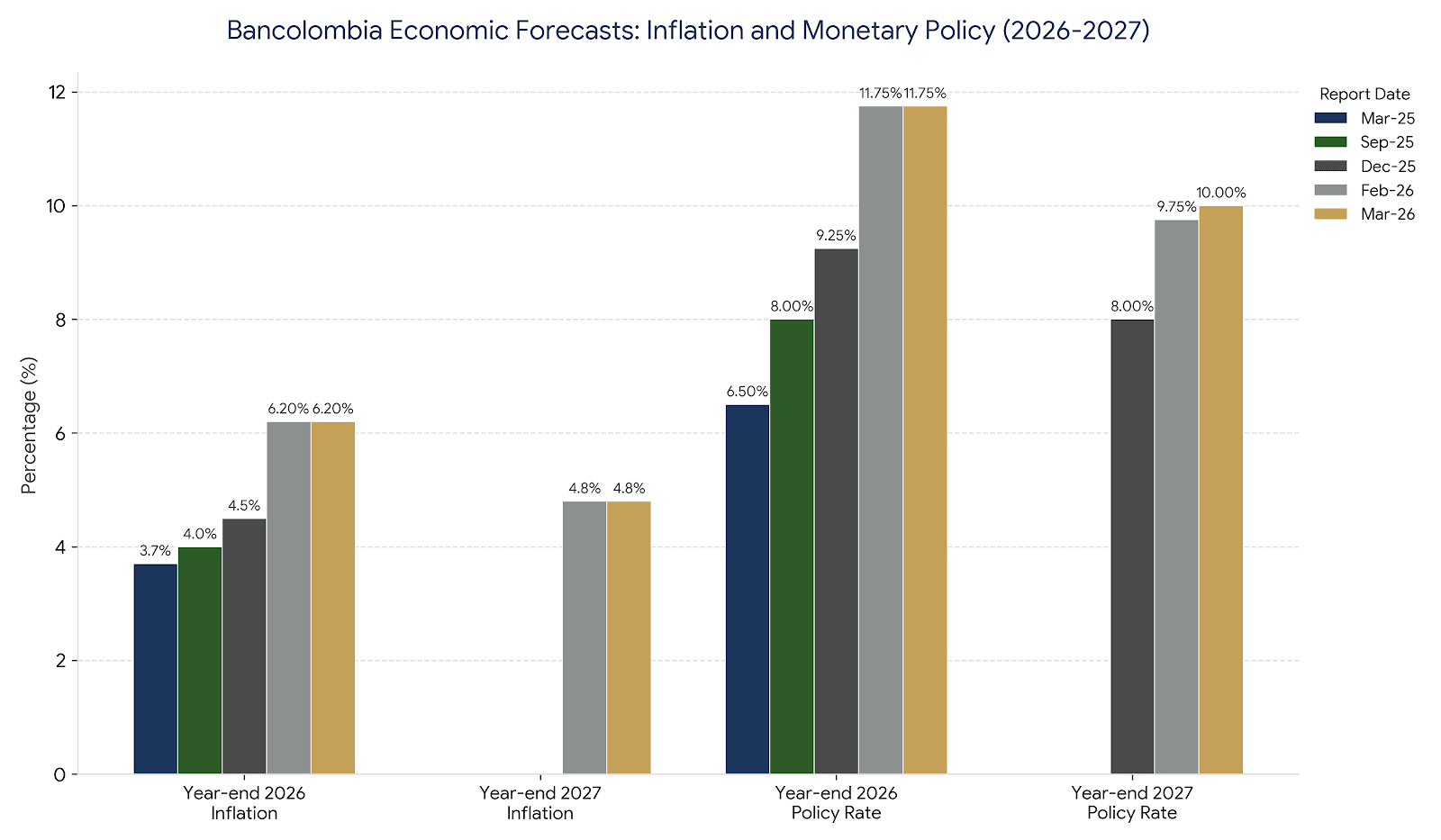
Forecast Category Mar-25 Sep-25 Dec-25 Feb-26 Mar-26
Year-end 2026 Inflation 3.7% 4.0% 4.5% 6.2% 6.2%
Year-end 2027 Inflation 4.8% 4.8%
Year-end 2026 Policy Rate 6.50% 8.00% 9.25% 11.75% 11.75%
Year-end 2027 Policy Rate 8.00% 9.75% 10.00%

Domestically, the business indices from think-tank Fedesarrollo showed mixed results for February. However, there are positive indicators in the labor market, as the urban unemployment rate across the 13 primary metropolitan areas continued its downward trend. Additionally, goods exports recorded an advance during the same period.

In the local fixed-income market, the TES fixed-rate curve saw a recovery last week. However, the March Financial Institutions Survey suggests that devaluations of TES may persist in the short term. Long-term TES Class B placements in the first quarter reached 1.0 percent of the GDP.

Chart based on data from Grupo Cibest & the Banco de la República.

Chart based on data from Grupo Cibest & the Banco de la República.

Energy markets remain volatile as crude oil inventories in the US increased beyond expectations in the third week of March. Despite this, the price of Brent crude rose toward the end of the week, driven by skepticism regarding a potential ceasefire in the Middle East. The Colombian peso appreciated over the past week, tracking the intensity of the regional conflict.

The equity market results for the fourth quarter of 2025 remained neutral and aligned with market expectations. Global volatility continues to be shaped by energy shocks, geopolitical strife, and a cautious approach toward investments in artificial intelligence.

The projected rate hike by the Banco de la República is intended to send a definitive signal of commitment to price stability. This adjustment reflects not only recent inflation trends but also a strategic effort to prevent the further deterioration of expectations in a high-risk environment.

Headline image: Bogotá headquarters of Banco de la República (Banrepublica). Photo credit Juan Enrique Rodríguez, courtesy Banrepublica

  •  

Bancolombia: Colombia Inflation Rises to 5.3% Under Indexation Pressures

The bank’s analysts say that the increase still doesn’t include the effects of Gustavo Petro’s 23% decreed increase in the country’s legal minimum wage.

According to a report by the Economic, Industry & Market Research Area of Bancolombia (BVC: BCOLOMBIA, NYSE: CIB), annual inflation in Colombia rose by 25 basis points to 5.35% in January 2026. This monthly increase of 1.18% represents the highest inflation level since October 2025.

The data, originally prepared by the National Administrative Department of Statistics (DANE), indicates that 70% of the January inflation print was concentrated in the services and regulated components. These two sectors contributed 83 basis points of the total 118-point monthly increase, largely driven by the initial stages of annual cost pass-throughs associated with high indexation.

Businesses should prepare for more intense inflationary pressures in February and March 2026 as the full impact of the minimum wage increase and renegotiated supplier contracts take effect.

Sectoral Impacts and Service Acceleration

Annual inflation in the services category accelerated by 40 basis points to reach 6.33% in January, its highest level since April 2025. The monthly variation of 1.18% in this sector was nearly double the historical January average of 0.63%.

Bancolombia analysts attribute this acceleration to early adjustments linked to the 23% minimum wage increase for 2026 and indexation to previous years’ inflation. Notable increases were observed in:

  • Full-service restaurant meals: 3.36%
  • Prepared meals consumed outside the home: 2.38%
  • Domestic services: 5.16%
  • Imputed rent: 0.43%

The regulated group also saw an acceleration, with annual inflation rising to 5.47% from 5.40%. This was primarily explained by adjustments in urban transportation, vehicle fuels, natural gas, and tolls.

Food and Goods Price Momentum

Annual food inflation edged up slightly to 5.10% from 5.06%. Perishable foods saw an acceleration to 4.69% due to seasonal and supply factors affecting products such as tomatoes, potatoes, and plantains. Processed foods, including beef, milk, and poultry, reflected early-year cost pass-throughs, though annual inflation in this sub-group eased to 5.23%.

The goods category reached its highest level since March 2024, at 2.93%. Price hikes in this segment were driven by new taxes on alcoholic beverages enacted under the economic emergency, as well as pharmaceutical products. Conversely, price declines were noted in personal hygiene products, vehicles, and appliances, benefiting from the recent appreciation of the exchange rate.

Monetary Policy Implications and Forecasts

The Central Bank of Colombia (Banco de la República) faces continued challenges in converging toward its 2% to 4% target range. Core inflation, excluding food and regulated items, reached its highest level since November 2024, indicating persistent upward pressure.

Bancolombia forecasts that year-end inflation will reach 6.4%. The analysts suggest that the full impact of the minimum wage increase has not yet been reflected in consumer prices, as many firms are still operating with inventories purchased at previous cost levels.

Consequently, the Central Bank is expected to continue raising its monetary policy rate to anchor inflation expectations. Bancolombia anticipates the policy rate could rise to 11%, noting that the challenging outlook introduces a hawkish bias to future decisions.

Photo courtesy Bancolombia

  •  

What Jumps Out: 7 Days, 7 Questions

Welcome to the weekend one and all. A week dominated, or at least that was the perception, by politics. Who will be standing in which primary and who will choose / have to go direct to Round 1 in May. Aside from that, the debate over the impact of the 23% minimum wage increase, continues.

1. How was January inflation from Departamento Administrativo Nacional de Estadística – DANE Colombia ?

2. Is the full impact of the Minimum Wage increase now baked in according to Bancolombia ?

3. How were Exports for December from Departamento Administrativo Nacional de Estadística – DANE Colombia ?

4. How many Presidential candidates do we expect to see on the ballot in May ?

5. Why is Petro again discussing Emergency Economic powers ?

6. What are FENALCO & ANDI – Asociación Nacional de Empresarios de Colombia saying about vehicle sales in 2026 ?

7. How have the markets been this week ?

That is our lot for this weekend. Wherever you are, please have a relaxing and peaceful day.

my regards

Rupert

  •  

Colombia’s 23.7% Minimum Wage Hike, Stirs Inflation and Informality Fears

Colombian President Gustavo Petro on Monday decreed a 23.7% increase in the country’s minimum wage for 2026, the largest real rise in at least two decades, bypassing negotiations with unions and business groups and sparking warnings from economists, bankers and employers over inflation, job losses and rising informality.

The decree lifts the monthly minimum wage to 1.75 million pesos (U.S$470), or close to 2 million pesos including transport subsidies, and will apply to roughly 2.5 million workers when it takes effect next year. Petro said the measure aims to reduce inequality and move Colombia toward a “living minimum wage” that allows workers to “live better.”

But business associations, financial analysts and opposition lawmakers said the scale of the increase — far above inflation and productivity trends — risks destabilising the labour market and the broader economy.

According to calculations based on official data, with inflation expected to close 2025 at around 5.3% and labour productivity growth estimated at 0.9%, a technically grounded adjustment would have been close to 6.2%. The gap between that benchmark and the decreed hike exceeds 17 percentage points, the largest deviation on record.

Informality and job losses

Colombia’s minimum wage plays an outsized role in the economy, serving not only as the legal wage floor but also as a reference for pensions, social security contributions and public-sector pay.

Banking association Asobancaria warned that increases far above productivity can generate unintended effects. Citing data from the national statistics agency DANE, the group noted that 49% of employed Colombians — about 11.4 million people — earn less than the minimum wage, mostly in the informal economy, while only 10% earn exactly the minimum wage. Former director of DANE and economist Juan Daniel Oviedo believes that an increase that only benefits one-out-of-ten workers will stump job creation. “A minimum wage of 2 million pesos will make us move like turtles when it comes to creating formal jobs  — something we need to structurally address poverty in Colombia.”

Retail association FENALCO described the decision as “populist” and said the talks had been a “charade.” Its president, Jaime Alberto Cabal, said the process ignored technical, economic and productivity variables and would hit small businesses hardest.

Lawmakers also raised concerns about the impact on independent workers and contractors in the agricultural sectors, especially hired-help on coffee planations. Carlos Fernando Motoa, a senator from the opposition Cambio Radical party, said the decision would push vulnerable workers out of the formal system.

“The unintended effects of this improvised handling of the minimum wage will end up hitting independent workers’ pockets,” Motoa said. “Many will be forced to choose between eating or paying for health and pension contributions.”

Economists warned that micro, small and medium-sized enterprises — which account for the majority of employment — may respond by cutting staff, reducing hours or shifting workers into informal arrangements to cope with higher payroll and social security costs.

Inflation and rates at risk

Analysts also cautioned that the wage hike could reignite inflation, complicating the central bank’s easing cycle. Central bank economists have forecast 2026 inflation at 3.6%, down from 5.1% expected in 2025, but several analysts said those projections may now need revising.

In an interview with Reuters, David Cubides, chief economist at Banco de Occidente, called the increase “absolutely unsustainable,” warning it would affect government payrolls, pension liabilities and the informal labour market.

“Inflation forecasts will have to be revised,” Cubides said, adding that interest rates could rise again in the medium term as a result.

The impact is amplified by Colombia’s ongoing reduction in the legal workweek. From July 2026, the standard workweek will fall to 42 hours, meaning the hourly minimum wage will rise by roughly 28.5%, further increasing labour costs.

The decree comes six months before the presidential election on May 31, 2026, and is viewed by critics of Colombia’s first leftist administration as an electoral gamble aimed at shoring up support for the ruling coalition’s candidate, Senator Iván Cepeda.

Opposition senator Esteban Quintero, from the Democratic Center party, warned that Colombia risked repeating the mistakes of other Latin American countries that pursued aggressive wage policies.

“Careful, Colombia. We cannot repeat the history of our neighbours,” Quintero said. “Populism is celebrated at first — and later the costs become unbearable.”

Former finance minister and presidential hopeful Mauricio Cárdenas said the decision would inevitably lead to layoffs, particularly in small businesses already operating on thin margins, and described the policy as “economic populism” whose costs would materialise after the election cycle.

“The employer ends up saying, ‘I can’t sustain this payroll,’” Cárdenas said. “People are laid off, and many end up working for less than the minimum wage. In the end, nothing is achieved.”

Liberal Party senator Mauricio Gómez Amín said the increase risked becoming a political banner rather than a technical policy tool.

“Without technical backing, a 23% increase translates into inflation, bankruptcies and fewer job opportunities,” Gómez Amín said. “Economic populism always sends the bill later.”

While supporters argue the measure will boost purchasing power at the start of 2026, analysts cautioned that the short-term gains could be offset by higher prices, job losses and a further expansion of Colombia’s informal economy — already one of the largest in Latin America.

  •  
❌