
Normal view

Analysis: In Sunday’s Election, Many Colombians Rejected The Political Status Quo. A Stark Right-Left Choice Remains

2 June 2026 at 22:26

Colombia’s Runoff Could Reshape Investment, Energy, and Labor Policy

Colombia’s first-round presidential election, held Sunday, May 31, 2026, produced a result that crystallizes the country’s political exhaustion with both the governing left and the traditional right. Criminal defense attorney and political outsider Abelardo de la Espriella placed first with more than 10.3 million votes. Leftist Senator Iván Cepeda, a close ally of outgoing President Gustavo Petro and the lead architect of the administration’s Paz Total peace policy, finished second with just under 9.7 million votes. The two will face each other in a runoff election on June 21.

Senator Paloma Valencia, the candidate backed by former President Álvaro Uribe and the standard-bearer of his Uribismo movement, placed a distant third, receiving less than 7% of the vote — fewer than 1.7 million ballots. Former Medellín mayor and Antioquia governor Sergio Fajardo received just over one million votes, while former Bogotá mayor Claudia López finished below 1%, with approximately 225,000 votes. The remaining minor candidates combined for just over 1% of the total.

Under Colombia’s electoral system, the top two finishers advance to a runoff if no candidate surpasses 50% in the first round. The June 21 vote will determine who assumes the presidency on August 7.

Click above to watch the video!

The Candidates: Background and Context

Abelardo de la Espriella, 47, has never held elected office. He built a national profile over more than two decades as a high-profile defense attorney, founding De La Espriella Lawyers in 2002, with offices in Colombia and the United States. His client roster has included controversial figures: he represented Alex Saab, a Colombian-born businessman who became a close associate of Venezuelan President Nicolás Maduro and was implicated in a scheme to launder proceeds from Venezuela’s food-assistance program, the Comité Local de Abastecimiento y Producción (CLAP). Saab was extradited to the United States, convicted, and later granted clemency before being re-arrested in Venezuela in early 2026. De la Espriella also represented members of the Nule family in connection with the Carrusel de Contratos — a major contracting scandal tied to infrastructure works at Bogotá’s El Dorado airport corridor. He has additionally been reported to have represented individuals linked to organized crime.

De la Espriella has drawn comparisons to figures such as US President Donald Trump and El Salvador’s Nayib Bukele. His campaign has centered on hard-line security policy, including proposals for large-scale incarceration, expanded military operations against armed groups, and the rejection of negotiations with guerrilla organizations. He is reported to hold Italian and US citizenship in addition to his Colombian nationality, and is said to own property in Florida.

In a notable departure from his defense work, de la Espriella took the side of a victim in a high-profile acid-attack case, acting as a private prosecutor to secure a stronger sentence for the perpetrator — an episode that raised his public profile beyond the defense bar.

Iván Cepeda, 63, enters the runoff as the consolidated candidate of the Colombian left and Petro’s Pacto Histórico coalition. He is the primary legislative architect of Paz Total, the Petro administration’s policy of negotiating simultaneously with multiple armed actors, including the ELN and FARC dissident factions. Cepeda’s family background includes deep ties to the Colombian left: his father was secretary general of the Communist Party, and was assassinated. Cepeda himself studied in communist Bulgaria during the soviet era. The two finalists have an established legal and political history: Uribe attempted to bring criminal charges against Cepeda while both served in the Senate, but the Supreme Court determined that Uribe had fabricated the accusations and attempted to bribe witnesses — a case that resulted in Uribe’s criminal conviction.

“If nothing changes, Abelardo wins.” — Loren Moss, Finance Colombia

The Electoral Map

The geographic distribution of the vote reflects deep regional divisions. Cepeda carried Bogotá, which has trended left for years, particularly in lower-income districts on the city’s south and west sides. Antioquia — historically the heartland of Uribismo and home to Medellín, the country’s second-largest city — voted more than two to one for de la Espriella, a result that signals the weakening grip of Uribe’s movement even in its traditional stronghold.

The heart of coffee-growing country — the departments of Caldas, Risaralda, and Quindío also went to de la Espriella. Caquetá, a sparsely populated department in southern Colombia that has suffered sustained guerrilla violence from both the ELN and FARC dissident groups, voted for de la Espriella as well, a result we may interpret as a direct rejection of Petro and Cepeda’s Paz Total.

Cepeda carried Colombia’s Pacific coast, including the chronically neglected department of Chocó, as well as the sparsely populated Amazonas and Putumayo departments bordering Peru and Brazil, and the northern Caribbean coast. The Caribbean coast result is notable, as the region has historically suffered from underdevelopment, infrastructure deficits, and significant income inequality. Norte de Santander with its Catatumbo region on the Venezuelan border and experiencing severe armed-group activity — voted for de la Espriella, a result consistent with public exhaustion over security policy.

The Political Context: From Uribe to Petro and Beyond

Colombia’s current political trajectory is rooted in decisions made across the past two decades. President Uribe served two terms in the early 2000s and, together with then-Defense Minister Juan Manuel Santos, mounted a sustained military campaign against the FARC that significantly weakened the insurgency. Santos later broke from Uribe after assuming the presidency, governing independently and ultimately negotiating a peace agreement with the FARC — a deal that Uribe actively opposed. A plebiscite on the accord failed, but Santos used legislative maneuvering to implement it anyway.
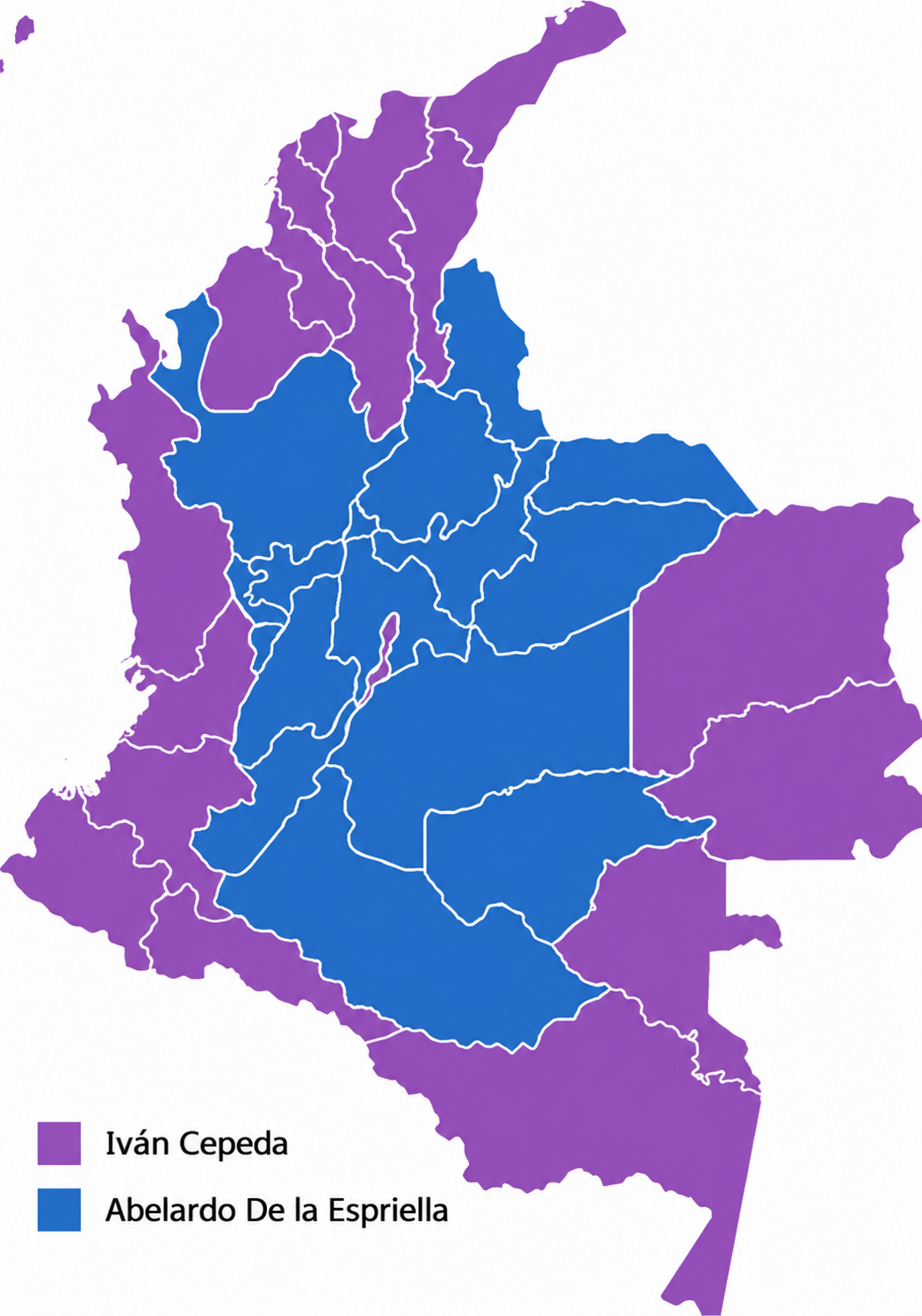
Colombia 2026 1st round top two (Graphic: Sofi Imfeld for Finance Colombia)

Colombia 2026 1st round top two (Graphic: Sofi Imfeld for Finance Colombia)

Uribe’s next handpicked candidate, Iván Duque, won the 2018 election but finished his term with approximately 30% approval. Members of his own party publicly distanced themselves from him — Senator María Fernanda Cabal, a staunch Uribista, called Duque a “mamerto” (leftist idiot) while he was still in office. Under his administration, indicators on crime and guerrilla activity worsened, and armed groups including the ELN rebuilt operational capacity that had been degraded under Uribe and Santos.

Petro’s administration has not met initial fears of a Venezuelan-style democratic breakdown: Congress has largely blocked the most radical components of his agenda, including attempts to nationalize the private pension system and convert the healthcare system to a single-payer model. However, crime has increased, armed groups have expanded their operational footprints, and the security situation in several regions has worsened. Paz Total is widely seen as having produced few tangible results.

Uribe himself was convicted of witness tampering and attempted bribery in the case he had brought against Cepeda. Though released from house arrest after conviction, the judges who authorized his release are now reportedly under investigation for judicial corruption. Valencia’s poor performance in the first round — despite being Uribe’s chosen standard-bearer — suggests that Uribismo as a political force is waning, with its core constituency aging and new generations of voters disengaged from the Uribe legacy.

What to Expect Before June 21

Both campaigns will intensify mobilization efforts over the coming three weeks. Cepeda’s movement — Colombia Humana and the broader Pacto Histórico coalition — has historically relied on organized mobilizations, including indigenous community-led mingas, labor unions, and allied social movements. Cepeda’s running mate Senator Aida Quilcué is an indigenous activist, a choice expected to energize those constituencies. FECODE, the Federación Colombiana de Trabajadores de la Educación (Colombia’s main teachers’ federation), is expected to align officially with Cepeda, though individual teachers may not follow union leadership in their voting choices.

On the right, Paloma Valencia issued a public endorsement of de la Espriella immediately following the first-round results. Business community organizations, including ANDI (the Asociación Nacional de Empresarios de Colombia) and Fenalco (the Federación Nacional de Comerciantes), do not formally endorse candidates, but their members are widely understood to favor a government that supports private enterprise and market-oriented policy. De la Espriella holds no congressional constituency, meaning whichever candidate wins will face the same dynamic Petro encountered: a fragmented Congress that is likely to act as a check on executive authority.

The question of centrist voter alignment remains open. Fajardo and López are not expected to formally endorse either finalist, and the direction of their combined approximately 1.2 million votes is uncertain.

Winners and Losers by Sector

For international investors and executives operating in Colombia, the policy differences between the two candidates are substantive across several key sectors.

Petroleum and Natural Gas: De la Espriella has stated unequivocally that he will restart petroleum exploration and licensing, which the Petro administration blocked. Ecopetrol S.A. (NYSE: EC; BVC: ECOPETROL), Colombia’s state-controlled oil company, which also holds producing assets in the US Permian Basin and Gulf of Mexico, has operated under a government that halted new drilling permits. The consequences have included a decline in future production capacity at a time when global oil prices have risen due to Middle East tensions. Colombia has been forced to import natural gas at elevated prices to meet existing domestic demand — including from transportation fleets that were converted to natural gas under government incentive programs. Cepeda would be expected to continue or deepen current restrictions on fossil fuel expansion.

Healthcare: The Petro-Cepeda platform favors a government single-payer model. The administration has already taken over several Entidades Promotoras de Salud (EPS) — Colombia’s managed-care intermediaries — placing the healthcare system in legal and financial uncertainty. Private clinics, hospitals, and physicians who wish to operate outside a government-controlled framework would benefit from a de la Espriella administration. Cepeda’s healthcare agenda would accelerate the shift toward government-managed care.

BPO, Tech, and Call Centers: The BPO sector — which provides large volumes of formal employment, particularly in Medellín, Bogotá, Cali, and Barranquilla — was significantly affected by Petro-era minimum wage increases of 16% and 23% in successive years. These increases created contract renegotiation pressures with international clients, some of whom have shifted or considered shifting operations to competing jurisdictions including Honduras, Jamaica, the Dominican Republic, Mexico, and Guatemala. At the CX Summit, the industry’s main annual event held in Cartagena, the son of Álvaro Uribe appeared as an invited keynote speaker — a gesture that could be interpreted within the industry as an implicit signal of political alignment. A de la Espriella government, with its orientation toward labor market deregulation and reduced regulatory burden, would be viewed more favorably by this sector. Current Colombian labor law prohibits part-time employment contracts and places significant restrictions on dual employment, making workforce flexibility difficult for businesses that operate outside traditional 40-hour weekly structures.

Mining: The Petro administration has been less aggressive toward mining than toward petroleum, but sector participants expect a more permissive regulatory environment under de la Espriella, and continued constraints under Cepeda.

Security and Tourism: Both candidates have stated support for tourism promotion, but the sector’s trajectory is more directly linked to security conditions. Under current policies, several regions that were accessible to domestic and international travelers several years ago have experienced increased armed-group activity, effectively closing them to tourism. A de la Espriella administration is expected to pursue a more aggressive military posture toward the ELN and FARC dissident factions; a Cepeda government would likely continue dialogue-first approaches. The outcome will directly affect which parts of Colombia’s territory remain accessible to investment and tourism.

Foreign Relations: A de la Espriella government is expected to restore a broadly cooperative relationship with the United States, which deteriorated under Petro following several high-profile diplomatic incidents. De la Espriella has expressed admiration for US President Donald Trump, and reports indicate he holds US citizenship and owns property in Florida. Relations with Ecuador, which have been strained by mutual tariff escalations between Petro and Ecuadorian President Daniel Noboa, would be expected to normalize. Relations with Venezuela under Cepeda would likely continue along the current allied trajectory, while a de la Espriella government would be expected to take a more critical posture toward Caracas. China and Russia would find a more receptive diplomatic environment under Cepeda, and a cooler one under de la Espriella.

The Poor and Informal Workers: Cepeda’s campaign argues that minimum wage increases and expanded state services benefit lower-income Colombians. Critics counter that elevated formal labor costs have pushed more employment into the informal sector — which currently accounts for approximately half the Colombian workforce — depriving those workers of pension contributions, health benefits, and job security. De la Espriella’s platform, which emphasizes business formation, security, and labor market deregulation, would be presented as generating more formal-sector job creation. The actual distributional effects of either approach remain contested.

The Outlook

Assuming current polling trends hold and Uribista voters consolidate behind de la Espriella as expected following Valencia’s endorsement, de la Espriella enters the runoff as the frontrunner. Cepeda’s path to victory depends on driving high turnout among his base, securing support from centrist voters who did not vote for either finalist in the first round, and potentially benefiting from any missteps by de la Espriella in the final three weeks of campaigning.

The first-round results produced no major electoral violence. The ELN announced a temporary halt to armed actions during the voting period. Authorities detained some individuals reportedly attempting to purchase votes in rural areas, but no large-scale incidents were recorded.

The incoming president will face a Congress with no natural majority aligned to the executive, a healthcare system in partial administrative disarray, a petroleum sector whose future production trajectory is in question, and regions where state presence remains contested by armed groups. The June 21 runoff will determine which vision — market-oriented restructuring or continuation of the Petro project — Colombia pursues for the next four years.

El Niño Warming Patterns Signal Operational Risks for Colombian Power and Agriculture

10 April 2026 at 10:49

Escalating drought risk is potential bad news for rural communities, power consumers.

The National Oceanic and Atmospheric Administration (NOAA) and the Climate Prediction Center (CPC) have confirmed that ENSO-neutral conditions are currently present in the equatorial Pacific Ocean. However, technical indicators suggest a rapid transition, with a 61% probability of El Niño emerging between May and July 2026. For international investors and executives operating in Colombia, this shift indicates a looming period of increased operational costs, specifically within the energy and agricultural sectors.

The El Niño Southern Oscillation (ENSO) is a recurring climate pattern involving changes in the temperature of waters in the central and eastern tropical Pacific Ocean. During El Niño, trade winds weaken, allowing warm water to move toward the west coast of South America. Conversely, La Niña is characterized by stronger trade winds and cooler ocean temperatures. These fluctuations disrupt global atmospheric circulation, altering rainfall and temperature patterns across the planet.

In Colombia, the effects of these phenomena are distinct and significant. El Niño typically results in a sharp decrease in precipitation and a rise in average temperatures. Because Colombia relies on hydroelectricity for more than 60% of its total power generation, extended dry periods lead to lower reservoir levels. This forces the grid to rely on more expensive thermal generation fueled by natural gas and coal, which historically drives up spot market electricity prices for industrial and residential consumers.

“There is a 25% probability that the index reaches or exceeds +2.0°C during the Northern Hemisphere winter,” according to the National Oceanic and Atmospheric Administration.

The current technical diagnostic from NOAA shows that while the sea surface temperature index in the Niño-3.4 region was recently -0.2°C, the easternmost indices have already moved into positive territory. Furthermore, the equatorial subsurface temperature index has increased for five consecutive months. This accumulation of ocean heat is a primary driver behind the high probability of El Niño persistence through the end of 2026. Some models, including those from the European Centre for Medium-Range Weather Forecasts (ECMWF), suggest a 25% chance of a “strong” or “very strong” event, where temperatures exceed the 2.0°C anomaly threshold.

The Ministerio de Minas y Energía and the Comisión de Regulación de Energía y Gas (CREG) are monitoring these developments closely. A strong El Niño would place additional stress on a natural gas system already facing structural supply constraints. Reduced hydroelectric output coupled with a potential deficit in gas supply could lead to significant energy price volatility. In past events, such as the 2015-2016 cycle, these conditions resulted in substantial financial pressure on the national utility system and necessitated emergency conservation measures.

Agricultural productivity is equally at risk. The Instituto de Hidrología, Meteorología y Estudios Ambientales (IDEAM) has identified the Caribbean and Andean regions—including departments such as La Guajira, Magdalena, and Antioquia—as highly vulnerable. During El Niño, these areas face increased risks of forest fires, water scarcity, and crop failure. For agribusinesses and exporters, this translates to disrupted planting cycles and higher production costs for staples like corn, potatoes, and vegetables, which can fuel domestic food inflation.

Conversely, when La Niña is in effect, Colombia faces the opposite extreme. The cooling of the Pacific leads to excessive rainfall, which can cause devastating landslides and flooding in mountainous terrain. While La Niña can replenish reservoirs, it often damages infrastructure and logistics networks, complicating the transport of goods to port. The current transition out of a La Niña phase provides a brief window of ENSO-neutral stability, which the CPC estimates has an 80% chance of lasting through June 2026.

For the international business community, the significance of these weather cycles extends to macro-economic stability. Persistent dry weather can impact GDP growth by raising the cost of basic services and reducing agricultural output. Strategic planning for 2026 and 2027 must account for these climatic variables. Meteorologists at Colorado State University note that El Niño also tends to reduce hurricane activity in the Atlantic, which may provide some relief for coastal logistics, but the primary threat remains the inland hydrological deficit.

As the Ministerio de Ambiente y Desarrollo Sostenible activates preventive mechanisms, companies are encouraged to review their energy procurement strategies and water management protocols. The next comprehensive diagnostic update from NOAA is scheduled for May 14, 2026, which will provide further clarity on the intensity of the projected warming trend. Understanding the mechanics of the ENSO cycle is no longer a matter of environmental interest but a necessity for risk mitigation in the Colombian market.

Satellite sea surface temperature departure in the Pacific Ocean for the month of October 2015, where darker orange-red colors are above normal temperatures and are indicative of El Niño. (Image credit: NOAA)

Satellite sea surface temperature departure in the Pacific Ocean for the month of October 2015, where darker orange-red colors are above normal temperatures and are indicative of El Niño. (Image credit: NOAA)

Headline photo: the Pacific Ocean from Guachalito Beach, Chocó, Colombia (photo © Loren Moss)

Frontera Energy Reports Loss While Pursuing Divestiture of Exploration & Production Assets

23 March 2026 at 16:43

Sale to Parex shifts company focus to midstream assets and LNG.

Frontera Energy Corporation (TSX: FEC) announced a net loss from continuing operations of $663 million USD for the fourth quarter of 2025. This figure includes a non-cash impairment of $603 million USD related to the divestment of the company’s Colombian exploration and production (E&P) portfolio and a $17 million USD impairment regarding its Guyana interest. The company has scheduled a special meeting of shareholders for April 30, 2026, to vote on the divestiture of these assets to Parex Resources Inc. (TSX: PXT).

The definitive agreement for the divestiture establishes a firm value of approximately $750 million USD. The transaction includes up to $525 million USD in equity consideration. Following the completion of the sale, Frontera Energy Corporation intends to distribute approximately $470 million USD to shareholders, which equates to approximately CAD $9.18 per share. This distribution includes a $25 million USD contingent payment.

The divestment marks a strategic shift for the Calgary-based company as it transitions into an infrastructure-focused business model. The new structure is anchored by interests in the Oleoducto de los Llanos Orientales S.A. (ODL) pipeline and the Sociedad Portuaria Regional Puerto Bahía S.A. maritime terminal. For the full year of 2025, the infrastructure segment reported an adjusted EBITDA of $116.6 million USD and a distributable cash flow of $76.7 million USD.

“Frontera now enters its next phase as a more focused, cash-generative infrastructure company, well positioned to deliver durable returns.” — Gabriel de Alba, Chairman of the Board of Directors, Frontera Energy Corporation

A central component of this new strategy is the development of a potential liquefied natural gas (LNG) regasification project in partnership with Ecopetrol S.A. (NYSE: EC, BVC: ECOPETROL). Puerto Bahía has secured a take-or-pay agreement with Ecopetrol S.A., subject to certain conditions, for the project. The initiative is planned in two phases, starting with an initial capacity of approximately 126 million cubic feet per day (MMcfd), with projections to reach at least 300 MMcfd by 2029.

In terms of operational metrics for 2025, Frontera reported an average production of 39,011 barrels of oil equivalent per day (boed). The company recorded an operating EBITDA of $308 million USD for the year. Production costs averaged $9.23/boe, while energy costs were $5.49/boe and transportation costs reached $12.00/boe.

The year-end independent reserves assessment, conducted by DeGolyer and MacNaughton Corp, placed the company’s gross reserves at 94.4 million Boe for the 1P category and 133.8 million Boe for the 2P category. All of the company’s booked reserves as of December 31, 2025, are located within Colombia.

On the environmental and social front, the company reported that 70,162 tons of CO2 equivalent were absorbed through environmental compensation areas in 2025. Additionally, 35% of operational water was reused during the same period. The company also noted a total of $95.1 million USD in purchases from local goods and services suppliers.

Upon the anticipated closing of the arrangement in the second quarter of 2026, Frontera Energy will retain its midstream assets in Colombia and certain non-Colombian interests, including those in Guyana. The company expects to allocate $25 million USD from the sale proceeds to further fund its infrastructure business and strategic growth projects.

Frontera To Sell Colombian Petroleum E&P Assets To Parex For $750 Million USD

14 March 2026 at 20:48

Frontera must pay a $25 million USD breakup fee to Geopark.

Frontera Energy Corporation (TSX: FEC) has entered into a definitive arrangement agreement to divest its Colombian upstream exploration and production (E&P) portfolio to Parex Resources Inc. (TSX: PXT) for a total firm value of approximately $750 million USD. The transaction follows the termination of a previous agreement with GeoPark Limited (NYSE: GPRK). Frontera opted for the Parex proposal after the Calgary-based independent producer offered $525 million USD in equity consideration, a $125 million USD increase over the prior GeoPark bid. As part of the transition, Frontera has paid a $25 million USD breakup fee to GeoPark.

The $525 million USD equity consideration includes an immediate $500 million USD cash payment upon closing and a $25 million USD contingent payment. The latter is dependent on the execution of a contractual amendment or binding agreement to extend the term of the Quifa Association Contract within 12 months.

Beyond the cash equity, Parex will assume $390 million USD in existing Frontera liabilities. This includes $310 million USD in 2028 Senior Unsecured Notes and an $80 million USD prepayment facility with Chevron Products Company, a subsidiary of Chevron Corporation (NYSE: CVX).

Following the close of the deal, Frontera intends to distribute approximately $470 million USD to its shareholders, which equates to roughly $9.18 CAD per share based on current exchange rates and outstanding share counts. This distribution is subject to shareholder approval and the successful completion of the transaction.

Frontera is retaining its exploration interests in Guyana.

Shift to Infrastructure Focus

Upon completion, Frontera will pivot its corporate strategy to focus exclusively on energy infrastructure. Its remaining portfolio will be anchored by two primary Colombian assets:

The company will also retain its exploration interests in Guyana. Frontera’s infrastructure division generated approximately $77 million USD in distributable cash flow in 2025. Post-transaction, Frontera expects to maintain $50 million USD in cash reserves to fund growth projects, including a potential Liquefied Natural Gas (LNG) regasification project in partnership with Ecopetrol S.A. (NYSE: EC; BVC: ECOPETROL).

Orlando Cabrales, CEO of Frontera, noted that Parex is currently the largest independent operator in Colombia and a pre-existing partner in the VIM-1 block, which suggests operational continuity for the assets and employees involved.

The independent members of Frontera’s Board of Directors have unanimously recommended the deal. Major shareholders The Catalyst Capital Group Inc. and Gramercy Funds Management LLC, who collectively hold approximately 53% of Frontera’s outstanding shares, have signed support agreements to vote in favor of the arrangement.

Timeline and Approvals

The transaction is structured as a plan of arrangement under the Business Corporations Act of British Columbia. It requires the approval of at least two-thirds of the votes cast by Frontera shareholders at a forthcoming special meeting.

The deal is also subject to approval by the Supreme Court of British Columbia and relevant regulatory bodies in both Canada and Colombia. Parex will fund the acquisition through existing cash, credit facilities, and an underwritten financing commitment from Scotiabank (TSX: BNS; NYSE: BNS). Closing is anticipated in the second quarter of 2026.

Citi (NYSE: C) served as the financial advisor to Frontera, while BMO Nesbitt Burns Inc. provided a fairness opinion. Legal counsel was provided by Blake, Cassels & Graydon LLP and McMillan LLP.

Above photo: Frontera Energy’s Quifa field Meta Colombia. Photo credit: Frontera Energy.

EPM Board Approves $29.8 Trillion COP Budget for 2026, Prioritizing Infrastructure and Energy Transition

6 December 2025 at 23:34

The Board of Directors of Empresas Públicas de Medellín (EPM) approved a budget of $29.8 trillion COP for the 2026 fiscal year during its session on December 2, 2025. The budget is intended to guarantee the continued provision of public utility services—including energy, water, and natural gas—while addressing challenges related to regulatory demands, climate variability, the energy transition, and increasing consumer demand.

The budget allocates resources across all of EPM’s business segments, which include Power Generation, Transmission and Distribution, Gas, Water Provision, and Wastewater. The overall spending plan prioritizes projects focused on modernizing infrastructure, expanding service coverage, and optimizing operational efficiency.

Budget Distribution and Key Investments

The 29.8 trillion COP total budget is divided across four main areas, with investments receiving the largest allocation:

  • Investment Expenses (48%): 14.1 trillion COP
    • Infrastructure investments: 4 trillion COP.
    • Long-term contracts for commercial operation and maintenance (registered as investment under current budgetary rules): 6 trillion COP.
    • Assets and inventory related to service provision and investments, provisions, and others: 3.2 trillion COP.
    • Capitalizations and other items: 907 billion COP.
  • Functioning Expenses (28%): 8.5 trillion COP
    • This includes transfers to the District of Medellín totaling 2.4 trillion COP, taxes and contributions to the national and territorial governments totaling 1.2 trillion COP, and personnel expenses amounting to 1.6 trillion COP.
  • Commercial Operation Expenses (10%): 3.1 trillion COP
    • This covers the purchase of energy, natural gas, and other inputs required to guarantee public service delivery.
  • Debt Service (11%): 3.3 trillion COP
  • Final Cash Availability (3%): 800 billion COP

Of the 4 trillion COP earmarked for infrastructure investments, 1.3 trillion COP is designated for the second phase of the Hidroituango Hydroelectric Project, a significant infrastructure development for the nation’s energy stability.

Financing and Operational Focus

The 2026 budget is projected to be financed primarily through 18.3 trillion COP (62%) in current revenues from services provided (energy, gas, water, and wastewater). This will be supplemented by 3.5 trillion COP (12%) from loans, with the remaining 26% sourced from dividends received from subsidiaries, accounts receivable recovery, and the initial cash balance.

The budget focuses on specific initiatives across EPM’s segments:

  • Power Generation: Includes the expansion of generation infrastructure and the implementation of a master plan for fire protection at generation plants. Resources are also allocated for the modernization of the Guadalupe-Troneras power stations.
  • Energy Transmission and Distribution: Focuses on infrastructure expansion and maintenance, replacement of cables and transformers across all voltage levels, and the control of non-technical energy losses.
  • Water and Wastewater: Key projects include the Orfelinato – Villa Hermosa Pumping System, the expansion of the Yulimar circuit, and the modernization of the Ayurá water treatment plant. The budget also funds the construction, intervention, and repair of water and sewer networks.
  • Gas: Initiatives include optimizing operations through the utilization of biogas from the La Pradera facility.

John Maya Salazar, General Manager of EPM, stated that the budget is aimed at enhancing operational efficiency, strengthening resource management, and ensuring service quality within a context of regulatory, climatic, and market challenges.

Headline photo courtesy EPM

Colgas Receives Recognition at Xposible Colsubsidio 2025 for SME Support Initiative

3 December 2025 at 00:44

Colombian propane gas distributor Colgas was recognized at the 2025 edition of Xposible Colsubsidio with the “Companies that Transform Society” award, a distinction granted to organizations with business models that integrate sustainability and social development. The recognition specifically highlighted the company’s corporate purpose and the execution of its “Empowering the Entrepreneurial Spirit” (Potenciar el Espíritu Emprendedor) project, an initiative designed to strengthen entrepreneurs and strategic allies within its value chain.

The 2025 iteration of Xposible Colsubsidio, a program led by Colsubsidio, received a total of over 500 submissions from business initiatives nationwide. The Colgas initiative was selected for its demonstrated capacity to generate value, promote business practices that meet social responsibility criteria, and contribute to the nation’s productivity.

Unusual for companies in Latin America, Colgas pledges to pay small business suppliers within 7 days of invoicing.

Didier Builes, General Manager of Colgas, indicated that the recognition validates the company’s corporate strategy. “At Colgas, we work to boost the entrepreneurs in our country, offering them concrete tools to grow and transform their businesses. This award motivates us to continue building opportunities that positively impact thousands of Colombian families,” Builes stated.

The “Empowering the Entrepreneurial Spirit” project by Colgas incorporates several strategic actions aimed at the formalization and growth of Small and Medium Enterprises (SMEs). Measures implemented include a program that guarantees payment to SME suppliers within 7 days, as well as financial inclusion initiatives designed to facilitate the sustainability of the small businesses associated with the company.

Furthermore, the program includes the Colgas Corporate University for Entrepreneurs (Universidad Corporativa de Emprendedores Colgas), a training platform that has provided instruction to collaborators and allies in areas such as sales, digital marketing, financial management, safety, and the secure use of Liquefied Petroleum Gas (LPG).

Colgas noted that this award reinforces its strategic positioning as an entity that supports productivity and entrepreneurship in Colombia. The company reaffirmed its focus on developing an ecosystem aimed at generating opportunities for the growth of small and medium businesses in the territories where it operates.

❌