Reading view

Russia orders Apple and Google to remove Important Stories, an investigative media app that works without a VPN — leaving Russians without a key source for accessing uncensored news

Important Stories launched the IStories mobile app in February to make sure information would reach Russians despite widespread internet censorship and VPN restrictions.

  •  

How to Find Compromised & Reused Passwords on iPhone, iPad, and Mac

The Passwords app, Apple’s built-in password manager for Mac, iPhone, and iPad, not only stores your logins and passwords for easy authentication, but it can also alert you to security risks. Passwords app makes it easy to quickly find compromised, reused, or weak passwords, and take action to secure your accounts. If you’re a Passwords ... Read More
  •  

U.S. Issues Strong “Do Not Travel” Advisory for Southwestern Colombia

The United States has updated a “do not travel” warning for large parts of southwestern Colombia after a wave of terrorist attacks have left over 20 people dead, underscoring growing international concern over the country’s deteriorating security situation and prompting regional authorities to demand stronger support from the leftist government of President Gustavo Petro.

The U.S. Department of State maintained most of Colombia at Level 3 – “Reconsider Travel” – citing crime, terrorism, civil unrest, kidnapping and natural disasters, but reinforced its Level 4 advisory for several conflict-hit regions, including the departments of Arauca, Cauca, Valle del Cauca and Norte de Santander.

Under the latest guidance, Americans are advised not to travel to Cauca, excluding the departmental capital Popayán, and Valle del Cauca, excluding Cali, due to crime and terrorism.

Norte de Santander and Arauca remain under the same highest warning level, while travel within 10 kilometers of the Colombia-Venezuela border is also strongly discouraged because of kidnapping risks, armed conflict and the possibility of detention.

“Do not travel to these areas for any reason,” the State Department said in its advisory, adding that violent crime, armed robbery and murder remain common, while terrorist groups continue to operate in remote and rural zones.

The warning was reinforced by a U.S. Embassy security alert issued in Bogotá on April 27, following 26 separate attacks across southwestern Colombia during the weekend of April 25. The attacks targeted transportation corridors, military installations and police stations, with authorities confirming at least 20 deaths and dozens of injuries.

Police and military facilities are frequent targets of armed groups, and the State Department warned that attacks in Colombia have included car bombs, grenades, truck bombs, explosive devices placed on roads and buildings, and even drones carrying explosives.

Illegal armed groups, including dissident factions of the former Revolutionary Armed Forces of Colombia (FARC), narcotrafficking organizations and other insurgent groups, have expanded their territorial presence in recent years, particularly in remote areas where coca cultivation, illegal mining and strategic trafficking corridors overlap.

The deadliest recent attack occurred near the El Túnel sector in Cajibío, Cauca, along the Pan-American Highway, where an explosive device detonated against civilian vehicles, killing 20 civilians and injuring over 50 more. Authorities attributed the bombing to FARC dissidents under command of alias “Iván Mordisco”.

The attack shocked the country and intensified criticism of President Gustavo Petro’s “Total Peace” policy, which seeks negotiated settlements with illegal armed groups but has faced mounting scrutiny as violence worsens in several regions.

In response, the Cauca governor’s office declared three days of official mourning. Authorities described the bombing as an “atrocious and unjustifiable” act and ordered flags to be flown at half-mast across public institutions and schools as a tribute to the victims.
The government also called for national unity and a stronger institutional response to confront armed violence in one of Colombia’s most volatile departments.

In neighboring Valle del Cauca, Governor Dilian Francisca Toro said she respected the U.S. warning but urged foreign governments and the media not to define the entire region by recent attacks.
“We ask that our region not be stigmatized,” Toro said, insisting that Valle del Cauca remains open to visitors and that violence does not represent the department’s cultural, economic and social identity.
At the same time, she sharply criticized the national government’s security response after attacks in Cali and Palmira, calling for “real, sustained and effective support” through more troops, stronger intelligence operations and direct action against criminal structures operating in the region.

Following an explosion near the Agustín Codazzi Engineers Battalion in Palmira, Toro announced an investment of nearly 70 billion pesos ($17 million) to strengthen police communications infrastructure, expand surveillance camera networks and improve secure transport corridors across municipalities.

In Cali, Mayor Alejandro Eder said an attempted attack against the Pichincha Battalion involved explosive gas cylinders, one of which failed to detonate while another exploded inside a minibus.

Authorities activated a citywide security operation and Eder offered a reward of up to 50 million pesos for information leading to the capture of those responsible. “We cannot allow terrorism to regain ground in our city,” Eder said.

  •  

Gunfire Incident on Putumayo River Revives Tensions Between Colombia & Peru

Despite the severity of the incident, Colombia and Peru have indicated a willingness to address it through diplomacy

 An incident on April 12, 2026, has reignited diplomatic and security tensions in the Amazon border region between Colombia and Peru, following an exchange of gunfire between a Colombian civilian vessel and the Marina de Guerra del Perú, a Peruvian Navy River unit, on the Putumayo River. The incident left one Colombian citizen dead and one person injured on each side.

The episode occurred near Marandúa (Amazonas, Colombia), across from the Peruvian town of El Estrecho. According to Colombia’s Defense Minister, Pedro Sánchez, the fatal victim was identified “as José Miguel Gutiérrez Baquero, owner of the cargo vessel involved in the incident, and one of his sons was injured,” while two other crew members were detained by Peruvian authorities.

Conflicting accounts of the operation

According to the Peruvian government statement, “the incident occurred during a patrol operation aimed at securing the electoral process,” previously coordinated between the two countries. Authorities said two Navy speedboats requested that the Colombian vessel stop for identification.

Peru’s Ministry of Foreign Affairs, which is leading the process, said that “the Colombian vessel refused to comply with the control order and opened fire on two Peruvian Navy units, which returned fire.” As a result, “a member of the Peruvian Navy was also injured, although he is out of danger.”

Colombian authorities, led by the Foreign Ministry, have requested a full clarification of the events and verification of the circumstances surrounding the exchange of gunfire.

Diplomatic channels activated

Following the incident, the governments of Colombia and Peru activated diplomatic and military channels. Colombia’s defense minister said that “preliminary measures were agreed, including prioritizing medical attention for the injured, facilitating the work of judicial authorities, and establishing a binational commission to investigate what happened.”

Colombia’s Foreign Ministry formally requested clarification of “the circumstances of time, mode and place” of the attack, while the Peruvian government expressed its “willingness to cooperate and maintain border coordination mechanisms.”

The detained individuals “remain in the custody of the Fiscalía Provincial Mixta de Putumayo, with access to consular assistance and due process guarantees.”

So far, no final responsibilities have been determined, and both countries agree on the need for a thorough investigation. Both governments said the issue will be addressed at the next High-Level Mechanism on Security and Judicial Cooperation meeting, scheduled for May 2026 in Bogotá.

Context of prior tensions

The incident comes amid sensitive bilateral relations. In recent months, Colombia and Peru have had disagreements over territorial issues in the Amazon, particularly regarding Santa Rosa de Loreto island.

The dispute dates back to August 5, 2025, when President Gustavo Petro said on X that the “government of Peru has taken over territory that belongs to Colombia” and alleged a “violation of the Rio de Janeiro Protocol, which defines the boundaries between the two countries.”

“The Rio de Janeiro Protocol established that the border is the deepest channel of the Amazon River and that any dispute must be resolved between the parties,” Petro said, referring to the emergence of new river islands “north of the current deepest channel,” which, according to his position, should belong to Colombia.

In response, Peru’s Foreign Ministry expressed its “strongest and most forceful protest,” stating that the island, home to about 3,000 residents, mostly Peruvians, is part of its territory and is key to regional river trade.

Tensions escalated days later when then-presidential pre-candidate Daniel Quintero traveled to the island and raised a Colombian flag during a campaign event broadcast on social media, saying: “I will not allow them to take the Amazon from us. Santa Rosa is Colombia.”

The Peruvian government described the act as an “unnecessary action” that “distracts from the cooperation efforts that Peru and Colombia must prioritize to jointly address urgent challenges.”

Headline photo: President Gustavo Petro, Vice President Francia Márquez and Defense Minister Pedro Sánchez at an event held in Leticia (Amazonas) to address tensions with Peru, Aug. 7, 2025. Photo courtesy of Colombia’s Ministry of Defense.

  •  

Colombia reels from worst terrorist attack in decades as Petro celebrates birthday

Colombians are expressing outrage and grief after a bombing attributed to dissident factions of the former FARC killed 20 people and left injured 46, marking the country’s deadliest attack in over a decade.

The blast on Saturday afternoon tore through a stretch of the Pan-American Highway near Cajibío, in the southwestern department of Cauca, leaving mangled vehicles, a massive crater, and scenes of devastation that authorities described as among the most brutal assaults on civilians in recent memory.

Departmental governor Octavio Guzmán said the explosion, which injured at least 36 people, including children, was the “most ruthless attack against the civilian population in decades,” adding that several vehicles were overturned by the force of the blast.

Military officials said attackers blocked traffic with a bus and another vehicle before detonating explosives as cars and buses were stranded along the highway, a vital artery linking Colombia’s southwest with the cities of Popayán and Cali.

The attack, attributed to a FARC dissident faction led by Iván Mordisco, came amid a surge of violence across southwestern Colombia, with authorities reporting at least 26 attacks over a two-day period in Cauca and neighbouring Valle del Cauca. Incidents included explosions, arson attacks on vehicles, and assaults on security forces in cities such as Cali, Palmira, and Jamundí.

But as the country mourns, President Gustavo Petro faced mounting criticism after posting images of himself celebrating his birthday, prompting accusations of insensitivity and a lack of leadership during a national crisis.

Late on Saturday evening, Petro shared a photograph on social media showing himself alongside three friends, all wearing Hawaiian-style flower garland necklaces, accompanied by a message marking his birthday on April 19. “Surrounded by love and bonds of affection,” Petro wrote. “We are an army of Quixotes doing the impossible and achieving the impossible.”

The post, which appeared hours after reports of the deadly attack emerged, sparked immediate backlash from political leaders and the public, many of whom questioned the president’s priorities at a moment of national mourning.

Senator Juan Manuel Galán criticized the timing of the message, writing on social media: “19 people murdered in Cajibío, Cauca, the country bleeding, the Pan-American highway turned into tragedy… but the priorities of Gustavo Petro were clear: the country in mourning and he showing us how he celebrated his birthday.”

Presidential hopeful Paloma Valencia travelled to Palmira to meet with victims’ families and express solidarity. “We are with the people who are afraid, who are mourning their loved ones, who need to feel safe again. Petro should be here,” she said.

The criticism underscores deep tensions surrounding Petro’s security strategy, particularly his “Total Peace” policy aimed at negotiating with illegal armed groups. Critics argue the approach has failed to contain violence in regions such as Cauca, where armed groups linked to narcotics trafficking and illegal mining continue to operate with increasing intensity.

Saturday’s bombing, one of the most lethal attacks since the 2016 peace accord with the FARC, has renewed fears about Colombia’s security trajectory and the resilience of dissident factions that refused to demobilise.

Images from the scene showed debris scattered across the highway, shattered vehicles, and a large crater where the explosion occurred. Authorities confirmed that 15 women and five men were among the dead, while several of the injured remained in critical condition.

For residents of the region, the attack has deepened a sense of vulnerability and abandonment.

“Cauca cannot continue to face this barbarity alone,” Governor Guzmán said, calling for greater national support and a stronger security response.

As Colombia approaches a general election on May 31, the attack also reveals the extent to which  the state remains unable to protect civilians, let alone presidential candidates opposed to the failed security policies of the country’s first leftist administration. “Petro: You are simply a disgrace. Show some empathy. Show some respect,” noted Paloma Valencia from Palmira.


  •  

Bogotá Mayor Galán calls for 8,000 more police after deadly film set attack

Bogotá’s mayor has called for a major expansion of the city’s police force following a deadly knife attack on a television production set and a separate killing at a public transport station, as authorities warn of shifting patterns of urban crime in Colombia’s capital.

Carlos Fernando Galán said the city requires at least 8,000 additional police officers to effectively confront rising insecurity, after convening an extraordinary security council on Monday with senior officials from law enforcement, the military and prosecutors.

The move follows a shocking outbreak of violence on April 18 during the filming of the television series Sin senos sí hay paraíso in the central Santa Fe locality — an incident that left three people dead and several others injured.

“This is an extremely serious and senseless act of violence that hurts all of Bogotá,” Galán said, expressing solidarity with the victims’ families and the country’s audiovisual sector. “To respond effectively, we must strengthen the police, improve investigations, expand technological capabilities and increase personnel.”

The attack unfolded at approximately 3:30 p.m. in the Los Laches neighborhood, near the eastern edge of Parque Nacional, where a production crew had been filming in a public street close to the Instituto Roosevelt.

According to preliminary findings, a man not affiliated with the production approached the set and, without any prior interaction, attacked a crew member with a sharp weapon.

The sudden assault triggered panic and a rapid escalation of violence. Witnesses said several people at the scene intervened in an attempt to stop the attacker, leading to a chaotic street fight in which multiple individuals were stabbed.

In the ensuing struggle, the assailant managed to inflict severe injuries on several people before being subdued. Three individuals — including the attacker and two members of the production team — were transported to Hospital La Samaritana, where they later died from their wounds.

A fourth person injured in the confrontation was taken to Hospital Universitario San Ignacio. Authorities have not released further details regarding that individual’s condition.

The victims from the audiovisual team were identified as Henry Alberto Benavides Cárdenas, 45, and Nicolás Francisco Perdomo Corrales, 18.

Officials have stressed that the attack does not appear to be linked to robbery or organized crime. Instead, investigators are examining the background of the alleged assailant, who had previously been reported for threats and is believed to have a history of mental health issues — factors now under review by judicial and medical authorities.

The case has rattled Colombia’s cultural sector, which have grown steadily in recent years as Bogotá has positioned itself as a regional hub for film and television production. For many in the sector, the attack represents a deeply unsettling breach of safety for the industry.

Monday’s security meeting also addressed a separate killing that occurred in the city’s public transport system. A 19-year-old man, identified as Freddy Santiago Guzmán, died after being attacked during a robbery at the Minuto de Dios TransMilenio station.

Galán said the two incidents, while distinct, highlight the need for a more robust and coordinated security strategy across the capital. He called on the national government to provide greater support in terms of funding, personnel and institutional backing.

“We will not step back in the fight against crime,” he said. “But Bogotá cannot face this challenge alone.”

Security Secretary César Restrepo warned of what he described as a structural weakness in controlling the circulation of weapons, particularly knives and other bladed instruments.

“More than 10,000 bladed weapons have been seized so far this year,” Restrepo said, adding that the continued flow of such weapons into the city remains a critical concern for authorities.

Officials also pointed to evolving criminal dynamics that are complicating law enforcement efforts. Galán described the emergence of more fluid and decentralized forms of criminal activity, in which individuals come together temporarily to commit specific acts before dispersing.

“We are seeing a kind of ‘freelance’ crime,” he said. “This creates new challenges for intelligence work and policing.”

The extraordinary security council brought together representatives from the police, the army’s 13th Brigade of the Colombian Army and the Fiscalía General de la Nación, as authorities seek to strengthen coordination in response to recent violence.

Police commander Giovanni Cristancho Zambrano said officers had recovered eight stolen vehicles in the past week and urged citizens to report suspicious behaviour, particularly involving occupants of private vehicles, to support preventive action.

The rash of incidents during one weekend in the capital have sharpened concerns over public safety, especially in central districts where commercial, residential and cultural life converge in densely populated areas.

For the city’s growing audiovisual sector, the killings have raised urgent questions about security protocols for productions operating in open urban environments. Messages of mourning circulated widely among industry professionals, reflecting both grief and frustration over the circumstances surrounding the attack.

While city authorities have pledged to reinforce measures across key areas, Galán’s call for thousands more officers reveals the scale of Bogotá’s security needs as it grapples with entrenched crime from micro-trafficking groups and rapidly evolving new forms of urban violence.

Investigations into both incidents remain ongoing, with authorities working to establish the full sequence of events and any underlying factors that may have contributed to the attacks.

  •  

Ugly Americans? Colombia Expels Americans, Others Deemed Undesirable For Behavior & Vice Accusations

Enhanced enforcement seeks to promote family-friendly tourism & unwelcome sex & vice-oriented tourism.

Migración Colombia, Colombia’s immigration agency, has executed the expulsion of two US citizens from Medellín following separate investigations into activities deemed a risk to public security and peaceful coexistence. The administrative measures targeted Steve Newland, a digital content creator known as “Chill Capo,” and Samuel McVey, a former teacher from New York. Both individuals were transported to the Aeropuerto Internacional José María Córdova in Rionegro and placed on a flight to Miami, Florida.

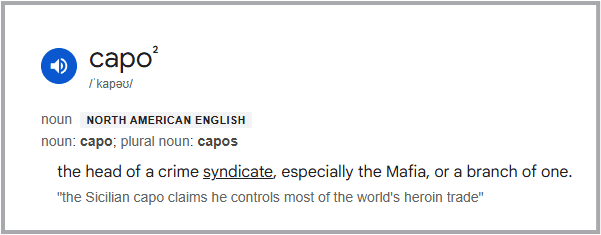
Definition of "Capo" according to Google.

Definition of “Capo” according to Google.

The actions come amid a broader strategy by the Colombian government to address concerns regarding sex tourism and the presence of foreign nationals with outstanding legal issues in their home countries. According to Paola Salazar, the Regional Director of Migración Colombia, the agency has adopted a stricter posture to ensure that Colombia is not utilized as a refuge for individuals linked to fraudulent or illicit activities.

The Case of Steve “Chill Capo”Newland

Steve Newland, a 42-year-old US citizen born in Willingboro, New Jersey, had been residing in Medellín since 2022. Operating under the digital brand “Chill Capo,” Newland promoted luxury lifestyle experiences and nightlife events. However, an investigation by Migración Colombia determined that Newland used his digital platforms to promote encounters with alleged purposes of sexual exploitation.

“Lo están esperando y lo capturan, (they are waiting for them and they will capture them)” stated Federico Gutiérrez, the Mayor of Medellín, referring to the coordination with US authorities regarding the return of the individuals.

The agency reported that Newland’s content included advice on how to evade immigration controls at the airport, such as using false medical certificates or simulating injuries to bypass rigorous inspections. His publications also mentioned accommodations linked to historical criminal figures, specifically the penthouses de Pablo Escobar, and provided instructions on how to avoid being targeted with escopolamina during social outings. Following the investigation, authorities confirmed Newland was in an irregular migration status. He has been banned from reentering Colombia for a minimum of five years.

Newland has publicly denied the allegations via his social media channels. He asserted that his primary objective was to educate visitors on safety and help them avoid dangerous situations. Newland claimed that his events were legal, safe, and conducted in collaboration with established Colombian businesses in the Parque Lleras district. He further contended that his visa had been renewed multiple times since 2022, suggesting that any illegal activity would have prevented such renewals. Newland challenged authorities to present specific evidence or identify victims related to the claims of exploitation.

🔴 #Noticia | Influenciador estadounidense que promovía turismo con fines de explotación sexual en Medellín, fue deportado por Migración Colombia.
El extranjero no podrá ingresar al país en los próximos cinco años, luego de este tiempo tendrá que solicitar una visa. pic.twitter.com/9QhZKJ7C8X

— Migración Colombia (@MigracionCol) April 11, 2026

Samuel McVey: School Incidents and US Warrants

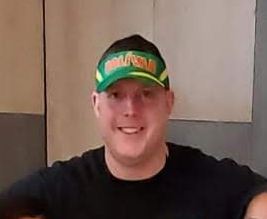
Samuel McVey crazy man

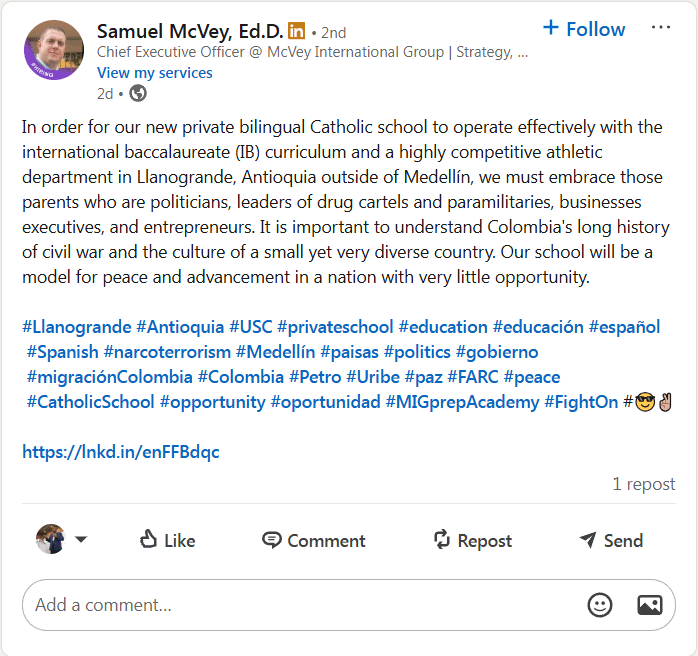
On LinkedIn, McVey claims to have a new private school in Llanogrande, Antioquia, that embraces “leaders of drug cartels and paramilitaries” among others.

In a separate incident, 46-year-old Samuel McVey, who was fired as a primary school teacher but styles himself as “Chief Executive Officer @ McVey International Group” on LinkedIn, was expelled following a series of disturbances at educational institutions in the Valle de Aburrá (Metro Medellín) and the city’s eastern Antioquia bedroom community of Rionegro. On April 8, 2026, McVey reportedly entered at least three schools in the wealthy Las Palmas sector of Medellín, where he allegedly initiated confrontations and made threats against staff and students. He subsequently traveled to Rionegro, where he attempted to gain entry to the Colegio Monteluna in Llanogrande by posing as an English language instructor.

When denied access, McVey reportedly directed threats toward students, prompting school officials to contact the Policía Nacional. He was apprehended by units from the Estación Llanogrande near a local strip mall. Manuel Villa Mejía, the Secretary of Security and Coexistence of Medellín, described McVey as a risk to the community and confirmed that the individual was in a state of high agitation upon his detention.Samuel McVey (photo from LinkedIn)

Investigation into McVey’s background revealed that he is a fugitive from New Rochelle, New York. In the United States, McVey faces charges of aggravated harassment in the second degree, a misdemeanor. The charges stem from an investigation by the New Rochelle Police Department involving threats made against Dr. Corey W. Reynolds, the Superintendent of the City School District of New Rochelle. McVey, a former Spanish teacher at Isaac E. Young Middle School, was terminated in early 2026. New Rochelle authorities had issued two bench warrants for his arrest after he failed to appear for court proceedings on March 26 and April 1, 2026.

Despite the outstanding warrants, the New Rochelle Police Department noted that they do not typically extradite individuals for misdemeanor offenses. Consequently, Colombian authorities processed his departure as an immediate expulsion based on his conduct within Colombia. McVey has been prohibited from entering Colombia for ten years.

Regional Enforcement Trends and Peak Travel Season Operations

The expulsions of Newland and McVey come after a larger enforcement effort during the 2026 Semana Santa (Easter Week) season. Migración Colombia reported that enhanced controls at airports and land borders resulted in the detection of numerous foreign nationals with irregular status or criminal backgrounds.

Specific cases identified by the agency during this period include:

  • In Leticia, Amazonas, a Peruvian citizen was detained at a hotel; the individual was the subject of an Interpol Red Notice for alleged crimes against public health.
  • In Ibagué, a Venezuelan citizen wanted by Peruvian authorities under an Interpol Red Notice for aggravated theft was arrested in a joint operation with the Policía Nacional.
  • In Facatativá, another Venezuelan national was apprehended for an Interpol Red Notice involving charges of human trafficking for sexual exploitation and membership in criminal organizations.
  • In Bogotá, two Dominican citizens were expelled after attempting to fraudulently obtain Colombian passports to travel to Europe.
  • At the Aeropuerto Internacional José María Córdova, a man and a woman from the Dominican Republic were intercepted while attempting to travel to Peru and Argentina using fraudulent Colombian documentation.

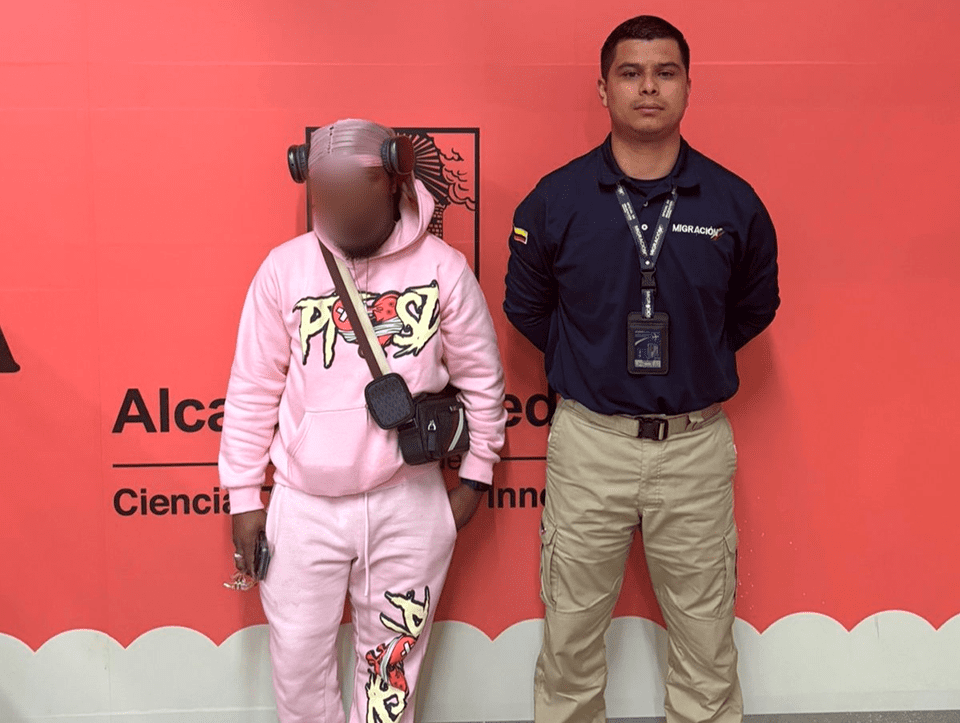
    Inadmitted (photo courtesy Migración Colombia)

    Inadmitted (photo courtesy Migración Colombia)

Statistical Overview of Inadmissibility in 2026

In the first quarter of 2026, Migración Colombia has denied entry to over 600 foreign nationals. The primary reasons for inadmissibility include state sovereignty and security risks (153 cases), lack of required visas (133 cases), and insufficient documentation (104 cases). Additionally, 89 individuals were rejected for providing false information during immigration interviews, while 34 had documented criminal records.

The agency also noted a specific focus on preventing the Explotación Sexual Comercial de Niños, Niñas y Adolescentes (ESCNNA). Through cooperation with international intelligence agencies and the Angel Watch platform, 471 individuals have been denied entry since 2016 for reasons associated with sexual offenses. At the Rionegro terminal alone, 31 inadmissibility cases have been recorded so far in 2026 related to potential sex tourism risks.

The Director General of Migración Colombia, Gloria Esperanza Arriero, emphasized that while the country remains open to international travel and investment, visitors are required to comply with the Constitución Política de Colombia and national laws. Under Decreto 2136 de 2021, the immigration authority maintains the power to deny entry or order the immediate return of any foreign citizen who poses a risk to national security or public order.

The main nationalities of those denied entry in early 2026 include citizens from the United States (76), the Dominican Republic (64), Ecuador (55), and Venezuela (52).

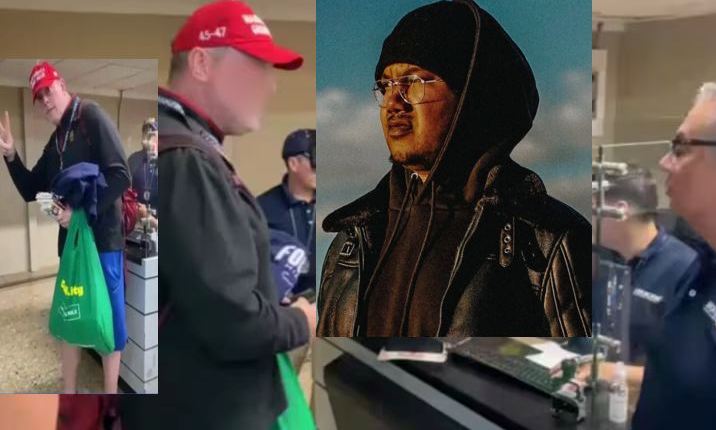
Montage of deportees Samuel McVey and Steven “Chill Capo” Newland

Video footage courtesy Migración Colombia

  •  

‘Invisible narco’ who enabled Tren de Aragua’s entry into Bogotá captured in police operation

Colombian authorities have captured the alleged crime boss “Mison,” also known as the “invisible narco”, who played a key role in facilitating the arrival of the Venezuelan criminal group Tren de Aragua in the capital Bogotá

The suspect, also known as “El Viejo,” was detained in Ecuador and handed over to Colombian authorities at the Rumichaca international border crossing under an Interpol notice, in a joint operation with Ecuadorian officials.

In Colombia, he is wanted on charges including aggravated conspiracy, homicide, drug trafficking and illegal weapons possession. A judge has ordered his pre-trial detention.

Authorities say Mison was the leader of “Los Maracuchos,” a criminal network with a strong presence in three Bogotá districts – Kennedy, Santa Fe and Los Mártires. For more than a decade, he allegedly operated under the guise of a nightlife entrepreneur, owning bars, nightclubs and informal rental properties known as “pagadiarios.”

Mayor Carlos Fernando Galán described the arrest as one of the most significant blows to organized crime in the city in recent years, calling the suspect “almost a myth” within criminal circles.

“He appeared to be a businessman in Bogotá’s nightlife economy, but in reality he was a central figure in a complex criminal structure,” Galán said.

According to investigators, the establishments he controlled served as hubs for drug distribution and were linked to serious crimes, including killings and torture. Among the venues identified by authorities are sites known as “Los Potrillos” and “Hotel Negro.”

Police also allege that Mison played a decisive role in enabling the expansion of Tren de Aragua into Bogotá around 2018, exploiting vulnerable migrant populations to recruit and train individuals for criminal activities. The group, which originated in Venezuela, has expanded across Latin America and is increasingly associated with organized crime in Colombia’s urban centers.

Bogotá Police Chief General Giovanni Cristancho said the arrest followed a two-year investigation involving cross-border cooperation. “He maintained a double life as a businessman while coordinating criminal operations,” noted Cristancho. “He was a pioneer in using ‘pagadiarios’ as operational centers to consolidate territorial control.”

Authorities said Mison fled to Ecuador in 2024 following intensified police pressure in Bogotá, where he continued operating under the cover of a merchant until his location was confirmed.

Prosecutors estimate that he accumulated assets worth more than 20 billion pesos (approximately $5 million), including rural properties, vehicles and real estate held through third parties. Officials say he generated monthly criminal revenues of up to 2 billion pesos through drug trafficking, extortion and other illicit activities.

Bogotá Security Secretary César Restrepo said the suspect’s influence extended beyond narcotics, linking him to extortion networks and contract killings.

“This is not a distant trafficker. He directly fueled violence in Bogotá and is responsible for significant harm to victims across the city,” Restrepo said.

Authorities believe the arrest will disrupt criminal structures tied to drug trafficking and urban violence, although they caution that such networks often adapt quickly.

If convicted, Mison could face a prison sentence of up to 32 years.

The operation is the latest in a series of high-profile security actions in Bogotá, as authorities seek to regain control over criminal networks and restore public safety in key areas of the capital.

Mayor Galán said the result demonstrates that sustained investigations and coordinated efforts can weaken organized crime groups.

  •  

Petro faces fresh political crisis after leaked audios link officials to alleged smuggler

Fresh audio revelations broadcast by Noticias Caracol have triggered a political storm in Colombia, implicating senior government-linked figures in alleged secret contacts with one of the country’s most notorious smugglers, Diego Marín Buitrago.

The recordings, aired late on April 5, appear to document meetings between intermediaries connected to President Gustavo Petro and the legal representative of Marín, widely known by the alias “Papá Pitufo.” The revelations come with just over four months remaining in Petro’s presidential term, intensifying scrutiny over his administration.

According to the report, the audios – lasting more than 90 minutes – capture conversations from early 2025 involving at least four individuals allegedly acting as emissaries of the government. Among them is Jorge Lemus, the former head of the National Intelligence Directorate (DNI), as well as other figures with links to the administration.

In the recordings, Lemus is heard holding closed-door meetings with Marín’s lawyer, Luis Felipe Ramírez, in which possible judicial benefits and guarantees are discussed in exchange for cooperation. Such proposals, if confirmed, would fall outside the remit of intelligence officials and raise questions about potential overreach and irregular negotiations.

The audios also suggest that these contacts occurred before any formal intervention by judicial authorities, with intermediaries allegedly presenting themselves as acting on behalf of the executive branch. Additional names mentioned include Catalan political figures Xavier Vendrell and Ramón Devesa, as well as former financial intelligence adviser Isaac Beltrán.

The revelations have revived a long-running controversy over alleged links between Marín and Petro’s 2022 presidential campaign. Previous reports indicated that the smuggler may have contributed 500 million pesos (approximately $130,000) to the campaign—funds Petro has said were returned upon discovery of their origin. However, opposition figures argue that no conclusive proof of that վերադարձ has ever been presented.

Opposition leaders, including senator and presidential hopeful Paloma Valencia, seized on the latest disclosures to demand an independent investigation. “This is an extremely serious institutional matter,” Valencia said in a video response, questioning the absence of evidence regarding the alleged վերադարձ of the funds and warning of a pattern of clandestine contacts.

Critics argue that the recordings point to “under-the-table” dealings with criminal actors, potentially undermining the government’s legitimacy at a critical political juncture.

President Petro responded by acknowledging that intelligence contacts with Marín’s circle had taken place but insisted they were authorized and aimed solely at securing the smuggler’s cooperation with Colombian justice.

“The purpose was to bring Marín to Colombia,” Petro said, framing the outreach as part of a broader strategy to dismantle criminal networks. However, the president went further, alleging that some intelligence agents may have exploited the situation by attempting to solicit money during the interactions.

According to Petro, these alleged irregularities led to dismissals within state agencies, suggesting internal misconduct rather than a coordinated government effort to negotiate with the smuggler.

The president also criticized the Fiscalía General de la Nación, accusing prosecutors of limiting the scope of investigations and pursuing what he described as a politically motivated campaign against his administration.

Marín, long considered one of Colombia’s most significant contraband operators, has been linked for decades to networks involved in smuggling and bribery. His arrest in Europe in 2024 triggered an ongoing extradition process, though legal challenges in countries including Spain and Portugal have complicated proceedings.

Prosecutors in Colombia have charged him with criminal conspiracy and bribery, alleging he led a sophisticated structure that penetrated state institutions.

The latest revelations add to mounting political pressure on Petro, whose administration has already faced a series of scandals and internal fractures. With the presidential term nearing its end, the emergence of recorded evidence – rather than testimony or second-hand accounts—marks a potentially decisive moment in a controversy that has shadowed his government for years.

Whether the audios lead to formal investigations or judicial consequences remains unclear. But politically, the damage appears immediate, reopening questions about the boundaries between state actors and criminal networks—and the extent to which those lines may have been blurred behind closed doors.

  •  

Apple Says No iPhone in Lockdown Mode Has Ever Been Hacked

Apple says it has no record of a successful spyware attack against any device running Lockdown Mode, the opt-in security feature it introduced in 2022.


"We are not aware of any successful mercenary spyware attacks against a Lockdown Mode-enabled Apple device," an Apple spokesperson told TechCrunch.

Lockdown Mode is available on the iPhone, iPad, and Mac, and dramatically restricts certain system features that are commonly exploited by mercenary spyware. When enabled, it blocks most message attachment types, disables certain complex web technologies, and prevents devices from automatically joining non-secure Wi-Fi networks, among other restrictions. Apple designed the feature specifically to protect high-risk users such as journalists, activists, lawyers, and others who may be personally targeted by sophisticated nation-state-level attacks.


Donncha Ó Cearbhaill, head of the security lab at Amnesty International, said he and his colleagues "have not seen any evidence of an iPhone being successfully compromised by mercenary spyware where Lockdown Mode was enabled at the time of the attack." Digital rights organizations including Amnesty International and the University of Toronto's Citizen Lab have documented numerous successful spyware attacks on iPhone users over the years, but none have involved a bypass of Lockdown Mode.

Citizen Lab researchers have confirmed at least two cases where Lockdown Mode actively blocked spyware attacks, with one involving NSO Group's Pegasus and another involving Predator spyware, made by a company now part of Intellexa. Google researchers found that spyware was coded to abort its infection attempt if it detected Lockdown Mode was active, apparently to avoid leaving traces that could expose the attack.

Patrick Wardle, an Apple cybersecurity expert, told TechCrunch, "I think it's safe to say, Lockdown Mode is one of the most aggressive consumer-facing hardening features ever shipped."
This article, "Apple Says No iPhone in Lockdown Mode Has Ever Been Hacked" first appeared on MacRumors.com

Discuss this article in our forums

  •  

Apple Now Sending Critical Security Alerts to iPhones Running iOS 17 and Earlier

Apple has begun pushing Lock Screen notifications to iPhones and iPads running older versions of iOS and iPadOS, warning users of active web-based attacks.


The alerts, which appear as a "Critical Software" notification from the Settings app, warn that Apple "is aware of attacks targeting out-of-date iOS software, including the version on your iPhone," and urge users to install a critical update to protect their device. The notifications are being seen on devices running a range of older iOS versions, including iOS 17.0, far beyond the iOS 13 and iOS 14 devices that Apple specifically flagged in its support documentation.

In the documentation, Apple highlighted recent reports about hacking tools that are effective against older versions of iOS. Hackers are using iOS exploit kits known as "Coruna" and "DarkSword," which can take advantage of vulnerabilities in iOS 13 through to iOS 17.2.1. Clicking a malicious link or visiting a compromised website on an unpatched device could result in data being stolen.

"If your iPhone doesn't have the latest software, update iOS to protect your data," Apple says. Users can update by going to Settings, General, and Software Update.

Apple released iOS 15.8.7 and iOS 16.7.15, along with corresponding iPadOS versions, on March 11 to address security vulnerabilities associated with the Coruna exploit kit. Devices running the latest updated versions of iOS 15 through iOS 26 are already protected, while devices on iOS 13 or iOS 14 must update to iOS 15 to receive these protections.

Apple has patched the vulnerabilities as they have come to light over the last several months, so users who have already upgraded to the newest version of iOS available for their iPhone are protected from the malicious websites and links that are circulating right now. Apple Safe Browsing in Safari is enabled by default and blocks the malicious URL domains identified in the attacks.

Users who are unable to update should consider enabling Lockdown Mode, if available, to protect against malicious web content. Lockdown Mode is available on iOS 16 and later.
Related Forums: iOS 17, iPadOS 17, iOS 15, iOS 16

This article, "Apple Now Sending Critical Security Alerts to iPhones Running iOS 17 and Earlier" first appeared on MacRumors.com

Discuss this article in our forums

  •  

PSA: iOS 26.4 Age Verification in UK Fails for Some, Leading to Device Restrictions

If you’re an iPhone user in the UK, you might want to hold off on the latest iOS 26.4 update for a bit, as many UK users are reporting problems with the new mandatory online Age Verification system that is included in the latest versions of iOS. Failures and issues with the age verification system ... Read More
  •  

Editorial: Gustavo Petro’s “Total Peace” Has Led to Total Chaos in Colombia

Colombia’s President Gustavo Petro ran for president on a campaign promising Paz Total—Total Peace. He promised to give the FARC dissidents, the vicious ELN guerillas, and mafias like the Clan del Golfo a good talking to, and with that, they will just lay down their weapons and become model citizens. Petro promised that through dialogue with bloodthirsty kidnappers and extortionists, they would be willing to stop being bloodthirsty kidnappers and extortionists; as if they are just misunderstood little muffins who only need a hug.

Nubia Carolina Córdoba, governor of Chocó, Colombia (photo from her Twitter account)

Nubia Carolina Córdoba, governor of Chocó, Colombia (photo from her Twitter account)

According to figures compiled by the Universidad Externado and reported by The City Paper Bogotá, Colombia has recorded 40,663 homicides during the first three years of the Petro presidency. Over 400 human rights defenders have been slaughtered between 2022 and 2025 according to the United Nations Office of the High Commissioner on Human Rights. Human Rights Watch reports that the ELN and FARC dissidents have expanded their territories by up to 55%. They are taking back over Colombia.

Under Gustavo Petro’s watch, Colombia has returned to the Institute for Economics and Peace’s Global Terrorism Index top ten list of countries impacted by terrorism, along with Total Peace destinations like Democratic Republic of Congo, Somalia, and Syria. Just this past week, a Clan del Golfo poster was put up within walking distance from the Aeropuerto Internacional José María Córdova just outside of Medellín. This Total Peace nonsense is a failure.

Right now, in the neglected Pacific department of Chocó, the ELN has kidnapped whole communities. Petro ran a campaign promising that he was going to embrace these historically neglected communities—places like Chocó, Nariño, La Guajira, and Norte de Santander—but insecurity is increasing. Chocó’s governor, Nubia Carolina Córdoba, says 6,047 people are trapped inside of their homes because the ELN has announced an illegal armed curfew in the municipality of Bajo Baudó. Most of these people are already poor, and now they have been kidnapped en masse by this guerilla group that operates with impunity because Gustavo Petro coddles them with “dialogue.”

According to Governor Córdoba, they attacked the police station in the village of Santa Rita using grenades attached to drones. It has gotten so bad that Colombia has restricted the entry of drones into the country. These people are calling out for help, but the president insists on talking as the ELN grows and continues to menace the police forces, the Colombian military, and, most importantly, the innocent public.

There is currently public disorder where belligerents have completely blocked the roads in the north of Antioquia, in the region called Bajo Cauca, and also in the neighboring department of Córdoba. The city of Caucasia is under curfew. Antioquia’s Governor, Andrés Rendón, has urgently called on the national government to stop the talk and take action. Groups are attacking ambulances and burning people’s motorcycles as they try to get by the roadblocks, regardless of the emergency.

Governor Rendón stated: “There can be no dialogue amidst blockades and human rights violations. It’s been seven days now with the Bajo Cauca region paralyzed and the country held hostage by chaos.” He called on the Fiscalía General de la Nación to bring those responsible to justice and challenged the Minister of Defense, Pedro Sánchez, to order the immediate reopening of the roads. “We’re not talking about small-scale miners here; behind this are criminal structures, as everyone knows, that finance themselves through illegal mining and move billions of pesos,” Rendón added, demanding full authority against the criminals who use communities as a shield.

El gobernador de Antioquia, @AndresJRendonC, se pronunció sobre la situación de orden público en el Bajo Cauca, en medio de los bloqueos que ya completan varios días y afectan la movilidad y la seguridad en la región. @GobAntioquia pic.twitter.com/4SPQgTa68r

— MiOriente (@MiOriente) March 22, 2026

The current situation with these organized criminal groups—whether regular mafias like the Clan del Golfo or murderous Marxist guerillas like the ELN and the FARC dissidents—is reminiscent of a classroom where a substitute teacher has lost all control. Petro promised Total Peace, but the result has been Total Chaos. Investors do not want to deal with this mess. While the Petro government claims they want tourism to be a major economic driver, road blocks make many areas look like scenes out of Mad Max: Road Warrior. Whole zones of the Pacific coast are unsafe even for residents, met with pure impotence from the regime.

Ten years ago, it was safe to drive from Medellín to the beachside town of Coveñas in Sucre, but that is no longer the case. While it remains safe to visit Colombia for business or tourism in major hubs like Bogotá, Medellín, Santa Marta, or the San Andrés islands, the long-term outlook is concerning. My hope is that Colombians choose a future leader serious about law and order as a prerequisite for human rights. It is not only the government that we need to protect human rights from; those who kill, steal, kidnap, and forcibly recruit children are violating those rights as well.

Colombian anti-explosives experts inspect propaganda by the Clan del Golfo mafia group just minutes away from Medellin's international airport in March, 2026 (image from Facebook).

Colombian anti-explosives experts inspect propaganda by the Clan del Golfo mafia group just minutes away from Medellin’s international airport in March, 2026 (image from Facebook).


  •  
❌