
Reading view

Explosive Drone Deactivated Near Bogotá’s El Dorado International Airport

Colombian authorities have seized and safely deactivated a commercial drone carrying improvised explosive materials just 5.4 kilometers from Bogotá’s El Dorado International Airport and the nearby Military Air Transport Command (CATAM), raising fresh security concerns in the capital three weeks before the country’s May 31 presidential election.

The discovery marks a significant escalation from recent unauthorized drone sightings that twice forced temporary flight suspensions at El Dorado, Colombia’s busiest airport, and highlights growing fears that tactics once largely confined to conflict zones in the southwest and Catatumbo region are now reaching the capital.

According to preliminary police and military reports, the device was located in the locality of Kennedy, near the Río Bogotá, after a security alert issued by prosecutors in Popayán, Cauca, prompted specialized units of the Colombian Air Force (FAC) and National Police to track suspicious coordinates in southern Bogotá.

Authorities found what appeared to be a makeshift encampment before locating the commercial drone, its battery and an explosive charge separated from the fuselage.

Anti-explosives officers later confirmed the device had been modified with a non-conventional fiber-optic guidance system, a method increasingly used by illegal armed groups to evade electronic signal jammers designed to disable unmanned aircraft.

Investigators said the drone carried approximately 258 grams of C4 explosive material inside a PVC tube fitted with an improvised detonator.

The device was safely neutralized by National Police explosives experts and transferred to the Attorney General’s Office – Fiscalía General – for forensic analysis and the opening of a criminal investigation.

Authorities have not publicly identified those responsible or confirmed the intended target, but officials noted the location placed the drone within minutes of both El Dorado International Airport and CATAM, one of Colombia’s most strategic military aviation facilities.

Security analysts say the use of fiber-optic spools as a guidance mechanism resembles tactics recently documented in Catatumbo and southwestern Colombia, particularly among the National Liberation Army (ELN) guerrilla and FARC dissident factions under the command of alias “Iván Mordisco.”

A similar drone equipped with the same system was discovered in Popayán on April 25 during a wave of attacks blamed on FARC dissidents in Cauca, while another was found the same day in Villavicencio, the departmental capital of Meta.

The appearance of such devices in Bogotá has raised alarm among security officials, particularly given the proximity to civilian and military aviation infrastructure.

Pilots and aviation experts warn that even small commercial drones can cause catastrophic damage if they collide with an aircraft during takeoff or landing. A drone carrying explosives near an airport runway significantly increases the potential for a large-scale tragedy.

The discovery also comes at a politically sensitive moment, with Colombia entering the final weeks before its presidential election on May 31, as security and public order remain dominant campaign issues amid rising violence in the departments of Antioquia, Chocó, and Norte de Santander.

The leftist government of President Gustavo Petro has faced intense criticism over deteriorating security conditions, particularly following road bombing attributed to illegal armed groups in Cauca, Valle del Cauca, Nariño and Catatumbo, where the use of drones for surveillance and attacks has become increasingly common.

Last month, drone sightings near El Dorado airport twice forced authorities to suspend all air operations, disrupting domestic and international flights and exposing vulnerabilities near the country’s principal air gateway.

On April 30, Aerocivil halted airport operations after the Colombian Aerospace Force confirmed the presence of a drone in the Engativá district near the airport perimeter. Two aircraft were forced to carry out missed approaches, including an international LATAM Airlines Boeing 787 arriving from Santiago, Chile, while another domestic flight was diverted to Armenia, Quindío.

Just two days earlier, on April 28, another drone was detected near El Dorado, triggering a 45-minute suspension of takeoffs and landings while military personnel deployed anti-drone systems and visual searches.

Defense Minister Pedro Sánchez later confirmed that operations had been temporarily canceled because of the possible drone sighting, although no confirmed target was found.

Aerocivil has repeatedly warned that unauthorized drone activity near airports represents a grave threat to aviation safety and can result in criminal prosecution.

Thursday’s discovery, however, suggests the threat may extend far beyond operational disruption.

For Bogotá, the concern is no longer simply rogue recreational drones interfering with airport traffic, but the possibility that explosive-equipped devices linked to Colombia’s armed conflict are now within reach of the nation’s capital – and its most critical infrastructure.
  •  

Colombia Elections: Cepeda Leads, Valencia Doubles in Race Down to Three

With just over a month to go before Colombia’s May 31 presidential election, a new Invamer poll suggests the race has narrowed to three viable contenders, as left-wing senator Iván Cepeda strengthens his lead and two right-wing rivals battle for a place in the runoff.

The survey, conducted for Noticias Caracol and Blu Radio, shows Cepeda commanding 44.3% of voting intention, a significant jump from 37.1% in February. The Pacto Histórico candidate has not only consolidated support among core voters but expanded his appeal across all regions, with particularly strong gains among younger voters aged 20 to 30.

Trailing behind, but still within striking distance of a second-round berth, are Abelardo de la Espriella with 21.5% and Paloma Valencia with 19.8%. While De la Espriella has posted modest gains since February, Valencia has emerged as the fastest-rising candidate, nearly doubling her support from 10% in the previous poll.

The data underscores a central dynamic shaping the race: a fragmented right competing for a single runoff slot, even as the left coalesces behind a dominant frontrunner. According to the data, as long as the right remains divided, any division among the pro-Uribe camps will continue to benefit Cepeda. Unless there is a clear consolidation after May 31, the numbers suggest the second round will be a contest over who faces the hard-leftist and not whether he gets to the final run-off.

The collapse of Colombia’s political center has been equally striking. Former Bogotá mayor Claudia López has seen her support plunge from 11.7% to 3.6%, while former Medellín mayor Sergio Fajardo has dropped from 6.6% to just 2.5%. Both candidates have lost more than half of their previous backing and now poll well below the 4% threshold required for state reimbursement of campaign expenses.

López’s decline appears particularly acute in urban constituencies, where she previously drew strong support, including among progressive and LGBTQ voters, pointing to a broader erosion of her core base. Fajardo, meanwhile, continues to struggle to regain traction, reflecting persistent voter dissatisfaction with centrist alternatives.

Analysts are also seeing how centrist voters are shifting toward Valencia, whose ticket includes former DANE statistics chief Juan Daniel Oviedo as the vice-presidential option. Oviedo appears to be decisive in broadening Valencia’s appeal beyond the Centro Democrático base.

Despite Cepeda’s commanding first-round lead, runoff scenarios suggest a more competitive contest – particularly if Valencia secures the second spot. In a hypothetical second round between Cepeda and De la Espriella, the left-wing candidate would win with 54.6% against 42.6%. However, against Valencia, the margin narrows significantly to 51.2% versus 46.6%.

That tightening gap reflects Valencia’s growing ability to attract support beyond her base, including voters from the political center and segments of the undecided electorate. According to the poll, she outperforms De la Espriella in capturing second-choice preferences, positioning her as the more competitive challenger in a potential runoff.

When respondents were asked who they would support if their first-choice candidate failed to advance, Cepeda led with 26.7%, followed closely by Valencia at 25.7%, with De la Espriella trailing at 19.8%. López and Fajardo lagged further behind, reinforcing their diminished relevance in the race.

Cepeda’s dominance, however, is not without warning signs. While he continues to lead comfortably, his projected runoff margins have narrowed compared to earlier surveys, particularly against Valencia. The erosion suggests that while his base remains solid, opposition voters may be coalescing more effectively than before.

For now, the trajectory is clear. Cepeda has gained ground nationally despite a worsening security situation and poll conducted before the terrorist bomb on Saturday, April 25 by FARC dissidents along the Pan-American highway in which 20 persons were killed.

With less than a month until Colombians head to the polls, the race appears increasingly defined not by a crowded field, but by a three-way struggle – one frontrunner and two challengers vying for the chance to stop him.

  •  

Colombia Confirms 14 Candidates for 2026 Presidential Election

Though surprises are possible, polling says the front runners are Iván Cepeda, Abelardo de la Espriella, and Paloma Valencia.

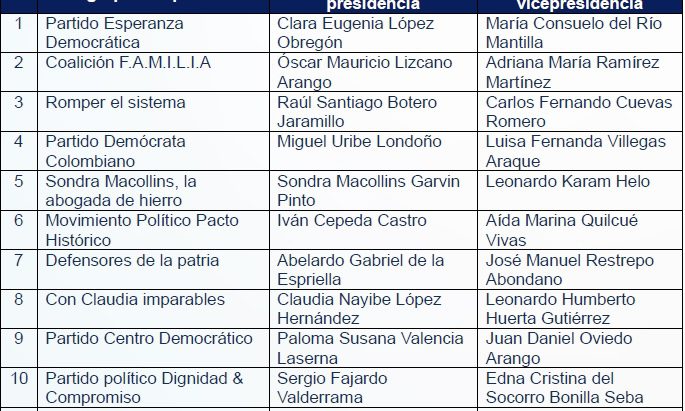
The Registraduría Nacional del Estado Civil of Colombia (RNEC), the entity responsible for organizing elections in the country, reported that a total of 14 candidates have officially registered to run in the country’s presidential elections, scheduled for May 31, 2026. In this vote, citizens will elect the President and Vice President of the Republic for the 2026–2030 term.

According to the electoral authority, the candidates represent a wide range of political perspectives, from left to right, including independent candidacies running through political movements. Here the list and brief profile of the candidates:

  1. Clara Eugenia López Obregón, currently a senator for the Esperanza Democrática She has served as Minister of Labor (2016–2017), acting mayor of Bogotá (2011–2012), and Bogotá’s secretary of government (2008–2010). She has been affiliated with left-wing parties and was Gustavo Petro’s vice presidential running mate in the 2010 election.
  2. Óscar Mauricio Lizcano, from the FAMILIA coalition. He served as Minister of Information Technologies (2023–2025), was a senator (2010–2018), and a member of the House of Representatives (2006–2010).
  3. Raúl Santiago Botero, candidate of the “Romper el Sistema” movement (Break the Establishment). An agronomist engineer and businessman from Medellín, he presents himself as an independent candidate with no prior political experience.
  4. Miguel Uribe Londoño, father of the slain presidential candidate Miguel Uribe Turbay. He is running under the Colombian Democratic Party and previously served as president of the Centro Democrático party founded by Álvaro Uribe Vélez.
  5. Sondra Macollins Garvin, from the movement “La Abogada de Hierro” (The Iron Lawyer) A criminal lawyer and psychologist, she presents herself as an independent candidate without political affiliations. She ran for the House of Representatives in 2022 and is known for her work in narcotrafficking and corruption cases.
  6. Iván Cepeda Castro, a senator since 2014 and the official candidate of the Pacto Histórico, the same party as President Gustavo Petro. Polls project he will receive the highest vote share in the first election round. He is aligned with left-wing political ideas.
  7. Abelardo de la Espriella, a lawyer with far-right positions, running for the first time under the Defensores de la Patria movement. Recent polls place him as a likely second or third contender in voter preference.
  8. Claudia López Hernández, former mayor of Bogotá (2020–2023) and former senator (2014–2018), running under the centrist movement “Imparables con Claudia.” She is known for her anti-corruption agenda and secured her candidacy with more than 570,000 votes (about 9%) in recent interparty primaries.
  9. Paloma Valencia Laserna, current senator and candidate of the Centro Democrático party led by Álvaro Uribe Vélez. She won the right-wing interparty primary on March 8 with more than 3 million votes. Polls place her among the top three contenders, and if she reaches a runoff, she would become the first woman in Colombia’s history to do so.
  • Sergio Fajardo Valderrama, an academic and mathematician running for the Dignidad y Compromiso He served as mayor of Medellín and governor of Antioquia and is running for president for the third time.
  • Roy Barreras, from the political party La Fuerza (The Force). He won the left-wing coalition primary on March 8 with the lowest vote total (257,000 votes, about 3.6%). Although currently aligned with left-wing movements and part of the Petro administration, he has previously been affiliated with right- and center-leaning parties.
  • Gustavo Matamoros Camacho, of the Colombian Ecologist Party. He served in the Colombian Army for 43 years. With no prior political experience, his campaign focuses on public security.
  • Luis Gilberto Murillo, who served as Minister of Foreign Affairs (2024–2025) and Colombia’s ambassador to the United States (2022–2024). A human rights advocate and Afro-Colombian leader from Chocó, he presents himself as an independent, moderate, centrist candidate.
  • Carlos Eduardo Caicedo, running under the independent movement “Con Caicedo.” He was mayor of Santa Marta (2012–2015) and governor of Magdalena (2020–2023), where he built a strong base as a left-wing political leader.

The RNEC also reported that “the draw to determine the position of presidential candidates on the ballot will take place on March 25 at the Ágora Bogotá Convention Center.”

This process marks the formal start of the final phase of the presidential campaign, during which candidates will seek to consolidate support ahead of the first round on May 31. If no candidate secures an absolute majority, a runoff between the two leading candidates will be held on June 21.

List of registered candidates for Colombia’s presidency. Photo courtesy of the Registraduría Nacional del Estado Civil.

List of registered candidates for Colombia’s presidency. Photo courtesy of the Registraduría Nacional del Estado Civil.

Headline photo: Polling station in Colombia during last Congress elections in March 8, 2026. Photo courtesy of the Registraduría Nacional del Estado Civil.

  •  

Valencia picks Oviedo as VP to expand Colombia’s center-right base

Conservative presidential candidate Paloma Valencia has chosen economist and former statistics chief Juan Daniel Oviedo as her vice-presidential running mate, a move widely interpreted as an effort by the right-wing Centro Democrático to broaden its appeal beyond its traditional conservative base ahead of Colombia’s May 31 presidential election.

The alliance seeks to balance Valencia’s hard-line security message – closely associated with former president Álvaro Uribe Vélez – with Oviedo’s more technocratic and centrist profile, which resonates with younger, urban voters.

Announcing the ticket in the bustling commercial district of San Victorino in central Bogotá, Valencia said the decision followed consultations within the party and with Uribe himself.

“We have reached the conclusion that the best teammate is Juan Daniel Oviedo,” Valencia said. “He obtained a popular backing that excites all of us. He is connecting with many Colombians who did not feel represented.”

The announcement comes just days before the deadline to register presidential tickets with Colombia’s electoral authorities and follows Valencia’s decisive victory in the conservative primary coalition known as “La Gran Consulta,” where she secured more than three million votes. Oviedo finished second with more than one million, quickly emerging as one of the race’s unexpected political figures.

Balancinga new centre

Valencia, a staunch supporter of Uribe’s political project, has repeatedly signaled she will not distance herself from the former president’s ideological influence.

“I’m not going to distance myself from Uribe; I’m going to die a Uribe supporter,” she said in a recent interview with El País, reaffirming her commitment to the security agenda associated with the former two-term president.

Yet her choice of Oviedo indicates an attempt to broaden the coalition’s reach. The economist, who gained national prominence as director of Colombia’s national statistics agency – DANE – is widely viewed as a highly-skilled data-driven analyst with appeal among educated urban voters in their thirties and forties – many of whom supported the Colombian Peace Agreement.

That demographic has traditionally gravitated toward centrist figures such as former Bogotá mayor Claudia López or the moderate political movement associated with Sergio Fajardo.

Oviedo’s presence on the ticket could help the conservative bloc penetrate that electorate while also tempering some of the party’s more polarizing rhetoric.

Beyond Differences

The partnership did not come easily. According to campaign strategists involved in negotiations, several days of discussions were required to reconcile differences between the candidates – particularly regarding Colombia’s peace process.

The Centro Democrático has long been critical of the transitional justice system created by the 2016 accord, especially the Jurisdicción Especial para la Paz (JEP), which has been investigating war crimes committed by ex-FARC and Armed Forces during two decades of the internal conflict.

Oviedo, however, has publicly supported the peace agreement and defended the need for reconciliation. Speaking after accepting the nomination, Oviedo emphasized the importance of political dialogue despite ideological differences.

“This is about listening,” he said. “In this coalition we are capable of recognizing our differences but uniting around a fundamental purpose: looking toward the future and building a country where everyone fits.”

He also highlighted his intention to include diverse sectors of Colombian society, mentioning farmers, informal workers, women and the LGBT community.

Strategic Moves in Gran San

The announcement’s location – San Victorino’s Gran San commercial center, one of Bogotá’s busiest retail hubs- was also symbolic. The district is a bustling marketplace dominated by small traders and informal workers, a constituency both candidates say they want to court.

Valencia described the alliance as a forward-looking project for a country weary of political polarization.

“We have many pains as a nation,” she said during the event. “If we only look backward we will find wounds that still need healing. But we have another option: to look forward toward the future we deserve.”

She also praised Oviedo’s credentials, describing him as a policymaker who understands the deep structural and social challenges facing Colombia. “He likes numbers, he likes studying,” she said. “Government is not about talking nonsense about problems – it’s about understanding them deeply in order to solve them,” she said to waves of applause.

The announcement quickly triggered reactions from across Colombia’s political landscape.

Former Liberal president Ernesto Samper welcomed the decision, arguing that Oviedo’s acceptance of the vice-presidential role signaled an implicit recognition by the right-wing party of the peace process. “The acceptance of Juan Daniel Oviedo demonstrates that the Centro Democrático validates the Havana peace agreement and the continuation of the JEP,” he Samper.

With the campaign entering its decisive phase, the Valencia-Oviedo ticket represents a strategic attempt to unite two currents within Colombia’s conservative electorate: an older security-focused base loyal to Uribe and a younger urban sector seeking pragmatic solutions to the internal conflict.

Whether the combination can bridge Colombia’s ideological divide – or deepen it- will likely shape the tone of the presidential race in the weeks and moths leading to the decisive vote.

  •  

RCN Poll Reveals Cepeda’s 30% Ceiling, Right’s Path to Consolidation

Colombia’s presidential race has entered poll season with a revealing snapshot from Noticias RCN and Spanish firm GAD3 that points to an election defined less by early frontrunners than by who can consolidate votes after March’s inter-party consultations.

At first glance, Historic Pact senator Iván Cepeda appears comfortably ahead. The RCN poll places him at 30% voting intention — well above far-right independent Abelardo de la Espriella (22%) and miles ahead of the scattered field trailing behind in single digits.

But a deeper reading of the numbers suggests Cepeda’s lead may already be capped.

The 30% figure aligns almost perfectly with President Gustavo Petro’s loyal electoral base, which has consistently hovered between 28% and 32% since his rise to national prominence. In other words, Cepeda appears to have consolidated petrismo rather than expanded beyond it. The poll reinforces this ceiling: 5% of respondents favor a blank vote, 11% say they would vote for none of the candidates, and 14% remain undecided — a combined 30% still outside the Petro orbit and unlikely to gravitate toward Cepeda.

Further down the list, potential left-leaning or independent figures barely register: Sergio Fajardo, Aníbal Gaviria, Juan Daniel Oviedo, Roy Barreras and Camilo Romero each sit around 1%. Even Claudia López and Germán Vargas Lleras score negligible fractions. The fragmentation benefits Cepeda for now, but it also masks the absence of new voters entering his camp.

By contrast, the Right’s apparent weakness hides a powerful consolidation opportunity.

The Gran Consulta por Colombia, on March 8, shows Paloma Valencia leading the consultation vote with 23%. Yet the poll also reveals that the rest of the consultation slate collectively commands nearly 20%: Juan Manuel Galán (8%), Vicky Dávila (8%), Juan Carlos Pinzón (6%), Juan Daniel Oviedo (4%), Aníbal Gaviria (3%), Enrique Peñalosa (2%), David Luna (1%) and Mauricio Cárdenas (1%).

This bloc is electorally decisive because it represents Colombia’s ideological center — liberal technocrats, urban moderates and business-friendly reformists who reject Petro’s economic direction but resist extreme rhetoric. Valencia’s political résumé, Senate visibility and party machinery position her as the most viable leader to absorb that vote once the consultation narrows the field.

If she consolidates those nearly 20 points, her support would leap toward — or beyond — 40%, instantly surpassing Cepeda’s apparent plateau.

De la Espriella’s 22% underscores the volatility on the Right but also its fragility. His voters overlap heavily with Valencia’s base and are expected to migrate toward a unified conservative candidacy. Even Uribe has hinted that such unity is inevitable in a runoff; the RCN poll suggests it could happen much earlier under electoral pressure.

Yet the poll’s most intriguing subplot lies within the Left’s own consultation, where Roy Barreras emerges as a latent threat to Cepeda despite low headline numbers.

In the Frente Amplio consultation, Cepeda commands 34%, but the striking figure is the 44% who say they would vote for none. Barreras registers 4%, and Camilo Romero 3%, revealing a progressive electorate deeply unconvinced by the current slate.

Barreras’ political positioning explains why that matters. Though aligned with Petro’s government, his ideological lineage is closer to former President Juan Manuel Santos — pragmatic, transactional and coalition-oriented. Unlike Cepeda, Barreras is seen as someone capable of negotiating with centrists and conservatives alike. He represents continuity without ideological rigidity.

If Barreras manages to capture even part of that dissatisfied 44%, Cepeda’s narrow base could erode quickly. The RCN poll already shows Cepeda strong only where the Left is unified and stagnant where broader voters are involved.

Second-round simulations deepen the warning. Cepeda defeats De la Espriella 40% to 32%, but those numbers again reflect Petro’s core plus soft undecideds. Against Paloma Valencia he drops to 43% versus her 20% — a gap that would narrow dramatically once Valencia inherits the consultation bloc. More telling still, Cepeda’s numbers barely move across matchups, reinforcing the perception of a fixed ceiling.

Colombia’s presidential arithmetic is therefore shifting beneath the surface.

Cepeda leads because the field is divided. Valencia stands to surge because her side is about to unify. Barreras lurks as the only left-leaning figure capable of fracturing Cepeda’s ideological monopoly and attracting voters beyond Petro’s loyalists.

While headlines focus on Cepeda versus De la Espriella, the RCN poll suggests the real race may ultimately emerge after March 8 — between Paloma Valencia consolidating a broad anti-Petro coalition and Roy Barreras positioning himself as the Left’s only candidate with cross-spectrum appeal.

In Colombia’s elections, momentum follows math. And the math is just beginning to move.

  •  

Right-wing candidate De la Espriella leads Colombia presidential race, shows latest poll

Far-right independent candidate Abelardo De la Espriella, widely known by the nickname “El Tigre” (The Tiger), has taken the lead in Colombia’s presidential race five months ahead of the election, according to a new poll by AtlasIntel published by Semana magazine.

The survey places De la Espriella, founder of the pro-democracy movement Defensores de la Patria, at 28% of voting intentions, narrowly ahead of left-wing senator Iván Cepeda at 26.5%. Former Antioquia governor Sergio Fajardo ranks third with 9.4%, once again failing to surpass the 10% benchmark that has long eluded his centrist candidacies.

A corporate lawyer by training, De la Espriella rose to prominence as a high-profile legal advocate for conservative causes and a vocal critic of President Gustavo Petro’s reform agenda. His political ascent has been driven by hardline law-and-order rhetoric, a confrontational style and an aggressive use of social media, allowing him to position himself as an outsider channeling anti-establishment sentiment and opposition to the left.

In a hypothetical second-round runoff, De la Espriella would defeat hard-leftist Cepeda by 9.3 percentage points, the poll found, consolidating his status as the best-positioned opposition figure at this early stage of the race.

AtlasIntel also projected a runoff between De la Espriella and Fajardo. In that scenario, De la Espriella would secure 37.9% of the vote, compared with 23.2% for Fajardo — a margin of 14.7 points.

Fajardo, a mathematician and former governor of Antioquia from 2012 to 2016, has struggled to expand his electoral base beyond a narrow segment of moderate voters. His current polling echoes his performance in the first round of the 2022 presidential election, when he placed fourth with just over 800,000 votes, equivalent to 4.2% of the total, despite entering that race as a well-known national figure.

Further down the field, Juan Carlos Pinzón and Paloma Valencia each registered 5.1% support, followed by Claudia López (2.6%), Enrique Peñalosa (2.3%), Juan Daniel Oviedo (1.8%) and Aníbal Gaviria (1.3%). Several other candidates polled below 1%.

The survey found that 7.2% of respondents would vote blank, 5.7% remain undecided, and 1.1% said they would not vote.

Valencia, a senator from the right-wing Centro Democrático party, could nonetheless emerge as a pivotal figure in the race. Former president Álvaro Uribe Vélez, Colombia’s most influential conservative leader, has named Valencia as the party’s official presidential candidate, formally placing the weight of his political machine behind her campaign.

Uribe, who governed Colombia from 2002 to 2010, retains significant influence, particularly in his home region of Antioquia and in the country’s second-largest city, Medellín, long considered a stronghold of uribismo. Analysts say Valencia’s numbers could rise sharply as party structures mobilise and undecided conservative voters coalesce around an officially endorsed candidate.

In other simulated second-round matchups, Valencia would narrowly defeat Cepeda by 2.4 points, while Cepeda would beat former defence minister Pinzón by 4.5 points, according to the poll.

AtlasIntel also measured voter intentions ahead of Colombia’s interparty primaries scheduled for March 8, to be held alongside congressional elections. About 18.7% of respondents said they plan to participate in the “Gran Consulta por Colombia,” while 29.8% expressed interest in voting in the leftist “Pacto Amplio”. Former Colombian Ambassador to the United Kingdom and insider of the Petro administration, Roy Barreras, is seen as a leading contender to the clinch the consultation.

Within the Gran Consulta, Valencia leads with 19.1% among likely participants, followed by Pinzón (13.1%), Aníbal Gaviria (11.1%), Juan Daniel Oviedo (10.6%) and former Semana director  Vicky Dávila (7%).

The poll results reinforce a broader pattern of fragmentation across the centre and right, even as opposition voters increasingly focus on preventing a left-wing victory. With five months to go before the May 31 election, an emerging landscape of “all against Cepeda” has appeared on the horizon, in which disparate conservative and centrist forces could eventually rally behind a single contender in a runoff scenario on June 19, 2026.

In this context, De la Espriella — himself a close ideological ally of Uribe — could seek to consolidate all right-wing factions by selecting Valencia as a potential vice-presidential running mate,  move that would unite his strong support on the Colombian coast, with the  strength of Centro Democrático and Uribe’s loyal political base in conservative departments.

According to AtlasIntel’s CEO Andrei Roman, the contest is being shaped by persistent ideological polarisation, internal divisions within the opposition, and the growing dominance of social media.

“The race is structured around the continuity of Petro-style progressivism versus a broad anti-Petro front,” Roman said. “At the same time, digital presence has become decisive, allowing outsider figures to gain traction quickly and redefine political mobilisation.”

  •  
❌