Reading view

Public Debt Markets Adjust Amid Colombia’s S&P Credit Downgrade

Colombia navigates fiscal challenges following S&P rating revision.

In Colombia’s local fixed-income market, the Títulos de Tesorería (TES) fixed-rate curve appreciated across its entire structure over the last month. As of March, the total balance of TES in circulation stood at 747.9 trillion COP. Despite this positive market valuation, macroeconomic headwinds remain a central concern for the Ministerio de Hacienda y Crédito Público. The fiscal balance of the Gobierno Nacional Central (GNC) reported an accumulated deficit of 1.7% of GDP through February.

These persistent fiscal imbalances were cited as the primary driver behind the recent decision by S&P Global (NYSE: SPGI) to downgrade Colombia’s sovereign credit rating. The administration continues to manage these debt instruments against a backdrop of tight monetary conditions, which remain a primary focus for institutional investors holding Colombian sovereign paper.

Colombian fixed-income markets show valuation gains despite a recent S&P credit downgrade linked to ongoing fiscal imbalances.

The international fixed-income landscape experienced notable shifts between March 25 and April 23, 2026. The yield curve for US Treasury bonds displayed mixed performance, defined by a decrease in short-term rates and an increase in long-term yields. Analysts attribute this volatility primarily to conflicting signals regarding the ongoing conflict in the Middle East.

Economic indicators released by the Bureau of Labor Statistics show that annual consumer inflation, measured by the Consumer Price Index (CPI), accelerated by 0.9 percentage points to reach 3.3% in March. This data triggered a rebound in short-term inflation expectations within the Treasury bond market, while medium and long-term outlooks remained stable. Consequently, the Intercontinental Exchange (NYSE: ICE) MOVE index—which tracks public debt market volatility—and the Cboe (NYSE: CBOE) VIX—which monitors S&P 500 equity volatility—both registered significant declines during the period.

  •  

Colombia’s Central Bank Prepares to Raise Policy Rate to an Expected 12.00%

Central bank hike aims to stabilize inflation amid global volatility.

The upcoming monetary policy meeting of the Banco de la República, scheduled for April 30, takes place as the balance of financial risks has shifted significantly compared to the first quarter of 2026. Analysts from Bancolombia (NYSE: CIB) expect the Junta Directiva to increase the benchmark interest rate by 75 basis points, bringing the policy rate to 12.00%.

The convergence of elevated inflation, recent reversal episodes, and misaligned market expectations has reinforced the perceived need for a restrictive monetary stance. This strategy aims to contain domestic demand while preserving the institutional credibility of the central bank. Unlike previous sessions, the current decision-making process is influenced by a shifting global environment where markets have moved toward a higher-for-longer interest rate scenario amid increased uncertainty.

Recent discussions regarding the participation of the Ministro de Hacienda in the Junta Directiva sessions have introduced an additional element of analysis. However, current assessments suggest this does not alter the fundamental policy diagnosis, and no disruptions to the decision-making process are anticipated. Monetary policy is expected to maintain consistency, with the strategic focus shifting from reaching a contractive level to determining the necessary duration of that posture.

Analysts project Banco de la República will raise rates to 12.00% to combat inflation despite slowing domestic economic growth.

The international economic context provides a mixed backdrop for the Colombian decision. Private sector activity in the US appeared to accelerate in April, following a 1.7% monthly increase in retail sales during March. In contrast, the Eurozone reported a contraction in economic activity during April. Energy markets have also seen volatility, with US crude inventories rising in the second week of April while gasoline stocks saw a significant decline. Furthermore, crude prices surged following reports of new security incidents in the Strait of Hormuz.

Domestically, the Departamento Administrativo Nacional de Estadística reported that the Índice de Seguimiento a la Economía grew by 1.6% in February. While imports maintained growth during the same month, the urban unemployment rate across the 13 primary metropolitan areas continued a downward trend through March 2026. In the fixed income market, the central government reported debt levels at 64.2% of GDP for the first quarter, with internal debt accounting for 71.2% of that total.

Market movements reflected these broader trends as the US Treasury curve saw valuation increases driven by investor caution. In the region, Colombia, Brazil, and Uruguay emerged as the primary beneficiaries of the J.P. Morgan (NYSE: JPM) GBI index rebalancing in March. Locally, fixed-rate Títulos de Tesorería experienced devaluations across the entire curve last week. According to the April Encuesta de Opinión Financiera, these devaluations are expected to persist in the coming months. In currency markets, the COP appreciated last week against a backdrop of global and local factors, while the Euro lost ground against the USD.

Headline photo: Bogotá headquarters of Banco de la República (Banrepublica). Photo credit Juan Enrique Rodríguez, courtesy Banrepublica

  •  

Bancolombia NowCast Index Signals Colombia Economic Slowdown in First Quarter

Activity cools to 2.1% annual expansion.

Economic activity in Colombia expanded at an estimated annual rate of 2.1% during the first quarter of 2026. According to the latest NowCast report issued by the Grupo Cibest, unit of Bancolombia (NYSE: CIB, BVC: BCOLOMBIA), this outcome reflects a loss of momentum compared to the rolling quarter ended in February. That previous period recorded a growth of 2.2%, which was revised downward by 10 basis points from an initial estimate of 2.3%.

The 2.1% growth rate for the quarter indicates a slowdown relative to both the market consensus average of 2.7% and the internal growth forecast of 3.3% held by the bank. On a month-over-month basis, the seasonally adjusted series of the NowCast index posted a 1.3% contraction in March 2026. When compared to March 2025, economic activity grew by 2% year over year, representing a 50-basis-point decline from the 2.5% reading recorded the previous month.

“Overall, these results suggest that the economy is beginning to lose steam, amid multiple sources of uncertainty.” — NowCast Bancolombia Report

Analysis at the sector level reveals a broadly weaker growth profile, with deceleration appearing across most productive areas. Slower momentum was identified in trade, manufacturing, recreation, real estate, and financial services. Manufacturing expansion cooled to 1.0% in March 2026, while financial services recorded marginal growth of 0.6%. The real estate sector maintained a steady growth rate of 1.9%.

Construction and communications were the only sectors to record negative growth during the period. The construction sector saw a significant downturn, contracting by 2.3% in March 2026 after having posted 1.4% growth in February. The information and communications sector contracted by 0.4%, marking its fourth consecutive month in contractionary territory. Conversely, acceleration was noted in public administration, which grew by 5.1%, agriculture at 3.7%, and mining at 0.8%.

The NowCast family of indicators is prepared by Grupo Cibest through the processing and aggregation of transaction data from the bank’s various payment channels. Using advanced quantitative tools, the index provides high-frequency estimates of Colombian productive activity to complement official data from the Departamento Administrativo Nacional de Estadística. The report was authored by Arturo Yesid González Peña, Head of Quantitative and Analytics, and Sebastián Ospina Cuartas, Data Controller.

The report also incorporates data from the Bloomberg platform and FocusEconomics Consensus Forecasts to provide broader economic context. While the national economy remains in expansionary territory, the analysts suggest that the current results indicate the market is losing steam due to various sources of domestic uncertainty.

  •  

S&P Global Ratings Downgrades Colombia to BB- Amid Fiscal Concerns

Credit downgrade is an indictment of the Petro administration’s fiscal management, including suspension of the fiscal rule.

On April 8, 2026, S&P Global Ratings (NYSE: SPGI) lowered its long-term foreign currency sovereign credit rating on Colombia to BB- from BB and its long-term local currency rating to BB from BB+. The outlook for both ratings is stable, reflecting expectations that the Government of Colombia will gradually reduce its fiscal deficit while sustaining moderate growth in the national gross domestic product.

The rating action follows persistent fiscal imbalances and a policy environment that has become less predictable since the pandemic-related recession. The government decision to suspend the national fiscal rule in 2025 marked a significant shift in the policy framework. Pro-cyclical fiscal policies have provided marginal support for employment and consumption, but have also contributed to higher inflation expectations and a wider current account deficit. S&P expects the general government fiscal deficit to reach 5.6% of the national gross domestic product in 2026, compared to 5.3% in 2025.

“We expect Colombia to have consistently large fiscal deficits over the next few years.” — S&P Global Ratings

Institutional stability remains a key factor in the rating, though challenges persist. A fragmented legislature followed the March 2026 elections, where Pacto Histórico and Centro Democrático emerged with the largest minorities. The upcoming presidential election, scheduled for May 31, 2026, adds further uncertainty. Candidates such as Iván Cepeda of Pacto Histórico, Paloma Valencia, and Abelardo de la Espriella have proposed varying approaches to fiscal consolidation. The new administration will inherit spending pressures related to domestic security, rising healthcare costs, and pension payments linked to minimum wage increases.

The Banco de la República, the independent central bank of the country, has maintained a tight monetary policy to combat inflationary pressures. Annual inflation reached 5.3% in February 2026, prompting the bank to increase reference rates to 11.25%. S&P anticipates that inflation will not return to the target range of 3% +/- 1% until early 2029. While the independent status of the central bank provides a buffer against external shocks, high interest rates and lower-than-expected revenue collections have contributed to the widening deficit since 2024.

Economic growth is projected at 2.5% for 2026, slightly below the 2.6% recorded in 2025. Per capita growth is estimated at $9,900 USD for 2026, with real growth expected to average just above 2% through 2029. Despite being a net energy exporter, the performance of the US economy and international energy prices continue to influence national outcomes. Hydrocarbon exports declined to 35% of goods exports in 2025, down from 67% in 2013, showing some diversification even as the sector remains a primary source of volatility.

Net general government debt is forecast to approach 66% of the national gross domestic product by 2029, rising from 60.4% in 2025. S&P notes that the government interest burden will average 12.3% of general government revenue over the next three years. The shift toward issuing shorter-term debt instruments has reduced reported interest payments but increased vulnerability to interest rate fluctuations. External indicators remain a concern, with narrow net external debt expected to stabilize at 130% of current account receipts through 2029. Foreign direct investment is expected to be the primary source for funding the current account deficit, which is projected to stabilize around 2.6% of the national gross domestic product.

Vise photo credit © Loren Moss

  •  

Colombia’s Central Bank to Lift Interest Rates Amid Inflationary Pressure

Monetary tightening impacts investment outlook in Colombia.

Colombia’s Banco de la República is preparing for a significant shift in monetary policy as inflationary risks deteriorate. According to the latest report from the Dirección de Investigaciones Económicas, Sectoriales y de Mercados at Bancolombia (NYSE: CIB), persistent internal pressures and a less favorable external environment are driving the need for a more restrictive stance.

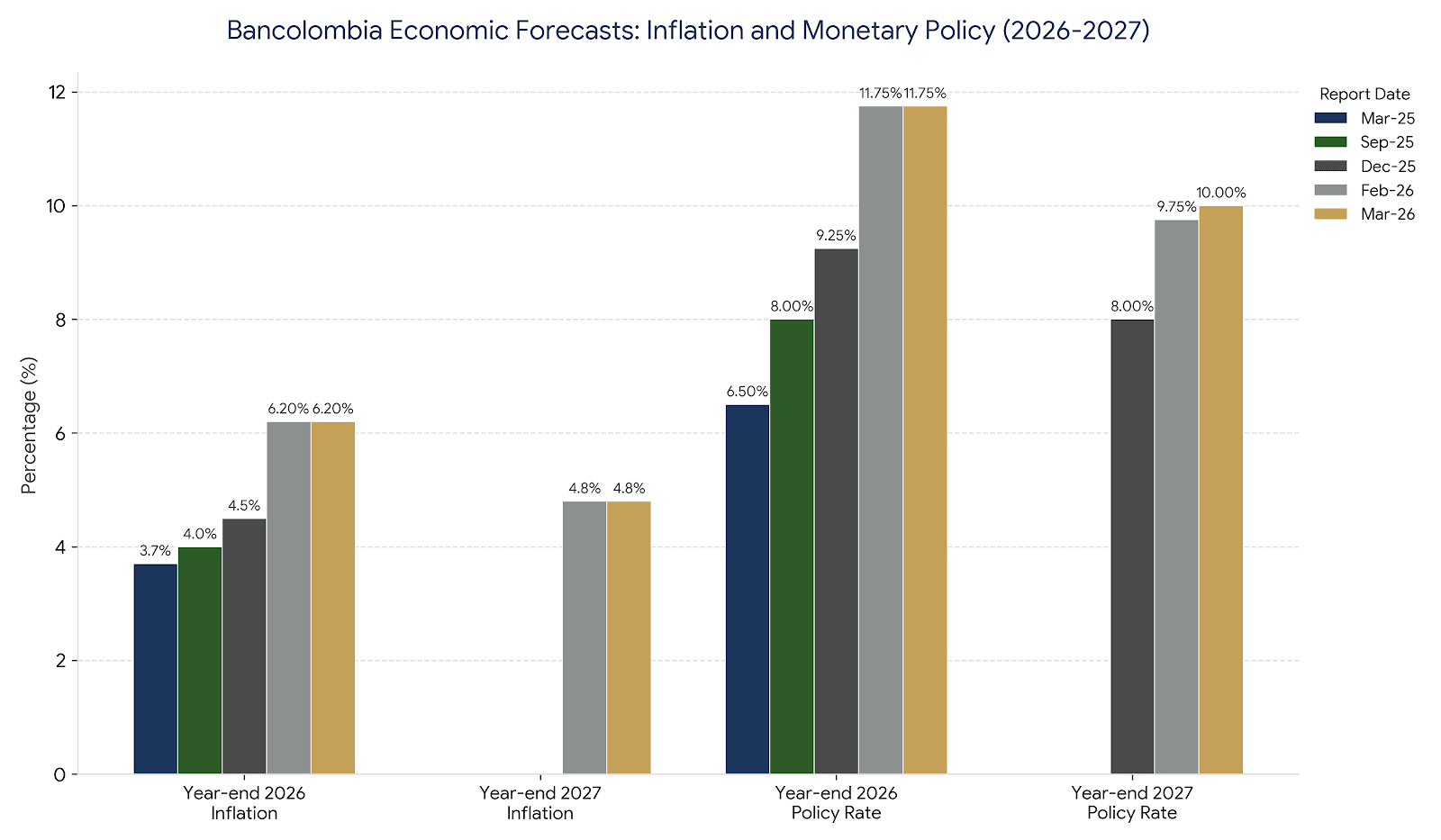
Bancolombia’s analysts expect the Junta Directiva of the Banco de la República to increase its policy interest rate by 100 basis points, bringing it to 11.25 percent. This forecast suggests that the first half of 2026 will be characterized by a more aggressive tightening cycle than previously anticipated, with the rate potentially reaching 12.75 percent.

The international landscape is playing an increasingly decisive role in these local policy configurations. A recent week of central bank decisions globally revealed a shift in tone among major financial institutions, primarily due to rising uncertainty stemming from the conflict in Iran. This geopolitical tension has directly impacted costs for energy, transportation, and agricultural inputs.

“The increase responds to the need to send a clear signal of commitment to price stability.” — Dirección de Investigaciones Económicas, Sectoriales y de Mercados at Bancolombia.

In the US, economic activity shows signs of moderation, yet producer price inflation in February exceeded expectations. The yield curve for US Treasuries, managed by the US Department of the Treasury, has shown mixed behavior as the conflict escalates, with the spread between 10-year and 3-month bonds reaching levels not seen since 2023. Inflation expectations in the US have rebounded in the short term, though they remain anchored over longer horizons.

Forecast Category Mar-25 Sep-25 Dec-25 Feb-26 Mar-26
Year-end 2026 Inflation 3.7% 4.0% 4.5% 6.2% 6.2%
Year-end 2027 Inflation 4.8% 4.8%
Year-end 2026 Policy Rate 6.50% 8.00% 9.25% 11.75% 11.75%
Year-end 2027 Policy Rate 8.00% 9.75% 10.00%

Domestically, the business indices from think-tank Fedesarrollo showed mixed results for February. However, there are positive indicators in the labor market, as the urban unemployment rate across the 13 primary metropolitan areas continued its downward trend. Additionally, goods exports recorded an advance during the same period.

In the local fixed-income market, the TES fixed-rate curve saw a recovery last week. However, the March Financial Institutions Survey suggests that devaluations of TES may persist in the short term. Long-term TES Class B placements in the first quarter reached 1.0 percent of the GDP.

Chart based on data from Grupo Cibest & the Banco de la República.

Chart based on data from Grupo Cibest & the Banco de la República.

Energy markets remain volatile as crude oil inventories in the US increased beyond expectations in the third week of March. Despite this, the price of Brent crude rose toward the end of the week, driven by skepticism regarding a potential ceasefire in the Middle East. The Colombian peso appreciated over the past week, tracking the intensity of the regional conflict.

The equity market results for the fourth quarter of 2025 remained neutral and aligned with market expectations. Global volatility continues to be shaped by energy shocks, geopolitical strife, and a cautious approach toward investments in artificial intelligence.

The projected rate hike by the Banco de la República is intended to send a definitive signal of commitment to price stability. This adjustment reflects not only recent inflation trends but also a strategic effort to prevent the further deterioration of expectations in a high-risk environment.

Headline image: Bogotá headquarters of Banco de la República (Banrepublica). Photo credit Juan Enrique Rodríguez, courtesy Banrepublica

  •  

Op-Ed: Latin America’s Air Cargo Hubs Are Engines For Economic Growth

Freight forwarders and logistics companies serving the Americas no longer think of the region’s air network as a peripheral add-on to ocean freight. Latin American airports now handle everything from export flowers and pharmaceuticals to e-commerce parcels on overnight schedules. With volumes showing a steady growth path—and with governments racing to upgrade runways, cold-chain rooms, and free-trade zones—these gateways are transforming how independent forwarders plan routings, price capacity, and promise lead-times to customers.

The Latin American air freight market, valued at $1.04 billion USD in 2025, is projected to experience sustained growth, driven by expanding e-commerce, increasing cross-border trade, including inter-Latin American trade. Key growth drivers include the rising demand for more reliable and quick turnaround delivery services, particularly for perishable goods and high-value products.

Global air cargo demand rose by 3.4% in 2025 compared with the previous year, according to data released by the International Air Transport Association (IATA).

At the same time, total capacity, measured in available cargo ton-kilometers (ACTK), increased by 3.7% year on year. For international operations, demand rose by 4.2%, while capacity increased by 5.1%.

Latin America Air Freight Industry Concentration & Characteristics

The Latin American air freight industry has been defined by a moderate level of concentration, with a few large global players dominating but now also including several significant regional carriers. While FedEx, UPS, and DHL hold substantial market share, particularly in international freight, regional players like LATAM Cargo, Avianca Cargo (Tampa Air), and Aeromexico maintain strong positions in domestic and regional routes.

Other leading players in the Latin American airfreight industry include IAG Cargo (UK), Copa Airlines (Panama), American Airlines, Delta Airlines, Azul Cargo Express (Brazil) and Emirates Skycargo.

Nicholas Sutherland’s opinions and claims are his own, and not necessarily those of Finance Colombia.

Regional Growth Drivers

  • E-commerce explosion – Same-day and next-day service expectations are migrating south, driving express integrators to expand cargo terminals in Latin America and sign block-space agreements with regional carriers.
  • Perishables dominance – Colombia, Ecuador, Peru, and Chile collectively ship more than 1.5 million tons of flowers, fruit, seafood, and pharma each year—commodities that depend on airport infrastructure for freight with reliable 2-8 °C corridors.
  • Pharmaceuticals – Colombia, Mexico and Brazil stand out as not only having large national companies, but also some of the largest pharma companies in the world have factories in these countries.

Electronics, jewelry, auto parts, specialized machine parts, and high-value textiles are also driving increased traffic.

Latin America’s Hub Status

For years, Latin America has been spoken of primarily as a supplier, a hub for perishables, electronics, and auto parts feeding the U.S. and Europe. Fast forward to 2025 and something is unmistakably clear: the region is no longer merely sourcing for the world. It is becoming one of the most strategically viable air cargo growth engines, driven by nearshoring, rising consumer markets, and accelerated infrastructure investment.

Leading Locations

Mexico

 Since 2023 the Felipe Ángeles International Airport, also within the Greater Metropolitan Area of Mexico City, has now surpassed the Benito Juarez airport for air cargo with 2025 figures showing 413,224 metric tons in air cargo traffic.

The International Airport of Mexico City, known officially as Benito Juárez International Airport, stands out as the largest airport in the country and is now the second busiest air cargo hub in Mexico and number three in the LATAM region. The figures underline the importance of this hub. In January 2022, the air terminal managed a total of 41,650 tons. In 2023, this number rose to 47,206.8 tons, reflecting an important increase of 5,556.8 tons. It is important to mention that this airport also acts as a center of operations and connections (HUB) for the Mexican airline Aeroméxico, further strengthening its strategic position in the airport and logistics scenario in the region.

The International Airport of Cancun (CUN), located in the Mexican Caribbean, is a major hub in cargo handling in Latin America. With leading-edge facilities and advanced systems for the processing of goods, the airport handles a diversity of products, including consumer goods, textiles, electronic parts and pharmaceutical products. Its strategic location makes it crucial for trade routes between North America, Latin America and Europe and it has undergone constant growth in its volume of cargo.

Colombia

El Dorado International Airport is in Colombia’s capital city, Bogotá, and stands out as the third most important airport in Latin America in terms of freight volume. It registered a 2024 throughput of 809,00 tons, with flowers, perishables and pharma being the main categories.

Colombia has consolidated its position as a world leader in the export of a wide range of products, including products derived from agriculture, foodstuffs and chemical products. The airport has also been consolidated as the center of strategic operations (HUB) for international airline, Avianca.

Two 3,800 m runways at 8,360 ft elevation make BOG a purpose-built wide-body freighter hub. Cargo airlines position here to bridge east-west schedules across the Caribbean, giving forwarders same-night connections into MIA, AMS, and DOH.

Panama

Tocumen International Airport (PTY), Panamá City handled 216,653 tons in 2024 (a 4% increase over 2023). PTY sits astride the Colón Free Zone and the Panamá Canal rail link; a third runway is budgeted for development in 2027 to future-proof capacity.

A new development project called “Tocumen Cargo City”, with an area of 124 hectares, which includes the concession for the development of the cargo terminal and logistics zone, was announced in 2024. This project will take advantage of Tocumen’s competitive advantages as the region’s main air hub that connects daily more than 80 commercial destinations, and more than 50 air cargo destinations integrating a multimodal axis with the country’s maritime and land transport operations,

 Peru

Jorge Chávez International Airport is in the region of Callao, outside of the metropolitan area of Lima (Peru). It stands out as the center of operations and connections for LATAM Airlines.

In 2023 the airport handled 230,993 tons of air freight. The largest quantities of air export products were fresh asparagus, blueberries, salmon and other seafood. In 2024, the airport also added another runway and a new passenger terminal with an adjoining logistics park.

Brazil

São Paulo-Guarulhos International Airport (GRU) had a throughput of 235,600 tons in 2024. Air-sea multimodality is boosted by a 90-minute drive to the Port of Santos. Automotive, machinery, pharma cold-chain (largest airport cool-store in Brazil) are the highest categories of products.

Campinas Viracopos (VCP) airport, in Sao Paulo state (not the city) handles roughly one-third of Brazil’s imported air freight and was voted 2024 Cargo Airport of the Year by routesonline.com . It boasts a 90,000 m² cargo terminal with 11 dedicated cold rooms and a live-animal zone.

 Looking Forward

Governments are aware that there is now fierce rivalry to attract air cargo logistics operations and several have identified the sector as a key segment which would improve the competitiveness of their economies and stimulate economic growth and create skilled employment opportunities. Integration of air cargo, ports, incentives and free zones have become a cornerstone for attracting logistics and manufacturing companies.

Cargo airports in Latin America are writing the next chapter in hemispheric logistics. For independent freight forwarders, and other investors, these hubs are not just transit points, they are strategic pivot points to shorten lead times, diversify modal risk, and command premium margins in niche verticals. Airports are emerging as focal points in this new logistics landscape. Policy support, geography, and international partnerships are essential to attracting international operators and service providers.

Several countries have made successful initiatives to increase investment in the multimodal logistics space including the Dominican Republic, El Salvador (with a focus on increasing Maintenance Repair and Overhaul operations) Ecuador and La Aurora International Airport in Guatemala becoming a major hub, with LAATS, a Guatemalan logistics and freight company, managing all regular cargo flights there.

Attracting Investment in the Caribbean

For countries in the Caribbean to consider becoming air cargo logistics locations, they require international operators to view them as viable long-term locations, therefore several factors need to be considered.

Cold-Chain certification is a cornerstone for diversified airfreight operations. Pharma shippers demand IATA CEIV or WHO GDP accreditation. GRU, VCP, and LIM all hold multiple certifications, allowing forwarders to move temperature-controlled cargo without auxiliary containers significant cost saving.

Customs & Free-Zone Synergy have been the defining characteristics of a country’s success. Many airports interface directly with bonded zones or inland ports. Panama’s Tocumen International Airport’s on-airport logistics park and Panama Pacifico free zone cut transfer times by 24 hours compared with off-site warehousing.

Customs Harmonization and Focused Incentives

Caribbean countries must consider integration of the electronic DUCA-F, a fundamental document for the export of products originating in a Central American country to other countries in the region, within the framework of current trade agreements. It integrates and connects the customs systems of the six countries that make up the Central American region. This interconnection significantly improves customs controls, allowing for the automatic validation of declared data and real-time verification of approvals issued by the single windows and customs authorities of each country.

Airports may waive or discount landing fees for 1–2 years to attract new carriers or new routes. Sao Paulo’s Viracopos International Airport in Brazil runs an incentive program for cargo carriers as it looks to strengthen international hub’s cargo activities. The program aims to develop Viracopos as an international cargo hub, and the gateway’s operator – Aeroportos Brasil Viracopos – wants to increase the number of international flight routes and cargo frequencies. Some of these incentives include 100% exemption of landing fees for operations at the airport’s cargo terminal for the first 24 months of a carrier’s cargo operation.

Like landing fees, building rents can be discounted for air cargo carriers. For example, St. Louis International Airport offers 18 months of waived terminal building rents and landing fees for new transoceanic service and related logistics. Income tax exemptions for the first four (4) years of operation and reduced tax rates (sub 10%) for air cargo-related logistics operations are other ways to compete with nearshore rival locations. Income tax exemptions on rental for developers are essential for infrastructure development. These exemptions can be for twenty years, combined with a reduced tax rate for the following years.

Several Caribbean countries have declared intentions to compete for investment in air logistics, however very few (except for the Dominican Republic) have made it a priority with an accompanying tactical and focused execution plan. Caribbean countries who wish to position themselves as an air cargo hub need to have feasibility studies done by internationally recognized logistics companies along with a well-defined plan for what reasonable short-term and long-term success looks like. It’s also essential to have a realistic outlook of what each country can offer, rival strengths and incentives and a clear understanding of any deficiencies which may pose headwinds to their stated goals.

  •  
❌