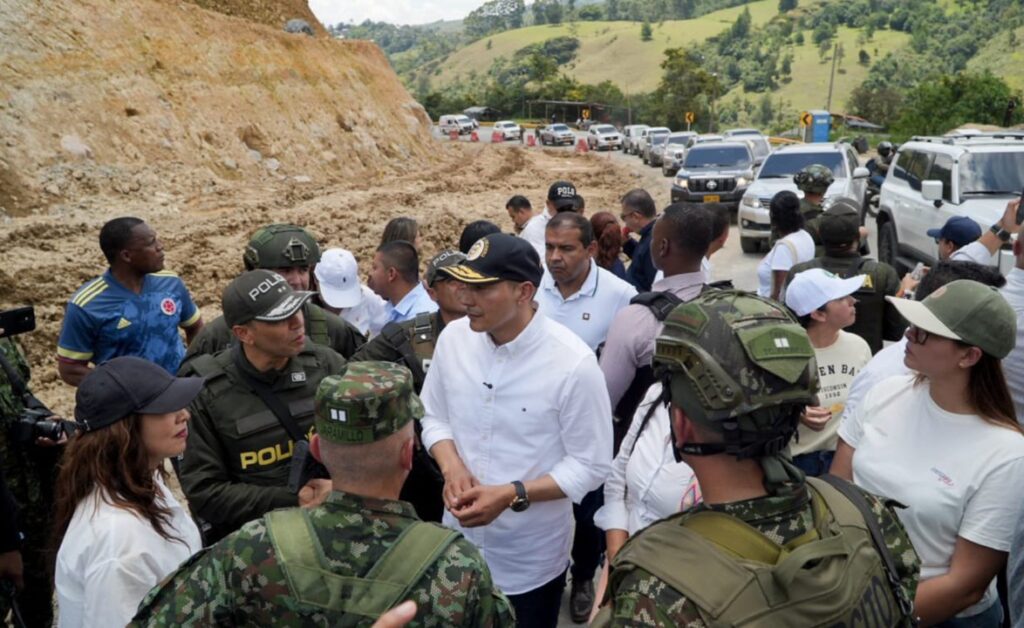
Misak community meeting in the Cauca hills during clashes on Thursday. Photo: X
A large military contingent has been sent to Cauca today to halt clashes between members of the Nasa and Misak communities fighting over ancestral territory.
The first of 500 troops arrived in Popayán, the department capital, to be ferried by helicopters to the hills around Sylvia in northern Cauca where members of both indigenous groups were fighting on Thursday. The violent confrontation led to seven deaths and more than 100 people injured, some seriously, according to latest reports.
Colombia’s minister of defence Pedro Sánchez, announcing the troop deployment, said the death toll was likely to rise as both military and state institutions gained access to the zone.
Videos posted online showed people from both communities fighting with machetes, spears and home-made explosives. But many dead and injured had gunshot wounds, suggesting firearms were being used, said Sánchez.
Leaders called for calm today, and Colombia’s president Gustavo Petro appealed to both sides to re-start talks over the contested land.
Troops arriving in Cauca on Friday.
“I have requested a meeting with the highest authorities of the Misak and Nasa peoples to guarantee peaceful coexistence,” tweeted Petro. He offered to broker talks next week.
Petro’s government has been attempting to resolve historical territorial issues with indigenous communities who often lack legal land titles through the Agencia Nacional de Tierras (ANT), the national land agency.
An “interethnic pact” was urgently needed in Cauca to return fertile land to original communities for agricultural crops, said Petro. The expertise of indigenous farmers could turn the tide of drug trafficking in the region, he added.
Conflict hotspot
Cauca, in southwest Colombia, is one of the country’s most conflicted regions with multiple armed groups in conflict with the state.
It is also home to some of Colombia’s largest indigenous communities, such as Nasa that inhabit large tracts of highlands that span the Andean massif and defend their land with both political bodies – powerful lobbies such as the CRIC or Consejo Regional Indigena del Cauca – and self-defense forces known as Guardia Indigena.
In Cauca, the Guardia Indigena are frequently targeted by armed groups and members of CRIC are victims of kidnap or assassination.
Vice-presidential candidate Aida Quilcué, herself Nasa, survived an abduction attempt in February this year when armed men intercepted her vehicle in the highlands of Cauca. She was rescued by Guardia Indigena who trailed her into the mountains.
This week’s clashes erupted after simmering dispute over 800 hectares (2,000 acres) of páramo highlands bordering the Pitayó Reserve, belonging to Nasa, and Guambia territory of the Misak.
CRIC indigenous guards from Cauca marching in Bogotá during the 2019 protests. Photo: S. Hide
Political twist
According to members of the communities, the plot of land had three springs and was of cultural and spiritual significance to both groups. But in 2023 the ANT appeared to award titles to Nasa based on colonial maps from the colonial era of the 1750s, and act that infuriated Misak who also claimed it as their ancestral territory.
In the aftermath of Thursday’s clashes, opposition politicians were quick to blame the Petro government for fomenting the violence, accusing the ANT of favoring the Nasa reserve and CRIC – widely seen as allied with Petro’s Pacto Historico party – of using the ANT judgment to invade Misak territory.
In a Facebook post right-wing presidential candidate Paloma Valencia accused Nasa’s community in the Pitayó reserve of breaking negotiations to take the disputed territory by force.
In a further twist, Valencia implicated Quilcué, the running mate of her main political rival Iván Cepeda in this month’s presidential elections. Quilcué, who previously led CRIC and was openly supported by the organization in her vice-presidential bid, had pushed the dispute, claimed Valencia.
“Instead of deciding to resolve the issues, the Nasa then decided to advance and invade the Misak territory,” she added.
Allowed to fester
According to an analysis by El Espectador, the conflict stemmed from a misunderstanding of 2023’s ANT declaration, which was an interim finding leaving a “wide margin of interpretation” for who owned the land.
Nasa interpreted the finding as an excuse to use the land traditionally inhabited by Misak, and in return the Misak community blocked access roads.
In March this year the governor of the Pitayó reserve Edinson Pacho condemned the Misak for causing economic damage to farmers unable to take their products to market.
In turn, this week Misak representative Liliana Pechenche accused the “armed forces of the CRIC” – the Guardia Indigena – of killing at least two Misak men and kidnapped 10 more of the Guambia community during the escalation.
She also denied the Misak were armed, claiming this was false information spread by the Nasa to justify their armed incursion: “We are at risk of physical extermination through persecution; we are a peaceful people.”
Both sides agreed on one thing: that the government and its ANT agency had allowed the misunderstanding to fester for several years despite warning signs that violence was brewing.
CRIC, which according to its website represents many indigenous groups including Misak in Cauca, rejected the appropriation of the conflict by national politicians.
“These situations cannot be used to deepen the division between fraternal communities,” it said in a statement.
“These conflicts…are the result of historical decisions and institutional omissions …to generate disputes, confusion, fragmentation and confrontations between indigenous groups,” it concluded.
By Friday a tense calm had settled on the area according to observers, with hopes for a quiet weekend before talks planned for next week.
Unexploded device sparks alarm after suspected links to armed groups.
Remains of the drone found in Bogotá this week, the PVC pipe contained C4 explosives. Photo: PoliciaNacional
Bogotá’s security agencies were on full alert this week after a drone rigged to carry explosives was found on the outskirts of the city less than six kilometers (3.7 miles) from El Dorado international airport.
Anti-terrorist units working along side Colombian air force specialists discovered the drone bomb in woodland close to the Bogotá River in the Kennedy district on Wednesday afternoon.
The drone was close to a makeshift camp, though it was unclear from official reports of the artefact had crashed there or was discarded and hidden.
An air force spokesman said the site was detected with the help of intelligence services after a tip-off from investigators in Cauca, a conflict region of Colombia where drone bombs are frequently used by armed groups.
The bomb itself was made from 260 grams of powerful C4 explosive stuffed in a PVC tube with a medical syringe rigged as a detonator, a device more commonly seen in Colombia with artisanal landmines, and a camera for guidance.
One unusual element of the drone was its unconventional control system using fiber-optic cables, said the spokesman. This style of drone, pioneered in the Russia – Ukraine conflict, can overcome signal jamming technology making it harder to intercept.
“This type of threat is now present in the cities, we call on the community to call in any suspicious activities,” said the spokesman. Citizens should phone 107 to report drone sightings.
Meanwhile the device had been disarmed and handed over to experts at the CTI (Cuerpo Técnico de Investigación) for forensic analysis, he added.
The improvised weapon’s discovery followed a week of alerts of unauthorized drones seen flying over El Dorado airport, in some cases causing temporary shutdowns. In the most recent incident, an Avianca crew spotted a drone close to the terminal building leading to a10-minute flight suspension.
Aeronáutica Civil, Colombia’s airspace agency, later declared the sighting a false alarm.
Rise of the drones
Armed drones are increasingly being used in Colombia with combatants dropping airborne explosives on rival gangs and state forces, often from home-made devices fabricated from small drones and accessories available on the high street.
The technological race to gain a performative edge on the battlefield has created game-changing tactics in the country’s decades-old conflict, but also brought misery to civilians caught in the crossfire.
According to website Razón Publica, there were 418 drone bombings across the country in 2024 and 2025, with 28 fatalities, of which 10 were civilians. Another 300 people were injured.
Three of Colombia’s largest armed groups, the ELN, Clan del Golfo and EMC dissidents, were perfecting these improvised devices while state security forces were scrambling to keep up, said the publication.
Drone attacks were reported in all of Colombia’s conflict hotspots, particularly Cauca, Valle, Norte de Santander, Antioquia and Caquetá.
Civilians were often collateral victims – bombs are dropped from several hundred meters and frequently miss their targets – and armed groups also used drones to control communities.
“The drone go beyond attacks: they monitor, intimidate, and generate displacements,” said Razón Publica.
On May 8th, a police station was attacked by five armed drones in the Cauca town of Suárez, according to the local mayor.
#Atención A esta hora disidentes atacan con drones cargados de explosivos la estación de Policía en Suárez, Cauca. La alcaldía suspendió la atención al público y ordenó a sus habitantes a permanecer resguardados en sus viviendas. pic.twitter.com/qcNmg8sDOB
Security chiefs speculated this week that the Bogotá drone bomb could have been planned for military installations based at El Dorado.
Colombia’s main international airport lies alongside the large hangars of CATAM, or Comando Aéreo de Transporte Militar, a large logistical base for military operations, as well as FAC (Air Force) and police facilities.
Cauca link
As for the drone’s origin, some clues pointed to EMC armed group currently fighting state forces in Cauca in the southwest of the country.
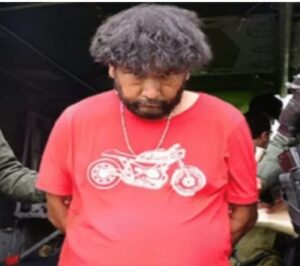
According to reports on the El Tiempo news site, the Bogotá drone was only found after prosecutors in Popayán alerted their counterparts in the capital of its location, and this tip-off came two days after the capture in Cauca of two suspected explosives experts – José Musse and José Valencia – accused of belonging to the Frente Carlos Patiño, one of the major fighting units of the EMC.
Cauca was the scene last month of one of Colombia’s worst conflict atrocities when a roadside bomb planted by the EMC exploded killing 21 civilians traveling close to Popayán, the departments regional capital.
When captured on May 4th in Cauca, Musse and Valencia were found with an “artisanal drone that could be used to attack official installations”, said local prosecutors.
The fact the pair had knowledge of the Bogotá drone – and where to find it – suggested a link to the EMC, said El Tiempo, though there was no evidence they were directly involved.
So the question remains who put a drone bomb in Bogotá? And was it linked to the drone alerts at the airport? With the presidential elections around the corner, many rolos will be hoping for some answers.
As the civilian death toll rises to 21, here’s a closer look at conflict in southwest Colombia.
Police anti-explosives experts remove half a tonne of explosives from a drainage channel in Cauca last week. The find follows a deadly attack by dissidents that killed 21 travelers. Photo: Policia Nacional
Colombian armed group the Estado Mayor Central (EMC) has admitted its role in the massive roadside bomb near the small town of Cajibío that killed 21 civilians and injured 60 others in Cauca on April 25, the worst such attack in the country’s recent history.
In a message, the EMC said “we cannot hide or justify the error” which resulted from buried explosives aimed at military targets but which they detonated in a queue of vehicles held at a roadblock.
Cajibío was one of 37 coordinated attacks over five days in Cauca and the neighboring Valle department, conflict analyst Gerson Arias of Fundacion Ideas para la Paz (FIP) told The Bogotá Post.
“This was a message of terror from the EMC who wanted to show their military superiority in the region,” he maintained.
And despite admitting its error, the EMC showed no signs of slowing its offensive in recent days. On Thursday police experts defused 600 kilos of explosives found wedged in a drainage tunnel near Piendamó, Cauca, potentially avoiding a fresh tragedy.
Civilian targets
Military sources told news media after the Cajibío bomb that the EMC fighters had likely set a trap on the Via Panamericana, the main route linking Cali and Popayán. They buried the massive bomb then forced trucks to block the highway before retreating to the wooded hillsides as a long queue of traffic formed on the busy road.
When troops arrived in their heavily armored tanquetas – fortified troop carriers with turret guns – they sensed a trap and parked several hundred meters from the blocked road, then moved on foot through the wooded hillside to engage the guerrillas.
An EMC fighter then remotely detonated the roadside bomb striking 15 civilian vehicles, killing 21 people and injuring 60. The combatants escaped in the aftermath.
Arias believes that despite their original plan to kill military targets, the EMC fighters chose to blow up civilian vehicles: “They decided to detonate; it was a decision by the EMC.”
Vehicles damaged by the roadside bomb at El Tunel, Cajibío, Cauca last April 25. Photo: X.
The resulting carnage was one of the highest civilian death tolls from a single incident in Colombian history, last seen on this scale in 2002 when a gas cylinder packed with high explosives detonated in a church in Bojayá, Chocó, killing 79 local people.
The deadly nature of homemade bombs, or ‘IEDs’ as they are called in military parlance (Improvised Explosive Devices), was shown again in August last year when 13 policemen were killed in Antioquia by a buried cylinder bomb that destroyed a helicopter.
Armed groups growing
Who was behind the Cajibío bomb? The EMC are remnants of the FARC’s 6th Front, formed by guerrillas that rejected the 2016 peace process, now called ‘disidencias’, or dissidents.
The EMC still uses the FARC name, uniforms and logo, and its leaders mimic the ideology of former FARC icons such as ‘Tirofijo’ insisting it is a “political insurgent force”.
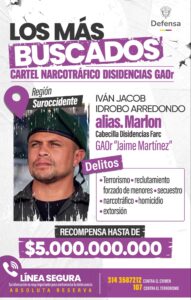
Last week Colombia’s defense minister was swift to blame the EMC’s Frente Jaime Martínez which is under the command of alias Marlon, a former FARC commander freed from jail in 2016 as a signatory to the peace deal but who returned to the fray.
The Cauca-based Frente Jaime Martínez numbered around 600 combatants, one of the most powerful units in the Bloque Occidental of the EMC, explained Arias. FIP data showed the EMC numbering around 3,300 fighters spread across southern Colombia, an estimated growth of 23% during 2025. Around 60% of those were concentrated in southwest Colombia.
“Cauca is a strategic point for illicit mining and narcotrafficking, all the armed groups are seeking dominance, and this means intensive recruitment of young people into their ranks,” said Arias.
Cauca’s Andean massif, rugged highlands that provide shelter for armed groups. Photo: S. Hide.
The mountainous department is a heartland of Colombia’s illicit economies, straddling both the Andean cordillera and the Pacific lowlands with topography perfect for both hiding rebel armies and providing lush hillsides for coca crops and marijuana.
Cocaine production needs large cropping areas, 32,000 hectares of coca bushes covered the Cauca hillsides by the last count (Indepaz, 2024). And since Spanish colonial times the lowland riverbeds have provided a source of gold, today mined illegally with destructive heavy machinery paid for by cocaine profits.
Inland links
Cauca has no proper roads linking the highlands coast, though there are numerous clandestine ‘conflict tracks’, mule trails and navigable rivers to the Pacific. A labyrinth of mangrove swamps provides cover for boats running an estimated 70% of Colombia’s cocaine product to central America and beyond.
The department’s east is formed by the ‘Cauca Boot’, a foot-shaped chunk of mountainous terrain long held by rebel groups which penetrates as far as the Caquetá jungle linking the eastern Llanos plains and Amazon region to the Pacific coast.
This corridor created a vital link between the interior of the country and the EMC’s Bloque Oriental, in the eastern plains and jungles, Arias told The Bogotá Post.
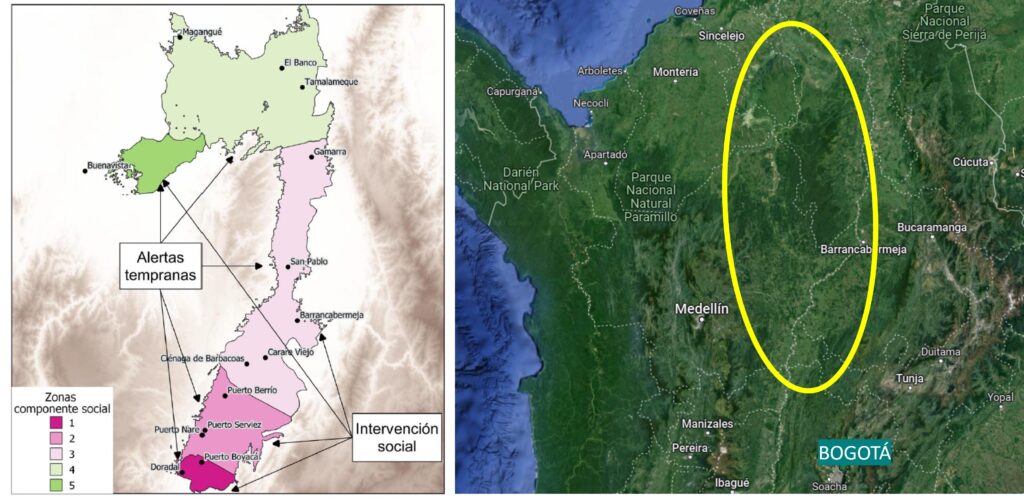
Map of Cauca and neighboring departments, and recent conflict events.
Cauca was also bisected by the Via Panamericana, the highway running down the mountain and linking three main cities – Cali, Popayán, Pasto – and on to Ecuador to the south. This neuralgic route was easily blocked or attacked by armed groups, he said.
Combat units like the Frente Jaime Martínez would likely have autonomy from the top leadership of the EMC and could plan and execute their own actions, explained Arias.
“They articulate and communicate with the EMC structure, but are not necessarily subordinate,” he said.
Failed peace plan
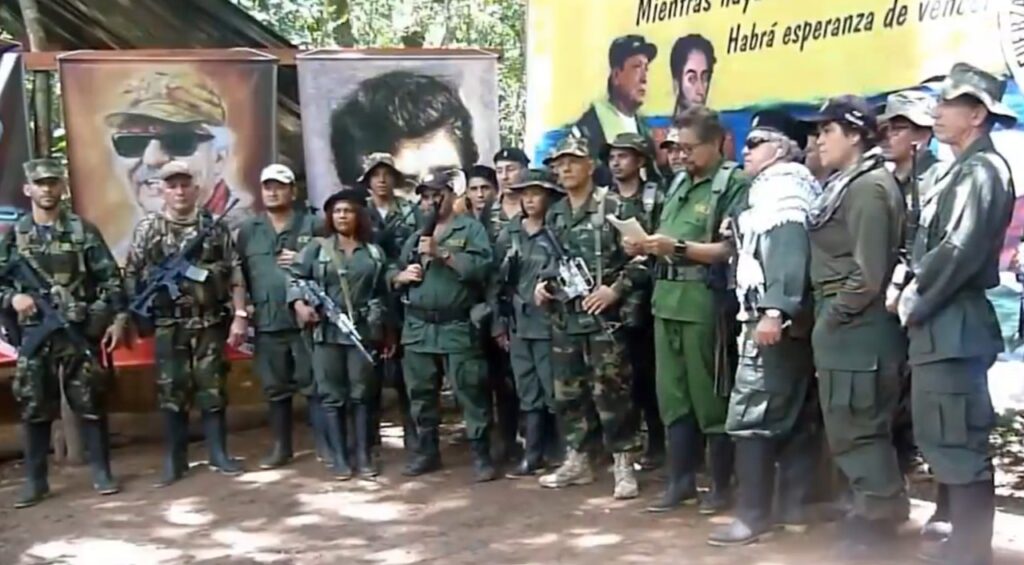
EMC message. They still use the FARC logo.
The EMC was originally included in Petro’s sweeping Paz Total (Total Peace) initiative in 2022, but after repeated infractions by the armed group – including murdering four indigenous children the group had forcibly recruited – talks broke down in 2024.
In October that year Petro called off the talks and ordered the military to attack EMC heartlands in Cauca. The ensuing Operation Perseus sparked intense combat around the town of El Plateado in the Micay Canyon, historically a hideout for the FARC and now an EMC stronghold.
FIP has been critical of Paz Total and in February this year published data showing that armed groups had used the façade of peace talks to expand both their ranks and territory.
According to Arias, Petro’s government failed to understand the strategic importance Cauca had to the armed groups, as well as underestimating the control the EMC had over local communities.
Many rural families were reliant on coca growing and gold mining in a region lacking state presence: “There’s been a historical process of armed groups coopting civilian and ethnic communities,” said Arias.
This was evident in the civilian uprisings – asonadas – against state forces leading to incidents such as the 57 soldiers forcibly detained by a community in El Tambo in June 2025.
But the armed groups also preyed on the host population, he said, particularly victimizing the indigenous communities which make up 20% of Cauca’s population. EMC commanders frequently forced indigenous youth to join their ranks, creating conflict with the Nasa and Misak people of the area.
Contacts ofThe Bogotá Post living in rural Cauca – who declined to be named – said that armed groups controlled communities with networks of spies and even used surveillance drones to monitor movements.
A person needing to travel in or out of the zone controlled by a particular armed group needed permission and had to carry ID cards issued by community councils under orders of the armed group.
Anyone rejecting these restrictions was threatened and displaced, and particularly social leaders who spoke out against the armed groups risked being assassinated: 12 in Cauca so far in 2026.
The Cauca cauldron
Strength in numbers was a contributing factor to EMC aggression in the region, said Arias. FIP data showed a steady increase in armed attacks against both civilian structures and military targets since 2016, peaking at 175 recorded incidents last year (see graph below).
Year on increase in coflict events, Cauca and Valle, 2010-2026. Source: FIP
Not all events involved state forces; the EMC was under pressure from rival groups such as the ELN, Segunda Marquetalia and EMBF dissidents. All want a share of Cauca’s illicit economies.
And while waging a conflict of asymmetric warfare, often resorting to terror tactics, the EMC was also demonstrating military dominance with armed drones that put the Colombian military on the back foot.
“Out of 500 attacks, 408 were using drones,” said Arias. “The conflict is changing direction, but state strategies are not adapting to respond to this new technology.”
But beyond a military response, the state needed to implement a strategy of well-planned and sustainable social interventions to stem the resurgence of the armed groups.
In Cauca, this was a huge challenge, said Arias. For now, groups like the EMC were sticking to illicit gold and narcotrafficking, even if it meant constant conflict to deter and weaken state forces.
“They are on the attack to show they are the bosses,” he said.
La Dragona, the monster truck that crashed killing three spectators in Poayán on Sunday. Photo: X still.
Colombia’s troubled corner of Cauca was struck by another tragedy Sunday when a monster truck plowed into spectators at a car show killing three persons and injuring dozens more.
Harrowing footage posted online showed spectators scrambling to escape the path of the customized jeep after it inexplicably left the track in Popayán, the regional capital of Cauca department. Others were not so lucky and crushed by the huge tires. A ten-year-old girl was reported among the dead.
Sunday’s incident was at a fun family event held during the Mayday bank holiday weekend. For many of the 1,500 attendees the car show would initially have been a welcome respite from the grim news that has emerged from Cauca in recent weeks.
The accident struck eight days after a roadside bomb killed 21 vehicle passengers on a highway 30 kilometers north of the city. Dissident fighters from the EMC armed grop later claimed responsibility for the attack, claming that is was targeting military troops but killed civilians by mistake.
At the car show event the monster truck, called La Dragona, was being driven by Colombian Sonia Segura. According to event organizers Colombian Monsters SAS, Segura is only woman in Latin America permitted to drive such oversized vehicles.
Monster failure
In an Instagram video posted before Sunday’s event she presented La Dragona and its “1,500 horsepower motor”.
The outdoors display, which also featured a monster truck called Godzilla and motocross competitions, had already appeared at several Colombian cities and has made regular tours of the country over the years.
According to their Facebook page, Colombian Monsters SAS is a Colombian company based in Bogotá but has trucks brought in from the U.S.
#ATENCIÓN. Lamentable balance en Popayán: asciende a 3 la cifra de fallecidos y al menos 12 heridos tras el accidente en la exhibición de Monster Truck en el Boulevard Rose. Entre los lesionados se encuentran varios menores de edad que recibían atención en centros asistenciales.… https://t.co/IsPHNJ0W6Hpic.twitter.com/YuYcIncITT
Footage of Sunday’s crash showed Segura driving La Dragona over crushed cars then turning towards the crowd and accelerating before hitting a concrete post that eventually stopped the vehicle. Ambulance and fire brigade then scrambled to assist the trail of crushed spectators.
Talking to El Tiempo after the tragedy, the Popayán’s police chief Julián Castañeda said that the accident was caused by mechanical faults. Segura was also injured and in hospital in a stable condition, he added.
“This was a private event. There was a mechanical failure, and the vehicle went off the road. The vehicle accelerated, the driver couldn’t brake.”
One video showed the truck engine on fire, though it is not clear if this is a feature of La Dragona or part of any mechanical problem.
Increasing numbers of travelers being denied entry after interrogations at the border.
Immigration officers have powers to interrogate, detain and deny entry to travelers. Photo: Migración Colombia.
Five foreign tourists flying into Colombia were turned back at Medellín airport Tuesday last week after other passengers reported them for “conversing on the plane about their plans for sexual encounters”.
Although not clear who exactly denounced the travelers, or what other evidence was produced, immigration officers barred them entry after declaring their reasons to visit Colombia as “illegitimate”.
The case is part of a growing crackdown by immigration authorities against sex tourism in Colombia, which has been on the rise in recent years.
The five U.S. citizens were interviewed by immigration officials after arriving at José Maria Cordova airport on a United Airlines flight from Houston.
According to posts by Migración Colombia, the men were overheard during the inbound flight discussing hiring sex workers to “fulfil their fantasies”.
The cases highlighted a trend of increasing sex tourism but also stronger measures to prevent it, said immigration officials this week.
“We are focusing immigration control on detecting these types of offenders, fighting sexual exploitation, and protecting children not only in Antioquia but throughout the country,” said Gloria Arriero, director of Migración Colombia.
Data showed that 60 tourists were denied entry at airports in the first four months of 2026, compared to 110 in all of 2025.
Watching angels
The problem existed in tourist destinations like Cartagena and Bogotá, but was most evident in Medellín, the capital of Antioquia and Colombia’s second city, said Arriero, with 48 of the cases registered at the José María Córdova Airport. Of the persons barred this year 51 were U.S. citizens.
In the last week alone 15 foreign nationals, mostly U.S. nationals, were denied entry including the five passengers overheard on the plane. Many of the suspects were arriving on flights from Houston, Miami and New York, added Arriero.
The latest expulsions followed a campaign by Medellín’s mayor Fico Gutiérrez to stamp out a rise in human trafficking and sexual exploitation, particularly of children, linked to organized crime and visitors to the city.
Prostitution is legal in Colombia although immigration officers have autonomous powers to deny entry to travelers if they suspect them of sex tourism. Checks have gathered pace in recent years under the “Angel Watch” system that allows Colombian immigration to identify foreign travelers with criminal records or reports of sexual offences against minors before they enter the country.
Angel Watch, which has been running in Colombia since 2024, gives immigration officers real-time access to data from national sex offender registries and state websites in the U.S, including the Department of Homeland Security and National Center for Missing & Exploited Children (NCMEC).
The U.S.-based Angel Watch Center then alerts overseas authorities to its citizens with convictions for sexual crimes against minors. Specialized police task forces in Colombia also use international alerts from INTERPOL to intercept other nationalities.
Angel Watch alerts can catch potential offenders at points of entry or prevent undesirables from obtaining or extending visas, if they are long stayers. The system blocks around 50 travelers a year detected with a history of pedophilia or sexual aggression.
Inadmiitted: five tourists sent home after talking trash on their inbound flight. Photo: Migración
Cell phones searches
For other cases border authorities rely on old-fashioned detective work, such as the case of the five travelers hauled in for questioning after reports of their lewd talk on the plane.
In February, two men were netted after being spotted filming children during the inbound flight. On investigation, border officers found bans from multiple countries for sexual offences involving minors.
Others have been interrogated based on items detected in their luggage; in February, a Lithuanian was sent home after inspectors found a huge haul of sex toys. These were decreed “inconsistent with his declared purpose for visiting Colombia” according to a press release at the time.
Migración has also revealed cases where large numbers of condoms, lingerie, or exaggerated quantities of “potency drugs” triggered interrogations and cell-phone searches which then revealed plans for sex tourism.
Migration officers also accompanied police units in sweeps where foreigners were suspected to be involved in wrongdoing. Tactics included visiting hotels and hostels which had registered visitors with previous convictions, but also monitoring their social media profiles for incriminating material.
Disturbing the peace
Earlier in April, Migración deported in a blitz of publicity Medellín-based influencer ‘Chill Capo’ (real name Steve Newland) who was sent back to the U.S. after being detained at a party in the city’s Parque Lleras, a hotspot for sex workers.
“We found he repeatedly used his social media to invite and organize sex parties at various establishments where the main focus is on women, viewed as just another object to attract foreigners,” said director of the regional migration office Paola Salazar.
#Medellín | Ruso, con extenso historial de quejas por alteraciones al orden público, fue expulsado, por parte de la autoridad migratoria. El individuo abordó un vuelo con destino a Miami luego de que la entidad consolidara un contundente expediente basado en múltiples denuncias pic.twitter.com/wMcuQSz2zk
The 42-year-old content creator denied the accusation claiming his on-line videos of sleaze-fests were simply to encourage “a safe experience” for clients seeking the services he advertised on social media. But since Newland’s visa had expired, he was slung out anyway and banned from the country for five years.
In another recent case, a U.S-Russian citizen living in the El Poblado district was detained and deported after two years of loud music, partying, and a constant parade of bikini-clad women in and out of his flashy flat.
40-year-old George Wolfe held day-long parties on his rooftop flat and accumulated dozens of fines for disturbing the peace.
Wolfe, who claimed to be a lawyer, threatened to sue immigration authorities but they reminded him that the state “has the discretion to admit, not admit, or expel foreign citizens”.
The question circulating on social media after Wolfe’s deportation was if Colombia was now less welcoming to overseas visitors. But statistics suggest otherwise since more than nine million tourists visited last year. Instead, the message for Migración seems increasingly clear: sex tourists aren’t welcome.
A bus damaged by the huge explosion on Saturday 30kms north of Popayán. Photo: X
A bomb attack attributed to fighters from the EMC armed group killed 20 travelers trapped on the busy highway connecting Colombia’s southwestern cities on Saturday.
The tragic events in the El Tunel sector, close to the town of Cajibío, unfolded after the dissidents mounted a checkpoint on the main Via Panamericana south of Cali and 30 kilometers (20 miles) before Popayán.
The busy road runs through a mountainous region dominated by gangs run by the former guerrillas dedicated to a booming cocaine industry in hidden canyons beyond state control. At the illegal checkpoint the fighters forced truck drivers to block the road and abandon their vehicles, causing a long queue of traffic.
According to video posted online, soon after a midday the huge explosion rocked the valley mangling around 15 vehicles caught blockade including two minibuses with civilian passengers.
The governor of Cauca, Octavio Guzmán, confirmed the 20 dead civilians caught in the blast were 15 women and five men, all adults. A further 47 people were injured, of whom three were critical. Five children were recovering in hospital. Eleven of the affected persons came from the same village of Pedregosa, close to Cajibío, he added.
“What happened on April 25th constitutes the most brutal and ruthless attack against the civilian population in decades in the department of Cauca,” the governor later announced.
The bomb had displaced 200 cubic meters of soil, he said, creating a crater five meters deep in the Panamericana highway, the main route linking Cali to Popayan and on to Ecuador. Despite the damage, road crews were able to partially reopen the road six hours after the blast.
Saturday’s attack, one of the worst atrocities in recent years, comes against a background of rising conflict between state forces and dissident armed groups in the southwest of Colombia.
A nuestro medio de comunicación llega video #PRIMICIA del momento exacto donde explota el artefacto explosivo en el sector conocido como el TÚNEL CAJIBIO CAUCA entre popayan y piendamo @Noti90Minutos@DELAESPRIELLAE
Just in the last four days communities across three departments – Valle, Cauca and Nariño – reported a series of what appear to be coordinated attacks against civilian and military targets. These included:
24 April – A bus bomb exploded close to base of the Pichincha Battalion in the south of Cali, causing damage and three injuries.
24 April – In the nearby town of Palmira, Valle, an army base came under attack from cylinder bombs launched from a passing vehicle, no injuries were reported.
25 April – Two attackers launched grenades at a petrol station in Rozo, Valle, damaging vehicles.
25 April – A police station in the rural community of Potrerito, close to Jamundí, came under gunfire attack in the early hours of the morning.
25 April – In another morning attack, Aeronáutica Civil reported drones launching explosives against a hilltop air traffic station close to El Tambo (Cauca), damaging antennas and leaving the radar inoperative.
25 April – a chiva rural bus was hit by explosive charges while traveling on Route 25 near to Mercaderes, south of Popayan. Police reported several injured including a child but no deaths
26 April – four men were gunned down in a bar in Toro, Valle, between Cali and Pereira.
According to a tally by thinktank Indepaz, the Toro deaths were the 48th massacre recorded in 2026. In Colombia a ‘massacre’ is defined by the intentional killing of three or more people at the same time.
This weekend’s attacks were typical of a return to terrorist tactics such as car bombs, motorbike bombs, drones dropping home-made explosives and other artisanal artefacts.
Cauca governor Octavio Guzmán visiting the scent of the explosion this weekend. Photo: Social Media
Saturday’s Cajibío attack was initially reported as a boobytrap bomb, or “IED” (Improvised Explosive Device) which are caches of high explosives buried by the roadside by rebel groups, usually aimed at passing military patrols
But later reports suggested the civilian vehicles were struck by a pipeta mortar. These are fashioned from household gas bottles and clumsily launched from mortars made of industrial piping.
Notoriously inaccurate, a pipetas have claimed many civilian lives in the Colombian conflict, most notably in the Chocó town of Bojayá in 2002 when a charge launched by FARC guerrillas struck a church killing 79 civilians sheltering inside.
Behind Saturday’s atrocity was alias ‘Marlon’ of the Estado Mayor Central (EMC), said Colombia’s defence minister of defence Pedro Sanchez. The state offered a reward of US$140,000 for information leading to his capture.
Original dissidents
Most Wanted…
Marlon, whose real name is Iván Idrobo, was formerly in the ranks of the FARC guerrillas where he trained as a bomb maker. He is now thought to lead the EMC’s Frente Jaime Martínez which according to the Defensoria del Pueblo controls the cocaine trade, illegal gold mining and extortion rackets around the town of Suárez in the northwest of Cauca.
The EMC, lead by former FARC chief Iván Mordico, has proven to be the most intransigent of the myriad of armed groups which the current Petro government has tried to broker peace with under his controversial Paz Total policy.
Seen as the “original” dissidents that rejected the partly successful peace process under former president Manual Santos in 2016, the EMC initially agreed to negotiate when Gustavo Petro came to power in 2022 but soon engaged in bitter infighting with rival armed groups creating a rupture with Paz Total.
For his part, Petro tweeted his disgust at the Cajibío attack and the EMC “narco-terrorists” behind it.
“The groups led by Iván Mordisco in Cauca are criminals who have committed crimes against humanity and must be treated as such,” he said.
Some pundits commented that Petro’s early treatment of the EMC as a political actor had given the armed group room to expand, contributing to the current security crisis. In the heat of next month’s elections, others turned their ire on presidential candidate Iván Cepeda, seen as an architect of Petro’s struggling peace plans.
Rival right-wing candidate Paloma Valencia accused Cepeda of his role in “tying the hands of state forces, the rampant increase in illicit crops, the historic numbers of massacres, and waves of violence like today’s”.
Valencia also rounded on Petro for posting photos of his birthday celebrations even as the country was reeling from the horrific footage of the Cauca bombing. “Show some respect,” she messaged.
Crucial Santa Marta conference will include voices of communities long opposed to the exploitation of fossil fuels.
Indigenous campaigners against oil drilling in the Amazon. Photo: courtesy Amazon Watch.
Thirty years ago, Colombia’s U’wa people were ready to commit mass suicide by jumping off a 500-meter cliff. The close-knit indigenous community would rather die with dignity than succumb to oil exploration on their ancestral land.
The U’wa announced their dilemma in 1995 in an open letter that ricocheted around the world. It was no empty threat: 400 years before their ancestors had jumped from the Alto de los Infieles (Cliff of the Infidels) rather than submit to the Spanish colonial yoke.
“The U’wa were the first to call oil the ‘blood of the earth’,” explains Kevin Koenig, director of climate and energy at Amazon Watch, a U.S.-based non-profit. “The U’wa were the first to say that oil needs to stay in the ground. They warned against its extraction and its impact on the world.”
Amazon Watch has supported the U’wa to resist extractive industries over the same three decades, along with dozens of other at-risk communities in Latin America.
This week, in a ground-breaking conference in Santa Marta, some of those efforts will come full circle at the first global summit on “Transitioning away from Fossil Fuels”.
The six-day conference, starting April 24, will host 50 country delegations plus dozens of civil society organizations.
This “road map towards renewable energy” is backed by the Fossil Fuel Treaty Initiative, an alliance of nation states, technical bodies, communities and individuals working to secure a “global just transition from coal, oil and gas”.
For the organizers the timing is critical with climate upset, fuel shortages, war in the Middle East and big oil’s sticky grip on geopolitics more exposed than ever. There’s never been a better moment to move to renewable energy.
A key part of the conference will be representation from indigenous communities; the U’wa, along with many others, will have a voice at the table.
Glacier gone
For Koenig, it is also significant that the inaugural meeting is in Colombia, one of the world’s most biodiverse countries, but also an oil producer moving to curb fossil fuels and embrace renewables.
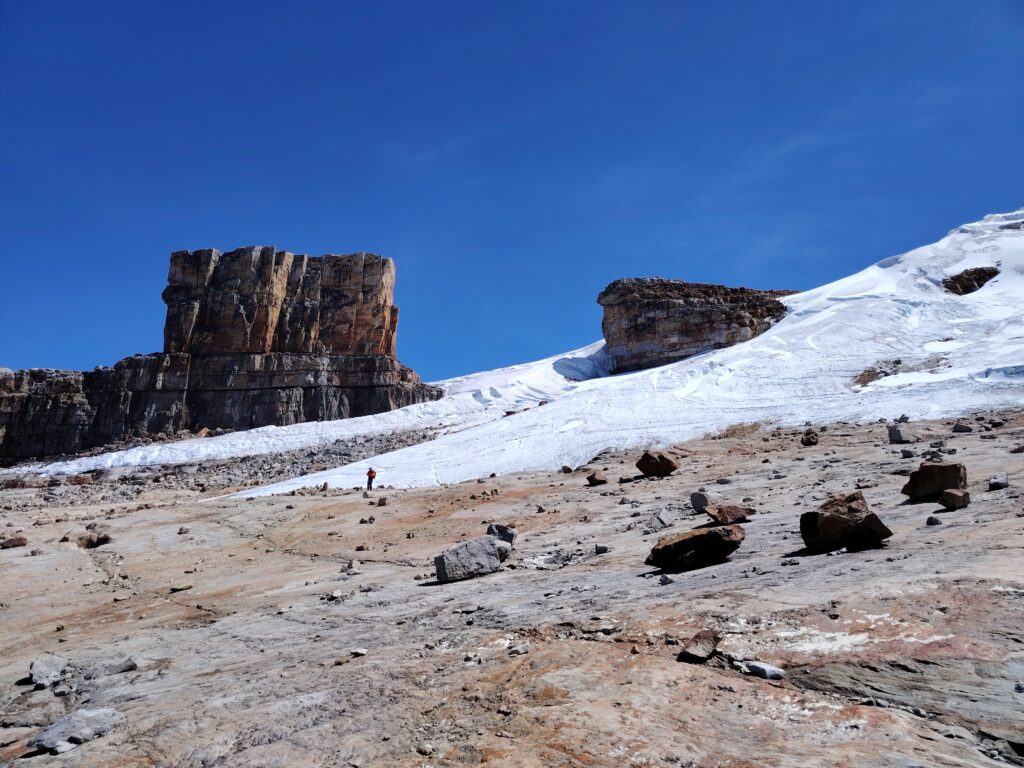
There is further symmetry in the location: the small coastal city of Santa Marta is “just over the hill” from the U’wa territory which straddles the tropical glaciers of the El Cocuy mountain range, Koenig tells The Bogotá Post.
A hiking route over the same mountains is known as Colombia’s climate change trail – see the ice before it melts.
Prophetically, just three weeks before the conference’s kick-off, the IDEAM climate agency reported that a glacier in the heart of U’wa territory had melted for good.
“Satellite monitoring confirms that Los Cerros de la Plaza glacier coverage is today at zero square kilometers,” it announced matter-of-factly.
Living these realities gives indigenous communities such as the U’wa, wedded to nature and geography, a powerful voice in the transition from fossil fuels.
This experience has often come at a high cost, says Koenig. In countries like Colombia, particularly in the Amazon, oil companies are an existential threat to both the natural environment and the communities it supports. Drilling is invariably a catalyst for violence.
“Some countries use oil extraction as a reason to open areas, saying ‘we can militarize it and it will be safer’. In fact, oil and energy infrastructures are a magnet for armed groups, for political attacks or blackmail,” he explains.
Amazon Watch has supported many indigenous communities to resist oil companies in the Amazon regions of southern Colombia, Peru and Ecuador, often through practical means such as providing solar power and communications equipment, trainings and legal resources, but also by raising their voices to the outside world.
The organization’s latest report, The Amazon Under Siege, highlights how extractive industries and the armed groups that trail in their wake are putting Amazon communities in the crossfire.
U’wa sacred territory includes El Cocuy glaciers which are melting with global warming. Photo: S. Hide.
Oil addiction
Colombia might have turned a corner with its oil moratorium in Amazon regions but neighboring countries are on a different path, one that might be summed up by U.S. president Donald Trump’s call to “drill, baby, drill”.
“Ecuador is going in the opposite direction with new oil auctions, and two new exploration blocks in remote rainforest,” says Koenig. Peru is following suit in jungle areas hitherto untouched. Perhaps not surprisingly, neither of the Andean countries is attending the Santa Marta transition conference.
According to Koenig, Peru and Ecuador are already in the throes of social violence but now risk replicating Colombia’s conflict with its rural oil pipelines that are constantly attacked or bombed, or oil lines tapped by fuel thieves, creating spills in biodiverse hotspots.
Added to that, drilling new wells makes little economic sense, he says. Current markets are signalling peak oil demand by 2030 even while wind and solar are taking a bigger share of energy output.
By doubling down on oil extraction both countries are “gambling with their future.” Aside from the moral and ethical issues of drilling in remote rainforest with indigenous peoples, getting banks to fund these ventures against the headwinds of renewables is not guaranteed.
“This is the moment where we are seeing both wars linked to fossil fuels politics and dependencies, but also for the first time renewables energies are not just theoretical, they are real, and decision-makers know they are scalable,” notes Koenig.
Inga indigenous guards in Putumayo. The community resists oil extraction on its lands. Photo: S.Hide
Fresh air
This seismic shift is reflected in the sassy subtext of the Santa Marta conference: climate deniers not invited. Meetings are reserved for a “coalition of the willing”, Colombian environment minister Irene Vélez, a key organizer of the event, told the Guardian this week..
For campaigners like Kevin Koenig this attitude is a breath of fresh air. Previous climate change conferences, run by the UN, have failed to pin global warming on big oil, he says.
“We know that fossil fuels are the number one source of carbon emissions but that’s nowhere to be found in the Paris [climate change] agreement. That’s due largely to the influence of the oil industry and lobbyists,” says Koenig.
Changing the narrative requires an alignment between traditional knowledge and science, he says. Indigenous communities, the original resisters, are now part of that with their wealth of experience.
Presidential spat intensifies after Ecuadorian leader revisits old rumors that Petro met with drug gang during state visit.
Relations between Noboa, left, and Petro, right, have hit rock bottom after a visit to Manta.
President Petro says he will sue Daniel Noboa over an interview in which the Ecuadorian president accused his Colombian counterpart of associating with feared drug baron Adolfo Macías Villamar, alias ‘Fito’, during a state visit to Ecuador.
“I have decided to file a criminal complaint against President Noboa for his slander,” wrote Petro on his X account, following statements made by Ecuador’s leader to Semana News.
In Sunday’s interview Noboa made references to Petro’s visit to Ecuador in May, 2025, as part of a state visit to attend the right-wing president’s own inauguration.
After the event Petro took a three-day visit to the coastal city of Manta to rest and write his book, the Colombian president later explained.
But this hiatus from the public eye – Petro is rarely out of the spotlight – and his choice of destination sparked rumors that the Colombian president was holding secret meetings with underworld figures. Manta is both a tourist destination with Pacific beaches and the ground zero for violent armed gangs that control Ecuador’s drug trafficking.
Rumors started with unfounded comments by Ecuadorian politicians that Petro was “holed up” in a luxury house on the coast, adding tantalizing details that officials “could not confirm or deny” that Fito or persons related to the gang leader were present.
“What we know is that Gustavo Petro was in Manta inside a house for his entire stay. We can’t confirm whether Fito was there. It’s been said that certain political figures were with him,” Ecuador’s Interior Minister John Reimberg stated to news media at the time.
“He arrived at a luxury house and stayed there for two days. He never left, not even to eat. He was locked inside. I can’t say who he met with.”
Manta on his mind
Noboa reinforced the slurs this week, stating without evidence that the house rented in Manta was “directly or indirectly linked to drug trafficking”.
The Colombian president “never has any real explanations for his actions”, pressed Noboa, suggesting the book writing was a cover for more suspicious motives. But he failed to provide any motive as to why Petro would want to meet with Fito or his associates from Los Choneros gang, Ecuador’s most violent armed group.
Fito has been likened to Mexico’s El Chapo, with a history of repeated prison breaks. The career criminal was re-arrested again in Manta in June last year – a month after Petro’s visit – hiding in a bunker, and has since been extradited to the U.S.
For his part, Petro hit back claiming the Ecuadorian president had been himself been well aware of his plans to holiday in Manta, a visit accompanied by the Ecuadorian army and a Colombian security detail. These and other witnesses could vouch for his book writing, he said.
“I don’t know if going anywhere in Ecuador raises suspicions of shady dealings. Manta is a beautiful place worth visiting.”
Petro stayed in a “wooden cabin with a sea view”, he said, and not the luxury condominium conjured up by Noboa.
Petro linked Noboa’s verbal attacks on the recent trade war between Colombia and Ecuador and Petro’s request that Noboa released former Ecuadorian vice president Jorge Glas currently jailed for corruption.
Both disputes have put relations between the two countries at rock bottom.
Behind those disagreements lie long-standing accusations by Ecuador that Colombia has exported violence and criminality over the shared border during Petro’s tenure, a claim supported by a recent report by Amazon Underworld.
Illegal drugs passing through Ecuador came mostly from Colombia, said the report, and Colombian armed groups like the Comandos de La Frontera had established a permanent presence on the Ecuadorian side of the border.
An abandoned Ecuadorian military post close to the Putumayo River. Cross-border incursions by Colombian armed groups have increased insecurity in a country once considered safe.
Political prisoner
The high tariffs imposed by Ecuador, which seem out of U.S. President Trump’s playbook, seem designed to punish Colombia for its internal security policies and Petro’s left-wing government at political poles from the Noboa administration.
The spat over Jorge Glas stems from the former vice-president’s jailing after being found guilty of corruption in public office.
Glas was VP to left-wing leader and former president Rafael Correa, and accused of corruption in contracting cases. In 2017 he was jailed for six years. After his release was again accused of fresh crimes related to corruption.
Faced with these new accusations, in 2024 the politician took refuge in the Mexican Embassy in Quito but was quickly captured by Ecuadorian state forces who violated international protocols by invading the protected site, creating a diplomatic crisis with Mexico.
For his part, Petro conferred Colombian citizenship on Glas, declared him a ‘political prisoner’, and demanded his extradition to Colombia. Meanwhile Petro has been highlighting the former VPs stark prison conditions on social media.
“Just as I demanded the freedom of political prisoners in Venezuela and Nicaragua, I believe that Jorge Glas should be released,” he wrote, angering Noboa who recalled his ambassador from Bogotá earlier this month.
The rift between the two leaders also widened after announcements of joint military operations between the U.S. and Ecuador, with tension mounting after an air bombardment of the border left an unexploded bomb on Colombian territory.
In Sunday’s message Petro alluded to coordinated plots by political opponents in Ecuador, Colombia and “the extreme right in Florida” to drag up dirt from his Mantra trip.
Events this week should clarify if Petro has grounds to sue his Ecuadorian counterpart in a court of law, or if the battle continues on social media.
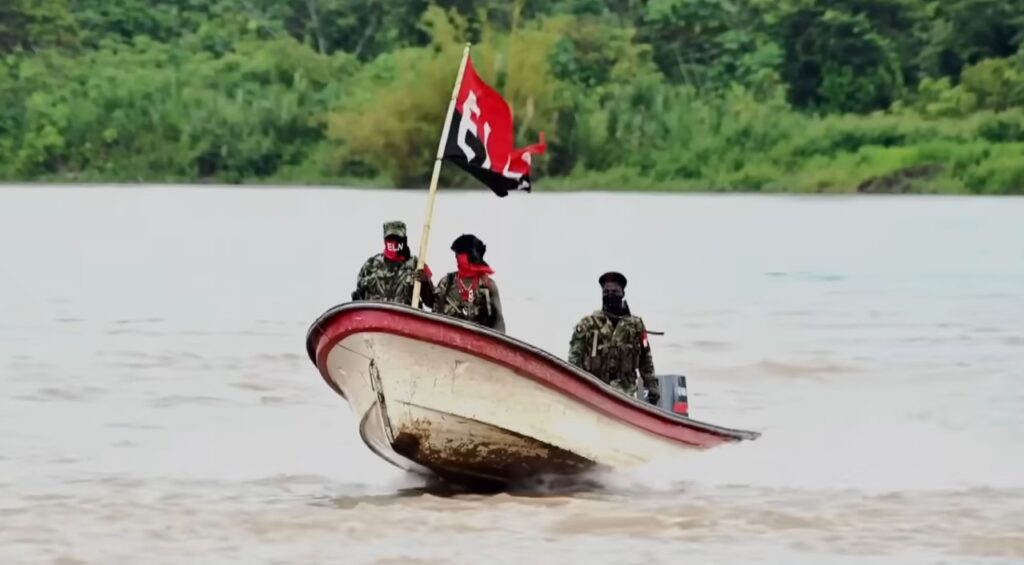
The ELN, Colombia’s oldest rebel group, has been trying to source weapons from Syria. Photo: Youtube screenshot.
A plan to swap Colombian cocaine for guns was exposed last week when a Lebanese-Syrian smuggler Antoine Kassis – a cousin of deposed Syrian dictator Bashir al-Assad – faced trial for his attempt to send Russian-made armaments to ELN guerrillas.
The failed plot, which played out in a U.S. federal courtroom last week but seemed more suited to a Hollywood movie, risked putting military-grade weapons sourced from Syrian arsenals in the hands of the Colombian rebels.
In exchange, the ELN planned to send 500 kilos of cocaine disguised in a cargo container of Colombian fruit, according to U.S. Justice Department documents.
A federal jury convicted Antoine Kassis on charges of narco-terrorism conspiracy and conspiracy to provide material support to a designated foreign terrorist organization after a five day hearing. He now faces at least 20 years in a U.S. prison.
Kassis, 59, who had links to proscribed organizations such as Hamas and Hezbollah, offered the ELN drones, grenades, assault rifles, missiles, mortars and heavy machine guns in exchange for the cocaine smuggled to a Syrian port.
He eventually hoped to sell the Colombian-supplied narcotics throughout the Middle East.
Captured in Kenya
The deal was initially brokered in 2024 before the fall of al-Assad but unraveled after a sting operation mounted by the U.S. Drug Enforcement Administration (DEA) in 2025.
As court documents revealed, Kassis traveled to Africa in February last year after reassuring the Colombian guerrillas that the cocaine swap was still on – even after the unexpected fall of his cousin’s brutal dictatorship in Syria at the end of 2024.
Kassis claimed he could bribe Syrian port staff US$10,000 per kilo of cocaine to import the illicit drug through Latakia, a well-known route for drugs in and out of the eastern Mediterranean.
Despite the fall of al-Assad, he could still access “all the toys”, he told the Colombians, referring to the military-grade weapons.
Unknown to Kassis, DEA investigators had already infiltrated the Colombian end of the deal and sent an undercover agent posing as an ELN weapons expert to the crucial meeting in Nairobi, Kenya.
Kassis was arrested with the help of Kenyan police and extradited weeks later to the U.S.
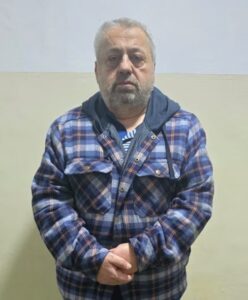
Meanwhile the suspected ELN counterparts, named by news website Infobae as Alirio Rafael Quintero and Wisam Kherfan Okde, were arrested in Colombia. They are currently detained in Bogotá’s La Picota prison pending extradition requests from the U.S.
Missed missiles
Evidence from the Kassis investigation pointed to a vast money-laundering operation based in Colombia that shifted million-dollar drug profits in cryptocurrencies across four continents. According to court documents, the plot roped in Palestine’s Hamas, Lebanon’s Hezbollah and Mexico’s Sinaloa drug cartel.
Syrian-Lebanese smuggler Antoine Kassis. Photo: Kenya Police.
The Kassis case also showed that the ELN was attempting to upgrade its weapons arsenal even as the armed group was engaged in on-off peace negotiations with Colombia’s Petro government. Talks are currently on hold.
The Marxist rebel group, properly known as the Ejército de Liberación Nacional, has been fighting the Colombian state since 1964 and is currently said to have 3,600 armed combatants, many based in neighboring Venezuela where it controls drug routes and illegal mining camps.
The latest round of peace talks, under Petro’s controversial Paz Total initiative, has seen the ELN expand in both territory and numbers within Colombia, with an estimated growth of 9 per cent in the last two years. Attempts to obtain Russian-made weapons via Syria are likely linked to that expansion.
Of note was the missiles included in the thwarted Syrian cargo. Though exact details were not given in the court documents, these could refer the portable shoulder-fired anti-aircraft weapons, highly coveted by Colombia’s armed groups for their ability to down helicopters and small attack aircraft used by state forces against insurgent groups.
In recent months Colombian armed forces have returned to aerial bombing of suspected guerrilla camps, a controversial practice that risks killing or injuring civilians and children. Bombing campaigns against dissident FARC groups in Guaviare late last year left at least 15 minors dead, according to news reports from the time.
And on February 4 this year, an air attack ordered by President Petro on an ELN camp in the Catutumbo region left seven ELN fighters dead, with no reports of child victims.
The ELN have in the past experimented with home-made anti-aircraft missiles, such as found in a hidden cache in Cauca in 2018, and some of their combatants are thought to have been trained in the use of Russian-made Igla-S missiles, of which 5,000 are used by state forces in Venezuela.
Hezbollah’s Latin American hubs
The Kassis case highlighted links between Colombian armed groups and the Middle East that include designated terror groups such as Lebanon-based Hezbollah.
According to expert testimony at a U.S. senate caucus on narcotics in October last year, groups like Hezbollah received funds via drug trafficking and money laundering in Latin America, with hubs in Brazil, Paraguay, Venezuela and Colombia.
“Hezbollah capitalized on a combination of weak local governance, corruption, and the presence of sympathetic diaspora communities to create cells and recruit financial facilitators,” former treasury official Marshall Billingslea told the caucus in October last year.
Billingslea suggested that Hezbollah could source up to a third of its income from Latin America, and until recently had close links through its Iranian backers Venezuela, now in flux with the forced removal of former president Nicolás Maduro to the U.S. in January this year.
Hard pivot to Colombia
But while its Venezuelan ties were more often reported, the Lebanese Shi’ite group had also made inroads into Colombian crime circles with a long history of deals, such as cocaine shipments sent by the Oficina de Envigado cartel, and drugs-for-weapons swaps with the former FARC guerrillas, he said.
In 2016, U.S. prosecutors brought charges against a Hezbollah laundering ring based in Medellín, according to reports in the Miami Herald at the time. Funds were connected to jailed Mexican kingpin Joaquín “El Chapo” Guzmán.
Billingslea explained that groups like Hezbollah also saw Colombia as a refuge for foreign operatives who obtained fake passports and ID cards. Recent turmoil in the Middle East could stimulate armed groups there to increase their interests in countries like Colombia, he said.
“Now, with their Lebanese infrastructure in shambles, and with robust financing from Iran again in doubt, I believe Hezbollah will make a hard pivot to Latin America and to the drug trade in particular.”
La Mesa gang rounded up in Bogotá last week. Members are accused of murders and drug trafficking. Photo: Secretary of Security
The dismantling of a major crime gang which operated in Bogotá caused controversy last week after it emerged its leader was declared a peace negotiator under President Petro’s controversial Paz Total, or Total Peace, plan.
National police rounded up 23 members of the La Mesa gang in simultaneous operations in Tolima, Cesar and Bogotá. According to police reports, the gang was involved in serious crimes across the capital since 2012, including drug trafficking and murders.
News of the arrests was tainted by the fact that under the Paz Total process – the Petro government’s wide-ranging negotiations with armed groups – gang leader Gustavo Adolfo Pérez Peña, alias El Montañero, had his arrest warrant suspended under his role as gestor de paz, or ‘peace facilitator’.
The kingpin’s release sparked a furious response from Bogotá mayor Carlos Galán, who accused Petro of undermining the city’s efforts to curb crime.
Hoy en Bogotá anunciamos que, gracias a la Dijín, a la Fiscalía y a la @PoliciaBogota, fueron capturados 23 miembros de la banda “El Mesa”, entre ellos 8 sicarios. Mientras tanto, el Gobierno Nacional nombra al cabecilla de esa banda como gestor de paz y le levantó la orden de… pic.twitter.com/qiSmSoHgh7
“While in Bogotá,…the prosecutor’s office and the police, with the support of the Bogotá mayor’s office, are working to capture and dismantle a criminal gang dedicated to serious crimes, the national government appoints the leader of that gang as a peace facilitator and lifts the arrest warrant for him,” he railed.
The gang was also suspected of being behind last year’s gruesome killings where pieces of the bodies of victims were wrapped in plastic bags and dumped on the city’s highways.
A free pass for career criminals like Pérez Peña makes fighting crime “incredibly difficult,” added Galán.
Dodging a warrant
Alias El Montañero during his capture in 2019.
Details of La Mesa’s criminal activities released by the prosecutor’s office this week showed the gang originated in Bello, Antioquia, but spread to Bogotá in 2012.
Court documents reported in local news outlet El Colombiano paint Pérez Peña as a hardened criminal; he has been imprisoned four times, including for armed robbery, homicide and illegal possession of firearms, but was freed before serving his full sentences.
His rap sheet includes attacks on armored trucks, notably a cash heist in Bogotá in 2003 where a policeman was shot dead.
Pérez Peña’s most recent jailing was in 2019 when he was sentenced to eight years for conspiracy to commit a crime and illegal possession of firearms. It was during this stint that he was freed as a peace facilitator.
And even while the La Mesa gang has been rounded up this week with members facing multiple charges and long prison sentences, its leader and founder continues at liberty.
Get out of jail free?
Inclusion of criminal gangs in the Paz Total process has proved one of the thorniest aspects of Petro’s flagship policies and a political hot potato in the run-up to next month’s presidential elections.
Since its inception in 2022, the government’s peace negotiators have tried to include some of Colombia’s most embedded crime dynasties under the acronym Estructuras Armadas Organizadas del Crimen de Alto Impacto (EAOCAI).
This Paz Urbana, or urban peace, initiative is based on the reality that in Colombia today lines are blurred between organized armed groups and engrained criminal structures. Much of its effort has focused on Antioquia’s Valle de Aburrá, around Medellín, where many crime gangs took root after the fragmentation of the 1980s cocaine cartels.
The president’s office recently declared the process a partial success, claiming that the nominated peace spokespersons – many feared capos with violent histories – were now in a dialogue process which could “prevent further violence and prevent the resurgence of these structures”.
Many critics have predicted that – similar to the Paz Total process with large guerrilla groups – criminal gangs will leverage the negotiations to their own interests to gain time and territory or a get-out-of-jail-free card.
This week Medellín’s mayor Fico Gutíerez welcomed a resolution by the attorney general’s office to overturn many of the 23 nominations of local crime bosses as peace facilitators.
“The resolution removes 16 criminals currently serving sentences for serious crimes from the program. Seven remain eligible for the benefit,” he posted on X.
He also echoed Galán’s complaint that hardened criminals were being included in the peace process. “It is unacceptable that the Petro government has asked the prosecutor’s office to lift the current arrest warrant for homicide.”
Peace as a right
Defenders of Petro’s agenda hit back reminding that Paz Urbana was part of a constitutional process protected by Colombian law.
“Peace is a right, not a political strategy,” said Isabel Zuleta, a senator and key player in the Paz Total process.
The senator, who represents the government at the negotiating table with representatives of criminal gangs, accused the media and politicians of misreporting the negotiations.
“For nearly three years, a serious path toward de-escalating urban violence in Medellín and the Aburrá Valley has been painstakingly forged. Today, that work is being exploited by right-wing sectors that prefer to sabotage urban peace rather than acknowledge progress that is not electorally advantageous to them,” she said.
Zuleta also pointed out suspension of arrest warrants for gang leaders seeking peace did not free them of responsibilities for crimes they committed, nor would it stop judicial investigations.
Meanwhile, a mix-up between Petro’s government and Attorney General’s Office emerged over Antioquia’s urban peace process: 16 of the 23 capos named as peace negotiators were already in prison, so suspending their “arrest warrants” was nonsensical as they were already detained in the high-security Itagüí Prison.
“We truly never imagined that a request would be made to suspend arrest warrants for people already serving sentences,” chief prosecutor Luz Adriana Camargo told Caracol Radio.
Senator Isabel Zuleta with crime bosses in Itagüí Prison. Photo: Paz Urbana
Prison party
For this judicial – rather than political – reason, Camargo revoked the suspension orders for the 16 capos already doing time.
“We are talking about dialogues inside a prison with convicted individuals,” she said.
The Attorney General’s office also corrected widespread fake news – amplified by right-wing presidential candidates Paloma Valencia and Abelardo de la Espriella – that the 16 jailed crime chiefs would be freed as part of the Paz Urbana negotiations.
In fact, there were no plans to release the IItagüí peace facilitators, clarified Camargo’s office.
But in a further twist this week the government froze the peace talks in the Itagüí Prison after revelations that the jailed capos mounted an unauthorized vallenato concert by popular singer Nelson Velásquez, reportedly costing 500 million pesos (US$140,000).
For many commentators, the partying in the prison brought back painful memories of drug baron Pablo Escobar’s luxury lifestyle while supposedly imprisoned by the state in the 1990s.
Meanwhile the chief prosecutor Camargo came under fire for her decision to suspend warrants for seven other gang leaders currently on the run – including that of Pérez Peña of La Mesa.
This week the exact whereabouts of Pérez Peña was unknown, as was his willingness to engage in any peace process. According to a report by TV station Teleantioquia, the La Mesa gang leader was based in Madrid, Spain, while “moving around Europe as a sophisticated tourist”.
For El Montañero, coming home to Colombia, even under the guise of a peace facilitator, could be less of a holiday.
Euthanasia planned for the numerous offspring of “cocaine hippos” originally smuggled in by Pablo Escobar.Not everyone is happy.
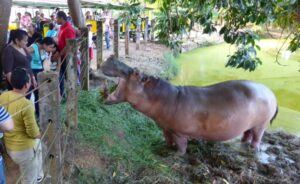
A hippo in Hacienda Nápoles, the ranch where Pablo Escobar first introduced them. Photo: S. Hide.
After years of debate over the fate of Colombia’s wild hippos – during which the feral beasts have multiplied in lush tropical rivers – the ministry of the environment has announced a plan to kill at least 80 of the African imports.
The non-native species was smuggled into Colombia by drug baron Pablo Escobar in 1980 as part of his collection of exotic animals – including rhinos and lions – which he kept at his ranch, Hacienda Napoles.
The infamous drug trafficker died in a rooftop battle in Medellín in1993, but a few hippos escaped his lowland ranch to find what biologists would later describe as “perfect conditions” in the nearby Magdalena River.
In the decades since around 200 offspring have spread over 100 kilometers (60 miles) of river and swamps bordering departments of Antioquia, Bolívar, Santander and Sucre.
But after years of procrastination over what to do with the wayward Hippopotamus amphibius – with various schemes to sterilize them or ship them to zoos and sanctuaries around the world – Colombia’s environment minister Irene Vélez said this week a cull was the only option.
“We’re talking of a process of euthanasia, which is the technical recommendation,” she told Blu Radio.
The plan was initially to reduce the population by 80 breeding individuals, then cull around 30 beasts per year which would systematically reduce the population.
The hippo range in Colombia, covering 100 kilometers of the Magdalena River Valley.
Hippo boom
The controversial decision is based on a 170-page technical report by the Humboldt Institute and Universidad Nacional in 2022.
The report concluded that the hippos were damaging the tropical ecosystem of the Magdalena river valley by spreading disease and overloading their watery habitat with nitrates: the amphibious herbivores grazed the riverbanks to each munch 50 kilos of grass a day – but then pooped the waste out into rivers and lakes.
Without an urgent cull the population “could increase to 500 hippopotamuses affecting our ecosystem by 2030,” Vélez told a press conference this week. This boom would further put at risk native populations of turtles and manatees.
Then there what the report referred to as “hippo – human interactions”, such as a car hitting a two-ton creatures on the main Bogotá – Medellín highway – which runs close to their main hangout near Puerto Triunfo – and even cases of locals trying to keep young ones as pets.
The report also pointed out that hippos were aggressive and territorial and officially the deadliest large mammal – they kill on average 500 people in Africa every year – and attacked boats and canoes on the river aswell as people, cattle and horses around the River Magdalena.
In other videos posted online people are seen chasing them down the highstreet in the town of Doradal.
Hippo takeover
To justify the cull, Vélez said reduction methods such as sterilization were too difficult – anaesthetizing wild hippos is no easy task – and none of the seven nations initially interesting in receiving live hippos for zoos and wildlife parks had followed through.
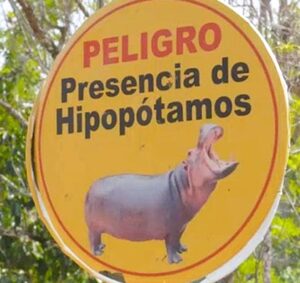
Watch out for hippos. Sign in Puerto Triunfo.
The cull would start in the second half of the 2026 around hippo hotspots close to Hacienda Nápoles in Puerto Triunfo and Isla del Silencio, a river island near to Puerto Boyacá, she said.
This island is home to a large group one of which attacked and severely injured a farmer collecting water from the riverbank in 2020, according to a news report. Colombia’s wet lowlands had perfect conditions for hippos, biologist Katerine Corrales told a Caracol news crew visiting the island this week.
“Africa has droughts and adverse weather patterns. Here we have a constant climate with abundant water and resources which generates a faster reproduction rate,” she said.
In the same report local villagers complained that the hippos had “taken over the island” and restricted commercial fishing.
Poor Pepe
Not everyone welcomed news of the cull. Hippo protection group Comisión Protectora de la Vida de los Hipopótamos – founded in the town of Puerto Triunfo close to Hacienda Nápoles and which benefits from hippo tourism – rejected the “terrible decision of the national government to authorize a hippo hunt”.
“In our municipality, we are committed to the protection and conservation of these incredible living beings. Hippos are an important part of our identity, and we must live in harmony with them,” said the group on its Facebook page this week.
It called a meeting in Bogotá to seek “non-violent” alternatives to the cull, such as a return to the plan of transferring live hippos to other countries.
Previous attempts to shoot hippos have ended in public relations disasters, such as the killing of Pepe in 2009. The large male hippo was slated for transfer to a zoo in Costa Rica after rampaging around Puerto Berrio.
But he was shot after a bungled attempt to capture him, and photos of an army platoon posing with his remains caused public revulsion, and a court ban on hunting hippos.
Pepe also highlighted the affection local communities had for “Pablo’s hippos”. For some folk the state persecution of the mammals was synonymous with the hunt for Pablo Escobar, still a popular figure among communities that benefitted from his largesse in the 1980s.
In fact, in the drug baron’s heyday the original hippos were kept at his Hacienda Nápoles in a public zoo and safari park where local families could tour for free. Today the hacienda and zoo is still there but managed by the state as part of a huge amusement park.
A captive hippo in Colombia. Escapees have multiplied in the wild. Photo: S Hide.
A grave in Colombia
This week, Minister Vélez was adamant that culling must form part of any population control.
It was global restrictions on wildlife trafficking – the CITES agreements – that had condemned the hippos in Colombia by preventing them being easily shipped abroad, she explained.
“It’s not enough for a zoo to raise its hand; the country must authorize their entry. Unfortunately, no country has given the green light. This administrative silence indicates that there is no interest in receiving them”.
It seems that putting Pablo’s hippos in overseas zoos is proving as difficult as extraditing the cartel kingpin himself. Like their progenitor, the big beasts face a violent end in Colombia rather than a cage in a foreign land.
Residency ‘R’ visas issued before 21 October 2022 need to be transferred to 5-year electronic format by October 31, 2026, Failure to comply could risk losing residency status.
Colombia’s cancilleria (foreign affairs ministry) was reminding foreign residents this week of the 2026 deadline to transfer their old resident visas to the new 5-year electronic visa scheme.
“Anyone with these visas, granted under previous regulations, must complete the mandatory process before October 31, 2026, before the Visa Authority,” announced the government, referring to resident ‘R’ visas issued before October, 2022, when new visa regulations came into effect.
Failure to transfer your visa by October 31 could lead to sanctions or even losing your residency status.
And even though the October deadline seems far away, the Cancilleria are expecting a flood of last-minute applications. Our advice is: don’t leave it to the last minute. Government websites are clunky at the best of times and you will need at least one appointment with Migración, which will be harder to get as the deadline approaches.
To avoid last-minute panic, here’s a quick Q and A to get ahead of the game…
I have a permanent ‘R’ residents visa in my passport. Surely that’s OK?
No. Under new laws passed in 2022 (law 5477 to be precise), all R visas for long-term residents are now subject to a transfer every five years, which also coincides with the lifespan of the Cedula Extranjeria (Colombian-issued ID card). So even if the visa stamp in your passport says indefinida, you still need to do the transfer.
The traspaso applies to:
All Resident (R) visas issued before October 21, 2022.
Any new R e-visas after five years (the expiry date is written on the visa).
If you change passports for any reason (expired, lost or stolen).
If you have a passport about to expire it makes sense to renew the passport before the visa transfer.
So, do I have to start the whole visa application process again?
No. The traspaso is relatively simple and can be done mostly online, directly with the Cancilleria website. Although touted as a ‘transfer’, in most cases you will be issued with a new visa number in an electronic format that will be sent to you by email. You can then print your own e-visa and carry it with your passport and store it in your phone.
Other steps require visiting your nearest Migración office.
What are the steps?
Obtain your Migration Movement Certificate from the nearest Migration Office.
Apply online for visa traspaso. Wait for the e-visa to be issued.
Register your new e-visa and apply for a new Cedula Extranjeria ID card online.
Make an appointment with Migration Office for your biometric data.
Collect your new Cedula Extranjeria ID card.
How much does it cost?
Around US$ 213 in total at current exchange rates. This breaks down to: US$25 for the Migration Movement Certificate, US$54 for the visa study, US$54 for the visa issuance, US$80 for a new replacement ID card (Cedula de Extranjeria).
What’s the Migration Movement Certificate?
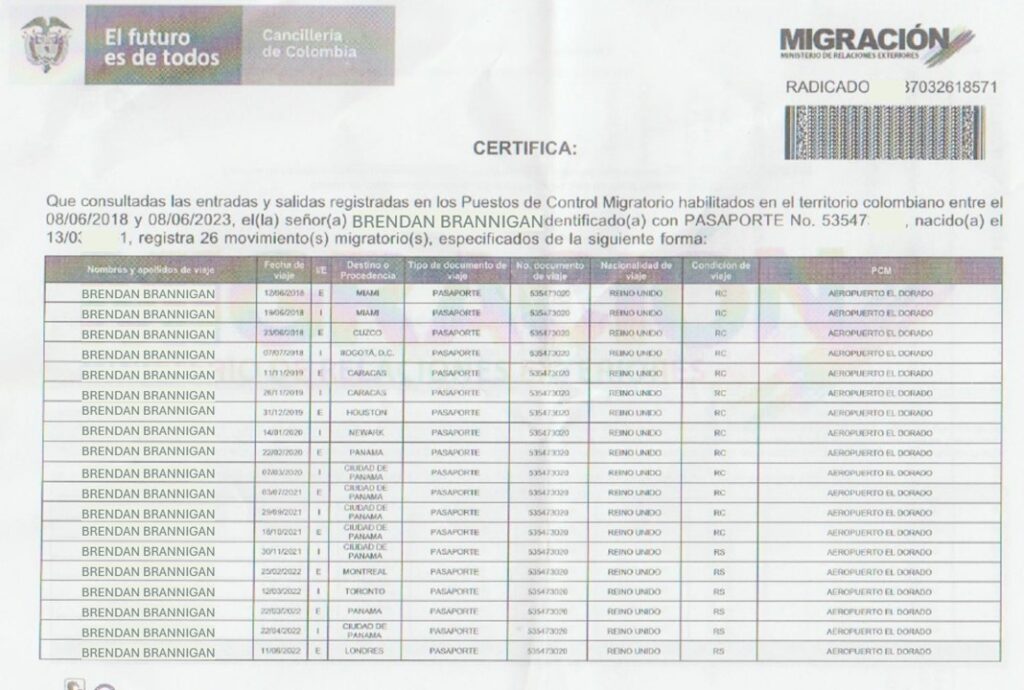
Before applying for the traspaso, you need to obtain Certificado de Movimientos Migratorios, which is a printed certificate issued by Migración showing your entrances and exits from Colombia. The purpose of the certificate is to show your presence in Colombia. If you have been absent from the country for more than two years your residency status is automatically cancelled. You can apply and pay for the certificate online at the Migración website Formulario Único de Trámites page.
Be careful to select the centro facilitador (Migration office) that is closest to you because you must collect the printed certificate in person from the office. Also select the 10-year option for the certificate’s timeframe.
Not usually. One you have applied online, Migración will send you an email within three days notifying that your certificate is ready. You can go to the office and skip the lines by showing the email to the door staff. The counter staff will then print off the certificate. There is usually no need to make an appointment.
Can I get the certificate from overseas?
At present, Migración is only giving the option to collect the certificate in person in Colombia. This is one way to ensure that the visa holder is resident in Colombia. The option to collect in an overseas – i.e. at Colombian consulates – could change in the future.
Example of the printed Certificado de Movimientos Migratorios.
OK, so what about the visa transfer?
Now you need to the visa website at www.cancilleria.gov.co, and navigate to the visa page called the SITAC. Note there are English and Spanish pages (the Spanish version sometimes works better).
Fill in your details to enter the system, then select ‘Visa traspaso’ from the dropdown menus. You will also be asked to click on the timeframe when your original ‘R’ visa was issued. You will then be told what documents to present; these can be uploaded in PDF.
The visa application page on the Cancelleria website. Choose ‘traspaso’ from the options.
What documents are required?
This varies depending on your type of Resident visa and when it was issued, but generally:
Scan of your original R visa.
Scan of your passport main page.
Scan of your current Cedula Extranjeria.
Scan of your most recent migration entry stamp to Colombia.
Scan of your Migratory Movements Certificate issued by Migración.
Letter requesting the transfer, explaining the reason for the request (i.e. ‘para cumplir con Ley 5477 de 2022’).
Passport-style digital photo meeting the specifications.
Holders of permanent resident visas do not need to provide any more information. Other types of R visas might require evidence that the conditions under which the visa was granted still applies.
How do I pay?
The fees are divided into a US$54 ‘study’ fee, which is paid on submission of the documents. When the visa transfer is approved you pay an additional ‘visa issuance fee’ of US$54. Payment is also online by Colombian PSE bank transfer scheme, or you can use Visa or Mastercard credit cards.
Is that the traspaso done?
No. Once your e-visa is sent to you be email, you need to register your visa and apply for a new Cedula Extranjeria ID card within 15 days of receiving the new e-visa. The initial application and payment is done online, using the Formulario Único de Trámites page. Tick the Cedula Extranjeria box and select your nearest Migración office from the drop-down menu.
You’ll need to provide more information, scans, and an US$80 payment.
Back to the FUT page, but this time for the Cedula and visa registration.
Surely that’s the end of it?
Nope. Now you need to make an appointment with the same Migración office to provide biometric data for your new CE. To make an appointment, first register with the website here. Slots for the following week are allocated often at 5pm on Sunday, so try at this time.
If there are no slots available, take a screenshot of the appointment page as you can later use this as evidence to prove you were trying to comply with the 15-day plan (Migración sometimes sanction visa holders for not registering on time).
If you do not get an appointment within 15 days don’t worry; with your screenshots of the full agendas, Migracion are unlikely to complain. Everyone knows the system is overloaded.
What about my Cedula de Extranjeria?
Another delay: some people wait months for the plastic card, though lately the wait has been getting shorter. You can use your old CE or your passport in the meantime.
Should I hire a commercial visa company to do the paperwork?
The Cancilleria recommends applicants to apply directly for the traspaso directly via the website. However, commercial visa companies can assist with the paperwork but will charge a fee up to several hundred dollars. Try the process yourself before seeking professional help.
Segunda Marquetalia ordered the attack last year according to trial testimony.
Segunda Marquetalia announce their formation in 2019, from the jungles of Guainia, Colombia. Video Capture.
Revelations that former FARC leaders ordered the 2025 killing of Miguel Uribe have heightened political tensions in the run-up to the May presidential elections.
The 39-year-old Colombian senator and presidential hopeful was gunned down by a Bogotá gang hired by the Segunda Marquetalia, an armed group created by disgruntled guerrillas hiding in Venezuela, according to testimony revealed in court.
The senator was shot down by a 15-year-old assassin at an open-air political rally in the barrio of Modelia in June, 2025. Uribe died of head wounds two months later.
After months of investigations and multiple arrests, state prosecutors were last week finally able to link the local gang that carried out the hit with the armed group.
The breakthrough came during the trial of Bogotá-based gang leader Simeón Pérez Marroquín, also known as ‘El Viejo’, who admitted he had hired the local Plata o Plomo (‘Silver or Lead’) gang to carry out the killing on behalf of the Segunda Marquetalia armed group.
“The deal was that they would pay one billion pesos [US$270,000] for the senator’s death,” said Marroquín in a statement reported by magazine Semana.
Right hand man
Confirmation of involvement by an armed group founded by former FARC leaders sparked a political spat between front-runners for the upcoming presidential election.
Right-wing candidate Paloma Valencia was quick to accuse the Petro government of negotiating peace with the Segunda Marquetalia – even while the armed group was plotting the murder of Uribe.
Valencia referred to Marroquín’s statements that the hit was organized by veteran guerrilla Zarco Aldinever, the right-hand man of the group leader Iván Márquez, in early 2025.
At this time Aldinever was nominated a ‘peace manager’ by the Petro government, meaning any arrest warrants were suspended and the rebel was free to roam. This despite the collapse of peace talks with the Segunda Marquetalia at the end of 2024.
Valencia further pointed to the closeness between her main election rival Iván Cepeda and leaders of the armed group.
Old photo
Iván Cepeda with Iván Marquez.
“The killer of Miguel Uribe is photographed hugging Iván Cepeda,” she wrote on X, attaching a photo of her rival with Segunda Marquetalia founder Iván Márquez.
In fact, the photo of Cepeda dated from the 2016 FARC peace talks, explained President Petro in a strongly worded statement defending his friend and political ally.
“The photo shows Iván Cepeda’s attempt to help [the Santos government] achieve peace. At that time, the entire FARC was ready for peace,” said.
Iván Márquez was number two in the FARC at the time and widely respected for his role in the negotiations.
Petro went on to blame his predecessor, right-wing president Iván Duque, for undermining the FARC peace process that forced former guerrilla leaders like Márquez back to arms and the Segunda Marquetalia.
Following the 2016 deal, some former FARC leaders had been “entrapped by state prosecutors with fake drug charges”, he said, leading to extradition requests from the United States.
Faced with this legal pressure several top commanders, including Iván Márquez and Jesus Santrich, fled to Venezuela in 2018 before emerging on video a year later to announce their new incarnation as the Segunda Marquetalia, named after the village in the Tolima department where the original FARC first formed in 1964.
The armed group was active in drug trafficking and illegal mining along the Colombia-Venezuela border, in the departments such as Vichada and Guainía, according to a profile by InsightCrime. The leadership is suspected of hiding out in Venezuela.
Another study by Fundacion Ideas para La Paz estimated the group to have 530 armed combatants in 2025, an increase of 15% on 2024, and work mostly in the eastern plains of Colombia.
A hunt is on
In a press conference on Tuesday, Valencia accused Cepeda and other left-wing lawmakers of backing the former FARC commanders in their legal battles back in 2018, creating a chain of events leading to the creation of recycled armed group.
“Congressmen like Cepeda defended [Marquéz and Santrich] …and didn’t allow them to be extradited. If these thugs had been extradited, Miguel Uribe would be alive today,” she said.
In his own press statement Cepeda called Valencia’s comments “a dirty political game” and issued a challenge to the candidate, and her political mentor right-wing former president Álvaro Uribe, to back up the accusations in court.
“It’s infamy to accuse me or President Petro to have any type of involvement in such a deplorable deed as the assassination of senator and presidential pre-candidate Miguel Uribe,” he said.
Meanwhile this week the Colombian attorney general’s office launched a fresh hunt for the leaders of the Segunda Marquetalia, offering around million-dollar rewards for the capture of seven commanders including Iván Márquez and Zarco Aldinever.
In fact, Aldinever was reported killed by rival armed group ELN in Venezuela during a squabble over a cocaine shipment in August last year – the same month that Miguel Uribe died – according to Colombian state forces at the time.
This week Colombia’s Minister of Defense Pedro Sanchez walked back that claim saying no body had ever been found and that the initial report of Aldinever’s death – sent from the Segunda Marquetalia itself – could be disinformation.
“At this time, the position is clear: without a body there is no confirmation of death, and that is why all institutional resources remain active to locate him,” said Sanchez.
Underworld connections
Closer to home, the Segunda Marquetalia’s influence in Bogotá was under scrutiny after Simeón Marroquín’s testimony shed light on the murky connections with the city’s underworld.
Marroquín admitted that in previous decades he had acted as an urban operative for the FARC guerrillas, a hired gun ready to carry out orders in the city.
“I never wore camouflage, but while I was here in Bogotá, I was a miliciano. Guerrilla missions would come up, and I’d carry them out, but I was never in the ranks.”
His contacts with the FARC continued to the Segunda Marquetalia that tapped him for the Uribe killing.
Early in 2025, Marroquín was invited to a secret meeting in Cúcuta close to the Venezuelan border where, according to his testimony, Aldinever offered him one billion pesos for the crime (US$270,000) and another 600 million pesos (US$160,000) to “bribe the justice system” to deflect attention from the guerrilla group.
The motive for the killing was not clearly revealed by Marroquín, though a text message later found on his phone sent to his guerrilla paymasters talked of an “eye for an eye”, suggesting the former rebels were out for revenge.
The Uribe case uncovered links between the Segunda Marquetalia guerrillas and urban criminals.
Chilling revelation
Uribe was selected as an influential senator, scion of a right-wing political family, and popular candidate for this year’s presidential elections. He was also an easy target for assassins with his regular visits to communities where he had walkabouts to engage with local voters.
In the first few months of 2025, Marroquín worked his underworld connections to hire the Plata o Plomo gang which in turn lured the 15-year-old gunman who shot and wounded Miguel Uribe in a small park in the barrio of Modelia on June 7.
Marroquín’s account paints a picture of a loose network of petty criminals lured by cash rather than political interests, ignorant of the details of both their intended target and the paymasters behind the plot.
The middleman saw the hit as a “good business opportunity” but also a chance to rekindle his role as urban operative for a guerrilla organization.
Marroquín’s plan unraveled after the 15-year-old gunman and various low-level gang members were detained in the hours and days following the June attack, creating a trail leading to his own capture in October.
“What’s done is done”
One chilling revelation was the order from above for Marroquín to kill low-level gang members to cut links to the guerrilla masterminds. This included murdering alias Gabriela, who transported the weapon and was present on the day of the shooting.
Marroquín refused to kill Gabriela, telling investigators “I didn’t have the heart for that because she was very young.” But he did send her by bus to the city of Florencia where the guerrillas were lying in wait.
#ATENCIÓN | "No hay palabras que justifiquen dicho acto, pero pues ya está hecho (…)", fueron las palabras con las que Simeón Pérez Marroquín, alias ‘El Viejo’, pidió perdón a la familia del senador y precandidato presidencial Miguel Uribe Turbay, tras reconocer que fue el… pic.twitter.com/btgnOsTEF7
The 19-year-old never made it; police investigators, already on Gabriela’s trail, organized for the bus to “break down” some miles before Florencia. Her arrest there and subsequent interrogation lead to Marroquín’s capture and eventual exposing of the links to the Segunda Marquetalia.
Last week, during the court process, Simeón Marroquín attempted to apologize for his role in the killing of Miguel Uribe.
“There are no words to justify my actions, but what’s done is done,” he said on camera from his cell, addressing his victim’s family – Uribe was married with four children – and asking forgiveness. He was then sentenced to 22 years in prison.
How quickly Colombian investigators can find Zarco Aldinever or other Segunda Marquetalia commanders, dead or alive, or hiding in Venezuela, remains to be seen.
Medellín, Colombia – During each of the last nine years around 100 human rights defenders have been assassinated in Colombia, according to a United Nations (UN) report published this Thursday.
The 972 deaths recorded between 2016 and 2025 make Colombia “one of the most dangerous countries in the world” for such activists, according to the UN’s High Commissioner for Human Rights, Volker Türk.
Following the historic peace accords between the government and the Revolutionary Armed Forces of Colombia (FARC) in 2016, the report noted a gradual increase in assassinations.
This was linked to the state’s inability to maintain a strong presence in areas previously controlled by the guerrilla group.
Over 70% of identified perpetrators were armed non-state actors, with the majority of cases analyzed by the report involved in drug trafficking, illegal mining, illegal logging, and human trafficking.
The number of attacks and threats against human rights defenders investigated by the UN between 2022 and 2025 was 2,018, however this is thought to represent “only a fraction” of the true number due to underreporting and the lack of efficient government records of such cases.
The report recognized the work of the current Historic Pact (Pacto Histórico) government of Gustavo Petro, which has publicly recognized the gravity of the situation and worked to develop a national strategy to counter it.
This included the 2022 law that established peace as a matter of state policy, recognizing the state’s responsibility to “guarantee human security” through a “territorial and intersectional approach”.
However, the UN says the state’s response has failed human rights defenders due to its fragmented nature that lacks coordination between national, departmental, and municipal authorities.
“In addition to ensuring accountability for the murders that have taken place, addressing the structural causes of this human tragedy through a comprehensive approach must be a priority for all relevant authorities in Colombia, in order to protect human rights defenders and enable them to carry out their vital work safely,” Türk said.
High levels of impunity have also persisted, with only 55 out of the 800 cases investigated between 2022 and 2025 ending in sentencing. In over half of these cases, no suspects have been identified.
Nearly a quarter of victims identified by the UN were Indigenous (23%) highlighting a disproportionate effect on this population that represents less than 5% of Colombians.
Other disproportionately affected groups include Afro-Colombians, LGBTQ+ individuals, rural community leaders and environmental protectors, as well as political leaders.
The report concluded by urging the Colombian state to take action to combat this issue, recommending institutional reforms and criminal investigations into perpetrators.
Gang members captured for the killing of Miguel Uribe.
Nine months after the shooting of presidential candidate Miguel Uribe Turbay in a leafy Bogotá park, the gang behind the killing have been rounded up and are facing justice.
The masterminds, though, are still at large. Circumstantial evidence points to a political assassination called in by an ex-FARC faction called the Segunda Marquetalia. But other theories exist.
And as the country prepares for the next rounds of elections, the youthful Uribe – seen by many as a presidential hopeful – is conspicuous by his absence.
We look back at killing that rocked Bogotá in 2025, and who might be behind it.
How did the shooting unfold?
Uribe was gunned down in Parque El Golfito, a green space in bustling Modelia on the western edge of Bogotá, on June 7, during a walkabout in the barrio where he met local business owners and climbed on a beer crate to deliver an impromptu address to a small crowd.
The senator was shot at close range twice in the head by a 15-year-old gunman wielding a Glock pistol in the crowd, who then fled but was himself shot in the leg by Uribe’s protection squad and captured in a nearby street.
Uribe was hospitalized and underwent several emergency surgeries before dying from his wounds on August 11, more than two months later.
Who was Miguel Uribe?
The 39-year-old senator was nationally recognized and scion of a political family. His grandfather Julio César Turbay was president from 1978 to 1982, and his mother the journalist Diana Turbay kidnapped by the Medellín cartel in 1991 who died in a botched rescue attempt, a tragedy immortalized by Gabriel García Márquez in his non-fiction book News of a Kidnapping.
Even though he was raised as a legacy politician, and a key candidate for the right-wing Centro Democratico, Uribe nevertheless garnered support across the political spectrum for his hard work and attention to detail, more technocrat than populist, and potentially a unifying figure.
It was perhaps typical of Uribe that the day he was shot he in an unsung corner of the city meeting everyday folks.
Vigil for Miguel Uribe outside the Bogotá hospital where he later died. Photo: S Hide.
What was the impact of his assassination?
Many mourned the loss of the young senator, married with four children. In reality, Uribe’s death was just one of many in Colombia during 2025 with 187 social leaders and human rights defenders murdered nationwide, according to data from conflict thinktank Indepaz.
The senator’s killing had an outsized impact for several reasons. First, Bogotá, unusually for a megacity, has almost half the homicide rate than many smaller cities and some rural areas with long-running conflicts between gangs and armed groups.
Secondly, the many feared Uribe’s attack signaled a return to the 1980s when a wave of political killings – usually by extreme right-wing forces against left wing targets in cahoots with drug cartels – plagued Bogotá and many other Colombian cities.
But united condemnation of the attack quickly degenerated to finger-pointing between political factions with Uribe’s lawyer filing a complaint against President Gustavo Petro for alleged “harassment” of the senator.
Was Petro to blame?
An early theory floated by the late senator’s lawyer was that the attack was a “hate crime”, which in Colombia covers persecution for ideological views. The argument went that Petro crossed the line with his itchy Twitter finger: in their complaint the lawyer presented a 20-page document with 42 presidential tweets disparaging Uribe.
While acknowledging that Petro was in no way linked to the physical attack, he had created a “favorable environment” for anyone with a serious grudge to take out the senator, said the lawyers, though this didn’t explain why a 15-year-old – not a likely candidate for political grievances – was coerced to pull the trigger.
And by the end of June new evidence emerged from the shooter himself. The youth didn’t even know who his target was the senator, or indeed who was Miguel Uribe.
And other pieces of the puzzle fell into place, clarifying that the shooter was hired for cash by an organized criminal gang that had planned the killing in detail.
If it was so well planned, why did they get caught?
Good question. The contract killers calling themselves Plata o Plomo (‘Silver or Lead’) left a trail of evidence starting with the wounded gunman captured with minutes of the shooting.
Next to fall was Carlos Mora, alias ‘El Veneco’, who drove the young assassin, followed a few days later by 19-year-old Katherine Martínez, alias ‘Gabriela’, who delivered the pistol.
Gabriela’s arrest gave the first clues to a wider conspiracy: the webcammer was tracked down to the regional capital of Florencia, Caquetá, a jungle department of Colombia with high presence of armed groups.
CCTV footage from Modelia placed her inside the car with the gunman, and she later confessed to transporting the gun itself.With CCTV footage, and information from Gabriela and El Veneco, other key members of the gang were soon rounded up including two other getaway drivers and a middleman for hiring the 15-year-old.
Seems like a very amateur operation…
Plata o Plomo was a loose group of criminals drawn from the Bogotá underworld, and many had worked together before. The leader was Elder José Arteaga, alias Chipi, who in a rather unlikely twist also ran a hair salon in Engativá.
When not trimming beards, Chipi was immersed in crime with a history of extortion, violence and armed robbery, and was linked to the murder of a Mexican businessman in Medellín in 2024.
He was also quite ruthless: according to Gabriela, Chipi was planning to cover his tracks by killing both El Veneco and the 15-year-old hired assassin. Being captured early likely saved their lives.
Chipi himself became the subject of a national manhunt until his luck ran out on July 5. He was captured hiding in a house in Engativá by a special police unit a month after the shooting, just a few kilometers from where it took place.
Hairdresser and accused contract killer Elder José Arteaga, alias Chipi.
So, case closed?
Not so fast. Chipi was just one link in a longer chain. According to Gabriela, now a key witness, the hairdresser told her the murder contract was for 700 million pesos, around US$190,000.
This amount of cash pointed to a bigger player.
In Colombia there are plenty of candidates to choose from, and no shortage of pundits to point the finger.
Examples please?
Sure. Journalist and presidential hopeful Vicky Dávila accused Iván Mordisco, commander of the Estado Mayor Central – EMC – a dissident FARC faction fighting the state in the southwest of the country. She claimed to have insider information from military intelligence that also pointed to the likelihood of more assassinations of right-wing figures.
Her theory was backed by interior minister Armando Benedetti, who also saw reason for the EMC to stir up trouble in Bogotá as revenge for the war being waged against the group in Cauca.
However, no direct evidence was presented, and that the EMC denied any involvement, calling the allegations “a media strategy”.
Petro claimed involvement by the mysterious “Board”, a mythical super-cartel fused from drug gangs, guerrillas and paramilitaries. Petro portrayed himself as another potential victim: The Board was also plotting his own assassination, he said.
Wow. Anyone and everyone could have done it.
Exactly. Pick the political flavor of your favorite conspiracy. More fanciful pitches were that the extreme right had planned it themselves to stoke a coup against Petro – who would likely get the blame – and at the same time eliminate the popular Uribe from the candidate’s list.
Or that the extreme left wanted to take out an effective political opponent from the presidential race.
One problem for investigators was the complex networks between criminal gangs, drug cartels and guerrilla groups, partly worsened by Petro’s Total Peace plan which had split armed groups into smaller and more dangerous factions.
The Plata o Plomo gang was clearly working for financial gain. But despite capturing eight members by the end of August, the important detail of who paid them – and why – was yet to be revealed.
Maybe the gang was scared to reveal the backers?
Quite likely. In the dog-eat-dog world of Colombian crime, and where people in jail are regularly murdered, spilling the beans is not recommended. But one more key suspect was emerging: a mysterious character known as ‘El Viejo’.
His capture came at the end of October after months of police work. Clues emerged from messages from El Viejo on Gabriela’s phone. She also confessed to transporting guns and explosives for him on various occasions in Bogotá.
Soon police had a name,Simeón Pérez Marroquín, and a place, in a remote fortified farmstead on the vast plains of Meta. A helicopter team swooped in and took him back to Bogotá.
So where did El Viejo lead?
El Viejo, the ninth capture in the Uribe case, was the most significant. While Chipi coordinated the killing on the ground, it seems El Viejo was closer to the backers.
Another key detail suggests the plot was months in the making: El Viejo was stalking Uribe in March, three months before the shooting in Modelia, and making notes on the senators movements and bodyguards.
Moreover, El Viejo, while living partly in Usme in the south of Bogotá, and on the farm in Meta, also had links to an area of Caquetá known as a stronghold of Segunda Marquetalia.
Segunda Marquetalia? Sounds more like a Cuban singer…
In fact, a recycled FARC guerrilla group named after the original rebel hideout in Tolima. Its leaders were senior commanders who abandoned the peace process in 2019 after persecution by the right-wing Duque government and threats to extradite them to the U.S.
State prosecutors accused some of drug trafficking, charges the commanders claimed were invented. According to Insight Crime, the group lead by Iván Márquez – formerly number two in the FARC – reactivated rebel units in both Colombia and Venezuela, where the group had hidden camps.
But in 2021 Colombian special forces pursued the leaders in Venezuelan territory killing three of the top commander. Further fighting in 2022 wounded Márquez, in fact he was declared dead by Colombian authorities before reappearing in a video in 2024, though he is rumoured to have suffered severe injuries.
Former FARC leader Iván Márquez with fellow commanders of the Segunda Marquetalia in 2019.
A reason to get angry?
Perhaps. A plausible theory is that the Segunda Marquetalia was seeking revenge and targeted Miguel Uribe as a visible – and vulnerable – figure of the Colombian right wing.
Colombian prosecutors claim to have found a digital trail linking El Viejo with the “criminal circle” of Iván Márquez’s armed group. And his stalking of Uribe months before the shooting suggests a long-term plot.
And if such a plot existed, it coincided with the breakdown of peace talks between Petro’s government and the Segunda Marquetalia at the start of 2025, perhaps another spur to action.
But this evidence is yet to be tested in court. El Viejo is jailed while awaiting trial for aggravated homicide, even while prosecutors are offering him a legal deal for information leading to the ultimate masterminds.
So will El Viejo talk?
That’s what investigators are hoping for. Two of the gang so far sentenced, Gabriela and El Veneco, have collaborated for reduced sentences, both getting 20 years in jail.
With presidential elections in May, and candidates on the stump, Colombia needs clarity.
We take a quick dive down Avenida Caracas where the raised railway is both a wonder and worry.
Line 1 of Bogotá’s long-awaited Metro rises above Avenida Caracas. Photo: S Hide.
For citizens used to the snail’s pace of work on their city’s infrastructure, the rapid rising of the Bogota’s Metro over their heads is something to behold.
With 11 kilometers of concrete viaduct completed, and many more clicks of columns in place, not to mention stations and interchanges emerging from the rubble, the megaobra is officially at 73% completion.
For rolos who have waited three generations for a train – the first Metro plan was made in 1942 – this advance is nothing short of a miracle.
Not everyone is happy. Last week small business owners along Avenida Caracas, the last south-north sector of the construction, took to the streets to protest the “destruction and insecurity” of their neighborhoods.
“The Metro advances. The community recedes,” said the banners the protesters hung across the formerly busy throughfare now converted into a construction site.
As is typical in Bogotá protests, it was public transport in the form of Transmilenio buses that were blocked forcing thousands of commuters to walk sections of their journey home.
Hanging on by a thread
Carlos Torres.
The protests ended, but the problems continued for Avenida Caracas.
This week the central section of the wide avenue was taken up by construction teams supporting the massive overhead beam launcher that dropped the pre-cast viaduct sections into place 15 meters above the street.
Meanwhile, car traffic was banned from the main artery while Transmilenio buses threaded their way past graffitied concrete columns. Pedestrians scurried out of the temporary bus stations and fast away from the apocalyptic scenes, more Blade Runner than Springtime in Paris.
Local shopkeepers told The Bogotá Post this week that business had never been bleaker.
“We’re hanging on by a thread,” said Carlos Torres of clothes store 80’s American World, on the corner of Calle 60. “We’ve had no financial help from the district, and takings are down by 80 per cent.”
He had been forced to suspend their health insurance payments for the last year and were struggling to pay the rent, he said.
Danger down below
Footfall had “fallen massively” said Angela Cruz on her way to a hair salon across the road, with people avoiding the dusty streets, partly from fear of robberies.
Avenida Caracas was “always a bid dodgy”, she said, but the attraction for thieves of the building works, with materials and machinery to pilfer, had increased insecurity.
“We’re worried when it’s finished the support columns and dark areas under the Metro will become full of attackers.”
That the Metro would shelter criminals was a recurring concern for residents. Concept drawings of the finished line depicted idyllic leafy walkways with pedestrians pushing prams.
But as every resident of the city already knows, any tunnel, underpass or covered area becomes a hotspot for crime.
And whereas the Metro planners had robust plans to control access to the overhead trains to ensure commuters travel in peace – in contrast to the Transmilenio where anyone can jump on or off – there were no clear plans to protect open spaces below.
“Walking home just got harder,” said Cruz.
Avenida Caracas degenerated before the Metro construction, but the work sites have added to the feeling of abandonment and attracted criminals according to residents in the area. Photo: S Hide.
Bogotá’s ‘Berlin Wall’
Similar concerns were raised recently in a speech by President Gustavo Petro when he railed against the elevated Metro plan – now near completion – as a boondoggle for property speculators and claimed that Avenida Caracas was being “destroyed by the oligarchy”.
He further suggested that the raised railway would become a “Berlin Wall, separating the rich from poor”.
Such rhetoric was not unexpected from the mandate who long championed an underground Metro, though failed to get it moving during his own term as Bogotá’s mayor (2012 to 2015). He might yet get his way; plans for Line 2, currently on the drawing board, are for an underground Metro running east west beneath the city’s wealthier northern barrios.
The final plan to build Line 1 overhead, while controversial, was taken for economic reasons and speed of construction during the second mayorship of Enrique Penalosa – the founder of Bogotá Transmilenio bus system and implacable political opponent of Petro – in 2016.
The elevated Line 1 of the Metro will be 24 kilometers – one of the longest urban light rails on the continent – and have 16 stations including 10 interchanges with the Transmilenio bendy-bus network.
Much of the line runs through poorer barrios in the south-west of the city where, even with the work unfinished, some economic benefits were being proclaimed.
Just get it done
Adenay Flores.
Thinktank ProBogotá, in a study with the Unversidad de losAndes, reported a rise in residential property values of 11 per cent in areas around Line 1. Such increases could generate investment in undeveloped pockets of the city.
In the long term, Avenida Caracas businesses were also predicting a boost from the Metro. Just not yet.
“Right now, times are hard,” said business owner Adenay Flores. He had seen profits plunge in the 18 months since construction began, he said, while painting the entrance to his Moscu pawnbrokers.
But he also recognized that the Metro was vital to the mobility of the city and could transform lives of people living in less accessible areas.
“Yes, we’ve had hardships. But this is the evolution of the city, I totally support the Metro. Once finished it will bring people back to Avenida Caracas,” he said. “But they need to get it done.”
It was a sentiment echoed by many business owners we talked to in the shadow of the concrete viaduct: torn between welcoming the future mass transit system while keeping their financial heads above water.
“We’re suffering, but we still want the Metro. It will bring better times,” Carlos Torres from the clothes shop told The Bogotá Post. “Until then, we just have to hang on.”
… but Centro Democratico bounces back, while small parties lose out in March 8 voting.
Voting in Bogotá on March 8. Participation was 48%, with the city making up 15% of overall votes cast. Photo: Registraduria
Last Sunday’s elections brought mixed results to Colombia’s capital with the left-wing Pacto Historico party cementing its position as most popular party in the city even while its main opponent the Centro Democratico showed relatively bigger gains.
With 18 Bogotá seats up for grabs in the Chamber of Representatives, the Pacto Historico, backed by President Gustavo Petro, took a majority of eight, an increase of one seat from the previous period.
And by garnering 900,000 votes the incumbent party upped its count by more than 100,000 compared to 2022, when it was also the most popular party in the city.
But by some comparisons the right-wing Centro Democratico’s result was even more impressive, surging from two to four seats on March 8, totalling 700,000 votes, up from around 300,000 in 2022.
In Bogotá, as at national level, the losers were the smaller independent parties often citizen-led or based on niche issues. Also failing was the Nuevo Liberalismo party, founded by mayor Carlos Galán, which failed to pick up a single seat, a sign perhaps of citizen discontent with the capital’s current administration.
The demise of the small and independents reflected a national trend of voter gravitation towards the two bigger parties, Centro Democratico and Pacto Historico, whose top candidates – Paloma Valencia and Iván Cepeda – are likely contenders for the presidential slug-out in May.
The remaining Bogotá seats went to smaller traditional parties the Green Alliance (2), and the Liberal Party (1), with one seat awarded to the upstart Salvacion Nacional formed by firebrand right-wing presidential candidate Abelardo De La Espriella.
Voting results for seat in the Cámara on March 8 in Bogotá. Note this is the preliminary electronic count, changes can take place after manual scrutiny of the results this week. Data: Registraduria
Political phenomenon
The stand-out result in the Bogotá caucus was Centro Democratico’s first-time congressional candidate Daniel Briceño who captured 262,000 votes for his seat in the chamber.
Not only did Briceño get the highest congressional vote across Colombia, he also out-voted the entire list of senators – which get elected nationally – with one of the historically highest ever recorded in Colombia for a camara or senado representative.
The 34-year-old lawyer was being hailed this week as a political phenomenon. Briceño is currently serving on Bogotá city council where he campaigns against corruption, cronyism and waste through a clever combination of social media and forensic takedowns of his political targets.
The influencer made his name by digging into big data on government databases that has allowed him to uncover contracts and documents embarrassing to the administration of Gustavo Petro.
Since then, he has gained both an online following and voter base by scrutinizing and exposing mismanagement at all government levels.
Rise of the influencers: Daniel Monroy, left and Laura Beltran aka Lalis , center, and Daniel Briceño, right.
Defend every vote
Briceño’s jump to congress was mirrored on the political left in Bogotá by the rise of influencers Laura Beltran, aka Lalis, and Daniel Monroy, who both won seats for Pacto Historico.
Despite their success at the urns on March 8, both Monroy and Beltran amplified claims of fraud in the days after the election.
Beltran, posting on X, issued a media alert begging for lawyers in the city to volunteer their time as scrutineers to check the recount after detecting “the winds of fraud”.
“We are defending each vote for the Pacto Historico. In Bogotá we have the chance to recover one more seat,” she said, suggesting the party could up its count to nine.
Monroy, for his part, made a widely echoed claim that “votes for Pacto Historico are disappearing”.
So far there is no evidence of electoral fraud, though changes in the final vote could come about from errors corrected in the final scrutiny taking place in Bogotá this week.
Meanwhile preliminary declarations by European Union electoral observers – 145 were deployed to Colombia – stated that the voting process had been “transparent, accurate and well-organized”.
Voter turnout for Bogotá was 48 per cent, similar to the level of participation across the country, with the capital providing 15 per cent of the national vote. A higher turnout is expected for the May presidential elections.
JEP magistrates addressing an audience in Villavicencio as part of the Case 07 on child recruitment. Photo: JEP
Former Revolutionary Armed Forces of Colombia (FARC) commanders have for the first time in Colombian history freely admitted the armed group’s role in recruiting more than 18,677 children during five decades of their armed conflict with the state.
In a five-page document signed by Rodrigo Londoño, alias ‘Timochenko’, and five other demobilized senior leaders, the former fighters recognized their role in forcing minors into a life under arms.
Colombia’s peace court, known as the Special Jurisdiction for Peace (JEP), had previously determined that the six defendants, all former members of the FARC secretariat, carried responsibility for the crimes of recruitment of minors under 15 years of age, mistreatment torture and murder of children, sexual and reproductive violence, and prejudice against minors with diverse sexual orientations or gender identities.
In the letter to the court the six defendants admitted the acts and asked for forgiveness.
“There are no words to repair these deeds,” said Londoño in a televised address widely circulated this week. “Today with honesty and clarity we recognize our role.”
“We ask forgiveness from direct and indirect victims, and from society in general.”
Londoño, who was the FARC’s last field commander up until the peace signing, said he recognized that the rebel’s actions had “stolen childhoods” as young combatants faced constant fear and death.
Historical whitewashing
Londoño also acknowledged that “the homicides, forced abortions, acts of gender-based violence, and reproductive violence caused serious physical and psychological damage that still persists”.
The statement was a milestone in Case 07 of Colombia’s JEP, the special court charged with untangling crimes committed by all sides during the state conflict with the FARC.
Case 07 was opened in 2019 and has since officially recognized 18,677 victims, of which 54 per cent are children themselves recruited, and 46 per cent families who lost children to the conflict.
Other actors in Colombia’s armed conflict have used minors as well. According to Crisis Group, “right-wing paramilitary groups” counted some 2,800 children within their ranks when they demobilized in the mid-2000s.
Historically the FARC whitewashed their role in the recruitment of minors, and during the 2016 peace process vigorously denied accusations of abducting children or threatening families to hand over their children.
According to the FARC’s own narrative, many young recruits joining the Marxist guerrilla group were “volunteers escaping poverty”. The leadership traditionally downplayed reports of sexual abuse, forced abortions and the murders and disappearances of children as political propaganda.
As recently as 2015, FARC commanders were claiming that the armed group “under no circumstance recruited children, or anyone else, forcefully,” according to a Human Rights Watch report critical of the guerrilla’s position.
Indigenous community members joining the consultations over Case 07. Photo: JEP
Never coming home
HRW’s own investigations had identified victims as young as 12 who were tied up by the guerrillas and threatened to be killed if they tried to resist. In other cases, kids were tricked with offers of presents or cash before being forced to fight under arms.
The report also cited cases of older commanders abusing girls as young as 12 in some incidents forcing them to use contraception or to have abortions.
According to JEP data presented under Case 07, child victims were present in the FARC ranks across 16 departments of Colombia, almost the whole territory controlled by the guerrilla group at its peak. Recruitment peaked between 1999 and 2013 but continued to 2016, the year of the peace accord between the rebels and the state.
Accredited to the case were 2,000 individual victims recruited as children but now adults, the JEP announced this week.
Also part of the group were families of 485 children recruited into the ranks who “never returned home”. The JEP had joined with the UPBD (Unidad de Búsqueda de Personas dadas por Desaparecidas) missing persons unit to try and locate the remains of those missing persons.
Details from Case 07 also highlighted the large numbers of minors taken from indigenous and Afro-Colombian communities, with 9,000 registered victims from six ethnic groups.
Restorative Justice
According to JEP proceedures, FARC leaders’ statements this week were an important step forward in the restorative justice process. The special peace court works with a system of dialogues between accused perpetrators and victims.
Information released by the court this week defined Case 07 as still in the dialogue phase with both private and public audiences were expected in the future where victims would given the opportunity to recount their experiences.
Data from an infographic presented by the JEP this week (translation by The Bogotá Post).
In line with previous cases, the former FARC leaders, could chose to respond to the crimes in front of the victims. Any punishment could come in the form of an eight-year sentence of restricted liberties for the former FARC leaders, though not jail time.
As part of the sentence the JEP might recommend restorative programs – a form of social work – in agreements made with the victims.
For its part, the former FARC secretariat announced its full support for this process. In a taped statement former commander Julián Galló also accepted his role in the crimes.
“Our compromise is to work in the future so that hopefully these cases don’t keep on occurring,” he said.
Circular problem
Repetition was already happening, according to a report published last month by Crisis Group called Kids on the Front Lines: Stopping Child Recruitment in Colombia. According to the Brussels-based think tank, the practice had “boomed in the last decade” even since the FARC demobilized under the peace process in 2016.
A new generation of armed groups still relied on minors to maintain territorial control, said the report, with 620 cases reported in 2024: “Children carry out high-risk tasks, suffer abuse, and are punished with death if caught escaping.”
Ruthless gangs were using social media posts to reel vulnerable youngsters into the conflict with false promises of wealth, status and protection, said Crisis Group. Families faced reprisals if they spoke out, the report added.
And with increased competition between fractionated armed groups, minors were being pushed to the front lines: “Kids now fight in high-risk combat roles.”
Colombia’s circular problem of child recruitment was highlighted this week by JEP magistrate Lily Rueda, presiding over Case 07, in conversation with El Espectador. The message from the peace courts was “more relevant then ever” after data from UNICEF showed that the recruitment of children in Colombia had increased by 300% in the last five years.
“This is an opportunity to reiterate our commitment to investigating and prosecuting these acts of violence against children, which constitute war crimes and are not subject to amnesty, not even in the context of peace agreements,” she said
“Victims who survived recruitment in the past should not be victimized again by the recruitment of their own sons and daughters in the present day.”
Vaccinator at work in Bogotá last week. Photo: courtesy Secretaria de Salud Bogotá.
Health authorities have activated over 200 free vaccination points across the city this week after two measles cases were reported.
The highly contagious virus, which is airborne and can cause serious health problems for young children, was detected in travelers from Mexico who had arrived in Bogotá and then fallen ill. Another imported case was found outside the capital.
In response the city’s District Health Secretariat said it had activated protocols to isolate the cases and had laboratories on hand to help with tracking any potential spread in the city.
Bogotá’s health secretary Gerson Bermont emphasized the need for a swift response: “Bogotá has all the infrastructure and human resources to provide technical support for diagnostic processes, he said. “The key is to act promptly to reduce local transmission.”
Measles was one of the most contagious viruses in existence and could be transmitted even by breathing, he warned. The best protection was with the MMR (measles, mumps, and rubella) vaccine, with two doses 97% effective at preventing the disease. The three people reported this week were unvaccinated.
In June last year U.S. embassies around the world took the unusual step of issuing a warning that measles was an “ongoing global risk” and advised citizens going abroad to get jabbed.
“Travelers can catch measles in many travel settings including travel hubs like airports and train stations, on public transportation like airplanes and trains, at tourist attractions, and at large, crowded events,” said the notice.
“Infected travelers can bring the disease back to their home communities where it can spread rapidly among people who are not immune.”
Good coverage
Recent data from the U.S. Centre for Disease Control (CDC) showed outbreaks in every region of the world with high caseloads in Mexico, Yemen, Indonesia, Pakistan, India, Angola and Laos.
The World Health Organization (WHO) declared Colombia free of measles in 2014, after intensive campaigns across the country by vaccination teams brought MMR to remote corners of the country.
Vaccinator in El Encanto, Amazon region of Colombia. Immunization coverage for measles is 93% according to WHO statistics, thanks to teams deployed to remote areas. Photo: S Hide.
Measles vaccine coverage in the country was 93 per cent for the first dose, according to data on the WHO immunization dashboard, a reasonable result for a country with access challenges for health teams
Bogotá last saw cases in 2019, when 11 persons were affected by the disease, according to data from the city’s Observatorio de Salud.
To avoid local spread from the imported cases this week, more than 200 vaccination points were activated across the city, with details in this link of locations and opening times. Most of the sites are in existing health facilities though all are welcome and the measles vaccine is free.
The city health authorities were offering free immunization with the triple MMR vaccines (measles, mumps and rubella) known in Colombia as SRP (sarampión, rubéola y paperas) or a double vaccine of SR (just measles and rubella). Any unvaccinated or partially vaccinate person between six months old and 60 years old was encouraged to get jabbed.
The risk to Colombia “could not be underestimated” Bermont told Blu Radio this week.
“It’s bad news what’s happening in the Americas,” he said. “Last year there were 15,000 measles cases across the region. Just in Mexico there were 32 deaths”.
Bermont said mass immunization was the best method to avoid an outbreak, but region had become vulnerable from anti-vax messaging by pressure groups that gained influence during the Covid-19 pandemia.
“We have to also recognize that today there are also health authorities in the world that throw doubt on the effectiveness of the vaccine.”
Colombia will head to the polls this year to elect the country’s next president and members of Congress. A report released this week by the Ombudsman’s Office found that the government is failing to implement over half of the watchdog’s recommendations to ensure safe and fair elections.
On Monday, the office released a follow-up report to its October 2025 Electoral Early Warning (ATE 013-25), saying that around 42% of recommendations for safeguarding elections were being implemented.
Last June, the country made international headlines when pre-presidential candidate Miguel Uribe Turbay was shot in the head while holding a rally in Bogotá’s Modelia neighborhood. He would succumb to his injuries two months later.
Since then, Ombudsman Iris Marín Ortiz’s office has registered 457 cases of death threats against social leaders, human rights defenders, and political actors in the pre-election period, which officially began in January 2025 when President Gustavo Petro convened his cabinet to decide which members would step down to run for elected office in 2026.
The report noted that candidates face ongoing risks, from constraints on campaigning in armed group–controlled areas to stigmatization, threats, and even homicide.
“The risk is not that the elections will be canceled,” said Marín, but rather that un-safeguarded elections could ignore the “forced silence of communities in the face of the governance of armed groups in some regions of the country.”
The Ombudsman’s report categorized municipalities into five risk levels from lowest to highest intensity of identified violence, in order to guide authorities on security, protection, and the safeguarding of political rights.
Two hundred fifty-seven were classified at Ordinary Action Level, 216 at Permanent Monitoring Level, 425 at Priority Action Level, 162 at Urgent Action Level, and 62 at Immediate Action Level — the most critical stage. In the follow-up Report, although the number of municipalities at Permanent Monitoring Level decreased (195), there was an increase in municipalities that required Priority Action (433), Urgent Action (168), and Immediate Action (69).
Political violence has continued in the period since Uribe Turbay’s death. Earlier in February, Senator Jairo Castellanos’s armored vehicle was attacked at an ELN rebel checkpoint in the northeastern Arauca department, killing two of his bodyguards. A few days later, Indigenous Senator Aida Quilcué was temporarily kidnapped in an area of western Cauca where FARC dissidents are active.
Upon reviewing the Government’s response, the highest rate of implementation for the 11 recommendations is 65% and the lowest is 0%. Strengthening and support for political organizations was the least advanced recommendation, followed by inter-institutional coordination and joint action for rapid response.
According to the Report’s conclusions, insufficient implementation of ATE 013-25 led to weak institutional coordination, allowed illegal armed groups to maintain control, jeopardized victims’ political participation in Special Transitional Peace Electoral Districts (CITREP), and perpetuated impunity through ineffective justice mechanisms.
The Ombudsman issued six new recommendations and reinforced the previous ones, urging the Ministry of the Interior to lead the Intersectoral Commission for Rapid Response to Early Warnings (CIPRAT), align action plans, ensure measurable budgets, and eliminate overlapping measures that cause operational gaps.
On March 8, Colombians will head to the polls for legislative elections where they’ll vote for representatives to the national congress, senate as well as primary elections where political parties will choose presidential candidates to represent them in the first round of presidential voting on May 31.

 Login
Login
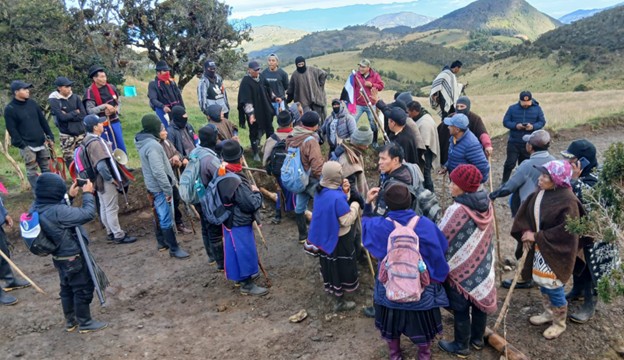
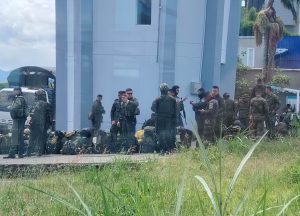


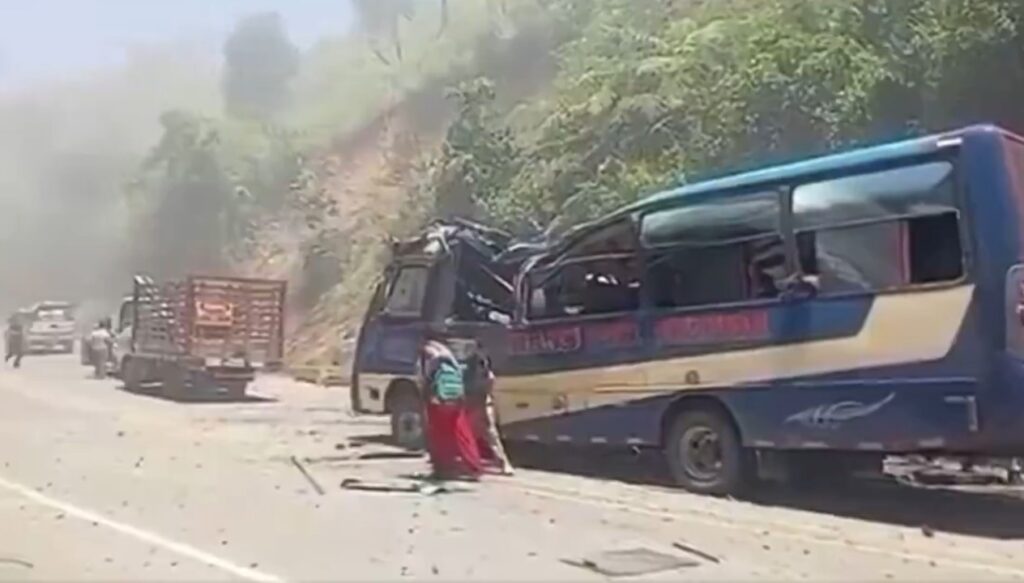
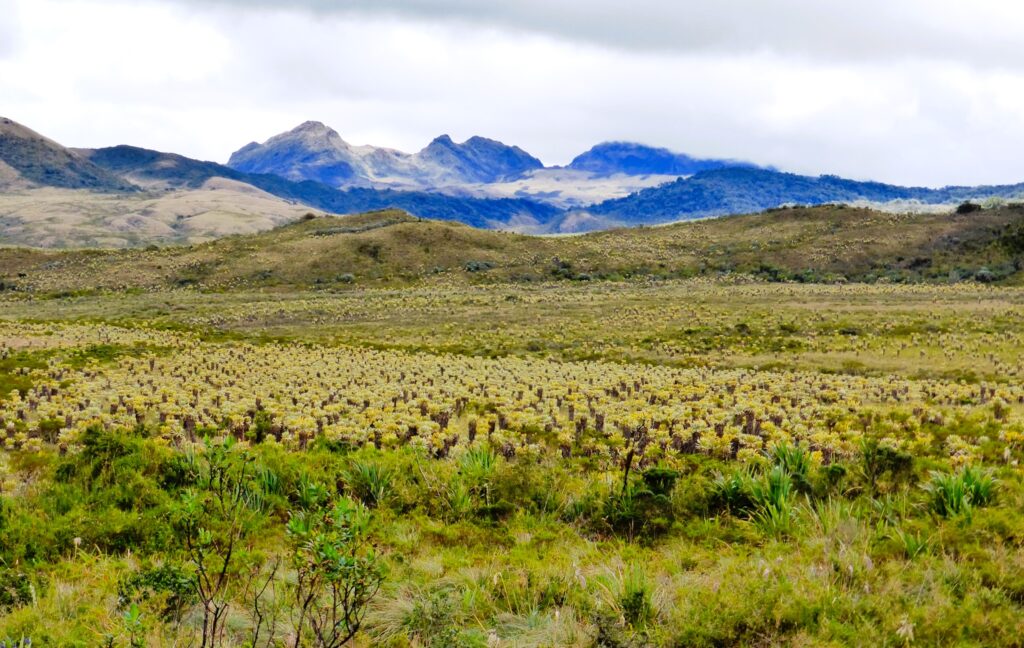

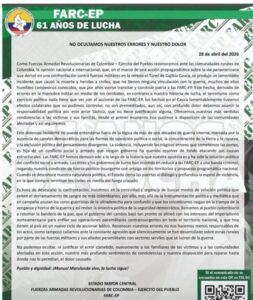
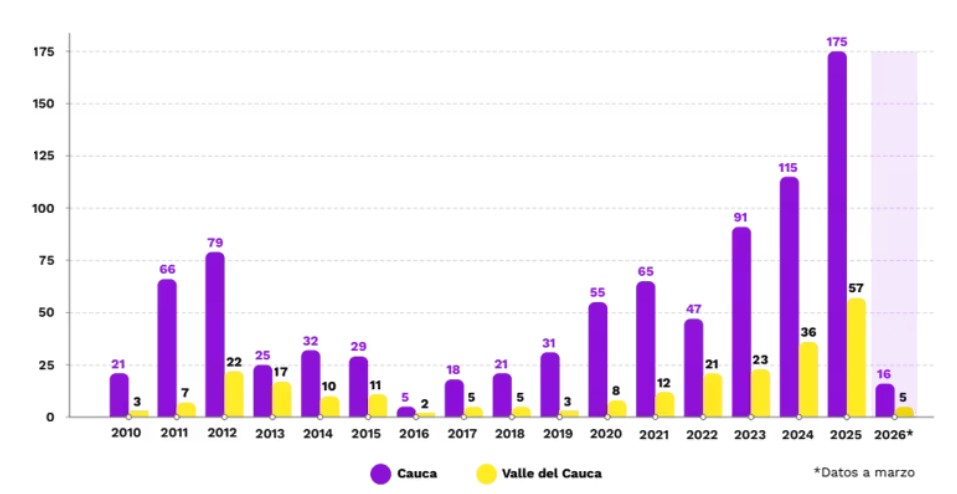

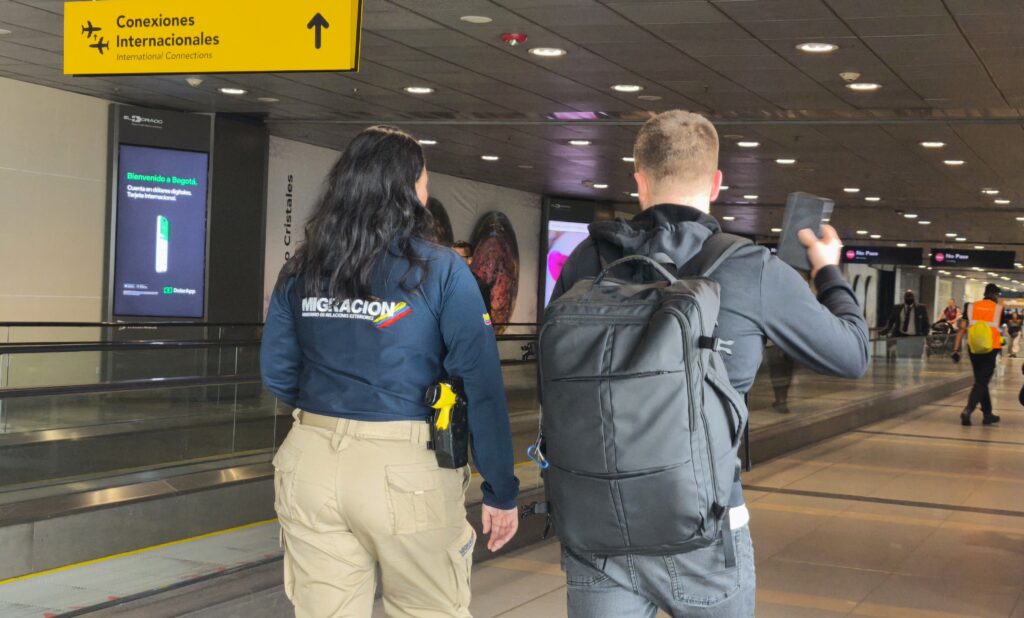

 en el sector conocido como el TÚNEL CAJIBIO CAUCA entre popayan y piendamo