
Reading view

Voting Begins in Colombia’s Closely Watched Presidential Race

Much of Colombia woke up to temperate weather and clear skies over the capital, Bogotá. As lines began to form outside polling stations when they opened at 8:00 a.m. on Sunday, voters cast their ballots in one of the country’s most closely watched presidential elections in decades, a contest that could redefine the political direction of the South American nation at a time of mounting security concerns and economic uncertainty.

In Bogotá, outside Corferias, the country’s largest exhibition and convention center and one of Colombia’s busiest voting locations, queues of unregistered voters formed well before polling stations officially opened.

According to the National Registry Office, more than 41 million Colombians are eligible to vote in the election, including approximately 1.4 million citizens residing abroad. Polling stations are under tight security nationwide and will remain open until 4:00 p.m. local time.

The 2026 election has been overshadowed by a resurgence of political violence, recalling memories of some of the country’s darkest electoral periods. Authorities have heightened security measures following a tense campaign season marked by threats against candidates, concerns over public safety, and growing polarization between the political left and right.

President Gustavo Petro, who is constitutionally barred from seeking re-election, has thrown his support behind left-wing senator Iván Cepeda, 63, who is widely regarded as the architect of the government’s failed “Total Peace” strategy aimed at negotiating disarmament agreements with FARC dissidents and other illegal armed groups.
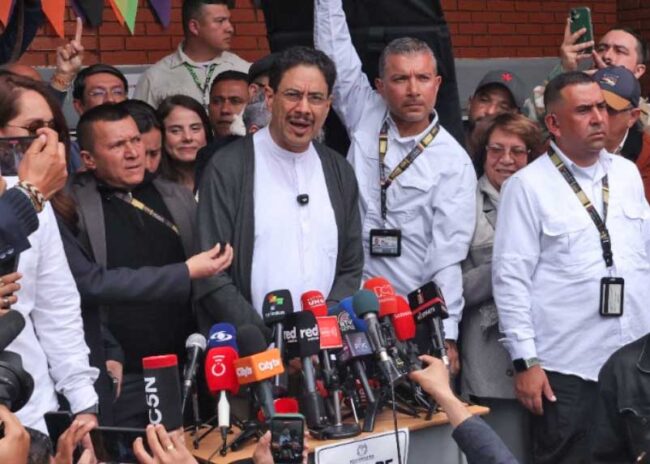
Iván Cepeda of the Historic Pact coalition voted at a district school in the locality of Kennedy, Bogotá. Photo: Cepeda Presidente.

President Petro cast his vote at 9:10 am from the Plazoleta Mosquera inside the National Capitol.

Opinion polls have placed Cepeda in first place with support ranging between 33% and 40%, making him the clear favorite to advance to a second-round runoff scheduled for June 21 should no candidate secure an outright majority of 50% plus one vote on Sunday.

Cepeda, of the ruling Historic Pact coalition, is facing two formidable opponents to his Marxist agenda: right-wing senator Paloma Valencia, 48, of the Centro Democrático party, and criminal defense lawyer Abelardo de la Espriella, 47, considered the “outsider” in the race, whose rapid rise has become one of the defining stories of the campaign.

Valencia and De la Espriella both embrace the “democratic security” doctrine associated with former president Álvaro Uribe Vélez, whose two administrations between 2002 and 2010 were defined by an aggressive military campaign against the FARC and ELN guerrillas.

De la Espriella, known among supporters as “The Tiger,” has portrayed himself as a political outsider capable of restoring economic growth and defeating criminal organizations. His campaign has gained momentum through a pro-Bukele message, fueled by a strong social media presence and rhetoric that resonates with middle-class Colombians on the Caribbean coast who are frustrated by extortion, insecurity, and the traditional political establishment.
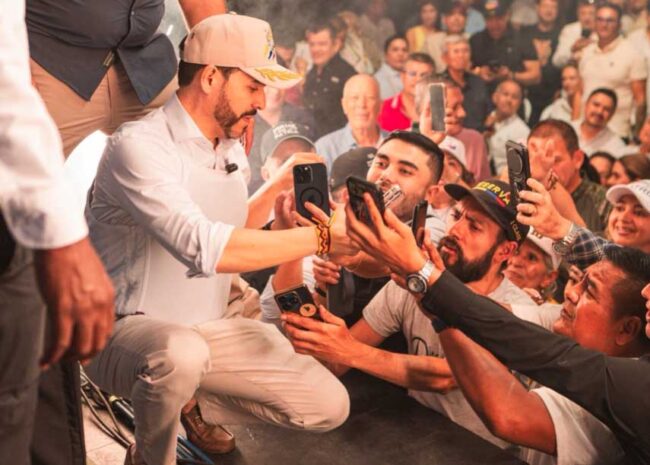
Abelardo De La Espriella has hosted large rallies along the Colombian coast. Photo: X

The political capital of  Sergio Fajardo and Claudia López appears to be spent, as the race has increasingly evolved into a contest between three candidates. The self-professed centrists and former mayors – one from Medellín (Fajardo) and other from Bogotá (López) — have consistently polled in the single digits, but on Sunday, their political relevance could evaporate a quickly with the final tally.

Sunday’s vote is unlikely to produce an outright winner, making a runoff between Cepeda and one of his conservative challengers the most probable outcome.

The key uncertainty is whether Valencia’s established party machinery and her effort to capture the undecided centre by naming Juan Daniel Oviedo as her running mate will push her beyond the six million votes she received in the March primaries.
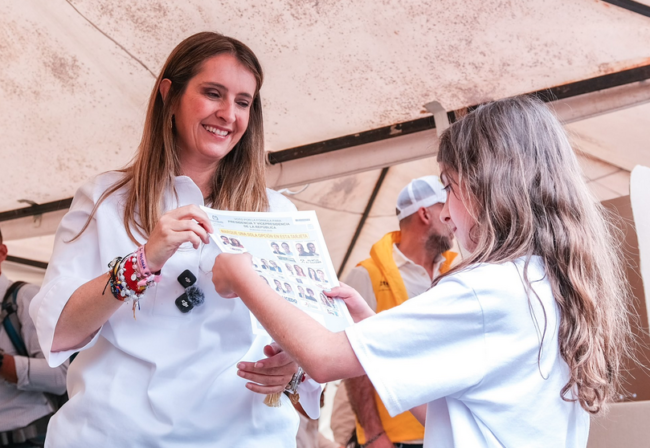
Candidate Paloma Valencia voted Sunday in Bogotá accompanied by her daughter Amapola. Prensa Paloma.
Candidate Paloma Valencia votes Sunday in Bogotá accompanied by her daughter Amapola. Prensa Paloma.

Should Valencia outperform polling forecasts, De la Espriella will be forced on Monday to convince his supporters to back Uribe’s official candidate.

For many Colombians, this election represents more than a contest between three frontrunners. It has become a referendum on President Petro’s stalled reform agenda, the country’s deteriorating security situation, and the future direction of a democracy facing some of its most significant challenges at a time when the “pink tide” of left-wing governments across Latin America has largely receded. Or in the words of former FARC hostage and ex-presidential candidate Ingrid Betancourt: “May ethics, hope, truth, and commitment to Colombia prevail today over the machismo, fear, violence, and misogyny of the extremes. I trust that we will have the first woman President.”


  •  

Former Colombia FM Álvaro Leyva Accuses Petro of Undermining Colombia’s Elections

Former Colombian Foreign Minister Álvaro Leyva Durán launched a blistering attack against President Gustavo Petro just days before Colombia heads to the polls on May 31, warning of what he described as looming threats to the country’s democratic institutions and accusing the government of preparing to reject an unfavorable electoral outcome.

In a lengthy manifesto published Tuesday on the social media platform X under the title “Propuesta de Álvaro Leyva Durán al País para las Elecciones,” the veteran Conservative politician claimed Petro fears both political defeat and possible legal consequences should right-wing presidential candidate Abelardo De la Espriella emerge victorious.

“Petro knows that his future depends on his successor protecting him from justice,” Leyva wrote, adding that De la Espriella “could win the elections in the first round.”

According to Leyva, the former member of the M-19 guerrilla and senator understands that with De la Espriella in office, “he himself could end up in prison. And that is why he has sought to derail the candidate and will refuse to recognize his victory.”

The explosive accusations mark the latest escalation in the increasingly bitter campaign season ahead of what analysts are calling one of Colombia’s most polarized elections in decades. Leyva, once one of Petro’s closest political allies and his first foreign minister, has in recent months become one of the president’s fiercest critics.

In the manifesto, Leyva intertwined personal memories of Colombia’s turbulent political history with warnings about what he believes is unfolding behind the scenes of the current administration.

“At my age, I know these kinds of stories well,” he wrote, before recalling his close relationship with slain Conservative leader Álvaro Gómez Hurtado.

“My father, Jorge Leyva, gave me at birth the name of his friend Álvaro Gómez Hurtado. When I was 12 years old, Álvaro would speak to me about politics and explain the world to me with a globe.”

Leyva recounted how Gómez and his own father were exiled after the 1953 military coup, and how decades later he worked alongside Gómez politically, even helping negotiate his release after he was kidnapped by the M-19 guerrilla movement in 1988.

“In 1995, after leaving a lecture at Sergio Arboleda University, Álvaro Gómez and I shook hands for the last time,” Leyva wrote. “Because minutes later, I watched in horror as he was assassinated in his car. It was a national tragedy.”

The former minister used Gómez’s legacy as a contrast to his eventual disillusionment with Petro.

“Because of that, I believed I could work with Gustavo Petro,” he said. “When he invited me to become his minister, I accepted because I believed him to be an honorable man. But I was wrong.”

Leyva then delivered some of his harshest remarks yet against the president.

“I came to know the monster from within: his vileness and degradation,” he wrote. “At enormous personal and family cost, I dared to denounce his baseness and his disrespect for the office.”

He added: “Because character demands that one not remain silent in the face of ignominy. And because of everything I witnessed, because of the rotten environment in which he (Petro) moves, I know what the government is plotting.”

Leyva also alleged that Petro’s radicalised supporters to intimidate opponents and manipulate the electoral process. “Today, while Abelardo wages a major democratic battle, Petro incites his followers to commit all kinds of outrages,” he wrote. “There has even been talk of snipers during the campaign.”

Without providing evidence, Leyva claimed that attempts had been made to invalidate De la Espriella’s candidacy, suppress favorable polling data and mobilize state-backed political machinery to influence the vote.

“On election day, rivers of money will flow in an attempt to stop De la Espriella,” he warned.

The former foreign minister also accused Petro of laying the groundwork to dispute the legitimacy of the election itself.

“The president has also spent months constructing a narrative of electoral manipulation,” Leyva wrote. In this way, according to the author, he is “weaving an argument to reject an adverse electoral outcome” that he already senses is inevitable. “That is the false ace up Petro’s sleeve,” he continued. “And like any gambler fueled by hatred, he will use it.”

Leyva also referenced U.S. Republican lawmakers from Florida, María Elvira Salazar and Rick Scott, claiming both were aware of the risks facing Colombia’s democratic process. “Scott is an ally of Colombian democracy and correctly sensed what the national government is planning,” he wrote.

In one of the most dramatic sections of the manifesto, Leyva proposed that Petro temporarily step aside if he alleges fraud after either the first or second round of voting.

“I make a proposal: if in the first or second round Petro claims there was fraud, he should step down from office under the terms of Article 193 of the Constitution,” Leyva wrote.

He suggested that the vice president temporarily assume office while an international commission made up of U.S. lawmakers, European parliamentarians, the Vatican and the United Nations review the vote count and oversee the transition of power before August 7.

“Think about it, Gustavo. Think about it carefully,” Leyva concluded. “Because the alternative will not end well for you. Abelardo De la Espriella will be the next president. And you will have to accept that reality, whether you like it or not.”

  •  

Exiled Venezuelans may well support regime change – but diasporas don’t always reflect the politics

Protest and military action raised the prospect of regime change in Iran and Venezuela, and the voices of both countries’ diasporas were heard loud and clear through the media of their host nations.

Venezuelan exiles in the U.S. were, according to the popular narrative, broadly behind President Donald Trump and his plan to “run Venezuela,” as the nickname “MAGAzuelans” suggests. Meanwhile, the Iranian diaspora rallied behind Prince Reza Pahlavi as he positioned himself as a leader-in-waiting, projecting an image of unified exile support.

Diasporas are often treated by media and policymakers as monolithic blocs — politically unified, ideologically coherent and ready to be mobilized for regime change. But as a scholar of migration and security in Latin America, I know this assumption misunderstands how diaspora communities form, evolve and engage politically.

Iranian and Venezuelan émigrés might broadly oppose their current governments — having left them, this is unsurprising. But they are far from unified on what should replace those governments, who should lead or how change should come about.

Migration waves shape politics

Diasporas are not uniform because their constituent populations did not arrive all at once, from the same places or for the same reasons. Each migration wave carries distinct political orientations shaped by the circumstances of departure.

The tendency of diasporas to become politically frozen at the moment of departure appears across contexts. El Salvador’s diaspora in the United States, which first left during the 1980s civil war, developed a reputation for being “stuck in the ’80s” — mentally still fighting battles that had long since ended at home.

This temporal displacement has consequences. Iranian-American sociologist Asef Bayat, writing about the Iranian diaspora, argues that exile opposition to the ruling government back home “suffers from a political disease, positioning itself against the movement it claims to support.”

In other words, diaspora activists may advocate positions that resonate with Western audiences but find little support among those actually living under authoritarian rule. This lack of accountability to political consequences back home can rankle the constituencies on whose behalf they seek to advocate.

Research on the Venezuelan diaspora reflects similar dynamics. A 2022 study found that Venezuelan exiles hold more extreme anti-government views than those who remained.

Despite this presumed disconnection, homeland politicians often devote disproportionate attention to those who have left. The logic is simple: emigrants send money home — accounting for as much as 25% of gross domestic product in some Central American and Caribbean countries. Politicians assume that this financial power translates into political influence over remittance-receiving relatives.

One party official in El Salvador told me: “If we get one Salvadoran in Washington to support us, that gives us five votes in El Salvador — and it doesn’t even matter if the one in Washington votes.”

My own research tested this assumption using polling and voting data across Latin America and found it to be exaggerated. Remittances and family communication mostly reinforce existing partisan sympathies rather than swing votes.

But the belief in diaspora influence matters politically — and diaspora voters can be weaponized by authoritarian leaders. El Salvadoran President Nayib Bukele, in his successful and plainly unconstitutional 2024 reelection bid, expanded external voting through online balloting, increasing diaspora votes by 87-fold over the previous election.

Diasporas can influence home-country politics through several channels: direct voting, financial support for opposition movements, lobbying host governments and transmitting democratic values through what sociologist Peggy Levitt calls “social remittances.” Other research has found that remittances can undermine dictatorships by helping fund opposition activities.

Yet authoritarian governments have developed sophisticated countermeasures. Freedom House recorded more than 1,200 incidents of physical transnational repression against dissidents — including assassinations, abductions and unlawful deportation — between 2014 and 2024 involving 48 governments.

The limits of exile politics

For Venezuela and Iran, these lessons counsel caution. Nearly 8 million Venezuelans have fled their homeland — the largest displacement crisis in the Western Hemisphere. Iranian emigration accelerated after the 2022 protests.

Both diasporas contain passionate activists, wealthy donors and would-be leaders positioning themselves for future rule. But passion does not equal unity, and visibility does not equal representation.

The loudest voices on social media — or those amplified by U.S. officials and media — may represent narrow slices of diverse communities. There may be consensus on opposing the government back home, but far less agreement on what should be done or how change should occur.

Nor does diaspora opposition necessarily translate into regime vulnerability. Authoritarian states have learned to insulate themselves from diaspora pressure while simultaneously using emigration as a safety valve, turning potential dissidents into remittance-senders.

Diasporas can contribute to democratic change through funding, advocacy and the transmission of democratic values. But ultimately, the path to democratic change in Venezuela, Iran and elsewhere will be determined by those who remain, not those who left. Diasporas can support that struggle; they cannot substitute for it.

About the author: Michael Paarlberg is Associate Professor of Political Science at Virginia Commonwealth University.

This article is reproduced from The Conversation under a Creative Commons licence.

  •  

Democracy Deferred: Did Washington Abandon María Corina Machado?

The extraction of Nicolás Maduro on Saturday was meant to signal the end of an era. Instead, it has exposed an uncomfortable truth that may loom over Washington weeks and months after the “shock-and-awe” attacks in central Caracas have waned from headlines: was Venezuela’s democratic opposition sidelined at the very moment it appeared closest to victory?

Just weeks earlier, María Corina Machado, the 2025 Nobel Peace Prize laureate and the symbolic leader of Venezuela’s opposition, had laid out her Freedom Manifesto — a sweeping blueprint for a Venezuelan-led democratic transition rooted in dignity, elections, free markets and the return of millions of exiles. She framed the coming moment not as an American intervention, but as a national rebirth steered by Venezuelans themselves.

That vision now appears to be colliding with a far more transactional reality.

Following Maduro’s capture in a U.S.-led operation, President Donald Trump declined to elevate Machado or her movement into any formal role. Instead, senior U.S. officials have coalesced around Delcy Rodríguez – Maduro’s longtime lieutenant and overseer of the oil sector — as Washington’s primary interlocutor in Caracas. Trump publicly praised Rodríguez’s cooperation while dismissing Machado as a “very nice woman” who “lacks the support” to lead the country.

On Monday, Delsy Rodríguez took the oath of office in the presence of the Ambassadors to China, Iran and Russia. The scene from the National Assembly recalls the sham investiture of Maduro on January 10, 2025,  and sends a dire signal to the internationl community:  Does oil security matter more than a secure democracy?

White House insiders told U.S. media that Trump had never warmed to Machado, “because his feelings got hurt”, reads the Daily Beast. According to an article on Monday in The Washington Post, the president declined to pick Machado because she committed the “ultimate sin” of offending his pride, after receiving the Nobel Peace Prize. “If she had turned it down and said, ‘I can’t accept it because it’s Donald Trump’s,’ she’d be the president of Venezuela today,” cites the newspaper’s sources.

Having lost the Oslo podium as the world’s “peace president,” personal grievance and strategic calculation have marked the White House’s decision to annoint a “moderate” in Miraflores. But Rodríguez is no moderate, and her penchant for state repression remains intact. A  recent article in the Wall Street Journal affirms that Washington is willing to tolerate a Maduro 2.0 — a Chavista continuity government — so long as it cooperates on oil, narcotics enforcement and geopolitical alignment.

On the ground in Caracas, the mood reflects that ambiguity. There have been no mass celebrations, no release of political prisoners, and no clear roadmap. Power remains concentrated within the same military-backed elites that have pillaged Venezuela for over three decades, even as Maduro himself awaits trial in New York on charges expected to exceed those once brought against Joaquín “El Chapo” Guzmán.

U.S. officials insist this is realism, not betrayal. Secretary of State Marco Rubio has argued that squeezing the regime economically and forcing compliance on security and oil will eventually produce leverage. But he has stopped short of demanding immediate elections — a notable omission given that the opposition already won one.

Machado’s Freedom Manifesto now reads less like a transition plan and more like a rebuke. It imagined a Venezuela where sovereignty flowed from the ballot box, not from foreign capitals; where dignity, not expediency, guided reconstruction; and where Venezuelans — not external powers — chose their leaders.

Instead, Trump has suggested that the United States will “run” Venezuela, even as it leaves the same repressive security apparatus intact. The contradiction is stark: maximum news coverage abroad, minimal transformation on the ground.

The question, then, is not only whether Trump sidetracked María Corina Machado, but whether the United States has traded a rare democratic opening for short-term gains. If Chavismo survives without Maduro — its prisons full, its generals untouched, its oil flowing under U.S management — the Nobel laureate’s blueprint may yet stand as the document of a revolution deferred.

And history may judge that Venezuela was not lost for lack of courage at home, but for lack of conviction abroad. In the words of Mexican historian Enrique Krauze, the end-game is inevitable: “If geopolitics seeks to turn Venezuela into a pawn on its chessboard, the people will take to the streets. They have chosen a legitimate president: Edmundo González. And they have a moral leader: María Corina Machado. Obstacles may arise, but Venezuela’s liberation is irreversible.”

  •  

Colombia’s Petro Calls Chile’s President-Elect José Kast a “Nazi”

Colombia’s president, Gustavo Petro, triggered yet another diplomatic rupture in South America on Sunday after denouncing Chile’s president-elect, José Antonio Kast, as a “Nazi,” rejecting the legitimacy of Chile’s democratic choice and sharply diverging from the cautious language typically observed between regional leaders.

Petro’s remarks came within hours of Kast’s decisive victory in Chile’s presidential runoff, in which the conservative candidate secured more than 58 per cent of the vote, defeating hard-left contender Jeannette Jara. Jara conceded promptly, saying that “democracy has spoken loud and clear” and wishing Kast success “for the good of Chile.”

Petro, however, used his social media platform X to frame Kast’s victory as evidence of an advancing wave of fascism in Latin America. “Fascism advances. I will never shake hands with a Nazi or a Nazi’s son, nor will I; they are death in human form,” the Colombian president wrote.

In a retort that called for Chileans to “take care of Neruda’s tomb,” Petro went on to equate Kast’s electoral mandate with the legacy of former dictator Augusto Pinochet. “It’s sad that Pinochet had to impose himself by force, but sadder now is that the people choose their Pinochet: elected or not, they are sons of Hitler and Hitler kills the people,” Petro said, adding that Latin Americans “know how to resist.”

The language marked one of the most explicit attacks by a sitting South American president on a democratically elected counterpart in recent years and raised immediate concerns about the state of Colombia – Chile relations, historically among the region’s most stable.

Kast’s victory completes a broader rightward shift in South American politics, following the election of Javier Milei in Argentina, Daniel Noboa in Ecuador and Nayib Bukele in El Salvador, while Bolivia recently ended nearly two decades of socialist rule with the election of centrist Rodrigo Paz. Petro, the region’s most unhinged left-wing leader, with just eight months remaining in his presidential term, appeared to ignore the potential diplomatic fallout of his remarks.

Within hours of Petro’s statement, US Republican Congressman Carlos Gimenez responded sharply, writing: “This guy (Petro) went too far with the drugs and alcohol. This is the real Gustavo Petro: incoherent, hateful, and schizophrenic.”

Former Colombian president Álvaro Uribe Vélez praised Chile’s electoral process and congratulated Kast, saying the vote had taken place peacefully and reflected citizens’ concerns about security and institutional stability. Uribe described Kast as “a guarantee for democratic institutions” in Chile and the wider region.

Another former president, conservative Andrés Pastrana, issued a sharply worded rebuke of Petro, saying the comments were “inappropriate and irresponsible” and did not represent Colombians nor the long-standing spirit of cooperation between Bogotá and Santiago.

Criticism also came from current lawmakers. Federico Hoyos, a congressman from the department of Antioquia, said Petro had “abandoned his role as head of state” and was acting instead as an “ideological agitator “unwilling to engage with leaders who do not share his views. Andrés Forero, a House representative from the opposition Centro Democrático party, accused Petro of disrespecting the sovereign will of Chilean voters, telling Colombians: “Let’s not fool ourselves, Petro is not a democrat.”

While Petro reviles diplomacy, Kast received public congratulations from international figures across the hemisphere. María Corina Machado, Venezuela’ opposition leader and 2025 Nobel Peace Prize Laureate, praised Chile’s election as “an extraordinary electoral day, an example for many nations of Latin America and the world.”

Addressing Kast directly, Machado wrote: “To the president-elect of Chile, José Antonio Kast, I send my affection and congratulations for the trust he has received. In the name of the Venezuelans, I wish him great success in his government.” She added that Venezuelans hoped to count on Kast’s support “to ensure an orderly transition to democracy in Venezuela” and to help build “a safe, prosperous and free hemisphere.”

Machado’s intervention was notable given her continued persecution by the regime of Nicolás Maduro and her public appearance at the Nobel ceremony last week in Oslo, her first in more than a year.

The United States also welcomed Kast’s victory. Secretary of State Marco Rubio said Washington looked forward to working with the incoming administration “to strengthen regional security and revitalise our trade relationship.”

Kast’s transition team said the president-elect would travel to Argentina this week to meet President Javier Milei, signalling an intention to align closely with like-minded governments in the region.

For Petro, the episode reinforces international perceptions that he has become an anachronism of regional politics — reliant on social-media provocation and historical revisionism.

For all the historical accuracy that seems to elude Petro, membership in Adolf Hitler’s National Socialist Party was not voluntary. While many Germans joined out of conviction, others were pressured or effectively compelled to enrol, particularly to obtain employment, documentation or travel permits. During and immediately after the Second World War, Germans seeking to live or work abroad — including in South America — were often required to disclose or document prior party affiliation to secure passports and legal work status, complicating later assessments of individual responsibility.

Michael Kast, born in 1924 in Thalkirschdorf, Bavaria, emigrated in Chile in 1946. His youngest son, José Antonio Kast (born 1966, Santiago) has repeatedly claimed his father was a Third Reich conscript.

Whether the outburst leads to lasting diplomatic consequences remains uncertain. But it has underscored how electoral change in Latin America is now accompanied not only by sharp policy shifts, but by open rhetorical conflict by a Colombian leader increasingly isolated among his regional peers, except for one ally, Venezuelan dictator Nicolás Maduro.

On Monday afternoon, Chile’s Minister of the Interior, Álvaro Elizalde, confirmed that a Letter of Protest will be sent to President Petro, stating in no uncertain terms that: “A decision has been made to uphold the point of view that has to do with Chilean democracy. Ultimately, the people of Chile decide, and we all have to respect that outcome”.

  •  
❌