Reading view

Apple Releases 'Silo' Season Three Trailer Ahead of Hit Show's Return

Apple's hit sci-fi series "Silo" is returning for a third season starting Friday, July 3, and a final trailer was released today.


"Silo" follows the lives of 10,000 people living in an underground bunker to escape the seemingly toxic wasteland outside. The people are unaware of why the silo was built, and those who seek the truth face deadly consequences. Rebecca Ferguson stars as Juliette Nichols, an engineer who attempts to unravel the mysteries surrounding the silo following a loved one's murder. The show is based on Hugh Howey's best-selling book series, and it is one of the most popular original series on the Apple TV streaming service.

The third season will have 10 episodes, with one released every Friday through September 4.

Apple says the third season "continues the saga of a dystopian society."

"In the present, Juliette Nichols (Rebecca Ferguson) survives her forced 'cleaning' but returns with memory loss as the silo recovers from rebellion and faces a dangerous new threat," says Apple. "Meanwhile, in the 'Before Times,' journalist Helen Drew (Jessica Henwick) and Congressman Daniel Keene (Ashley Zukerman) uncover a conspiracy that pulls them into a chain of events with catastrophic, irreversible consequences."

Apple already renewed "Silo" for a fourth and final season as well.

"With the final two chapters of 'Silo,' we can't wait to give fans of the show an incredibly satisfying conclusion to the many mysteries and unanswered questions contained within the walls of these silos," said showrunner and executive producer Graham Yost, regarding the third and fourth seasons of the show.

Trailer


Apple TV


In the U.S., Apple TV is priced at $12.99 per month or $129 per year, with a free one-week trial available for new subscribers. Apple TV is also included in Apple One and Peacock bundles, with all of the options outlined on Apple's website.

You can stream Apple TV in the Apple TV app, which is available on the iPhone, iPad, Mac, Apple TV 4K, Apple Vision Pro, Android, PlayStation, Xbox, Roku, Amazon Fire TV, select smart TVs, on the web at tv.apple.com, and more.
This article, "Apple Releases 'Silo' Season Three Trailer Ahead of Hit Show's Return" first appeared on MacRumors.com

Discuss this article in our forums

  •  

Microsoft Office 2019 for Mac Will Soon Stop Letting You Edit Documents

Microsoft will prevent Office 2019 for Mac owners from editing their documents from July 13, a restriction the company is attributing to the productivity suite's expiring digital certificate.

office for mac 2019
The Office 2019 apps affected include Word, Excel, PowerPoint, Outlook, and OneNote. Once the certificate used to confirm the suite's license expires, these apps will drop into what Microsoft is calling "reduced functionality mode." In other words, users will still be able to open, view, and print existing documents, but creating, editing and saving documents will be disabled. The same restriction will apply to iPhone and iPad apps that can't be updated, according to Microsoft.

Microsoft has actually renewed the suite's certificate, but the fix can only be delivered through a software update. That means users of Microsoft 365 and Office 2021 are in the clear – they'll receive the update, so neither will be affected. However, Microsoft stopped offering support for Office 2019 on October 10, 2023, and the suite has received no updates since. As such, it won't be updated to version 16.83, which is the release that includes the renewed certificate.

Microsoft says the problem can't be fixed by reinstalling Office 2019. Instead, it suggests affected users turn to the company's free Microsoft 365 web apps, take out a paid Microsoft 365 subscription, or make a one-time purchase of Office 2024.

Users running newer supported versions of Office on macOS 12 Monterey or later simply need to update to build 16.83. For users on iPhone and iPad running iOS 17 or later, it's build 2.93. You can check which version you have by opening Word and selecting Word ➝ About Word, but most suites will be automatically updated in the background.

Office 2021 will only receive updates until October 13, 2026, when it too reaches the end of support. Microsoft says the apps will continue to function after that date, but they will no longer receive security or feature updates.

Some critics have argued that Microsoft's deadline is effectively self-imposed because the company renewed the certificate but chose not to provide the update to Office 2019 users. For example, JimmyTech, the IT consultancy that spotted the change, has argued that using the expiry to retire older software rather than quietly renewing it "amounts to a choice."

Microsoft's messaging on the subject hasn't done it any favors, either. Its end-of-support page for Office 2019 for Mac, originally posted in October 2023, once told owners to "Rest assured that all your Office 2019 apps will continue to function." A revision now dated May 15, 2026 has dropped that line, replacing it with a note that their data "can be accessed in a supported Microsoft 365 or Office product."

Microsoft began emailing affected customers in May, but there's a chance this is still news to some Office for 2019 owners. Apple's iWork suite is an alternative route for anyone done with Microsoft's offering. It's also worth checking out the free and open-source LibreOffice, developed by The Document Foundation.
This article, "Microsoft Office 2019 for Mac Will Soon Stop Letting You Edit Documents" first appeared on MacRumors.com

Discuss this article in our forums

  •  

Ecopetrol Board Says Ricardo Roa’s Medical Leave Will Extend Absence From Company

Medical leave, vacation time and unpaid leave will keep Ricardo Roa away from Ecopetrol through late July

The board of directors of Ecopetrol, Colombia’s largest oil and energy company, announced the postponement of unpaid leave previously granted to its president, Ricardo Roa Barragán, due to a 30-day medical leave taken by the executive. The decision was disclosed by the state-controlled company in an official statement issued May 27, 2026.

According to the company, the unpaid leave, initially scheduled to begin May 26 for a 30-day period, will take effect once both Roa’s medical leave and his remaining vacation period have concluded, meaning it is now expected to begin June 27.

If the schedule remains unchanged, Roa Barragán would return to Ecopetrol in late July, just one week before Colombia’s next president is sworn in on August 7, 2026, and gains the authority to appoint new leadership at the state-owned oil company.

Read Ecopetrol Announces Temporary Leave for President Ricardo Roa Amid Investigations by Colombia’s Attorney General’s Office by Finance Colombia.

The rescheduling extends Roa Barragán’s temporary absence during a sensitive period for Colombia’s largest state-controlled company, amid a government transition and growing scrutiny over its corporate stability.

The vacations and unpaid leave had previously been approved by Ecopetrol’s board as an institutional response to tensions surrounding Roa Barragán’s continued tenure. While labor unions, minority shareholders and various public voices had called for his removal, President Gustavo Petro publicly maintained his support.

Read The petroleum workers called for Ricardo Roa’s head following formal influence-peddling charges filed by Colombia’s Attorney General’s Office.

The board also decided to keep Juan Carlos Hurtado as acting president of Ecopetrol. Hurtado has served as executive vice president of hydrocarbons since November 2025.

So far in 2026, Colombia’s Attorney General’s Office has formally charged Roa Barragán in two separate cases: one involving alleged influence peddling by a public official, linked to purported benefits obtained in the purchase of an apartment in Bogotá, and another involving alleged violations of campaign spending limits in the 2022 “Petro Presidente” presidential campaign, for which he served as campaign manager.

Read Ecopetrol President Ricardo Roa Charged Over Alleged Campaign Spending Violations in Petro’s Presidential Campaign.

So far, no judicial conviction has been issued in either case, and the executive retains the presumption of innocence.

Under the revised schedule, Roa Barragán is expected to remain away from Ecopetrol’s presidency during part of the electoral period and presidential transition, ahead of the eventual handover to the administration elected in Colombia’s May 31 elections.

  •  

Colombia’s Debt-to-GDP Ratio Settles Into a New 60% Baseline After 20 Years of Macroeconomic Swings

Twenty-Year Debt Arc Resets Colombia’s Sovereign Risk Outlook

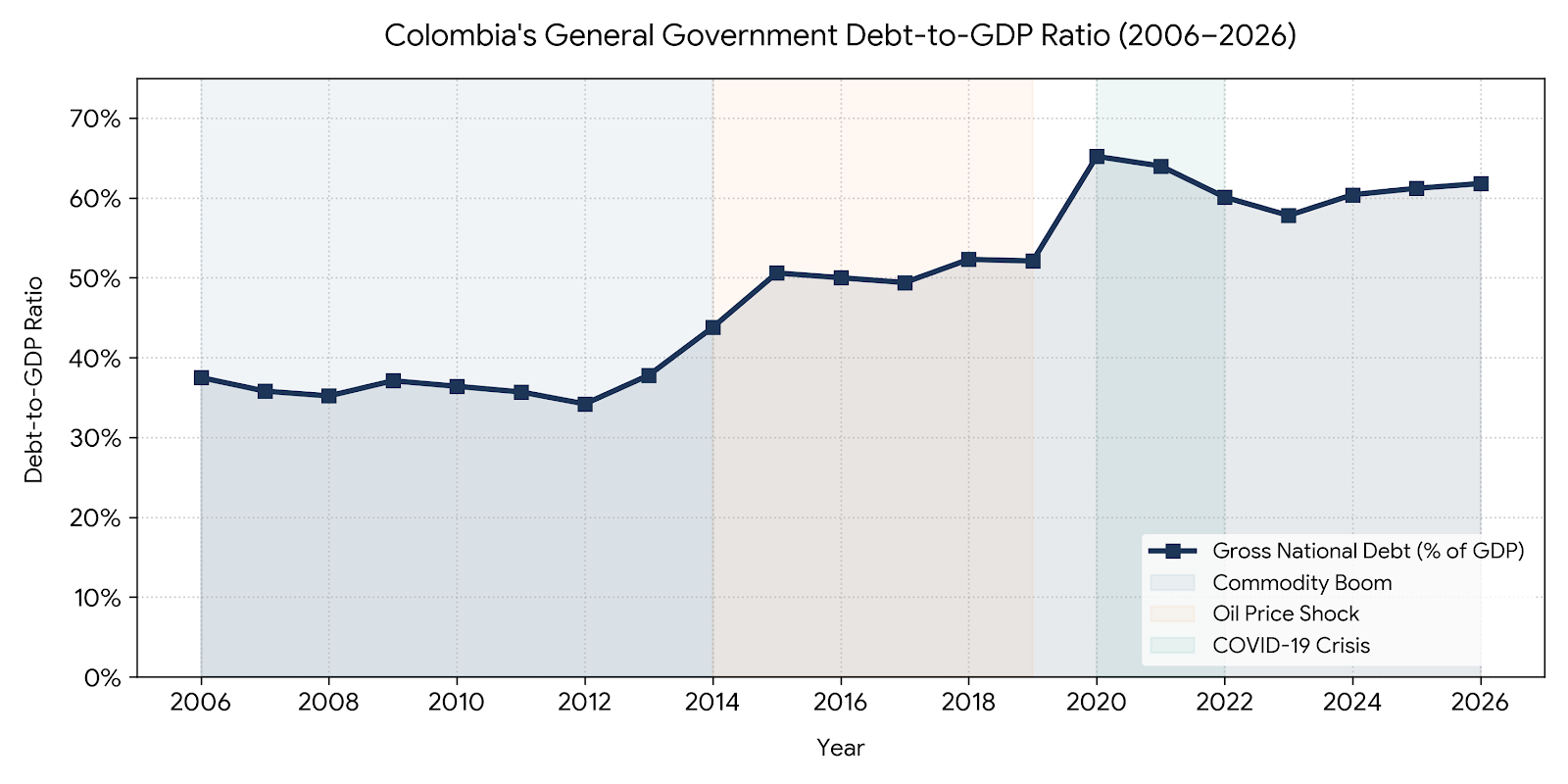
Two decades of fiscal data show that Colombia’s gross general government debt has moved through four distinct macroeconomic phases, ending the current cycle at a level that is materially higher than its pre-pandemic baseline. Persistent annual fiscal deficits, currency volatility, an emergency spending shock and weaker-than-projected tax revenues have combined to push the ratio of public debt to gross domestic product from the mid-30s percent range in the mid-2000s to a band of roughly 60 to 62 percent at the start of 2026, according to figures published by the Ministerio de Hacienda y Crédito Público and the Banco de la República.

The shift carries direct implications for sovereign bondholders, multinationals operating in Colombia and any investor pricing country risk in the Andean region. All three major rating agencies — S&P Global Ratings, Moody’s Ratings and Fitch Ratings — now place Colombia in speculative-grade, or junk, territory, with consecutive downgrades through 2025 and into early 2026.

“The activation of the escape clause confirms that the deterioration observed in 2024 will not be corrected in 2025.” — Renzo Merino, sovereign analyst, Moody’s Ratings

The commodity cushion: 2006 to 2014

During the global commodity supercycle, Colombia benefited from sustained gross domestic product growth and steady government revenue. Hydrocarbon and mining receipts — channeled through Ecopetrol (NYSE: EC; BVC: ECOPETROL) and the broader extractive sector — supplied a substantial share of national tax intake. The debt-to-GDP ratio remained relatively stable during this period, generally hovering between 34 and 38 percent. Even with chronic primary deficits, nominal growth in the denominator absorbed new borrowing, masking the underlying structural imbalance that the Comité Autónomo de la Regla Fiscal (CARF) would later flag as the persistent driver of fiscal stress.

The currency and revenue shock: 2014 to 2019

The mechanics of the ratio changed sharply when Brent crude prices collapsed in late 2014. Reduced hydrocarbon royalties widened the fiscal gap just as the Colombian peso depreciated against the US dollar. Because a significant share of Colombia’s sovereign liabilities is denominated in foreign currency, the peso’s slide automatically inflated the local-currency value of outstanding external debt when measured against domestic GDP. The combined effect — wider deficits funded by new borrowing, plus a valuation effect on existing dollar-denominated obligations — pushed the ratio steadily higher through the late 2010s.

The structural revenue weakness that surfaced during this period has remained a recurring theme in subsequent fiscal assessments from Fedesarrollo and the Pontificia Universidad Javeriana Observatorio Fiscal, both of which have noted that successive tax reforms failed to fully close the gap between commitments and ordinary income.

The pandemic ceiling: 2020

The combination of emergency social spending under the Ingreso Solidario program, expanded health outlays and a sharp contraction in nominal GDP drove the ratio to a historic peak above 65 percent in 2020. The Ministerio de Hacienda reports the all-time high at 65.3 percent of GDP that year. The government activated the escape clause of the regla fiscal — Colombia’s fiscal rule, codified in Law 1473 of 2011 and modified by Law 2155 of 2021 — to accommodate the spending response, suspending the rule for 2020 and 2021.

That episode also triggered the first sovereign downgrade cycle: S&P Global Ratings cut Colombia’s long-term foreign currency rating to BB+ from BBB- in May 2021 after the administration of then-president Iván Duque withdrew a tax reform bill following street protests, costing the country its investment-grade status with that agency.

The new baseline: 2023 to 2026

Strong post-pandemic nominal growth briefly pulled the debt ratio down toward 57 percent in 2023. The decline did not hold. Structural spending pressures, elevated international interest rates and tax collections below budgeted projections pushed the ratio back up, establishing a new operating band around 60 to 62 percent of GDP. The Ministerio de Hacienda reported government debt to GDP at 61.3 percent for 2024.

The administration of President Gustavo Petro and Finance Minister Germán Ávila Plazas activated the regla fiscal escape clause for a second time in June 2025, with the Consejo Superior de Política Fiscal (Confis) approving a three-year suspension covering 2025 through 2027. The decision came despite an unfavorable technical opinion from the Comité Autónomo de la Regla Fiscal, which concluded that legal conditions for activating the clause were not met outside of a national emergency. The clause had previously been invoked only during the COVID-19 pandemic.

According to the Marco Fiscal de Mediano Plazo (MFMP) presented by the Ministerio de Hacienda, net public debt to GDP is projected to rise from 53 percent in 2023 to 61.3 percent in 2025 and approximately 63 percent in 2026. The fiscal deficit for 2025 was initially projected at 7.1 percent of GDP and later revised to roughly 6.2 percent of GDP, with the administration targeting a deficit below 6 percent of GDP for 2026.

Debt service consumes a larger share of the budget

The cost of servicing this debt has reshaped the structure of the national budget. The 2026 draft budget presented by Minister Ávila totals $557 trillion COP, equivalent to roughly $134.7 billion USD, and represents 28.9 percent of GDP. Of that, debt servicing costs are projected at $102.5 trillion COP, or 5.3 percent of GDP, down from 6.2 percent of GDP in 2025.

The figures published by the Ministerio de Hacienda for domestic debt service in 2026 are higher when measured against tax intake alone: of an estimated $130 trillion COP in domestic debt service, $79 trillion COP corresponds to principal that can be rolled over through new issuances, while $51 trillion COP represents interest payments funded directly from the budget. Against projected tax revenue of approximately $300 trillion COP, that implies roughly one in every three pesos collected by the central government is allocated to interest on existing debt.

Rating agencies reprice the sovereign

The rating cycle has accelerated alongside the fiscal trajectory. Moody’s Ratings downgraded Colombia to Baa3 and subsequently into junk territory in 2025, citing the suspension of the fiscal rule. S&P Global Ratings issued a further downgrade in April 2026, its second cut in less than a year, on the same persistent deficit and debt concerns. Fitch Ratings also moved Colombia deeper into speculative grade in December 2025.

The Banco de la República reported external debt — combining public and private liabilities — at $238.7 billion USD at the close of November 2025, equivalent to 54.8 percent of GDP, an increase of $15.8 billion USD from January of the same year. The Colombian economy is currently valued at approximately $435 billion USD.

What investors are watching next

The Comité Autónomo de la Regla Fiscal has stated in its most recent reports to Congress that the 2025 primary balance target was missed by a wide margin even after the escape clause was activated, and that incoming projections for 2026 raise the bar for any return to the original fiscal rule by 2028. Business groups including Fenalco and the Consejo Gremial Nacional have publicly opposed the suspension and signaled potential legal challenges.

The 2026 financing plan disclosed by the Ministerio de Hacienda includes approximately $4.6 billion USD in global bond issuances, primarily to refinance a one-year Swiss-franc Total Return Swap operation valued at roughly $9.3 billion USD. The ministry has stated that the issuance does not constitute net new external debt. Updated debt and deficit targets are scheduled for release in the next iteration of the Plan Financiero.

For executives operating in Colombia or evaluating new investment, the baseline shift from a mid-30s to a low-60s debt-to-GDP environment alters several variables simultaneously: peso volatility tied to refinancing cycles, the trajectory of corporate tax policy as Congress weighs successive reform proposals, and the path of domestic interest rates set by the Banco de la República as it manages inflation alongside elevated sovereign funding costs. Detailed historical and forward-looking debt data is published by the Investor Relations Colombia office of the Ministerio de Hacienda.

Colombia's General Government Debt-to-GDP Ratio (2006-2026) (image: Google)

Colombia’s General Government Debt-to-GDP Ratio (2006-2026) (image: Google)

  •  

Colombia congress holds hearing on 1989 plane bombing blamed on Pablo Escobar

Families move closer to justice over the downing of Avianca Flight 203, blamed on Pablo Escobar.

Avianca Boeing 727-21 HK-1803, which was downed in 1989. Image credit: Richard Vandervord via Wikimedia Commons.

Colombia’s Congress held a hearing on Wednesday on the bombing of Avianca Flight 203 for the first time since it happened on November 27, 1989. 

The explosion killed all 107 people on board shortly after take-off from Bogotá on its way to Cali, and has been widely attributed to Pablo Escobar’s Medellin Cartel.

Families have long demanded truth, justice and reparations for the attack, considered one of Colombia’s deadliest acts of narco-related violence.

The hearing, held as a political oversight session, focused on truth, justice, memory and reparations for victims of narcoterrorism.

The Attorney General’s Office has led the investigation for decades, but families say the process has been “painfully slow.”

“It is a case that remains in a preliminary stage, as if it had happened this morning,” Gonzalo Enrique Rojas Peña, son of one of the victims, told The Bogotá Post.

Rojas was 10 years old when his father, Gonzalo Hernán Rojas Castro, was killed. He now represents families of victims of the bombing.

Gonzalo Rojas alongside his late father. Image credit: Catherine Ellis.

“Many aspects have not been clarified by the state, particularly regarding who planned and carried out the attack, and the possible involvement of other actors,” he explained.

The hearing highlighted questions that remain unanswered, including the identity of all those responsible and the current status of investigations.

Authorities initially attributed the attack to an assassination attempt on presidential candidate César Gaviria, who did not board the plane on the advice of his security team.

Later investigations concluded that a young man boarded the plane with explosives under orders from the Medellín Cartel, one of the most violent drug trafficking organisations in Colombia’s history. Questions around the case, however, persist, and victims continue to seek justice.

Just one person was jailed for the attack: Dandeny Muñoz Mosquera, known as “La Quica”, who was sentenced to three life terms in the United States, although he has repeatedly denied involvement.

The session was convened by the Human Rights Commission of the Chamber of Representatives and led by Representative Juan Daniel Peñuela. The National Centre for Historical Memory, the Victims’ Unit and the Ministry of the Interior were present, alongside families of victims, many of whom spoke about their loved ones.

However, two key institutions — the Attorney General’s Office and the Special Jurisdiction for Peace (JEP) — did not attend, despite being formally invited.

“On one hand we had two national institutions, but on the other it was unfortunate that the Fiscalía and the JEP did not attend. It is unfortunate that responses remain very ambiguous,” Gonzalo said.

Gonzalo Rojas at the hearing on May 27. Image credit: Catherine Ellis.

The hearing also addressed the issue of reparations, which families say they have spent decades waiting for.

The Victims’ Unit said it will convene working groups to address long-standing gaps in registration and documentation that affect families’ access to reparations under Colombia’s 2011 Victims Law. The law provides recognition, financial compensation, symbolic measures and psychosocial support for victims of armed conflict.

Claudia Peñón was 17 years old when her father was killed on the flight in 1989.

“He was an excellent man and a hardworking man. He had the hope of seeing me graduate from high school, and he never got to do that,” she told The Bogotá Post, adding so many people’s lives were shattered that fateful day. “One hundred and seven families’ lives were left shattered. One hundred and seven families had their dreams destroyed.”

Her mother always expected answers, but died ten years ago without receiving them or reparations.

“She never got to see real restitution, never got to see justice in that situation. And honestly, so many other families have been failed too — and we’re still fighting,” she said. 

Families are also pushing for stronger memory-building efforts.

While there have been initiatives to recognize victims of armed conflict, the history of narcoterrorism has often been marginal in official narratives.

During the hearing, the National Centre for Historical Memory said the case has not yet been developed as a dedicated exhibition in Colombia’s planned Museum of Memory. It is included in broader reports and timelines, but could still be incorporated through a future “memory initiative”.

The hearing triggered formal follow-up steps from state institutions.

Congress will send official requests to the Attorney General’s Office over its absence and may refer the matter to the Procuraduría for review.

But for many families, the session underscored a deeper reality: after 37 years, there has been no new judicial breakthrough and no clear path to resolution.

“I think the day was partially positive,” said Gonzalo.  “I feel calm that other families were able to have a space to receive more information about the case. But there is still more to do.”

The post Colombia congress holds hearing on 1989 plane bombing blamed on Pablo Escobar appeared first on The Bogotá Post.

  •  

Colombia’s House Committee Opens Investigation into Petro Over Alleged Political Interference Ahead of Presidential Election

The ongoing investigations have now been joined by a new complaint filed by presidential candidate Claudia López

Colombia’s House Investigation and Accusation Committee has opened an ex officio investigation into President Gustavo Petro over alleged improper political participation ahead of the country’s presidential election on May 31, 2026, amid growing scrutiny over the president’s neutrality during the campaign.

The decision became public Tuesday, May 26, through an official document in which the committee said the investigation stems from “recent statements and social media posts” by the head of state “related to alleged participation in politics in connection with the upcoming presidential elections.”

“This Legal Investigation and Accusation Committee is legally obligated, under the powers granted by Law 600 of 2000 (Article 27) and Law 5 of 1992, to initiate an ex officio criminal investigation for the crime of Political Intervention (Article 422 of the Criminal Code),” the document states.

The order was signed by Gloria Arizabaleta, chair of the Investigation and Accusation Committee and a House representative from the ruling Pacto Histórico party.

Although Colombia’s president is considered the natural leader of his political movement, in this case, Pacto Histórico, whose presidential candidate is Iván Cepeda, Colombian law imposes restrictions on public officials regarding electoral participation.

In Colombia, public officials are subject to the principle of political neutrality, preventing them from intervening in electoral controversies or using their positions to influence citizens’ votes in favor of a particular party or candidate, although they retain their individual right to vote.

Article 422 of Colombia’s Criminal Code (Law 599 of 2000) establishes penalties for improper political intervention, including prison sentences and disqualification from holding public office. Such conduct may also result in disciplinary sanctions under Colombia’s General Disciplinary Code.

Claudia López files separate complaint

Presidential candidate Claudia López also filed a formal complaint before the same committee, alleging lack of electoral guarantees and abuse of power by the president.

“We filed before the House Investigation Committee a 58-page complaint with evidence of President Gustavo Petro’s improper participation in politics and the lack of electoral guarantees. His attacks against my campaign, abuse of power and blatant political interference cannot be accepted,” López said in a social media post.

Inspector General requests report on complaints

Meanwhile, Colombia’s Inspector General’s Office requested a detailed report from the committee regarding existing complaints against Petro related to alleged improper political participation.

The request was signed by Inspector General Gregorio Eljach, who asked for a “detailed report listing complaints against the President of the Republic” to be delivered within three days.

However, the scope of the Inspector General’s Office remains limited because, under Colombia’s institutional system, it holds disciplinary authority over lawmakers and local officials, while constitutional authority to investigate the president rests with the House of Representatives.

“The Executive Branch is overwhelmingly powerful compared with the others, and the president, as head of the state’s public administration, has extraordinary powers and tremendous influence over society,” Eljach told El Tiempo newspaper, referring to the president’s social media activity and its possible impact on voters.

According to El País newspaper in Cali, the Investigation and Accusation Committee currently has around 12 complaints against Petro related to alleged political intervention.

The investigation opens in the final stretch of a presidential campaign in which Petro has sought to maintain political influence through support for ruling coalition candidate Iván Cepeda, who currently leads voter intention polls ahead of the first round.

  •  

Federal Jury Convicts Tennessee Man of Sex Trafficking and Exploiting Medellín Minor; Court Imposes 30-Year Sentence

Tenth US conviction under joint US-Colombia child exploitation offensive

A federal jury in the Southern District of Florida convicted Ramon Arellano Sandoval, 65, of Antioch, Tennessee, on charges of attempted sex trafficking of a minor and attempted production of child sexual abuse material involving a 14-year-old victim residing in Medellín, Colombia. A US federal district judge subsequently sentenced Arellano Sandoval to 30 years in federal prison, according to Alcaldía de Medellín Mayor Federico “Fico” Gutiérrez, who confirmed the sentence on May 21, 2026.

The case, prosecuted by the US Attorney’s Office for the Southern District of Florida under case number 24-cr-20519, represents the tenth conviction obtained under a joint US-Colombia enforcement initiative targeting foreign nationals who travel to Medellín to sexually exploit minors. Three other US citizens previously sentenced in connection with the program include Stefan Correa and Manuel Poceiro, who each received life sentences, and Mohamed Anaswed, who received 21 years in federal prison.

According to court records and evidence presented at the February 24 trial, Arellano Sandoval exchanged thousands of text and video messages with the victim, who was 14 years old at the time, and who lived in a rural area near Medellín. Prosecutors presented evidence that the defendant knew the victim’s age, repeatedly solicited sexually explicit videos from her, directed her to produce illicit material in exchange for electronic payments, and traveled to Colombia to engage in commercial sex with her.

“The evidence showed that this defendant pressured a child to create sexually explicit videos and even traveled overseas to abuse her. That conduct is predatory, criminal, and intolerable.” — Jason A. Reding Quiñones, US Attorney, Southern District of Florida

The jury found Arellano Sandoval guilty of attempted sex trafficking of a minor, which carries a maximum sentence of life in federal prison, and attempted production of visual depictions of the sexual exploitation of a minor, which carries a maximum sentence of 30 years.

“The jury’s verdict delivered justice for a 14-year-old victim who was targeted and exploited by a 65-year-old man who knew exactly what he was doing,” said US Attorney Jason A. Reding Quiñones for the Southern District of Florida. “The evidence showed that this defendant pressured a child to create sexually explicit videos and even traveled overseas to abuse her.”

The investigation was conducted by Homeland Security Investigations (HSI) Miami under Special Agent in Charge José R. Figueroa, with operational support from HSI Colombia. Assistant US Attorneys Tim Farina and Camille Smith handled the prosecution. On the Colombian side, the arrest and evidence collection involved the Alcaldía de Medellín, the Policía Nacional through its Dirección de Protección y Servicios Especiales (DIPRO), the Fiscalía General de la Nación, and Migración Colombia.

“La justicia no tiene fronteras cuando se trata de proteger a nuestros niños, niñas y adolescentes,” Gutiérrez wrote on his X account, referring to cross-border judicial cooperation in cases involving the exploitation of minors. The mayor indicated the administration would continue pursuing similar prosecutions, stating that any foreign national traveling to Medellín to exploit minors would be pursued until obtaining a conviction, including in their country of origin.

‼La justicia no tiene fronteras cuando se trata de proteger a nuestros niños, niñas y adolescentes.🚨Otro condenado más.

Ramón Arellano Sandoval, de 65 años de Estados Unidos, fue sentenciado a 30 años en prisión federal de ese país, por los delitos de intento de explotación… pic.twitter.com/mepkNuOURX

— Fico Gutiérrez (@FicoGutierrez) May 21, 2026

The Arellano Sandoval case follows a similar prosecution earlier in 2026 against Michael Jaime Inofuentes, also a US citizen, who was sentenced by the US District Court for the Eastern District of Virginia to 18 years in federal prison. Court evidence in that case established that Inofuentes sexually abused a 15-year-old in Medellín and paid for encounters in hotels, resulting in a pregnancy in early 2024. The investigation, triggered by a complaint from the victim’s mother to Colombian authorities, led to Inofuentes’s arrest in Miami. Prosecutors introduced WhatsApp conversations, financial transfers, and the defendant’s own admissions, which included statements that he had fathered other children in Colombia under similar circumstances. Related court documents and additional case information are available through the US District Court for the Southern District of Florida at www.flsd.uscourts.gov and through the PACER system at pacer.flsd.uscourts.gov under case number 24-cr-20519.

Headline image: Wilkie D. Ferguson Jr. United States Courthouse
  •  

iPhone 17 Pro Will Make Sports History This Weekend

Apple today announced that this Saturday's Major League Soccer match between the LA Galaxy and Houston Dynamo FC will be captured entirely with the iPhone 17 Pro.


Apple said this will mark the first time an iPhone will be used to capture the entirety of a major professional live sporting event broadcast, rather than studio cameras, so the iPhone 17 Pro will make sports history this weekend.

"iPhone 17 Pro will capture live footage throughout the match, including team warmups on the pitch, player introductions, in-net goal angles, and the atmosphere inside the stadium," said Apple. "With cameras positioned throughout the venue, the broadcast will deliver the pristine video quality fans expect, alongside dynamic new perspectives that bring viewers closer to the action, made possible by the small form factor of iPhone."

Apple TV subscribers will be able to stream the match live on Saturday, May 23 at 7:30 p.m. Pacific Time. For the 2026 season, only an Apple TV subscription is required, with a separate MLS Season Pass subscription no longer necessary.

Apple already used the iPhone 17 Pro to capture select moments and cinematic Fenway Park footage during a Major League Baseball game between the Boston Red Sox and Detroit Tigers last year, but other cameras were also used. For the Major League Soccer match this weekend, the iPhone 17 Pro will exclusively capture all footage.

Earlier this year, the U.S. National Baseball Hall of Fame and Museum added one of the four iPhone 17 Pro devices that captured the Red Sox's thrilling walk-off win over the Tigers to its permanent collection in Cooperstown, New York, so the device already made sports history, and now it will repeat the feat in an even bigger way.
Related Roundup: iPhone 17 Pro
Related Forum: iPhone

This article, "iPhone 17 Pro Will Make Sports History This Weekend" first appeared on MacRumors.com

Discuss this article in our forums

  •  

How to Record & Send Voice Messages on iPhone (iOS 26+)

The iPhone Voice Messages feature is quite useful and fun, allowing for audio recordings to be sent to and from people in the Messages app. Voice Messaging allows people to hear your voice, and you to hear theirs, and for many people it’s easier to speak into their iPhone rather than tap out a long ... Read More
  •  

Former Medellín Mayor Daniel Quintero Appointed Colombia’s Health Superintendent Amid Political and Legal Scrutiny


National Health Superintendence oversees patients’ rights and regulates EPS insurers, a key pillar of the system that President Petro has sought to eliminate in his reform efforts

Former Medellín mayor and former presidential pre-candidate Daniel Quintero has been appointed as Colombia’s new National Superintendent of Health, a decision that has sparked controversy across political and social sectors due to ongoing judicial and disciplinary investigations against him.

The National Health Superintendence is responsible for safeguarding the rights of users within the health system, overseeing Health Promoting Entities (also called EPS) and Health Service Providers (IPS), and monitoring the use of public finances allocated to the sector, areas that President Gustavo Petro has sought to reform during his administration.

The appointment comes amid a complex situation in Colombia’s health system. During his administration, President Petro presented two structural reform proposals aimed at reshaping the system, including major changes to the role of EPS. Both initiatives were rejected by Congress.

Following these legislative setbacks, the government has pursued reforms through administrative measures and decrees, including the intervention of several of the country’s largest EPS, which together serve more than 23 million affiliates (More information: Colombian President Gustavo Petro Seeks To Restructure Colombian Health Care Despite Congressional Rejection by Finance Colombia).

During his swearing-in, Quintero said his administration would strengthen oversight of the system. “It is time to put an end to abuses by the EPS,” he said.

Criticism over qualifications and legal cases

The appointment has drawn criticism from organizations and political figures who question both his background as an electronic engineer and his legal situation. Transparency for Colombia said the designation “is inappropriate because it places a political figure widely questioned for using public office to favor private interests in charge of addressing the health crisis, instead of appointing individuals with the training, knowledge, and experience required to resolve it.”

The organization also called on the Attorney General’s Office to expedite ongoing investigations. “We respectfully call on the Attorney General’s Office (FGN) to ensure that cases involving Daniel Quintero move forward swiftly, respecting due process guarantees while delivering results in light of the seriousness of the allegations,” it said.

Quintero, who served as mayor of Medellín from 2020 to 2023, faces more than 40 criminal and disciplinary complaints related to alleged corruption during his administration. Among them is the “Aguas Vivas” case, involving the sale of a forest reserve land plot exceeding 140,000 square meters. In that case, prosecutors have already filed charges for alleged embezzlement, undue interest in public contracts, and misconduct in office, although no conviction has been issued.

Criticism has also emerged from within the government. Carlos Carrillo, head of Colombia’s National Unit for Disaster Risk Management, said that “Quintero is currently on trial for crimes against public administration. He has the right to defend himself, but the Pacto Histórico has no reason to bear the political cost of his legal troubles; we owe him nothing and he brings us nothing.”

Quintero will be the fifth health superintendent appointed during Petro’s administration. His tenure is expected to be temporary, as a new president will take office on August 7, 2026, and will have the authority to appoint a new head of the agency.

  •  

Monster Truck Kills 3 People After Driving Into Crowd in Colombia

The police are investigating the incident after a driver of a monster truck appeared to lose control of the vehicle after performing a stunt at an outdoor rally in Popayán on Sunday, killing three people and injuring 40 others.
  •  

Rising Violence in Colombia: Highway Explosion Leaves 21 Dead, Dozens Injured

Petro’s “Total Peace” strategy is under pressure ahead of presidential elections as violence by armed groups escalates

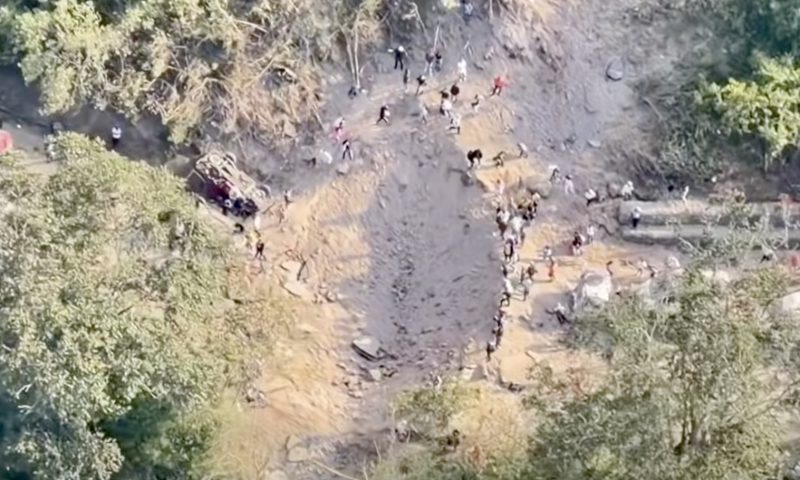
An explosive attack on the Pan-American Highway near the municipality of Cajibío, in Colombia’s Cauca department, left at least 21 people dead and 56 injured, Defense Minister Pedro Sánchez Suárez confirmed.

The attack occurred Saturday, April 25, on one of the main roads in the country’s southwest, an area historically affected by the presence of illegal armed groups.

The minister attributed the attack to alias “Marlon,” described as one of the most wanted leaders in the region, “for whom we are offering a reward of up to $1.4 million USD,” he said.

According to local media reports cited by El Tiempo, “the attack was initially intended to target army troops. However, a change in military plans reportedly led to the explosive being detonated while civilians were passing through the area.”

The impact of the attack was significant. Spain’s El País reported “that the explosion created a large crater, left the road covered in debris, and forced rescue operations that lasted several hours due to difficult access conditions.”

Aerial view of the crater caused by the explosion on the Pan-American Highway. Photo courtesy of Colombia’s Ministry of Defense.

Aerial view of the crater caused by the explosion on the Pan-American Highway. Photo courtesy of Colombia’s Ministry of Defense.

Cauca Governor Octavio Guzmán described the incident as one of the most serious attacks in the region in decades. “What happened on April 25 constitutes the most brutal and ruthless attack against civilians in decades,” he said.

The attack comes amid a resurgence of violence in southwestern Colombia, where illegal armed groups linked to drug trafficking, illegal mining and other illicit economies operate. Authorities continue operations in the area as investigations proceed to clarify the circumstances of the attack and determine responsibility.

According to reports by BBC Mundo, alias “Marlon” is a dissident FARC leader identified as Iván Jacobo Idrobo Arredondo, “the alleged head of the Jaime Martínez structure, part of the Estado Mayor Central (EMC),” one of the country’s most powerful illegal armed groups.

Operations and arrests

As part of response operations, the National Police reported the capture of José Alex Bitoco, alias “David” or “Mi Pez,” identified as the leader of the Dagoberto Ramos structure, another illegal armed faction, who is believed to have acted under orders from alias “Marlon”.

National Police Director Gen. William Rincón Zambrano said the detainee “will have to answer for the wave of terrorist activity” and linked him directly to the attack, stating that “he is responsible for what happened on April 25 in the El Túnel sector on the Pan-American Highway.”

The Defense Ministry reiterated that alias “Marlon” remains a priority target. “He is a high-value target, and we are searching for him with all the capabilities of the state. We have deployed a dedicated intelligence task force to locate him,” Sánchez said, confirming a reward of up to $1.4 million USD for information leading to his capture.

Context: criticism of “Paz Total” policy (Total Peace)

The attack comes amid growing security deterioration in Colombia, intensifying criticism of President Gustavo Petro’sTotal Peace” policy. The Ideas for Peace Foundation (FIP) has warned of a possible failure of the strategy, noting that “less than four months before the end of the government, the lack of progress in peace negotiations and the deterioration of security have become one of the main points of criticism of the Petro administration.”

According to the think tank, during the current administration “the number of disputed territories between illegal actors has nearly doubled, and the number of members in these structures has increased by 85%: they now total more than 27,000 members, including armed individuals and support networks.”

This figure not only represents a significant increase but also places the country at levels similar to, and even higher than, those seen before the peace process with the FARC began. Between 2011 and 2012, the estimate stood at around 26,800 members, compared with 14,600 at the end of Iván Duque’s administration in 2022.

The recent increase has also been rapid. According to the FIP, armed groups grew by 23.5% over the past year (from December 2024 to December 2025), reflecting a swift reconfiguration of these structures. At the same time, violence has intensified. Analysts such as Professor Karol Solís Menco note that over the weekend of April 25–26 alone, “26 terrorist attacks of varying magnitude” were recorded across the country.

Political analysis outlets point to a structural dynamic. According to La Silla Vacía, “Cauca is not experiencing an isolated event, but rather a phase of intensifying territorialized violence, marked by fragmentation among armed actors and a type of violence capable of producing national-level impacts.”

In this context, FARC dissident groups have once again taken center stage in the conflict. “Once again, attention is turning to FARC dissidents. Every attack, every gas cylinder bomb, every assault in Valle and Cauca ends with the same name on the table: the Jaime Martínez structure, one of the strongest groups of Iván Mordisco’s Estado Mayor Central,” El País reported.

Violence indicators also reflect sustained deterioration. “In the first four months of 2026, Colombia has already recorded 48 massacres, with 229 victims, most of them civilians, according to Indepaz. It is the highest figure in the past decade. With these numbers, which represent only a partial picture of the country’s violence, this election year is shaping up to be the most violent since the 2016 peace agreement with the now-defunct FARC guerrilla group,” the same outlet reported.

Cauca, where the attack took place, is considered one of the most sensitive regions. “Cauca is particularly complex because it combines multiple layers of conflict: the historic presence of Indigenous, peasant and Afro-descendant communities; illicit economies; Pacific corridors; disputes over drug trafficking routes; control of the Pan-American Highway; and the presence of FARC dissidents, particularly structures linked to Iván Mordisco,” El País said.

Experts agree that part of the difficulty lies in the design and implementation of the government’s strategy. “Early implementation was a valuable innovation in intent, but it failed to ensure minimum conditions of verification and institutional coherence,” said analyst Germán Valencia of the Peace and Reconciliation Foundation (Pares).

Taken together, these factors have led various sectors to conclude that the “Total Peace” policy faces serious structural limitations amid a scenario of armed fragmentation and territorial expansion by illegal groups.

  •  

Colombia Lifts Suspension of Former Intelligence Chief and Army General in Probe Over Alleged Links to FARC Dissidents

Despite the suspension being lifted, Wilmar Mejía has resigned from the intelligence agency and is set to lead the Financial Information and Analysis Unit (UIAF)

Colombia’s Inspector General’s Office (Procuraduría General de la Nación) has decided not to extend the three-month provisional suspension imposed on former Chief of the National Intelligence Agency (DNI), Wilmar Mejía, and Army General Juan Miguel Huertas, as part of a disciplinary investigation into alleged links with dissident factions of the former FARC guerrilla group.

Both officials had been temporarily removed from their positions after being mentioned in chats and documents found on devices belonging to alias “Calarcá,” one of the leaders of these illegal armed groups.

According to a document released by the Inspector General’s Office and published by the digital media La Silla Vacía, the “alleged conduct under investigation corresponds to events that occurred in 2024, when those involved were not yet public officials.” In that regard, the oversight body said it “will continue gathering evidence to determine whether such conduct extended into the period in which they held public office.”

“It is therefore necessary to continue the evidentiary process to establish whether the questioned conduct, in addition to being corroborated, extended into periods when those under investigation held public office,” the Inspector said in a statement.

Under Colombia’s legal framework, the Inspector General’s Office investigates public officials and individuals who manage public resources. If it is established that the alleged acts occurred prior to their appointment, the case would fall exclusively under the jurisdiction of the Attorney General’s Office (Fiscalía General de la Nación), which handles criminal investigations involving private citizens.

Ongoing investigation and background

The initial suspension was ordered on November 27, 2025, by the Inspector General’s Disciplinary Investigation Chamber and confirmed on December 23 of the same year, for a period of three months.

Later, at the end of March 2026, the National Intelligence Agency requested, by public communication, that the oversight body “clarify the scope of the measure,” which led to the recent decision not to extend the suspension, while the disciplinary investigation remains ongoing.

In parallel, the Attorney General’s Office continues investigations into the so-called “Calarcá case.” Attorney General Luz Adriana Camargo said there is “confirmed serious information from computers and cellphones about links between the group and a general and a DNI official,” according to statements reported by Caracol Noticias.

So far, no charges or convictions have been issued in connection with these cases.

Changes at the National Intelligence Agency

Amid the investigation, Wilmar Mejía confirmed his departure from the National Intelligence Agency on April 1, 2026, in an interview with Canal 1. “When the Inspector General’s Office lifted my suspension, I went to sign my reinstatement document and within 15 minutes I submitted my resignation. I am no longer the director of intelligence,” he said.

Following his resignation, President Gustavo Petro appointed him as director of the Financial Information and Analysis Unit (UIAF), the agency responsible for combating money laundering and terrorism financing in Colombia. The decision has drawn criticism, as Mejía remains linked to ongoing investigations by both the Inspector General’s Office and the Attorney General’s Office.

More information about the Colombia´s Intelligence Agency? Read “Colombia Intelligence Chief’s Resignation Exposes Instability and Possible Illegal Group Infiltration” by Finance Colombia.

  •  

Public Debt Markets Adjust Amid Colombia’s S&P Credit Downgrade

Colombia navigates fiscal challenges following S&P rating revision.

In Colombia’s local fixed-income market, the Títulos de Tesorería (TES) fixed-rate curve appreciated across its entire structure over the last month. As of March, the total balance of TES in circulation stood at 747.9 trillion COP. Despite this positive market valuation, macroeconomic headwinds remain a central concern for the Ministerio de Hacienda y Crédito Público. The fiscal balance of the Gobierno Nacional Central (GNC) reported an accumulated deficit of 1.7% of GDP through February.

These persistent fiscal imbalances were cited as the primary driver behind the recent decision by S&P Global (NYSE: SPGI) to downgrade Colombia’s sovereign credit rating. The administration continues to manage these debt instruments against a backdrop of tight monetary conditions, which remain a primary focus for institutional investors holding Colombian sovereign paper.

Colombian fixed-income markets show valuation gains despite a recent S&P credit downgrade linked to ongoing fiscal imbalances.

The international fixed-income landscape experienced notable shifts between March 25 and April 23, 2026. The yield curve for US Treasury bonds displayed mixed performance, defined by a decrease in short-term rates and an increase in long-term yields. Analysts attribute this volatility primarily to conflicting signals regarding the ongoing conflict in the Middle East.

Economic indicators released by the Bureau of Labor Statistics show that annual consumer inflation, measured by the Consumer Price Index (CPI), accelerated by 0.9 percentage points to reach 3.3% in March. This data triggered a rebound in short-term inflation expectations within the Treasury bond market, while medium and long-term outlooks remained stable. Consequently, the Intercontinental Exchange (NYSE: ICE) MOVE index—which tracks public debt market volatility—and the Cboe (NYSE: CBOE) VIX—which monitors S&P 500 equity volatility—both registered significant declines during the period.

  •  

Colombia to Reinforce Border Security with Ecuador Amid Escalating Trade Tensions

Colombia’s Defense Ministry detailed a plan to bolster security along the Ecuador border

Colombia’s government has announced a package of measures to strengthen security in municipalities along the border with Ecuador, amid escalating tensions between the two countries over security and trade issues.

According to a statement released by the presidency, the actions include “the deployment of 200 additional National Police officers and 270 soldiers, as well as enhanced maritime and riverine capabilities for territorial control and the fight against drug trafficking.”

The plan also includes technical support for surveillance systems, the deployment of two armored platoons to ensure troop mobility, and meetings aimed at strengthening joint operations by security forces and control at border crossings.

Defense Minister Pedro Sánchez announced the measures, stating that “we will not allow criminal groups seeking to profit from illegal activities such as drug trafficking, illegal mining, extortion and smuggling to affect security indicators.”

He added that security forces have already seized 2.4 tons of drugs and remain deployed in the region “to protect our seas and critically disrupt drug trafficking.”

Context: security and trade tensions

The measures come days before Ecuador’s tariff increase takes effect, raising the so-called “security tariff” on Colombian goods from 50% to 100% starting May 1, 2026.

Ecuadorian President Daniel Noboa told Revista Semana magazine that the decision is not part of a “trade war” with Colombia but rather reflects the costs of reinforcing border security. “We have to spend twice as much, and it costs $400 million USD more per year to keep our armed forces deployed at the border,” he said.

For its part, Colombia’s government has rejected claims of insufficient action on border security. Minister of Commerce, Industry and Tourism Diana Marcela Morales Rojas said Colombia has kept diplomatic channels open.

“We have exhausted all diplomatic efforts and maintained open dialogue channels with the Government of Ecuador, seeking a solution that benefits both countries, businesses and, above all, communities on both sides of the border. However, we have not received a positive response,” she said in a statement.

At the same time, Colombia is evaluating its tariff response. Although President Gustavo Petro previously said he would not impose 100% tariffs on Ecuador, a draft update to Decree 170 of 2026 has recently emerged proposing differentiated tariffs of 35%, 50% and 75% on imports from the neighboring country. So far, the proposal has not been signed or officially published.

More information on the trade dispute between Colombia and Ecuador? Read Trade War Between Colombia And Ecuador Escalates, With 50% Tariffs Threatened by Finance Colombia.

  •  

Apple TV Series 'The Savant' Set for July Premiere After Delay

Apple is finally planning to release The Savant, an Apple TV series that it delayed following the assassination of Charlie Kirk.


The Savant is set to air in July 2026, according to Variety. The ‌Apple TV‌ show was supposed to come out on Friday, September 26, 2025, but Apple decided not to release it due to the topic and the political climate.

When the series was pulled, star Jessica Chastain said that she was "not aligned" with Apple's decision.
I want to say how much I value my partnership with Apple. They've been incredible collaborators and I deeply respect their team. That said, I wanted to reach out and let you know that we're not aligned on the decision to pause the release of The Savant.

In the last five years since we've been making the show, we've seen an unfortunate amount of violence in the United States: the kidnapping attempt on Michigan Governor Gretchen Whitmer; the January 6th attack on the Capitol; the assassination attempts on President Trump; the political assassinations of Democratic representatives in Minnesota; the attack on Speaker Pelosi's husband; the assassination of conservative commentator Charlie Kirk; the recent shooting at an ABC affiliate station in California; and over 300 school shootings across this country.

These incidents, though far from encompassing the full range of violence witnessed in the United States, illustrate a broader mindset that crosses the political spectrum and must be confronted. I've never shied away from difficult subjects, and while I wish this show wasn't so relevant, unfortunately it is.

The Savant is about the heroes who work every day to stop violence before it happens, and honoring their courage feels more urgent than ever. While I respect Apple's decision to pause the release for now, I remain hopeful the show will reach audiences soon. Until then, I'm wishing safety and strength for everyone, and I'll let you know if and when The Savant is released.

Chastain told Variety this weekend that she originally wasn't sure if the show would come out at all, but now she has received confirmation that it will be released. "We're going to see it," she said.

The Savant is a political thriller featuring Chastain as a woman who works undercover on the dark web to infiltrate online hate groups to prevent large-scale public attacks.

The July timing for The Savant has not yet been confirmed by Apple.
Related Roundup: Apple TV
Buyer's Guide: Apple TV (Don't Buy)

This article, "Apple TV Series 'The Savant' Set for July Premiere After Delay" first appeared on MacRumors.com

Discuss this article in our forums
  •  
❌