
Normal view

Colombia’s Prosecutors Go After FARC Dissidents “Segunda Marquetalia” For Presidential Candidate Miguel Uribe Turbay Murder

26 March 2026 at 18:58

So far, three people have been convicted in the killing of former presidential candidate Miguel Uribe Turbay, while arrest warrants target seven members of FARC dissident factions.

Colombia’s Attorney General’s Office is advancing its investigation into the assassination of Senator and presidential pre-candidate Miguel Uribe Turbay. On one hand, it sentenced alias “El Viejo” to more than 22 years in prison for acting as an intermediary between those who ordered the crime and the criminal network that carried out the attack; on the other, it issued arrest warrants for seven individuals belonging to a dissident faction of the FARC accused of ordering the killing.

The assassination of the Centro Democrático party senator and presidential candidate took place on June 7, 2025, in Bogotá while he was participating in campaign-related activities. The attack was carried out by a 14-year-old who fired multiple shots and was immediately captured after an exchange of gunfire with National Police officers and Uribe Turbay’s security team.

General attorney, Luz Adriana Camargo Garzón said the crime was not “an isolated act, but the result of a structured criminal operation that involved both an urban criminal network operating as outsourcing and an organized armed group” known as the “The Segunda Marquetalia.”

Miguel Uribe Londoño, a presidential candidate and the victim’s father, said in a tweet directed at President Gustavo Petro:President @petrogustavo You harassed Miguel with your verbal abuse, making him a target for assassination. Your government failed to protect him. Your government has been tolerant of drug trafficking, and the criminals who benefited from your total peace used the Second Marquetalia to assassinate Miguel. But the masterminds behind this must continue to be sought within the Colombian government. We cannot continue to accept this violence. This is why Miguel’s legacy needs to be upheld in the Presidency, and I will carry it until the last day of my life.”

Presidente @petrogustavo.

Usted hostigó a Miguel con su violencia verbal poniéndolo como carne de cañón para que lo asesinaran.

Su gobierno no le dio protección.

Su gobierno ha sido tolerante con el narcotráfico y los criminales beneficiados con su paz total utilizaron a la… pic.twitter.com/mPPvVYZgJv

— Miguel Uribe (@migueluribel) March 22, 2026

Judicial developments and convictions

According to the Attorney General’s report, three individuals have already been convicted through plea agreements:

  1. Simeón Pérez Marroquín, alias “El Viejo,” identified as the link between those who ordered the crime and the criminal network, was sentenced on March 20 to 22 years and four months in prison.
  2. Carlos Mora González, who conducted surveillance at the attack site and transported other suspects, was sentenced to 21 years in prison.
  3. Katherine Andrea Martínez, who took part in planning meetings and retrieved the weapon used (a Glock pistol), was sentenced to 21 years and two months in prison.

The 14-year-old who carried out the attack was sentenced under Colombia’s Juvenile Criminal Responsibility System.

Criminal network and FARC dissident involvement

After nine months of investigation, prosecutors established the involvement of the dissident FARC faction known as The Segunda Marquetalia as the group that ordered the crime and issued arrest warrants against several of its alleged leaders and members.

According to the statement, those targeted include Kendry Téllez Álvarez, identified as a possible mastermind; Iván Luciano Marín Arango, alias “Iván Márquez”; Géner García Molina, alias “Jhon 40”; Alberto Cruz Lobo, alias “Enrique Marulanda”; Jhon Jairo Bedoya Arias, alias “Rusbel”; Diógenes Medina Hernández, alias “Gonzalo”, and José Aldinever Sierra Sabogal, alias “Zarco Aldinever”.

They face charges of aggravated homicide, conspiracy to commit a crime, and the manufacture, trafficking, possession or carrying of firearms, accessories, parts or ammunition.

Additionally, according to El Colombiano, authorities are offering a reward of up to $5 billion Colombian pesos (around $1,4 million USD) for information leading to the capture of alias “Iván Márquez”, and $4 billion Colombian pesos ($1,2 million USD) for alias “Jhon 40” and “Zarco Aldinever”, identified as key leaders of the group.

“Wanted dead or alive”

According to El Colombiano, “the inclusion of ‘Zarco Aldinever’ on the most-wanted list has raised questions, as he had reportedly been killed in August 2025 in alleged clashes with the National Liberation Army (ELN) guerrilla group”

“He is alive; that is, we have no evidence that he is dead. For us, “Zarco Aldinever” is alive. There is no corroborated evidence regarding the rumor that he was killed by the ELN. It remains a rumor, which is why the arrest warrant was issued,” the attorney general said.

Meanwhile, the whereabouts of Iván Luciano Marín Arango, alias “Iván Márquez”, one of the former negotiators of the 2016 peace agreement who later returned to armed activity, remain unknown. He has been reported dead on several occasions, most recently in July 2023, when it was speculated he had died from gunshot wounds in Venezuela.

However, the government has not confirmed those reports. “Despite intelligence efforts by the security forces, there is no reliable information to determine his whereabouts or status,” Defense Minister, Major General (ret.) Pedro Arnulfo Sánchez said.

Photo above. Colombia’s Attorney General Luz Adriana Camargo during a presentation on progress in the Miguel Uribe Turbay case. Photo courtesy of the Attorney General’s Office.

Photo in social media. Miguel Uribe Turbay. Photo courtesy of the Senate of the Republic of Colombia.
Colombia Confirms 14 Candidates for 2026 Presidential Election

20 March 2026 at 22:26

Though surprises are possible, polling says the front runners are Iván Cepeda, Abelardo de la Espriella, and Paloma Valencia.

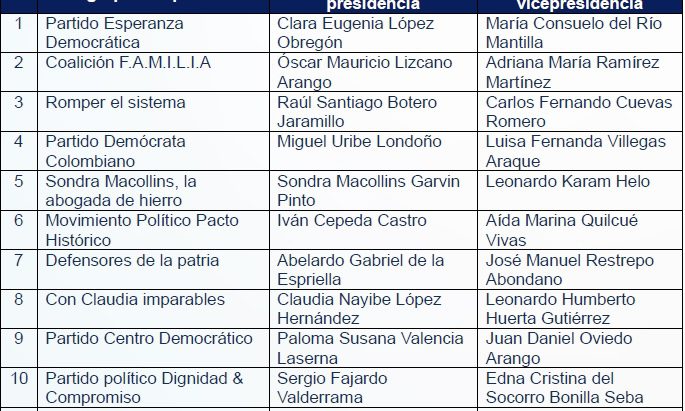
The Registraduría Nacional del Estado Civil of Colombia (RNEC), the entity responsible for organizing elections in the country, reported that a total of 14 candidates have officially registered to run in the country’s presidential elections, scheduled for May 31, 2026. In this vote, citizens will elect the President and Vice President of the Republic for the 2026–2030 term.

According to the electoral authority, the candidates represent a wide range of political perspectives, from left to right, including independent candidacies running through political movements. Here the list and brief profile of the candidates:

  1. Clara Eugenia López Obregón, currently a senator for the Esperanza Democrática She has served as Minister of Labor (2016–2017), acting mayor of Bogotá (2011–2012), and Bogotá’s secretary of government (2008–2010). She has been affiliated with left-wing parties and was Gustavo Petro’s vice presidential running mate in the 2010 election.
  2. Óscar Mauricio Lizcano, from the FAMILIA coalition. He served as Minister of Information Technologies (2023–2025), was a senator (2010–2018), and a member of the House of Representatives (2006–2010).
  3. Raúl Santiago Botero, candidate of the “Romper el Sistema” movement (Break the Establishment). An agronomist engineer and businessman from Medellín, he presents himself as an independent candidate with no prior political experience.
  4. Miguel Uribe Londoño, father of the slain presidential candidate Miguel Uribe Turbay. He is running under the Colombian Democratic Party and previously served as president of the Centro Democrático party founded by Álvaro Uribe Vélez.
  5. Sondra Macollins Garvin, from the movement “La Abogada de Hierro” (The Iron Lawyer) A criminal lawyer and psychologist, she presents herself as an independent candidate without political affiliations. She ran for the House of Representatives in 2022 and is known for her work in narcotrafficking and corruption cases.
  6. Iván Cepeda Castro, a senator since 2014 and the official candidate of the Pacto Histórico, the same party as President Gustavo Petro. Polls project he will receive the highest vote share in the first election round. He is aligned with left-wing political ideas.
  7. Abelardo de la Espriella, a lawyer with far-right positions, running for the first time under the Defensores de la Patria movement. Recent polls place him as a likely second or third contender in voter preference.
  8. Claudia López Hernández, former mayor of Bogotá (2020–2023) and former senator (2014–2018), running under the centrist movement “Imparables con Claudia.” She is known for her anti-corruption agenda and secured her candidacy with more than 570,000 votes (about 9%) in recent interparty primaries.
  9. Paloma Valencia Laserna, current senator and candidate of the Centro Democrático party led by Álvaro Uribe Vélez. She won the right-wing interparty primary on March 8 with more than 3 million votes. Polls place her among the top three contenders, and if she reaches a runoff, she would become the first woman in Colombia’s history to do so.
  • Sergio Fajardo Valderrama, an academic and mathematician running for the Dignidad y Compromiso He served as mayor of Medellín and governor of Antioquia and is running for president for the third time.
  • Roy Barreras, from the political party La Fuerza (The Force). He won the left-wing coalition primary on March 8 with the lowest vote total (257,000 votes, about 3.6%). Although currently aligned with left-wing movements and part of the Petro administration, he has previously been affiliated with right- and center-leaning parties.
  • Gustavo Matamoros Camacho, of the Colombian Ecologist Party. He served in the Colombian Army for 43 years. With no prior political experience, his campaign focuses on public security.
  • Luis Gilberto Murillo, who served as Minister of Foreign Affairs (2024–2025) and Colombia’s ambassador to the United States (2022–2024). A human rights advocate and Afro-Colombian leader from Chocó, he presents himself as an independent, moderate, centrist candidate.
  • Carlos Eduardo Caicedo, running under the independent movement “Con Caicedo.” He was mayor of Santa Marta (2012–2015) and governor of Magdalena (2020–2023), where he built a strong base as a left-wing political leader.

The RNEC also reported that “the draw to determine the position of presidential candidates on the ballot will take place on March 25 at the Ágora Bogotá Convention Center.”

This process marks the formal start of the final phase of the presidential campaign, during which candidates will seek to consolidate support ahead of the first round on May 31. If no candidate secures an absolute majority, a runoff between the two leading candidates will be held on June 21.

List of registered candidates for Colombia’s presidency. Photo courtesy of the Registraduría Nacional del Estado Civil.

List of registered candidates for Colombia’s presidency. Photo courtesy of the Registraduría Nacional del Estado Civil.

Headline photo: Polling station in Colombia during last Congress elections in March 8, 2026. Photo courtesy of the Registraduría Nacional del Estado Civil.

Miguel Uribe Londoño Relaunches Colombia Presidential Bid Under AfroColombian Political Alliance

16 February 2026 at 18:09

Uribe Londoño’s presidential hopes had been paused due to his falling out with Alvaro Uribe’s Centro Democrático party.

Miguel Uribe Londoño has officially launched his second campaign for the presidency of Colombia ahead of the 2026 elections. For this cycle, the 73-year-old former senator will represent the Partido Demócrata Colombiano, a political organization focused on afrocolombian rights and representation, and that secured its legal standing following the 2022 election of Representative Ana Rogelia Monsalve to the seat reserved for Afro-descendant communities. This marks a significant shift for Uribe Londoño, who had been running under Alvaro Uribe’s (no relation) Centro Democrático party, just has his son, the slain presidential candidate Miguel Uribe had been doing.

Miguel Uribe Londoño took up the presidential campaign left whin his son, Miguel Uribe Turbay, was assassinated last year while campaigning in Bogotá.

The move follows a public fracture between Uribe Londoño and the leadership of the Centro Democrático, headed by former President Alvaro Uribe. Uribe Londoño resigned his membership after alleging that the party leadership marginalized his candidacy to favor other internal aspirants, including Senator and actual party nominee Paloma Valencia. He claimed his internal polling numbers were higher than those of the candidates eventually endorsed by the party. The Partido Demócrata Colombiano, while sharing a similar name, is a distinct entity from the Centro Democrático.

The candidate’s 2026 platform, that would be viewed as center-right by most impartial observers, is structured around the principles of protection, order, and justice. Uribe Londoño has proposed an economic model focused on wealth creation, stating that the generation of capital must precede distribution to avoid the socialization of poverty. His security strategy advocates a justice system capable of delivering prompt sanctions against criminal activity and a protection model that applies to both urban and rural sectors. He asserted that current presidential contenders are offering inadequate solutions to the various crises facing the nation.

During the announcement, Uribe Londoño framed his candidacy as a tribute to the legacy of his son, Miguel Uribe Turbay. He stated that his participation in the race is intended to ensure that his son’s political proposals are not silenced following his death. While Uribe Londoño has not historically been linked to Afro-Colombian social movements, Pedro Adán Torres, president of the Partido Demócrata Colombiano, expressed support for the bid, citing a shared commitment to achieving tangible justice for ethnic communities in Colombia.

The Partido Demócrata Colombiano currently holds one seat in the Colombian Congress. By providing a platform for Uribe Londoño, the party seeks to elevate its influence in a political landscape often dominated by larger traditional movements. The campaign will likely test the viability of smaller party platforms and the influence of independent conservative voices outside the traditional Centro Democrático structure as the 2026 election cycle approaches in Colombia.

Above photo: Twitter/X account of Miguel Uribe Londoño

❌