
Normal view

Strike Threat Looms as Colombia Oil and Gas Union Calls for Ecopetrol President’s Removal

26 March 2026 at 20:37

The petroleum workers called for Ricardo Roa’s head following formal influence-peddling charges filed by Colombia’s Attorney General’s Office.

One of Colombia’s principal petroleum worker’s unions, the Unión Sindical Obrera (USO), has formally requested that Ecopetrol’s board of directors remove Ricardo Roa Barragán as president of the state-controlled oil company, amid ongoing investigations against him by the Attorney General’s Office. The union warned that it will call a nationwide strike if the request is not addressed.

The request was made in a letter dated March 24, sent after a meeting between union representatives and the company’s board. In the document, the USO stated that, “understanding the feelings of the Colombian people as reflected by the thousands of Ecopetrol workers, we immediately request that, within the framework of due diligence, the board of directors adopt the necessary measures to remove Dr. Ricardo Roa Barragán from his position as president of Ecopetrol.”

The union added that, if the request is not met, “this union will call for nationwide mobilization in defense of the most important asset of the Colombian people.”

On the same day, March 24, Ecopetrol’s board issued a public response, reported by outlets such as Caracol Radio, stating that it had reviewed requests from employees, the union and some minority shareholders.

In its statement, the board said it is “aware of its responsibilities within the framework of due diligence” and has been assessing the risks to the company stemming from reports related to Roa. However, it confirmed that Roa will remain in his position while the evaluation process continues.

The union’s request follows charges filed by the Attorney General’s Office on March 11 against Roa for alleged influence peddling. According to prosecutors, Roa is accused of favoring a third party in the allocation of a project in exchange for a reduction in the price of an apartment he purchased in 2023.

More details on the case can be found in the article “Colombia’s Top Prosecutor Charges Ecopetrol President in Alleged Influence-Peddling Case,” published by Finance Colombia.

At this stage, although the information has been publicly reported, judicial decisions remain under the authority of the Attorney General’s Office, which is leading the proceedings.

Roa’s legal situation is also linked to another investigation involving alleged irregularities in the financing of the Pacto Histórico presidential campaign in 2022, which he managed and which resulted in Gustavo Petro’s election as president.

In February, the Attorney General’s Office said investigators found indications that the campaign may have exceeded legal spending limits. A similar case had already been reviewed by Colombia’s elections authority, the National Electoral Council, which fined those responsible more than $5 billion Colombian pesos (over $1.4 million USD).

Photo by Ecopetrol.
Grupo EPM Achieves $40.6 Trillion COP Revenue Amidst Regulatory and Climate Headwinds

24 March 2026 at 14:36

Grupo EPM, the multi-utility conglomerate owned by the municipality of Medellin, reported consolidated revenue of $40.6 trillion COP (approx. $11 billion USD) for the full year 2025. Despite a year characterized by climate variability and increased regulatory pressure, the group saw net income rise to $5.3 trillion COP, a 9% increase compared to 2024 results. Earnings before interest, taxes, depreciation, and amortization (EBITDA) reached $11 trillion COP ($2.98 billion USD).

The Medellín utility unit, EPM, contributed $20 trillion COP in revenue and $4.9 trillion COP in net income. Management attributed the stability of these figures to a diversified portfolio. Power generation remains the primary driver of profitability, accounting for 49% of net income, followed by energy distribution at 27%. The water, sewage, and waste management sectors contributed 15%, while transmission and natural gas accounted for 3% and 1% respectively.

In 2025, Grupo EPM obtained results that confirm its ability to advance in complex scenarios, reflecting work to achieve lasting efficiencies.” — John Maya Salazar, General Manager of EPM

Financial leverage remained within contractual covenants. The debt-to-EBITDA ratio for the group closed at 2.9x, comfortably below the 3.5x threshold required by many credit agreements. For the individual EPM entity, the ratio stood at 3.5x. This solvency allows the organization to continue its capital expenditure program, which saw $5 trillion COP ($1.36 billion USD) invested in infrastructure and social programs throughout the year.

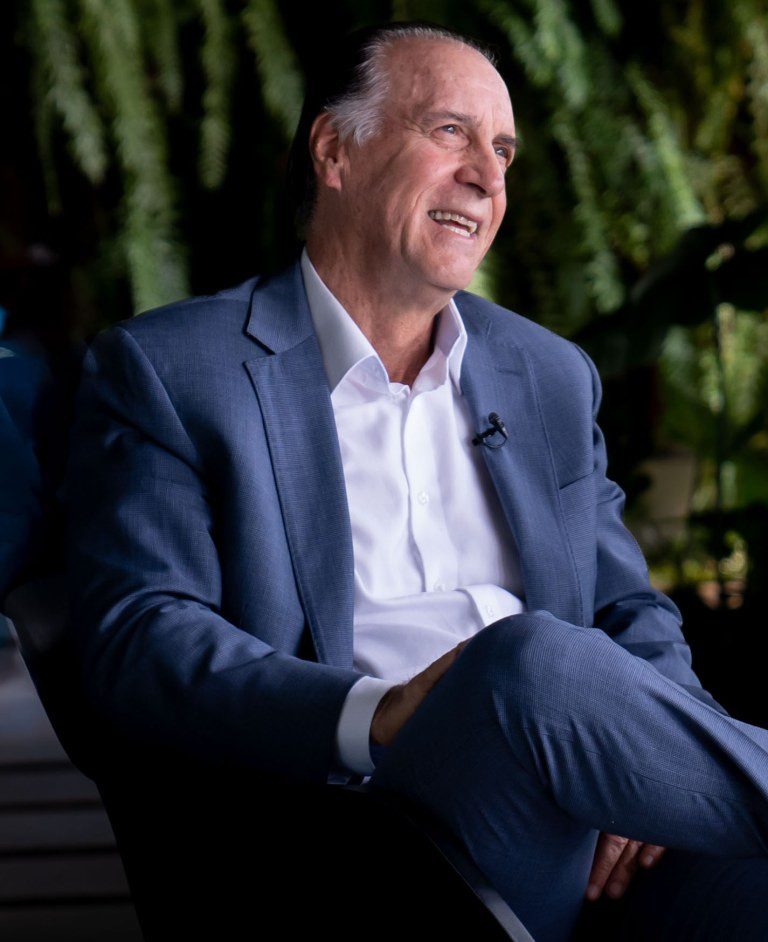
John Maya Salazar, General Manager of EPM (photo courtesy EPM)

John Maya Salazar, General Manager of EPM (photo courtesy EPM)

A significant portion of the capital budget was directed toward the Hidroituango hydroelectric project. Approximately $1 trillion COP was allocated to Stage 2 of the project, specifically turbine units 5 through 8. Beyond energy, the company continued funding the Unidos por el Agua and Unidos por el Gas initiatives, which target utility access for vulnerable populations in the department of Antioquia and other regions.

Dividend and Fiscal Transfers

During the 2025 fiscal period, EPM executed transfers totaling $2.6 trillion COP to the Distrito de Medellín. These funds, representing 55% of the utility’s 2024 net income, serve as a primary funding source for the municipal development plan. Additionally, the group generated $21.8 trillion COP in total added value across its areas of operation, including $3.7 trillion COP in taxes, fees, and contributions to the state.

The company is currently undergoing a structural reorganization intended to modernize its operating model. According to management, this transition is designed to improve strategic efficiency as the group faces future macroeconomic shifts. The group’s economic footprint in 2025 included $6.7 trillion COP paid to suppliers and the financial system, along with $3 trillion COP dedicated to direct and indirect employment costs. Total reinvestment into the group’s various subsidiaries reached $5.6 trillion COP to ensure infrastructure modernization.

Financial data and sustainability reports are routinely filed with the Superintendencia Financiera de Colombia. Interested parties can find further information on the company’s investor relations portal or through the Alcaldía de Medellín official website.

Above video: An aerial view of EPM’s Hidroituango hydroelectric dam(video © Loren Moss)

Frontera Energy Reports Loss While Pursuing Divestiture of Exploration & Production Assets

23 March 2026 at 17:43

Sale to Parex shifts company focus to midstream assets and LNG.

Frontera Energy Corporation (TSX: FEC) announced a net loss from continuing operations of $663 million USD for the fourth quarter of 2025. This figure includes a non-cash impairment of $603 million USD related to the divestment of the company’s Colombian exploration and production (E&P) portfolio and a $17 million USD impairment regarding its Guyana interest. The company has scheduled a special meeting of shareholders for April 30, 2026, to vote on the divestiture of these assets to Parex Resources Inc. (TSX: PXT).

The definitive agreement for the divestiture establishes a firm value of approximately $750 million USD. The transaction includes up to $525 million USD in equity consideration. Following the completion of the sale, Frontera Energy Corporation intends to distribute approximately $470 million USD to shareholders, which equates to approximately CAD $9.18 per share. This distribution includes a $25 million USD contingent payment.

The divestment marks a strategic shift for the Calgary-based company as it transitions into an infrastructure-focused business model. The new structure is anchored by interests in the Oleoducto de los Llanos Orientales S.A. (ODL) pipeline and the Sociedad Portuaria Regional Puerto Bahía S.A. maritime terminal. For the full year of 2025, the infrastructure segment reported an adjusted EBITDA of $116.6 million USD and a distributable cash flow of $76.7 million USD.

“Frontera now enters its next phase as a more focused, cash-generative infrastructure company, well positioned to deliver durable returns.” — Gabriel de Alba, Chairman of the Board of Directors, Frontera Energy Corporation

A central component of this new strategy is the development of a potential liquefied natural gas (LNG) regasification project in partnership with Ecopetrol S.A. (NYSE: EC, BVC: ECOPETROL). Puerto Bahía has secured a take-or-pay agreement with Ecopetrol S.A., subject to certain conditions, for the project. The initiative is planned in two phases, starting with an initial capacity of approximately 126 million cubic feet per day (MMcfd), with projections to reach at least 300 MMcfd by 2029.

In terms of operational metrics for 2025, Frontera reported an average production of 39,011 barrels of oil equivalent per day (boed). The company recorded an operating EBITDA of $308 million USD for the year. Production costs averaged $9.23/boe, while energy costs were $5.49/boe and transportation costs reached $12.00/boe.

The year-end independent reserves assessment, conducted by DeGolyer and MacNaughton Corp, placed the company’s gross reserves at 94.4 million Boe for the 1P category and 133.8 million Boe for the 2P category. All of the company’s booked reserves as of December 31, 2025, are located within Colombia.

On the environmental and social front, the company reported that 70,162 tons of CO2 equivalent were absorbed through environmental compensation areas in 2025. Additionally, 35% of operational water was reused during the same period. The company also noted a total of $95.1 million USD in purchases from local goods and services suppliers.

Upon the anticipated closing of the arrangement in the second quarter of 2026, Frontera Energy will retain its midstream assets in Colombia and certain non-Colombian interests, including those in Guyana. The company expects to allocate $25 million USD from the sale proceeds to further fund its infrastructure business and strategic growth projects.

Leaked Internal Documents Point to Possible $42 Million USD Corrupt Deal Inside Ecopetrol

22 March 2026 at 20:20

Ricardo Roa was appointed CEO of Ecopetrol after serving as Colombian President Gustavo Petro’s campaign manager. The Presidential campaign is also under investigation for campaign finance violations.

The controversy surrounding the filing of charges against Ricardo Roa Barragán, president of Colombia´s oil and energy company, Ecopetrol, has taken a new turn following the leak of an internal report suggesting that more than $42 million USD may have been transferred to a private company based in the British Virgin Islands.

According to disclosed information, “the media outlet 6AM W obtained documents showing the link between the USD 42 million payment made by Ecopetrol and a company connected to Serafino Iácono,” as stated by the outlet itself.

It is important to recall that on March 11, Colombia’s Attorney General’s Office (Fiscalía General de la Nación – FGN) formally charged Ricardo Roa Barragán with the alleged crime of influence peddling by a public official. According to the accusation, the executive allegedly intervened to favor a third party (Serafino Iácono) in the assignment of a gasification project in exchange for personal benefits. The FGN stated that Roa “ordered that a specific person be assigned to a gasification project in exchange for a reduction in the price of an apartment” located in northern Bogotá. During the hearing, the executive did not accept the charges.

Regarding the leaked documents, 6AM W reports that the published material “is a memorandum produced following a communication between the lawyers of Miller & Chevallier, hired by Ecopetrol, and Charles Cain, head of the Anti-Corruption Unit for Foreign Operators at the US Securities Exchange Commission (SEC).” This suggests that the document is an internal Ecopetrol report produced in 2024.

Additionally, the report includes references to an “audit commissioned by Ecopetrol to Control Risks, which identifies Iácono as a possible beneficiary of the alleged irregular payment of $42 million USD made through a purchase option” of power generation plants linked to the company Genser, associated with the businessman.

The leaked documents can be accessed through the Caracol Radio website via “Las contradicciones de Ecopetrol y Serafino Iácono en el caso del apartamento de Roa y Termomorichal.”

For his part, Serafino Iácono issued a statement, published by La República via the social network X, in which he affirms that since April 7, 2017, he has had no relationship with the company and that the transaction in question took place in 2023, after his departure.

At this stage, although the information has been reported by the media, judicial decisions remain under the authority of Colombia’s Attorney General’s Office, which is leading the proceedings against Ricardo Roa. Iacono said that he would be filing suit against Control Risks, and hired well-known Colombian lawyer Jaime Lombana Villalba to begin the process.

For further context, readers are encouraged to consult the article “Colombia’s Top Prosecutor Charges Ecopetrol President in Alleged Influence-peddling Case,” published by Finance Colombia.

Beyond the communications previously issued and reported by Finance Colombia in the aforementioned article, no new official statements have been released by Ecopetrol’s board of directors since March 12, prior to the information leak. Finance Colombia has reached out to Iacono for comment and will report any additional information.

Colombia’s Top Prosecutor Charges Ecopetrol President in Alleged Influence-Peddling Case

18 March 2026 at 22:07

The charge adds to a separate investigation over alleged violations of campaign finance limits during President Gustavo Petro’s 2022 presidential campaign

Colombia’s Attorney General’s Office (Fiscalía General de la Nación – FGN) charged the president of the country’s state-controlled oil and energy company Ecopetrol (NYSE: EC’, BVC: ECOPETROL), Ricardo Roa Barragán, with the alleged crime of influence peddling by a public official. The charge was formally presented on March 11 during a public hearing.

According to the prosecutors press release, Roa “ordered that a specific person be assigned to a gasification project in exchange for a reduction in the price of an apartment” located in northern Bogotá. The Attorney General’s Office said the alleged intervention was related to the executive’s interest in acquiring the property below market value.

During the hearing, a prosecutor from the Specialized Anti-Corruption Directorate formally presented the charge. However, Roa did not accept the accusation.

The newspaper El Colombiano explained that “the filing of charges is a formal act within the criminal process through which the person under investigation is officially notified of their link to a judicial case and the facts attributed to them. However, this step does not imply a conviction or a final decision and maintains the presumption of innocence that protects the executive.”

After the judicial decision became public, Ecopetrol’s Board of Directors said Roa will remain in his position as president of the company. In a public statement, the company’s highest governing body said it respects “Ricardo Roa’s presumption of innocence and his right to due process.” It also said it will continue acting according to the company’s established protocols for evaluating this type of situation.

Roa pled innocent to the influence trafficking charges.

Context: political, legal, and corporate challenges

Ecopetrol is currently facing several political and economic challenges. These include judicial and disciplinary proceedings involving its president, as well as questions about the company’s institutional and financial stability.

For example, the company’s 2025 annual report sparked public debate after reporting the highest reserve replacement ratio in the last four years (121%). According to the document, “300 million barrels of oil equivalent (BOE) were added, guaranteeing an average reserve life of 7.8 years.”

The report also said, “net proven reserves reached 1.944 billion barrels of oil equivalent.” However, private firms such as the independent investment bank BTG Pactual questioned those figures due to a change in the methodology used to calculate them.

Another point of debate has been the presidency of the Board of Directors, currently headed by Ángela María Robledo Gómez, a psychologist and former member of Colombia’s House of Representatives for Bogotá. Robledo was a member of the Partido Alianza Verde between 2010 and 2018 and later ran as vice presidential candidate alongside Gustavo Petro in the 2018 elections.

Roa’s legal situation is also linked to another investigation related to alleged irregularities in the financing of the Pacto Histórico presidential campaign in 2022, which he managed and which resulted in Petro becoming president.

In February, the Attorney General’s Office said investigators had found evidence suggesting that the campaign exceeded the legal spending limits. A similar case had already been examined by Colombia’s elections regulator Consejo Nacional Electoral, which fined those responsible more than $5 billion Colombian pesos (over $1.4 million USD).

For his part, Colombian President Gustavo Petro has publicly defended Roa. During a public event broadcast by media outlets such as Blue Radio, the president said the accusations are politically motivated. “We did not exceed spending limits; I have reviewed that accounting up and down,” he said. He also argued that the opening of criminal proceedings could be interpreted as an attempt to politically target his government.

Headline photo: Colombian President Gustavo petro (left) with former campaign manager and current Ecopetrol CEO Ricardo Roa (photo courtesy Ecopetrol).

Frontera To Sell Colombian Petroleum E&P Assets To Parex For $750 Million USD

14 March 2026 at 21:48

Frontera must pay a $25 million USD breakup fee to Geopark.

Frontera Energy Corporation (TSX: FEC) has entered into a definitive arrangement agreement to divest its Colombian upstream exploration and production (E&P) portfolio to Parex Resources Inc. (TSX: PXT) for a total firm value of approximately $750 million USD. The transaction follows the termination of a previous agreement with GeoPark Limited (NYSE: GPRK). Frontera opted for the Parex proposal after the Calgary-based independent producer offered $525 million USD in equity consideration, a $125 million USD increase over the prior GeoPark bid. As part of the transition, Frontera has paid a $25 million USD breakup fee to GeoPark.

The $525 million USD equity consideration includes an immediate $500 million USD cash payment upon closing and a $25 million USD contingent payment. The latter is dependent on the execution of a contractual amendment or binding agreement to extend the term of the Quifa Association Contract within 12 months.

Beyond the cash equity, Parex will assume $390 million USD in existing Frontera liabilities. This includes $310 million USD in 2028 Senior Unsecured Notes and an $80 million USD prepayment facility with Chevron Products Company, a subsidiary of Chevron Corporation (NYSE: CVX).

Following the close of the deal, Frontera intends to distribute approximately $470 million USD to its shareholders, which equates to roughly $9.18 CAD per share based on current exchange rates and outstanding share counts. This distribution is subject to shareholder approval and the successful completion of the transaction.

Frontera is retaining its exploration interests in Guyana.

Shift to Infrastructure Focus

Upon completion, Frontera will pivot its corporate strategy to focus exclusively on energy infrastructure. Its remaining portfolio will be anchored by two primary Colombian assets:

The company will also retain its exploration interests in Guyana. Frontera’s infrastructure division generated approximately $77 million USD in distributable cash flow in 2025. Post-transaction, Frontera expects to maintain $50 million USD in cash reserves to fund growth projects, including a potential Liquefied Natural Gas (LNG) regasification project in partnership with Ecopetrol S.A. (NYSE: EC; BVC: ECOPETROL).

Orlando Cabrales, CEO of Frontera, noted that Parex is currently the largest independent operator in Colombia and a pre-existing partner in the VIM-1 block, which suggests operational continuity for the assets and employees involved.

The independent members of Frontera’s Board of Directors have unanimously recommended the deal. Major shareholders The Catalyst Capital Group Inc. and Gramercy Funds Management LLC, who collectively hold approximately 53% of Frontera’s outstanding shares, have signed support agreements to vote in favor of the arrangement.

Timeline and Approvals

The transaction is structured as a plan of arrangement under the Business Corporations Act of British Columbia. It requires the approval of at least two-thirds of the votes cast by Frontera shareholders at a forthcoming special meeting.

The deal is also subject to approval by the Supreme Court of British Columbia and relevant regulatory bodies in both Canada and Colombia. Parex will fund the acquisition through existing cash, credit facilities, and an underwritten financing commitment from Scotiabank (TSX: BNS; NYSE: BNS). Closing is anticipated in the second quarter of 2026.

Citi (NYSE: C) served as the financial advisor to Frontera, while BMO Nesbitt Burns Inc. provided a fairness opinion. Legal counsel was provided by Blake, Cassels & Graydon LLP and McMillan LLP.

Above photo: Frontera Energy’s Quifa field Meta Colombia. Photo credit: Frontera Energy.

Colombia, Ecuador locked in trade dispute as pipeline tariff jumps 900%

27 January 2026 at 20:05

Ecuador has sharply increased tariffs on Colombian crude oil transported through its pipeline system, deepening a trade and energy dispute between the two Andean neighbours that has already disrupted electricity exports and bilateral commerce.

Ecuador said on Tuesday it had raised the tariff paid by Colombia for each barrel of oil transported through the state-owned Trans-Ecuadorian Oil Pipeline System (SOTE) by 900%, lifting the fee from $3 to $30 per barrel. The move came in response to Colombia’s decision to suspend electricity exports to Ecuador from Feb. 1, 2026.

Bogotá has yet to issue an official response to the tariff increase.

The dispute has widened beyond trade into energy cooperation and crude transportation, straining relations between the two countries amid longstanding tensions over border security and cooperation against drug trafficking.

Without explicitly referring to the trade conflict, Colombia’s Ministry of Mines and Energy last week issued a resolution suspending international electricity transactions (TIE) with Ecuador, describing the measure as a preventive step aimed at protecting Colombia’s energy sovereignty and security amid climate-related pressures on domestic supply.

Colombia is a key electricity supplier to Ecuador, particularly during periods of drought. Ecuador has faced prolonged power cuts in recent years, including in 2024 and 2025, in a country where roughly 70% of electricity generation depends on hydropower.

Colombia’s leftist President Gustavo Petro said his country had previously acted in solidarity during Ecuador’s worst drought in decades. “I hope Ecuador appreciated that when it needed us, we responded with energy,” Petro said last week.

Ecuador’s Environment and Energy Minister Inés Manzano said the crude transport tariff increase applied to Colombia’s state oil company Ecopetrol and private firms exporting oil through the SOTE. “We made a change in the tariff value,” Manzano said. “Instead of three dollars, it is now 30 dollars per barrel.”

According to Ecuadorian news outlets, the SOTE transported nearly 10,300 barrels per day of Colombian crude in November, shipped by Ecopetrol and private companies.

Manzano has also said Ecuador will impose new fees on Colombian crude transported through the Oleoducto de Crudos Pesados (OCP) pipeline, citing reciprocity following Colombia’s suspension of electricity exports.

The trade conflict began last week when Ecuadorian President Daniel Noboa, a close political ally of U.S. President Donald Trump, announced a 30% tariff on imports from Colombia, effective from February. Speaking from the World Economic Forum in Davos, Noboa said the measure was justified by what he described as insufficient cooperation from Bogotá in combating drug trafficking and organised crime along the shared border.

“We have made real efforts of cooperation with Colombia,” Noboa said in a post on social media, adding that Ecuador faces a trade deficit of more than $1 billion with its neighbour. “But while we insist on dialogue, our military continues confronting criminal groups tied to narcotrafficking on the border without cooperation.”

Colombia’s foreign ministry rejected the move as unilateral and contrary to Andean Community (CAN) trade rules, sending a formal protest note to Quito. Bogotá has proposed a high-level ministerial meeting involving foreign affairs, defence, trade and energy officials to de-escalate the dispute, though no date has been confirmed.

Colombia’s Ministry of Commerce, Industry and Tourism (MinCIT) responded by announcing a 30% tariff on 23 Ecuadorian products, which have not yet been specified, with the option to extend the measure to additional goods. Trade Minister Diana Marcela Morales Rojas said the tariff was proportional, temporary and intended to restore balance to bilateral trade.

“This levy does not constitute a sanction or a confrontational measure,” the ministry said in a statement. “It is a corrective action aimed at protecting the national productive apparatus.”

Business groups say Colombia exports mainly electricity, medicines, vehicles, cosmetics and plastics to Ecuador, while importing vegetable oils and fats, canned tuna, minerals and metals. Ecuador’s exporters federation, Fedexpor, said non-oil exports to Colombia rose 4% between January and November last year, with more than 1,130 products entering the Colombian market.

Colombia and Ecuador share a 600-kilometre border stretching from the Pacific coast to the Amazon rainforest, a region where Colombian guerrilla groups and binational criminal organisations operate, including networks involved in drug trafficking, arms smuggling and illegal mining.

Although Quito and Bogotá have both signalled willingness to engage in dialogue, the rapid escalation of tariffs and energy measures has raised concerns among exporters, energy producers and regional analysts about the risk of prolonged disruption to trade and cooperation between two of the Andean region’s closest economic partners.

Colombia, Ecuador in trade and energy spat after Noboa announces 30% “security” tariff

22 January 2026 at 17:13

Colombia and Ecuador have started exchanging trade retaliations after Ecuadorian President Daniel Noboa announced a 30% “security” tariff on imports from Colombia, escalating tensions between Andean neighbours over border security cooperation.

Noboa said the measure would take effect on Feb. 1 and would remain in place until Colombia shows “real commitment” to jointly tackle drug trafficking and illegal mining along the shared frontier. He made the announcement from Davos, where he is attending the World Economic Forum.

“We have made real efforts of cooperation with Colombia… but while we have insisted on dialogue, our military continues facing criminal groups tied to drug trafficking on the border without any cooperation,” Noboa said in a post on X, citing an annual trade deficit of more than $1 billion.

Colombia’s foreign ministry rejected the tariff in a formal protest note, calling it a unilateral decision that violates Andean Community (CAN) rules, and proposed a ministerial meeting involving foreign affairs, defence, trade and energy officials on Jan. 25 in Ipiales, Colombia’s southern border city.

The government of President Gustavo Petro also announced a 30% tariff on 20 products imported from Ecuador in response, though it has not specified the items. Diana Marcela Morales, Colombia’s Minister of Commerce, Industry and Tourism (MinCIT) said Ecuador’s exports covered by the retaliatory measure total some $250 million, and described the policy as “temporary” and “revisable.”

Fedexpor, Ecuador’s exporters federation, said non-oil exports to Colombia rose 4% between January and November 2025, and that the Colombian market receives more than 1,130 Ecuadorian export products. The top exports include wood boards, vegetable oils and fats, canned tuna, minerals and metals, and processed food products.

The dispute has also spread into the energy sector. Colombia’s Ministry of Mines and Energy said on Thursday it had suspended international electricity transactions with Ecuador, citing climate-related pressure on domestic supply and the need to prioritise national demand amid concerns over a possible new El Niño weather cycle.

Ecuador has struggled with severe droughts in recent years, triggering long power cuts in 2024 and 2025 in a country where roughly 70% of electricity generation depends on hydropower, while Colombia has supplied electricity during periods of shortage.

President Petro noted that Colombia acted in solidarity during Ecuador’s worst drought in 60 years. “I hope Ecuador has appreciated that when we were needed, we responded with energy,” Petro said on Wednesday.

Following Colombia’s electricity suspension, Ecuador announced new tariffs on transporting Colombian crude through its heavy crude pipeline system. Environment and Energy Minister Inés Manzano said the oil transport fee through the OCP pipeline would reflect “reciprocity,” without giving details.

Colombia and Ecuador share a 600-kilometre border stretching from the Pacific coast to the Amazon, where Colombian armed groups and criminal networks operate, including organisations involved in drug trafficking, arms smuggling and illegal mining. Relations between Petro and Noboa, who sit on opposite ends of the political spectrum, have frequently been strained.

Democracy Deferred: Did Washington Abandon María Corina Machado?

5 January 2026 at 23:15

The extraction of Nicolás Maduro on Saturday was meant to signal the end of an era. Instead, it has exposed an uncomfortable truth that may loom over Washington weeks and months after the “shock-and-awe” attacks in central Caracas have waned from headlines: was Venezuela’s democratic opposition sidelined at the very moment it appeared closest to victory?

Just weeks earlier, María Corina Machado, the 2025 Nobel Peace Prize laureate and the symbolic leader of Venezuela’s opposition, had laid out her Freedom Manifesto — a sweeping blueprint for a Venezuelan-led democratic transition rooted in dignity, elections, free markets and the return of millions of exiles. She framed the coming moment not as an American intervention, but as a national rebirth steered by Venezuelans themselves.

That vision now appears to be colliding with a far more transactional reality.

Following Maduro’s capture in a U.S.-led operation, President Donald Trump declined to elevate Machado or her movement into any formal role. Instead, senior U.S. officials have coalesced around Delcy Rodríguez – Maduro’s longtime lieutenant and overseer of the oil sector — as Washington’s primary interlocutor in Caracas. Trump publicly praised Rodríguez’s cooperation while dismissing Machado as a “very nice woman” who “lacks the support” to lead the country.

On Monday, Delsy Rodríguez took the oath of office in the presence of the Ambassadors to China, Iran and Russia. The scene from the National Assembly recalls the sham investiture of Maduro on January 10, 2025,  and sends a dire signal to the internationl community:  Does oil security matter more than a secure democracy?

White House insiders told U.S. media that Trump had never warmed to Machado, “because his feelings got hurt”, reads the Daily Beast. According to an article on Monday in The Washington Post, the president declined to pick Machado because she committed the “ultimate sin” of offending his pride, after receiving the Nobel Peace Prize. “If she had turned it down and said, ‘I can’t accept it because it’s Donald Trump’s,’ she’d be the president of Venezuela today,” cites the newspaper’s sources.

Having lost the Oslo podium as the world’s “peace president,” personal grievance and strategic calculation have marked the White House’s decision to annoint a “moderate” in Miraflores. But Rodríguez is no moderate, and her penchant for state repression remains intact. A  recent article in the Wall Street Journal affirms that Washington is willing to tolerate a Maduro 2.0 — a Chavista continuity government — so long as it cooperates on oil, narcotics enforcement and geopolitical alignment.

On the ground in Caracas, the mood reflects that ambiguity. There have been no mass celebrations, no release of political prisoners, and no clear roadmap. Power remains concentrated within the same military-backed elites that have pillaged Venezuela for over three decades, even as Maduro himself awaits trial in New York on charges expected to exceed those once brought against Joaquín “El Chapo” Guzmán.

U.S. officials insist this is realism, not betrayal. Secretary of State Marco Rubio has argued that squeezing the regime economically and forcing compliance on security and oil will eventually produce leverage. But he has stopped short of demanding immediate elections — a notable omission given that the opposition already won one.

Machado’s Freedom Manifesto now reads less like a transition plan and more like a rebuke. It imagined a Venezuela where sovereignty flowed from the ballot box, not from foreign capitals; where dignity, not expediency, guided reconstruction; and where Venezuelans — not external powers — chose their leaders.

Instead, Trump has suggested that the United States will “run” Venezuela, even as it leaves the same repressive security apparatus intact. The contradiction is stark: maximum news coverage abroad, minimal transformation on the ground.

The question, then, is not only whether Trump sidetracked María Corina Machado, but whether the United States has traded a rare democratic opening for short-term gains. If Chavismo survives without Maduro — its prisons full, its generals untouched, its oil flowing under U.S management — the Nobel laureate’s blueprint may yet stand as the document of a revolution deferred.

And history may judge that Venezuela was not lost for lack of courage at home, but for lack of conviction abroad. In the words of Mexican historian Enrique Krauze, the end-game is inevitable: “If geopolitics seeks to turn Venezuela into a pawn on its chessboard, the people will take to the streets. They have chosen a legitimate president: Edmundo González. And they have a moral leader: María Corina Machado. Obstacles may arise, but Venezuela’s liberation is irreversible.”

EPM Board Approves $29.8 Trillion COP Budget for 2026, Prioritizing Infrastructure and Energy Transition

7 December 2025 at 00:34

The Board of Directors of Empresas Públicas de Medellín (EPM) approved a budget of $29.8 trillion COP for the 2026 fiscal year during its session on December 2, 2025. The budget is intended to guarantee the continued provision of public utility services—including energy, water, and natural gas—while addressing challenges related to regulatory demands, climate variability, the energy transition, and increasing consumer demand.

The budget allocates resources across all of EPM’s business segments, which include Power Generation, Transmission and Distribution, Gas, Water Provision, and Wastewater. The overall spending plan prioritizes projects focused on modernizing infrastructure, expanding service coverage, and optimizing operational efficiency.

Budget Distribution and Key Investments

The 29.8 trillion COP total budget is divided across four main areas, with investments receiving the largest allocation:

  • Investment Expenses (48%): 14.1 trillion COP
    • Infrastructure investments: 4 trillion COP.
    • Long-term contracts for commercial operation and maintenance (registered as investment under current budgetary rules): 6 trillion COP.
    • Assets and inventory related to service provision and investments, provisions, and others: 3.2 trillion COP.
    • Capitalizations and other items: 907 billion COP.
  • Functioning Expenses (28%): 8.5 trillion COP
    • This includes transfers to the District of Medellín totaling 2.4 trillion COP, taxes and contributions to the national and territorial governments totaling 1.2 trillion COP, and personnel expenses amounting to 1.6 trillion COP.
  • Commercial Operation Expenses (10%): 3.1 trillion COP
    • This covers the purchase of energy, natural gas, and other inputs required to guarantee public service delivery.
  • Debt Service (11%): 3.3 trillion COP
  • Final Cash Availability (3%): 800 billion COP

Of the 4 trillion COP earmarked for infrastructure investments, 1.3 trillion COP is designated for the second phase of the Hidroituango Hydroelectric Project, a significant infrastructure development for the nation’s energy stability.

Financing and Operational Focus

The 2026 budget is projected to be financed primarily through 18.3 trillion COP (62%) in current revenues from services provided (energy, gas, water, and wastewater). This will be supplemented by 3.5 trillion COP (12%) from loans, with the remaining 26% sourced from dividends received from subsidiaries, accounts receivable recovery, and the initial cash balance.

The budget focuses on specific initiatives across EPM’s segments:

  • Power Generation: Includes the expansion of generation infrastructure and the implementation of a master plan for fire protection at generation plants. Resources are also allocated for the modernization of the Guadalupe-Troneras power stations.
  • Energy Transmission and Distribution: Focuses on infrastructure expansion and maintenance, replacement of cables and transformers across all voltage levels, and the control of non-technical energy losses.
  • Water and Wastewater: Key projects include the Orfelinato – Villa Hermosa Pumping System, the expansion of the Yulimar circuit, and the modernization of the Ayurá water treatment plant. The budget also funds the construction, intervention, and repair of water and sewer networks.
  • Gas: Initiatives include optimizing operations through the utilization of biogas from the La Pradera facility.

John Maya Salazar, General Manager of EPM, stated that the budget is aimed at enhancing operational efficiency, strengthening resource management, and ensuring service quality within a context of regulatory, climatic, and market challenges.

Headline photo courtesy EPM

Colgas Receives Recognition at Xposible Colsubsidio 2025 for SME Support Initiative

3 December 2025 at 01:44

Colombian propane gas distributor Colgas was recognized at the 2025 edition of Xposible Colsubsidio with the “Companies that Transform Society” award, a distinction granted to organizations with business models that integrate sustainability and social development. The recognition specifically highlighted the company’s corporate purpose and the execution of its “Empowering the Entrepreneurial Spirit” (Potenciar el Espíritu Emprendedor) project, an initiative designed to strengthen entrepreneurs and strategic allies within its value chain.

The 2025 iteration of Xposible Colsubsidio, a program led by Colsubsidio, received a total of over 500 submissions from business initiatives nationwide. The Colgas initiative was selected for its demonstrated capacity to generate value, promote business practices that meet social responsibility criteria, and contribute to the nation’s productivity.

Unusual for companies in Latin America, Colgas pledges to pay small business suppliers within 7 days of invoicing.

Didier Builes, General Manager of Colgas, indicated that the recognition validates the company’s corporate strategy. “At Colgas, we work to boost the entrepreneurs in our country, offering them concrete tools to grow and transform their businesses. This award motivates us to continue building opportunities that positively impact thousands of Colombian families,” Builes stated.

The “Empowering the Entrepreneurial Spirit” project by Colgas incorporates several strategic actions aimed at the formalization and growth of Small and Medium Enterprises (SMEs). Measures implemented include a program that guarantees payment to SME suppliers within 7 days, as well as financial inclusion initiatives designed to facilitate the sustainability of the small businesses associated with the company.

Furthermore, the program includes the Colgas Corporate University for Entrepreneurs (Universidad Corporativa de Emprendedores Colgas), a training platform that has provided instruction to collaborators and allies in areas such as sales, digital marketing, financial management, safety, and the secure use of Liquefied Petroleum Gas (LPG).

Colgas noted that this award reinforces its strategic positioning as an entity that supports productivity and entrepreneurship in Colombia. The company reaffirmed its focus on developing an ecosystem aimed at generating opportunities for the growth of small and medium businesses in the territories where it operates.

Black-market will push Venezuela for bigger discounts following US oil tanker seizure

15 December 2025 at 11:26

The U.S. seizure of an oil tanker off the Venezuelan coast appears designed to further squeeze the economy of President Nicolás Maduro’s government. The Dec. 10, 2025 operation — in which American forces descended from helicopters onto the vessel — followed months of U.S. military buildup in the Caribbean and was immediately condemned by Venezuela as “barefaced robbery and an act of international piracy.”

The seized tanker, according to reports, is a 20-year-old supertanker called Skipper, capable of carrying around 2 million barrels of oil.

According to the Trump administration, the vessel was heading to Cuba. Given its size, however, it is far more likely that the final destination was China. Tankers of this scale are rarely used for short Caribbean routes; much smaller vessels typically serve Cuba.

The tanker had been sanctioned by the U.S. Treasury in 2022 for carrying prohibited Iranian oil. At the time, it was alleged that the ship — then known as Adisa — was controlled by Russian oil magnate Viktor Artemov and linked to an oil smuggling network.

On the surface, the seizure was unrelated to U.S. sanctions imposed on Venezuela in 2019 and expanded in 2020 to include secondary sanctions on third parties doing business with Caracas.

Venezuelan officials have therefore described the move as unprecedented, and they are largely correct. While Iranian tankers have been seized in the past for sanctions violations, this marks the first time a vessel departing Venezuela with a Venezuelan crew has been taken.

The Trump administration has signaled it intends to seize not only the cargo but the ship itself — a significant loss for the owning company. Because the shipment was sold under a “Free on Board” contract, the buyer assumed responsibility once the vessel left Venezuelan waters.

Nonetheless, the seizure represents a clear escalation in pressure on Venezuela. Reports indicate that around 30 other tankers operating near the country face some form of sanction. These vessels are part of a shadow fleet designed to evade restrictions while transporting oil from Venezuela, Russia, and Iran.

The message from Washington is unambiguous: more seizures may follow as the U.S. seeks to further squeeze Venezuelan oil revenues.

Venezuela’s economy remains overwhelmingly dependent on oil. Although official figures have not been published for seven years, most analysts estimate that oil accounts for more than 80% of exports, with some placing the figure above 90%.

Most Venezuelan oil is sold on the black market, largely to independent refiners in China. Chinese state-owned firms avoid these purchases to limit sanctions exposure, while authorities in Beijing tend to overlook shipments to non-state entities — particularly when tankers conceal their true origin.

An estimated 80% of Venezuelan oil ultimately goes to China through this channel. About 17% is exported to the United States under a Treasury license granted to Chevron, while roughly 3% goes to Cuba, often on subsidized terms.

Oil also accounts for around 20% of Venezuela’s GDP and more than half of government revenue, making the sector indispensable to Maduro’s survival.

Crucially, Venezuela’s oil industry was already in steep decline before U.S. sanctions began. Production peaked at 3.4 million barrels per day in 1998, fell to 2.7 million by the time Maduro took office in 2013, and dropped to 1.3 million barrels per day by 2019.

The 2019 oil sanctions shut Venezuela out of the U.S. market, forcing it to rely more heavily on China and India. When secondary sanctions followed in 2020, Europe and India halted purchases altogether. Combined with the pandemic-driven oil slump, production collapsed to just 400,000 barrels per day.

Output has since recovered to about 1 million barrels per day, aided largely by Chevron’s continued operations.

To sustain exports, Venezuela relies on a shadow fleet that uses false flags, renamed vessels, and manipulated transponders. Cargoes are sometimes transferred at sea — posing major environmental risks — before being relabeled in transit hubs such as Malaysia and shipped on to China.

The tanker seizure had little immediate impact on global oil prices due to ample supply and Venezuela’s limited market share. However, a more aggressive U.S. campaign could change that calculus.

For Venezuelan oil prices, the consequences may be sharper. Already heavily discounted due to sanctions risk, Venezuelan crude is now likely to be sold at even steeper reductions. Buyers will demand higher discounts and fewer prepayments, while export volumes may fall, forcing production cuts that are costly to reverse.

The result will be further pressure on the limited revenues Maduro depends on to keep the Venezuelan state afloat.

About the author:
Francisco J. Monaldi, Ph.D., is the Wallace S. Wilson Fellow in Latin American Energy Policy and director of the Latin America Energy Program at the Center for Energy Studies at Rice University’s Baker Institute for Public Policy.

This article is reproduced from The Conversation under a Creative Commons licence

❌