Central bank hike aims to stabilize inflation amid global volatility.
The upcoming monetary policy meeting of the Banco de la República, scheduled for April 30, takes place as the balance of financial risks has shifted significantly compared to the first quarter of 2026. Analysts from Bancolombia (NYSE: CIB) expect the Junta Directiva to increase the benchmark interest rate by 75 basis points, bringing the policy rate to 12.00%.
The convergence of elevated inflation, recent reversal episodes, and misaligned market expectations has reinforced the perceived need for a restrictive monetary stance. This strategy aims to contain domestic demand while preserving the institutional credibility of the central bank. Unlike previous sessions, the current decision-making process is influenced by a shifting global environment where markets have moved toward a higher-for-longer interest rate scenario amid increased uncertainty.
Recent discussions regarding the participation of the Ministro de Hacienda in the Junta Directiva sessions have introduced an additional element of analysis. However, current assessments suggest this does not alter the fundamental policy diagnosis, and no disruptions to the decision-making process are anticipated. Monetary policy is expected to maintain consistency, with the strategic focus shifting from reaching a contractive level to determining the necessary duration of that posture.
Analysts project Banco de la República will raise rates to 12.00% to combat inflation despite slowing domestic economic growth.
The international economic context provides a mixed backdrop for the Colombian decision. Private sector activity in the US appeared to accelerate in April, following a 1.7% monthly increase in retail sales during March. In contrast, the Eurozone reported a contraction in economic activity during April. Energy markets have also seen volatility, with US crude inventories rising in the second week of April while gasoline stocks saw a significant decline. Furthermore, crude prices surged following reports of new security incidents in the Strait of Hormuz.
Domestically, the Departamento Administrativo Nacional de Estadística reported that the Índice de Seguimiento a la Economía grew by 1.6% in February. While imports maintained growth during the same month, the urban unemployment rate across the 13 primary metropolitan areas continued a downward trend through March 2026. In the fixed income market, the central government reported debt levels at 64.2% of GDP for the first quarter, with internal debt accounting for 71.2% of that total.
Market movements reflected these broader trends as the US Treasury curve saw valuation increases driven by investor caution. In the region, Colombia, Brazil, and Uruguay emerged as the primary beneficiaries of the J.P. Morgan (NYSE: JPM) GBI index rebalancing in March. Locally, fixed-rate Títulos de Tesorería experienced devaluations across the entire curve last week. According to the April Encuesta de Opinión Financiera, these devaluations are expected to persist in the coming months. In currency markets, the COP appreciated last week against a backdrop of global and local factors, while the Euro lost ground against the USD.
Headline photo: Bogotá headquarters of Banco de la República (Banrepublica). Photo credit Juan Enrique Rodríguez, courtesy Banrepublica
Apple has announced that longtime Apple CEO Tim Cook will be stepping down from his role on September 1, 2026, concluding a 15 year tenure that has coincided with Apple become one of the largest and most influential companies in the world. Tim Cook will transition to the role of executive chairman of the Apple ... Read More
Current Apple CEO Tim Cook is set to leave his role on September 1, 2026, and as he prepares to step down as CEO, he has written a letter addressed to the Apple community.
Cook said that he starts his day reading notes from Apple users all over the world, which fills him with an indescribable gratitude. According to Cook, Ternus is the perfect person to take over as Apple's CEO.
To the Apple community:
For the past 15 years I've started just about every morning the same way. I open my email and I read notes I received the day before from Apple's users all over the world.
You share little pieces of your lives with me and tell me things you want me to know about how Apple has touched you. About the moment your mom was saved by her Apple Watch. About the perfect selfie you captured at the summit of a mountain that seemed impossible to climb. You thank me for the ways Mac has changed what you can do at work and sometimes give me a hard time because something you care about isn't working like it should.
In every one of those emails I feel the beating heart of our shared humanity. I feel a sense of deepening obligation to work harder and push further. But most of all, I feel a gratitude that I cannot put into words, that I somehow got to be the person on the other end of those emails, the leader of a company that ignites imaginations and enriches lives in such profound ways it defies description. What an honor and a privilege it has been.
Today we announced that I'm taking the next step in my journey at Apple. Over the coming months I will be transitioning into a new role, leaving the CEO job behind in September and becoming Apple's executive chairman. A new person will be stepping into what I know in my heart is the best job in the world. That leader is John Ternus, a brilliant engineer and thinker who has spent the past 25 years building the Apple products our users love so much, obsessed with every detail, focused on every possible way we can make something better, bolder, more beautiful, and more meaningful. He is the perfect person for the job.
John cares so much about who we are at Apple, what we do at Apple, who we reach at Apple, and he has the heart and character to lead with extraordinary integrity. I am so proud to call him Apple's next CEO. This company will reach such incredible heights under his leadership, and you will feel his impact in every bit of delight and discovery that grows out of the products and services to come. I can't wait for you to get to know him like I do.
This is not goodbye. But at this moment of transition, I wanted to take the opportunity to say thank you. Not on behalf of the company, this time, though there is a wellspring of gratitude for you that overflows inside our walls. But simply on behalf of me. Tim. A person who grew up in a rural place in a different time and, for these magical moments, got to be the CEO of the greatest company in the world. Thank you for the confidence and kindness you've shown me. Thank you for saying hi to me on the street and in our stores. Thank you for cheering alongside me when we unveiled a new product or service. Thank you, most of all, for believing in me to lead the company that has always put you at the center of our work. Every day we get up and think about what we can do to make your life a little bit better. And every day, you've made mine the best I could have asked for.
Cook will remain on as Apple CEO until September 1, 2026, which is when John Ternus will take over. After Ternus assumes the role of CEO, Cook will continue to advise Apple in a new role as executive chairman.
Apple's Senior Vice President of Hardware Technologies Johny Srouji is set to take on an expanded role as Apple's Chief Hardware Officer as John Ternus transitions to his role as Apple's next CEO.
Srouji is going to lead Hardware Engineering, reporting to Ternus. Current Apple CEO Tim Cook said that Srouji has been pivotal in Apple's transition to Apple silicon.
Johny is one of the most talented people I have ever had the privilege to work with. He has played a singular role in driving Apple's silicon strategy, and his influence has been felt deeply not just inside the company, but across the industry. He has always led his organization with remarkable deftness and judgment, and time and again, his team has delivered breakthrough innovations that have transformed our products. We are incredibly fortunate to have him as Apple's chief hardware officer.
Srouji is well-known as Apple's chip lead, and he has overseen the development of Apple silicon chips for the Mac. Apple's hardware engineering team is responsible for all of Apple's hardware products, and Srouji will lead everything from product design to system engineering to reliability and durability testing.
Apple CEO Tim Cook is stepping down as Apple's chief executive officer, and hardware engineering chief John Ternus is set to take over, Apple announced today.
Cook will continue on as Apple CEO through the summer, with Ternus set to join Apple's Board of Directors and take over as CEO on September 1, 2026. Cook is going to transition to executive chairman, and he will "assist with certain aspects of the company, including engaging with policymakers around the world."
In a statement, Cook said that his time as Apple's CEO has been the "greatest privilege" of his life.
It has been the greatest privilege of my life to be the CEO of Apple and to have been trusted to lead such an extraordinary company. I love Apple with all of my being, and I am so grateful to have had the opportunity to work with a team of such ingenious, innovative, creative, and deeply caring people who have been unwavering in their dedication to enriching the lives of our customers and creating the best products and services in the world. John Ternus has the mind of an engineer, the soul of an innovator, and the heart to lead with integrity and with honor. He is a visionary whose contributions to Apple over 25 years are already too numerous to count, and he is without question the right person to lead Apple into the future. I could not be more confident in his abilities and his character, and I look forward to working closely with him on this transition and in my new role as executive chairman.
Ternus said that he is optimistic about what Apple can achieve in the years to come.
I am profoundly grateful for this opportunity to carry Apple's mission forward. Having spent almost my entire career at Apple, I have been lucky to have worked under Steve Jobs and to have had Tim Cook as my mentor. It has been a privilege to help shape the products and experiences that have changed so much of how we interact with the world and with one another. I am filled with optimism about what we can achieve in the years to come, and I am so happy to know that the most talented people on earth are here at Apple, determined to be part of something bigger than any one of us. I am humbled to step into this role, and I promise to lead with the values and vision that have come to define this special place for half a century.
Apple says that the transition was approved by the Board of Directors and is the result of a "thoughtful, long-term succession planning process." The current board chair, Arthur Levinson, will become the lead independent director on the board.
Former Foreign Minister Álvaro Leyva releases another scathing attack on his former boss as he fights charges.
On April 10, former Colombian Foreign Minister Álvaro Leyva Durán released a formal statement responding to his indictment by the Fiscalía General de la Nación. Leyva faces charges related to his 2023 decision to declare a passport procurement tender void, a process that involved the private security printing firm Thomas Greg & Sons. The former official characterized the legal proceedings as a politically motivated maneuver orchestrated from the Casa de Nariño.
The indictment for prevarication centers on Leyva’s intervention in the bidding process, which the Fiscalía interprets as a deliberate breach of administrative law. In his defense, Leyva maintained that his actions were necessary to address irregularities and ensure the application of the Constitución Política de Colombia. He argued that the prosecuting body’s thesis would criminalize the conduct of any public servant who identifies unconstitutional terms in a government contract.
“If that argument is accepted, then any official who declares a bidding process void because they find the terms and conditions unconstitutional or illegal should go to jail.” — Álvaro Leyva Durán, former Minister of Foreign Affairs.
Leyva also directed accusations toward his successor at the Cancillería, Luis Gilberto Murillo. According to the statement, Murillo suspended a subsequent legal bidding process to justify a state of emergency, which Leyva claims led to an unnecessary markup of approximately $30 billion COP. Furthermore, Leyva alleged that software contracts exceeding $10 billion COP were improperly managed and that the funds remain unaccounted for under the current administration.
The former minister’s statement included severe personal and political criticisms of President Gustavo Petro. Leyva alleged a lack of moral conduct by the head of state during international state visits and questioned the president’s sobriety in public settings. The letter further asserted that US authorities are currently investigating potential links between the executive branch and narcotics trafficking organizations.
Regarding the domestic political landscape, Leyva warned of perceived risks to the Colombian electoral process. He alleged that the administration has engaged in the illegal interception of political candidates and intends to undermine the integrity of future vote counts. Leyva concluded by affirming his intention to defend his record and his legal decisions before the Corte Suprema de Justicia.
Finance Colombia translation of Leyva’s recent open letter dated April 10th
Some time ago, I denounced in a public communiqué that Gustavo Petro had woven against me an atrocious persecution, as retaliation for my denunciations of his closeness to the world of drugs—denunciations that have led to the United States having him cornered today. There I warned that, from within the government, intrigues were being made to throw me in prison and that attempts would be made against my life.
Now, months later, the Attorney General’s Office accuses me of malfeasance (prevaricato) because I declared void a passport tender that, according to that same institution, was based on a “catch-all specifications document” (pliego sastre). For the accusing entity, I should not have fulfilled the obligation of applying the Constitution that I myself helped draft and, by seeking equality, I acted with malicious intent. The world turned upside down.
Understand the gravity: if that thesis is accepted, any official who declares a tender void because they find unconstitutional or illegal specifications must go to prison. So, faced with such a thing, the trial is welcome. I will give the battle in the Supreme Court with all my strength. Because I trust its magistrates, because my life has been a permanent struggle for Colombia, and because justice, reason, and the law are with me.
The acquittal will be the logical consequence of the process in which I will prove, with official documents and among other things, the following: that I left in motion a new, clean, and legal tender, which Minister Luis Gilberto Murillo suspended. That he thus justified another manifest urgency, completely unnecessary, and added an overcharge of nearly 30 billion pesos to it. And that he contracted software for more than 10 billion additional pesos, which was pocketed. All by hand-picking. All murky. All without control. Thus, by brute force, the door was opened to the passport debacle of today. I warned Petro of what was coming down on the country. But he kept silent.
Today I feel the pride of having helped unmask the boss of the mafia that has plunged Colombia into its darkest hours. I took office as his Foreign Minister with the hope of change. But then I came to know his life of vice and decadence. I was slow to understand his vileness and, surely, also slow to denounce it. But from my father Jorge Leyva Urdaneta, exiled for opposing the dictatorship, I inherited courage and respect for institutions; from Álvaro Gómez Hurtado, I learned the necessity of a just order; and from Misael Pastrana Borrero, I learned to think about social peace. So, faithful to myself and to the spirit of my mentors, I denounced in various letters the moral, political, and personal degeneration that I came to know in Gustavo Petro. And time has proven me right.
The President is an infamous being: international human trafficking is a scourge of the poor girls of Colombia, and he, in the middle of a state visit, ends up as a customer of a brothel in Lisbon; he claims to be a champion of peace, but full of hatred he violently divides society with his stale, classist, and racist rhetoric; he claims to fight drug trafficking, but he goes out into the public square drugged, drunk on alcohol and sectarianism, to mistreat and insult those who contradict him, while in the United States his ties to narcos are being investigated. And so, from scandal to scandal, the horrible night does not cease: the homeland trampled by its own President is today the object of all the mockery abroad.
Petro knows that the upcoming electoral process resembles the one recently lived in Chile. And, to avoid the same result, he illegally intercepts candidates, seeks to destroy them, and is already trying to cast a mantle of doubt over the vote count. But Colombia deserves a new dawn. And the radical left, which—turned into the President’s hooligan squad—forgives him everything, seems condemned to the desert. We shall see whether, in the future, they also forgive him for being responsible for their possible defeat. For my part, I remain ready for all battles: always embracing justice against oppression, and with the law as my spear, shield, and banner.
Jazz summit fosters US-Colombia cultural and professional ties.
The city of Medellín is preparing for a sophisticated display of cultural diplomacy as the Centro Colombo Americano Medellín and Teatro El Tesoro present Noche de Jazz en El Tesoro. Scheduled for Friday, April 24, at 7:00 p.m., this event serves as a high-profile prelude to International Jazz Day. For the international investment community and expatriate executives, the concert represents more than just a musical performance; it is a testament to the enduring soft-power bridges between the US and Colombia, fostering an environment of innovation and collaborative spirit in the heart of Antioquia.
The Centro Colombo Americano Medellín is the driving force behind this cultural exchange. As a non-profit binational center, the Colombo performs vital work in the region by providing high-quality English language instruction and promoting democratic values through the arts. Their initiatives are critical for the local workforce, equipping Colombian professionals with the linguistic and cultural competencies required to engage with global markets and attract foreign direct investment to the Valle de Aburrá (the greater Medellín metro area).
For those attending, Teatro El Tesoro offers a world-class venue located within the prestigious El Tesoro Parque Comercial shopping center. Tickets are available through Tuboleta. Pricing remains accessible for such a high-caliber performance, with general public tickets starting from $64,000 pesos.
Economic activity in Colombia expanded at an estimated annual rate of 2.1% during the first quarter of 2026. According to the latest NowCast report issued by the Grupo Cibest, unit of Bancolombia (NYSE: CIB, BVC: BCOLOMBIA), this outcome reflects a loss of momentum compared to the rolling quarter ended in February. That previous period recorded a growth of 2.2%, which was revised downward by 10 basis points from an initial estimate of 2.3%.
The 2.1% growth rate for the quarter indicates a slowdown relative to both the market consensus average of 2.7% and the internal growth forecast of 3.3% held by the bank. On a month-over-month basis, the seasonally adjusted series of the NowCast index posted a 1.3% contraction in March 2026. When compared to March 2025, economic activity grew by 2% year over year, representing a 50-basis-point decline from the 2.5% reading recorded the previous month.
“Overall, these results suggest that the economy is beginning to lose steam, amid multiple sources of uncertainty.” — NowCast Bancolombia Report
Analysis at the sector level reveals a broadly weaker growth profile, with deceleration appearing across most productive areas. Slower momentum was identified in trade, manufacturing, recreation, real estate, and financial services. Manufacturing expansion cooled to 1.0% in March 2026, while financial services recorded marginal growth of 0.6%. The real estate sector maintained a steady growth rate of 1.9%.
Construction and communications were the only sectors to record negative growth during the period. The construction sector saw a significant downturn, contracting by 2.3% in March 2026 after having posted 1.4% growth in February. The information and communications sector contracted by 0.4%, marking its fourth consecutive month in contractionary territory. Conversely, acceleration was noted in public administration, which grew by 5.1%, agriculture at 3.7%, and mining at 0.8%.
The NowCast family of indicators is prepared by Grupo Cibest through the processing and aggregation of transaction data from the bank’s various payment channels. Using advanced quantitative tools, the index provides high-frequency estimates of Colombian productive activity to complement official data from the Departamento Administrativo Nacional de Estadística. The report was authored by Arturo Yesid González Peña, Head of Quantitative and Analytics, and Sebastián Ospina Cuartas, Data Controller.
The report also incorporates data from the Bloomberg platform and FocusEconomics Consensus Forecasts to provide broader economic context. While the national economy remains in expansionary territory, the analysts suggest that the current results indicate the market is losing steam due to various sources of domestic uncertainty.
A significant number of iPhone users run into situations where they discover their iPhone is not ringing or making sounds with incoming phone calls, text messages, and alerts, leading to missed calls and texts. This is hugely frustrating, but for most situations the reason why this happens is pretty simple; the iPhone has accidentally been ... Read More
Since the start of President Gustavo Petro’s administration, the intelligence agency has had four directors, highlighting instability within one of the institutions responsible for state security.
The resignation of Wilmar Mejía as chief of Colombia’s National Intelligence Agency has highlighted instability within the country’s main intelligence agency under the government of President Gustavo Petro, which has seen four leadership changes over the past three years.
Mejía confirmed his departure on April 1 in an interview with Canal 1. “When the Inspector General’s Office lifted my suspension, I went to sign my reinstatement document and within 15 minutes I submitted my resignation. I am no longer the director of intelligence,” he said.
The official had been suspended since December 23, 2025, by the Inspector General’s Office as part of a disciplinary investigation “for alleged links to and the provision of information to members of dissident factions of the former Revolutionary Armed Forces of Colombia (FARC).” The Inspector Office said at the time that the measure aimed to prevent possible interference with the process.
Investigation into alleged links to guerrilla dissidents
The case is related to the seizure of digital files belonging to Alexander Díaz Mendoza, known as “Calarcá Córdoba,” a leader of one of the dissident structures grouped under the Estado Mayor de Bloques y Frente (EMBF). Authorities say the documents point to possible contacts with the former intelligence chief.
Mejía has denied any involvement and has argued that the accusations are part of alleged “setups aimed at silencing reports of internal corruption.”
According to the Inspector Office, the investigation “includes possible acts such as the disclosure of military force communication frequency codes and support in the creation of security companies that could facilitate the legalization of weapons in the event of a breakdown in peace talks with the government.”
So far, neither the Inspector General’s Office nor the Attorney General’s Office has concluded its investigations, and no determination of responsibility has been made.
The case has raised concerns about state security and the institutional stability of the agency, considered a key body for the country’s strategic intelligence.
Local media outlets such as El Colombiano have reported that the situation has affected trust among international intelligence partners, suggesting that agencies such as the CIA (United States), MI6 (United Kingdom), and Mossad (Israel) have restricted the sharing of strategic information with Colombia.
Four directors in just over three years
Since Petro took office, the agency has had four directors, all of them close to the president through their past involvement in the M-19 guerrilla group, which signed a peace agreement in 1990.
The instability dates back to the beginning of Petro’s administration. Since August 2022, when Manuel Alberto Casanova Guzmán was appointed, the agency has undergone repeated leadership changes.
Casanova, who faced criticism over his lack of intelligence experience and background as a philosopher, was removed following allegations of involvement in a false extortion case linked to then-Foreign Minister Álvaro Leyva, as reported by Infobae.
Finally, just before Mejía, the agency was led by Jorge Lemus, who served for nearly a year before resigning. He was subsequently appointed by Petro as director of the Unidad de Información y Análisis Financiero (UIAF), amid growing allegations of possible infiltration within the country’s security institutions.
After the rocky Handmaid's Tale season 6 finale, The Testaments on Hulu and Disney+ is just the beginning of something even bigger, better, and bolder.
Apple's vice president of fitness technologies Jay Blahnik will retire this summer, bringing to an end a 13-year stint with Apple that was marred by accusations that he created a toxic work environment and sexually harassed an employee.
In an email to employees this week, Apple said Blahnik, 57, will retire in July "to spend time with his family and make an exciting move to New York City," according to The New York Times.
Blahnik joined Apple in 2013 after two decades as a consultant at Nike. He played a central role in developing the Apple Watch's iconic Activity rings (the three colored circles that users close daily by exercising, standing, and burning calories) and later oversaw Fitness+, Apple's subscription workout service featuring video classes for strength work, HIIT, cycling, meditation, yoga, and more.
His leadership of the Fitness+ team however drew serious complaints. In an August 2025 report by the Times, nine current and former employees accused Blahnik of being "verbally abusive, manipulative and inappropriate." More than 10 of the roughly 100 employees on his team had sought extended mental health or medical leaves of absence since 2022, the report said.
Apple settled one complaint alleging sexual harassment by Blahnik and is currently defending him in a separate lawsuit brought by employee Mandana Mofidi, who accused him of bullying. That case is scheduled to go to trial next year.
When employees raised concerns about Blahnik's conduct, Apple initiated an internal investigation and found no evidence of wrongdoing, so Blahnik remained in his role. At the time, Apple spokesperson Lance Lin called the NYT report full of "many inaccurate claims and mischaracterizations," but didn't specify which claims the company disputed.
It's unclear who will succeed Blahnik at Fitness+. Meanwhile, the future of Fitness+ is itself said to be "under review," according to Bloomberg, with services chief Eddy Cue apparently "considering changes" to the service.
Apple Fitness+ launched in 2020. In the U.S., the service costs $9.99 per month or $79.99 per year. Apple Fitness+ is also available as part of the Apple One Premier bundle, with U.S. pricing set at $37.95 per month.
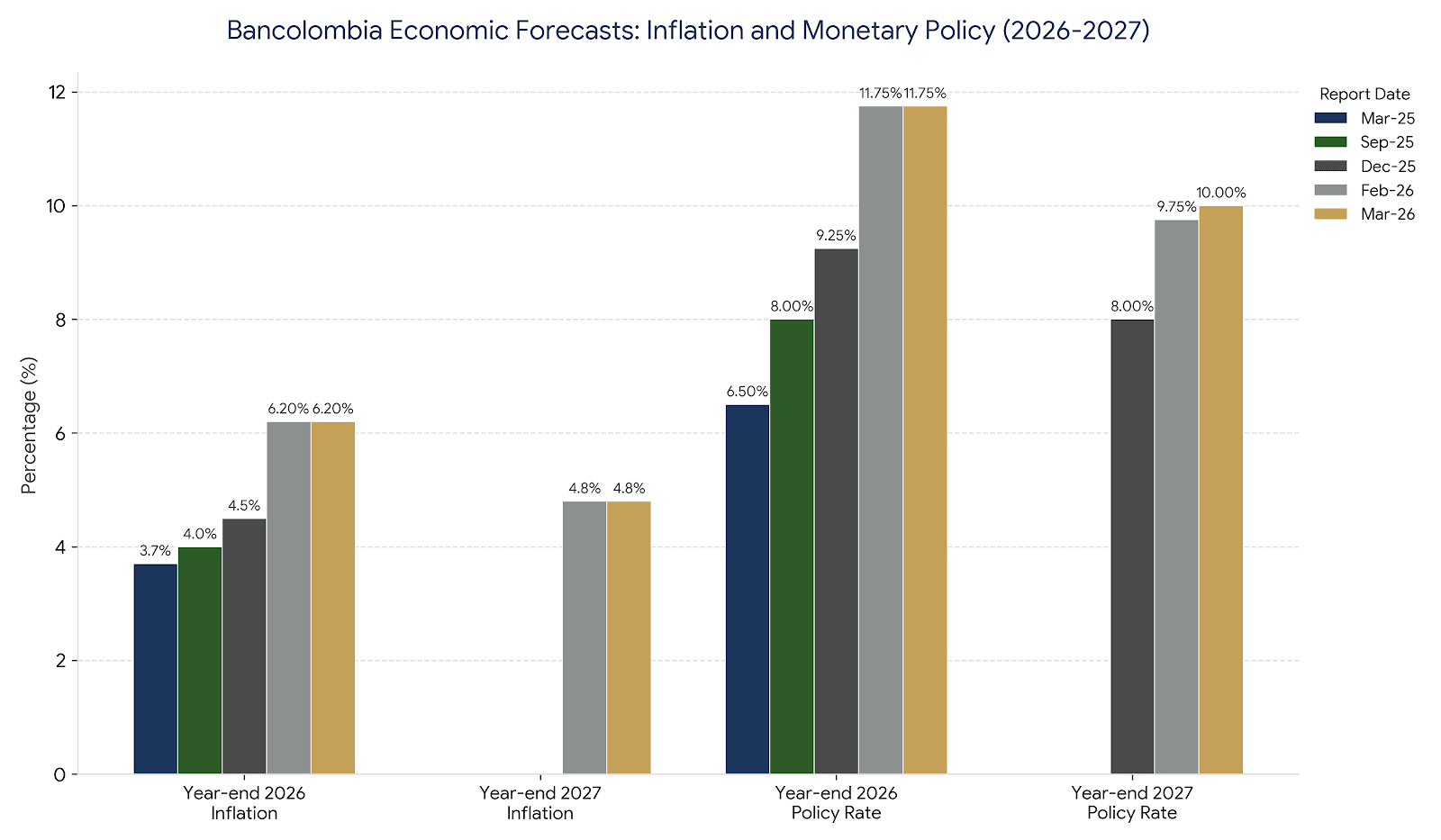
Bancolombia’s analysts expect the Junta Directiva of the Banco de la República to increase its policy interest rate by 100 basis points, bringing it to 11.25 percent. This forecast suggests that the first half of 2026 will be characterized by a more aggressive tightening cycle than previously anticipated, with the rate potentially reaching 12.75 percent.
The international landscape is playing an increasingly decisive role in these local policy configurations. A recent week of central bank decisions globally revealed a shift in tone among major financial institutions, primarily due to rising uncertainty stemming from the conflict in Iran. This geopolitical tension has directly impacted costs for energy, transportation, and agricultural inputs.
In the US, economic activity shows signs of moderation, yet producer price inflation in February exceeded expectations. The yield curve for US Treasuries, managed by the US Department of the Treasury, has shown mixed behavior as the conflict escalates, with the spread between 10-year and 3-month bonds reaching levels not seen since 2023. Inflation expectations in the US have rebounded in the short term, though they remain anchored over longer horizons.
Forecast Category
Mar-25
Sep-25
Dec-25
Feb-26
Mar-26
Year-end 2026 Inflation
3.7%
4.0%
4.5%
6.2%
6.2%
Year-end 2027 Inflation
—
—
—
4.8%
4.8%
Year-end 2026 Policy Rate
6.50%
8.00%
9.25%
11.75%
11.75%
Year-end 2027 Policy Rate
—
—
8.00%
9.75%
10.00%
Domestically, the business indices from think-tank Fedesarrollo showed mixed results for February. However, there are positive indicators in the labor market, as the urban unemployment rate across the 13 primary metropolitan areas continued its downward trend. Additionally, goods exports recorded an advance during the same period.
In the local fixed-income market, the TES fixed-rate curve saw a recovery last week. However, the March Financial Institutions Survey suggests that devaluations of TES may persist in the short term. Long-term TES Class B placements in the first quarter reached 1.0 percent of the GDP.
Chart based on data from Grupo Cibest & the Banco de la República.
Energy markets remain volatile as crude oil inventories in the US increased beyond expectations in the third week of March. Despite this, the price of Brent crude rose toward the end of the week, driven by skepticism regarding a potential ceasefire in the Middle East. The Colombian peso appreciated over the past week, tracking the intensity of the regional conflict.
The equity market results for the fourth quarter of 2025 remained neutral and aligned with market expectations. Global volatility continues to be shaped by energy shocks, geopolitical strife, and a cautious approach toward investments in artificial intelligence.
The projected rate hike by the Banco de la República is intended to send a definitive signal of commitment to price stability. This adjustment reflects not only recent inflation trends but also a strategic effort to prevent the further deterioration of expectations in a high-risk environment.
Headline image: Bogotá headquarters of Banco de la República (Banrepublica). Photo credit Juan Enrique Rodríguez, courtesy Banrepublica
In an in-depth article for Bloomberg Businessweek today, Mark Gurman profiled Apple's hardware engineering chief John Ternus, who is widely viewed as the leading candidate to become Apple's next CEO whenever Tim Cook decides to step down.
The article is very long, so we recommend reading it in full, but a few of the key takeaways are that Ternus is apparently "well-liked among Apple's leadership" and helped with "reversing a trend of declining product quality" at the company.
"Since getting the top hardware engineering role in 2021, he's overseen an expansion in Apple's product lineup, improving quality and focusing on functional improvements around battery life, performance and connectivity," wrote Gurman.
Cook reportedly gave oversight of Apple's design teams to Ternus at the end of last year, and Ternus has been making a lot more public appearances in interviews and in product introduction videos over the past few years. The profile provides a closer look at how Ternus has risen to become the frontrunner to succeed Cook eventually.
Cook has not shared his retirement plans with even some of his closest lieutenants, according to the report, so it is unclear when he plans to step down. Cook has served as Apple's CEO since 2011, and he reached the common retirement age of 65 last year. In a recent interview, he vaguely said "I can't imagine life without Apple."
Medellín, Colombia’s second-largest city, is often cited globally as a textbook example of urban transformation. Central to this evolution is ACI Medellín, the city’s specialized Agency for Cooperation and Investment. By fostering a unique “triple helix” collaboration between the public sector, private enterprise, and academia, the agency has managed to maintain a stable environment for capital even during periods of national political volatility.
In this exclusive interview, Loren Moss, Executive Editor of Finance Colombia, speaks with Cristina Zambrano Restrepo, the Executive Director of ACI Medellín. They discuss how the city nearly tripled its investment attraction over the past year, reaching over $400 million USD, and the strategies used to reassure international investors during a complex electoral landscape in Colombia.
Finance Colombia: I’m here with Cristina Zambrano Restrepo, the Executive Director of ACI Medellín. It’s always a pleasure to be with you. Thank you for the invitation. I know you’re extremely busy, so thank you for making the time to speak with Finance Colombia. How have you been?
Cristina Zambrano Restrepo: Very well, thank you very much. Truly happy to be here with you. Thank you for accepting this invitation. Without a doubt, we work to bring good and positive news to this city, and thank you for being here and for sharing and conveying all of these good things.
Finance Colombia: Yes, today you talked about the successes that ACI Medellín and the city have had this year in attracting investment. Tell us a bit about some of those successes. I think it’s going to be another large business hotel, and tell us a little about how you’ve kept busy.
Cristina Zambrano Restrepo: Of course. A major focus for us is job creation through investment attraction. So, what did we achieve this year? We went from USD 150 million generated last year to more than USD 400 million this year. As I’ve mentioned, this is reflected in the creation of more than 11,500 formal, high-quality jobs generated by this investment attraction. We have major allies and players here, such as Renault-Sofasa, Rivana Business Park, SoftServe, and POMA. A great deal of companies, some already established, others newly arriving in the region. TaskUs too, which is also extremely important and has made major commitments to us. These are the companies that manage to generate that employment.
Finance Colombia: Excellent, that’s fascinating. I have a history with Colombia of about 20 years, and here in Medellín of about 11 years, and it’s truly wonderful to see how the city has grown—not only in population, but in investment and innovation. However, we’re living in a time of high uncertainty around the world—not just in Colombia, not just in the United States, but globally. Especially when we talk about the sector, not in general terms, but politically and economically. Has this made attracting investment more difficult or more challenging over the past year? How has this affected efforts to attract FDI, like, foreign investment, and what strategies have you used to overcome this challenge?
Cristina Zambrano Restrepo: Here, clearly, the political landscape affects and directly impacts confidence, right? The stability of a region, how we present ourselves to the world and to those very large capital investments, showing that we are a stable region, that we believe in them, and that we will support them. So, what strategies do we have? Without a doubt, it has been very challenging. We would like, for example, to be able to offer a range of benefits, extensions, fast-track processes in permitting and such, but in that sense we depend heavily on the national government. But we don’t stop there. We work from the regional level and have a firm commitment locally, focusing on what we ourselves can support, contribute, and manage from this area, the private sector. Which also helped sustain the region during the previous administration, and the academic sector, all the universities, and that ecosystem, which have been fundamental. And now the public sector as well, we are all working together specifically from this region to demonstrate that we are a region that inspires confidence, offers stability, and has all the right conditions for investment to continue to arrive.
Finance Colombia: One thing you’ve mentioned that’s very important, and something Medellín is known for, is the collaboration between the private and public sectors. In many other places, without naming names, it’s an endless war. But in Medellín it has always felt like it’s everybody. That’s why Medellín has always had the Metro and continues to have major projects here, because the private sector has a strong sense of civic ownership. People talk about the GEA, but from a foreign perspective, what I’ve seen is that companies like Grupo Argos, SURA, Bancolombia, and more recently Nutresa, and many smaller ones that aren’t international names, have a sense of belonging and work hand in hand with the government. Speaking of that, for example, Mayor Federico Gutiérrez has traveled to the United States and other places to maintain those good relationships, despite what may be happening in Bogotá or at the Casa de Nariño. What is the importance of the efforts made by the metropolitan government and the city government of Medellín, not only at the ACI level, but also at the level of Alpujarra? How important is this in maintaining a long-term course so that foreign investors continue to see Medellín as a destination, no matter how much may be happening 400 kilometers away?
“We went from USD 150 million generated last year to more than USD 400 million this year… reflected in the creation of more than 11,500 formal, high-quality jobs.” — Cristina Zambrano Restrepo
Cristina Zambrano Restrepo: I think what you’re pointing out is fundamental, and it’s specifically how we’ve achieved this model in Medellín. In a way, when we go out into the world and explain how we work hand in hand, as you said, there are cities and countries that react like, “Why do we need to sit at the same table? I’m very clear about my purpose, and you’re very clear about yours.” Here, the real history of what this city lived through 40 years ago made all of us sit at the same table, and we realized that the efforts of the three actors are always aligned toward the same goals. What always matters to us is citizens’ well-being, quality of life, economic and social development, many things. So when we were going through our hardest moments, we managed to set aside egos, agendas, and competing visions. We sat down, we talked, and we’ve continued to work under that model ever since.
As for what’s happening and what lies ahead in the future: clearly, having a political leader like Federico Gutiérrez, with those strategies and international connections, matters greatly. Countries trust leaders who have demonstrated stability and very clear commitments throughout their governing trajectory, and that’s what our mayor has done. Because of that, they continue to seek us out as a region and want to work with us as a region. As we were just discussing, the investment world is very accustomed to government cycles, more than people might think. They know how to manage political and public-sector issues and how to make bold bets at certain moments. We work on this, and together with the mayor we focus on those countries where we need them to keep believing in us and trusting us. The United States is Colombia’s partner par excellence, that is not going to change. It is the largest market in the world. So the mayor’s strategy of being very close to that government, of working with a binational chamber like AmCham Colombia, which always helps us continue attracting investment and fostering exchanges, is exactly how we work hand in hand.
Finance Colombia: Well, you’ve been very generous with your time. Just two more questions. One is that in the United States, we have a saying: “Nothing happens before the elections.” That big companies are always waiting to see what’s going to happen, what’s going to unfold. Is it the same here in Colombia? I know in Colombia, even more than in the U.S., there’s a law—well, speaking of public contracting, where nothing can really happen. But aside from that, not talking about selling food to a school or something like that—do investors or multinational companies see this as a challenge? Are they ready to sign contracts, or are they waiting to see what happens?
Cristina Zambrano Restrepo: Of course, without a doubt it’s a challenge. And it’s not a minor one. It’s a challenge that forces us to work even harder to demonstrate, from the regional level, just how stable we can continue to be so that investment keeps coming. There are many companies that make their decisions regardless of the electoral period we’re in, largely because, as I mentioned, they know how to manage political risk. But there are certainly many others that are on pause, waiting to see what happens in the upcoming elections. So yes, in that sense, it does present significant challenges. Even so, we are still projecting USD 400 million for next year despite the elections, and we continue to work toward and commit to that goal. And regarding what you mentioned about contracting, specifically public-sector contracting; a city cannot come to a halt just because there is a law on guarantees, right? All of that is already anticipated. Contracts need to be signed and put in motion ahead of time. Everyone here knows how to operate during a six-month guarantees-law period, so everything has to keep moving and functioning.
Finance Colombia: The last question, I’ve known ACI, even from before I was living in Colombia. I’ve now been in Colombia for 12 years, and I’ve known Juan since I was living in Miami. They were always calling me, saying, “Look, come see what we have in Medellín. Come, let us show you something beautiful we have, or an investment opportunity here.” And that was truly a big part of why, when I was living in Bogotá, I decided to move to Medellín. It was exactly like that, maybe not as a major investor, but that attitude, that paisa pride.
Cristina Zambrano Restrepo: Paisa pride, yes, I was just going to say.
Finance Colombia: Exactly, exactly. Like my wife, who’s paisa, when we’re abroad and someone asks her, “Are you Colombian?” she says, “I’m paisa.”
Cristina Zambrano Restrepo: More than Colombian, I’m paisa.
Finance Colombia: What is the “secret hogao” of ACI Medellín? Because regardless of the government in power, regardless of what happens under your leadership, and even looking at the long term, what is the secret sauce behind the success ACI has had as an investment promotion agency? You have a strong global reputation in the FDI space, Foreign Direct Investment. You, as director, as someone who knows how the internal plumbing works, what is the key to the success ACI has achieved?
Cristina Zambrano Restrepo: Well, I think without a doubt it’s our long-term planning. It’s a vision we have for the city, a vision for the territory—a clearly defined commitment. Every time we come in, there’s no need to reinvent things; we need to keep working on what already works. We have a technical team, and this is something I really want to highlight: this is a highly technical organization. While it does, of course, depend on electoral and government cycles, it has a well-trained staff that has been working in these areas for many years, and thanks to them we’ve been able to maintain the stability this institution has. So I would emphasize that, in addition to what you mentioned about paisa pride—which is an identity that characterizes all of us from Medellín. We truly like to see our city doing well; we fight for it, we defend it, we work for it. That paisa pride ensures that everyone who passes through this institution clearly understands the vision and works toward it, regardless of how long they remain here.
Finance Colombia: Yes, it’s true—you have a world-class team, so I know they make your job much easier. Thank you very much for your time; it’s always an honor to see you and to speak with you, and know you can always count on Finance Colombia for anything.
Cristina Zambrano Restrepo: Thank you as well, truly, for being here and for always supporting ACI Medellín. Indeed, you and Finance Colombia have been great partners for us in continuing to share and convey all the news that’s happening.
 Login
Login