Normal view

The ‘Era of the Tiger’ Begins: De La Espriella Responds to Trump’s Endorsement

3 June 2026 at 20:12

In a lengthy post on Truth Social, U.S. President Donald Trump threw his support behind Colombian presidential candidate Abelardo “El Tigre” de la Espriella, describing him as a “Smart, Strong, and Tough Leader” and offering what he called his “Complete and Total Endorsement” ahead of Colombia’s June 21 presidential runoff.

Trump praised De la Espriella’s first-round victory and portrayed him as a future champion of economic growth, law and order, and closer ties with the United States.

“The results of this Election are very important to the future of Colombia and its relationship to the United States,” Trump wrote.

The endorsement was notable not only for its enthusiasm but also for its language. Trump attacked De la Espriella’s opponent, left-wing senator Iván Cepeda, as a “Radical Left Marxist” and suggested the runoff could shape the future direction of one of Washington’s closest allies in Latin America.

Then came the response.

Addressing Trump directly, De la Espriella published a lengthy open letter that read less like a campaign statement and more like a declaration of intent.

“With my head held high and a heart full of patriotic gratitude, I receive your words and your steadfast support,” he wrote.

“Thank you, Mr. President.”

The candidate praised Trump as “a leader of true strength and conviction” who had refused to surrender to ideological trends or enemies of freedom.

More importantly, he suggested that Colombia was now following a path similar to that taken by Trump’s political movement in the United States.

“You have paved the way for the people to defeat the entrenched powers that have long held sway,” De la Espriella wrote. “In Colombia, we have now begun to follow that same path.”

It was one of the clearest attempts yet by the conservative candidate to place his campaign within a broader political realignment taking shape across the Americas.

The letter repeatedly returned to the idea of a common destiny shared by Colombia and the United States.

“The United States and Colombia are sister nations, bound by the blood of heroes and by our shared destiny to defend Western civilization across the Americas,” he wrote.

“Together, we are unbreakable.”

For De la Espriella, the relationship extends beyond diplomacy. It is rooted in what he described as shared values, mutual respect and a common struggle against forces that threaten both nations.

The candidate outlined a vision of closer cooperation on security, trade and economic development while emphasizing that both countries face similar challenges from organized crime and drug trafficking.

“Our security policies are fully aligned,” he wrote.

“Narcoterrorism is the cancer destroying our societies, and we will confront it relentlessly, with iron resolve and without apology.”

The statement echoed themes that have defined much of De la Espriella’s campaign: security, economic growth, private enterprise and a promise to reverse what he views as the failures of the Petro administration.

“We stand together in the sacred defense of private property, free enterprise, productive growth, and the well-being of our citizens as the highest purpose of government,” he wrote.

The candidate also pledged resistance to what he called the advance of communism in the hemisphere and announced support for an “Alliance of the Shield of the Americas,” a regional initiative intended to strengthen cooperation among governments committed to security, democracy and economic freedom.

The exchange unfolded as another senior figure in the Trump administration weighed in on Colombia’s election. U.S. Secretary of State Marco Rubio said Washington would closely monitor the electoral process. “We will be very firm in guaranteeing free and fair elections in Colombia and will do everything within our power to achieve that,” he said.

The comments were interpreted by many as a sign of growing U.S. interest in the outcome of the June 21 runoff.

President Gustavo Petro responded without mentioning Trump directly.

“When one country intervenes in the decisions of another country, freedom dies,” he wrote on social media, before posting videos of anti-riot police on the streets of Santiago, Chile, accompanied by the text: “They chose (President) Kazt and once again the violent war against youth in Chile.”  Petro’s incoherence is palpable.

Yet it was the final image accompanying De la Espriella’s letter that perhaps captures the moment more effectively than any political statement.

Created using artificial intelligence, the illustration shows a bald eagle next to a fearless tiger. Behind them, the flags of the United States and Colombia under a turbulent sky.

The symbolism requires little explanation.

The eagle represents the United States. The tiger represents the firebrand “outsider”.

And together they illustrate the central message of De la Espriella’s response: that if voters elect him on June 21, relations between Bogotá and Washington will enter a new chapter.

“In this coming Era of the Tiger – which begins on June 21 – we look forward to the full normalization of relations between Colombia and the United States, built on mutual respect, sovereignty, and mutual benefit.”

Whether Colombians embrace that vision remains to be seen.

But for one extraordinary day in the campaign, the conversation was no longer only about Colombia’s future. It was about two flags, an eagle, a tiger and a political alliance that both supporters and critics believe could reshape relations across the hemisphere.

Analysis: In Sunday’s Election, Many Colombians Rejected The Political Status Quo. A Stark Right-Left Choice Remains

2 June 2026 at 22:26

Colombia’s Runoff Could Reshape Investment, Energy, and Labor Policy

Colombia’s first-round presidential election, held Sunday, May 31, 2026, produced a result that crystallizes the country’s political exhaustion with both the governing left and the traditional right. Criminal defense attorney and political outsider Abelardo de la Espriella placed first with more than 10.3 million votes. Leftist Senator Iván Cepeda, a close ally of outgoing President Gustavo Petro and the lead architect of the administration’s Paz Total peace policy, finished second with just under 9.7 million votes. The two will face each other in a runoff election on June 21.

Senator Paloma Valencia, the candidate backed by former President Álvaro Uribe and the standard-bearer of his Uribismo movement, placed a distant third, receiving less than 7% of the vote — fewer than 1.7 million ballots. Former Medellín mayor and Antioquia governor Sergio Fajardo received just over one million votes, while former Bogotá mayor Claudia López finished below 1%, with approximately 225,000 votes. The remaining minor candidates combined for just over 1% of the total.

Under Colombia’s electoral system, the top two finishers advance to a runoff if no candidate surpasses 50% in the first round. The June 21 vote will determine who assumes the presidency on August 7.

Click above to watch the video!

The Candidates: Background and Context

Abelardo de la Espriella, 47, has never held elected office. He built a national profile over more than two decades as a high-profile defense attorney, founding De La Espriella Lawyers in 2002, with offices in Colombia and the United States. His client roster has included controversial figures: he represented Alex Saab, a Colombian-born businessman who became a close associate of Venezuelan President Nicolás Maduro and was implicated in a scheme to launder proceeds from Venezuela’s food-assistance program, the Comité Local de Abastecimiento y Producción (CLAP). Saab was extradited to the United States, convicted, and later granted clemency before being re-arrested in Venezuela in early 2026. De la Espriella also represented members of the Nule family in connection with the Carrusel de Contratos — a major contracting scandal tied to infrastructure works at Bogotá’s El Dorado airport corridor. He has additionally been reported to have represented individuals linked to organized crime.

De la Espriella has drawn comparisons to figures such as US President Donald Trump and El Salvador’s Nayib Bukele. His campaign has centered on hard-line security policy, including proposals for large-scale incarceration, expanded military operations against armed groups, and the rejection of negotiations with guerrilla organizations. He is reported to hold Italian and US citizenship in addition to his Colombian nationality, and is said to own property in Florida.

In a notable departure from his defense work, de la Espriella took the side of a victim in a high-profile acid-attack case, acting as a private prosecutor to secure a stronger sentence for the perpetrator — an episode that raised his public profile beyond the defense bar.

Iván Cepeda, 63, enters the runoff as the consolidated candidate of the Colombian left and Petro’s Pacto Histórico coalition. He is the primary legislative architect of Paz Total, the Petro administration’s policy of negotiating simultaneously with multiple armed actors, including the ELN and FARC dissident factions. Cepeda’s family background includes deep ties to the Colombian left: his father was secretary general of the Communist Party, and was assassinated. Cepeda himself studied in communist Bulgaria during the soviet era. The two finalists have an established legal and political history: Uribe attempted to bring criminal charges against Cepeda while both served in the Senate, but the Supreme Court determined that Uribe had fabricated the accusations and attempted to bribe witnesses — a case that resulted in Uribe’s criminal conviction.

“If nothing changes, Abelardo wins.” — Loren Moss, Finance Colombia

The Electoral Map

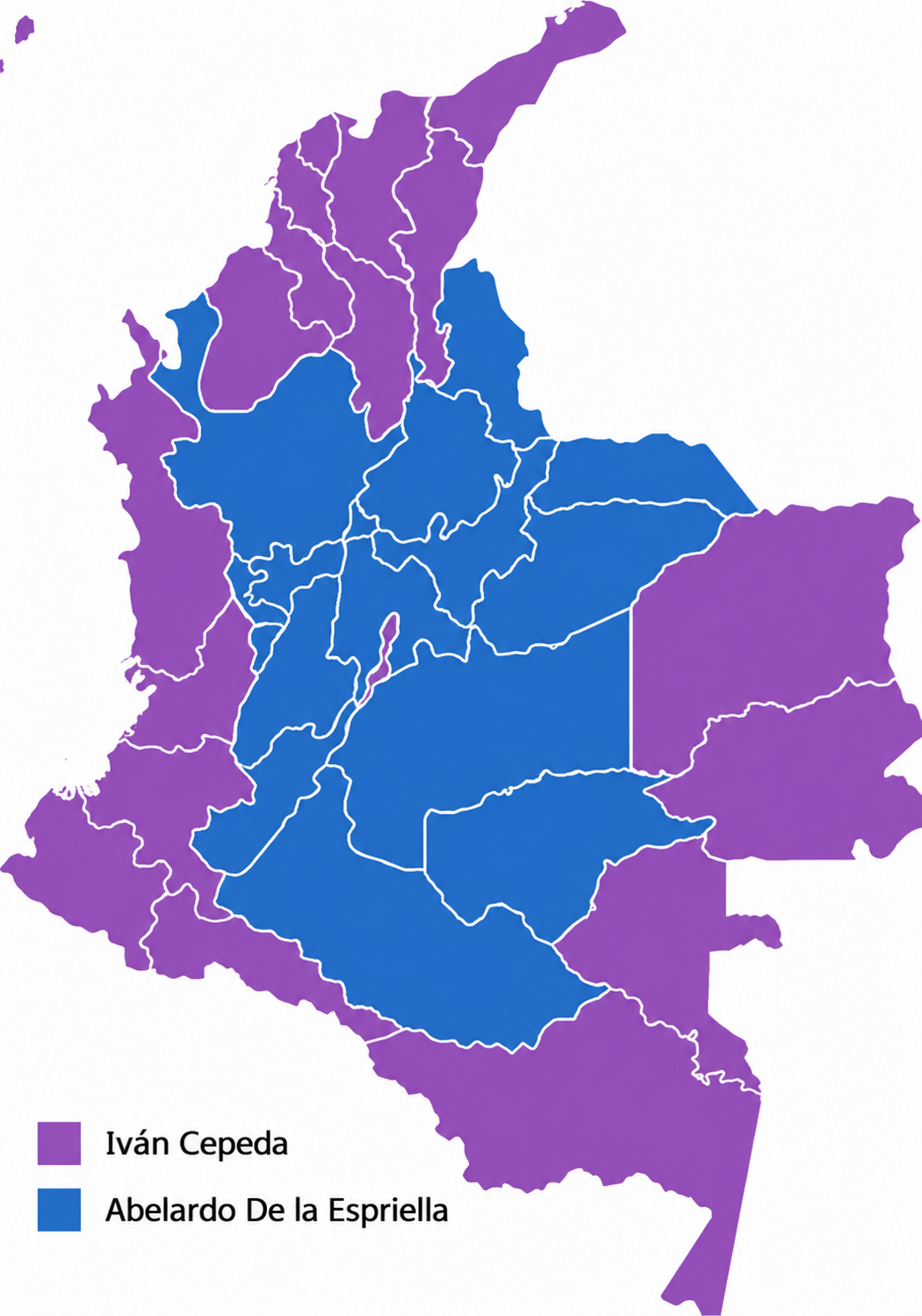
The geographic distribution of the vote reflects deep regional divisions. Cepeda carried Bogotá, which has trended left for years, particularly in lower-income districts on the city’s south and west sides. Antioquia — historically the heartland of Uribismo and home to Medellín, the country’s second-largest city — voted more than two to one for de la Espriella, a result that signals the weakening grip of Uribe’s movement even in its traditional stronghold.

The heart of coffee-growing country — the departments of Caldas, Risaralda, and Quindío also went to de la Espriella. Caquetá, a sparsely populated department in southern Colombia that has suffered sustained guerrilla violence from both the ELN and FARC dissident groups, voted for de la Espriella as well, a result we may interpret as a direct rejection of Petro and Cepeda’s Paz Total.

Cepeda carried Colombia’s Pacific coast, including the chronically neglected department of Chocó, as well as the sparsely populated Amazonas and Putumayo departments bordering Peru and Brazil, and the northern Caribbean coast. The Caribbean coast result is notable, as the region has historically suffered from underdevelopment, infrastructure deficits, and significant income inequality. Norte de Santander with its Catatumbo region on the Venezuelan border and experiencing severe armed-group activity — voted for de la Espriella, a result consistent with public exhaustion over security policy.

The Political Context: From Uribe to Petro and Beyond

Colombia’s current political trajectory is rooted in decisions made across the past two decades. President Uribe served two terms in the early 2000s and, together with then-Defense Minister Juan Manuel Santos, mounted a sustained military campaign against the FARC that significantly weakened the insurgency. Santos later broke from Uribe after assuming the presidency, governing independently and ultimately negotiating a peace agreement with the FARC — a deal that Uribe actively opposed. A plebiscite on the accord failed, but Santos used legislative maneuvering to implement it anyway.

Colombia 2026 1st round top two (Graphic: Sofi Imfeld for Finance Colombia)

Colombia 2026 1st round top two (Graphic: Sofi Imfeld for Finance Colombia)

Uribe’s next handpicked candidate, Iván Duque, won the 2018 election but finished his term with approximately 30% approval. Members of his own party publicly distanced themselves from him — Senator María Fernanda Cabal, a staunch Uribista, called Duque a “mamerto” (leftist idiot) while he was still in office. Under his administration, indicators on crime and guerrilla activity worsened, and armed groups including the ELN rebuilt operational capacity that had been degraded under Uribe and Santos.

Petro’s administration has not met initial fears of a Venezuelan-style democratic breakdown: Congress has largely blocked the most radical components of his agenda, including attempts to nationalize the private pension system and convert the healthcare system to a single-payer model. However, crime has increased, armed groups have expanded their operational footprints, and the security situation in several regions has worsened. Paz Total is widely seen as having produced few tangible results.

Uribe himself was convicted of witness tampering and attempted bribery in the case he had brought against Cepeda. Though released from house arrest after conviction, the judges who authorized his release are now reportedly under investigation for judicial corruption. Valencia’s poor performance in the first round — despite being Uribe’s chosen standard-bearer — suggests that Uribismo as a political force is waning, with its core constituency aging and new generations of voters disengaged from the Uribe legacy.

What to Expect Before June 21

Both campaigns will intensify mobilization efforts over the coming three weeks. Cepeda’s movement — Colombia Humana and the broader Pacto Histórico coalition — has historically relied on organized mobilizations, including indigenous community-led mingas, labor unions, and allied social movements. Cepeda’s running mate Senator Aida Quilcué is an indigenous activist, a choice expected to energize those constituencies. FECODE, the Federación Colombiana de Trabajadores de la Educación (Colombia’s main teachers’ federation), is expected to align officially with Cepeda, though individual teachers may not follow union leadership in their voting choices.

On the right, Paloma Valencia issued a public endorsement of de la Espriella immediately following the first-round results. Business community organizations, including ANDI (the Asociación Nacional de Empresarios de Colombia) and Fenalco (the Federación Nacional de Comerciantes), do not formally endorse candidates, but their members are widely understood to favor a government that supports private enterprise and market-oriented policy. De la Espriella holds no congressional constituency, meaning whichever candidate wins will face the same dynamic Petro encountered: a fragmented Congress that is likely to act as a check on executive authority.

The question of centrist voter alignment remains open. Fajardo and López are not expected to formally endorse either finalist, and the direction of their combined approximately 1.2 million votes is uncertain.

Winners and Losers by Sector

For international investors and executives operating in Colombia, the policy differences between the two candidates are substantive across several key sectors.

Petroleum and Natural Gas: De la Espriella has stated unequivocally that he will restart petroleum exploration and licensing, which the Petro administration blocked. Ecopetrol S.A. (NYSE: EC; BVC: ECOPETROL), Colombia’s state-controlled oil company, which also holds producing assets in the US Permian Basin and Gulf of Mexico, has operated under a government that halted new drilling permits. The consequences have included a decline in future production capacity at a time when global oil prices have risen due to Middle East tensions. Colombia has been forced to import natural gas at elevated prices to meet existing domestic demand — including from transportation fleets that were converted to natural gas under government incentive programs. Cepeda would be expected to continue or deepen current restrictions on fossil fuel expansion.

Healthcare: The Petro-Cepeda platform favors a government single-payer model. The administration has already taken over several Entidades Promotoras de Salud (EPS) — Colombia’s managed-care intermediaries — placing the healthcare system in legal and financial uncertainty. Private clinics, hospitals, and physicians who wish to operate outside a government-controlled framework would benefit from a de la Espriella administration. Cepeda’s healthcare agenda would accelerate the shift toward government-managed care.

BPO, Tech, and Call Centers: The BPO sector — which provides large volumes of formal employment, particularly in Medellín, Bogotá, Cali, and Barranquilla — was significantly affected by Petro-era minimum wage increases of 16% and 23% in successive years. These increases created contract renegotiation pressures with international clients, some of whom have shifted or considered shifting operations to competing jurisdictions including Honduras, Jamaica, the Dominican Republic, Mexico, and Guatemala. At the CX Summit, the industry’s main annual event held in Cartagena, the son of Álvaro Uribe appeared as an invited keynote speaker — a gesture that could be interpreted within the industry as an implicit signal of political alignment. A de la Espriella government, with its orientation toward labor market deregulation and reduced regulatory burden, would be viewed more favorably by this sector. Current Colombian labor law prohibits part-time employment contracts and places significant restrictions on dual employment, making workforce flexibility difficult for businesses that operate outside traditional 40-hour weekly structures.

Mining: The Petro administration has been less aggressive toward mining than toward petroleum, but sector participants expect a more permissive regulatory environment under de la Espriella, and continued constraints under Cepeda.

Security and Tourism: Both candidates have stated support for tourism promotion, but the sector’s trajectory is more directly linked to security conditions. Under current policies, several regions that were accessible to domestic and international travelers several years ago have experienced increased armed-group activity, effectively closing them to tourism. A de la Espriella administration is expected to pursue a more aggressive military posture toward the ELN and FARC dissident factions; a Cepeda government would likely continue dialogue-first approaches. The outcome will directly affect which parts of Colombia’s territory remain accessible to investment and tourism.

Foreign Relations: A de la Espriella government is expected to restore a broadly cooperative relationship with the United States, which deteriorated under Petro following several high-profile diplomatic incidents. De la Espriella has expressed admiration for US President Donald Trump, and reports indicate he holds US citizenship and owns property in Florida. Relations with Ecuador, which have been strained by mutual tariff escalations between Petro and Ecuadorian President Daniel Noboa, would be expected to normalize. Relations with Venezuela under Cepeda would likely continue along the current allied trajectory, while a de la Espriella government would be expected to take a more critical posture toward Caracas. China and Russia would find a more receptive diplomatic environment under Cepeda, and a cooler one under de la Espriella.

The Poor and Informal Workers: Cepeda’s campaign argues that minimum wage increases and expanded state services benefit lower-income Colombians. Critics counter that elevated formal labor costs have pushed more employment into the informal sector — which currently accounts for approximately half the Colombian workforce — depriving those workers of pension contributions, health benefits, and job security. De la Espriella’s platform, which emphasizes business formation, security, and labor market deregulation, would be presented as generating more formal-sector job creation. The actual distributional effects of either approach remain contested.

The Outlook

Assuming current polling trends hold and Uribista voters consolidate behind de la Espriella as expected following Valencia’s endorsement, de la Espriella enters the runoff as the frontrunner. Cepeda’s path to victory depends on driving high turnout among his base, securing support from centrist voters who did not vote for either finalist in the first round, and potentially benefiting from any missteps by de la Espriella in the final three weeks of campaigning.

The first-round results produced no major electoral violence. The ELN announced a temporary halt to armed actions during the voting period. Authorities detained some individuals reportedly attempting to purchase votes in rural areas, but no large-scale incidents were recorded.

The incoming president will face a Congress with no natural majority aligned to the executive, a healthcare system in partial administrative disarray, a petroleum sector whose future production trajectory is in question, and regions where state presence remains contested by armed groups. The June 21 runoff will determine which vision — market-oriented restructuring or continuation of the Petro project — Colombia pursues for the next four years.

Trump Nominates Nate Morris as U.S. Ambassador to Colombia

U.S. President Donald Trump has nominated Kentucky businessman and political ally Nathaniel “Nate” Morris to serve as the next U.S. ambassador to Colombia, placing a prominent supporter of the Republican president at the helm of one of Washington’s most important diplomatic posts in Latin America.

The nomination was formally submitted to lawmakers on Monday, one day after right-wing presidential candidate Abelardo “El Tigre” de la Espriella emerged as the frontrunner in Colombia’s first-round election, setting up a runoff that could reshape relations between Bogotá and Washington.

Morris, 45, is the founder of Rubicon Technologies, an environmental technology and waste-management company, and has become one of Trump’s most visible political allies in Kentucky. His nomination comes as Colombia enters a period of political transition and uncertainty over the future direction of bilateral cooperation on security, counternarcotics efforts, trade and migration.

The White House announced Morris’s nomination as part of a broader package of diplomatic appointments across Latin America. If confirmed by the Senate, he would become Washington’s top representative in Colombia at a pivotal moment for relations between the longtime allies.

Trump had previously urged Morris to abandon a potential bid for the U.S. Senate in Kentucky in order to join his administration.

“Nate is a fantastic businessman and a strong MAGA warrior,” Trump wrote on social media. “I have asked Nate to step aside from the Senate race to take a role in my Administration as Ambassador. Nate is Oxford-educated, tough as steel, loves our great nation, and will represent the United States very well.”

Although Morris has limited public diplomatic experience, his appointment reflects the Trump administration’s preference for politically connected allies and business leaders in several ambassadorial posts.

A native of Kentucky, Morris studied at George Washington University before pursuing further studies at the University of Oxford. He founded Rubicon Technologies, a company focused on waste management and environmental services, and later established Morris Industries, a private investment holding company based in Lexington with interests in sustainability, technology, industrial operations and financial services.

The nomination comes amid expectations that Colombia’s foreign policy could shift following Sunday’s election result. De la Espriella’s strong showing has fueled speculation that a future administration could seek closer alignment with Washington after years of tensions between the governments of President Donald Trump and Colombian President Gustavo Petro.

Before taking up the post in Bogotá, Morris must undergo Senate hearings and secure confirmation by a majority vote, a process that could take several weeks or months.

De la Espriella and Cepeda Advance to Colombia’s Presidential Runoff After Polarized First-Round Vote

1 June 2026 at 17:11

A June 21 presidential runoff will decide Colombia’s next president

Far-right candidate Abelardo de la Espriella and leftist Iván Cepeda advanced to the runoff round of Colombia’s presidential election after emerging as the top vote-getters in the May 31, 2026, first-round vote, in a result that reflects the deep political polarization shaping the country.

With 99.99% of polling stations counted, the Registraduría Nacional del Estado Civil reported that De la Espriella won more than 10.3 million votes (43.7%), while Cepeda secured 9.6 million votes (40.9%). The two candidates will face each other in a runoff election scheduled for June 21, 2026.

Voter turnout reached 23.7 million people, equivalent to 57.8% of eligible voters. Together, the two candidates captured nearly 85% of valid ballots, leaving the remaining contenders far behind and setting up a contest between two sharply contrasting political visions.

De la Espriella’s unexpected rise

De la Espriella’s first-round victory represents one of the biggest surprises of the election and marks the first time in Colombia’s modern political history that a far-right party has emerged with a realistic chance of winning the presidency.

A lawyer by profession with no previous elected office experience, De la Espriella built his campaign around a populist message focused on political confrontation, public security, a hard-liner approach to crime and opposition to negotiations with illegal armed groups. His political style has drawn comparisons to Argentine President Javier Milei, Salvadoran President Nayib Bukele and US President Donald Trump.

Most pre-election polls placed him in second or third position, with support ranging between 15% and 25%, well below his final result.

His platform emphasizes stronger security policies, tougher penalties for criminal and narcotraffic organizations, and the construction of large-scale prisons similar to those in El Salvador. He has also rejected peace negotiations with armed groups.

His opposition to diversity and inclusion policies, as well as controversies involving remarks toward female journalists for which he later apologized, also became defining features of his campaign.

Cepeda achieves the strongest result ever for Colombia’s left party

Although he finished second, Cepeda achieved the highest vote total ever received by a left-wing presidential candidate in Colombia, surpassing the 8.5 million votes won by President Gustavo Petro in a previous presidential election.

The candidate of the ruling Pacto Histórico party based his campaign on grassroots mobilization, public rallies and the consolidation of a unified left-wing movement. His message focused on expanding social programs, inclusion and reducing inequality.

However, his candidacy has also been weighed down by criticism of the current administration, particularly regarding security concerns, problems within Colombia’s healthcare system and the limited results of the government’s “Total Peace” policy, which Petro promoted and Cepeda supported during his years in Congress.

Cepeda’s political career has been built in Congress, where he became known for defending the rights of victims of paramilitary violence and for his role in legal cases involving former President Álvaro Uribe.

After preliminary results were released, both Cepeda and Petro publicly questioned the preliminary vote count while stating they would recognize the official results certified by electoral commissions, judges and notaries.

“As president, I do not accept the preliminary count results,” Petro wrote on X, arguing that Colombia’s pre-count system has no legal validity and that only the official scrutiny process produces binding results. He later added that “the binding results the president will recognize are those issued by the electoral scrutiny commissions.”

Cepeda has also sought to distance himself from some of Petro’s proposals, including the idea of convening a constituent assembly to revise Colombia’s constitutional framework.

Historic defeat for Uribe’s political movement

Another major statement of the election was the poor performance of Paloma Valencia, candidate of the Centro Democrático party and backed by former President Uribe, who campaigned alongside her throughout the country despite defections by several prominent supporters.

Valencia finished third with 1.6 million votes (6.9%), far below polling projections that had placed her above 20%.

The result is widely attributed to voter fatigue with Uribe’s political movement and the migration of conservative voters toward De la Espriella, who was endorsed during the campaign by several prominent right-wing figures, including senators Paola Holguín and María Fernanda Cabal, as well as leader and businessman José Félix Lafaurie.

Strategic decisions within Valencia’s campaign may also have contributed to the result, including the selection of former Bogotá councilman Juan Daniel Oviedo as her vice-presidential running mate and her reluctance to directly confront De la Espriella during the campaign.

This marks the second consecutive presidential election in which Uribe reaches the runoff without a candidate from his own party. Nevertheless, he quickly endorsed De la Espriella after the results became known.

That endorsement could prove crucial. If elected, De la Espriella would face a Congress in which his movement holds only limited representation, making support from Centro Democrático, the second-largest congressional bloc, essential for advancing legislation and reforms.

Centrist voters may decide the runoff

Former Medellín Mayor Sergio Fajardo, who campaigned as a centrist alternative, finished fourth with more than 1 million votes (4.2%), while none of the remaining candidates surpassed 1% of the vote.

As the runoff approaches, the votes won by both Valencia and Fajardo are expected to be closely watched by the two campaigns, as they could prove decisive in an election that is shaping up to be highly competitive, deeply polarized and politically fragmented.

While Valencia has already endorsed De la Espriella, Fajardo has yet to take a public position. In previous elections, the former Medellín mayor has preferred to leave his supporters free to decide rather than formally endorse either finalist.

In Valencia’s case, despite her endorsement of De la Espriella, it remains unclear whether her support came primarily from voters aligned with former President Álvaro Uribe or whether a significant share was driven by the candidacy of Juan Daniel Oviedo, who won more than 1.2 million votes in the coalition primaries held in March.

The June 21 presidential runoff will therefore pit two sharply different visions for Colombia’s future against one another, in a political environment marked by polarization, social tensions, and persistent challenges related to security and governance that the next administration will have to address.

❌