
Reading view

Trump shows AI map with Canada, Greenland and Venezuela under U.S flag.

U.S. President Donald Trump said on Tuesday there was “no going back” on his goal to bring Greenland under U.S. control, refusing to rule out the use of force and escalating tensions with European allies already bracing for a renewed transatlantic trade dispute.

Trump’s remarks followed a series of social media posts featuring AI-generated images, including one depicting the president standing in Greenland holding a U.S. flag and another showing a map of North America with Canada, Greenland and Venezuela covered by the stars and stripes.

The imagery, shared without official explanation, has fuelled alarm among allies and raised questions about the blurring of political messaging and artificial intelligence at a moment of heightened geopolitical strain.

“As I expressed to everyone, very plainly, Greenland is imperative for National and World Security. There can be no going back — on that, everyone agrees,” Trump said after speaking with NATO Secretary General Mark Rutte.

Greenland, a vast Arctic island rich in minerals and strategically located between North America and Europe, is a self-governing territory of Denmark, a fellow NATO member. Trump’s renewed push to acquire it has revived a proposal he first floated during his previous term, but has now been accompanied by explicit warnings of tariffs and the possible use of force.

European leaders reacted with unease. Danish Prime Minister Mette Frederiksen told parliament in Copenhagen that “the worst may still lie ahead.”

“We can negotiate about everything — security, investments, the economy — but we cannot negotiate our most fundamental values: sovereignty, our country’s identity, our borders and our democracy,” Frederiksen said.

At the World Economic Forum in Davos, European Commission President Ursula von der Leyen urged the bloc to prepare for a more confrontational era.

“The seismic change we are going through today is an opportunity — in fact a necessity — to build a new form of European independence,” she said.

Trade war fears resurface

Trump has threatened steep tariffs on countries he says stand in the way of U.S. interests, including European allies involved in NATO exercises in Greenland. The European Union has warned it could retaliate with tariffs on up to €93 billion ($101 billion) of U.S. imports if trade measures are imposed.

One option under discussion is the EU’s Anti-Coercion Instrument, a powerful tool that could restrict access to public tenders, investment or services, including digital services where U.S. companies hold a surplus.

U.S. Treasury Secretary Scott Bessent sought to calm markets and dismissed fears of an escalating trade war.

“It’s been 48 hours. Sit back, relax,” Bessent told reporters in Davos. “Calm down the hysteria. Take a deep breath.”

Financial markets were less sanguine. U.S. stock index futures slid to one-month lows, global equities fell, and gold prices touched record highs as investors sought safety.

Canada and Venezuela react

The inclusion of Canada and Venezuela in the AI-generated map added to the controversy.

Canada, a close U.S. ally and NATO member, has previously been the subject of Trump’s rhetoric suggesting it could become the “51st state.” Canadian Prime Minister Mark Carney said he was “concerned” by the escalation and warned of the implications for North American and transatlantic security.

Canadian officials said Ottawa has drawn up plans to send a small contingent of soldiers to Greenland to participate in NATO military exercises, pending final approval from Carney. Canada already has aircraft and personnel deployed there as part of a NORAD exercise involving the United States.

Venezuela’s government condemned Trump’s post and called on citizens to share the country’s official map online in what officials described as a symbolic defence of sovereignty.

Russia weighs in

Russia, which has closely watched the growing rift between Washington and Europe, questioned Denmark’s sovereignty over Greenland. Foreign Minister Sergei Lavrov said the island was the result of “colonial conquest,” while denying Moscow had any designs on the territory.

Protesters also took to the streets in several European cities, including Zurich, where demonstrators carried banners opposing Trump’s appearance at Davos and denouncing what they called imperialist policies.

Despite pushback from allies and some members of Congress, Trump has shown no sign of softening his stance, leaving diplomats and markets braced for further escalation as NATO cohesion and global trade relations come under renewed strain.
  •  

Tras la llamada con Trump, Petro aumenta la presión sobre los rebeldes acusados de narcotráfico

Los expertos afirman que la determinación del presidente de Colombia de desmantelar al ELN es un reflejo tanto de las exigencias de Trump como de la frustración interna por su anterior gestión de los grupos armados.
  •  

After Trump Call, Colombia’s Petro Turns Up Heat on Far-Left Armed Group

President Gustavo Petro of Colombia is taking a harder line against the National Liberation Army, or ELN, a leftist group experts call a powerful drug trafficker in Colombia and Venezuela.
  •  

Trump hace temblar la política de América Latina

Las distintas reacciones de los países latinoamericanos a la incursión de EE. UU. en Venezuela muestran cómo el gobierno de Trump está alterando el continente.
  •  

Thousands rally in Colombia’s Plaza de Bolívar following President Petro’s call with Trump

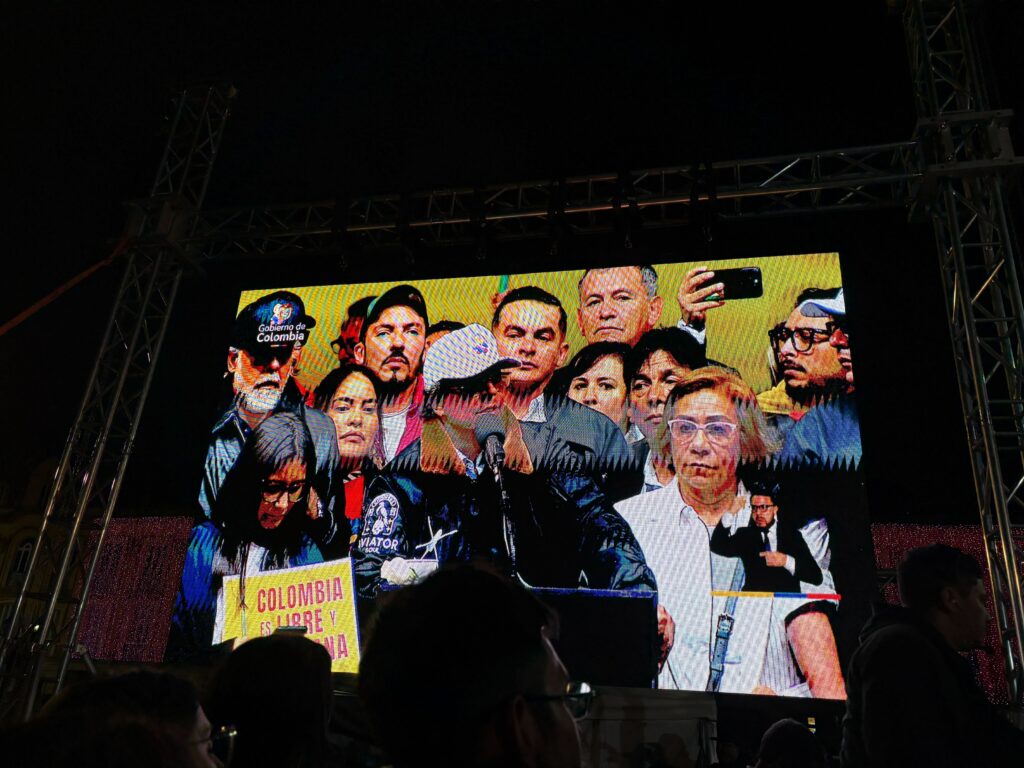
Bogotá, Colombia — Thousands gathered in Plaza de Bolívar after answering Colombian President Gustavo Petro’s call to mobilize against threats to Colombia’s national sovereignty from the United States.

Petro called for people to take to the streets in every public square across the country after Trump said military action in Colombia “sounds good” on Sunday, January 4,, just a day after removing Nicolás Maduro from power in neighboring Venezuela.

While Petro was expected to deliver a rousing speech against U.S. intervention, he told the crowd that he had to make his remarks less “harsh” after a conciliatory call with Trump just minutes before addressing demonstrators.

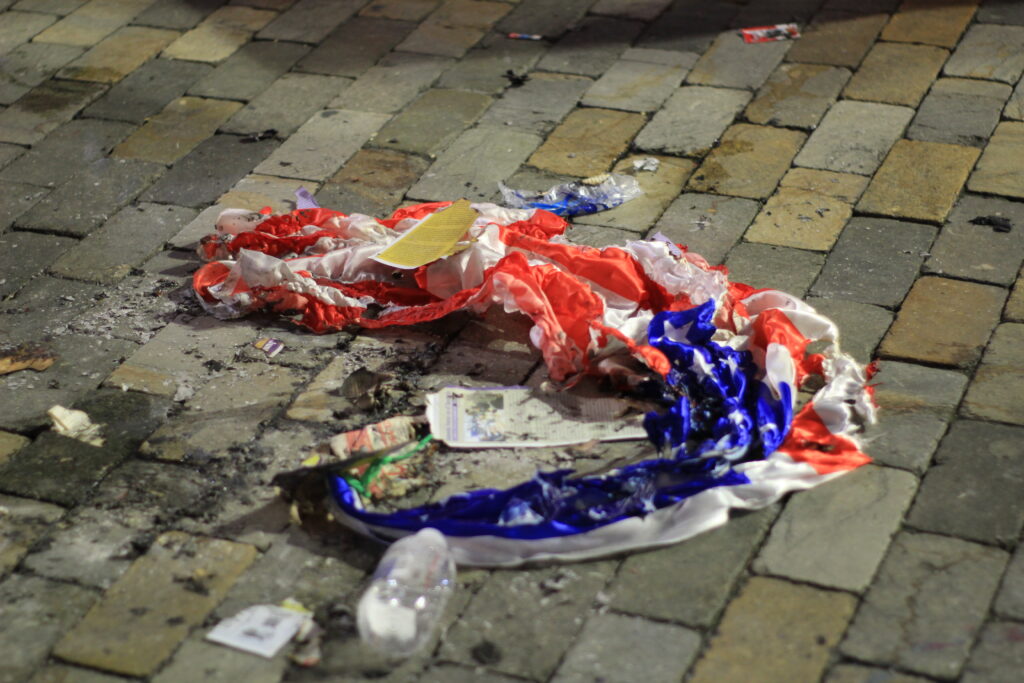
Plaza de Bolívar, located in central Bogotá near Congress and the Casa de Nariño presidential residence and office, hosted over 20,000 demonstrators and was adorned with flags and protest signs from the afternoon into the night of January 7.

“And no, no, I do not feel like being a North American colony. And yes, yes, I do feel like being a free and sovereign Colombia,” protesters chanted.

Image Source: Cristina Dorado Suaza

Many participants also used the demonstration to voice opposition to related issues, such as the exploitation of natural resources and the presence of foreign military bases.

“If we don’t defend our country, who will do it for us?” said one demonstrator. Other attendees stressed that the mobilization was not only about Colombia, but about Latin America as a whole.

Throughout the day, the rally featured musical performances and included the presence of labor and union representatives, public institutions, and a large portion of the presidential cabinet. The president and several ministers delivered speeches from the main stage.

President Petro presented some official data and concrete results from three years of his administration — including his fight against drug trafficking — many of them in comparison with the previous government. Among the achievements cited was the seizure of 2,800 tons of illegal substances by December 31, 2025. 

“My goal was zero blows against Colombia’s peasantry, voluntary crop substitution; we are now at 30,000 hectares registered,” he explained.

Image Source: Cristina Dorado Suaza

Petro publicly accused the U.S. far right and Colombian politicians of having convinced Trump that he “ran cocaine factories” and was a “front man for Maduro.” “We are not enemies of any people in the world,” he stated during his speech. Petro also said he spoke with Delcy Rodríguez, Interim President of Venezuela.

The phone call was later confirmed by Trump through his Truth Social account: “It was a great Honor to speak with the President of Colombia, Gustavo Petro, who called to explain the situation of drugs and other disagreements that we had. I appreciated his call and tone, and look forward to meeting him in the near future. Arrangements are being made between Secretary of State Marco Rubio and the Foreign Minister of Colombia. This meeting will take place in the White House in Washington, D.C..” 

In closing, the Colombian leader reaffirmed his stance on national sovereignty, as well as his differences with Trump over events in Venezuela — which he described as “illegal” — and other issues.

“To the mothers of Colombia, I say that the country clearly stands up for the defense of national sovereignty, because [Álvaro] Uribe is wrong. If they touch Petro, they touch Colombia. And if they touch Colombia, Colombia responds as its history has taught it—plain and simple.”

Featured image: Demonstrators at Plaza de Bolívar in central Bogotá
Author: Cristina Dorado Suaza

This article originally appeared on Latin America Reports and was re-published with permission.

The post Thousands rally in Colombia’s Plaza de Bolívar following President Petro’s call with Trump appeared first on The Bogotá Post.

  •  
❌