It was a frustrating night for the roughly 6,000 supporters gathered in Bogotá’s Plaza de Bolívar to hear President Gustavo Petro deliver what many expected to be a fiery, anti-imperialist address.
After waiting for hours in cold, rainy conditions, demonstrators waved placards reading “Yankee Go Home,” “Out Trump,” and “Respect Colombia,” anticipating a confrontational speech aimed squarely at U.S. President Donald Trump following weeks of diplomatic tension.
Instead, when Petro finally took the stage, the tone of the rally shifted abruptly.
The Colombian president opened by announcing that he would not deliver his prepared speech. Rather than launching into the expected denunciation of Washington, Petro told the crowd that his delay was due to a lengthy phone call with Trump — a revelation that visibly stunned the audience.
As Petro spoke about the conversation, the plaza fell largely silent. Each mention of Trump appeared to drain the rally of its energy, replacing chants and applause with uneasy quiet. What had been billed as a mass show of resistance against U.S. pressure became an unexpected account of diplomatic rapprochement.
According to Petro, the call — conducted with simultaneous translation — lasted close to an hour and marked the first direct conversation between the two leaders since Trump’s return to office. “Today I came with one speech, and I have to give another,” Petro told supporters. “The first one was quite hard.”
A source at the presidential palace told El Colombiano that Petro appeared relaxed during the exchange, smiling several times as he spoke with Trump. A photograph of the moment, later shared by Petro, showed him seated at his desk mid-conversation.
Petro said the discussion focused primarily on drug trafficking, Venezuela and other bilateral disagreements. He acknowledged that significant differences remain but argued that dialogue was preferable to confrontation.
“I know that if anyone were to harm me — in any way — what would happen, given Colombia’s history and the level of support we have reached, is that the Colombian people would enter into conflict,” Petro said during the rally. “If they touch Petro, they touch Colombia.”
The remarks were a response to Trump’s recent comments suggesting that a military operation against Colombia, similar to the one carried out in Venezuela, “sounds good.” Petro, however, struck a notably more conciliatory tone on Wednesday, saying Trump “is not foolish,” even if he disagreed with him.
In a further surprise to supporters, Petro stated publicly that Nicolás Maduro was not his ally, claiming the Venezuelan leader had previously distanced him from Hugo Chávez by preventing him from attending Chávez’s funeral.
Shortly after the call, Trump issued a statement on his Truth Social platform confirming the conversation and signalling a thaw in relations.
“It was a Great Honor to speak with the President of Colombia, Gustavo Petro, who called to explain the situation of drugs and other disagreements that we have had,” Trump wrote. “I appreciated his call and tone, and look forward to meeting him in the near future.”
Trump added that Secretary of State Marco Rubio and Colombia’s foreign minister were already making arrangements for a meeting at the White House in Washington.
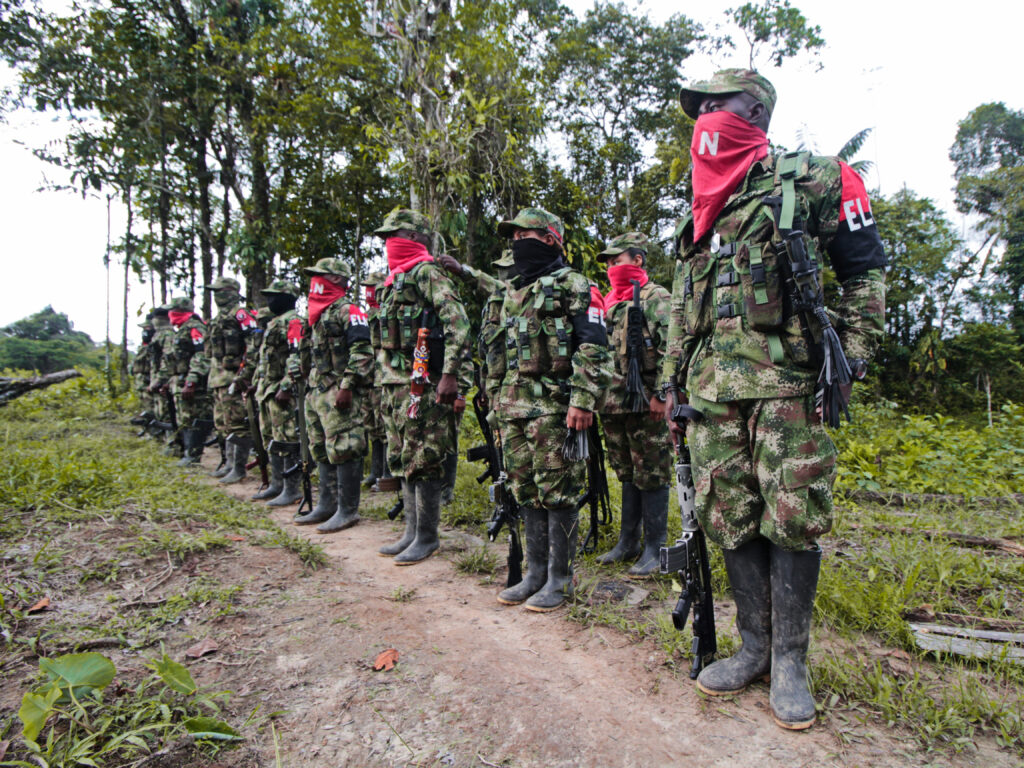
Petro confirmed that further discussions would be needed, particularly regarding drug trafficking figures, the role of the ELN guerrilla group along Colombia’s borders and Venezuela’s political future. “We cannot lower our guard,” Petro said. “There are still things to discuss at the White House.”
The president also revealed that he had spoken days earlier with Venezuela’s interim leader Delcy Rodríguez and had invited her to Colombia — a disclosure likely to further complicate regional diplomacy.
What was intended as a show of defiance against Washington ultimately became a public demonstration of Petro’s willingness to recalibrate his strategy, leaving his hardline supporters confused and critics questioning whether the president had overplayed the politics of mobilisation — only to pivot, unexpectedly, toward negotiation.
If you’re a Mac user who has recently discovered their Logitech mouse or keyboard is not working suddenly, or not working properly with missing customizations and functionality, it might be because of an issue with an expired security certificate with Logitech devices on the Mac. Specifically, if you use Logi Options+ or G HUB with ... Read More
Colombian President Gustavo Petro has called on supporters to mobilise nationwide on Wednesday to defend “national sovereignty,” sharply escalating a diplomatic crisis with the United States after President Donald Trump said a U.S. military operation against Colombia “sounds good” to him.
The demonstrations are expected to take place in Bogotá’s Plaza de Bolívar, Parque Lourdes in the Chapinero locality, and outside the U.S. Embassy, with parallel protests planned in Medellín (Plaza Mayor), Cali (Plaza de Cayzedo), Bucaramanga (Plazoleta Cívica Luis Carlos Galán), Cartagena (Plaza de San Pedro Claver), Santa Marta (Parque de Bolívar).
The mobilisation follows Trump’s remarks aboard Air Force One on Sunday, when he described Petro as “a sick man” and appeared to endorse the idea of a U.S. military operation in Colombia — dubbed “Operation Colombia” by a journalist — comparable in scope to the operation that led to the arrest of Venezuela’s Nicolás Maduro and wife, Cilia Flores.
When pressed on whether he meant direct military action, Trump replied: “Sounds good to me,” before adding that Petro should “watch his ass.” The White House has not clarified whether the comments reflect official U.S. policy.
A Return to Arms?
Petro responded with a torrent of social media posts and public statements that have alarmed political opponents and business leaders . In some of his strongest language since taking office, the leftist president warned that U.S. military action would plunge Colombia back into armed conflict.
“If you bomb peasants, thousands of guerrillas will return to the mountains,” Petro said. “And if you arrest the president whom a good part of my people want and respect, you will unleash the popular jaguar.”
Petro, Colombia’s first leftist leader and a former militant of the M-19 guerrilla, said he had sworn under the 1989 peace pact never to take up arms again, but suggested that commitment could be reversed if Colombia’s sovereignty were threatened.
“Although I have not been a military man, I know war and clandestinity,” Petro wrote. “I swore not to touch a weapon again since the 1989 Peace Pact, but for the homeland I will take up arms again — even though I do not want to.”
He also warned Colombia’s armed forces against showing loyalty to Washington, saying any commander who prioritised U.S. interests over Colombia’s would be dismissed. The constitution, he said, required the military to defend “popular sovereignty.”
Diplomatic protest lodged in Washington
Colombia’s Foreign Ministry formally raised the dispute on January 4, issuing a diplomatic note of protest to the U.S. government through Ambassador Daniel García-Peña in Washington.
In the letter, the ministry said Trump’s remarks violated basic principles governing relations between sovereign states and amounted to “undue interference” in Colombia’s internal affairs.
“The President of the Republic of Colombia has been legitimately elected by the sovereign will of the Colombian people,” the statement said, adding that any attempt to discredit him was incompatible with international law and the United Nations Charter.
The Cancillería also cited principles of sovereign equality, non-intervention and mutual respect, saying threats or the use of force between states were “unacceptable.”
“Colombia is a democratic, sovereign state that conducts its foreign policy autonomously,” it said. “Its sovereignty, institutional legitimacy and political independence are not subject to external conditioning.”
The crisis has further polarised Colombia’s already fractured political landscape. Former president Álvaro Uribe, a vocal critic of Petro, said Colombia was drifting toward a Venezuela-style confrontation with the United States, though he stopped short of endorsing military intervention.
“What Colombia needs is a change of government,” Uribe told El Tiempo, adding that he trusted Washington’s strategy was “well conceived.”
Petro has cast Wednesday’s demonstrations as a defining moment for his presidency, portraying himself as the defender of national dignity against foreign aggression. He also reiterated the Colombian goverment’s position to cooperate fully with Washington on counter-narcotics and security issues. “You (Trump) took it upon yourself, in an act of arrogance, to punish my opinion — my words against the Palestinian genocide. Your punishment has been to falsely label me a drug trafficker and accuse me of running cocaine factories,” stated Petro hours after the Air Force One declations. “I don’t know whether Maduro is good or bad, or even whether he is a drug trafficker (…) so, stop the slander against me,” he said.
Petro’s critics accuse the president of instrumentalising public rallies to divert attention from Colombia’s deep internal security crisis, and to position himself politically alongside Venezuela’s ousted strongman. They argue that his language of “sovereignty” closely mirrors chavista narratives, warning that the protests risk morphing into an implicit show of solidarity with Nicolás Maduro rather than a defence of Colombia’s territorial integrity.
The White House has not walked back Trump’s remarks, and U.S. officials have so far declined to offer reassurances. On Wednesday morning, Secretary of State Marco Rubio and U.S. Secretary of War Pete Hegseth held a classified briefing with senators on Capitol Hill in which, according to Democratic leaders, their Republican counterparts refused to rule out sending U.S. troops to Venezuela or other countries.
Democratic Senate leader Chuck Schumer said he had asked for assurances that Washington was not planning operations elsewhere. “I mentioned some cases — including Colombia and Cuba — and I was very disappointed with their response,” Schumer said, adding that the meeting “left more questions than answers” and that the plan for the United States to govern Venezuela was “vague and based on illusions.”
As governments across Latin America closely watch the incoming chavista regime under interim president Delcy Rodríguez, the confrontation between Trump and Petro marks the most serious rupture in U.S.–Colombia relations in over two centuries. For Bogotá — long one of Washington’s closest allies in the region — the escalation has raised fears that incendiary rhetoric and mass mobilisation could push an already volatile situation into dangerous territory.
Editor’s Note: The U.S Embassy in Bogotá has issued a security alert, warning U.S. citizens to avoid large protests “as they have the potential to turn violent”.
If you’re an iPad user and you really don’t like the iPadOS 26 update for whatever reason, you probably already looked around for ways to downgrade iPadOS 26 back to iPadOS 18, and you likely found that it is no longer possible to perform that downgrade. This is because Apple has locked down iPadOS 18 ... Read More
The extraction of Nicolás Maduro on Saturday was meant to signal the end of an era. Instead, it has exposed an uncomfortable truth that may loom over Washington weeks and months after the “shock-and-awe” attacks in central Caracas have waned from headlines: was Venezuela’s democratic opposition sidelined at the very moment it appeared closest to victory?
Just weeks earlier, María Corina Machado, the 2025 Nobel Peace Prize laureate and the symbolic leader of Venezuela’s opposition, had laid out her Freedom Manifesto — a sweeping blueprint for a Venezuelan-led democratic transition rooted in dignity, elections, free markets and the return of millions of exiles. She framed the coming moment not as an American intervention, but as a national rebirth steered by Venezuelans themselves.
That vision now appears to be colliding with a far more transactional reality.
Following Maduro’s capture in a U.S.-led operation, President Donald Trump declined to elevate Machado or her movement into any formal role. Instead, senior U.S. officials have coalesced around Delcy Rodríguez – Maduro’s longtime lieutenant and overseer of the oil sector — as Washington’s primary interlocutor in Caracas. Trump publicly praised Rodríguez’s cooperation while dismissing Machado as a “very nice woman” who “lacks the support” to lead the country.
On Monday, Delsy Rodríguez took the oath of office in the presence of the Ambassadors to China, Iran and Russia. The scene from the National Assembly recalls the sham investiture of Maduro on January 10, 2025, and sends a dire signal to the internationl community: Does oil security matter more than a secure democracy?
White House insiders told U.S. media that Trump had never warmed to Machado, “because his feelings got hurt”, reads the Daily Beast. According to an article on Monday in The Washington Post, the president declined to pick Machado because she committed the “ultimate sin” of offending his pride, after receiving the Nobel Peace Prize. “If she had turned it down and said, ‘I can’t accept it because it’s Donald Trump’s,’ she’d be the president of Venezuela today,” cites the newspaper’s sources.
Having lost the Oslo podium as the world’s “peace president,” personal grievance and strategic calculation have marked the White House’s decision to annoint a “moderate” in Miraflores. But Rodríguez is no moderate, and her penchant for state repression remains intact. A recent article in the Wall Street Journal affirms that Washington is willing to tolerate a Maduro 2.0 — a Chavista continuity government — so long as it cooperates on oil, narcotics enforcement and geopolitical alignment.
On the ground in Caracas, the mood reflects that ambiguity. There have been no mass celebrations, no release of political prisoners, and no clear roadmap. Power remains concentrated within the same military-backed elites that have pillaged Venezuela for over three decades, even as Maduro himself awaits trial in New York on charges expected to exceed those once brought against Joaquín “El Chapo” Guzmán.
U.S. officials insist this is realism, not betrayal. Secretary of State Marco Rubio has argued that squeezing the regime economically and forcing compliance on security and oil will eventually produce leverage. But he has stopped short of demanding immediate elections — a notable omission given that the opposition already won one.
Machado’s Freedom Manifesto now reads less like a transition plan and more like a rebuke. It imagined a Venezuela where sovereignty flowed from the ballot box, not from foreign capitals; where dignity, not expediency, guided reconstruction; and where Venezuelans — not external powers — chose their leaders.
Instead, Trump has suggested that the United States will “run” Venezuela, even as it leaves the same repressive security apparatus intact. The contradiction is stark: maximum news coverage abroad, minimal transformation on the ground.
The question, then, is not only whether Trump sidetracked María Corina Machado, but whether the United States has traded a rare democratic opening for short-term gains. If Chavismo survives without Maduro — its prisons full, its generals untouched, its oil flowing under U.S management — the Nobel laureate’s blueprint may yet stand as the document of a revolution deferred.
And history may judge that Venezuela was not lost for lack of courage at home, but for lack of conviction abroad. In the words of Mexican historian Enrique Krauze, the end-game is inevitable: “If geopolitics seeks to turn Venezuela into a pawn on its chessboard, the people will take to the streets. They have chosen a legitimate president: Edmundo González. And they have a moral leader: María Corina Machado. Obstacles may arise, but Venezuela’s liberation is irreversible.”
U.S. President Donald Trump escalated rhetoric toward Colombia on Sunday, suggesting that a U.S. military operation against the country — which he said could be dubbed “Operation Colombia” — was a possibility following Washington’s capture of Venezuelan dictator Nicolás Maduro.
Speaking to reporters aboard Air Force One, Trump described Colombian President Gustavo Petro as “a sick man” and accused him of overseeing cocaine production destined for the United States.
“Colombia is run by a sick man who likes making cocaine and selling it to the United States,” Trump said. “And he’s not going to be doing it very long. Let me tell you.”
When asked directly whether he meant a U.S. military operation against Colombia, Trump replied: “Sounds good to me.”
Trump’s remarks came a day after the United States announced it had captured Maduro in a military operation in Caracas, an unprecedented move that has sent shockwaves across Latin America and raised fears of further U.S. interventions in the region.
Trump said the United States could also consider military action against Mexico if it failed to curb the flow of illicit drugs into the country. He added that Venezuelan migrants in the United States were among the factors considered in the raid against Maduro.
Trump also warned that Cuba, a close ally of Venezuela, was “a failing nation” and said its political future was “something we’ll end up talking about.”
Maduro is currently being held in a New York detention center and is expected to appear in court on Monday on drug trafficking charges. Trump said his administration would seek to work with remaining members of the Venezuelan government to crack down on drug trafficking and overhaul the country’s oil sector, rather than push immediately for elections.
Despite Maduro’s capture, Venezuela’s Vice President and oil minister, Delcy Rodríguez, has assumed interim leadership with the backing of the country’s top court. Rodríguez has insisted that Maduro remains Venezuela’s legitimate president and has denied Trump’s claim that she is willing to cooperate with Washington.
In an interview published by The Atlantic on Sunday, Trump warned that Rodríguez could “pay a bigger price than Maduro” if she failed to cooperate with the United States. Venezuela’s communications ministry did not immediately respond to a request for comment.
Petro denounces U.S. threats
Trump’s comments prompted an immediate and forceful response from Petro, who accused the U.S. president of slander and warned that Latin America risked being treated as “servants and slaves” unless it united.
“Stop slandering me,” Petro said, calling on regional leaders to close ranks in the face of what he described as renewed U.S. imperial aggression.
In a series of lengthy posts on X, Petro said the United States had crossed a historic line by bombing Caracas during the operation to capture Maduro.
“The United States is the first country in the world to bomb a South American capital in all of human history,” Petro wrote. “Neither Netanyahu, nor Hitler, nor Franco, nor Salazar did it. That is a terrible medal, one that South Americans will not forget for generations.”
Petro said revenge was not the answer but warned that the damage would be long-lasting.
“Friends do not bomb each other,” he said, likening the attack on Caracas to the Nazi bombing of Guernica during the Spanish Civil War.
Instead, Petro urged deeper regional integration, arguing that Latin America must look beyond alignment with global powers.
“We do not look only to the north, but in all directions,” he said. “Latin America must unite or it will be treated as a servant and not as the vital center of the world.”
In a separate post, Petro issued a stark message to Colombia’s armed forces, ordering commanders to immediately remove any officer who showed loyalty to the United States over Colombia.
“Every Colombian soldier has an order from now on,” Petro wrote. “Any commander of the public forces who prefers the U.S. flag over the Colombian flag must immediately leave the institution.”
Petro said the armed forces were under orders not to fire on civilians but to defend Colombia’s sovereignty against any foreign invasion.
“I am not illegitimate. I am not a narco,” Petro wrote, rejecting Trump’s accusations. “I trust my people and the history of Colombia.”
Colombia’s first leftist president and a former member of the M-19 guerrilla movement also raised the spectre of a return to armed struggle, saying that while he had sworn under the 1989 peace pact never to take up weapons again, he would do so if Colombia’s sovereignty were threatened.
“I am not a military man, but I know war and clandestinity,” Petro wrote. “I swore never to touch a weapon again, but for the homeland I would take up arms once more, even though I do not want to.”
Rising fears of wider intervention
Trump’s warnings to Colombia were not his first. In the immediate aftermath of Maduro’s capture, he said Petro needed to “watch his ass” and suggested that Cuba’s political collapse was imminent.
The comments have heightened anxiety across the region, where governments are closely watching Washington’s next moves following the Caracas operation.
In Venezuela, a state of emergency has been in force since Saturday. A decree published on Monday ordered police to “immediately begin the national search and capture of everyone involved in the promotion or support for the armed attack by the United States,” according to the text.
Caracas remained largely quiet on Sunday, though residents reported a tense atmosphere as uncertainty mounted over the country’s political future and the possibility of further U.S. action.
For Colombia – a key U.S. ally that shares a 2,000-kilometre border with Venezuela, a country the Trump administration has said it will “run” in the aftermath of Saturday’s seizure of Maduro – the remarks mark the most explicit threat of U.S. military action in more than two centuries of diplomatic relations, and an ominous deterioration in already strained ties between Washington and Bogotá.
U.S. President Donald Trump said on Saturday that the United States would “run” Venezuela until a “safe, proper and judicious transition” of power is completed, following a U.S. military operation that resulted in the capture of Venezuelan dictator Nicolás Maduro and his wife, Cilia Flores.
Speaking at a press conference at his Mar-a-Lago residence in Florida, Trump described the operation as a “spectacular assault” and “one of the most stunning, effective and powerful displays of American military might and competence in American history.”
“This was overwhelming military power,” Trump said, praising U.S. forces for what he called their “breathtaking speed, power, precision and competence.” He said the operation involved close coordination between the U.S. military, intelligence agencies and law enforcement.
Trump said Venezuelan forces had been “waiting for us” and were in a “ready position,” but were “completely overwhelmed and very quickly incapacitated.” He said no U.S. servicemembers were killed and no equipment was lost.
According to Trump, U.S. forces struck what he described as a “heavily fortified military fortress” in the heart of Caracas, disabling Venezuelan military capabilities and temporarily cutting power to the capital. “The lights went out due to a certain expertise that America has,” he said.
U.S. military officials said the operation, dubbed “Operation Absolute Resolve,” relied on months of intelligence gathering and the deployment of more than 150 aircraft. General Dan Caine said the mission maintained “total surprise,” dismantling Venezuelan air defense systems before U.S. helicopters arrived at Maduro’s compound shortly after 1:00 a.m. Eastern Time.
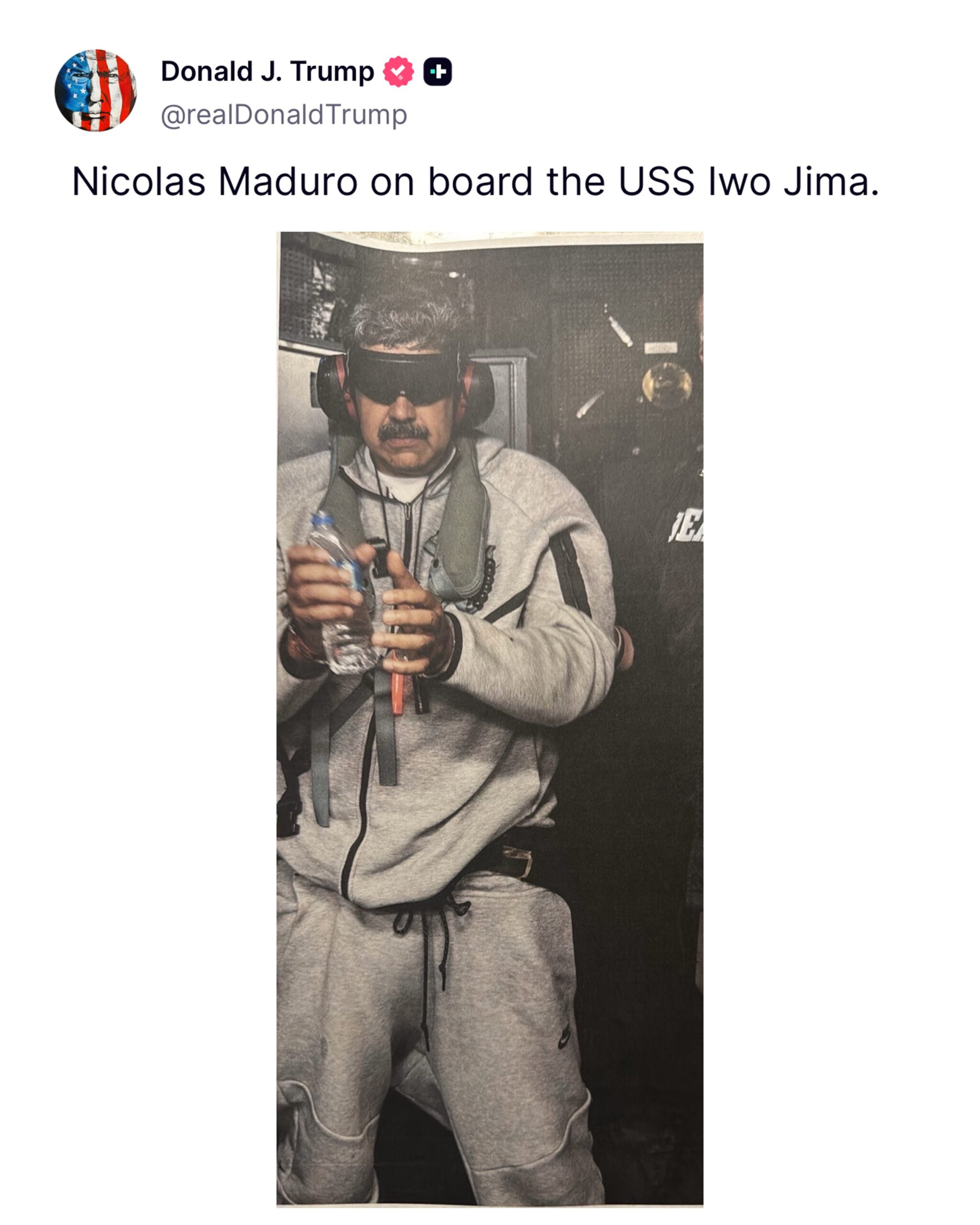
The helicopters came under fire, Caine said, prompting a response with “overwhelming force.” One aircraft was hit, but all returned safely. Maduro and his wife “gave up” and were taken into custody by the U.S. Department of Justice, boarding the USS Iwo Jima at 3:29 a.m., he added.
Trump said Maduro and Flores are being taken to New York to face drug trafficking-related charges. Maduro has repeatedly denied U.S. accusations that he leads a drug cartel.
Trump said the United States was prepared to carry out a second wave of attacks if necessary, adding that Washington was “not afraid of boots on the ground” and that U.S. forces had operated “at a very high level” inside Venezuela.
Asked how the United States would govern Venezuela during the transition, Trump offered few specifics, saying only that officials were “designating people right now.” He gestured toward himself and Secretary of State Marco Rubio, saying that for a period of time “it’s largely going to be the people standing right behind me.”
Rubio described Maduro as a “fugitive of American justice” with a US$50 million reward on his head. “I guess we saved ourselves $50 million,” Rubio said, prompting Trump to add: “We should make sure nobody claims it.”
Rubio said Maduro had been given “multiple opportunities” to avoid confrontation but instead chose to “act like a wild man,” accusing him of inviting Iran into Venezuela and allowing criminal gangs to send migrants into the United States. “President Trump is not a game player,” Rubio said.
Trump also said U.S. companies would be allowed to enter Venezuela to repair its oil infrastructure and “start making money for the country,” framing the intervention as the beginning of a “partnership” that would make Venezuelans “rich, independent and safe.” He referred to Maduro as an “illegitimate dictator.”
Trump confirmed that Rubio had been in contact with Delcy Rodríguez, Venezuela’s vice president and one of Maduro’s closest allies. Rodríguez issued an audio statement after the strikes urging the United States to provide proof of life for Maduro and Flores, sparking speculation that she may no longer be in Venezuela.
Trump said Rodríguez had expressed a willingness to do “whatever the U.S. asks,” though analysts say she would struggle to gain credibility as an agent of political change after years of defending the Maduro’s regime.
Opposition leader and Nobel Peace Prize laureate María Corina Machado has hailed the operation as a turning point for the country.
“The hour of freedom has arrived,” Machado said in a statement, declaring that Maduro is now facing international justice for “atrocious crimes” committed against Venezuelans and foreign citizens. She said the time had come for “popular sovereignty and national sovereignty” to prevail.
Machado called for the immediate recognition of opposition-backed Edmundo González Urrutia as Venezuela’s legitimate president and commander-in-chief of the armed forces, urging military officers to recognize his authority.
“We are prepared to enforce our mandate and take power,” she said, calling on Venezuelans inside the country to remain organized and on those abroad to mobilize international support for rebuilding Venezuela.
“Venezuela will be free,” Machado said. “Hand in hand with God, until the very end.”
U.S. President Donald Trump has hailed as “brilliant” the U.S. military operation that resulted in the capture of Venezuelan dictator Nicolás Maduro, as explosions were reported in Caracas early Saturday. Governments across the Americas and Europe are reacting to the arrest of the Maduro and his wife Cilia Flores.
In a brief telephone interview with The New York Times hours after the strikes, Trump praised the planning and execution of the operation. “A lot of good planning and a lot of great, great troops and people,” Trump said. “It was a brilliant operation, actually.”
Trump said U.S. forces carried out a large-scale strike against military targets in Venezuela and captured Maduro and his wife, Cilia Flores, who were flown out of the country. He has not disclosed where they are being held. The U.S. administration claims there were no American casualties in the operation but declined to comment on Venezuelan casualties.
Venezuelan authorities have yet to confirm Maduro’s capture. Vice President Delcy Rodríguez said on state television that the whereabouts of Maduro and Flores were unknown and demanded “proof of life” from Washington.
Interior Minister and the regime’s henchman Diosdado Cabello urged calm, telling Venezuelans not to “make things easier for the invading enemy,” and alleged without evidence that civilian buildings had been hit.
In a separate statement broadcast on state television VTV, Venezuela’s Attorney General Tarek William Saab formally requested proof of life for Maduro and Flores. Saab condemned the U.S. action as a shift “from rhetoric to direct violence” and described the strikes as a premeditated act of terrorism. He said the operation left an unspecified number of people injured and killed, without providing figures or evidence.
Explosions were reported across Caracas in the early hours of Saturday, with power outages affecting several districts, according to witnesses and local media. Venezuelan state outlets reported strikes on major military and government sites, including Fuerte Tiuna, the country’s largest military base, and the La Carlota air base in heart of the capital.
According to sources inside Venezuela, pro-opposition supporters aligned with Venezuela’s legitimate president-elect Edmundo González and Nobel Peace Prize laureate María Corina Machado have begun mobilizing to secure government buildings and institutions and are preparing steps toward a political transition. Sources claim to be preparing the groundwork for what they describe as a interim administration, though no formal announcement has been made.
The U.S. embassy in Bogotá issued a security alert urging American citizens in Venezuela to shelter in place, citing “reports of explosions in and around” Caracas. The United States suspended operations at its embassy in Caracas in 2019.
Bogotá Mayor Carlos Fernando Galán called for calm and announced increased security measures near the U.S. and Venezuelan diplomatic missions in the Colombian capital. “It is clear that a new stage is opening today for Venezuela, which should be oriented toward the return of democracy. That process must be peaceful and with full respect for the civilian population and international law. At this moment, the protection of Venezuelan citizens, both within their country and abroad, is a priority. Bogotá is home to hundreds of thousands of Venezuelan citizens, and our responsibility is to ensure their safety, their rights, and coexistence in the city,” he said.
Maduro was indicted in the United States in 2020 on corruption and drug trafficking charges, which he has repeatedly denied. The U.S. State Department has offered a $50 million reward for information leading to his arrest or conviction.
U.S. Attorney General Pamela Bondi said Maduro and Flores had been indicted in the Southern District of New York on charges including narco-terrorism conspiracy and cocaine importation conspiracy, adding that both would face U.S. justice.
Republicans react to Venezuela strikes
U.S House Representative María Elvira Salazar, a Florida Republican and outspoken critic of the Maduro government, said the strikes represented “the fall of a criminal structure masquerading as a government.” She said Maduro’s removal opened the door for “a real democratic transition led by Venezuelans who have resisted tyranny for years.”
Republican Senator Carlos Gimenez affirmed that “President Trump has changed the course of history in our hemisphere. Our country and the world are safer for it. Today’s decisive action is this hemisphere’s equivalent to the Fall of the Berlin Wall.”
Senator Rick Scott announced “A new day for Venezuela and Latin America. The United States and our hemisphere are safer because of President Trump’s leadership!”
U.S. Deputy Secretary of State Christopher Landau said in a social media post that Maduro had been removed from power and would be put on trial or punished, without providing further details.
Reactions from Latin America
Former Colombian President Álvaro Uribe Vélez defended the U.S. action as legitimate self-defense, arguing that Venezuela had for years harbored armed groups and facilitated drug trafficking. Uribe said that when a country becomes “a sanctuary for narco-terrorism,” it inevitably triggers consequences. He accused Venezuela’s leadership of destroying democratic institutions and fueling an exodus of millions across the region, urging Venezuelans to pursue freedom and institutional reconstruction.
Former Colombian President Iván Duque also welcomed the development, calling Maduro’s capture “the beginning of the end of the narco-dictatorship in Venezuela.” Duque said the moment opened a path toward democratic reconstruction with international support, while emphasizing the need to protect regional security.
Colombia’s current President Gustavo Petro took a sharply different view, rejecting what he called aggression against Venezuela’s sovereignty. Petro said Colombia had deployed security forces to its border and activated contingency plans in case of a mass influx of refugees, while seeking to convene the United Nations Security Council. “Internal conflicts between peoples are resolved by those same peoples in peace,” Petro said.
Argentina’s President Javier Milei struck a celebratory tone, posting on “X”: “Long live freedom, carajo!”
Ecuador’s President Daniel Noboa voiced support for Venezuela and the opposition. “To María Corina Machado, Edmundo González and the Venezuelan people, it is time to recover your country,” Noboa wrote, adding that what he called “narco-Chavista criminal structures” would continue to fall across the continent.
Colombian presidential candidate Paloma Valencia of the Centro Democrático party was among the first to react to the breaking news, stating: “Free Venezuela. The illegitimate dictator who usurped power, and subjugated Venezuela and the Venezuelans, has fallen. Democrats yearned for an opportunity for the return of democracy and freedom.”
Medellin Mayor Federico Gutiérrez also celebrated the arrest of the regime leader, saying: “Dictator Nicolás Maduro has been captured. Every tyrant’s time comes. Venezuela Free.”
Spain’s Prime Minister Pedro Sánchez has urged restraint and respect for international law, while Cuba’s President Miguel Díaz-Canel condemned the “criminal attack” by the United States.
As of Saturday morning, no senior Venezuelan military official, including Defense Minister Vladimir Padrino, had appeared publicly, and it remained unclear who controlled key state institutions or how Venezuela’s armed forces would respond as the crisis continued to unfold.
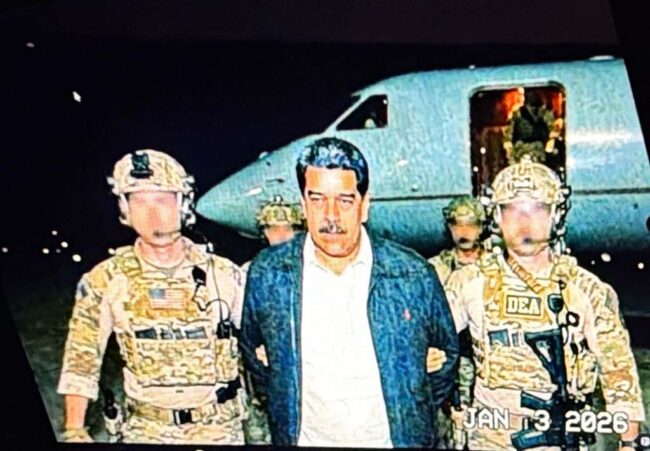
Screen capture from television shows DEA agents escorting Venezuela’s Nicolás Maduro.
Arrested president of Venezuela Nicolás Maduro. Photo courtesy of X
The US carried out limited airstrikes in Venezuela this morning and claim to have captured Nicolás Maduro. Colombia has reacted with strong condemnation.
Colombia this morning woke to the news that US forces had attacked the neighbouring capital Caracas. President Donald Trump claimed via Truth Social that Maduro had been captured and extricated from the country, with the airstrikes necessary for that operation to take place.
It later emerged that the attack and capture was an arrest. The US has confirmed Maduro’s indictment in New York and that he will stand trial for narcotrafficking and potentially other offences. This dates back to 2020, although it was not widely known that Maduro’s wife Cilia, captured with him, had also been part of that case.
What is Colombia’s position?
Unsurprisingly, President Gustavo Petro is firmly against US action in general and particularly in the neighbouring country. In the short term he has sent troops to the border in preparation for a possible surge in refugees. Interestingly, it seems that the Colombian government may have had advance warning, as his security meeting started at 3AM.
Acabamos de terminar consejo de seguridad nacional desde las 3 am.
Se despliega la fuerza pública en la frontera, se despliega toda la fuerza asistencial que dispongamos en caso de entrada masiva de refugiados.
La embajada de Colombia en Venezuela está activa a llamadas de…
Petro rejects all US actions that violates the sovereignty of Venezuela and Latin America. He has said already that he will use his position on the UN security council to discuss this matter and search for a solution. In this, he will find support domestically and internationally.
For many in Colombia, and indeed Latin America in general, this brings memories of US interventionism during the Cold War. From helping to topple Allende in Chile, supporting dictatorships across the Southern Cone and the Sandinista affair, there is a long history of meddling in regional politics.
Equally, there is no love for Nicolás Maduro in Colombia. That is shared across the political spectrum for different reasons and comes through solidarity with the Venezuelan people, a dislike of the immigration wave he caused or a fierce disagreement with leftwing politicians in general.
However little sympathy there is for Maduro, that does not equate to support for direct military action from the US in foreign territory. Many Colombians have fears that similar might happen to their country. While that seems unlikely, Donald Trump is at best unpredictable and few would have seen today’s actions coming a year ago.
Colombia is also likely to have strained relations with the incoming administration in Caracas. Petro and many on his side are no fans of Machado, who they see as a classic representative of the Latin rightwing oligarchy.
Petro will be wary of supporting the notion that presidents can be toppled in this manner and regime change forced upon a nation by foreign forces. At the least, he will call for free and fair elections to be held sooner rather than later.
Relations with the USA have significantly deteriorated, for obvious reasons, but Colombia is very much with international feeling on this one, with Trump the pariah. A number of world leaders have issued statements decrying and condemning the US actions. Only Machado, Netanyahu and Argentina’s Milei have departed from the consensus, unsurpisingly.
ELN held a short-lived paro armado in December warning against foreign interference in the region, so it’s entirely likely that they might announce similar measures in the next few weeks. It’s unclear how or if groups such as the gaitanistas may react, given that they were recently declared terrorist organisations by the US State department.
What happens next?
For Colombia, the three biggest fears for the future are the probability of refugees fleeing across the border; the possibility that similar will happen here; the effects on this year’s election. This might have been a relatively quick operation, but its effects will linger for months at bare minimum and likely years.
Venezuela itself will have to work out who is going to replace Maduro in the presidential Palacio Miraflores. That could well be recent Nobel Peace Prize winner María Corina Machado, or could be a general stepping up to lead an interim government while elections are organised.
It could even be a continuation government, refusing to give in after the loss of Maduro and daring further strikes. US Secretary of State Marco Rubio has ruled out further actions for the time being now that Maduro has been captured.
The likelihood of large scale US actions within Colombian territory is very low, despite Trump’s rhetoric that Petro might be next in line. The country has just assumed a position on the UN security council and is a member of NATO. Having said all that, focused operations targeting terrorists are certainly possible and Trump is often hard to predict.
Even smaller, focused operations would be incredibly controversial within Colombia and Petro would be pushed to respond strongly, not only by his own supporters. However, his options are relatively limited. He does not have the firepower to make serious counterattacks and is unlikely to want to do so outside of Colombian territory, for example against carriers in international waters.
Any operation involving boots on the ground within Colombia would be a very different story and the military would be more or less forced to intervene. That would push tensions to boiling point with the White House.
Venezuelan immigrants to Colombia already number around two million or more and this action is likely to see increased travel across the borders. Colombia has sent troops to the border in order to attempt to maintain order. Cities such as Cúcuta in Norte de Santander and Riohacha in La Guajira are already under strain and will struggle to absorb further numbers.
It is entirely possible that serious criminal elements and/or government or armed fores members will try to cross within the chaos, putting added pressure on the Colombian government. They may be destabilising elements and there may be pressure from the US not to harbour who they see as essentially international criminals.
For the upcoming election, candidates are already in a difficult position on this topic and things are likely to get harder. Rightwingers have spent years railing against the Venezuelan regime, but will be aware that most Colombians oppose this action.
The added complication is the possibility of Trump supporting one side or another, even making remarks like he did before the Guatemalan election or even offering financial support as he did in the Argentinian elections.
That will be tricky – being on Trump’s side will alienate enough voters to make victory unachievable, yet coming into office in conflict with the leader of the USA will make governing difficult. Candidates have a fine line to walk in terms of balancing electoral rhetoric with diplomacy.
Then there’s the question of who is in the Palacio Miraflores in Caracas. Hard leftwingers will start off on a bad footing with a Machado government or similar, whereas rightwingers will chime with her politically. If there is a sort of continuity, expect the opposite.
Given the surprise, if not shock, of this morning’s actions, it is hard to predict exactly what will happen next, other than there will be short term chaos at least. Trump, of course, thrives on chaos and has a gift for navigating uncertain times. He described this as a “brilliant operation” but few in the region will be in agreement. After all, he is not the one who has to live with the consequences.
The United States has captured Venezuelan dictator Nicolás Maduro, along with his wife Cilia Flores, after a series of targeted military strikes on Caracas at 1:30 am on Saturday, January 3, 2026.
In a statement posted on his Truth Social platform, U.S President Donald J. Trump said U.S. forces, working with U.S. law enforcement, conducted a “large scale strike” that resulted in the capture of Maduro and his wife, Cilia Flores. Trump said both were flown out of Venezuela, without providing details on where they were taken or the legal basis for their detention.
“The United States of America has successfully carried out a large scale strike against Venezuela and its leader, President Nicolas Maduro,” Trump said, adding that more information would be released at a news conference scheduled for 11 a.m. ET at his Mar-a-Lago residence in Florida.
Explosions were reported across parts of Caracas in the early hours of Saturday, according to witnesses and videos posted on social media, which showed flashes in the sky, fires and power outages in several areas of the capital. One of the main targets appeared to be Fuerte Tiuna, the country’s largest military base and a key command center for Venezuela’s Bolivarian Armed Forces.
The extent of damage and possible casualties could not be independently verified. Venezuelan authorities did not immediately confirm whether senior military officials, including Defense Minister Vladimir Padrino, were injured or killed in the strikes.
In Washington, Republican lawmakers were quick to praise President Trump’s decisive action. Representative Mario Díaz-Balart praised the operation, saying it demonstrated decisive leadership against what he described as an illegitimate regime that posed a threat to U.S. and regional security. Other lawmakers raised questions about the legality of the strikes and whether Congress had authorized the use of force.
In Colombia, Medellín Mayor Federico Gutiérrez expressed support for Venezuelans living abroad, saying millions had fled repression and economic collapse under Maduro’s rule. Venezuelan migrants make up a significant share of Medellín’s population, local authorities say.
It remains unclear how Venezuela’s armed forces will respond or whether Maduro’s removal will lead to a peaceful transition of power with the return of President-elect Edmundo González and opposition leader Maria Corina Machado, both currently out of the country.
As the year winds to an end, the Bogotá Post looks back at 2025 in Colombia
2025 might well be looked back upon in years to come as the calm before the storm. An early sign of the potentially troubled waters ahead was the assassination of Senator Miguel Uribe in early June. Other themes included friction with the US, political deadlock and a sense that much is being put off for next year.
Colombia still welcomes the world, but maybe not the US president. Photo: Emma Whitaker-Pitts
Relations with the USA started badly after Trump was sworn in, as he deported Colombian immigrants in chains on military planes. Petro at first refused to receive the flights, before relenting and allowing them to land but greeting the travellers and treating them with dignity.
From there it got worse, with Petro turning up on the New York streets protesting while on a visit to the UN. Trump in turn has no love for Petro, calling him a bad guy and putting him and his family on the Clinton List, alongside highly controversial longtime advisor Armando Benedetti. It also emerged at that point that Petro had separated from Veronica Alcocer some time ago.
After the US started bombing alleged narco ships in international waters in the Caribbean, things took an even darker turn. Petro, like most world leaders, was highly critical of US operations in the Caribbean, leading Trump to warn that “he could be next”.
Bogotá herself kept on with business as usual, although that’s not always a good sign. Mayor Gálan has little to show at the mid point of his time in the Palacio Liévano. Crime and rubbish are the most visible signs of a city that sometimes feels stuck in place, although the Metro seems to be on track.
Away from the febrile world of Colombian politics, there was plenty going on in cultural fields, from an impressive Copa América run by the superpoderosas to possibly the best festival Cordillera yet in Bogotá.
Violence mars the start of 2026 campaigning
Senator Miguel Uribe was assassinated at the start of his electoral bid in a worrrying reminder of what can happen in Colombian politics. The politician was shot a number of times in the head while making a visit to Modelia and put into intensive care for a month before passing.
Miguel Uribe giving a speech
One shooter, just 15 years of age was shot and captured at the scene by Uribe’s protection. Other suspects and accomplices were relatively quickly captured, although the intellectual author of the crime remains unclear. While social networks have been hothouses of rumours and propaganda, candidates have thankfully so far stayed largely clear of commenting.
Runners and riders for the presidency have emerged and started the process of thinning the field. The Liberales, Conservadores and Cambio Radical are yet to declare their representatives. However, there are still six candidates for political parties and another 14 who have acquired the requisite 635,000 signatures to run as independents.
Among the latter names there are some big names such as Claudia López, Luis Murillo, Abelardo de Espriella and Vicky Dávila. There’s also a number of seeming no-hopers, but remember that was Rodolfo Hérnandez this time last year and he got to the second round as a semi-protest candidate.
Iván Cepeda is Petro’s successor candidate for Pacto Historico, while the Centro Democrático have plumped for Paloma Valencia. Sergio Fajardo is back in the race again, for Dignidad y Compromiso. That means no place for some high profile heavyweights such as Maria Fernanda Cabal, Susana Muhamed and Gustavo Bolívar.
High-profile roadblocks, change by the back door
One of the constants in Colombian politics in 2025 was that major reforms and were blocked and delayed, yet a few things were snuck in through alternative measures. This was exemplified by Petro declaring economic emergency in a constitutionally dubious manner.
The reforma de salud was sunk again in the springtime, but by mid-year MinSalud had gone ahead with some of the changes anyway. This may well be reversed by an incoming government next year, meaning that EPSs remain somewhat in limbo.
Cómo así que no hay que castigar alcohol cuando más se tiene alcohol en la mercancía, ¿no sabe que es la droga que más produce muerte y daños en los sistemas presupuestales de salud? Menos alcohol en las personas y la sociedad es productivo y beneficioso para la vida. Aquí no se… https://t.co/GFbT4Wx0k5
Major budget changes are unlikely to get through under anyone, so failing to get this done can’t really be laid at Petro’s door. However, he’s gone ahead with what he can do: enormous hikes in the minimum salary, IVA abolished on certain items, demanding that pension funds divest from foreign investments and repatriate their savings.
Paz Total is looking more and more like Fracaso Total as time ticks on. At best, talks with various groups are going nowhere, while other talks have essentially collapsed. Trump declaring the Gaitanistas a terrorist group has muddied the waters even further. The ELN, Colombia’s largest remaining guerilla force, in particular have intensified operations.
While some of that has underlined the difference between their rhetoric and reality, with December’s paro nacional affecting little of the country, other attacks have been bloody and worrying, with the increased use of drones a dangerous direction of travel.
Economic uncertainty?
Whether the economy is doing well or not and whether that is because or in spite of the government will depend mainly on your fellings towards Petro. It’s a mixed bag with plenty of caveats on both sides. GDP growth has been good and ahead of expectation, with unemployment continuing to fall and inflation slowing. Those new jobs are largely formal, too.
However, the GDP growth isn’t as fast as it could be, while it’s outperforming regionally, it’s behind the global average. Unemployment is at a low point for the century, but is still mainly informal and the rate of decrease is slowing. It’s hard to guess how the recently announced minimum wage hike to COP$2,000,000 will affect this.
The minimum salary has reached a symbolic COP$2,000,000
Much more worrying is that much of this may be built on sand. While Petro has struggled to get big-ticket bills through the legislature, he’s quietly done things behind the scenes that have ramped up public spending. He’s betting on that being an investment which will keep delivering in the long run. If not, it will be an albatross for future governments.
Inflation remains at 5.3% annually, not calamitous, but stubbornly high. The cost of living, too, is ever-increasing, not helped by uncertainty in global trade routes. Despite all that wind and bluster between Trump and Petro, tariffs remain at the standard 10% for the time being.
Petro finally got his reforma laboral over the line, in some ways a major achievement considering the opposition it faced in the Senate. However, the text of the bill is somewhat underwhelming. For the main part, there are minor changes such as a cap on overtime and night shifts starting two hours earlier as well as solidifying full time contracts as the norm.
The most substantial change is a commitment to make online providers such as Rappi pay social security and workplace risk contributions for their workers. This may find the devil is in the details in terms of bringing it into reality.
Colombia also brought the Bre-B system of instant payments online. This is already having a huge impact in a country where digital payments are widespread and popular. Long term, this provides a base for increasing transparancy and reducing corruption. However, questions remain over the infrastructure underpinning these systems.
Transport no longer stuck in a jam
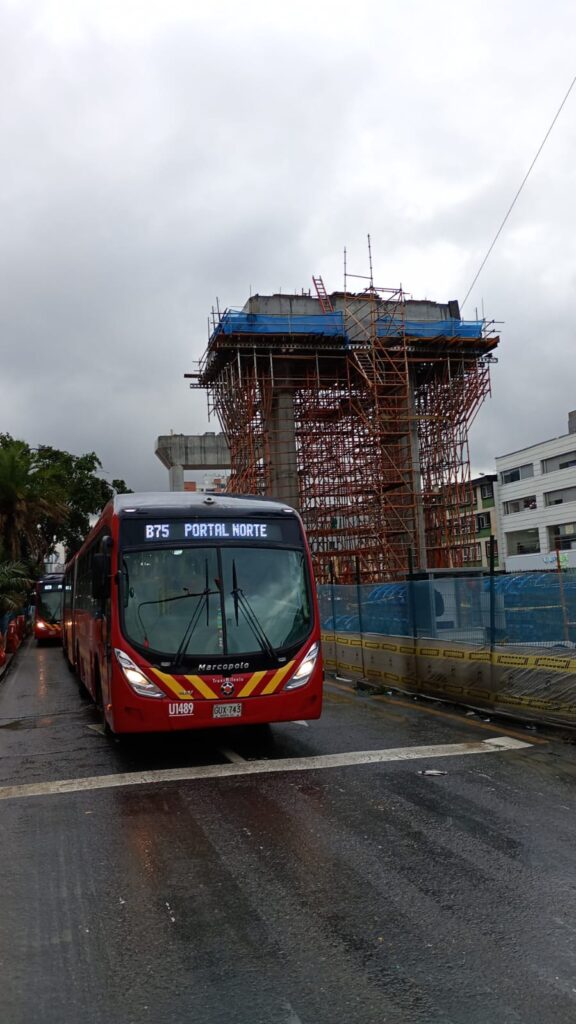
The Metro columns are popping up along the Caracas
The really big local news has been that the Metro is progressing as planned. This might not seem like big news, but given how long the project spent in planning and the tendency of the president to stick his beak in, it’s just good to see something being done.
The first trains have arrived in the country and are running tests while the towering columns of the track are in place all over the city. Today, that means pain as Transmi stations close and traffic is rerouted, but all is in place for a fully integrated public transport system in the future.
RegioTram is also more or less on schedule, although it will need to be reworked to connect with the Bogotá systems, after it was pointed out that the planned stations are a fair distance away from the trnasmi and Metro. Regardless, connecting satellite towns with the capital is a gamechanging proposal.
Life in the city remains irritating due to continued high crime levels and the seeming refusal of Carlos Fernando Galán to do anything about rubbish on the streets. The best that can be said about Gálan at this point is that he has done little of note, hardly a glowing resumé, given his ambitions coming into office.
Culture vultures
Festival Cordillera is now intertwined with la nevera
The capital saw a celebration of Latino music as Festival Cordillera 2025 confirmed the event’s stature as a lodestone of music in Colombia. With Festival Estéreo Picnic 2025 providing a balance that focuses on anglophone music, the capital is well set. However, with both those festivals in the Parque Bolívar, Rock al Parque is struggling to stay relevant.
Plenty of other bands were touring throughout the year too, with Bogotá increasingly on the map for big-name world superstars. That means enduring the likes of Guns N’ Roses, but also means that rolos can see contemporary stars like Dua Lipa.
Former busker Ed Sheeran popped up on stage as a surprise guest of J Balvin in December, while another Brit unsurprisingly failed to turn up because that’s what Morrissey does these days. Latinos across Instagram responded by trolling the famous vegetarian with meat recipes.
Elsewhere online, Colombian food performed well on a host of dubious internet polls, sparkign waves of reposted joy throughout the year. In more dispiriting news, Club Colombia Negra was discontinued by Bavaria, meaning you have few chances to neck the country’s last widely available dark lager.
For those more interested in staying home, Colombia’s first ever board games convention took place in November. Ludotopia was an undisputed success, attracting the likes of Wingspan artist Ana Maria Martínez (who teased the upcoming expansion for Wingspan South America, Central America and Caribbean) and proving that Bogotá retains a dynamic and evolving cultural scene.
Colombia fall just short again
The women’s football team came into the Copa América on good form and were within seconds of taking the title. With two minutes of regular time to go, Mayra Ramírez put Colombia ahead for the third and seemingly last time at 3:2. Brazilian superstar supersub Marta, in her last tournament, broke Colombian hearts as she rolled back the years with a last gasp equalizer in the sixth minute of injury time.
The drama wasn’t over, as she then put Brazil in front for the first time in extra time before Leicy Santos equalized and took the game to penalties. There, the game slipped through the fingers of the superpoderosas as perma-champions Brazil showed their experience. They took the shoot out 5:4 for their 9th title in ten Copa Américas.
The men’s team, also runners up in their Copa América, ground their way to qualification for next year’s World Cup in North America. Conmebol was a slogfest this time around, with everyone except Argentina involved in taking points off each other and goals in short supply.
Eventually, Colombia found form, only losing a single game in the year and finishing with a goalfest against Venezuela, beating their fierce rivals 6-3 in the last game. That leaves Colombia 13th in the FIFA rankings – unlucky for some maybe, but not coach Nestor Lorenzo.
Santa Fe had a sweet victory over Millos en route to the first title
On the local stage, Santa Fe reclaimed the liga apertura for Bogotá, triumphing in Medellín over Independiente thanks to an inspired performance from Wigan legend Hugo Rodellega. Knocking out Millos and El Tigre Falcao on the way made it even sweeter. Junior of Barranquilla took the finalizácion, with Nacional winning the Copa Colombia. The latter was a Medellín derby and marred by a pitch invasion and violence at the end.
Cricket Colombia hit a six as MinDeportes officially recognised the gentleman’s game as a sport in the country. This opens up the field for more funding and support for events. They also welcomed a visiting team from Trinidad and Tobago as well as setting a T20 record for a last wicket chase in the Gulf Series against México.
What’s coming next?
Next year promises much more drama in Colombia, with national elections set to be hard-fought. This is an unusual cycle, as the country is preparing to see who will succeed a leftist president. Whether there will be continuity, a sharp tack rightwards or a drive for the centre is still anyone’s guess.
The lineups for the capital’s big music festivals seem strong, with a supporting cast of superstars also set to tour. The men’s football team have a relatively straightforward group in the World Cup and will fancy themselves to do well.
Our predictions for 2026 will be coming in the next few days, but whatever comes to pass, we’ll be here to keep you in the loop with what’s happening in Colombia and why. We got some of the 2025 calls right, after all. right Happy new year from the Bogotá Post – your English voice in Colombia!
An extraordinary leap of 23.78% in the Colombian minimum salary per month brings it to a symbolic COP$2,000,000
More money in many wallets with the Colombian minimum salary 2026
An unprecedented hike in the Colombian minimum salary for 2026 was announced on Monday 29 December, bringing the rate to two million pesos per month. That represents an increase of 23.78% on the 2025 number. That’s the biggest jump ever – only 1997 comes close in recent years with 21.02%.
The minimum salary itself (SMMLV or Salario Mínimo Mensual Legal Vigente) has gone up to COP$1,750,905. There is also a transport subsidy (COP$249,095) which brings the effective minimum salary in Colombia for 2026 to two million on the nose.
Business leaders had suggested a rise of around 7.21%, keeping it above annual inflation (5.3% as of November), while trade unions and syndicates had called for an optimistic 16%. Both were left in the dust by Petro’s extraordinary decision.
The extraordinary rise is not due directly to inflation, nor to the rising cost of living, but represents a fundamental change in the rationale behind the number. Colombian president Gustavo Petro explained that the minimum salary should be considered a household income, not individual. He calls this salario vital, or salario digno.
Whether the household basis for the minimum salary holds up to scrutiny is hard to say. It certainly was the case, but like most other middle-income countries Colombia is rapidly changing. The idea of a single income supporting a family is less true every year, with Colombian households under 3.5 people on average and with 1.5 workers. That means a true dependency ratio of nearly one to one.
It was calculated by working around the price of a basket of goods for the average family (canasta básica), logged at nearly 3 million pesos for four people. Using that number of 1.5 workers gave the convenient round number of two million.
The minimum salary (not including the transport subsidy) is the baseline number that in turn influences a whole lot of other values in Colombia, such as fines and public salaries which are counted as multiples of the SMMLV. That includes, happily for Congress, politicians’ pay.
What does the increase in the Colombian minimum salary mean for the economy?
Far harder to work out is the long term impact of this rise in the Colombian minimum salary. Petro claims it will further stoke private spending in the country as the increased wages percolate throughout the economy and allow continued growth.
It will increase labour costs for a number of businesses, especially small companies, some of which will struggle to keep their heads above water with such a sudden rise in payroll. For medium and larger size businesses, this includes mandatory SENA apprentices.
Note that payroll costs for employers will increase by more than the 23.78% headline figure, as they have to make social security payments based on an employee’s wage as well as the wage itself.
Massive firms who are liquid enough to be able to absorb costs will likely be absolutely fine, even if there are a couple of high-profile exceptions. Companies that are dodging the system, either through informal working or false self-employment, will also likely thrive.
Of course, the new reforma laboral promises to regularise and/or eliminate such practices. On paper, that is. In reality, these are the potential counterintuitive effects that could be the legacy of this increase in the Colombian minimum salary.
Colombia saw a sharp downtick in the number of employees on minimum salary this year, while informal work and self-employment has risen to around 55% of the workforce. This trend could continue much more rapidly with companies unwilling to pay the high new Colombian minimum salary.
A further issue is how close the minimum salary is now to the average. This will particularly affect smaller businesses and recent graduates. The former will find it hard to offer salaries that are significantly above minimum to attract quality employees, while the latter will find themselves often close to minimum salary and waiting longer for a return on their studies.
It is worth remembering that both minimum salaries themselves and increases to them are often bitterly opposed the world over and predictions of chaos are frequently sown. In most cases there is short term turbulence followed by long term stability.
Is this a political power play?
Despite Petro’s official line about household incomes, many will see this as a nakedly political move ahead of next year’s elections. It certainly will play well among the Colombia Humana base and potential voters as a reason to keep faith with the left and cast their vote accordingly next year.
A more charitable view would be to say that it’s one of the last significant acts that Petro can take before leaving office, so he’s gone big to deliver an achievement. Those have been in short supply over his time in the Palacio Nariño.
What’s undoubtable is that this creates a massive headache for next year. Regardless of who takes power, they won’t be expected to deliver quite such a large rise. However, they will have to be careful how far they go below it.
Any successor to Petro will at least be able to say their allies prepared the ground and maybe get away with a modest increase. An incoming fiscal conservative will be under pressure to deliver another big increase against their natural instincts and take heat for not doing so, while actually cutting the rate would be close to political suicide.
While a lot of candidates in the 2026 election might say that this was a fiscally imprudent move, they will have to be careful how far they push it. Many in Colombia will agree with them, but those same people are also likely benefiting from the increase.
There are also the optics of a rich politician arguing against the very many voters who are on minimum wage or even those who aspire to earn minimum wage. It’s not a good look to argue against giving stuff to the people whose vote you want.
Short term gains, but long term problems?
So in the end this is a huge play from Petro, which has won him a useful political victory for today. It backs up his rhetoric, as he can easily claim he’s acting on behalf of the workers. There’s plenty of truth in that, as many Colombians work on minimum wage.
It may be a bribe to the electorate, but many will claim that no one else has at least offered them anything like this ever before, so good on him. Going into the 2026 election candidates on Petro’s side will be able to point to this achievement, while opposition candidates face pressure to offer at least something similar or be painted as rich folk denying the poor.
It’s hard to see a short term in which we won’t see a lot of businesses go bankrupt. The longer term is harder to read, as most companies will be unhappy but able to keep going. The effect on public salaries is potentially alarming with the state already running a deficit, unable to achieve fiscal reform and still expanding.
Ironically, it’s entirely possible that the increase in the Colombian minimum salary for 2026 might lead to more informality and less dynamism in the economy. However, it’s also completely believable that the economy is resilient enough to handle it with ease. This may be Petro’s biggest gamble yet and even he doesn’t know how it’ll play out.
Colombian army officers frustrate an ELN cylinder bomb attack in Antioquia. Image credit: @COL_EJERCITO via X
The National Liberation Army (ELN), a Colombian guerrilla group, concluded its 72-hour armed strike this morning, putting an end to days of tension in many parts of the country.
The action –a common tactic in Colombia which aims at paralyzing movement by threatening violence against those who do not stay home – left at least three people dead, with incidents registered in 13 departments across the country.
The ELN declared the strike to oppose United States “imperialism” and military threats in the region, with analysts warning White House aggression in the region could empower the guerrillas.
What happened during the strike?
Police attributed various violent actions over the weekend to the ELN. Shortly after the strike began on Sunday, cylinder bombs appeared on key roadways across the country, disrupting land travel.
While over a dozen departments registered incidents, transport in Norte de Santander was particularly affected, with the main road from the capital, Cúcuta, to Pamplona closed due to a bomb.
An attack on a police station in Norte de Santander also claimed the life of an ambulance driver, who reportedly got caught in the crossfire. Two more corpses were found in a Cúcuta neighborhood near the Venezuelan border, which are being investigated as linked to the strike.
In addition to police stations, the rebels attacked other government installations, blowing up a toll booth in Barrancabermeja, Santander, and injuring a worker.
In a particularly grim incident, two policemen in Cali, Colombia’s third city, were killed in a bomb attack on Tuesday morning.
The ELN also burned an intercity bus in the Antioquia department.
‘On the offensive’
The ELN’s actions over the weekend marked the group’s first national-level armed strike since early 2022.
While its leaders signalled an openness to resume peace talks with the state just months ago, the rebels’ actions this week suggest a renewed aggression towards the government.
“The ELN is quite literally on the offensive. It is difficult to know what they want at this time,” said Laura Bonilla, deputy director of the Colombian Peace and Reconciliation Foundation (Pares).
The analyst explained that the actions highlighted a shift in the methods used by the ELN, notably an increase in the use of indiscriminate explosives like cylinder bombs and drones.
“The implication of this is that these are weapons that produce a greater effect on civilians,” Bonilla told The Bogotá Post.
In 2024, there was an 89% increase in the number of victims of explosive attacks in Colombia, according to the International Committee for the Red Cross.
Bonilla also noted that the ELN is growing more aggressive as the White House ramps up pressure in the region.
The group declared the strike to “protest the threat of imperialist intervention in our country as a new phase of Trump’s neo-colonial plan.”
According to Bonilla, the ELN has been “paradoxically empowered” by Washington’s growing militancy, as it fuels their claims to be an anti-imperialist bastion. As Trump promises land strikes on Venezuela, where the ELN has a stronghold, the group may grow more active and more aggressive in Colombia.
The United States today classified the Gaitanist Army of Colombia (EGC), Colombia’s most powerful armed group, a foreign terrorist organization (FTO).
The EGC, or Clan del Golfo, has expanded its criminal enterprise in Colombia in recent years, consolidating control over lucrative illicit economies like cocaine and illegal gold mining, as well as extorting large-scale enterprise.
While its designation as an FTO could assist authorities in unravelling the organization’s financial structure, analysts say it may threaten ongoing peace talks in Qatar between the EGC and the Colombian government.
“Today, the Department of State is designating Clan del Golfo as a Foreign Terrorist Organization (FTO) and a Specially Designated Global Terrorist (SDGT),” wrote Secretary of State Marco Rubio in a statement on Tuesday morning.
“Based in Colombia, Clan del Golfo is a violent and powerful criminal organization with thousands of members. The group’s primary source of income is cocaine trafficking, which it uses to fund its violent activities,” continued the memo.
Who are the EGC?
The EGC was born from the remnants of the United Self-Defense Forces of Colombia (AUC), a paramilitary group responsible for grave human rights abuses in the late 1990s and early 2000s.
Since then, it has re-branded itself several times; for a time it called itself the Urabeños, then the Clan del Golfo, honoring its heartland in the Gulf of Urabá in northern Colombia; it later changed its name to the Gaitanist Self-Defense Forces of Colombia (AGC); most recently, the group adopted the EGC moniker.
In recent years, the group has argued that it is a political actor in Colombia’s decades-long internal conflict, but its origins were strictly focused on making money illicitly.
In the past decade, the organization has rapidly expanded beyond northern Colombia into as many as 20 departments across the country, exerting control in both rural and urban areas.
“On the one hand, the group is an organized crime structure that manages various legal and illegal businesses and, on the other hand, it has also formed a uniformed army,” explained Gerson Arias, conflict and security investigator at the Ideas for Peace Foundation (FIP), a Colombian think tank.
Today, the group counts between 3,000 and 3,500 uniformed troops among its ranks while it has a further 6,000 members who form part of its broader crime structure of extorting businesses, according to Arias.
“The main threat facing Colombia today is represented by the Clan del Golfo and its military and economic structure, both legal and illegal,” the analyst told The Bogotá Post.
What does the FTO designation change?
Following Washington’s sanctions, anyone deemed to be providing material support to the EGC can be brought to trial in a U.S. court.
“Not only could cases be brought against members of the Clan del Golfo, but against any businessmen, facilitators, logistics operators, or anyone who provides even something as simple as buying them a meal,” explained Elizabeth Dickinson, Deputy Director for Latin America at International Crisis Group.
She told The Bogotá Post that the FTO designation could therefore “open some interesting doors” by exposing links between the EGC and legal enterprise, adding “this is an organization that has deep tentacles in the business world.”
The move could also provide a pretext for military action against the EGC in Colombia, with the Trump administration saying in recent weeks that drug production in any country is a legitimate target.
“An FTO in and of itself is not a justification for military action. However, it has historically been a step along the road to paving a narrative politically that could lead to the U.S. considering military action,” said Dickinson.
Impact on peace negotiations
In September, the first round of negotiations took place between EGC and Colombian state negotiators in Doha, mediated by the Qatari government.
A second round in December led to the signing of a “commitment to peace”, with the first step towards demobilization planned for March 2026.
But the State Department’s FTO designation threatens to derail talks, according to analysts.
“I think there’s a lot of pending questions right now about the future of negotiations with this group,” said Dickinson.
She stressed the progress made in talks so far, including a commitment to take a census of children fighting in the ranks of armed groups and return them to the state.
FIP’s Arias warned that the FTO classification will complicate both the subject of talks and the logistics of engaging in negotiations.
He noted that EGC negotiators will struggle to attend talks safely outside of Colombia and that Colombian authorities will be unable to provide credible non-extradition guarantees to the group’s leaders.
But Dickinson warned of the dangers of ending negotiations: “This organization is the largest threat to peace and security in Colombia. I think it will be important for the Colombian authorities and their country partners in mediation to consider what could be the implications of if peace talks were to end.”
ELN fighters. Image credit: Brasil de Fato via Flickr
The Colombian National Liberation Army (ELN) has declared a 72-hour nationwide armed strike beginning on Sunday in protest against increased US military activity in Latin America.
In a statement, the group warned Colombians not to travel via the country’s roadways or navigable rivers during the three day window; while the group said it would not harm civilians, armed strikes are enforced through violence, with previous iterations involving vehicle burnings and civilian casualties.
The action will be the first national-level armed strike since 2022 and comes amid an ongoing U.S. boat bombing campaign – which the Pentagon says has targeted ELN members – as well as White House threats of further intervention, including land strikes in Colombia.
“We, the peoples’ forces of Colombia, protest the threat of imperialist intervention in our country as a new phase of Trump’s neo-colonial plan, which aims to sink its claws even deeper into Latin American and Caribbean territories,” read a decree emitted on Friday by the ELN.
On multiple occasions, U.S. President Donald Trump has floated the idea of striking drug production targets within Colombian borders; Colombia is the world’s largest producer of cocaine and the ELN is known to be a key actor in the drug trade.
The communiqué said the strike would begin at 6:00 AM on Sunday, December 14 and last until the same time on Wednesday.
While it instructed civilians not to travel by road or river during the three day window, it maintained that its “road control units will respect civilians and their property,” but advised regular people not to mix with soldiers in order to “avoid accidents.”
Although the measures are purportedly national, analysts say they are unlikely to affect the whole country.
“In practical terms, this is a national announcement, but it has a limited impact because the ELN does not have a national presence,” Gerson Arias, investigator at the Ideas for Peace Foundation (FIP), a Colombian think-tank, told The Bogotá Post.
Arias said the bulk of the effect will be seen in areas of ELN control, especially in Colombia’s northeast and in the western departments of Cauca, Nariño and Chocó.
The last time the ELN implemented a nationwide armed strike was in 2022, with incidents across 17 departments including vehicle burnings and road blockages intended to protest the Ivan Duque administration (2018-2022).
But the ELN regularly uses smaller scale armed strikes to exert control over specific areas, usually in rural regions. Experts say that the guerrillas often use the actions as a guise to secure drug transit corridors and facilitate the movement of soldiers and contraband.
Rights groups criticize armed strikes for producing a host of deleterious effects on affected populations, with forced confinement impeding access to education, food, and healthcare.
While the ELN’s decree did not explicitly mention U.S. threats against Venezuela, the group is known to have a presence in the country and has recorded ties with the Nicolás Maduro regime.
Much of the guerrilla group’s territory lies on the border with Venezuela and any U.S. attack on Colombia’s neighbor would also threaten the ELN, according to FIP’s Arias.
“The ELN is well aware that it may be affected by some of the measures taken by the United States,” said the analyst.
The group has already been directly impacted by Trump’s boat bombing campaign, with U.S. Secretary of War Pete Hegseth saying an October 17 strike on an alleged drug vessel had killed three ELN members. The rebels denied the claim, insisting they do not smuggle drugs.
The ELN’s armed strike declaration underscores the complex panorama of armed groups in the region and their ties to government, drug trafficking, and border zones. While the impact of the action is yet to be seen, the announcement shows the far-reaching consequences of the White House’s mounting military pressure in the region.
Donald Trump saluting soldiers. Image credit: @Potus via X
U.S. President Donald Trump said he would not rule out land attacks in any drug producing country on Tuesday, moments after criticizing cocaine production in Colombia.
“I hear Colombia, the country of Colombia, is making cocaine. They have cocaine manufacturing plants, OK, and then they sell us their cocaine. We appreciate that very much. But yeah, anybody that’s doing that and selling it into our country is subject to attack,” Trump told reporters at the White House on Tuesday afternoon.
In response, Colombian President Gustavo Petro warned that such an attack “would be a declaration of war,” telling Trump not to damage “two centuries of diplomatic relations.”
Trump’s comments come amid mounting tensions in the Caribbean, where the U.S. has amassed forces since September. While Washington has so far only attacked alleged drug boats, killing at least 80 people, Trump said on Tuesday he plans to expand the campaign to land strikes “very soon.”
While Venezuela and the Nicolás Maduro regime have been the primary focus of the pressure campaign, Petro’s criticism of the strikes aggravated already tense relations between Bogotá and Washington. In October, the White House sanctioned Petro after he alleged the U.S. had killed a Colombian fisherman in a September boat strike, accusing the South American leader of being “an illegal drug dealer.”
“I think the U.S. has been very clear that they have a problem with Petro, but that they have a very productive relationship with Colombian institutions and particularly the security forces,” explained Elizabeth Dickinson, Deputy Director for Latin America at International Crisis Group.
“For that reason, I think it would be extremely unlikely that there would be a strike on Colombian soil,” Dickinson told The Bogotá Post.
Today is not the first time Trump has floated strikes on Colombian territory, with the president in November saying he would be “proud” to destroy cocaine factories in Colombia.
Colombia is the world’s largest producer of cocaine and the United Nations recently estimated that potential cocaine production increased by 50% in 2023. Trump has personally blamed Petro for this increase but the Colombian president cites his government’s commitment to dismantling cocaine laboratories, often with U.S. cooperation.
But the White House has also shown its ability to distinguish between Colombia’s government and its security forces. When he decertified Colombia as a drug cooperation partner in September, Trump praised the country’s army and police and said “the failure of Colombia to meet its drug control obligations over the past year rests solely with its political leadership.”
For that reason, any strike in Colombia is likely to be done in cooperation with the country’s security and intelligence agencies, according to Dickinson.
“If there were to be a unilateral strike, I think that there would be a massive diplomatic fallout,” added the analyst, “but in practice, the relationship likely would survive.”
Electronic jamming and missiles are two of the risks identified by US regulators.
Latam airlines suspended its Bogota´- Caracas route this week after FAA advice. Photo: CD Dobelli
Major airlines cancelled flights from Bogotá to Caracas this week after US regulators warned of “heightened military activity” around Venezuela.
Avianca and LATAM suspended flights through Venezuelan airspace, along with at least five other airlines, as a response to a Federal Aviation Authority NOTAM (Notice to Airmen) that reported “Global Navigation Satellite System (GNSS) interference” around Maiquetía “Simón Bolívar” International Airport, which serves nearby Caracas.
The warnings were linked to military exercises under way in Venezuela, a response to threats from US forces massing in the Caribbean and aerial attacks on suspect drug boats, some originating from Venezuelan waters.
Colombia’s own airline regulator, Aeronáutica Civil de Colombia, repeated the FAA’s warning but said that air operators in Colombia could take “autonomous decisions” over flights to Venezuela.
On Monday several airlines were continuing direct flights from Bogotá, such as Wingo, Avior (a Venezuelan airline) and Satena (a commercial airline linked to the Colombian Ministry of Defense). Copa offered connections via Panama.
Mobile missiles
The list of airlines suspending flights continued to grow on Monday night with TAP, Turkish Airlines, Iberia and GOL being joined by Air Europa and Plus Ultra.
This came despite pushback from Venezuela’s Instituto Nacional deAeronáutica Civil (INAC) which threatened to punish airlines for following the FAA’s recommendations. According to a report in Aviation Online, airlines avoiding Caracas could in the long term lose access to the country’s airspace.
INAC also issued an ultimatum for airlines suspending flights “to resume services within a 48-hour period” or risk losing their landing permits.
Meanwhile the US FAA issued a more detailed FAA backgrounder clarifying that Venezuela had “at no point expressed an intent to target civil aviation”.
Portable Russian anti-aircraft missile similar to those used in Venezuela. Photo: André Gustavo Stumpf
It did, however, seem concerned that the current context could trigger an air accident.
Venezuela, it said, had mobilized “thousands of military and reserve forces” with access to shoulder-mounted anti-aircraft missiles, or MANPADs (man-portable air defense systems), capable of downing low-altitude aircraft.
This followed comments by Maduro last month that his military were in possession of Russian-made Igla-S missiles “with no fewer than 5,000 of them in key anti-aircraft defense positions to guarantee peace, stability, and tranquility”.
Jammers and spoofers
The more immediate risk was to electronic systems, said the FAA documents, with several civil aircraft recently reporting interference while transiting Venezuela, in some cases causing “lingering effects throughout the night”.
“GNSS jammers and spoofers can affect aircraft out to 250 nautical miles [450 kilometres] and can impact a wide variety of critical communication, navigation, surveillance, and safety equipment on aircraft.”
The FAA said it would “continue to monitor the risk environment for US civil aviation operating in the region and make adjustments, as appropriate, to safeguard U.S. civil aviation”.
In fact, the US airlines stopped all direct commercial and cargo flights into Venezuela as part of an order issued in 2019, related to sanctions against the Maduro regime, widely seen as illegitimate, with the US State Department offering a bounty of US$50 million “for information leading to the arrest and / or conviction” .
Venezuelan leader Nicolás Maduro has a US$50 million bounty on his head. Photo: Steve Hide
Open to talks
Commentators on US – Venezuelan relations this week said that FAA announcement was not necessarily a sign of imminent US military action. Former Associated Press analyst Dan Perry told News Nation that the FAA warning was “a message that they [the FAA] expected the country to become unstable”, but did not point to a ground invasion.
For most observers, the NOTAM was a continuation of the maximum pressure strategy pursued by Washington against the Maduro regime, including a recent decision to declare the Cártel de los Soles — a disconnected group of corrupt military officers who facilitate drug shipments — as a Foreign Terrorist Organization.
Last week Maduro said he was open to talks with Washington, according to AP News, though US President Trump underscored that military action was “still on the table”.
In recent months the US has sent eight navy ships, a submarine, an aircraft carrier and 10,000 service members to the Caribbean. And since August, US firepower has killed at least 83 people in aerial attacks on speedboats suspected of running drugs; for anyone arriving in Venezuela, air is still safer than sea.
Colombian President Gustavo Petro on Monday decreed a 23.7% increase in the country’s minimum wage for 2026, the largest real rise in at least two decades, bypassing negotiations with unions and business groups and sparking warnings from economists, bankers and employers over inflation, job losses and rising informality.
The decree lifts the monthly minimum wage to 1.75 million pesos (U.S$470), or close to 2 million pesos including transport subsidies, and will apply to roughly 2.5 million workers when it takes effect next year. Petro said the measure aims to reduce inequality and move Colombia toward a “living minimum wage” that allows workers to “live better.”
But business associations, financial analysts and opposition lawmakers said the scale of the increase — far above inflation and productivity trends — risks destabilising the labour market and the broader economy.
According to calculations based on official data, with inflation expected to close 2025 at around 5.3% and labour productivity growth estimated at 0.9%, a technically grounded adjustment would have been close to 6.2%. The gap between that benchmark and the decreed hike exceeds 17 percentage points, the largest deviation on record.
Informality and job losses
Colombia’s minimum wage plays an outsized role in the economy, serving not only as the legal wage floor but also as a reference for pensions, social security contributions and public-sector pay.
Banking association Asobancaria warned that increases far above productivity can generate unintended effects. Citing data from the national statistics agency DANE, the group noted that 49% of employed Colombians — about 11.4 million people — earn less than the minimum wage, mostly in the informal economy, while only 10% earn exactly the minimum wage. Former director of DANE and economist Juan Daniel Oviedo believes that an increase that only benefits one-out-of-ten workers will stump job creation. “A minimum wage of 2 million pesos will make us move like turtles when it comes to creating formal jobs — something we need to structurally address poverty in Colombia.”
Retail association FENALCO described the decision as “populist” and said the talks had been a “charade.” Its president, Jaime Alberto Cabal, said the process ignored technical, economic and productivity variables and would hit small businesses hardest.
Lawmakers also raised concerns about the impact on independent workers and contractors in the agricultural sectors, especially hired-help on coffee planations. Carlos Fernando Motoa, a senator from the opposition Cambio Radical party, said the decision would push vulnerable workers out of the formal system.
“The unintended effects of this improvised handling of the minimum wage will end up hitting independent workers’ pockets,” Motoa said. “Many will be forced to choose between eating or paying for health and pension contributions.”
Economists warned that micro, small and medium-sized enterprises — which account for the majority of employment — may respond by cutting staff, reducing hours or shifting workers into informal arrangements to cope with higher payroll and social security costs.
Inflation and rates at risk
Analysts also cautioned that the wage hike could reignite inflation, complicating the central bank’s easing cycle. Central bank economists have forecast 2026 inflation at 3.6%, down from 5.1% expected in 2025, but several analysts said those projections may now need revising.
In an interview with Reuters, David Cubides, chief economist at Banco de Occidente, called the increase “absolutely unsustainable,” warning it would affect government payrolls, pension liabilities and the informal labour market.
“Inflation forecasts will have to be revised,” Cubides said, adding that interest rates could rise again in the medium term as a result.
The impact is amplified by Colombia’s ongoing reduction in the legal workweek. From July 2026, the standard workweek will fall to 42 hours, meaning the hourly minimum wage will rise by roughly 28.5%, further increasing labour costs.
The decree comes six months before the presidential election on May 31, 2026, and is viewed by critics of Colombia’s first leftist administration as an electoral gamble aimed at shoring up support for the ruling coalition’s candidate, Senator Iván Cepeda.
Opposition senator Esteban Quintero, from the Democratic Center party, warned that Colombia risked repeating the mistakes of other Latin American countries that pursued aggressive wage policies.
“Careful, Colombia. We cannot repeat the history of our neighbours,” Quintero said. “Populism is celebrated at first — and later the costs become unbearable.”
Former finance minister and presidential hopeful Mauricio Cárdenas said the decision would inevitably lead to layoffs, particularly in small businesses already operating on thin margins, and described the policy as “economic populism” whose costs would materialise after the election cycle.
“The employer ends up saying, ‘I can’t sustain this payroll,’” Cárdenas said. “People are laid off, and many end up working for less than the minimum wage. In the end, nothing is achieved.”
Liberal Party senator Mauricio Gómez Amín said the increase risked becoming a political banner rather than a technical policy tool.
“Without technical backing, a 23% increase translates into inflation, bankruptcies and fewer job opportunities,” Gómez Amín said. “Economic populism always sends the bill later.”
While supporters argue the measure will boost purchasing power at the start of 2026, analysts cautioned that the short-term gains could be offset by higher prices, job losses and a further expansion of Colombia’s informal economy — already one of the largest in Latin America.
Why such a massive U.S. military deployment off the coast of Venezuela, supposedly to combat the “Cartel of the Suns” and stop drug trafficking from Venezuela to the United States? After more than four months, the results amount to little more than a handful of small vessels destroyed – an extremely modest impact given the scale of the force deployed.
The reality is that the volume of drug trafficking transiting through Venezuela to the United States is relatively small. Venezuela is not a producer of cocaine, much less of fentanyl, most of which enters the United States via Mexico. If the real interest is not to halt drug trafficking, what then is the motivation for placing the Fourth Fleet on a war footing in the Caribbean Sea? Logic might lead one to think the U.S. interest is oil, since Venezuela holds the largest reserves in the world—but that is not it either. Today the United States is the world’s leading oil producer, at 13.4 million barrels per day, and it has proven reserves sufficient for approximately ten years, assuming no new discoveries and no improvements in recovery or technological advances—an impossible assumption.
So what, then, is the underlying issue if it is neither drugs, nor oil, nor other minerals in which Venezuela might have potential and that would be attractive to the United States?
The answer lies in a little-publicized document formally released by the White House on December 4, titled National Security Strategy 2025. While the document introduces substantial changes in relations with Europe and traditional adversaries, the most striking element is the new emphasis placed on Latin America. Of the document’s “roadmap to ensure that America remains the greatest and most successful nation in human history”, five sections are devoted exclusively to our region, positioning Latin America as a fundamental component of U.S. security – a very significant shift from earlier versions, which historically prioritized the Middle East or Asia. There is a new strategy, or if you will, a “New Monroe Doctrine,” a continuation of the 1823 Monroe Doctrine, reaffirming U.S. preeminence in the region.
“After years of neglect, the United States will once again apply and enforce the Monroe Doctrine to reestablish U.S. preeminence in the Western Hemisphere, and to protect our homeland and our access to key geographies throughout the region. We will deny non-Hemispheric competitors the ability to position forces or other threatening capabilities, or to own or control strategically vital assets, in our Hemisphere,” states the 29-page document.
Key elements of this new doctrine include: countering external influence by requiring Latin American governments to dismantle foreign military installations and divest strategic assets in exchange for aid or alliances; stopping illegal migration, including naval patrols in the Caribbean and the eastern Pacific, selective border deployments, and the use of incentives for governments to curb migratory flows; combating narco-terrorists and cartels; and sealing economic and political commitments with aligned governments in a win-win framework that would include procurement preferences and greater cooperation, among other measures, with a view to turning Latin America into a stable market for U.S. exports and a buffer against global rivals.
In recent years, China has achieved significant penetration in Latin America through its diplomacy and long-term strategy (the Belt and Road Initiative, or New Silk Road). For nearly all countries in the region, China has become the leading trading partner, displacing the United States; it is also an investor in major infrastructure projects and a lender of funds (in Venezuela’s case, a very large lender that negotiated debt repayment in oil at very low prices). In addition, China has become a major supplier of weapons and information technology.
In this context, what Washington appears to be seeking is indeed a regime change in Venezuela to counter the influence of China and Russia, but without openly announcing it in order to avoid a direct diplomatic confrontation. Trump has segmented the region into friendly regimes (Argentina, El Salvador, Ecuador, Honduras, and Guatemala), enemy regimes (Venezuela, Cuba, and Nicaragua), and regimes in limbo (Colombia and Brazil).
For Venezuela, regime change appears imminent, which would profoundly benefit Colombia, because, as Miguel Uribe Turbay said before he was assassinated, “as long as there is no freedom in Venezuela, there will be no peace in Colombia.” On the other hand, a change of government in Colombia is also approaching, and the country will have to decide which of these groups it wants to belong to—whether it repairs its relations with its traditional partner and ally, or definitively joins the group of pariah states in the region. Let us hope it is the former.
About the author:Luis Guillermo Plata served as Minister of Trade, Industry of Commerce during the government of President Álvaro Uribe Vélez, and in 2021, appointed by President Iván Duque, Ambassador of Colombia to Spain.
For a literary festival, silence can be more revealing than speech. The decision by three writers to withdraw from the 2026 Hay Festival in Cartagena over the presence of María Corina Machado, this year’s Nobel Peace Prize laureate and the most prominent figure in Venezuela’s democratic opposition, has exposed a paradox at the heart of contemporary literary culture: a professed devotion to free expression that falters when confronted with an inconvenient voice.
Hay Festival Cartagena, now in its 21st edition, is scheduled to take place from 29 January to 1 February 2026, with parallel events in Barranquilla, Medellín and a special edition in Jericó, Antioquia. Founded three decades ago in Wales and once described by Bill Clinton as “the Woodstock of the mind,” Hay has built its global reputation on the premise that literature flourishes in the presence of disagreement. Its stages have hosted figures as diverse – and divisive – as Salman Rushdie, Jonathan Safran Foer and David Goodhart, writers whose ideas have unsettled orthodoxies across continents.
Yet in Cartagena, dialogue has been recast as contamination.
The Colombian novelist Laura Restrepo, the Barranquilla-born writer Giuseppe Caputo and the Dominican activist Mikaelah Drullard announced they would not attend in protest at Machado’s invitation. Restrepo, winner of the 2004 Alfaguara Prize, had been scheduled to participate in several events, including a conversation with Indian novelist Pankaj Mishra and a session devoted to her most recent book, I Am the Dagger and I Am the Wound. In a public letter addressed to festival director Cristina de la Fuente, Restrepo described Machado’s presence as “a line” crossed.
“I must cancel my attendance at Hay Festival Cartagena 2026,” Restrepo wrote. “The reason is the participation of María Corina Machado, an active supporter of United States military intervention in Latin America.” Granting her a platform, Restrepo argued, amounted to facilitating positions hostile to regional autonomy.
Caputo echoed his reasoning on social media, announcing that “in the current context of escalating imperial violence, it is better to withdraw from a festival taking place opposite the bombarded waters of the Caribbean Sea.” Drullard, five days earlier, said she could not attend an event that “supports pro-genocide and interventionist positions through the mobilisation of those who promote them,” citing Machado’s proximity to the administration of US President Donald Trump.
What remains striking, however, is not merely the severity of these accusations but their selectivity. None of the boycott statements devotes comparable moral energy to denouncing the documented human rights abuses of Nicolás Maduro’s regime: arbitrary detentions, enforced disappearances, torture of political prisoners, or the systematic dismantling of democratic institutions. One is left to ask whether the authors’ moral outrage extends to the lived realities of Venezuelans themselves, or whether it finds expression only when filtered through the optics of geopolitics.
The irony is sharpened by the fact that the same US administration helped secure Machado’s escape from Venezuela on December 8, enabling her to arrive in Oslo hours after her daughter Ana Corina Sosa received the Nobel Peace Prize on her behalf. “When the history of our time is written, it won’t be the names of the authoritarian rulers that stand out – but the names of those who dared resist,” noted the Nobel Foundation.
The arguments from Machado’s detractors warrant scrutiny – and above all, debate. What they do not justify is refusal from Latin America’s self-entitled literati. A boycott replaces argument with absence, moral reasoning with pantomime. It is a gesture that confers ethical purity upon the boycotter while foreclosing the very exchange that literature has traditionally claimed to defend. This is the “line” that cannot be crossed.
The Hay Festival’s response has been characteristically diplomatic In a statement following the cancellations, organisers reaffirmed their commitment to pluralism: “We reaffirm our conviction that open, plural and constructive dialogue remains an essential tool for addressing complex realities and for defending the free exchange of ideas and freedom of expression.” They stressed that Hay “does not align itself with or endorse the opinions, positions or statements of those who participate in its activities,” while respecting the decisions of those who chose not to attend.
That insistence on neutrality, however, also reveals a deeper unease. If a literary festival must repeatedly assert its impartiality, it may be because neutrality itself has become suspect. Increasingly, festivals are asked to function as courts of moral arbitration, conferring legitimacy on some voices while quietly disqualifying others. The result is not a more just cultural sphere, but a narrower one—policed less by argument than by consensus.
The controversy has unfolded at a particularly volatile moment for Venezuela’s eight-million diaspora. Machado’s invitation coincides with a renewed escalation in US pressure in the Caribbean Sea. On Tuesday, President Trump ordered a “total and complete blockade” of all sanctioned oil tankers entering or leaving the country, targeting Caracas’s principal source of revenue. His administration also designated Maduro’s government a Foreign Terrorist Organization, accusing it of using “stolen US assets” to finance terrorism, drug trafficking and organised crime.
“Venezuela is completely surrounded by the largest armada ever assembled in the history of South America,” Trump wrote on Truth Social. “It will only get bigger, and the shock to them will be like nothing they have ever seen before – until such time as they return to the United States all of the oil, land and other assets they previously stole from us.”
Against this backdrop, Machado’s high-profile presence at Hay has acquired a symbolic weight that far exceeds literary stages. Yet it is precisely at such moments that intellectual forums are tested. Fiction, after all, teaches empathy, complexity and the capacity to hold contradiction without retreat. To boycott rather than engage is to abandon that lesson – and, with it, democratical ideals.
The reputational cost to Hay Festival Cartagena may prove lasting – not because Machado was invited, but because the limits of reason and tolerance have been publicly exposed. A gathering that once prided itself on hosting difficult conversations now finds itself unsettled by the very principle on which it was founded.
And there is a final inflection. If Hay’s commitment to dialogue is grounded in a leftist agenda – if certain voices render discussion impossible – then Machado herself should reasonably question the value of her remote participation at the festival on January 30, for a scheduled conversation with Venezuelan journalist and former minister Moisés Naím.
In Cartagena, it is not Machado’s words that should concern audiences, but the intellectual impoverishment by those who chose not to speak to her at all.

 Login
Login