Ricardo Roa was appointed CEO of Ecopetrol after serving as Colombian President Gustavo Petro’s campaign manager. The Presidential campaign is also under investigation for campaign finance violations.
The controversy surrounding the filing of charges against Ricardo Roa Barragán, president of Colombia´s oil and energy company, Ecopetrol, has taken a new turn following the leak of an internal report suggesting that more than $42 million USD may have been transferred to a private company based in the British Virgin Islands.
According to disclosed information, “the media outlet 6AM W obtained documents showing the link between the USD 42 million payment made by Ecopetrol and a company connected to Serafino Iácono,” as stated by the outlet itself.
It is important to recall that on March 11, Colombia’s Attorney General’s Office (Fiscalía General de la Nación – FGN) formally charged Ricardo Roa Barragán with the alleged crime of influence peddling by a public official. According to the accusation, the executive allegedly intervened to favor a third party (Serafino Iácono) in the assignment of a gasification project in exchange for personal benefits. The FGN stated that Roa “ordered that a specific person be assigned to a gasification project in exchange for a reduction in the price of an apartment” located in northern Bogotá. During the hearing, the executive did not accept the charges.
Regarding the leaked documents, 6AM W reports that the published material “is a memorandum produced following a communication between the lawyers of Miller & Chevallier, hired by Ecopetrol, and Charles Cain, head of the Anti-Corruption Unit for Foreign Operators at the US Securities Exchange Commission (SEC).” This suggests that the document is an internal Ecopetrol report produced in 2024.
Additionally, the report includes references to an “audit commissioned by Ecopetrol to Control Risks, which identifies Iácono as a possible beneficiary of the alleged irregular payment of $42 million USD made through a purchase option” of power generation plants linked to the company Genser, associated with the businessman.
For his part, Serafino Iácono issued a statement, published by La República via the social network X, in which he affirms that since April 7, 2017, he has had no relationship with the company and that the transaction in question took place in 2023, after his departure.
At this stage, although the information has been reported by the media, judicial decisions remain under the authority of Colombia’s Attorney General’s Office, which is leading the proceedings against Ricardo Roa. Iacono said that he would be filing suit against Control Risks, and hired well-known Colombian lawyer Jaime Lombana Villalba to begin the process.
Beyond the communications previously issued and reported by Finance Colombia in the aforementioned article, no new official statements have been released by Ecopetrol’s board of directors since March 12, prior to the information leak. Finance Colombia has reached out to Iacono for comment and will report any additional information.
U.S. federal prosecutors have opened preliminary criminal investigations into Colombian President Gustavo Petro over alleged links to drug traffickers and possible illicit financing of his 2022 campaign, according to a report by The New York Times.
The previously undisclosed probes are being conducted by federal prosecutors in Manhattan and Brooklyn and involve specialists in international narcotics trafficking, as well as agents from the Drug Enforcement Administration and Homeland Security Investigations, the newspaper said, citing people familiar with the matter.
Investigators are examining, among other issues, whether Petro held meetings with individuals connected to drug trafficking networks and whether his presidential campaign solicited or received donations from such actors. The two investigations are being carried out independently and remain in their early stages, with no certainty that they will lead to formal criminal charges.
There is no indication that the White House played any role in launching the investigations, according to the report. However, the inquiries emerge in a broader context of heightened tensions and fluctuating diplomacy between Bogotá and Washington.
Relations between Petro and U.S. President Donald Trump have been volatile, marked by sharp public exchanges, threats of tariffs that were never implemented, and the temporary revocation of Petro’s U.S. visa. Trump has repeatedly accused Petro of failing to curb narcotics production and has described him in highly critical terms, while Petro has denounced what he characterises as political pressure and interference.
The U.S. Treasury Department last year imposed sanctions on Petro, members of his family and senior officials, including Interior Minister Armando Benedetti, alleging links to narcotics activity. The measures, which included asset freezes and travel restrictions, were justified by Washington on the grounds that cocaine production in Colombia had reached record levels and that the government had offered concessions to armed groups involved in trafficking.
Petro has rejected those claims, insisting that his administration has strengthened seizures of cocaine and slowed the rate of expansion of coca cultivation. He has also denied any knowledge of illicit funds entering his campaign, dismissing the allegations as politically motivated attacks.
Colombia’s Attorney General is examining charges that Petro’s son – Nicolás Petro – received money from individuals linked to illicit activities during the 2022 campaign. While his son acknowledged receiving funds that were not reported, no criminal charges have been filed against the president himself, and Petro has maintained he was unaware of the campaign “donations”.
According to the NYT, the U.S. investigations are taking place amid a broader strategy in which Washington has increasingly used legal and judicial tools to advance foreign policy objectives. Analysts say such actions could serve as leverage in bilateral relations or influence political dynamics in allied countries.
The timing of the probes is particularly sensitive, as Colombia prepares for presidential elections on May 31, with a potential runoff in June. Petro, the country’s first leftist president, is constitutionally barred from seeking re-election but has actively backed his political successor with hardleftist Iván Cepeda.
The allegations could reverberate through the electoral campaign, where relations with the United States remain a central issue. Candidates on the right have emphasised the importance of maintaining close ties with Washington, while figures on the left have framed U.S. actions as a challenge to Colombia’s sovereignty.
Despite months of tensions, diplomatic relations between the two countries have shown signs of stabilisation in recent weeks. Petro and Trump held a bilateral meeting at the White House earlier this year, which both sides described as constructive, and officials have since sought to rebuild communication channels.
Even so, uncertainty persists over the trajectory of the relationship, particularly as Washington continues to prioritise counternarcotics cooperation with Colombia, historically one of its closest partners in the region.
Petro has consistently denied any links to drug trafficking and has pointed to his government’s security strategy, which includes negotiations with armed groups and efforts to reduce violence, as evidence of a broader approach to the drug trade.
The start of U.S. investigations add a new layer of complexity to an already fraught political and diplomatic landscape, with potential implications not only for Petro’s post-presidential future but for Colombia’s ties with its most important security ally.
Apple has issued a security advisory to all iPhone and iPad users, urging them to update their devices to the latest available versions of iOS / iPadOS system software to keep their data protected. In the support document, Apple specifies web-based attacks that are aimed at older versions of iOS and iPadOS, potentially allowing malicious ... Read More
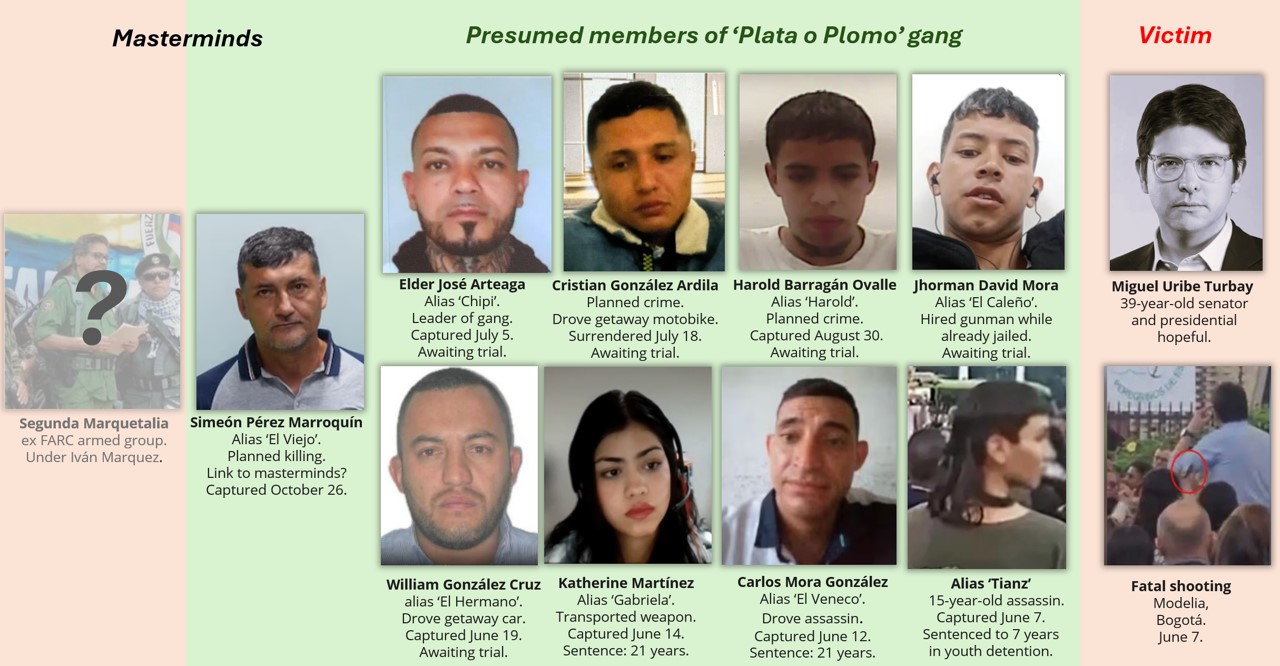
Gang members captured for the killing of Miguel Uribe.
Nine months after the shooting of presidential candidate Miguel Uribe Turbay in a leafy Bogotá park, the gang behind the killing have been rounded up and are facing justice.
The masterminds, though, are still at large. Circumstantial evidence points to a political assassination called in by an ex-FARC faction called the Segunda Marquetalia. But other theories exist.
And as the country prepares for the next rounds of elections, the youthful Uribe – seen by many as a presidential hopeful – is conspicuous by his absence.
We look back at killing that rocked Bogotá in 2025, and who might be behind it.
How did the shooting unfold?
Uribe was gunned down in Parque El Golfito, a green space in bustling Modelia on the western edge of Bogotá, on June 7, during a walkabout in the barrio where he met local business owners and climbed on a beer crate to deliver an impromptu address to a small crowd.
The senator was shot at close range twice in the head by a 15-year-old gunman wielding a Glock pistol in the crowd, who then fled but was himself shot in the leg by Uribe’s protection squad and captured in a nearby street.
Uribe was hospitalized and underwent several emergency surgeries before dying from his wounds on August 11, more than two months later.
Who was Miguel Uribe?
The 39-year-old senator was nationally recognized and scion of a political family. His grandfather Julio César Turbay was president from 1978 to 1982, and his mother the journalist Diana Turbay kidnapped by the Medellín cartel in 1991 who died in a botched rescue attempt, a tragedy immortalized by Gabriel García Márquez in his non-fiction book News of a Kidnapping.
Even though he was raised as a legacy politician, and a key candidate for the right-wing Centro Democratico, Uribe nevertheless garnered support across the political spectrum for his hard work and attention to detail, more technocrat than populist, and potentially a unifying figure.
It was perhaps typical of Uribe that the day he was shot he in an unsung corner of the city meeting everyday folks.
Vigil for Miguel Uribe outside the Bogotá hospital where he later died. Photo: S Hide.
What was the impact of his assassination?
Many mourned the loss of the young senator, married with four children. In reality, Uribe’s death was just one of many in Colombia during 2025 with 187 social leaders and human rights defenders murdered nationwide, according to data from conflict thinktank Indepaz.
The senator’s killing had an outsized impact for several reasons. First, Bogotá, unusually for a megacity, has almost half the homicide rate than many smaller cities and some rural areas with long-running conflicts between gangs and armed groups.
Secondly, the many feared Uribe’s attack signaled a return to the 1980s when a wave of political killings – usually by extreme right-wing forces against left wing targets in cahoots with drug cartels – plagued Bogotá and many other Colombian cities.
But united condemnation of the attack quickly degenerated to finger-pointing between political factions with Uribe’s lawyer filing a complaint against President Gustavo Petro for alleged “harassment” of the senator.
Was Petro to blame?
An early theory floated by the late senator’s lawyer was that the attack was a “hate crime”, which in Colombia covers persecution for ideological views. The argument went that Petro crossed the line with his itchy Twitter finger: in their complaint the lawyer presented a 20-page document with 42 presidential tweets disparaging Uribe.
While acknowledging that Petro was in no way linked to the physical attack, he had created a “favorable environment” for anyone with a serious grudge to take out the senator, said the lawyers, though this didn’t explain why a 15-year-old – not a likely candidate for political grievances – was coerced to pull the trigger.
And by the end of June new evidence emerged from the shooter himself. The youth didn’t even know who his target was the senator, or indeed who was Miguel Uribe.
And other pieces of the puzzle fell into place, clarifying that the shooter was hired for cash by an organized criminal gang that had planned the killing in detail.
If it was so well planned, why did they get caught?
Good question. The contract killers calling themselves Plata o Plomo (‘Silver or Lead’) left a trail of evidence starting with the wounded gunman captured with minutes of the shooting.
Next to fall was Carlos Mora, alias ‘El Veneco’, who drove the young assassin, followed a few days later by 19-year-old Katherine Martínez, alias ‘Gabriela’, who delivered the pistol.
Gabriela’s arrest gave the first clues to a wider conspiracy: the webcammer was tracked down to the regional capital of Florencia, Caquetá, a jungle department of Colombia with high presence of armed groups.
CCTV footage from Modelia placed her inside the car with the gunman, and she later confessed to transporting the gun itself.With CCTV footage, and information from Gabriela and El Veneco, other key members of the gang were soon rounded up including two other getaway drivers and a middleman for hiring the 15-year-old.
Seems like a very amateur operation…
Plata o Plomo was a loose group of criminals drawn from the Bogotá underworld, and many had worked together before. The leader was Elder José Arteaga, alias Chipi, who in a rather unlikely twist also ran a hair salon in Engativá.
When not trimming beards, Chipi was immersed in crime with a history of extortion, violence and armed robbery, and was linked to the murder of a Mexican businessman in Medellín in 2024.
He was also quite ruthless: according to Gabriela, Chipi was planning to cover his tracks by killing both El Veneco and the 15-year-old hired assassin. Being captured early likely saved their lives.
Chipi himself became the subject of a national manhunt until his luck ran out on July 5. He was captured hiding in a house in Engativá by a special police unit a month after the shooting, just a few kilometers from where it took place.
Hairdresser and accused contract killer Elder José Arteaga, alias Chipi.
So, case closed?
Not so fast. Chipi was just one link in a longer chain. According to Gabriela, now a key witness, the hairdresser told her the murder contract was for 700 million pesos, around US$190,000.
This amount of cash pointed to a bigger player.
In Colombia there are plenty of candidates to choose from, and no shortage of pundits to point the finger.
Examples please?
Sure. Journalist and presidential hopeful Vicky Dávila accused Iván Mordisco, commander of the Estado Mayor Central – EMC – a dissident FARC faction fighting the state in the southwest of the country. She claimed to have insider information from military intelligence that also pointed to the likelihood of more assassinations of right-wing figures.
Her theory was backed by interior minister Armando Benedetti, who also saw reason for the EMC to stir up trouble in Bogotá as revenge for the war being waged against the group in Cauca.
However, no direct evidence was presented, and that the EMC denied any involvement, calling the allegations “a media strategy”.
Petro claimed involvement by the mysterious “Board”, a mythical super-cartel fused from drug gangs, guerrillas and paramilitaries. Petro portrayed himself as another potential victim: The Board was also plotting his own assassination, he said.
Wow. Anyone and everyone could have done it.
Exactly. Pick the political flavor of your favorite conspiracy. More fanciful pitches were that the extreme right had planned it themselves to stoke a coup against Petro – who would likely get the blame – and at the same time eliminate the popular Uribe from the candidate’s list.
Or that the extreme left wanted to take out an effective political opponent from the presidential race.
One problem for investigators was the complex networks between criminal gangs, drug cartels and guerrilla groups, partly worsened by Petro’s Total Peace plan which had split armed groups into smaller and more dangerous factions.
The Plata o Plomo gang was clearly working for financial gain. But despite capturing eight members by the end of August, the important detail of who paid them – and why – was yet to be revealed.
Maybe the gang was scared to reveal the backers?
Quite likely. In the dog-eat-dog world of Colombian crime, and where people in jail are regularly murdered, spilling the beans is not recommended. But one more key suspect was emerging: a mysterious character known as ‘El Viejo’.
His capture came at the end of October after months of police work. Clues emerged from messages from El Viejo on Gabriela’s phone. She also confessed to transporting guns and explosives for him on various occasions in Bogotá.
Soon police had a name,Simeón Pérez Marroquín, and a place, in a remote fortified farmstead on the vast plains of Meta. A helicopter team swooped in and took him back to Bogotá.
So where did El Viejo lead?
El Viejo, the ninth capture in the Uribe case, was the most significant. While Chipi coordinated the killing on the ground, it seems El Viejo was closer to the backers.
Another key detail suggests the plot was months in the making: El Viejo was stalking Uribe in March, three months before the shooting in Modelia, and making notes on the senators movements and bodyguards.
Moreover, El Viejo, while living partly in Usme in the south of Bogotá, and on the farm in Meta, also had links to an area of Caquetá known as a stronghold of Segunda Marquetalia.
Segunda Marquetalia? Sounds more like a Cuban singer…
In fact, a recycled FARC guerrilla group named after the original rebel hideout in Tolima. Its leaders were senior commanders who abandoned the peace process in 2019 after persecution by the right-wing Duque government and threats to extradite them to the U.S.
State prosecutors accused some of drug trafficking, charges the commanders claimed were invented. According to Insight Crime, the group lead by Iván Márquez – formerly number two in the FARC – reactivated rebel units in both Colombia and Venezuela, where the group had hidden camps.
But in 2021 Colombian special forces pursued the leaders in Venezuelan territory killing three of the top commander. Further fighting in 2022 wounded Márquez, in fact he was declared dead by Colombian authorities before reappearing in a video in 2024, though he is rumoured to have suffered severe injuries.
Former FARC leader Iván Márquez with fellow commanders of the Segunda Marquetalia in 2019.
A reason to get angry?
Perhaps. A plausible theory is that the Segunda Marquetalia was seeking revenge and targeted Miguel Uribe as a visible – and vulnerable – figure of the Colombian right wing.
Colombian prosecutors claim to have found a digital trail linking El Viejo with the “criminal circle” of Iván Márquez’s armed group. And his stalking of Uribe months before the shooting suggests a long-term plot.
And if such a plot existed, it coincided with the breakdown of peace talks between Petro’s government and the Segunda Marquetalia at the start of 2025, perhaps another spur to action.
But this evidence is yet to be tested in court. El Viejo is jailed while awaiting trial for aggravated homicide, even while prosecutors are offering him a legal deal for information leading to the ultimate masterminds.
So will El Viejo talk?
That’s what investigators are hoping for. Two of the gang so far sentenced, Gabriela and El Veneco, have collaborated for reduced sentences, both getting 20 years in jail.
With presidential elections in May, and candidates on the stump, Colombia needs clarity.
Colombian authorities on Wednesday arrested Ángel Esteban Aguilar Morales, alias “Lobo Menor”, an alleged senior figure in the Ecuadorian criminal group Los Lobos and suspected intellectual author behind the 2023 assassination of Ecuadorian presidential candidate Fernando Villavicencio.
The arrest took place at El Dorado International Airport, where Aguilar Morales arrived on a commercial flight from Mexico, according to Colombia’s migration authority.
Officials said the suspect attempted to evade detection using false identification as a Colombian citizen, but biometric verification and international intelligence-sharing mechanisms exposed his true identity. He was detained under an Interpol red notice and handed over to judicial authorities pending extradition proceedings.
Aguilar Morales is considered a high-ranking member of Los Lobos, an Ecuador-based criminal organization linked to narcotrafficking, contract killings, illegal mining, and broader transnational crime. Authorities allege he played a central role in planning the killing of Villavicencio, whose assassination during the 2023 campaign sent shockwaves across the region.
The arrest comes at a delicate moment in bilateral relations. Colombia and Ecuador are this week attempting to defuse a growing diplomatic and security crisis following the discovery of an unexploded device inside Colombian territory near the border between the departments of Nariño and Putumayo. The incident has triggered sharp exchanges between the governments of President Gustavo Petro and Ecuador’s leadership, amid mutual accusations over cross-border security threats.
Colombia’s migration chief Gloria Esperanza Arriero López said the capture underscores the country’s determination to confront transnational criminal networks, particularly as tensions with Ecuador highlight the porous and contested nature of the shared border.
“This result demonstrates that Colombia has strong institutions and coordinated security forces working to close the space for criminal organizations, regardless of their origin,” Arriero said.
Colombian officials said Aguilar Morales had been under surveillance following intelligence tracking his movements through Medellín and Itagüí before traveling to Mexico. Authorities credited close cooperation with Mexican counterparts for locating and intercepting him as part of a multinational operation referred to by Petro as “Jericó.”
Petro described the suspect as one of the most significant figures linked to the Villavicencio assassination and alleged ties to dissident Colombian armed factions, including networks associated with “Iván Mordisco,” as well as Mexican cartels — evidence, he said, of the expanding integration of regional criminal economies.
According to investigators, Aguilar Morales had previously been sentenced in Ecuador to 20 years in prison for murder in 2013, but was granted conditional release in 2022 after serving half his sentence. Authorities allege he used falsified documents to meet legal reporting requirements while continuing criminal operations across borders.
The arrest marks a major development in the Villavicencio case and comes as Ecuador grapples with escalating violence linked to organized crime and drug trafficking routes. The slain candidate had campaigned on an anti-corruption platform and vowed to dismantle criminal networks, placing him squarely in their crosshairs.
Colombian authorities said the capture also demonstrates the importance of trilateral coordination between Colombia, Ecuador and Mexico in dismantling organized crime structures. Aguilar Morales is expected to face extradition as Ecuador seeks to prosecute those responsible for orchestrating the assassination.
The timing of the arrest — against the backdrop of rising diplomatic tensions and border security concerns — is likely to reinforce calls for deeper regional cooperation to address increasingly interconnected criminal threats operating across the Andes.
Apple has issued a release candidate build of iOS 26.4, iPadOS 26.4, and macOS Tahoe 26.4, to users who are participating in the beta testing program for Apple system software. The RC (release candidate) build typically matches the final release version, unless any critical bugs or issues are discovered, and usually marks the end of ... Read More
Apple has released what they are calling a “Security Improvement” as a software update for macOS Tahoe 26.3.1, iOS 26.3.1, and iPadOS 26.3.1. The update, err, improvement, is being labeled as macOS Tahoe 26.3.1 (a), macOS 26.3.2 (a), iOS 26.3.1 (a), and iPadOS 26.3.1 (a), and though it installs just like a software update, you ... Read More
On March 8, for the first time in Colombia’s history, an artificial intelligence candidate appeared on ballot papers across the country.
Gaitana IA (AI) ran for the Indigenous seat in the Senate and the House of Representatives in the northern state of Sucre.
While Gaitana did not win a seat in either of the country’s legislative bodies, it has sparked debate about the role of AI in Colombian politics.
With the ballots counted, Gaitana won a total of under 3,000 votes – less than 2% of the total votes for the Indigenous seat – suggesting that many people remain skeptical of this new digital approach.
Many questions have emerged surrounding Gaitana, such as why the Registraduría—the Colombian entity in charge of validating and accepting candidates—permitted this unprecedented candidacy, or what the intentions were behind the AI.
“Many local media outlets talked about an AI going to Congress, but that is not the case; they are humans leading the project,” Gaitana’s co-founder, Natalia Aase, told The Bogotá Post.
“It is actually a consensus tool developed by our community members, between 14 and 25 years old, from the Senú community of Reparo Torrente, in Coveñas,” she explained.
Rather than planning for the AI to assume office, Gaitana was devised as a democratic experiment underpinned by real human candidates
Aase detailed how the platform was designed to work: Colombian citizens could subscribe through a link to virtually participate and propose various debates regarding topics such as healthcare, women’s rights, and more. These interactions would also feed the AI database.
Once an initiative reached a collective consensus, the people occupying the seats in Congress would “decide the direction of the proposed laws.”
The two humans represented by Gaitana were Carlos Redondo Rincón, a Mechatronics Engineer from the Senú community, who was running for Senate, and Luz Rincón, an Embera-Katio Indigenous sociologist, who was seeking a seat in the House of Representatives.
The co-founder of Gaitana also revealed that the team conducted deep research into global democratic models, such as the one in Norway, and compared them with their own community dynamics.
As the research advanced, the team found that their community in Senú had already established a model of social interaction that worked well, prompting them to launch a digital project modeled on their own practices.
This meant digitizing their traditional way of reaching a consensus; in the Senú community, men, women, and youth gather around tables to discuss specific topics, such as women’s health or local fishing.
“Gaitana IA is not a generative AI; it is a participatory AI. What does that mean? Well, it is not ChatGPT. Instead, it takes the information provided by the users and organizes it,” pointed out Aase. “Transparency and security are the most important things for us; that is why we use blockchain technology—a system of blocks—to power this platform.”
According to Aase, the project was born from a motivation to prevent corruption and explained that with ‘Gaitana AI’, the decisions are not made by a single person but must be approved by at least 100 people.
“You might be able to manipulate one individual, but you cannot manipulate a hundred if you don’t even know who they are,” she concluded.
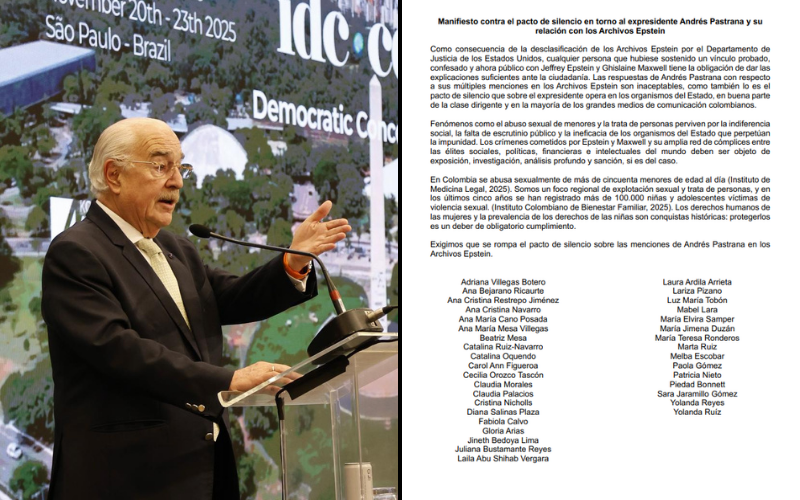
Split image of former President Andres Pastrana and the initial declaration signed by 35 women. Image credit: @AndresPastrana_ via X.
Medellín, Colombia – Prominent female journalists, writers, academics and columnists in Colombia have drafted and signed a declaration titled ‘No to the pact of silence’ in response to former president Andrés Pastrana’s appearance in the Jeffrey Epstein files.
Andrés Pastrana (1998-2002) was mentioned 57 times in files linked to Epstein, who was convicted for sexual trafficking and exploitation of minors before his death in 2019. The ex-president appeared in the batch of documents released last November by the U.S. Justice Department.
The declaration called on Pastrana to issue a statement as a matter of public interest, posed 20 questions to the ex-president, and demanded urgent measures to protect women and girls in Colombia.
‘No to the pact of silence’
The Epstein files have caused scandal across the world, implicating some of the world’s richest and most powerful people, including names like Bill Clinton and Andrew Mountbatten-Windsor.
Epstein and his partner, Ghislaine Maxwell, were both convicted for their involvement in the sex trafficking network. Epstein was found dead in 2019 in his prison cell in New York and Maxwell has been in prison since 2022.
In Colombia, the release last November of 3 million additional files linked to investigations into Epstein revealed connections between Pastrana and the late billionaire.
These included: a photo of Pastrana and Maxwell wearing Colombian Air Force uniforms at a military base; compromising emails with Maxwell; testimonies in which Maxwell said the two were friends and that she flew a Black Hawk helicopter in Colombia; and an alleged flight on a private plane with Epstein and disgraced modelling agent Jean Luc Brunel, who was accused of procuring minors for the late financier.
The ‘No to the pact of silence’ declaration was conceived mostly by female journalists while they were investigating Pastrana’s involvement in the files.
The statement was published on February 24, signed by 35 women, but has since been opened up to include other women through one-to-one invitations.
“The crimes committed by Epstein and Maxwell, and their extensive network of accomplices among the world’s social, political, financial, and intellectual elites, must be subject to exposure, investigation, thorough analysis, and, if applicable sanctions,” the declaration stated.
Colombian journalist Ana Cristina Restrepo, one of the creators and signatories of the declaration, spoke to The Bogotá Post about the reasons behind it.
“It is of public interest in several aspects. First, because he is a person who was elected by popular vote. He was a President of the Republic, and with greater responsibility comes greater scrutiny from citizens,” said Restrepo.
Currently, the declaration has 171 signatures that meet three requirements: to be a woman, to be a feminist, and to have a public voice. Signatures must also be made in individual names, not on behalf of collectives.
While there were men that showed support and wanted to sign the statement, Restrepo explained that only women were allowed: “Many thanks, but they – men – can write their own declaration. Why didn’t they think of it before?” “It has a symbolic power that we are all women,” she added.
The statement also took aim at the wider issue of sexual violence in Colombia. It highlighted that more than 50 minors are abused per day, according to the Institute of Legal Medicine in 2025. Also, in the last five years more than 100,000 girls and adolescents were victims of sexual abuse, according to the Colombian Family Welfare Institute (ICBF).
“Women’s human rights and the primacy of girls’ rights are historic achievements: protecting them is a mandatory duty. We demand that the silence surrounding the mentions of Andrés Pastrana in the Epstein files be broken,” the declaration stated.
Restrepo said that the pact of silence their statement seeks to redress is “one arm of something bigger”: a patriarchal pact that has existed for centuries.
“It is a tacit pact among men who hold power and belong to the elites to protect one another in the different things they do – not only sexual crimes, but also, let’s say, economic matters,and issues in society. They cover for each other,” she explained.
20 questions after more than 20 years of silence
In addition to calling for an end to the pact of silence, the declaration posed 20 questions to Pastrana. These were drafted based on the Epstein files, but also with other evidence, following a methodological journalistic investigation by Restrepo, Diana Salinas and the Cuestión Pública team, Daniel Coronell and Ana Bejarano.
“Everything is based on published and known facts, not on assumptions,” Restrepo explained.
Each question has a lengthy preamble that contains corroborated evidence including pictures, email threads, timelines, interviews, and testimonies. All questions have to do with Pastrana’s relationship with Epstein and Maxwell, their meetings, mentions in the list, contradictions in his statements and related matters.
“Asking questions is not incrimination,” she said. “We are saying: If he has nothing to hide, then answer.”
The enduring pact of silence
Since the declaration was released, many prominent figures have come to Pastrana’s defense.
Following its publication, Pastrana’s former ministers and others who were part of his administration issued a statement of solidarity with the ex-president: “We know Andrés Pastrana and we worked with him as part of his administration… He is a good man of strong values, respectful of his family and human dignity. His character and his track record do not correspond to being involved in infamous conduct,” the statement said.
The signatories have also faced verbal attacks since the declaration was published, including from public figures. One of the primary sources of the abuse has been the former president’s brother, Juan Carlos Pastrana, with Restrepo saying, “he has been one of the most violent.”
For Restrepo, this reaction highlights the very problem the declaration seeks to redress – that powerful men protect their own.
She also noted that the so-called ‘pact of silence’ extends far beyond Colombia.
“The U.S. Department of Justice releases the Epstein files. In other words, they already knew this information and had it stored… There are files from 2003; there are files that are more than 20 years old,” said Restrepo.
“How do you manage to keep information about a network involved in trafficking and sexual exploitation of minors for more than 20 years if not through a pact of silence? So it is a pact of silence that exists not only in Colombia, but also among elites around the world,” she concluded.
Featured image description: Split image of former President Andres Pastrana and the initial declaration signed by 35 women.
President Gustavo Petro accused Ecuador on Monday of carrying out bombing raids inside Colombian territory, sharply escalating a diplomatic and trade dispute that has been simmering since January.
Petro said “27 charred bodies” have been found near the border and suggested the attacks could not have been carried out by illegal armed groups, though he presented no evidence to support the claim.
“Ecuador is bombing us, and these are not illegal armed groups,” Petro said during a televised cabinet meeting, warning of a serious breach of sovereignty.
Ecuador’s President Daniel Noboa swiftly rejected the accusation.
“President Petro, your statements are false; we are acting within our own territory,” Noboa said, adding that Ecuadorian forces were targeting “narco-terrorist structures” operating near the border.
Petro said a bomb believed to have been dropped from an aircraft had been discovered near the frontier, reinforcing what he described as a pattern of cross-border strikes.
“A bomb has appeared, dropped from a plane… very close to the border with Ecuador,” Petro said. “We must investigate thoroughly, but this supports my suspicion that Ecuador is bombing us.”
He added that “many explosions” had been reported and said his government would soon release an audio recording allegedly originating from Ecuador.
In a post on social media platform X, Petro said the bombings did not appear to come from Colombian armed forces or illegal groups, which he argued lack the capability to carry out aerial attacks. “The explanation (from Ecuador) is not credible,” he wrote, without specifying when or where the deaths occurred.
Ecuador doubles down
Noboa, facing a surge in organized crime violence at home, has adopted an aggressive military strategy that includes aerial bombardments of suspected cartel camps near the Colombian border.
His government says the operations are conducted strictly within Ecuadorian territory and are often aimed at groups with Colombian origins, including FARC dissidents. “Together with international cooperation, we continue this fight, bombing locations used as hideouts by these groups, many of them Colombian,” Noboa said in a statement.
He also accused Colombia of failing to control its side of the border, allowing criminal organizations to spill into Ecuador.
The latest confrontation comes against the backdrop of a worsening trade dispute that began in January when Ecuador imposed a 30% “security tariff” on Colombian imports, citing Bogotá’s alleged inaction against narcotrafficking.
The tariff was later increased to 50%.
Colombia retaliated with tariffs on 73 products, suspended electricity exports to Ecuador, and imposed restrictions on bilateral trade, deepening tensions between the neighboring countries.
Ecuador responded by raising fees on the transport of Colombian crude through one of its main pipelines.
Despite early attempts to contain the fallout, relations have steadily deteriorated, culminating in the current exchange of accusations.
Risk of escalation
Petro’s latest claims mark the most serious rupture yet, raising the specter of a cross-border military incident between the two countries, which share a long and porous frontier plagued by drug trafficking and illegal mining.
The Colombian president said he had appealed to Donald Trump to intervene diplomatically.“I asked him to act and call the president of Ecuador because we do not want to go to war,” he said.
The involvement of the United States adds another layer of complexity. Ecuador recently deepened security cooperation with Washington, including the establishment of a new FBI office and joint operations targeting organized crime. Earlier this month, Ecuadorian and U.S. forces conducted strikes on a camp linked to the Comandos de la Frontera, a dissident faction of the FARC guerrilla.
The Colombia–Ecuador border has long been a strategic corridor for cocaine trafficking, with armed groups exploiting weak state presence on both sides. While the border itself is not disputed, diverging security strategies have increasingly brought Bogotá and Quito into conflict.
Petro’s government has prioritized negotiations with armed groups under its “Total Peace” policy, while Noboa has pursued a hardline military crackdown.
For now, the allegations from Casa de Nariño remain unverified, but the political damage is done – and one further miscalculation could carry deep consequences far beyond the shared border.
Colombia’s migration authority Migración Colombia denied entry last week to 10 foreign nationals suspected of seeking sex tourism, marking the largest single-day refusal of its kind at Medellín’s main international gateway, officials said.
The individuals — nine from the United States and one from Anguilla — were stopped at José María Córdova International Airport on March 11 after migration officers concluded their travel did not correspond to legitimate tourism.
Authorities said the group arrived on a flight from Miami with a stopover in Panama and voluntarily allowed inspections of their luggage. Officials reported finding sex toys and large quantities of condoms which, along with interview responses, raised suspicions about the purpose of their visit.
In a separate case the same day, the Anguillan national, arriving from the Dominican Republic, told officials he intended to “select women to have sexual relations” in his home country, prompting his immediate inadmission.
The measures form part of a broader government effort to curb human trafficking and sexual exploitation, following directives issued by President Gustavo Petro to strengthen migration controls.
“This is about protecting local communities and preventing Colombia from being used as a destination for illicit activities,” said Gloria Esperanza Arriero, director of Migración Colombia, praising officers in the Antioquia–Chocó regional unit for their rigorous enforcement.
The agency said the refusals were applied as a preventive measure under existing migration law, which grants authorities discretion to deny entry to foreigners who fail to meet requirements or pose risks to public safety or human rights.
The latest cases bring to 26 the number of foreign nationals denied entry in 2026 at the Rionegro airport for suspected links to sexual exploitation. In 2025, authorities recorded 110 such inadmissions nationwide, with roughly 80 occurring at the same terminal, the principal international gateway to Medellín.
Officials say the figures underscore the airport’s strategic importance in detecting early attempts to enter the country for illicit purposes, particularly in a city whose nightlife districts have drawn increasing international scrutiny in recent years.
Migration enforcement has also expanded beyond airports. Authorities reported recent operations in Medellín targeting suspected criminal networks linked to sexual exploitation, drug trafficking and theft in nightlife areas such as Parque Lleras.
In one case, two foreign nationals with criminal records in Venezuela were located in the El Poblado district. One of them, a Venezuelan woman known as “Kata,” had been sentenced to nine years in prison for human trafficking by a court in Caracas. She was expelled after officials confirmed the ruling through Venezuela’s consulate.
Investigators said she had operated in Colombia using falsified documents and was allegedly involved in prostitution networks and drug distribution in Medellín’s nightlife zones, highlighting the challenges authorities face in monitoring transnational criminal activity.
A second suspect, identified as “Gokú,” a dual Colombian-Venezuelan national, was wanted in Venezuela for charges including aggravated robbery, homicide and illegal possession of firearms. Authorities said he posed as a tourist while facilitating theft operations tied to criminal groups.
Separately, migration officials in Bogotá located a French national subject to an Interpol red notice in a hotel near the U.S. Embassy district. The individual was wanted for child abduction and document falsification and was handed over to the relevant authorities following verification of the international warrant.
Migración Colombia said the case was one of nearly 40 alerts recorded so far in 2026 across multiple regions, including Bogotá, Boyacá, Caquetá, Huila and Tolima, involving migration violations and international judicial requests.
The agency added that these operations have led to arrests and more than ten expulsions of foreign nationals this year, underscoring an intensification of enforcement efforts across the country.
In a separate incident underscoring authorities’ concerns, Colombian police arrested a 46-year-old U.S. citizen in Medellín after he was found with a 14-year-old girl in a short-term rental apartment in the El Poblado area, according to local media reports.
The case was triggered by an anonymous tip to the emergency line, prompting officers from the police child protection unit to respond. Authorities said the minor, still in her school uniform, told investigators the man had contacted her through social media to solicit sexual services.
The suspect was detained and faces charges related to the commercial sexual exploitation of a minor under 18, police said. Authorities did not immediately release further details on his identity or legal status.
Officials say the inadmissions at Rionegro reflect a broader trend seen in 2025, when most of the 110 foreigners denied entry over suspected sex tourism were U.S. nationals, reinforcing concerns about the international dimension of the issue.
Authorities say they will continue strengthening coordination with international bodies to prevent Colombia from being used as a destination for sexual exploitation or as a refuge for individuals attempting to evade justice.
Colombia kicked off its electoral year with the Senate and House elections last weekend, alongside consultas for presidential runs. Who’s come out ahead?
The Colombian elections of 2026 started last week, with the Senate and Cámara finalising their seats for the next parliament. The presidential elections will take place at the end of May, with a second round in June if necessary.
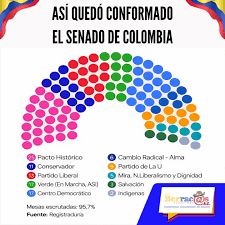
The new Senate layout. Photo courtesy of the registraduría.
The presidential elections also had a hand in last week’s results, with consultas to decide on who would represent groups of candidates with similar politics. That saw Claudia López, Roy Barreras and Paloma Valencia take the honours in their respective consultas.
When all was said and done, the results showed that traditional parties and candidates had generally performed poorly, with new candidates doing well and a difference in the traditional balance of power.
So, a week on and with the dust having settled as final results come in from all over the country, who’s up and who’s down after the first Colombian elections of 2026?
Winners
It was a good day for the government, with the Pacto Histórico gaining seats and a low turnout for the leftist consulta. The Centro Democrático, too, had a good afternoon. Paloma won her consulta handily and the party overall also gained seats in borth houses.
Pacto Historico
The governing party had a spectacular Sunday, simply said. They increased their presence in both chambers and became the largest single party to boot. The Senate remains without a clear majority, but they are in a very strong position indeed, even without the former FARC combatientes’ curules.
On top of that, other results largely went their way. The leftist consulta that Cepeda was blocked from running in was a washout as the Pacto told their supporters to stay away. Prominent critics of the party from other parties such as Robledo, Miranda, Betancourt and Juvinao all crashed out as well.
While an overall majority in either house is far from within their grasp, the Senate now leans slightly more left than right, with left and centre-left senators adding up to 53. On top of that, after an often rocky government, it’s clear that they haven’t lost their base, indeed even expanding.
Paloma Valencia
A fortnight ago, Paloma Valencia’s campaign seemed to be stuttering. She was polling in single figures for first round intentions for the presidency and making few public appearances other than the mass debates for the Gran Consulta por Colombia. There was even a worry that she might suffer an upset in that consulta.
Fast forward to today and it’s a very different picture indeed. The latest polling shows her rocketing in popularity, now standing at around 20%. That’s because she picked up over three million votes in that consulta.
Then she picked the runner up in that race as her VP ticket, a smart move on her side to try and attract voters more in the centre as well as boost her in the capital. It’s not a landslide move, but it’s canny and the presidential race will likely come down to small margins.
Juan Daniel Oviedo
Technically a loser, in the sense that he was a clear second to Valencia in the Gran Consulta. However, he picked up over a million votes, paying off his mortgage and significantly outperforming expectations. He also opened the door for some new paths in his political adventure.
It had looked like his next step was to concentrate on a tilt for Bogotá mayor, having come in second last time around after another strong campaign. He then pulled a remarkable volte-face, accepting Valencia’s offer to run on her ticket.
That’s a move that puts him potentially in a different league than before, very much on the national stage now. It’s come at an enormous reputational price though, with many that voted for him feeling betrayed as he runs on a rightist ticket. He can claim that it’s centrist as much as he likes, but few see it that way.
Influencers
Electorates worldwide are losing patience with technocrats and politics as usual. That’s as true in Colombia as anywhere else, with a number of influencers running and doing fairly well. This is a trend that has been open for a while and shows no sign of slowing down.
Former adult actress Amaranta Hank won a spot for the Pacto Historico, while the White Elephant took a seat for the Partido Verde, having started out as a content creator looking to expose corruption and poor spending practices.
Safety
Despite fears of electoral violence and a turbulent run-up to election day, it was a relatively calm Sunday in the end. There was an attack on a voting centre in Meta, plus another couple of issues elsewhere, but overall it was a good sign for the upcoming presidential elections.
Losers
There were plenty of losers last week, with several high-profile candidates for the presidential race crashing out in their consultas. That saw Vicky Dávila unconvincingly claiming she wasn’t a loser and Enrique Peñalosa falling at the first hurdle again among others.
Farewell, too, for some familiar faces. Ingrid Betancourt failed to make the cut for Senate, losing her seat alongside her party. Jorge Robledo, the leftmost critic of Petro did likewise. Miguel Polo Polo unsurprisingly lost his seat as an Afro-Colombian representative, replaced by a principled lawyer, which delighted many.
In general, old parties and old faces fared poorly, with incumbency working against many. A striking exception to that was the party for ex-FARC combatants, Comunes. To their surprise, but no one else’s, they failed to meet the threshold for representation.
Roy Barreras
Standing in the leftwing consulta, Roy won in the sense that he saw off the threat from controversial former Medellín mayor Daniel Quintero. However, the Pacto campaign to not vote in consultas laid his lack of support bare.
Viejos Verdes
The Partido Verde managed to limit their losses in terms of seats, remaining at a similar level as before. However, there has been a significant change in who takes those curules. They had an open list, meaning that no-one was assured of a place.
Voters made it clear that they wanted to see new blood, with government critics Katherine Miranda and Cathy Juvinao voted out, along with Inti Asprilla and Angelica Lozano.
The old Frente Nacional
For much of the last century, the Liberales and Conservadores absolutely dominated Colombian politics. For most of this century they’ve avoided running viable presidential candidates, preferring to hold their power in the Senate, Cámara and local politics.
This time out they have taken a big hit in both houses, losing five seats between them and no longer being in the top level of voting blocs. Due to the fragmented nature of the parliament, they retain some kingmaking powers, but are a shadow of what they once were.
A big question now looms for both parties ahead of next year’s local elections. Just as the Pacto will feel they can make some big gains there, so too will the Liberales and Conservadores worry they might take more damage.
Claudia López
The former Bogotá mayor faced no real opposition in her consulta, sailing through with over 90% of the vote. However, that was 90% of not very much and she failed to get voters out to show support in the way that Valencia and Oviedo did. She faces an uphill slog from here.
Sergio Fajardo and Abelardo de la Espriella
Neither of this pair were in consultas, instead going to the second round. That’s meant they’ve been kept out of the headlines and lost momentum as well as having some unfortunate results.
The scale of the turnout for Valencia shows she’s a viable contender to Aspriella on the right and her leap in polling is matched by a significant downturn for el tigre. For Fajardo, it’s even worse: voters are largely abandoning the centre and technocratic politicians.
Trust in the system
With the governing party repeatedly questioning the openness and fairness of the elections, this was rough. There have been a number of reports coming out questioning the practices of various voting centres and plenty of allegations, particularly from the left.
On top of that, a couple of candidates were arrested on voting day with big bags of cash that were allegedly to be used in vote-buying. While corruption in electoral processes is likely nowhere near as widespread as many claim, it’s clearly still an issue, especially in rural zones.
Centrist politics
Other than Juan Daniel Oviedo, centrists had a bad day at the polls, especially the centre-right. While the Centro Democrático and Pacto Historico gained votes on the flanks of both right and left, parties close to the centre lost out.
Cambio Radical took a big hit, as did the conservatives, with Abelardo de la Espriella’s new Salvación Nacional party gaining three seats from literally nowhere. The partido de la U also lost a seat while Ahora! won another two seats. Poor turnout for the centrist consulta also means there seems to be little support on the presidential level.
What happens next?
The presidential election on May 31 is now very much the focus of attention. Iván Cepeda still leads the polls comfortably, with Paloma Valencia and Abelardo de la Aspriella splitting the rightwing vote at the moment. However, with over two months of campaigning time ahead, there is plenty of time for everything to change.
Gustavo Petro has shown little sign of intending to follow the guidelines on not campaigning, making references to Oviedo and Valencia as well as thinly-disguised references to Cepeda and so on. Expect this to continue and ever more strongly worded warnings from the registraduría to be ignored.
It’s also likely that there will be ever more rhetoric over electoral fraud, with the Pacto campaign leaning heavily into that already and working on raising awareness of the issue ahead of the voting for the first round.
There’s currently a very good chance that the presidential campaigns will get pretty ugly, with lots of negative campaigning and attack ads. There is no love lost between the candidates and plenty of bad blood on all sides. We’ll keep you up to date with things as the campaigns develop.
Conservative presidential candidate Paloma Valencia has chosen economist and former statistics chief Juan Daniel Oviedo as her vice-presidential running mate, a move widely interpreted as an effort by the right-wing Centro Democrático to broaden its appeal beyond its traditional conservative base ahead of Colombia’s May 31 presidential election.
The alliance seeks to balance Valencia’s hard-line security message – closely associated with former president Álvaro Uribe Vélez – with Oviedo’s more technocratic and centrist profile, which resonates with younger, urban voters.
Announcing the ticket in the bustling commercial district of San Victorino in central Bogotá, Valencia said the decision followed consultations within the party and with Uribe himself.
“We have reached the conclusion that the best teammate is Juan Daniel Oviedo,” Valencia said. “He obtained a popular backing that excites all of us. He is connecting with many Colombians who did not feel represented.”
The announcement comes just days before the deadline to register presidential tickets with Colombia’s electoral authorities and follows Valencia’s decisive victory in the conservative primary coalition known as “La Gran Consulta,” where she secured more than three million votes. Oviedo finished second with more than one million, quickly emerging as one of the race’s unexpected political figures.
Balancinga new centre
Valencia, a staunch supporter of Uribe’s political project, has repeatedly signaled she will not distance herself from the former president’s ideological influence.
“I’m not going to distance myself from Uribe; I’m going to die a Uribe supporter,” she said in a recent interview with El País, reaffirming her commitment to the security agenda associated with the former two-term president.
Yet her choice of Oviedo indicates an attempt to broaden the coalition’s reach. The economist, who gained national prominence as director of Colombia’s national statistics agency – DANE – is widely viewed as a highly-skilled data-driven analyst with appeal among educated urban voters in their thirties and forties – many of whom supported the Colombian Peace Agreement.
That demographic has traditionally gravitated toward centrist figures such as former Bogotá mayor Claudia López or the moderate political movement associated with Sergio Fajardo.
Oviedo’s presence on the ticket could help the conservative bloc penetrate that electorate while also tempering some of the party’s more polarizing rhetoric.
Beyond Differences
The partnership did not come easily. According to campaign strategists involved in negotiations, several days of discussions were required to reconcile differences between the candidates – particularly regarding Colombia’s peace process.
The Centro Democrático has long been critical of the transitional justice system created by the 2016 accord, especially the Jurisdicción Especial para la Paz (JEP), which has been investigating war crimes committed by ex-FARC and Armed Forces during two decades of the internal conflict.
Oviedo, however, has publicly supported the peace agreement and defended the need for reconciliation. Speaking after accepting the nomination, Oviedo emphasized the importance of political dialogue despite ideological differences.
“This is about listening,” he said. “In this coalition we are capable of recognizing our differences but uniting around a fundamental purpose: looking toward the future and building a country where everyone fits.”
He also highlighted his intention to include diverse sectors of Colombian society, mentioning farmers, informal workers, women and the LGBT community.
Strategic Moves in Gran San
The announcement’s location – San Victorino’s Gran San commercial center, one of Bogotá’s busiest retail hubs- was also symbolic. The district is a bustling marketplace dominated by small traders and informal workers, a constituency both candidates say they want to court.
Valencia described the alliance as a forward-looking project for a country weary of political polarization.
“We have many pains as a nation,” she said during the event. “If we only look backward we will find wounds that still need healing. But we have another option: to look forward toward the future we deserve.”
She also praised Oviedo’s credentials, describing him as a policymaker who understands the deep structural and social challenges facing Colombia. “He likes numbers, he likes studying,” she said. “Government is not about talking nonsense about problems – it’s about understanding them deeply in order to solve them,” she said to waves of applause.
The announcement quickly triggered reactions from across Colombia’s political landscape.
Former Liberal president Ernesto Samper welcomed the decision, arguing that Oviedo’s acceptance of the vice-presidential role signaled an implicit recognition by the right-wing party of the peace process. “The acceptance of Juan Daniel Oviedo demonstrates that the Centro Democrático validates the Havana peace agreement and the continuation of the JEP,” he Samper.
With the campaign entering its decisive phase, the Valencia-Oviedo ticket represents a strategic attempt to unite two currents within Colombia’s conservative electorate: an older security-focused base loyal to Uribe and a younger urban sector seeking pragmatic solutions to the internal conflict.
Whether the combination can bridge Colombia’s ideological divide – or deepen it- will likely shape the tone of the presidential race in the weeks and moths leading to the decisive vote.
Apple has released a series of new software updates with important security fixes for various older iPhone and iPad models, versioned as iOS 16.7.15, ipadOS 16.7.15, iOS 15.8.7, and iPadOS 15.8.7. Specifically, the iPhone 8, iPhone 8 Plus, iPhone X, iPad 5th generation, iPad Pro 9.7-inch, and iPad Pro 12.9-inch 1st generation have iOS 16.7.15 ... Read More
Colombia’s high-altitude Sierra Nevada de Santa Marta has become the latest flashpoint in the country’s worsening rural security crisis, after armed clashes between illegal groups left Indigenous communities trapped in the crossfire and triggered a humanitarian evacuation mission.
Authorities confirmed that at least nine wounded civilians, including two minors, were evacuated following heavy fighting between the Clan del Golfo (Gulf Clan) and paramilitary group Autodefensas Conquistadoras de la Sierra Nevada, which are battling for territorial control in the mountainous region.
The fighting first broke out in the foothills near Aracataca, department of Magdalena, and birthplace of Literature Nobel Laurate Gabriel García Márquez. According to local news sources, several indigenous Arhuaco communities reported being trapped by gunfire, and in some cases, used as human shields during the armed confrontations.
Colombia’s human rights ombudsman, the Defensoría del Pueblo, deployed a humanitarian mission to monitor the deteriorating situation and coordinate assistance with Indigenous authorities, regional officials and the armed forces.
The operation succeeded in evacuating nine injured people who had been confined in areas affected by the fighting. Among the wounded are two children, highlighting the vulnerability of civilian populations in the isolated highlands.
The mission was carried out in the Indigenous community of Gunmaku, where Arhuaco traditional authorities accompanied humanitarian teams in assessing the impact of the violence and assisting those affected.
Officials said both armed groups agreed to temporarily respect a humanitarian corridor, allowing rescue teams to reach the injured and transport them to safety.
Despite the evacuation, the Defensoría warned that the situation remains critical.
Preliminary humanitarian reports indicate the disappearance of two women, the killing of a man, and the injury of a child, while many residents remain confined in their communities due to the ongoing clashes.
“We are deeply concerned about the population in Serankua and nearby rural settlements,” stated the ombudsman’s office, referring to communities located high in the Sierra Nevada where access is extremely difficult.
The entity added that the confrontation had been anticipated in earlier early-warning alerts, but the national government failed to fully prevent the escalation.
Rescue operations have been complicated by the region’s extreme geography.
Much of the affected territory lies more than 2,800 metres above sea level, accessible only by footpaths and rugged mountain trails. Helicopter evacuations carried out by the Colombian Army involved considerable risk due to the altitude and lack of landing zones.
Magdalena governor Margarita Guerra Zúñiga confirmed that the military conducted what she described as a “humanitarian extraction” operation, transporting injured civilians to Santa Marta for treatment.
Several evacuees are receiving medical attention and are in stable condition, except for one child who required emergency surgery.
Indigenous leaders are now warning of forced displacement, similar to the humanitarian crisis last year in the mountainous Catatumbo region, Norte de Santander, close to the Venezuelan border.
Protection agencies, such as the Childrens Welfare Agency (ICBF) are calling on armed groups to respect international humanitarian law, particularly the principles of distinction and precaution, which prohibit attacks against civilians or the use of non-combatants as human shields.
Human rights monitors also called for stronger state presence in the Sierra Nevada, warning that ancestral communities remain highly vulnerable to violence and coercion from criminals.
Security analysts claim the clashes are part of a broader territorial struggle for control of drug trafficking routes that extend from La Guajira to the Uraba Gulf, as well as expanding extortion networks along Colombia’s Caribbean coast.
The Clan del Golfo, Colombia’s largest drugs cartel, has expanded operations across the Caribbean in recent years. The group is now competing for more territorial control with the Autodefensas Conquistadoras de la Sierra Nevada, also known as “Los Pachenca”.
The Sierra Nevada — a vast mountainous ecosystem rising from the Caribbean coast to snow-capped peaks — is the spiritual and ancestral home for the Arhuaco, Kogui, Wiwa and Kankuamo peoples.
Community leaders warn that the expansion of armed groups threatens not only civilian lives but also the ecological and cultural balance of the mountain range, which Indigenous “elders” – mamos – regard as the “Heart of the World”.
Humanitarian agencies have urged Colombia’s government to convene the Intersectoral Commission for Rapid Response to Early Warnings (CIPRAT) and strengthen coordination between the Interior Ministry, regional authorities and the Victims’ Unit.
While more army units are being deployed to the area, Indigenous leaders warn that unless the government of President Petro establishes a permanent security and humanitarian presence, the remote communities inside the world’s highest coastal mountain range will find themselves trapped in a conflict that engulfs not only their ancient territories, but also, one of the country’s most recognized tourism destinations.
We take a quick dive down Avenida Caracas where the raised railway is both a wonder and worry.
Line 1 of Bogotá’s long-awaited Metro rises above Avenida Caracas. Photo: S Hide.
For citizens used to the snail’s pace of work on their city’s infrastructure, the rapid rising of the Bogota’s Metro over their heads is something to behold.
With 11 kilometers of concrete viaduct completed, and many more clicks of columns in place, not to mention stations and interchanges emerging from the rubble, the megaobra is officially at 73% completion.
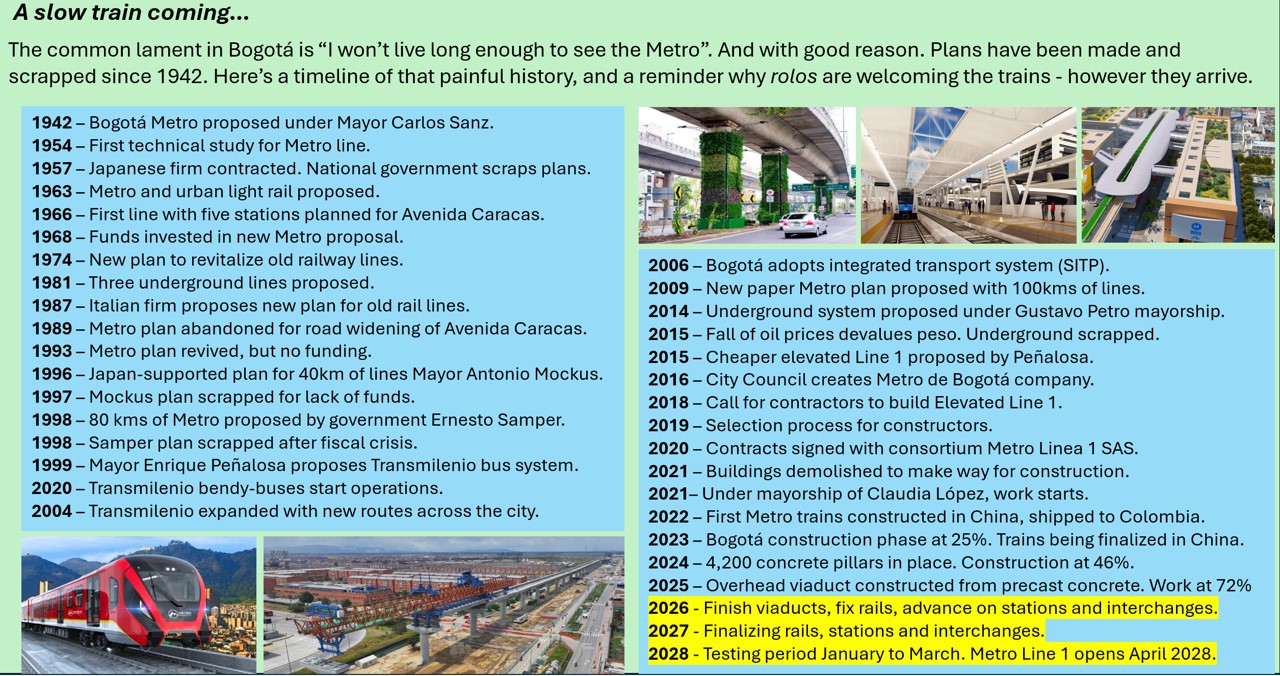
For rolos who have waited three generations for a train – the first Metro plan was made in 1942 – this advance is nothing short of a miracle.
Not everyone is happy. Last week small business owners along Avenida Caracas, the last south-north sector of the construction, took to the streets to protest the “destruction and insecurity” of their neighborhoods.
“The Metro advances. The community recedes,” said the banners the protesters hung across the formerly busy throughfare now converted into a construction site.
As is typical in Bogotá protests, it was public transport in the form of Transmilenio buses that were blocked forcing thousands of commuters to walk sections of their journey home.
Hanging on by a thread
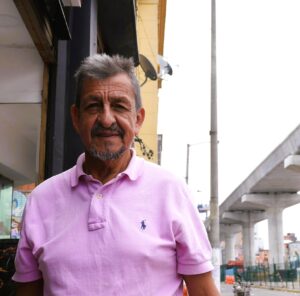
Carlos Torres.
The protests ended, but the problems continued for Avenida Caracas.
This week the central section of the wide avenue was taken up by construction teams supporting the massive overhead beam launcher that dropped the pre-cast viaduct sections into place 15 meters above the street.
Meanwhile, car traffic was banned from the main artery while Transmilenio buses threaded their way past graffitied concrete columns. Pedestrians scurried out of the temporary bus stations and fast away from the apocalyptic scenes, more Blade Runner than Springtime in Paris.
Local shopkeepers told The Bogotá Post this week that business had never been bleaker.
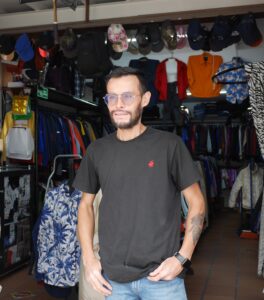
“We’re hanging on by a thread,” said Carlos Torres of clothes store 80’s American World, on the corner of Calle 60. “We’ve had no financial help from the district, and takings are down by 80 per cent.”
He had been forced to suspend their health insurance payments for the last year and were struggling to pay the rent, he said.
Danger down below
Footfall had “fallen massively” said Angela Cruz on her way to a hair salon across the road, with people avoiding the dusty streets, partly from fear of robberies.
Avenida Caracas was “always a bid dodgy”, she said, but the attraction for thieves of the building works, with materials and machinery to pilfer, had increased insecurity.
“We’re worried when it’s finished the support columns and dark areas under the Metro will become full of attackers.”
That the Metro would shelter criminals was a recurring concern for residents. Concept drawings of the finished line depicted idyllic leafy walkways with pedestrians pushing prams.
But as every resident of the city already knows, any tunnel, underpass or covered area becomes a hotspot for crime.
And whereas the Metro planners had robust plans to control access to the overhead trains to ensure commuters travel in peace – in contrast to the Transmilenio where anyone can jump on or off – there were no clear plans to protect open spaces below.
“Walking home just got harder,” said Cruz.
Avenida Caracas degenerated before the Metro construction, but the work sites have added to the feeling of abandonment and attracted criminals according to residents in the area. Photo: S Hide.
Bogotá’s ‘Berlin Wall’
Similar concerns were raised recently in a speech by President Gustavo Petro when he railed against the elevated Metro plan – now near completion – as a boondoggle for property speculators and claimed that Avenida Caracas was being “destroyed by the oligarchy”.
He further suggested that the raised railway would become a “Berlin Wall, separating the rich from poor”.
Such rhetoric was not unexpected from the mandate who long championed an underground Metro, though failed to get it moving during his own term as Bogotá’s mayor (2012 to 2015). He might yet get his way; plans for Line 2, currently on the drawing board, are for an underground Metro running east west beneath the city’s wealthier northern barrios.
The final plan to build Line 1 overhead, while controversial, was taken for economic reasons and speed of construction during the second mayorship of Enrique Penalosa – the founder of Bogotá Transmilenio bus system and implacable political opponent of Petro – in 2016.
The elevated Line 1 of the Metro will be 24 kilometers – one of the longest urban light rails on the continent – and have 16 stations including 10 interchanges with the Transmilenio bendy-bus network.
Much of the line runs through poorer barrios in the south-west of the city where, even with the work unfinished, some economic benefits were being proclaimed.
Just get it done
Adenay Flores.
Thinktank ProBogotá, in a study with the Unversidad de losAndes, reported a rise in residential property values of 11 per cent in areas around Line 1. Such increases could generate investment in undeveloped pockets of the city.
In the long term, Avenida Caracas businesses were also predicting a boost from the Metro. Just not yet.
“Right now, times are hard,” said business owner Adenay Flores. He had seen profits plunge in the 18 months since construction began, he said, while painting the entrance to his Moscu pawnbrokers.
But he also recognized that the Metro was vital to the mobility of the city and could transform lives of people living in less accessible areas.
“Yes, we’ve had hardships. But this is the evolution of the city, I totally support the Metro. Once finished it will bring people back to Avenida Caracas,” he said. “But they need to get it done.”
It was a sentiment echoed by many business owners we talked to in the shadow of the concrete viaduct: torn between welcoming the future mass transit system while keeping their financial heads above water.
“We’re suffering, but we still want the Metro. It will bring better times,” Carlos Torres from the clothes shop told The Bogotá Post. “Until then, we just have to hang on.”
Voters in San Pedro de los Milagros. Credit: Manuela Peña Giraldo.
Colombians voted for a new Congress on March 8 in an election that stretched across thousands of rural towns and villages, where geography, infrastructure and the legacy of armed conflict continue to shape how citizens participate in democracy.
“I don’t like politics,” said Silvia Bedoya, 52, a resident of San Pedro de los Milagros in the mountains north of Medellín. “Instead of uniting people to move the country forward, it tends to divide us.”
Despite that frustration, Bedoya said voting still matters. “If you vote, at least you have the chance to raise your voice about something you don’t like,” she said. “If you don’t vote, you just have to accept what happens.”
More than 40 million Colombians were eligible to vote in the elections, with 13,493 polling stations installed nationwide, including 7,482 in rural areas, according to the National Registry Office. Security forces said they deployed 120,000 police officers across the country to guarantee the vote in the nation’s 1,104 municipalities.
The scale of the operation reflects the logistical challenges of voting in rural Colombia, where many communities remain separated by mountains, unpaved roads and long travel distances.
In San Pedro de los Milagros, a cattle-farming municipality in the Andean department of Antioquia, voters arriving at polling stations described a mixture of civic duty, skepticism toward politicians and concern over the country’s economic and social problems.
Mauricio Martínez, 47, declined to say who he supported, but emphasized the importance of participation. “Voting is the greatest right and duty we have as citizens,” he said.
Others said their choices were shaped by dissatisfaction with the government of President Gustavo Petro, Colombia’s first leftist president, whose progressive agenda – including a major land reform program – has drawn both support and criticism in rural areas.
Maicol Jovani Sepulveda, 28, said he voted for the right-wing Democratic Center (Centro Democrático) party after losing faith in promises he believed would help young people. “I believed they were going to help us study,” he said. “But I didn’t receive a scholarship and I couldn’t go to university, so I was disappointed.”
The Democratic Center won more than 40% of the vote for both the Senate and the House of Representatives in San Pedro de los Milagros, a 24% increase from 2022. Across the department of Antioquia, it was also the most voted list with over 31% of votes, followed by the ruling leftist Historic Pact (Pacto Histórico) coalition with 16%.
Some voters in the town said their support for the right reflected growing frustration with Petro’s government. Among them was María Regina Avendaño Muñoz, 63, who said she cast her vote for Centro Democrático after feeling disappointed with the administration: “I’m very sad because he promised change and convinced many young people and teachers who voted for him.”
Beyond individual concerns, analysts say structural barriers have long shaped political participation in rural Colombia.
Rural voters play an important role in Colombia’s political landscape. Although the country’s largest voting blocs are concentrated in major cities, the countryside has long been central to debates over land ownership, security and development – issues that have shaped the country’s decades-long armed conflict and remain at the center of national politics.
“When we talk about political participation, we’re really talking about processes of democratization – who gets to speak and under what conditions,” Bladimir Ramirez Valencia, a professor at the University of Antioquia’s Institute of Regional Studies who works with farmers’ organizations, told Latin America Reports.
Historically, he said, rural communities have faced both violence and logistical obstacles that limit their ability to vote. About 75% of the victims of Colombia’s armed conflict have been civilians, many of them farmers, according to historical estimates.
Distance alone can also be a barrier. “For many communities, polling stations used to be three or four hours away,” Ramírez said. “Bringing voting sites closer to those places is fundamental.”
Authorities expanded electoral infrastructure for the 2026 vote, increasing the number of polling stations by 5,5% in rural areas compared with the previous 2022 election.
In some regions of Antioquia, Ramírez said, rural residents traveled to voting sites on foot or by chiva, the brightly colored buses that connect remote villages with municipal centers.
Recent government policies may also be shaping political engagement in the countryside. Programs related to land reform, land restitution and rural development have helped strengthen the government’s legitimacy among some farming communities, Ramirez said. “When farmers feel they are being heard and see policies reaching their territories, that can influence how they participate politically.”
Still, rural voting patterns remain complex and vary widely by region. “You can find campesino families involved in social movements defending their land,” Ramírez said. “But when elections arrive, they still vote for traditional parties.”
Across Colombia’s countryside, the election reflected both deep skepticism toward politics and the determination of rural voters to take part in a democratic process that has historically been harder to reach in the country’s most remote regions.
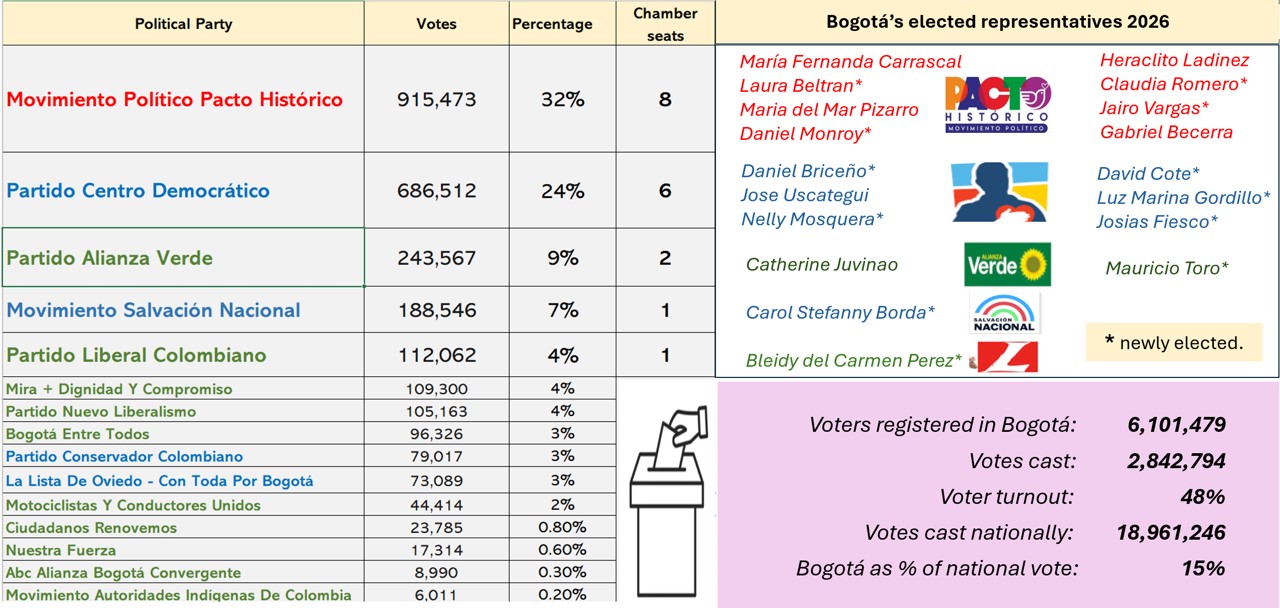
… but Centro Democratico bounces back, while small parties lose out in March 8 voting.
Voting in Bogotá on March 8. Participation was 48%, with the city making up 15% of overall votes cast. Photo: Registraduria
Last Sunday’s elections brought mixed results to Colombia’s capital with the left-wing Pacto Historico party cementing its position as most popular party in the city even while its main opponent the Centro Democratico showed relatively bigger gains.
With 18 Bogotá seats up for grabs in the Chamber of Representatives, the Pacto Historico, backed by President Gustavo Petro, took a majority of eight, an increase of one seat from the previous period.
And by garnering 900,000 votes the incumbent party upped its count by more than 100,000 compared to 2022, when it was also the most popular party in the city.
But by some comparisons the right-wing Centro Democratico’s result was even more impressive, surging from two to four seats on March 8, totalling 700,000 votes, up from around 300,000 in 2022.
In Bogotá, as at national level, the losers were the smaller independent parties often citizen-led or based on niche issues. Also failing was the Nuevo Liberalismo party, founded by mayor Carlos Galán, which failed to pick up a single seat, a sign perhaps of citizen discontent with the capital’s current administration.
The demise of the small and independents reflected a national trend of voter gravitation towards the two bigger parties, Centro Democratico and Pacto Historico, whose top candidates – Paloma Valencia and Iván Cepeda – are likely contenders for the presidential slug-out in May.
The remaining Bogotá seats went to smaller traditional parties the Green Alliance (2), and the Liberal Party (1), with one seat awarded to the upstart Salvacion Nacional formed by firebrand right-wing presidential candidate Abelardo De La Espriella.
Voting results for seat in the Cámara on March 8 in Bogotá. Note this is the preliminary electronic count, changes can take place after manual scrutiny of the results this week. Data: Registraduria
Political phenomenon
The stand-out result in the Bogotá caucus was Centro Democratico’s first-time congressional candidate Daniel Briceño who captured 262,000 votes for his seat in the chamber.
Not only did Briceño get the highest congressional vote across Colombia, he also out-voted the entire list of senators – which get elected nationally – with one of the historically highest ever recorded in Colombia for a camara or senado representative.
The 34-year-old lawyer was being hailed this week as a political phenomenon. Briceño is currently serving on Bogotá city council where he campaigns against corruption, cronyism and waste through a clever combination of social media and forensic takedowns of his political targets.
The influencer made his name by digging into big data on government databases that has allowed him to uncover contracts and documents embarrassing to the administration of Gustavo Petro.
Since then, he has gained both an online following and voter base by scrutinizing and exposing mismanagement at all government levels.
Rise of the influencers: Daniel Monroy, left and Laura Beltran aka Lalis , center, and Daniel Briceño, right.
Defend every vote
Briceño’s jump to congress was mirrored on the political left in Bogotá by the rise of influencers Laura Beltran, aka Lalis, and Daniel Monroy, who both won seats for Pacto Historico.
Despite their success at the urns on March 8, both Monroy and Beltran amplified claims of fraud in the days after the election.
Beltran, posting on X, issued a media alert begging for lawyers in the city to volunteer their time as scrutineers to check the recount after detecting “the winds of fraud”.
“We are defending each vote for the Pacto Historico. In Bogotá we have the chance to recover one more seat,” she said, suggesting the party could up its count to nine.
Monroy, for his part, made a widely echoed claim that “votes for Pacto Historico are disappearing”.
So far there is no evidence of electoral fraud, though changes in the final vote could come about from errors corrected in the final scrutiny taking place in Bogotá this week.
Meanwhile preliminary declarations by European Union electoral observers – 145 were deployed to Colombia – stated that the voting process had been “transparent, accurate and well-organized”.
Voter turnout for Bogotá was 48 per cent, similar to the level of participation across the country, with the capital providing 15 per cent of the national vote. A higher turnout is expected for the May presidential elections.
Apple has released MacOS Tahoe 26.3.2 as a software update specifically and only for the all-new MacBook Neo. This makes the MacOS 26.3.2 update a day-one update for the Mac, and should therefore be installed right away for any new MacBook Neo owner. This update is not available for any other Mac. The update apparently ... Read More
Colombia’s presidential race entered a decisive new phase this week after Sunday’s inter-party primaries propelled conservative senator Paloma Valencia into the national spotlight and triggered a scramble among political factions to forge alliances ahead of the May 31 election.
Valencia’s commanding performance in the right-wing “La Gran Consulta” primary – where she secured roughly six million votes – has reshaped the political landscape, opening a contest within the conservative bloc while forcing candidates across the spectrum to recalibrate their strategies.
The vote effectively marks the start of Colombia’s election season, in which presidential hopefuls must broaden their appeal beyond ideological bases while navigating a fragmented political field.
For the right, the central challenge is whether it can attract moderate and centrist voters without alienating the hardline supporters who form the backbone of a political base – and party – associated with former president Álvaro Uribe.
Valencia, a senior figure in Uribe’s Democratic Center, emerged from the primaries as one of the leading conservative contenders after her vote total surpassed the turnout achieved by President Gustavo Petro and Vice President Francia Márquez in their coalition primaries ahead of the 2022 election.
For Uribe’s movement, which appeared weakened after the presidency of Iván Duque and several electoral setbacks, the result represents an unexpected demonstration of political resilience.
Yet the surge of security-focused Senator has also intensified competition from the far right.
Barranquilla-based lawyer Abelardo de la Espriella, who had previously dominated opposition to Petro, now faces a rival capable of consolidating support among traditional party structures while courting voters beyond the hard-right.
De la Espriella announced Tuesday that Ivan Duque’s former finance minister José Manuel Restrepo will join his presidential ticket as vice-presidential candidate, a move widely interpreted as an attempt to add economic credibility to a campaign largely driven by security rhetoric.
Political observers on the night of the consulations emphasized that Uribe will play a decisive role in shaping the outcome of any hard-right and center-right alliance.
The former president remains the most influential figure within Colombia’s right-wing political establishment and will act as “kingmaker” when negotiations begin over a possible understanding between Valencia and De la Espriella aimed at consolidating the anti-Petro vote.
Whether such an agreement materializes remains uncertain, as both candidates seek to position themselves as the principal challenger to the left in the first round scheduled for May 31.
Sunday’s primaries also produced a surprise showing from economist Juan Daniel Oviedo, the former head of Colombia’s national statistics agency (DANE), who secured more than one million votes and finished second in La Gran Consulta.
Oviedo has cultivated support among urban and younger voters, particularly in Bogotá, where his technocratic style and socially liberal positions have resonated with diverse constituencies, including large segments of the LGBTQ community.
Yet his unexpectedly strong performance now places him at a political crossroads.
Oviedo is expected to meet Valencia on Thursday to discuss a possible alliance that could include joining her ticket as a vice-presidential candidate.
Such a partnership could help Valencia reach voters beyond the traditional conservative base. But it also carries risks for Oviedo, whose supporters may question a close association with the Uribe-aligned political establishment that has dominated Colombia’s right for more than two decades.
The two politicians differ sharply on several issues, including the 2016 peace agreement with FARC and role of the Special Jurisdiction for Peace (JEP), the transitional justice tribunal created to prosecute war crimes committed during Colombia’s internal conflict.
While Oviedo has defended Juan Manuel Santos’ peace agreement and role of the tribunal, Valencia has long criticized JEP and promoted reforms aimed at limiting its legal authority.
Despite the shifting dynamics on the right, the left retains an important institutional foothold following Sunday’s legislative elections.
Petro’s governing coalition, the Historic Pact, emerged as the largest force in the Senate with 25 of the chamber’s 102 seats, according to official results, though it fell short of an outright majority and will need alliances with other parties in the fragmented legislature.
Within the progressive camp, however, the primaries exposed clear divisions.
Former Senate president and former Ambassador to London Roy Barreras secured just over 200,000 votes in the left-wing primary and publicly blamed Petro for the weak turnout, accusing the president of discouraging supporters from voting on Sunday to cement the official candidacy of hard-left candidate Iván Cepeda.
The primaries also underscored the continued weakness of Colombia’s political center.
Former Bogotá mayor Claudia López won her coalition’s primary but attracted fewer than half a million votes, a disappointing result that leaves her entering the first round of the presidential race with reduced political momentum.
With nearly three months remaining before the first round of voting, the campaign that begins this week bears little resemblance to the one that existed before Sunday’s primaries.
The conservative opposition remains divided but newly energized, the left retains institutional strength despite internal tensions, and the political center faces an uphill battle to remain relevant.
In a race now expected to be decided in two rounds, Colombia’s presidential contest is once again wide open as candidates maneuver to build alliances and capture the pivotal voters who will ultimately decide the country’s political direction.

 Login
Login