
Reading view

Colombians take to streets as landmark minimum wage hike faces legal challenges 
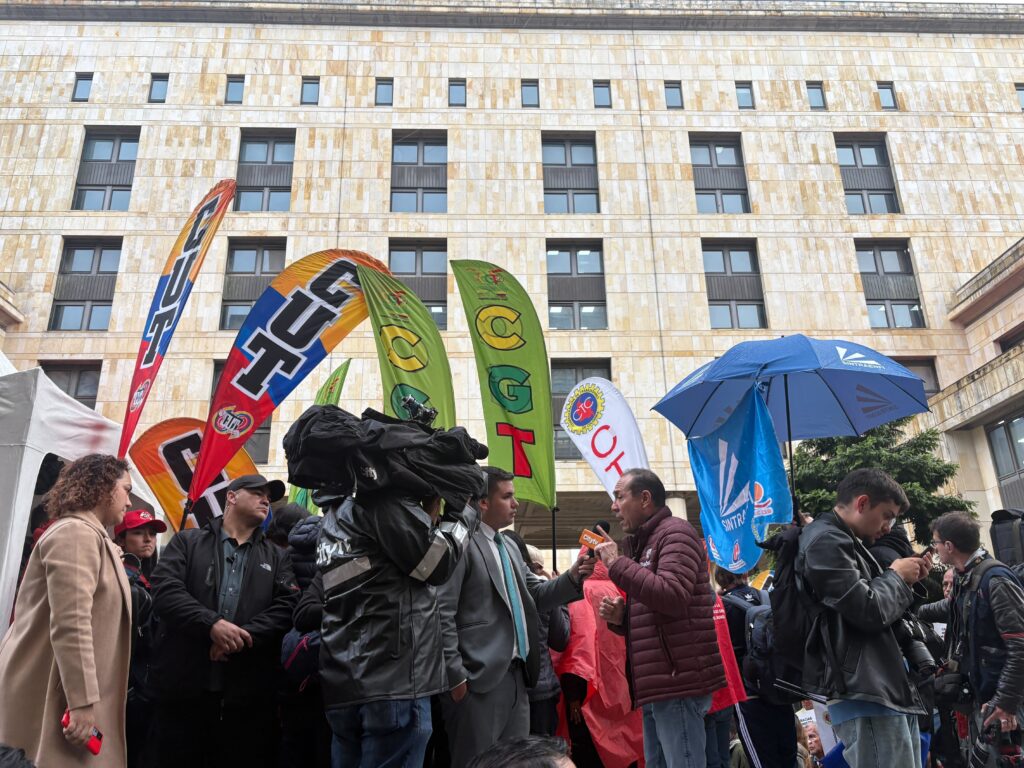
Minister of Labor Antonio Sanguino being interviewed at the January 28 march in support of the minimum wage hike. Image credit: Cristina Dorado Suaza

Bogotá, Colombia — In the past week, Colombians have taken to the streets on two occasions to defend the government’s minimum wage increase as it faces legal attacks by business sectors. 

On January 28 and February 3, Colombians marched in major cities in support of the landmark 23% wage increase established at the end of last year.

But the future of Decree 1469, which established what the government has called a “living wage”, remains uncertain.

“This is a major step forward by the government of Gustavo Petro. It is not just an increase; it is the dignification of workers’ wages in Colombia. That is why, as union members and as teachers, we support this mission, which directly impacts people’s everyday lives,” Oscar Patiño, an attendee of the January 28 march, told The Bogotá Post

For Patiño, a teacher and union leader, the protest represented a demand that the Council of State act as a guarantor of workers’ rights through its role in defining public policy.

He was part of a wave of sit-in protests in cities across the country called by labor unions, with the backing of the government, to defend the minimum wage hike. The 23% raise brings the monthly base salary to COP$1,750,905 (USD$477) and the transportation allowance to COP $249,095 (USD$68). 

In Bogotá, the demonstration was joined by Labor Minister Antonio Sanguino and lawmakers from the pro-government bloc, including Senator Wilson Arias.

“This increase no longer leaves workers’ wages below key economic indicators. It is for the improvement of their quality of life,” said another attendee, who did not want to be named.

As well as raising the base salary, December’s decree incorporated the concept of a “living wage” as an additional criterion for setting the increase. This concept is not new: it is enshrined in Article 53 of Colombia’s Political Constitution and in International Labour Organization (ILO) Convention No. 131 of 1970.

“In that ruling, the Constitutional Court reminds the government that when setting wages, remuneration must be minimum, I quote, ‘living, and adjustable,’” said Mery Laura Perdomo, a lawyer specializing in labor, social security, and constitutional law. 

The “living wage” responds to the real cost of living, unlike the minimum wage, which barely covers basic needs. “This helps generate conditions for a dignified life in a Social State governed by the rule of law … The major shift is from a minimum wage to a living wage,” said Labor Minister Antonio Sanguino.

The government passed the decree raising wages unilaterally after failing to reach consensus with government representatives, business associations and labor unions. It determined the base salary raise based on economic criteria such as inflation (CPI), GDP, the contribution of wages to national income, inflation targets, and productivity.

But the decree generated dissatisfaction among business associations and parts of the public, prompting them to pursue legal action. 

Perdomo notes that there are two types of challenges to the wage increase: tutela actions—arguing violations of fundamental rights, specifically due process or harm to certain companies—and a lawsuit seeking the annulment of the decree.

“I believe there are no sufficient legal grounds for a potential declaration of unconstitutionality,” Perdomo said, noting that the decree grounds its constitutionality in ILO conventions, the constitution, and technical and economic studies and criteria. “There are constitutional, legal, jurisprudential, and technical-economic grounds to say that this minimum wage decree could not be declared unconstitutional.”

So far, tutela actions have not succeeded, according to Perdomo. As for the annulment lawsuit—filed by the National Federation of Merchants (Fenalco)—it is currently under review and awaiting evaluation by the assigned judge, according to the Colombian economic magazine Portafolio. The claim argues that constitutional and legal criteria were disregarded.

Portafolio also reports that the risks of the legal debate lie in the possibility that, while a final decision is pending, the Council of State could not only annul the decree but also order a provisional suspension of the wage increase.

But Perdomo warned this would be an unpopular move ahead of next month’s legislative elections: “Politically, this is risky in an electoral context, since a large portion of the population—especially low-income earners—is satisfied with the minimum wage increase. Overturning it could sour the political climate on the eve of elections and have a real impact on voting intentions.”

Meanwhile, Petro’s ruling Pacto Historico coalition, which has formed into a party ahead of the elections, has made a point of championing the minimum wage increase. 

On Tuesday, it called for rallies across the country to support the living wage, justice, and labor dignity. 

“The living wage is not a favor; it is a right. A dignified life begins with fair work, and this mobilization reminds us that labor dignity is the foundation of social justice,” declared Health Minister Guillermo Alfonso Jaramillo from Bogotá’s Plaza de Bolívar.

The post Colombians take to streets as landmark minimum wage hike faces legal challenges  appeared first on The Bogotá Post.

  •  

All That Glitters Isn’t Trump Nor Petro

Colombian President Gustavo Petro appeared on Tuesday to melt into the gilded woodwork of the Oval Office, wearing a gold tie and an uncharacteristically sober dark suit. Seated beside U.S. President Donald Trump, the two-hour meeting appeared—at least on the surface—to be a cordial encounter between political adversaries entrenched on opposite sides of the ideological divide.

After months of public insults, veiled threats and mutual distrust, both leaders emerged from their first face-to-face meeting keen to project warmth. “We got along very well,” Trump told reporters afterward. “I thought he was terrific.” Petro, speaking later at the Colombian embassy in Washington, described the encounter as “optimistic” and “constructive,” particularly on counter-narcotics cooperation.

Yet behind the gold accents, handshakes and flattering soundbites, the meeting revealed less of a breakthrough than a carefully choreographed de-escalation – one that stabilizes a fraught bilateral relationship without resolving its deepest contradictions.

The meeting defied expectations precisely because expectations were so low. Trump and Petro had spent months trading insults from afar. Trump had previously labeled the Colombian leader a “sick man” and an “illegal drug leader,” offering no evidence. Petro, a former left-wing guerrilla turned president, accused Trump’s administration of committing war crimes through strikes on suspected drug-smuggling vessels and denounced the U.S. operation that removed Venezuelan leader Nicolás Maduro as a “kidnapping.”

Analysts in Bogotá and Washington alike feared the encounter could spiral into confrontation—or worse, an unfiltered monologue. Instead, the Oval Office doors closed to the press, and when they reopened, both leaders spoke in unusually measured tones.

“There was more fear of what could go wrong than hope for what could go right,” wrote El País. “None of it happened.”

Trump hailed the talks as “terrific,” while Petro posted a photograph on X showing the two men smiling, accompanied by a handwritten note from Trump reading: “Gustavo – A great honor – I love Colombia.” For Petro, the optics alone mattered: after months of diplomatic frost, he had secured not only an invitation but public validation from the most unpredictable ally Colombia has.

Gilded optics for now

Despite the upbeat rhetoric, neither side announced concrete agreements. Trump said the two leaders were “working on” counter-narcotics efforts. Petro said he had urged Trump to cooperate in locating and capturing major drug traffickers living outside Colombia, including in the United Arab Emirates, Europe and the United States.

On Venezuela, Petro floated the idea of trilateral cooperation on oil and gas exports involving Caracas, Bogotá and Washington – an ambitious proposal that runs headlong into U.S. sanctions policy. He also claimed Trump agreed to mediate Colombia’s escalating trade dispute with Ecuador, whose president, Daniel Noboa, is a close Trump ally.

What emerged was less a roadmap than a reset: an agreement to keep talking.

That alone represents progress. Colombia’s security situation has deteriorated sharply, with armed groups such as the ELN expanding their reach. U.S. intelligence, technology and funding remain central to Bogotá’s counterinsurgency and counter-narcotics strategies—just as they were during the years that led the FARC to the negotiating table.

Petro’s political calculus

Domestically, the meeting strengthened Petro at a sensitive moment. As El País noted, Colombia is already edging toward a heated electoral cycle, and the prospect of a public clash with Trump had unnerved even some of Petro’s allies.

Instead, the Colombian president managed to appear pragmatic without abandoning his ideological posture. “He did not change his way of thinking on many issues, and neither did I,” Petro said. His quip about a “pact for life” to “make the America(s) great again” signaled both irony and accommodation – a rhetorical olive branch wrapped in Trump’s own slogan.

The presence of senior officials on both sides underscored the meeting’s importance. Petro was joined by Foreign Minister Rosa Yolanda Villavicencio, Defense Minister Pedro Sánchez and Ambassador Daniel García-Peña. Trump was flanked by Vice President J.D. Vance, Secretary of State Marco Rubio and Republican Senator Bernie Moreno.

The Clinton List

One issue loomed quietly in the background: Petro’s status on the so-called Clinton List. According to Colombian media reports citing sources close to the White House, Washington may reassess Petro’s inclusion only after Colombia’s 2026 presidential elections, with a decision expected no earlier than June.

If confirmed, the message is clear: Trump’s administration is willing to thaw relations—but not without leverage.

Trump also said he was working on lifting U.S. sanctions imposed on Petro last year over alleged links to the drug trade, accusations the Colombian president has repeatedly dismissed as “slander.” No timeline was offered.

Alliance restored

For the United States, Colombia remains indispensable: a key intelligence partner, a bulwark against narcotics flows, and a strategic player in a volatile region where Venezuela’s political and economic future remains uncertain. For Colombia, the relationship is existential – economically, militarily and diplomatically. Nearly 30% of Colombian exports go to the U.S., while remittances from more than three million Colombians living there exceed $13 billion annually.

What Tuesday’s meeting achieved was not reconciliation, but recalibration.

The gold tie, the flattering notes, the carefully chosen words – all that glittered. But neither Trump nor Petro abandoned their instincts, their ideologies or their mutual suspicion. The real test will come not in photographs or handwritten dedications, but in whether cooperation materializes once the optics fade.

  •  

Tropical storms batter Colombia’s Caribbean coast, flooding tens of thousands of homes

Powerful storm surges and weeks of unusually intense rainfall have triggered widespread flooding across Colombia’s Caribbean coast, affecting more than 50,000 families, damaging homes and infrastructure, and placing hundreds of thousands of livestock at risk, authorities said.

The floods have hit the Magdalena River basin and large swathes of northern Colombia, forcing beach closures in major tourist hubs and leaving vast rural areas under water, particularly in the department of Córdoba, one of the country’s most productive cattle-raising regions.

In Cartagena, Colombia’s flagship Caribbean destination, six-foot waves driven by strong winds washed ashore this week, prompting authorities to close beaches and confine tourists to hotels as storm conditions intensified. Local officials warned that continued rough seas could further disrupt port operations and tourism activity.

Córdoba has borne the brunt of the emergency. According to local authorities, up to 70% of the department remains flooded after rivers burst their banks following sustained heavy rainfall. The National Federation of Cattle Ranchers (Fedegán) said losses to agriculture and livestock production were already “in the millions of dollars.”

Leonardo Fabio de las Salas, Fedegán’s coordinator in Córdoba, said 20 municipalities were flooded, with 4,778 rural properties submerged and more than 263,000 animals at risk. “Córdoba is the most severely affected department so far,” he said.

The floods have killed at least five people in Córdoba and left 24 of its 30 municipalities in a state of emergency, according to Colombia’s disaster management agency.

Carlos Carrillo, director of the National Unit for Disaster Risk Management (UNGRD), confirmed that the entity will oversee the delivery of emergency aid kits to affected families. The agency said more than 7,500 humanitarian kits — including food, hygiene products, cooking supplies and blankets — have already been distributed in municipalities such as Ciénaga de Oro, Montelíbano, Moñitos and Puerto Libertador.

Additional deliveries are being extended to Canalete, Cereté, San Pelayo and San Bernardo del Viento, while a new phase of assistance has been scheduled for towns including Lorica, Sahagún, Valencia and Puerto Escondido, some 6,000 families are expected to receive aid this week.

Córdoba Governor Erasmo Zuleta described the situation as one of the worst climate emergencies the department has faced in recent years. “The balance for Córdoba is very sad, very hard,” Zuleta said in a radio interview. “We have 23 of our 30 municipalities affected, 12 of them in critical condition. Around 20,000 families are currently displaced or severely impacted by the rains.”

The extreme weather has not been confined to Córdoba. In Santa Marta, a diesel tanker ran aground on Los Cocos beach on Tuesday morning near the city’s historic center after losing maneuverability amid strong currents and gale-force winds. The vessel remained stranded overnight, with authorities saying hazardous sea conditions continued to hamper efforts to remove it.

The incident also highlighted the scale of debris and waste washed ashore by the storm surge along Colombia’s Caribbean coastline. Local authorities in Santa Marta, echoing measures taken earlier in Cartagena, ordered the temporary closure of beaches as a cold front from the northern hemisphere intensified rainfall, winds and rough seas across the region.

Residents filmed the cargo vessel as it became lodged in the sand just meters from the shore, near the city’s marina. Officials have not yet said how long it will take to refloat the ship, citing ongoing maritime risks.

The first months of 2026 have been marked by persistent and unusually heavy rainfall across Colombia, from the Caribbean coast to central and western regions. Authorities say swollen rivers, landslides and flash floods have destroyed homes, killed people and animals, and caused widespread material losses.

Meteorological officials have warned that further rainfall is expected in the coming days, raising concerns that flooding could worsen in already saturated areas as emergency services struggle to reach remote communities.

  •  
❌