The freshly released macOS Tahoe 26.3 update has resolved an accessibility issue where the “Reduce Transparency” feature was not working properly on the Mac. Before macOS Tahoe 26.3, toggling the switch on would leave considerable transparent effects, including in sidebars, headers, titlebars, search boxes, and more, leading to situations where text would overlap and interface ... Read More
Stark figures show expansion of fighting groups under ‘Paz Total’.
Comandos de La Frontera in Putumayo, one of many armed groups in talks with the Colombian government: Photo credit: Bram Ebus.
Colombia’s illegal armed groups have grown by 84 per cent during the three years of the Petro government’s Paz Total plan, thinktank Fundacion Ideas para la Paz (FIP) announced last week.
The alarming data showed the country’s main guerrilla factions and organised crime gangs totalled 27,000 active members at the end of 2025, adding 5,000 new recruits in just 12 months.
And humanitarian crises associated with the expansion of illicit economies, such as combats, displacements or confinement of communities, attacks on social leaders and extortion were also on the rise.
According to Gerson Arias, co-author of FIP’s El Deterioro de la Seguridad Marca el Inicio de 2026 (Deteriorating Security Marks the Start of 2026), the endless peace talks played out under President Petro’s expansive Paz Total policy had only incentivised armed groups to grow in terms of fighters, weapons and territory.
“Paz Total was based on a state ceasefire – but without any conditions put on the groups, such as ceasing recruitment, including child recruitment, or ending expansion,” he told The Bogotá Post.
“As such, the policy gave a gigantic strategic advantage to the armed groups to strengthen their fighting forces.”
Big surge
The biggest surge was in the organised crime group Clan de Golfo, up by 30 per cent to 9,840 active agents, reported FIP (see chart below).
Next in terms of size was the ELN, the guerrilla group dominating the eastern borderlands of Colombia, with 6,810 members, an increase of 9 per cent.
Dissident FARC groups also grew, some by almost a quarter, such as CNEB (Coordinadora Nacional Ejercito Bolivariano) which despite drawn-out peace talks with the Petro government – and numerous plans for a disarmament – ended the year 25 per cent bigger than started, now numbering 2,089.
And these were probably underestimates, said Arias. The FIP figures were based on military and intelligence data collected annually since 2002,and generally considered to be lower than the actual numbers.
“We tend to undermeasure illegal activity. It’s impossible to say with precision, but we would say the real data could be 20% or 30% higher,” he concluded.
All of Colombia’s major armed groups have grown in the last year. Credit: FIP.
Unlucky 13
These numbers included both armed fighters – often uniformed and carrying heavy weaponry – and support members tasked with infiltrating civilian communities to “ensure compliance”, often carrying pistols. Armed groups were increasingly deploying explosives by drones.
According to the FIP report, none of the negotiation processes had managed to curb their recruitment capacity.
Territorial expansion had also triggered disputes over illegal gold mining, coca, and trafficking routes. The FIP report identified 13 zones where two or more groups were facing off, more than twice the number of disputed territories that Petro inherited from the Duque government in 2022.
Top in terms of combat last year were Catatumbo in Norte de Santander, and areas of Guaviare, Cauca, Nariño, Valle and Arauca (see map).
But even departments considered peaceful in recent years, such as Tolima and Huila, were being drawn back into the fray, said Arias.
This rise in conflict brought a host of humanitarian impacts. Armed groups strictly controlled their zones, at times displacing or confining populations, but also imposing daily controls such as travel permissions and ID cards.
Last year, according to UN figures quoted by FIP, one million mostly rural Colombians were affected by armed group controls, tripling the number recorded in 2024.
Colombia’s 13 hot zones at the end of 2025 (marked in purple). Credit: FIP.
Civilians in the crosshairs
And according to Arias, the government had itself increased the risks to civilians by involving them as third parties in the peace talks while failing in any robust plan to pacify the zone.
“Petro reached partial agreements with the groups – even while they were still armed, still controlling, extorting, confining and pressuring civilian communities. There was no cost to the armed groups,” said the researcher.
Part of the problem was that Paz Total had initially failed to link to any coherent military strategy that could had protected civilian communities. This had put civic leaders “in the crosshairs of armed groups” as one side accused them of siding with the other.
The statement is backed by a graph showing a year-on increase since 2022 in attacks both between armed groups, and against civilians and state forces. Last year there were 150 attacks on civilian targets.
In fact, by Arias’s estimate Colombia had gone back to 2011 in terms of the numbers of non-state armed actors – 27,000 – potentially in conflict.
That compared to a recent low of 12,800 combatants in 2018, two years after former president Santos signed the 2016 peace deal with the FARC guerrillas.
From bad to worse
In fact, to explain the current situation, Arias pointed to failures in the both the current administration and the previous right-wing government under Ivan Duque.
Taking over in 2018, Duque rolled back many of the agreements made with the FARC sending many ex-combatants back to the bush along with a wave of new combatants.
But then left-leaning Gustavo Petro, taking over in 2022, surprised even his own military advisers by declaring a unilateral ceasefire. This was the opening salvo of the Paz Total policy which announced negotiations with armed groups and criminal gangs on multiple fronts – in some cases even without informing them.
Petro’s plan was conceived “with good intentions”, said Arias, but had put misplaced trust in armed groups busy enriching themselves by illegal activities and with little incentive to demobilize.
By comparison, during the 2013-16 process with the FARC, the military forces under Santos had continued operations against the guerrilla up until the final signing: “This pressure incentivised the FARC to take serious decisions in terms of the peace process,” he said.
Graph showing year-on increase in conflict events in Colombia. Credit: FIP
Too little, too late
The failings of Paz Total were apparent on the ground in the first few months of inception in 2022, with community organisations raising the alarm over the increased fighting between groups.
It took until late 2024 for the state military to step up offensive actions in areas such as Cauca, with battles against the dissident FARC factions of Ivan Mordisco. Then, in early 2025, the Catatumbo region of Norte de Santander caught fire with fierce combat between the ELN and FARC 33, leading to the largest humanitarian crisis in Colombia’s recent history.
But it took until August last year for President Petro himself to acknowledge that the policy had “not achieved peace”.
During 2025 military actions increased by 30 per cent, but with reduced state forces – many experienced soldiers and commanders had left – facing stronger armed groups, said Arias.
“The offensive came slowly and without an analysis of what was required to combat the strengthened armed groups.”
“Years of intelligence capacity was lost, along with military presence and air deployment. This explains why – despite the offensives – there are few concrete improvements for many communities.”
For soldiers on the ground, the job got harder under Paz Total with a strengthened enemy and less military intelligence to rely on. According to President Petro’s own presentation to the Trump Whitehouse early this month, 360 state forces have been killed “in the fight against drug trafficking” in the last three years, with 1,680 wounded.
But even away from the front line, Paz Total was not up to the monumental task of negotiating peace with multiple armed groups given that most governments had failed to pacify even one.
Illegal gold mining barge in Guainia. In many parts of Colombia, control of illicit economies have proved more tempting for the armed groups than the peace process. Photo: S. Hide.
At whatever cost
“Paz Total never evaluated the institutional capacity required. It’s good to say: ‘we have to negotiate with everyone’. But that requires a method,” said Arias.
The government often pushed talks ahead even without any legal framework that would allow, constitutionally, the state to make peace with certain criminal gangs, or groups of recycled combatants that had previously demobilised. This created a credibility gap which continued to undermine the peace initiative.
“Even today, no group has taken a serious position on disarming or demobilisation or reducing violence,” said Arias.
FIP also questioned the government’s own seriousness in finalizing any negotiations, terming Paz Total an “electoral peace”; endless rounds of talks through the upcoming election period.
It’s a strategy Arias condemned: “This government seems intent on continuing the process at whatever costs and put the burden of resolution on the next government. This is politically irresponsible.”
Lack of concrete results could also taint future processes, he said.
“The poor results have thrown doubt on the idea that political solutions to conflict is the best route, which is very worrying, and eventually exposes communities to more risk.”
His main message – and the key finding of the FIP report – was that ending conflict in Colombia required more than goodwill, he told The Bogotá Post.
“It’s incoherent to talk of ‘peace or security’. We need to talk of ‘peace and security’. Without that, we’ve gone backwards.”
Apple has released MacOS Sequoia 15.7.4 and MacOS Sonoma 14.8.4 as system software updates for the Sonoma and Sequoia operating systems, focusing on security patches for Mac users who are not running macOS Tahoe. Separately, macOS Tahoe 26.3, iOS 26.4, ipadOS 26.3, watchOS 26.3, tvOS 26.3, along with iOS 18 updates, are also available for ... Read More
International airlines are rapidly re-establishing services to Venezuela, signalling a cautious but commercially significant reopening of the country’s aviation market. On Thursday, February 12, Colombia’s Avianca resumed a daily direct flights between Bogotá and Caracas.
The move restores one of the most important air corridors in northern South America and comes amid a flurry of announcements from carriers across Europe, the Americas and the Middle East seeking to regain access to a market that has been largely closed since 2019.
The flagship carrier claims that this key route was restored after a “comprehensive evaluation of operational conditions and aviation safety,” carried out in coordination with Colombian and Venezuelan authorities.
Avianca’s daily round trip flight will operate with an A320 aircraft, departing Bogotá (AV142) at 07:40 a.m. and returning from Caracas (AV143) at 12:10 p.m.
The resumption reflects the strong commercial ties between Colombia and Venezuela, as well as growing confidence among airlines that operational, regulatory and security conditions now allow for a gradual return.
For Avianca, which has operated in Venezuela for more than 60 years, the route carries both symbolic and strategic weight. The carrier said the service would strengthen regional connectivity and support trade, tourism and business travel between the two countries, which share deep economic and social ties disrupted during years of political confrontation and border closures.
Avianca’s return is part of a broader recalibration by the global aviation industry following Venezuela’s political transition and the end of Nicolás Maduro’s rule. Airlines had largely withdrawn from the country after the suspension of international flights, currency controls, safety concerns and U.S. sanctions made operations increasingly unviable.
Now, with demand for travel surging among Venezuela’s large diaspora and regional business community, carriers are moving quickly to reclaim market share — albeit cautiously, with a close eye on regulatory approvals and security assessments.
In January, American Airlines said it was ready to resume daily service to Venezuela, positioning itself as the first U.S. carrier to formally announce plans to return after nearly seven years. The airline said flights would remain subject to U.S. government approval and security evaluations, and has not yet announced a launch date.
“We have a more than 30-year history connecting Venezuelans to the U.S., and we are ready to renew that relationship,” said Nat Pieper, American’s chief commercial officer, underscoring the airline’s focus on family reunification, business travel and trade.
Before suspending operations in 2019, American was the largest U.S. airline serving Venezuela, having entered the market in 1987. The carrier said it remains in close contact with federal authorities and is working with regulators, unions and internal teams to ensure a compliant return.
While direct U.S.–Venezuela flights remain pending, regional alternatives are already expanding. Panama-based Copa Airlines has enabled ticket sales since late January allowing passengers to travel between Caracas and Miami via Panama under a single reservation, restoring a key transit option for Venezuelan travellers.
European and Latin American airlines have moved faster, with firm restart dates announced over the next six weeks. Spain’s Air Europa will resume Madrid–Caracas flights on February 17, followed by Laser Airlines the next day. LATAM Airlines plans to restart flights from Bogotá on February 23, while Colombian low-cost carrier Wingo will relaunch Medellín–Caracas services on March 1.
Further afield, Turkish Airlines will begin flights between Istanbul and Caracas on March 3, marking the return of a long-haul intercontinental connection. Spain’s low-cost Plus Ultra will also start services that same day, while Brazil’s GOL plans to resume flights from São Paulo on March 8.
TAP Portugal is scheduled to restore Lisbon–Caracas flights by the end of March.
The pace of announcements reflects both pent-up demand and a race among carriers to secure early-mover advantage in a market that, while still fragile, offers long-term potential. Venezuela’s population of more than 28 million, combined with millions of citizens living abroad, represents a sizeable base for leisure, family and humanitarian travel.
Yet challenges remain. Airlines face currency risks, infrastructure constraints and the possibility of renewed political or regulatory instability. Industry executives say most carriers are returning with limited capacity and flexible schedules, allowing them to scale operations up or down as conditions evolve.
For now, the reopening of Venezuela’s airspace is being driven less by optimism than by calculated risk-taking. Airlines are betting that gradual political normalization and the easing of restrictions will allow them to rebuild routes profitably — without repeating the costly exits of the past decade.
Avianca’s daily Bogotá–Caracas service may therefore serve as an early test case. If demand proves resilient and operations remain stable, more capacity is likely to follow. If not, airlines may once again find themselves navigating turbulence in one of Latin America’s most complex markets.
Still, after years of near-total isolation, Venezuela’s reappearance on international departure boards marks a turning point — one that global airlines are keen not to miss
Colombia’s goldenberry symbolized the country’s push into high-value fruit exports. Now, it faces a turf war at home from a fruit with far greater global recognition: the blueberry. While blueberry cultivation has expanded rapidly across Colombia over the past decade, producers say the industry remains far from becoming a fully fledged export powerhouse.
Colombia currently has close to 1,000 hectares planted with blueberries, concentrated mainly in the Andean departments of Boyacá and Cundinamarca, which together account for almost the entire cultivated area. Smaller projects are emerging in Antioquia and other regions, bringing national production to an estimated 20,000 tonnes a year.
That marks a dramatic rise from just 40 hectares planted a decade ago. In the past two years alone, between 150 and 200 additional hectares have been planted, reflecting growing interest from investors and farmers seeking alternatives to traditional crops.
Yet despite this momentum, industry leaders warn that Colombia’s blueberry sector still lacks the scale, investment and coordination needed to compete seriously in international markets.
“Blueberries are one of the fastest-growing fruit crops in Colombia, but we are still very far from consolidating a true export agroindustry,” said Camilo Lozano, vice-president of Asocolblue, the national blueberry growers’ association, in an interview with La República.
Lozano argues that Colombia’s potential far exceeds its current footprint. “The country could easily reach 5,000, 6,000 or even 10,000 hectares,” he said. “But that won’t happen overnight. We need more investment, greater scale and the entry of larger producers.”
Peru offers a stark comparison. In 2012, Peruvian blueberry exports were worth just US$400,000. Today, they exceed US$3 billion, supported by more than 22,000 hectares of plantations. Colombia, Lozano notes, shares many of the same advantages that fuelled Peru’s rise: favourable soils, competitive labour costs, efficient logistics and the ability to produce year-round.
“These are the same conditions that made Colombia the world’s leading exporter of cut flowers,” he said.
Blueberries are particularly attractive because they are already deeply embedded in global consumer markets. In North America and Europe, they are a staple product, unlike many tropical fruits that require costly marketing campaigns to build demand.
“In the United States and Canada, consumers already know blueberries,” Lozano said. “You don’t have to explain what they are or how to eat them.”
At present, around 90 per cent of Colombia’s Arandano exports are destined for the United States, with Europe a distant second. Asia remains largely out of reach due to phytosanitary barriers and long shipping times, which can exceed 30 days by sea.
Even in established markets, Colombia struggles to meet minimum volume requirements. International buyers often request several containers per week, but domestic supply remains too fragmented to deliver consistently.
“Today, we get clients asking for five containers a week, and we can’t even fill one,” Lozano admitted. “Only two companies export blueberries by sea on a regular basis.”
The domestic market, however, tells a different story. According to industry estimates, formal blueberry sales in Colombia exceed 200 billion pesos (about US$50 million) annually. Imports — mainly from Peru and Chile — add another 50 billion pesos, highlighting the gap between local demand and national production.
That imbalance underscores both the opportunity and the challenge facing Colombian growers. While consumption is rising, domestic supply remains insufficient, and many producers lack the technical expertise and capital required to expand efficiently.
Asocolblue, which brings together 28 producers, has repeatedly warned that blueberries are not a crop for improvisation. Establishing a commercial plantation requires high upfront investment, technical knowledge, strict quality standards and long-term planning.
“This is not traditional agriculture,” Lozano said. “It’s an agro-industrial business.”
The association operates technical, export and marketing committees aimed at professionalising the sector and ensuring that growth does not come at the expense of productivity or sustainability.
For farmers who succeed, the rewards can be significant. Blueberries offer relatively stable international prices and allow producers to integrate into global supply chains, generating employment, foreign exchange and long-term income. “It allows the producer to make a qualitative leap — from farmer to agro-industrialist,” Lozano said. “It’s essentially an agricultural factory.”
For now, Colombia’s farmers across the Altiplanto Boyacense are enjoying their blueberry boom, but the story is more one of promise than parity with terrirorial rivals, such the uchuva and feijoa. Whether it can replicate the success of its flower industry — or Peru’s meteoric rise — will depend on how quickly investment, scale and coordination catch up with ambition.
Apple has released macOS Tahoe 26.3 for all Mac users to install as a software update. macOS Tahoe 26.3 focuses on bug fixes and security enhancements, and are recommended to install for all Tahoe users. Mac users who are running Sequoia or Sonoma will find smaller security patch oriented updates available for those system software ... Read More
iOS 26.3 for iPhone and iPadOS 26.3 for iPad have been released by Apple for all supported devices. The software updates aim to provide important security updates and bug fixes. Additionally, Apple has released macOS Tahoe 26.3 update for Mac, along with updates to Sequoia, Sonoma, watchOS, tvOS, visionOS, and older iPhone and iPad models ... Read More
If you’d like to maintain and ad-free AI experience, you might want to consider using Claude, which offers free AI tools, web chat, and clients for Mac, iPhone, and iPad, all of which are free from advertising clutter. Why are you mentioning this? Well, you might have seen that OpenAI has recently announced that ChatGPT ... Read More
Unseasonal heavy rains and severe flooding across northern Colombia have created a full-blown humanitarian crisis, displacing hundreds of thousands, destroying homes and farmland, and pushing local infrastructure and health systems to breaking point.
The disaster has hit hardest in the department of Córdoba, where officials say 156,000 people have been affected and 80% of the territory remains underwater following rainfall that broke historical records for February, traditionally one of the region’s driest months.
“In one day we received the amount of rain expected for an entire month,” Ghisliane Echeverry, director of the Institute of Hydrology, Meteorology and Environmental Studies (Ideam), told ministers during a government emergency council meeting.
The flooding has spread across multiple departments, including Sucre, Magdalena, La Guajira, Chocó and Antioquia, but Córdoba — a key agricultural and cattle-raising hub — has borne the brunt of the devastation.
“This is much more serious than even the most pessimistic scenarios we expected,” Carlos Carrillo, director of the National Unit for Disaster Risk Management (UNGRD), said. “We are facing a severe climate crisis that has overwhelmed traditional coping mechanisms.”
Displacement and extensive damage
Preliminary government assessments report at least 14 confirmed deaths linked to flooding and landslides, while thousands of families have been forced into temporary shelters as floodwaters inundate entire neighborhoods.
In Córdoba’s rural areas, officials estimate that around 157,000 hectares of agricultural land are submerged, affecting crops such as plantain, yucca and watermelon as well as commercial monocultures like African palm. Livestock losses are mounting, with local authorities reporting that more than 5,500 animals have been affected.
“We have 1,700 homes already destroyed and 4,000 more uninhabitable,” Carrillo said, though he cautioned that final figures are expected to change once waters recede and damage is fully assessed.
The United Nations Office for the Coordination of Humanitarian Affairs (OCHA) said more than 27,000 families have been impacted by flooding across the Caribbean departments, with thousands more indirectly affected as access roads and bridges have been reduced to rubble.
Public health officials warn that overcrowded shelters are becoming hotspots for disease, exacerbated by lack of access to clean water, sanitation and essential medical care.
“We are seeing extreme levels of waterborne and respiratory illnesses among displaced families,” said a health official in Montería, the capital of Córdoba. “The combination of stagnant water, cramped conditions and limited resources is a ticking time bomb.”
Essential supplies including food, mattresses and personal hygiene products are in critically short supply in many shelters, officials said.
Cold front and climate pressures
Meteorologists have attributed the extreme rainfall to an atypical cold front entering from the Caribbean, which has pushed precipitation far above normal levels. Rainfall in some areas has been measured at more than 64% above average for January and February.
“The water levels we are witnessing have never been recorded in February,” Carrillo said. Ideam has maintained high-level yellow and red alerts for at least 16 departments as flooding and landslide risks persist.
Typically dry early months of the year have instead seen consistent rains, and meteorologists warn that March and April could bring the usual seasonal rains, compounding the already dire situation.
Local officials across affected regions reported severe disruptions to vital road networks, bridges and public services, isolating some communities entirely. In the Urabá Antioqueño in western Antioquia, authorities said more than 9,000 families were left displaced in 13 municipalities that declared calamity.
Despite the scale of the disaster, the national government has not formally declared an economic emergency, a move that would unlock additional disaster funds and expedite aid. President Gustavo Petro, who convened a council of ministers in Montería, has signaled that such a declaration is under consideration.
“The magnitude of these floods demands a national response,” one government official said. “We are mobilizing resources but the scale of the crisis is beyond anything we normally plan for.”
The response has also brought renewed scrutiny to long-standing water management challenges in the region. Carrillo and other government officials have criticized decades-old hydraulic works, including reservoirs and levees, for altering natural water flows and potentially exacerbating flooding.
President Petro echoed these concerns on social media, singling out infrastructure such as the Urrá hydroelectric reservoir — built in the 1990s — as part of the region’s broader hydrological challenges.
“These reservoirs were not designed to manage excess water but to drain lands and disrupt natural flow patterns,” Petro wrote, arguing that such interventions may have contributed to current conditions.
Communities struggle amid uncertainty
In two coastal departments – La Guajira and Magdalena – continuous rainfall has caused streams to overflow and paralyzed mobility, while in the colonial port city of Santa Marta, strong winds and currents drove a cargo vessel ashore, highlighting the intensity of the storms.
For residents in isolated rural towns, the toll is deeply personal. Entire families have lost homes and livelihoods, and many are now waiting for relief that has been slow to reach remote areas.
“We’ve never seen water this high,” said a farmer in northern Córdoba. “We are afraid of what comes next — we don’t know how we will recover.”
With rains expected to continue over the coming weeks, authorities and humanitarian organizations warn that the full scale of the disaster may not be known for months, and that recovery will require sustained national and international support.
Nearly a week after Donald Trump hosted Colombia’s president, Gustavo Petro, at the White House, calm has returned to a bilateral relationship that only recently appeared headed for rupture. The insults have stopped. The social media theatrics have faded. Diplomacy, not spectacle, is back in charge.
This alone tells us that both governments have agreed to “disagree” and agree again.
The meeting itself produced no headline agreements. Instead, it marked something more consequential and less dramatic – a quiet end to illusions. In Washington, Petro’s flagship policy of “Total Peace” is now widely regarded as exhausted, if not outright discredited. What replaces it is a far more traditional, conditional partnership: security cooperation first, democracy under scrutiny, and patience in short supply.
The timing matters. Within days of the White House meeting, the U.S. State Department announced that John McNamara, Washington’s chargé d’affaires in Bogotá, will leave his post on February 13. McNamara arrived a year ago at a moment of open hostility between Trump and Petro, when the relationship was being tested not only by policy disagreements but by personal antagonism. His task was not to advance grand initiatives, but to prevent a collapse. That he succeeded says much about the value of professional diplomacy in an era of impulsive politics.
His departure now marks the end of a holding pattern. What comes next will be harder, more explicit, and less forgiving.
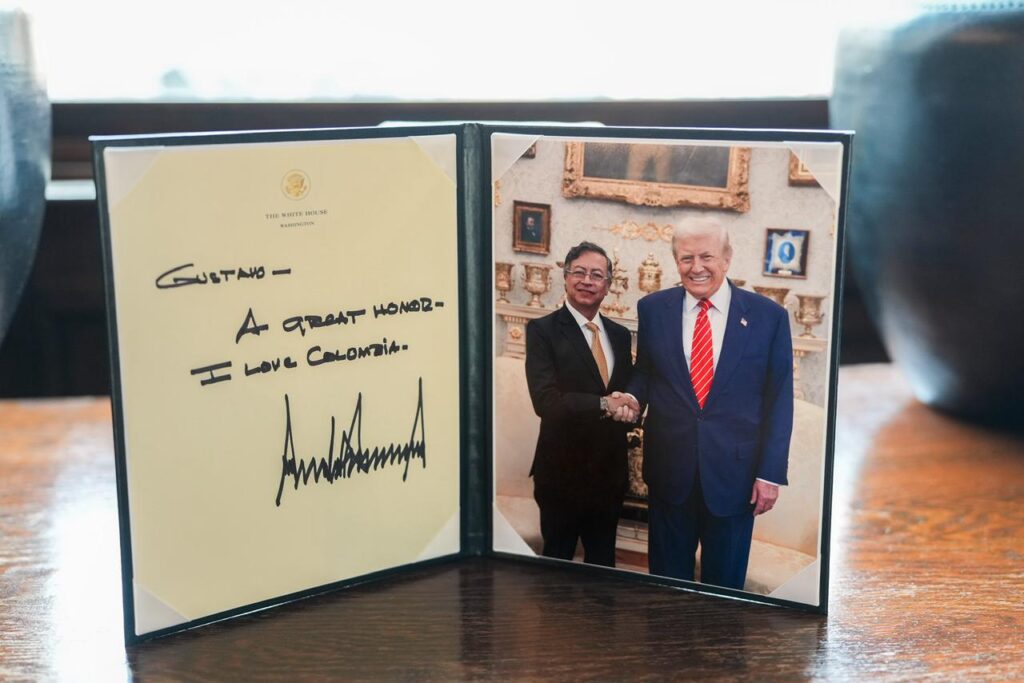
The Trump – Petro encounter was cordial, almost surprisingly so. Trump praised Petro as “terrific.” Petro shared a handwritten note from Trump declaring his affection for Colombia. The optics were deliberate. But the substance lay elsewhere.
According to officials and lawmakers briefed on the talks, Washington’s message was blunt: negotiations without consequences have failed. Petro’s Paz Total—a strategy built on ceasefires, open-ended negotiations, and the assumption that armed groups could be coaxed into disarmament—has not reduced violence. In many regions, it has coincided with territorial expansion by FARC dissidents, rising extortion, and a deepening humanitarian crisis. From Washington’s perspective, it has blurred the line between peace realpolitik and paralysis.
U.S. cooperation with Colombia is now explicitly conditioned on key demands. First, decisive military action against armed groups, especially the ELN along the Venezuelan border, where insurgents have long enjoyed sanctuary. Second, ironclad guarantees that Colombia’s upcoming electoral processes will be free, fair, and transparent ahead of a high-stakes 2026 presidential race.
This is not ideological hostility. It is strategic calculation – from Bogotá to Caracas, and ultimately, the Oval Office.
Colombia remains indispensable to U.S. interests: a capstone of regional security, a key counter-narcotics partner, and a democratic anchor in a hemisphere unsettled by authoritarian drift and Venezuelan instability. But indispensability does not mean indulgence. Washington’s conclusion is that leverage must now be used, not deferred.
The shift was visible almost immediately. Colombian forces bombed ELN encampments in the Catatumbo region near the Venezuelan border, killing several fighters and seizing weapons. The strikes signaled a return to military pressure after months of restraint under Paz Total.
Yet they also exposed the moral and political cost of the new course. According to Colombia’s forensic authorities and reporting by El Colombiano, one of those killed in Catatumbo was a child. Seven bodies were recovered after the operation, including that of a minor. The incident echoed last November’s bombing in Guaviare that killed seven minors, among them an 11-year-old girl.
Shift in tone and strategy
Petro, in the aftermath of the Trump encounter, has responded with a stark argument: armed groups recruit children precisely to deter military action. Halting airstrikes, he said, would reward a “cowardly and criminal” strategy and accelerate forced recruitment. It is a grim logic, but not an implausible one—and it illustrates the impossible trade-offs now confronting the Colombian state.
Peace negotiations have not been spared. The Clan del Golfo, one of the country’s most powerful criminal organizations, suspended talks with the government after reports that Colombia and the United States discussed targeting “high-value” leaders. From Washington’s perspective, this reaction only reinforces its skepticism: armed groups talk peace when it buys time, not when it requires surrender.
None of this suggests enthusiasm in Washington for a militarized Colombia. It suggests resignation. The United States has seen this cycle before – in Colombia and throughout the hemisphere. Negotiations without enforcement are a contradiction. Ceasefires without verification entrench armed actors. Elections held amid coercion corrode democratic legitimacy from within.
Which brings us to the second pillar of the new relationship: electoral transparency.
U.S. officials have made clear that Colombia’s democratic processes will now be watched closely – not as a moral abstraction, but as a strategic necessity. A Colombia that cannot guarantee free elections is not a reliable ally, no matter how aligned its security policies may be.
This is the bargain now on offer. Not a reset. No rupture. Conditional coexistence.
John McNamara’s departure symbolizes the transition. His tenure was about keeping the peace between governments. The next phase will be about enforcing terms.
For Petro, the challenge is severe. He must deliver security results demanded by Washington without losing legitimacy at home, where skepticism of militarization runs deep. He must demonstrate democratic integrity while navigating a polarized political landscape. And he must do so knowing that Total Peace, once his signature promise, no longer commands confidence abroad.
The calm in U.S.–Colombia relations is real- but it is not comfort. It is the quiet before accountability.
Samsung is planning to follow Apple in adding a variable aperture to its smartphone cameras, Korea's ET News reports.
A variable aperture allows the camera to adjust the amount of light that reaches the sensor. This means that in dark environments, the aperture can be opened to receive more light, while in light environments, it can be closed to prevent over-exposure. It also should provide users with greater control over depth of field, which refers to how sharp a subject appears in the foreground compared to the background.
The iPhone 18 Pro and iPhone 18 Pro Max are now widely expected to feature an upgraded main camera with a variable aperture. In December 2024, Apple supply chain analyst Ming-Chi Kuo was first to say that that the main rear camera on both iPhone 18 Pro models will offer variable aperture. A more recent report from October 2025 said Apple was moving ahead with plans to bring the technology to next-generation iPhones and was discussing components with suppliers.
Apple has never used a variable aperture on an iPhone camera before. The main cameras on all of the iPhone 14 Pro through iPhone 17 Pro models have a fixed aperture of ƒ/1.78, and the lens is always fully open and shooting with this aperture. Samsung Electronics previously brought a variable aperture camera to its Galaxy S9 and Galaxy S10 models in 2018 and 2019, but due to increased thickness and high price, it dropped the feature in 2020.
In light of Apple's plans, Samsung has reportedly asked multiple camera module partners to develop variable apertures and provide samples. The feature is in early development and final installation has not yet been confirmed, but there is said to be a "strong will" to introduce it.
Samsung apparently sees adding a variable aperture as "necessary to increase camera competitiveness," replacing software correction with physical hardware. The company hopes that in investing in variable aperture camera technology, thickness can be reduced and costs will reduce over time. Apple's first variable aperture camera is expected to arrive in the iPhone 18 Pro models in the fall.
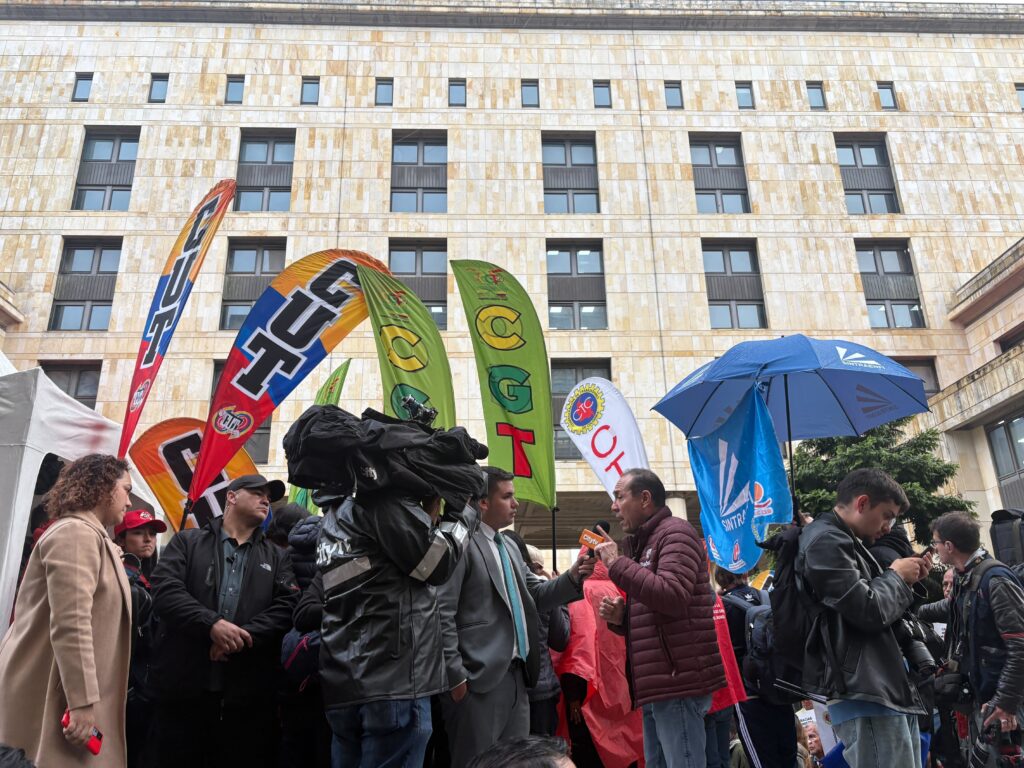
Minister of Labor Antonio Sanguino being interviewed at the January 28 march in support of the minimum wage hike. Image credit: Cristina Dorado Suaza
Bogotá, Colombia — In the past week, Colombians have taken to the streets on two occasions to defend the government’s minimum wage increase as it faces legal attacks by business sectors.
On January 28 and February 3, Colombians marched in major cities in support of the landmark 23% wage increase established at the end of last year.
But the future of Decree 1469, which established what the government has called a “living wage”, remains uncertain.
“This is a major step forward by the government of Gustavo Petro. It is not just an increase; it is the dignification of workers’ wages in Colombia. That is why, as union members and as teachers, we support this mission, which directly impacts people’s everyday lives,” Oscar Patiño, an attendee of the January 28 march, told The Bogotá Post.
For Patiño, a teacher and union leader, the protest represented a demand that the Council of State act as a guarantor of workers’ rights through its role in defining public policy.
He was part of a wave of sit-in protests in cities across the country called by labor unions, with the backing of the government, to defend the minimum wage hike. The 23% raise brings the monthly base salary to COP$1,750,905 (USD$477) and the transportation allowance to COP $249,095 (USD$68).
In Bogotá, the demonstration was joined by Labor Minister Antonio Sanguino and lawmakers from the pro-government bloc, including Senator Wilson Arias.
“This increase no longer leaves workers’ wages below key economic indicators. It is for the improvement of their quality of life,” said another attendee, who did not want to be named.
As well as raising the base salary, December’s decree incorporated the concept of a “living wage” as an additional criterion for setting the increase. This concept is not new: it is enshrined in Article 53 of Colombia’s Political Constitution and in International Labour Organization (ILO) Convention No. 131 of 1970.
“In that ruling, the Constitutional Court reminds the government that when setting wages, remuneration must be minimum, I quote, ‘living, and adjustable,’” said Mery Laura Perdomo, a lawyer specializing in labor, social security, and constitutional law.
The “living wage” responds to the real cost of living, unlike the minimum wage, which barely covers basic needs. “This helps generate conditions for a dignified life in a Social State governed by the rule of law … The major shift is from a minimum wage to a living wage,” said Labor Minister Antonio Sanguino.
The government passed the decree raising wages unilaterally after failing to reach consensus with government representatives, business associations and labor unions. It determined the base salary raise based on economic criteria such as inflation (CPI), GDP, the contribution of wages to national income, inflation targets, and productivity.
But the decree generated dissatisfaction among business associations and parts of the public, prompting them to pursue legal action.
Perdomo notes that there are two types of challenges to the wage increase: tutela actions—arguing violations of fundamental rights, specifically due process or harm to certain companies—and a lawsuit seeking the annulment of the decree.
“I believe there are no sufficient legal grounds for a potential declaration of unconstitutionality,” Perdomo said, noting that the decree grounds its constitutionality in ILO conventions, the constitution, and technical and economic studies and criteria. “There are constitutional, legal, jurisprudential, and technical-economic grounds to say that this minimum wage decree could not be declared unconstitutional.”
So far, tutela actions have not succeeded, according to Perdomo. As for the annulment lawsuit—filed by the National Federation of Merchants (Fenalco)—it is currently under review and awaiting evaluation by the assigned judge, according to the Colombian economic magazine Portafolio. The claim argues that constitutional and legal criteria were disregarded.
Portafolio also reports that the risks of the legal debate lie in the possibility that, while a final decision is pending, the Council of State could not only annul the decree but also order a provisional suspension of the wage increase.
But Perdomo warned this would be an unpopular move ahead of next month’s legislative elections: “Politically, this is risky in an electoral context, since a large portion of the population—especially low-income earners—is satisfied with the minimum wage increase. Overturning it could sour the political climate on the eve of elections and have a real impact on voting intentions.”
Meanwhile, Petro’s ruling Pacto Historico coalition, which has formed into a party ahead of the elections, has made a point of championing the minimum wage increase.
On Tuesday, it called for rallies across the country to support the living wage, justice, and labor dignity.
“The living wage is not a favor; it is a right. A dignified life begins with fair work, and this mobilization reminds us that labor dignity is the foundation of social justice,” declared Health Minister Guillermo Alfonso Jaramillo from Bogotá’s Plaza de Bolívar.
Colombian President Gustavo Petro appeared on Tuesday to melt into the gilded woodwork of the Oval Office, wearing a gold tie and an uncharacteristically sober dark suit. Seated beside U.S. President Donald Trump, the two-hour meeting appeared—at least on the surface—to be a cordial encounter between political adversaries entrenched on opposite sides of the ideological divide.
After months of public insults, veiled threats and mutual distrust, both leaders emerged from their first face-to-face meeting keen to project warmth. “We got along very well,” Trump told reporters afterward. “I thought he was terrific.” Petro, speaking later at the Colombian embassy in Washington, described the encounter as “optimistic” and “constructive,” particularly on counter-narcotics cooperation.
Yet behind the gold accents, handshakes and flattering soundbites, the meeting revealed less of a breakthrough than a carefully choreographed de-escalation – one that stabilizes a fraught bilateral relationship without resolving its deepest contradictions.
The meeting defied expectations precisely because expectations were so low. Trump and Petro had spent months trading insults from afar. Trump had previously labeled the Colombian leader a “sick man” and an “illegal drug leader,” offering no evidence. Petro, a former left-wing guerrilla turned president, accused Trump’s administration of committing war crimes through strikes on suspected drug-smuggling vessels and denounced the U.S. operation that removed Venezuelan leader Nicolás Maduro as a “kidnapping.”
Analysts in Bogotá and Washington alike feared the encounter could spiral into confrontation—or worse, an unfiltered monologue. Instead, the Oval Office doors closed to the press, and when they reopened, both leaders spoke in unusually measured tones.
“There was more fear of what could go wrong than hope for what could go right,” wrote El País. “None of it happened.”
Trump hailed the talks as “terrific,” while Petro posted a photograph on X showing the two men smiling, accompanied by a handwritten note from Trump reading: “Gustavo – A great honor – I love Colombia.” For Petro, the optics alone mattered: after months of diplomatic frost, he had secured not only an invitation but public validation from the most unpredictable ally Colombia has.
Gilded optics for now
Despite the upbeat rhetoric, neither side announced concrete agreements. Trump said the two leaders were “working on” counter-narcotics efforts. Petro said he had urged Trump to cooperate in locating and capturing major drug traffickers living outside Colombia, including in the United Arab Emirates, Europe and the United States.
On Venezuela, Petro floated the idea of trilateral cooperation on oil and gas exports involving Caracas, Bogotá and Washington – an ambitious proposal that runs headlong into U.S. sanctions policy. He also claimed Trump agreed to mediate Colombia’s escalating trade dispute with Ecuador, whose president, Daniel Noboa, is a close Trump ally.
What emerged was less a roadmap than a reset: an agreement to keep talking.
That alone represents progress. Colombia’s security situation has deteriorated sharply, with armed groups such as the ELN expanding their reach. U.S. intelligence, technology and funding remain central to Bogotá’s counterinsurgency and counter-narcotics strategies—just as they were during the years that led the FARC to the negotiating table.
Petro’s political calculus
Domestically, the meeting strengthened Petro at a sensitive moment. As El País noted, Colombia is already edging toward a heated electoral cycle, and the prospect of a public clash with Trump had unnerved even some of Petro’s allies.
Instead, the Colombian president managed to appear pragmatic without abandoning his ideological posture. “He did not change his way of thinking on many issues, and neither did I,” Petro said. His quip about a “pact for life” to “make the America(s) great again” signaled both irony and accommodation – a rhetorical olive branch wrapped in Trump’s own slogan.
The presence of senior officials on both sides underscored the meeting’s importance. Petro was joined by Foreign Minister Rosa Yolanda Villavicencio, Defense Minister Pedro Sánchez and Ambassador Daniel García-Peña. Trump was flanked by Vice President J.D. Vance, Secretary of State Marco Rubio and Republican Senator Bernie Moreno.
The Clinton List
One issue loomed quietly in the background: Petro’s status on the so-called Clinton List. According to Colombian media reports citing sources close to the White House, Washington may reassess Petro’s inclusion only after Colombia’s 2026 presidential elections, with a decision expected no earlier than June.
If confirmed, the message is clear: Trump’s administration is willing to thaw relations—but not without leverage.
Trump also said he was working on lifting U.S. sanctions imposed on Petro last year over alleged links to the drug trade, accusations the Colombian president has repeatedly dismissed as “slander.” No timeline was offered.
Alliance restored
For the United States, Colombia remains indispensable: a key intelligence partner, a bulwark against narcotics flows, and a strategic player in a volatile region where Venezuela’s political and economic future remains uncertain. For Colombia, the relationship is existential – economically, militarily and diplomatically. Nearly 30% of Colombian exports go to the U.S., while remittances from more than three million Colombians living there exceed $13 billion annually.
What Tuesday’s meeting achieved was not reconciliation, but recalibration.
The gold tie, the flattering notes, the carefully chosen words – all that glittered. But neither Trump nor Petro abandoned their instincts, their ideologies or their mutual suspicion. The real test will come not in photographs or handwritten dedications, but in whether cooperation materializes once the optics fade.
Powerful storm surges and weeks of unusually intense rainfall have triggered widespread flooding across Colombia’s Caribbean coast, affecting more than 50,000 families, damaging homes and infrastructure, and placing hundreds of thousands of livestock at risk, authorities said.
The floods have hit the Magdalena River basin and large swathes of northern Colombia, forcing beach closures in major tourist hubs and leaving vast rural areas under water, particularly in the department of Córdoba, one of the country’s most productive cattle-raising regions.
In Cartagena, Colombia’s flagship Caribbean destination, six-foot waves driven by strong winds washed ashore this week, prompting authorities to close beaches and confine tourists to hotels as storm conditions intensified. Local officials warned that continued rough seas could further disrupt port operations and tourism activity.
Córdoba has borne the brunt of the emergency. According to local authorities, up to 70% of the department remains flooded after rivers burst their banks following sustained heavy rainfall. The National Federation of Cattle Ranchers (Fedegán) said losses to agriculture and livestock production were already “in the millions of dollars.”
Leonardo Fabio de las Salas, Fedegán’s coordinator in Córdoba, said 20 municipalities were flooded, with 4,778 rural properties submerged and more than 263,000 animals at risk. “Córdoba is the most severely affected department so far,” he said.
The floods have killed at least five people in Córdoba and left 24 of its 30 municipalities in a state of emergency, according to Colombia’s disaster management agency.
Carlos Carrillo, director of the National Unit for Disaster Risk Management (UNGRD), confirmed that the entity will oversee the delivery of emergency aid kits to affected families. The agency said more than 7,500 humanitarian kits — including food, hygiene products, cooking supplies and blankets — have already been distributed in municipalities such as Ciénaga de Oro, Montelíbano, Moñitos and Puerto Libertador.
Additional deliveries are being extended to Canalete, Cereté, San Pelayo and San Bernardo del Viento, while a new phase of assistance has been scheduled for towns including Lorica, Sahagún, Valencia and Puerto Escondido, some 6,000 families are expected to receive aid this week.
Córdoba Governor Erasmo Zuleta described the situation as one of the worst climate emergencies the department has faced in recent years. “The balance for Córdoba is very sad, very hard,” Zuleta said in a radio interview. “We have 23 of our 30 municipalities affected, 12 of them in critical condition. Around 20,000 families are currently displaced or severely impacted by the rains.”
The extreme weather has not been confined to Córdoba. In Santa Marta, a diesel tanker ran aground on Los Cocos beach on Tuesday morning near the city’s historic center after losing maneuverability amid strong currents and gale-force winds. The vessel remained stranded overnight, with authorities saying hazardous sea conditions continued to hamper efforts to remove it.
The incident also highlighted the scale of debris and waste washed ashore by the storm surge along Colombia’s Caribbean coastline. Local authorities in Santa Marta, echoing measures taken earlier in Cartagena, ordered the temporary closure of beaches as a cold front from the northern hemisphere intensified rainfall, winds and rough seas across the region.
Residents filmed the cargo vessel as it became lodged in the sand just meters from the shore, near the city’s marina. Officials have not yet said how long it will take to refloat the ship, citing ongoing maritime risks.
The first months of 2026 have been marked by persistent and unusually heavy rainfall across Colombia, from the Caribbean coast to central and western regions. Authorities say swollen rivers, landslides and flash floods have destroyed homes, killed people and animals, and caused widespread material losses.
Meteorological officials have warned that further rainfall is expected in the coming days, raising concerns that flooding could worsen in already saturated areas as emergency services struggle to reach remote communities.
Apple has moved on to the Release Candidate phase of the beta cycle for macOS Tahoe 26.3, iOS 26.3, and iPadOS 26.3. The new RC builds are available for users participating in the beta programs. Release Candidate builds indicate the end of the beta testing period, absent any major bugs or issues, and also serve ... Read More
A picture frame with a kind message and smiles all round: was the Colombia-USA meeting at the White House an unalloyed success?
Colombian president Gustavo Petro’s trip to Washington to meet his counterpart Donald Trump seems to have gone very well. The build-up had been pretty good, with Trump praising Petro and both sides avoiding inflammatory rhetoric.
Petro’s commemorative photobook. Image: Gustavo Petro via Facebook
So well did it go, in fact, that Petro ended up with a signed photobook memory of the encounter on first name terms. Trump’s handwritten note said it was a great honour to have met Petro, adding “I love Colombia”. For his part, Petro said his team was looking for solutions and invited Trump to visit Cartagena.
Trump was effusive in his praise for the Colombian president, noting that they had “not exactly been the best friends” but that he never felt offended by Petro’s rhetoric. That’s par for the course with the US leader, as he seems to often make up with people after fierce words. He ended by saying he thought Petro was terrific and they got along great.
From being sworn enemies all through last year and with sharp words exchanged just a month ago peace has broken out with surprising speed between Donald and Gustavo. In a way, it’s more of a frenemy relationship than a bromance, with both realising that it suits them better to work together for the time being.
They’re also quite similar politicians, if polar opposites politically, which means they probably understand each other better than the rest of us do. Long-winded speeches to large rallies of supporters, unpredictable behaviour, constant use of socials – they basically work in the same way towards different ends.
Fears of Petro having to walk into the famed Oval Office bearpit were laid aside the night before when it was confirmed as a behind-closed-doors meeting. That was relatively unsurprising, given the Colombia president’s reluctance to speak English.
Also in the room were the presidents’ teams, including JD Vance and Marco Rubio on the US side. However, Petro made it clear that the reunion was between himself and Trump.
The crux of the meeting was over cocaine exports, which Petro said was mainly organised from abroad, naming Dubai, Madrid and Miami as their ‘capitals’. He said sharing information and working together was key and that he had passed names to the American administration.
An insider speaking to Colombian news source El Tiempo said that they thought Trump had bought the idea that the war on drugs had to be fought against cartel leaders and not campesinos. They said that Trump had said they would go after the bosses.
Venezuela was a topic of conversation too, with both countries looking towards reestablishing relations following the fall of Maduro. For Colombia, that involves controlling the flow of drugs across the long border in the east as well as working on oil and gas exports.
Quito and Bogotá have been engaged in a tit-for-tat tariff war in recent weeks, which is of course Trump’s speciality. He’s agreed to step in and mediate, which is good news for Colombia as he is a key ally of Ecuadorian president Noboa.
This is not full co-operation though, as some important things have yet to be resolved. Petro remains on the Clinton List and he noted that neither himself and Trump were given to changing their ways of thinking about things. Trump mentioned sanctions, but was not clear what that referred to.
Expect to see these at rallies soon. Image courtesy of Gustavo Petro via Facebook
Cordial tones and friendly words might not be concrete action, but it’s a significant difference from where we were just a month ago. The USA might not be everyone in Colombia’s favourite country, but it remains a key international relationship with strong links between the nations on many levels.
At the end of the meeting, Petro came out with MAGA hats, not his usual choice of attire. He then later took to socials to show off his customisation – an ‘S’ scrawled after ‘America’. That’s a thankfully restrained and playful take that shouldn’t raise any heckles, but serves to underline the point that for all the warm words, they have sharp differences of opinion.
Making the Americas great again would be in everyone’s best interest and thankfully it seems like they may be able to put egos and differences aside in order to pursue that. If the bonhomie of this week can be converted into meaningful results, it could make a lot of people’s lives better. That’s something to hope for.
Apple has released important software updates to a variety of older devices, including older model Macs, iPhones, iPads, and Apple Watch’s. These new updates are released as macOS Big Sur 11.7.11 and macOS Catalina Security Update 2026-001 Catalina, iOS 16.7.14, iPadOS 16.7.14, watchOS 10.6.2, watchOS 9.6.4, and watchOS 6.3.1. According to release notes from Apple, ... Read More
We analyse recent homicide figures in Colombia’s capital.
Anti-extortion police arrest a suspected member of the Satanás crime gang, linked to a rash of extortion and killings in Bogotá during 2025. Photo. Secretaria de Seguridad.
Last month we looked at the latest homicide data for the city: in 2025 violent deaths went down 3.4% on the previous year. These 1,165 killings gave Bogotá – with a population of around 8 million – a homicide rate of 14.8 deaths per 100,000 of the population.
This month we look deeper into this statistic. Why homicides? Though an imperfect indicator, murder rates do give an insight into insecurity in a zone as they are often the extreme outcome of robberies gone wrong, gang feuds, political violence, domestic violence, fights, targeted killings, drugging of victims and bungled kidnappings. Put simply, the number of bodies means the amount of crime.
Crime patchwork
Where are homicides happening? In our own analysis of Bogotá’s 20 districts (see map below) the gritty downtown area of Sant Fe has the highest rate of 54 killings per 100,000 inhabitants, followed by nearby Los Martíres with 47, and Ciudad Bolívar with 33.
Sant Fe, like many Bogotá districts, is a patchwork of agreeable barrios, such as the touristy Las Aguas for example, and historic La Candelaria (with just three homicides last year) juxtaposed with crime-ridden neighborhoods.
Heat map of current homicide rates adjusted for population size in Bogotá districts. Graphic: S. Hide
But in the southwest corner of Santa Fe lies San Bernardo, or ‘Samber’ as it is known locally, generally recognized as the most dangerous barrio in Bogotá, a hub for gangs selling drugs to street people and the scene of several fatal grenade attacks in 2025.
Santa Fe is a reminder that in Bogotá safer streets are often just a block away from no-go zones. Rolos and long-term residentslearn to navigate these invisible barriers.
To emphasize this point, Santa Fe, statistically the most dangerous district in the city, lies adjacent to the leafy district of Teusaquillo with a homicide rate of 5 per 100,000 in 2025 (amounting to nine deaths), which according to this metric makes it the safest district in Bogotá.
Less grim up north
Other districts registering less than 10 killings per 100,000 in 2025 are the more upmarket northern districts of the city: Chapinero, Usaquén, Suba, Fontibón and Engativá. And as in most years, there is a gradient towards safer barrios in the north, with the dividing line running roughly along the Avenida El Dorado (Av Calle 26).
But in terms of reducing crime, there are success stories in the south. While still the most dangerous district, Santa Fe has reduced its homicide rate by 28 per cent in 2025 alongside Bosa, Usme and Antonio Nariño, all with reductions in double digits.
These results are hard to assess; organized criminal gangs are present in all these areas, so the peace could be transitory and a result of rival gangs declaring a truce, or one gang leveraging control, rather than societal shifts or better policing.
Ciudad Bolívar, a southern city district with high rates of poverty and crime. There were 218 homicides reported in this sector of the city during 2025. Photo: S. Hide
In some cases, large-scale operations have had an impact, combing security and social services in a carrot and stick approach called megatomas. In Santa Fe, for example, following the grenade attacks, the Bogotá administration both militarized the barrio and flooded it with development programs to support the huge homeless population there. This approach seems to have worked, at least temporarily.
On the negative side, three central districts (Puente Aranda, San Cristóbal and Rafael Uribe Uribe) have seen a spike in killings, a reminder of the balloon effect; pushing down on crime in one zone just forces it to pop up somewhere else.
Sicario scenarios
What’s behind the killings? Police databases do not reveal motives, but media coverage and occasional analyses by Bogotá’s Secretaría de Seguridad give insights into the city’s mean streets.
Targeted killings, usually carried out by paid hitmen (sicarios), are for the city the visible tip of an underworld iceberg of organized crime. Hits are carried out often on the street or public spaces against identified victims by professional gunslingers sometimes recruited specifically for the job with promises of cash.
Clear-up rates are low: in June last year city councilors complained that in the first half of 2025 out of 521 homicides, 156 were targeted hits, for which only 16 people had been arrested. “In other words, 90 per cent of assassinations on Bogotá go unpunished,” pointed out councilor Julián Espinosa in one debate.
This was despite the city police’s vaunted Plan Candado – Padlock Strategy – of mobile rapid response teams and drones to quickly catch perpetrators by locking down zones within minutes of a major crime.
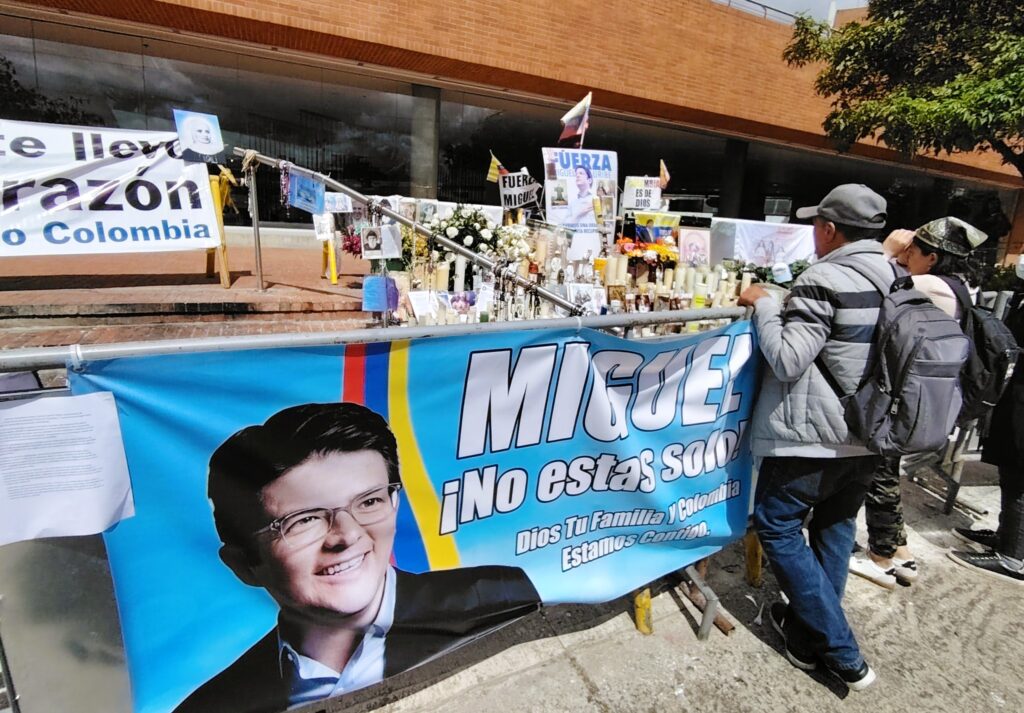
Vigil for Miguel Uribe, the young politician shot by a 15-year-old hitman in a Bogotá park in June 2025. He survived the initial attack but died from his wounds two months later. Photo: S. Hide.
The most high-profile killing was the gunning down of senator and presidential candidate Miguel Uribe, shot in the head during a walkabout in a Bogotá park. The police quickly apprehended the small-time gangsters behind the shooting in June 2025, including the 15-year-old shooter, but today despite nine arrests are no closer to revealing the paymasters behind the hit.
Another unsolved assassination was the targeted killing of emerald czar Hernando Sánchez, shot dead while walking with his family in a leafy northern suburb of Usaquén in April last year. The military-style killing, by a sniper hiding in nearby woodlands, was identical to the mysterious murder nine months before of a fellow emerald baron, known as Pedro Pechuga, also unresolved.
Weapons of choice
Despite Colombia having restrictions for private ownership of firearms, the majority of 2025 killings were with guns, at 703, according to the police database. Other weapons recorded were knives (304), blunt objects (84) and grenades (6).
This pattern has persisted for decades; Colombia, and its capital, are flooded with illegal firearms, many of them from the estimated 600,000 guns smuggled south across the border from the U.S. each year. Just in the first four months of 2025, police confiscated 8,466 illegal weapons across the country
According to Carolina Ortega, a political scientist at the National University, and quoted by UPI, illegal guns were used in 78 per cent of killings in Colombia.
Easy access to guns also raised the risk of spontaneous killings, according to data from the Secretaria de Seguridad which showed that40 per cent of Bogotá homicides followed a dispute, argument or scuffle.
Most of these happened outside on the street, late in the evening, and “amidst scenes of revelry and excessive alcohol consumption”, said the report, released as part of a media campaign called “Take a second before you shoot…”.
Violent machismo
Femicides went down on 2025, both in Bogotá and at national level, according to data released this week by the Observatorio de Mujeres y Equidad de Género de Bogotá.
In Bogotá during 2025 there were 97 females killed, around 8% of total violent deaths. Of these, 20 were classified as femicides. This was slightly less than in 2024 (22 deaths) and mirrored a similar reduction (7%) nationally. Nationally, approximately one killing in five of a female was later classified as a femicide, the “violent expression of machismo”, said the study.
A study by Bogotá’s Secretaria de la Mujer found that in 49 per cent of cases in the capital, the women had suffered physical violence in the weeks before the murder, and 40 per cent had previously sought help from the police.
According to observatory data, last year Secretaria staff supported 142,688 women, of which 48% were facing violence, a slight reduction on the previous years. The 2025 figures were a reminder that although more warning signs were being detected, timely intervention was not always possible, said the report.
“Femicide does not arise from nothing: it is foreshadowed, repeated, and often normalized before reaching its most tragic outcome,” it concluded.
Pay up – or pay the price
In 2025 many Bogotá murders were linked to extortion demands, with gangs ruthlessly gunning down small business owners if they failed to pay protection money. Sometimes shop staff or a passerby were also killed or injured, in some case with grenades or explosives.
Protection rackets are nothing new in the city, but cases and killings skyrocketed post-pandemic partly because of turf wars between gangs diversifying from the drug trade and Venezuelan gangs linked to the transnational group Tren de Aragua with names like Las Satanás and Los Coyotes.
Extortion reached epidemic proportions in 2024, with an average of 200 cases a month, and continued into 2025 with a rash of crimes such as the killings of informal minibus drivers in the south of Bogotá.
Overall, Bogotá in 2025 saw extortion go down by 20 per cent compared to 2024, though it was still higher than any year during the previous decade. And already in the first month of 2026 there have been several murders linked to extortion demands including a grenade attack on a nightclub in Los Mártires last week which killed one and injured a dozen more.
Millionaire’s ride
Another death last week, that of a university professor found dead and incinerated on the outskirts of the city, highlighted increased cases of Bogotá’s infamous Paseo Millonario, where armed gangs working with taxi drivers attack and extort passengers, often torturing them to reveal bank details while they empty their accounts.
Victims are often targeted late at night leaving bars or restaurants. In a chilling twist, recent cases pointed to victims being subdued with ketamine, with the drug either killing or severely incapacitating the victim.
According to data from the GAULA (Anti-Kidnapping and Extortion Group), 40 Paseo Millonario cases were reported in 2025, a rise of 207 per cent on the previous year. Even that figure was thought to be a huge underestimate since many victims were too scared to come forward. Hotspots were in Chapinero, Kennedy, Bosa, Ciudad Bolívar, and Fontibón.
In one case a taxi gang held a victim for 19 hours, prompting the Attorney General’s Office to reclassify such crimes as “kidnapping” with a potential 42-year prison sentence. In theory this prompted the police to start responding more robustly to a crime that has plagued Bogotá for decades.
Perpetrators of these high-impact crimes were also more likely now to get locked up, with 47 imprisoned last year out of the 52 captured, which was way above average jailing rate of 6 percent of criminals arrested, according to Bogotá police chief Giovanni Cristancho, talking to RCN News last week.
But he also admitted that the understaffed police force was struggling to keep up with constantly emerging kidnap gangs, usually small teams of four or five people which could easily move around the city.
“As soon as we reinforce one area, such as around Calle 85, the modus operandi shifts to other zones,” he told RCN.
It’s that randomness, and the risk of being drugged – or worse – that makes the Paseo Millonario one of the most feared crimes in Bogotá. And for 2026, the one to watch.
Colombian president Gustavo Petro is in the US capital for a crunch summit on bilateral relations. What’s behind it and what could happen?
After months of extremely strained relations with the US, Colombian president Gustavo Petro is now in Washington to meet his counterpart Donald Trump. The actual head-to-head is scheduled for tomorrow, Tuesday February 3rd. The Colombian team also includes key advisors such as the Canciller, Interior Minister, the USA business envoy and the Defense Minister.
While both sides have cooled their rhetoric, there’s plenty of unpredictability in both camps and past relations have been rocky to say the least. Petro and other members of his delegation had to be issued temporary visas just for the diplomatic visit, as Trump had previously cancelled his visa in September.
That also applied to highly controversial Interior Minister Armando Benedetti, as well as members of Petro’s family. Before leaving, the president tweeted a particularly unusual post on X specifying that he’d visited his mother before leaving in a mildly ominous tone. He then expounded on love and sex in a non-sequiter.
Empiezo mi jornada de comunicación intensa con el gobierno de los EEUU, con mi entrevista con el representante de negocios de los EEUU en Colombia McNamara.
Antes de esta reunión he visitado a mi mamá para despedirme.
A highly unusual tweet by Colombian president Gustavo Petro
Petro is also somewhat predictably calling for protesters to fill the Bolívar square (as long it’s not raining) to defend the minimum wage increase, democracy and peace in Colombia. The first two have nothing to do with the Washington summit, while the latter isn’t seriously under threat from the US at this point.
Why is the Colombian president visiting Washington this week?
This was Trump’s offer after the war of words following Nicolás Maduro’s capture in early January. He initially suggested a phone call, after which a follow-up invitation to meet face to face in the White House was offered.
While Trump and Petro are on better terms, not everyone is happy with the USA
After that initial call, the pair appeared to have ended up on relatively good terms, and for now there appears to be a wary calm between the Palacio Nariño and the White House. It’s too early to talk of a bromance, but there was certainly a rapid de-escalation.
The US president pointedly praised Petro’s tone in his tweet after they spoke over the phone, indicating that the Colombian president had been rather less bullish one on one compared to his public speeches and tweets. That hasn’t changed much in recent weeks.
Petro appears to have struck a far more conciliatory note when actually talking to the US president on Wednesday. For his part, Donald Trump also turned down the heat, saying it was a great honour to speak with the Colombian president and reaffirming his respect for the Colombian people.
The Colombian president went on to say that he had cleared the air and underlined that he is not connected to the illegal drug trade. He pointed out that he has stepped up seizures of drugs and has in fact been threatened various times over his life by drug cartels.
He’s gone further over the past week or so, claiming that estimates of Colombian coca crop capability in production are wildly inaccurate, especially when they come from foreign observers. He hasn’t helped matters by refusing to publish his own figures, but a recent high-profile seizure off the coast of Portugal won’t have hurt.
Petro was highly critical of Trump’s actions in the Caribbean from the outset. He warned Trump “not to wake the jaguar”, denounced his strikes on boats in international waters and convened an emergency meeting of the UN security council to investigate the Maduro affair.
Bad blood between the pair goes back a long way, with Trump’s grandstanding over deportations of Colombian nationals being met with strong pushback from Petro. Although the Colombian president eventually backed down from initial threats to not let the planes in, he met the deportees upon landing and symbolically undid their handcuffs.
Petro’s fierce criticism of the military build up in the Caribbean and Trump’s position on migration in terms of ICE and so forth had led to him and his estranged wife Veronica Alcócer being stuck on the Clinton List along with advisor and Interior Minister, Armando Benedetti.
The truth is that antagonistic public rhetoric plays well for both Petro and Trump, regardless of how much damage it may do to the reputation of either country. They both get to play the big man and impress their base, which both need right now in the face of domestic woes.
It’s entirely possible that both sides will have a relatively amiable meeting in which progress is made, before going back to lightly criticising one another in order to please their local audiences. Trump seems not to mind people doing that, even going so far as to encourage NYC mayor Zohran Mamdani to call him a fascist in a recent meeting.
What can Petro’s team come back with?
There are a number of points to cover and a range of different outcomes on each. Military and security cooperation and guarantees are perhaps most important, with drug exportation, migration, ICE, visas and tariffs also on the table.
Much will depend on whether the meeting is televised or behind closed doors. Petro will by far prefer the latter and likely want to avoid as much as possible the media bearpit that Trump often sets up for visiting politicians.
Colombia is looking to avoid anything remotely similar to the Maduro operation
Colombia will be looking for guarantees and assurances that US military action won’t happen on local soil. There’s no suggestion that Trump is looking to do that in the short term anyway, but it’s not hard to believe that could change, for example making a strike on cartel leaders within Colombian borders.
The USA might refuse to give an official guarantee but indicate that the option is currently off the table, which would still calm tensions significantly. Petro has made it clear he considers US military action a real danger. There’s also the possibility that the countries could agree to work together and cooperate. Again, this is likely to be far more palatable to the Colombian public.
Information sharing and support in terms of hardware and technology would be of great use to the Colombian military, after all, and both countries share a common interest in cracking down on the cartels, at least on paper.
Trump might demand a greater show of good faith from Petro in terms of action taken to combat the cartels, which is tricky. The Colombian state has been relatively efficient over the last three years at capturing drug smugglers and received little credit for it from Washington.
Colombian governments of all hues have struggled to deal with the problems of armed non-state actors, whether paramilitaries, cartels, guerillas or any mix of the above. Trump has little patience for this sort of thing and is results-oriented. That could be an excuse for unilateral action or could lead to an offer of help. Colombia will want the second of those options.
No economic instrument is more beloved by Donald Trump than tariffs, his self-declared ‘favourite word in the language’. Colombia is currently still at the global standard of 10% and won’t want that to change. That means it could be a powerful negotiating tool and Trump has threatened an increase in tariff rates at various points, as he does with many countries.
Colombia has turned more and more towards China in recent years, with Beijing helping guide construction of the Metro project in Bogotá. Trump may be looking to try and keep Colombia closer to the US economically, as fewer and fewer Latin countries treat their northern neighbour as the most important part of their trade network.
Visas, too, have been contentious. Waiting times at the US embassy were getting better but often involve months of waiting time. That hasn’t been helped by the recent freeze on residency visas for a swathe of countries including Colombia.
Speeding up processing times in Bogotá for basic American tourist and business visas would be relatively low-hanging fruit in negotiations. If both sides could agree, that would make a lot of people’s lives a lot easier and be popular in Colombia.
In the best case scenario, Colombians can hope for no additional tariffs, military guarantees and cooperation and an easing on visas. In the worst case, Trump will impose drastic new economic measures, cancel a load of visas and keep a strong military presence in the Caribbean with eyes towards Colombia.
The end result will probably be somewhere in the middle of all that. Given the relatively calm immediate build-up to the trip, it’s most likely that an accord can be reached that both sides can present as positive if not perfect. It doesn’t suit either side to have a massive bust-up at this point, but we are talking about two politicians with a reputation for fits of pique.
More cynically-minded people may wonder if a more personal deal may be struck as well – Petro off the Clinton list and his US visa reinstated. He’s talked before about wanting to tour the world as a public speaker on social and environmental issues and this would make that easier.
Whatever does happen in the meeting, it will be pivotal for relations between the US and Colombia. With the country being one of the last in Latin America to have the USA as their biggest trade partner, that affects many ordinary people.
For the business community, the impact of potential tariffs or restrictions could be huge. For NGOs and rights workers, re-establishing foreign aid would be very useful. For ordinary folk, further controls or freezes on visas would be a real pain. For everyone, a sense that military action was definitely off the table would bring much-needed peace of mind.
What’s coming for Colombia in 2026? A new president, a return to the world cup and all the usual sports, music and culture are ahead. There’s also plenty of uncertainty for now.
Just like the high mountains, Colombia’s future is clouded in fog
It had seemed that the only big political news of the year would be the election cycle and incoming president. However, all that changed on the first weekend of the year as the US military captured Nicolás Maduro in Venezuela and brought him to face charges in New York.
Then at the end of January, the Corte Constitucional blocked president Petro’s economic emergency declaration, plunging the country into another round of uncertainty. While the court deliberates, the country’s businesses will have to wait to see what’s ahead. Meanwhile, minimum salary workers can celebrate their first COP$2,000,000 paychecks.
#LaCorteInforma | La Corte suspende provisionalmente el Decreto 1390 de 2025 “Por el cual se declara el Estado de Emergencia Económica y Social en todo el territorio nacional”, mientras se profiere una decisión de fondo.
February won’t let up as Petro’s off to Washington at the start of the month to meet Donald Trump in what could be a tense meeting. While both sides have cooled their rhetoric, there’s plenty of unpredictability in both camps. This is perhaps best illustrated by Petro having to be granted a 5-day visa just to visit, Trump having cancelled his last one.
It’s anyone’s guess how that might end, with Petro currently blocking the release of coca growing figures and denying the reliability of foreign sources. In the best case scenario, Colombians can hope for no additional tariffs, military guarantees and cooperation and an easing on visas.
This is a year with big events set to dominate after a relatively quiet 2025 still managed to contain plenty of shocks and surprises. As ever, Colombia seems set to live in interesting times. We’ll be here throughout the year to keep you up to speed on what’s going on and why, from entertainment to hard news.
Another big election
Expect Colombians to grumble as they are called up for compulsory vote counting duty. There will be two sets of elections this year, with voting for the Senate and House of Representatives taking place first on the 8th of March. There will also be voting for candidates in blocks on that day.
The election is tighter than the estrecho de Magdalena
After that, it’s the presidential race on the 31st of May with a likely run off between the top two candidates around three weeks later. The last four elections have all featured second rounds and no candidate looks capable of registering more than half the initial vote.
As with many presidential systems, there’s an enormous gap between winners being declared and them arriving in office. Pleasingly, this takes place on national days: the Senators and Representatives won’t arrive until Colombian Independence (20th July) and the president takes over on the anniversary of the Batalla de Boyacá (7th August).
The presidential runners and riders are in a very crowded field right now, but that will thin out until the 13th March, the final deadline for candidacies. The 8th March vote for various lists of candidates is especially important for this. The race remains wide open at the moment, with no clear leader and a very good opportunity for someone to come out of nowhere.
Interestingly, there’s a good chance that Colombia will elect its first ever female and/or LGBTQI president, with Vicky Dávila, Paloma Valencia, Daniel Oviedo and Claudia López all potentially already in the mix or capable of putting together a big surge.
On the loosely defined left, Iván Cepeda is the official candidate for Pacto, having won out in the internal poll. Luis Murillo is also in the hunt, with Roy Barreras and the formerly-discredited Medellín mayor Daniel Quintero as outsiders. Cepeda will absolutely dominate the leftist vote and is very likely to make the second round as a result.
A rally by presidential candidate Iván Cepeda in Neiva, Huila
A host of candidates on the nominal right are standing, with former journalist Dávila and Centro Democrático heavyweight Valencia in the ‘Gran Consulta’ block which defines itself as centrist but would be considered by many to be at least right-leaning.
The wildcards here are Abelardo de la Espriella, a tough on crime former lawyer who led the field in gathering public nominations at over 5 million and serial candidate and former Medellín mayor Sergio Fajardo who narrowly failed to make the second round last time around.
Harder to pin down are candidates such as Claudia López and Juan Daniel Oviedo. They could surprise some people with a strong spring surge, especially if they can channel a dislike of established parties. However, López has baggage from her time as Bogotá mayor and Oviedo is in the ‘Gran Consulta’, meaning he’ll struggle to stay in the race.
Tying up loose ends
Elsewhere in the political landscape are other issues that could do with being resolved before the change in head of state. Paz Total is nowhere near happening, with a number of talks deadlocked or non-existent, the economic emergency is currently frozen and Venezuelan relations remain unclear.
The sun is setting on Petro’s presidency
If the economic emergency goes ahead, there will be increased IVA (VAT or Sales Tax) on a range of things including online gambling, liquor and wine. There will also be a dramatic change in importation limits, with a limit of USD$50 for tax-exempt gifts.
The ELN have asked to get back to the table, perhaps sensing that a possible right-wing government might not be quite so favourably disposed to their antics. Petro himself seems to have lost patience though, dismissing the request out of hand due to their recent attacks on Colombian army members.
Inflation will probably remain high and base interest rates are now in double digits as a result. However, the economy is chugging along decently and consumer spending remains strong. The minimum wage increase will likely help that continue and with a weakening dollar, prices may start to stabilise.
Whatever happens in Venezuela will have a big impact in Colombia. If the country opens up again, it’s entirely possible that some of the three million or so Venezuelans in the country may return. That will ease pressure in the labour market, increase trade flows and please a certain type of politician.
If Delcy Rodríguez stays in office with US support, things may be a lot more complicated. There’s not much love for the Venezuelan regime in Colombian political circles, meaning trade may not take off and there is likely to be limited cooperation on regional matters.
Ecuadorian relations also are heading in a downward spiral, with Noboa and Petro currently engaged in a tit-for-tat trade war and imposing hefty tariffs on each other. That’s choking trade across the border and affecting cooperation on cross-border security issues.
If there is a change in government, there might be more serious attempts to investigate a range of overhanging scandals such as the peculiar case of Laura Sarabia, currently ambassador to the UK and Juliana Guerrero’s and others’ mysterious qualifications.
With six months more in office, Petro has plenty of time to address these scandals or start new ones. Expect his twitter account to get even more heated between March and June as he gets involved in the election. He’s also likely to continue the ministerial merry-go-round which is past 60 changes already.
His approval ratings upon leaving office are likely to be higher than either of his two immediate predecessors. After a sharp post-election fall, he’s stayed consistently relatively popular by Colombian presidential standards and showing an uptick in recent months. For all the mutterings of doom when he came in, he’ll leave office in a relatively good position.
Big issues in Bogotá
Mayor Gálan is halfway through his tenure and has little to show for it so far. He’s managed to keep things ticking over but has not made big changes, nor has much of a legacy as things stand. The Metro was his inheritance and will be inaugurated under the next mayor, so he could do with something big this year. Trouble is, there’s nothing on his books for now.
A long-term boon but short-term disruption
Transport is perhaps the biggest issue, with the Metro still firmly on track. Gálan deserves credit for this, as the project has not been without problems and has endured meddling from the Palacio Nariño. Regiotram to the westerly satellite towns is also still on the way.
On the other hand, there will be even more disruption in the short term thanks to the Metro works, and road quality is awful. Road traffic incidents are stubbornly high, with nearly 500 deaths predicted over 2026.
Prices have been hiked to COP$3,550 on the Transmilenio and SITP for 2026, despite Gálan’s earlier pledge not to do so. The mayor says it’s unavoidable due to the minimum wage rise. Petro has responded by refusing to fund a new fleet of electric buses.
Water rationing was an issue this time last year, but it seems unlikely to return for the short term, thanks to the unseasonal levels of rain we’ve had over the holiday period. An El Niño event is predicted for the year but there’s little sign of it so far.
Crime is nominally coming down, but few believe the official figures. Perceptions of crime remain high and most Bogotanos feel unsafe in the city. It’s not hard to see why – it feels like there are more and more chirretes around and fewer police.
One thing that is always in view is rubbish, with big piles over much of the city. Some of this is from an increase in fly-tipping, some from a faulty collection system struggling to keep up and others from a simple breakdown in civic values.
A succession of Bogotá mayors have avoided the issue after Petro got into hot water in his time in office, but things are coming to a head now. It’s becoming a public health problem with rats frequently seen even in midday as well as a simple blight on the city.
Entertainment
Peso Pluma has pulled out of Festival Estéreo Picnic 2026, but la Tigresa del Oriente has joined, which is probably a win. The best event in Bogotá, and by extension Colombia, remains a top-drawer festival with genuine international heavyweights which is well worth getting tickets for if you’re in town.
With a lineup boasting Tyler, The Creator, The Killers and Deftones, the festival is a viable cultural tourism draw if you’re visiting. Prices are competitive with North American and European fests and experiencing a Latin American festival environment is something most music fans should relish.
FEP2026 is the bigger event, but little sister Cordillera offers a more Latin experience
Balancing FEP2026 is Festival Cordillera 2026 in September, which offers a different attraction: the chance to see what (loosely defined) contemporary Latin music sounds like. The event focuses almost exclusively on Latin talent from across the musical spectrum, giving you the opportunity to explore a soundscape you may not know too much about.
Sadly, those two mega-festivals are helping sound the death knell for Rock al Parque. It hasn’t really recovered post-COVID and has been poorly managed by the alcaldía. Hopefully it can find its feet again, and the offshoots (salsa al parque, rap al parque etc) are all still strong and accessible.
Flying under the radar last year was Colombia’s first ever board games convention, Ludotopia. Given the enormous success of the event, it’s likely to run again. In other boardgaming news, Wingspan will launch an Americas expansion featuring a bevy of local aves, illustrated by Colombian lead designers Ana Maria Martínez and Natalia Rojas.
Filbo from 21 April- 5 May is the nation’s keystone for literary events, accessible and open to all with a strong focus on education as usual. The country of invitation this year is India, a welcome departure from the usual Latin or European focus and sure to open up exciting new possibilities.
Ludotopia was a smash hit in 2025
Geekfest SOFA will be in October, which has turned into an absolute juggernaut of an event. Crowds will be intense in the daytime weekends, so try and make it there on weekdays or in the evenings if you’re going. Comic Con is much quieter but lacks the joyfulness of SOFA, being much more commercial in nature.
Colombian sporting specials in 2026
Colombia have a reasonably straightforward World Cup group and will be aiming high. Head coach Nestor Lorenzo has turned dressing room morale around 180° and taken los cafeteros to a runner’s up spot in the last Copa América.
With Colombia currently ranked 13th by FIFA, they are expected to do well and will be seen as a team to beat. Matching the 2014 run to the quarter-finals will be no easy task, but achievable. Surpassing it would be a real upset but it’s a funny old game and anything could happen. The squad is well built for tournament football, with key players such as James capable of burning bright for a few weeks.
A hotly contested capitalino derby on the way to Santa Fe’s championship
There’s also plenty to keep an eye on in domestic football, with Falcao returning to Millonarios. That didn’t go fantastically well in the 2024 apertura, as city rivals Santa Fe knocked them out and went to lift the trophy. El Tigre didn’t take that well at all, throwing his toys out of the pram in a charged presser after the match. Santa Fe went on to win the Supercup at the start of this year.
After working wonders with Wrexham, Hollywood superstar Ryan Reynolds will be hoping to do similar for Inter de Bogotá. Previously known as La Equidad, the team changed name after being acquired by Reynolds’ investment vehicle. The actor has already donned the jersey and may appear at games in 2026.
In non-traditional sport, Cricket Colombia are celebrating their recent designation as an official sport in the country. They’re getting things kicked off with the Barranquilla Cricket tournament from February 20-22 seeing regional teams from Santa Marta, Bogotá, Cali and Medellín fighting it out to decide national supremacy. Cartagena, Santa Marta and Barranquilla are also hosting a women’s competition as the sport grows in the country.
Egg-chasers are spoilt for choice with Gaelic football in the capital as well as Aussie Rules, American football and rugby across the country. With the Superbowl coming up, if you are inspired, get in touch with the American football leagues across the country.
The Colombian women’s sevens are currently competing in the SVNS championship in Dubai and making a good account of themselves. The Toucans are punching above their weight with limited resources available to them.
AFL in Colombia continues to build momentum, and Gaelic football is becoming a bigger deal as well, with the Bogotá Beithigh practising on a more consistent basis in partnership with Colombia rugby to help build their profile.
What’s most likely to happen in Colombia in 2026?
Well, frankly put, the most likely thing is a big surprise in Colombia in 2026. Unexpected events seem to happen with regularity, so there’s every chance something comes out of leftfield. Plenty of things popped up in 2025 that we hadn’t seen coming this time last year.
The news rolls like the mountains of the macizo colombiano
Having said that, there are some good bets to lay: the economy should continue strengthening and the dollar exchange should ease back in the direction of COP$3,000 (which remains a long way off). There definitely will be a new president, even if it’s a continuity candidate and we will see changes in the Senate.
The big cultural events of 2026 in Colombia look like they’ll all be roaring successes as usual, as the country shows no sign of slowing down.
It’s unlikely that any of the peace processes will come to a conclusion and depressingly likely that they will face more turmoil if certain candidates take over in the Palacio de Nariño. While we can all hope that things will improve in the capital, there’s currently no sign that will happen. On the other hand, steady progress will continue on existing projects.
En fin, it’s likely to be six months of the usual turmoil and drama, culminating in two huge events: May-June’s presidential elections and the fortunes of the footballers in North America at the World Cup in July. Then we’ll face the remainder of the year watching what the president does in his or her first months. Whatever happens, there’ll be plenty going on in Colombia in 2026.

 Login
Login