Reading view

Colombia’s Three Presidential Front-Runners Draw Divergent Maps for Foreign Capital, Security, and Rule of Law

Colombians face three sharply different futures in May 31 vote

Colombia votes on May 31 with its presidential race concentrated around three candidates whose platforms diverge on nearly every dimension of economic and security policy relevant to foreign investors. For corporate executives, institutional investors, and multinational operations with Colombian exposure, the choice between senator Iván Cepeda, senator Paloma Valencia, and defense attorney Abelardo de la Espriella carries direct, measurable implications for the regulatory environment, foreign direct investment (FDI) conditions, energy sector licensing, and geopolitical alignment through at least 2030.

No candidate is projected to clear the 50%-plus-one threshold required to win outright on May 31, making a runoff election on June 21 the expected outcome. The question that will determine the direction of that runoff — and by extension the next administration — is which of the two opposition candidates finishes second.

Click above to play the video!

A Race Reshaped by Late Polling

The final-week polling picture shifted substantially, and the trajectory matters as much as the snapshot. The CONDOR weighted aggregate — which incorporates surveys from six polling firms and applies greater weight to more recent data — placed the race as of May 23 at: Cepeda 36.3%, De la Espriella 29.1%, Valencia 16.7%.

Invamer, one of Colombia’s most established polling firms, surveyed 3,800 respondents across 152 municipalities between May 13 and May 20, registering Cepeda at 44.6%, De la Espriella at 31.6%, and Valencia at 14.0%. The Centro Nacional de Consultoría (CNC) published a survey conducted May 22 and 23 showing Cepeda at 33.4%, De la Espriella at 30.9%, and Valencia at 12.6%.

Comparing those figures to the Fundación Génesis Crea survey from May 4 through May 11 — which placed Cepeda at 35.1%, Valencia at 25.4%, and De la Espriella at 21.6% — indicates a multi-poll trend of De la Espriella gaining approximately nine to ten percentage points in three weeks while Valencia shed a comparable share. AS/COA’s poll tracker confirms the directional consistency across firms.

Atlas Intel, which published figures more favorable to De la Espriella, is currently under investigation by Colombia’s Consejo Nacional Electoral (CNE) for potential methodology violations and could face suspension of its operations. Those figures are treated with caution in this analysis.

Runoff modeling diverges between firms. Fundación Génesis Crea showed Valencia defeating Cepeda 49.1% to 44.7% in a second-round matchup — meaning she was the stronger opposition candidate in that scenario. The Guarumo/Ecoanalítica survey found Cepeda losing all hypothetical runoff scenarios, including against De la Espriella. Two minor candidates — former senator Clara López and former Chocó governor Luis Gilberto Murillo — withdrew and endorsed Cepeda before the first round, a consolidation that appears to have had limited effect on his polling numbers.

Finance Colombia reported in May that the campaign has been marked by an unusual absence of traditional televised debates. Cepeda declined to participate in events organized by major media outlets, stating that proposed formats lacked neutrality. Former Bogotá Mayor Claudia López, herself a candidate, said publicly that Cepeda’s refusal was motivated by an unwillingness to defend his record as the architect of President Gustavo Petro‘s Paz Total security negotiation strategy.

Security Policy: The Three Approaches to Armed Groups

Public security is the top voter concern heading into the election. InSight Crime documented that the Ejército de Liberación Nacional (ELN) launched a major offensive against FARC dissident factions in Norte de Santander in early 2025, resulting in mass civilian casualties in the Catatumbo region. In Chocó and Antioquia, the ELN and the Autodefensas Gaitanistas de Colombia (AGC), commonly known as the Clan del Golfo, are competing for control of illegal gold mining corridors and drug trafficking routes. In Cauca, FARC dissident factions have established territorial control in areas where state presence has collapsed.
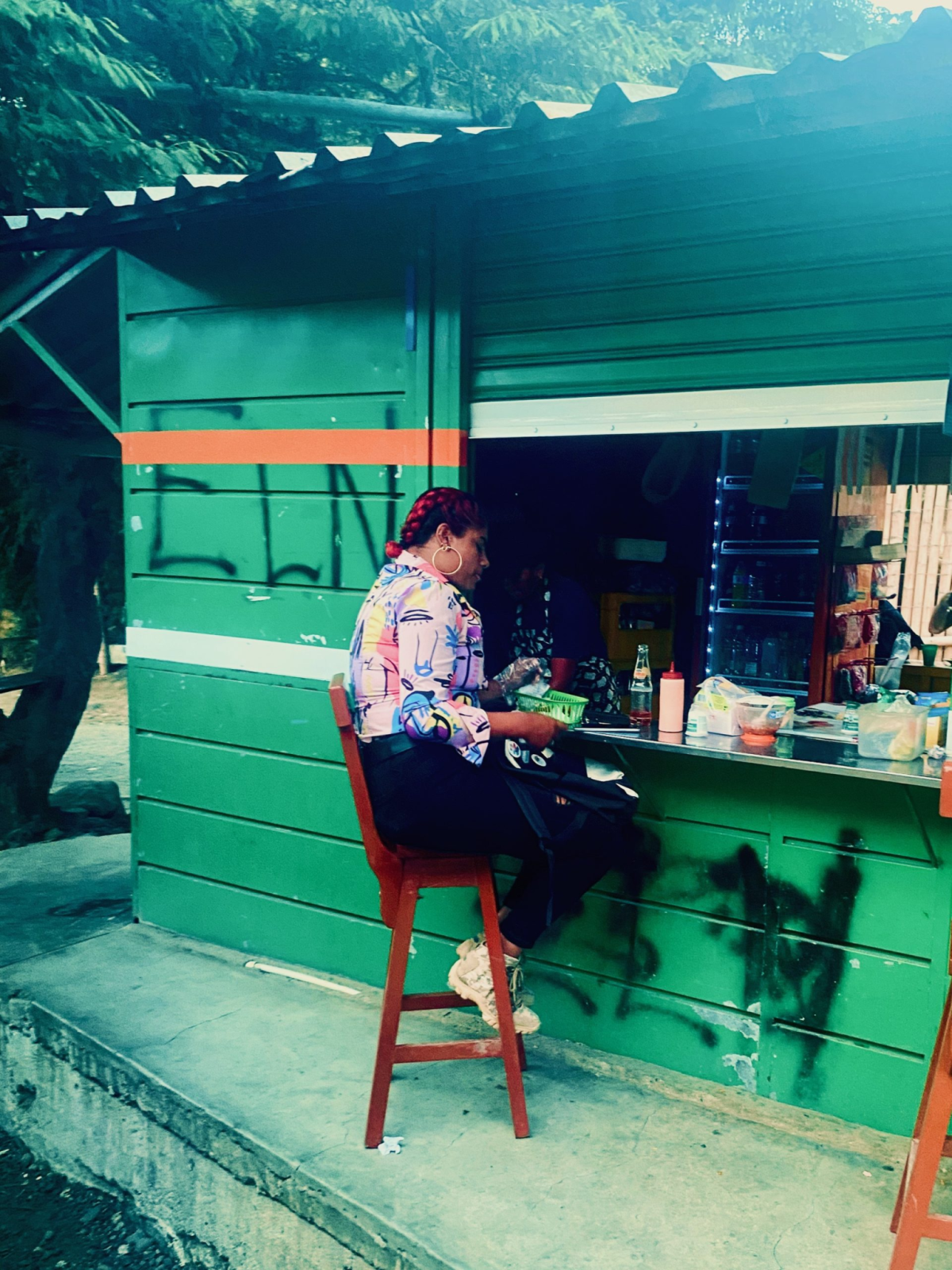
Grafiti of the ELN and ex-FARC Mafia near Corinto, Cauca (Credit: Henry Shuldiner)Cepeda’s approach to security is defined by his role as the principal legislative architect of Paz Total. As chair of the Senate‘s peace commission, he designed the framework that extended negotiating status to the ELN, FARC dissident groups, and the Clan del Golfo. His stated rationale is that targeting the financial leadership of drug networks rather than foot soldiers produces more durable results — a position that has academic backing in narcotics policy literature. In practice, Paz Total produced ceasefires that were repeatedly violated, and security indicators in conflict-affected departments deteriorated during the Petro administration. A Cepeda presidency is expected to continue the negotiated settlement model, with the military operating under political constraints.

Valencia’s security platform is based on reinstating Seguridad Democrática, the doctrine associated with former president Álvaro Uribe’s administrations from 2002 to 2010. The core elements are expanded military presence in rural conflict zones, dismantling of rural criminal networks, and resumption of extradition agreements with the United States — which Petro suspended, effectively shielding cartel leadership from US federal prosecution. The Uribe-era approach resulted in measurable reductions in homicide rates, forced displacement, and ELN and FARC territorial control, though human rights organizations documented serious abuses by security forces during that period.

De la Espriella has stated explicitly that his government would have no peace process. He advocates for a model similar to El Salvador’s under President Nayib Bukele: mass incarceration, construction of high-security prison facilities, classification of guerrilla and cartel organizations as foreign terrorist organizations, and broad military offensives. He has not detailed how such operations would be financed or how the mass detention model would interact with Colombia’s Constitutional Court, which has repeatedly constrained executive security powers.

For the armed groups operating in Norte de Santander and Cauca, the historical record indicates that Colombia’s criminal organizations respond more acutely to sustained, institutionally grounded military pressure and functioning extradition pipelines than to political rhetoric. By that measure, Valencia’s platform — which rebuilds the institutional security apparatus incrementally — represents a more structurally credible threat to the ELN and the Estado Mayor Central (EMC) FARC dissidents. For the Clan del Golfo leadership, extradition to the United States has historically been the principal deterrent, and Valencia’s program explicitly restores it.

Business Climate and Employment Conditions

The Petro administration enacted a series of minimum wage increases totaling more than 60% over four years — including a 16% increase for 2023, the largest single-year hike in Colombian history, and a 23.78% increase for 2026 — restructured labor regulations to expand premium pay requirements for night, weekend, and holiday shifts, and raised corporate tax rates to fund social spending programs. The Asociación Nacional de Empresarios de Colombia (ANDI) characterized the regulatory environment as adverse to private investment. Finance Colombia tracked a material decline in FDI in the extractive sector over the same period.

Cepeda supported those labor and fiscal reforms throughout their legislative passage. His platform extends the Petro model: increased state social spending, continued land redistribution programs, and maintenance of the current wage and labor cost structure. For companies with established Colombian operations, the regulatory environment is manageable; for companies evaluating market entry or operational expansion, the cost structure adds friction.

Valencia’s economic program emphasizes corporate stability and private sector investment as the primary mechanisms of job creation. Her vice-presidential running mate, Juan Daniel Oviedo — former director of DANE, Colombia’s national statistics agency — represents a technocratic orientation focused on reducing structural market distortions, streamlining public procurement, and scaling back state administrative overhead. Oviedo’s appointment is a direct signal to the business community that economic management would be data-driven rather than ideologically directed. Oviedo also publicly identifies as a member of the LGBTQ+ community, a departure from the traditional social conservatism of Centro Democrático.

De la Espriella’s economic orientation is pro-business with protectionist elements. His vice-presidential candidate, José Manuel Restrepo — who served as Colombia’s Finance Minister and Commerce Minister — provides institutional credibility on fiscal and trade policy. Restrepo’s presence on the ticket signals commitment to fiscal discipline and regulatory reduction in the extractive and commercial sectors. De la Espriella’s personal style, however, introduces operational uncertainty; his campaign has generated multiple high-profile controversies, including a public altercation with Caracol Noticias journalist María Lucía Fernández during a live broadcast and a formal apology following misconduct allegations by journalist Laura Rodríguez of Piso 8 FM.

Foreign Investment, Oil, and Mining

Ecopetrol holds a 31.5% stake in the Gunflint oil field in the Gulf of Mexico.

Ecopetrol holds a 31.5% stake in the Gunflint oil field in the Gulf of Mexico.

The extractive sector is the most consequential economic policy dimension for international capital. Ecopetrol (NYSE: EC; BVC: ECOPETROL) — Colombia’s state-controlled energy company and the largest corporation in the country — has operated under exploration restrictions during the Petro administration, which has opposed new fossil fuel contracts on climate grounds.

Cepeda’s position extends the Petro framework: mandatory transition away from fossil fuels, heavy restrictions or outright prohibitions on new oil and gas exploration contracts, and stringent environmental licensing requirements for open-pit mining operations. Foreign investment would be directed by policy toward green hydrogen, ecotourism, and smallholder agriculture. For the multinational oil majors with Colombian operations and for institutional investors in the mining sector, a Cepeda presidency represents a continuation of the current constraints and, in some contract scenarios, an accelerated wind-down of Colombian portfolios.

In a related development, Finance Colombia reported in May that Ecopetrol’s president, Ricardo Roa, has been formally charged in connection with alleged campaign spending violations during Petro’s 2022 presidential campaign. The case will be inherited by whoever takes office in August.

Valencia’s position is that hydrocarbon revenues are essential to Colombia’s macroeconomic stability and that the country cannot exit the sector before alternative revenue structures exist. Her platform actively encourages FDI in petroleum exploration, is open to regulated fracking, and commits to clearing the environmental licensing backlog that has stalled multiple large-scale gold and copper mining projects. For energy and mining companies currently blocked by administrative delays, this represents the most direct path to project advancement.

De la Espriella’s position goes further: essentially deregulating the environmental licensing process for major extraction projects on the grounds that Colombia’s economic sovereignty takes precedence over environmental restrictions he characterizes as externally imposed. The practical constraint is whether a De la Espriella administration would have the institutional coherence and congressional support to deliver regulatory rollback, given that his movement has no established political party structure and entered the race through an independent signature campaign.

Foreign Policy: Washington Alignment vs. Multipolar Strategy
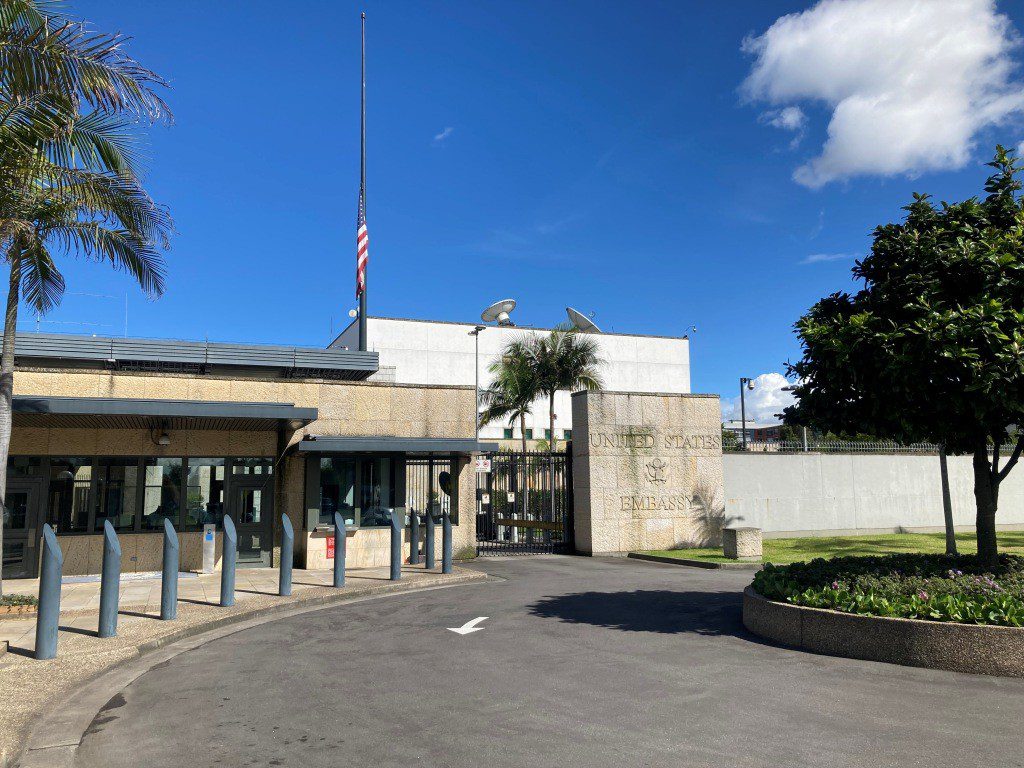
The US Embassy in Bogotá is said to be the 3rd largest US mission in the world (photo: Loren Moss)

The US Embassy in Bogotá is said to be the 3rd largest US mission in the world (photo: Loren Moss)

Colombia’s relationship with the United States deteriorated materially under Petro, who aligned Colombia with Venezuela’s Nicolás Maduro, pursued closer ties with China and Russia, and suspended extradition agreements. US counternarcotics cooperation was strained throughout the period.

Cepeda is committed to what he describes as a multipolar foreign policy — maintaining functional diplomatic channels with Washington and Brussels while deepening strategic and commercial relationships with China and Russia. His alignment with regional left-of-center governments in Mexico, Brazil, and Bolivia would position Colombia as part of a Latin American bloc that has grown increasingly skeptical of US regional leadership. For US companies operating in Colombia, this trajectory does not mean immediate operational disruption, but it reduces Colombia’s utility as a reliable counterpart on security cooperation, counter-narcotics intelligence sharing, and trade dispute resolution.

Valencia positions a return to the Western alignment as a core objective. She would prioritize restoring the US-Colombia relationship, reinforcing the bilateral Free Trade Agreement, and reestablishing intelligence-sharing mechanisms that were reduced under Petro. Her framing positions Colombia as a democratic anchor in a region experiencing authoritarian pressures.

De la Espriella takes the most explicit pro-US position in the race. La Silla Vacía reported that De la Espriella or entities linked to his campaign donated more than $90,000 USD to the US Republican Party, a fact that raises questions about the nature and expectations of those relationships. He has publicly aligned himself with the populist right in the United States, takes a hostile posture toward China, Russia, and Venezuela, and has characterized his security approach as consistent with a transactional alliance with Washington focused on counter-narcotics enforcement and cartel designation as foreign terrorist organizations.

“Ese pisco robó a 200 mil colombianos.” — Claudia López, former Mayor of Bogotá, referring to presidential candidate Abelardo de la Espriella’s legal representation of DMG pyramid scheme founder David Murcia Guzmán, during a presidential campaign event.

Corruption and Judicial Independence

All three candidates have stated commitments to fighting corruption, though their approaches and focal points differ in ways that are material to the institutional environment for business operations.

Cepeda’s legislative record includes serious, documented work investigating paramilitary infiltration of Colombia’s political institutions — the period known as parapolítica — and pursuing accountability for those cases. His blind spot, his critics argue, is corruption within the current administration. When Ecopetrol’s Ricardo Roa was formally charged in connection with Petro’s 2022 campaign, the response from the Pacto Histórico coalition was subdued. Cepeda has been Álvaro Uribe’s primary judicial antagonist in the Senate; a Cepeda administration would offer no institutional protection to Uribe and would be expected to support the full progress of judicial proceedings against him. For left-wing politicians facing legal exposure, including former Medellín mayor Daniel Quintero, a Cepeda administration would be expected to be more receptive to amnesty frameworks.

Valencia’s approach to anti-corruption is structural rather than prosecutorial: strengthening the independence of the Contraloría General de la República and the Fiscalía General de la Nación, implementing digital transparency in public procurement, and reducing informal executive influence over judicial processes. She would be expected to apply political and rhetorical pressure on behalf of Uribe — her political mentor and a close ally — though her legislative track record indicates a degree of institutional independence from Centro Democrático party orthodoxy.

De la Espriella’s anti-corruption rhetoric centers on severe criminal penalties for corrupt officials. The credibility of that position is complicated by his professional history, which is examined in detail below.

De la Espriella’s Legal Career: The Documented Record

De la Espriella’s campaign has faced sustained scrutiny over his client history as one of Colombia’s highest-profile criminal defense attorneys. The record is documented in reporting by El Colombiano, El Espectador, and the investigative outlet Corrupción al Día.
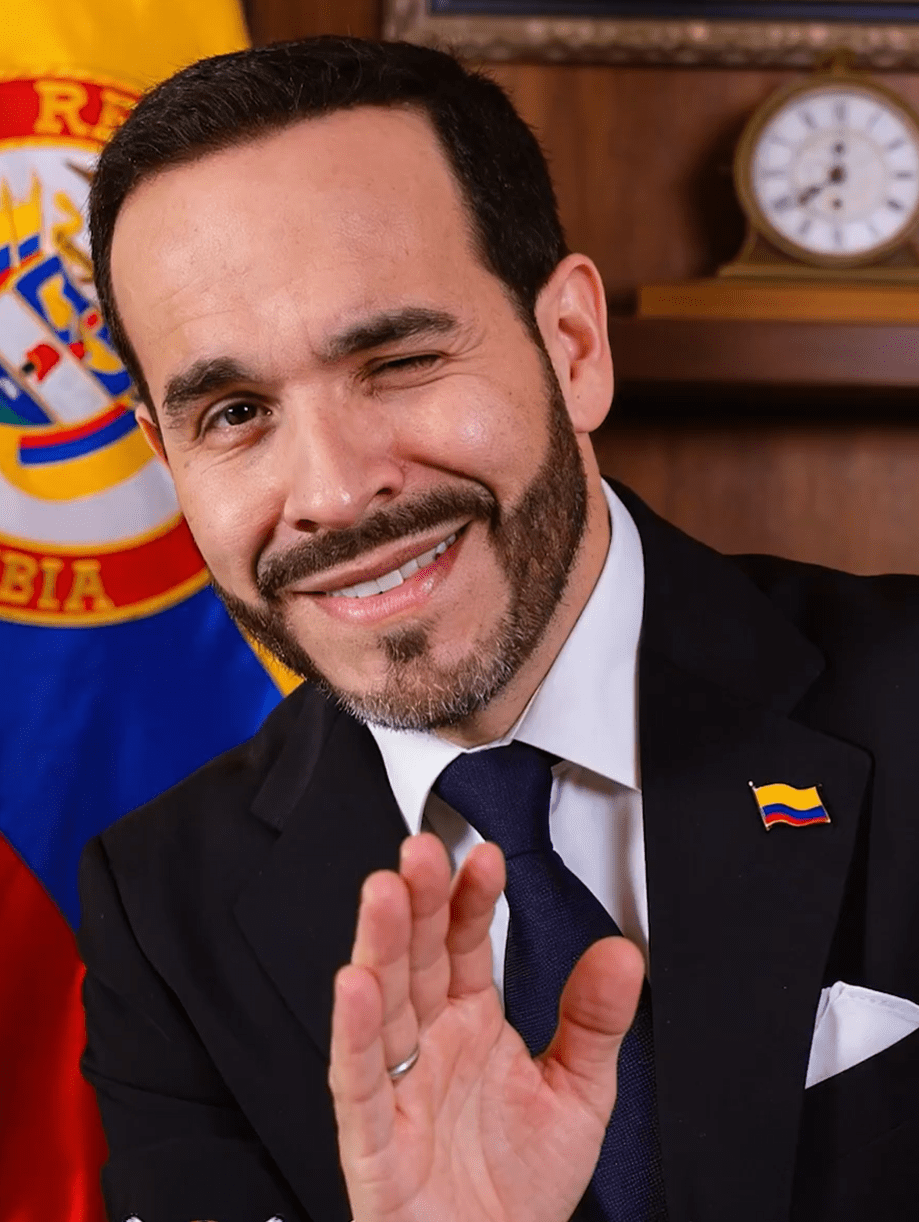
Abelardo de la Espriella (screen capture from Twitter video)

Abelardo de la Espriella (screen capture from Twitter video)

His documented client roster includes Salvatore Mancuso, the former supreme commander of the Autodefensas Unidas de Colombia (AUC) paramilitary network; multiple legislators convicted in the parapolítica scandal, which established systematic infiltration of Colombia’s congress by paramilitary organizations; David Murcia Guzmán, the operator of the DMG pyramid scheme that defrauded an estimated 200,000 Colombian investors; the Nule Primos, convicted of large-scale public contract fraud; and Álex Saab, the Colombian businessman extradited to the United States on charges of acting as the primary money launderer for the Maduro government in Venezuela. According to Corrupción al Día, De la Espriella’s legal fees from Saab reportedly reached $12 million USD and included private aircraft travel.

De la Espriella’s response to this line of criticism rests on due process principles: that every accused person is entitled to vigorous legal defense regardless of the charges, and that his ability to navigate Colombia’s criminal code at its most complex levels demonstrates the expertise required to enforce the law from the executive branch. The argument has legal validity as a principle. The specific issue for foreign compliance officers and US government counterparts is the Saab representation: the same Nicolás Maduro whose regime De la Espriella’s campaign now characterizes as an ideological enemy received legal services from De la Espriella’s firm when the representation was commercially available.

The Fiscalía investigated De la Espriella in connection with alleged paramilitary links in 2009 and again in 2012; both investigations were dismissed for insufficient evidence, and he carries no convictions or active investigations on those matters.

Cepeda’s Family History and Ideological Background
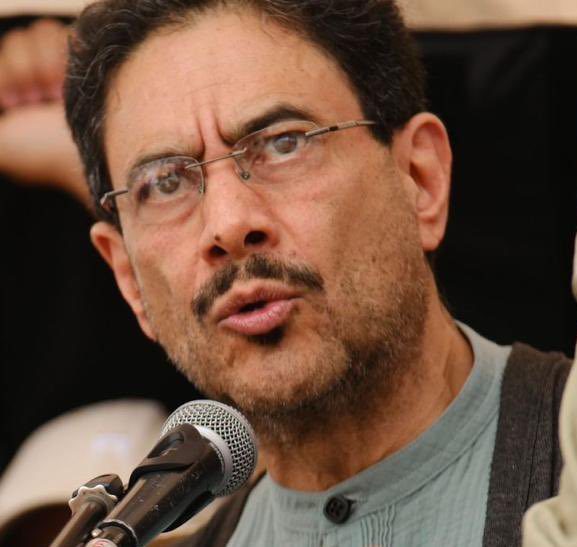
Iván Cepeda (from Twitter)

Iván Cepeda (from Twitter)

Critics of Iván Cepeda, including Enrique Gómez of the Salvación Nacional party, have argued that his family background constitutes evidence of structural alignment with guerrilla movements. The record on this point merits examination.

Cepeda is the son of Manuel Cepeda Vargas, who served as Secretary-General of the Colombian Communist Party and as a senator for the Unión Patriótica (UP), a left-wing political movement that was systematically exterminated by a combination of state actors and paramilitary organizations during the 1980s and 1990s. Manuel Cepeda Vargas was assassinated on August 9, 1994. The Inter-American Court of Human Rights subsequently found the Colombian state responsible for his murder. The FARC-EP named its Frente Urbano Manuel Cepeda Vargas — an urban front operating within the Bloque Occidental — in the elder Cepeda’s honor.

The Fundación Paz y Reconciliación (PARES) has documented that Iván Cepeda’s relationship with his father’s political positions was more complex than the family lineage alone suggests. After studying in Bulgaria in 1981, Cepeda broke from his father’s Soviet-oriented communist framework and aligned with democratic leftists including Bernardo Jaramillo Ossa, who publicly rejected the FARC’s armed strategy. Cepeda has repeatedly stated his repudiation of the FARC’s use of his father’s name. No documented evidence connects him to operational coordination with current armed groups.

What the family history does establish is the ideological framework through which Cepeda processes security policy: a belief, grounded in personal and political experience, that the Colombian state’s institutional violence has been as destructive as guerrilla violence, and that negotiated settlements are structurally preferable to military solutions. That framework generates Paz Total. It also generates a posture toward ELN and FARC dissident negotiators that prioritizes process continuity over verified compliance — a disposition that armed groups have demonstrably exploited to maintain territorial and operational positions while negotiation frameworks provided legal cover.

Paloma Valencia (image Twitter)

Paloma Valencia (image Twitter)

Valencia and the Uribe Question

The comparison to former president Iván Duque (2018–2022) comes up regularly in discussions of Valencia’s political independence. Duque, who had limited independent political standing before Uribe selected him, was perceived throughout his term as governing within constraints set by his patron — a dynamic that Colombian political cartoonists characterized as ventriloquism.

Valencia’s profile differs materially. She is the granddaughter of former Colombian president Guillermo León Valencia, carries her own political lineage, and has served in the Senate for over a decade, building positions on agrarian reform, judicial modernization, and indigenous land rights that have placed her at variance with standard Centro Democrático positions on those issues. She won the Gran Consulta por Colombia primary on March 8 with more than 45% of the vote — over 3.2 million Colombians — establishing a democratic mandate distinct from any party endorsement.

She would be expected to use institutional and rhetorical channels to support Uribe in the ongoing judicial proceedings against him, and to apply pressure on the trajectory of those cases. Whether that constitutes political interference with judicial independence or normal advocacy within democratic norms is a question on which observers disagree. What the legislative record does not support is the characterization of Valencia as incapable of independent governance.

Press Freedom and the Media Environment

Press freedom carries an indirect but measurable correlation with rule-of-law quality, which in turn affects operational risk for companies that rely on regulatory predictability and transparent legal processes.

Cepeda has maintained a posture toward critical media that mirrors President Petro’s practice of characterizing adversarial outlets as acting in the interests of economic elites. Under Petro, this produced a systematic exclusion of critical media from official information flows and persistent rhetorical delegitimization of independent journalism, though the press remained legally free to operate. A Cepeda administration would be expected to continue this pattern.

Valencia’s background in Colombia’s traditional political and intellectual establishment, combined with a decade in a party that has faced sustained critical coverage from Colombia’s major outlets, points toward a conventional institutional relationship with the press — adversarial at times, but within professional norms.

De la Espriella’s conduct during the campaign provides direct evidence of his approach. He publicly called Caracol Noticias journalist María Lucía Fernández “ignorant” in a live interview. He issued a formal apology after journalist Laura Rodríguez of Piso 8 FM made allegations of inappropriate conduct. His campaign strategy has drawn comparisons to the approach of Argentine president Javier Milei and US president Donald Trump in its use of direct digital channels to circumvent traditional media while publicly attacking outlets that publish critical coverage. The press would remain legally protected under a De la Espriella administration, but the operational environment for investigative journalism would be hostile.

The Ideological Spectrum: Market Liberalism to State Direction

The question of which candidate is most aligned with free-market principles requires a distinction that the international business press frequently elides: the difference between economic deregulation and political authoritarianism. These can, and in this election do, exist independently.

De la Espriella’s platform is often described in international coverage as the most pro-market. His deregulation proposals for the extractive sector and his corporate tax rhetoric support that reading in the economic domain. His security platform, however, involves a substantial expansion of state coercive power: mass detention operations, a mega-prison construction program, and the suspension of standard due process protections to facilitate rapid incarceration of criminal suspects. The Cato Institute‘s framework of economic freedom as inseparable from civil liberties would categorize a state powerful enough to detain people without standard procedural protections as a state that represents an institutional risk to property rights and contract enforcement as well.

Valencia’s platform, anchored by Oviedo’s technocratic program of structural market reform — reduced administrative barriers, streamlined procurement, smaller state overhead, maintained civil liberties — represents the closest approximation to coherent market liberalism available in this field. It does not carry the rhetorical force of De la Espriella’s deregulation proposals, but it has more institutional grounding.

Cepeda’s platform is the furthest from market liberalism by any standard measure: state-directed investment allocation, wealth redistribution through tax and transfer mechanisms, state expansion in healthcare and pension administration, and agrarian land redistribution. His program is continuous with the Petro administration’s economic framework.

Minor Candidates: The Rest of the Ballot

Claudia López, senator of Colombia. (Credit: Patty Suescún)

Claudia López, senator of Colombia. (Credit: Patty Suescún)

Several other candidates remain on the ballot and are drawing small but potentially consequential vote shares in a first round where the margin between second and third place could be narrow.

Claudia López, former mayor of Bogotá running under the Con Claudia Imparables coalition, positions herself as a progressive centrist with a documented anti-corruption record. Her polling has not broken 3.5% in major surveys, and her high polarization ratings from her mayoral term limit her growth ceiling. Her attacks on De la Espriella during the campaign — she publicly called him a “defender of the mafia” in reference to his client history — have been among the most pointed in the race, and factually grounded on the public record.

Sergio Fajardo, making his third consecutive presidential run under Dignidad y Compromiso, continues to represent a technocratic, education-focused centrism grounded in his work transforming Medellín in the early 2000s. He has not broken 3.5% in any major poll in this cycle.

Roy Barreras, running under La Fuerza de la Paz following his Frente por la Vida primary victory, is one of the most experienced political operatives in Colombia, having been part of multiple coalition governments across ideological lines over two decades. He polls below the threshold for meaningful first-round impact.

Miguel Uribe Londoño, running under Partido Demócrata, represents a younger-generation conservative platform emphasizing fiscal discipline and private sector growth, broadly consistent with Valencia’s program. He also polls below 3.5%.

Carlos Caicedo, running on a regionalist platform emphasizing decentralization away from Bogotá, draws support primarily from the Costa Caribe. His structural argument about Colombia’s administrative over-centralization is substantively grounded, though his national profile is insufficient to affect the first-round outcome.

Investment Implications

For international capital with Colombian exposure, the three-way race produces three materially different operational scenarios.

A Cepeda victory — which remains the single most likely first-round outcome based on available polling — would signal continuity of the Petro-era regulatory framework: sustained capital outflow pressure, high corporate tax rates, no new fossil fuel exploration contracts for Ecopetrol (NYSE: EC; BVC: ECOPETROL) or private operators, continued labor cost escalation, and a foreign policy trajectory away from Washington. Colombian equity valuations would be expected to remain under pressure. The mining licensing backlog would continue to accumulate. A Cepeda administration would not replicate Venezuela’s economic trajectory — Colombia’s independent central bank, Banco de la República, its functioning constitutional court, and its institutional depth provide meaningful buffers — but the investment headwinds would be structural rather than cyclical.

A Valencia victory would represent the sharpest regulatory reversal available in this field. Ecopetrol exploration contracts would be expected to advance. The mining licensing backlog would be addressed. US bilateral relations would be restored, reactivating security intelligence cooperation and trade facilitation mechanisms. The Colombian peso would be expected to strengthen as country risk premium declined. The path to that outcome now requires her to either close the gap significantly on De la Espriella in the first round or rely on runoff polling that showed her as the stronger second-round candidate — data that predates the most recent polling shift.

A De la Espriella victory introduces the widest distribution of possible outcomes. The upside scenario involves Restrepo managing fiscal and trade policy competently, genuine regulatory rollback in the extractive sector, aggressive extradition resumption, and security operations that reduce the physical risk premium in conflict-affected departments including Cauca, Norte de Santander, and Chocó. The downside scenario involves recurring crises generated by De la Espriella’s personal conduct, conflicts of interest arising from his former client relationships, and authoritarian security measures that attract international human rights attention and complicate bilateral relationships. Restrepo’s presence on the ticket reduces the probability of the downside scenario but does not eliminate it.

The current polling trend indicates that right-wing voters are consolidating around De la Espriella at Valencia’s expense. Whether that consolidation produces a runoff between De la Espriella and Cepeda — and whether the runoff produces a left or right-wing government — remains uncertain. What the polling data does not support is the scenario, widely assumed until recently, of a Cepeda-Valencia runoff in which Valencia was positioned as the structurally stronger opposition candidate.

Subscribe to Finance Colombia to remain updated on key developments and impartial analysis.


  •  

Colombia’s Foreign Ministry Presents Coffee and Cacao Export Strategy to Bogotá Diplomatic Corps

Colombia’s coffee-cacao export push generates 100+ tons in foreign sales

Colombia’s Ministerio de Relaciones Exteriores convened ambassadors, international organizations, agricultural producers, and strategic partners in Bogotá on May 15, 2026, to present the Ruta del Café y Cacao, a government-led strategy that uses the diplomatic network to connect Colombian specialty coffee and cacao producers directly with international buyers, importers, and distributors. The session was organized in coordination with the Departamento Nacional de Planeación (DNP), Colombia Compra Eficiente, and the Servicio Nacional de Aprendizaje (SENA), with additional participation from the Agencia de Desarrollo Rural and the Unidad de Implementación del Acuerdo de Paz.

Between 2025 and 2026, the Ruta del Café y Cacao has participated in international trade fairs and multilateral venues in Asia, the Americas, and Europe, generating more than 1,200 commercial contacts and exports exceeding 100 tons. The strategy is coordinated through Colombia Nos Une, a directorate within the Ministerio de Relaciones Exteriores that oversees relations with Colombian communities and commercial networks abroad.

“This strategy is not limited to the promotion of a product. It is a tool of economic diplomacy, productive inclusion, rural development, and peacebuilding.” — Rosa Yolanda Villavicencio Mapy, Minister of Foreign Relations of Colombia

Foreign Minister Rosa Yolanda Villavicencio Mapy used the event to outline the government’s rationale for embedding agricultural trade promotion into foreign policy. “From the Ministry of Foreign Relations, we want economic diplomacy to translate into concrete results for the territories,” she said. “Foreign policy must have the capacity to open opportunities, connect markets, and contribute to the productive development of our communities.” She added that the strategy extends beyond product promotion: “It is a tool of economic diplomacy, productive inclusion, rural development, and peacebuilding.”

Natalia Irene Molina Posso, director general of the Departamento Nacional de Planeación, presented the Café Social program as a related mechanism designed to strengthen small agricultural producers. The initiative links public procurement policy with territorial development and small-scale coffee farming, creating demand channels within Colombia’s public sector for domestically produced specialty coffee.

Gloria Cuartas Montoya, director of the Unidad de Implementación del Acuerdo de Paz, addressed the relationship between coffee and cacao production and post-conflict territorial transformation. “You have all the entities that have been working on the implementation of the Peace Agreement and in the new processes being carried out, so that territorial peace finds in these two [commodity] lines paths of enormous value and projection,” she said. Cuartas also referenced recent engagement in Barcelona, where business operators and organizations expressed interest in awareness-building activities around Colombian coffee and cacao, citing the social and community dimensions behind those products.

A central element of the event was the participation of producers and associations from multiple regions of Colombia, convened by the Ministerio de Relaciones Exteriores through the Colombia Nos Une directorate. The participants included cooperatives and producer groups led by women, former combatants who signed the 2016 Peace Agreement, ethnic communities, and victims of the armed conflict. These groups presented their productive and commercial operations directly to diplomatic delegations attending the event.

The session also included a guided coffee tasting led by SENA’s Escuela Nacional del Café, during which attendees sampled specialty coffee varieties and received information on production processes and the characteristics that differentiate Colombian coffees participating in the Ruta del Café y Cacao. The tasting segment was designed to give diplomatic representatives direct exposure to the product profiles of the producers involved in the strategy.

Photo courtesy of Ministry of Foreign Relations of Colombia

  •  

Apple Slashes iPhone 17 Prices in China for Annual 618 Festival

Apple has slashed prices on the iPhone 17 Pro series in China by 1,000 yuan (around $138) in anticipation of the annual 618 shopping festival, one of the country's largest mid-year online retail events.


The cuts went live on Friday on JD.com and Tmall, with Apple's official store on the latter platform applying a direct 1,000-yuan discount on the iPhone 17 Pro series. On JD.com, taking into consideration trade-in offers and platform promotions, some iPhone 17 Pro models can be picked up for as low as 6,999 yuan (around $968). That's the lowest price since the device's launch, according to the Global Times.

The standard iPhone 17 also received its first notable markdown. Some configurations are now available for 4,499 yuan (around $622) including discounts, bringing it well under the 6,000-yuan threshold for China's national trade-in subsidy, which knocks 15% off qualifying devices up to a 500-yuan cap – something that customers of the Pro models miss out on.

News of Apple's price cuts quickly shot to the top of social media platform Weibo's trending list on Friday. Meanwhile, Huawei has also introduced lower prices for its high-end foldable models for the first time.

"Apple and Huawei are the two companies most closely benchmarked against each other in the high-end segment," said Liu Dingding, a technology industry analyst speaking to the Global Times. "Other brands still hold market share, but in terms of premium-market influence, the rivalry is increasingly centered on these two players."

Liu said both companies are using this year's shopping festival window to quickly lift orders and shipments while competing for a larger share of replacement demand.

Apple's iPhone 17 series has been a runaway hit in China so far. Apple reported $26 billion in Chinese revenue during its fiscal first quarter, a 38 percent year-over-year increase and the company's best-ever performance in the region. China now accounts for roughly one-fifth of Apple's total global sales.

The results are a major turnaround after nearly three years of declining sales in the country, where Apple has faced stiff competition from domestic rivals like Huawei, Xiaomi, and Vivo.

Apple CEO Tim Cook is currently on his way back home from China, following his participation in an official U.S. business delegation accompanying President Donald Trump as he met with Chinese president Xi Jinping.
Related Roundup: iPhone 17
Tag: China
Buyer's Guide: iPhone 17 (Neutral)
Related Forum: iPhone

This article, "Apple Slashes iPhone 17 Prices in China for Annual 618 Festival" first appeared on MacRumors.com

Discuss this article in our forums

  •  

Apple's Tim Cook Among CEOs Invited on Trump's Trip to China

The Trump administration plans to invite Apple CEO Tim Cook and CEOs from other companies like Nvidia, Qualcomm, Exxon, and Boeing on a trip to China next week, reports Semafor.


Trump will apparently focus on building his relationship with Chinese President Xi Jinping during the May 14 and May 15 meetings. Treasury Secretary Scott Bessent, United States Trade Representative Jamieson Greer, and U.S. Ambassador to China David Perdue have been suggesting CEOs for Trump to invite. It will be the first U.S. presidential visit to China since Trump's 2017 visit.

Apple CEO ‌Tim Cook‌ is set to leave his role on September 1, 2026, with Apple hardware chief John Ternus taking over as CEO.

Cook will remain at Apple as executive chairman, and will "assist with certain aspects of the company, including engaging with policymakers around the world." Cook recently said that he plans to be in the executive chairman role "for a long time," and Apple will remain his top priority.

Two weeks ago, Trump said he has "always been a big fan" of Cook, and he has bragged about the relationship Cook has established with him. "I was very impressed with myself to have the head of Apple calling to 'kiss my ass,'" said Trump, speaking of his first presidential term.

Cook has worked through two Trump presidencies, and he has worked to maintain a positive rapport for Apple's benefit. Cook donated $1 million to Trump's inaugural fund in 2025, and he marked Apple's $600 billion U.S. investment pledge with a glass-and-24-karat gold plaque that he gifted to Trump.

With Cook taking on an expanded role interfacing with Trump and other policymakers worldwide, incoming CEO John Ternus will be able to spend more time focused on Apple. Ternus also won't be subject to the same criticism that Cook has faced for his relationship with Trump.
This article, "Apple's Tim Cook Among CEOs Invited on Trump's Trip to China" first appeared on MacRumors.com

Discuss this article in our forums

  •  

Apple Apparently Sees Camera Control as Key Foldable iPhone Feature

Apple's first foldable iPhone will be eSIM only and feature a Camera Control despite its ultra-thin design, according to a known leaker.


In a series of new posts, the leaker known as "Instant Digital" said that Apple has made deliberate engineering compromises to ensure that the first foldable iPhone features a Camera Control button, despite it being at least 1.1mm thinner than the iPhone Air when unfolded.

According to the leaker, Apple's rationale is largely ergonomic: With competing foldable phones, Apple believes that making adjustments and taking photos can be "cumbersome" owing to their large size. The Camera Control is said to be the company's preferred solution, enabling users to maintain a steady grip on the device while making any required adjustments, or do so one-handed if they wish.

This ensures that even when the screen is fully unfolded, users can still perform these operations effortlessly using just one hand.

Although the reception for this button on standard flat-screen iPhones has been somewhat polarized, Apple believes that within the unique context of a foldable device's ergonomics, its practical value will be significantly enhanced. Consequently, the Apple team made a firm decision to prioritize this feature—even at the cost of sacrificing precious internal component stacking space—to ensure the "Camera Control" button is included on their very first generation of foldable iPhones.


In addition, Apple's U.S. imaging team apparently recently took a trip to Shenzhen, China, to test the cameras of foldable smartphones from rival brands such as Huawei, with particular attention to telephoto zoom capabilities. The first foldable iPhone is not expected to offer a telephoto camera, with only wide and ultra wide cameras on the rear like the iPhone 17. Most high-end rival foldable smartphones, such as the Samsung Galaxy Z Fold 7, feature three rear cameras, including a telephoto.

Instant Digital added that they have seen no signs in the supply chain of tooling or stocking for SIM card tray modules for the foldable iPhone, concluding the device will be eSIM-only across all regions, just like the ‌iPhone Air‌. The leaker also puts first-year production at a conservative 10 million units, with pricing expected to fall between 15,000 and 20,000 RMB (roughly $2,060–$2,750).

The leaker added that the mainland China variants of the iPhone 18 Pro models are set to adopt a "Single SIM + eSIM" configuration, dropping the dual-physical-SIM setup currently used in the region. The Hong Kong version is said to follow the same approach while retaining a physical SIM card slot.

The foldable iPhone is widely expected to launch alongside the ‌iPhone 18 Pro‌ and ‌iPhone 18 Pro‌ Max in fall 2026. It is expected to feature a 7.8-inch inner display, a 5.5-inch outer display, Touch ID, the A20 chip, the C2 modem, and more.
Related Roundups: iPhone 18 Pro, iPhone Fold

This article, "Apple Apparently Sees Camera Control as Key Foldable iPhone Feature" first appeared on MacRumors.com

Discuss this article in our forums

  •  

Ecopetrol Refinances $1.25 Billion USD in Debt and Finalizes State Subsidy Settlement

Ecopetrol S.A. (BVC: ECOPETROL; NYSE: EC) has entered into a formal payment agreement with the Government of Colombia to settle outstanding balances from the Fuel Price Stabilization Fund, known in Spanish as the Fondo de Estabilización de Precios de los Combustibles (FEPC). The agreement, reached through the Ministerio de Hacienda y Crédito Público and the Ministerio de Minas y Energía, addresses $1.6 trillion COP owed for the first quarter of 2025.

Under the terms of Resolutions 00368 and 00369 issued by the Dirección de Hidrocarburos, the total amount is divided between Ecopetrol S.A., which is owed $1.2 trillion COP, and Refinería de Cartagena S.A.S. (Reficar), which is owed $0.4 trillion COP. The repayment schedule began with a cash transfer of $2.89 billion COP on April 1, 2026. The remaining balance of approximately $1.55 trillion COP is scheduled to be paid on December 15, 2026, through the issuance of Treasury Securities, or Títulos de Tesorería (TES). The Colombian state has acknowledged the financial costs associated with the time elapsed until the final December payment.

“The Ecopetrol Group continues to work in close coordination with the Ministries of Finance and Public Credit and of Mines and Energy — the authorities responsible for fuel pricing policy — in the implementation of payment mechanisms and the reduction of FEPC balances.” — Ecopetrol S.A.

Concurrent with the subsidy settlement, Ecopetrol received authorization from the Ministerio de Hacienda y Crédito Público via Resolution 0666 to execute an external public debt management transaction totaling $1.25 billion USD. The five-year loan was secured through a consortium of international lenders including BBVA (BME: BBVA; NYSE: BBVA), Bank of America (NYSE: BAC), JP Morgan Chase (NYSE: JPM), and Bank of China (HKG: 3988). The credit facility carries a floating interest rate indexed to the Secured Overnight Financing Rate (SOFR) and will be repaid in four equal installments.

The proceeds from the $1.25 billion USD loan are designated for the repayment of existing obligations. Specifically, $1.2 billion USD will be used to settle a 2024 loan previously authorized for the acquisition of the state’s interest in Interconexión Eléctrica S.A. E.S.P. (ISA), while the remaining $50 million USD will be applied to an outstanding balance from a 2025 credit agreement. The loan agreement is governed by the laws of the State of New York and includes standard covenants regarding the borrower’s payment capacity and financial integrity.

These financial maneuvers are intended to optimize the maturity profile of the Ecopetrol Group, which remains responsible for over 60% of hydrocarbon production in Colombia. The company continues to operate integrated systems in transportation, refining, and petrochemicals, with additional international operations in the US Permian basin, the Gulf of Mexico, Brazil, and Mexico.

  •  

Apple Bucks China's Smartphone Slump With 23% Sales Jump

Apple saw a 23% year-over-year increase in iPhone sales in China during the first nine weeks of 2026, significantly outperforming a broader market decline driven by weak demand and rising component costs, according to Counterpoint Research.


China smartphone sales apparently fell by 4% year-over-year in the first nine weeks of 2026. Within this environment, Apple emerged as the fastest-growing major vendor, with iPhone sales rising 23% compared to the same period in 2025. Counterpoint attributed Apple's impressive performance partly to a combination of e-commerce discounts and the inclusion of the standard iPhone 17 in government subsidy programs aimed at stimulating consumer electronics purchases.

Counterpoint noted that the rising cost of memory components has been passed on to vendors, forcing several Android brands to adjust pricing strategies. Chinese smartphone makers OPPO and vivo have announced notable price increases for some existing models, with those changes set to take effect this month.

In contrast, Apple has not announced any comparable price increases and is unlikely to follow competitors in raising prices, instead absorbing some of the margin pressure from higher component costs to maintain pricing stability. The firm added that Apple's control over its supply chain leaves it better positioned than rivals to withstand rising memory costs.

Rising memory prices are expected to persist throughout 2026. The research firm expects China's smartphone market to remain under pressure in the coming months, with potential improvement in June driven by the country's mid-year "618" shopping festival. Counterpoint's findings are based on its China Weekly Smartphone Sell-Out Tracker, which monitors retail sales across the market.
This article, "Apple Bucks China's Smartphone Slump With 23% Sales Jump" first appeared on MacRumors.com

Discuss this article in our forums

  •  

Apple Watch AFib History Feature Launches in Mainland China

Apple today launched its atrial fibrillation history feature for Apple Watch in mainland China.


Since 2022, Apple Watch in the U.S. has supported AFib History, which allows users diagnosed with atrial fibrillation to view an estimate of how frequently their heart is in this type of irregular rhythm.

The feature analyzes pulse rate data collected by a photoplethysmography (PPG) sensor to identify episodes consistent with AFib and provides the user with a retrospective estimate of AFib burden (a measure of the amount of time spent in AFib during past Apple Watch wear). Apple says the feature is intended for individuals aged 22 years or older who have been diagnosed with atrial fibrillation by a physician.

Capabilities like ECG and AFib tracking are typically classified as medical or quasi-medical functions, requiring approval from China's National Medical Products Administration (NMPA), hence the delayed launch.

ECG, Irregular Heart Rhythm Notifications, and AFib History are features that can be used by Apple Watch owners in over 150 countries worldwide. Apple maintains a dedicated list of Apple Watch feature availability on its website.
Related Roundup: Apple Watch 11
Tag: China
Buyer's Guide: Apple Watch (Neutral)

This article, "Apple Watch AFib History Feature Launches in Mainland China" first appeared on MacRumors.com

Discuss this article in our forums

  •  

Tim Cook Warned by CIA That China Could Move on Taiwan by 2027

Apple CEO Tim Cook was among a handful of top tech executives who attended a classified CIA briefing warning that China could attack Taiwan by 2027, according to a sweeping investigative report by The New York Times ($).


The previously unreported briefing was apparently held in a secure room in Silicon Valley in July 2023. The meeting is said to have been arranged at the request of the then-commerce secretary Gina Raimondo, who had grown frustrated with the tech industry's reluctance to move chip production away from Taiwan.

CIA director William Burns and director of national intelligence Avril Haines reportedly presented the latest intelligence on China's military plans to Cook, Nvidia CEO Jensen Huang, AMD CEO Lisa Su, and Qualcomm CEO Cristiano Amon.

Cook reportedly told officials afterward that he slept "with one eye open."

A similar classified session was said to have been held at the White House in late 2021, but executives left skeptical because much of the intelligence had already been reported publicly. Earlier that same year, a senior U.S. military official had told Congress that the armed services believed President Xi Jinping of China wanted his army to be ready to take Taiwan by 2027. From the report:
Jake Sullivan, Mr. Biden's national security adviser, ranked the U.S. reliance on Taiwan for semiconductors as one of America's greatest vulnerabilities. He wanted the industry to recognize the risk and support construction of U.S. manufacturing plants. Mr. Biden also wanted to provide $50 billion in government subsidies to build semiconductor plants domestically [resulting in the CHIPS and Science Act of 2022].

"We were saying: 'This is crazy. We have to do something about it,'" Mr. Sullivan said in an interview.
The investigation reveals Silicon Valley's stubborn dependence on Taiwan Semiconductor Manufacturing Company (TSMC), which produces around 90 percent of the world's most advanced chips, including all of Apple's custom silicon for iPhone, iPad, and Mac.

A confidential 2022 report commissioned by the Semiconductor Industry Association and reviewed by NYT concluded that losing access to Taiwan's chip supply would trigger the worst economic crisis since the Great Depression, with U.S. GDP falling 11 percent. Another report by Bloomberg from January 2024 estimated a conflict would cost the global economy more than $10 trillion.

Despite the warnings, the NYT investigation found that companies including Apple were initially slow to commit to buying more expensive chips from U.S. factories. Chips made domestically cost more than 25 percent above those produced in Taiwan because of higher material, labor and permitting costs, and TSMC's Arizona plants currently run technology a generation behind what's available on the island.

Apple has since taken steps, however. Last summer, Cook visited the Oval Office and committed to investing $100 billion in the United States, with the money being used to support TSMC and other chip manufacturers. Apple has reportedly also begun holding all-day engineering meetings with Intel to evaluate its manufacturing capabilities.

TSMC has now committed to roughly $165 billion in U.S. investment, including land for at least five additional plants in Phoenix. The company's Arizona facility recently produced Nvidia's first U.S.-made AI chip, although the report notes that even those chips still need to be shipped back to Taiwan for advanced packaging.

Meanwhile, Taiwan's government maintains an unofficial policy requiring TSMC to keep its most advanced manufacturing technology on the island. This "silicon shield" is designed to make the country too economically important to attack – yet Russia's invasion of Ukraine has shown that economic self-interest does not necessarily prevent military aggression. TSMC's CFO said earlier this year that its most advanced processes will remain in Taiwan for the foreseeable future.
This article, "Tim Cook Warned by CIA That China Could Move on Taiwan by 2027" first appeared on MacRumors.com

Discuss this article in our forums

  •  

Daniel Giraldo of FTI Consulting Unpacks The Significance of Colombia Joining China’s Belt & Road Initiative

In an era of shifting global economic alliances, few countries find themselves more strategically positioned than Colombia. Caught between the massive state-backed investment initiatives of China and the established political and economic influence of the United States, Bogotá’s policy decisions have never held higher stakes for investors, the region, or especially, the country’s own citizens.

At the 2025 Colombia Gold Summit, Finance Colombia Executive Editor Loren Moss spoke with Daniel Giraldo, a Managing Director at FTI Consulting (NYSE: FCN), a global business advisory firm specializing in cross-border investment and corporate finance. Giraldo offered his perspective on the geopolitical chessboard, examining what Colombia’s recent decision to join the Belt and Road Initiative means for its future relationship with its largest long-standing ally, the United States.

Finance Colombia: I’m here with Daniel Giraldo of FTI Consulting. So we’re here at the 2025 CGS, Colombia Gold Summit, where we also talk about other precious metals, we talk about silver, we also talk about metals like copper, molybdenum, things like that. You gave an interesting talk yesterday, I don’t want to steal your thunder. Why don’t you summarize your discussion?

Daniel Giraldo: Well, if I could summarize my lecture yesterday, I think there’s a chessboard, a giant global chessboard right now. And there are two main players: US and China. And Colombia is one key figure, a key part of this chessboard. Right now, Colombia is in a key position with lots of opportunities between Chinese investment and the US investment. However, which decisions Colombia takes right now will shift the entire game for the coming years.

Finance Colombia: So we are in the last few months of a government that has been relatively friendly or biased towards China. And hostile might be too strong of a word, but relatively cold towards the United States, talking about the Petro government. Colombia, under Petro, just signed up for the Belt and Road Initiative. What is the significance of that for Colombia, not just in its relationship with the United States, but what does that do or change for Colombia?

Daniel Giraldo: Well, what we are seeing right now is that Colombia signed formally the Belt and Road Initiative earlier this year. And there’s been a lot of tensions with the Trump government. At the same time, the US is the main investor in Colombia. And what we’re seeing is how China, through different initiatives, wants to have a bigger long-term influence in the region. And Colombia is, in a soft way, saying, “We want that for us.” However, that’s not a shift that can be made automatically. That’s not made in a single signature by one president. It takes years and years to forge a relationship. And although the government of Petro, President Petro is showing how they’re very interested in the Chinese investment, and to have a strong relationship with the Chinese government, it’s not the way, to just step out of their major alliances throughout years with the US

Finance Colombia: The way that investment is done in China is fundamentally different than the way investment is done from places like the US or Canada or many European countries. In the US, if you’re going to attract investment in Colombia, it’s going to be with some company. And that company is going to do what it wants to do within the law but not really giving a damn about what Washington says or what Washington wants or what Ottawa says or wants. Whereas in China, it’s very much a government-to-government thing. You have state-owned enterprises, and Xi Jinping or the Communist Party says, “we’re going to invest in this,” whether it’s profitable or not, for whatever kind of geopolitical reasons that they want to do things. So it’s a fundamentally different thing.

If you do a deal with a company in the US, you’re doing a deal with that company. Now, yes, you have to make sure that regulatory things go through. Trump is a little bit more of a patronage type of president where he wants to get involved with things so he can find benefit for himself or his administration. But generally speaking, even still, if we look at investors, if you’re going to bring in someone to invest in one of these mining companies here or exploration, it’s a company. In China, it’s going to be a state-backed company. Now, what does that imply, then, for the way business would be done going forward, number one? And number two, Petro’s on his way out, and maybe there will be another left-wing government to continue his project, it doesn’t look like it at this point. But do you see continuity in that affinity or that participation in the Belt and Road Initiative? Like you mentioned, it’s not a treaty, it’s more of like a memorandum of understanding, like the diplomats like to call it. But what do you foresee over the next two or three years?

Daniel Giraldo: Yeah, I believe every tactic has been launched in a very moderate way somehow. So, of course, Belt and Road is just a framework, and every project that could be contemplated by Chinese government, depending on the feasibility of each one of these projects. So they’re not basically getting married yet, they’re just dating.

They’re just on their first dates. However, we’re married to the US We’ve had a long-standing marriage, and what we are seeing right now is that how investment works for both countries is different. However, for both countries, there are more and more, basically, things they require to be approved.

So in order to achieve this, the US is not being indirect about it. They require trusted partners. They require trusted allies, which get what’s at stake right now. So, Petro’s government has one year left. We are expecting a shift. However, even if Colombia gets a left-wing government or a right-wing government, it doesn’t change the fact that investment in the latest years has been in a rough place.

So Colombia requires this investment, and the country requires a very stable policy framework, regulatory framework, legal framework, in order to get investors feeling safer, with more appeal. And, yes, of course, it’s not the same as an SOE (State Owned Enterprise) Chinese company that wants to invest, that needs the approval of Beijing and all this. In contrast, we have the US. Of course, Washington can say whatever they want. They can say Petro is now on the Clinton list, and they can sanction him personally. But a company, a US company, can still invest here; it changes how they see Colombia in the long run.

Finance Colombia: I think one of the things that is very notable is that the Trump government sanctioned Petro, his son, his wife, and his interior minister personally, rather than imposing sanctions on the country or doing, like, I don’t know, tariff things. Actually, by the time we publish the video, we might know what happens, but right before the Supreme Court right now, actually as we speak, there is a challenge to Trump’s ability to circumvent congressional law. And so if we have a trade pact, like free trade agreement or something like that, a lot of businesses in the US have challenged Trump’s ability to just… you can’t just cancel a law. Congress passed a law, and it’s in effect, and you can’t just cancel it. Well, that’s what they’re arguing. And all of these kind of unilateral, discretionary tariff moves that affect entire economies and entire industries, there’s some uncertainty that is going to be settled there.

“However, we’re married to the US We’ve had a long-standing marriage, and what we are seeing right now is that how investment works for both countries is different.” – Daniel Giraldo

But it’s interesting because it seems that with them sanctioning Petro and Benedetti directly as individuals, they’re saying that they want to maintain some predictability and constancy in the bilateral economic relationship with Colombia. And I think that there have been a lot of missions. Fico, the mayor here in Medellin, some of the other mayors and Colombian congressional people have visited Washington and met with senators and met with people in the State Department and said, “Look, you know, we disagree with what the president’s doing. Wait a few months.” And it seems like Washington has heard that and is not acting too rashly towards Colombia as a country but rather decided to take their ire out directly on the president and his consigliere Armando Benedetti.

Daniel Giraldo: What I believe of this is that Trump’s government can say like, “We’re not afraid. We are not afraid of imposing sanctions. We’re not afraid of not conducting business in the way we used to do it anymore.” And it’s been shown, for example, in the relationship with China, for example, with the Chinese government, with Xi Jinping. And there’s been like an escalation of tariffs, for example, I think up to 130%. I can’t remember the exact number. And then last week they say, “let’s stop this. Let’s trade the sequels.” And it’s also their way of showing the carrot and then showing the mace or bat, this metaphor.

Finance Colombia: Yeah, the stick.

Daniel Giraldo: And with Colombia, I believe it is the same. It’s like we could, if we wanted, to give some sanctions and they will have great consequences in terms of our bilateral trade. However, they’re aware of their position. They’re our main investor. We have a very good relationship in bilateral trade. There’s been years and there’s been decades of both countries benefiting from each other. We have a great position in one of the closest countries to enter South America. And they know this government is just ending. So why would they give us, like give the left-wing parties an opportunity to just bash them and say, “Oh, Trump’s government can’t be trusted.” Whereas if you take another position and say, “Look, this is personal, this is just these individuals, not the whole country.” You still have ground to negotiate, to renegotiate, to benefit. So I believe it is quite tactical.

Finance Colombia: Another thing that you mentioned is the difference on the ground. When you look at, for example, if we talk about the mining sector, not just on the ground, but literally in the ground, the US right now, the Trump administration, and really just the US more broadly, is very concerned about rare earths. And Colombia, even though there’s not yet a lot of mining activity, Colombia does have rare earth potential. There’s already been illegal coltan, cobalt ore mining taking place down in the Amazon, things like that. But it would seem that further damaging relationships with Colombia right now would contravene the political strategy in the US to strengthen its rare earth mineral supply chain.

Daniel Giraldo: Yes, it is completely true. The US has shown how important it is for them to be less dependent on the supply chains of the Chinese government, specifically in terms of their rare earths and critical minerals refining processes. So the US has been in recent weeks signing lots of memorandums of understanding and bilateral agreements with Australia, with Japan, with Malaysia, with Thailand. And they already have very good deals with Argentina, with the Mineral Security Partnership, for example, Mexico, Peru, Argentina. And the Dominican Republic. And Colombia could be in the radar as well. And what Colombia requires to be here and to benefit with the US as well is just to be patient, to get the best and the highest standards of ESG, and to reassure the different governments that it is safe to trade minerals with Colombia. That if they purchase Colombian minerals, they explore the region and they trade with us, they will find quality, they will find high standards of minerals, without assuming lots of risks that these markets don’t want to assess anymore.

Finance Colombia: So longer term, looking out three to five years, are you optimistic or pessimistic about the bilateral relationship between the US and Colombia?

Daniel Giraldo: I feel optimistic, not only because it’s the most comfortable answer, but I do feel optimistic because I believe there is a lot of potential. And right now, the sector is not in its best place. But I believe that sometimes you just have to grit your teeth, take the punch, and then stand up again and do everything that’s in your power to just become better. And Colombia has a history of learning, and the sector will learn as well how to be more competent, how to attract investors, and how to get to the highest standard and quality of their bilateral trade with different countries.

Finance Colombia: Great. Well, Daniel Giraldo from FTI Consulting, you guys are one of the leading strategic consulting firms globally, especially when you look at things like cross-border investment. That seems to be your strong suit, even though you guys are a large firm and you guys do a lot of different things. Always great to see your presence here at CGS, at Colombia Gold Summit. And thanks for your insights.

Daniel Giraldo: It’s a pleasure, thanks for having me.

  •  

The New Monroe Doctrine: U.S. Recasts Latin America as Security Priority

Why such a massive U.S. military deployment off the coast of Venezuela, supposedly to combat the “Cartel of the Suns” and stop drug trafficking from Venezuela to the United States? After more than four months, the results amount to little more than a handful of small vessels destroyed – an extremely modest impact given the scale of the force deployed.

The reality is that the volume of drug trafficking transiting through Venezuela to the United States is relatively small. Venezuela is not a producer of cocaine, much less of fentanyl, most of which enters the United States via Mexico. If the real interest is not to halt drug trafficking, what then is the motivation for placing the Fourth Fleet on a war footing in the Caribbean Sea? Logic might lead one to think the U.S. interest is oil, since Venezuela holds the largest reserves in the world—but that is not it either. Today the United States is the world’s leading oil producer, at 13.4 million barrels per day, and it has proven reserves sufficient for approximately ten years, assuming no new discoveries and no improvements in recovery or technological advances—an impossible assumption.

So what, then, is the underlying issue if it is neither drugs, nor oil, nor other minerals in which Venezuela might have potential and that would be attractive to the United States?

The answer lies in a little-publicized document formally released by the White House on December 4, titled National Security Strategy 2025. While the document introduces substantial changes in relations with Europe and traditional adversaries, the most striking element is the new emphasis placed on Latin America. Of the document’s “roadmap to ensure that America remains the greatest and most successful nation in human history”, five sections are devoted exclusively to our region, positioning Latin America as a fundamental component of U.S. security – a very significant shift from earlier versions, which historically prioritized the Middle East or Asia. There is a new strategy, or if you will, a “New Monroe Doctrine,” a continuation of the 1823 Monroe Doctrine, reaffirming U.S. preeminence in the region.

“After years of neglect, the United States will once again apply and enforce the Monroe Doctrine to reestablish U.S. preeminence in the Western Hemisphere, and to protect our homeland and our access to key geographies throughout the region. We will deny non-Hemispheric competitors the ability to position forces or other threatening capabilities, or to own or control strategically vital assets, in our Hemisphere,” states the 29-page document.

Key elements of this new doctrine include: countering external influence by requiring Latin American governments to dismantle foreign military installations and divest strategic assets in exchange for aid or alliances; stopping illegal migration, including naval patrols in the Caribbean and the eastern Pacific, selective border deployments, and the use of incentives for governments to curb migratory flows; combating narco-terrorists and cartels; and sealing economic and political commitments with aligned governments in a win-win framework that would include procurement preferences and greater cooperation, among other measures, with a view to turning Latin America into a stable market for U.S. exports and a buffer against global rivals.

In recent years, China has achieved significant penetration in Latin America through its diplomacy and long-term strategy (the Belt and Road Initiative, or New Silk Road). For nearly all countries in the region, China has become the leading trading partner, displacing the United States; it is also an investor in major infrastructure projects and a lender of funds (in Venezuela’s case, a very large lender that negotiated debt repayment in oil at very low prices). In addition, China has become a major supplier of weapons and information technology.

In this context, what Washington appears to be seeking is indeed a regime change in Venezuela to counter the influence of China and Russia, but without openly announcing it in order to avoid a direct diplomatic confrontation. Trump has segmented the region into friendly regimes (Argentina, El Salvador, Ecuador, Honduras, and Guatemala), enemy regimes (Venezuela, Cuba, and Nicaragua), and regimes in limbo (Colombia and Brazil).

For Venezuela, regime change appears imminent, which would profoundly benefit Colombia, because, as Miguel Uribe Turbay said before he was assassinated, “as long as there is no freedom in Venezuela, there will be no peace in Colombia.” On the other hand, a change of government in Colombia is also approaching, and the country will have to decide which of these groups it wants to belong to—whether it repairs its relations with its traditional partner and ally, or definitively joins the group of pariah states in the region. Let us hope it is the former.

About the author: Luis Guillermo Plata served as Minister of Trade, Industry of Commerce during the government of President Álvaro Uribe Vélez, and in 2021, appointed by President Iván Duque, Ambassador of Colombia to Spain.

  •  

iPhone Air Sells Out in China

Apple's iPhone Air sold out across online stores in China within hours of pre-orders opening on Friday, the South China Morning Post reports.


Demand for the ‌iPhone Air‌ reportedly surged immediately after pre-orders opened. Apple's online store and the official Tmall flagship both listed multiple color and storage configurations as unavailable within the first two hours of availability, reflecting even higher demand than the device saw in western markets last month. Prices begin at 7,999 yuan (approximately $1,122).

The ‌iPhone Air‌ was introduced globally in September but delayed in mainland China pending government approval for eSIM, which replaces physical SIM cards and enables slimmer smartphone designs.

The launch coincides with the Ministry of Industry and Information Technology's decision to authorize eSIM trials for smartphones, marking the first time Chinese users can activate a mobile number without a physical SIM card. China Mobile, China Unicom, and China Telecom confirmed this week that they had received approval to begin commercial operations, paving the way for the ‌iPhone Air‌ to launch without regulatory restrictions.
Related Roundup: iPhone Air
Buyer's Guide: iPhone Air (Buy Now)

This article, "iPhone Air Sells Out in China" first appeared on MacRumors.com

Discuss this article in our forums

  •  

Apple CEO Tim Cook Pledges to Increase Investment in China

Apple CEO Tim Cook pledged to expand the company's investments in China during his latest visit to the country, signaling that Apple intends to maintain a strong presence in its most important manufacturing hub even as it continues diversifying production elsewhere, Reuters reports.


During meetings with Chinese government officials this week, Cook told China's industry minister Li Lecheng that Apple will keep investing in the country, with ongoing commitment to its Chinese supply chain and operations. Lecheng told Cook that China hopes Apple will continue to expand in the country and "grow together with Chinese suppliers," adding that the government intends to foster a favorable business environment for foreign companies.

Cook's visit comes at a sensitive time in U.S.–China relations, as both countries remain locked in a prolonged trade dispute mired by tariffs, export restrictions, and increasing pressure on technology companies to localize their manufacturing. The White House has promoted domestic production under initiatives such as the CHIPS and Science Act, while Beijing has sought to reinforce ties with foreign investors amid slowing economic growth.

Apple's position in this environment has grown increasingly complex. The company has spent the past two years shifting parts of its manufacturing to countries such as India and Vietnam to reduce its dependency on China, yet the majority of its iPhones and other key products continue to be assembled by Chinese partners. Cook's latest assurances in China underscore that, despite diversification efforts, China remains integral to Apple's global operations.

Apple remains caught between competing political and economic pressures. U.S. regulators have intensified scrutiny of American firms operating in China, while Chinese authorities have increased oversight of foreign technology companies. Yet Apple has so far remained largely unscathed compared to other U.S. firms such as Nvidia and Qualcomm, both of which have faced regulatory investigations in China.

Apple's Chief Operating Officer Sabih Khan joined Cook for the visit, meeting with Lens Technology, one of Apple's longtime Chinese suppliers responsible for producing glass covers for the iPhone and Apple Watch.
This article, "Apple CEO Tim Cook Pledges to Increase Investment in China" first appeared on MacRumors.com

Discuss this article in our forums

  •  
❌