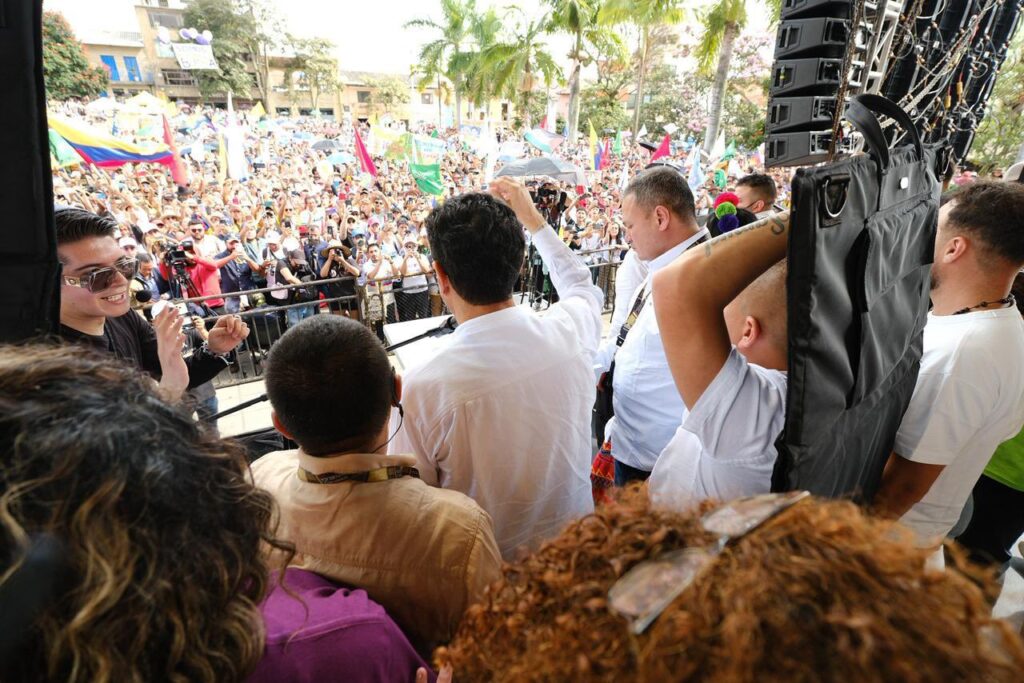
Former Colombian President Álvaro Uribe Vélez confronted a group of protesters outside his residence in Rionegro, Antioquia, on Wednesday after activists began painting a mural referencing victims of Colombia’s “false positives” scandal.
Videos and images shared widely on social media showed Uribe surrounded by security personnel while holding a paint roller near the wall where the mural was being painted. Wearing a light field jacket and broad-brimmed hat, the former president appeared visibly upset as tensions rose between demonstrators, supporters and members of his security team.
The incident quickly became one of Colombia’s most discussed political flashpoints this week, exposing deep divisions surrounding the country’s internal armed conflict with ex-FARC, the transitional justice system, and the increasingly polarized 2026 presidential race. The official candidate of Uribe’s Centro Democrático party, Paloma Valencia, is considered Cepeda’s strongest rival in the event of a run-off election on June 21.
Uribe later said he had interrupted a political meeting in Medellín after receiving a call informing him that a large group had gathered near the entrance to his property while his wife was home alone.
“Cowardly Cepeda, stop sending people to my house where my lady was alone,” Uribe wrote on X Wednesday, referring his political foe and presidential frontrunner Iván Cepeda.
In a separate statement, Uribe accused the hard-leftist senator and Hernán Muriel, a congressman from the governing Historic Pact coalition, of promoting what he described as “acts of provocation and intimidation” against his family.
According to Uribe, the protesters arrived in three buses and gathered close to the entrance of the estate while artists painted the mural. He claimed one of his supporters was injured with a knife during the confrontation and said a member of his security detail was also hurt.
“I told them that I was going to erase the mural,” Uribe wrote. “Before provoking violence against my family and our home, they would have to kill me.”
Later footage showed Uribe personally covering the painted wall with a roller while supporters and security personnel stood guard nearby.
The mural referenced the latest figures released by Colombia’s Special Jurisdiction for Peace (JEP), the transitional tribunal created following the 2016 peace accord with FARC. The tribunal recently updated estimates tied to the “false positives” scandal, in which civilians were allegedly killed by members of the armed forces and falsely presented as combat casualties during more than four decades of Colombia’s internal conflict.
Muriel, who organized the demonstration, rejected accusations that the protest was intended to threaten Uribe or his family. He described the gathering “as a peaceful act” organized by victims’ organizations, social movements and human rights defenders seeking to highlight the revised JEP findings.
“We are carrying out an act of social mobilization and memory pedagogy,” Muriel said in remarks shared online. “We are here with social organizations, victims and human rights defenders following the new figure of 7,837 false positives announced by the JEP.”
According to Muriel, the mural was painted on public property near the residence and was intended to commemorate victims of the conflict.
The confrontation prompted swift reactions from political allies of the former president in Antioquia, one of Colombia’s most conservative regions and a longtime bastion of Uribe’s “democratic security” agenda.
Medellín Mayor Federico Gutiérrez criticized the protest and accused supporters of President Gustavo Petro of fostering political hostility toward opposition figures. “It’s the same method used during the last mayoral campaign in Medellín,” he wrote on social media, adding that political tensions in the country were continuing to escalate.
Antioquia Governor Andrés Julián Rendón also condemned the incident and called for respect toward Uribe and his family.
The episode underscores how historical revisionism spread on social media continues to discredit the legacy of the country’s two-term president (2002-2010), and leading opposition leaders. By Thursday morning, the images from Rionegro — showing Uribe beside the mural with a paint roller in hand — had spread across Colombian media and social networks, becoming the latest symbol of how the left justifies ideologically-fueled protests to vandalize public space and infrastructure.
A new national survey suggests Colombia’s 2026 presidential race is shaping into a high-stakes runoff between Iván Cepeda and conservative rival Paloma Valencia, with the first round on May 31 favoring the left-wing senator, but the second round – on June 21 – projecting a narrow victory for the Centro Democratico candidate.
The latest poll by Fundación Génesis Crea places Cepeda at the top of voter intention for the first round with 35.1%, followed by Valencia with 25.4% and lawyer Abelardo de la Espriella with 21.6%, signaling an increasingly polarized contest just weeks before Colombians head to the polls.
The survey, conducted between May 4 and May 11 across 134 municipalities and 24 departmental capitals, interviewed 4,352 citizens and presents one of the most detailed snapshots yet of the country’s electoral mood ahead of what many analysts are calling the most decisive presidential vote in years.
Despite Cepeda’s strong lead in the opening round, the numbers suggest a dramatic reversal in a hypothetical runoff. In a second-round scenario against Valencia, the senator from the Democratic Center would secure 48.3% of the vote, compared to 45.6% for Cepeda, while blank votes would account for 6.1%.
The findings indicate that while Cepeda commands a consolidated progressive base, Valencia could benefit from a broader anti-government coalition in a runoff, uniting conservative, centrist and undecided voters wary of continuity with President Gustavo Petro’s political project.
Against other rivals, Cepeda performs more strongly. He would defeat De la Espriella with 46.5% to 41.4%, and also surpass former Bogotá mayor Claudia López with 47.2% to 40.2%, though blank voting would remain unusually high at around 12% in both matchups.
The poll also reflects the deep national divide over Petro’s presidency. Some 51.2% of respondents reported an unfavorable image of the president, while 44.6% viewed him positively. By contrast, former president Álvaro Uribe Vélez registered a 50.4% favorable rating, with 48.3% holding an unfavorable view.
These figures reinforce the enduring political influence of Uribe, whose legacy continues to shape right-wing mobilization, while Petro faces growing criticism over security concerns, economic uncertainty and the faltering progress of his “Total Peace” agenda.
Beyond the top three contenders, voter preference remains fragmented. López registers 3.6%, followed by Sergio Fajardo at 2.9%, while other names such as Roy Barreras, Mauricio Liscano and Carlos Caicedo remain below 1%.
Blank voting stands at 3.2%, while 5.4% of respondents said they remain undecided — a figure that could prove decisive in an increasingly volatile campaign season.
The study reports a margin of error of ±1.485% and a 95% confidence level, with data weighted according to official demographic indicators from the Dane and the National Civil Registry. The sample covered all major regions of Colombia, including the Caribbean, Pacific, Coffee Region, Llanos and Amazon basin.
With just two weeks before the first decisive round, the poll confirms that Colombia is heading toward an electoral confrontation defined less by ideological persuasion than by rejection: a battle between those seeking continuity with Petro’s leftist administration and those determined to stop it.
For now, Cepeda leads the first charge. But if the runoff materializes as projected, Paloma Valencia may be waiting at the finish line.
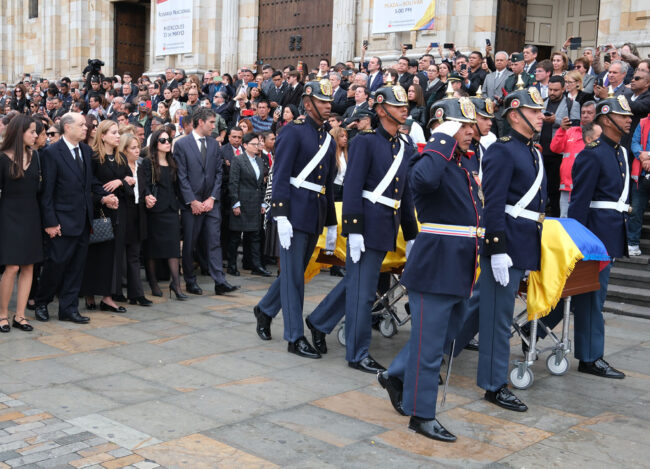
The departure of former Vice President Germán Vargas Lleras’s coffin from Bogotá’s Palacio de San Carlos on Monday morning blended state mourning with unmistakable political symbolism, as Colombia’s political elite gathered to bid farewell to one of the country’s most influential figures.
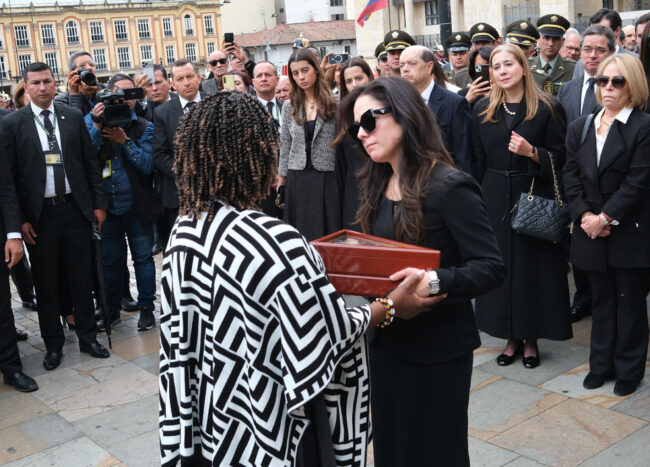
His daughter, Clemencia Vargas Umaña, attended the ceremony accompanied by her father’s two French bulldogs – Toño and Henry – adding a deeply personal note to the solemn proceedings before the main funeral mass at 11:00 a.m. inside Bogotá’s Primatial Cathedral of Bogotá. The service marked the conclusion of three days in which the Foreign Ministry headquarters became the center of national political attention.
Vice President Francia Márquez represented the national government in the absence of President Gustavo Petro and delivered one of the most emotional moments of the day when she embraced Clemencia Vargas before the ceremony. Earlier, Márquez had publicly offered condolences to the family, praising Vargas Lleras’ democratic legacy and saying his “democratic work will be remembered.”
Colombia’s VP Francia Márquez and former presidential candidate Juan Carlos Pinzón attended the funeral ceremony. Photo: Richard Emblin
The wake drew figures from across Colombia’s political spectrum, reflecting Vargas Lleras’ decades-long influence. Former presidents Juan Manuel Santos, with whom Vargas Lleras served as vice president, Ernesto Samper, and Iván Duque were present, along with senator Paloma Valencia and former president Álvaro Uribe Vélez, whose attendance underscored the respect afforded to Vargas Lleras despite years of sharp public disputes between the two men.
Vargas Lleras died Friday in Bogotá after a prolonged battle with cancer. He was 64. His death ends a political career spanning more than three decades as senator, minister, vice president, and two-time presidential candidate.
The only daughter of Germán Vargas Lleras, Clemencia Vargas, receives the flag from VP Francia Márquez. Photo: Richard Emblin
Born in Bogotá on February 19, 1962, Vargas Lleras came from one of Colombia’s most prominent political dynasties. His grandfather, former President Carlos Lleras Restrepo, was a leading figure of the Liberal Party.
He built his own career as a city councilman, congressman, minister, and ultimately leader of the Cambio Radical party. His first presidential run came in 2010, where he finished third with nearly 1.5 million votes. Though unsuccessful, the campaign positioned him as a national force.
President Santos later appointed him to his cabinet, and in 2014 selected him as his running mate for reelection. The pair won in the runoff, and Vargas Lleras assumed office as vice president on August 7 that year.
He ran again for president in 2018 under the “Mejor Vargas Lleras” coalition, focusing on infrastructure, housing and administrative reform. He finished fourth in the first round and did not advance to the runoff.
Throughout his career, Vargas Lleras survived two assassination attempts and weathered political scandals, including accusations linked to parapolitics investigations, though he was never formally charged.
In later years, his health increasingly limited his public life. He was diagnosed with a benign meningioma in 2016 after a fainting episode, and in recent years battled cancer while largely stepping back from frontline politics.
Even as his public appearances became rare, his influence endured. Monday’s funeral made clear that, in death as in life, Germán Vargas Lleras remained a central figure in Colombia’s political history.
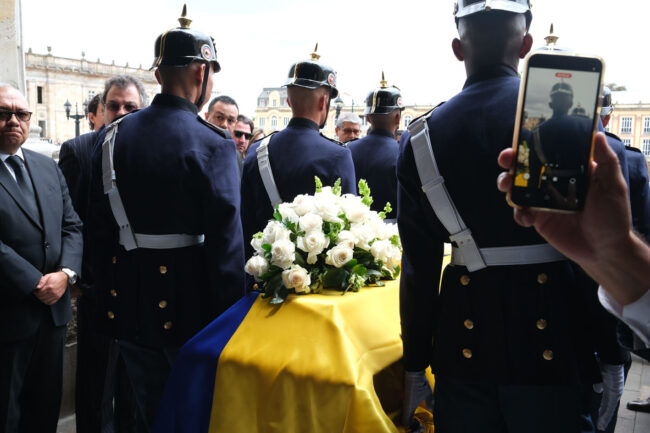
The flag-draped coffin of former Vice President Germán Vargas Lleras leaves Bogotá’s Primatial Cathedral of Bogotá on May 11. Photo: Richard Emblin
Colombian politician Germán Vargas Lleras died Friday in the capital Bogotá, according to Semana magazine. His death brings an end to a political career spanning more than 30 years, including as a senator, minister, vice president, and two-time presidential candidate.
On Monday, Vargas Lleras was admitted to the Intensive Care Unit at the Luis Carlos Sarmiento Angulo Cancer Treatment and Research Center in Bogotá. He was later transferred to another hospital where he lost a battle with cancer he had been fighting for years. He was 64 years old.
Political career
Born in Bogotá on February 19, 1962, Vargas Lleras grew up in a political family. His grandfather, former President Carlos Lleras Restrepo, was a pillar of the country’s Liberal Party.
He would go on to make a name for himself on his own, serving as a city councilman, congressman, minister, and ultimately leader of the Cambio Radical political party.
Vargas Lleras first ran for president 2009. He traveled the country, participated in debates, and garnered nearly 1.5 million votes. It wasn’t enough to win, but he finished third.
The winner of the election, Juan Manuel Santos, would later call on him to serve as a minister in his cabinet.
In 2014, Santos chose him as his running mate for reelection. Together they won in the runoff, and Vargas Lleras took office as vice president on August 7 of that year.
Once his term as vice president ended, Vargas Lleras did not sit idle. In 2018, he ran again for president, this time with the “Mejor Vargas Lleras” coalition backed by Cambio Radical.
His policy proposals included infrastructure, housing, and a more efficient public administration.
In the first round, he received over 1.4 million votes but finished fourth, knocking him out of the runoff race. His campaign stated that he would not officially endorse either of the remaining candidates, Iván Duque and Gustavo Petro.
Over time, he kept a lower profile, though he never completely stepped away from politics.
During his career, Vargas Lleras would survive two assassination attempts and a “parapolitics” scandal in which he was accused, but never charged, with benefitting politically from his connections to warlord “Martin Llanos”.
Health issues
In his later years, his health gradually got in the way of politics; reportedly, he suffered from a benign meningioma, a tumor in the membranes surrounding the brain and spinal cord, which was detected in 2016 after a fainting spell.
On March 11, former President Álvaro Uribe commented on his condition, saying, “My best wishes for the health of Dr. Germán Vargas Lleras, a distinguished patriot whom I respect despite our occasional disagreements.”
During his final months, the former vice president stayed out of the public eye, though he briefly reappeared on March 3 in a video concerning the March 8 parliamentary elections.
Upon learning of his death, former President Santos wrote on X that he is “deeply saddened” and described Vargas Lleras as “an exceptional colleague.”
Current President Gustavo Petro also mourned the political leader’s death: “Both in the Senate and on the campaign trail, he behaved like a gladiator. As someone who often disagreed with him, I regret that his seriousness in debate will be lost,” he said on his X account.
A landmark ruling by the Superior Tribunal of Bogotá has delivered one of the strongest judicial rebukes yet of the narrative surrounding Colombia’s 2021 National Strike, concluding that some of the most destructive episodes of violence during the protests were not spontaneous acts of social unrest but part of a coordinated criminal strategy involving illegal armed groups.
The decision, issued by the Criminal Chamber of the tribunal under magistrate Jaime Andrés Velasco Velasco Muñoz, found that several of those prosecuted for violent acts in the capital maintained operational ties with cells linked to the Second Manuel Marulanda Vélez, a dissident faction of the Revolutionary Armed Forces of Colombia – FARC.
For years, much of the public debate framed the violence of the so-called Paro Nacional as the uncontrolled overflow of legitimate citizen protests sparked by social inequality, police abuse, unemployment and widespread anger over the government of then-President Iván Duque.
But after reviewing wiretaps, surveillance records, testimonies and digital communications, the court concluded that several of the attacks that paralyzed Bogotá followed a clear operational structure, with leadership roles, territorial coordination and instructions issued in advance.
According to the ruling, some defendants acted in coordination with illegal armed actors to organize attacks on police command posts, TransMilenio stations, commercial establishments and strategic road corridors across the capital.
“For the magistrates, these were not isolated or improvised actions,” the ruling stated. “There existed an organized structure with assigned functions, defined leadership and a chain of command.”
The 2021 protests initially erupted after Duque introduced a controversial tax reform proposal during the height of the COVID-19 pandemic. The measure, widely criticized for placing additional burdens on the middle and working classes during an economic crisis, quickly ignited nationwide demonstrations.
Although the government later withdrew the reform, the protests escalated into weeks of nationwide unrest, marked by deadly confrontations between demonstrators and security forces, the burning of police stations, attacks on public transport infrastructure and prolonged road blockades that crippled supply chains across Colombia.
In Bogotá alone, dozens of TransMilenio stations were vandalized or destroyed, CAI neighborhood police posts were torched, and mobility across major avenues such as Las Américas, Carrera Séptima and Autonorte was severely disrupted.
Elsewhere, especially in southwestern Colombia, blockades led to shortages of fuel, medical oxygen and basic food supplies, with business leaders warning of millions of dollars in economic losses and humanitarian consequences for vulnerable communities.
The tribunal’s ruling argues that at least part of that violence was not the natural escalation of protest, but the result of deliberate planning.
Investigators identified several WhatsApp groups allegedly used to coordinate simultaneous actions across the city. Among the names cited in the judicial file were groups linked to strategic corridors such as “Américas,” “Carrera Séptima,” “Autonorte,” “Autosur” and “Caracas.”
According to prosecutors, these digital channels were used to organize blockades, assign responsibilities and plan attacks against public infrastructure.
The court also found that some young defendants had been tasked with recruiting new members and expanding influence within university environments, both public and private, strengthening support networks and facilitating operational logistics.
One of the most significant findings involved intercepted communications that allegedly referenced support from higher-ranking commanders connected to FARC dissidents.
For the magistrates, this reinforced the conclusion that there was external coordination behind the violence, rather than a purely spontaneous citizen uprising.
The ruling now sharply challenges the long-promoted narrative of the unrest as exclusively peaceful social protest and instead reframes part of the National Strike as coordinated urban sabotage carried out under the cover of legitimate public discontent.
It also revives scrutiny of the national strike committee and senior left-wing political leaders, including current President Gustavo Petro, who strongly supported the demonstrations and positioned himself as one of the loudest critics of Duque’s handling of both the protests and the pandemic.
Critics argue that political backing from opposition leaders helped legitimize actions that moved far beyond peaceful protest, allowing criminal actors to operate behind the shield of social mobilization while deepening institutional instability.
The protests also unfolded at one of the most fragile moments of the COVID-19 emergency, when Colombia was still facing high ICU occupancy, strict mobility restrictions and biosecurity measures intended to limit mass contagion.
Large demonstrations and road blockades directly violated those restrictions, and critics maintain that the protests contributed to additional infections and unnecessary strain on an already overwhelmed public health system.
For opponents of Petro and sectors of the business community, the ruling is less a revelation than a delayed institutional acknowledgment of what many citizens experienced firsthand: burned police stations, destroyed public transport, food shortages and entire cities brought to a standstill.
After evaluating the full body of evidence, the court sentenced three of the principal defendants to 19 years in prison for terrorism and criminal conspiracy. A fourth defendant received a 10-year prison sentence.
The tribunal also imposed fines exceeding 1 billion pesos, reflecting the severe damage caused to both public and private infrastructure.
Far from closing the chapter on the National Strike, the ruling reopens one of Colombia’s deepest political wounds: whether the country witnessed a legitimate social uprising, or whether parts of it were, from the beginning, a calculated strategy of destabilization supported by organized criminal networks.
For many Colombians, the answer may shape how the country remembers 2021—and who must ultimately be held responsible.
With just over a month to go before Colombia’s May 31 presidential election, a new Invamer poll suggests the race has narrowed to three viable contenders, as left-wing senator Iván Cepeda strengthens his lead and two right-wing rivals battle for a place in the runoff.
The survey, conducted for Noticias Caracol and Blu Radio, shows Cepeda commanding 44.3% of voting intention, a significant jump from 37.1% in February. The Pacto Histórico candidate has not only consolidated support among core voters but expanded his appeal across all regions, with particularly strong gains among younger voters aged 20 to 30.
Trailing behind, but still within striking distance of a second-round berth, are Abelardo de la Espriella with 21.5% and Paloma Valencia with 19.8%. While De la Espriella has posted modest gains since February, Valencia has emerged as the fastest-rising candidate, nearly doubling her support from 10% in the previous poll.
The data underscores a central dynamic shaping the race: a fragmented right competing for a single runoff slot, even as the left coalesces behind a dominant frontrunner. According to the data, as long as the right remains divided, any division among the pro-Uribe camps will continue to benefit Cepeda. Unless there is a clear consolidation after May 31, the numbers suggest the second round will be a contest over who faces the hard-leftist and not whether he gets to the final run-off.
The collapse of Colombia’s political center has been equally striking. Former Bogotá mayor Claudia López has seen her support plunge from 11.7% to 3.6%, while former Medellín mayor Sergio Fajardo has dropped from 6.6% to just 2.5%. Both candidates have lost more than half of their previous backing and now poll well below the 4% threshold required for state reimbursement of campaign expenses.
López’s decline appears particularly acute in urban constituencies, where she previously drew strong support, including among progressive and LGBTQ voters, pointing to a broader erosion of her core base. Fajardo, meanwhile, continues to struggle to regain traction, reflecting persistent voter dissatisfaction with centrist alternatives.
Analysts are also seeing how centrist voters are shifting toward Valencia, whose ticket includes former DANE statistics chief Juan Daniel Oviedo as the vice-presidential option. Oviedo appears to be decisive in broadening Valencia’s appeal beyond the Centro Democrático base.
Despite Cepeda’s commanding first-round lead, runoff scenarios suggest a more competitive contest – particularly if Valencia secures the second spot. In a hypothetical second round between Cepeda and De la Espriella, the left-wing candidate would win with 54.6% against 42.6%. However, against Valencia, the margin narrows significantly to 51.2% versus 46.6%.
That tightening gap reflects Valencia’s growing ability to attract support beyond her base, including voters from the political center and segments of the undecided electorate. According to the poll, she outperforms De la Espriella in capturing second-choice preferences, positioning her as the more competitive challenger in a potential runoff.
When respondents were asked who they would support if their first-choice candidate failed to advance, Cepeda led with 26.7%, followed closely by Valencia at 25.7%, with De la Espriella trailing at 19.8%. López and Fajardo lagged further behind, reinforcing their diminished relevance in the race.
Cepeda’s dominance, however, is not without warning signs. While he continues to lead comfortably, his projected runoff margins have narrowed compared to earlier surveys, particularly against Valencia. The erosion suggests that while his base remains solid, opposition voters may be coalescing more effectively than before.
For now, the trajectory is clear. Cepeda has gained ground nationally despite a worsening security situation and poll conducted before the terrorist bomb on Saturday, April 25 by FARC dissidents along the Pan-American highway in which 20 persons were killed.
With less than a month until Colombians head to the polls, the race appears increasingly defined not by a crowded field, but by a three-way struggle – one frontrunner and two challengers vying for the chance to stop him.
Colombian President Gustavo Petro will meet Venezuela’s interim leader Delcy Rodríguez in Caracas on Friday to address security challenges along the shared border, marking their first official encounter since Nicolás Maduro was captured by U.S special forces on January 3, 2026.
The meeting, to be held at the Miraflores presidential palace, is expected to center on coordination between the two countries to tackle armed groups, drug trafficking and other cross-border threats that have long destabilized frontier regions.
Colombia’s presidency said the talks aim to “strengthen bilateral cooperation, territorial control and coordination on security matters,” following the cancellation of a previous meeting scheduled for March 13 at the border due to security concerns cited by Caracas.
Friday’s talks come after Rodríguez assumed power earlier this year following the capture of former Venezuelan dictator Nicolás Maduro during Operation Absolute Resolve.
Petro is expected to travel to Caracas after holding meetings earlier in Bogotá. The leaders will first hold a private discussion to outline joint actions addressing border instability, followed by a broader metting between their respective delegations aimed at formalizing institutional commitments.
Officials from both countries are also expected to sign the final act of the III Commission on Neighborhood and Integration, with foreign ministers participating, before delivering statements to the media.
The Colombia–Venezuela border stretches more than 2,200 kilometers (1,367 miles) from the Caribbean coast to the Amazon basin and has long been a hotspot for illegal activity, including the presence of the National Liberation Army (ELN) guerrilla, as well as drug trafficking and smuggling networks.
Petro said earlier this week that the talks would place particular emphasis on the Catatumbo region, one of the most volatile areas along the frontier, where violence linked to armed groups and illicit economies has intensified.
“If we go, Catatumbo is a key issue to discuss with President Delcy,” Petro said during a cabinet meeting on April 21, adding that his delegation would include military and police officials to coordinate security strategies.
He said the goal is to develop a joint security plan, improve coordination between the two countries’ armed forces and police, and deepen intelligence-sharing, warning that a lack of cooperation could lead to operations that harm civilian populations.
The meeting also comes against the backdrop of a rebound in bilateral trade between the two countries following years of strained relations.
Trade flows have increased significantly in recent years, rising from around US$200 million three years ago to more than $1 billion, representing an increase of roughly 600%, according to official figures.
Colombia recorded a trade surplus of US$1 billion with Venezuela in 2025, underscoring the economic incentives for both governments to maintain stable ties despite ongoing political uncertainties.
Petro first announced the trip last week during an interview in Spain, referencing the earlier failed meeting and signaling his willingness to travel to Caracas to advance talks.
The visit marks a key test of Colombia’s role in engaging with Venezuela’s transitional leadership, as both countries seek to stabilize their shared border while cautiously rebuilding diplomatic and economic relations in the post-Maduro era.
Bogotá, Colombia – Leftist presidential candidate Iván Cepeda challenged his opponents to a debate on Saturday after turning down previous proposals to face-off with his rivals.
“I challenge the far right, its two candidates – Senator Paloma Valencia and lawyer Abelardo de la Espriella – to a debate,” Cepeda told a crowd at a rally in Fusagasugá, a city near Bogotá.
His opponents responded by accepting the proposal, while also highlighting that they had been calling for a debate for months.
The possibility of a live face-off between candidates has been a recurring theme ahead of first-round presidential elections on May 31.
Shortly after beginning his candidacy last year, Cepeda dismissed the idea of participating in a debate: “I’m not going to take part in debates—let me make this clear from the outset—to exchange insults with other candidates, or to threaten one another, or to denigrate one another.”
Iván Cepeda addressed a crowd of supporters on Saturday in Fusagasugá.
Cepeda’s rivals have repeatedly criticized him for refusing to spar with them on the public stage, something they highlighted following the leftist candidate’s U-turn on Saturday.
“Allow me to correct you: you’re not issuing a challenge; you’re accepting the challenge you were invited to take up months ago,” said criminal defense attorney de la Espriella.
Valencia, the candidate for the Centro Democrático (Democratic Center) party, also seized the opportunity to pounce on Cepeda: “A few weeks ago, it was I who challenged Iván Cepeda several times to a face-to-face debate, yet you chose to hide away in the Senate with a controlled microphone.”
She suggested that Cepeda’s U-turn owes toaworsening performance in recent polls: “Now that the polls are tightening, you’re coming out of Fusagasugá with this challenge.”
Analysts agreed with Valencia’s suggestion, saying that Cepeda’s debate proposal is an attempt to inject life into a stagnating campaign.
“Cepeda has offered to debate because of his campaign’s inherent lack of momentum and general weakness. He is not captivating any new voters or finding a tangible way of changing the narrative in his favor,” Sergio Guzmán, Director at Colombia Risk Analysis, a political risk consultancy, told Latin America Reports.
Internal party polls reportedly show sluggish growth in Cepeda’s polling numbers since he became the official candidate for the Pacto Histórico (Historic Pact) in October.
Meanwhile, Valencia has been soaring in the polls following her victory in presidential primaries in March; Cepeda and de la Espriella did not partake.
But the debate is not without risk for Cepeda, according to Guzmán: “Cepeda runs the risk of having to go on the defensive of Petro and his administration.”
Others believe that Cepeda’s oratory style does not lend itself to the televised debate format.
“He has a much more academic tendency, which is not so typical in politics, let alone in modern politics,” noted Miguel Jaramillo Luján, a Colombian political strategist. In contrast, he noted that de la Espriella and Valencia have a more media-savvy communication style.
Nevertheless, the analyst told Latin America Reports that Cepeda’s debate style could give him the chance to woo crucial centrist voters: “I believe he can inspire confidence and credibility among his target audience and even among the centre, particularly when it comes to dispelling certain myths and lies that have been spread by the centre and the right.”
With the leading candidates agreeing to debate, the battle over the specifics – including moderators, questions, and location – begins.
Fresh audio revelations broadcast by Noticias Caracol have triggered a political storm in Colombia, implicating senior government-linked figures in alleged secret contacts with one of the country’s most notorious smugglers, Diego Marín Buitrago.
The recordings, aired late on April 5, appear to document meetings between intermediaries connected to President Gustavo Petro and the legal representative of Marín, widely known by the alias “Papá Pitufo.” The revelations come with just over four months remaining in Petro’s presidential term, intensifying scrutiny over his administration.
According to the report, the audios – lasting more than 90 minutes – capture conversations from early 2025 involving at least four individuals allegedly acting as emissaries of the government. Among them is Jorge Lemus, the former head of the National Intelligence Directorate (DNI), as well as other figures with links to the administration.
In the recordings, Lemus is heard holding closed-door meetings with Marín’s lawyer, Luis Felipe Ramírez, in which possible judicial benefits and guarantees are discussed in exchange for cooperation. Such proposals, if confirmed, would fall outside the remit of intelligence officials and raise questions about potential overreach and irregular negotiations.
The audios also suggest that these contacts occurred before any formal intervention by judicial authorities, with intermediaries allegedly presenting themselves as acting on behalf of the executive branch. Additional names mentioned include Catalan political figures Xavier Vendrell and Ramón Devesa, as well as former financial intelligence adviser Isaac Beltrán.
The revelations have revived a long-running controversy over alleged links between Marín and Petro’s 2022 presidential campaign. Previous reports indicated that the smuggler may have contributed 500 million pesos (approximately $130,000) to the campaign—funds Petro has said were returned upon discovery of their origin. However, opposition figures argue that no conclusive proof of that վերադարձ has ever been presented.
Opposition leaders, including senator and presidential hopeful Paloma Valencia, seized on the latest disclosures to demand an independent investigation. “This is an extremely serious institutional matter,” Valencia said in a video response, questioning the absence of evidence regarding the alleged վերադարձ of the funds and warning of a pattern of clandestine contacts.
Critics argue that the recordings point to “under-the-table” dealings with criminal actors, potentially undermining the government’s legitimacy at a critical political juncture.
President Petro responded by acknowledging that intelligence contacts with Marín’s circle had taken place but insisted they were authorized and aimed solely at securing the smuggler’s cooperation with Colombian justice.
“The purpose was to bring Marín to Colombia,” Petro said, framing the outreach as part of a broader strategy to dismantle criminal networks. However, the president went further, alleging that some intelligence agents may have exploited the situation by attempting to solicit money during the interactions.
According to Petro, these alleged irregularities led to dismissals within state agencies, suggesting internal misconduct rather than a coordinated government effort to negotiate with the smuggler.
The president also criticized the Fiscalía General de la Nación, accusing prosecutors of limiting the scope of investigations and pursuing what he described as a politically motivated campaign against his administration.
Marín, long considered one of Colombia’s most significant contraband operators, has been linked for decades to networks involved in smuggling and bribery. His arrest in Europe in 2024 triggered an ongoing extradition process, though legal challenges in countries including Spain and Portugal have complicated proceedings.
Prosecutors in Colombia have charged him with criminal conspiracy and bribery, alleging he led a sophisticated structure that penetrated state institutions.
The latest revelations add to mounting political pressure on Petro, whose administration has already faced a series of scandals and internal fractures. With the presidential term nearing its end, the emergence of recorded evidence – rather than testimony or second-hand accounts—marks a potentially decisive moment in a controversy that has shadowed his government for years.
Whether the audios lead to formal investigations or judicial consequences remains unclear. But politically, the damage appears immediate, reopening questions about the boundaries between state actors and criminal networks—and the extent to which those lines may have been blurred behind closed doors.
Colombia is on the verge of banning female genital mutilation (FGM), as lawmakers advance legislation that would outlaw a practice still reported in parts of the country, making it the only nation in Latin America where cases have been documented.
In a unanimous decision, the First Commission of the Senate approved the bill in its third debate, leaving just one final vote in the full chamber before it can become law — a significant step in addressing a practice widely condemned as a violation of human rights.
The initiative, known as Bill 440 of 2025 (accumulated with 239 of 2024), seeks not only to prohibit FGM but to eradicate the conditions that allow it to persist, particularly in indigenous communities.
“This is about settling a historic debt with Indigenous women and girls,” Representative Jennifer Pedraza said after the vote. “Eradicating this violent and limiting practice is essential to guaranteeing their health and dignity.”
Globally, more than 230 million girls and women alive today have undergone FGM, according to the World Health Organization. The practice, defined as the partial or total removal of external female genitalia for non-medical reasons, is most often carried out on minors and can lead to severe bleeding, infections, complications in childbirth and long-term psychological trauma.
While FGM is most prevalent in parts of Africa, the Middle East and Asia, Colombia’s case has drawn particular concern due to its singular status in the Americas. Lawmakers noted that the practice disproportionately affects very young girls, often under the age of one, with cases concentrated in the departments of La Guajira, Chocó and Risaralda.
Official data show a gradual decline in reported cases: 91 in 2023, 54 in 2024 and 39 so far in 2025. Authorities caution, however, that underreporting, is pervasive.
The bill marks a strategic shift away from punitive approaches toward prevention, education and intercultural dialogue. Senator Clara López, who led the initiative in the Senate, argued that criminalization alone has failed to eliminate the practice elsewhere.
“In countries where FGM has been banned for decades, prevalence remains high,” López said during the debate, pointing to cases such as Mali and Egypt, where rates have remained above 80% despite legal prohibitions.
The legislation was developed through consultations with Indigenous leaders, including representatives of the Emberá community, where cases have been recorded. Juliana Dominico, a spokesperson for the Emberá, backed the bill while stressing that FGM is not an essential cultural or spiritual practice.
Supporters argue that framing FGM solely as a criminal issue risks driving it underground and alienating communities. Instead, the proposed law emphasizes public health strategies, education campaigns and culturally sensitive engagement to encourage abandonment of the practice.
International bodies have long called for a coordinated response. In 2008, the World Health Assembly adopted Resolution WHA61.16, urging governments to act across sectors including health, education, justice and social services.
Beyond its immediate health risks, FGM is widely recognized as a violation of fundamental rights, including bodily integrity and freedom from cruel or degrading treatment. In some cases, the procedure can be fatal.
The economic burden is also significant. The WHO estimates that treating complications related to FGM costs health systems around $1.4 billion annually, a figure expected to rise without stronger efforts to end the practice.
If approved in its final debate, Colombia’s ban would mark a turning point for the hemisphere, aligning the country with global efforts to eliminate FGM while testing a prevention-focused model that lawmakers hope will succeed where criminalization alone has fallen short.
The investigation into Colombia’s President comes on the heels of Petro’s visit to Washington & meeting with Trump.
The Drug Enforcement Administration (DEA) has designated Colombian President Gustavo Petro as a priority target as federal prosecutors in New York investigate potential connections to narcotics trafficking organizations. Records indicate that the US Department of Justice is reviewing multiple inquiries dating back to 2022, primarily supported by information from confidential informants.
The investigations involve allegations regarding interactions with the Sinaloa cartel and the possible use of the Paz Total policy to benefit specific traffickers who reportedly contributed to the 2022 presidential campaign. Documents also mention the potential use of law enforcement assets to facilitate the transport of cocaine and fentanyl through maritime terminals. The priority target designation is applied to individuals whom the DEA identifies as having a significant influence on international narcotics distribution.
President Petro has denied any involvement with criminal organizations or the acceptance of illicit funds for his political activities. In a statement released on social media, he suggested that legal proceedings in the US would eventually disprove allegations originating from political opponents. The Embassy of Colombia in Washington stated that the reports are based on unverified and anonymous sources.
“The reported insinuations have no legal or factual basis,” stated the Embassy of Colombia in Washington.
The inquiry has expanded in recent months, with prosecutors in the Eastern and Southern Districts of New York questioning detained individuals about allegations that representatives of the administration solicited bribes in exchange for preventing extradition to the US. It has not been confirmed whether formal charges will be filed against the president, and the White House has stated it has played no role in the independent judicial process.
Portions of the DEA records cite a 2024 interview regarding allegations that former aides and officials from Ecopetrol (NYSE: EC) (BVC: ECOPETROL) were used to launder funds. Ricardo Roa, the president of Ecopetrol, has denied these claims. Simultaneously, the US Department of the Treasury previously sanctioned Petro in late 2025, citing concerns over cocaine production levels, though specific evidence was not made public at that time.
While Petro denies connections to criminal groups, it is important to note that he was a member of the homicidal M-19 guerilla group in Colombia from his teenage years until the group laid down its arms in 1987. Petro served prison time for illegal arms possession due to his activities with the M-19.
Domestic investigations in Colombia are also ongoing regarding the president’s relatives. His son, Nicolas Petro, faced charges in 2023 related to the alleged receipt of funds from a convicted trafficker. Furthermore, the president’s brother, Juan Fernando Petro, has been linked to investigations involving unauthorized negotiations with inmates at the La Picota prison regarding the Paz total framework and extradition protections.
Witnesses currently in US custody who may be relevant to the ongoing probes include former members of the Venezuelan Cartel de Los Soles and various Colombian nationals recently extradited, such as individuals associated with the La Inmaculada organization and the Clan del Golfo (Gulf Clan). Some reports suggest that sums near $500 million COP were discussed in exchange for gestores de paz (“Peace Manager”) status, though these allegations remain under judicial review.
Headline photo: Colombian President Gustavo Petro (photo César Carrión, Presidencia de Colombia)
Though surprises are possible, polling says the front runners are Iván Cepeda, Abelardo de la Espriella, and Paloma Valencia.
The Registraduría Nacional del Estado Civil of Colombia (RNEC), the entity responsible for organizing elections in the country, reported that a total of 14 candidates have officially registered to run in the country’s presidential elections, scheduled for May 31, 2026. In this vote, citizens will elect the President and Vice President of the Republic for the 2026–2030 term.
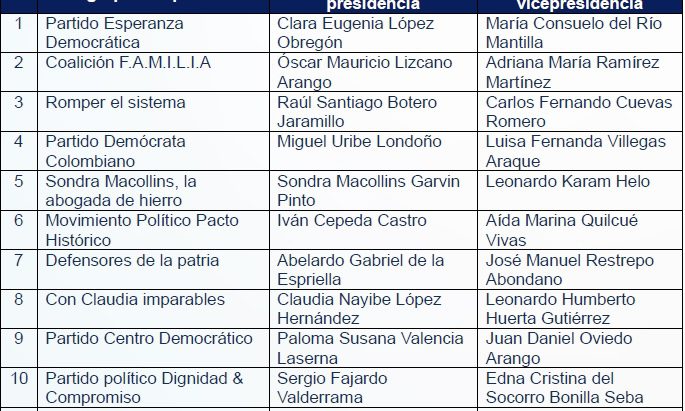
According to the electoral authority, the candidates represent a wide range of political perspectives, from left to right, including independent candidacies running through political movements. Here the list and brief profile of the candidates:
Clara Eugenia López Obregón, currently a senator for the Esperanza Democrática She has served as Minister of Labor (2016–2017), acting mayor of Bogotá (2011–2012), and Bogotá’s secretary of government (2008–2010). She has been affiliated with left-wing parties and was Gustavo Petro’s vice presidential running mate in the 2010 election.
Óscar Mauricio Lizcano, from the FAMILIA coalition. He served as Minister of Information Technologies (2023–2025), was a senator (2010–2018), and a member of the House of Representatives (2006–2010).
Raúl Santiago Botero, candidate of the “Romper el Sistema” movement (Break the Establishment). An agronomist engineer and businessman from Medellín, he presents himself as an independent candidate with no prior political experience.
Miguel Uribe Londoño, father of the slain presidential candidate Miguel Uribe Turbay. He is running under the Colombian Democratic Party and previously served as president of the Centro Democrático party founded by Álvaro Uribe Vélez.
Sondra Macollins Garvin, from the movement “La Abogada de Hierro” (The Iron Lawyer) A criminal lawyer and psychologist, she presents herself as an independent candidate without political affiliations. She ran for the House of Representatives in 2022 and is known for her work in narcotrafficking and corruption cases.
Iván Cepeda Castro, a senator since 2014 and the official candidate of the Pacto Histórico, the same party as President Gustavo Petro. Polls project he will receive the highest vote share in the first election round. He is aligned with left-wing political ideas.
Abelardo de la Espriella, a lawyer with far-right positions, running for the first time under the Defensores de la Patria movement. Recent polls place him as a likely second or third contender in voter preference.
Claudia López Hernández, former mayor of Bogotá (2020–2023) and former senator (2014–2018), running under the centrist movement “Imparables con Claudia.” She is known for her anti-corruption agenda and secured her candidacy with more than 570,000 votes (about 9%) in recent interparty primaries.
Paloma Valencia Laserna, current senator and candidate of the Centro Democrático party led by Álvaro Uribe Vélez. She won the right-wing interparty primary on March 8 with more than 3 million votes. Polls place her among the top three contenders, and if she reaches a runoff, she would become the first woman in Colombia’s history to do so.
Sergio Fajardo Valderrama, an academic and mathematician running for the Dignidad y Compromiso He served as mayor of Medellín and governor of Antioquia and is running for president for the third time.
Roy Barreras, from the political party La Fuerza (The Force). He won the left-wing coalition primary on March 8 with the lowest vote total (257,000 votes, about 3.6%). Although currently aligned with left-wing movements and part of the Petro administration, he has previously been affiliated with right- and center-leaning parties.
Gustavo Matamoros Camacho, of the Colombian Ecologist Party. He served in the Colombian Army for 43 years. With no prior political experience, his campaign focuses on public security.
Luis Gilberto Murillo, who served as Minister of Foreign Affairs (2024–2025) and Colombia’s ambassador to the United States (2022–2024). A human rights advocate and Afro-Colombian leader from Chocó, he presents himself as an independent, moderate, centrist candidate.
Carlos Eduardo Caicedo, running under the independent movement “Con Caicedo.” He was mayor of Santa Marta (2012–2015) and governor of Magdalena (2020–2023), where he built a strong base as a left-wing political leader.
The RNEC also reported that “the draw to determine the position of presidential candidates on the ballot will take place on March 25 at the Ágora Bogotá Convention Center.”
This process marks the formal start of the final phase of the presidential campaign, during which candidates will seek to consolidate support ahead of the first round on May 31. If no candidate secures an absolute majority, a runoff between the two leading candidates will be held on June 21.
List of registered candidates for Colombia’s presidency. Photo courtesy of the Registraduría Nacional del Estado Civil.
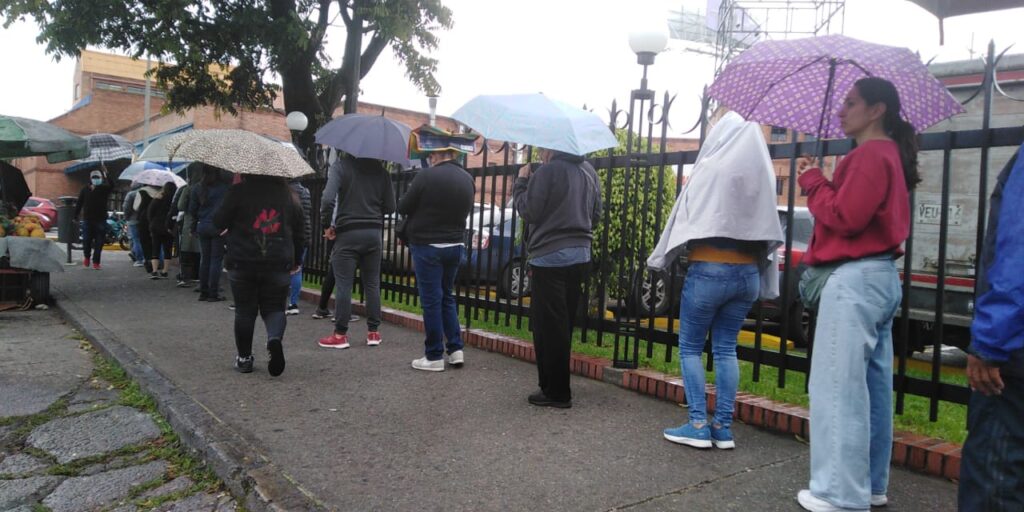
Headline photo: Polling station in Colombia during last Congress elections in March 8, 2026. Photo courtesy of the Registraduría Nacional del Estado Civil.
U.S. federal prosecutors have opened preliminary criminal investigations into Colombian President Gustavo Petro over alleged links to drug traffickers and possible illicit financing of his 2022 campaign, according to a report by The New York Times.
The previously undisclosed probes are being conducted by federal prosecutors in Manhattan and Brooklyn and involve specialists in international narcotics trafficking, as well as agents from the Drug Enforcement Administration and Homeland Security Investigations, the newspaper said, citing people familiar with the matter.
Investigators are examining, among other issues, whether Petro held meetings with individuals connected to drug trafficking networks and whether his presidential campaign solicited or received donations from such actors. The two investigations are being carried out independently and remain in their early stages, with no certainty that they will lead to formal criminal charges.
There is no indication that the White House played any role in launching the investigations, according to the report. However, the inquiries emerge in a broader context of heightened tensions and fluctuating diplomacy between Bogotá and Washington.
Relations between Petro and U.S. President Donald Trump have been volatile, marked by sharp public exchanges, threats of tariffs that were never implemented, and the temporary revocation of Petro’s U.S. visa. Trump has repeatedly accused Petro of failing to curb narcotics production and has described him in highly critical terms, while Petro has denounced what he characterises as political pressure and interference.
The U.S. Treasury Department last year imposed sanctions on Petro, members of his family and senior officials, including Interior Minister Armando Benedetti, alleging links to narcotics activity. The measures, which included asset freezes and travel restrictions, were justified by Washington on the grounds that cocaine production in Colombia had reached record levels and that the government had offered concessions to armed groups involved in trafficking.
Petro has rejected those claims, insisting that his administration has strengthened seizures of cocaine and slowed the rate of expansion of coca cultivation. He has also denied any knowledge of illicit funds entering his campaign, dismissing the allegations as politically motivated attacks.
Colombia’s Attorney General is examining charges that Petro’s son – Nicolás Petro – received money from individuals linked to illicit activities during the 2022 campaign. While his son acknowledged receiving funds that were not reported, no criminal charges have been filed against the president himself, and Petro has maintained he was unaware of the campaign “donations”.
According to the NYT, the U.S. investigations are taking place amid a broader strategy in which Washington has increasingly used legal and judicial tools to advance foreign policy objectives. Analysts say such actions could serve as leverage in bilateral relations or influence political dynamics in allied countries.
The timing of the probes is particularly sensitive, as Colombia prepares for presidential elections on May 31, with a potential runoff in June. Petro, the country’s first leftist president, is constitutionally barred from seeking re-election but has actively backed his political successor with hardleftist Iván Cepeda.
The allegations could reverberate through the electoral campaign, where relations with the United States remain a central issue. Candidates on the right have emphasised the importance of maintaining close ties with Washington, while figures on the left have framed U.S. actions as a challenge to Colombia’s sovereignty.
Despite months of tensions, diplomatic relations between the two countries have shown signs of stabilisation in recent weeks. Petro and Trump held a bilateral meeting at the White House earlier this year, which both sides described as constructive, and officials have since sought to rebuild communication channels.
Even so, uncertainty persists over the trajectory of the relationship, particularly as Washington continues to prioritise counternarcotics cooperation with Colombia, historically one of its closest partners in the region.
Petro has consistently denied any links to drug trafficking and has pointed to his government’s security strategy, which includes negotiations with armed groups and efforts to reduce violence, as evidence of a broader approach to the drug trade.
The start of U.S. investigations add a new layer of complexity to an already fraught political and diplomatic landscape, with potential implications not only for Petro’s post-presidential future but for Colombia’s ties with its most important security ally.
President Gustavo Petro accused Ecuador on Monday of carrying out bombing raids inside Colombian territory, sharply escalating a diplomatic and trade dispute that has been simmering since January.
Petro said “27 charred bodies” have been found near the border and suggested the attacks could not have been carried out by illegal armed groups, though he presented no evidence to support the claim.
“Ecuador is bombing us, and these are not illegal armed groups,” Petro said during a televised cabinet meeting, warning of a serious breach of sovereignty.
Ecuador’s President Daniel Noboa swiftly rejected the accusation.
“President Petro, your statements are false; we are acting within our own territory,” Noboa said, adding that Ecuadorian forces were targeting “narco-terrorist structures” operating near the border.
Petro said a bomb believed to have been dropped from an aircraft had been discovered near the frontier, reinforcing what he described as a pattern of cross-border strikes.
“A bomb has appeared, dropped from a plane… very close to the border with Ecuador,” Petro said. “We must investigate thoroughly, but this supports my suspicion that Ecuador is bombing us.”
He added that “many explosions” had been reported and said his government would soon release an audio recording allegedly originating from Ecuador.
In a post on social media platform X, Petro said the bombings did not appear to come from Colombian armed forces or illegal groups, which he argued lack the capability to carry out aerial attacks. “The explanation (from Ecuador) is not credible,” he wrote, without specifying when or where the deaths occurred.
Ecuador doubles down
Noboa, facing a surge in organized crime violence at home, has adopted an aggressive military strategy that includes aerial bombardments of suspected cartel camps near the Colombian border.
His government says the operations are conducted strictly within Ecuadorian territory and are often aimed at groups with Colombian origins, including FARC dissidents. “Together with international cooperation, we continue this fight, bombing locations used as hideouts by these groups, many of them Colombian,” Noboa said in a statement.
He also accused Colombia of failing to control its side of the border, allowing criminal organizations to spill into Ecuador.
The latest confrontation comes against the backdrop of a worsening trade dispute that began in January when Ecuador imposed a 30% “security tariff” on Colombian imports, citing Bogotá’s alleged inaction against narcotrafficking.
The tariff was later increased to 50%.
Colombia retaliated with tariffs on 73 products, suspended electricity exports to Ecuador, and imposed restrictions on bilateral trade, deepening tensions between the neighboring countries.
Ecuador responded by raising fees on the transport of Colombian crude through one of its main pipelines.
Despite early attempts to contain the fallout, relations have steadily deteriorated, culminating in the current exchange of accusations.
Risk of escalation
Petro’s latest claims mark the most serious rupture yet, raising the specter of a cross-border military incident between the two countries, which share a long and porous frontier plagued by drug trafficking and illegal mining.
The Colombian president said he had appealed to Donald Trump to intervene diplomatically.“I asked him to act and call the president of Ecuador because we do not want to go to war,” he said.
The involvement of the United States adds another layer of complexity. Ecuador recently deepened security cooperation with Washington, including the establishment of a new FBI office and joint operations targeting organized crime. Earlier this month, Ecuadorian and U.S. forces conducted strikes on a camp linked to the Comandos de la Frontera, a dissident faction of the FARC guerrilla.
The Colombia–Ecuador border has long been a strategic corridor for cocaine trafficking, with armed groups exploiting weak state presence on both sides. While the border itself is not disputed, diverging security strategies have increasingly brought Bogotá and Quito into conflict.
Petro’s government has prioritized negotiations with armed groups under its “Total Peace” policy, while Noboa has pursued a hardline military crackdown.
For now, the allegations from Casa de Nariño remain unverified, but the political damage is done – and one further miscalculation could carry deep consequences far beyond the shared border.
Colombia kicked off its electoral year with the Senate and House elections last weekend, alongside consultas for presidential runs. Who’s come out ahead?
The Colombian elections of 2026 started last week, with the Senate and Cámara finalising their seats for the next parliament. The presidential elections will take place at the end of May, with a second round in June if necessary.
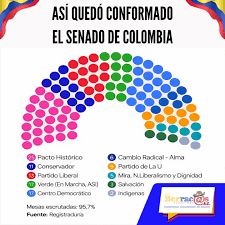
The new Senate layout. Photo courtesy of the registraduría.
The presidential elections also had a hand in last week’s results, with consultas to decide on who would represent groups of candidates with similar politics. That saw Claudia López, Roy Barreras and Paloma Valencia take the honours in their respective consultas.
When all was said and done, the results showed that traditional parties and candidates had generally performed poorly, with new candidates doing well and a difference in the traditional balance of power.
So, a week on and with the dust having settled as final results come in from all over the country, who’s up and who’s down after the first Colombian elections of 2026?
Winners
It was a good day for the government, with the Pacto Histórico gaining seats and a low turnout for the leftist consulta. The Centro Democrático, too, had a good afternoon. Paloma won her consulta handily and the party overall also gained seats in borth houses.
Pacto Historico
The governing party had a spectacular Sunday, simply said. They increased their presence in both chambers and became the largest single party to boot. The Senate remains without a clear majority, but they are in a very strong position indeed, even without the former FARC combatientes’ curules.
On top of that, other results largely went their way. The leftist consulta that Cepeda was blocked from running in was a washout as the Pacto told their supporters to stay away. Prominent critics of the party from other parties such as Robledo, Miranda, Betancourt and Juvinao all crashed out as well.
While an overall majority in either house is far from within their grasp, the Senate now leans slightly more left than right, with left and centre-left senators adding up to 53. On top of that, after an often rocky government, it’s clear that they haven’t lost their base, indeed even expanding.
Paloma Valencia
A fortnight ago, Paloma Valencia’s campaign seemed to be stuttering. She was polling in single figures for first round intentions for the presidency and making few public appearances other than the mass debates for the Gran Consulta por Colombia. There was even a worry that she might suffer an upset in that consulta.
Fast forward to today and it’s a very different picture indeed. The latest polling shows her rocketing in popularity, now standing at around 20%. That’s because she picked up over three million votes in that consulta.
Then she picked the runner up in that race as her VP ticket, a smart move on her side to try and attract voters more in the centre as well as boost her in the capital. It’s not a landslide move, but it’s canny and the presidential race will likely come down to small margins.
Juan Daniel Oviedo
Technically a loser, in the sense that he was a clear second to Valencia in the Gran Consulta. However, he picked up over a million votes, paying off his mortgage and significantly outperforming expectations. He also opened the door for some new paths in his political adventure.
It had looked like his next step was to concentrate on a tilt for Bogotá mayor, having come in second last time around after another strong campaign. He then pulled a remarkable volte-face, accepting Valencia’s offer to run on her ticket.
That’s a move that puts him potentially in a different league than before, very much on the national stage now. It’s come at an enormous reputational price though, with many that voted for him feeling betrayed as he runs on a rightist ticket. He can claim that it’s centrist as much as he likes, but few see it that way.
Influencers
Electorates worldwide are losing patience with technocrats and politics as usual. That’s as true in Colombia as anywhere else, with a number of influencers running and doing fairly well. This is a trend that has been open for a while and shows no sign of slowing down.
Former adult actress Amaranta Hank won a spot for the Pacto Historico, while the White Elephant took a seat for the Partido Verde, having started out as a content creator looking to expose corruption and poor spending practices.
Safety
Despite fears of electoral violence and a turbulent run-up to election day, it was a relatively calm Sunday in the end. There was an attack on a voting centre in Meta, plus another couple of issues elsewhere, but overall it was a good sign for the upcoming presidential elections.
Losers
There were plenty of losers last week, with several high-profile candidates for the presidential race crashing out in their consultas. That saw Vicky Dávila unconvincingly claiming she wasn’t a loser and Enrique Peñalosa falling at the first hurdle again among others.
Farewell, too, for some familiar faces. Ingrid Betancourt failed to make the cut for Senate, losing her seat alongside her party. Jorge Robledo, the leftmost critic of Petro did likewise. Miguel Polo Polo unsurprisingly lost his seat as an Afro-Colombian representative, replaced by a principled lawyer, which delighted many.
In general, old parties and old faces fared poorly, with incumbency working against many. A striking exception to that was the party for ex-FARC combatants, Comunes. To their surprise, but no one else’s, they failed to meet the threshold for representation.
Roy Barreras
Standing in the leftwing consulta, Roy won in the sense that he saw off the threat from controversial former Medellín mayor Daniel Quintero. However, the Pacto campaign to not vote in consultas laid his lack of support bare.
Viejos Verdes
The Partido Verde managed to limit their losses in terms of seats, remaining at a similar level as before. However, there has been a significant change in who takes those curules. They had an open list, meaning that no-one was assured of a place.
Voters made it clear that they wanted to see new blood, with government critics Katherine Miranda and Cathy Juvinao voted out, along with Inti Asprilla and Angelica Lozano.
The old Frente Nacional
For much of the last century, the Liberales and Conservadores absolutely dominated Colombian politics. For most of this century they’ve avoided running viable presidential candidates, preferring to hold their power in the Senate, Cámara and local politics.
This time out they have taken a big hit in both houses, losing five seats between them and no longer being in the top level of voting blocs. Due to the fragmented nature of the parliament, they retain some kingmaking powers, but are a shadow of what they once were.
A big question now looms for both parties ahead of next year’s local elections. Just as the Pacto will feel they can make some big gains there, so too will the Liberales and Conservadores worry they might take more damage.
Claudia López
The former Bogotá mayor faced no real opposition in her consulta, sailing through with over 90% of the vote. However, that was 90% of not very much and she failed to get voters out to show support in the way that Valencia and Oviedo did. She faces an uphill slog from here.
Sergio Fajardo and Abelardo de la Espriella
Neither of this pair were in consultas, instead going to the second round. That’s meant they’ve been kept out of the headlines and lost momentum as well as having some unfortunate results.
The scale of the turnout for Valencia shows she’s a viable contender to Aspriella on the right and her leap in polling is matched by a significant downturn for el tigre. For Fajardo, it’s even worse: voters are largely abandoning the centre and technocratic politicians.
Trust in the system
With the governing party repeatedly questioning the openness and fairness of the elections, this was rough. There have been a number of reports coming out questioning the practices of various voting centres and plenty of allegations, particularly from the left.
On top of that, a couple of candidates were arrested on voting day with big bags of cash that were allegedly to be used in vote-buying. While corruption in electoral processes is likely nowhere near as widespread as many claim, it’s clearly still an issue, especially in rural zones.
Centrist politics
Other than Juan Daniel Oviedo, centrists had a bad day at the polls, especially the centre-right. While the Centro Democrático and Pacto Historico gained votes on the flanks of both right and left, parties close to the centre lost out.
Cambio Radical took a big hit, as did the conservatives, with Abelardo de la Espriella’s new Salvación Nacional party gaining three seats from literally nowhere. The partido de la U also lost a seat while Ahora! won another two seats. Poor turnout for the centrist consulta also means there seems to be little support on the presidential level.
What happens next?
The presidential election on May 31 is now very much the focus of attention. Iván Cepeda still leads the polls comfortably, with Paloma Valencia and Abelardo de la Aspriella splitting the rightwing vote at the moment. However, with over two months of campaigning time ahead, there is plenty of time for everything to change.
Gustavo Petro has shown little sign of intending to follow the guidelines on not campaigning, making references to Oviedo and Valencia as well as thinly-disguised references to Cepeda and so on. Expect this to continue and ever more strongly worded warnings from the registraduría to be ignored.
It’s also likely that there will be ever more rhetoric over electoral fraud, with the Pacto campaign leaning heavily into that already and working on raising awareness of the issue ahead of the voting for the first round.
There’s currently a very good chance that the presidential campaigns will get pretty ugly, with lots of negative campaigning and attack ads. There is no love lost between the candidates and plenty of bad blood on all sides. We’ll keep you up to date with things as the campaigns develop.
Conservative presidential candidate Paloma Valencia has chosen economist and former statistics chief Juan Daniel Oviedo as her vice-presidential running mate, a move widely interpreted as an effort by the right-wing Centro Democrático to broaden its appeal beyond its traditional conservative base ahead of Colombia’s May 31 presidential election.
The alliance seeks to balance Valencia’s hard-line security message – closely associated with former president Álvaro Uribe Vélez – with Oviedo’s more technocratic and centrist profile, which resonates with younger, urban voters.
Announcing the ticket in the bustling commercial district of San Victorino in central Bogotá, Valencia said the decision followed consultations within the party and with Uribe himself.
“We have reached the conclusion that the best teammate is Juan Daniel Oviedo,” Valencia said. “He obtained a popular backing that excites all of us. He is connecting with many Colombians who did not feel represented.”
The announcement comes just days before the deadline to register presidential tickets with Colombia’s electoral authorities and follows Valencia’s decisive victory in the conservative primary coalition known as “La Gran Consulta,” where she secured more than three million votes. Oviedo finished second with more than one million, quickly emerging as one of the race’s unexpected political figures.
Balancinga new centre
Valencia, a staunch supporter of Uribe’s political project, has repeatedly signaled she will not distance herself from the former president’s ideological influence.
“I’m not going to distance myself from Uribe; I’m going to die a Uribe supporter,” she said in a recent interview with El País, reaffirming her commitment to the security agenda associated with the former two-term president.
Yet her choice of Oviedo indicates an attempt to broaden the coalition’s reach. The economist, who gained national prominence as director of Colombia’s national statistics agency – DANE – is widely viewed as a highly-skilled data-driven analyst with appeal among educated urban voters in their thirties and forties – many of whom supported the Colombian Peace Agreement.
That demographic has traditionally gravitated toward centrist figures such as former Bogotá mayor Claudia López or the moderate political movement associated with Sergio Fajardo.
Oviedo’s presence on the ticket could help the conservative bloc penetrate that electorate while also tempering some of the party’s more polarizing rhetoric.
Beyond Differences
The partnership did not come easily. According to campaign strategists involved in negotiations, several days of discussions were required to reconcile differences between the candidates – particularly regarding Colombia’s peace process.
The Centro Democrático has long been critical of the transitional justice system created by the 2016 accord, especially the Jurisdicción Especial para la Paz (JEP), which has been investigating war crimes committed by ex-FARC and Armed Forces during two decades of the internal conflict.
Oviedo, however, has publicly supported the peace agreement and defended the need for reconciliation. Speaking after accepting the nomination, Oviedo emphasized the importance of political dialogue despite ideological differences.
“This is about listening,” he said. “In this coalition we are capable of recognizing our differences but uniting around a fundamental purpose: looking toward the future and building a country where everyone fits.”
He also highlighted his intention to include diverse sectors of Colombian society, mentioning farmers, informal workers, women and the LGBT community.
Strategic Moves in Gran San
The announcement’s location – San Victorino’s Gran San commercial center, one of Bogotá’s busiest retail hubs- was also symbolic. The district is a bustling marketplace dominated by small traders and informal workers, a constituency both candidates say they want to court.
Valencia described the alliance as a forward-looking project for a country weary of political polarization.
“We have many pains as a nation,” she said during the event. “If we only look backward we will find wounds that still need healing. But we have another option: to look forward toward the future we deserve.”
She also praised Oviedo’s credentials, describing him as a policymaker who understands the deep structural and social challenges facing Colombia. “He likes numbers, he likes studying,” she said. “Government is not about talking nonsense about problems – it’s about understanding them deeply in order to solve them,” she said to waves of applause.
The announcement quickly triggered reactions from across Colombia’s political landscape.
Former Liberal president Ernesto Samper welcomed the decision, arguing that Oviedo’s acceptance of the vice-presidential role signaled an implicit recognition by the right-wing party of the peace process. “The acceptance of Juan Daniel Oviedo demonstrates that the Centro Democrático validates the Havana peace agreement and the continuation of the JEP,” he Samper.
With the campaign entering its decisive phase, the Valencia-Oviedo ticket represents a strategic attempt to unite two currents within Colombia’s conservative electorate: an older security-focused base loyal to Uribe and a younger urban sector seeking pragmatic solutions to the internal conflict.
Whether the combination can bridge Colombia’s ideological divide – or deepen it- will likely shape the tone of the presidential race in the weeks and moths leading to the decisive vote.
Colombia’s presidential race entered a decisive new phase this week after Sunday’s inter-party primaries propelled conservative senator Paloma Valencia into the national spotlight and triggered a scramble among political factions to forge alliances ahead of the May 31 election.
Valencia’s commanding performance in the right-wing “La Gran Consulta” primary – where she secured roughly six million votes – has reshaped the political landscape, opening a contest within the conservative bloc while forcing candidates across the spectrum to recalibrate their strategies.
The vote effectively marks the start of Colombia’s election season, in which presidential hopefuls must broaden their appeal beyond ideological bases while navigating a fragmented political field.
For the right, the central challenge is whether it can attract moderate and centrist voters without alienating the hardline supporters who form the backbone of a political base – and party – associated with former president Álvaro Uribe.
Valencia, a senior figure in Uribe’s Democratic Center, emerged from the primaries as one of the leading conservative contenders after her vote total surpassed the turnout achieved by President Gustavo Petro and Vice President Francia Márquez in their coalition primaries ahead of the 2022 election.
For Uribe’s movement, which appeared weakened after the presidency of Iván Duque and several electoral setbacks, the result represents an unexpected demonstration of political resilience.
Yet the surge of security-focused Senator has also intensified competition from the far right.
Barranquilla-based lawyer Abelardo de la Espriella, who had previously dominated opposition to Petro, now faces a rival capable of consolidating support among traditional party structures while courting voters beyond the hard-right.
De la Espriella announced Tuesday that Ivan Duque’s former finance minister José Manuel Restrepo will join his presidential ticket as vice-presidential candidate, a move widely interpreted as an attempt to add economic credibility to a campaign largely driven by security rhetoric.
Political observers on the night of the consulations emphasized that Uribe will play a decisive role in shaping the outcome of any hard-right and center-right alliance.
The former president remains the most influential figure within Colombia’s right-wing political establishment and will act as “kingmaker” when negotiations begin over a possible understanding between Valencia and De la Espriella aimed at consolidating the anti-Petro vote.
Whether such an agreement materializes remains uncertain, as both candidates seek to position themselves as the principal challenger to the left in the first round scheduled for May 31.
Sunday’s primaries also produced a surprise showing from economist Juan Daniel Oviedo, the former head of Colombia’s national statistics agency (DANE), who secured more than one million votes and finished second in La Gran Consulta.
Oviedo has cultivated support among urban and younger voters, particularly in Bogotá, where his technocratic style and socially liberal positions have resonated with diverse constituencies, including large segments of the LGBTQ community.
Yet his unexpectedly strong performance now places him at a political crossroads.
Oviedo is expected to meet Valencia on Thursday to discuss a possible alliance that could include joining her ticket as a vice-presidential candidate.
Such a partnership could help Valencia reach voters beyond the traditional conservative base. But it also carries risks for Oviedo, whose supporters may question a close association with the Uribe-aligned political establishment that has dominated Colombia’s right for more than two decades.
The two politicians differ sharply on several issues, including the 2016 peace agreement with FARC and role of the Special Jurisdiction for Peace (JEP), the transitional justice tribunal created to prosecute war crimes committed during Colombia’s internal conflict.
While Oviedo has defended Juan Manuel Santos’ peace agreement and role of the tribunal, Valencia has long criticized JEP and promoted reforms aimed at limiting its legal authority.
Despite the shifting dynamics on the right, the left retains an important institutional foothold following Sunday’s legislative elections.
Petro’s governing coalition, the Historic Pact, emerged as the largest force in the Senate with 25 of the chamber’s 102 seats, according to official results, though it fell short of an outright majority and will need alliances with other parties in the fragmented legislature.
Within the progressive camp, however, the primaries exposed clear divisions.
Former Senate president and former Ambassador to London Roy Barreras secured just over 200,000 votes in the left-wing primary and publicly blamed Petro for the weak turnout, accusing the president of discouraging supporters from voting on Sunday to cement the official candidacy of hard-left candidate Iván Cepeda.
The primaries also underscored the continued weakness of Colombia’s political center.
Former Bogotá mayor Claudia López won her coalition’s primary but attracted fewer than half a million votes, a disappointing result that leaves her entering the first round of the presidential race with reduced political momentum.
With nearly three months remaining before the first round of voting, the campaign that begins this week bears little resemblance to the one that existed before Sunday’s primaries.
The conservative opposition remains divided but newly energized, the left retains institutional strength despite internal tensions, and the political center faces an uphill battle to remain relevant.
In a race now expected to be decided in two rounds, Colombia’s presidential contest is once again wide open as candidates maneuver to build alliances and capture the pivotal voters who will ultimately decide the country’s political direction.
Colombia goes off to the polls for the first time tomorrow – but what’s at stake in the first Colombian election of 2026, how does it all work and why are there claims of fraud?
National elections are taking place in Colombia in 2026, with the first taking place tomorrow morning, Sunday 8th March. This returns representatives for both houses of parliament as well as eliminating some candidates for the presidential elections coming in May.
Colombians in the 2022 elections. Photo courtesy of Angela Forero-Aponte
Oversight is carried out by the CNE (Consejo Nacional Electoral). In order to do this over the vast territory and number of stations, over 800,000 citizens are selected to be vote-counters. This is similar to jury duty in other countries and is compensated with a day off as well as a compulsory day of training a couple of weeks beforehand.
As the electorate is growing, there are now some 13,000 voting sites across the country, most with multiple voting tables. Colombians have to vote where their cédula is registered, so don’t be surprised to see some people trekking to other cities if they forgot to update their registration.
Borders will close, along with various road closures within city limits and ciclovía cancelled to allow for ease of transport to voting stations. There will also be a dry law enacted from this afternoon and you can expect a heightened police and military presence.
This is the first year in which the parties representing demobilised ex-FARC combatants do not receive guaranteed seats and is also the first time the leftist bloc is coming in as incumbents rather than opposition.
With plenty of rhetoric and conflict in the run up to the election as well as the unusual political situation of the country, these are particularly hard elections in Colombia to call. While the upcoming presidential elections in May are the bigger deal, this round will give some insight into how that might go.
What’s on the table in the Colombian elections 2026?
Both houses of parliament will be fully elected, which means 103 senators and 183 representatives for the lower house, known as the Cámara de Representantes. The key difference in choice here is whether you vote regionally or nationally.
The Senate is voted for on a national basis, with all candidates open to all voters. Of the 103 curules, a straight 100 are chosen by the electorate as a whole, while Indigenous communities select a further two and the runner-up in the presidential election will receive the final seat.
The Cámara is regionally organised, with residents of the capital voting for Bogotá-based candidates and so on. Bogotanos have 18 representatives in total, whereas departments are guaranteed a minimum of two seats. Like the Senate, there are also seats set aside for special groups: afro-Colombians, Indigenous Colombians and conflict victims.
Just in case you thought there was enough on the plate, there are further considerations at stake. To avoid spreading the vote, various presidential candidates with similar positions group together for a preliminary vote. The losers in each consulta will drop out on Monday. This year there are three on the voting card.
They are leftist, rightist and centrist. Ex-mayor of Bogotá Claudia López is nailed on for the latter and ex-mayor of Medellín Daniel Quintero is likely to win the former. The rightist consulta is more open, with Paloma Valencia of the centro democrático leading polls but Juan Daniel Oviedo and Juan Galán eyeing the outside chance of an upset.
While there is a diverse group of parties, they hang together in loose blocs roughly delineated as government, opposition and neutral. With the government only controlling 34 curules and the opposition 24, the neutrals are incredibly important for horse-trading.
This will be a huge litmus test for the ruling leftist bloc. They will lose their guaranteed Comunes seats, so any further losses will be highly problematic. On the other hand, gaining curules would be a huge shot in the arm in terms of public support, hence why they are campaigning in places like Huila, outside of their traditional strongholds.
Continuity candidate for presidency Iván Cepeda continues to lead polling by a healthy amount, but is closer to Petro’s numbers in 2018 than 2022, which will be a concern. A good performance tomorrow will help him out considerably.
Within the consultas, Paloma Valencia’s support will be the big question. She’s likely to win, but the percentages will be a big sign as to whether she can truly challenge Abelardo de la Espriella for the rightwing vote.
The most likely outcome is that there will be little change in the makeup of the Senate, with neither the government nor opposition likely to take outright control or make large gains. Whichever of those two groups increases their representation will quickly turn it into a sign that they are on the right track and use that as support for their presidential campaign.
What’s the background to these elections?
The run-up to the first Colombian elections of 2026 has seen a lot of criticism of the system, almost all of it coming from the national government. President Gustavo Petro has been front and centre on this issue, repeatedly questioning the neutrality of the elections.
Petro’s concerns rest on the fact that Thomas Greg and Sons handle the software used in the election system, a firm that he’s clashed with repeatedly, especially over Colombian passport printing.
He says that the systems are opaque and he has not received answers from the CNE or Registraduria over various concerns he has. However, both groups, along with Colombia’s neutral election observers MOE have been clear about the processes.
Online, there are hundreds of posts claiming that a key part of the alleged fraud will be in the reports made by the jurados. This echoes previous elections, where there was a flurry of images purporting to show electoral forms that had been altered. With AI entering the scenario, expect more of this from midday or so tomorrow onwards.
Voy a escribir porqué los escrutinio son opacos y vulnerables al fraude en las elecciones.
No porque crea que nuestro proyecto democrático vaya a perder sino porque es mi deber como jefe del estado al menos informar sobre uno de los peores riesgos de la democracia hasta ahora…
The President has issued dozens of tweets claiming electoral fraud
Of course, Petro is only claiming that electoral fraud exists against him, not in the multiple occasions in which he’s won at the voting urns. This is a well established populist tactic – calling elections into doubt before they happen. It’s likely to rally his turnout and provide an excuse if results are bad.
There is little credibility to most of the vote rigging claims. Colombia does indeed have some serious problems around corruption and influence buying, but this tends to be concentrated in rural zones in the periphery of the country. It’s also worth noting that these seats return candidates from across the political spectrum.
A lot of electoral impropriety is very hard to prove – the machines that promise to deliver blocks of votes are well-versed in legal limits and plausible deniability. Offering someone some free gifts in return for ‘support’, for example, is widespread and while dubious hard to prove in court.
It goes without saying that political attacks on the CNE are particularly unhelpful, especially in what is still a very charged political atmosphere nationwide. The assassination of presidential pre-candidate Miguel Uribe last year was a shock to a country that has a long history of political violence.
Concerns remain over both electoral safety and fraud in much of the country, with over 200 municipios at high risk of fraud and/or violence. 39 of those are classed as very high risk and only 167 at very low risk, mainly in the Andino region.
How does the system work?
Every Colombian over the age of majority (18) and with a correctly registeredcédula ciudandanía can vote. In return, each voter gets a half day off work. Non-citizens are not eligible to vote in national elections, but holders of resident visas will be able to vote in next year’s local elections.
The polls are open from 8am until 4pm and counting is usually very fast with the first results coming in before sundown tomorrow. Due to the PR system (see below), final results for some more isolated zones will come through in the week.
Land and fluvial borders will be closed for Colombian nationals tomorrow morning, although foreigners can cross. From this afternoon until early on Monday morning, ley seca will apply, meaning no alcohol sales in bars, restaurants or shops. That applies for everyone, so no representation or boozing for foreign residents.
Some parties run a closed list system, meaning you simply vote for them, whereas others have open lists, meaning you vote for the party and can also vote for your preferred candidate within the party. For closed lists, the party will simply enter their candidates in the order they’ve given up to their limit of seats, with an open list it will be done in order of preference.
There’s also the curious option of voto en blanco. Different from a spoiled vote, which is simply disregarded, this is an active protest. If it ranks highest in any race, then a rerun of the election must take place within a month with entirely new candidates and/or party lists.
A smidgen under 50% turnout is common for house elections, with higher figures expected for the presidential elections later this year. The Colombian parliament is a bicameral system with the Senate acting as the upper and more powerful house and the Cámara the lower house.
Most parties do not really have well-defined manifestos as such, although better-funded candidates will give a range of positions on matters. In general, there will simply be slogans and general aims that give voters an idea of where their candidates stand.
Colombia’s outgoing president Alvaro Uribe meets the public during a visit to the Agro Del Pacífico 2010 agricultural fair in Cali. Image credit: Neil Palmer (CIAT) via Wikimedia Commons
Colombia’s former president Alvaro Uribe Velez will participate in this Sunday’s congressional election following his conviction and subsequent acquittal for procedural fraud and bribery of a public official.
While he is last in line for a seat in his party’s list, the Centro Democrático, or Democratic Center, hopes his name will help it secure between 18 and 20 seats in the 103-seat Senate.
Uribe is returning to the ballots after resigning from the Senate in 2020, when the Supreme Court began proceedings against him over witness tampering allegations.
In Colombia’s congressional elections, parties and party coalitions can run either closed lists, where voters choose only the party and seats go to candidates in a predetermined order, or open lists, where voters can select individual candidates. Since the Democratic Center is running a closed list, being number 25 means that Uribe is the least likely candidate to get a seat in Congress for his party.
“The political strategy of placing Uribe in the 25th position is highly effective for pulling in votes and taking advantage of voters’ lack of understanding [about how closed lists work],” political advisor Felipe García told The Bogotá Post.
The Democratic Center is a hyper-personalized party whose votes rely heavily on the stature of Uribe as the natural leader of Colombia’s political right. Therefore, it is likely that voters will go to the polls on Sunday to vote for whoever Uribe endorsed, regardless of whether he himself ends up being elected.
Legal battle
The legal case against Uribe centered on a libel suit he had brought against Senator Iván Cepeda Castro, the current leftist presidential frontrunner, who accused Uribe of being involved with paramilitary death squads.
Uribe and Cepeda represent opposite poles of Colombia’s political spectrum. Uribe is a conservative, hardline anti-guerrilla leader, whereas Cepeda supports peace negotiations with rebels.
While investigating a separate case to the libel inquiry, authorities overheard in a wiretap that Uribe’s lawyer, Diego Cadena, had contacted jailed paramilitaries to change their testimony in Uribe’s favor.
This evidence became key to a July 2025 ruling which made Uribe Colombia’s first ex-president to be criminally convicted, with judge Sandra Heredia sentencing him to 12 years of house arrest.
But the politician’s lawyers appealed the ruling and in October, the Superior Court of Bogotá acquitted Uribe of all charges, as the wiretap evidence against him was illegally collected.
A month before his acquittal, the Democratic Center – which was founded by Uribe – announced that its former leader would be number 25 on the party’s Senate candidate closed list.
Uribe’s 2020 resignation from the senate was seen as both a legal and political move, since it meant that his case would be picked up by the Attorney General’s Office, which at the time was headed by Francisco Barbosa Delgado, an ally of the former president.
After several failed attempts to close the case and after Barbosa left office as attorney general, the office formally charged former president Álvaro Uribe Vélez with bribery and witness tampering in May 2024. By that time, Uribe’s defense team was already alleging that the politician was the victim of lawfare.
Recently, the prosecution team in the Uribe trial and alleged victims of paramilitaries announced they would file an extraordinary appeal before the Supreme Court. The ruling is expected to carry greater legal significance than political or public impact, according to García.
Many victims’ groups celebrated Uribe’s conviction as a symbolic victory. Uribe was the president during the ‘false positives’ killings — cases in which Colombian soldiers killed civilians and falsely presented them as guerrilla members killed in combat.
Colombians head to the polls on March 8 for what is, formally, a legislative election. In practice, it is something more consequential: a stress test of the country’s political coalitions ahead of the May 31 presidential race already defined by fragmentation – and by mounting security concerns for right-wing candidates.
The vote for Congress matters. But the country will be watching the consultas presidenciales—three parallel primaries that function as a de facto first round. In them, Colombians vote less for programs than for trajectories: continuity, rupture, or something in between.
On the right, Paloma Valencia is poised to dominate La Gran Consulta, a coalition spanning moderate conservatives, independent liberals, and slate of well-known political leaders. Polling places her far ahead of her rivals, with margins large enough not merely to win, but to define the bloc itself. In a pre-Petro era, such a coalition might have fractured under its contradictions, but today, it coheres around one single objective: opposition to the government of Gustavo Petro and the restoration of order- political, fiscal, and territorial.
Valencia’s strength is not only electoral; it is structural. She inherits the Centro Democrático machinery and the disciplined base loyal to former two-term president Álvaro Uribe, whose legacy continues to shape Colombia’s right. But her challenge begins the moment she wins. The right is not unified—it is merely aligned. To convert alignment into victory, she will need to reach out to Abelardo de la Espriella, a pro-Bukele, pro-Milei, lawyer whose mass appeal is rooted in a more visceral, anti-left electorate. If Valencia succeeds in clinching La Gran Consulta, the right could reach May 31 not only united, but energized. If she fails, she risks replaying a familiar Colombian pattern: ideological proximity undone by personal rivalries.
With “El Tigre” de la Espriella lurking in the shadows, the right looks ascendant. Uribe Vélez now faces the daunting challenge of fusing his CD base with Espriella’s fervent Defensores de la Patria.
A Spectral Center
Claudia López is expected to win her consultation comfortably, aided as much by the absence of strong rivals as by the presence of loyal supporters. Her likely vote total- perhaps around one million—will be spun as a comeback. In reality, it reflects the residual strength of her partisan mayoralty and Bogotá-based electorate.
The absence of Sergio Fajardo from the Consulta de las Soluciones underscores the fragmentation of Colombia’s center. A strong showing by López will force a choice: seek alliances quickly or face marginalization after March 8. Even a López–Fajardo ticket would face sharp criticism from within their respective bases, and risk a repeat of the 2022 election season in which Sergio Fajardo’s campaign imploded under the weight of Petrismo or Uribismo.
On the left, the situation is more fluid – and more revealing.
The exclusion of Iván Cepeda has transformed the Frente por la Vida into a contest between two practitioners of political adaptation: Roy Barreras and Daniel Quintero. Neither represents the ideological hardline of Petrismo. Both instead offer variations of what might be called continuity without commitment – a “Petrismo 2.0” calibrated for chaise-lounge socialists.
Barreras relies on organization, his tenure as a loyal Petro “insider”, and the quiet efficiencies of Colombia’s territorial elites. Quintero counters with a direct, anti-Uribe narrative amplified through social media. Each seeks not to replace Petro, but to reinterpret him. Yet the Barreras-versus-Quintero contest feels less like a continuation of an embattled political project than an attempt for both candidates to repackage their political futures.
The most important actor on the left may be Petro himself – precisely because of his absence. By declining to endorse the consultation, he has deprived it of coherence. The result is a referendum on his government without his direct participation, and turnout that may struggle to reach even one million voters. In political terms, that is not a mobilization. It is a warning.
What emerges from these three contests is not a country coalescing, but one sorting itself into sharper, more disciplined minorities. The right is concentrated and motivated. The left is divided and improvisational. The center is present, but peripheral.
Then there is the largest bloc of all: those who will not participate. Polling suggests that a majority of Colombians will abstain from the primaries altogether. This is not apathy in the conventional sense. It reflects something more structural – a growing distance between citizens and political mechanisms that no longer seem to mediate power so much as ratify it.
In that respect, March 8 clarifies less about who will win than about how Colombia now conducts politics. Elections no longer aggregate a national will; they stage competitions between organized intensities. Victory belongs not to the broadest coalition, but to the most cohesive one.
By Sunday night, the candidates will claim momentum. Some will have earned it. Others will have inherited it. But all will confront the same reality: the path to the presidency no longer runs through the mythical Colombian center. It runs through blocs – disciplined, polarized, and increasingly unwilling to transcend partisan loyalties for the greater good.

 Login
Login