Normal view
Gustavo Petro, presidente de Colombia, no se enfrenta a cargos en EE. UU. ahora
-
The Bogotá Post
- Political tensions rise as guerrilla group revealed to be behind Miguel Uribe’s murder
Political tensions rise as guerrilla group revealed to be behind Miguel Uribe’s murder
Segunda Marquetalia ordered the attack last year according to trial testimony.

Revelations that former FARC leaders ordered the 2025 killing of Miguel Uribe have heightened political tensions in the run-up to the May presidential elections.
The 39-year-old Colombian senator and presidential hopeful was gunned down by a Bogotá gang hired by the Segunda Marquetalia, an armed group created by disgruntled guerrillas hiding in Venezuela, according to testimony revealed in court.
The senator was shot down by a 15-year-old assassin at an open-air political rally in the barrio of Modelia in June, 2025. Uribe died of head wounds two months later.
After months of investigations and multiple arrests, state prosecutors were last week finally able to link the local gang that carried out the hit with the armed group.
See also: Who ordered the murder of presidential candidate Miguel Uribe?
The breakthrough came during the trial of Bogotá-based gang leader Simeón Pérez Marroquín, also known as ‘El Viejo’, who admitted he had hired the local Plata o Plomo (‘Silver or Lead’) gang to carry out the killing on behalf of the Segunda Marquetalia armed group.
“The deal was that they would pay one billion pesos [US$270,000] for the senator’s death,” said Marroquín in a statement reported by magazine Semana.
Right hand man
Confirmation of involvement by an armed group founded by former FARC leaders sparked a political spat between front-runners for the upcoming presidential election.
Right-wing candidate Paloma Valencia was quick to accuse the Petro government of negotiating peace with the Segunda Marquetalia – even while the armed group was plotting the murder of Uribe.
See also: Peace Plan has caused more conflict, says thinktank
Valencia referred to Marroquín’s statements that the hit was organized by veteran guerrilla Zarco Aldinever, the right-hand man of the group leader Iván Márquez, in early 2025.
At this time Aldinever was nominated a ‘peace manager’ by the Petro government, meaning any arrest warrants were suspended and the rebel was free to roam. This despite the collapse of peace talks with the Segunda Marquetalia at the end of 2024.
Valencia further pointed to the closeness between her main election rival Iván Cepeda and leaders of the armed group.
Old photo

“The killer of Miguel Uribe is photographed hugging Iván Cepeda,” she wrote on X, attaching a photo of her rival with Segunda Marquetalia founder Iván Márquez.
In fact, the photo of Cepeda dated from the 2016 FARC peace talks, explained President Petro in a strongly worded statement defending his friend and political ally.
“The photo shows Iván Cepeda’s attempt to help [the Santos government] achieve peace. At that time, the entire FARC was ready for peace,” said.
Iván Márquez was number two in the FARC at the time and widely respected for his role in the negotiations.
Petro went on to blame his predecessor, right-wing president Iván Duque, for undermining the FARC peace process that forced former guerrilla leaders like Márquez back to arms and the Segunda Marquetalia.
Following the 2016 deal, some former FARC leaders had been “entrapped by state prosecutors with fake drug charges”, he said, leading to extradition requests from the United States.
Faced with this legal pressure several top commanders, including Iván Márquez and Jesus Santrich, fled to Venezuela in 2018 before emerging on video a year later to announce their new incarnation as the Segunda Marquetalia, named after the village in the Tolima department where the original FARC first formed in 1964.
The armed group was active in drug trafficking and illegal mining along the Colombia-Venezuela border, in the departments such as Vichada and Guainía, according to a profile by InsightCrime. The leadership is suspected of hiding out in Venezuela.
Another study by Fundacion Ideas para La Paz estimated the group to have 530 armed combatants in 2025, an increase of 15% on 2024, and work mostly in the eastern plains of Colombia.
A hunt is on
In a press conference on Tuesday, Valencia accused Cepeda and other left-wing lawmakers of backing the former FARC commanders in their legal battles back in 2018, creating a chain of events leading to the creation of recycled armed group.
“Congressmen like Cepeda defended [Marquéz and Santrich] …and didn’t allow them to be extradited. If these thugs had been extradited, Miguel Uribe would be alive today,” she said.
In his own press statement Cepeda called Valencia’s comments “a dirty political game” and issued a challenge to the candidate, and her political mentor right-wing former president Álvaro Uribe, to back up the accusations in court.
“It’s infamy to accuse me or President Petro to have any type of involvement in such a deplorable deed as the assassination of senator and presidential pre-candidate Miguel Uribe,” he said.
Meanwhile this week the Colombian attorney general’s office launched a fresh hunt for the leaders of the Segunda Marquetalia, offering around million-dollar rewards for the capture of seven commanders including Iván Márquez and Zarco Aldinever.
In fact, Aldinever was reported killed by rival armed group ELN in Venezuela during a squabble over a cocaine shipment in August last year – the same month that Miguel Uribe died – according to Colombian state forces at the time.
This week Colombia’s Minister of Defense Pedro Sanchez walked back that claim saying no body had ever been found and that the initial report of Aldinever’s death – sent from the Segunda Marquetalia itself – could be disinformation.
“At this time, the position is clear: without a body there is no confirmation of death, and that is why all institutional resources remain active to locate him,” said Sanchez.
Underworld connections
Closer to home, the Segunda Marquetalia’s influence in Bogotá was under scrutiny after Simeón Marroquín’s testimony shed light on the murky connections with the city’s underworld.
Marroquín admitted that in previous decades he had acted as an urban operative for the FARC guerrillas, a hired gun ready to carry out orders in the city.
“I never wore camouflage, but while I was here in Bogotá, I was a miliciano. Guerrilla missions would come up, and I’d carry them out, but I was never in the ranks.”
His contacts with the FARC continued to the Segunda Marquetalia that tapped him for the Uribe killing.
Early in 2025, Marroquín was invited to a secret meeting in Cúcuta close to the Venezuelan border where, according to his testimony, Aldinever offered him one billion pesos for the crime (US$270,000) and another 600 million pesos (US$160,000) to “bribe the justice system” to deflect attention from the guerrilla group.
The motive for the killing was not clearly revealed by Marroquín, though a text message later found on his phone sent to his guerrilla paymasters talked of an “eye for an eye”, suggesting the former rebels were out for revenge.

Chilling revelation
Uribe was selected as an influential senator, scion of a right-wing political family, and popular candidate for this year’s presidential elections. He was also an easy target for assassins with his regular visits to communities where he had walkabouts to engage with local voters.
In the first few months of 2025, Marroquín worked his underworld connections to hire the Plata o Plomo gang which in turn lured the 15-year-old gunman who shot and wounded Miguel Uribe in a small park in the barrio of Modelia on June 7.
See also: Arrests made – but still questions in Uribe shooting.
Marroquín’s account paints a picture of a loose network of petty criminals lured by cash rather than political interests, ignorant of the details of both their intended target and the paymasters behind the plot.
The middleman saw the hit as a “good business opportunity” but also a chance to rekindle his role as urban operative for a guerrilla organization.
Marroquín’s plan unraveled after the 15-year-old gunman and various low-level gang members were detained in the hours and days following the June attack, creating a trail leading to his own capture in October.
“What’s done is done”
One chilling revelation was the order from above for Marroquín to kill low-level gang members to cut links to the guerrilla masterminds. This included murdering alias Gabriela, who transported the weapon and was present on the day of the shooting.
Marroquín refused to kill Gabriela, telling investigators “I didn’t have the heart for that because she was very young.” But he did send her by bus to the city of Florencia where the guerrillas were lying in wait.
#ATENCIÓN | "No hay palabras que justifiquen dicho acto, pero pues ya está hecho (…)", fueron las palabras con las que Simeón Pérez Marroquín, alias ‘El Viejo’, pidió perdón a la familia del senador y precandidato presidencial Miguel Uribe Turbay, tras reconocer que fue el… pic.twitter.com/btgnOsTEF7
— ÚltimaHoraCaracol (@UltimaHoraCR) March 20, 2026
The 19-year-old never made it; police investigators, already on Gabriela’s trail, organized for the bus to “break down” some miles before Florencia. Her arrest there and subsequent interrogation lead to Marroquín’s capture and eventual exposing of the links to the Segunda Marquetalia.
Last week, during the court process, Simeón Marroquín attempted to apologize for his role in the killing of Miguel Uribe.
“There are no words to justify my actions, but what’s done is done,” he said on camera from his cell, addressing his victim’s family – Uribe was married with four children – and asking forgiveness. He was then sentenced to 22 years in prison.
How quickly Colombian investigators can find Zarco Aldinever or other Segunda Marquetalia commanders, dead or alive, or hiding in Venezuela, remains to be seen.
The post Political tensions rise as guerrilla group revealed to be behind Miguel Uribe’s murder appeared first on The Bogotá Post.
-
Finance Colombia
- Colombia’s Prosecutors Go After FARC Dissidents “Segunda Marquetalia” For Presidential Candidate Miguel Uribe Turbay Murder
Colombia’s Prosecutors Go After FARC Dissidents “Segunda Marquetalia” For Presidential Candidate Miguel Uribe Turbay Murder
So far, three people have been convicted in the killing of former presidential candidate Miguel Uribe Turbay, while arrest warrants target seven members of FARC dissident factions.
Colombia’s Attorney General’s Office is advancing its investigation into the assassination of Senator and presidential pre-candidate Miguel Uribe Turbay. On one hand, it sentenced alias “El Viejo” to more than 22 years in prison for acting as an intermediary between those who ordered the crime and the criminal network that carried out the attack; on the other, it issued arrest warrants for seven individuals belonging to a dissident faction of the FARC accused of ordering the killing.
The assassination of the Centro Democrático party senator and presidential candidate took place on June 7, 2025, in Bogotá while he was participating in campaign-related activities. The attack was carried out by a 14-year-old who fired multiple shots and was immediately captured after an exchange of gunfire with National Police officers and Uribe Turbay’s security team.
General attorney, Luz Adriana Camargo Garzón said the crime was not “an isolated act, but the result of a structured criminal operation that involved both an urban criminal network operating as outsourcing and an organized armed group” known as the “The Segunda Marquetalia.”
Miguel Uribe Londoño, a presidential candidate and the victim’s father, said in a tweet directed at President Gustavo Petro: “President @petrogustavo You harassed Miguel with your verbal abuse, making him a target for assassination. Your government failed to protect him. Your government has been tolerant of drug trafficking, and the criminals who benefited from your total peace used the Second Marquetalia to assassinate Miguel. But the masterminds behind this must continue to be sought within the Colombian government. We cannot continue to accept this violence. This is why Miguel’s legacy needs to be upheld in the Presidency, and I will carry it until the last day of my life.”
Presidente @petrogustavo.
Usted hostigó a Miguel con su violencia verbal poniéndolo como carne de cañón para que lo asesinaran.
Su gobierno no le dio protección.
Su gobierno ha sido tolerante con el narcotráfico y los criminales beneficiados con su paz total utilizaron a la… pic.twitter.com/mPPvVYZgJv
— Miguel Uribe (@migueluribel) March 22, 2026
Judicial developments and convictions
According to the Attorney General’s report, three individuals have already been convicted through plea agreements:
- Simeón Pérez Marroquín, alias “El Viejo,” identified as the link between those who ordered the crime and the criminal network, was sentenced on March 20 to 22 years and four months in prison.
- Carlos Mora González, who conducted surveillance at the attack site and transported other suspects, was sentenced to 21 years in prison.
- Katherine Andrea Martínez, who took part in planning meetings and retrieved the weapon used (a Glock pistol), was sentenced to 21 years and two months in prison.
The 14-year-old who carried out the attack was sentenced under Colombia’s Juvenile Criminal Responsibility System.
Criminal network and FARC dissident involvement
After nine months of investigation, prosecutors established the involvement of the dissident FARC faction known as The Segunda Marquetalia as the group that ordered the crime and issued arrest warrants against several of its alleged leaders and members.
According to the statement, those targeted include Kendry Téllez Álvarez, identified as a possible mastermind; Iván Luciano Marín Arango, alias “Iván Márquez”; Géner García Molina, alias “Jhon 40”; Alberto Cruz Lobo, alias “Enrique Marulanda”; Jhon Jairo Bedoya Arias, alias “Rusbel”; Diógenes Medina Hernández, alias “Gonzalo”, and José Aldinever Sierra Sabogal, alias “Zarco Aldinever”.
They face charges of aggravated homicide, conspiracy to commit a crime, and the manufacture, trafficking, possession or carrying of firearms, accessories, parts or ammunition.
Additionally, according to El Colombiano, authorities are offering a reward of up to $5 billion Colombian pesos (around $1,4 million USD) for information leading to the capture of alias “Iván Márquez”, and $4 billion Colombian pesos ($1,2 million USD) for alias “Jhon 40” and “Zarco Aldinever”, identified as key leaders of the group.
“Wanted dead or alive”
According to El Colombiano, “the inclusion of ‘Zarco Aldinever’ on the most-wanted list has raised questions, as he had reportedly been killed in August 2025 in alleged clashes with the National Liberation Army (ELN) guerrilla group”
“He is alive; that is, we have no evidence that he is dead. For us, “Zarco Aldinever” is alive. There is no corroborated evidence regarding the rumor that he was killed by the ELN. It remains a rumor, which is why the arrest warrant was issued,” the attorney general said.
Meanwhile, the whereabouts of Iván Luciano Marín Arango, alias “Iván Márquez”, one of the former negotiators of the 2016 peace agreement who later returned to armed activity, remain unknown. He has been reported dead on several occasions, most recently in July 2023, when it was speculated he had died from gunshot wounds in Venezuela.
However, the government has not confirmed those reports. “Despite intelligence efforts by the security forces, there is no reliable information to determine his whereabouts or status,” Defense Minister, Major General (ret.) Pedro Arnulfo Sánchez said.
Photo above. Colombia’s Attorney General Luz Adriana Camargo during a presentation on progress in the Miguel Uribe Turbay case. Photo courtesy of the Attorney General’s Office.
Photo in social media. Miguel Uribe Turbay. Photo courtesy of the Senate of the Republic of Colombia.
Who ordered the murder of presidential candidate Miguel Uribe?

Nine months after the shooting of presidential candidate Miguel Uribe Turbay in a leafy Bogotá park, the gang behind the killing have been rounded up and are facing justice.
The masterminds, though, are still at large. Circumstantial evidence points to a political assassination called in by an ex-FARC faction called the Segunda Marquetalia. But other theories exist.
And as the country prepares for the next rounds of elections, the youthful Uribe – seen by many as a presidential hopeful – is conspicuous by his absence.
We look back at killing that rocked Bogotá in 2025, and who might be behind it.
How did the shooting unfold?
Uribe was gunned down in Parque El Golfito, a green space in bustling Modelia on the western edge of Bogotá, on June 7, during a walkabout in the barrio where he met local business owners and climbed on a beer crate to deliver an impromptu address to a small crowd.
See also: Miguel Uribe hospitalized after assassination attempt
The senator was shot at close range twice in the head by a 15-year-old gunman wielding a Glock pistol in the crowd, who then fled but was himself shot in the leg by Uribe’s protection squad and captured in a nearby street.
Uribe was hospitalized and underwent several emergency surgeries before dying from his wounds on August 11, more than two months later.
Who was Miguel Uribe?
The 39-year-old senator was nationally recognized and scion of a political family. His grandfather Julio César Turbay was president from 1978 to 1982, and his mother the journalist Diana Turbay kidnapped by the Medellín cartel in 1991 who died in a botched rescue attempt, a tragedy immortalized by Gabriel García Márquez in his non-fiction book News of a Kidnapping.
Even though he was raised as a legacy politician, and a key candidate for the right-wing Centro Democratico, Uribe nevertheless garnered support across the political spectrum for his hard work and attention to detail, more technocrat than populist, and potentially a unifying figure.
It was perhaps typical of Uribe that the day he was shot he in an unsung corner of the city meeting everyday folks.

What was the impact of his assassination?
Many mourned the loss of the young senator, married with four children. In reality, Uribe’s death was just one of many in Colombia during 2025 with 187 social leaders and human rights defenders murdered nationwide, according to data from conflict thinktank Indepaz.
The senator’s killing had an outsized impact for several reasons. First, Bogotá, unusually for a megacity, has almost half the homicide rate than many smaller cities and some rural areas with long-running conflicts between gangs and armed groups.
Secondly, the many feared Uribe’s attack signaled a return to the 1980s when a wave of political killings – usually by extreme right-wing forces against left wing targets in cahoots with drug cartels – plagued Bogotá and many other Colombian cities.
But united condemnation of the attack quickly degenerated to finger-pointing between political factions with Uribe’s lawyer filing a complaint against President Gustavo Petro for alleged “harassment” of the senator.
Was Petro to blame?
An early theory floated by the late senator’s lawyer was that the attack was a “hate crime”, which in Colombia covers persecution for ideological views. The argument went that Petro crossed the line with his itchy Twitter finger: in their complaint the lawyer presented a 20-page document with 42 presidential tweets disparaging Uribe.
While acknowledging that Petro was in no way linked to the physical attack, he had created a “favorable environment” for anyone with a serious grudge to take out the senator, said the lawyers, though this didn’t explain why a 15-year-old – not a likely candidate for political grievances – was coerced to pull the trigger.
And by the end of June new evidence emerged from the shooter himself. The youth didn’t even know who his target was the senator, or indeed who was Miguel Uribe.
And other pieces of the puzzle fell into place, clarifying that the shooter was hired for cash by an organized criminal gang that had planned the killing in detail.
If it was so well planned, why did they get caught?
Good question. The contract killers calling themselves Plata o Plomo (‘Silver or Lead’) left a trail of evidence starting with the wounded gunman captured with minutes of the shooting.
Next to fall was Carlos Mora, alias ‘El Veneco’, who drove the young assassin, followed a few days later by 19-year-old Katherine Martínez, alias ‘Gabriela’, who delivered the pistol.
Gabriela’s arrest gave the first clues to a wider conspiracy: the webcammer was tracked down to the regional capital of Florencia, Caquetá, a jungle department of Colombia with high presence of armed groups.
CCTV footage from Modelia placed her inside the car with the gunman, and she later confessed to transporting the gun itself.With CCTV footage, and information from Gabriela and El Veneco, other key members of the gang were soon rounded up including two other getaway drivers and a middleman for hiring the 15-year-old.
Seems like a very amateur operation…
Plata o Plomo was a loose group of criminals drawn from the Bogotá underworld, and many had worked together before. The leader was Elder José Arteaga, alias Chipi, who in a rather unlikely twist also ran a hair salon in Engativá.
When not trimming beards, Chipi was immersed in crime with a history of extortion, violence and armed robbery, and was linked to the murder of a Mexican businessman in Medellín in 2024.
See also: Arrests made but still questions in Uribe shooting.
He was also quite ruthless: according to Gabriela, Chipi was planning to cover his tracks by killing both El Veneco and the 15-year-old hired assassin. Being captured early likely saved their lives.
Chipi himself became the subject of a national manhunt until his luck ran out on July 5. He was captured hiding in a house in Engativá by a special police unit a month after the shooting, just a few kilometers from where it took place.

So, case closed?
Not so fast. Chipi was just one link in a longer chain. According to Gabriela, now a key witness, the hairdresser told her the murder contract was for 700 million pesos, around US$190,000.
This amount of cash pointed to a bigger player.
In Colombia there are plenty of candidates to choose from, and no shortage of pundits to point the finger.
Examples please?
Sure. Journalist and presidential hopeful Vicky Dávila accused Iván Mordisco, commander of the Estado Mayor Central – EMC – a dissident FARC faction fighting the state in the southwest of the country. She claimed to have insider information from military intelligence that also pointed to the likelihood of more assassinations of right-wing figures.
Her theory was backed by interior minister Armando Benedetti, who also saw reason for the EMC to stir up trouble in Bogotá as revenge for the war being waged against the group in Cauca.
However, no direct evidence was presented, and that the EMC denied any involvement, calling the allegations “a media strategy”.
Petro claimed involvement by the mysterious “Board”, a mythical super-cartel fused from drug gangs, guerrillas and paramilitaries. Petro portrayed himself as another potential victim: The Board was also plotting his own assassination, he said.
Wow. Anyone and everyone could have done it.
Exactly. Pick the political flavor of your favorite conspiracy. More fanciful pitches were that the extreme right had planned it themselves to stoke a coup against Petro – who would likely get the blame – and at the same time eliminate the popular Uribe from the candidate’s list.
Or that the extreme left wanted to take out an effective political opponent from the presidential race.
One problem for investigators was the complex networks between criminal gangs, drug cartels and guerrilla groups, partly worsened by Petro’s Total Peace plan which had split armed groups into smaller and more dangerous factions.
See also: Peace Plan has caused more conflict, says thinktank
The Plata o Plomo gang was clearly working for financial gain. But despite capturing eight members by the end of August, the important detail of who paid them – and why – was yet to be revealed.
Maybe the gang was scared to reveal the backers?
Quite likely. In the dog-eat-dog world of Colombian crime, and where people in jail are regularly murdered, spilling the beans is not recommended. But one more key suspect was emerging: a mysterious character known as ‘El Viejo’.
His capture came at the end of October after months of police work. Clues emerged from messages from El Viejo on Gabriela’s phone. She also confessed to transporting guns and explosives for him on various occasions in Bogotá.
Soon police had a name, Simeón Pérez Marroquín, and a place, in a remote fortified farmstead on the vast plains of Meta. A helicopter team swooped in and took him back to Bogotá.
So where did El Viejo lead?
El Viejo, the ninth capture in the Uribe case, was the most significant. While Chipi coordinated the killing on the ground, it seems El Viejo was closer to the backers.
Another key detail suggests the plot was months in the making: El Viejo was stalking Uribe in March, three months before the shooting in Modelia, and making notes on the senators movements and bodyguards.
Moreover, El Viejo, while living partly in Usme in the south of Bogotá, and on the farm in Meta, also had links to an area of Caquetá known as a stronghold of Segunda Marquetalia.
Segunda Marquetalia? Sounds more like a Cuban singer…
In fact, a recycled FARC guerrilla group named after the original rebel hideout in Tolima. Its leaders were senior commanders who abandoned the peace process in 2019 after persecution by the right-wing Duque government and threats to extradite them to the U.S.
State prosecutors accused some of drug trafficking, charges the commanders claimed were invented. According to Insight Crime, the group lead by Iván Márquez – formerly number two in the FARC – reactivated rebel units in both Colombia and Venezuela, where the group had hidden camps.
But in 2021 Colombian special forces pursued the leaders in Venezuelan territory killing three of the top commander. Further fighting in 2022 wounded Márquez, in fact he was declared dead by Colombian authorities before reappearing in a video in 2024, though he is rumoured to have suffered severe injuries.

A reason to get angry?
Perhaps. A plausible theory is that the Segunda Marquetalia was seeking revenge and targeted Miguel Uribe as a visible – and vulnerable – figure of the Colombian right wing.
Colombian prosecutors claim to have found a digital trail linking El Viejo with the “criminal circle” of Iván Márquez’s armed group. And his stalking of Uribe months before the shooting suggests a long-term plot.
And if such a plot existed, it coincided with the breakdown of peace talks between Petro’s government and the Segunda Marquetalia at the start of 2025, perhaps another spur to action.
But this evidence is yet to be tested in court. El Viejo is jailed while awaiting trial for aggravated homicide, even while prosecutors are offering him a legal deal for information leading to the ultimate masterminds.
So will El Viejo talk?
That’s what investigators are hoping for. Two of the gang so far sentenced, Gabriela and El Veneco, have collaborated for reduced sentences, both getting 20 years in jail.
With presidential elections in May, and candidates on the stump, Colombia needs clarity.
The post Who ordered the murder of presidential candidate Miguel Uribe? appeared first on The Bogotá Post.
Valencia picks Oviedo as VP to expand Colombia’s center-right base
Conservative presidential candidate Paloma Valencia has chosen economist and former statistics chief Juan Daniel Oviedo as her vice-presidential running mate, a move widely interpreted as an effort by the right-wing Centro Democrático to broaden its appeal beyond its traditional conservative base ahead of Colombia’s May 31 presidential election.
The alliance seeks to balance Valencia’s hard-line security message – closely associated with former president Álvaro Uribe Vélez – with Oviedo’s more technocratic and centrist profile, which resonates with younger, urban voters.
Announcing the ticket in the bustling commercial district of San Victorino in central Bogotá, Valencia said the decision followed consultations within the party and with Uribe himself.
“We have reached the conclusion that the best teammate is Juan Daniel Oviedo,” Valencia said. “He obtained a popular backing that excites all of us. He is connecting with many Colombians who did not feel represented.”
The announcement comes just days before the deadline to register presidential tickets with Colombia’s electoral authorities and follows Valencia’s decisive victory in the conservative primary coalition known as “La Gran Consulta,” where she secured more than three million votes. Oviedo finished second with more than one million, quickly emerging as one of the race’s unexpected political figures.
Balancinga new centre
Valencia, a staunch supporter of Uribe’s political project, has repeatedly signaled she will not distance herself from the former president’s ideological influence.
“I’m not going to distance myself from Uribe; I’m going to die a Uribe supporter,” she said in a recent interview with El País, reaffirming her commitment to the security agenda associated with the former two-term president.
Yet her choice of Oviedo indicates an attempt to broaden the coalition’s reach. The economist, who gained national prominence as director of Colombia’s national statistics agency – DANE – is widely viewed as a highly-skilled data-driven analyst with appeal among educated urban voters in their thirties and forties – many of whom supported the Colombian Peace Agreement.
That demographic has traditionally gravitated toward centrist figures such as former Bogotá mayor Claudia López or the moderate political movement associated with Sergio Fajardo.
Oviedo’s presence on the ticket could help the conservative bloc penetrate that electorate while also tempering some of the party’s more polarizing rhetoric.
Beyond Differences
The partnership did not come easily. According to campaign strategists involved in negotiations, several days of discussions were required to reconcile differences between the candidates – particularly regarding Colombia’s peace process.
The Centro Democrático has long been critical of the transitional justice system created by the 2016 accord, especially the Jurisdicción Especial para la Paz (JEP), which has been investigating war crimes committed by ex-FARC and Armed Forces during two decades of the internal conflict.
Oviedo, however, has publicly supported the peace agreement and defended the need for reconciliation. Speaking after accepting the nomination, Oviedo emphasized the importance of political dialogue despite ideological differences.
“This is about listening,” he said. “In this coalition we are capable of recognizing our differences but uniting around a fundamental purpose: looking toward the future and building a country where everyone fits.”
He also highlighted his intention to include diverse sectors of Colombian society, mentioning farmers, informal workers, women and the LGBT community.
Strategic Moves in Gran San
The announcement’s location – San Victorino’s Gran San commercial center, one of Bogotá’s busiest retail hubs- was also symbolic. The district is a bustling marketplace dominated by small traders and informal workers, a constituency both candidates say they want to court.
Valencia described the alliance as a forward-looking project for a country weary of political polarization.
“We have many pains as a nation,” she said during the event. “If we only look backward we will find wounds that still need healing. But we have another option: to look forward toward the future we deserve.”
She also praised Oviedo’s credentials, describing him as a policymaker who understands the deep structural and social challenges facing Colombia. “He likes numbers, he likes studying,” she said. “Government is not about talking nonsense about problems – it’s about understanding them deeply in order to solve them,” she said to waves of applause.
The announcement quickly triggered reactions from across Colombia’s political landscape.
Former Liberal president Ernesto Samper welcomed the decision, arguing that Oviedo’s acceptance of the vice-presidential role signaled an implicit recognition by the right-wing party of the peace process. “The acceptance of Juan Daniel Oviedo demonstrates that the Centro Democrático validates the Havana peace agreement and the continuation of the JEP,” he Samper.
With the campaign entering its decisive phase, the Valencia-Oviedo ticket represents a strategic attempt to unite two currents within Colombia’s conservative electorate: an older security-focused base loyal to Uribe and a younger urban sector seeking pragmatic solutions to the internal conflict.
Whether the combination can bridge Colombia’s ideological divide – or deepen it- will likely shape the tone of the presidential race in the weeks and moths leading to the decisive vote.
-
Finance Colombia
- Colombian Voters Elect New Congress for 2026-2030 Legislative Term; Party With Largest Senate Block Still Only 26%
Colombian Voters Elect New Congress for 2026-2030 Legislative Term; Party With Largest Senate Block Still Only 26%
The new members of Congress will take office on July 20, the official start of the new legislative term.
On March 8, Colombia elected the Congress that will exercise legislative authority during the 2026–2030 term. From more than 3,200 candidates, voters chose the 102 senators (upper house) and 182 members of the House of Representatives (lower house) who will make up the country’s legislative branch.
According to preliminary reports from the Registraduría Nacional del Estado Civil (RNEC), with 98.4% of polling stations counted, equivalent to 19,220,365 votes tallied, the new Congress has been defined electorally, however, it should be noted that these seat projections correspond to the official preliminary count, which still must go through several formal procedures before the final results are certified.
How the Senate Race is Shaping Up?
The Pacto Histórico, the party of current President Gustavo Petro, obtained around 22% of the vote (4,402,601), which would allow it to increase its representation from 20 senators in the current legislature to approximately 25 seats in the next term.
In second place is the Centro Democrático, the party of former President Álvaro Uribe, with about 15% of the vote (3,020,459), potentially increasing its representation from 13 to 17 seats.
The Partido Liberal would rank third with 13 seats (2,268,658 votes). It would be followed by the Alianza por Colombia, led by the Green Party, with 10 seats (1,899,096 votes), and the Partido Conservador, also with 10 seats (1,859,493 votes).
Other wins in the Senate include Party of La U (9 seats), Cambio Radical (7), the Ahora Colombia coalition (5), which backs presidential candidate Sergio Fajardo, and Salvación Nacional (4), the movement of presidential candidate Abelardo de la Espriella. The two remaining seats correspond to the special indigenous constituency.
In terms of losses in representation, the Partido Conservador would be the most affected, losing five of its current 15 seats. Cambio Radical would lose four, the Greens three, La U two, while Liberals and Ahora Colombia would each lose one seat.
Among the prominent figures who would be left out of the new Senate is former President Álvaro Uribe, who occupied position number 25 on his party’s list and would not obtain a seat if the Centro Democrático secures only 17 seats. Green Party senator Angélica Lozano, known for promoting legislation related to transparency, would also lose her seat.
Likewise, movements such as the coalition that supported Juan Daniel Oviedo and the Partido Oxígeno, led by former presidential candidate Ingrid Betancourt, who was kidnapped for years by the now-defunct FARC guerrilla group, would fail to surpass the minimum threshold required to obtain Senate representation (3% of the total vote).
On the other hand, the performance of the Salvación Nacional movement, led by presidential candidate Abelardo de la Espriella, stands out. In its first participation in a congressional election, the party would surpass the electoral threshold and secure four senators.
What About the House of Representatives?
The allocation of seats in the House of Representatives follows a different process from that of the Senate, making it difficult to project the final distribution in the early stages of the vote count.
This is because the calculation is conducted department by department, once the RNEC determines the seat allocation formula and electoral quotient in each of the 32 States and the Capital District of Bogotá.
According to report number 45 from the RNEC, with 99.03% of votes counted, the main parties have obtained the following preliminary nationwide results:
- Centro Democrático: 2,551,706 votes.
- Partido Liberal: 2,101,877 votes.
- Partido Conservador: 1,967,996 votes.
- La U: 1,044,778 votes.
- Pacto Histórico: 913,990 votes.
- Cambio Radical: 803,721 votes.
- Alianza Verde: 654,071 votes.
- Salvación Nacional: 436,365 votes.
Because the House of Representatives elections involve parties, movements, and coalitions with strong local and regional influence, several smaller political organizations are expected to win seats, as they must surpass regional thresholds rather than a national one.
The Highlight: a Fragmented Congress that Will Require Coalitions
With the preliminary distribution of seats in both the Senate and the House of Representatives, projections suggest that Colombia’s next president will need to govern through legislative coalitions, as has occurred under President Gustavo Petro and his predecessors.
Presidential candidates Iván Cepeda, of the Pacto Histórico, and Paloma Valencia, of the Centro Democrático, would begin the next political phase with the largest congressional blocs, although neither would have enough seats to govern alone.
Traditional parties such as the Liberal, Conservador, Cambio Radical, and La U, which together could account for more than 40% of the new congress, have not yet decided which presidential candidate they will support, a situation similar to what occurred in the previous election. These parties could therefore become kingmakers, capable of facilitating, or blocking, governability depending on the alliances and coalitions they choose to form.
For that reason, the coming weeks are expected to be marked by intense political negotiations, as presidential contenders attempt to build alliances that would allow them to secure legislative support.
For candidates such as Sergio Fajardo, whose Ahora Colombia coalition would obtain only five senators, or Abelardo de la Espriella, whose Salvación Nacional movement would have four, the challenge will be significantly greater.
Above photo: Polling station during Colombia’s congressional elections. Photo courtesy of the Registraduría Nacional del Estado Civil.
-
The Bogotá Post
- Colombia ex-president Alvaro Uribe running for senate after acquittal for witness bribery
Colombia ex-president Alvaro Uribe running for senate after acquittal for witness bribery

Colombia’s former president Alvaro Uribe Velez will participate in this Sunday’s congressional election following his conviction and subsequent acquittal for procedural fraud and bribery of a public official.
While he is last in line for a seat in his party’s list, the Centro Democrático, or Democratic Center, hopes his name will help it secure between 18 and 20 seats in the 103-seat Senate.
Uribe is returning to the ballots after resigning from the Senate in 2020, when the Supreme Court began proceedings against him over witness tampering allegations.
In Colombia’s congressional elections, parties and party coalitions can run either closed lists, where voters choose only the party and seats go to candidates in a predetermined order, or open lists, where voters can select individual candidates. Since the Democratic Center is running a closed list, being number 25 means that Uribe is the least likely candidate to get a seat in Congress for his party.
“The political strategy of placing Uribe in the 25th position is highly effective for pulling in votes and taking advantage of voters’ lack of understanding [about how closed lists work],” political advisor Felipe García told The Bogotá Post.
The Democratic Center is a hyper-personalized party whose votes rely heavily on the stature of Uribe as the natural leader of Colombia’s political right. Therefore, it is likely that voters will go to the polls on Sunday to vote for whoever Uribe endorsed, regardless of whether he himself ends up being elected.
Legal battle
The legal case against Uribe centered on a libel suit he had brought against Senator Iván Cepeda Castro, the current leftist presidential frontrunner, who accused Uribe of being involved with paramilitary death squads.
Uribe and Cepeda represent opposite poles of Colombia’s political spectrum. Uribe is a conservative, hardline anti-guerrilla leader, whereas Cepeda supports peace negotiations with rebels.
While investigating a separate case to the libel inquiry, authorities overheard in a wiretap that Uribe’s lawyer, Diego Cadena, had contacted jailed paramilitaries to change their testimony in Uribe’s favor.
This evidence became key to a July 2025 ruling which made Uribe Colombia’s first ex-president to be criminally convicted, with judge Sandra Heredia sentencing him to 12 years of house arrest.
But the politician’s lawyers appealed the ruling and in October, the Superior Court of Bogotá acquitted Uribe of all charges, as the wiretap evidence against him was illegally collected.
A month before his acquittal, the Democratic Center – which was founded by Uribe – announced that its former leader would be number 25 on the party’s Senate candidate closed list.
Uribe’s 2020 resignation from the senate was seen as both a legal and political move, since it meant that his case would be picked up by the Attorney General’s Office, which at the time was headed by Francisco Barbosa Delgado, an ally of the former president.
After several failed attempts to close the case and after Barbosa left office as attorney general, the office formally charged former president Álvaro Uribe Vélez with bribery and witness tampering in May 2024. By that time, Uribe’s defense team was already alleging that the politician was the victim of lawfare.
Recently, the prosecution team in the Uribe trial and alleged victims of paramilitaries announced they would file an extraordinary appeal before the Supreme Court. The ruling is expected to carry greater legal significance than political or public impact, according to García.
Many victims’ groups celebrated Uribe’s conviction as a symbolic victory. Uribe was the president during the ‘false positives’ killings — cases in which Colombian soldiers killed civilians and falsely presented them as guerrilla members killed in combat.
The post Colombia ex-president Alvaro Uribe running for senate after acquittal for witness bribery appeared first on The Bogotá Post.
-
Finance Colombia
- Over 3,200 Candidates to Run for 284 Seats in Colombia’s Legislative Elections This Sunday
Over 3,200 Candidates to Run for 284 Seats in Colombia’s Legislative Elections This Sunday
Seats are distributed using the D’Hondt method, known in Colombia as the cifra repartidora, which allocates seats proportionally according to the number of votes obtained.
A total of 3,231 candidates will compete for seats in Colombia’s congress in the legislative elections scheduled for March 8, according to the Registraduría Nacional del Estado Civil (RNEC), the authority responsible for organizing the country’s electoral processes. In total, 102 senators and 182 members of the House of Representatives will be elected.
According to the electoral authority, 1,124 candidates registered for the Senate and 2,107 for the House of Representatives, the two chambers that make up Colombia’s congress.
As the political analysis website Razón Pública explains, Colombia’s electoral system is based on proportional representation, which seeks to reflect the diversity of political opinions within society in the composition of Congress. For the Senate, or upper chamber, voters may cast their ballots for candidates anywhere in the country, as it operates under a national constituency. In contrast, the House of Representatives, or lower chamber, is elected through territorial constituencies by departments, including Bogotá as the Capital District.
According to the RNEC, 41,287,084 citizens are eligible to vote in the upcoming elections, a key figure because it influences how seats are allocated.
Senate elections
In this election, 102 senators will be chosen by popular vote. According to the Senate’s official website, 100 will be elected through a nationwide constituency and the remaining two seats are reserved for indigenous communities, a special constituency established by the 1991 Constitution to guarantee political representation for these groups.
Voters must choose between receiving the national ballot or the Indigenous constituency ballot, but they cannot vote in both.
House of Representatives elections
For the House of Representatives, 182 members will be elected, distributed as follows:
- Territorial constituencies: 161 seats allocated to departments and the Capital District of Bogotá.
- Special Transitional Peace Constituencies: 16 seats reserved for victims of the armed conflict, created by the Acto Legislativo 02 of 2021.
- Afro-descendant communities: 2 seats.
- Indigenous communities: 1 seat.
- Community of San Andrés (Raizal): 1 seat.
- Colombians living abroad: 1 seat.
Unlike the Senate, each department receives a specific number of seats based on its population, creating regional electoral dynamics in which local political leadership often plays a key role. In practice, more populous departments hold greater representation than smaller ones.
Both the Senate and the House of Representatives receive one additional seat after the presidential election, allocated to the candidate who obtains the second-highest number of votes.
How seats are allocated
Colombia’s electoral system is regulated by the Acto Legislativo 001 of 2003 and the Electoral Law, and operates under principles of proportional representation.
First, the valid votes obtained by each party list are counted. Only those lists that surpass a 3% threshold of total valid votes are eligible to participate in the distribution of seats. In the 2022 legislative elections, this threshold exceeded 509,000 votes.
According to projections by the Misión de Observación Electoral (MOE), the threshold for the Senate in the upcoming elections could reach around 600,000 votes.
This threshold is crucial because if, for example, a candidate obtains 450,000 votes but their party fails to pass the threshold, neither the candidate nor the party will secure a seat in Congress.
Among the lists that surpass the threshold, seats are distributed using the D’Hondt method, known in Colombia as the cifra repartidora, which allocates seats proportionally according to the number of votes obtained. In 2022, the seat-allocation quotient was 144,013 votes.
For the House of Representatives, the process is more complex because the threshold and D’Hondt method are applied separately within each department, producing different results across regions.
With closed lists, voters select only the political party or list as a whole, without choosing an individual candidate.
Open and closed lists
Under the Acto Legislativo 1 of 2003, political parties may register open lists or closed lists. With open lists, voters select a specific candidate within a party’s list. The vote counts both for the political party and for the individual candidate. Seats obtained by the party are then assigned to the candidates who received the highest number of votes, regardless of their initial position on the list.
With closed lists, voters select only the political party or list as a whole, without choosing an individual candidate. Seats are then allocated according to the order predetermined and registered at the start of the campaign by the party.
In the upcoming elections, two of Colombia’s most prominent political forces will present closed lists: the Pacto Histórico, the coalition led by current President Gustavo Petro, and the Centro Democrático, the right-wing party founded by former President Álvaro Uribe Vélez.
Photo courtesy of the National Civil Registry of Colombia,
-
Finance Colombia
- Colombia’s Primary & Legislative Elections This Sunday Will Set The Tone For Upcoming Presidential Election
Colombia’s Primary & Legislative Elections This Sunday Will Set The Tone For Upcoming Presidential Election
Colombia’s presidential primaries are interparty, where broad coalitions decide on a candidate that the allied parties then agree to back.
This Sunday, March 8, 2026, Colombia will hold one of the most significant electoral events of the year’s political calendar. In addition to electing a new congress, voters will participate in the so-called Interparty Primaries, a mechanism through which political parties select their candidates for the presidential election scheduled for May 31.
According to the political analysis website Razón Pública, these consultations seek to “build broad coalitions composed of parties, movements, and independent candidacies.” In practice, they allow different political sectors to determine through open voting who will represent each coalition in the presidential race.
Political parties seek to boost their chances in the presidential race or strengthen their leverage in potential coalition negotiations.
In total, three separate primaries will take place, each with its own ballot. Citizens may participate in only one of them by requesting the corresponding ballot when voting for Congress.
The first is the “Solutions Primary: Healthcare, Security and Education,” made up of parties from the political center. In this contest, former Bogotá mayor Claudia López faces independent lawyer Leonardo Huertas. According to the latest Invamer poll, López is the clear frontrunner, with a projected 92.9% voting preference, compared with her only opponent.
The second consultation represents the political right and includes nine pre-candidates in the so-called “Grand Primary for Colombia.”![]()
Among the contenders are former ministers of previous governments Juan Carlos Pinzón (Defense), Mauricio Cárdenas (Finance), and David Luna (Information Technologies); former Antioquia governor Aníbal Gaviria; former Bogotá mayor Enrique Peñalosa; journalist Vicky Dávila; and three senators representing their respective parties: Juan Manuel Galán (Nuevo Liberalismo), Juan Daniel Oviedo (Con Toda con Colombia), and Paloma Valencia (Centro Democrático).
Polls consistently identify Paloma Valencia as the favorite to win the primary. The Invamer poll projects her with 41.6% of the vote, Atlas Intel 44.4%, and Guarumo-EcoAnalítica 40.6%, while the firm Gad3 also places her first but with a lower estimated vote share of 17%. Valencia has been campaigning nationwide accompanied by former president Álvaro Uribe Vélez, the leading figure of the Centro Democrático, and previously won her party’s internal selection process through a member survey held on December 15.
The third primary corresponds to the coalition known as the “Front for Life,” made up of left-wing candidates, although without the official backing of current President Gustavo Petro, who under Colombian law is prohibited from participating in electoral politics or promoting candidates.
Candidates in this race include Héctor Elías Pineda, a former member of the M-19 guerrilla movement (the same group Petro once belonged to); Edison Lucio Torres of the Partido de los Trabajadores (Worker’s Party); and independent candidate Martha Viviana Bernal.
Former senator Roy Barreras; and embattled former mayor of Medellín Daniel Quintero Calle registered through the Movimiento de Autoridades Indígenas de Colombia. Polls by Guarumo-EcoAnalítica (47.6%) and Invamer (68.1%) place Daniel Quintero as the leading candidate of this Primary. However, the firm Atlas Intel did not measure this coalition, arguing that it did not surpass the statistical threshold required.
What comes next in the political landscape after the Primaries?
According to Razón Pública, “once the March 8 voting concludes, the political landscape will enter a phase of critical decisions. The results will determine alliances and realignments ahead of the presidential first round.”
Across the political spectrum, the winners of each consultation will attempt to consolidate support to compete against other candidates who registered directly without participating in the consultations. These include Abelardo de la Espriella, a conservative lawyer and businessman who registered through citizen signatures; Iván Cepeda, the official candidate of the Pacto Histórico coalition led by President Petro and currently leading voting-intention polls; and Sergio Fajardo, who registered with the party Dignidad y Compromiso.
Under Colombia’s electoral Law (1475 of 2011), political parties may still modify or withdraw candidates until March 20. After that date, the presidential campaign will move toward the first round scheduled for May 31. If no candidate secures an absolute majority of the vote (50% plus one), the two candidates receiving the highest number of votes will compete in a runoff election on June 21, where the candidate with a simple majority will be elected president.
Photos courtesy of the Registraduría Nacional del Estado Civil
-
Finance Colombia
- Miguel Uribe Londoño Relaunches Colombia Presidential Bid Under AfroColombian Political Alliance
Miguel Uribe Londoño Relaunches Colombia Presidential Bid Under AfroColombian Political Alliance
Uribe Londoño’s presidential hopes had been paused due to his falling out with Alvaro Uribe’s Centro Democrático party.
Miguel Uribe Londoño has officially launched his second campaign for the presidency of Colombia ahead of the 2026 elections. For this cycle, the 73-year-old former senator will represent the Partido Demócrata Colombiano, a political organization focused on afrocolombian rights and representation, and that secured its legal standing following the 2022 election of Representative Ana Rogelia Monsalve to the seat reserved for Afro-descendant communities. This marks a significant shift for Uribe Londoño, who had been running under Alvaro Uribe’s (no relation) Centro Democrático party, just has his son, the slain presidential candidate Miguel Uribe had been doing.
Miguel Uribe Londoño took up the presidential campaign left whin his son, Miguel Uribe Turbay, was assassinated last year while campaigning in Bogotá.
The move follows a public fracture between Uribe Londoño and the leadership of the Centro Democrático, headed by former President Alvaro Uribe. Uribe Londoño resigned his membership after alleging that the party leadership marginalized his candidacy to favor other internal aspirants, including Senator and actual party nominee Paloma Valencia. He claimed his internal polling numbers were higher than those of the candidates eventually endorsed by the party. The Partido Demócrata Colombiano, while sharing a similar name, is a distinct entity from the Centro Democrático.
The candidate’s 2026 platform, that would be viewed as center-right by most impartial observers, is structured around the principles of protection, order, and justice. Uribe Londoño has proposed an economic model focused on wealth creation, stating that the generation of capital must precede distribution to avoid the socialization of poverty. His security strategy advocates a justice system capable of delivering prompt sanctions against criminal activity and a protection model that applies to both urban and rural sectors. He asserted that current presidential contenders are offering inadequate solutions to the various crises facing the nation.
During the announcement, Uribe Londoño framed his candidacy as a tribute to the legacy of his son, Miguel Uribe Turbay. He stated that his participation in the race is intended to ensure that his son’s political proposals are not silenced following his death. While Uribe Londoño has not historically been linked to Afro-Colombian social movements, Pedro Adán Torres, president of the Partido Demócrata Colombiano, expressed support for the bid, citing a shared commitment to achieving tangible justice for ethnic communities in Colombia.
The Partido Demócrata Colombiano currently holds one seat in the Colombian Congress. By providing a platform for Uribe Londoño, the party seeks to elevate its influence in a political landscape often dominated by larger traditional movements. The campaign will likely test the viability of smaller party platforms and the influence of independent conservative voices outside the traditional Centro Democrático structure as the 2026 election cycle approaches in Colombia.
Above photo: Twitter/X account of Miguel Uribe Londoño
-
The City Paper Bogotá
- Right-wing candidate De la Espriella leads Colombia presidential race, shows latest poll
Right-wing candidate De la Espriella leads Colombia presidential race, shows latest poll
Far-right independent candidate Abelardo De la Espriella, widely known by the nickname “El Tigre” (The Tiger), has taken the lead in Colombia’s presidential race five months ahead of the election, according to a new poll by AtlasIntel published by Semana magazine.
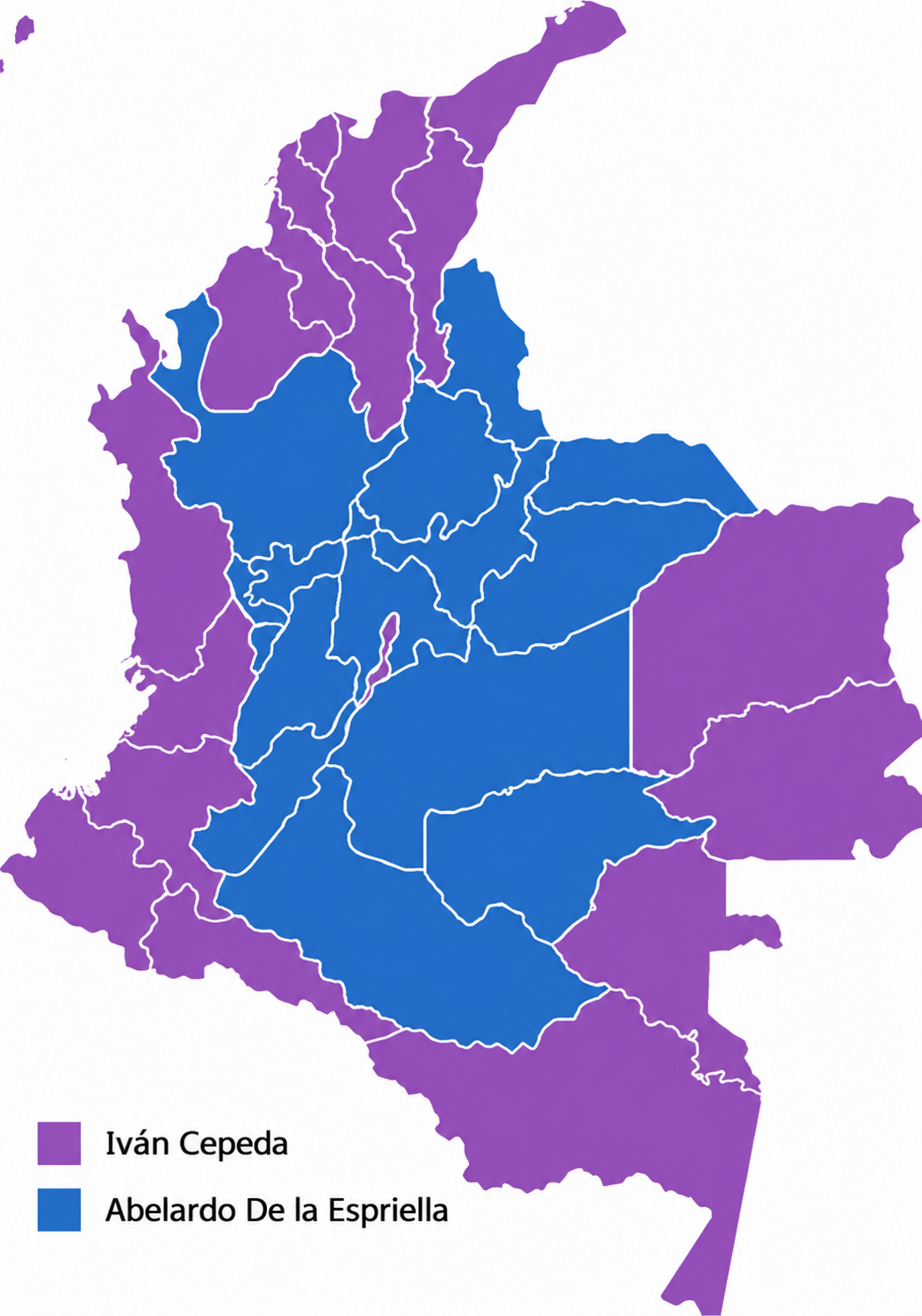
The survey places De la Espriella, founder of the pro-democracy movement Defensores de la Patria, at 28% of voting intentions, narrowly ahead of left-wing senator Iván Cepeda at 26.5%. Former Antioquia governor Sergio Fajardo ranks third with 9.4%, once again failing to surpass the 10% benchmark that has long eluded his centrist candidacies.
A corporate lawyer by training, De la Espriella rose to prominence as a high-profile legal advocate for conservative causes and a vocal critic of President Gustavo Petro’s reform agenda. His political ascent has been driven by hardline law-and-order rhetoric, a confrontational style and an aggressive use of social media, allowing him to position himself as an outsider channeling anti-establishment sentiment and opposition to the left.
In a hypothetical second-round runoff, De la Espriella would defeat hard-leftist Cepeda by 9.3 percentage points, the poll found, consolidating his status as the best-positioned opposition figure at this early stage of the race.
AtlasIntel also projected a runoff between De la Espriella and Fajardo. In that scenario, De la Espriella would secure 37.9% of the vote, compared with 23.2% for Fajardo — a margin of 14.7 points.
Fajardo, a mathematician and former governor of Antioquia from 2012 to 2016, has struggled to expand his electoral base beyond a narrow segment of moderate voters. His current polling echoes his performance in the first round of the 2022 presidential election, when he placed fourth with just over 800,000 votes, equivalent to 4.2% of the total, despite entering that race as a well-known national figure.
Further down the field, Juan Carlos Pinzón and Paloma Valencia each registered 5.1% support, followed by Claudia López (2.6%), Enrique Peñalosa (2.3%), Juan Daniel Oviedo (1.8%) and Aníbal Gaviria (1.3%). Several other candidates polled below 1%.
The survey found that 7.2% of respondents would vote blank, 5.7% remain undecided, and 1.1% said they would not vote.
Valencia, a senator from the right-wing Centro Democrático party, could nonetheless emerge as a pivotal figure in the race. Former president Álvaro Uribe Vélez, Colombia’s most influential conservative leader, has named Valencia as the party’s official presidential candidate, formally placing the weight of his political machine behind her campaign.
Uribe, who governed Colombia from 2002 to 2010, retains significant influence, particularly in his home region of Antioquia and in the country’s second-largest city, Medellín, long considered a stronghold of uribismo. Analysts say Valencia’s numbers could rise sharply as party structures mobilise and undecided conservative voters coalesce around an officially endorsed candidate.
In other simulated second-round matchups, Valencia would narrowly defeat Cepeda by 2.4 points, while Cepeda would beat former defence minister Pinzón by 4.5 points, according to the poll.
AtlasIntel also measured voter intentions ahead of Colombia’s interparty primaries scheduled for March 8, to be held alongside congressional elections. About 18.7% of respondents said they plan to participate in the “Gran Consulta por Colombia,” while 29.8% expressed interest in voting in the leftist “Pacto Amplio”. Former Colombian Ambassador to the United Kingdom and insider of the Petro administration, Roy Barreras, is seen as a leading contender to the clinch the consultation.
Within the Gran Consulta, Valencia leads with 19.1% among likely participants, followed by Pinzón (13.1%), Aníbal Gaviria (11.1%), Juan Daniel Oviedo (10.6%) and former Semana director Vicky Dávila (7%).
The poll results reinforce a broader pattern of fragmentation across the centre and right, even as opposition voters increasingly focus on preventing a left-wing victory. With five months to go before the May 31 election, an emerging landscape of “all against Cepeda” has appeared on the horizon, in which disparate conservative and centrist forces could eventually rally behind a single contender in a runoff scenario on June 19, 2026.
In this context, De la Espriella — himself a close ideological ally of Uribe — could seek to consolidate all right-wing factions by selecting Valencia as a potential vice-presidential running mate, move that would unite his strong support on the Colombian coast, with the strength of Centro Democrático and Uribe’s loyal political base in conservative departments.
According to AtlasIntel’s CEO Andrei Roman, the contest is being shaped by persistent ideological polarisation, internal divisions within the opposition, and the growing dominance of social media.
“The race is structured around the continuity of Petro-style progressivism versus a broad anti-Petro front,” Roman said. “At the same time, digital presence has become decisive, allowing outsider figures to gain traction quickly and redefine political mobilisation.”