Normal view

Colombia Concludes Multilateral Diplomatic Event With African Nations

22 March 2026 at 21:15

New Africa initiative drives 112% growth in non-mining exports.

The Ministerio de Comercio, Industria y Turismo (Ministry of Trade, Industry, and Tourism) hosted the first Foro de Reencuentro Económico CELAC–África at the Ágora Convention Center in Bogotá on March 20, 2026. The event, held as part of a broader high-level forum, aimed to strengthen commercial and investment ties between Colombia and the African continent. During the proceedings, officials identified various sectors for potential growth, including jewelry, agricultural machinery, construction materials, software, digital marketing, and food and beverages.

Minister of Trade Diana Marcela Morales Rojas stated that the forum represents a strategic shift toward trade equity and shared economic opportunities. Over the past four years, the Colombian government has sought to diversify its market reach through economic diplomacy, trade missions, and the establishment of new logistical routes to Africa. Data from 2025 indicates that these efforts have resulted in a significant increase in non-mining and non-energy exports to the continent.

“We aim for this forum to mark the beginning of a new stage: one of strategic cooperation, trade with equity, and the construction of shared opportunities.” — Diana Marcela Morales Rojas, Minister of Trade, Industry, and Tourism.

According to ministry figures, non-mining exports to Africa reached $296.5 million USD in 2025, representing a 112% increase compared to 2024. In terms of volume, these shipments totaled 209,273 tons, a 226.8% rise over the previous year. These goods accounted for 46.6% of Colombia’s total exports to the continent, signaling a shift toward a more diversified export basket. Key products driving this growth include coffee, bananas, machinery, paper, and apparel.

The number of Colombian firms participating in this trade has also expanded. In 2025, 165 companies exported non-mining goods to Africa with values exceeding $10,000 USD, up from 145 companies in 2024. This 15.2% growth in participating firms underscores a transition toward higher value-added exports. Vice President Francia Márquez Mina noted that the economies of Latin America and Africa are complementary, offering potential for the development of new value chains and the utilization of strategic mineral reserves necessary for the global energy transition.

A central component of the forum was a business matchmaking event held on March 17 and 18. Preliminary results from the session show expected trade operations totaling $16 million USD. Nicolás Mejía, Vice President of Exports at ProColombia, characterized the results as a validation of the current market diversification plan. Since the beginning of the current administration, the government has implemented the Estrategia África 2022–2026 to strengthen socioeconomic relations with the region.

Through commercial intelligence analysis, the Colombian government has prioritized nine specific markets for its diplomatic and economic deployment: South Africa, Angola, Mozambique, Nigeria, Ghana, Senegal, Egypt, Tunisia, and Algeria. These nations serve as the primary focus for the continued implementation of the 2022–2026 strategy.

Above photo: MinCIT/Ricardo Báez.

Jaguar Uranium Initiates Rare Earth Element Assessment at Colombia’s Berlin Mining Project

20 March 2026 at 22:52

Berlin has historically reported indications of Rare Earth Elements, Vanadium, Phosphate and Uranium — Positioned as Potential Non-Chinese Critical Minerals Project in the Western Hemisphere

TORONTO — Jaguar Uranium Corp. (NYSE American: JAGU) has commenced an initial rare earth element assessment program at its flagship Berlin Project in Caldas, Colombia. The site is a polymetallic sedimentary deposit containing uranium mineralization alongside associated rare earth elements (REE) and battery-related commodities such as vanadium, phosphate, nickel, molybdenum, rhenium, and yttrium.

The company plans to utilize approximately 20,000 meters of preserved historic drill core for selective re-sampling and assaying. This approach is intended to advance early-stage REE characterization without the immediate requirement for new drilling. The program represents the first dedicated effort by the company to evaluate the rare earth potential of the 9,053-hectare concession area.

“The results could be a step-change in how this project is understood and technically evaluated.” — Steven Gold, Chief Executive Officer, Jaguar Uranium Corp.

“We are now attempting to advance the recognition that Berlin could represent a relevant non-China based critical mineral deposits in the western hemisphere and specifically in Latin America,” stated Steven Gold, Chief Executive Officer of Jaguar Uranium Corp. “We believe the results could be a step-change in how this project is understood and technically evaluated.”

The strategic shift toward REE evaluation follows a period of increased global policy attention regarding critical mineral supply chains. Materials required for defense systems, electric vehicles, and clean energy infrastructure have become a priority for Western governments seeking to diversify away from Chinese-dominated markets. Gracelin Baskaran, director of the Critical Minerals Security Program at the Center for Strategic and International Studies (CSIS), has indicated that the US and the European Union are working to foster independent markets for these materials.

The Berlin Project deposit is situated within a layered sedimentary sequence of phosphate-bearing limestone. The company is employing a three-phase approach for its assessment: core logging and systematic re-sampling, multi-element geological modeling, and an evaluation of by-product economics. This modeling will integrate REE assay data with existing datasets for uranium, vanadium, and phosphate to establish a technical foundation for future resource estimates.

Infrastructure at the site includes proximity to a hydroelectric power source 12 kilometers away and access to a river port approximately 65 kilometers from the project, providing a logistical route to the Caribbean coast. The company, which completed a $25 million USD initial public offering on the NYSE American (NYSE American: JAGU) in February 2026, is also managing the Laguna Salada Project in the Argentine province of Chubut and the Huemul mine in Mendoza.

Technical information regarding the program was approved by Owen D. W. Miller, a qualified person as defined by NI 43-101. The company noted that the Berlin Project remains in the exploration stage and does not currently host mineral resources or reserves as defined under SEC Regulation S-K 1300.

Above photo: Col. John P. Kunstbeck scans uranium ore for alpha and beta radiation signatures outside of a uranium mill. (Photo Credit: U.S. Army photo by Maj. Mark S. Quint)

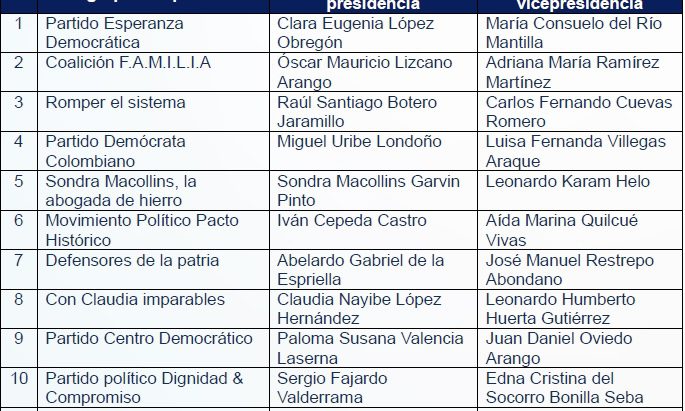
Colombia Confirms 14 Candidates for 2026 Presidential Election

20 March 2026 at 22:26

Though surprises are possible, polling says the front runners are Iván Cepeda, Abelardo de la Espriella, and Paloma Valencia.

The Registraduría Nacional del Estado Civil of Colombia (RNEC), the entity responsible for organizing elections in the country, reported that a total of 14 candidates have officially registered to run in the country’s presidential elections, scheduled for May 31, 2026. In this vote, citizens will elect the President and Vice President of the Republic for the 2026–2030 term.

According to the electoral authority, the candidates represent a wide range of political perspectives, from left to right, including independent candidacies running through political movements. Here the list and brief profile of the candidates:

  1. Clara Eugenia López Obregón, currently a senator for the Esperanza Democrática She has served as Minister of Labor (2016–2017), acting mayor of Bogotá (2011–2012), and Bogotá’s secretary of government (2008–2010). She has been affiliated with left-wing parties and was Gustavo Petro’s vice presidential running mate in the 2010 election.
  2. Óscar Mauricio Lizcano, from the FAMILIA coalition. He served as Minister of Information Technologies (2023–2025), was a senator (2010–2018), and a member of the House of Representatives (2006–2010).
  3. Raúl Santiago Botero, candidate of the “Romper el Sistema” movement (Break the Establishment). An agronomist engineer and businessman from Medellín, he presents himself as an independent candidate with no prior political experience.
  4. Miguel Uribe Londoño, father of the slain presidential candidate Miguel Uribe Turbay. He is running under the Colombian Democratic Party and previously served as president of the Centro Democrático party founded by Álvaro Uribe Vélez.
  5. Sondra Macollins Garvin, from the movement “La Abogada de Hierro” (The Iron Lawyer) A criminal lawyer and psychologist, she presents herself as an independent candidate without political affiliations. She ran for the House of Representatives in 2022 and is known for her work in narcotrafficking and corruption cases.
  6. Iván Cepeda Castro, a senator since 2014 and the official candidate of the Pacto Histórico, the same party as President Gustavo Petro. Polls project he will receive the highest vote share in the first election round. He is aligned with left-wing political ideas.
  7. Abelardo de la Espriella, a lawyer with far-right positions, running for the first time under the Defensores de la Patria movement. Recent polls place him as a likely second or third contender in voter preference.
  8. Claudia López Hernández, former mayor of Bogotá (2020–2023) and former senator (2014–2018), running under the centrist movement “Imparables con Claudia.” She is known for her anti-corruption agenda and secured her candidacy with more than 570,000 votes (about 9%) in recent interparty primaries.
  9. Paloma Valencia Laserna, current senator and candidate of the Centro Democrático party led by Álvaro Uribe Vélez. She won the right-wing interparty primary on March 8 with more than 3 million votes. Polls place her among the top three contenders, and if she reaches a runoff, she would become the first woman in Colombia’s history to do so.
  • Sergio Fajardo Valderrama, an academic and mathematician running for the Dignidad y Compromiso He served as mayor of Medellín and governor of Antioquia and is running for president for the third time.
  • Roy Barreras, from the political party La Fuerza (The Force). He won the left-wing coalition primary on March 8 with the lowest vote total (257,000 votes, about 3.6%). Although currently aligned with left-wing movements and part of the Petro administration, he has previously been affiliated with right- and center-leaning parties.
  • Gustavo Matamoros Camacho, of the Colombian Ecologist Party. He served in the Colombian Army for 43 years. With no prior political experience, his campaign focuses on public security.
  • Luis Gilberto Murillo, who served as Minister of Foreign Affairs (2024–2025) and Colombia’s ambassador to the United States (2022–2024). A human rights advocate and Afro-Colombian leader from Chocó, he presents himself as an independent, moderate, centrist candidate.
  • Carlos Eduardo Caicedo, running under the independent movement “Con Caicedo.” He was mayor of Santa Marta (2012–2015) and governor of Magdalena (2020–2023), where he built a strong base as a left-wing political leader.

The RNEC also reported that “the draw to determine the position of presidential candidates on the ballot will take place on March 25 at the Ágora Bogotá Convention Center.”

This process marks the formal start of the final phase of the presidential campaign, during which candidates will seek to consolidate support ahead of the first round on May 31. If no candidate secures an absolute majority, a runoff between the two leading candidates will be held on June 21.

List of registered candidates for Colombia’s presidency. Photo courtesy of the Registraduría Nacional del Estado Civil.

List of registered candidates for Colombia’s presidency. Photo courtesy of the Registraduría Nacional del Estado Civil.

Headline photo: Polling station in Colombia during last Congress elections in March 8, 2026. Photo courtesy of the Registraduría Nacional del Estado Civil.

Festival Estéreo Picnic 2026: Brave New Mundo Distinto

20 March 2026 at 20:19

Colombia’s premier music event kicks off today, with top tier talent throughout the bill. Who’s on and what do you need to know about Festival Estéreo Picnic 2026? 

Festival Estéreo Picnic 2026 is here at last! By far the most high-profile event in the Bogotá musical calendar, the festival has gone from strength to strength since its return to the heart of the capital and this year is certainly no exception. The sun has even come out to say hello for Friday at least.

With music event tourism growing in popularity, Festival Estéreo Picnic 2026 is a reason to visit Bogotá for many, with floods of foreign tourists coming in from Latin America and beyond, eager to check out what a contemporary Latin music festival looks like and how rolos party.

Our guide will let you in on some talent you might not have heard of on the bill as well as give you an idea of what the festival itself is like. Whether that’s eating and drinking, transportation or even what to wear, we’ve got you covered.

How to get around Festival Estéreo Picnic 2026

First time at Festival Estéreo Picnic? First time at a major Latin event? Don’t worry, it’s a well-oiled machine that is easy to deal with. All basic transactions are done via a cashless wristband that you can pick up onsite. The system is easy to charge, use and even reclaim outstanding balance from.

Bands are usually timed so that you can flip back and forth between the two main stages (Festival Estereo Picnic and Mundo Distinto) and catch everyone as long as you don’t need to be right at the front for everyone. Getting around is usually pretty easy, with big wide paths and wheelchair access relatively well set up.

Estéreo Picnic is definitely the main stage, facing in reverse to the Rock al Parque setup, but Mundo Distinto pushes it close as a strong second stage. Many years it sees the best performances, with the likes of Fatboy Slim and Limp Biskit ripping it up in recent years.

However, for true music geek points you’ll want to get to Lago (behind the second stage) and Bosque (to the left of main stage) for smaller bands and a more intimate atmosphere. When well-supported locals are onstage, this is a lively place to be.

There’s even a beach! Sort of.

As well as the bands on the open air stages there are also a triptych of tents. These feature a range of cabaret artists – expect burlesque, drag and the like – and a revolving lineup of mostly local DJs. These are great places to dip into if you’re left cold by the stages, but expect a fierce heat inside.

In terms of refreshments you should have no problems. There’s a decent dedicated eating area and unless you go at the absolute peak time you should have no trouble finding seats. Prices are towards the higher end of Bogotá, but not at all crazy.

Offerings are similar to what you might expect to find in a food court at a mall: a bunch of big and big-ish chains plus a few smaller outlets. Vegans are usually catered to by either NoPollo or Stankov. There’ll be a craft beer stall somewhere plus a BBC van.

This is Bogotá, so make sure you pack waterproofs and suncream porque sí. You probably need at least one of them and possibly both. If you turn up in the late afternoon you can get away without the cream, but remember people burn fast at altitude.

Decent hiking waterproofs aren’t high fashion but they are very practical and with La Niña refusing to clear off, likely to be necessary. Even if you avoid the actual rainy spells, there’s a good chance of muddy patches that can quickly ruin nice trainers.

El mundo distinto is set to be sunny for the start of the weekend

If you find yourself with a long time between bands or needing a rest, there are chill out zones to relax with as well as a market featuring stalls usually run by independent brands. There will also be plenty of megacorps trying to flog stuff all over the park.

This year, it’s a three-day event. That seems like a good move, concentrating quality into a long weekend rather than stretching things over four days. Adult tickets start at COP$523,000 for a single day and are available online via Ticketmaster here

Finally, toilets. Yes, it’s a festival, but no, they aren’t bad. Men and women are neatly separated, but make sure you bring a pack of tissues as paper is usually in short supply. The area is nice and large so no risk of anything horrible happening.

Who to watch at Festival Estéreo Picnic 2026?

Friday

Friday’s lineup starts strong

Get onsite early to check out Entreco opening the Lago stage at 4pm on the way in. They’re queer-punk iconoclasts from Cali with a long history. The crowd might be small, but the performance will be big, with plenty of charisma on stage. Manú is then over at the Bosque for some more introspective pop.

Djo and Katseye arrived at the airport together this week and they play joined at the hip – the latter on the second stage for sundown, with the former taking over on the main stage after an hour.

Then things get complicated. Six Sex will be on a minor stage, Bogotá rockcito mainstays Nicolás y los Fumadores are at the Lago and Addison Rae lights up the second stage. Digital Nuclear Transistor is worth catching in the tents if you’re a fan of dark techno.

And then Turnstile arrive at the main stage for what will be a crushing moshpit. They’re on at the right time in the right place: it’ll be intense, just as it was when they played here a few years back.

With probably the strongest single-day lineup, there’s only one place to be to see out the day as Tyler, the Creator takes to the stage at 23:15. Lorde is the warm-up on the second stage if you don’t want to be pushing to the front for the headliner.

Saturday

Old favourites return on Saturday

After Friday’s fun and games, you might be tempted to arrive late on the following afternoon. That would be a shame, because there’s some fine acts early doors. Machaka from Ecuador is an interesting take on Latin pop, Kabinett is wildly inventive alternative electronica and 31 minutos is a puppet show. Yes really, and it’ll be huge.

Perhaps one of the most Latin experiences you can have is on today: La Tigresa del Oriente. An octagenarian balladeer that defies all comparison and most description, look her up to get an idea of what’ll happen. Aora tent at 7pm, it’ll be something special.

After that, you have Tom Morello continuing to rage against the machine, but still having an early night and The Killers, who have been here before and always turn in a big set. Swedish House Mafia close out the second stage and that is likely to be bouncing, with Festival Estéreo Picnic always loving this type of slot.

Sunday

Sunday finishes on a high

The day kicks off with an absolute riot of local talent from early on, with Anto<3, Agraciada Pirineos en Llamas and Zarigüeya all opening stages. All four are exciting young Colombian talent that reward those getting onsite to see them.

Unlike anything else on the bill, Zarigüeya is proudly political without tubthumping and blending carranga rhythms into a smooth smorgasbord of styles.

Latin American maximalism is represented by Agraciada, who teams that visual style with soulful, delicate minimalist harmonies.

Anto<3, meanwhile, are a very different proposition entirely. That’s Gen Z Latin hyperpop that’s bouncy, energetic and sultry all at once.

Macario Martínez is a Mexican viral sensation tipped to make it big while booking Travis to play Colombia early afternoon this close to the rainy season is frankly tempting fate. Then there’s the mystery of pop pixie Sabrina Carpenter, a ray of upbeat pop among an array of darker and more aggressive acts.

Those are Interpol, Deftones and Skrillex, giving a very turn of the century feel to the end of the festival. Interpol will sound like they always do, serviceable, but the other two are more interesting. 

Deftones are back on track after some rocky years, gaining near-universal acclaim for this tour as more people re-evaluate their position as nu-metal pioneers. Skrillex, meanwhile, dug a furrow all of his own as the DJ metalheads love and metalhead DJs love. He’ll lean more into the former than latter to close out Festival Estéreo Picnic 2026.

The post Festival Estéreo Picnic 2026: Brave New Mundo Distinto appeared first on The Bogotá Post.

U.S. prosecutors probe Colombia’s Petro over alleged narco links, NYT reports

20 March 2026 at 20:10

U.S. federal prosecutors have opened preliminary criminal investigations into Colombian President Gustavo Petro over alleged links to drug traffickers and possible illicit financing of his 2022 campaign, according to a report by The New York Times.

The previously undisclosed probes are being conducted by federal prosecutors in Manhattan and Brooklyn and involve specialists in international narcotics trafficking, as well as agents from the Drug Enforcement Administration and Homeland Security Investigations, the newspaper said, citing people familiar with the matter.

Investigators are examining, among other issues, whether Petro held meetings with individuals connected to drug trafficking networks and whether his presidential campaign solicited or received donations from such actors. The two investigations are being carried out independently and remain in their early stages, with no certainty that they will lead to formal criminal charges.

There is no indication that the White House played any role in launching the investigations, according to the report. However, the inquiries emerge in a broader context of heightened tensions and fluctuating diplomacy between Bogotá and Washington.

Relations between Petro and U.S. President Donald Trump have been volatile, marked by sharp public exchanges, threats of tariffs that were never implemented, and the temporary revocation of Petro’s U.S. visa. Trump has repeatedly accused Petro of failing to curb narcotics production and has described him in highly critical terms, while Petro has denounced what he characterises as political pressure and interference.

The U.S. Treasury Department last year imposed sanctions on Petro, members of his family and senior officials, including Interior Minister Armando Benedetti, alleging links to narcotics activity. The measures, which included asset freezes and travel restrictions, were justified by Washington on the grounds that cocaine production in Colombia had reached record levels and that the government had offered concessions to armed groups involved in trafficking.

Petro has rejected those claims, insisting that his administration has strengthened seizures of cocaine and slowed the rate of expansion of coca cultivation. He has also denied any knowledge of illicit funds entering his campaign, dismissing the allegations as politically motivated attacks.

Colombia’s Attorney General  is examining charges that Petro’s son – Nicolás Petro – received money from individuals linked to illicit activities during the 2022 campaign. While his son acknowledged receiving funds that were not reported, no criminal charges have been filed against the president himself, and Petro has maintained he was unaware of the campaign “donations”.

According to the NYT, the U.S. investigations are taking place amid a broader strategy in which Washington has increasingly used legal and judicial tools to advance foreign policy objectives. Analysts say such actions could serve as leverage in bilateral relations or influence political dynamics in allied countries.

The timing of the probes is particularly sensitive, as Colombia prepares for presidential elections on May 31, with a potential runoff in June. Petro, the country’s first leftist president, is constitutionally barred from seeking re-election but has actively backed his political successor with hardleftist Iván Cepeda.

The allegations could reverberate through the electoral campaign, where relations with the United States remain a central issue. Candidates on the right have emphasised the importance of maintaining close ties with Washington, while figures on the left have framed U.S. actions as a challenge to Colombia’s sovereignty.

Despite months of tensions, diplomatic relations between the two countries have shown signs of stabilisation in recent weeks. Petro and Trump held a bilateral meeting at the White House earlier this year, which both sides described as constructive, and officials have since sought to rebuild communication channels.

Even so, uncertainty persists over the trajectory of the relationship, particularly as Washington continues to prioritise counternarcotics cooperation with Colombia, historically one of its closest partners in the region.

Petro has consistently denied any links to drug trafficking and has pointed to his government’s security strategy, which includes negotiations with armed groups and efforts to reduce violence, as evidence of a broader approach to the drug trade.

The start of U.S. investigations add a new layer of complexity to an already fraught political and diplomatic landscape, with potential implications not only for Petro’s post-presidential future but for Colombia’s ties with its most important security ally.

Festival Estéreo Picnic 2026: Agraciada is happy to be here

20 March 2026 at 19:26

Mixing Latin American maximalist visuals with a sensitive minimalist sound, Agraciada is set to light up Festival Estéreo Picnic 2026.

Huilense popster Agraciada in person screams Latin American maximalism with her outfit. Musically, though, she’s more introspective and sensitive with a deep groundswell of emotion eddying through her songs in the tradition of melancholic Latin crooners. She’s set to bring something different to Festival Estéreo Picnic 2026.

This clash of flamboyance and melancholy would be reminiscent of Morrissey were she not so easy to talk to and such pleasant company. Born Georgina Rojas Vargás, she explains where the dualism of visual maximalism and musical minimalism comes from. 

“It depends on the day,” she says with regard to her flamboyant outfit and stuffed toy. “Sometimes you have to do something a bit special. The visual identity is very important for me, the maximalism. That has a lot to do with my day-to-day life too.”

She warms to the theme, explaining that when it comes to music she thinks less can be more. “I consider myself very sensitive, it’s part of my personality. I perceive everything as very intense and music permits me to express that.”

Her music is very traditional in terms of emotion and emphasis, with a heavy focus on loss, melancholy and sadness as well as dreams of love. While there’s a lot going on, it’s muted rather than flashy, allowing the vocals to take centre stage. 

In the Latin tradition, it’s gentle and soulful with stripped back wistful harmonies. “I consider my music very melancholic,” she says, continuing “there’s the romanticism of salsa and ranchera as well as other traditional genres in Colombia and Mexico particularly. It’s a very Latin American mix.”

Pressed for a personal recommendation, she says that “Calor de corazón shows the intensity of my personality.” She recommends listening in 5.1 surround sound for the full effect of the aural soundscape to reach and envelop you.

She’s looking forward to being onstage at Festival Estéreo Picnic 2026 as she loves performing. “For me art is like a service, I’m inviting the audience to share something very personal from me.” She’s been in Bogotá more than enough time to pick up the accent, so she knows just how big a stage this is.

It’ll be a big affair as well – she’s turning up with full musical support. “There will be 15 musicians on stage with me, because they’re my friends and we want to put something a bit different on stage. That includes two pianos.”

Agraciada is a bundle of contrasts that triggers lots of emotions through her gentle, softcore delivery. It’s perfect music both for a warm Bogotá afternoon at Festival Estéreo Picnic 2026 or in a nice cosy bar elsewhere in la nevera.

Agraciada plays the Bosque stage on Sunday March 22 at 14:30 as part of Festival Estéreo Picnic 2026.

The post Festival Estéreo Picnic 2026: Agraciada is happy to be here appeared first on The Bogotá Post.

Festival Estéreo Picnic 2026: Zarigüeya – Proudly political

20 March 2026 at 05:32

Singer-songwriter Zarigüeya is on a learning curve at Festival Estéreo Picnic 2026, but she’s sure of her principles. Find out why she’s not on the world’s biggest music streamer.

Colombian singer-songwriter Zarigüeya at a promotional event for Festival Estéreo Picnic 2026. She is in a red phone box drinking through a straw.
Sara at the Festival Estéreo Picnic press event

Singer Sara Puentes Umbarila is performing at Festival Estéreo Picnic 2026 with a musical style that’s markedly different to much of the bill.

Known as Zarigüeya, she combines a range of musical influences with an unapologetically political stance. This isn’t party politics though, instead being about principles and philosophy.

It’s not easy finding Zarigüeya online, and she readily explains why. “I’m really hard to find because I’m not on Spotify. I was, but then I took my music out of the platform. It was a political decision, because I found out the owner was investing in war and on top of that they don’t pay the artists well. So I prefer not to be part of that.”

It’s a principled stand of the type that used to be normal in music but is becoming less commonplace. “I know it’s important for artists to be easy to find, but I don’t care.” A sentiment that might resonate with the likes of Tom Morello on the bill.

Not being on Spotify means more promotion the old-fashioned way – making good music and playing it live. And there’s no bigger stage than Festival Estéreo Picnic 2026. “I’m here to learn, basically, she says, adding “I feel good, a little bit shy, anxious  but I know it’s going to be really fun and special to have this chance to share this music in places where I usually wouldn’t go.”

Making the effort to find her music (on pretty much any other platform) is well worth it though. She has a beguilingly soft voice that underpins deep lyrics. While she’s certainly part of the well established Latin tradition of a singer with a guitar, there’s a lot more to her music, blending a rainbow range of rhythms and styles.

She returns again to the theme of learning as she explains how her songs differ. “I’m still figuring things out after three years as a songwriter, so I have my band and I also play alone.” That adds to the sense of whimsy that permeates her sound – as comfortable with full backing or going solo.

Carranga pops up often in descriptions of Zarigüeya and it is a part of the mix, but she draws from lots of sources. “I mean, I love carranga, it’s one of my favorite genres, but this is not intended to be 100% carranga.”

“This is music, you have a little bit of many different rhythms. It has a clear carranga inspiration but not in all the songs. Three or four have a strong influence, but many are just whatever comes [to me] in the moment, not on a strict schedule.”

It’s no surprise that this isn’t just a musical basis. “One of my biggest influences is Violeta Parra cause she has an amazing voice, she had a very free spirit and also was always trying to find songs in the fields, in the mountains, in the people. And also she was really political in her songs which is something I admire.”

It’s a departure from much of the bill, for sure. “[The audience] can expect to see something different from the rest of the lineup, because of the music and also the vibe of the show. I like to talk a lot and be very narrative.” Adding to that is a multimedia experience, with a friend illustrating live on stage and her own art also prominent as a backdrop.

Festival Estéreo Picnic 2026 isn’t her usual scene, so it’s a special opportunity. “I go to other places usually, other kinds of festivals. So in all senses it’s new to me. It’s challenging and confronting to be part of this. I was not looking for it but I think I will learn a lot.” As will you if you get to her set on Sunday, or further down the line.

Zarigüeya plays the Lago stage at 14:15 on Sunday afternoon at Festival Estéreo Picnic 2026.

The post Festival Estéreo Picnic 2026: Zarigüeya – Proudly political appeared first on The Bogotá Post.

Nearly 100 human rights defenders killed every year in Colombia: UN report

19 March 2026 at 22:09

Medellín, Colombia – During each of the last nine years around 100 human rights defenders have been assassinated in Colombia, according to a United Nations (UN) report published this Thursday.

The 972 deaths recorded between 2016 and 2025 make Colombia “one of the most dangerous countries in the world” for such activists, according to the UN’s High Commissioner for Human Rights, Volker Türk. 

Following the historic peace accords between the government and the Revolutionary Armed Forces of Colombia (FARC) in 2016, the report noted a gradual increase in assassinations. 

This was linked to the state’s inability to maintain a strong presence in areas previously controlled by the guerrilla group. 

Over 70% of identified perpetrators were armed non-state actors, with the majority of cases analyzed by the report involved in drug trafficking, illegal mining, illegal logging, and human trafficking. 

The number of attacks and threats against human rights defenders investigated by the UN between 2022 and 2025 was 2,018, however this is thought to represent “only a fraction” of the true number due to underreporting and the lack of efficient government records of such cases. 

The report recognized the work of the current Historic Pact (Pacto Histórico) government of Gustavo Petro, which has publicly recognized the gravity of the situation and worked to develop a national strategy to counter it. 

This included the 2022 law that established peace as a matter of state policy, recognizing the state’s responsibility to “guarantee human security” through a “territorial and intersectional approach”. 

However, the UN says the state’s response has failed human rights defenders due to its fragmented nature that lacks coordination between national, departmental, and municipal authorities. 

“In addition to ensuring accountability for the murders that have taken place, addressing the structural causes of this human tragedy through a comprehensive approach must be a priority for all relevant authorities in Colombia, in order to protect human rights defenders and enable them to carry out their vital work safely,” Türk said. 

High levels of impunity have also persisted, with only 55 out of the 800 cases investigated between 2022 and 2025 ending in sentencing. In over half of these cases, no suspects have been identified. 

Nearly a quarter of victims identified by the UN were Indigenous (23%) highlighting a disproportionate effect on this population that represents less than 5% of Colombians. 

Other disproportionately affected groups include Afro-Colombians, LGBTQ+ individuals, rural community leaders and environmental protectors, as well as political leaders. 

The report concluded by urging the Colombian state to take action to combat this issue, recommending institutional reforms and criminal investigations into perpetrators.

Featured image credit: Leon Hernandez via Flickr.

The post Nearly 100 human rights defenders killed every year in Colombia: UN report appeared first on The Bogotá Post.

Cristina Zambrano Restrepo of ACI Medellin Unpacks the Colombian City’s Surge With Over $400 Million USD in Foreign Direct Investment

18 March 2026 at 22:55

Medellín, Colombia’s second-largest city, is often cited globally as a textbook example of urban transformation. Central to this evolution is ACI Medellín, the city’s specialized Agency for Cooperation and Investment. By fostering a unique “triple helix” collaboration between the public sector, private enterprise, and academia, the agency has managed to maintain a stable environment for capital even during periods of national political volatility.

In this exclusive interview, Loren Moss, Executive Editor of Finance Colombia, speaks with Cristina Zambrano Restrepo, the Executive Director of ACI Medellín. They discuss how the city nearly tripled its investment attraction over the past year, reaching over $400 million USD, and the strategies used to reassure international investors during a complex electoral landscape in Colombia.

Finance Colombia: I’m here with Cristina Zambrano Restrepo, the Executive Director of ACI Medellín. It’s always a pleasure to be with you. Thank you for the invitation. I know you’re extremely busy, so thank you for making the time to speak with Finance Colombia. How have you been?

Cristina Zambrano Restrepo: Very well, thank you very much. Truly happy to be here with you. Thank you for accepting this invitation. Without a doubt, we work to bring good and positive news to this city, and thank you for being here and for sharing and conveying all of these good things.

Finance Colombia: Yes, today you talked about the successes that ACI Medellín and the city have had this year in attracting investment. Tell us a bit about some of those successes. I think it’s going to be another large business hotel, and tell us a little about how you’ve kept busy.

Cristina Zambrano Restrepo: Of course. A major focus for us is job creation through investment attraction. So, what did we achieve this year? We went from USD 150 million generated last year to more than USD 400 million this year. As I’ve mentioned, this is reflected in the creation of more than 11,500 formal, high-quality jobs generated by this investment attraction. We have major allies and players here, such as Renault-Sofasa, Rivana Business Park, SoftServe, and POMA. A great deal of companies, some already established, others newly arriving in the region. TaskUs too, which is also extremely important and has made major commitments to us. These are the companies that manage to generate that employment.

Finance Colombia: Excellent, that’s fascinating. I have a history with Colombia of about 20 years, and here in Medellín of about 11 years, and it’s truly wonderful to see how the city has grown—not only in population, but in investment and innovation. However, we’re living in a time of high uncertainty around the world—not just in Colombia, not just in the United States, but globally. Especially when we talk about the sector, not in general terms, but politically and economically. Has this made attracting investment more difficult or more challenging over the past year? How has this affected efforts to attract FDI, like, foreign investment, and what strategies have you used to overcome this challenge?

Cristina Zambrano Restrepo: Here, clearly, the political landscape affects and directly impacts confidence, right? The stability of a region, how we present ourselves to the world and to those very large capital investments, showing that we are a stable region, that we believe in them, and that we will support them. So, what strategies do we have? Without a doubt, it has been very challenging. We would like, for example, to be able to offer a range of benefits, extensions, fast-track processes in permitting and such, but in that sense we depend heavily on the national government. But we don’t stop there. We work from the regional level and have a firm commitment locally, focusing on what we ourselves can support, contribute, and manage from this area, the private sector. Which also helped sustain the region during the previous administration, and the academic sector, all the universities, and that ecosystem, which have been fundamental. And now the public sector as well, we are all working together specifically from this region to demonstrate that we are a region that inspires confidence, offers stability, and has all the right conditions for investment to continue to arrive.

Finance Colombia: One thing you’ve mentioned that’s very important, and something Medellín is known for, is the collaboration between the private and public sectors. In many other places, without naming names, it’s an endless war. But in Medellín it has always felt like it’s everybody. That’s why Medellín has always had the Metro and continues to have major projects here, because the private sector has a strong sense of civic ownership. People talk about the GEA, but from a foreign perspective, what I’ve seen is that companies like Grupo Argos, SURA, Bancolombia, and more recently Nutresa, and many smaller ones that aren’t international names, have a sense of belonging and work hand in hand with the government. Speaking of that, for example, Mayor Federico Gutiérrez has traveled to the United States and other places to maintain those good relationships, despite what may be happening in Bogotá or at the Casa de Nariño. What is the importance of the efforts made by the metropolitan government and the city government of Medellín, not only at the ACI level, but also at the level of Alpujarra? How important is this in maintaining a long-term course so that foreign investors continue to see Medellín as a destination, no matter how much may be happening 400 kilometers away?

“We went from USD 150 million generated last year to more than USD 400 million this year… reflected in the creation of more than 11,500 formal, high-quality jobs.” — Cristina Zambrano Restrepo

Cristina Zambrano Restrepo: I think what you’re pointing out is fundamental, and it’s specifically how we’ve achieved this model in Medellín. In a way, when we go out into the world and explain how we work hand in hand, as you said, there are cities and countries that react like, “Why do we need to sit at the same table? I’m very clear about my purpose, and you’re very clear about yours.” Here, the real history of what this city lived through 40 years ago made all of us sit at the same table, and we realized that the efforts of the three actors are always aligned toward the same goals. What always matters to us is citizens’ well-being, quality of life, economic and social development, many things. So when we were going through our hardest moments, we managed to set aside egos, agendas, and competing visions. We sat down, we talked, and we’ve continued to work under that model ever since.

As for what’s happening and what lies ahead in the future: clearly, having a political leader like Federico Gutiérrez, with those strategies and international connections, matters greatly. Countries trust leaders who have demonstrated stability and very clear commitments throughout their governing trajectory, and that’s what our mayor has done. Because of that, they continue to seek us out as a region and want to work with us as a region. As we were just discussing, the investment world is very accustomed to government cycles, more than people might think. They know how to manage political and public-sector issues and how to make bold bets at certain moments. We work on this, and together with the mayor we focus on those countries where we need them to keep believing in us and trusting us. The United States is Colombia’s partner par excellence, that is not going to change. It is the largest market in the world. So the mayor’s strategy of being very close to that government, of working with a binational chamber like AmCham Colombia, which always helps us continue attracting investment and fostering exchanges, is exactly how we work hand in hand.

Finance Colombia: Well, you’ve been very generous with your time. Just two more questions. One is that in the United States, we have a saying: “Nothing happens before the elections.” That big companies are always waiting to see what’s going to happen, what’s going to unfold. Is it the same here in Colombia? I know in Colombia, even more than in the U.S., there’s a law—well, speaking of public contracting, where nothing can really happen. But aside from that, not talking about selling food to a school or something like that—do investors or multinational companies see this as a challenge? Are they ready to sign contracts, or are they waiting to see what happens?

Cristina Zambrano Restrepo: Of course, without a doubt it’s a challenge. And it’s not a minor one. It’s a challenge that forces us to work even harder to demonstrate, from the regional level, just how stable we can continue to be so that investment keeps coming. There are many companies that make their decisions regardless of the electoral period we’re in, largely because, as I mentioned, they know how to manage political risk. But there are certainly many others that are on pause, waiting to see what happens in the upcoming elections. So yes, in that sense, it does present significant challenges. Even so, we are still projecting USD 400 million for next year despite the elections, and we continue to work toward and commit to that goal. And regarding what you mentioned about contracting, specifically public-sector contracting; a city cannot come to a halt just because there is a law on guarantees, right? All of that is already anticipated. Contracts need to be signed and put in motion ahead of time. Everyone here knows how to operate during a six-month guarantees-law period, so everything has to keep moving and functioning.

Finance Colombia: The last question, I’ve known ACI, even from before I was living in Colombia. I’ve now been in Colombia for 12 years, and I’ve known Juan since I was living in Miami. They were always calling me, saying, “Look, come see what we have in Medellín. Come, let us show you something beautiful we have, or an investment opportunity here.” And that was truly a big part of why, when I was living in Bogotá, I decided to move to Medellín. It was exactly like that, maybe not as a major investor, but that attitude, that paisa pride.

Cristina Zambrano Restrepo: Paisa pride, yes, I was just going to say.

Finance Colombia: Exactly, exactly. Like my wife, who’s paisa, when we’re abroad and someone asks her, “Are you Colombian?” she says, “I’m paisa.”

Cristina Zambrano Restrepo: More than Colombian, I’m paisa.

Finance Colombia: What is the “secret hogao” of ACI Medellín? Because regardless of the government in power, regardless of what happens under your leadership, and even looking at the long term, what is the secret sauce behind the success ACI has had as an investment promotion agency? You have a strong global reputation in the FDI space, Foreign Direct Investment. You, as director, as someone who knows how the internal plumbing works, what is the key to the success ACI has achieved?

Cristina Zambrano Restrepo: Well, I think without a doubt it’s our long-term planning. It’s a vision we have for the city, a vision for the territory—a clearly defined commitment. Every time we come in, there’s no need to reinvent things; we need to keep working on what already works. We have a technical team, and this is something I really want to highlight: this is a highly technical organization. While it does, of course, depend on electoral and government cycles, it has a well-trained staff that has been working in these areas for many years, and thanks to them we’ve been able to maintain the stability this institution has. So I would emphasize that, in addition to what you mentioned about paisa pride—which is an identity that characterizes all of us from Medellín. We truly like to see our city doing well; we fight for it, we defend it, we work for it. That paisa pride ensures that everyone who passes through this institution clearly understands the vision and works toward it, regardless of how long they remain here.

Finance Colombia: Yes, it’s true—you have a world-class team, so I know they make your job much easier. Thank you very much for your time; it’s always an honor to see you and to speak with you, and know you can always count on Finance Colombia for anything.

Cristina Zambrano Restrepo: Thank you as well, truly, for being here and for always supporting ACI Medellín. Indeed, you and Finance Colombia have been great partners for us in continuing to share and convey all the news that’s happening.

Finance Colombia: We will, thank you.

Colombia’s Top Prosecutor Charges Ecopetrol President in Alleged Influence-Peddling Case

18 March 2026 at 22:07

The charge adds to a separate investigation over alleged violations of campaign finance limits during President Gustavo Petro’s 2022 presidential campaign

Colombia’s Attorney General’s Office (Fiscalía General de la Nación – FGN) charged the president of the country’s state-controlled oil and energy company Ecopetrol (NYSE: EC’, BVC: ECOPETROL), Ricardo Roa Barragán, with the alleged crime of influence peddling by a public official. The charge was formally presented on March 11 during a public hearing.

According to the prosecutors press release, Roa “ordered that a specific person be assigned to a gasification project in exchange for a reduction in the price of an apartment” located in northern Bogotá. The Attorney General’s Office said the alleged intervention was related to the executive’s interest in acquiring the property below market value.

During the hearing, a prosecutor from the Specialized Anti-Corruption Directorate formally presented the charge. However, Roa did not accept the accusation.

The newspaper El Colombiano explained that “the filing of charges is a formal act within the criminal process through which the person under investigation is officially notified of their link to a judicial case and the facts attributed to them. However, this step does not imply a conviction or a final decision and maintains the presumption of innocence that protects the executive.”

After the judicial decision became public, Ecopetrol’s Board of Directors said Roa will remain in his position as president of the company. In a public statement, the company’s highest governing body said it respects “Ricardo Roa’s presumption of innocence and his right to due process.” It also said it will continue acting according to the company’s established protocols for evaluating this type of situation.

Roa pled innocent to the influence trafficking charges.

Context: political, legal, and corporate challenges

Ecopetrol is currently facing several political and economic challenges. These include judicial and disciplinary proceedings involving its president, as well as questions about the company’s institutional and financial stability.

For example, the company’s 2025 annual report sparked public debate after reporting the highest reserve replacement ratio in the last four years (121%). According to the document, “300 million barrels of oil equivalent (BOE) were added, guaranteeing an average reserve life of 7.8 years.”

The report also said, “net proven reserves reached 1.944 billion barrels of oil equivalent.” However, private firms such as the independent investment bank BTG Pactual questioned those figures due to a change in the methodology used to calculate them.

Another point of debate has been the presidency of the Board of Directors, currently headed by Ángela María Robledo Gómez, a psychologist and former member of Colombia’s House of Representatives for Bogotá. Robledo was a member of the Partido Alianza Verde between 2010 and 2018 and later ran as vice presidential candidate alongside Gustavo Petro in the 2018 elections.

Roa’s legal situation is also linked to another investigation related to alleged irregularities in the financing of the Pacto Histórico presidential campaign in 2022, which he managed and which resulted in Petro becoming president.

In February, the Attorney General’s Office said investigators had found evidence suggesting that the campaign exceeded the legal spending limits. A similar case had already been examined by Colombia’s elections regulator Consejo Nacional Electoral, which fined those responsible more than $5 billion Colombian pesos (over $1.4 million USD).

For his part, Colombian President Gustavo Petro has publicly defended Roa. During a public event broadcast by media outlets such as Blue Radio, the president said the accusations are politically motivated. “We did not exceed spending limits; I have reviewed that accounting up and down,” he said. He also argued that the opening of criminal proceedings could be interpreted as an attempt to politically target his government.

Headline photo: Colombian President Gustavo petro (left) with former campaign manager and current Ecopetrol CEO Ricardo Roa (photo courtesy Ecopetrol).

Fitch Ratings Revises Ban100 Outlook to Positive on Asset Quality and Earnings Stability

18 March 2026 at 21:59

Fitch Ratings has revised the national long-term rating outlook for Colombian payroll (libranzas) lender Ban100 to Positive from Stable. The ratings agency also affirmed the bank’s long- and short-term national scale ratings at ‘AA-(col)’ and ‘F1+(col)’, respectively.

The revision reflects a sustained improvement in operating profitability and asset quality metrics. According to the ratings agency, the move is supported by a business model focused on payroll loan (libranza) products, specifically targeting the pensioner segment in Colombia.

“Libranzas” is a form of payroll lending that works via payroll deduction, ensuring that the lender gets paid before discretionary spending.

As of the close of 2025, Ban100 reported a non-performing loan (NPL) ratio (over 30 days) of 1.8%, a decrease from the 2.4% recorded in 2024. This figure remains below the financial system average of 3.8%. Fitch attributed this performance to the bank’s niche specialization and controlled operational structure across more than 1,000 municipalities.

Financial data indicates that the bank’s operating profit to risk-weighted assets ratio rose to 2.12% at the end of 2025, representing a 3.8-fold increase compared to 2024. The recovery in profitability was driven by lower provision requirements, higher debt recoveries, and efficient management of administrative expenses.

The bank’s balance sheet showed total assets of $2.8 trillion COP at the end of 2025. Funding remains diversified, with deposits reaching $2.3 trillion COP and securitization operations totaling $390,000 million COP during the same period. Total loan disbursements for the year exceeded $1.096 trillion COP.

Héctor Chaves, president of Ban100, stated that the outlook upgrade confirms the discipline of the bank’s growth strategy during a challenging period for the Colombian financial sector. The institution continues to focus on providing formal credit access to the base of the population and retired citizens.

The ‘AA-(col)’ rating indicates a very low expectation of default risk relative to other issuers or obligations in the same country. Ban100, which has operated for 13 years, maintains its headquarters in Bogotá and provides savings and investment products alongside its core lending business.

Photo from Linkedin account of Ban100

Colombia arrests “mastermind” of Ecuador candidate Villavicencio’s murder

18 March 2026 at 21:16

Colombian authorities on Wednesday arrested Ángel Esteban Aguilar Morales, alias “Lobo Menor”, an alleged senior figure in the Ecuadorian criminal group Los Lobos and suspected intellectual author behind the 2023 assassination of Ecuadorian presidential candidate Fernando Villavicencio.

The arrest took place at El Dorado International Airport, where Aguilar Morales arrived on a commercial flight from Mexico, according to Colombia’s migration authority.

Officials said the suspect attempted to evade detection using false identification as a Colombian citizen, but biometric verification and international intelligence-sharing mechanisms exposed his true identity. He was detained under an Interpol red notice and handed over to judicial authorities pending extradition proceedings.

Aguilar Morales is considered a high-ranking member of Los Lobos, an Ecuador-based criminal organization linked to narcotrafficking, contract killings, illegal mining, and broader transnational crime. Authorities allege he played a central role in planning the killing of Villavicencio, whose assassination during the 2023 campaign sent shockwaves across the region.

The arrest comes at a delicate moment in bilateral relations. Colombia and Ecuador are this week attempting to defuse a growing diplomatic and security crisis following the discovery of an unexploded device inside Colombian territory near the border between the departments of Nariño and Putumayo. The incident has triggered sharp exchanges between the governments of President Gustavo Petro and Ecuador’s leadership, amid mutual accusations over cross-border security threats.

Colombia’s migration chief Gloria Esperanza Arriero López said the capture underscores the country’s determination to confront transnational criminal networks, particularly as tensions with Ecuador highlight the porous and contested nature of the shared border.

“This result demonstrates that Colombia has strong institutions and coordinated security forces working to close the space for criminal organizations, regardless of their origin,” Arriero said.

Colombian officials said Aguilar Morales had been under surveillance following intelligence tracking his movements through Medellín and Itagüí before traveling to Mexico. Authorities credited close cooperation with Mexican counterparts for locating and intercepting him as part of a multinational operation referred to by Petro as “Jericó.”

Petro described the suspect as one of the most significant figures linked to the Villavicencio assassination and alleged ties to dissident Colombian armed factions, including networks associated with “Iván Mordisco,” as well as Mexican cartels — evidence, he said, of the expanding integration of regional criminal economies.

According to investigators, Aguilar Morales had previously been sentenced in Ecuador to 20 years in prison for murder in 2013, but was granted conditional release in 2022 after serving half his sentence. Authorities allege he used falsified documents to meet legal reporting requirements while continuing criminal operations across borders.

The arrest marks a major development in the Villavicencio case and comes as Ecuador grapples with escalating violence linked to organized crime and drug trafficking routes. The slain candidate had campaigned on an anti-corruption platform and vowed to dismantle criminal networks, placing him squarely in their crosshairs.

Colombian authorities said the capture also demonstrates the importance of trilateral coordination between Colombia, Ecuador and Mexico in dismantling organized crime structures. Aguilar Morales is expected to face extradition as Ecuador seeks to prosecute those responsible for orchestrating the assassination.

The timing of the arrest — against the backdrop of rising diplomatic tensions and border security concerns — is likely to reinforce calls for deeper regional cooperation to address increasingly interconnected criminal threats operating across the Andes.

Top female journalists demand answers over Colombia ex-president’s Epstein links

17 March 2026 at 20:24
Split image of former President Andres Pastrana and the initial declaration signed by 35 women. Image credit: @AndresPastrana_ via X.

Medellín, Colombia – Prominent female journalists, writers, academics and columnists in Colombia have drafted and signed a declaration titled ‘No to the pact of silence’ in response to former president Andrés Pastrana’s appearance in the Jeffrey Epstein files.

Andrés Pastrana (1998-2002) was mentioned 57 times in files linked to Epstein, who was convicted for sexual trafficking and exploitation of minors before his death in 2019. The ex-president appeared in the batch of documents released last November by the U.S. Justice Department.

The declaration called on Pastrana to issue a statement as a matter of public interest, posed 20 questions to the ex-president, and demanded urgent measures to protect women and girls in Colombia.

‘No to the pact of silence’

The Epstein files have caused scandal across the world, implicating some of the world’s richest and most powerful people, including names like Bill Clinton and Andrew Mountbatten-Windsor.

Epstein and his partner, Ghislaine Maxwell, were both convicted for their involvement in the sex trafficking network. Epstein was found dead in 2019 in his prison cell in New York and Maxwell has been in prison since 2022.

In Colombia, the release last November of 3 million additional files linked to investigations into Epstein revealed connections between Pastrana and the late billionaire.

These included: a photo of Pastrana and Maxwell wearing Colombian Air Force uniforms at a military base; compromising emails with Maxwell; testimonies in which Maxwell said the two were friends and that she flew a Black Hawk helicopter in Colombia; and an alleged flight on a private plane with Epstein and disgraced modelling agent Jean Luc Brunel, who was accused of procuring minors for the late financier.

The ‘No to the pact of silence’ declaration was conceived mostly by female journalists while they were investigating Pastrana’s involvement in the files. 

The statement was published on February 24, signed by 35 women, but has since been opened up to include other women through one-to-one invitations.

“The crimes committed by Epstein and Maxwell, and their extensive network of accomplices among the world’s social, political, financial, and intellectual elites, must be subject to exposure, investigation, thorough analysis, and, if applicable sanctions,” the declaration stated.

Colombian journalist Ana Cristina Restrepo, one of the creators and signatories of the declaration, spoke to The Bogotá Post about the reasons behind it.

“It is of public interest in several aspects. First, because he is a person who was elected by popular vote. He was a President of the Republic, and with greater responsibility comes greater scrutiny from citizens,” said Restrepo.

Currently, the declaration has 171 signatures that meet three requirements: to be a woman, to be a feminist, and to have a public voice. Signatures must also be made in individual names, not on behalf of collectives. 

While there were men that showed support and wanted to sign the statement, Restrepo explained that only women were allowed: “Many thanks, but they – men – can write their own declaration. Why didn’t they think of it before?” “It has a symbolic power that we are all women,” she added.

The statement also took aim at the wider issue of sexual violence in Colombia. It highlighted that more than 50 minors are abused per day, according to the Institute of Legal Medicine in 2025. Also, in the last five years more than 100,000 girls and adolescents were victims of sexual abuse, according to the Colombian Family Welfare Institute (ICBF).

“Women’s human rights and the primacy of girls’ rights are historic achievements: protecting them is a mandatory duty. We demand that the silence surrounding the mentions of Andrés Pastrana in the Epstein files be broken,” the declaration stated.

Restrepo said that the pact of silence their statement seeks to redress is “one arm of something bigger”: a patriarchal pact that has existed for centuries.

“It is a tacit pact among men who hold power and belong to the elites to protect one another in the different things they do – not only sexual crimes, but also, let’s say, economic matters,and issues in society. They cover for each other,” she explained.

20 questions after more than 20 years of silence

In addition to calling for an end to the pact of silence, the declaration posed 20 questions to Pastrana. These were drafted based on the Epstein files, but also with other evidence, following a methodological journalistic investigation by Restrepo, Diana Salinas and the Cuestión Pública team, Daniel Coronell and Ana Bejarano. 

“Everything is based on published and known facts, not on assumptions,” Restrepo explained.

Each question has a lengthy preamble that contains corroborated evidence including pictures, email threads, timelines, interviews, and testimonies. All questions have to do with Pastrana’s relationship with Epstein and Maxwell, their meetings, mentions in the list, contradictions in his statements and related matters.

“Asking questions is not incrimination,” she said. “We are saying: If he has nothing to hide, then answer.”

The enduring pact of silence

Since the declaration was released, many prominent figures have come to Pastrana’s defense. 

Following its publication, Pastrana’s former ministers and others who were part of his administration issued a statement of solidarity with the ex-president: “We know Andrés Pastrana and we worked with him as part of his administration… He is a good man of strong values, respectful of his family and human dignity. His character and his track record do not correspond to being involved in infamous conduct,” the statement said

The signatories have also faced verbal attacks since the declaration was published, including from public figures. One of the primary sources of the abuse has been the former president’s brother, Juan Carlos Pastrana, with Restrepo saying, “he has been one of the most violent.”

For Restrepo, this reaction highlights the very problem the declaration seeks to redress – that powerful men protect their own. 

She also noted that the so-called ‘pact of silence’ extends far beyond Colombia.

“The U.S. Department of Justice releases the Epstein files. In other words, they already knew this information and had it stored… There are files from 2003; there are files that are more than 20 years old,” said Restrepo.

“How do you manage to keep information about a network involved in trafficking and sexual exploitation of minors for more than 20 years if not through a pact of silence? So it is a pact of silence that exists not only in Colombia, but also among elites around the world,” she concluded.

Featured image description: Split image of former President Andres Pastrana and the initial declaration signed by 35 women.

Featured image credit: @AndresPastrana_ via X.

The post Top female journalists demand answers over Colombia ex-president’s Epstein links appeared first on The Bogotá Post.

Colombia – Ecuador rift widens over cross-border bombings

17 March 2026 at 19:40

President Gustavo Petro accused Ecuador on Monday of carrying out bombing raids inside Colombian territory, sharply escalating a diplomatic and trade dispute that has been simmering since January.

Petro said “27 charred bodies” have been found near the border and suggested the attacks could not have been carried out by illegal armed groups, though he presented no evidence to support the claim.

“Ecuador is bombing us, and these are not illegal armed groups,” Petro said during a televised cabinet meeting, warning of a serious breach of sovereignty.

Ecuador’s President Daniel Noboa swiftly rejected the accusation.

“President Petro, your statements are false; we are acting within our own territory,” Noboa said, adding that Ecuadorian forces were targeting “narco-terrorist structures” operating near the border.

Petro said a bomb believed to have been dropped from an aircraft had been discovered near the frontier, reinforcing what he described as a pattern of cross-border strikes.

“A bomb has appeared, dropped from a plane… very close to the border with Ecuador,” Petro said. “We must investigate thoroughly, but this supports my suspicion that Ecuador is bombing us.”

He added that “many explosions” had been reported and said his government would soon release an audio recording allegedly originating from Ecuador.

In a post on social media platform X, Petro said the bombings did not appear to come from Colombian armed forces or illegal groups, which he argued lack the capability to carry out aerial attacks. “The explanation (from Ecuador) is not credible,” he wrote, without specifying when or where the deaths occurred.

Ecuador doubles down

Noboa, facing a surge in organized crime violence at home, has adopted an aggressive military strategy that includes aerial bombardments of suspected cartel camps near the Colombian border.

His government says the operations are conducted strictly within Ecuadorian territory and are often aimed at groups with Colombian origins, including FARC dissidents. “Together with international cooperation, we continue this fight, bombing locations used as hideouts by these groups, many of them Colombian,” Noboa said in a statement.

He also accused Colombia of failing to control its side of the border, allowing criminal organizations to spill into Ecuador.

The latest confrontation comes against the backdrop of a worsening trade dispute that began in January when Ecuador imposed a 30% “security tariff” on Colombian imports, citing Bogotá’s alleged inaction against narcotrafficking.

The tariff was later increased to 50%.

Colombia retaliated with tariffs on 73 products, suspended electricity exports to Ecuador, and imposed restrictions on bilateral trade, deepening tensions between the neighboring countries.

Ecuador responded by raising fees on the transport of Colombian crude through one of its main pipelines.

Despite early attempts to contain the fallout, relations have steadily deteriorated, culminating in the current exchange of accusations.

Risk of escalation

Petro’s latest claims mark the most serious rupture yet, raising the specter of a cross-border military incident between the two countries, which share a long and porous frontier plagued by drug trafficking and illegal mining.

The Colombian president said he had appealed to Donald Trump to intervene diplomatically.“I asked him to act and call the president of Ecuador because we do not want to go to war,” he said.

The involvement of the United States adds another layer of complexity. Ecuador recently deepened security cooperation with Washington, including the establishment of a new FBI office and joint operations targeting organized crime. Earlier this month, Ecuadorian and U.S. forces conducted strikes on a camp linked to the Comandos de la Frontera, a dissident faction of the FARC guerrilla.

The Colombia–Ecuador border has long been a strategic corridor for cocaine trafficking, with armed groups exploiting weak state presence on both sides. While the border itself is not disputed, diverging security strategies have increasingly brought Bogotá and Quito into conflict.

Petro’s government has prioritized negotiations with armed groups under its “Total Peace” policy, while Noboa has pursued a hardline military crackdown.

For now, the allegations from Casa de Nariño remain unverified, but the political damage is done – and one further miscalculation could carry deep consequences far beyond the shared border.

❌