Wingo expansion strengthens Medellín as a regional aviation hub
Wingo, a subsidiary of Copa Holdings (NYSE: CPA), has announced the launch of two new direct international routes from Medellín to Guatemala City, Guatemala, and Montego Bay, Jamaica. With this expansion, the carrier becomes the only airline to operate these specific nonstop segments from José María Córdova International Airport in Rionegro, which serves the Antioquia region.
The new service increases Wingo’s international portfolio to 10 destinations from the city, complementing its existing network of five domestic routes. According to data provided by the airline, Medellín has become a primary operational base in Colombia. In 2025, approximately 35% of the carrier’s total passenger traffic, representing 1.2 million travelers, originated from or arrived in the city.
“Medellín is a strategic city for Wingo, and these two new routes reflect our confidence in the potential of the city and the response of travelers.” — Jorge Jiménez, Commercial and Planning Vice President of Wingo.
The Alcaldía de Medellín, through the Secretaría de Turismo y Entretenimiento and the Bureau de Medellín y Antioquia, coordinated with airport concessionaire Airplan to facilitate the new frequencies. The Medellín to Guatemala City route is scheduled to begin operations on June 25, 2026, with three weekly frequencies on Tuesdays, Thursdays, and Saturdays. The airline expects to offer 30,000 seats annually on this route, with one-way fares starting at $108 USD, including taxes and fees.
The connection to Montego Bay is slated for a June 23, 2026, start date, also operating three times per week on Tuesdays, Thursdays, and Saturdays. Introductory fares for the Jamaican destination are positioned at $159 USD per trayect. This move follows a 2025 pilot program where Jamaica was marketed as a high-interest destination for Colombian travelers.
Jorge Jiménez, Commercial and Planning Vice President at Wingo, stated that these routes reflect confidence in the potential of the city and the response of travelers to direct, low-cost international options. Ana María López Acosta, Secretary of Tourism and Entertainment, noted that the collaboration between the public and private sectors continues to project the city as an attractive destination for tourism and investment.
The expansion comes as the Aeropuerto Internacional José María Córdova continues to increase its capacity as a logistical platform for the country. Javier Benítez, Manager of the airport, indicated that the arrival of these routes reaffirms the facility’s potential to facilitate international business and connection for the region.
Grupo EPM, the multi-utility conglomerate owned by the municipality of Medellin, reported consolidated revenue of $40.6 trillion COP (approx. $11 billion USD) for the full year 2025. Despite a year characterized by climate variability and increased regulatory pressure, the group saw net income rise to $5.3 trillion COP, a 9% increase compared to 2024 results. Earnings before interest, taxes, depreciation, and amortization (EBITDA) reached $11 trillion COP ($2.98 billion USD).
The Medellín utility unit, EPM, contributed $20 trillion COP in revenue and $4.9 trillion COP in net income. Management attributed the stability of these figures to a diversified portfolio. Power generation remains the primary driver of profitability, accounting for 49% of net income, followed by energy distribution at 27%. The water, sewage, and waste management sectors contributed 15%, while transmission and natural gas accounted for 3% and 1% respectively.
In 2025, Grupo EPM obtained results that confirm its ability to advance in complex scenarios, reflecting work to achieve lasting efficiencies.” — John Maya Salazar, General Manager of EPM
Financial leverage remained within contractual covenants. The debt-to-EBITDA ratio for the group closed at 2.9x, comfortably below the 3.5x threshold required by many credit agreements. For the individual EPM entity, the ratio stood at 3.5x. This solvency allows the organization to continue its capital expenditure program, which saw $5 trillion COP ($1.36 billion USD) invested in infrastructure and social programs throughout the year.
John Maya Salazar, General Manager of EPM (photo courtesy EPM)
A significant portion of the capital budget was directed toward the Hidroituango hydroelectric project. Approximately $1 trillion COP was allocated to Stage 2 of the project, specifically turbine units 5 through 8. Beyond energy, the company continued funding the Unidos por el Agua and Unidos por el Gas initiatives, which target utility access for vulnerable populations in the department of Antioquia and other regions.
Dividend and Fiscal Transfers
During the 2025 fiscal period, EPM executed transfers totaling $2.6 trillion COP to the Distrito de Medellín. These funds, representing 55% of the utility’s 2024 net income, serve as a primary funding source for the municipal development plan. Additionally, the group generated $21.8 trillion COP in total added value across its areas of operation, including $3.7 trillion COP in taxes, fees, and contributions to the state.
The company is currently undergoing a structural reorganization intended to modernize its operating model. According to management, this transition is designed to improve strategic efficiency as the group faces future macroeconomic shifts. The group’s economic footprint in 2025 included $6.7 trillion COP paid to suppliers and the financial system, along with $3 trillion COP dedicated to direct and indirect employment costs. Total reinvestment into the group’s various subsidiaries reached $5.6 trillion COP to ensure infrastructure modernization.
Financial data and sustainability reports are routinely filed with the Superintendencia Financiera de Colombia. Interested parties can find further information on the company’s investor relations portal or through the Alcaldía de Medellín official website.
Colombia’s President Gustavo Petro ran for president on a campaign promising Paz Total—Total Peace. He promised to give the FARC dissidents, the vicious ELN guerillas, and mafias like the Clan del Golfo a good talking to, and with that, they will just lay down their weapons and become model citizens. Petro promised that through dialogue with bloodthirsty kidnappers and extortionists, they would be willing to stop being bloodthirsty kidnappers and extortionists; as if they are just misunderstood little muffins who only need a hug.
Nubia Carolina Córdoba, governor of Chocó, Colombia (photo from her Twitter account)
According to figures compiled by the Universidad Externado and reported by The City Paper Bogotá, Colombia has recorded 40,663 homicides during the first three years of the Petro presidency. Over 400 human rights defenders have been slaughtered between 2022 and 2025 according to the United Nations Office of the High Commissioner on Human Rights. Human Rights Watch reports that the ELN and FARC dissidents have expanded their territories by up to 55%. They are taking back over Colombia.
Under Gustavo Petro’s watch, Colombia has returned to the Institute for Economics and Peace’s Global Terrorism Index top ten list of countries impacted by terrorism, along with Total Peace destinations like Democratic Republic of Congo, Somalia, and Syria. Just this past week, a Clan del Golfo poster was put up within walking distance from the Aeropuerto Internacional José María Córdova just outside of Medellín. This Total Peace nonsense is a failure.
Right now, in the neglected Pacific department of Chocó, the ELN has kidnapped whole communities. Petro ran a campaign promising that he was going to embrace these historically neglected communities—places like Chocó, Nariño, La Guajira, and Norte de Santander—but insecurity is increasing. Chocó’s governor, Nubia Carolina Córdoba, says 6,047 people are trapped inside of their homes because the ELN has announced an illegal armed curfew in the municipality of Bajo Baudó. Most of these people are already poor, and now they have been kidnapped en masse by this guerilla group that operates with impunity because Gustavo Petro coddles them with “dialogue.”
According to Governor Córdoba, they attacked the police station in the village of Santa Rita using grenades attached to drones. It has gotten so bad that Colombia has restricted the entry of drones into the country. These people are calling out for help, but the president insists on talking as the ELN grows and continues to menace the police forces, the Colombian military, and, most importantly, the innocent public.
There is currently public disorder where belligerents have completely blocked the roads in the north of Antioquia, in the region called Bajo Cauca, and also in the neighboring department of Córdoba. The city of Caucasia is under curfew. Antioquia’s Governor, Andrés Rendón, has urgently called on the national government to stop the talk and take action. Groups are attacking ambulances and burning people’s motorcycles as they try to get by the roadblocks, regardless of the emergency.
Governor Rendón stated: “There can be no dialogue amidst blockades and human rights violations. It’s been seven days now with the Bajo Cauca region paralyzed and the country held hostage by chaos.” He called on the Fiscalía General de la Nación to bring those responsible to justice and challenged the Minister of Defense, Pedro Sánchez, to order the immediate reopening of the roads. “We’re not talking about small-scale miners here; behind this are criminal structures, as everyone knows, that finance themselves through illegal mining and move billions of pesos,” Rendón added, demanding full authority against the criminals who use communities as a shield.
El gobernador de Antioquia, @AndresJRendonC, se pronunció sobre la situación de orden público en el Bajo Cauca, en medio de los bloqueos que ya completan varios días y afectan la movilidad y la seguridad en la región. @GobAntioquiapic.twitter.com/4SPQgTa68r
The current situation with these organized criminal groups—whether regular mafias like the Clan del Golfo or murderous Marxist guerillas like the ELN and the FARC dissidents—is reminiscent of a classroom where a substitute teacher has lost all control. Petro promised Total Peace, but the result has been Total Chaos. Investors do not want to deal with this mess. While the Petro government claims they want tourism to be a major economic driver, road blocks make many areas look like scenes out of Mad Max: Road Warrior. Whole zones of the Pacific coast are unsafe even for residents, met with pure impotence from the regime.
Ten years ago, it was safe to drive from Medellín to the beachside town of Coveñas in Sucre, but that is no longer the case. While it remains safe to visit Colombia for business or tourism in major hubs like Bogotá, Medellín, Santa Marta, or the San Andrés islands, the long-term outlook is concerning. My hope is that Colombians choose a future leader serious about law and order as a prerequisite for human rights. It is not only the government that we need to protect human rights from; those who kill, steal, kidnap, and forcibly recruit children are violating those rights as well.
Colombian anti-explosives experts inspect propaganda by the Clan del Golfo mafia group just minutes away from Medellin’s international airport in March, 2026 (image from Facebook).
This mobile cinema initiative in Medellín provides training for 4,000 creators to boost local digital advertising and entrepreneurship.
MEDELLÍN — The mobile film festival SMARTFILMS announced the launch of its third edition in the “City of the Eternal Primavera” on March 17, 2026. The initiative aims to democratize cinema and foster local creative talent through technology and audiovisual narratives. The program’s goal is to train 4,000 participants in the technical skills required to produce films using mobile devices.
The launch is supported by the Alcaldía de Medellín (Medellín mayor’s office), which is providing 3,300 training slots, the Área Metropolitana del Valle de Aburrá (Aburrá Valley metropolitan area) with 300 slots, and the Cámara de Comercio de Medellín para Antioquia with 250 slots. Additional strategic partners include EPM and Fenalco Antioquia, organizations that focus on regional innovation and commercial development. The official opening, led by CEO Yesenia Valencia, took place at the Poblado branch of the Chamber of Commerce,
“SMARTFILMS is not just a festival; it is a platform that demonstrates that to tell a great story, one only needs a good idea and the device everyone carries in their pocket.”
The 2026 program utilizes a four-phase methodology designed to transition creators into digital entrepreneurs. The first phase involves mass training for 4,000 individuals in mobile audiovisual production. In the second phase, 400 selected participants will attend a specialized bootcamp at the Cámara de Comercio de Medellín para Antioquia featuring industry experts. The third phase focuses on business skills for 40 finalists, covering marketing, digital advertising, budgeting, and legal contracts.
In the final stage, participants must produce advertising content for three local neighborhood businesses to assist in their digital transition. Financial incentives include prizes of $10 million COP for first place, $5 million COP for second place, and $3 million COP for third place. Additionally, finalists receive seed capital of $1.5 million COP per person for recording equipment. Registration is managed through the cineconcelular.com platform.
The festival reports a significant regional economic impact, generating 115 direct jobs and over 300 indirect jobs. The direct positions include 33 payroll staff and 82 contractors based in Medellín. Since its inception, the model has trained 8,000 people and led to the creation of 120 businesses nationwide. These creative enterprises currently report monthly revenues ranging from $2 million COP to $10 million COP.
The 2026 version of the project seeks to expand its reach across all districts of the metropolitan area to stimulate the development of cultural companies and social transformation. Documentation from the organizers highlights a 0% desertion rate among participants over the last two years.
Though surprises are possible, polling says the front runners are Iván Cepeda, Abelardo de la Espriella, and Paloma Valencia.
The Registraduría Nacional del Estado Civil of Colombia (RNEC), the entity responsible for organizing elections in the country, reported that a total of 14 candidates have officially registered to run in the country’s presidential elections, scheduled for May 31, 2026. In this vote, citizens will elect the President and Vice President of the Republic for the 2026–2030 term.
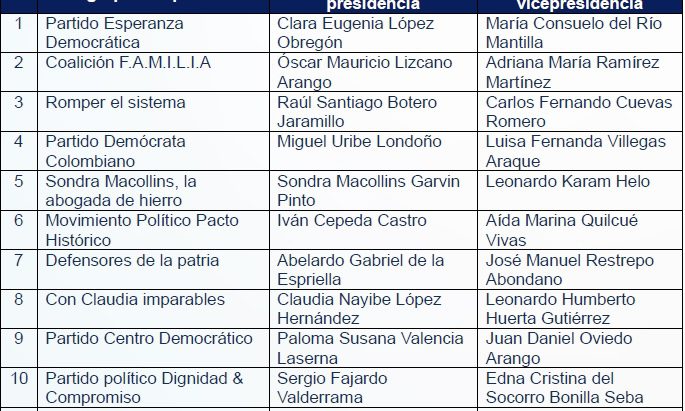
According to the electoral authority, the candidates represent a wide range of political perspectives, from left to right, including independent candidacies running through political movements. Here the list and brief profile of the candidates:
Clara Eugenia López Obregón, currently a senator for the Esperanza Democrática She has served as Minister of Labor (2016–2017), acting mayor of Bogotá (2011–2012), and Bogotá’s secretary of government (2008–2010). She has been affiliated with left-wing parties and was Gustavo Petro’s vice presidential running mate in the 2010 election.
Óscar Mauricio Lizcano, from the FAMILIA coalition. He served as Minister of Information Technologies (2023–2025), was a senator (2010–2018), and a member of the House of Representatives (2006–2010).
Raúl Santiago Botero, candidate of the “Romper el Sistema” movement (Break the Establishment). An agronomist engineer and businessman from Medellín, he presents himself as an independent candidate with no prior political experience.
Miguel Uribe Londoño, father of the slain presidential candidate Miguel Uribe Turbay. He is running under the Colombian Democratic Party and previously served as president of the Centro Democrático party founded by Álvaro Uribe Vélez.
Sondra Macollins Garvin, from the movement “La Abogada de Hierro” (The Iron Lawyer) A criminal lawyer and psychologist, she presents herself as an independent candidate without political affiliations. She ran for the House of Representatives in 2022 and is known for her work in narcotrafficking and corruption cases.
Iván Cepeda Castro, a senator since 2014 and the official candidate of the Pacto Histórico, the same party as President Gustavo Petro. Polls project he will receive the highest vote share in the first election round. He is aligned with left-wing political ideas.
Abelardo de la Espriella, a lawyer with far-right positions, running for the first time under the Defensores de la Patria movement. Recent polls place him as a likely second or third contender in voter preference.
Claudia López Hernández, former mayor of Bogotá (2020–2023) and former senator (2014–2018), running under the centrist movement “Imparables con Claudia.” She is known for her anti-corruption agenda and secured her candidacy with more than 570,000 votes (about 9%) in recent interparty primaries.
Paloma Valencia Laserna, current senator and candidate of the Centro Democrático party led by Álvaro Uribe Vélez. She won the right-wing interparty primary on March 8 with more than 3 million votes. Polls place her among the top three contenders, and if she reaches a runoff, she would become the first woman in Colombia’s history to do so.
Sergio Fajardo Valderrama, an academic and mathematician running for the Dignidad y Compromiso He served as mayor of Medellín and governor of Antioquia and is running for president for the third time.
Roy Barreras, from the political party La Fuerza (The Force). He won the left-wing coalition primary on March 8 with the lowest vote total (257,000 votes, about 3.6%). Although currently aligned with left-wing movements and part of the Petro administration, he has previously been affiliated with right- and center-leaning parties.
Gustavo Matamoros Camacho, of the Colombian Ecologist Party. He served in the Colombian Army for 43 years. With no prior political experience, his campaign focuses on public security.
Luis Gilberto Murillo, who served as Minister of Foreign Affairs (2024–2025) and Colombia’s ambassador to the United States (2022–2024). A human rights advocate and Afro-Colombian leader from Chocó, he presents himself as an independent, moderate, centrist candidate.
Carlos Eduardo Caicedo, running under the independent movement “Con Caicedo.” He was mayor of Santa Marta (2012–2015) and governor of Magdalena (2020–2023), where he built a strong base as a left-wing political leader.
The RNEC also reported that “the draw to determine the position of presidential candidates on the ballot will take place on March 25 at the Ágora Bogotá Convention Center.”
This process marks the formal start of the final phase of the presidential campaign, during which candidates will seek to consolidate support ahead of the first round on May 31. If no candidate secures an absolute majority, a runoff between the two leading candidates will be held on June 21.
List of registered candidates for Colombia’s presidency. Photo courtesy of the Registraduría Nacional del Estado Civil.
Headline photo: Polling station in Colombia during last Congress elections in March 8, 2026. Photo courtesy of the Registraduría Nacional del Estado Civil.
Voters in San Pedro de los Milagros. Credit: Manuela Peña Giraldo.
Colombians voted for a new Congress on March 8 in an election that stretched across thousands of rural towns and villages, where geography, infrastructure and the legacy of armed conflict continue to shape how citizens participate in democracy.
“I don’t like politics,” said Silvia Bedoya, 52, a resident of San Pedro de los Milagros in the mountains north of Medellín. “Instead of uniting people to move the country forward, it tends to divide us.”
Despite that frustration, Bedoya said voting still matters. “If you vote, at least you have the chance to raise your voice about something you don’t like,” she said. “If you don’t vote, you just have to accept what happens.”
More than 40 million Colombians were eligible to vote in the elections, with 13,493 polling stations installed nationwide, including 7,482 in rural areas, according to the National Registry Office. Security forces said they deployed 120,000 police officers across the country to guarantee the vote in the nation’s 1,104 municipalities.
The scale of the operation reflects the logistical challenges of voting in rural Colombia, where many communities remain separated by mountains, unpaved roads and long travel distances.
In San Pedro de los Milagros, a cattle-farming municipality in the Andean department of Antioquia, voters arriving at polling stations described a mixture of civic duty, skepticism toward politicians and concern over the country’s economic and social problems.
Mauricio Martínez, 47, declined to say who he supported, but emphasized the importance of participation. “Voting is the greatest right and duty we have as citizens,” he said.
Others said their choices were shaped by dissatisfaction with the government of President Gustavo Petro, Colombia’s first leftist president, whose progressive agenda – including a major land reform program – has drawn both support and criticism in rural areas.
Maicol Jovani Sepulveda, 28, said he voted for the right-wing Democratic Center (Centro Democrático) party after losing faith in promises he believed would help young people. “I believed they were going to help us study,” he said. “But I didn’t receive a scholarship and I couldn’t go to university, so I was disappointed.”
The Democratic Center won more than 40% of the vote for both the Senate and the House of Representatives in San Pedro de los Milagros, a 24% increase from 2022. Across the department of Antioquia, it was also the most voted list with over 31% of votes, followed by the ruling leftist Historic Pact (Pacto Histórico) coalition with 16%.
Some voters in the town said their support for the right reflected growing frustration with Petro’s government. Among them was María Regina Avendaño Muñoz, 63, who said she cast her vote for Centro Democrático after feeling disappointed with the administration: “I’m very sad because he promised change and convinced many young people and teachers who voted for him.”
Beyond individual concerns, analysts say structural barriers have long shaped political participation in rural Colombia.
Rural voters play an important role in Colombia’s political landscape. Although the country’s largest voting blocs are concentrated in major cities, the countryside has long been central to debates over land ownership, security and development – issues that have shaped the country’s decades-long armed conflict and remain at the center of national politics.
“When we talk about political participation, we’re really talking about processes of democratization – who gets to speak and under what conditions,” Bladimir Ramirez Valencia, a professor at the University of Antioquia’s Institute of Regional Studies who works with farmers’ organizations, told Latin America Reports.
Historically, he said, rural communities have faced both violence and logistical obstacles that limit their ability to vote. About 75% of the victims of Colombia’s armed conflict have been civilians, many of them farmers, according to historical estimates.
Distance alone can also be a barrier. “For many communities, polling stations used to be three or four hours away,” Ramírez said. “Bringing voting sites closer to those places is fundamental.”
Authorities expanded electoral infrastructure for the 2026 vote, increasing the number of polling stations by 5,5% in rural areas compared with the previous 2022 election.
In some regions of Antioquia, Ramírez said, rural residents traveled to voting sites on foot or by chiva, the brightly colored buses that connect remote villages with municipal centers.
Recent government policies may also be shaping political engagement in the countryside. Programs related to land reform, land restitution and rural development have helped strengthen the government’s legitimacy among some farming communities, Ramirez said. “When farmers feel they are being heard and see policies reaching their territories, that can influence how they participate politically.”
Still, rural voting patterns remain complex and vary widely by region. “You can find campesino families involved in social movements defending their land,” Ramírez said. “But when elections arrive, they still vote for traditional parties.”
Across Colombia’s countryside, the election reflected both deep skepticism toward politics and the determination of rural voters to take part in a democratic process that has historically been harder to reach in the country’s most remote regions.
The survey also found that the Medellín suburb of Envigado is the city with the fastest internet connectivity.
According to the latest connectivity report for the second half of 2025 released by Ookla, the Colombian telecommunications market has seen specific performance leaders in both mobile and fixed broadband sectors. The data, which tracks network performance across the country, identifies Claro (NYSE: AMX, BMV: AMX) and Movistar (NYSE: TEF, BMEX: TEF) as the primary benchmarks for speed and user experience during this period.
In the mobile sector, Claro was identified as the provider with the highest network performance. The operator recorded a median download speed of 44.26 Mbps and a median upload speed of 14.03 Mbps. These figures contributed to the company securing the highest rankings for mobile connectivity metrics in the Colombian market for the latter part of the year.
The report also evaluated the fixed internet market, where Movistar maintained a significant lead in throughput. The Telefónica-owned provider registered a median download speed of 308.37 Mbps and a median upload speed of 291.3 Mbps. This performance distinguishes Movistar as the fastest Internet Service Provider (ISP) in the country for fixed line connections.
Colombian carriers continue to deploy fiber optic fixed internet, and 5G wireless throughout the country.
In terms of specific user applications, Claro led the gaming category. The provider recorded the highest metrics for mobile gaming and also achieved the top score for gaming experience among fixed internet providers. This metric typically accounts for latency, jitter, and packet loss, which are critical for real-time interactive applications.
Geographic analysis of the data revealed that Envigado, a municipality located just sout of Medellín in the Antioquia Department, outperformed other major urban centers. Among the most populous cities in Colombia, Envigado recorded the fastest median download speeds for both mobile and fixed connections, reaching 54.76 Mbps and 269.9 Mbps, respectively.
The findings from Ookla provide an objective overview of the infrastructure performance as the Colombian government and private entities continue to expand 5G and fiber optic deployment. While Claro leads in mobile and gaming, Movistar maintains the highest speed profile for fixed residential and business internet.
Colombia’s security forces alerted late Sunday Medellín Mayor Federico Gutiérrez and Antioquia Governor Andrés Julián Rendón to cancel a planned visit to the Hidroituango hydroelectric complex for Monday, March 2, after intelligence warnings of a possible drone attack and credible terrorist threat.
The visit, which included a press conference expected to draw around 100 journalists, was intended to showcase progress at the country’s largest hydroelectric project, now reported to be 95% complete. Instead, regional officials said army security recommendations prompted an abrupt suspension after the detection of unauthorized drone activity over the area.
“The recommendation of the National Army is that the trip be postponed given the detected presence of large, unauthorized drone overflights,” the Antioquia governor’s office said in a statement, adding that the devices were believed to be operated by the 36th Front of dissident Revolutionary Armed Forces of Colombia (FARC) guerrilla.
Officials said the threat was not speculative. Security teams warned that an attack could materialise during the public event, raising concerns not only for the two high-profile politicians but also for members of the press corps and technical staff.
Rendón told Caracol Radio that the drones had been observed manoeuvring persistently over the precise location where the press conference was scheduled to take place. The activity coincided with a recent military operation in the nearby municipality of San Andrés de Cuerquia, where troops seized a drone, explosives, detonators, radios and military-style clothing from the same dissident group.
“All of this is highly coincidental,” Rendón said, adding that authorities were analyzing whether the overflights formed part of reconnaissance ahead of a planned attack.
Gutiérrez said armed groups were seeking to destabilize the country and disrupt key infrastructure. “These terrorist groups want to shut down the country, to generate damage,” he said, pointing to ongoing threats against Empresas Públicas de Medellín (EPM), the state-owned utility responsible for the project.
The cancelled visit had both symbolic and operational significance. In addition to reviewing construction progress and the installation of four turbines, officials were expected to outline new revenue flows generated by the project for Medellín and the wider Antioquia department.
Hidroituango has long been a flagship infrastructure initiative, though it has also faced years of engineering setbacks, financial strain and political scrutiny.
The press event has been rescheduled to take place in Medellín’s La Alpujarra administrative complex under heightened security.
The incident underscores growing concern over the rapid adoption of drones by illegal armed groups. Once limited to reconnaissance, commercially available drones modified to carry explosives are now being used in targeted attacks across conflict-prone regions of the country, including the southwest departments of Nariño, Cauca and Valle del Cauca.
According to military data, more than 400 drone-related attacks have been recorded in Colombia over the past two years, reflecting a sharp escalation in both frequency and sophistication. Analysts say such devices offer armed groups a low-cost, high-impact means of striking military, civilian and infrastructure targets while reducing direct exposure.
Recent attacks in Antioquia highlight the trend. In rural Segovia, a drone-delivered explosive killed three members of a family and displaced more than 100 households amid clashes between FARC dissidents and the Gulf Clan criminal group last week. In Ituango, the nearrest municiplity to the power-generating damn, another drone attack targeted a fuel station using improvised explosives.
On Saturday, in southern Bolívar, a military helicopter was struck in a drone attack attributed to the National Liberation Army (ELN) guerrilla, leaving 14 soldiers injured. Colombian military officials say some armed groups may have received external training in the use of drones for covert operations.
Colombia’s armed forces are moving to adapt to the emerging threat, announcing last October the creation of a specialized “Drone Battalion” aimed at strengthening aerial surveillance and counter-drone capabilities. However, security experts warn that defending against small, low-flying devices — some costing as little as US$600 — remains a significant challenge, particularly in mountainous terrain like that surrounding Hidroituango.
The alleged plot has also raised concerns about a possible shift in targeting strategy by armed groups, from rural security forces to high-profile political figures and critical infrastructure ahead of the May 31 presidential elections.
While no attack ultimately took place, authorities say the decision to cancel the visit reflects the seriousness of the threat.
For now, officials are treating the incident as a direct warning of how Colombia’s long-running conflict is evolving – increasingly shaped by technology, and capable of reaching beyond traditional conflict zones into strategic economic and political targets.
Drone with GoPro digital camera mounted. Credit: Don McCullough, Wikimedia Commons
Medellín, Colombia – On Thursday morning, a drone dropped a mortar shell on a home in Segovia, a town in the northeast of the Antioquia department, killing three occupants of the house and leaving one critically injured.
The police identified the victims as María Cecilia Silva Silva and her two adult children, Yalusan Cano Silva and Alsonso de Jesús Silva. Silva’s other son was also wounded in the attack.
Segovia is a key center for illegal gold mining and is being contested by multiple armed groups, including the Gaitanist Army of Colombia (EGC), also known as the Clan del Golfo, and dissident groups of the now-defunct FARC rebels.
Authorities are still working to establish if the attack was directed at the family or if it was an error by the drone operators, an increasingly common occurrence as drones become the latest technology used in Colombia’s internal armed conflict.
According to the Secretary of Security of Antioquia, General Luis Eduardo Martínez Gúzman, the victims were “a family who have nothing to do with the conflict, who were simply attacked by a drone.”
Martínez highlighted the danger of these devices, suggesting that the explosive device was detached from the drone, which means the mortar could “fall anywhere.”
The Director of the National Police in Colombia, General William Oswaldo Rincón Zambrano, released a statement of condemnation: “[we] categorically reject this criminal act which plunges a Colombian family into mourning and demonstrates the contempt of illegal armed groups for human life and dignity.”
He also reported that state security forces have headed to the area where the attack took place in order to verify what happened and assist in locating and capturing those responsible. He also expressed solidarity with the victims and their families.
The Governor of Antioquia, Andrés Julián Rendón took to social media to blame the security policies of the national government for the attack: “Who in their right mind could consider that this government has achieved transformations for Colombia?”
Rendón criticized President Gustavo Petro for negotiating with the armed groups involved in the conflict in Segovia, part of the leftist leader’s “total peace” policy.
“This is the so-called ‘total peace’: concessions for criminals and burials for civilians. Antioquia demands an unwavering military offensive, full backing for the security forces, and zero leniency towards the criminals,” said Rendón.
Drone attacks, both against armed groups as well as against security forces and the civilian population, have become widespread in Colombia. Between April 2024 and February 2026, the government recorded 418 attacks using drones.
Tackling the mounting security crisis is a key issue in upcoming elections, which the United Nations warns may be undermined by the armed conflict.
Featured image description: Drone with GoPro digital camera mounted
Featured image credit: Don McCullough, Wikimedia Commons
The school year had barely begun when gunfire forced children in rural northern Colombia to cower under their desks in fear and silence.
On the same day students were returning to classrooms after the Christmas and New Year holidays, fighting between illegal armed groups erupted near Briceño, in the northeast of Antioquia. By nightfall, schools were shut, a rural health post had closed, and families were sheltering under their beds as rifle fire echoed through nearby hills.
Local authorities say at least 28 rural school sites have been forced to close, cutting off education for some 375 children who now remain at home under a temporary non-attendance model. In several villages, students had already arrived at their classrooms when the clashes began, leaving teachers scrambling to keep children indoors and away from windows as shots rang out nearby.
“For these children, school should be a place of safety,” said Mayor Noé de Jesús Espinosa. “Instead, it has become another place of fear.”
Fighting between Clan del Golfo (Gulf Clan) and the 36th Front of FARC dissidents has now drawn-in the state’s security forces. The violence has also shut down the health center in the village of El Roblal, leaving residents without medical care at a time when movement between villages has become too dangerous.
Across at least ten rural communities, daily life has ground to a halt. Public transport and cargo services have been suspended, cutting off supplies of food and medicine. Roughly 500 people are now confined to their homes, many lying on the floor or hiding beneath their beds to protect themselves from bullets and explosive shockwaves.
“In some houses, entire families are sleeping under their beds,” Espinosa said. “They don’t know when the shooting will start again.”
Fear has already driven at least 23 families to flee their homes. Carrying only what they could gather in minutes, they arrived in Briceño’s town center seeking refuge with relatives and friends. Municipal officials are now coordinating emergency aid, while warning that more displacement is likely if the fighting continues.
The violence is rooted in a territorial dispute over the Cauca River canyon, a strategic corridor connecting Antioquia’s Bajo Cauca region with the west of the department. Military intelligence and local sources say the escalation follows an order by alias “Gonzalito,” identified as a senior commander of the Clan del Golfo, to eliminate alias “Primo Gay,” leader of the dissident 36th Front, and seize control of the area.
For residents, however, the strategic calculations of armed groups mean little. What they feel is the constant fear — the uncertainty of whether children can return to school, whether the sick can reach a clinic, and whether families will be forced to flee again.
Army units from the Fourth Brigade are advancing cautiously toward villages such as El Roblal, slowed by the presence of improvised explosive devices and suspected minefields planted along rural paths. The risk has made it difficult for troops — and humanitarian assistance — to reach many isolated communities.
Antioquia Governor Andrés Julián Rendón has urged the national government to maintain a permanent military presence in the area, warning against further troop withdrawals.
“Peasant communities in Antioquia’s most remote regions deserve to live without fear,” Rendón said, recalling that promises made last year to keep troops in Briceño were later reversed.
The trauma is not new. In October, more than 2,000 people — roughly a quarter of Briceño’s population — were forced to flee 18 rural villages after threats from armed groups. Many slept for days in the town’s main square and urban school, unsure if they would ever return home.
As indiscriminate violence once again targets the country’s most vulnerable and forces families to lock themselves inside their homes, residents fear the humanitarian crisis will deepen across Antioquia, just months before Colombians are due to cast their votes in the May 31 presidential election.
Far-right independent candidate Abelardo De la Espriella, widely known by the nickname “El Tigre” (The Tiger), has taken the lead in Colombia’s presidential race five months ahead of the election, according to a new poll by AtlasIntel published by Semana magazine.
The survey places De la Espriella, founder of the pro-democracy movement Defensores de la Patria, at 28% of voting intentions, narrowly ahead of left-wing senator Iván Cepeda at 26.5%. Former Antioquia governor Sergio Fajardo ranks third with 9.4%, once again failing to surpass the 10% benchmark that has long eluded his centrist candidacies.
A corporate lawyer by training, De la Espriella rose to prominence as a high-profile legal advocate for conservative causes and a vocal critic of President Gustavo Petro’s reform agenda. His political ascent has been driven by hardline law-and-order rhetoric, a confrontational style and an aggressive use of social media, allowing him to position himself as an outsider channeling anti-establishment sentiment and opposition to the left.
In a hypothetical second-round runoff, De la Espriella would defeat hard-leftist Cepeda by 9.3 percentage points, the poll found, consolidating his status as the best-positioned opposition figure at this early stage of the race.
AtlasIntel also projected a runoff between De la Espriella and Fajardo. In that scenario, De la Espriella would secure 37.9% of the vote, compared with 23.2% for Fajardo — a margin of 14.7 points.
Fajardo, a mathematician and former governor of Antioquia from 2012 to 2016, has struggled to expand his electoral base beyond a narrow segment of moderate voters. His current polling echoes his performance in the first round of the 2022 presidential election, when he placed fourth with just over 800,000 votes, equivalent to 4.2% of the total, despite entering that race as a well-known national figure.
Further down the field, Juan Carlos Pinzón and Paloma Valencia each registered 5.1% support, followed by Claudia López (2.6%), Enrique Peñalosa (2.3%), Juan Daniel Oviedo (1.8%) and Aníbal Gaviria (1.3%). Several other candidates polled below 1%.
The survey found that 7.2% of respondents would vote blank, 5.7% remain undecided, and 1.1% said they would not vote.
Valencia, a senator from the right-wing Centro Democrático party, could nonetheless emerge as a pivotal figure in the race. Former president Álvaro Uribe Vélez, Colombia’s most influential conservative leader, has named Valencia as the party’s official presidential candidate, formally placing the weight of his political machine behind her campaign.
Uribe, who governed Colombia from 2002 to 2010, retains significant influence, particularly in his home region of Antioquia and in the country’s second-largest city, Medellín, long considered a stronghold of uribismo. Analysts say Valencia’s numbers could rise sharply as party structures mobilise and undecided conservative voters coalesce around an officially endorsed candidate.
In other simulated second-round matchups, Valencia would narrowly defeat Cepeda by 2.4 points, while Cepeda would beat former defence minister Pinzón by 4.5 points, according to the poll.
AtlasIntel also measured voter intentions ahead of Colombia’s interparty primaries scheduled for March 8, to be held alongside congressional elections. About 18.7% of respondents said they plan to participate in the “Gran Consulta por Colombia,” while 29.8% expressed interest in voting in the leftist “Pacto Amplio”. Former Colombian Ambassador to the United Kingdom and insider of the Petro administration, Roy Barreras, is seen as a leading contender to the clinch the consultation.
Within the Gran Consulta, Valencia leads with 19.1% among likely participants, followed by Pinzón (13.1%), Aníbal Gaviria (11.1%), Juan Daniel Oviedo (10.6%) and former Semana director Vicky Dávila (7%).
The poll results reinforce a broader pattern of fragmentation across the centre and right, even as opposition voters increasingly focus on preventing a left-wing victory. With five months to go before the May 31 election, an emerging landscape of “all against Cepeda” has appeared on the horizon, in which disparate conservative and centrist forces could eventually rally behind a single contender in a runoff scenario on June 19, 2026.
In this context, De la Espriella — himself a close ideological ally of Uribe — could seek to consolidate all right-wing factions by selecting Valencia as a potential vice-presidential running mate, move that would unite his strong support on the Colombian coast, with the strength of Centro Democrático and Uribe’s loyal political base in conservative departments.
According to AtlasIntel’s CEO Andrei Roman, the contest is being shaped by persistent ideological polarisation, internal divisions within the opposition, and the growing dominance of social media.
“The race is structured around the continuity of Petro-style progressivism versus a broad anti-Petro front,” Roman said. “At the same time, digital presence has become decisive, allowing outsider figures to gain traction quickly and redefine political mobilisation.”
Colombian authorities have rescued 17 minors belonging to Lev Tahor, an ultra-Orthodox Jewish sect widely accused across several countries of child abuse, forced marriage, kidnapping and extreme coercive control. The operation — carried out by Migración Colombia in coordination with the Army’s Gaula Militar — was triggered by international alerts and concerns that the group may have been attempting to establish a new enclave inside Colombia.
Officials intervened in a hotel in the northern municipality of Yarumal after receiving intelligence reports about the presence of foreign minors linked to Lev Tahor. The hotel operation allowed officers to verify the identity and migration status of 26 people, including 17 children from the United States, Guatemala, Canada and other countries. Five of the minors had active Interpol “yellow notices,” issued when a child is reported missing or potentially at risk of crimes such as trafficking or kidnapping.
Authorities said that seven families associated with the sect had arrived in Colombia on October 22 and 23 on flights from New York City. Sister agencies abroad had previously warned Colombian counterparts about possible movements of Lev Tahor members due to ongoing investigations in other jurisdictions. Some members of the group’s leadership have prior convictions in the United States for kidnapping and the sexual exploitation of minors. There are also long-standing allegations from Guatemala of enforced pregnancies, mistreatment of minors and rape inside the community.
According to Colombian investigators, one working hypothesis is that the families may have been seeking to establish a new settlement in rural Colombia. The group has a history of sudden, secretive migrations to avoid scrutiny from foreign governments. Lev Tahor communities, estimated at around 50 families worldwide, have lived in the United States, Canada, Guatemala and Mexico, often leaving abruptly when law-enforcement pressure escalates.
Authorities emphasized that the primary goal of the operation was to protect the children and clarify their situation. The minors were transported to Migración Colombia’s Service Center in Medellín, where they spent the night under continuous supervision. Officials from the Colombian Family Welfare Institute (ICBF), child-protection attorneys and multidisciplinary teams of psychologists, social workers and medical professionals were deployed to guarantee a comprehensive assessment of the children’s well-being.
“All of our actions were guided by an absolute commitment to safeguard the rights of these boys, girls and adolescents,” said Gloria Esperanza Arriero, Director General of Migración Colombia. “This was a preventative and coordinated intervention. Our priority is to determine whether these minors were victims of abuse, coercion, or human trafficking under the guise of religious activity.”
Local and international investigators are now examining evidence to determine whether any of the minors were taken from their home countries illegally. Some preliminary findings suggest that at least a few of the children may have been transported across borders without full parental consent or in violation of court orders, raising the possibility of a trafficking scheme.
The Lev Tahor sect – founded in the 1980s – is known for its rigid, isolationist doctrine and its strict dress codes for women, who are required to wear black, head-to-toe garments. Members live in tightly controlled communities overseen by male leaders and bound by strict obedience norms. Over the past decade, authorities in Canada, the United States, Guatemala and Mexico have repeatedly intervened amid accusations of forced underage marriages, psychological abuse and extreme discipline practices.
In December 2024, Guatemalan authorities rescued 160 minors from a Lev Tahor-occupied farm after receiving reports of forced pregnancies and sexual violence. A year earlier, Mexican police dismantled a compound near the Guatemalan border, removing women and children and arresting at least one leader. And in 2021, two senior members of the group were convicted in New York for kidnapping children and attempting to force a 14-year-old girl back into an illegal sexual relationship with an adult man.
Colombian authorities say they are now collaborating with Interpol, foreign embassies, child-protection agencies, the Attorney General’s Office and the Gaula Militar to fully determine the legal status of the rescued minors, ensure they are not returned to dangerous environments and rule out any signs of human trafficking.
“Protection comes first,” Migración Colombia said in a statement. “We will use every institutional mechanism available to guarantee the safety of these children.”

 Login
Login