
Normal view

Colombia’s Presidential Race Marked by Polarization, Divided Right and Absence of Debates

18 May 2026 at 22:53

As Colombia nears its presidential vote, two candidates have endorsed Iván Cepeda and eight others remain below 3.5% in polls

With less than two weeks remaining before Colombia’s presidential election, whose first round is scheduled for May 31, three candidates are concentrating most voter support and competing for access to the presidential palace, Casa de Nariño: ruling coalition senator Iván Cepeda, candidate of the left-wing Pacto Histórico party; senator Paloma Valencia, representing the right-wing Centro Democrático party; and lawyer and businessman Abelardo de la Espriella, a figure of Colombia’s far right.

Although 13 candidates will appear on the ballot, two contenders: Clara López and Luis Gilberto Murillo, withdrew their campaigns to support Cepeda, while the remaining candidates have failed to surpass 3.5% voter support in pre-elections polls, a figure close to the statistical margin of error.

If polling trends hold, no candidate is expected to secure the 50% plus one vote needed to win outright in the first round, making a runoff election on June 21, 2026, highly likely.

Cepeda has remained relatively stable in polls, with voter support ranging between 35% and 43%, effectively securing his place in a second round if trends continue.

The key question: Who will face Cepeda in a runoff?

The main electoral uncertainty centers on who will finish second and challenge the ruling coalition in a likely runoff.

Under Colombia’s electoral system, only the two candidates receiving the highest vote totals advance to the second round. The fragmentation of the political right has complicated efforts to consolidate support behind either Valencia or De la Espriella.

Polls suggest a competitive scenario. Valencia has registered between 14% and 21% voter support, while De la Espriella fluctuates between 16% and 24%, depending on the poll and methodology used.

The lack of unity between the two camps stems from both ideological differences and their political structures. Valencia is a member of the political party founded by former President Álvaro Uribe, while De la Espriella entered the race through an independent signature campaign, marking the first time Colombia’s far right has emerged as a viable contender for the presidency.

A campaign shaped by the absence of public debates

The presidential campaign has been marked by an unusual lack of debates among the leading candidates.

Cepeda has refused to participate in events organized by media outlets, arguing that proposed formats do not offer guarantees of neutrality or what he describes as “fair rules” established by news organizations.

As a result, part of the political confrontation has shifted to Congress, where both Cepeda and Valencia currently serve in the Senate.

Critics, however, have challenged Cepeda’s decision. Former Bogotá Mayor and presidential candidate Claudia López argued that his absence from debates reflects that “Cepeda does not want to take responsibility for the failures of Total Peace (Paz Total),” the negotiation policy with armed groups promoted by President Gustavo Petro, in which Cepeda played a key role as a lawmaker.

Instead of regular debates, the campaign has been dominated by disputes over media formats, digital presence, social media strategies and public controversies aimed at amplifying candidates’ visibility.

De la Espriella embraces confrontation

One of the candidates who has most effectively capitalized on the digital environment is Abelardo de la Espriella, whose political strategy has been compared to right-wing populist leadership styles such as those of Argentine President Javier Milei and US President Donald Trump.

In recent weeks, De la Espriella has faced several media controversies, including an incident involving journalist Laura Rodríguez of Piso 8 FM, for which he later apologized after accusations of inappropriate sexual conduct. He also clashed live on air with television presenter María Lucía Fernández of Caracol Noticias, whom he called “ignorant.”

Questions also emerged following reports by digital outlet La Silla Vacía regarding donations linked to the US Republican Party.

Despite the controversies, the strategy appears to be strengthening his electoral standing. An Atlas Intel poll for Semana magazine, published May 15, showed De la Espriella surpassing Valencia by a two-to-one margin for the first time, with 32.9% support compared with 16.7%.

However, the polling firm is currently under investigation by Colombia’s National Electoral Council (CNE) amid concerns over whether its methodology complies with national standards. If irregularities are confirmed, the firm could face suspension of its operations in Colombia.

Valencia seeks to broaden support toward the political center

Meanwhile, Valencia has sought to expand her electoral base by shifting strategically toward the political center.

As part of that effort, on May 17 she officially introduced her proposal “Mámá No Está Sola (Mom Is Not Alone),” aimed at female heads of household and focused on access to credit, employment and housing property. The proposal also includes a promise to deliver 1 million homes prioritized for women community leaders.

Valencia’s candidacy also marks a historic first for Colombia’s political right: it is the first time a major conservative party has nominated a woman for president.

Her vice presidential running mate, former Bogotá councilman Juan Daniel Oviedo, has openly identified as a member of the LGBTQ+ community, a move that represents a significant shift for the Centro Democrático traditionally conservative electorate.

Colombia appears headed for a runoff

With a highly fragmented field and no signs of consolidation among right-wing candidates, Colombia appears increasingly likely to hold a presidential runoff on June 21, 2026.

Barring a major shift in polling trends, the contest seems set to come down to Iván Cepeda and whichever opposition candidate manages to emerge from an increasingly competitive battle within Colombia’s political right.
Andean Community Orders Colombia and Ecuador to Dismantle Tariffs and Trade Restrictions

18 May 2026 at 22:47

A tariff dispute between Colombia and Ecuador escalated to 100% duties on Colombian imports after Ecuador cited a lack of cooperation on border security

The Andean Community of Nations (CAN) ordered Colombia and Ecuador to dismantle, within 10 business days, the trade restrictions and tariff measures imposed since late 2025, concluding that they violate the legal framework governing the regional bloc composed of Bolivia, Colombia, Ecuador, and Peru.

The decision was adopted through three resolutions issued May 8, 2026, by the CAN General Secretariat, led by Gonzalo Gutiérrez Reinel, following an assessment of trade disputes that emerged between the two countries amid tensions related to border security and commerce.

The organization concluded that several measures implemented by Quito and Bogotá violate the Cartagena Agreement, the founding treaty of Andean integration, which prohibits restrictions on intraregional trade among member states.

More information about the “security tariff”: Colombia and Ecuador Escalate Trade Tensions with Tariffs Raised to 100%.

Ecuador ordered to lift border restrictions and “security tariff”

The first resolution, No. 2581, ruled in favor of Colombia in a complaint related to Ecuador’s decision to limit bilateral land trade to a single border crossing. The General Secretariat classified the measure as a “restriction on Andean subregional trade” and granted Ecuador 10 business days to withdraw it.

The resolution also urged both countries to strengthen bilateral cooperation on border security matters.

“To urge the Republic of Ecuador and the Republic of Colombia to strengthen bilateral cooperation and coordination mechanisms in border control (…) through joint actions, without affecting the normal development of subregional trade,” the organization stated in Resolution 2581.

Meanwhile, Resolution 2582 ordered Ecuador to eliminate the so-called “security tariff” imposed exclusively on Colombian imports, which initially stood at 30% and later escalated to 100%.

According to CAN, the measure violates the Trade Liberalization Program established under the Cartagena Agreement and constitutes a “disguised tariff.”

The General Secretariat concluded that the so-called Customs Control Service Fee (TSCA) or “security tariff” does not qualify as a legitimate fee because it does not compensate for an individualized service to importers, but instead finances general state functions related to intelligence and strategic security.

Ecuador was given a maximum of 10 business days to dismantle the measure and formally report compliance. So far, the government of President Daniel Noboa has not issued an official response to the resolutions.

CAN also orders Colombia to dismantle countermeasures

“I have no problem removing tariffs on Ecuadorian products in the same manner and timeline in which they were imposed,” Petro wrote on X after the ruling became public.

The third resolution, No. 2583, rejected the trade countermeasures adopted by Colombia in response to Ecuador.

The government of President Gustavo Petro had issued Decree 0170, later tightened through Decree 0455, imposing reciprocal tariffs ranging from 30% to 75% on Ecuadorian products and restricting the entry of rice, potatoes, onions, and fishery products through specific border crossings.

CAN concluded that these measures are also incompatible with Andean community regulations.

Trade dispute rooted in security tensions

The commercial dispute between the two countries intensified beginning in late 2025 and reached its peak in April 2026, when both governments progressively increased tariffs and trade restrictions, citing concerns related to border security and anti-narcotics enforcement.

The tensions particularly affected border regions, where business groups and transport operators warned of disruptions to trade flows and rising logistical costs.

CAN’s resolutions now seek to restore free trade conditions within the Andean bloc and reduce diplomatic tensions between two of its largest economies.

Ecuador Reduces Tariffs on Colombian Products as Trade Tensions Begin to Ease

9 May 2026 at 22:54

Ecuador’s decision to lower tariffs starting June 1 could mark the beginning of a de-escalation in tensions with Colombia

The government of Ecuador, led by President Daniel Noboa, announced a reduction in the so-called “security tariff” applied to imports from Colombia, lowering it from 100% to 75% effective June 1, 2026.

The decision was announced in an official statement from Ecuador’s presidency, which said the measure “reaffirms the national government’s willingness to move toward bilateral cooperation mechanisms on security matters, promoting greater coordination between both countries and strengthening the development of the border region.”

More information about the “security tariff”: Colombia and Ecuador Escalate Trade Tensions with Tariffs Raised to 100%.

Political tensions and tariff dispute

Differences between the governments of Gustavo Petro and Noboa have escalated since 2025, driven by political, commercial and border security disagreements.

In April 2025, Petro initially said he could not recognize Noboa’s election, arguing that Ecuador’s electoral process had taken place “under a state of emergency” and with military presence during voting. However, he later reversed his position and attended Noboa’s inauguration ceremony on May 24, 2025, in Quito.

Since then, both countries have faced disputes related to border security, trade and energy transportation, leading to a gradual escalation in tariffs. Import duties increased progressively from 30% to 50% and later reached 100% on April 9, 2026.

Read: Colombia to Reinforce Border Security with Ecuador Amid Escalating Trade Tensions.

“Unfortunately, it is not possible to reach agreements with someone who does not share the same commitment to fighting narco-terrorism. Since we adopted this measure, violent deaths along the northern border have decreased by 33%. In the future, it will be possible to talk with a government that is truly committed to fighting crime and drug trafficking,” Noboa wrote on X on April 10, 2026, while defending the tougher trade measures.

Signs of de-escalation

The tariff reduction announced by Ecuador coincides with the Colombian government’s earlier decision not to raise its own tariffs to 100%, a move seen as a sign of moderation that could help ease diplomatic and commercial tensions between the two countries.

The dispute has particularly affected Colombian border regions such as Nariño and Cauca, which are already facing security challenges linked to the presence of illegal armed groups and recent violent attacks.

Read: Rising Violence in Colombia: Highway Explosion Leaves 21 Dead, Dozens Injured.

Colombia’s Minister of Commerce, Industry and Tourism, Diana Marcela Morales Rojas, said that “what we are seeing is that Ecuador’s initial strategy did not produce the expected effects on Colombia and instead generated distortions within its own trade system.”

In that regard, “Colombia has maintained and will continue to maintain a permanent willingness for technical dialogue and cooperation, with the same seriousness with which it adopts its policy decisions. Along that path, we are ready to move forward,” the minister added on X.

Meanwhile, Colombian Foreign Minister Rosa Villavicencio said during an interview broadcast by La FM that the government would seek to “resume dialogue with Ecuador in hopes of restoring relations, reducing those tariffs and returning to the trade flow we previously had.”

Who are the Five Candidates Most Likely to Become Colombia’s Next Vice President After the Upcoming Elections?

9 May 2026 at 22:52

Despite 13 campaigns underway, only five candidates’ poll above 2.5% in voter intention

Colombia is heading toward the first round of presidential elections on May 31, 2026, with 13 candidates in the race, in a scenario marked by political fragmentation and a strong concentration of voter support among a few contenders.

The next president will take office on August 7, following the end of President Gustavo Petro’s term, marking the transition from the country’s first left-wing government in recent history.

According to pre-election polls, only five candidates exceed 2% in voter intention, leaving most with limited chances of reaching the presidential palace. Among the leading contenders are Iván Cepeda, the candidate of the ruling Pacto Histórico, who leads polls with between 35% and 43% support; right-wing candidate Abelardo de la Espriella, with between 16% and 24%; and Paloma Valencia of the Centro Democrático party, with between 14% and 21%.

A second group includes centrist candidates Claudia López, polling between 3% and 4%, and Sergio Fajardo, at around 2.5%, reflecting a fragmented vote within that political segment.

Vice presidential picks shape campaign strategies

As the campaign unfolds, candidates have selected their running partners as a key strategy to broaden their electoral appeal.

Iván Cepeda has chosen Aida Quilcué, an Indigenous Nasa leader from southwestern Colombia, reinforcing the campaign’s leftist profile and its emphasis on including historically marginalized communities in political decision-making.

Quilcué has served as a governor and Indigenous authority in her community and, like Cepeda, is a victim of Colombia’s armed conflict: her husband was killed by state agents in 2008. She has been affiliated with the Regional Indigenous Council of Cauca (CRIC) and the National Indigenous Organization of Colombia (ONIC). She presents herself publicly as an Indigenous leader, human rights defender and senator (2022–2026), without reporting formal higher education credentials.

Abelardo de la Espriella has selected former Finance, and Commerce, Industry and Tourism Minister, Juan Manuel Restrepo, as his running mate, forming a ticket focused on security and economic strengthening. “That is a capability I have because I understand productivity, competitiveness and economic development,” Restrepo told La Silla Vacía during his registration.

Restrepo is an economist with a specialization in finance from Rosario University, a master’s degree in economics from the London School of Economics, a specialization in senior management from INALDE Business School, and a doctorate in higher education leadership from the University of Bath. He has also served as rector of three major universities in Colombia.

Juan Daniel Oviedo, a former Bogotá city councilor, is running alongside Paloma Valencia of the Centro Democrático party. As economist from Universidad del Rosario, Oviedo holds a master’s degree in mathematical economics and econometrics and a Ph.D. in economics from the University of Toulouse in France.

He previously served as head of Colombia’s National Statistics Agency (DANE) during the Iván Duque administration and ran for mayor of Bogotá in 2023.

His vice presidential bid gained momentum after securing more than 1.2 million votes in the March 8 inter-party primary, finishing second. His selection aims to attract centrist and center-right voters and strengthen Valencia’s chances of advancing to a potential runoff.

However, his nomination has sparked controversy, as it marks the first time the right-wing party has chosen a candidate with liberal positions on issues such as women’s rights and LGBTQ+ rights.

Claudia López selected Leonardo Huerta, a university professor of law and philosophy, as her running mate. According to Spain’s El País, he comes from “a working middle-class family,” is the youngest of four siblings, and is married with two children.

Huerta is a lawyer from Universidad Libre and holds a degree in philosophy from the Technological University of Pereira. He has a master’s degree in administrative law and is a doctoral candidate in law. His public sector experience includes serving as education secretary in Pereira and as a deputy ombudsman for health issues during the COVID-19 pandemic in 2020.

Sergio Fajardo selected Edna Bonilla as his running mate, reinforcing a campaign centered on education and dialogue. Bonilla previously served as Bogotá’s education secretary during Claudia López’s administration (2020–2023).

She is a public accountant from the National University of Colombia, holds a tax specialization from Externado University and a doctorate in political studies. During the campaign launch, Fajardo said: “We will work together to deliver the serious and safe change Colombia needs. To move beyond polarization and build bridges instead of trenches.”

Voter participation

According to Registraduría Nacional del Estado Civil, which oversees elections, a total of 41,421,973 citizens are eligible to vote in Colombia and abroad in the first round of the presidential election. Of these, 21,298,492 are women and 20,123,481 are men.

If no candidate secures more than 50% of the vote, a runoff election will be held on June 21, 2026, between the top two candidates.

Gunfire Incident on Putumayo River Revives Tensions Between Colombia & Peru

26 April 2026 at 16:53

Despite the severity of the incident, Colombia and Peru have indicated a willingness to address it through diplomacy

 An incident on April 12, 2026, has reignited diplomatic and security tensions in the Amazon border region between Colombia and Peru, following an exchange of gunfire between a Colombian civilian vessel and the Marina de Guerra del Perú, a Peruvian Navy River unit, on the Putumayo River. The incident left one Colombian citizen dead and one person injured on each side.

The episode occurred near Marandúa (Amazonas, Colombia), across from the Peruvian town of El Estrecho. According to Colombia’s Defense Minister, Pedro Sánchez, the fatal victim was identified “as José Miguel Gutiérrez Baquero, owner of the cargo vessel involved in the incident, and one of his sons was injured,” while two other crew members were detained by Peruvian authorities.

Conflicting accounts of the operation

According to the Peruvian government statement, “the incident occurred during a patrol operation aimed at securing the electoral process,” previously coordinated between the two countries. Authorities said two Navy speedboats requested that the Colombian vessel stop for identification.

Peru’s Ministry of Foreign Affairs, which is leading the process, said that “the Colombian vessel refused to comply with the control order and opened fire on two Peruvian Navy units, which returned fire.” As a result, “a member of the Peruvian Navy was also injured, although he is out of danger.”

Colombian authorities, led by the Foreign Ministry, have requested a full clarification of the events and verification of the circumstances surrounding the exchange of gunfire.

Diplomatic channels activated

Following the incident, the governments of Colombia and Peru activated diplomatic and military channels. Colombia’s defense minister said that “preliminary measures were agreed, including prioritizing medical attention for the injured, facilitating the work of judicial authorities, and establishing a binational commission to investigate what happened.”

Colombia’s Foreign Ministry formally requested clarification of “the circumstances of time, mode and place” of the attack, while the Peruvian government expressed its “willingness to cooperate and maintain border coordination mechanisms.”

The detained individuals “remain in the custody of the Fiscalía Provincial Mixta de Putumayo, with access to consular assistance and due process guarantees.”

So far, no final responsibilities have been determined, and both countries agree on the need for a thorough investigation. Both governments said the issue will be addressed at the next High-Level Mechanism on Security and Judicial Cooperation meeting, scheduled for May 2026 in Bogotá.

Context of prior tensions

The incident comes amid sensitive bilateral relations. In recent months, Colombia and Peru have had disagreements over territorial issues in the Amazon, particularly regarding Santa Rosa de Loreto island.

The dispute dates back to August 5, 2025, when President Gustavo Petro said on X that the “government of Peru has taken over territory that belongs to Colombia” and alleged a “violation of the Rio de Janeiro Protocol, which defines the boundaries between the two countries.”

“The Rio de Janeiro Protocol established that the border is the deepest channel of the Amazon River and that any dispute must be resolved between the parties,” Petro said, referring to the emergence of new river islands “north of the current deepest channel,” which, according to his position, should belong to Colombia.

In response, Peru’s Foreign Ministry expressed its “strongest and most forceful protest,” stating that the island, home to about 3,000 residents, mostly Peruvians, is part of its territory and is key to regional river trade.

Tensions escalated days later when then-presidential pre-candidate Daniel Quintero traveled to the island and raised a Colombian flag during a campaign event broadcast on social media, saying: “I will not allow them to take the Amazon from us. Santa Rosa is Colombia.”

The Peruvian government described the act as an “unnecessary action” that “distracts from the cooperation efforts that Peru and Colombia must prioritize to jointly address urgent challenges.”

Headline photo: President Gustavo Petro, Vice President Francia Márquez and Defense Minister Pedro Sánchez at an event held in Leticia (Amazonas) to address tensions with Peru, Aug. 7, 2025. Photo courtesy of Colombia’s Ministry of Defense.

Colombia to Reinforce Border Security with Ecuador Amid Escalating Trade Tensions

26 April 2026 at 16:50

Colombia’s Defense Ministry detailed a plan to bolster security along the Ecuador border

Colombia’s government has announced a package of measures to strengthen security in municipalities along the border with Ecuador, amid escalating tensions between the two countries over security and trade issues.

According to a statement released by the presidency, the actions include “the deployment of 200 additional National Police officers and 270 soldiers, as well as enhanced maritime and riverine capabilities for territorial control and the fight against drug trafficking.”

The plan also includes technical support for surveillance systems, the deployment of two armored platoons to ensure troop mobility, and meetings aimed at strengthening joint operations by security forces and control at border crossings.

Defense Minister Pedro Sánchez announced the measures, stating that “we will not allow criminal groups seeking to profit from illegal activities such as drug trafficking, illegal mining, extortion and smuggling to affect security indicators.”

He added that security forces have already seized 2.4 tons of drugs and remain deployed in the region “to protect our seas and critically disrupt drug trafficking.”

Context: security and trade tensions

The measures come days before Ecuador’s tariff increase takes effect, raising the so-called “security tariff” on Colombian goods from 50% to 100% starting May 1, 2026.

Ecuadorian President Daniel Noboa told Revista Semana magazine that the decision is not part of a “trade war” with Colombia but rather reflects the costs of reinforcing border security. “We have to spend twice as much, and it costs $400 million USD more per year to keep our armed forces deployed at the border,” he said.

For its part, Colombia’s government has rejected claims of insufficient action on border security. Minister of Commerce, Industry and Tourism Diana Marcela Morales Rojas said Colombia has kept diplomatic channels open.

“We have exhausted all diplomatic efforts and maintained open dialogue channels with the Government of Ecuador, seeking a solution that benefits both countries, businesses and, above all, communities on both sides of the border. However, we have not received a positive response,” she said in a statement.

At the same time, Colombia is evaluating its tariff response. Although President Gustavo Petro previously said he would not impose 100% tariffs on Ecuador, a draft update to Decree 170 of 2026 has recently emerged proposing differentiated tariffs of 35%, 50% and 75% on imports from the neighboring country. So far, the proposal has not been signed or officially published.

More information on the trade dispute between Colombia and Ecuador? Read Trade War Between Colombia And Ecuador Escalates, With 50% Tariffs Threatened by Finance Colombia.

Colombia and Ecuador Escalate Trade Tensions with Tariffs Raised to 100%

13 April 2026 at 11:25

President Gustavo Petro recalls Colombia’s ambassador and signals a potential withdrawal from the Andean Community of Nations (CAN)

Ecuador’s government announced an increase in the so-called “security tariff” applied to imports from Colombia, raising it from 50% to 100%, a move that has intensified trade tensions between the two countries.

In response, the Colombian government, through its Ministry of Commerce, Industry and Tourism, said it will match Ecuador’s measure by adjusting its tariffs to the same level, arguing the need to “maintain balance in bilateral trade conditions.”

The Ecuadorian decision was formalized through a resolution issued by the National Customs Service of Ecuador (Servicio Nacional de Aduana del Ecuador), which establishes that the new tariff will take effect on May 1, 2026.

According to Ecuador’s government, led by President Daniel Noboa, the measure is driven by concerns over border security. In an official statement, authorities said that “after confirming the lack of implementation of concrete and effective border security measures by Colombia, Ecuador is obliged to adopt sovereign actions.”

Colombia’s response and diplomatic measures

Amid the escalation, President Gustavo Petro announced immediate diplomatic actions, including recalling Colombia’s ambassador to Ecuador, María Antonia Velasco, whom he said “must return immediately” to Colombia. He also stated that “the next cabinet meeting will be held at a location along the border with Ecuador,” in a message posted on X.

Petro also criticized statements from Ecuador’s government, saying that “the president of Ecuador insults the Colombian government, which has seized more cocaine than at any point in world history.”

For her part, Minister of Commerce, Industry and Tourism, Diana Marcela Morales Rojas said Colombia “had maintained open diplomatic channels prior to Ecuador’s decision.”

“We have exhausted all diplomatic efforts and kept dialogue channels open with the Government of Ecuador, seeking a solution that benefits both countries, businesses, and above all, communities on both sides of the border. However, we have not received a positive response,” she said in a statement.

Economic impact and trade response

Colombia’s government, led by the Ministry of Commerce, Industry and Tourism, also announced it will amend Decree 170 to raise tariffs to 100%, in line with Ecuador’s measure. The proposal will be submitted to the Committee on Customs, Tariff and Foreign Trade Affairs (Triple A) for review, meaning that details and the effective date of the increase have yet to be determined.

According to the statement, Ecuador’s tariff hike distorts competitive conditions in the Andean market, negatively affecting Colombian producers competing with Ecuadorian goods.

The government also announced relief measures aimed at mitigating the impact on the productive sector, including favorable credit lines, expanded access to financing, and mechanisms to preserve employment.

Political escalation and questions over the Andean system

Amid the growing trade dispute, President Petro also signaled a potential shift in Colombia’s economic foreign policy, stating that Ecuador’s actions “mark the end of the Andean Pact for Colombia.”

“We have nothing left to do there. The foreign minister must begin the process of joining Mercosur as a full member and redirect our efforts toward the Caribbean and Central America,” he said.

The Andean Pact, also known as the Andean Community of Nations (CAN), established in 1969 by Colombia, Ecuador, Peru and Bolivia, has historically been a cornerstone of regional economic integration.

Both governments have filed formal complaints with the CAN, which will assess the admissibility of the claims and may mediate the dispute.

More information on the trade dispute between Colombia and Ecuador? Read Trade War Between Colombia And Ecuador Escalates, With 50% Tariffs Threatened by Finance Colombia.

Above photo: President Gustavo Petro of Colombia with President Daniel Noboa of Ecuador (photo courtesy Presidencia of Ecuador)

Experience the Pinnacle of Jazz as US Faculty Masters Perform in Medellín April 24th

10 April 2026 at 12:30

Jazz summit fosters US-Colombia cultural and professional ties.

The city of Medellín is preparing for a sophisticated display of cultural diplomacy as the Centro Colombo Americano Medellín and Teatro El Tesoro present Noche de Jazz en El Tesoro. Scheduled for Friday, April 24, at 7:00 p.m., this event serves as a high-profile prelude to International Jazz Day. For the international investment community and expatriate executives, the concert represents more than just a musical performance; it is a testament to the enduring soft-power bridges between the US and Colombia, fostering an environment of innovation and collaborative spirit in the heart of Antioquia.

The performance features the US Jazz Faculty Collective, a premier ensemble directed by Dr. Ryan Middagh. This group highlights the academic and professional excellence of five distinguished jazz educators from the United States. The lineup includes Dennis Wilson, a former Count Basie trombonist and associate professor at the University of Michigan; Dr. Ryan Middagh, the Director of Jazz Studies at the Blair School of Music at Vanderbilt University; Christopher Kozak, an associate professor and jazz director at the University of Alabama; Dr. Marc Widenhofer, a Nashville-based percussionist and faculty member at Vanderbilt University; and Dr. Bruce Dudley, a celebrated pianist and professor at Belmont University.

The Centro Colombo Americano Medellín is the driving force behind this cultural exchange. As a non-profit binational center, the Colombo performs vital work in the region by providing high-quality English language instruction and promoting democratic values through the arts. Their initiatives are critical for the local workforce, equipping Colombian professionals with the linguistic and cultural competencies required to engage with global markets and attract foreign direct investment to the Valle de Aburrá (the greater Medellín metro area).

For those attending, Teatro El Tesoro offers a world-class venue located within the prestigious El Tesoro Parque Comercial shopping center. Tickets are available through Tuboleta. Pricing remains accessible for such a high-caliber performance, with general public tickets starting from $64,000 pesos.

Colombia Intelligence Chief’s Resignation Exposes Instability and Possible Illegal Group Infiltration

3 April 2026 at 18:47

Since the start of President Gustavo Petro’s administration, the intelligence agency has had four directors, highlighting instability within one of the institutions responsible for state security.

The resignation of Wilmar Mejía as chief of Colombia’s National Intelligence Agency has highlighted instability within the country’s main intelligence agency under the government of President Gustavo Petro, which has seen four leadership changes over the past three years.

Mejía confirmed his departure on April 1 in an interview with Canal 1. “When the Inspector General’s Office lifted my suspension, I went to sign my reinstatement document and within 15 minutes I submitted my resignation. I am no longer the director of intelligence,” he said.

The official had been suspended since December 23, 2025, by the Inspector General’s Office as part of a disciplinary investigation “for alleged links to and the provision of information to members of dissident factions of the former Revolutionary Armed Forces of Colombia (FARC).” The Inspector Office said at the time that the measure aimed to prevent possible interference with the process.

Investigation into alleged links to guerrilla dissidents

The case is related to the seizure of digital files belonging to Alexander Díaz Mendoza, known as “Calarcá Córdoba,” a leader of one of the dissident structures grouped under the Estado Mayor de Bloques y Frente (EMBF). Authorities say the documents point to possible contacts with the former intelligence chief.

Mejía has denied any involvement and has argued that the accusations are part of alleged “setups aimed at silencing reports of internal corruption.”

According to the Inspector Office, the investigation “includes possible acts such as the disclosure of military force communication frequency codes and support in the creation of security companies that could facilitate the legalization of weapons in the event of a breakdown in peace talks with the government.”

So far, neither the Inspector General’s Office nor the Attorney General’s Office has concluded its investigations, and no determination of responsibility has been made.

The case has raised concerns about state security and the institutional stability of the agency, considered a key body for the country’s strategic intelligence.

Local media outlets such as El Colombiano have reported that the situation has affected trust among international intelligence partners, suggesting that agencies such as the CIA (United States), MI6 (United Kingdom), and Mossad (Israel) have restricted the sharing of strategic information with Colombia.

Four directors in just over three years

Since Petro took office, the agency has had four directors, all of them close to the president through their past involvement in the M-19 guerrilla group, which signed a peace agreement in 1990.

The instability dates back to the beginning of Petro’s administration. Since August 2022, when Manuel Alberto Casanova Guzmán was appointed, the agency has undergone repeated leadership changes.

Casanova, who faced criticism over his lack of intelligence experience and background as a philosopher, was removed following allegations of involvement in a false extortion case linked to then-Foreign Minister Álvaro Leyva, as reported by Infobae.

He was succeeded by Carlos Ramón González, who later left the post amid investigations into his alleged role in the corruption scandal involving Unidad Nacional de Gestión de Riesgo y Desastres (UNGRD). He is currently in Nicaragua under political asylum, while Colombia has requested his extradition and Interpol has issued a red notice.

Finally, just before Mejía, the agency was led by Jorge Lemus, who served for nearly a year before resigning. He was subsequently appointed by Petro as director of the Unidad de Información y Análisis Financiero (UIAF), amid growing allegations of possible infiltration within the country’s security institutions.

Border Crossing Between Colombia & Ecuador Reopens After 19 Day Blockade

28 March 2026 at 19:42

While Colombia & Ecuador are at peace, the neighboring presidents have a sour relationship going back to when Colombian President Gustavo Petro initially refused to recognize Daniel Noboa’s election.

Traders and transport operators have suspended a 19-day blockade at the Rumichaca International Bridge, the primary land crossing between Colombia and Ecuador. The protest, catalyzed by a 50% tax imposed by the Ecuadorian government on Colombian goods, was lifted to accommodate travel and commerce during the Semana Santa holiday period. Despite the suspension of the strike, the regional business community reports that significant economic damage and diplomatic tensions persist.

Ecuador's President Daniel Noboa (photo: Carlos Silva/Presidencia de la República)

Ecuador’s President Daniel Noboa (photo: Carlos Silva/Presidencia de la República)

The closure of the border crossing created a substantial disruption in binational economic activity. Estimates from the Cámara de Comercio de Ipiales in Nariño, Colombia indicate that losses reached approximately $5 million USD per day due to freight remaining stationary in the border zone. The Comité Gremial de Trabajadores de la Frontera de Ipiales stated that while the reopening is a responsible gesture for the high-traffic holiday season, current tariff policies continue to threaten hundreds of direct and indirect jobs linked to foreign trade.

The Governor of Nariño, Luis Alfonso Escobar, criticized the trade barriers implemented by the administration of Ecuadorian President Daniel Noboa. Governor Escobar argued that such measures inadvertently encourage illicit activities in the region. He emphasized that instead of facilitating formal commerce, high tariffs drive trade toward illegality, undermining regional security efforts. To mitigate the conflict, the Comunidad Andina de Naciones (CAN) has initiated high-level dialogues. Diplomatic delegations led by Colombian Deputy Minister of Foreign Affairs Juana Castro and her Ecuadorian counterpart, Alejandro Dávalos, held a virtual working group to address pending issues in trade, transport, energy, and hydrocarbons.

“Decisions adopted without considering the reality of our communities have put at risk the livelihood of merchants, transporters, foreign trade workers, and thousands of people who live from binational exchange,” stated the Comité Gremial de Trabajadores de la Frontera de Ipiales.

Diplomatic friction has extended into the energy sector. President Noboa claimed that in 2017, Ecuador assisted Colombia during a potential blackout by charging 1.6 cents USD per kWh, whereas in 2024, Colombia charged an average of 28 cents USD per kWh during Ecuador’s hydroelectric crisis. In response, the Colombian Minister of Mines and Energy, Edwin Palma, clarified that prices during the 2023-2024 El Niño phenomenon reflected the actual costs of production and distribution, particularly when fossil fuel-powered thermoelectric plants using fuel oil and diesel were activated.

The ongoing trade dispute has impacted more than 5,500 companies over the past two months. Diana Marcela Morales, the Colombian Minister of Commerce, Industry, and Tourism, confirmed scheduled meetings with Ecuadorian officials to de-escalate the conflict and establish fair, transparent rules. Concurrently, the Ministerio de Comercio, Industria y Turismo has moved to protect domestic industries by implementing new tariffs on steel and ceramics from countries without existing free trade agreements. These measures aim to counter market distortions and protect a sector that employs more than 50,000 people while promoting circular economy practices and reducing CO2 emissions.

Above photo: Border between Ecuador & Colombia looking towards Ipiales, Colombia (Photo: Cancillería de Colombia)

At Least 66 Dead After Colombian Military Plane Crashes During Troop Mission

25 March 2026 at 22:02

A C-130 Hercules aircraft crashed in Putumayo, southern Colombia, on March 23, killing 66 people, including soldiers, Air Force personnel and police. A total of 128 people were on board.

A Hercules aircraft operated by the Colombian Air Force (FAC) crashed shortly after takeoff from Puerto Leguízamo, in southern Colombia’s Putumayo department, in a tragedy on Monday, March 23, that left dozens of victims among members of the security forces.

According to Jhon Molina, governor of Putumayo, “58 soldiers, six members of the Air Force and two police officers were among the victims who died in the accident.” A total of 128 people were on board the aircraft. One survived unharmed, and four others remain unaccounted for.

The aircraft, a US-built C-130 Hercules used to transport troops and supplies, went down about one and a half kilometers from the airfield just minutes after takeoff.

Defense Minister, Major General (ret.) Pedro Arnulfo Sánchez, said the crash occurred as the aircraft “was taking off from Puerto Leguízamo (Putumayo, near the border with Peru and Ecuador) while transporting troops from our security forces.”

Investigation underway

The national government authorities said that, based on the information available so far, there is no evidence of an attack by illegal armed groups. According to the defense minister, “the fire triggered the detonation of part of the ammunition being transported, which explains the sounds heard in videos circulating on social media.”

The minister said that “all response protocols for the victims and their families have been activated, along with the corresponding investigation.” In a message posted on X, he added: “I extend my deepest condolences to the families of those affected and, out of respect for their grief, I urge people to avoid speculation until official information is available.”

President Gustavo Petro also addressed structural limitations within the armed forces, noting that bureaucratic processes have delayed modernization efforts. “Renewing the armed forces’ equipment has been a decision of my administration for years. Bureaucratic obstacles in military administration have prevented the approval of the Conpes/Confis (Colombia´s public policy instruments) for over a year since I requested it,” he said.

Statement from the Colombian Air Force

The Colombian Air Force (FAC) expressed its condolences following the crash. We “deeply regrets the tragic accident involving the C-130 Hercules, a loss that brings mourning to our military forces and National Police. The aircraft and its crew were in optimal condition to carry out the mission, with the professionalism that characterizes them.”

The institution added that “the pain and helplessness caused by the unexpected loss of our heroes in this tragic air accident are immense. But that pain is transformed into determination: to honor their memory and legacy with an even greater commitment to the nation, doing what we love: protecting Colombia.”

Gen. Carlos Fernando Silva of the Colombian Air Force said a technical investigation will be conducted with support from the US Air Force to determine the causes of the crash “with transparency and rigor.”

Photos courtesy of the FAC.

Colombia Concludes Multilateral Diplomatic Event With African Nations

22 March 2026 at 20:15

New Africa initiative drives 112% growth in non-mining exports.

The Ministerio de Comercio, Industria y Turismo (Ministry of Trade, Industry, and Tourism) hosted the first Foro de Reencuentro Económico CELAC–África at the Ágora Convention Center in Bogotá on March 20, 2026. The event, held as part of a broader high-level forum, aimed to strengthen commercial and investment ties between Colombia and the African continent. During the proceedings, officials identified various sectors for potential growth, including jewelry, agricultural machinery, construction materials, software, digital marketing, and food and beverages.

Minister of Trade Diana Marcela Morales Rojas stated that the forum represents a strategic shift toward trade equity and shared economic opportunities. Over the past four years, the Colombian government has sought to diversify its market reach through economic diplomacy, trade missions, and the establishment of new logistical routes to Africa. Data from 2025 indicates that these efforts have resulted in a significant increase in non-mining and non-energy exports to the continent.

“We aim for this forum to mark the beginning of a new stage: one of strategic cooperation, trade with equity, and the construction of shared opportunities.” — Diana Marcela Morales Rojas, Minister of Trade, Industry, and Tourism.

According to ministry figures, non-mining exports to Africa reached $296.5 million USD in 2025, representing a 112% increase compared to 2024. In terms of volume, these shipments totaled 209,273 tons, a 226.8% rise over the previous year. These goods accounted for 46.6% of Colombia’s total exports to the continent, signaling a shift toward a more diversified export basket. Key products driving this growth include coffee, bananas, machinery, paper, and apparel.

The number of Colombian firms participating in this trade has also expanded. In 2025, 165 companies exported non-mining goods to Africa with values exceeding $10,000 USD, up from 145 companies in 2024. This 15.2% growth in participating firms underscores a transition toward higher value-added exports. Vice President Francia Márquez Mina noted that the economies of Latin America and Africa are complementary, offering potential for the development of new value chains and the utilization of strategic mineral reserves necessary for the global energy transition.

A central component of the forum was a business matchmaking event held on March 17 and 18. Preliminary results from the session show expected trade operations totaling $16 million USD. Nicolás Mejía, Vice President of Exports at ProColombia, characterized the results as a validation of the current market diversification plan. Since the beginning of the current administration, the government has implemented the Estrategia África 2022–2026 to strengthen socioeconomic relations with the region.

Through commercial intelligence analysis, the Colombian government has prioritized nine specific markets for its diplomatic and economic deployment: South Africa, Angola, Mozambique, Nigeria, Ghana, Senegal, Egypt, Tunisia, and Algeria. These nations serve as the primary focus for the continued implementation of the 2022–2026 strategy.

Above photo: MinCIT/Ricardo Báez.

Colombia Confirms 14 Candidates for 2026 Presidential Election

20 March 2026 at 21:26

Though surprises are possible, polling says the front runners are Iván Cepeda, Abelardo de la Espriella, and Paloma Valencia.

The Registraduría Nacional del Estado Civil of Colombia (RNEC), the entity responsible for organizing elections in the country, reported that a total of 14 candidates have officially registered to run in the country’s presidential elections, scheduled for May 31, 2026. In this vote, citizens will elect the President and Vice President of the Republic for the 2026–2030 term.

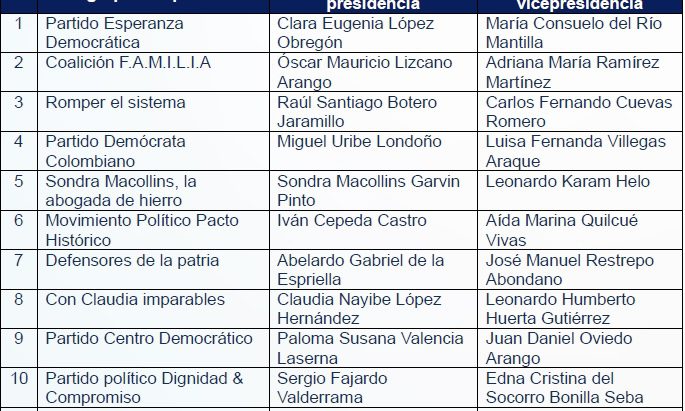
According to the electoral authority, the candidates represent a wide range of political perspectives, from left to right, including independent candidacies running through political movements. Here the list and brief profile of the candidates:

  1. Clara Eugenia López Obregón, currently a senator for the Esperanza Democrática She has served as Minister of Labor (2016–2017), acting mayor of Bogotá (2011–2012), and Bogotá’s secretary of government (2008–2010). She has been affiliated with left-wing parties and was Gustavo Petro’s vice presidential running mate in the 2010 election.
  2. Óscar Mauricio Lizcano, from the FAMILIA coalition. He served as Minister of Information Technologies (2023–2025), was a senator (2010–2018), and a member of the House of Representatives (2006–2010).
  3. Raúl Santiago Botero, candidate of the “Romper el Sistema” movement (Break the Establishment). An agronomist engineer and businessman from Medellín, he presents himself as an independent candidate with no prior political experience.
  4. Miguel Uribe Londoño, father of the slain presidential candidate Miguel Uribe Turbay. He is running under the Colombian Democratic Party and previously served as president of the Centro Democrático party founded by Álvaro Uribe Vélez.
  5. Sondra Macollins Garvin, from the movement “La Abogada de Hierro” (The Iron Lawyer) A criminal lawyer and psychologist, she presents herself as an independent candidate without political affiliations. She ran for the House of Representatives in 2022 and is known for her work in narcotrafficking and corruption cases.
  6. Iván Cepeda Castro, a senator since 2014 and the official candidate of the Pacto Histórico, the same party as President Gustavo Petro. Polls project he will receive the highest vote share in the first election round. He is aligned with left-wing political ideas.
  7. Abelardo de la Espriella, a lawyer with far-right positions, running for the first time under the Defensores de la Patria movement. Recent polls place him as a likely second or third contender in voter preference.
  8. Claudia López Hernández, former mayor of Bogotá (2020–2023) and former senator (2014–2018), running under the centrist movement “Imparables con Claudia.” She is known for her anti-corruption agenda and secured her candidacy with more than 570,000 votes (about 9%) in recent interparty primaries.
  9. Paloma Valencia Laserna, current senator and candidate of the Centro Democrático party led by Álvaro Uribe Vélez. She won the right-wing interparty primary on March 8 with more than 3 million votes. Polls place her among the top three contenders, and if she reaches a runoff, she would become the first woman in Colombia’s history to do so.
  • Sergio Fajardo Valderrama, an academic and mathematician running for the Dignidad y Compromiso He served as mayor of Medellín and governor of Antioquia and is running for president for the third time.
  • Roy Barreras, from the political party La Fuerza (The Force). He won the left-wing coalition primary on March 8 with the lowest vote total (257,000 votes, about 3.6%). Although currently aligned with left-wing movements and part of the Petro administration, he has previously been affiliated with right- and center-leaning parties.
  • Gustavo Matamoros Camacho, of the Colombian Ecologist Party. He served in the Colombian Army for 43 years. With no prior political experience, his campaign focuses on public security.
  • Luis Gilberto Murillo, who served as Minister of Foreign Affairs (2024–2025) and Colombia’s ambassador to the United States (2022–2024). A human rights advocate and Afro-Colombian leader from Chocó, he presents himself as an independent, moderate, centrist candidate.
  • Carlos Eduardo Caicedo, running under the independent movement “Con Caicedo.” He was mayor of Santa Marta (2012–2015) and governor of Magdalena (2020–2023), where he built a strong base as a left-wing political leader.

The RNEC also reported that “the draw to determine the position of presidential candidates on the ballot will take place on March 25 at the Ágora Bogotá Convention Center.”

This process marks the formal start of the final phase of the presidential campaign, during which candidates will seek to consolidate support ahead of the first round on May 31. If no candidate secures an absolute majority, a runoff between the two leading candidates will be held on June 21.

List of registered candidates for Colombia’s presidency. Photo courtesy of the Registraduría Nacional del Estado Civil.

List of registered candidates for Colombia’s presidency. Photo courtesy of the Registraduría Nacional del Estado Civil.

Headline photo: Polling station in Colombia during last Congress elections in March 8, 2026. Photo courtesy of the Registraduría Nacional del Estado Civil.

Colombian Voters Elect New Congress for 2026-2030 Legislative Term; Party With Largest Senate Block Still Only 26%

9 March 2026 at 21:29

The new members of Congress will take office on July 20, the official start of the new legislative term.

On March 8, Colombia elected the Congress that will exercise legislative authority during the 2026–2030 term. From more than 3,200 candidates, voters chose the 102 senators (upper house) and 182 members of the House of Representatives (lower house) who will make up the country’s legislative branch.

According to preliminary reports from the Registraduría Nacional del Estado Civil (RNEC), with 98.4% of polling stations counted, equivalent to 19,220,365 votes tallied, the new Congress has been defined electorally, however, it should be noted that these seat projections correspond to the official preliminary count, which still must go through several formal procedures before the final results are certified.

How the Senate Race is Shaping Up?

The Pacto Histórico, the party of current President Gustavo Petro, obtained around 22% of the vote (4,402,601), which would allow it to increase its representation from 20 senators in the current legislature to approximately 25 seats in the next term.

In second place is the Centro Democrático, the party of former President Álvaro Uribe, with about 15% of the vote (3,020,459), potentially increasing its representation from 13 to 17 seats.

The Partido Liberal would rank third with 13 seats (2,268,658 votes). It would be followed by the Alianza por Colombia, led by the Green Party, with 10 seats (1,899,096 votes), and the Partido Conservador, also with 10 seats (1,859,493 votes).

Other wins in the Senate include Party of La U (9 seats), Cambio Radical (7), the Ahora Colombia coalition (5), which backs presidential candidate Sergio Fajardo, and Salvación Nacional (4), the movement of presidential candidate Abelardo de la Espriella. The two remaining seats correspond to the special indigenous constituency.

In terms of losses in representation, the Partido Conservador would be the most affected, losing five of its current 15 seats. Cambio Radical would lose four, the Greens three, La U two, while Liberals and Ahora Colombia would each lose one seat.

Among the prominent figures who would be left out of the new Senate is former President Álvaro Uribe, who occupied position number 25 on his party’s list and would not obtain a seat if the Centro Democrático secures only 17 seats. Green Party senator Angélica Lozano, known for promoting legislation related to transparency, would also lose her seat.

Likewise, movements such as the coalition that supported Juan Daniel Oviedo and the Partido Oxígeno, led by former presidential candidate Ingrid Betancourt, who was kidnapped for years by the now-defunct FARC guerrilla group, would fail to surpass the minimum threshold required to obtain Senate representation (3% of the total vote).

On the other hand, the performance of the Salvación Nacional movement, led by presidential candidate Abelardo de la Espriella, stands out. In its first participation in a congressional election, the party would surpass the electoral threshold and secure four senators.

What About the House of Representatives?

The allocation of seats in the House of Representatives follows a different process from that of the Senate, making it difficult to project the final distribution in the early stages of the vote count.

This is because the calculation is conducted department by department, once the RNEC determines the seat allocation formula and electoral quotient in each of the 32 States and the Capital District of Bogotá.

According to report number 45 from the RNEC, with 99.03% of votes counted, the main parties have obtained the following preliminary nationwide results:

  • Centro Democrático: 2,551,706 votes.
  • Partido Liberal: 2,101,877 votes.
  • Partido Conservador: 1,967,996 votes.
  • La U: 1,044,778 votes.
  • Pacto Histórico: 913,990 votes.
  • Cambio Radical: 803,721 votes.
  • Alianza Verde: 654,071 votes.
  • Salvación Nacional: 436,365 votes.

Because the House of Representatives elections involve parties, movements, and coalitions with strong local and regional influence, several smaller political organizations are expected to win seats, as they must surpass regional thresholds rather than a national one.

The Highlight: a Fragmented Congress that Will Require Coalitions

With the preliminary distribution of seats in both the Senate and the House of Representatives, projections suggest that Colombia’s next president will need to govern through legislative coalitions, as has occurred under President Gustavo Petro and his predecessors.

Presidential candidates Iván Cepeda, of the Pacto Histórico, and Paloma Valencia, of the Centro Democrático, would begin the next political phase with the largest congressional blocs, although neither would have enough seats to govern alone.

Traditional parties such as the Liberal, Conservador, Cambio Radical, and La U, which together could account for more than 40% of the new congress, have not yet decided which presidential candidate they will support, a situation similar to what occurred in the previous election. These parties could therefore become kingmakers, capable of facilitating, or blocking, governability depending on the alliances and coalitions they choose to form.

For that reason, the coming weeks are expected to be marked by intense political negotiations, as presidential contenders attempt to build alliances that would allow them to secure legislative support.

For candidates such as Sergio Fajardo, whose Ahora Colombia coalition would obtain only five senators, or Abelardo de la Espriella, whose Salvación Nacional movement would have four, the challenge will be significantly greater.

Above photo: Polling station during Colombia’s congressional elections. Photo courtesy of the Registraduría Nacional del Estado Civil.

Sunday’s Colombian Presidential Primary Election Results Were Full of Surprises

9 March 2026 at 21:13

Colombia’s presidential race has entered a new phase following the interparty primaries held on March 8. Three major coalitions selected their candidates ahead of the first round scheduled for May 31: Paloma Valencia (48 years) will represent the right, Claudia López (56) the center, and Roy Barreras (62) a segment of the left.

They will join three candidates who did not participate in the primaries because they already hold the official endorsement of their parties: Iván Cepeda (63) of the Pacto Histórico (left), Sergio Fajardo (69) of Dignidad y Compromiso (center), and Abelardo de la Espriella (47) of the Salvación Nacional (far right).

Beyond their immediate results, Colombia’s interparty primaries typically serve two main purposes: reducing the number of contenders and selecting the flagbearers of each coalition, while also measuring the electoral strength of political figures ahead of potential negotiations among parties and candidates. With 99% of polling stations counted, and preliminary results rapidly released by the Registraduría Nacional del Estado Civil, several political consequences of the vote are already emerging.

Paloma Valencia to Lead the Uribista Right

The right-wing consultation brought together nine candidates from different center-right and conservative currents. One of its main goals was to secure a strong turnout that could consolidate the sector in public opinion and counter the rise of far-right candidate Abelardo de la Espriella, who seeks to capture a portion of Colombia’s traditional conservative electorate.

The winner was Senator Paloma Valencia, who has campaigned nationwide alongside former President Álvaro Uribe Vélez, the leading figure of the Centro Democrático party.

Although polls had already projected her victory, the surprise was the scale of the result. With 99% of polling stations counted, Valencia secured 3,212,528 votes, representing more than 45% of the total votes cast across the three primaries.

She now faces three major challenges. The first will be unifying the right behind her candidacy and preventing conservative voters from drifting toward De la Espriella. In this context, the selection of her vice-presidential running mate will be crucial.

Among the names circulating is Juan Daniel Oviedo (48), a former Bogotá city councilor who unexpectedly finished second in the consultation with more than 1,200,00 votes, despite his well-known ideological differences with the Uribista movement.

The second challenge is symbolic: no woman has ever reached the second round of Colombia’s presidential election, making it difficult to break that historical barrier even with the political backing of Uribe, who still maintains strong favorability ratings.

Finally, Valencia will attempt to channel the anti-Petro vote, capitalizing on public dissatisfaction with the policies of President Gustavo Petro and his close political ally Iván Cepeda, who currently appears as the frontrunner in most polls for both the first and second rounds.

The Center Cools Around Claudia López

With 99% of votes counted, the centrist consultation recorded the lowest turnout among the three coalitions. Former Bogotá mayor Claudia López received more than 572,000 votes, representing just 8.14% of the total, well below polling projections that placed her above 12%.

For López, the result follows a long campaign that began more than a year ago, during which she sought to challenge Sergio Fajardo, the former mayor of Medellín who already holds the endorsement of the Dignidad y Compromiso party.

The key question now is her next political move: whether to remain in the presidential race or eventually join forces with Fajardo, whose polling numbers also remain modest, hovering around 5%.

The weak result may reflect the fragmentation of Colombia’s political center, often criticized for positions perceived as moderate or ambiguous. It may also indicate that Juan Daniel Oviedo attracted part of the centrist electorate within the right-wing consultation.

In any case, the outcome suggests the presidential campaign could once again polarize around two main narratives: “with Petro,” led by Iván Cepeda and the Pacto Histórico, or “against Petro,” a space still contested between Paloma Valencia and Abelardo de la Espriella.

Roy Barreras Wins the Left Consultation, but Momentum Favors Cepeda

In Roy Barreras’s case, two key factors appear to have contributed to his limited result. First was his decision to maintain a primary that many within the left considered unnecessary, given that much of the progressive sector had already rallied behind Iván Cepeda.

Second is his long political trajectory across multiple governments and ideological camps, from the right to the left, which has led some voters to view him as a traditional establishment politician.

With 99% of votes counted, Barreras secured just over 255,000 votes, less than 4% of the total. During the campaign, Barreras had stated he expected to surpass 1,500,000 votes in order to negotiate a stronger position within the left-wing coalition. Following these results, his most likely option may be withdrawing his candidacy and endorsing Cepeda, signaling unity within the progressive camp.

Other Highlights from the Electoral Day

One of the most striking outcomes was the performance of Juan Daniel Oviedo, who finished second among the 18 candidates participating in the primaries with 1,251,428 votes. With this electoral capital, Oviedo has become one of the most sought-after figures for potential alliances.

His political alignment remains uncertain. It is unclear whether he will fully integrate into Paloma Valencia’s campaign and the Centro Democrático, with whom he has ideological differences, or attempt to move closer to the weakened political center.

Unlike many traditional politicians, Oviedo has built a relatively short but distinctive political career based on his technocratic profile, his experience in economic policy, and his attempt to position himself outside the traditional Petro-Uribe political divide.

Meanwhile, journalist Vicky Dávila (52), who has run a campaign with populist elements inspired by figures such as Javier Milei in Argentina and Donald Trump in the United States, received more than 236,000 votes, around 3.3% of the total, leaving her with limited negotiating leverage.

A similar outcome affected Daniel Quintero (45), the former mayor of Medellín, who received just over 226,000 votes (around 3.2%), with his campaign likely hurt by controversies linked to alleged corruption during his administration.

Under Colombia’s electoral law (Law 1475 of 2011), political parties may still modify or withdraw candidates until March 20. After that date, the presidential campaign will move toward the first round scheduled for May 31. If no candidate obtains an absolute majority (50% plus one), the two candidates with the highest vote totals will compete in a runoff election on June 21.

For now, the race appears likely to center on a left-wing coalition led by Iván Cepeda with the backing of President Gustavo Petro, and a divided right contested between Paloma Valencia and the ultraconservative Abelardo de la Espriella.

Above photo: Claudia López, candidate in the centrist primary, casting her vote in Bogotá. Photo courtesy of Claudia López’s campaign team.


Over 3,200 Candidates to Run for 284 Seats in Colombia’s Legislative Elections This Sunday

6 March 2026 at 19:31

Seats are distributed using the D’Hondt method, known in Colombia as the cifra repartidora, which allocates seats proportionally according to the number of votes obtained.

A total of 3,231 candidates will compete for seats in Colombia’s congress in the legislative elections scheduled for March 8, according to the Registraduría Nacional del Estado Civil (RNEC), the authority responsible for organizing the country’s electoral processes. In total, 102 senators and 182 members of the House of Representatives will be elected.

According to the electoral authority, 1,124 candidates registered for the Senate and 2,107 for the House of Representatives, the two chambers that make up Colombia’s congress.

As the political analysis website Razón Pública explains, Colombia’s electoral system is based on proportional representation, which seeks to reflect the diversity of political opinions within society in the composition of Congress. For the Senate, or upper chamber, voters may cast their ballots for candidates anywhere in the country, as it operates under a national constituency. In contrast, the House of Representatives, or lower chamber, is elected through territorial constituencies by departments, including Bogotá as the Capital District.

According to the RNEC, 41,287,084 citizens are eligible to vote in the upcoming elections, a key figure because it influences how seats are allocated.

Senate elections

In this election, 102 senators will be chosen by popular vote. According to the Senate’s official website, 100 will be elected through a nationwide constituency and the remaining two seats are reserved for indigenous communities, a special constituency established by the 1991 Constitution to guarantee political representation for these groups.

Voters must choose between receiving the national ballot or the Indigenous constituency ballot, but they cannot vote in both.

House of Representatives elections

For the House of Representatives, 182 members will be elected, distributed as follows:

  • Territorial constituencies: 161 seats allocated to departments and the Capital District of Bogotá.
  • Special Transitional Peace Constituencies: 16 seats reserved for victims of the armed conflict, created by the Acto Legislativo 02 of 2021.
  • Afro-descendant communities: 2 seats.
  • Indigenous communities: 1 seat.
  • Community of San Andrés (Raizal): 1 seat.
  • Colombians living abroad: 1 seat.

Unlike the Senate, each department receives a specific number of seats based on its population, creating regional electoral dynamics in which local political leadership often plays a key role. In practice, more populous departments hold greater representation than smaller ones.

Both the Senate and the House of Representatives receive one additional seat after the presidential election, allocated to the candidate who obtains the second-highest number of votes.

How seats are allocated

Colombia’s electoral system is regulated by the Acto Legislativo 001 of 2003 and the Electoral Law, and operates under principles of proportional representation.

First, the valid votes obtained by each party list are counted. Only those lists that surpass a 3% threshold of total valid votes are eligible to participate in the distribution of seats. In the 2022 legislative elections, this threshold exceeded 509,000 votes.

According to projections by the Misión de Observación Electoral (MOE), the threshold for the Senate in the upcoming elections could reach around 600,000 votes.

This threshold is crucial because if, for example, a candidate obtains 450,000 votes but their party fails to pass the threshold, neither the candidate nor the party will secure a seat in Congress.

Among the lists that surpass the threshold, seats are distributed using the D’Hondt method, known in Colombia as the cifra repartidora, which allocates seats proportionally according to the number of votes obtained. In 2022, the seat-allocation quotient was 144,013 votes.

For the House of Representatives, the process is more complex because the threshold and D’Hondt method are applied separately within each department, producing different results across regions.

With closed lists, voters select only the political party or list as a whole, without choosing an individual candidate.

Open and closed lists

Under the Acto Legislativo 1 of 2003, political parties may register open lists or closed lists. With open lists, voters select a specific candidate within a party’s list. The vote counts both for the political party and for the individual candidate. Seats obtained by the party are then assigned to the candidates who received the highest number of votes, regardless of their initial position on the list.

With closed lists, voters select only the political party or list as a whole, without choosing an individual candidate. Seats are then allocated according to the order predetermined and registered at the start of the campaign by the party.

In the upcoming elections, two of Colombia’s most prominent political forces will present closed lists: the Pacto Histórico, the coalition led by current President Gustavo Petro, and the Centro Democrático, the right-wing party founded by former President Álvaro Uribe Vélez.

Photo courtesy of the National Civil Registry of Colombia,

Colombia’s Primary & Legislative Elections This Sunday Will Set The Tone For Upcoming Presidential Election

6 March 2026 at 17:59

Colombia’s presidential primaries are interparty, where broad coalitions decide on a candidate that the allied parties then agree to back.

This Sunday, March 8, 2026, Colombia will hold one of the most significant electoral events of the year’s political calendar. In addition to electing a new congress, voters will participate in the so-called Interparty Primaries, a mechanism through which political parties select their candidates for the presidential election scheduled for May 31.

According to the political analysis website Razón Pública, these consultations seek to “build broad coalitions composed of parties, movements, and independent candidacies.” In practice, they allow different political sectors to determine through open voting who will represent each coalition in the presidential race.

Political parties seek to boost their chances in the presidential race or strengthen their leverage in potential coalition negotiations.

In total, three separate primaries will take place, each with its own ballot. Citizens may participate in only one of them by requesting the corresponding ballot when voting for Congress.

The first is the “Solutions Primary: Healthcare, Security and Education,” made up of parties from the political center. In this contest, former Bogotá mayor Claudia López faces independent lawyer Leonardo Huertas. According to the latest Invamer poll, López is the clear frontrunner, with a projected 92.9% voting preference, compared with her only opponent.

The second consultation represents the political right and includes nine pre-candidates in the so-called “Grand Primary for Colombia.”

Among the contenders are former ministers of previous governments Juan Carlos Pinzón (Defense), Mauricio Cárdenas (Finance), and David Luna (Information Technologies); former Antioquia governor Aníbal Gaviria; former Bogotá mayor Enrique Peñalosa; journalist Vicky Dávila; and three senators representing their respective parties: Juan Manuel Galán (Nuevo Liberalismo), Juan Daniel Oviedo (Con Toda con Colombia), and Paloma Valencia (Centro Democrático).

Polls consistently identify Paloma Valencia as the favorite to win the primary. The Invamer poll projects her with 41.6% of the vote, Atlas Intel 44.4%, and Guarumo-EcoAnalítica 40.6%, while the firm Gad3 also places her first but with a lower estimated vote share of 17%. Valencia has been campaigning nationwide accompanied by former president Álvaro Uribe Vélez, the leading figure of the Centro Democrático, and previously won her party’s internal selection process through a member survey held on December 15.

The third primary corresponds to the coalition known as the “Front for Life,” made up of left-wing candidates, although without the official backing of current President Gustavo Petro, who under Colombian law is prohibited from participating in electoral politics or promoting candidates.

Candidates in this race include Héctor Elías Pineda, a former member of the M-19 guerrilla movement (the same group Petro once belonged to); Edison Lucio Torres of the Partido de los Trabajadores (Worker’s Party); and independent candidate Martha Viviana Bernal.

Former senator Roy Barreras; and embattled former mayor of Medellín Daniel Quintero Calle registered through the Movimiento de Autoridades Indígenas de Colombia. Polls by Guarumo-EcoAnalítica (47.6%) and Invamer (68.1%) place Daniel Quintero as the leading candidate of this Primary. However, the firm Atlas Intel did not measure this coalition, arguing that it did not surpass the statistical threshold required.

What comes next in the political landscape after the Primaries?

According to Razón Pública, “once the March 8 voting concludes, the political landscape will enter a phase of critical decisions. The results will determine alliances and realignments ahead of the presidential first round.”

Across the political spectrum, the winners of each consultation will attempt to consolidate support to compete against other candidates who registered directly without participating in the consultations. These include Abelardo de la Espriella, a conservative lawyer and businessman who registered through citizen signatures; Iván Cepeda, the official candidate of the Pacto Histórico coalition led by President Petro and currently leading voting-intention polls; and Sergio Fajardo, who registered with the party Dignidad y Compromiso.

Under Colombia’s electoral Law (1475 of 2011), political parties may still modify or withdraw candidates until March 20. After that date, the presidential campaign will move toward the first round scheduled for May 31. If no candidate secures an absolute majority of the vote (50% plus one), the two candidates receiving the highest number of votes will compete in a runoff election on June 21, where the candidate with a simple majority will be elected president.

Photos courtesy of the Registraduría Nacional del Estado Civil

Trade War Between Colombia And Ecuador Escalates, With 50% Tariffs Threatened

3 March 2026 at 01:39

Tensions between Colombia’s Gustavo Petro & Ecuador’s Daniel Noboa began last year when Petro refused to recognize Noboa’s election as legitimate.

Colombia and Ecuador are engaged in a tariff dispute that could affect both countries. At the beginning of February, Ecuador imposed 30% tariffs on products imported from its northern neighbor, and then Colombia responded with reciprocal tariffs at the same rate. Ecuador has now escalated the dispute by raising the tariff to 50%. Here is a summary of what is happening.

The most recent move by Ecuador was on February 26. “After confirming the lack of implementation of concrete and effective border security measures by Colombia, Ecuador is obliged to adopt sovereign actions. Starting March 1, the security fee on imports originating from Colombia will be increased from 30% to 50%,” the Servicio Nacional de Aduana said in a press release as retaliation for the announcement of reciprocal tariffs by Colombia.

Before that, the Colombian government had officially imposed a reciprocal 30% tariff on imports of goods originating from Ecuador, as established in Decree 170 of 2026, signed on February 24 by President Gustavo Petro and his ministerial cabinet.

The decree states that the measure responds to the 30% tariff previously imposed by Ecuador on Colombian products has generated “an estimated 97% drop in exports to that country, equivalent to an annual reduction of approximately $1.803 billion USD.”

Colombia has suspended electricity delivery to Ecuador in retaliation.

The Colombian decision came as a direct response to the so-called “security fee” introduced by Ecuadorian President Daniel Noboa on February 1, which applied the same rate to goods originating from Colombia.

At the time, the Secretaría General de Comunicaciones de Ecuador, announced the measure through the social media platform X, stating that the objective was to “protect national security and strengthen customs controls and security in the border area.” According to President Noboa, the decision was based on “a lack of reciprocity and the need for stronger security measures,” adding that the tariff would remain in place “until there is a genuine joint commitment to combat drug trafficking and illegal mining along the shared border.”

These actions mark an escalation in trade tensions between the two countries, which have faced growing political and diplomatic challenges in recent months. Colombia had already suspended electricity exports to Ecuador following the initial tariffs, while Quito increased fees for transporting Colombian petroleum through its pipelines.

Products affected by tariffs include beans, rice, fats and oils, unsweetened cocoa powder, fresh bananas, ethyl alcohol and denatured spirits, as well as insecticides, fungicides, and disinfectants, among others. Although the tariff is initially paid by importers at the border, these costs are typically passed on to end consumers through price adjustments.

Despite historically close trade relations, it remains unclear whether both countries will reach a short-term agreement, or move toward formal dispute resolution mechanisms. On February 6, foreign ministers from both nations held a negotiation meeting in Quito, though no formal agreement was reached. Ecuador, at the time, conditioned further decisions on progress in security and energy cooperation.

Additionally, according to Bogotá-based El Tiempo daily newspaper, both governments have filed formal complaints with the Comunidad Andina de Naciones (CAN), which must determine whether the claims will be accepted. Analysts generally agree that a diplomatic solution remains the most viable path to resolving the current trade dispute.

The Central Market in Tulcán, Ecuador, near the Colombian border, one of the most affected areas by the new tariffs. (photo: Jadin Samit Vergara)

The Central Market in Tulcán, Ecuador, near the Colombian border, one of the most affected areas by the new tariffs. (photo: Jadin Samit Vergara)

Headline photo: Border between Tulcán, Ecuador, and Ipiales, Colombia, at the Rumichaca International Bridge. (Photo Jadin Samit Vergara)

Miguel Uribe Londoño Relaunches Colombia Presidential Bid Under AfroColombian Political Alliance

16 February 2026 at 17:09

Uribe Londoño’s presidential hopes had been paused due to his falling out with Alvaro Uribe’s Centro Democrático party.

Miguel Uribe Londoño has officially launched his second campaign for the presidency of Colombia ahead of the 2026 elections. For this cycle, the 73-year-old former senator will represent the Partido Demócrata Colombiano, a political organization focused on afrocolombian rights and representation, and that secured its legal standing following the 2022 election of Representative Ana Rogelia Monsalve to the seat reserved for Afro-descendant communities. This marks a significant shift for Uribe Londoño, who had been running under Alvaro Uribe’s (no relation) Centro Democrático party, just has his son, the slain presidential candidate Miguel Uribe had been doing.

Miguel Uribe Londoño took up the presidential campaign left whin his son, Miguel Uribe Turbay, was assassinated last year while campaigning in Bogotá.

The move follows a public fracture between Uribe Londoño and the leadership of the Centro Democrático, headed by former President Alvaro Uribe. Uribe Londoño resigned his membership after alleging that the party leadership marginalized his candidacy to favor other internal aspirants, including Senator and actual party nominee Paloma Valencia. He claimed his internal polling numbers were higher than those of the candidates eventually endorsed by the party. The Partido Demócrata Colombiano, while sharing a similar name, is a distinct entity from the Centro Democrático.

The candidate’s 2026 platform, that would be viewed as center-right by most impartial observers, is structured around the principles of protection, order, and justice. Uribe Londoño has proposed an economic model focused on wealth creation, stating that the generation of capital must precede distribution to avoid the socialization of poverty. His security strategy advocates a justice system capable of delivering prompt sanctions against criminal activity and a protection model that applies to both urban and rural sectors. He asserted that current presidential contenders are offering inadequate solutions to the various crises facing the nation.

During the announcement, Uribe Londoño framed his candidacy as a tribute to the legacy of his son, Miguel Uribe Turbay. He stated that his participation in the race is intended to ensure that his son’s political proposals are not silenced following his death. While Uribe Londoño has not historically been linked to Afro-Colombian social movements, Pedro Adán Torres, president of the Partido Demócrata Colombiano, expressed support for the bid, citing a shared commitment to achieving tangible justice for ethnic communities in Colombia.

The Partido Demócrata Colombiano currently holds one seat in the Colombian Congress. By providing a platform for Uribe Londoño, the party seeks to elevate its influence in a political landscape often dominated by larger traditional movements. The campaign will likely test the viability of smaller party platforms and the influence of independent conservative voices outside the traditional Centro Democrático structure as the 2026 election cycle approaches in Colombia.

Above photo: Twitter/X account of Miguel Uribe Londoño

As Fighting Engulfs Briceño, Colombia, Schools Forced to Close

26 January 2026 at 23:12

The school year had barely begun when gunfire forced children in rural northern Colombia to cower under their desks in fear and silence.

On the same day students were returning to classrooms after the Christmas and New Year holidays, fighting between illegal armed groups erupted near Briceño, in the northeast of Antioquia. By nightfall, schools were shut, a rural health post had closed, and families were sheltering under their beds as rifle fire echoed through nearby hills.

Local authorities say at least 28 rural school sites have been forced to close, cutting off education for some 375 children who now remain at home under a temporary non-attendance model. In several villages, students had already arrived at their classrooms when the clashes began, leaving teachers scrambling to keep children indoors and away from windows as shots rang out nearby.

“For these children, school should be a place of safety,” said Mayor Noé de Jesús Espinosa. “Instead, it has become another place of fear.”

Fighting between Clan del Golfo (Gulf Clan) and the 36th Front of FARC dissidents has now drawn-in the state’s security forces. The violence has also shut down the health center in the village of El Roblal, leaving residents without medical care at a time when movement between villages has become too dangerous.

Across at least ten rural communities, daily life has ground to a halt. Public transport and cargo services have been suspended, cutting off supplies of food and medicine. Roughly 500 people are now confined to their homes, many lying on the floor or hiding beneath their beds to protect themselves from bullets and explosive shockwaves.

“In some houses, entire families are sleeping under their beds,” Espinosa said. “They don’t know when the shooting will start again.”

Fear has already driven at least 23 families to flee their homes. Carrying only what they could gather in minutes, they arrived in Briceño’s town center seeking refuge with relatives and friends. Municipal officials are now coordinating emergency aid, while warning that more displacement is likely if the fighting continues.

The violence is rooted in a territorial dispute over the Cauca River canyon, a strategic corridor connecting Antioquia’s Bajo Cauca region with the west of the department. Military intelligence and local sources say the escalation follows an order by alias “Gonzalito,” identified as a senior commander of the Clan del Golfo, to eliminate alias “Primo Gay,” leader of the dissident 36th Front, and seize control of the area.

For residents, however, the strategic calculations of armed groups mean little. What they feel is the constant fear — the uncertainty of whether children can return to school, whether the sick can reach a clinic, and whether families will be forced to flee again.

Army units from the Fourth Brigade are advancing cautiously toward villages such as El Roblal, slowed by the presence of improvised explosive devices and suspected minefields planted along rural paths. The risk has made it difficult for troops — and humanitarian assistance — to reach many isolated communities.

Antioquia Governor Andrés Julián Rendón has urged the national government to maintain a permanent military presence in the area, warning against further troop withdrawals.

“Peasant communities in Antioquia’s most remote regions deserve to live without fear,” Rendón said, recalling that promises made last year to keep troops in Briceño were later reversed.

The trauma is not new. In October, more than 2,000 people — roughly a quarter of Briceño’s population — were forced to flee 18 rural villages after threats from armed groups. Many slept for days in the town’s main square and urban school, unsure if they would ever return home.

As indiscriminate violence once again targets the country’s most vulnerable and forces families to lock themselves inside their homes, residents fear the humanitarian crisis will deepen across Antioquia, just months before Colombians are due to cast their votes in the May 31 presidential election.

❌