Reading view

Trump: U.S. partnership to make Venezuelans “rich, independent and safe”

U.S. President Donald Trump said on Saturday that the United States would “run” Venezuela until a “safe, proper and judicious transition” of power is completed, following a U.S. military operation that resulted in the capture of Venezuelan dictator Nicolás Maduro and his wife, Cilia Flores.

Speaking at a press conference at his Mar-a-Lago residence in Florida, Trump described the operation as a “spectacular assault” and “one of the most stunning, effective and powerful displays of American military might and competence in American history.”

“This was overwhelming military power,” Trump said, praising U.S. forces for what he called their “breathtaking speed, power, precision and competence.” He said the operation involved close coordination between the U.S. military, intelligence agencies and law enforcement.

Trump said Venezuelan forces had been “waiting for us” and were in a “ready position,” but were “completely overwhelmed and very quickly incapacitated.” He said no U.S. servicemembers were killed and no equipment was lost.

According to Trump, U.S. forces struck what he described as a “heavily fortified military fortress” in the heart of Caracas, disabling Venezuelan military capabilities and temporarily cutting power to the capital. “The lights went out due to a certain expertise that America has,” he said.

U.S. military officials said the operation, dubbed “Operation Absolute Resolve,” relied on months of intelligence gathering and the deployment of more than 150 aircraft. General Dan Caine said the mission maintained “total surprise,” dismantling Venezuelan air defense systems before U.S. helicopters arrived at Maduro’s compound shortly after 1:00 a.m. Eastern Time.

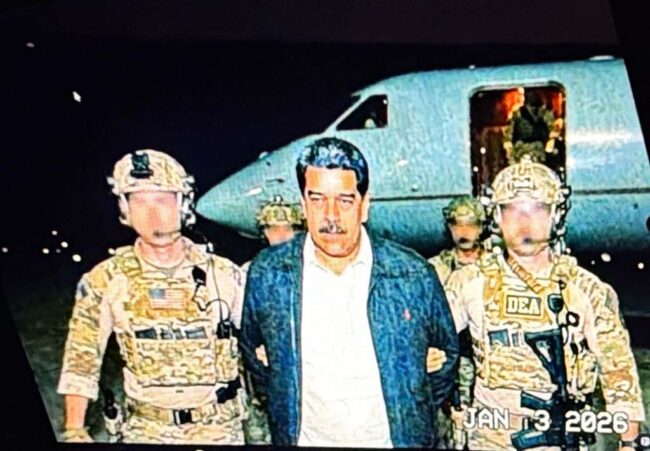
The helicopters came under fire, Caine said, prompting a response with “overwhelming force.” One aircraft was hit, but all returned safely. Maduro and his wife “gave up” and were taken into custody by the U.S. Department of Justice, boarding the USS Iwo Jima at 3:29 a.m., he added.

Trump said Maduro and Flores are being taken to New York to face drug trafficking-related charges. Maduro has repeatedly denied U.S. accusations that he leads a drug cartel.

Trump said the United States was prepared to carry out a second wave of attacks if necessary, adding that Washington was “not afraid of boots on the ground” and that U.S. forces had operated “at a very high level” inside Venezuela.

Asked how the United States would govern Venezuela during the transition, Trump offered few specifics, saying only that officials were “designating people right now.” He gestured toward himself and Secretary of State Marco Rubio, saying that for a period of time “it’s largely going to be the people standing right behind me.”

Rubio described Maduro as a “fugitive of American justice” with a US$50 million reward on his head. “I guess we saved ourselves $50 million,” Rubio said, prompting Trump to add: “We should make sure nobody claims it.”

Rubio said Maduro had been given “multiple opportunities” to avoid confrontation but instead chose to “act like a wild man,” accusing him of inviting Iran into Venezuela and allowing criminal gangs to send migrants into the United States. “President Trump is not a game player,” Rubio said.

Trump also said U.S. companies would be allowed to enter Venezuela to repair its oil infrastructure and “start making money for the country,” framing the intervention as the beginning of a “partnership” that would make Venezuelans “rich, independent and safe.” He referred to Maduro as an “illegitimate dictator.”

Trump confirmed that Rubio had been in contact with Delcy Rodríguez, Venezuela’s vice president and one of Maduro’s closest allies. Rodríguez issued an audio statement after the strikes urging the United States to provide proof of life for Maduro and Flores, sparking speculation that she may no longer be in Venezuela.

Trump said Rodríguez had expressed a willingness to do “whatever the U.S. asks,” though analysts say she would struggle to gain credibility as an agent of political change after years of defending the Maduro’s regime.

Opposition leader and Nobel Peace Prize laureate María Corina Machado has hailed the operation as a turning point for the country.

“The hour of freedom has arrived,” Machado said in a statement, declaring that Maduro is now facing international justice for “atrocious crimes” committed against Venezuelans and foreign citizens. She said the time had come for “popular sovereignty and national sovereignty” to prevail.

Machado called for the immediate recognition of opposition-backed Edmundo González Urrutia as Venezuela’s legitimate president and commander-in-chief of the armed forces, urging military officers to recognize his authority.

“We are prepared to enforce our mandate and take power,” she said, calling on Venezuelans inside the country to remain organized and on those abroad to mobilize international support for rebuilding Venezuela.

“Venezuela will be free,” Machado said. “Hand in hand with God, until the very end.”
  •  

Trump praises “brilliant” military operation against Venezuela’s Nicolás Maduro

U.S. President Donald Trump has hailed as “brilliant” the U.S. military operation that resulted in the capture of Venezuelan dictator Nicolás Maduro, as explosions were reported in Caracas early Saturday. Governments across the Americas and Europe are reacting to the arrest of the Maduro and his wife Cilia Flores.

In a brief telephone interview with The New York Times hours after the strikes, Trump praised the planning and execution of the operation. “A lot of good planning and a lot of great, great troops and people,” Trump said. “It was a brilliant operation, actually.”

Trump said U.S. forces carried out a large-scale strike against military targets in Venezuela and captured Maduro and his wife, Cilia Flores, who were flown out of the country. He has not disclosed where they are being held. The U.S. administration claims there were no American casualties in the operation but declined to comment on Venezuelan casualties.

Venezuelan authorities have yet to confirm Maduro’s capture. Vice President Delcy Rodríguez said on state television that the whereabouts of Maduro and Flores were unknown and demanded “proof of life” from Washington.

Interior Minister and the regime’s henchman Diosdado Cabello urged calm, telling Venezuelans not to “make things easier for the invading enemy,” and alleged without evidence that civilian buildings had been hit.

In a separate statement broadcast on state television VTV, Venezuela’s Attorney General Tarek William Saab formally requested proof of life for Maduro and Flores. Saab condemned the U.S. action as a shift “from rhetoric to direct violence” and described the strikes as a premeditated act of terrorism. He said the operation left an unspecified number of people injured and killed, without providing figures or evidence.

Explosions were reported across Caracas in the early hours of Saturday, with power outages affecting several districts, according to witnesses and local media. Venezuelan state outlets reported strikes on major military and government sites, including Fuerte Tiuna, the country’s largest military base, and the La Carlota air base in heart of the capital.

According to sources inside Venezuela, pro-opposition supporters aligned with Venezuela’s legitimate president-elect Edmundo González and Nobel Peace Prize laureate María Corina Machado have begun mobilizing to secure government buildings and institutions and are preparing steps toward a political transition. Sources claim to be preparing the groundwork for what they describe as a interim administration, though no formal announcement has been made.

The U.S. embassy in Bogotá issued a security alert urging American citizens in Venezuela to shelter in place, citing “reports of explosions in and around” Caracas. The United States suspended operations at its embassy in Caracas in 2019.

Bogotá Mayor Carlos Fernando Galán called for calm and announced increased security measures near the U.S. and Venezuelan diplomatic missions in the Colombian capital.  “It is clear that a new stage is opening today for Venezuela, which should be oriented toward the return of democracy. That process must be peaceful and with full respect for the civilian population and international law. At this moment, the protection of Venezuelan citizens, both within their country and abroad, is a priority. Bogotá is home to hundreds of thousands of Venezuelan citizens, and our responsibility is to ensure their safety, their rights, and coexistence in the city,” he said.

Maduro was indicted in the United States in 2020 on corruption and drug trafficking charges, which he has repeatedly denied. The U.S. State Department has offered a $50 million reward for information leading to his arrest or conviction.

U.S. Attorney General Pamela Bondi said Maduro and Flores had been indicted in the Southern District of New York on charges including narco-terrorism conspiracy and cocaine importation conspiracy, adding that both would face U.S. justice.

Republicans react to Venezuela strikes

U.S House Representative María Elvira Salazar, a Florida Republican and outspoken critic of the Maduro government, said the strikes represented “the fall of a criminal structure masquerading as a government.” She said Maduro’s removal opened the door for “a real democratic transition led by Venezuelans who have resisted tyranny for years.”

Republican Senator Carlos Gimenez affirmed that “President Trump has changed the course of history in our hemisphere. Our country and the world are safer for it. Today’s decisive action is this hemisphere’s equivalent to the Fall of the Berlin Wall.”

Senator Rick Scott announced “A new day for Venezuela and Latin America. The United States and our hemisphere are safer because of President Trump’s leadership!”

U.S. Deputy Secretary of State Christopher Landau said in a social media post that Maduro had been removed from power and would be put on trial or punished, without providing further details.

Reactions from Latin America

Former Colombian President Álvaro Uribe Vélez defended the U.S. action as legitimate self-defense, arguing that Venezuela had for years harbored armed groups and facilitated drug trafficking. Uribe said that when a country becomes “a sanctuary for narco-terrorism,” it inevitably triggers consequences. He accused Venezuela’s leadership of destroying democratic institutions and fueling an exodus of millions across the region, urging Venezuelans to pursue freedom and institutional reconstruction.

Former Colombian President Iván Duque also welcomed the development, calling Maduro’s capture “the beginning of the end of the narco-dictatorship in Venezuela.” Duque said the moment opened a path toward democratic reconstruction with international support, while emphasizing the need to protect regional security.

Colombia’s current President Gustavo Petro took a sharply different view, rejecting what he called aggression against Venezuela’s sovereignty. Petro said Colombia had deployed security forces to its border and activated contingency plans in case of a mass influx of refugees, while seeking to convene the United Nations Security Council. “Internal conflicts between peoples are resolved by those same peoples in peace,” Petro said.

Argentina’s President Javier Milei struck a celebratory tone, posting on “X”: “Long live freedom, carajo!”

Ecuador’s President Daniel Noboa voiced support for Venezuela and the opposition. “To María Corina Machado, Edmundo González and the Venezuelan people, it is time to recover your country,” Noboa wrote, adding that what he called “narco-Chavista criminal structures” would continue to fall across the continent.

Colombian presidential candidate Paloma Valencia of the Centro Democrático party was among the first to react to the breaking news, stating: “Free Venezuela. The illegitimate dictator who usurped power, and subjugated Venezuela and the Venezuelans, has fallen. Democrats yearned for an opportunity for the return of democracy and freedom.”

Medellin Mayor Federico Gutiérrez also celebrated the arrest of the regime leader, saying: “Dictator Nicolás Maduro has been captured. Every tyrant’s time comes. Venezuela Free.”

Spain’s Prime Minister Pedro Sánchez has urged restraint and respect for international law, while Cuba’s President Miguel Díaz-Canel condemned the  “criminal attack” by the United States.

As of Saturday morning, no senior Venezuelan military official, including Defense Minister Vladimir Padrino, had appeared publicly, and it remained unclear who controlled key state institutions or how Venezuela’s armed forces would respond as the crisis continued to unfold.

Screen capture from television shows DEA agents escorting Venezuela’s Nicolás Maduro.
  •  

BREAKING: Venezuela’s Maduro captured after U.S strikes Caracas

The United States has captured Venezuelan dictator Nicolás Maduro, along with his wife Cilia Flores, after a series of targeted military strikes on Caracas at 1:30 am on Saturday, January 3, 2026.

In a statement posted on his Truth Social platform, U.S President Donald J. Trump said U.S. forces, working with U.S. law enforcement, conducted a “large scale strike” that resulted in the capture of Maduro and his wife, Cilia Flores. Trump said both were flown out of Venezuela, without providing details on where they were taken or the legal basis for their detention.

“The United States of America has successfully carried out a large scale strike against Venezuela and its leader, President Nicolas Maduro,” Trump said, adding that more information would be released at a news conference scheduled for 11 a.m. ET at his Mar-a-Lago residence in Florida.

Explosions were reported across parts of Caracas in the early hours of Saturday, according to witnesses and videos posted on social media, which showed flashes in the sky, fires and power outages in several areas of the capital. One of the main targets appeared to be Fuerte Tiuna, the country’s largest military base and a key command center for Venezuela’s Bolivarian Armed Forces.

The extent of damage and possible casualties could not be independently verified. Venezuelan authorities did not immediately confirm whether senior military officials, including Defense Minister Vladimir Padrino, were injured or killed in the strikes.

In Washington, Republican lawmakers were quick to praise President Trump’s decisive action. Representative Mario Díaz-Balart praised the operation, saying it demonstrated decisive leadership against what he described as an illegitimate regime that posed a threat to U.S. and regional security. Other lawmakers raised questions about the legality of the strikes and whether Congress had authorized the use of force.

In Colombia, Medellín Mayor Federico Gutiérrez expressed support for Venezuelans living abroad, saying millions had fled repression and economic collapse under Maduro’s rule. Venezuelan migrants make up a significant share of Medellín’s population, local authorities say.

It remains unclear how Venezuela’s armed forces will respond or whether Maduro’s removal will lead to a peaceful transition of power with the return of President-elect Edmundo González and opposition leader Maria Corina Machado, both currently out of the country.

Developing News Story….

  •  

US Grants Entry to Colombian Eggs for Industrial Processing

The US Animal and Plant Health Inspection Service (APHIS) has authorized the entry of Colombian shell eggs destined for industrial processing, according to an announcement made by Diana Marcela Morales Rojas, Minister of Commerce, Industry and Tourism (MinCIT). This decision expands the export capacity for Colombia’s poultry sector by allowing the product to enter the US market without requiring additional import permits or sanitary certificates from the Colombian Government.

The authorization by APHIS follows technical and commercial discussions between US and Colombian regulatory bodies. Minister Morales Rojas stated that the outcome enables the poultry industry to expand its presence in international markets and integrate into higher-standard value chains.

The regulatory modification is the result of collaboration between the Government of Colombia, the Instituto Colombiano Agropecuario (ICA), the Ministry of Commerce, Industry and Tourism, the Embassy of Colombia in the United States, and the Federación Nacional de Avicultores (Fenavi), the trade association representing the poultry sector.

Six US facilities have been designated to receive the Colombian shell eggs for processing. These plants are situated in the states of New York, Pennsylvania, New Jersey, Arkansas, and Georgia. The direct entry authorization for industrial use simplifies the logistics and required sanitary compliance for the export of the product.

Above photo: Colombia’s Minister of Commerce, Industry and Trade, Diana Marcela Morales (courtesy MinCIT)

  •  

The New Monroe Doctrine: U.S. Recasts Latin America as Security Priority

Why such a massive U.S. military deployment off the coast of Venezuela, supposedly to combat the “Cartel of the Suns” and stop drug trafficking from Venezuela to the United States? After more than four months, the results amount to little more than a handful of small vessels destroyed – an extremely modest impact given the scale of the force deployed.

The reality is that the volume of drug trafficking transiting through Venezuela to the United States is relatively small. Venezuela is not a producer of cocaine, much less of fentanyl, most of which enters the United States via Mexico. If the real interest is not to halt drug trafficking, what then is the motivation for placing the Fourth Fleet on a war footing in the Caribbean Sea? Logic might lead one to think the U.S. interest is oil, since Venezuela holds the largest reserves in the world—but that is not it either. Today the United States is the world’s leading oil producer, at 13.4 million barrels per day, and it has proven reserves sufficient for approximately ten years, assuming no new discoveries and no improvements in recovery or technological advances—an impossible assumption.

So what, then, is the underlying issue if it is neither drugs, nor oil, nor other minerals in which Venezuela might have potential and that would be attractive to the United States?

The answer lies in a little-publicized document formally released by the White House on December 4, titled National Security Strategy 2025. While the document introduces substantial changes in relations with Europe and traditional adversaries, the most striking element is the new emphasis placed on Latin America. Of the document’s “roadmap to ensure that America remains the greatest and most successful nation in human history”, five sections are devoted exclusively to our region, positioning Latin America as a fundamental component of U.S. security – a very significant shift from earlier versions, which historically prioritized the Middle East or Asia. There is a new strategy, or if you will, a “New Monroe Doctrine,” a continuation of the 1823 Monroe Doctrine, reaffirming U.S. preeminence in the region.

“After years of neglect, the United States will once again apply and enforce the Monroe Doctrine to reestablish U.S. preeminence in the Western Hemisphere, and to protect our homeland and our access to key geographies throughout the region. We will deny non-Hemispheric competitors the ability to position forces or other threatening capabilities, or to own or control strategically vital assets, in our Hemisphere,” states the 29-page document.

Key elements of this new doctrine include: countering external influence by requiring Latin American governments to dismantle foreign military installations and divest strategic assets in exchange for aid or alliances; stopping illegal migration, including naval patrols in the Caribbean and the eastern Pacific, selective border deployments, and the use of incentives for governments to curb migratory flows; combating narco-terrorists and cartels; and sealing economic and political commitments with aligned governments in a win-win framework that would include procurement preferences and greater cooperation, among other measures, with a view to turning Latin America into a stable market for U.S. exports and a buffer against global rivals.

In recent years, China has achieved significant penetration in Latin America through its diplomacy and long-term strategy (the Belt and Road Initiative, or New Silk Road). For nearly all countries in the region, China has become the leading trading partner, displacing the United States; it is also an investor in major infrastructure projects and a lender of funds (in Venezuela’s case, a very large lender that negotiated debt repayment in oil at very low prices). In addition, China has become a major supplier of weapons and information technology.

In this context, what Washington appears to be seeking is indeed a regime change in Venezuela to counter the influence of China and Russia, but without openly announcing it in order to avoid a direct diplomatic confrontation. Trump has segmented the region into friendly regimes (Argentina, El Salvador, Ecuador, Honduras, and Guatemala), enemy regimes (Venezuela, Cuba, and Nicaragua), and regimes in limbo (Colombia and Brazil).

For Venezuela, regime change appears imminent, which would profoundly benefit Colombia, because, as Miguel Uribe Turbay said before he was assassinated, “as long as there is no freedom in Venezuela, there will be no peace in Colombia.” On the other hand, a change of government in Colombia is also approaching, and the country will have to decide which of these groups it wants to belong to—whether it repairs its relations with its traditional partner and ally, or definitively joins the group of pariah states in the region. Let us hope it is the former.

About the author: Luis Guillermo Plata served as Minister of Trade, Industry of Commerce during the government of President Álvaro Uribe Vélez, and in 2021, appointed by President Iván Duque, Ambassador of Colombia to Spain.

  •  

Stain on Hay: Should María Corina Machado Refuse the Literary Festival?

For a literary festival, silence can be more revealing than speech. The decision by three writers to withdraw from the 2026 Hay Festival in Cartagena over the presence of María Corina Machado, this year’s Nobel Peace Prize laureate and the most prominent figure in Venezuela’s democratic opposition, has exposed a paradox at the heart of contemporary literary culture: a professed devotion to free expression that falters when confronted with an inconvenient voice.

Hay Festival Cartagena, now in its 21st edition, is scheduled to take place from 29 January to 1 February 2026, with parallel events in Barranquilla, Medellín and a special edition in Jericó, Antioquia. Founded three decades ago in Wales and once described by Bill Clinton as “the Woodstock of the mind,” Hay has built its global reputation on the premise that literature flourishes in the presence of disagreement. Its stages have hosted figures as diverse – and divisive – as Salman Rushdie, Jonathan Safran Foer and David Goodhart, writers whose ideas have unsettled orthodoxies across continents.

Yet in Cartagena, dialogue has been recast as contamination.

The Colombian novelist Laura Restrepo, the Barranquilla-born writer Giuseppe Caputo and the Dominican activist Mikaelah Drullard announced they would not attend in protest at Machado’s invitation. Restrepo, winner of the 2004 Alfaguara Prize, had been scheduled to participate in several events, including a conversation with Indian novelist Pankaj Mishra and a session devoted to her most recent book, I Am the Dagger and I Am the Wound. In a public letter addressed to festival director Cristina de la Fuente, Restrepo described Machado’s presence as “a line” crossed.

“I must cancel my attendance at Hay Festival Cartagena 2026,” Restrepo wrote. “The reason is the participation of María Corina Machado, an active supporter of United States military intervention in Latin America.” Granting her a platform, Restrepo argued, amounted to facilitating positions hostile to regional autonomy.

Caputo echoed his reasoning on social media, announcing that “in the current context of escalating imperial violence, it is better to withdraw from a festival taking place opposite the bombarded waters of the Caribbean Sea.” Drullard, five days earlier, said she could not attend an event that “supports pro-genocide and interventionist positions through the mobilisation of those who promote them,” citing Machado’s proximity to the administration of US President Donald Trump.

What remains striking, however, is not merely the severity of these accusations but their selectivity. None of the boycott statements devotes comparable moral energy to denouncing the documented human rights abuses of Nicolás Maduro’s regime: arbitrary detentions, enforced disappearances, torture of political prisoners, or the systematic dismantling of democratic institutions. One is left to ask whether the authors’ moral outrage extends to the lived realities of Venezuelans themselves, or whether it finds expression only when filtered through the optics of geopolitics.

The irony is sharpened by the fact that the same US administration helped secure Machado’s escape from Venezuela on December 8, enabling her to arrive in Oslo hours after her daughter Ana Corina Sosa received the Nobel Peace Prize on her behalf. “When the history of our time is written, it won’t be the names of the authoritarian rulers that stand out – but the names of those who dared resist,” noted the Nobel Foundation. 

The arguments from Machado’s detractors  warrant scrutiny – and above all, debate. What they do not justify is refusal from Latin America’s self-entitled literati. A boycott replaces argument with absence, moral reasoning with pantomime. It is a gesture that confers ethical purity upon the boycotter while foreclosing the very exchange that literature has traditionally claimed to defend. This is the “line” that cannot be crossed.

The Hay Festival’s response has been characteristically diplomatic In a statement following the cancellations, organisers reaffirmed their commitment to pluralism: “We reaffirm our conviction that open, plural and constructive dialogue remains an essential tool for addressing complex realities and for defending the free exchange of ideas and freedom of expression.” They stressed that Hay “does not align itself with or endorse the opinions, positions or statements of those who participate in its activities,” while respecting the decisions of those who chose not to attend.

That insistence on neutrality, however, also reveals a deeper unease. If a literary festival must repeatedly assert its impartiality, it may be because neutrality itself has become suspect. Increasingly, festivals are asked to function as courts of moral arbitration, conferring legitimacy on some voices while quietly disqualifying others. The result is not a more just cultural sphere, but a narrower one—policed less by argument than by consensus.

The controversy has unfolded at a particularly volatile moment for Venezuela’s eight-million diaspora. Machado’s invitation coincides with a renewed escalation in US pressure in the Caribbean Sea. On Tuesday, President Trump ordered a “total and complete blockade” of all sanctioned oil tankers entering or leaving the country, targeting Caracas’s principal source of revenue. His administration also designated Maduro’s government a Foreign Terrorist Organization, accusing it of using “stolen US assets” to finance terrorism, drug trafficking and organised crime.

“Venezuela is completely surrounded by the largest armada ever assembled in the history of South America,” Trump wrote on Truth Social. “It will only get bigger, and the shock to them will be like nothing they have ever seen before – until such time as they return to the United States all of the oil, land and other assets they previously stole from us.”

Against this backdrop, Machado’s high-profile presence at Hay has acquired a symbolic weight that far exceeds literary stages. Yet it is precisely at such moments that intellectual forums are tested. Fiction, after all, teaches empathy, complexity and the capacity to hold contradiction without retreat. To boycott rather than engage is to abandon that lesson – and, with it, democratical ideals.

The reputational cost to Hay Festival Cartagena may prove lasting – not because Machado was invited, but because the limits of reason and tolerance have been publicly exposed. A gathering that once prided itself on hosting difficult conversations now finds itself unsettled by the very principle on which it was founded.

And there is a final inflection. If Hay’s commitment to dialogue is grounded in a leftist agenda – if certain voices render discussion impossible – then Machado herself should reasonably question the value of her remote participation at the festival on January 30, for a scheduled conversation with Venezuelan journalist and former minister Moisés Naím.

In Cartagena, it is not Machado’s words that should concern audiences, but the intellectual impoverishment by those who chose not to speak to her at all.

  •  

María Corina Machado Issues Post-Maduro “Freedom Manifesto”

As the USS Gerald R. Ford navigates uncomfortably close to the Venezuelan coastline and some 15,000 U.S. Marines remain stationed across Caribbean waters, Venezuela’s political crisis has entered a volatile new phase. In Caracas, Nicolás Maduro is publicly calling for peace and dialogue — even quoting John Lennon’s “Imagine” and delivering rally slogans in English — while the country’s most prominent opposition figure, Nobel Peace Prize laureate María Corina Machado, has issued an expansive “Freedom Manifesto” envisioning a democratic rebirth after the collapse of Maduro’s rule.

Both gestures — Maduro’s unusually soft-spoken overtures and Machado’s sweeping declaration of national principles — arrive just days before a major U.S. decision that could redefine Washington’s policy toward Venezuela. On November 24, the State Department is expected to designate the Cartel de los Soles, a Venezuelan military-linked drug trafficking network allegedly headed by Maduro, as a Foreign Terrorist Organization (FTO).

Secretary of State Marco Rubio reiterated that the group “has corrupted the institutions of government in Venezuela and is responsible for terrorist violence conducted by and with other designated FTOs, as well as for trafficking drugs into the United States and Europe.”

Yet even as Washington prepares its most severe sanction to date, President Donald Trump has said he is open to speaking directly with Maduro. “I would probably talk to him, yeah,” Trump said. “I talk to everybody.”

That combination — tightening pressure paired with a sudden willingness to talk — has created what regional observers describe as an unprecedented moment of strategic ambiguity. Across Latin America, many now wonder whether the United States has a coherent plan for Venezuela or whether it is improvising amid escalating military preparations.

Maduro appears intent on exploiting that ambiguity. In recent public appearances, he has addressed the U.S. public directly, shifting between Spanish and English, at one point even singing. Over the weekend, he declared he wanted a “face-to-face” with Trump, urging: “Dialogue, call, yes; peace, yes; war, no — never, never war.”

In a televised address Monday, he warned that any U.S. military intervention would mark the “political end” of Trump’s leadership, accusing advisers around the U.S. president of “provoking” an armed conflict for political gain.

But even while denouncing Washington’s “hawks,” Maduro simultaneously extended yet another olive branch: he was willing to speak, he said, “with anyone in the Trump administration who wants to talk to Venezuela.”

This duality – hostility mixed with conspicuous calls for peace – reflects the delicate position Caracas faces as U.S. firepower mounts offshore and covert options reportedly expand.

According to a report published Tuesday by The New York Times, Trump has authorized the CIA to prepare potential covert operations inside Venezuela, part of a broader pressure campaign to weaken Maduro’s government. The same report said the White House has quietly reopened back-channel communications with Caracas, during which Maduro suggested he might consider stepping aside after a negotiated transition.

The State Department has also fueled speculation by delaying the FTO designation until November 24 — a move some analysts view as an ultimatum: enter negotiations or face an escalation that could sever what remains of Venezuela’s diplomatic and economic links to the outside world.

Vision for “The New Venezuela”

While Maduro navigates the diplomatic minefield, María Corina Machado is attempting to position herself — and the opposition — for a post-Maduro future. On Tuesday, Machado released her “Freedom Manifesto,” a sweeping philosophical and political declaration, that lays out a roadmap for what she calls “a Venezuela reborn from the ashes.”

The document is sharply moral in tone. It presents Venezuelans as having endured “chains of tyranny” and calls for the restoration of dignity, property rights, free markets, unrestricted speech, secure voting, institutional reform, environmental protection, and the return of nine million exiles forced abroad.

“We stand at the edge of a new era – one where our natural rights will prevail,” Machado writes. She envisions a country with a revitalized energy sector, a diversified high-tech economy, demilitarized institutions, and a reinvigorated place in the “international community of democracies.”

Her manifesto is both a political program and a counterpoint to the perception  prevalent in several Latin American capitals – that Washington’s next steps, not Venezuela’s internal politics, may determine the timing and nature of Maduro’s exit.

Even before the FTO designation, the United States had already escalated its military posture. Since early September, U.S. forces have carried out 21 strikes on boats in the Caribbean Sea and eastern Pacific, killing 83 people, in what the administration describes as anti-narcotics operations. Trump has hinted that known trafficking sites within Venezuela are potential targets.

The prospect of further strikes has unsettled the region’s leftist governments, most notably Colombia, under Gustavo Petro. While Washington is willing to keep the door to dialogue open with Maduro, it remains water-tight shut to a democratically-elected president described by President Turmp as an “illegitimate drug leader”.

For Maduro, calling for dialogue may be a defensive tactic — an effort to avoid isolation at a moment when Washington appears to be tightening multiple pressure channels at once. For Machado, the combination of international pressure and internal exhaustion presents a rare opportunity to present the blueprint for a new Constitution.

Yet the central question remains whether the United States has a clear strategy for a peaceful transition to democracy. A show of overwhelming force without a defined political horizon could embolden Maduro’s close allies – including Russia and Colombia’s Petro – to argue that Washington lacks staying power in the hemisphere. Should the military arsenal in the Caribbean fail to deliver tangible results – from regime transition to a negotiated exile for Maduro – the Chavista leadership will feel emboldened to stay the course.

The next ten days, leading to the November 24 FTO designation, will prove decisive. Either Maduro exits quietly – triggering the removal of the U.S. government’s $50 million bounty for his arrest – or the United States crosses a legal and diplomatic threshold that could redefine the region for decades to come.

  •  

Apple Starts Shipping Made-in-America AI Servers Early

Apple has begun shipping American-made artificial intelligence servers from a newly built factory in Houston, beating its 2026 target.


The servers designed for Apple's Private Cloud Compute system have started shipping from the 250,000-square-foot Houston site months earlier than planned. Apple Chief Operating Officer Sabih Khan confirmed the acceleration in a statement provided to Fox Business:

We are thrilled to be shipping American-made advanced servers from our Houston facility. As part of our $600 billion commitment to the United States, these servers will be installed in our data centers and play a key role in powering Apple Intelligence with Private Cloud Compute. Our teams have done an incredible job accelerating work to get the new Houston factory up and running ahead of schedule, and we plan to continue expanding the facility to increase production next year.


Private Cloud Compute is the architecture Apple uses to offload certain Apple Intelligence computations from devices to the cloud, while preserving the on-device privacy model that Apple says is core to its AI system. Apple CEO Tim Cook also posted on X about the news:

Apple’s American-made advanced servers are now shipping from our new Houston facility to Apple data centers!

These servers will help power Private Cloud Compute and Apple Intelligence, as part of our $600 billion US commitment. pic.twitter.com/maOd3lCGfK

— Tim Cook (@tim_cook) October 23, 2025


Apple is reportedly partnering with local contractors and recruiting from Houston City College to staff the facility. The Houston facility is part of a $600 billion U.S. investment commitment Apple made earlier this year, which includes capital for domestic manufacturing, silicon engineering, R&D, and workforce training initiatives.
This article, "Apple Starts Shipping Made-in-America AI Servers Early" first appeared on MacRumors.com

Discuss this article in our forums

  •  
❌