 Login
Login
El mar arrastra a Colombia pruebas de los ataques aéreos de Trump
Primero fue la embarcación calcinada. Luego los cuerpos destrozados y los paquetes con restos de marihuana. Ahora, los pescadores temen zarpar al océano que los alimenta.

In an era of shifting global economic alliances, few countries find themselves more strategically positioned than Colombia. Caught between the massive state-backed investment initiatives of China and the established political and economic influence of the United States, Bogotá’s policy decisions have never held higher stakes for investors, the region, or especially, the country’s own citizens.
At the 2025 Colombia Gold Summit, Finance Colombia Executive Editor Loren Moss spoke with Daniel Giraldo, a Managing Director at FTI Consulting (NYSE: FCN), a global business advisory firm specializing in cross-border investment and corporate finance. Giraldo offered his perspective on the geopolitical chessboard, examining what Colombia’s recent decision to join the Belt and Road Initiative means for its future relationship with its largest long-standing ally, the United States.
Finance Colombia: I’m here with Daniel Giraldo of FTI Consulting. So we’re here at the 2025 CGS, Colombia Gold Summit, where we also talk about other precious metals, we talk about silver, we also talk about metals like copper, molybdenum, things like that. You gave an interesting talk yesterday, I don’t want to steal your thunder. Why don’t you summarize your discussion?
Daniel Giraldo: Well, if I could summarize my lecture yesterday, I think there’s a chessboard, a giant global chessboard right now. And there are two main players: US and China. And Colombia is one key figure, a key part of this chessboard. Right now, Colombia is in a key position with lots of opportunities between Chinese investment and the US investment. However, which decisions Colombia takes right now will shift the entire game for the coming years.
Finance Colombia: So we are in the last few months of a government that has been relatively friendly or biased towards China. And hostile might be too strong of a word, but relatively cold towards the United States, talking about the Petro government. Colombia, under Petro, just signed up for the Belt and Road Initiative. What is the significance of that for Colombia, not just in its relationship with the United States, but what does that do or change for Colombia?
Daniel Giraldo: Well, what we are seeing right now is that Colombia signed formally the Belt and Road Initiative earlier this year. And there’s been a lot of tensions with the Trump government. At the same time, the US is the main investor in Colombia. And what we’re seeing is how China, through different initiatives, wants to have a bigger long-term influence in the region. And Colombia is, in a soft way, saying, “We want that for us.” However, that’s not a shift that can be made automatically. That’s not made in a single signature by one president. It takes years and years to forge a relationship. And although the government of Petro, President Petro is showing how they’re very interested in the Chinese investment, and to have a strong relationship with the Chinese government, it’s not the way, to just step out of their major alliances throughout years with the US
Finance Colombia: The way that investment is done in China is fundamentally different than the way investment is done from places like the US or Canada or many European countries. In the US, if you’re going to attract investment in Colombia, it’s going to be with some company. And that company is going to do what it wants to do within the law but not really giving a damn about what Washington says or what Washington wants or what Ottawa says or wants. Whereas in China, it’s very much a government-to-government thing. You have state-owned enterprises, and Xi Jinping or the Communist Party says, “we’re going to invest in this,” whether it’s profitable or not, for whatever kind of geopolitical reasons that they want to do things. So it’s a fundamentally different thing.
If you do a deal with a company in the US, you’re doing a deal with that company. Now, yes, you have to make sure that regulatory things go through. Trump is a little bit more of a patronage type of president where he wants to get involved with things so he can find benefit for himself or his administration. But generally speaking, even still, if we look at investors, if you’re going to bring in someone to invest in one of these mining companies here or exploration, it’s a company. In China, it’s going to be a state-backed company. Now, what does that imply, then, for the way business would be done going forward, number one? And number two, Petro’s on his way out, and maybe there will be another left-wing government to continue his project, it doesn’t look like it at this point. But do you see continuity in that affinity or that participation in the Belt and Road Initiative? Like you mentioned, it’s not a treaty, it’s more of like a memorandum of understanding, like the diplomats like to call it. But what do you foresee over the next two or three years?
Daniel Giraldo: Yeah, I believe every tactic has been launched in a very moderate way somehow. So, of course, Belt and Road is just a framework, and every project that could be contemplated by Chinese government, depending on the feasibility of each one of these projects. So they’re not basically getting married yet, they’re just dating.
They’re just on their first dates. However, we’re married to the US We’ve had a long-standing marriage, and what we are seeing right now is that how investment works for both countries is different. However, for both countries, there are more and more, basically, things they require to be approved.
So in order to achieve this, the US is not being indirect about it. They require trusted partners. They require trusted allies, which get what’s at stake right now. So, Petro’s government has one year left. We are expecting a shift. However, even if Colombia gets a left-wing government or a right-wing government, it doesn’t change the fact that investment in the latest years has been in a rough place.
So Colombia requires this investment, and the country requires a very stable policy framework, regulatory framework, legal framework, in order to get investors feeling safer, with more appeal. And, yes, of course, it’s not the same as an SOE (State Owned Enterprise) Chinese company that wants to invest, that needs the approval of Beijing and all this. In contrast, we have the US. Of course, Washington can say whatever they want. They can say Petro is now on the Clinton list, and they can sanction him personally. But a company, a US company, can still invest here; it changes how they see Colombia in the long run.
Finance Colombia: I think one of the things that is very notable is that the Trump government sanctioned Petro, his son, his wife, and his interior minister personally, rather than imposing sanctions on the country or doing, like, I don’t know, tariff things. Actually, by the time we publish the video, we might know what happens, but right before the Supreme Court right now, actually as we speak, there is a challenge to Trump’s ability to circumvent congressional law. And so if we have a trade pact, like free trade agreement or something like that, a lot of businesses in the US have challenged Trump’s ability to just… you can’t just cancel a law. Congress passed a law, and it’s in effect, and you can’t just cancel it. Well, that’s what they’re arguing. And all of these kind of unilateral, discretionary tariff moves that affect entire economies and entire industries, there’s some uncertainty that is going to be settled there.
“However, we’re married to the US We’ve had a long-standing marriage, and what we are seeing right now is that how investment works for both countries is different.” – Daniel Giraldo
But it’s interesting because it seems that with them sanctioning Petro and Benedetti directly as individuals, they’re saying that they want to maintain some predictability and constancy in the bilateral economic relationship with Colombia. And I think that there have been a lot of missions. Fico, the mayor here in Medellin, some of the other mayors and Colombian congressional people have visited Washington and met with senators and met with people in the State Department and said, “Look, you know, we disagree with what the president’s doing. Wait a few months.” And it seems like Washington has heard that and is not acting too rashly towards Colombia as a country but rather decided to take their ire out directly on the president and his consigliere Armando Benedetti.
Daniel Giraldo: What I believe of this is that Trump’s government can say like, “We’re not afraid. We are not afraid of imposing sanctions. We’re not afraid of not conducting business in the way we used to do it anymore.” And it’s been shown, for example, in the relationship with China, for example, with the Chinese government, with Xi Jinping. And there’s been like an escalation of tariffs, for example, I think up to 130%. I can’t remember the exact number. And then last week they say, “let’s stop this. Let’s trade the sequels.” And it’s also their way of showing the carrot and then showing the mace or bat, this metaphor.
Finance Colombia: Yeah, the stick.
Daniel Giraldo: And with Colombia, I believe it is the same. It’s like we could, if we wanted, to give some sanctions and they will have great consequences in terms of our bilateral trade. However, they’re aware of their position. They’re our main investor. We have a very good relationship in bilateral trade. There’s been years and there’s been decades of both countries benefiting from each other. We have a great position in one of the closest countries to enter South America. And they know this government is just ending. So why would they give us, like give the left-wing parties an opportunity to just bash them and say, “Oh, Trump’s government can’t be trusted.” Whereas if you take another position and say, “Look, this is personal, this is just these individuals, not the whole country.” You still have ground to negotiate, to renegotiate, to benefit. So I believe it is quite tactical.
Finance Colombia: Another thing that you mentioned is the difference on the ground. When you look at, for example, if we talk about the mining sector, not just on the ground, but literally in the ground, the US right now, the Trump administration, and really just the US more broadly, is very concerned about rare earths. And Colombia, even though there’s not yet a lot of mining activity, Colombia does have rare earth potential. There’s already been illegal coltan, cobalt ore mining taking place down in the Amazon, things like that. But it would seem that further damaging relationships with Colombia right now would contravene the political strategy in the US to strengthen its rare earth mineral supply chain.
Daniel Giraldo: Yes, it is completely true. The US has shown how important it is for them to be less dependent on the supply chains of the Chinese government, specifically in terms of their rare earths and critical minerals refining processes. So the US has been in recent weeks signing lots of memorandums of understanding and bilateral agreements with Australia, with Japan, with Malaysia, with Thailand. And they already have very good deals with Argentina, with the Mineral Security Partnership, for example, Mexico, Peru, Argentina. And the Dominican Republic. And Colombia could be in the radar as well. And what Colombia requires to be here and to benefit with the US as well is just to be patient, to get the best and the highest standards of ESG, and to reassure the different governments that it is safe to trade minerals with Colombia. That if they purchase Colombian minerals, they explore the region and they trade with us, they will find quality, they will find high standards of minerals, without assuming lots of risks that these markets don’t want to assess anymore.
Finance Colombia: So longer term, looking out three to five years, are you optimistic or pessimistic about the bilateral relationship between the US and Colombia?
Daniel Giraldo: I feel optimistic, not only because it’s the most comfortable answer, but I do feel optimistic because I believe there is a lot of potential. And right now, the sector is not in its best place. But I believe that sometimes you just have to grit your teeth, take the punch, and then stand up again and do everything that’s in your power to just become better. And Colombia has a history of learning, and the sector will learn as well how to be more competent, how to attract investors, and how to get to the highest standard and quality of their bilateral trade with different countries.
Finance Colombia: Great. Well, Daniel Giraldo from FTI Consulting, you guys are one of the leading strategic consulting firms globally, especially when you look at things like cross-border investment. That seems to be your strong suit, even though you guys are a large firm and you guys do a lot of different things. Always great to see your presence here at CGS, at Colombia Gold Summit. And thanks for your insights.
Daniel Giraldo: It’s a pleasure, thanks for having me.

Figure 2: Plan View of the Apollo System Highlighting Drill Holes Announced in this Release (CNW Group/Collective Mining Ltd.)
On December 3, 2025, Collective Mining Ltd. (NYSE: CNL, TSX: CNL) announced assay results from three orthogonal diamond drill holes designed to continue expanding the high-grade Ramp Zone (“Ramp”), a component of the company’s flagship Apollo system within the Guayabales Project in Caldas, Colombia.
The results confirm broad and continuous intervals of reduced intrusion-related gold mineralization, extending the Ramp Zone to 300 meters of strike by 270 meters vertical. The company stated that the zone remains open in all directions.
The Ramp Zone, situated at approximately 1,000 meters above sea level at the bottom of the Apollo system, is part of a large, partially Reduced Intrusion Related System (RIRS) mineralized with gold, silver, copper, and tungsten. Drilling at Apollo has outlined continuous mineralization from the surface to more than 1,370 vertical meters.

Figure 3: Apollo System: High-Grade Over 1,370 Metres from Surface (CNW Group/Collective Mining Ltd.)
The deepest and northeastern-most hole reported to date, APC143-D1, intercepted 23.35 meters grading 8.24 g/t gold and 8 g/t silver. This intercept was contained within a broader interval of 76.10 meters grading 3.26 g/t gold and 4 g/t silver, starting from 409.60 meters downhole. This result expanded the Ramp Zone’s dimensions from the previously stated 275 meters of strike by 200 meters vertical.
A second hole, APC140-D2, locally extended the Ramp Zone by 50 meters to the northwest. This hole cut 16.40 meters grading 8.44 g/t gold and 19 g/t silver within a 55.10-meter interval grading 3.06 g/t gold and 7 g/t silver, beginning at 243.10 meters downhole.
A related wedge hole, APC140-D1, intersected two mineralized segments: 47.70 meters grading 1.98 g/t gold and 5 g/t silver from 527.40 meters downhole, including 15.15 meters grading 3.00 g/t gold and 8 g/t silver; and 14.15 meters grading 2.13 g/t gold and 4 g/t silver from 598.55 meters downhole.

Figure 4: Cross Section Outlining the Ramp Zone Extension to the Northwest (CNW Group/Collective Mining Ltd.)
The company has contracted a third deep-capacity diamond rig to operate at the Ramp Zone, with two additional deep-capacity rigs scheduled to arrive in mid-Q1 2026. Two additional drill holes into the Ramp Zone (APC143-D2 and APC143-D3) are pending assay results; these holes were reported to have intersected 18 sightings of visible gold, compared to none observed in the results detailed in this announcement.
To date, Collective Mining has completed 150,000 meters of diamond drilling across the Guayabales and San Antonio projects, with 105,000 meters dedicated to the Apollo system. Ten rigs are currently operating on site.
The company stated that it is fully funded for its aggressive 2026 program, which targets up to 100,000 meters of additional drilling, based on a cash position of $135 million USD as of December 1, 2025.

Figure 5: Side-by-Side Comparison of the Apollo System and the Neighboring Marmato Mine, Highlighting How the Ramp Zone and Marmato Deeps Systems Begin at the Same Elevation and the Potential for the Ramp Zone to Continue Expanding Along Strike and to Depth (CNW Group/Collective Mining Ltd.)
Executive Chairman Ari Sussman commented on the results, noting that hole APC143-D1 extended the zone along strike and at depth and demonstrated consistent mineralization over substantial widths.
The continued presence of Ramp Zone mineralization at least 270 meters beneath the initial discovery at 1,000 meters above sea level supports the view that the drilling may have only tested the top of a large intrusion-related gold system that shares mineralogical similarities with the multi-million ounce Marmato Deeps Zone.
Collective Mining was established by the team that developed and sold Continental Gold Inc. to Zijin Mining Group Co., Ltd. (SSE: 601899, HKEX: 2899)

Figure 6: Plan View of the Guayabales Project Highlighting the Apollo System (CNW Group/Collective Mining Ltd.)
Headline image – Figure 1: Cross Section Outlining the Ramp Zone Extension to the North (CNW Group/Collective Mining Ltd.)
The Medellín Secretariat of Tourism and Entertainment participated in the annual United States Tour Operators Association (USTOA) Conference and Marketplace, held through Friday at the Gaylord National Resort & Convention Center in Maryland. The Colombian city’s objective was to market its tourism offerings to US visitors and operators who prioritize sustainable practices and respect for local communities.
The USTOA Annual Conference is considered a significant platform within the US travel industry. The organization, founded in 1972, promotes responsible tourism and the development of experiences that contribute to cultural and environmental preservation. Medellín, operating as an associate member, utilized the event to engage with leading tour operators, international destinations, and specialized suppliers, aiming to secure high-value business agreements and build strategic alliances.
Medellín is seeking to encourage conscious and family-oriented tourism, and discourage those with more lascivious motives.
According to a statement from the Secretariat, the city’s delegation secured 10 business-to-business (B2B) meetings with US operators focused on expanding their travel portfolios into emerging Latin American markets. Medellín also contributed to the conference’s academic section, presenting its tourism assets. The city’s presentation emphasized its focus on the entertainment and social tourism segments, positioning itself for travelers seeking cultural and leisure activities with a defined responsible approach.
The Medellín Mayor’s Office, through its tourism agency and the Greater Medellín Convention & Visitors Bureau, highlighted several elements intended to appeal to international operators. These assets include the city’s calendar of international events, its gastronomic and musical offerings, and its active nightlife. Furthermore, city officials pointed to the modern hotel infrastructure, venues suitable for large-scale events, increased flight connectivity, and the range of cultural programs as factors allowing international operators to design programs that meet traveler expectations.
The city’s participation in the conference represents a push to cultivate long-term partnerships with operators who are committed to what the local administration defines as a more conscious form of travel, aligning with shifting industry trends.
Avianca Group International Limited (AGIL) yesterday reported its consolidated financial results for the third quarter of 2025. The company achieved $411 million USD in Earnings Before Interest, Taxes, Depreciation, Amortization, and Rent (EBITDAR), resulting in a 27.2% margin for the period.
The third-quarter EBITDAR represents a 15.5% year-over-year increase from the $356 million USD reported in Q3 2024. Total operating revenues reached $1,509 million USD, marking a 12.8% increase compared to the $1,338 million USD recorded in the same period of the prior year. Total operating costs increased by 13.3% year-over-year, settling at $1,290 million USD. Net income for the quarter was $101 million USD, an improvement from $72 million USD in Q3 2024.
Capacity, measured in Available Seat Kilometers (ASKs), reached 18,284 million, denoting a 6.8% increase compared to Q3 2024. This growth was attributed primarily to a 6.2% year-over-year increase in Stage Length. Passenger departures increased 1.0% year-over-year. The company transported 9.7 million passengers, consistent with the volume in the comparable period of 2024. The network encompassed 169 routes serving 83 destinations across 28 countries. Subsequent to the quarter’s close, Avianca introduced three new international routes, which included Belém (Brazil) and Monterrey (Mexico).
Cost performance for the quarter indicated a reduction in overall per-unit costs. Total Passenger CASK (Cost per Available Seat Kilometer) was 5.7 cents, a 1.9% decrease relative to Q3 2024. This decline was largely driven by Passenger Fuel CASK, which decreased 9.9% to 1.7 cents, resulting from lower fuel prices and increased fuel efficiency. Passenger CASK excluding fuel increased 2.1% year-over-year to 3.9 cents.
As of September 30, 2025, Avianca reported liquidity totaling $1,361 million USD, which represented 24.2% of last-twelve-month revenue. This total includes a cash balance of $1,161 million USD and $200 million USD available through an undrawn Revolving Credit Facility. The Net Debt to last-twelve-month EBITDAR ratio improved sequentially to 2.8x from 2.9x reported on June 30, 2025.
Rating agencies Moody’s and Fitch upgraded Avianca’s credit ratings to B1 and B+ respectively. Both rating actions were assigned a stable outlook.
The cargo division, Avianca Cargo, recorded $157 million USD in revenue during Q3 2025, representing a 14.1% year-over-year increase. The operating freighter fleet currently consists of nine Airbus A330s, following the integration of two additional P2F aircraft during the quarter.
The loyalty program, LifeMiles, reported a 72% year-over-year increase in Q3 2025 Third-Party Cash EBITDA, reaching $77 million USD.
In network strategy, AGIL expanded its Business Class service to 54 additional routes from key operational centers including Bogotá (Colombia), Medellín (Colombia), San Salvador (El Salvador), Quito, and Guayaquil (Ecuador). The company’s passenger operating fleet totaled 161 aircraft as of September 2025, including 134 Airbus A320 family aircraft, 15 Boeing 787s, and 12 Airbus A330s.
Avianca is a member of Star Alliance and is part of the Abra Group. The Abra Group also controls Gol Linhas Aéreas Inteligentes S.A. and holds a strategic investment in Wamos Air .
Above photo: Avianca A330F cargo jet (photo courtesy Avianca)
The Latin American culinary sector convened in Antigua, Guatemala, for the 13th edition of Latin America’s 50 Best Restaurants 2025, an event sponsored by S.Pellegrino & Acqua Panna (SIX: NESN, OTC: NSRGY). The ceremony, held at Santo Domingo del Cerro, highlighted establishments from 21 cities across the region, with Bogotá’s El Chato securing the No. 1 position.
Led by Chef Álvaro Clavijo, El Chato ascended from the No. 3 spot in 2024 to be named “The Best Restaurant in Latin America” and “The Best Restaurant in Colombia.” The contemporary bistro is noted for its engagement with local producers and its interpretation of Colombian ingredients. Clavijo founded the restaurant with the objective of positioning Colombian gastronomy globally by utilizing regional products.
“We are truly delighted to celebrate El Chato as The Best Restaurant in Latin America 2025,” stated Craig Hawtin-Butcher, Managing Director for 50 Best. “This achievement reflects the energy, talent and authenticity that make Latin American gastronomy unique in the world.”
Beyond the top spot, Colombian restaurants maintained a significant presence on the list. Celele in Cartagena, known for its research into Caribbean biodiversity, ranked No. 5. In Bogotá, Chef Leonor Espinosa’s Leo placed at No. 23.
Several new entries and recognitions for Colombia were announced. Afluente, located in Bogotá, debuted on the list at No. 34. Humo Negro, also in the capital, appeared at No. 41. Manuel, a restaurant in Barranquilla, was ranked No. 46.
Specific accolades were awarded to Colombian venues. Oda, a Bogotá-based restaurant situated within the G Lounge, received the Sustainable Restaurant Award. The establishment focuses on ingredients sourced from urban gardens and local producers.
Buenos Aires led the city rankings with eight restaurants in the top 50, followed by Lima with seven and Santiago with five. Kjolle (No. 2) in Lima was named “The Best Restaurant in Peru,” while Don Julio (No. 3) in Buenos Aires took the title of “The Best Restaurant in Argentina.”
Other notable awards included:
Highest New Entry: Casa Las Cujas (No. 14) in Santiago.
Highest Climber: Cosme (No. 9) in Lima, sponsored by Lee Kum Kee.
Icon Award: Rodolfo Guzmán of Boragó (No. 6) in Santiago.
Best Pastry Chef: Bianca Mirabili of Evvai (No. 20), sponsored by República del Cacao.
Chefs’ Choice Award: Alejandro Chamorro of Nuema (No. 10), sponsored by Estrella Damm (BME: DAMM).
Best Sommelier: Maximiliano Pérez, sponsored by Vik.
Best Female Chef: Tássia Magalhães.
The voting process is audited by professional services consultancy Deloitte, utilizing a panel of 300 regional experts including journalists, food critics, and chefs to determine the rankings.
The event was hosted in partnership with the Guatemalan Institute of Tourism (INGUAT), which aims to position Guatemala as a competitive destination. Other partners included American Express (NYSE: AXP), Buchanan’s (LSE: DGE, NYSE: DEO), and Ron Zacapa (LSE: DGE, NYSE: DEO).
Above photo: El Chato in Bogotá takes the No.1 spot in Latin America’s 50 Best Restaurants 2025, sponsored by S.Pellegrino & Acqua Panna (PRNewsfoto/50 Best)
The US Animal and Plant Health Inspection Service (APHIS) has authorized the entry of Colombian shell eggs destined for industrial processing, according to an announcement made by Diana Marcela Morales Rojas, Minister of Commerce, Industry and Tourism (MinCIT). This decision expands the export capacity for Colombia’s poultry sector by allowing the product to enter the US market without requiring additional import permits or sanitary certificates from the Colombian Government.
The authorization by APHIS follows technical and commercial discussions between US and Colombian regulatory bodies. Minister Morales Rojas stated that the outcome enables the poultry industry to expand its presence in international markets and integrate into higher-standard value chains.
The regulatory modification is the result of collaboration between the Government of Colombia, the Instituto Colombiano Agropecuario (ICA), the Ministry of Commerce, Industry and Tourism, the Embassy of Colombia in the United States, and the Federación Nacional de Avicultores (Fenavi), the trade association representing the poultry sector.
Six US facilities have been designated to receive the Colombian shell eggs for processing. These plants are situated in the states of New York, Pennsylvania, New Jersey, Arkansas, and Georgia. The direct entry authorization for industrial use simplifies the logistics and required sanitary compliance for the export of the product.
Above photo: Colombia’s Minister of Commerce, Industry and Trade, Diana Marcela Morales (courtesy MinCIT)
As the year winds to an end, the Bogotá Post looks back at 2025 in Colombia
2025 might well be looked back upon in years to come as the calm before the storm. An early sign of the potentially troubled waters ahead was the assassination of Senator Miguel Uribe in early June. Other themes included friction with the US, political deadlock and a sense that much is being put off for next year.
Relations with the USA started badly after Trump was sworn in, as he deported Colombian immigrants in chains on military planes. Petro at first refused to receive the flights, before relenting and allowing them to land but greeting the travellers and treating them with dignity.
From there it got worse, with Petro turning up on the New York streets protesting while on a visit to the UN. Trump in turn has no love for Petro, calling him a bad guy and putting him and his family on the Clinton List, alongside highly controversial longtime advisor Armando Benedetti. It also emerged at that point that Petro had separated from Veronica Alcocer some time ago.
After the US started bombing alleged narco ships in international waters in the Caribbean, things took an even darker turn. Petro, like most world leaders, was highly critical of US operations in the Caribbean, leading Trump to warn that “he could be next”.
Bogotá herself kept on with business as usual, although that’s not always a good sign. Mayor Gálan has little to show at the mid point of his time in the Palacio Liévano. Crime and rubbish are the most visible signs of a city that sometimes feels stuck in place, although the Metro seems to be on track.
Away from the febrile world of Colombian politics, there was plenty going on in cultural fields, from an impressive Copa América run by the superpoderosas to possibly the best festival Cordillera yet in Bogotá.
Senator Miguel Uribe was assassinated at the start of his electoral bid in a worrrying reminder of what can happen in Colombian politics. The politician was shot a number of times in the head while making a visit to Modelia and put into intensive care for a month before passing.

One shooter, just 15 years of age was shot and captured at the scene by Uribe’s protection. Other suspects and accomplices were relatively quickly captured, although the intellectual author of the crime remains unclear. While social networks have been hothouses of rumours and propaganda, candidates have thankfully so far stayed largely clear of commenting.
Runners and riders for the presidency have emerged and started the process of thinning the field. The Liberales, Conservadores and Cambio Radical are yet to declare their representatives. However, there are still six candidates for political parties and another 14 who have acquired the requisite 635,000 signatures to run as independents.
Among the latter names there are some big names such as Claudia López, Luis Murillo, Abelardo de Espriella and Vicky Dávila. There’s also a number of seeming no-hopers, but remember that was Rodolfo Hérnandez this time last year and he got to the second round as a semi-protest candidate.
Iván Cepeda is Petro’s successor candidate for Pacto Historico, while the Centro Democrático have plumped for Paloma Valencia. Sergio Fajardo is back in the race again, for Dignidad y Compromiso. That means no place for some high profile heavyweights such as Maria Fernanda Cabal, Susana Muhamed and Gustavo Bolívar.
One of the constants in Colombian politics in 2025 was that major reforms and were blocked and delayed, yet a few things were snuck in through alternative measures. This was exemplified by Petro declaring economic emergency in a constitutionally dubious manner.
The reforma de salud was sunk again in the springtime, but by mid-year MinSalud had gone ahead with some of the changes anyway. This may well be reversed by an incoming government next year, meaning that EPSs remain somewhat in limbo.
Cómo así que no hay que castigar alcohol cuando más se tiene alcohol en la mercancía, ¿no sabe que es la droga que más produce muerte y daños en los sistemas presupuestales de salud? Menos alcohol en las personas y la sociedad es productivo y beneficioso para la vida. Aquí no se… https://t.co/GFbT4Wx0k5
— Gustavo Petro (@petrogustavo) December 31, 2025
Major budget changes are unlikely to get through under anyone, so failing to get this done can’t really be laid at Petro’s door. However, he’s gone ahead with what he can do: enormous hikes in the minimum salary, IVA abolished on certain items, demanding that pension funds divest from foreign investments and repatriate their savings.
Paz Total is looking more and more like Fracaso Total as time ticks on. At best, talks with various groups are going nowhere, while other talks have essentially collapsed. Trump declaring the Gaitanistas a terrorist group has muddied the waters even further. The ELN, Colombia’s largest remaining guerilla force, in particular have intensified operations.
While some of that has underlined the difference between their rhetoric and reality, with December’s paro nacional affecting little of the country, other attacks have been bloody and worrying, with the increased use of drones a dangerous direction of travel.
Whether the economy is doing well or not and whether that is because or in spite of the government will depend mainly on your fellings towards Petro. It’s a mixed bag with plenty of caveats on both sides. GDP growth has been good and ahead of expectation, with unemployment continuing to fall and inflation slowing. Those new jobs are largely formal, too.
However, the GDP growth isn’t as fast as it could be, while it’s outperforming regionally, it’s behind the global average. Unemployment is at a low point for the century, but is still mainly informal and the rate of decrease is slowing. It’s hard to guess how the recently announced minimum wage hike to COP$2,000,000 will affect this.

Much more worrying is that much of this may be built on sand. While Petro has struggled to get big-ticket bills through the legislature, he’s quietly done things behind the scenes that have ramped up public spending. He’s betting on that being an investment which will keep delivering in the long run. If not, it will be an albatross for future governments.
Inflation remains at 5.3% annually, not calamitous, but stubbornly high. The cost of living, too, is ever-increasing, not helped by uncertainty in global trade routes. Despite all that wind and bluster between Trump and Petro, tariffs remain at the standard 10% for the time being.
Petro finally got his reforma laboral over the line, in some ways a major achievement considering the opposition it faced in the Senate. However, the text of the bill is somewhat underwhelming. For the main part, there are minor changes such as a cap on overtime and night shifts starting two hours earlier as well as solidifying full time contracts as the norm.
The most substantial change is a commitment to make online providers such as Rappi pay social security and workplace risk contributions for their workers. This may find the devil is in the details in terms of bringing it into reality.
Colombia also brought the Bre-B system of instant payments online. This is already having a huge impact in a country where digital payments are widespread and popular. Long term, this provides a base for increasing transparancy and reducing corruption. However, questions remain over the infrastructure underpinning these systems.
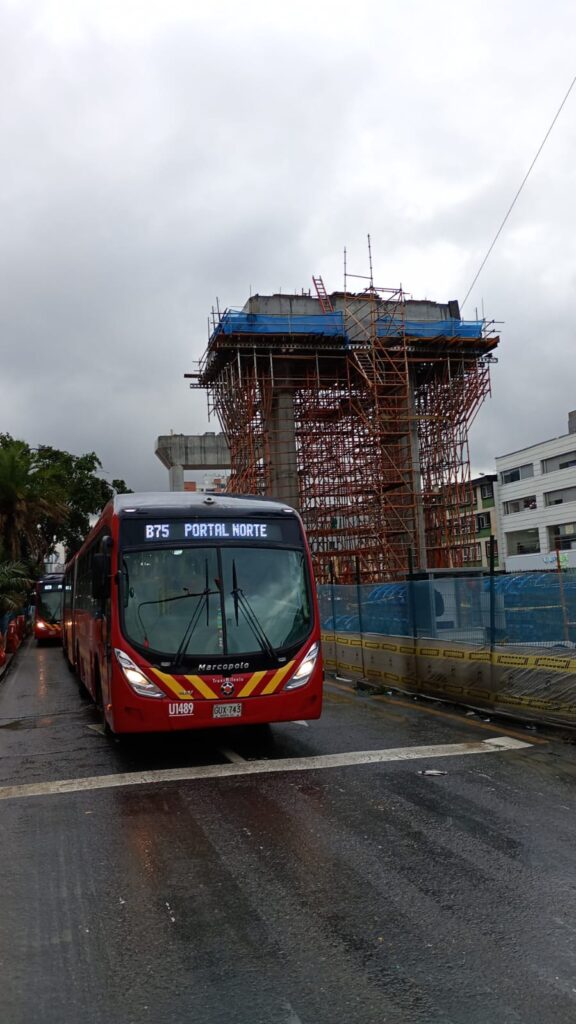
The really big local news has been that the Metro is progressing as planned. This might not seem like big news, but given how long the project spent in planning and the tendency of the president to stick his beak in, it’s just good to see something being done.
The first trains have arrived in the country and are running tests while the towering columns of the track are in place all over the city. Today, that means pain as Transmi stations close and traffic is rerouted, but all is in place for a fully integrated public transport system in the future.
RegioTram is also more or less on schedule, although it will need to be reworked to connect with the Bogotá systems, after it was pointed out that the planned stations are a fair distance away from the trnasmi and Metro. Regardless, connecting satellite towns with the capital is a gamechanging proposal.
Life in the city remains irritating due to continued high crime levels and the seeming refusal of Carlos Fernando Galán to do anything about rubbish on the streets. The best that can be said about Gálan at this point is that he has done little of note, hardly a glowing resumé, given his ambitions coming into office.

The capital saw a celebration of Latino music as Festival Cordillera 2025 confirmed the event’s stature as a lodestone of music in Colombia. With Festival Estéreo Picnic 2025 providing a balance that focuses on anglophone music, the capital is well set. However, with both those festivals in the Parque Bolívar, Rock al Parque is struggling to stay relevant.
Plenty of other bands were touring throughout the year too, with Bogotá increasingly on the map for big-name world superstars. That means enduring the likes of Guns N’ Roses, but also means that rolos can see contemporary stars like Dua Lipa.
Former busker Ed Sheeran popped up on stage as a surprise guest of J Balvin in December, while another Brit unsurprisingly failed to turn up because that’s what Morrissey does these days. Latinos across Instagram responded by trolling the famous vegetarian with meat recipes.
Elsewhere online, Colombian food performed well on a host of dubious internet polls, sparkign waves of reposted joy throughout the year. In more dispiriting news, Club Colombia Negra was discontinued by Bavaria, meaning you have few chances to neck the country’s last widely available dark lager.
For those more interested in staying home, Colombia’s first ever board games convention took place in November. Ludotopia was an undisputed success, attracting the likes of Wingspan artist Ana Maria Martínez (who teased the upcoming expansion for Wingspan South America, Central America and Caribbean) and proving that Bogotá retains a dynamic and evolving cultural scene.
The women’s football team came into the Copa América on good form and were within seconds of taking the title. With two minutes of regular time to go, Mayra Ramírez put Colombia ahead for the third and seemingly last time at 3:2. Brazilian superstar supersub Marta, in her last tournament, broke Colombian hearts as she rolled back the years with a last gasp equalizer in the sixth minute of injury time.
The drama wasn’t over, as she then put Brazil in front for the first time in extra time before Leicy Santos equalized and took the game to penalties. There, the game slipped through the fingers of the superpoderosas as perma-champions Brazil showed their experience. They took the shoot out 5:4 for their 9th title in ten Copa Américas.
The men’s team, also runners up in their Copa América, ground their way to qualification for next year’s World Cup in North America. Conmebol was a slogfest this time around, with everyone except Argentina involved in taking points off each other and goals in short supply.
Eventually, Colombia found form, only losing a single game in the year and finishing with a goalfest against Venezuela, beating their fierce rivals 6-3 in the last game. That leaves Colombia 13th in the FIFA rankings – unlucky for some maybe, but not coach Nestor Lorenzo.

On the local stage, Santa Fe reclaimed the liga apertura for Bogotá, triumphing in Medellín over Independiente thanks to an inspired performance from Wigan legend Hugo Rodellega. Knocking out Millos and El Tigre Falcao on the way made it even sweeter. Junior of Barranquilla took the finalizácion, with Nacional winning the Copa Colombia. The latter was a Medellín derby and marred by a pitch invasion and violence at the end.
Cricket Colombia hit a six as MinDeportes officially recognised the gentleman’s game as a sport in the country. This opens up the field for more funding and support for events. They also welcomed a visiting team from Trinidad and Tobago as well as setting a T20 record for a last wicket chase in the Gulf Series against México.
Next year promises much more drama in Colombia, with national elections set to be hard-fought. This is an unusual cycle, as the country is preparing to see who will succeed a leftist president. Whether there will be continuity, a sharp tack rightwards or a drive for the centre is still anyone’s guess.
The lineups for the capital’s big music festivals seem strong, with a supporting cast of superstars also set to tour. The men’s football team have a relatively straightforward group in the World Cup and will fancy themselves to do well.
Our predictions for 2026 will be coming in the next few days, but whatever comes to pass, we’ll be here to keep you in the loop with what’s happening in Colombia and why. We got some of the 2025 calls right, after all. right Happy new year from the Bogotá Post – your English voice in Colombia!
The post That was the year that was: Colombia 2025 appeared first on The Bogotá Post.
An extraordinary leap of 23.78% in the Colombian minimum salary per month brings it to a symbolic COP$2,000,000

An unprecedented hike in the Colombian minimum salary for 2026 was announced on Monday 29 December, bringing the rate to two million pesos per month. That represents an increase of 23.78% on the 2025 number. That’s the biggest jump ever – only 1997 comes close in recent years with 21.02%.
The minimum salary itself (SMMLV or Salario Mínimo Mensual Legal Vigente) has gone up to COP$1,750,905. There is also a transport subsidy (COP$249,095) which brings the effective minimum salary in Colombia for 2026 to two million on the nose.
Business leaders had suggested a rise of around 7.21%, keeping it above annual inflation (5.3% as of November), while trade unions and syndicates had called for an optimistic 16%. Both were left in the dust by Petro’s extraordinary decision.
The extraordinary rise is not due directly to inflation, nor to the rising cost of living, but represents a fundamental change in the rationale behind the number. Colombian president Gustavo Petro explained that the minimum salary should be considered a household income, not individual. He calls this salario vital, or salario digno.
Whether the household basis for the minimum salary holds up to scrutiny is hard to say. It certainly was the case, but like most other middle-income countries Colombia is rapidly changing. The idea of a single income supporting a family is less true every year, with Colombian households under 3.5 people on average and with 1.5 workers. That means a true dependency ratio of nearly one to one.
It was calculated by working around the price of a basket of goods for the average family (canasta básica), logged at nearly 3 million pesos for four people. Using that number of 1.5 workers gave the convenient round number of two million.
The minimum salary (not including the transport subsidy) is the baseline number that in turn influences a whole lot of other values in Colombia, such as fines and public salaries which are counted as multiples of the SMMLV. That includes, happily for Congress, politicians’ pay.
Far harder to work out is the long term impact of this rise in the Colombian minimum salary. Petro claims it will further stoke private spending in the country as the increased wages percolate throughout the economy and allow continued growth.
It will increase labour costs for a number of businesses, especially small companies, some of which will struggle to keep their heads above water with such a sudden rise in payroll. For medium and larger size businesses, this includes mandatory SENA apprentices.
Note that payroll costs for employers will increase by more than the 23.78% headline figure, as they have to make social security payments based on an employee’s wage as well as the wage itself.
Massive firms who are liquid enough to be able to absorb costs will likely be absolutely fine, even if there are a couple of high-profile exceptions. Companies that are dodging the system, either through informal working or false self-employment, will also likely thrive.
Of course, the new reforma laboral promises to regularise and/or eliminate such practices. On paper, that is. In reality, these are the potential counterintuitive effects that could be the legacy of this increase in the Colombian minimum salary.
Colombia saw a sharp downtick in the number of employees on minimum salary this year, while informal work and self-employment has risen to around 55% of the workforce. This trend could continue much more rapidly with companies unwilling to pay the high new Colombian minimum salary.
A further issue is how close the minimum salary is now to the average. This will particularly affect smaller businesses and recent graduates. The former will find it hard to offer salaries that are significantly above minimum to attract quality employees, while the latter will find themselves often close to minimum salary and waiting longer for a return on their studies.
It is worth remembering that both minimum salaries themselves and increases to them are often bitterly opposed the world over and predictions of chaos are frequently sown. In most cases there is short term turbulence followed by long term stability.
Despite Petro’s official line about household incomes, many will see this as a nakedly political move ahead of next year’s elections. It certainly will play well among the Colombia Humana base and potential voters as a reason to keep faith with the left and cast their vote accordingly next year.
A more charitable view would be to say that it’s one of the last significant acts that Petro can take before leaving office, so he’s gone big to deliver an achievement. Those have been in short supply over his time in the Palacio Nariño.
What’s undoubtable is that this creates a massive headache for next year. Regardless of who takes power, they won’t be expected to deliver quite such a large rise. However, they will have to be careful how far they go below it.
Any successor to Petro will at least be able to say their allies prepared the ground and maybe get away with a modest increase. An incoming fiscal conservative will be under pressure to deliver another big increase against their natural instincts and take heat for not doing so, while actually cutting the rate would be close to political suicide.
While a lot of candidates in the 2026 election might say that this was a fiscally imprudent move, they will have to be careful how far they push it. Many in Colombia will agree with them, but those same people are also likely benefiting from the increase.
There are also the optics of a rich politician arguing against the very many voters who are on minimum wage or even those who aspire to earn minimum wage. It’s not a good look to argue against giving stuff to the people whose vote you want.
So in the end this is a huge play from Petro, which has won him a useful political victory for today. It backs up his rhetoric, as he can easily claim he’s acting on behalf of the workers. There’s plenty of truth in that, as many Colombians work on minimum wage.
It may be a bribe to the electorate, but many will claim that no one else has at least offered them anything like this ever before, so good on him. Going into the 2026 election candidates on Petro’s side will be able to point to this achievement, while opposition candidates face pressure to offer at least something similar or be painted as rich folk denying the poor.
It’s hard to see a short term in which we won’t see a lot of businesses go bankrupt. The longer term is harder to read, as most companies will be unhappy but able to keep going. The effect on public salaries is potentially alarming with the state already running a deficit, unable to achieve fiscal reform and still expanding.
Ironically, it’s entirely possible that the increase in the Colombian minimum salary for 2026 might lead to more informality and less dynamism in the economy. However, it’s also completely believable that the economy is resilient enough to handle it with ease. This may be Petro’s biggest gamble yet and even he doesn’t know how it’ll play out.
The post Colombian minimum salary rockets appeared first on The Bogotá Post.

The National Liberation Army (ELN), a Colombian guerrilla group, concluded its 72-hour armed strike this morning, putting an end to days of tension in many parts of the country.
The action –a common tactic in Colombia which aims at paralyzing movement by threatening violence against those who do not stay home – left at least three people dead, with incidents registered in 13 departments across the country.
The ELN declared the strike to oppose United States “imperialism” and military threats in the region, with analysts warning White House aggression in the region could empower the guerrillas.
Police attributed various violent actions over the weekend to the ELN. Shortly after the strike began on Sunday, cylinder bombs appeared on key roadways across the country, disrupting land travel.
While over a dozen departments registered incidents, transport in Norte de Santander was particularly affected, with the main road from the capital, Cúcuta, to Pamplona closed due to a bomb.
An attack on a police station in Norte de Santander also claimed the life of an ambulance driver, who reportedly got caught in the crossfire. Two more corpses were found in a Cúcuta neighborhood near the Venezuelan border, which are being investigated as linked to the strike.
In addition to police stations, the rebels attacked other government installations, blowing up a toll booth in Barrancabermeja, Santander, and injuring a worker.
In a particularly grim incident, two policemen in Cali, Colombia’s third city, were killed in a bomb attack on Tuesday morning.
The ELN also burned an intercity bus in the Antioquia department.
The ELN’s actions over the weekend marked the group’s first national-level armed strike since early 2022.
While its leaders signalled an openness to resume peace talks with the state just months ago, the rebels’ actions this week suggest a renewed aggression towards the government.
“The ELN is quite literally on the offensive. It is difficult to know what they want at this time,” said Laura Bonilla, deputy director of the Colombian Peace and Reconciliation Foundation (Pares).
The analyst explained that the actions highlighted a shift in the methods used by the ELN, notably an increase in the use of indiscriminate explosives like cylinder bombs and drones.
“The implication of this is that these are weapons that produce a greater effect on civilians,” Bonilla told The Bogotá Post.
In 2024, there was an 89% increase in the number of victims of explosive attacks in Colombia, according to the International Committee for the Red Cross.
Bonilla also noted that the ELN is growing more aggressive as the White House ramps up pressure in the region.
The group declared the strike to “protest the threat of imperialist intervention in our country as a new phase of Trump’s neo-colonial plan.”
According to Bonilla, the ELN has been “paradoxically empowered” by Washington’s growing militancy, as it fuels their claims to be an anti-imperialist bastion. As Trump promises land strikes on Venezuela, where the ELN has a stronghold, the group may grow more active and more aggressive in Colombia.
The post ELN armed strike in Colombia ends with at least 3 dead, 13 departments affected appeared first on The Bogotá Post.

The United States today classified the Gaitanist Army of Colombia (EGC), Colombia’s most powerful armed group, a foreign terrorist organization (FTO).
The EGC, or Clan del Golfo, has expanded its criminal enterprise in Colombia in recent years, consolidating control over lucrative illicit economies like cocaine and illegal gold mining, as well as extorting large-scale enterprise.
While its designation as an FTO could assist authorities in unravelling the organization’s financial structure, analysts say it may threaten ongoing peace talks in Qatar between the EGC and the Colombian government.
“Today, the Department of State is designating Clan del Golfo as a Foreign Terrorist Organization (FTO) and a Specially Designated Global Terrorist (SDGT),” wrote Secretary of State Marco Rubio in a statement on Tuesday morning.
“Based in Colombia, Clan del Golfo is a violent and powerful criminal organization with thousands of members. The group’s primary source of income is cocaine trafficking, which it uses to fund its violent activities,” continued the memo.
The EGC was born from the remnants of the United Self-Defense Forces of Colombia (AUC), a paramilitary group responsible for grave human rights abuses in the late 1990s and early 2000s.
Since then, it has re-branded itself several times; for a time it called itself the Urabeños, then the Clan del Golfo, honoring its heartland in the Gulf of Urabá in northern Colombia; it later changed its name to the Gaitanist Self-Defense Forces of Colombia (AGC); most recently, the group adopted the EGC moniker.
In recent years, the group has argued that it is a political actor in Colombia’s decades-long internal conflict, but its origins were strictly focused on making money illicitly.
In the past decade, the organization has rapidly expanded beyond northern Colombia into as many as 20 departments across the country, exerting control in both rural and urban areas.
“On the one hand, the group is an organized crime structure that manages various legal and illegal businesses and, on the other hand, it has also formed a uniformed army,” explained Gerson Arias, conflict and security investigator at the Ideas for Peace Foundation (FIP), a Colombian think tank.
Today, the group counts between 3,000 and 3,500 uniformed troops among its ranks while it has a further 6,000 members who form part of its broader crime structure of extorting businesses, according to Arias.
“The main threat facing Colombia today is represented by the Clan del Golfo and its military and economic structure, both legal and illegal,” the analyst told The Bogotá Post.
Following Washington’s sanctions, anyone deemed to be providing material support to the EGC can be brought to trial in a U.S. court.
“Not only could cases be brought against members of the Clan del Golfo, but against any businessmen, facilitators, logistics operators, or anyone who provides even something as simple as buying them a meal,” explained Elizabeth Dickinson, Deputy Director for Latin America at International Crisis Group.
She told The Bogotá Post that the FTO designation could therefore “open some interesting doors” by exposing links between the EGC and legal enterprise, adding “this is an organization that has deep tentacles in the business world.”
The move could also provide a pretext for military action against the EGC in Colombia, with the Trump administration saying in recent weeks that drug production in any country is a legitimate target.
“An FTO in and of itself is not a justification for military action. However, it has historically been a step along the road to paving a narrative politically that could lead to the U.S. considering military action,” said Dickinson.
In September, the first round of negotiations took place between EGC and Colombian state negotiators in Doha, mediated by the Qatari government.
A second round in December led to the signing of a “commitment to peace”, with the first step towards demobilization planned for March 2026.
But the State Department’s FTO designation threatens to derail talks, according to analysts.
“I think there’s a lot of pending questions right now about the future of negotiations with this group,” said Dickinson.
She stressed the progress made in talks so far, including a commitment to take a census of children fighting in the ranks of armed groups and return them to the state.
FIP’s Arias warned that the FTO classification will complicate both the subject of talks and the logistics of engaging in negotiations.
He noted that EGC negotiators will struggle to attend talks safely outside of Colombia and that Colombian authorities will be unable to provide credible non-extradition guarantees to the group’s leaders.
But Dickinson warned of the dangers of ending negotiations: “This organization is the largest threat to peace and security in Colombia. I think it will be important for the Colombian authorities and their country partners in mediation to consider what could be the implications of if peace talks were to end.”
The post Washington designated Colombia’s EGC a terrorist organization: what now? appeared first on The Bogotá Post.
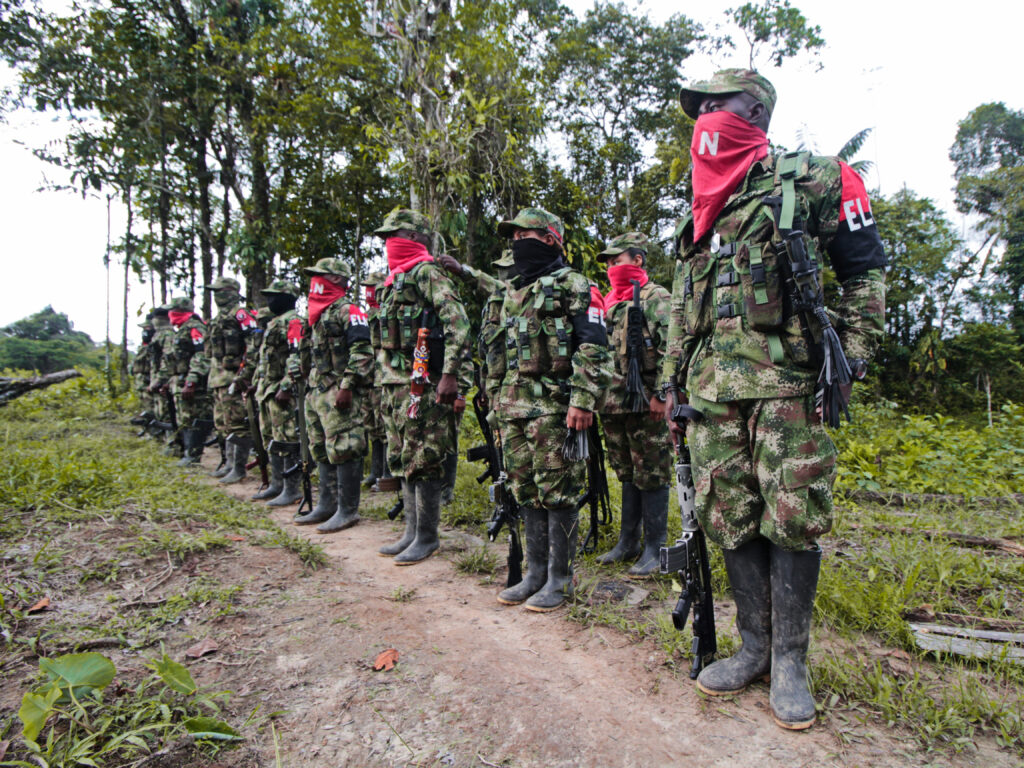
The Colombian National Liberation Army (ELN) has declared a 72-hour nationwide armed strike beginning on Sunday in protest against increased US military activity in Latin America.
In a statement, the group warned Colombians not to travel via the country’s roadways or navigable rivers during the three day window; while the group said it would not harm civilians, armed strikes are enforced through violence, with previous iterations involving vehicle burnings and civilian casualties.
The action will be the first national-level armed strike since 2022 and comes amid an ongoing U.S. boat bombing campaign – which the Pentagon says has targeted ELN members – as well as White House threats of further intervention, including land strikes in Colombia.
“We, the peoples’ forces of Colombia, protest the threat of imperialist intervention in our country as a new phase of Trump’s neo-colonial plan, which aims to sink its claws even deeper into Latin American and Caribbean territories,” read a decree emitted on Friday by the ELN.
On multiple occasions, U.S. President Donald Trump has floated the idea of striking drug production targets within Colombian borders; Colombia is the world’s largest producer of cocaine and the ELN is known to be a key actor in the drug trade.
The communiqué said the strike would begin at 6:00 AM on Sunday, December 14 and last until the same time on Wednesday.
While it instructed civilians not to travel by road or river during the three day window, it maintained that its “road control units will respect civilians and their property,” but advised regular people not to mix with soldiers in order to “avoid accidents.”
Although the measures are purportedly national, analysts say they are unlikely to affect the whole country.
“In practical terms, this is a national announcement, but it has a limited impact because the ELN does not have a national presence,” Gerson Arias, investigator at the Ideas for Peace Foundation (FIP), a Colombian think-tank, told The Bogotá Post.
Arias said the bulk of the effect will be seen in areas of ELN control, especially in Colombia’s northeast and in the western departments of Cauca, Nariño and Chocó.
The last time the ELN implemented a nationwide armed strike was in 2022, with incidents across 17 departments including vehicle burnings and road blockages intended to protest the Ivan Duque administration (2018-2022).
But the ELN regularly uses smaller scale armed strikes to exert control over specific areas, usually in rural regions. Experts say that the guerrillas often use the actions as a guise to secure drug transit corridors and facilitate the movement of soldiers and contraband.
Rights groups criticize armed strikes for producing a host of deleterious effects on affected populations, with forced confinement impeding access to education, food, and healthcare.
While the ELN’s decree did not explicitly mention U.S. threats against Venezuela, the group is known to have a presence in the country and has recorded ties with the Nicolás Maduro regime.
Much of the guerrilla group’s territory lies on the border with Venezuela and any U.S. attack on Colombia’s neighbor would also threaten the ELN, according to FIP’s Arias.
“The ELN is well aware that it may be affected by some of the measures taken by the United States,” said the analyst.
The group has already been directly impacted by Trump’s boat bombing campaign, with U.S. Secretary of War Pete Hegseth saying an October 17 strike on an alleged drug vessel had killed three ELN members. The rebels denied the claim, insisting they do not smuggle drugs.
The ELN’s armed strike declaration underscores the complex panorama of armed groups in the region and their ties to government, drug trafficking, and border zones. While the impact of the action is yet to be seen, the announcement shows the far-reaching consequences of the White House’s mounting military pressure in the region.
The post Colombian guerrillas declare nationwide armed strike to protest US aggression appeared first on The Bogotá Post.
