
Reading view

Border Crossing Between Colombia & Ecuador Reopens After 19 Day Blockade

While Colombia & Ecuador are at peace, the neighboring presidents have a sour relationship going back to when Colombian President Gustavo Petro initially refused to recognize Daniel Noboa’s election.

Traders and transport operators have suspended a 19-day blockade at the Rumichaca International Bridge, the primary land crossing between Colombia and Ecuador. The protest, catalyzed by a 50% tax imposed by the Ecuadorian government on Colombian goods, was lifted to accommodate travel and commerce during the Semana Santa holiday period. Despite the suspension of the strike, the regional business community reports that significant economic damage and diplomatic tensions persist.
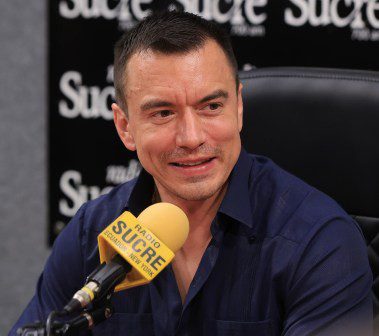
Ecuador's President Daniel Noboa (photo: Carlos Silva/Presidencia de la República)

Ecuador’s President Daniel Noboa (photo: Carlos Silva/Presidencia de la República)

The closure of the border crossing created a substantial disruption in binational economic activity. Estimates from the Cámara de Comercio de Ipiales in Nariño, Colombia indicate that losses reached approximately $5 million USD per day due to freight remaining stationary in the border zone. The Comité Gremial de Trabajadores de la Frontera de Ipiales stated that while the reopening is a responsible gesture for the high-traffic holiday season, current tariff policies continue to threaten hundreds of direct and indirect jobs linked to foreign trade.

The Governor of Nariño, Luis Alfonso Escobar, criticized the trade barriers implemented by the administration of Ecuadorian President Daniel Noboa. Governor Escobar argued that such measures inadvertently encourage illicit activities in the region. He emphasized that instead of facilitating formal commerce, high tariffs drive trade toward illegality, undermining regional security efforts. To mitigate the conflict, the Comunidad Andina de Naciones (CAN) has initiated high-level dialogues. Diplomatic delegations led by Colombian Deputy Minister of Foreign Affairs Juana Castro and her Ecuadorian counterpart, Alejandro Dávalos, held a virtual working group to address pending issues in trade, transport, energy, and hydrocarbons.

“Decisions adopted without considering the reality of our communities have put at risk the livelihood of merchants, transporters, foreign trade workers, and thousands of people who live from binational exchange,” stated the Comité Gremial de Trabajadores de la Frontera de Ipiales.

Diplomatic friction has extended into the energy sector. President Noboa claimed that in 2017, Ecuador assisted Colombia during a potential blackout by charging 1.6 cents USD per kWh, whereas in 2024, Colombia charged an average of 28 cents USD per kWh during Ecuador’s hydroelectric crisis. In response, the Colombian Minister of Mines and Energy, Edwin Palma, clarified that prices during the 2023-2024 El Niño phenomenon reflected the actual costs of production and distribution, particularly when fossil fuel-powered thermoelectric plants using fuel oil and diesel were activated.

The ongoing trade dispute has impacted more than 5,500 companies over the past two months. Diana Marcela Morales, the Colombian Minister of Commerce, Industry, and Tourism, confirmed scheduled meetings with Ecuadorian officials to de-escalate the conflict and establish fair, transparent rules. Concurrently, the Ministerio de Comercio, Industria y Turismo has moved to protect domestic industries by implementing new tariffs on steel and ceramics from countries without existing free trade agreements. These measures aim to counter market distortions and protect a sector that employs more than 50,000 people while promoting circular economy practices and reducing CO2 emissions.

Above photo: Border between Ecuador & Colombia looking towards Ipiales, Colombia (Photo: Cancillería de Colombia)
  •  

Colombia Confirms 14 Candidates for 2026 Presidential Election

Though surprises are possible, polling says the front runners are Iván Cepeda, Abelardo de la Espriella, and Paloma Valencia.

The Registraduría Nacional del Estado Civil of Colombia (RNEC), the entity responsible for organizing elections in the country, reported that a total of 14 candidates have officially registered to run in the country’s presidential elections, scheduled for May 31, 2026. In this vote, citizens will elect the President and Vice President of the Republic for the 2026–2030 term.

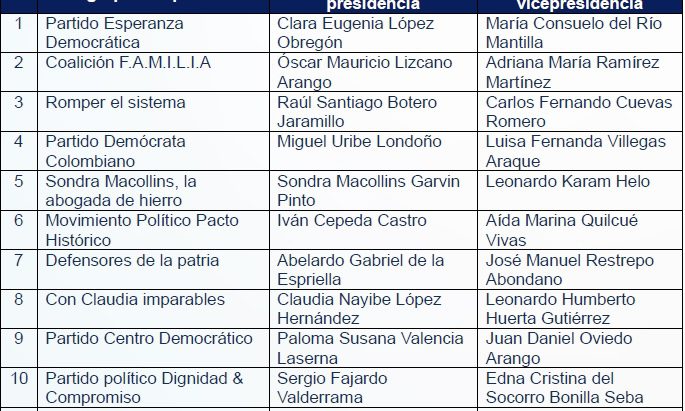
According to the electoral authority, the candidates represent a wide range of political perspectives, from left to right, including independent candidacies running through political movements. Here the list and brief profile of the candidates:

  1. Clara Eugenia López Obregón, currently a senator for the Esperanza Democrática She has served as Minister of Labor (2016–2017), acting mayor of Bogotá (2011–2012), and Bogotá’s secretary of government (2008–2010). She has been affiliated with left-wing parties and was Gustavo Petro’s vice presidential running mate in the 2010 election.
  2. Óscar Mauricio Lizcano, from the FAMILIA coalition. He served as Minister of Information Technologies (2023–2025), was a senator (2010–2018), and a member of the House of Representatives (2006–2010).
  3. Raúl Santiago Botero, candidate of the “Romper el Sistema” movement (Break the Establishment). An agronomist engineer and businessman from Medellín, he presents himself as an independent candidate with no prior political experience.
  4. Miguel Uribe Londoño, father of the slain presidential candidate Miguel Uribe Turbay. He is running under the Colombian Democratic Party and previously served as president of the Centro Democrático party founded by Álvaro Uribe Vélez.
  5. Sondra Macollins Garvin, from the movement “La Abogada de Hierro” (The Iron Lawyer) A criminal lawyer and psychologist, she presents herself as an independent candidate without political affiliations. She ran for the House of Representatives in 2022 and is known for her work in narcotrafficking and corruption cases.
  6. Iván Cepeda Castro, a senator since 2014 and the official candidate of the Pacto Histórico, the same party as President Gustavo Petro. Polls project he will receive the highest vote share in the first election round. He is aligned with left-wing political ideas.
  7. Abelardo de la Espriella, a lawyer with far-right positions, running for the first time under the Defensores de la Patria movement. Recent polls place him as a likely second or third contender in voter preference.
  8. Claudia López Hernández, former mayor of Bogotá (2020–2023) and former senator (2014–2018), running under the centrist movement “Imparables con Claudia.” She is known for her anti-corruption agenda and secured her candidacy with more than 570,000 votes (about 9%) in recent interparty primaries.
  9. Paloma Valencia Laserna, current senator and candidate of the Centro Democrático party led by Álvaro Uribe Vélez. She won the right-wing interparty primary on March 8 with more than 3 million votes. Polls place her among the top three contenders, and if she reaches a runoff, she would become the first woman in Colombia’s history to do so.
  • Sergio Fajardo Valderrama, an academic and mathematician running for the Dignidad y Compromiso He served as mayor of Medellín and governor of Antioquia and is running for president for the third time.
  • Roy Barreras, from the political party La Fuerza (The Force). He won the left-wing coalition primary on March 8 with the lowest vote total (257,000 votes, about 3.6%). Although currently aligned with left-wing movements and part of the Petro administration, he has previously been affiliated with right- and center-leaning parties.
  • Gustavo Matamoros Camacho, of the Colombian Ecologist Party. He served in the Colombian Army for 43 years. With no prior political experience, his campaign focuses on public security.
  • Luis Gilberto Murillo, who served as Minister of Foreign Affairs (2024–2025) and Colombia’s ambassador to the United States (2022–2024). A human rights advocate and Afro-Colombian leader from Chocó, he presents himself as an independent, moderate, centrist candidate.
  • Carlos Eduardo Caicedo, running under the independent movement “Con Caicedo.” He was mayor of Santa Marta (2012–2015) and governor of Magdalena (2020–2023), where he built a strong base as a left-wing political leader.

The RNEC also reported that “the draw to determine the position of presidential candidates on the ballot will take place on March 25 at the Ágora Bogotá Convention Center.”

This process marks the formal start of the final phase of the presidential campaign, during which candidates will seek to consolidate support ahead of the first round on May 31. If no candidate secures an absolute majority, a runoff between the two leading candidates will be held on June 21.

List of registered candidates for Colombia’s presidency. Photo courtesy of the Registraduría Nacional del Estado Civil.

List of registered candidates for Colombia’s presidency. Photo courtesy of the Registraduría Nacional del Estado Civil.

Headline photo: Polling station in Colombia during last Congress elections in March 8, 2026. Photo courtesy of the Registraduría Nacional del Estado Civil.

  •  
❌