Reading view

Colombian elections 2026: Winners and Losers after March Madness

Colombia kicked off its electoral year with the Senate and House elections last weekend, alongside consultas for presidential runs. Who’s come out ahead?

The Colombian elections of 2026 started last week, with the Senate and Cámara finalising their seats for the next parliament. The presidential elections will take place at the end of May, with a second round in June if necessary.
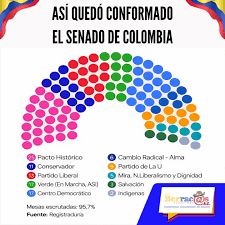
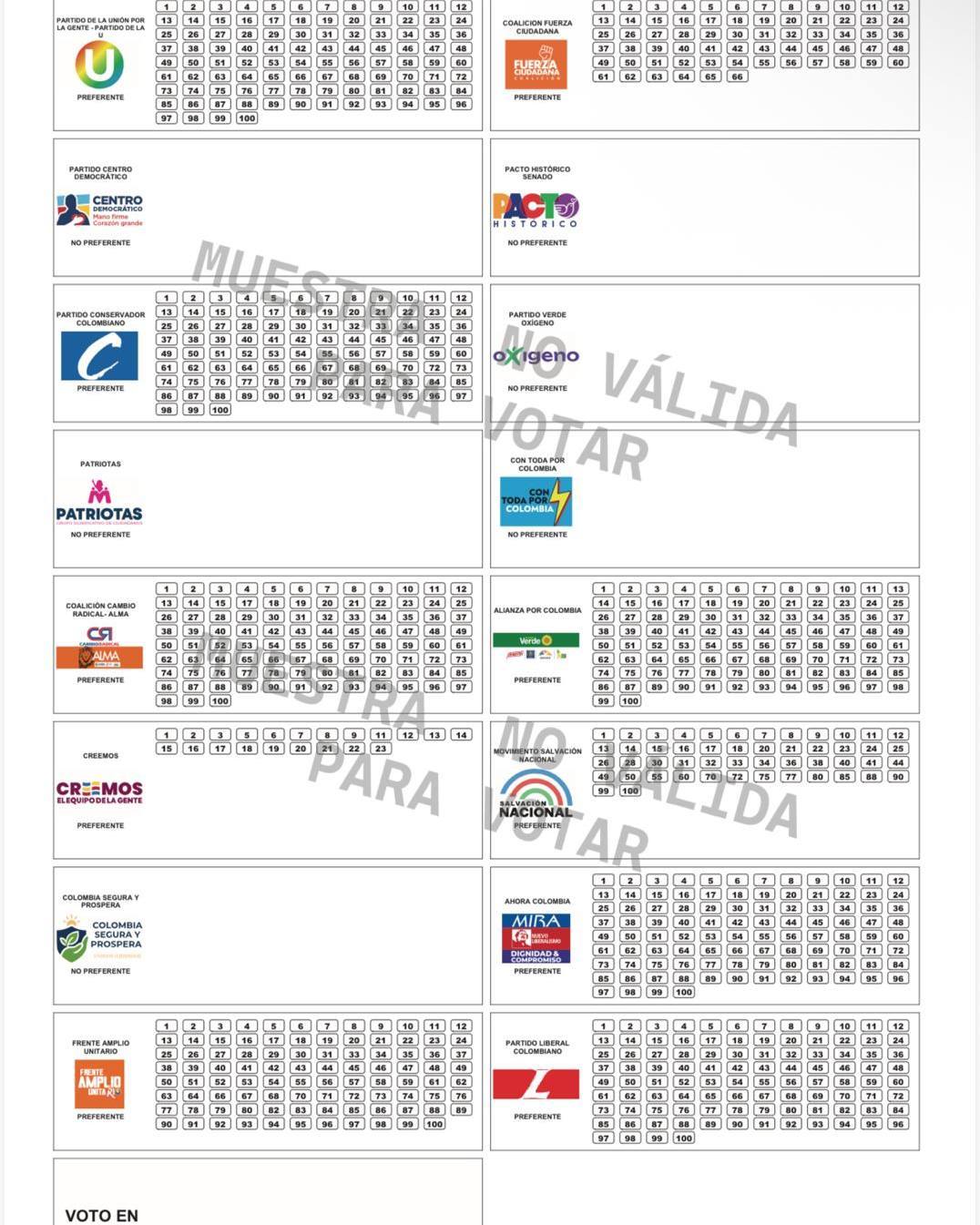
The new Senate layout. Photo courtesy of the registraduría.

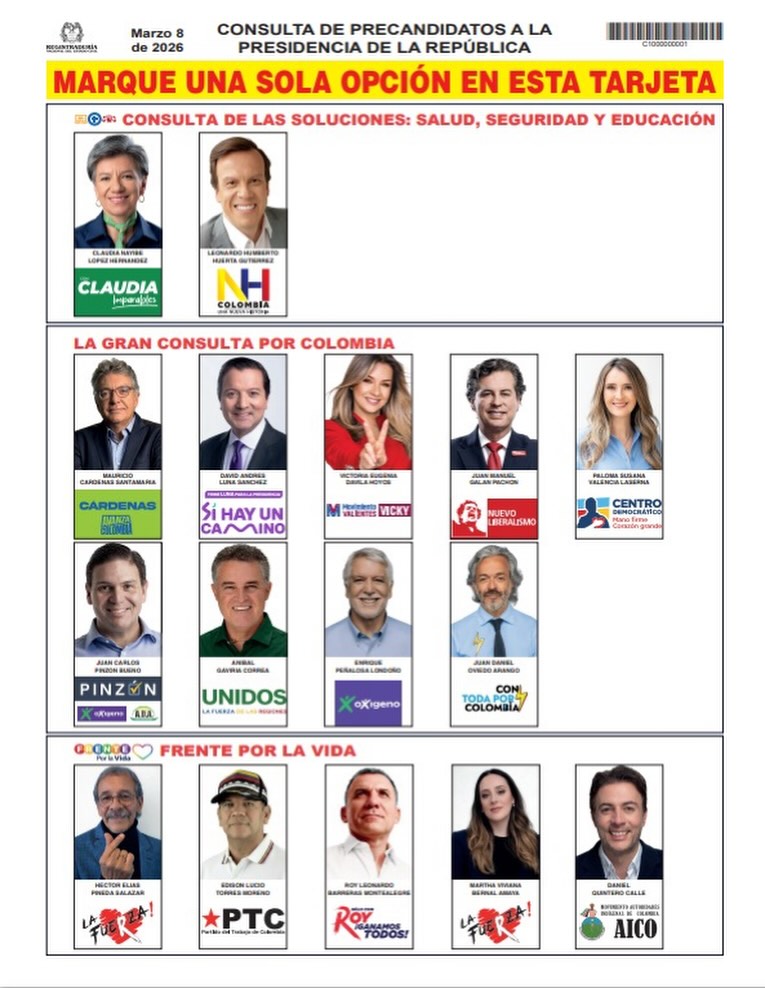
The presidential elections also had a hand in last week’s results, with consultas to decide on who would represent groups of candidates with similar politics. That saw Claudia López, Roy Barreras and Paloma Valencia take the honours in their respective consultas.

When all was said and done, the results showed that traditional parties and candidates had generally performed poorly, with new candidates doing well and a difference in the traditional balance of power.

So, a week on and with the dust having settled as final results come in from all over the country, who’s up and who’s down after the first Colombian elections of 2026?  

Winners

It was a good day for the government, with the Pacto Histórico gaining seats and a low turnout for the leftist consulta. The Centro Democrático, too, had a good afternoon. Paloma won her consulta handily and the party overall also gained seats in borth houses.

Pacto Historico

The governing party had a spectacular Sunday, simply said. They increased their presence in both chambers and became the largest single party to boot. The Senate remains without a clear majority, but they are in a very strong position indeed, even without the former FARC combatientes’ curules.

On top of that, other results largely went their way. The leftist consulta that Cepeda was blocked from running in was a washout as the Pacto told their supporters to stay away. Prominent critics of the party from other parties such as Robledo, Miranda, Betancourt and Juvinao all crashed out as well.

While an overall majority in either house is far from within their grasp, the Senate now leans slightly more left than right, with left and centre-left senators adding up to 53. On top of that, after an often rocky government, it’s clear that they haven’t lost their base, indeed even expanding.

Paloma Valencia

A fortnight ago, Paloma Valencia’s campaign seemed to be stuttering. She was polling in single figures for first round intentions for the presidency and making few public appearances other than the mass debates for the Gran Consulta por Colombia. There was even a worry that she might suffer an upset in that consulta.

Fast forward to today and it’s a very different picture indeed. The latest polling shows her rocketing in popularity, now standing at around 20%. That’s because she picked up over three million votes in that consulta.

Then she picked the runner up in that race as her VP ticket, a smart move on her side to try and attract voters more in the centre as well as boost her in the capital. It’s not a landslide move, but it’s canny and the presidential race will likely come down to small margins. 

Juan Daniel Oviedo

Technically a loser, in the sense that he was a clear second to Valencia in the Gran Consulta. However, he picked up over a million votes, paying off his mortgage and significantly outperforming expectations. He also opened the door for some new paths in his political adventure. 

It had looked like his next step was to concentrate on a tilt for Bogotá mayor, having come in second last time around after another strong campaign. He then pulled a remarkable volte-face, accepting Valencia’s offer to run on her ticket.

That’s a move that puts him potentially in a different league than before, very much on the national stage now. It’s come at an enormous reputational price though, with many that voted for him feeling betrayed as he runs on a rightist ticket. He can claim that it’s centrist as much as he likes, but few see it that way.

Influencers

Electorates worldwide are losing patience with technocrats and politics as usual. That’s as true in Colombia as anywhere else, with a number of influencers running and doing fairly well. This is a trend that has been open for a while and shows no sign of slowing down.

Former adult actress Amaranta Hank won a spot for the Pacto Historico, while the White Elephant took a seat for the Partido Verde, having started out as a content creator looking to expose corruption and poor spending practices.

Safety

Despite fears of electoral violence and a turbulent run-up to election day, it was a relatively calm Sunday in the end. There was an attack on a voting centre in Meta, plus another couple of issues elsewhere, but overall it was a good sign for the upcoming presidential elections.

Losers

There were plenty of losers last week, with several high-profile candidates for the presidential race crashing out in their consultas. That saw Vicky Dávila unconvincingly claiming she wasn’t a loser and Enrique Peñalosa falling at the first hurdle again among others.

Farewell, too, for some familiar faces. Ingrid Betancourt failed to make the cut for Senate, losing her seat alongside her party. Jorge Robledo, the leftmost critic of Petro did likewise. Miguel Polo Polo unsurprisingly lost his seat as an Afro-Colombian representative, replaced by a principled lawyer, which delighted many.

In general, old parties and old faces fared poorly, with incumbency working against many. A striking exception to that was the party for ex-FARC combatants, Comunes. To their surprise, but no one else’s, they failed to meet the threshold for representation.

Roy Barreras

Standing in the leftwing consulta, Roy won in the sense that he saw off the threat from controversial former Medellín mayor Daniel Quintero. However, the Pacto campaign to not vote in consultas laid his lack of support bare.

Viejos Verdes

The Partido Verde managed to limit their losses in terms of seats, remaining at a similar level as before. However, there has been a significant change in who takes those curules. They had an open list, meaning that no-one was assured of a place.

Voters made it clear that they wanted to see new blood, with government critics Katherine Miranda and Cathy Juvinao voted out, along with Inti Asprilla and Angelica Lozano. 

The old Frente Nacional

For much of the last century, the Liberales and Conservadores absolutely dominated Colombian politics. For most of this century they’ve avoided running viable presidential candidates, preferring to hold their power in the Senate, Cámara and local politics. 

This time out they have taken a big hit in both houses, losing five seats between them and no longer being in the top level of voting blocs. Due to the fragmented nature of the parliament, they retain some kingmaking powers, but are a shadow of what they once were.

A big question now looms for both parties ahead of next year’s local elections. Just as the Pacto will feel they can make some big gains there, so too will the Liberales and Conservadores worry they might take more damage.

Claudia López

The former Bogotá mayor faced no real opposition in her consulta, sailing through with over 90% of the vote. However, that was 90% of not very much and she failed to get voters out to show support in the way that Valencia and Oviedo did. She faces an uphill slog from here.

Sergio Fajardo and Abelardo de la Espriella

Neither of this pair were in consultas, instead going to the second round. That’s meant they’ve been kept out of the headlines and lost momentum as well as having some unfortunate results.

The scale of the turnout for Valencia shows she’s a viable contender to Aspriella on the right and her leap in polling is matched by a significant downturn for el tigre. For Fajardo, it’s even worse: voters are largely abandoning the centre and technocratic politicians.

Trust in the system

 With the governing party repeatedly questioning the openness and fairness of the elections, this was rough. There have been a number of reports coming out questioning the practices of various voting centres and plenty of allegations, particularly from the left.

On top of that, a couple of candidates were arrested on voting day with big bags of cash that were allegedly to be used in vote-buying. While corruption in electoral processes is likely nowhere near as widespread as many claim, it’s clearly still an issue, especially in rural zones.

Centrist politics

Other than Juan Daniel Oviedo, centrists had a bad day at the polls, especially the centre-right. While the Centro Democrático and Pacto Historico gained votes on the flanks of both right and left, parties close to the centre lost out. 

Cambio Radical took a big hit, as did the conservatives, with Abelardo de la Espriella’s new Salvación Nacional party gaining three seats from literally nowhere. The partido de la U also lost a seat while Ahora! won another two seats. Poor turnout for the centrist consulta also means there seems to be little support on the presidential level.

What happens next?

The presidential election on May 31 is now very much the focus of attention. Iván Cepeda still leads the polls comfortably, with Paloma Valencia and Abelardo de la Aspriella splitting the rightwing vote at the moment. However, with over two months of campaigning time ahead, there is plenty of time for everything to change.

Gustavo Petro has shown little sign of intending to follow the guidelines on not campaigning, making references to Oviedo and Valencia as well as thinly-disguised references to Cepeda and so on. Expect this to continue and ever more strongly worded warnings from the registraduría to be ignored.

It’s also likely that there will be ever more rhetoric over electoral fraud, with the Pacto campaign leaning heavily into that already and working on raising awareness of the issue ahead of the voting for the first round.

There’s currently a very good chance that the presidential campaigns will get pretty ugly, with lots of negative campaigning and attack ads. There is no love lost between the candidates and plenty of bad blood on all sides. We’ll keep you up to date with things as the campaigns develop.

The post Colombian elections 2026: Winners and Losers after March Madness appeared first on The Bogotá Post.

  •  

In the shadow of the Metro

We take a quick dive down Avenida Caracas where the raised railway is both a wonder and worry.

Line 1 of Bogotá's long-awaited Metro rises above Avenida Caracas. Photo: S Hide.
Line 1 of Bogotá’s long-awaited Metro rises above Avenida Caracas. Photo: S Hide.

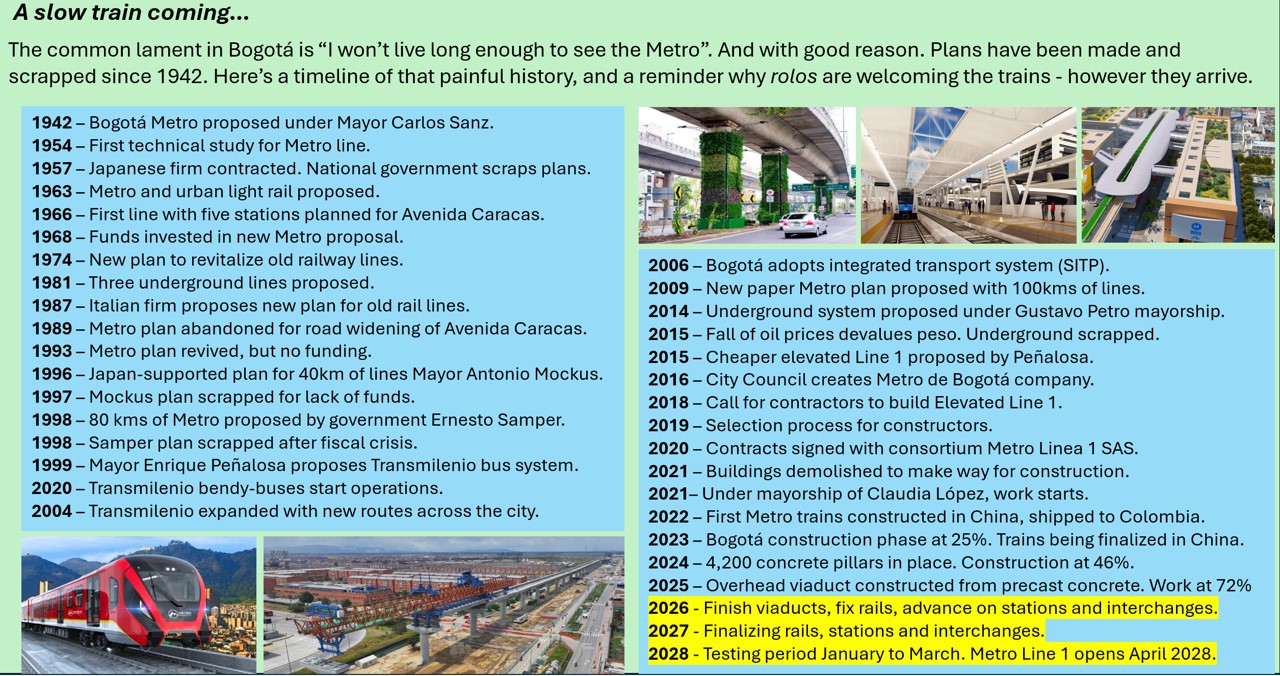
For citizens used to the snail’s pace of work on their city’s infrastructure, the rapid rising of the Bogota’s Metro over their heads is something to behold.

With 11 kilometers of concrete viaduct completed, and many more clicks of columns in place, not to mention stations and interchanges emerging from the rubble, the megaobra is officially at 73% completion.

For rolos who have waited three generations for a train – the first Metro plan was made in 1942 – this advance is nothing short of a miracle.

Not everyone is happy. Last week small business owners along Avenida Caracas, the last south-north sector of the construction, took to the streets to protest the “destruction and insecurity” of their neighborhoods.

“The Metro advances. The community recedes,” said the banners the protesters hung across the formerly busy throughfare now converted into a construction site.

As is typical in Bogotá protests, it was public transport in the form of Transmilenio buses that were blocked forcing thousands of commuters to walk sections of their journey home.

Hanging on by a thread

Carlos Torres.

The protests ended, but the problems continued for Avenida Caracas.

This week the central section of the wide avenue was taken up by construction teams supporting the massive overhead beam launcher that dropped the pre-cast viaduct sections into place 15 meters above the street.

Meanwhile, car traffic was banned from the main artery while Transmilenio buses threaded their way past graffitied concrete columns. Pedestrians scurried out of the temporary bus stations and fast away from the apocalyptic scenes, more Blade Runner than Springtime in Paris.

Local shopkeepers told The Bogotá Post this week that business had never been bleaker.

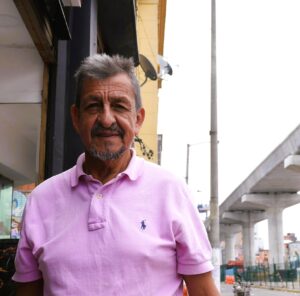
“We’re hanging on by a thread,” said Carlos Torres of clothes store 80’s American World, on the corner of Calle 60. “We’ve had no financial help from the district, and takings are down by 80 per cent.”

He had been forced to suspend their health insurance payments for the last year and were struggling to pay the rent, he said.

Danger down below

Footfall had “fallen massively” said Angela Cruz on her way to a hair salon across the road, with people avoiding the dusty streets, partly from fear of robberies.

Avenida Caracas was “always a bid dodgy”, she said, but the attraction for thieves of the building works, with materials and machinery to pilfer, had increased insecurity.

“We’re worried when it’s finished the support columns and dark areas under the Metro will become full of attackers.”

That the Metro would shelter criminals was a recurring concern for residents. Concept drawings of the finished line depicted idyllic leafy walkways with pedestrians pushing prams.

But as every resident of the city already knows, any tunnel, underpass or covered area becomes a hotspot for crime.

And whereas the Metro planners had robust plans to control access to the overhead trains to ensure commuters travel in peace – in contrast to the Transmilenio where anyone can jump on or off – there were no clear plans to protect open spaces below.

“Walking home just got harder,” said Cruz.

Avenida Caracas degenerated before the Metro construction, but the work sites have added to the feeling of abandonment and attracted criminals, according to residents in the area. Photo: S Hide.
Avenida Caracas degenerated before the Metro construction, but the work sites have added to the feeling of abandonment and attracted criminals according to residents in the area. Photo: S Hide.

Bogotá’s ‘Berlin Wall’

Similar concerns were raised recently in a speech by President Gustavo Petro when he railed against the elevated Metro plan – now near completion – as a boondoggle for property speculators and claimed that Avenida Caracas was being “destroyed by the oligarchy”.

He further suggested that the raised railway would become a “Berlin Wall, separating the rich from poor”.

Such rhetoric was not unexpected from the mandate who long championed an underground Metro, though failed to get it moving during his own term as Bogotá’s mayor (2012 to 2015). He might yet get his way; plans for Line 2, currently on the drawing board, are for an underground Metro running east west beneath the city’s wealthier northern barrios.

See also: Going Underground, Petro threatens to derail Metro.

The final plan to build Line 1 overhead, while controversial, was taken for economic reasons and speed of construction during the second mayorship of Enrique Penalosa – the founder of Bogotá Transmilenio bus system and implacable political opponent of Petro – in 2016.

The elevated Line 1 of the Metro will be 24 kilometers – one of the longest urban light rails on the continent – and have 16 stations including 10 interchanges with the Transmilenio bendy-bus network.   

Much of the line runs through poorer barrios in the south-west of the city where, even with the work unfinished, some economic benefits were being proclaimed.  

Just get it done

Adenay Flores.

Thinktank ProBogotá, in a study with the Unversidad de los Andes, reported a rise in residential property values of 11 per cent in areas around Line 1. Such increases could generate investment in undeveloped pockets of the city.

In the long term, Avenida Caracas businesses were also predicting a boost from the Metro. Just not yet.

“Right now, times are hard,” said business owner Adenay Flores.  He had seen profits plunge in the 18 months since construction began, he said, while painting the entrance to his Moscu pawnbrokers.

But he also recognized that the Metro was vital to the mobility of the city and could transform lives of people living in less accessible areas.

“Yes, we’ve had hardships. But this is the evolution of the city, I totally support the Metro. Once finished it will bring people back to Avenida Caracas,” he said. “But they need to get it done.”

It was a sentiment echoed by many business owners we talked to in the shadow of the concrete viaduct: torn between welcoming the future mass transit system while keeping their financial heads above water.

“We’re suffering, but we still want the Metro. It will bring better times,” Carlos Torres from the clothes shop told The Bogotá Post. “Until then, we just have to hang on.”

The post In the shadow of the Metro appeared first on The Bogotá Post.

  •  

Election boost for Pacto Historico in Bogotá …

… but Centro Democratico bounces back, while small parties lose out in March 8 voting.

Voting in Bogotá on March 8. Participation was 48%, with the city making up 15% of overall votes cast. Photo: Registraduria

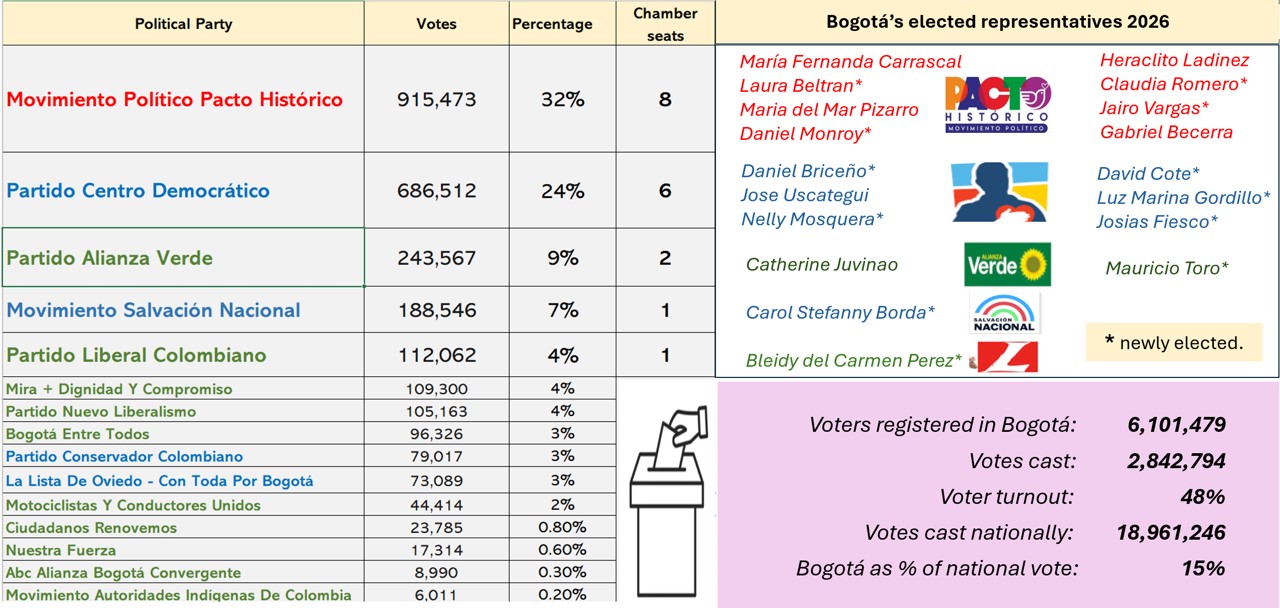
Last Sunday’s elections brought mixed results to Colombia’s capital with the left-wing Pacto Historico party cementing its position as most popular party in the city even while its main opponent the Centro Democratico showed relatively bigger gains.

With 18 Bogotá seats up for grabs in the Chamber of Representatives, the Pacto Historico, backed by President Gustavo Petro, took a majority of eight, an increase of one seat from the previous period.

And by garnering 900,000 votes the incumbent party upped its count by more than 100,000 compared to 2022, when it was also the most popular party in the city.

But by some comparisons the right-wing Centro Democraticos result was even more impressive, surging from two to four seats on March 8, totalling 700,000 votes, up from around 300,000 in 2022.

In Bogotá, as at national level, the losers were the smaller independent parties often citizen-led or based on niche issues. Also failing was the Nuevo Liberalismo party, founded by mayor Carlos Galán, which failed to pick up a single seat, a sign perhaps of citizen discontent with the capital’s current administration.

The demise of the small and independents reflected a national trend of voter gravitation towards the two bigger parties, Centro Democratico and Pacto Historico, whose top candidates – Paloma Valencia and Iván Cepeda – are likely contenders for the presidential slug-out in May. 

The remaining Bogotá seats went to smaller traditional parties the Green Alliance (2), and the Liberal Party (1), with one seat awarded to the upstart Salvacion Nacional formed by firebrand right-wing presidential candidate Abelardo De La Espriella.

Voting results for seat in the Cámara de Representantes on March 8 in Bogotá. Data: Registraduria
Voting results for seat in the Cámara on March 8 in Bogotá. Note this is the preliminary electronic count, changes can take place after manual scrutiny of the results this week. Data: Registraduria

Political phenomenon

The stand-out result in the Bogotá caucus was Centro Democratico’s first-time congressional candidate Daniel Briceño who captured 262,000 votes for his seat in the chamber.

Not only did Briceño get the highest congressional vote across Colombia, he also out-voted the entire list of senators – which get elected nationally – with one of the historically highest ever recorded in Colombia for a camara or senado representative.

The 34-year-old lawyer was being hailed this week as a political phenomenon. Briceño is currently serving on Bogotá city council where he campaigns against corruption, cronyism and waste through a clever combination of social media and forensic takedowns of his political targets.

The influencer made his name by digging into big data on government databases that has allowed him to uncover contracts and documents embarrassing to the administration of Gustavo Petro.

Since then, he has gained both an online following and voter base by scrutinizing and exposing mismanagement at all government levels.

ise of the influencers: Daniel Monroy, left and Laura Beltran aka Lalis , center, and Daniel Briceño, right.
Rise of the influencers: Daniel Monroy, left and Laura Beltran aka Lalis , center, and Daniel Briceño, right.

Defend every vote

Briceño’s jump to congress was mirrored on the political left in Bogotá by the rise of influencers Laura Beltran, aka Lalis, and Daniel Monroy, who both won seats for Pacto Historico.

Despite their success at the urns on March 8, both Monroy and Beltran amplified claims of fraud in the days after the election.

Beltran, posting on X, issued a media alert begging for lawyers in the city to volunteer their time as scrutineers to check the recount after detecting “the winds of fraud”.

“We are defending each vote for the Pacto Historico. In Bogotá we have the chance to recover one more seat,” she said, suggesting the party could up its count to nine.

Monroy, for his part, made a widely echoed claim that  “votes for Pacto Historico are disappearing”.

So far there is no evidence of electoral fraud, though changes in the final vote could come about from errors corrected in the final scrutiny taking place in Bogotá this week.

Meanwhile preliminary declarations by European Union electoral observers  – 145  were deployed to Colombia – stated that the voting process had been “transparent, accurate and well-organized”.

Voter turnout for Bogotá was 48 per cent, similar to the level of participation across the country, with the capital providing 15 per cent of the national vote. A higher turnout is expected for the May presidential elections.

The post Election boost for Pacto Historico in Bogotá … appeared first on The Bogotá Post.

  •  

Historic Pact and Democratic Center parties lead Colombia’s legislative elections

Image credit: Registraduría Nacional del Estado Civil via X.

Amelia Makstutis, Lily O’Sullivan and Jonathan Hernández Nassif contributed to reporting.

Colombians went to the polls on Sunday to choose new representatives to Congress and the Senate, as well as presidential candidates for three main political blocs. Both the ruling leftist party and opposition right-wing party had good showings, setting up a potentially polarizing next legislative term. 

Despite warnings of possible political violence by the country’s illegal armed groups, elections took place “without any major security incidents” according to the United Nations mission in Colombia. Overall voter turnout was around 48%, about on par with previous legislative election years. 

With over 3,000 candidates competing for 102 Senate and 182 House seats, leftist President Gustavo Petro’s Historic Pact (Pacto Historico) party and the opposition Democratic Center (Centro Democratic) — founded by former right-wing President Álvaro Uribe — had the strongest showing Sunday. 

By 10:00 PM, with nearly 100% of preliminary votes tallied, Historic Pact secured 22.8% of Senate votes while the Democratic Center tallied 15.6%, according to the National Civil Registry. The Liberal Party (Partido Liberal), Green Alliance (Alianza Verde), and the Conservative Party (Partido Conservador de Colombia) trailed with 11.7%, 9.8% and 9.6% respectively. 

Official tallies for the lower house are still unclear, but analysts expect a divided Congress. 

The results could keep Colombia’s legislature polarized as no party was able to secure an absolute majority. Throughout his presidency, Petro has faced barriers in Congress to passing his progressive legislation and he even called for a constituent assembly to circumvent the body. 

His party’s presidential candidate, Senator Ivan Cepeda, who aims to carry the torch for Petro’s reforms, celebrated the party’s win in the senate race saying, “Today our second half begins, with a strong and committed caucus we will begin a new stage of transformations.” 

Political risk consultant Sergio Guzman told Reuters, “The left showed that it is here to stay, the ​right that it is divided, but it is not weak. We are going to have a fragmented Congress for the next legislature.”

Jeni Suarez, 41, who voted for the Historic Pact for the Senate and Congress, told The Bogotá Post in Medellin that the most important problem at the moment is the “political war from side to side.” 

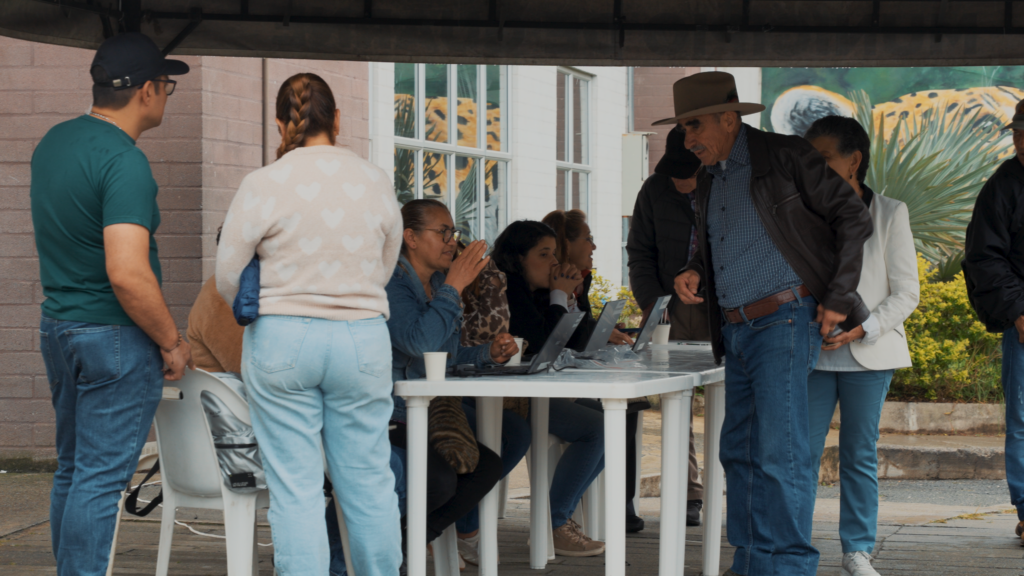
Voter registration table in Medellin, Colombia. Image credit: Jonathan Hernández Nassif.

Presidential primaries 

In addition to the House and Senate, Colombia also held three primary elections — known as inter-party consultations – to choose candidates for the three main political blocs: left, centrist, and right-wing. 

Two candidates currently leading in the polls — far-right lawyer Abelardo de la Espriella and left-wing Senator Ivan Cepeda — were not included in the primaries and the eventual nominees from the three consultations – “The Consultation for Solutions: Health, Security, and Education” (center); “Front for Life” (left), and “The Great Consultation for Colombia” (right) – will go on to compete against them in the first round of presidential elections on May 31. 

Sunday night’s big winner was Paloma Valencia, a protégé of former President Uribe’s Democratic Center party with a political pedigree that includes a former president grandfather and an aunt who was Colombia’s first female cabinet-level minister. 

Addressing her base at her victory party, Valencia lambasted President Petro, calling his administration “a time bomb that’s ticking down the seconds until it explodes.” 

In an interview ahead of the primaries, Valencia told Latin America Reports, “I am Uribista, and I will die Uribista,” and said she plans to follow in her mentor’s footsteps. 

Former Bogotá Mayor Claudia Lopez handily won her Consultation for Solutions primary, and former Medellín Mayor Daniel Quintero conceded to longtime politician and former Senator Roy Barreras in the Front for Life consultation. 

“I want to congratulate Roy on his victory. I will support him as required by law,” said Quintero on X. “I hope he leads us toward a process of unity.”

Paloma Valencia celebrates presidential primary win on March 8. Image credit Paloma Valencia via X.

Election security 

In the days leading up to elections, the UN High Commissioner for Human Rights warned that non-State armed groups were using violence to control civilian populations in Colombia and could undermine election security. 

Last year, the UN recorded 18 homicides and 126 cases of attacks and threats against political leaders, including the high-profile assassination of right-wing pre-presidential candidate Miguel Uribe Turbay, who was shot in the head at rally in Bogotá’s Modelia neighborhood in June and succumbed to his injuries in August. 

On Sunday, Minister of Defense Pedro Sánchez said over 240,000 security forces had been deployed to safeguard elections, which a delegate for the National Civil Registry called a “peaceful day at the polls, except for some isolated cases in the regions.”

Voting was temporarily suspended in the rural municipality of La Macarena, Meta following an alleged drone strike by a guerilla group near a polling station, according to the National Civil Registry. The agency also denounced “100 million cyberattacks” against its website.

Other election interference, including vote-buying was also reported. Colombia’s National Police said they captured 88 people related to elections and seized over $990,000 (COP 3,761,000,000) in cash meant to influence voting. 

In the hours leading up to the election, Víctor Hugo Moreno Bandeira, the Democratic Center congressional candidate in the southern Amazonas department, was arrested with $5,200 (COP $20 million) in cash allegedly meant for vote buying. His party later suspended his candidacy. 

And Fredy Camilo Gómez Castro, a senatorial candidate for The U Party (Partido de la U), was arrested and accused of being the right-hand to Colombia’s contraband king, Diego Marín, alias “Papá Pitufo.”

On Colombia’s eastern border with Venezuela, Defense Minister Sánchez denounced mass illegal border crossings, with an estimated 2,400 people crossing the Tachira river “presumably headed to vote.”

Álvaro Uribe campaigning ahead of March 8 senate elections. Image credit Álvaro Uribe via X.

While his party had success, Álvaro Uribe fell flat 

For the first time in his storied political career, the History Channel’s “Greatest Colombian in History”, Álvaro Uribe, failed to win a seat in the Senate. 

Projections indicate that Uribe’s Democratic Center party will secure 17 seats in the Senate, and he was placed 25th on the list of his party’s candidates, effectively excluding him from a seat. 

Uribe, who won over much of Colombia’s electorate for beating back leftist guerrillas during his presidential terms between 2002 and 2010, has come under fire in recent years for his ties to drug traffickers and paramilitary death squads. 

Last August, the controversial president was convicted of procedural fraud and bribing a witness and was sentenced to 12 years house arrest before Bogotá’s Superior Court overturned the conviction two months later.

Amelia Makstutis, Lily O’Sullivan and Jonathan Hernández Nassif contributed to reporting.

The post Historic Pact and Democratic Center parties lead Colombia’s legislative elections appeared first on The Bogotá Post.
  •  

Colombian elections 2026: What’s at stake this weekend?

Colombia goes off to the polls for the first time tomorrow – but what’s at stake in the first Colombian election of 2026, how does it all work and why are there claims of fraud?

National elections are taking place in Colombia in 2026, with the first taking place tomorrow morning, Sunday 8th March. This returns representatives for both houses of parliament as well as eliminating some candidates for the presidential elections coming in May.

Colombians in the 2022 elections. Photo courtesy of Angela Forero-Aponte

Oversight is carried out by the CNE (Consejo Nacional Electoral). In order to do this over the vast territory and number of stations, over 800,000 citizens are selected to be vote-counters. This is similar to jury duty in other countries and is compensated with a day off as well as a compulsory day of training a couple of weeks beforehand.

As the electorate is growing, there are now some 13,000 voting sites across the country, most with multiple voting tables. Colombians have to vote where their cédula is registered, so don’t be surprised to see some people trekking to other cities if they forgot to update their registration.

Borders will close, along with various road closures within city limits and ciclovía cancelled to allow for ease of transport to voting stations. There will also be a dry law enacted from this afternoon and you can expect a heightened police and military presence.

This is the first year in which the parties representing demobilised ex-FARC combatants do not receive guaranteed seats and is also the first time the leftist bloc is coming in as incumbents rather than opposition. 

With plenty of rhetoric and conflict in the run up to the election as well as the unusual political situation of the country, these are particularly hard elections in Colombia to call. While the upcoming presidential elections in May are the bigger deal, this round will give some insight into how that might go.

What’s on the table in the Colombian elections 2026?

Both houses of parliament will be fully elected, which means 103 senators and 183 representatives for the lower house, known as the Cámara de Representantes. The key difference in choice here is whether you vote regionally or nationally.

The Senate is voted for on a national basis, with all candidates open to all voters. Of the 103 curules, a straight 100 are chosen by the electorate as a whole, while Indigenous communities select a further two and the runner-up in the presidential election will receive the final seat.

The Cámara is regionally organised, with residents of the capital voting for Bogotá-based candidates and so on. Bogotanos have 18 representatives in total, whereas departments are guaranteed a minimum of two seats. Like the Senate, there are also seats set aside for special groups: afro-Colombians, Indigenous Colombians and conflict victims.

Just in case you thought there was enough on the plate, there are further considerations at stake. To avoid spreading the vote, various presidential candidates with similar positions group together for a preliminary vote. The losers in each consulta will drop out on Monday. This year there are three on the voting card.

They are leftist, rightist and centrist. Ex-mayor of Bogotá Claudia López is nailed on for the latter and ex-mayor of Medellín Daniel Quintero is likely to win the former. The rightist consulta is more open, with Paloma Valencia of the centro democrático leading polls but Juan Daniel Oviedo and Juan Galán eyeing the outside chance of an upset.

While there is a diverse group of parties, they hang together in loose blocs roughly delineated as government, opposition and neutral. With the government only controlling 34 curules and the opposition 24, the neutrals are incredibly important for horse-trading.

This will be a huge litmus test for the ruling leftist bloc. They will lose their guaranteed  Comunes seats, so any further losses will be highly problematic. On the other hand, gaining curules would be a huge shot in the arm in terms of public support, hence why they are campaigning in places like Huila, outside of their traditional strongholds.

Continuity candidate for presidency Iván Cepeda continues to lead polling by a healthy amount, but is closer to Petro’s numbers in 2018 than 2022, which will be a concern. A good performance tomorrow will help him out considerably.

Within the consultas, Paloma Valencia’s support will be the big question. She’s likely to win, but the percentages will be a big sign as to whether she can truly challenge Abelardo de la Espriella for the rightwing vote. 

The most likely outcome is that there will be little change in the makeup of the Senate, with neither the government nor opposition likely to take outright control or make large gains. Whichever of those two groups increases their representation will quickly turn it into a sign that they are on the right track and use that as support for their presidential campaign.

What’s the background to these elections?

The run-up to the first Colombian elections of 2026 has seen a lot of criticism of the system, almost all of it coming from the national government. President Gustavo Petro has been front and centre on this issue, repeatedly questioning the neutrality of the elections.

Petro’s concerns rest on the fact that Thomas Greg and Sons handle the software used in the election system, a firm that he’s clashed with repeatedly, especially over Colombian passport printing.

He says that the systems are opaque and he has not received answers from the CNE or Registraduria over various concerns he has. However, both groups, along with Colombia’s neutral election observers MOE have been clear about the processes.

Online, there are hundreds of posts claiming that a key part of the alleged fraud will be in the reports made by the jurados. This echoes previous elections, where there was a flurry of images purporting to show electoral forms that had been altered. With AI entering the scenario, expect more of this from midday or so tomorrow onwards.

Voy a escribir porqué los escrutinio son opacos y vulnerables al fraude en las elecciones.

No porque crea que nuestro proyecto democrático vaya a perder sino porque es mi deber como jefe del estado al menos informar sobre uno de los peores riesgos de la democracia hasta ahora…

— Gustavo Petro (@petrogustavo) March 1, 2026
The President has issued dozens of tweets claiming electoral fraud

Of course, Petro is only claiming that electoral fraud exists against him, not in the multiple occasions in which he’s won at the voting urns. This is a well established populist tactic – calling elections into doubt before they happen. It’s likely to rally his turnout and provide an excuse if results are bad.

There is little credibility to most of the vote rigging claims. Colombia does indeed have some serious problems around corruption and influence buying, but this tends to be concentrated in rural zones in the periphery of the country. It’s also worth noting that these seats return candidates from across the political spectrum.

A lot of electoral impropriety is very hard to prove – the machines that promise to deliver blocks of votes are well-versed in legal limits and plausible deniability. Offering someone some free gifts in return for ‘support’, for example, is widespread and while dubious hard to prove in court.

It goes without saying that political attacks on the CNE are particularly unhelpful, especially in what is still a very charged political atmosphere nationwide. The assassination of presidential pre-candidate Miguel Uribe last year was a shock to a country that has a long history of political violence.

Concerns remain over both electoral safety and fraud in much of the country, with over 200 municipios at high risk of fraud and/or violence. 39 of those are classed as very high risk and only 167 at very low risk, mainly in the Andino region. 

How does the system work?

Every Colombian over the age of majority (18) and with a correctly registered cédula ciudandanía can vote. In return, each voter gets a half day off work. Non-citizens are not eligible to vote in national elections, but holders of resident visas will be able to vote in next year’s local elections.

The polls are open from 8am until 4pm and counting is usually very fast with the first results coming in before sundown tomorrow. Due to the PR system (see below), final results for some more isolated zones will come through in the week. 

Land and fluvial borders will be closed for Colombian nationals tomorrow morning, although foreigners can cross. From this afternoon until early on Monday morning, ley seca will apply, meaning no alcohol sales in bars, restaurants or shops. That applies for everyone, so no representation or boozing for foreign residents.

Some parties run a closed list system, meaning you simply vote for them, whereas others have open lists, meaning you vote for the party and can also vote for your preferred candidate within the party. For closed lists, the party will simply enter their candidates in the order they’ve given up to their limit of seats, with an open list it will be done in order of preference.

There’s also the curious option of voto en blanco. Different from a spoiled vote, which is simply disregarded, this is an active protest. If it ranks highest in any race, then a rerun of the election must take place within a month with entirely new candidates and/or party lists. 

A smidgen under 50% turnout is common for house elections, with higher figures expected for the presidential elections later this year. The Colombian parliament is a bicameral system with the Senate acting as the upper and more powerful house and the Cámara the lower house.

Most parties do not really have well-defined manifestos as such, although better-funded candidates will give a range of positions on matters. In general, there will simply be slogans and general aims that give voters an idea of where their candidates stand.

The post Colombian elections 2026: What’s at stake this weekend? appeared first on The Bogotá Post.
  •  

Former FARC chiefs ask forgiveness for forcing children into the guerrilla ranks

JEP magistrates addressing an audience in Villavicencio as part of the Case 07 on child recruitment. Photo: JEP

Former Revolutionary Armed Forces of Colombia (FARC) commanders have for the first time in Colombian history freely admitted the armed group’s role in recruiting more than 18,677 children during five decades of their armed conflict with the state.

In a five-page document signed by Rodrigo Londoño, alias ‘Timochenko’, and five other demobilized senior leaders, the former fighters recognized their role in forcing minors into a life under arms.

Colombia’s peace court, known as the Special Jurisdiction for Peace (JEP), had previously determined that the six defendants, all former members of the FARC secretariat, carried responsibility for the crimes of recruitment of minors under 15 years of age, mistreatment torture and murder of children, sexual and reproductive violence, and prejudice against minors with diverse sexual orientations or gender identities.

See also: Peace plan has caused more conflict, says thinktank.

In the letter to the court the six defendants admitted the acts and asked for forgiveness.

“There are no words to repair these deeds,” said Londoño in a televised address widely circulated this week. “Today with honesty and clarity we recognize our role.”

“We ask forgiveness from direct and indirect victims, and from society in general.”

Londoño, who was the FARC’s last field commander up until the peace signing, said he recognized that the rebel’s actions had “stolen childhoods” as young combatants faced constant fear and death.

Historical whitewashing

Londoño also acknowledged that “the homicides, forced abortions, acts of gender-based violence, and reproductive violence caused serious physical and psychological damage that still persists”.

The statement was a milestone in Case 07 of Colombia’s JEP, the special court charged with untangling crimes committed by all sides during the state conflict with the FARC.

Case 07 was opened in 2019 and has since officially recognized 18,677 victims, of which 54 per cent are children themselves recruited, and 46 per cent families who lost children to the conflict.

Other actors in Colombia’s armed conflict have used minors as well. According to Crisis Group, “right-wing paramilitary groups” counted some 2,800 children within their ranks when they demobilized in the mid-2000s.

Historically the FARC whitewashed their role in the recruitment of minors, and during the 2016 peace process vigorously denied accusations of abducting children or threatening families to hand over their children.

According to the FARC’s own narrative, many young recruits joining the Marxist guerrilla group were “volunteers escaping poverty”. The leadership traditionally downplayed reports of sexual abuse, forced abortions and the murders and disappearances of children as political propaganda.

As recently as 2015, FARC commanders were claiming that the armed group “under no circumstance recruited children, or anyone else, forcefully,” according to a Human Rights Watch report critical of the guerrilla’s position.

Indigenous community members joining the consultations over Case 07. Photo: JEP

Never coming home

HRW’s own investigations had identified victims as young as 12 who were tied up by the guerrillas and threatened to be killed if they tried to resist. In other cases, kids were tricked with offers of presents or cash before being forced to fight under arms.

The report also cited cases of older commanders abusing girls as young as 12 in some incidents forcing them to use contraception or to have abortions.

According to JEP data presented under Case 07, child victims were present in the FARC ranks across 16 departments of Colombia, almost the whole territory controlled by the guerrilla group at its peak. Recruitment peaked between 1999 and 2013 but continued to 2016, the year of the peace accord between the rebels and the state.

Accredited to the case were 2,000 individual victims recruited as children but now adults, the JEP announced this week.

Also part of the group were families of 485 children recruited into the ranks who “never returned home”. The JEP had joined with the UPBD (Unidad de Búsqueda de Personas dadas por Desaparecidas) missing persons unit to try and locate the remains of those missing persons.

Details from Case 07 also highlighted the large numbers of minors taken from indigenous and Afro-Colombian communities, with 9,000 registered victims from six ethnic groups.

Restorative Justice

According to JEP proceedures, FARC leaders’ statements this week were an important step forward in the restorative justice process. The special peace court works with a system of dialogues between accused perpetrators and victims.

Information released by the court this week defined Case 07 as still in the dialogue phase with both private and public audiences were expected in the future where victims would given the opportunity to recount their experiences.

Data from an infographic presented by the JEP this week (translation by the Bogotá Post).
Data from an infographic presented by the JEP this week (translation by The Bogotá Post).

In line with previous cases, the former FARC leaders, could chose to respond to the crimes in front of the victims. Any punishment could come in the form of an eight-year sentence of restricted liberties for the former FARC leaders, though not jail time.

As part of the sentence the JEP might recommend restorative programs – a form of social work – in agreements made with the victims.   

For its part, the former FARC secretariat announced its full support for this process. In a taped statement former commander Julián Galló also accepted his role in the crimes.

“Our compromise is to work in the future so that hopefully these cases don’t keep on occurring,” he said.

Circular problem

Repetition was already happening, according to a report published last month by Crisis Group called Kids on the Front Lines: Stopping Child Recruitment in Colombia. According to the Brussels-based think tank, the practice had “boomed in the last decade” even since the FARC demobilized under the peace process in 2016.

A new generation of armed groups still relied on minors to maintain territorial control, said the report, with 620 cases reported in 2024: “Children carry out high-risk tasks, suffer abuse, and are punished with death if caught escaping.”

Ruthless gangs were using social media posts to reel vulnerable youngsters into the conflict with false promises of wealth, status and protection, said Crisis Group. Families faced reprisals if they spoke out, the report added.

And with increased competition between fractionated armed groups, minors were being pushed to the front lines: “Kids now fight in high-risk combat roles.”

Colombia’s circular problem of child recruitment was highlighted this week by JEP magistrate Lily Rueda, presiding over Case 07, in conversation with El Espectador. The message from the peace courts was “more relevant then ever” after data from UNICEF showed that the recruitment of children in Colombia had increased by 300% in the last five years.

“This is an opportunity to reiterate our commitment to investigating and prosecuting these acts of violence against children, which constitute war crimes and are not subject to amnesty, not even in the context of peace agreements,” she said

“Victims who survived recruitment in the past should not be victimized again by the recruitment of their own sons and daughters in the present day.”

The post Former FARC chiefs ask forgiveness for forcing children into the guerrilla ranks appeared first on The Bogotá Post.

  •  

Vaccination drive after measles cases detected in Bogotá

Vaccinator at work in Bogotá last week. Photo: courtesy Secretaria de Salud Bogotá.

Health authorities have activated over 200 free vaccination points across the city this week after two measles cases were reported.

The highly contagious virus, which is airborne and can cause serious health problems for young children, was detected in travelers from Mexico who had arrived in Bogotá and then fallen ill. Another imported case was found outside the capital.

In response the city’s District Health Secretariat said it had activated protocols to isolate the cases and had laboratories on hand to help with tracking any potential spread in the city.

Bogotá’s health secretary Gerson Bermont emphasized the need for a swift response: “Bogotá has all the infrastructure and human resources to provide technical support for diagnostic processes, he said. “The key is to act promptly to reduce local transmission.”

Measles was one of the most contagious viruses in existence and could be transmitted even by breathing, he warned. The best protection was with the MMR (measles, mumps, and rubella) vaccine, with two doses 97% effective at preventing the disease. The three people reported this week were unvaccinated.

In June last year U.S. embassies around the world took the unusual step of issuing a warning that measles was an “ongoing global risk” and advised citizens going abroad to get jabbed.

“Travelers can catch measles in many travel settings including travel hubs like airports and train stations, on public transportation like airplanes and trains, at tourist attractions, and at large, crowded events,” said the notice.

“Infected travelers can bring the disease back to their home communities where it can spread rapidly among people who are not immune.”

Good coverage

Recent data from the U.S. Centre for Disease Control (CDC) showed outbreaks in every region of the world with high caseloads in Mexico, Yemen, Indonesia, Pakistan, India, Angola and Laos.

 The World Health Organization (WHO)  declared Colombia free of measles in 2014, after intensive campaigns across the country by vaccination teams brought MMR to remote corners of the country.

VVaccinator in El Encanto, Amazon region of Colombia. Immunization coverage for measles is 93% according to WHO statistics, thanks to teams deployed to remote areas. Photo: S Hide.
Vaccinator in El Encanto, Amazon region of Colombia. Immunization coverage for measles is 93% according to WHO statistics, thanks to teams deployed to remote areas. Photo: S Hide.

Measles vaccine coverage in the country was 93 per cent for the first dose, according to data on the WHO immunization dashboard, a reasonable result for a country with access challenges for health teams

Bogotá last saw cases in 2019, when 11 persons were affected by the disease, according to data from the city’s Observatorio de Salud.  

To avoid local spread from the imported cases this week, more than 200 vaccination points were activated across the city, with details in this link of locations and opening times. Most of the sites are in existing health facilities though all are welcome and the measles vaccine is free.

The city health authorities were offering free immunization with the triple MMR vaccines (measles, mumps and rubella) known in Colombia as SRP (sarampión, rubéola y paperas) or a double vaccine of SR (just measles and rubella). Any unvaccinated or partially vaccinate person between six months old and 60 years old was encouraged to get jabbed.

The risk to Colombia “could not be underestimated” Bermont told Blu Radio this week.

“It’s bad news what’s happening in the Americas,” he said. “Last year there were 15,000 measles cases across the region. Just in Mexico there were 32 deaths”.

Bermont said mass immunization was the best method to avoid an outbreak, but region had become vulnerable from anti-vax messaging by pressure groups that gained influence during the Covid-19 pandemia.  

“We have to also recognize that today there are also health authorities in the world that throw doubt on the effectiveness of the vaccine.”

The post Vaccination drive after measles cases detected in Bogotá appeared first on The Bogotá Post.
  •  

Colombia’s Ombudsman warns government not acting sufficiently to safeguard elections

Colombia will head to the polls this year to elect the country’s next president and members of Congress. A report released this week by the Ombudsman’s Office found that the government is failing to implement over half of the watchdog’s recommendations to ensure safe and fair elections. 

On Monday, the office released a follow-up report to its October 2025 Electoral Early Warning (ATE 013-25), saying that around 42% of recommendations for safeguarding elections were being implemented.

Last June, the country made international headlines when pre-presidential candidate Miguel Uribe Turbay was shot in the head while holding a rally in Bogotá’s Modelia neighborhood. He would succumb to his injuries two months later. 

Since then, Ombudsman Iris Marín Ortiz’s office has registered 457 cases of death threats against social leaders, human rights defenders, and political actors in the pre-election period, which officially began in January 2025 when President Gustavo Petro convened his cabinet to decide which members would step down to run for elected office in 2026.

The report noted that candidates face ongoing risks, from constraints on campaigning in armed group–controlled areas to stigmatization, threats, and even homicide.

“The risk is not that the elections will be canceled,” said Marín, but rather that un-safeguarded elections could ignore the “forced silence of communities in the face of the governance of armed groups in some regions of the country.”

The Ombudsman’s report categorized municipalities into five risk levels from lowest to highest intensity of identified violence, in order to guide authorities on security, protection, and the safeguarding of political rights.

Two hundred fifty-seven were classified at Ordinary Action Level, 216 at Permanent Monitoring Level, 425 at Priority Action Level, 162 at Urgent Action Level, and 62 at Immediate Action Level — the most critical stage. In the follow-up Report, although the number of municipalities at Permanent Monitoring Level decreased (195), there was an increase in municipalities that required Priority Action (433), Urgent Action (168), and Immediate Action (69).

Political violence has continued in the period since Uribe Turbay’s death. Earlier in February, Senator Jairo Castellanos’s armored vehicle was attacked at an ELN rebel checkpoint in the northeastern Arauca department, killing two of his bodyguards. A few days later, Indigenous Senator Aida Quilcué was temporarily kidnapped in an area of western Cauca where FARC dissidents are active.

Upon reviewing the Government’s response, the highest rate of implementation for the 11 recommendations is 65% and the lowest is 0%. Strengthening and support for political organizations was the least advanced recommendation, followed by inter-institutional coordination and joint action for rapid response.

According to the Report’s conclusions, insufficient implementation of ATE 013-25 led to weak institutional coordination, allowed illegal armed groups to maintain control, jeopardized victims’ political participation in Special Transitional Peace Electoral Districts (CITREP), and perpetuated impunity through ineffective justice mechanisms.

The Ombudsman issued six new recommendations and reinforced the previous ones, urging the Ministry of the Interior to lead the Intersectoral Commission for Rapid Response to Early Warnings (CIPRAT), align action plans, ensure measurable budgets, and eliminate overlapping measures that cause operational gaps.

On March 8, Colombians will head to the polls for legislative elections where they’ll vote for representatives to the national congress, senate as well as primary elections where political parties will choose presidential candidates to represent them in the first round of presidential voting on May 31.

The post Colombia’s Ombudsman warns government not acting sufficiently to safeguard elections appeared first on The Bogotá Post.

  •  

Paseo Millionario: don’t be taken for a ride

An express kidnapping highlights the risks of taking a taxi in Colombia’s capital. What happened, and how to avoid it happening to you.

A few rogue taxis among Bogotá's 55,000 are implicated in express kidnappings. Photo: S. Hide.
A few rogue taxis among Bogotá’s 55,000 are implicated in express kidnappings. Photo: S. Hide.

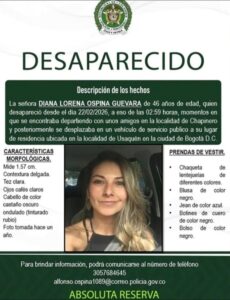
Bogotá breathed a collective sigh of relief on Tuesday morning when news broke of the safe arrival home of Diana Ospina, a rola missing for almost 40 hours after being kidnapped by a taxi she had hailed in the street after a night out in Chapinero.

Ospina was the latest victim of El Paseo Millonario, the ‘millionaire ride’, where passengers riding in yellow public taxis are physically attacked and forced to hand over cash and valuables.

The technique varies, but victims are usually targeted late at night in busy streets in party zones outside restaurants or discotheques, then driven to a quiet spot where two accomplices of the driver climb in the back seat and threaten the passenger with knives, guns or syringes.

See also: Bogotá’s Murder Mosaic

The following ordeal can last minutes or hours or even days. Victims are intimidated with beatings or stab wounds, and hooded or blindfolded. Some are killed, as in the case of a university professor found dead on the outskirts of the city in January this year.

Foreigners are also targeted: in 2013, a DEA officer Terry Watson was stabbed to death in a Bogotá taxi after two assailants jumped in the back seat. Authorities later said the army veteran resisted the attack. Seven taxi drivers were later captured and extradited to the U.S. to face charges for his murder.

According to police data, during 2025 in Bogotá there were registered 37 cases of kidnapping for ransom or extortion, though these crimes are highly under-reported. This is because the same gangs threaten the victims to keep quiet, and in the case of taxi gangs, know where their targets live.

Publicity blitz

Poster for Diana Ospina, later found safe.
Police poster for Diana Ospina, later found safe.

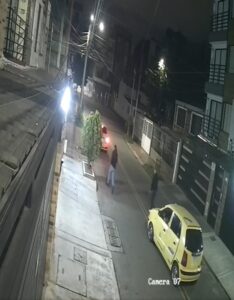
In the case of Ospina, her kidnap started early Sunday morning when she hailed a yellow taxi that took her to within one block of her home in Engativá, where two men from a following taxi climbed in the back, threatened her and took her blindfolded for a three-hour driver around the city while using her phone and bank cards.

The ordeal did not end there. Ospina was then passed on to another kidnap group operating in the south of the city and held in a house there while more extortion demands were made. Late on Monday night, after being captive for nearly 40 hours, Ospina was dropped off in the hills above Bogotá where she eventually walked to a police station for assistance.

According to information on FM radio, from contacts close to the family, the kidnap gang released her after the “feeling pressure from the media blitz” with social media platforms widely publicising her disappearance. Other news reports stated they released her only after draining 50 million pesos (US$15,000) from her bank accounts.

This week the authorities were still hunting the perpetrators, expecting arrests imminently.

Your world in your phone

The Ospina case highlights how smartphones have upped the risks for kidnap victims in Colombia.

Whereas in the past a paseo millonario was usually a short-term event – passengers held for an hour while the gang used their bankcards at an ATM – criminals nowadays are eyeing much bigger profits from emptying bank accounts held on smartphones.

The insistence by banks and other financial platforms to use biometric approvals such as face recognition or fingerprint scanning has created the need for gangs to keep their targets captive for many days, in some cases drugging them into compliance or subduing them through threats of violence.

See also: Bogotá Police take down gang drugging victims in Teusaquillo and Chapinero

The rise of the digital nomads in Colombia often with juicy crypto accounts accessed through their phones has also created opportunities for tech savvy criminals. After such attacks, platforms are reluctant to reimburse funds arguing that they were transferred with the biometric approval of the victim.

One thing is clear: apart from increased financial losses, the longer victims are held captive the worse their outcome, both in terms of physical and psychological damage, the risk of sexual violence, or death from an overdose of the powerful drugs such as burundanga administered by the gangs.

The Canaries

Bogotá has more than 55,000 public taxis circulating on any given day sometimes referred to as ‘Los Canarios’ (the canaries) after their yellow cars and a popular telenovela depicting taxi drivers. It is worth noting that taxi drivers are themselves frequently the victims of robbery, extortions and murder.

Yellow taxi companies in Bogotá are registered and controlled by the Secretería de Movilidad with each driver given a Tarjeta de Control, the plasticized card hanging down the seat back that – in theory – displays the name, details and photo of the driver as well as the fare scale, and is revalidated every month.

In Bogotá, passengers can independently check the status of registered drivers by entering the numberplate into the menu at SIMUR at  www.simur.gov.co/conductores-de-taxi.

But in a random test by The Bogotá Post, out of 10 taxis entered by number plate, only six had a registered driver. Four were reported “without an active registration”.

That lack of control is further weakened by the fact that registered taxistas often allow other drivers to take the wheel, said transport companies this week.

“We work on good faith, but we can’t guarantee that drivers don’t hand over their cars to other persons to commit crimes,” Maria  Botero, manager of Radiotaxis told Noticias Caracol.

In the case of Ospina, the taxis that abducted her were quickly identified along with their owners, but not the actual attackers. One car was not currently registered on SIMUR.

Bogota´'s SIMUR taxi checker. In a random test by The Bogotá Post, only six out of 10 taxis were found to have a current registration.  Access the site here
Bogotá’s SIMUR taxi checker. In a random test by The Bogotá Post, only six out of 10 taxis were found to have a current registered driver. To do your own test, access the site here.

No dar papaya

How to avoid becoming a victim? A good tip is to use a ride platforms like Didi, Cabify, Uber or Indrive. Some like Didi are also linked to the yellow public taxis, but safer because the ride is traced. At times hailing a street taxi is the only option because app cars are far off, and you weigh the risks of standing on the street, or (as in the case of Diana Ospina) the app ride is suddenly cancelled.

Attacks are usually at night, on weekends, on persons leaving bars or restaurants. But passengers can be targeted in daytime, particularly in financial districts or leaving a bank. If you are riding the yellow taxis, here are some ways to no dar papaya, as they say in Bogotá (‘don’t be a sucker’).

Before going out:

  • Carry a clean phone with no banking apps and limited personal data. Many people in Bogotá are now leaving their financial transactions on a second phone or tablet stored safely at home.
  • Carry a wad of cash. Perhaps counterintuitively, in the digital world cash makes you less of a target. And it is easy to hand over.
  • If you do carry a bank card, take just one linked to a low-balance account.

Getting the taxi:

  • Travel in a group. Criminals generally target solo passengers.
  • Check the taxi numberplate in SIMUR, see above. This takes seconds and confirms if there is a registered driver. If not, walk away.
  • Take a photo of the taxi numberplate, send to friends or family. Ensure the driver sees you doing this.
  • Before entering a taxi, look carefully to ensure there is no-one hidden inside.
  • Check the Tarjeta de Control photo with the actual driver. Do this before setting off.
  • Check doors can be locked and unlocked from the passenger seat.

During the trip:

  • Lock doors on both sides.
  • Share your real-time location with a family member or friend.

Signs of danger:

  • The driver changes the route without explanation.
  • The taxi turns onto dark or deserted streets.
  • The driver suddenly stops to pick up other persons.
  • Motorcycles or other cars or taxis closely follow the vehicle.

During an attack:

  • Prioritize your physical safety.
  • Give up any valuables without resistance.

If you suspect someone you know has been abducted by a taxi gang, call the GAULA special police unit (Grupos de Acción Unificada por la Libertad Personal) that deals with extortion and kidnapping, on Line 165.

“Safe taxi” zones

Moment of terror; two attackers approach the taxi of Diana Ospina.

Even with these precautions, street taxis are still a risk, and a growing one according to Bogotá security authorities who during 2025 arrested at least 20 persons from several different Paseo Millonario gangs such as La 57 and La Zona T.

A recent advance by the city has been the recognition of the crime as “kidnap with extortion”, with up to 40 years in jail for perpetrators.

Another nitiative announced by the Secretaría de Seguridad this week was taxi seguro zones where uniformed teams patrol outside nightspots and assist revellers to take only registered taxis.

But while mediatic, such initiatives are likely to have only limited impact. Taxi gangs are generally compact, with three people, and mobile so they can cruise new zones. And new gangs seem to pop up as quickly as old ones are taken down.

So while the city can celebrate the safe return of Diana Ospina, and hopefully soon see her attackers rounded up, there will be plenty more candidates for the Millionaire Ride.  

The post Paseo Millionario: don’t be taken for a ride appeared first on The Bogotá Post.

  •  

More trouble at Bogotá’s Universidad Nacional?

The Struggle Continues: students painting murals at the Universidad Nacional last week. Photo: S Hide.

Student leaders declare ‘indefinite strike’ at Bogotá’s sprawling Universidad Nacional as controversial rector reappointed.  

In another twist in the saga of who runs the ‘Nacho’, Colombia’s largest public university, controversial candidate Ismael Peña was formally inducted as rector last week ending a two-year legal wrangle.

Peña was sworn in during a small private ceremony on Thursday just days after a Bogotá tribunal ordered his reinstatement in the job. This followed the resignation last November of another rector whose possession was ruled illegitimate by Colombia’s state council.

Read more: Court Ruling Expected to Spark Trouble at the National University.

The initial controversy was sparked in 2024 in the highly politicized campus when a popular candidate, Leopoldo Múnera, lost out to Peña in the last voting round by the university council.

#BOGOTÁ | Este es el panorama a esta hora (6:53 p.m.) en la calle 26 a la altura de la Universidad Nacional.

Los servicios troncales que transitan realizan retornos en Corferias y Concejo de Bogotá.

Los vehículos particulares no pueden circular en sentido Oriente-Occidente.… pic.twitter.com/WWfyIrqwXi

— ÚltimaHoraCaracol (@UltimaHoraCR) February 19, 2026

The ensuing strikes and protests galvanized the university for four months setting back the academic agenda and creating an exhausting three-term year in 2025, from which students and professors are only just recovering.

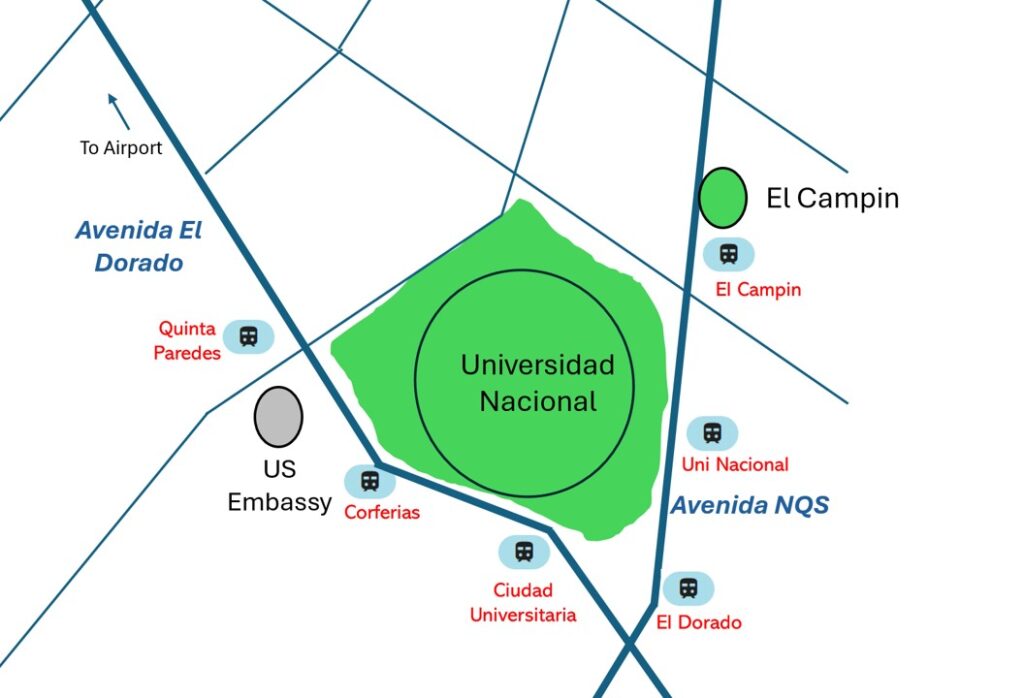
Protests and vandalism spilled over onto major nearby transport routes around the Bogotá campus. In Bogotá, the Nacho sits in the corner of the busy Avenida NQS and Avenida El Dorado, two of the most vital throughfares for both public and private transport.

Bogotá's Universidad Nacional campus sits on the junction of the city's main transport routes.
Bogotá’s Universidad Nacional campus sits on the junction of the city’s main transport routes.

Return of Torres

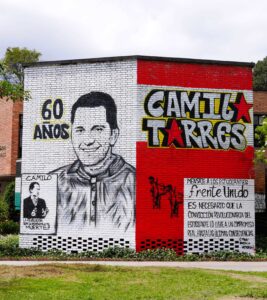
Mural of Camilo Torres.

Even as news of Peña’s legal victory and imminent reinstatement was announced last week, students and supporters quickly blocked the Avenida El Dorado forcing Transmilenio buses to suspend operations and thousands of commuters to make their way on foot.

Student assemblies at the university’s two main campuses, Bogotá and Medellin, called for “indefinite strikes” to protest Peña reinstatement.

To add to the confusion, the Bogotá campus was also invaded by a large group of campesinos from Cauca whose later protests detained workers in government buildings, part of a plan to draw attention to conflict-related problems in their department.

On Friday, when The Bogotá Post visited the university, most of the faculties were closed but the campus was filled with students busy painting fresh murals to celebrate the return of the remains to the campus of Camilo Torres, a revolutionary priest and founder of the university Sociology Department, who joined the ELN guerrillas and was killed in action against the army in 1966.

See also: Remains of Rebel Priest Set to Return to Bogotá.

Many students gave their views on the return of Peña but  declined to be fully identified.

Roberto, a sociology student selling food in the campus, said he supported the strike to “preserve the autonomy of the university”. Peña was seen as an unpopular candidate “linked to private interests that will privatize the curriculum and syphon off profits”, he said.

Corporate spinoffs

Similar sentiments were expressed across the campus: that Peña was being parachuted in with the backing of the Centro Democratic party to advance both a right-wing agenda and disburse lucrative contracts to a select group of private companies.

According to an investigation by magazine La Raya last year, Peña was the continuity candidate for “a parallel administration system” embedded in a company called Rotorr that dished out deals on behalf of the university, but bypassed internal auditing procedures leaving an opaque tangle of beneficiaries.

During his rectorship Múnera described these corporate spinoffs as engaging in “crimes against the university” and flagged them to the judicial authorities, but so far with no clear resolution.

Despite these controversies, Peña’s return was boosted by support from the Consejo Superior Universitario, the highest decision-making body of public universities in Colombia, that unanimously agreed to respect the tribunal ruling, clearing any final legal hurdles.

Strike Down

In another unexpected outcome, an online poll of students revealed that a majority were against the suspension of classes.

 The initial strike call came after a hastily convened student assembly on the Bogotá campus where some student representatives later complained that their voices were not heard.

“There was one classmate, he raised his hand and they wouldn’t let him speak. So, the next day we decided to conduct a survey to ask the students if they agreed with the strike,” student representative Kevin Arriguí told City TV.

The results, based on a total of 5,438 respondents, showed that 56 per cent (3,060 students) disagreed with the strike, while only 36 per cent (2,141 students) supported it. There were 237 undecideds.

Tellingly, the online strike survey had a higher participation among students than last year’s vote to install a Constituyente Universitaria – a people’s body – that is now in place.

Some students consulted on the campus by The Bogotá Post last week were mindful of the outcome of the 2024 strike which lasted several months and created hardships, particularly for poor students from rural areas who had spent money to travel to the capital to study, only to face severe interruptions to their curriculums and the risk of having to study another year to gain their degrees.

“We don’t want Peña. People are angry. But we don’t want to stop the term either,” said Carla, a student outside the newly constructed 70,000-million-peso arts faculty building.

Bogotá is Colombia's protest capital with thousands of events every year. Photo: S Hide.
Bogotá is Colombia’s protest capital with thousands of events every year. Photo: S Hide.

Fragile mobility

Finding a compromise could be problematic. Activists on the campus were pressuring undergraduates to not attend classes and most lessons were abandoned. Some professors offered their classes on-line.

The student assembly planned this week at the Bogotá site could reverse the strike plans, though this seems unlikely. The general mood among students on the campus was that they would “block Peña, whatever it takes”.

Such talk is common at a university that is a petri dish for the national condition and at times – literally – a battleground for political divisions, particularly in a city nominated as the country’s “protest capital”.

This was revealed by data published in an El Espectador op-ed this week which showed Bogotá had 1,678 mass mobilization recorded during 2025, roughly 32 per week, and an increase of 17 per cent on the previous year.

While celebrating this increase as a “symptom of democracy”, it also pointed out that these protests “affected public order and the fragile mobility of millions of Bogotanos”.  

 That included two million people using the Transmilenio each day, with a majority of these on lines passing close to the Universidad Nacional. Easy targets for agitators based on the campus.

Which is why trouble at the Nacho generally means headaches for the whole city.

The post More trouble at Bogotá’s Universidad Nacional? appeared first on The Bogotá Post.
  •  

Young hemophilia patient dies after delay in life-saving medicines

Kevin Acosta whose tragic death last week sparked intense debate over health access. Photo: online sources.

Failures in Colombia’s health system were highlighted this week after a young boy died from “completely preventable” complications from blood condition after going off treatment for two months.

Seven-year-old Kevin Acosta was rushed to hospital in Pitalito, Huila, on February 8 after falling off his bike and hitting his head, a situation complicated by his hemophilia.

According to his mother Katherine Pico, the boy required regular injections of clotting factors to prevent the genetic condition that can cause fatal bleeding if untreated.

But due to failings by his health insurer, Nueva EPS, Kevin had missed his regular injections for two months, and on the day of his accident he was denied emergency doses even while bleeding from his head in the hospital in Pitalito.

When the health insurer finally agreed to evacuate Kevin by air ambulance 24 hours later to Bogotá, where clotting factors were available, the blood loss was severe. Kevin died four day later in the Intensive Care Unit of the Hospital de la Misericordia in Bogotá.

Since then, Kevin’s death has caused huge indignation in Colombia both among medical experts who claim the death was preventable and critics of the current government’s political intervention in the health system which has left many users worse off.

Get off your bike

Adding to the furor, President Gustavo Petro waded into the debate blaming the mother for allowing Kevin to ride a bicycle.

“A hemophiliac child shouldn’t ride a bike; it’s a matter of prevention. We need to know if the doctor or the health system isn’t providing education, because mothers don’t learn about it, especially given the low educational levels in Colombia,” he said.

His own health minister, Guillermo Jaramillo, added: “Children with hemophilia should be restricted from activities that can generate violent trauma,” he said.

These comments were challenged by patient’s rights groups, who pointed out that cyclists with hemophilia have competed in the Tour de France, and medical experts who emphasized that in recent decades in Colombia prevention has been based on weekly or monthly injections of “clotting factors” which allowed hemophiliacs to lead normal lives.

Many medical experts concurred that children with regular prophylaxis to prevent excess bleeding could, and should, integrate in physical activities.  

“The child died from the accident, but the reason he died was because he didn’t have the medication,” Dr Sergio Robledo, president of the Colombian League of Hemophiliacs, told Blu Radio.  “Prevention in hemophilia means having the drugs, not locking the child up at home.”

“For more than 20 years in Colombia we have not had any [hemophilia] deaths specifically due to a lack of medicine,” Robledo continued.

Chaotic plan

Kevin’s case was symptomatic of problems in Colombia’s health system which had worsened under the Petro government, Denis Silva told the Bogotá Post this week.

Silva, spokesperson for Paciente Colombia, a coalition of 202 patients’ rights groups, said Kevin’s death was “100 per cent avoidable”.

“If Kevin had been given the prophylaxis or given the treatment when he went to the clinic to coagulate his blood, the situation would have been different”.

Kevin’s mother had been asking Nueva EPS for the life-saving medicines since December, he said, but they were never delivered because the EPS had “failed to pay the clinic” that administered the drug in Pitalito.

Blame for these errors should bounce back to the Petro government, said Silva. State entities had forcibly intervened in Nueva EPS in 2024, claiming fraud in the huge health insurer, and were thereafter legally responsible for managing the entity that covered 11 million Colombians.

Interventions in EPS insurers was not unusual in Colombia, he said. Previous governments had done the same to avoid a crisis for patients.

But were timely actions to “administrate, improve and, where necessary, rescue” the health insurers, though in some cases they were shuttered and patients moved to other companies. Petro’s current takeovers were more chaotic and linked to political overhaul of the health system, he said.

Health system in crisis

This agenda was heavily criticized in an opinion article ‘How Politics Destroyed Colombia’s Model Healthcare System’, by Colombian-based journalist Luke Taylor and published in the prestigious British Medical Journal in January.

Referring to President Petro’s “bungled reforms”, the story claimed that maternity wards and neonatal units were shutting their doors, emergency departments becoming overwhelmed, and training programs for specialist doctors being shut down.

It also quoted the Colombian president as stating that health companies were being “run by crooks”, even as the his government’s interventions triggered a slew of complaints by patients suddenly finding their health care a lot worse.

For patients with chronic ailments reliant on monthly checkups and regular medical supply, the decline was becoming an existential threat, said Colombia’s ombudsman, Iris Marín, this week.

Kevin Acosta was “yet another victim of the failures in the availability and access to medicines that thousands of Colombians face today, in order to access timely treatments that are crucial for their health”.

According to documents released by Nueva EPS, Pico had tried to transfer her son’s care from Huila to Santander department, then switched back to Huila, suggesting a paperwork logjam had delayed the treatment. In another statement, it denied suspending the prophylaxis.

Need for treatment

This was “a big lie” said Pico, talking to Semana, since even before the administrative switch the local clinic treating Kevin had told her in early January that Nueva EPS had ended its contract. Without payments from the EPS, the clinic was forced to suspend treatment.

“By January we had no medication, no appointments, nothing,” said Pico.

Her position was supported by the fact that, across the country, other chronic or rare disease sufferers – including hemophiliac suffers in Pico’s same family – were reporting the same shortages, in many cases linked to contractual or payment problems with health suppliers. 

ACHOP, the Colombian Association of Pediatric Hematology and Oncology, warned in a public communication that children and adolescents “were not receiving in a timely and continuous manner the essential medicines to preserve their lives in conditions of dignity”.

These shortages fell mostly on patients with the state-intervened Nueva EPS, confirmed hemophilia specialist Dr Jorge Peña, who said he regularly treated dozens of children with the condition.

Talking to Caracol Radio, Dr Peña said that children with other insurers were receiving their prophylaxis on time and were “happy, free from bleeding, and going to school as usual”.

“In comparison Nueva EPS patients are not getting the medicines, and I see them every day with bleeding. They can’t go to school.”

Leaked records

Meanwhile attempts by the government and President Petro to push back on Pico even while grieving her son’s death caused condemnation across the political spectrum, particularly since the state had taken over Nueva EPS.

“The responsibility is clear: when the state intervenes and controls, it is held accountable,” said Senator Jorge Robledo on X.

“The healthcare system already had problems, but under this government it’s worse. And meanwhile, more and more Colombians are suffering from illnesses that medicine knows how to treat.”

More criticism piled on President Petro after he leaked details from the Kevin Acosta’s medical records during a speech in La Guajira. Patient spokesperson Denis Silva called on the government to respect patient confidentiality

“These are confidential in Colombia,” said Silva. “By law the EPS insurer should guard the medical records, and no-one should access them without permission from the family”.

The leaks came even as the state agency overseeing the system, the Superintendency of Health (also known as Supersalud), announced an investigation into the Kevin’s care, including looking at “administrative barriers and the delivery of medication by Nueva EPS and the service provider”. This audit should clarify differences in accounts from the family and Nueva EPS.

But even with results pending, President Petro again doubled down in a speech claiming the family was primarily responsible for Kevin’s health outcomes.

“It’s the family that first of all cares for its children,” he said, “Not everything is the responsibility of the state, because the state can’t respond to everything, otherwise we lose our liberty”.  

Colombians living with hemophilia might want those liberties to include the right to life-saving drugs – and to ride a bike.

The post Young hemophilia patient dies after delay in life-saving medicines appeared first on The Bogotá Post.

  •  

Rain, rain, go away

2026 has started off unusually wet, with downpours in Bogotá and floods elsewhere in Colombia. What’s going on and how can you help?

While this is meant to be the dry season for most of Colombia, it’s instead been raining heavily. Vast swathes of the Caribbean region have flooded, and in Bogotá, it’s led to collapses in the traffic systems. That’s led to an emergency declaration by the president and frantic relief efforts (links at article end).

Heavy floods have left much of Córdoba underwater. Photo courtesy of UNGRD

Colombian president Gustavo Petro has declared a state of emergency yet again to address the situation in the northern department of Córdoba and elsewhere. While the emergency measures were declared for Córdoba, this was later extended to 22 departments, underlining the severity of the situation.

Within the capital, flash floods have swamped roads and forced traffic to grind to a halt as well as collapsing roofs and flooding buildings. Luckily, Bogotá has so far escaped the levels of damage seen elsewhere in the nation.

Barrios such as Nicolás de Federman have been hit by hailstorms heavy enough to resemble a blizzard, leaving them carpeted in white as though snowed in while the autopista norte has been forced to close as it resembles a swamp.

One silver lining to the rainclouds is that the reservoirs will be nice and full, alleviating fears that Bogotá will be forced to return to water rationing, as happened in 2024. That will be little comfort to many who have lost everything in the floods.

Why is it raining so much?

Heavy rain has persisted through year start

Colombia’s weather monitors, IDEAM, have explained that there are four main factors: the Madden and Julian wave; high Amazonian humidity; a lack of winds to move that humidity and la Niña-esque conditions.

All put together, these four factors combine to make a perfect storm and unseasonably high January rainfall levels. That’s continued into February and with March and April around the corner there is little relief in sight.

That’s led to half the country being put on alert for potential floods and high precipitation, which leads to all sorts of other trouble such as landslides. Colombia’s disaster relief agency UNGRD is underprepared currently, having endured corruption scandals recently.  

This is meant to be the dry season, too. Bogotá in particular is meant to receive heavy rain October-December and April, not January and February. In fact, these months are normally characterised by blazing sunshine, clear skies and hot temperatures.

Adding to the confusion is the fact that we’re supposed to be heading into an El Niño cycle, meaning dry weather and lower rainfall than expected. Instead, we’ve had the precise opposite so far. While Colombia is the world’s rainiest country, it’s not meant to fall in January and February, at least not in the north.

Floods in the Caribbean

The rains have been annoying and disruptive in Bogotá, but other parts of the country have faced genuine devastation. First among those is the department of Córdoba, which has suffered widespread floods. However, over half the country has been affected.

The capital of Córdoba, Montería, is the worst hit major city in the country, with thousands of people evacuated in the city and surrounds. Over a quarter of a million people have been directly affected by the rains nationally.

Sadly, politics have come into play here too, with Petro clashing with regional governor Erasmo Zuleta over the management of the department. The pair have had a lot of differences over the years. He also said he was initially unable to land in Córdoba due to the risk of an attack.

Rivers across Colombia are full and at risk of flooding

More reasonable are Petro’s claims that the situation has been exacerbated by water management systems such as reservoirs. These have diverted normal water flows and critically diminished the region’s ability to handle pressure from unusual weather patterns. Zuleta’s response is that the national government oversees the Urrá hydro plant.

The worst affected regions are on the Caribbean coast, with Uraba Antioqueño, La Guajira and Sucre joining Córdoba, but the Amazon and Pacific regions have also seen unusually high rainfall for the start of the year.

There has been flooding in Medellín, as well as the risk of landslides in hillside comunas, while coastal cities such as Cartagena have had heavy downpours and storms, affecting much-needed tourism income in high season as beaches close.

Even when the rains stop, the long term effects will take years to overcome. Already, bad actors are starting to take advantage of the situation, with desperate houseowners paying through the nose for boaters to rescue their belongings before thieves arrive.

Fields that are now underwater will take an age to fully drain and even longer to recover from the damage currently being wrought upon them. Thousands upon thousands of hectares of farmland will be unusable for the near future.

With what looks like a fraught year ahead for Colombia, this is an unwanted extra pressure to deal with and exposes the fragility of infrastructure in the face of increased climate change pressure. Whoever wins the next election, investment will be needed to avoid similar problems going forward. 

The Cruz Roja Colombiana are taking donations of clothes and building materials at their Salitre centre (Av.68 #68b-31), and you can donate money directly on this link. The local government in Bogotá is also organising donation drives on this link.

The post Rain, rain, go away appeared first on The Bogotá Post.
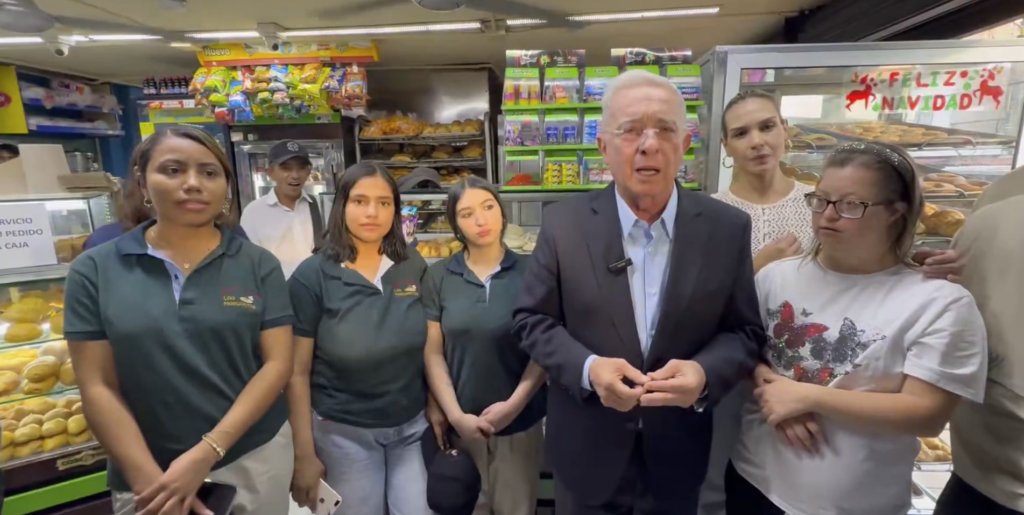
  •  

Is justice in sight for the Andino mall bombing victims?

Andino bombing suspect Violeta Arango detained in the Sur de Bolívar in 2022. She has always denied any role in the attack. Photo: Colombian Army.
Andino bombing suspect Violeta Arango detained in the Sur de Bolívar in 2022. She has always denied any role in the mall attack. Photo: Policia Nacional

Judges ordered the recapture this week of a Violeta Arango Ramírez, a prime suspect in the 2017 bombing of Bogotá’s Andino shopping mall, after she lost her legal protections as an ELN peace manager.

The Colombian attorney general’s office requested that Arango, thought to be active in the ranks of the ELN guerrillas, “be found immediately to comply with an order for prison detention” based on accusations she was a key participant in the attack that left three dead and 10 more injured.

Arango, a sociologist, was previously arrested in 2022, but then released from prison to assume the role of a gestora de paz (‘peace manager’) during peace talks between the ELN and the the Petro government.

The controversial release was criticised at the time by survivors and families of victims of the Andino attack as Arango remained a key suspect. By being nominated as a gestora de paz, Arango was allowed both her freedom and temporary avoidance of homicide and terrorism charges while whe was “collaborating with the peace process”.  

This week’s recapture order followed breakdowns in government talks with the ELN with the Justice Department officially removing many combatants’ designations as peace managers. The news gave a glimmer of hope for justice after nine years of uncertainty as to who was behind the attack.

Arango herself has always denied any involvement in the attack, pointing to a plot from within the state prosecutors’ office to frame left-wing activists during the political fallout from the 2016 FARC peace deal.

Pamphlet bombs

The Andino attack unfolded during the evening of Saturday, June 17, 2017, inside the crowded women’s restroom of the busy shopping mall at a peak hour. It was the eve of Father’s Day.

A bomb placed in a toilet cubicle exploded killing one French and two Colombian citizens and maimed at least eight more women in or around the restroom.

Police investigators quickly blamed the Movimiento Revolucionario del Pueblo or MRP, a left-wing group that had evolved in Bogotá’s public universities and was dedicated to mediatic events such as dangling flags from buildings and letting off weak explosives that launched political leaflets into the air.

MRP pamplet from 2017.
MRP pamphlet from 2017.

Over the space of two years the MRP had targeted public spaces outside tax offices, health insurers and banks with messages such as: “Today in Colombia the peace process is a business plan”, and “Health in Colombia is a problem of democracy”.

In the months following the attack, a dozen suspects accused of being linked to the MRP were rounded up, detained over many months, then tried and released after none of the evidence against them could be proven in court.

Meanwhile an alternative theory emerged: that the Andino bombing was part of a right-wing plot carried out to destabilise the then-Santos government’s closeness to left-wing guerrilla groups in the wake of the historic 2016 peace process with the FARC, previously Colombia’s most powerful armed group.

False positives

In this narrative, the MRP, with its history of small-scale attacks and rumoured links to the larger ELN guerrilla group, made a convenient scape-goat.

Investigators claimed to have found similarities between the Andino bomb and the pamphlet explosives, but an analysis by news website Las2Orillas at the time pointed out that the attorney general’s office at the time “had a long history of fabricating evidence” to bring down left-wing political targets, partly as a distraction from their own implications in high profile corruption cases.

Violeta Arango, an activist with links to left-wing causes, found herself officially accused of being an MRP leader and coordinator with the much larger ELN guerrilla group.

She avoided capture and publicy declared herself the victim of a “falso positivo”, or false positive, referring to the practice by the Colombian military of murdering civilians and disguising their bodies as guerrilla combatants.

“This legal persecution I am suffering, along with my family who are being harassed and abused, is nothing more than a setup by the police and the attorney general’s office,” she wrote in an open letter, before fleeing Bogotá.

What happened next is subject to speculation. According to Arango herself, she escaped into the arms of the ELN (literally, as she became the romantic partner of a senior commander) fearing for her life in the face of “political persecution”.  

But her smooth transition into the ELN guerrilla’s Darío Ramírez Castro Front – active in the conflict zone of Sur de Bolívar – also seemed to vindicate the prosecution’s narrative of her links to urban terrorism.

Alias ‘Talibán’

Iván Ramírez, named by the police as 'alias Talibán'. Photo: from Andino File: A Judicial Set-up
Iván Ramírez, named by the police as ‘alias Talibán’. Photo: from Andino File: A Judicial Set-up.

Meanwhile in Bogotá, 10 other people were detained as suspected MRP members linked to the attack.

After searches of their homes, some were accused of carrying false IDs, carrying weapons, and, in some cases, having printed plans of the Andino shopping centre showing entrances and exits, and notes which appeared to show preparations for the bombing, and USB sticks with messages from the MRP.

But in many cases the police arrests and searches were themselves found to be illegal and without due process which, added to the flimsy evidence presented in court, lead to the the cases falling apart under legal scrutiny.

Some of these investigations were later examined in a documentary called Andino File: A Judicial Set-up? produced by journalism collective La Liga Contra el Silencio. One of the main accused, Iván Ramírez, described how the police produced CCTV used to identify him “scoping out the Andino”. This “evidence” later turned out to be video of a regular mall worker with a similar look.

In another twist, Ramírez described how the police themselves invented the aliases to which the suspects were presented as a “terrorist cell” to the media; for example, ‘El Calvo’, ‘Japo’, ‘Aleja’ and, in the case of the bearded sociologist, ‘Talibán’. The scary name stuck and Ramírez was thereafter referred to by Colombia media as ‘alias Talíban’.

He was also constantly described by prosecutors as the “explosives expert” of the MRP cell, a charge he consistently denied.

Ramírez was released from custody in 2021 after spending four years in pre-trial detention, during which time every case against him collapsed. But even after his release he continued to be “linked to the investigation”.

Arango in the ELN. Photo: Policia Nacional

Peace managing

Then in June 2022, Violeta Arango, now in the ELN, was captured in the Sur de Bolívar in the same military operation that killed her partner, known as Pirry.

According to a post on X by the then minister of defence, Diego Molano, alias Pirry was “one of the top ELN commanders responsible for attacks on the civilian population, forced recruitment, and terrorism”.  

Arango was jailed for her guerrilla links even while the process continued against her for the Andino bombing.

That panorama changed when Petro Gustavo took the presidency in August 2022; with peace talks in the air, and after a visit from a Cuban and Norwegian delegation to her jail, Arango was released to her gestora de paz role in November that year. She resurfaced a month later in Caracas, Venezuela, as part of the ELN talks with the Petro government.

This appearance caused anger among the Andino victims. Pilar Molano, who lost a leg in the explosion, told Vorágine magazine that “it’s insane that they let her out and put her in the peace negotiations with the ELN”.

Six years after the Andino attack, in April 2023, the prosecutor’s office again filed charges against Arango based on evidence that prior to the bombing she had downloaded plans of the shopping mall from the Internet.

Cell structures

The indictment formally accused Arango of the “detailed planning” of the bomb attack. It further alleged that Arango was a senior member of the MRP “responible for attracting new members to the criminal organization in Bogotá and apparently participated in at least 21 terrorist attacks against EPS headquarters, public transport and infrastructure”.

With this week’s recapture order the case can move ahead – assuming she can be found.

Any trial could shed light on the who and why of the Andino bombing, and also the complex backstory of ‘Violeta’. But, given the shambolic history of the judicial process, it could also put the investigation back to square one.

In interviews in the intervening years leaders of MRP have repeatedly denied their groups involvement, as well as denying any links to the ELN, or any connections to the original suspects.

But the truth might be hard to find even within the two armed groups; both the ELN and the MRP are known to work in cell structures which plan autonomous actions often without the co-members or leaders aware.

Such was the case with the devastating car bomb that killed 20 young police recruits in Bogotá in 2019, initially denied by the ELN – their leadership claimed not to know of the plot – but eventually taking responsibility.

An unusual element of the Andino bombing is that no armed group or political movement has ever taken responsibility. And so far the prosecutors have not only failed to pin the attack on the MRP, but also ignored alternative lines of investigations such as a false flag operation by paramilitary or right-wing groups.

Lawyer for the Andino victims and survivors Franciso Bernate, said this week that “on behalf of the 11 female victims we hope Violeta is found so she can respond to these grave accusations”.

The post Is justice in sight for the Andino mall bombing victims? appeared first on The Bogotá Post.
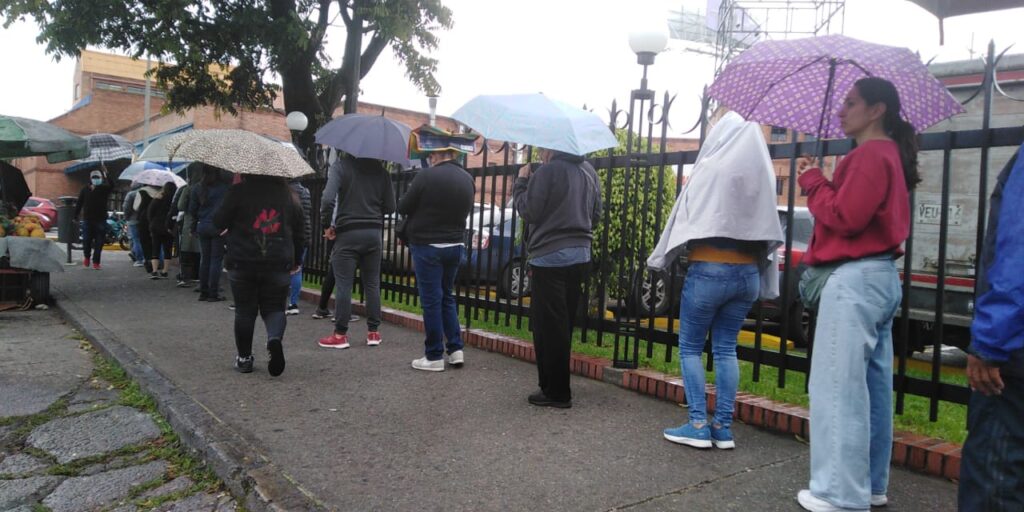
  •  

Peace plan has caused more conflict, says thinktank.

Stark figures show expansion of fighting groups under ‘Paz Total’.

Comandos de La Frontera in Putumayo, one of many armed groups in talks with the Colombian government: Photo credit: Bram Ebus.

Colombia’s illegal armed groups have grown by 84 per cent during the three years of the Petro government’s Paz Total plan, thinktank Fundacion Ideas para la Paz (FIP) announced last week.

The alarming data showed the country’s main guerrilla factions and organised crime gangs totalled 27,000 active members at the end of 2025, adding 5,000 new recruits in just 12 months.

And humanitarian crises associated with the expansion of illicit economies, such as combats, displacements or confinement of communities, attacks on social leaders and extortion were also on the rise.

According to Gerson Arias, co-author of FIP’s El Deterioro de la Seguridad Marca el Inicio de 2026 (Deteriorating Security Marks the Start of 2026), the endless peace talks played out under President Petro’s expansive Paz Total policy had only incentivised armed groups to grow in terms of fighters, weapons and territory.

Paz Total was based on a state ceasefire – but without any conditions put on the groups, such as ceasing recruitment, including child recruitment, or ending expansion,” he told The Bogotá Post.

“As such, the policy gave a gigantic strategic advantage to the armed groups to strengthen their fighting forces.”

Big surge

The biggest surge was in the organised crime group Clan de Golfo, up by 30 per cent to 9,840 active agents, reported FIP (see chart below).

Next in terms of size was the ELN, the guerrilla group dominating the eastern borderlands of Colombia, with 6,810 members, an increase of 9 per cent.

Dissident FARC groups also grew, some by almost a quarter, such as CNEB (Coordinadora Nacional Ejercito Bolivariano) which despite drawn-out peace talks with the Petro government – and numerous plans for a disarmament – ended the year 25 per cent bigger than started, now numbering 2,089.

And these were probably underestimates, said Arias. The FIP figures were based on military and intelligence data collected annually since 2002,and generally considered to be lower than the actual numbers.

“We tend to undermeasure illegal activity. It’s impossible to say with precision, but we would say the real data could be 20% or 30% higher,” he concluded.

All of Colombia’s major armed groups have grown in the last year. Credit: FIP.

Unlucky 13

These numbers included both armed fighters – often uniformed and carrying heavy weaponry – and support members tasked with infiltrating civilian communities to “ensure compliance”, often carrying pistols. Armed groups were increasingly deploying explosives by drones.

According to the FIP report, none of the negotiation processes had managed to curb their recruitment capacity.

Territorial expansion had also triggered disputes over illegal gold mining, coca, and trafficking routes. The FIP report identified 13 zones where two or more groups were facing off, more than twice the number of disputed territories that Petro inherited from the Duque government in 2022.

Top in terms of combat last year were Catatumbo in Norte de Santander, and areas of Guaviare, Cauca, Nariño, Valle and Arauca (see map).

But even departments considered peaceful in recent years, such as Tolima and Huila, were being drawn back into the fray, said Arias.

This rise in conflict brought a host of humanitarian impacts. Armed groups strictly controlled their zones, at times displacing or confining populations, but also imposing daily controls such as travel permissions and ID cards.

Last year, according to UN figures quoted by FIP, one million mostly rural Colombians were affected by armed group controls, tripling the number recorded in 2024.

Colombia's 13 hot zones at the end of 2025 (marked in purple) - double than in 2025. Credit: FIP
Colombia’s 13 hot zones at the end of 2025 (marked in purple). Credit: FIP.

Civilians in the crosshairs

And according to Arias, the government had itself increased the risks to civilians by involving them as third parties in the peace talks while failing in any robust plan to pacify the zone.

“Petro reached partial agreements with the groups – even while they were still armed, still controlling, extorting, confining and pressuring civilian communities. There was no cost to the armed groups,” said the researcher.

Part of the problem was that Paz Total had initially failed to link to any coherent military strategy that could had protected civilian communities. This had put civic leaders “in the crosshairs of armed groups” as one side accused them of siding with the other.  

The statement is backed by a graph showing a year-on increase since 2022 in attacks both between armed groups, and against civilians and state forces. Last year there were 150 attacks on civilian targets.

In fact, by Arias’s estimate Colombia had gone back to 2011 in terms of the numbers of non-state armed actors – 27,000 – potentially in conflict.

That compared to a recent low of 12,800 combatants in 2018, two years after former president Santos signed the 2016 peace deal with the FARC guerrillas.

From bad to worse

In fact, to explain the current situation, Arias pointed to failures in the both the current administration and the previous right-wing government under Ivan Duque.

Taking over in 2018, Duque rolled back many of the agreements made with the FARC sending many ex-combatants back to the bush along with a wave of new combatants.

But then left-leaning Gustavo Petro, taking over in 2022, surprised even his own military advisers by declaring a unilateral ceasefire. This was the opening salvo of the Paz Total policy which announced negotiations with armed groups and criminal gangs on multiple fronts – in some cases even without informing them.

Petro’s plan was conceived “with good intentions”, said Arias, but had put misplaced trust in armed groups busy enriching themselves by illegal activities and with little incentive to demobilize.

By comparison, during the 2013-16 process with the FARC, the military forces under Santos had continued operations against the guerrilla up until the final signing: “This pressure incentivised the FARC to take serious decisions in terms of the peace process,” he said.

Graph showing year-on increase in conflict events in Colombia. Credit: FIP

Too little, too late

The failings of Paz Total were apparent on the ground in the first few months of inception in 2022, with community organisations raising the alarm over the increased fighting between groups.

It took until late 2024 for the state military to step up offensive actions in areas such as Cauca, with battles against the dissident FARC factions of Ivan Mordisco. Then, in early 2025, the Catatumbo region of Norte de Santander caught fire with fierce combat between the ELN and FARC 33, leading to the largest humanitarian crisis in Colombia’s recent history.

But it took until August last year for President Petro himself to acknowledge that the policy had “not achieved peace”.

During 2025 military actions increased by 30 per cent, but with reduced state forces – many experienced soldiers and commanders had left – facing stronger armed groups, said Arias.

“The offensive came slowly and without an analysis of what was required to combat the strengthened armed groups.”

“Years of intelligence capacity was lost, along with military presence and air deployment. This explains why – despite the offensives – there are few concrete improvements for many communities.”

For soldiers on the ground, the job got harder under Paz Total with a strengthened enemy and less military intelligence to rely on. According to President Petro’s own presentation to the Trump Whitehouse early this month, 360 state forces have been killed “in the fight against drug trafficking” in the last three years, with 1,680 wounded.

But even away from the front line, Paz Total was not up to the monumental task of negotiating peace with multiple armed groups given that most governments had failed to pacify even one.

Illegal gold mining barge in Guainia. In many parts of Colombia, control of illicit economies have proved more tempting for the armed groups than the peace process. Photo: S. Hide.

At whatever cost

Paz Total never evaluated the institutional capacity required. It’s good to say: ‘we have to negotiate with everyone’. But that requires a method,” said Arias.

The government often pushed talks ahead even without any legal framework that would allow, constitutionally, the state to make peace with certain criminal gangs, or groups of recycled combatants that had previously demobilised. This created a credibility gap which continued to undermine the peace initiative.

“Even today, no group has taken a serious position on disarming or demobilisation or reducing violence,” said Arias.

FIP also questioned the government’s own seriousness in finalizing any negotiations, terming Paz Total an “electoral peace”; endless rounds of talks through the upcoming election period.  

It’s a strategy Arias condemned: “This government seems intent on continuing the process at whatever costs and put the burden of resolution on the next government. This is politically irresponsible.”

Lack of concrete results could also taint future processes, he said.

“The poor results have thrown doubt on the idea that political solutions to conflict is the best route, which is very worrying, and eventually exposes communities to more risk.”

His main message – and the key finding of the FIP report – was that ending conflict in Colombia required more than goodwill, he told The Bogotá Post.

“It’s incoherent to talk of ‘peace or security’. We need to talk of ‘peace and security’. Without that, we’ve gone backwards.”

The post Peace plan has caused more conflict, says thinktank. appeared first on The Bogotá Post.

  •  

Why You Should Check Out Festival Estéreo Picnic 2026 in Bogotá

Festival Estéreo Picnic 2026 is nearly here, and is a great way to find out more about Latin music alongside serious international superstars

Festival Estéreo Picnic 2026 is only a few weeks away now, with artists including Tyler, the Creator and Sabrina Carpenter topping a typically star-studded bill on the 20th-22nd of March. Having cemented its place in the centre of Bogotá, the event continues to be the biggest draw in town.

Festival Estéreo Picnic 2026 in Bogotá is just a few weeks away

This year, it’s a three-day event. That seems like a good move, concentrating quality into a long weekend rather than stretching things over four days. Adult tickets start at COP$523,000 for a single day and are available online via Ticketmaster here

Full fest regular passes are at COP$1,413,000 and Sat-Sun at COP$939,000. VIP rates are significantly higher, with a full 3 day pass clocking in at COP$2,899,000. Prices will increase in the coming weeks.

Cultural tourism is now a heavyweight part of the sector and is rapidly diversifying away from purely traditional events like Barranquilla Carnival. That means a lot more travellers timing trips to coincide with festivals like Estéreo Picnic.

It’s easy to see why. Not only do you get a stellar international lineup, but also a peek at the flow of a Latin crowd. With prices competitive compared to North America and Europe, it’s a good way to see international stars along with your holiday.

What is Festival Estéreo Picnic in Bogotá like?

In a word: fantastic. Since the move back to the heart of the city, everything now flows pretty much seamlessly. Considering the size of the event, this is quite an achievement. It’s a cashless wristband affair, meaning you don’t have to worry about carrying too much cash.

There’s two big stages as well as a frequently interesting third stage set behind the second stage, often home to some of the more quirky and/or local acts. Hometown hip-hoppers La Etnnia’s set in 2024 was emblematic of that.

Of course, you’ll find getting to the front tricky with thousands of people in front of you, but there’s no VIP barriers to contend with and good views of most stages across the site. Bands are timed to avoid clashes, so you should be able to catch everyone on your list, even if from far away and there’s little dead time to contend with.

There’s even a (sort of) beach!

Food and drink is reasonably priced: you won’t be able to find a corrientazo bargain, but neither is it airport pricing. There’s a wide selection of local chains and some internationals with all tastes catered for, usually including fully vegan stands. The park’s normal drinking water fountains keep running through the festival too, with long lines.

If you’re getting tired after hours in a field, there are lots of seated spaces or grass to lie on, as well as tents in which to keep warm or shelter from rain. If you find yourself between bands, there’s a wide selection of shops and stalls to peruse. If things are really going south, there are dedicated chill-out spots and medical support.

Who’s headlining Festival Estéreo Picnic 2026 in Bogotá?

Festival Estéreo Picnic 2026 will be starting off front foot forward, with Tyler, The Creator headlining Friday night. Kiwi popster Lorde is the undercard here, with Turnstile bound to attract a big audience, given how much of a rock city Bogotá is.

On Saturday night, traditionally the biggest party of the weekend, the festival is going back to a tried and trusted favourite: The Killers. They’ve played Colombia a half dozen times over the past decade, so this isn’t breaking new ground, but will be popular.

There’s plenty of international quality down the bill on the middle day too, with Swedish House Mafia likely to go down an absolute storm, The Whitest Boy Alive popular and Tom Morello guaranteed to make a political statement.

For the final night, there’s a mix of contemporary talent and big name legends. Sabrina Carpenter ticks the first box, while Skrillex, Deftones and Interpol tick the latter. Scottish Britpop survivors Travis are timing things perfectly for a rendition of Why Does It Always Rain On Me.

Who else should I check out at Festival Estéreo Picnic 2026?

So, there’s plenty of well-known names you’ll recognise from international charts, but what about the local and Latin talent? After all, you can catch many of the big names around the world, but this might be your only chance to check out local talent.

These bands are usually scheduled earlier in the day, giving you the perfect excuse to rock up early and miss the queues for peaktime entrance around 6pm. Sadly, the local scene isn’t always the best attended, meaning that it’ll be easy to get up nice and close for most of these bands.

Nicolás y los Fumadores are as classic rolo rockcito as they come and command a strong following in the capital. 80s-infused Pirineos en Llamas are popping over from Medellín. Up-and-coming popster Manú is touring last year’s album, while Zarigüeya mix pop with carranga rhythms.

Viral Mexican sensation Macario Martínez is a young version of the classic Latin pop-rock crooners of yesteryear.  From Quito is Machaka, highlighting Ecuadorian and wider Latin culture via tropipop. Spain is represented by Guitarricadelafuente and Judeline.

Cult kitsch octogenarian Peruvian legend La Tigresa Del Oriente plays the cabaret tent. It’s hard to describe precisely what she’s like, as she ploughs her own furrow, but this will be packed and spectacular. FEP fixture La Ramona will also play there. DJs such as Briela Veneno, Babath and Silvia Ponce are also onsite for electronica fans.

You need to see La Tigresa to understand her

The post Why You Should Check Out Festival Estéreo Picnic 2026 in Bogotá appeared first on The Bogotá Post.

  •  

Restorative justice in Colombia: Victims, former combatants come together in Granada

Photos of victims from Granada, Antioquia killed in Colombia’s armed conflict. Image credit: Jonathan Hernandez Nassif.

Inside the Salón del Nunca Más (Hall of Never Again), where the faces of victims of Colombia’s half-century-long internal conflict stare silently from their pictures hung along the walls, former combatants, members of the security forces, and survivors of the armed conflict sat together on February 2 to talk. 

This wasn’t a hollow symbolic gesture, nor a staged act of reconciliation. It was something far more fragile, and far more real: an uncomfortable, human exercise in restorative justice.

The meeting in the hall took place in Granada, a municipality that endured some of the worst violence of Colombia’s long-running conflict. Between 1980 and the mid-2000’s, this corner of eastern Antioquia was caught between the crossfire of guerrilla groups, paramilitaries, and state forces. 

The result was mass displacement and violence. An estimated 90% of rural residents and 70% of the urban population were forced from their homes, nearly 3,000 people were disappeared, 460 were victims of selective killings, and dozens of kidnappings and sexual assaults left a community deeply fractured.

Now, ASOVIDA, the local victims’ association, together with representatives from Comunidades Restaurativas, a program supported by Prison Fellowship Colombia, brought together victims of the conflict, former combatants from the demobilized Revolutionary Armed Forces of Colombia (FARC), and former members of Colombia’s security forces appearing before the Special Jurisdiction for Peace (JEP). 

While participants meet regularly throughout the process, the February 2 gathering marked the culmination of the process and took the form of a symbolic celebration.

“This place is sacred”

The gathering opened with words from Gloria Ramírez, a community leader, member of ASOVIDA, and a victim of forced displacement. She reminded those present that this was no ordinary meeting hall.

“This place is sacred,” she said. “We are not here to victimize ourselves again. We are here to find tools to move forward.”

In Granada, memory has become a form of resistance. For more than 18 years, victims groups have worked to transform grief into collective action, often under threat, often in silence. Gloria admitted that for a long time, the idea of sitting across from those who caused the harm felt impossible.

“We were terrified of getting close to them,” she said. “But we understood that without truth, there is no path forward.”

That insistence on truth echoed throughout the encounter. For the victims, reconciliation does not mean forgetting, nor abandoning the most painful questions: what happened, why it happened, and where the bodies of the disappeared are located.

Walking through the hall makes that tension visible. Archival photographs show war-battered streets and faces of victims and their loved ones frozen in grief. Yet alongside them are images of community members rebuilding together, evidence of resilience layered on top of loss.

Comunidades Restaurativas gathers victims and former combatants of Colombia’s armed conflict in an effort to promote restorative justice. Image credit: Jonathan Hernandez Nassif.

The long road to restorative justice

The Comunidades Restaurativas program, or “Communities of Reconciliation,” did not arrive in Granada to open arms. It emerged from a recognition that traditional justice mechanisms often fail to fully address victims’ needs, that legal rulings alone do not always translate into a sense of reparation or closure.

Its early attempts to convene dialogue sessions and community meetings between victims and former perpetrators were met with rejection. The community was not ready to receive their victimizers. Trust had to be built slowly, conversation by conversation.

A turning point came on September 23, 2017, when former FARC members publicly asked for forgiveness inside the town’s church, led by demobilized guerrilla commander José Lisandro Lascarro, known by the nome de guerra “Pastor Alape”. Granada was later declared a “Territory of Peace,” and the Day of Forgiveness and Reconciliation was formally established.

Since then, between 50 and 60 former guerrillas, paramilitaries, and ex-members of the security forces, have taken part in symbolic acts of victim reparation. 

Many have contributed to rebuilding community spaces, gestures meant to acknowledge responsibility rather than erase the past.

“They were not mistakes. They were actions.”

One of the most powerful moments of the gathering in February was the intervention of Gabriel Montaño, who is appearing before Colombia’s Special Jurisdiction for Peace in connection with extrajudicial executions. 

Montaño reflected on his responsibility. “I used to think what we had done were mistakes,” he said. “Today, I understand they were not mistakes. They were actions, and those actions caused profound harm.”

His words captured a core principle of restorative justice: taking responsibility without euphemisms.

“I am responsible for what I did,” Montaño added. “And part of this process is learning to live with that truth—without ever forgetting the victims.”

For those listening, such acknowledgment does not erase pain. But it shifts the conversation.

“When someone looks you in the eye and says, ‘Yes, I did this,’ it changes the possibility of moving forward,” said Sonia Suárez, a member of ASOVIDA.

Survivors, not enemies

William Forero, a former FARC combatant who is now a community leader, offered a reframing that resonated across the room: moving beyond the language of “victims and perpetrators” to recognize one another as survivors of the war.

According to Forero, the conflict cannot be reduced to a simple battle between good and evil.

“Most of those who carried weapons were pushed there by a system that denied them opportunities,” he said.

In Granada, the war did not arrive as an external invasion. It was local young people who ended up on opposing sides.

Granada became a corridor of violence largely because of its strategic location in eastern Antioquia. 

Situated along key routes connecting Medellín with the Magdalena Medio region and the eastern plains, the municipality served as a passageway for armed groups seeking territorial control, mobility, and access to supply lines. 

Its rural geography, combined with a weak state presence during the height of the conflict, made it a contested zone for guerrilla groups, paramilitary forces, and state security forces alike. 

Control over Granada meant control over transit routes, local populations, and strategic depth, placing the civilian community at the center of competing military and political interests.

Comunidades Restaurativas gathers victims and former combatants of Colombia’s armed conflict in an effort to promote restorative justice. Image credit: Jonathan Hernandez Nassif.

Remembering, so it does not happen again

The meeting closed around a shared conviction: memory should not trap communities in pain, but prevent repeating the offenses.  

In Granada, roads once used for war are being reimagined as paths toward reconciliation. Spaces of mourning are turning into places of collective learning.

“War is not welcome here,” one community leader said at the end of the event. “We do not want to leave our children a territory marked by violence. Our inheritance will be peace.”

In a country where armed conflict persists and political polarization runs deep, what is happening in Granada offers an uncomfortable but powerful lesson: reconciliation cannot be decreed from above.

It is built slowly, when former enemies choose to sit face to face and decide to speak.

The post Restorative justice in Colombia: Victims, former combatants come together in Granada appeared first on The Bogotá Post.

  •  

Colombian Elections 2026: How do they work?

Colombia is off to the polls in a little under a month, but what’s at stake and what could happen? And why can’t you have a drink while watching results roll in?

Sunday March 8th will be the first of three elections in Colombia. Photo: Element5 Digital on Unsplash

Every Colombian over the age of majority (18) and with a correctly registered cédula ciudandanía can vote. In return, each voter gets a half day off work. Non-citizens are not eligible to vote in national elections, but holders of resident visas will be able to vote in next year’s local elections.

The polls are open from 8am until 4pm and counting is usually very fast with the first results coming in just an hour or so later. Due to the PR system (see below), final results come through in the week. 

Land and fluvial borders will be closed for Colombian nationals on the day of the election, although foreigners can cross. From the Saturday afternoon before voting until the Monday morning, ley seca will apply, meaning no alcohol sales in bars, restaurants or shops. That applies for everyone, so no representation or boozing.

Oversight is carried out by the CNE (Consejo Nacional Electoral). In order to do this over the vast territory and number of stations, over 800,000 citizens are selected to be vote-counters. This is similar to jury duty in other countries and is compensated with a day off as well as a compulsory day of training a couple of weeks beforehand.

As the electorate is growing, there are now some 13,000 voting sites across the country, most with multiple voting tables. Colombians have to vote where their cédula is registered, so don’t be surprised to see some people trekking to other cities if they forgot to update their registration.

Some parties run a closed list system, meaning you simply vote for them, whereas others have open lists, meaning you vote for the party and can also vote for your preferred candidate within the party. For closed lists, the party will decide who enters congress, with an open list it will be done in order of preference.

A smidgen under 50% turnout is common for house elections, with higher figures expected for the presidential elections later this year. The Colombian parliament is a bicameral system with the Senate acting as the upper and more powerful house and the Cámara the lower house.

Most parties do not really have well-defined manifestos as such, although better-funded candidates will give a range of positions on matters. In general, there will simply be slogans and general aims that give voters an idea of where their candidates stand.

Who’s up for election?

With a PR system in place there are a plethora of parties to peruse. The country was dominated for decades by the Conservadores and Liberales and both remain strong across the country. In recent years they’ve been joined by the Centro Democrático as the third force. Expect all three to do well.

Mid-level parties include the likes of the right-wing Cambio Radical, particularly strong on the Caribbean, centrist (and not ecologically centred) Alianza Verde and ex-president Santos’ centrist partido de la U. The last election saw the leftist Colombia Humana rocket up to join these blocs.

Then there are the smaller parties, often operating essentially as almost one-man-bands. These usually have an enormous amount of support in a particular area or for a certain candidate but fail to translate this to a wider audience. It’s common to see them banding together, as with the governing coalition Pacto Histórico.

Finally, there are guaranteed seats in both the Senate and Cámara for certain groups and people. This year sees the Comunes party no longer receiving an automatic five seats in both houses that they had in the last two votes as part of the peace process. 

If you are a fan of PR, this system allows a diverse number of voices to be heard and limits the power of government, especially when there is opposition to their plans. For those more cynically-minded, it is a way to make sure that little gets done and few significant bills are passed.

There’s also the curious option of voto en blanco. Different from a spoiled vote, which is simply disregarded, this is an active protest. If it ranks highest in any race, then a rerun of the election must take place within a month with entirely new candidates and/or party lists. 

Colombian Senate Elections 2026

The Senate now has 103 seats (known as curules) and is the upper house in the bicameral system. Of those, a straight 100 are chosen by the electorate as a whole, while Indigenous communities select a further two and the runner-up in the presidential election will receive the final seat.

The voting list for elections in Colombia in 2026
The tarjetón for voting in the Senate. Photo courtesy of the Registraduría via Facebook

The Senate currently boasts a whopping 17 parties, but only six of those have double figure representation with the Conservadores’ 15 being the biggest single group. 26 parties are running 1,000 candidates between them this time. Voting is done on a national basis and tallied up across the territory, meaning this takes a little while to work out.

While there is a diverse group of parties, they hang together in loose blocs roughly delineated as government, opposition and neutral. With the government only controlling 34 curules and the opposition 24, the neutrals are incredibly important for horse-trading.

This will be a huge litmus test for the ruling leftist bloc. They will lose their guaranteed  Comunes seats, so any further losses will be highly problematic. On the other hand, gaining curules would be a huge shot in the arm in terms of public support, hence why they are campaigning in places like Huila, outside of their traditional strongholds.

The most likely outcome is that there will be little change in the makeup of the Senate, with neither the government nor opposition likely to take outright control or make large gains. Whichever of those two groups increases their representation will quickly turn it into a sign that they are on the right track and use that as support for their presidential campaign.

Cámara de Representantes election Colombia 2026

The lower chamber, too, is also up for election. It is significantly larger, with 188 seats and 23 parties. The government is also in a minority here and relies on support from independents to get things done. There are over 2,000 candidates representing nearly 500 parties, or listas of similar candidates.

The key difference in voting here is that it is largely territorial, with 161 seats divided between the departments and Bogotá, DC. The latter returns the most seats, with 18, closely followed by Antioquia with one fewer. Colombians living abroad and voting in embassies get one between them

However, these are not equal, as departments receive at least two seats, meaning Vaupés gets one representative for every 20,000 or so people, while the national average is more like 300,000. Changes in population have led to odd situations like Caldas returning more representantes (5) than Cauca (four) despite only having ⅔ of its population.

Then there are the special seats. Again, the Comunes party will lose their five extra seats in this term and it is also the last election to feature the 16 seats reserved for conflict victims. Colombians of Afro descent get two seats, while Indigenous Colombians and raizales from San Andres and Providencia have one apiece and the VP runner-up rounds it out.

Consultas for the presidential election

Just in case you thought there was enough on the plate, there are further considerations at stake. To avoid spreading the vote, various presidential candidates with similar positions group together for a preliminary vote. The losers in each consulta will drop out on March 9th. This year there are three on the voting card.

The voting list for consultas in Colombia elections 2026
The tarjetón for voting in the Senate. Photo courtesy of the Registraduría via Facebook

The biggest of these with 9 names is the Gran Consulta Por Colombia, which stretches the credibility of political similarity. It’s nominally centrist but features prominent rightists Vicky Dávila and Paloma Valencia alongside traditional centre voices such as Enrique Peñalosa and Juan David Oviedo. The latter is also the Centro Democrático candidate. 

The leftist consulta is under intense scrutiny as candidate Iván Cepeda, currently leading the polls, was blocked from taking part. That led to further withdrawals and angry denunciations from Cépeda and sitting president Gustavo Petro. Roy Barreras is now the favourite to win this five person race.

Then there’s a centrist competition between former Bogotá mayor Claudia López and little-known candidate Leonardo Huerta. López is the clear favourite here after perennial runner Sergio Fajardo chose to go directly to the first round of presidential voting.

At the moment, the presidential campaign is very unclear. Iván Cepeda leads polling and is extremely unlikely not to make the second round. Who joins him is hard to see at this point, so the consultas will trim that field significantly.

While the Senate and Cámara will be decided by mid-March, this is only the first lap of the field for the presidential candidates. Some will fall out, others will consolidate their position and things will start changing throughout the spring until the May 31st first round.

The post Colombian Elections 2026: How do they work? appeared first on The Bogotá Post.
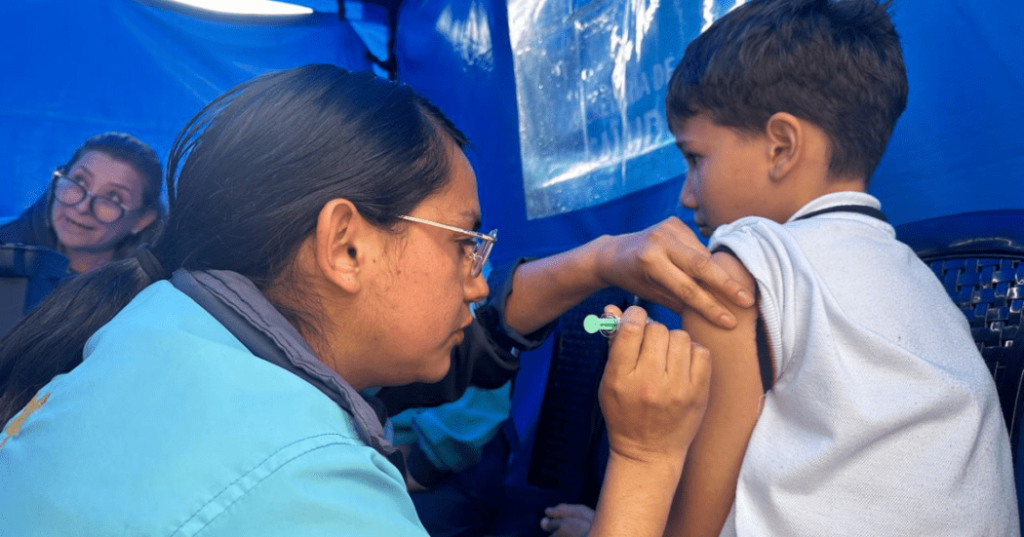
  •  

Superbowl in Bogotá: Where and When to Watch?

With Superbowl weekend about to kick off, we take a look at the best places to watch the big game as well as where to get involved with local American Football clubs.

Football that you play with your feet and a ball reigns supreme in Colombia, but there’s also plenty of support for the types of football that you play with your hands and an egg. We’ve covered Aussie Rules football and Rugby Union before, but with the Superb Owl between Seattle Seahawks and New England Patriots coming up on Sunday, it’s time to look at the USA’s favourite sport in Colombia’s capital.

Bulldogs DC are one of the Colombian flag football teams in the capital

There’s a Colombian element this time around too, with star cornerback Christian Gonzalez lining up in the Patriots’ backfield. Born in Texas to a Caleño family, he went 15th in the 2023 draft and anchors pass coverage for New England.

He retains a great love for Colombia, saying that he’ll have mixed feelings if his country of birth and country of descent meet in this year’s World Cup in North America.

The game kicks off at 18:30 Colombian time, pretty much perfect for Sunday evening viewing. The pregame show by Green Day will be popular in Colombia, but it’s halftime that will draw all eyes to the screen.

Puerto Rican megastar Bad Bunny is scheduled to play and he hasn’t held back in commenting on ICE actions across mainland USA. He said “ICE out” while accepting an award at the Grammys, adding “We’re not savage, we’re not animals, we’re not aliens. We are humans and we are Americans.” That has made him the highest profile US Latino speaking out on the issue.

Watching is easy, but playing is certainly possible, with a wealth of clubs throughout la nevera and elsewhere in Colombia. We spoke to local organiser Javier Zuleta about how local American Football works and how to get involved, whether that’s full kit or flag.

Where to watch

This is by no means an exhaustive list – the match will be widely shown around Bogotá. However, it’s a Sunday night, and that means there will be a limited number of places open anyway, so it pays to check ahead. If you’re looking for a proper atmosphere, these places will sort you out on Sunday evening.

All these venues are running DAZN and Gamepass, so you won’t have to deal with dodgy streams or any sort of hiccups. All should feature a mixed crowd of Americans watching their home sport and Colombian fans of the NFL, making for a different atmosphere than you might previously have experienced.

International Centre

Superbowl party at the Meeting House

Meeting House

Closest to the centre, by the centro comercial San Martín at Calle 32 #6b-43 (3rd floor), the Meeting House offers a huge screen, plenty of tables and a long bar. They expect to busy, so reserve here to assure yourself of a place at the party.

They have a large terrace/patio for smoking, as well as activities such as Beer Pong if you’re not glued to the halftime show or Bad Bunny’s been cancelled. Expect a lively party atmosphere.

There’s a range of offers on cocktails and the full kitchen menu, with picadas probably as a special offer as well for the extra-hungry. Both bottled and draft beer is available as well as a range of spirits. They have pitchers up to a whopping 5 litres to make sure you’ve no chance of going thirsty.

Teusaquillo

Shots Lab

Shots Lab has plenty of screens for the Superbowl in Bogotá

Open from 3pm, the Shots Lab at Calle 45 #20-20 has a plethora of screens across three areas for your viewing pleasure. The early start means you can make sure you get a good seat and the number of screens means you’re assured of a good view wherever you are.

The owner is a Saints fan, so it’s pretty neutral. There’s two indoor spaces as well as an open-air patio which is cooler if it’s crowded and a dartboard if the game turns into a blowout. Rock music provides a solid backdrop.

They are running all their usual menu, as well as offers on cubetazos up until kick off o clock. Águila, Póker and Andina are at six for COP$25,000 while Club Colombia is at COP$30,000. They have an extensive menu and a good range of both beers and spirits.

Zona T

Irish Pubs

The Usaquén, Quinta Camacho and Zona T are your best bets here. They will have the games on at all locations with a dependable selection of beers and food. Best one for atmosphere is probably the Zona T where there are offers on nachos and wings with beer on a 100 inch screen.

Gigante is the craft beer option that stands out

Gigante

If you’re looking for craft beer while watching the match, this is your best bet. Owner Will Catlett serves up his own Gigante brews made locally. A California native, he’ll be backing fellow NFC West team the Seahawks.

Unsurprisingly, the screen is, well, gigante and there’s plenty of space inside to make sure you can see it. It’s conveniently located right in the heart of the Zona T at Carrera 14A #83-44.

Litre-and-a-half beer pitchers at COP$50,000 are a great deal, with 2×1 cocktails on a slew of options if you don’t want to chug the beers. Also at COP$50,000 are beer plus food (hamburger or choripan) combos to help make sure your stomach’s lined.

Wherever you end up, watching the Superbowl in Bogotá is great if you know what you’re doing. And why not consider popping along to check out some of the local teams’ training sessions – they’re friendly, welcoming and always looking for new members.

The post Superbowl in Bogotá: Where and When to Watch? appeared first on The Bogotá Post.
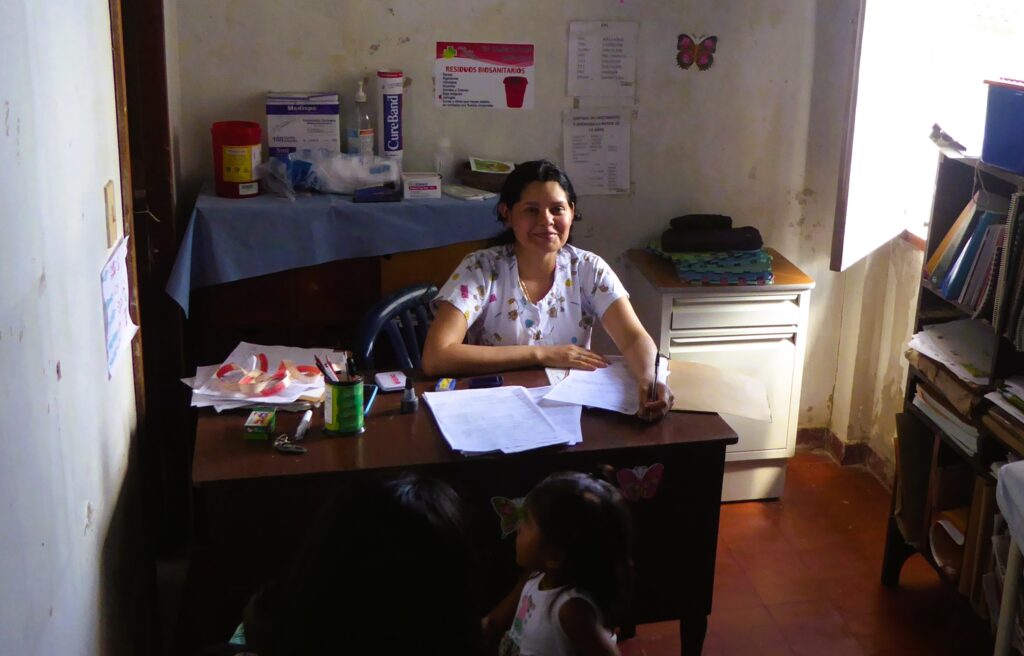
  •  

Día Sin Carro 2026: What is it and what to do?

Cars are off the road for día sin carro 2026 in Bogotá. We explain why the city does this and how to get about today.

Expect to see few cars and motos on the roads of la nevera today. Once or twice a year, Bogotá bans personal car and motorbike use for the vast majority of the city for most of the day – known as Día sin Carro y Moto. The first is scheduled for the first Thursday in February (the fifth) and there’s sometimes a second in autumn, around September.

Traffic parked in Carrera 13 in Bogotá. it is día sin carro 2026 in Bogotá, so there are no private cars, just taxis, a van and some buses.
Día sin Carro 2026 in Bogotá. Photo courtesy of Oliver Pritchard

It’s a lot more extreme than the normal Sunday and holiday ciclovía schemes, as almost all regular cars and motorbikes are banned from all roads. Obvious exceptions exist for taxis, buses, emergency vehicles, and certain key workers such as doctors.

However, expect to see streets much emptier than normal and predominately yellow with taxis and buses. Remember that there are also the white servicio especial taxis and a surprising number of exempted people travelling around, especially in central and downtown Bogotá.

The policy has been quite controversial, to say the least. Every year it leads to much wailing and gnashing of teeth from a whole host of sectors. Of course, people who usually use their cars to commute are furious, but it’s worth remembering that they are by no means the majority of the city’s commuters

Post-pandemic, that’s changed a lot. With the rise of remote working and home offices, it’s become much more viable for big swathes of the city to just tell people not to come in. Many schools are shut, universities are giving virtual classes and employees citywide are logging in.

A lot of people won’t even attempt to travel today, despite the fact that most Bogotanos don’t even use cars as primary transport. This reflects the growing acceptance of remote and hybrid working in Colombia, and points to a possible future with fewer commuters.

Portal Norte in Bogotá clear of traffic in 2023. Photo courtesy of Brendan Corrigan

After all, Bogotá is a much nicer city if you don’t have to move around too much in it. Cities should be designed for people, not cars and motorbikes. Much of the city is still very much accessible by foot and bike, even if there are significant holes in the bus network.

So what’s the point of all of this? Well, the reason is above – Bogotá is so much more liveable without traffic jams, fumes, noise, delays and chaos. Bogotá might not be as bad as some Asian cities in terms of air pollution, but it’s certainly not a shining ecological star.

Día sin carro reduces this significantly, according to the city’s environmental department. Commute times are laughably inefficient, which leads to a lot of wasted time, lowering productivity and quality of life. And just have a listen to the quieter streets with fewer badly-tuned motorbikes.

So, what can you do on Día sin Carro 2026 in Bogotá?

If you’re out and about during Día sin Carro 2026 in Bogotá, you have several transport options.

Buses

Most people will be hopping on some type of bus, as indeed most commuters do every day. Whether it’s TransMilenio rapid bus transit, SITP buses in their rainbow of assorted colours or regular colectivos, they’re the transport lifeblood of la nevera

There might be a bit more crowding than usual, but off-peak it’s unlikely to be too bad. Also, there are more buses in circulation today, and they don’t have anywhere near as much traffic to navigate. You might think that in the case of the TransMi that’s not an issue, but remember that cars often get stuck crossing TransMi lanes.

Bikes 

Bicycles on the septima in Bogotá. It is día sin carro 2026, so there is limited traffic and more bicycles
Almost a peloton on Séptima this morning

Remember, you can always get on your bike in Bogotá. We’ve criticised the self-aggrandising capital mundial de bici posturing from the alcaldía before, but it’s still an excellent city (and country) to ride in. The bike lanes will be busier than normal, but there are plenty of them and they’re far less stressful than normal traffic.

No bike? No problem! Bogotá has a bikeshare scheme with a Brazilian company called Tembici. The system has had a few wobbles, but comes into its own on days like this. You will need to download the app to be able to use the scheme and it is relatively pricey for short term work.

A tembici stand in Bogotá
This is what tembici stands look like.

Taxis

You may have trouble moving about with some rideshare apps, but the regular yellow taxis are most definitely buzzing about the city today. Apps such as easytaxi, tappsi, taxis libres et al should work as normal, just with high demand. Expect to wait a little while longer for a connection.

Hopefully, they’ll be on their best behaviour today and not taking advantage of the situation. Despite copping a lot of flak, rolo taxis aren’t nearly as bad as they’re often made out to be and have a big incentive to play nicely right now.

Taxis on the Septima in Bogotá, Colombia
Taxis dominate on a day like diá sin carro 2026

Walk! 

It’s a nice warm Bogotá day with fewer fumes in the air, which have been few and far between in recent weeks. Perfect conditions for a stroll in the sunshine. Most of the city is very flat and walkable, and you’re never far from a decent café to keep yourself safe from sunburn and rehydrate. Our top tip for a day like today is a limonada de coco!

The post Día Sin Carro 2026: What is it and what to do? appeared first on The Bogotá Post.

  •  

Petro and Trump: New Besties?

A picture frame with a kind message and smiles all round: was the Colombia-USA meeting at the White House an unalloyed success?

Colombian president Gustavo Petro’s trip to Washington to meet his counterpart Donald Trump seems to have gone very well. The build-up had been pretty good, with Trump praising Petro and both sides avoiding inflammatory rhetoric.

Petro’s commemorative photobook. Image: Gustavo Petro via Facebook

So well did it go, in fact, that Petro ended up with a signed photobook memory of the encounter on first name terms. Trump’s handwritten note said it was a great honour to have met Petro, adding “I love Colombia”. For his part, Petro said his team was looking for solutions and invited Trump to visit Cartagena.

Trump was effusive in his praise for the Colombian president, noting that they had “not exactly been the best friends” but that he never felt offended by Petro’s rhetoric. That’s par for the course with the US leader, as he seems to often make up with people after fierce words. He ended by saying he thought Petro was terrific and they got along great.

¿Qué me quiso decir Trump en esta dedicatoria?
No entiendo mucho el inglés pic.twitter.com/biNGKcVBu2

— Gustavo Petro (@petrogustavo) February 3, 2026
He definitely knows what that says

From being sworn enemies all through last year and with sharp words exchanged just a month ago peace has broken out with surprising speed between Donald and Gustavo. In a way, it’s more of a frenemy relationship than a bromance, with both realising that it suits them better to work together for the time being.

They’re also quite similar politicians, if polar opposites politically, which means they probably understand each other better than the rest of us do. Long-winded speeches to large rallies of supporters, unpredictable behaviour, constant use of socials – they basically work in the same way towards different ends.

Fears of Petro having to walk into the famed Oval Office bearpit were laid aside the night before when it was confirmed as a behind-closed-doors meeting. That was relatively unsurprising, given the Colombia president’s reluctance to speak English.

Also in the room were the presidents’ teams, including JD Vance and Marco Rubio on the US side. However, Petro made it clear that the reunion was between himself and Trump.

The crux of the meeting was over cocaine exports, which Petro said was mainly organised from abroad, naming Dubai, Madrid and Miami as their ‘capitals’. He said sharing information and working together was key and that he had passed names to the American administration.

An insider speaking to Colombian news source El Tiempo said that they thought Trump had bought the idea that the war on drugs had to be fought against cartel leaders and not campesinos. They said that Trump had said they would go after the bosses.

Venezuela was a topic of conversation too, with both countries looking towards reestablishing relations following the fall of Maduro. For Colombia, that involves controlling the flow of drugs across the long border in the east as well as working on oil and gas exports.

Quito and Bogotá have been engaged in a tit-for-tat tariff war in recent weeks, which is of course Trump’s speciality. He’s agreed to step in and mediate, which is good news for Colombia as he is a key ally of Ecuadorian president Noboa.

This is not full co-operation though, as some important things have yet to be resolved. Petro remains on the Clinton List and he noted that neither himself and Trump were given to changing their ways of thinking about things. Trump mentioned sanctions, but was not clear what that referred to.

Expect to see these at rallies soon. Image courtesy of Gustavo Petro via Facebook

Cordial tones and friendly words might not be concrete action, but it’s a significant difference from where we were just a month ago. The USA might not be everyone in Colombia’s favourite country, but it remains a key international relationship with strong links between the nations on many levels.

At the end of the meeting, Petro came out with MAGA hats, not his usual choice of attire. He then later took to socials to show off his customisation – an ‘S’ scrawled after ‘America’. That’s a thankfully restrained and playful take that shouldn’t raise any heckles, but serves to underline the point that for all the warm words, they have sharp differences of opinion.

Making the Americas great again would be in everyone’s best interest and thankfully it seems like they may be able to put egos and differences aside in order to pursue that. If the bonhomie of this week can be converted into meaningful results, it could make a lot of people’s lives better. That’s something to hope for.

The post Petro and Trump: New Besties? appeared first on The Bogotá Post.

  •  
❌