In a lengthy post on Truth Social, U.S. President Donald Trump threw his support behind Colombian presidential candidate Abelardo “El Tigre” de la Espriella, describing him as a “Smart, Strong, and Tough Leader” and offering what he called his “Complete and Total Endorsement” ahead of Colombia’s June 21 presidential runoff.
Trump praised De la Espriella’s first-round victory and portrayed him as a future champion of economic growth, law and order, and closer ties with the United States.
“The results of this Election are very important to the future of Colombia and its relationship to the United States,” Trump wrote.
The endorsement was notable not only for its enthusiasm but also for its language. Trump attacked De la Espriella’s opponent, left-wing senator Iván Cepeda, as a “Radical Left Marxist” and suggested the runoff could shape the future direction of one of Washington’s closest allies in Latin America.
Then came the response.
Addressing Trump directly, De la Espriella published a lengthy open letter that read less like a campaign statement and more like a declaration of intent.
“With my head held high and a heart full of patriotic gratitude, I receive your words and your steadfast support,” he wrote.
“Thank you, Mr. President.”
The candidate praised Trump as “a leader of true strength and conviction” who had refused to surrender to ideological trends or enemies of freedom.
More importantly, he suggested that Colombia was now following a path similar to that taken by Trump’s political movement in the United States.
“You have paved the way for the people to defeat the entrenched powers that have long held sway,” De la Espriella wrote. “In Colombia, we have now begun to follow that same path.”
It was one of the clearest attempts yet by the conservative candidate to place his campaign within a broader political realignment taking shape across the Americas.
The letter repeatedly returned to the idea of a common destiny shared by Colombia and the United States.
“The United States and Colombia are sister nations, bound by the blood of heroes and by our shared destiny to defend Western civilization across the Americas,” he wrote.
“Together, we are unbreakable.”
For De la Espriella, the relationship extends beyond diplomacy. It is rooted in what he described as shared values, mutual respect and a common struggle against forces that threaten both nations.
The candidate outlined a vision of closer cooperation on security, trade and economic development while emphasizing that both countries face similar challenges from organized crime and drug trafficking.
“Our security policies are fully aligned,” he wrote.
“Narcoterrorism is the cancer destroying our societies, and we will confront it relentlessly, with iron resolve and without apology.”
The statement echoed themes that have defined much of De la Espriella’s campaign: security, economic growth, private enterprise and a promise to reverse what he views as the failures of the Petro administration.
“We stand together in the sacred defense of private property, free enterprise, productive growth, and the well-being of our citizens as the highest purpose of government,” he wrote.
The candidate also pledged resistance to what he called the advance of communism in the hemisphere and announced support for an “Alliance of the Shield of the Americas,” a regional initiative intended to strengthen cooperation among governments committed to security, democracy and economic freedom.
The exchange unfolded as another senior figure in the Trump administration weighed in on Colombia’s election. U.S. Secretary of State Marco Rubio said Washington would closely monitor the electoral process. “We will be very firm in guaranteeing free and fair elections in Colombia and will do everything within our power to achieve that,” he said.
The comments were interpreted by many as a sign of growing U.S. interest in the outcome of the June 21 runoff.
President Gustavo Petro responded without mentioning Trump directly.
“When one country intervenes in the decisions of another country, freedom dies,” he wrote on social media, before posting videos of anti-riot police on the streets of Santiago, Chile, accompanied by the text: “They chose (President) Kazt and once again the violent war against youth in Chile.” Petro’s incoherence is palpable.
Yet it was the final image accompanying De la Espriella’s letter that perhaps captures the moment more effectively than any political statement.
Created using artificial intelligence, the illustration shows a bald eagle next to a fearless tiger. Behind them, the flags of the United States and Colombia under a turbulent sky.
The symbolism requires little explanation.
The eagle represents the United States. The tiger represents the firebrand “outsider”.
And together they illustrate the central message of De la Espriella’s response: that if voters elect him on June 21, relations between Bogotá and Washington will enter a new chapter.
“In this coming Era of the Tiger – which begins on June 21 – we look forward to the full normalization of relations between Colombia and the United States, built on mutual respect, sovereignty, and mutual benefit.”
Whether Colombians embrace that vision remains to be seen.
But for one extraordinary day in the campaign, the conversation was no longer only about Colombia’s future. It was about two flags, an eagle, a tiger and a political alliance that both supporters and critics believe could reshape relations across the hemisphere.
Mr. Trump said that the candidate, Abelardo De La Espriella, was important for the U.S.-Colombia relationship and called his left-wing rival a “Radical Left Marxist.”
Colombia’s Runoff Could Reshape Investment, Energy, and Labor Policy
Colombia’s first-round presidential election, held Sunday, May 31, 2026, produced a result that crystallizes the country’s political exhaustion with both the governing left and the traditional right. Criminal defense attorney and political outsider Abelardo de la Espriella placed first with more than 10.3 million votes. Leftist Senator Iván Cepeda, a close ally of outgoing President Gustavo Petro and the lead architect of the administration’s Paz Total peace policy, finished second with just under 9.7 million votes. The two will face each other in a runoff election on June 21.
Senator Paloma Valencia, the candidate backed by former President Álvaro Uribe and the standard-bearer of his Uribismo movement, placed a distant third, receiving less than 7% of the vote — fewer than 1.7 million ballots. Former Medellín mayor and Antioquia governor Sergio Fajardo received just over one million votes, while former Bogotá mayor Claudia López finished below 1%, with approximately 225,000 votes. The remaining minor candidates combined for just over 1% of the total.
Under Colombia’s electoral system, the top two finishers advance to a runoff if no candidate surpasses 50% in the first round. The June 21 vote will determine who assumes the presidency on August 7.
Click above to watch the video!
The Candidates: Background and Context
Abelardo de la Espriella, 47, has never held elected office. He built a national profile over more than two decades as a high-profile defense attorney, founding De La Espriella Lawyers in 2002, with offices in Colombia and the United States. His client roster has included controversial figures: he represented Alex Saab, a Colombian-born businessman who became a close associate of Venezuelan President Nicolás Maduro and was implicated in a scheme to launder proceeds from Venezuela’s food-assistance program, the Comité Local de Abastecimiento y Producción (CLAP). Saab was extradited to the United States, convicted, and later granted clemency before being re-arrested in Venezuela in early 2026. De la Espriella also represented members of the Nule family in connection with the Carrusel de Contratos — a major contracting scandal tied to infrastructure works at Bogotá’s El Dorado airport corridor. He has additionally been reported to have represented individuals linked to organized crime.
De la Espriella has drawn comparisons to figures such as US President Donald Trump and El Salvador’s Nayib Bukele. His campaign has centered on hard-line security policy, including proposals for large-scale incarceration, expanded military operations against armed groups, and the rejection of negotiations with guerrilla organizations. He is reported to hold Italian and US citizenship in addition to his Colombian nationality, and is said to own property in Florida.
In a notable departure from his defense work, de la Espriella took the side of a victim in a high-profile acid-attack case, acting as a private prosecutor to secure a stronger sentence for the perpetrator — an episode that raised his public profile beyond the defense bar.
Iván Cepeda, 63, enters the runoff as the consolidated candidate of the Colombian left and Petro’s Pacto Histórico coalition. He is the primary legislative architect of Paz Total, the Petro administration’s policy of negotiating simultaneously with multiple armed actors, including the ELN and FARC dissident factions. Cepeda’s family background includes deep ties to the Colombian left: his father was secretary general of the Communist Party, and was assassinated. Cepeda himself studied in communist Bulgaria during the soviet era. The two finalists have an established legal and political history: Uribe attempted to bring criminal charges against Cepeda while both served in the Senate, but the Supreme Court determined that Uribe had fabricated the accusations and attempted to bribe witnesses — a case that resulted in Uribe’s criminal conviction.
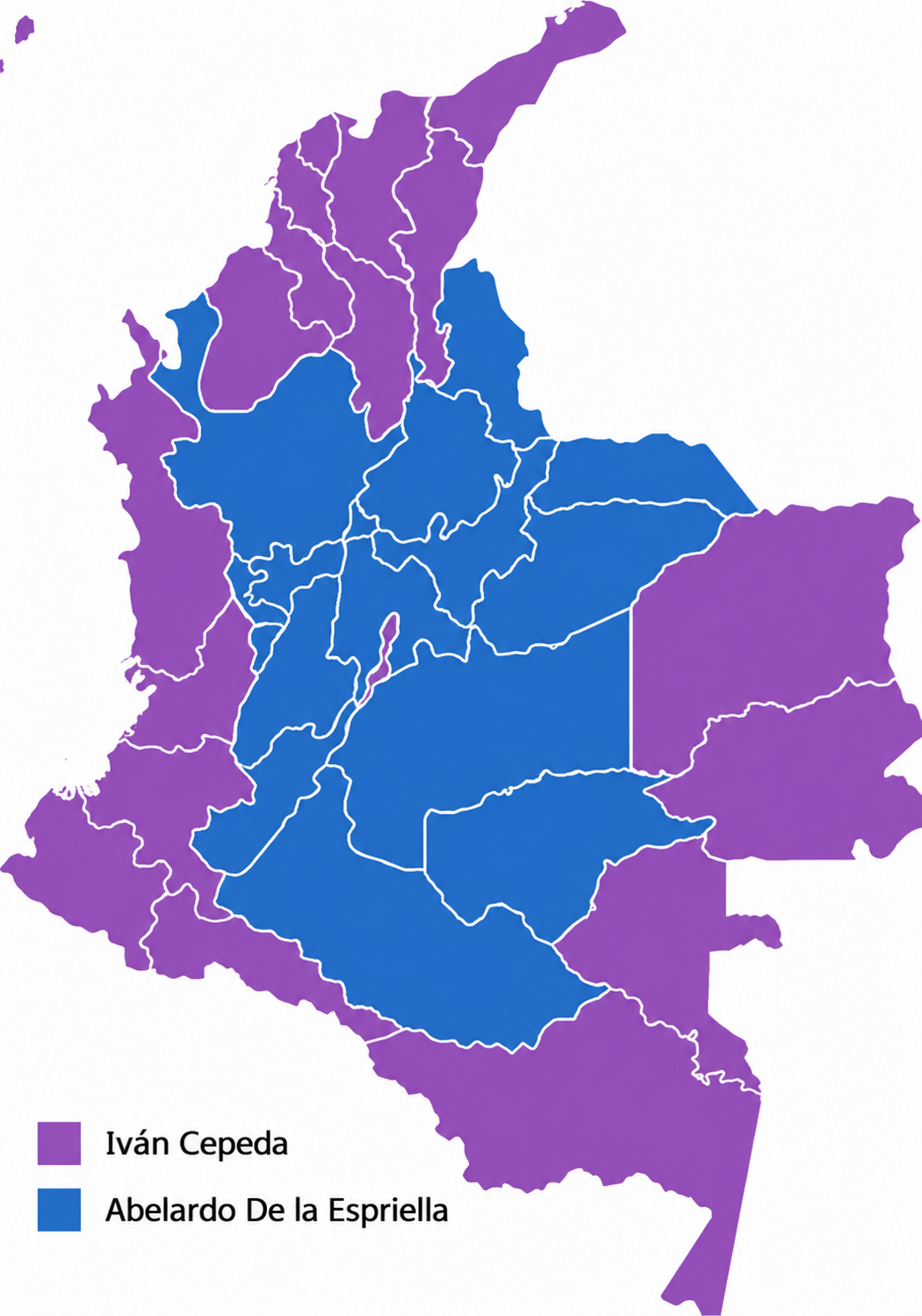
The geographic distribution of the vote reflects deep regional divisions. Cepeda carried Bogotá, which has trended left for years, particularly in lower-income districts on the city’s south and west sides. Antioquia — historically the heartland of Uribismo and home to Medellín, the country’s second-largest city — voted more than two to one for de la Espriella, a result that signals the weakening grip of Uribe’s movement even in its traditional stronghold.
The heart of coffee-growing country — the departments of Caldas, Risaralda, and Quindío also went to de la Espriella. Caquetá, a sparsely populated department in southern Colombia that has suffered sustained guerrilla violence from both the ELN and FARC dissident groups, voted for de la Espriella as well, a result we may interpret as a direct rejection of Petro and Cepeda’s Paz Total.
Cepeda carried Colombia’s Pacific coast, including the chronically neglected department of Chocó, as well as the sparsely populated Amazonas and Putumayo departments bordering Peru and Brazil, and the northern Caribbean coast. The Caribbean coast result is notable, as the region has historically suffered from underdevelopment, infrastructure deficits, and significant income inequality. Norte de Santander with its Catatumbo region on the Venezuelan border and experiencing severe armed-group activity — voted for de la Espriella, a result consistent with public exhaustion over security policy.
The Political Context: From Uribe to Petro and Beyond
Colombia’s current political trajectory is rooted in decisions made across the past two decades. President Uribe served two terms in the early 2000s and, together with then-Defense Minister Juan Manuel Santos, mounted a sustained military campaign against the FARC that significantly weakened the insurgency. Santos later broke from Uribe after assuming the presidency, governing independently and ultimately negotiating a peace agreement with the FARC — a deal that Uribe actively opposed. A plebiscite on the accord failed, but Santos used legislative maneuvering to implement it anyway.
Colombia 2026 1st round top two (Graphic: Sofi Imfeld for Finance Colombia)
Uribe’s next handpicked candidate, Iván Duque, won the 2018 election but finished his term with approximately 30% approval. Members of his own party publicly distanced themselves from him — Senator María Fernanda Cabal, a staunch Uribista, called Duque a “mamerto” (leftist idiot) while he was still in office. Under his administration, indicators on crime and guerrilla activity worsened, and armed groups including the ELN rebuilt operational capacity that had been degraded under Uribe and Santos.
Petro’s administration has not met initial fears of a Venezuelan-style democratic breakdown: Congress has largely blocked the most radical components of his agenda, including attempts to nationalize the private pension system and convert the healthcare system to a single-payer model. However, crime has increased, armed groups have expanded their operational footprints, and the security situation in several regions has worsened. Paz Total is widely seen as having produced few tangible results.
Uribe himself was convicted of witness tampering and attempted bribery in the case he had brought against Cepeda. Though released from house arrest after conviction, the judges who authorized his release are now reportedly under investigation for judicial corruption. Valencia’s poor performance in the first round — despite being Uribe’s chosen standard-bearer — suggests that Uribismo as a political force is waning, with its core constituency aging and new generations of voters disengaged from the Uribe legacy.
What to Expect Before June 21
Both campaigns will intensify mobilization efforts over the coming three weeks. Cepeda’s movement — Colombia Humana and the broader Pacto Histórico coalition — has historically relied on organized mobilizations, including indigenous community-led mingas, labor unions, and allied social movements. Cepeda’s running mate Senator Aida Quilcué is an indigenous activist, a choice expected to energize those constituencies. FECODE, the Federación Colombiana de Trabajadores de la Educación (Colombia’s main teachers’ federation), is expected to align officially with Cepeda, though individual teachers may not follow union leadership in their voting choices.
On the right, Paloma Valencia issued a public endorsement of de la Espriella immediately following the first-round results. Business community organizations, including ANDI (the Asociación Nacional de Empresarios de Colombia) and Fenalco (the Federación Nacional de Comerciantes), do not formally endorse candidates, but their members are widely understood to favor a government that supports private enterprise and market-oriented policy. De la Espriella holds no congressional constituency, meaning whichever candidate wins will face the same dynamic Petro encountered: a fragmented Congress that is likely to act as a check on executive authority.
The question of centrist voter alignment remains open. Fajardo and López are not expected to formally endorse either finalist, and the direction of their combined approximately 1.2 million votes is uncertain.
Winners and Losers by Sector
For international investors and executives operating in Colombia, the policy differences between the two candidates are substantive across several key sectors.
Petroleum and Natural Gas: De la Espriella has stated unequivocally that he will restart petroleum exploration and licensing, which the Petro administration blocked. Ecopetrol S.A. (NYSE: EC; BVC: ECOPETROL), Colombia’s state-controlled oil company, which also holds producing assets in the US Permian Basin and Gulf of Mexico, has operated under a government that halted new drilling permits. The consequences have included a decline in future production capacity at a time when global oil prices have risen due to Middle East tensions. Colombia has been forced to import natural gas at elevated prices to meet existing domestic demand — including from transportation fleets that were converted to natural gas under government incentive programs. Cepeda would be expected to continue or deepen current restrictions on fossil fuel expansion.
Healthcare: The Petro-Cepeda platform favors a government single-payer model. The administration has already taken over several Entidades Promotoras de Salud (EPS) — Colombia’s managed-care intermediaries — placing the healthcare system in legal and financial uncertainty. Private clinics, hospitals, and physicians who wish to operate outside a government-controlled framework would benefit from a de la Espriella administration. Cepeda’s healthcare agenda would accelerate the shift toward government-managed care.
BPO, Tech, and Call Centers: The BPO sector — which provides large volumes of formal employment, particularly in Medellín, Bogotá, Cali, and Barranquilla — was significantly affected by Petro-era minimum wage increases of 16% and 23% in successive years. These increases created contract renegotiation pressures with international clients, some of whom have shifted or considered shifting operations to competing jurisdictions including Honduras, Jamaica, the Dominican Republic, Mexico, and Guatemala. At the CX Summit, the industry’s main annual event held in Cartagena, the son of Álvaro Uribe appeared as an invited keynote speaker — a gesture that could be interpreted within the industry as an implicit signal of political alignment. A de la Espriella government, with its orientation toward labor market deregulation and reduced regulatory burden, would be viewed more favorably by this sector. Current Colombian labor law prohibits part-time employment contracts and places significant restrictions on dual employment, making workforce flexibility difficult for businesses that operate outside traditional 40-hour weekly structures.
Mining: The Petro administration has been less aggressive toward mining than toward petroleum, but sector participants expect a more permissive regulatory environment under de la Espriella, and continued constraints under Cepeda.
Security and Tourism: Both candidates have stated support for tourism promotion, but the sector’s trajectory is more directly linked to security conditions. Under current policies, several regions that were accessible to domestic and international travelers several years ago have experienced increased armed-group activity, effectively closing them to tourism. A de la Espriella administration is expected to pursue a more aggressive military posture toward the ELN and FARC dissident factions; a Cepeda government would likely continue dialogue-first approaches. The outcome will directly affect which parts of Colombia’s territory remain accessible to investment and tourism.
Foreign Relations: A de la Espriella government is expected to restore a broadly cooperative relationship with the United States, which deteriorated under Petro following several high-profile diplomatic incidents. De la Espriella has expressed admiration for US President Donald Trump, and reports indicate he holds US citizenship and owns property in Florida. Relations with Ecuador, which have been strained by mutual tariff escalations between Petro and Ecuadorian President Daniel Noboa, would be expected to normalize. Relations with Venezuela under Cepeda would likely continue along the current allied trajectory, while a de la Espriella government would be expected to take a more critical posture toward Caracas. China and Russia would find a more receptive diplomatic environment under Cepeda, and a cooler one under de la Espriella.
The Poor and Informal Workers: Cepeda’s campaign argues that minimum wage increases and expanded state services benefit lower-income Colombians. Critics counter that elevated formal labor costs have pushed more employment into the informal sector — which currently accounts for approximately half the Colombian workforce — depriving those workers of pension contributions, health benefits, and job security. De la Espriella’s platform, which emphasizes business formation, security, and labor market deregulation, would be presented as generating more formal-sector job creation. The actual distributional effects of either approach remain contested.
The Outlook
Assuming current polling trends hold and Uribista voters consolidate behind de la Espriella as expected following Valencia’s endorsement, de la Espriella enters the runoff as the frontrunner. Cepeda’s path to victory depends on driving high turnout among his base, securing support from centrist voters who did not vote for either finalist in the first round, and potentially benefiting from any missteps by de la Espriella in the final three weeks of campaigning.
The first-round results produced no major electoral violence. The ELN announced a temporary halt to armed actions during the voting period. Authorities detained some individuals reportedly attempting to purchase votes in rural areas, but no large-scale incidents were recorded.
The incoming president will face a Congress with no natural majority aligned to the executive, a healthcare system in partial administrative disarray, a petroleum sector whose future production trajectory is in question, and regions where state presence remains contested by armed groups. The June 21 runoff will determine which vision — market-oriented restructuring or continuation of the Petro project — Colombia pursues for the next four years.
U.S. President Donald Trump has nominated Kentucky businessman and political ally Nathaniel “Nate” Morris to serve as the next U.S. ambassador to Colombia, placing a prominent supporter of the Republican president at the helm of one of Washington’s most important diplomatic posts in Latin America.
The nomination was formally submitted to lawmakers on Monday, one day after right-wing presidential candidate Abelardo “El Tigre” de la Espriella emerged as the frontrunner in Colombia’s first-round election, setting up a runoff that could reshape relations between Bogotá and Washington.
Morris, 45, is the founder of Rubicon Technologies, an environmental technology and waste-management company, and has become one of Trump’s most visible political allies in Kentucky. His nomination comes as Colombia enters a period of political transition and uncertainty over the future direction of bilateral cooperation on security, counternarcotics efforts, trade and migration.
The White House announced Morris’s nomination as part of a broader package of diplomatic appointments across Latin America. If confirmed by the Senate, he would become Washington’s top representative in Colombia at a pivotal moment for relations between the longtime allies.
Trump had previously urged Morris to abandon a potential bid for the U.S. Senate in Kentucky in order to join his administration.
“Nate is a fantastic businessman and a strong MAGA warrior,” Trump wrote on social media. “I have asked Nate to step aside from the Senate race to take a role in my Administration as Ambassador. Nate is Oxford-educated, tough as steel, loves our great nation, and will represent the United States very well.”
Although Morris has limited public diplomatic experience, his appointment reflects the Trump administration’s preference for politically connected allies and business leaders in several ambassadorial posts.
A native of Kentucky, Morris studied at George Washington University before pursuing further studies at the University of Oxford. He founded Rubicon Technologies, a company focused on waste management and environmental services, and later established Morris Industries, a private investment holding company based in Lexington with interests in sustainability, technology, industrial operations and financial services.
The nomination comes amid expectations that Colombia’s foreign policy could shift following Sunday’s election result. De la Espriella’s strong showing has fueled speculation that a future administration could seek closer alignment with Washington after years of tensions between the governments of President Donald Trump and Colombian President Gustavo Petro.
Before taking up the post in Bogotá, Morris must undergo Senate hearings and secure confirmation by a majority vote, a process that could take several weeks or months.
A June 21 presidential runoff will decide Colombia’s next president
Far-right candidate Abelardo de la Espriella and leftist Iván Cepeda advanced to the runoff round of Colombia’s presidential election after emerging as the top vote-getters in the May 31, 2026, first-round vote, in a result that reflects the deep political polarization shaping the country.
With 99.99% of polling stations counted, the Registraduría Nacional del Estado Civil reported that De la Espriella won more than 10.3 million votes (43.7%), while Cepeda secured 9.6 million votes (40.9%). The two candidates will face each other in a runoff election scheduled for June 21, 2026.
Voter turnout reached 23.7 million people, equivalent to 57.8% of eligible voters. Together, the two candidates captured nearly 85% of valid ballots, leaving the remaining contenders far behind and setting up a contest between two sharply contrasting political visions.
De la Espriella’s unexpected rise
De la Espriella’s first-round victory represents one of the biggest surprises of the election and marks the first time in Colombia’s modern political history that a far-right party has emerged with a realistic chance of winning the presidency.
A lawyer by profession with no previous elected office experience, De la Espriella built his campaign around a populist message focused on political confrontation, public security, a hard-liner approach to crime and opposition to negotiations with illegal armed groups. His political style has drawn comparisons to Argentine President Javier Milei, Salvadoran President Nayib Bukele and US President Donald Trump.
Most pre-election polls placed him in second or third position, with support ranging between 15% and 25%, well below his final result.
His platform emphasizes stronger security policies, tougher penalties for criminal and narcotraffic organizations, and the construction of large-scale prisons similar to those in El Salvador. He has also rejected peace negotiations with armed groups.
His opposition to diversity and inclusion policies, as well as controversies involving remarks toward female journalists for which he later apologized, also became defining features of his campaign.
Cepeda achieves the strongest result ever for Colombia’s left party
Although he finished second, Cepeda achieved the highest vote total ever received by a left-wing presidential candidate in Colombia, surpassing the 8.5 million votes won by President Gustavo Petro in a previous presidential election.
The candidate of the ruling Pacto Histórico party based his campaign on grassroots mobilization, public rallies and the consolidation of a unified left-wing movement. His message focused on expanding social programs, inclusion and reducing inequality.
However, his candidacy has also been weighed down by criticism of the current administration, particularly regarding security concerns, problems within Colombia’s healthcare system and the limited results of the government’s “Total Peace” policy, which Petro promoted and Cepeda supported during his years in Congress.
Cepeda’s political career has been built in Congress, where he became known for defending the rights of victims of paramilitary violence and for his role in legal cases involving former President Álvaro Uribe.
After preliminary results were released, both Cepeda and Petro publicly questioned the preliminary vote count while stating they would recognize the official results certified by electoral commissions, judges and notaries.
“As president, I do not accept the preliminary count results,” Petro wrote on X, arguing that Colombia’s pre-count system has no legal validity and that only the official scrutiny process produces binding results. He later added that “the binding results the president will recognize are those issued by the electoral scrutiny commissions.”
Cepeda has also sought to distance himself from some of Petro’s proposals, including the idea of convening a constituent assembly to revise Colombia’s constitutional framework.
Historic defeat for Uribe’s political movement
Another major statement of the election was the poor performance of Paloma Valencia, candidate of the Centro Democrático party and backed by former President Uribe, who campaigned alongside her throughout the country despite defections by several prominent supporters.
Valencia finished third with 1.6 million votes (6.9%), far below polling projections that had placed her above 20%.
The result is widely attributed to voter fatigue with Uribe’s political movement and the migration of conservative voters toward De la Espriella, who was endorsed during the campaign by several prominent right-wing figures, including senators Paola Holguín and María Fernanda Cabal, as well as leader and businessman José Félix Lafaurie.
Strategic decisions within Valencia’s campaign may also have contributed to the result, including the selection of former Bogotá councilman Juan Daniel Oviedo as her vice-presidential running mate and her reluctance to directly confront De la Espriella during the campaign.
This marks the second consecutive presidential election in which Uribe reaches the runoff without a candidate from his own party. Nevertheless, he quickly endorsed De la Espriella after the results became known.
That endorsement could prove crucial. If elected, De la Espriella would face a Congress in which his movement holds only limited representation, making support from Centro Democrático, the second-largest congressional bloc, essential for advancing legislation and reforms.
Centrist voters may decide the runoff
Former Medellín Mayor Sergio Fajardo, who campaigned as a centrist alternative, finished fourth with more than 1 million votes (4.2%), while none of the remaining candidates surpassed 1% of the vote.
As the runoff approaches, the votes won by both Valencia and Fajardo are expected to be closely watched by the two campaigns, as they could prove decisive in an election that is shaping up to be highly competitive, deeply polarized and politically fragmented.
While Valencia has already endorsed De la Espriella, Fajardo has yet to take a public position. In previous elections, the former Medellín mayor has preferred to leave his supporters free to decide rather than formally endorse either finalist.
In Valencia’s case, despite her endorsement of De la Espriella, it remains unclear whether her support came primarily from voters aligned with former President Álvaro Uribe or whether a significant share was driven by the candidacy of Juan Daniel Oviedo, who won more than 1.2 million votes in the coalition primaries held in March.
The June 21 presidential runoff will therefore pit two sharply different visions for Colombia’s future against one another, in a political environment marked by polarization, social tensions, and persistent challenges related to security and governance that the next administration will have to address.
The results are starting to come in from around the country for the 2026 Colombian presidential election first round. Abelardo de la Espriella has outperformed expectations to win the first round with over ten million votes, facing Iván Cepeda in three weeks’ time
Voters in Bogotá on May 31st in the 2026 Colombian presidential election first round
The ballot boxes closed at 4pm for the 2026 Colombian presidential election first round and now the tallying up of votes is underway. So far, with 99% of the votes in (19:30), Abelardo de la Espriella is outperforming expectations and has won the first round. He was expected to win between 25-30% of the vote, but now stands at 43.74%, significantly exceeding those predictions.
In second place by a whisker is Iván Cepeda of the ruling Pacto Democrático. He was widely expected to come first with 40-45% of the vote and that’s where he appears to be (40.91%). The good news is that he’s matched expectations and that he’s against the candidate he most wanted to face in the second round. The bad news is that he looks set to finish second, is right at the bottom end of his target vote share and Abelardo’s performance has put the tiger among the pigeons.
The big losers of the day seem set to be the centrists and Paloma Valencia. The former are below even the extremely modest predictions they had been given, while the latter is performing beyond her worst nightmares. She had been expected to get at least into double figures, but is languishing at under 7%.
This is a result that few had on their prediction slates
This is only the preconteo, so the votes will be formalised and fully scrutinised later. However, there is rarely a big change between the two numbers. There will still be heavy scrutiny on the data, especially with the focus on impropriety and accusations of vote-rigging (see below).
Voters queue at a Bogotá university
Only Abelardo de la Espriella managed to cross the symbolic ten million vote barrier, with Cepeda over 300,000 off the mark. With around 11 million votes needed for victory in the second round, things look promising for the self-styled outsider candidate.
Abelardo de la Espriella had been gaining momentum steadily in the last few weeks, but this is still a turn-up for the books and an extraordinary result for him. There is some speculation that a share of his vote comes from Pacto supporters that would prefer a run-off with him against Cepeda, but this seems unfounded.
There have been reports of private transport being laid on for rural voters to get to stations, paid for by both Cepeda and de la Espriella supporters in different regions. Supporters of both those candidates have also been accused of campaigning on the day and so forth in various reports from around the nation.
The collapse in the Centro Democrático vote isn’t hard to understand: Paloma Valencia had run a poor campaign and failed to get traction in the final weeks. What is surprising is the sheer scale of it: she’s ten to 20 points behind where she had expected to be. Questions will be asked in the Centro Democrático head offices now.
Elsewhere in the election, the dominance of de la Espriella and Cepeda left little room for anyone else. Sergio Fajardo ended his political career with over a million votes and nearly 5% of the vote, not too far off Valencia in the end. Failed Bogotá mayor Claudia López only got a quarter of the way to the 932,000 votes needed to recover her deposit. Hilariously, that’s about half the votes she gained in March’s primaries.
López did manage to squeak ahead of the reprehensible Santiago Botero, arrested in Cartagena on the morning of the election on domestic abuse charges. No surprise from a candidate who had been promising bullets for delinquents. Spare a thought, though, for Gustavo Matamoros in last place with a shade over 5,000 votes.
Turnout was higher than normal at 57.86%, with voto en blanco outranking all but four candidates and winning over 400,000 votes. As predicted, the Pacto won both coasts, the outer Amazon/llanos and Bogotá, while the right won all the central areas outside the capital. Dig deeper and the picture changes a bit: only de la Espriella won for the right, and Pacto’s vote share while winning was lower than expected in many departments (and Bogotá).
What happens next in the 2026 Colombian presidential election?
This means we are looking at a second round run-off on June 21st between Iván Cepeda and Abelardo de la Espriella, the two most polarising candidates on the tarjetón today. Whichever one triumphs, Colombia will have a lot of unhappy voters. It’s easy to assume that Paloma voters will flock to de la Espriella, but that’s far from guaranteed, given the divisive nature of the candidate.
We are likely to be in coin flip territory at this point – de la Espriella won around 600,000 more votes today, which is a selnder advantage. The million voters for Fajardo should mainly go his way, but again that’s far from guaranteed. He is no longer in pole position, but also not out of the race. Both candidates have a lot of work to do now.
With a relatively high turnout this weekend, it’s unlikely that there is a well of voters that will come out only for the second round, something that Cepeda will be hoping for. However, there are millions of non-voters who could make the difference if either candidate wins them over.
There are likely to be increased attacks on the electoral system from both the president and Pacto Histórico supporters. Petro has spent months questioning its validity and claiming that the system is opaque and unclear. Today has already seen a flurry of similar comments flooding social media with claims of impropriety in various places.
Cédulas gemeleadas en anillos de corrupción en la registraduría. La señora tiene el derecho de elegir y se lo han conculcado.
He’s riding the line on political participation very finely
Oversight is carried out by the CNE (Consejo Nacional Electoral). In order to do this over the vast territory and number of stations, over 800,000 citizens are selected to be vote-counters. This is similar to jury duty in other countries and is compensated with a day off as well as a compulsory day of training a couple of weeks beforehand. As the electorate is growing, there are now some 13,000 voting sites across the country, most with multiple voting tables – 122,000 in total for today’s elections.
Petro’s concerns rest on the fact that Thomas Greg and Sons handle the software used in the election system, a firm that he’s clashed with repeatedly, especially over Colombian passport printing. He says that the systems are opaque and he has not received answers from the CNE or Registraduria over various concerns he has. However, both groups, along with Colombia’s neutral election observers MOE have been clear about the processes.
Online, there are many posts claiming that a key part of the alleged fraud will be in the reports made by the jurados. This echoes previous elections, where there was a flurry of images purporting to show electoral forms (E-14) that had been altered by the vote-counters. With AI entering the scenario, expect more of this after the first round, especially if de la Espriella or Cepeda do badly.
US senator Bernie Moreno, Bogotá-born, is in Colombia to observe the voting process, along with a significant number of international observers. Their reports will come through in the coming week, but this is only part of the story. Much of the voting irregularities here are hard to prove and difficult for outsiders to properly scrutinise.
Petro will also be under a keen eye from the electoral authorities and watchdogs over his involvement in campagining. The president is supposed to keep neutral throughout the election of his successor, but Petro has at best ridden that line very closely. He’s been accused on multiple occasions of crossing it, too, as have his ministers and Cepeda himself.
Whatever happens in the coming three weeks, the Bogotá Post team will keep you up to date with unbiased local reporting, free from vested interests or paymasters. Stay tuned to find out what twists and turns are coming in the 2026 Colombian presidential election race, as well as detailed profiles on the two candidates left in the race.
Heard about the 2026 Colombian presidential election first round this weekend? Confused about what exactly is going on? Our guide clues you in on how it all works and why the bars and borders are shut
Tomorrow sees the first round of the 2026 Colombian presidential election. It’s been a long race which has turned particularly bitter in the final week. The candidates are largely campaigning on little more than vibes and charisma, with the centre absent.
While it’s been spiky, the country remains relatively safe on election weekends. You might well see some protests or celebrations on Sunday evening, there might be people on soapboxes in the streets in some areas, but there is unlikely to be any major disturbances in large urban conurbations. The story may well be very different in isolated rural zones, as is often the case in Colombia.
Colombia shuts down a lot over election weekend, with bars closing for ley seca and borders closing as well. There will be an increased police and military presence throughout the country, with particular focus on keeping key transport routes open.
Yesterday we looked at the candidates, how they might fare and what it would mean for the second round. Today we’re turning our attention to how things actually work in the 2026 Colombian presidential election on Sunday, including ley seca times and border closures.
How does the Colombian electoral system work?
Every Colombian over the age of majority (18) and with a correctly registeredcédula ciudandanía can vote. In return, each voter gets a half day off work. Non-citizens are not eligible to vote in national elections, but holders of resident visas will be able to vote in next year’s local elections.
Oversight is carried out by the CNE (Consejo Nacional Electoral). In order to do this over the vast territory and number of stations, over 800,000 citizens are selected to be vote-counters. This is similar to jury duty in other countries and is compensated with a day off as well as a compulsory day of training a couple of weeks beforehand.
As the electorate is growing, there are now some 13,000 voting sites across the country, most with multiple voting tables. Colombians have to vote where their cédula is registered, so don’t be surprised to see some people trekking to other cities if they forgot to update their registration.
The polls are open from 8am until 4pm and counting is usually very fast with the results being clear before sundown. Land and fluvial borders will be closed for Colombian nationals tomorrow morning, although foreigners can cross. Airports will not be affected, so don’t worry if you are arriving on a flight.
Bogotá has entered ley seca earlier than usual, meaning no alcohol sales in bars, restaurants or shops from 6pm Friday night to Monday midday. That applies for everyone, so no representation or boozing for foreign residents, unless you do it at home. Ciclovía will also be cancelled for ease of access to polling stations.
What’s the background to the 2026 Colombian presidential election?
The run-up to the 2026 Colombian presidential election has seen a lot of criticism of the system, almost all of it coming from the national government. President Gustavo Petro has been front and centre on this issue, repeatedly questioning the neutrality of the elections.
Petro’s concerns rest on the fact that Thomas Greg and Sons handle the software used in the election system, a firm that he’s clashed with repeatedly, especially over Colombian passport printing. He says that the systems are opaque and he has not received answers from the CNE or Registraduria over various concerns he has. However, both groups, along with Colombia’s neutral election observers MOE have been clear about the processes.
Online, there are many posts claiming that a key part of the alleged fraud will be in the reports made by the jurados. This echoes previous elections, where there was a flurry of images purporting to show electoral forms (E-14) that had been altered. With AI entering the scenario, expect more of this after the first round, especially if de la Espriella or Cepeda do badly.
Voy a escribir porqué los escrutinio son opacos y vulnerables al fraude en las elecciones.
No porque crea que nuestro proyecto democrático vaya a perder sino porque es mi deber como jefe del estado al menos informar sobre uno de los peores riesgos de la democracia hasta ahora…
Of course, Petro is only claiming that electoral fraud exists against him, not in the multiple occasions in which he’s won at the voting urns. This is a well established populist tactic – calling elections into doubt before they happen. It’s likely to rally his base and provide an excuse if results are bad.
There is little credibility to most of the vote rigging claims. Colombia does indeed have some serious problems around corruption and influence buying, but this tends to be concentrated in rural zones in the periphery of the country. It’s also worth noting that these seats return candidates from across the political spectrum.
A lot of electoral impropriety is very hard to prove – the machines that promise to deliver blocks of votes are well-versed in legal limits and plausible deniability. Offering someone some free gifts in return for ‘support’, for example, is widespread and while dubious hard to prove in court.
The official tarjetón for the 2026 Colombian presidential election. Courtesy of the CNE
It’s particularly noticeable that alliances between political actors in order to deliver voting blocs is both very common and very hard to stop. That’s where Nicolás Petro appeared to be operating and it is not clear quite who is exactly in bed with who at this point.
It goes without saying that political attacks on the CNE are particularly unhelpful, especially in what is still a very charged political atmosphere nationwide. The assassination of presidential pre-candidate Miguel Uribe last year was a shock to a country that has a long history of political violence.
Concerns remain over both electoral safety and fraud in much of the country, with over 200 municipios at high risk of fraud and/or violence. 39 of those are classed as very high risk and only 167 at very low risk, mainly in the Andino region.
There have been rumblings from Washington about the veracity of the 2026 Colombian presidential elections as well, with Bogotá-born Senator Bernie Moreno in the country as an observer. He can’t vote, having renounced his citizenship. The difference here is that they think Petro is going to rig the elections in his favour.
Petro himself has been rebuked by the Electoral Commission and others for participating in the 2026 Colombian presidential election. He’s repeatedly made comments that are at best close to the line of violating the constitutional neutrality of his office.
Not only that, but a third of his cabinet have joined in, also being rebuked by the CNE. There’s over 140 public servants under investigation. Iván Cepeda himself has come under fire for a rally in Montería on Monday after campaigns constitutionally have to end. He claims it was a private event, just attended by hundreds of local people.
Who’s in the 2026 Colombian presidential election?
Over time, the field has been whittled down to thirteen candidates on the official voting card. In reality, though, only three are at the races: Iván Cepeda, Abelardo de la Espriella and Paloma Valencia in order of current voting intention. Together, they account for around 80-90% of polling at the moment.
The left has been concentrated behind Cepeda, while Paloma Valencia has snaffled the centre-right position. Abelardo is the anti-establishment maverick. All the centrist candidates are languishing in the doldrums, with failed Bogotá mayor Claudia López and eternal candidate Sergio Fajardo the best of the bunch but both polling in low single figures.
People checking their voting station in Bogotá, March 2026
There’s also the curious option of voto en blanco. Different from a spoiled vote, which is simply disregarded, this is an active protest. If it ranks highest in any race, then a rerun of the election must take place within a month with entirely new candidates and/or party lists.
Iván Cepeda is absolutely nailed on for the second round, almost certainly in first place. Who joins him is a slightly more open question. At the moment, Abelardo has the momentum and is riding high in the polls. However, polling isn’t infallible and Paloma could sneak into second place.
At best, many voters will be voting for their least-worst option in the second round. In recent years, Colombians have often cast negative votes rather than for a candidate they really support and this year is likely to be the same. Whoever wins, it will almost certainly be a loveless victory, despite their inevitable claims of popular support.
Heard about the 2026 Colombian presidential election first round this weekend? Confused about what exactly is going on? Our guide clues you in on who’s running and what’s likely to happen
The 2026 Colombian presidential election enters its first round this weekend, with the election taking place on Sunday 31st May. If no one takes an overall majority, the run-off will take place three weeks later. It feels like a lifetime since the house elections in March and candidates have been furiously jockeying for position over the last few weeks.
At the moment, continuity candidate Iván Cepeda leads polling, with the rightists split between traditionalist Paloma Valencia and outsider Abelardo de la Espriella. The centre is currently more or less absent. Read on for more information about the candidates, the political backdrop and potential outcomes.
The polls are open from 8am until 4pm on Sunday 31st June for all Colombian nationals wherever their cédula is registered. Counting is usually very fast with the results being clear before sundown. Land and fluvial borders will be closed for Colombian nationals tomorrow morning, although foreigners can cross.
Bogotá will enter ley seca earlier than usual, meaning no alcohol sales in bars, restaurants or shops from 6pm Friday night to Monday midday. That applies for everyone, so no representation or boozing for foreign residents, unless you do it at home. Ciclovía will also be cancelled for ease of access to polling stations.
Who are the runners and riders in the 2026 Colombian presidential election?
13 candidates – unlucky for some in the 2026 Colombian presidential election?
Over time, the field has been whittled down to thirteen candidates on the official voting card. In reality, though, only three are at the races: Iván Cepeda, Abelardo de la Espriella and Paloma Valencia in order of current voting intention. Together, they account for around 80-90% of polling at the moment.
The left has been concentrated behind Cepeda, while Paloma Valencia has snaffled the centre-right position. Abelardo is the anti-establishment maverick. All the centrist candidates are languishing in the doldrums, with failed Bogotá mayor Claudia López and eternal candidate Sergio Fajardo the best of the bunch but both polling in low single figures.
Some interesting characters are in the also-run list. Santiago Botero has an incredibly aggressive position on crime: bullets for rapists and so on. Roy Barreras is running as a leftist alternative to Cepeda and Gustavo Matamoros represents the ecologist party of Colombia.
It won’t be third time lucky for Fajardo, who had probably the best thought-out manifesto on paper last time around. His brand of centrism is no longer en vogue and he’s announced his retirement from politics following this election.
Strangely, most of the country’s biggest parties are literally absent from the voting card. The Conservadores and Liberales dominated the last century but now don’t bother running candidates in the 2026 Colombian presidential election. Neither is there a Green candidate or a Cambio Radical candidate. Only Pacto and Centro Democrático are there.
There’s also the curious option of voto en blanco. Different from a spoiled vote, which is simply disregarded, this is an active protest. If it ranks highest in any race, then a rerun of the election must take place within a month with entirely new candidates and/or party lists.
Two candidates on the card have actually pulled out, Carlos Caicedo and Luis Gilberto Murillo. Any votes cast for them will be counted as spoiled, not for voto en blanco. Clara López pulled out earlier, which is why there is a blank space on the tarjetón.
What are the campaigns like?
The manifestos are terribly written, for the main part. There is a frankly shocking number of basic errors in most of them, suggesting that proofreaders weren’t asked to play a big part in production. Despite having had years to plan for this, it seems everybody chose to rush it instead.
Past the errors, there’s a generally low level of detail across all the manifestos. Vague numbers and targets are given with little to no consideration of how it will be achieved. That might lead one to suspect that there isn’t a high chance any of this will actually be stuck to, regardless of the outcome.
Voters in Bogotá checking their tables for the March 2026 elections
There has been no debate among all candidates. Even partial debates have been few and far between, with almost everyone preferring to stick to home turf where they have more control over questions and so forth. There’s been a host of negative publicity via influencer campaigns, with traditional electoral machines being somewhat sidelined.
Iván Cepeda is the continuity candidate, promising more of the same and offering very few details in his actual plan de gobierno, despite it being 433 pages long. He’s had an unusual campaign, turning up to dozens of rallies but offering few interviews. In many ways, he’s not the draw for his campaign.
Abelardo de la Espriella has run a controversial and divisive campaign portraying him as the outsider. That’s won him voters and he’s peaking at the right time. His manifesto is long on ideas and short on detail. He’s frequently made inflammatory comments, being accused of sexism, homophobia and racism and often leaning into that.
Paloma Valencia has been faltering over the past few weeks in particular. She’s done well to make traditional political alliances, but that could be an albatross for her. Having Uribe’s support might lose as many votes as it gains. Despite this, she’s still in the race and has by far the most detailed manifesto of the three main challengers.
It’s notable that a lot of the messaging is quite similar across the candidates. Cepeda is for los nadies; de la Espriella is for los que nunca. Both Valencia and Cepeda want 30,000km of new roads and are overshadowed by their political mentors. Paloma and Abelardo both want to turn the gas and oil taps back on.
They all support crop substitution for coca farmers and all claim to be anti-corruption. All of them support rural communities and home carers. With this level of agreement, a lot of the distinction that is being drawn is on personality and charisma, hence the two populists exploding in popularity.
So, who’s going to win the 2026 Colombian presidential election?
It’s anyone’s guess at this point, despite the polymarket predictions going wildly overboard in favour of Abelardo de la Espriella. That’s mainly from a certain type of punter that understands little about Colombian politics and is simply making a political statement via putting money on the rightist.
The last election was razor thin, with Gustavo Petro squeaking past Rodolfo Hernández (remember him?) with barely more than 50% of the vote, similar to 2018 when it went the other way for the current president. That’s very likely to be repeated more or less in full: the Pacto candidate dominating the first round then a very close run between the final two and one winning by a nose.
Iván Cepeda is absolutely nailed on for the second round, almost certainly in first place. Who joins him is a slightly more open question. At the moment, Abelardo has the momentum and is riding high in the polls. However, polling isn’t infallible and Paloma could sneak into second place.
More interesting is how many votes everyone gets. Cepeda will want 40% minimum, under that he’s probably in big trouble. If he can get over 45% he’s likely to win the second round. Anything in the middle and we’re into coinflip territory again. Note where the votes come, too. If Abelardo does well in Bogotá, a leftist heartland, that’s a good sign for him.
Cepeda is popular in Bogotá and leads first round intentions nationally
If Abelardo gets over 30%, he’s in a good position. If Paloma can get to that level, she’s going to be extremely happy. Those two candidates need to match Cepeda’s total at least in order to feel confident. If their combined vote share tops 50% then a rightist victory is likely.
The final numbers to keep an eye on are turnout and the centre vote. The latter will likely be 5-10% and could be crucial for the second round. The former should be over 50%. If it’s not, then the second round could be very unpredictable, especially if it’s two populists.
Looking ahead, it’s entirely possible that someone could win with under 50% of the vote in the second round. This has become an election that is already both polarised and unstable. It is likely to become very vicious in the next phase, too.
At best, many voters will be voting for their least-worst option in the second round. In recent years, Colombians have often cast negative votes rather than for a candidate they really support and this year is likely to be the same. Whoever wins, it will almost certainly be a loveless victory, despite their inevitable claims of popular support.
President Gustavo Petro. Image credit: @infopresidencia via X.
Just days away from Colombia’s first-round presidential election, incumbent President Gustavo Petro continues to sound the alarm about voter fraud.
On Tuesday, he repeated claims that the National Registrar’s Office is allowing the vote to be manipulated against his party’s candidate, Senator Iván Cepeda.
Petro renewed calls for citizens to supervise the vote count, describing it as the only way to avoid fraud: “Only the physical vigilance of millions of people can overcome the algorithm manipulations that the Registrar’s Office refused to prevent.”
But are the president’s claims of vulnerabilities in the voting system valid?
A decade-long dispute
Petro’s claims stem from a long-running grudge with Thomas Greg & Sons, a multinational security and printing company tasked with issuing Colombian passports and overseeing electoral logistics.
According to Petro, the firm cannot be trusted with the sensitive task of printing, delivering, and processing vote counting forms.
While the president’s claims have widely been dismissed by electoral institutions as reckless, there is some foundation for them.
Following the 2014 legislative elections, the evangelical political party, MIRA, filed a legal petition against the Registrar’s Office, claiming a discrepancy between the ballot pre-count (filled out by citizen juries in a form known as E-14) and the digitized tally of the vote (filled out by officials in the E-24 form).
MIRA claimed to have evidence of manipulation of the software used for “voting, information, transmission, or tabulation of election results,” which was managed by a subsidiary of Thomas Greg & Sons.
After a lengthy four-year legal case, the Council of State (Consejo de Estado), the highest court overseeing the government, issued a ruling in favor of MIRA. It found evidence of destruction of electoral material and inconsistencies between the E-14 and E-24 forms.
Crucially, the Council of State said that it could not confirm that voting software had been sabotaged because it did not have access to the source code of the software during the elections.
Without the original code, it was impossible to know if the system had been tampered with.
The body issued a clear recommendation to prevent repetitions of the dispute in future elections: “Direct the Electoral Organization to acquire the necessary vote-counting software for use within the state—that is, software owned by the organization itself—which allows for full traceability of the vote-counting process from the polling stations through to the official declaration of the election results.”
In other words, it recommended that electoral authorities roll out their own software, rather than relying on third party providers.
But 12 years later, Thomas Greg & Sons remains in charge of the electoral software; according to the Registrar’s Office, purchasing proprietary software and operating the corresponding data centers is not feasible.
The Registrar’s Office has launched an advertisement campaign defending the integrity of the voting process. Image credit: Alfie Pannell.
While Petro continues to lobby for a fully state-owned system, he has concentrated his efforts on mitigating the risks of a repeat of the 2014 source code issue.
The president has repeatedly demanded that the Registrar’s Office share the source code with the government and the public, which he says would allow them to prevent a repeat of the situation in 2014.
But the Registrar’s Office maintains that there is no need, suggesting that publicizing the code would leave the software more vulnerable to attacks and defending internal audit processes.
Petro rebutted, calling the claim “an immense lie”.
Other types of fraud
As well as warning about software manipulation, the president has also raised the alarm about differences between the pre-count and the official, scrutinized count. Ahead of the March elections, he warned that the pre-count may not accurately reflect the results.
Petro’s concerns stem from the 2022 legislative elections in which over half a million votes for his Historic Pact coalition were excluded in the pre-count and later revealed in the scrutiny.
Rather than software, the culprit for the discrepancy, which in total represented a 5.49% difference, was human error; the Electoral Observation Mission (MOE) had warned the ballot sheets were designed in a way that could lead to Historic Pact votes being neglected.
But the 2022 vote appears to be an outlier, with the MOE reporting just a 0.28% discrepancy between the pre-count and the scrutinized votes in March’s legislative elections.
Petro’s mistrust in the pre-count may be valid in the case of a tight race with razor-thin margins but not so much if there is a clear winner. And, in any case, the scrutiny process should clear up any doubts.
“In Colombian elections, it is judges who determine electoral disputes and not a logistical operator such as Thomas Greg & Sons,” explained Sergio Guzmán, director at Colombia Risk Analysis, a political risk think tank.
Bigger fish to fry
While Petro aims his crusade against Thomas Greg & Sons, a firm which he has clashed with on a range of issues, there are other, more prescient threats to electoral integrity.
“I think that concerns about voters being coerced to vote are legitimate… but I think concerns that somebody will steal the election are overblown,” said Guzmán.
International observers including the United Nations have warned that violence may undermine the elections, particularly in areas under armed group control.
Vote buying is also a well-documented phenomenon in many regions of the country.
While Petro has some basis for his allegations of voter fraud, there is no evidence of software manipulation determining presidential election results in Colombia.
In a razor-thin race, observers would be wise to wait for the scrutinized vote count to declare a winner. But for now, Petro’s warnings about election-rigging appear to be largely overblown.
Confused about the upcoming Colombian presidential election? We’re here to help you with a set of cheat sheets on the top candidates so you can follow the local news. Today we’re looking at poll leader Iván Cepeda of the Pacto Histórico.
Iván Cepeda, 2026 Colombian presidential candidate. Photo courtesy of Wikicommons
Who is Iván Cepeda?
Iván Cepeda Castro is a leftist politician who has served in the Colombian senate for the last 12 years. Before that, he was a Congressman for a term. Born in Bogotá to activist politician parents, the family was forced into exile in Soviet Czechia and Cuba in his youth. At 63 years of age, he’s notably older than his main rivals.
His father was assassinated for political reasons in 1994, something that has unsurprisingly contributed enormously to his sociopolitical views. He was a young communist, but long since moved away from that, preferring to concentrate on social analysis, activism and campaigning against rightist corruption.
He represents the Pacto Histórico ruling coalition, meaning that he benefits from the popularity of the current president Gustavo Petro. That’s no surprise, as they’ve been firm friends and comrades for years, with the president supporting his bid.
In comparison to his mentor, Cepeda is far more serious. Petro often plays the cuddly socialist grandpa, going off on tangents about free love and so forth. Cepeda is much more of a hardline Maoist academic who is well up for a long march through the institutions. He lacks the charisma of Petro, coming across more professorial and dry.
Is he polling well?
Very. He’s absolutely nailed on for the second round, with the only real question being how high his vote share is. There is some speculation that he may come second, but more likely he will be comfortably in front of the two rightest candidates.
The trickier part is the second round, when the right will be consolidated behind one person rather than split in two. He’s still often favourite against both Abelardo de la Espriella and Paloma Valencia, but likely prefers the former.
While he’s been out in front all through the campaigning process, he’s not really gone anywhere, simply sitting on 38-43% in every poll. While that’s admirable consistency, it also calls into question his ability to draw in the undecided voters.
He’s a marmite candidate, with very few informed voters neutral on him. Either you think he’s the saviour of the republic who can make Colombia more equal or you think he’s a dangerous revolutionary who will ruin the country. A lot of votes are for him under any circumstance and as many are against him under any circumstance.
What’s his campaign like?
Firmly leftist, unsurprisingly. He’s also leaning heavily into being the continuity candidate for the Petro government. That makes sense, with approval levels riding high after the giant minimum wage increase this year. While that might yet be a problem down the line, it’s electoral dynamite.
However, his campaigning has been rather lacklustre. He’s not a natural orator in the way that Petro is, and he lacks charisma, coming across as a dry theoretical academic. Perhaps aware of this, his team have arranged rallies where he can preach to the converted and otherwise keeping him out of the spotlight.
In reality, much of his campaigning is being done by others. Petro is the key figure here, with the president right up against the line of not technically campaigning. However, the head of state is taking a lot of actions that are clearly designed to help Cepeda, as well as constantly using his pulpit to call for the continuation of his ideas.
Complementing this is an incredibly powerful influencer/social push. Much of this is fairly organic, with Pacto supporters used to activism and intuitively good at promoting their candidate. It fits in well with his man of the people image. The biggest meme is ‘Solo pacto en esta mondá’. Notably, Cepeda himself isn’t the draw, with variations on the phrase namechecking Petro.
Petro is still the main event for leftist politics
Combined with his very loose manifesto (see below), his campaign messaging is basically that only the Pacto will stand up for the people, especially those that have been treated poorly by the state. There’s little in the way of concrete offers, just a call for loyalty.
So what’s in his manifesto then?
You can read it for yourself online, but have a big pot of tea ready: it outdoes Marx and Engels at a whopping 433(!) pages long. A lot of that is AI images, while the actual propuestas are hidden away between rambling discourse, tangential essays, theoretical musings and diary entries. Notably, it is mostly in the past and present tenses.
A recurring theme is the involvement of civil society via what he calls the poder constituyente, especially youth and women’s groups. He claims he will call all political and social actors to the table in a mesa de diálogo nacional aimed at forming concrete proposals.
This will be implemented by a new Alianza Público-Popular which will allow civil groups to directly manage state funds. Both ethnic minority and campesino territories will be recognised and organised. There will be a Banco del Pueblo to improve access to financial instruments for poorer people as well as the unbanked.
The campaign is feelings-heavy; detail-light
Security is not a priority, but the key aim is to dismantle armed groups that are ‘successors of paramilitaries’. Iván Cepeda will continue the extant peace talks set up by Petro, but with a red line over assassinations of social leaders. Coca farmers will be encouraged to turn away from illegality via crop substitution.
Corruption will be dealt with by the Secretary for Transparency of the Presidency being given full independence and the Fiscalía receiving an Institute for Macrocorruption, as well as beefing up existing systems. Civil society will be encouraged to involve themselves in these processes.
A new Ley de Austeridad Republicana will be brought in to limit state spending via civil servants in an attempt to cut costs. He will reduce the salaries of the president’s office immediately and encourage his ministers to do the same. There will be greater scrutiny of public spending across all levels of the state. Again, no details.
More interesting is the promise to give victims of corruption resources, partially funded by seizure of illegal gains. All of this will be aimed at the parts of the country with the highest rates of corruption and impunity.
Victims of the conflict, meanwhile, will benefit from a new acuerdo nacional which will aim to deliver further reparations. He will also make sure that the 2016 peace agreement is carried out as originally planned, focusing on the Planes de Desarollo con Enfoque Territorial (PDET) for the areas most affected.
International relations will not revolve around the interests of Washington or Miami (?), but rather the national interest. The plan is for autonomy and integration, again involving civil society to work with foreign-based counterparts.
For rural areas, there will be 30,000km of minor roads built to improve connections to far-flung places, known as the vías para la paz. There will also be more rights to participate in politics, defend territory, improve connectivity and services, more land restitution and so on, none of which is clearly defined or detailed in numbers.
Rubbish is on the agenda, unlike any other candidate. He promises to strengthen and enforce recycling schemes and the basura cero initiative. Revitalisation and regrowth of urban areas is also under plan. On transport, he says he will rejuvenate trains as well as sort out the roads.
Quilcué is a key part of the campaign
Who is he running with?
Aida Marina Quilcué Vivas is an Indigenous activist and current senator of the Republic. While she won’t bring any votes with her, this is a huge signal from the Pacto that they are serious about Indigenous representation.
Her selection shows Pacto confidence that they don’t need to reach out and form alliances with other groups. The advantage is that Quilcué and Cepeda will agree on virtually everything, in sharp contrast to Petro and Francia Márquez.
Quilcué has been an active part of the campaign, rallying supporters across the country, especially in rural and Indigneous areas. She’s chastised Abelardo for using the jaguar as a symbol. She’s also clashed with Paloma Valencia over indigenous rights in Cauca.
Is he a communist guerrilla that will expropriate my property?
No, he’s not. He was a young communist, but distanced himself from the party (against the wishes of his family) three and a half decades ago. He’s not a guerilla either and never has been, despite his closeness to M-19. He’s a leftist for sure, but that is not synonymous with communism either in act or desire.
The reason this gets so much traction is that he has certainly been close to guerilla groups, either working with them or in peace talks. He doesn’t help this by his actions, often going out of his way to avoid criticising groups that have a nominally leftist agenda, while specifying that he wants to go after ex-paras.
What’s all this about the Caso Uribe?
Iván Cepeda has been a fierce critic of Álvaro Uribe dating all the way back to when Uribe was in the Casa de Nariño. In many ways, the ex-president has defined Cepeda’s political career as much as Petro, though as sworn enemy rather than comrade.
Cepeda accused the ex-president of links to paramilitarism, relating to the falsos positivos case and others. After repeated attacks in the Senate, Uribe filed a defamation writ against Cepeda, which was eventually annulled. In turn, Uribe found himself under investigation for allegedly attempting to influence witnesses in that case.
Vindication came last year with a Bogotá court ruling in favour of Cepeda after over a decade of deliberation. However, it was only a partial victory, with the ex-president only being declared guilty of fraude procesal y soborno en actuación judicial.
This means there is absolutely no love lost between the two, with Uribe’s preferred candidate Paloma Valencia and Iván Cepeda frequently clashing in the Senate and in the media. Abelardo de la Espriella also is close to Uribe, having represented him legally.
Any skeletons in his closet?
Yes. He has a habit of ignoring things that aren’t connected to paramilitarism or the peace process, ending up as one of the most absent senators in the last couple of years. He also has habitually evaded making clear statements on his health following his diagnosis of bowel cancer. He claims it is in remission, but rumours swirl that it is not.
Then there’s the Operation Fénix affair. He was allegedly namechecked in emails found in a raid on a FARC base. It’s never been fully proved or denied, but has always hung over him. Added to the controversy over recent audioclips by guerrillas referring to him as a comrade, it fuels the fire for those who see him as too close to armed groups.
So, can he succeed?
Yes, he can and is probably the favourite at the moment. It would be absolutely shocking were he not to get to the second round and he matches up well with both of the two people he’s likely to face there.
Of the two rightists, he probably wants to see Abelardo against him. While he carries a threat as a markedly anti-establishment candidate in contrast to Cepeda’s life in politics, he will also turn off some of the anti-left candidates, especially those who want someone serious.
Voto en blanco could then become the decider. If we end up with a situation where a high number of voters decide they want neither option, Cepeda is likely in luck. It’s entirely possible that he could win without crossing 50% of the vote.
The popularity of Petro works in his favour, as does the minimum wage issue. Many will want further increases and see him as the best way to get that done. This may not be a vote for him so much as for the Pacto, but they all count.
However, there are no guarantees. He will get very few voters coming across from eliminated candidates. The key battle here will be turnout, which usually increases by 5-10 percentage points for the runoff.
Confused about the upcoming Colombian presidential election? We’re here to help you with a set of cheat sheets on the top candidates so you can follow the local news. Today we’re looking at Paloma Valencia of the Centro Democrático.
Who is Paloma Valencia?
Paloma Valencia, candidate for the Colombian presidential election 2026. Photo courtesy of Wikicommons
Paloma Susana Valencia Laserna is a conservative politician who has represented the Centro Democrático in the Senate for 12 years. She won her primary battle with three million votes in March, confirming her position as the establishment rightist candidate.
Anti-establishment types, look away now. Her paternal grandfather Guillermo León Valencia was President of the Republic from 1962-66, while her maternal grandfather Mario Laserna Pinzón founded the Universidad de los Andes.
Perhaps not coincidentally, that’s her alma mater, studying economics there before a Master’s in creative writing at New York University. She’s been heavily involved in politics for two decades now, originally as a candidate for Alas Equipo Colombia before jumping ship to the Centro Democrático.
Her faith is deeply important to her, as is tradition. Coming from the circle of the Popayán elite, she is a fairly standard conservative on most cultural and social issues. On the economy, she tacks more to a neoliberal line.
Is she polling well?
Not as well as she would like. While she won comfortably in the March primaries as part of the Gran Consulta por Colombia, she has since fluctuated around 15-25%, usually rising and falling in rhythm with rightist rival Abelardo de la Espriella.
Most recent polling has her in third place a week out from the election, which is a problem. She does outperform Abelardo in head-to-head matchups with Iván Cepeda in most polls, which her messaging will want to lean into over the coming week.
What’s her campaign like?
Centrism, slightly improbably. As one of two rightists in an election with a clearly dominant leftist candidate, two flailing centrists and a host of also-rans, she’s positioning herself as the closest to the centre of the viable options.
That’s her offer
However, she’s firmly of the right, although tempered somewhat by her far more liberal vicepresidential candidate Juan Daniel Oviedo. This is best evidenced by the fact she is very much ‘la que dice Uribe’, clearly having the backing of the controversial yet still influential ex-president.
Her campaign logo features a cross, with religion playing a large role for her stance on many cultural and social issues. She leans heavily into those as a conservative. Colombia Más Grande is the slogan, but they don’t use it particularly well.
If elected, she would be Colombia’s first ever female head of state (with a first ever gay vicepresident too), although she’s not really leant into that much as you might think. As with much else, she’s not managing to cut through particularly well on socials or make a big splash in the national debate.
So what’s in her manifesto then?
You can read it for yourself online, under the name 111puntos. You even get an extra point for free. It’s fairly well presented, laid out and supported, but that’s not necessarily going to win any votes. Overall, other than a massive reliance on AI, there’s no big surprise or radical shakeup here, more a return to the old ways of doing things.
Paloma is certainly no dove when it comes to security and crime, promising a tough line. COP$20tn over four years for the armed forces in order to modernise and rebuild, finishing at 4% of annual GDP destined for the forces. That includes recruiting 30,000 more military personnel and the same number of police officers.
The rest of the money will go on increasing pay, conditions and so forth as well as a big push on tech. Drones are the centrepiece for investment, but cyberdefence is also highlighted as an area that needs urgent investment.
Slightly more old-school is her plan to militarise key transportation routes immediately. More of the same with coca farms: more spraying that allegedly won’t affect ecosystems or people, combined with subsidies for substitution. The fact that neither of those things have worked for decades isn’t stopping her.
On the other side of the coin, Paloma Valencia promises zero impunity: “el que la hace, la paga”. That means more powers to seize illicit gains and more prison sentences for those found guilty of corruption, reducing the number of casa por carcel sentences. 22,000 more penitentiary places and 19,000 more prisoners.
There will be 50 new casas de justicia and mobile courts to tour the country visiting rural locations that are currently not served by the legal systems. All of this is working towards an aim to get congestion in the system from 48% down to 0. Ominously, there’s also a promise of a law to “regulate protest and punish vandalism”.
New laws on corruption are to be brought in, mostly focused around greater transparency using tech. That means blockchain to record transactions and deals as well as AI to analyse potential discrepancies. There will be greater enforcement of existing regulations and a guardian of public integrity to oversee processes.
On the economy, it’s all about recovering confidence from the international market. That will be done by getting infrastructure and mining production back up to pre-pandemic levels (6%+), USD$10mn more in exports and growth over five percent annually.
More FDI to the tune of USD$2bn annually, 25% of GDP to go into internal investment and reducing the deficit by COP$50tn. How is she going to pay for all this? With, err, tax cuts for homeowners and businesses, efficiency savings of 25% and debt refinancing. Good luck with all that.
She’s the only candidate to really take the healthcare crisis seriously. First up is a promise to resolve 10 million blocked prescriptions, appointments and so on in the first 100 days. She plans to send doctors to patients in rural areas, not the other way round.
This will be paid for by a COP$9tn investment. A third of that is destined for delivery of outstanding operations and prescriptions, the rest for paying accumulated state debt to healthcare operators. Many taxpayers won’t like the latter.
Energy faces a similar situation: paying off state debts to operators within the first three months. The goal here is to avoid blackouts and brownouts in the short term, while putting in place structures to avoid the same issues over the long term.
Turning on the taps for both oil and gas lies at the heart of this plan, with a reboot of exploration and extraction projects. Partly, this is to attract AI database and server investment. There’s also support for renewables and alternatives, but it seems more of an afterthought.
Her plan on international relations is to ride two horses. Free competition with China and more co-operation on infrastructure and exports from Colombia. At the same time, leadership in Donald Trump’s Shield of the Americas project while guaranteeing that only the Colombian Armed Forces will operate in national territory.
There will be 187,000 free school places for talented children, 150,000 grants for vulnerable children and 10 public superschools. ICETEX loans, in line with other countries, will only be repayable when you have a salary. COLFUTURO will be rescued as well. The 16 biggest urban centres will have psycho-social units to look out for vulnerable children.
Businesses employing people under 28 will receive a subsidy of up to 30% of minimum wage for a year. Agricultural workers will receive better lines of credit, three million hectares of land formalised and a million new farming zones designated. Tourism is projected to double, with new routes opened for Asia and Europe.
There is a heavy focus on the grey economy. Informal workers will have access to seed capital, loans, a virtual wallet and a host of other possibilities. The goal is to offer help without persecution.
Pensioners will all be covered unconditionally, regardless of law or budget changes as well as three million vulnerable adults to receive subsidies. Each child born into poverty will have COP$500,000 put aside as seed capital to start saving.
Infrastructure starts off with 35,000km of new roads as well as increased satellite connectivity for marginalised communities. There will be 1 million new homes built, with a quarter of those directly subsidised. A million further homes will receive new or improved potable water access.
Finally, the environment. The brakes will go on for deforestation and the national parks will be protected from guerrilla activity. Local families will be given subsidies in order to protect areas of natural interest. Money generated from mining will be ploughed back into environmental protection.
Who is she running with?
Oviedo has been a key asset for the Paloma Valencia campaign
Juan Daniel Oviedo, former head of DANE and candidate in the last race for Bogotá mayor. In that contest, he managed to force Gustavo Bolívar into third place in a two-horse race, showcasing his impressive campaigning ability. He came second in the Gran Consulta with over a million votes, reinforcing his reputation.
He’s been more visible than Paloma Valencia for much of the campaign and is much more active than either of the other two undercards. That was the reason he was brought in – to appeal to more liberal voters and to provide an injection of energy on socials. He’s delivered in spades on both accounts.
However, there are a couple of issues here. Firstly, he runs the risk of overshadowing Paloma Valencia with his charisma and presence. Secondly, by joining her campaign he lost some of those centrist voters who saw it as a betrayal to join forces with the Centro Democrático.
They certainly aren’t natural bedfellows, with Oviedo a fair bit left of Valencia on a lot of economic issues. More profound splits are found on social issues. For example, Oviedo is out and proud while Valencia stands against gay adoption and marriage. Awkward at best.
— Álvaro Uribe Vélez (@AlvaroUribeVel) May 18, 2026
Uribe is still firmly behind Paloma Valencia
That’s a bit unfair on a candidate with a long and storied political career of her own. However, while she isn’t just Uribe’s candidate, she certainly makes a lot of having his passionate backing.
That’s been a mixed blessing for a while now, with Uribe’s influence waning as the years pass. While his candidate won in 2018, they failed to even make the second round in 2014 and 2022 and we could well be on for a repeat of that.
The ex-president certainly casts a long shadow and that’s not always positive, especially with Oviedo also shining bright. Support for Uribe has dwindled over the past two decades, as Colombian demographics change profoundly.
However, Uribe does retain a large swell of support and also commands the biggest party machine of the candidates in the race. The Centro Democrático will be able to make a huge campaigning push on and offline across the entire country, which may be underreported.
Any skeletons in her closet?
A few, mainly over her combative social media use while in the Senate. Paloma Valencia has largely avoided serious controversy though, with most of her twitterstorms being differences of opinion rather than accusations of impropriety.
She accused now-president Gustavo Petro of corruption in 2018 following the Odebrecht affair. This amounted to grainy footage of him receiving cash at an unknown point. That was archived as being far too flimsy to be evidence of anything at all.
In 2022 she defended the Colombian state’s actions during the armed conflict, saying that while there may have been errors and atrocities, they were legitimate and in defence of the country. That unsurprisingly met with a huge backlash from various quarters.
Una narrativa mucho más constructiva (y verdadera) es: Los para y la guerrrilla fueron y son monstruosos. El Estado cometió errores y atrocidades, pero era legítimo y fundamentalmente estuvo en la defensa de los ciudadanos.
— Paloma Valencia L (@PalomaValenciaL) July 29, 2022
An extraordinary claim from Paloma Valencia here
There is one case hanging over Paloma Valencia still. Her link to Uribe led to her questioning the legitimacy of a key witness in the case against him. In turn, the witnesses defence lawyers filed a defamation case against the senator, over which the Supreme Court has ordered a conciliatory process. That has not yet concluded.
She’s also clashed with Cepeda’s vicepresidential candidate Aida Quilcué over indigenous rights in Cauca. Indeed, she’s gone as far as to suggest splitting the entire department in two, one for Indigenous Colombians only, something many view as racially motivated.
So, can she succeed?
Yes, she can. Next weekend is arguably a harder test for her than a second round would be if she gets through. Similar concerns swirled around her in the Gran Consulta por Colombia, but she ended up sailing through comfortably.
If she can repeat that trick, she matches up better than anyone else against Iván Cepeda. However, that’s very far from guaranteed, as they’re closely matched. It’s assumed that she’ll gain a lot of Abelardo voters, but that may not be true. The anti-left will flock to her, but the anti-establishment might not.
Her main draw is presenting herself as the only viable sensible candidate. In part that’s with Oviedo on board, in part that both Cepeda and de la Espriella are seen as populist. There’s a lot of centrist voters that will hold their noses and vote for her along those lines.
Having said all that, centrism isn’t in vogue in many places globally and Colombia is no exception. That may block her even getting to a final face-off and her chances of winning rest with anti-Cepeda votes. More than any other candidate, hers would be a loveless victory.
Confused about the 2026 Colombian presidential elections? We’re here to help you with a set of cheat sheets on the top candidates so you can follow the local news. First we’re looking at Abelardo de la Espriella of Defensores de la Patria.
Who is Abelardo de la Espriella?
Abelardo de la Espriella hails from Montería, which he makes great play of. He was actually born in Bogotá, as well as studying in various universities here. He rose to fame as a defence lawyer, eventually setting up his own firm, De La Espriella Lawyers Enterprise. Their clients have been varied (more of that later).
He has a colourful background alongside his legal activity, releasing two albums of classical and traditional music as well as launching De La Espriella Style, his menswear line. He also has his fingers in other pies, including rum, wine and coffee, several books and a foundation to help impoverished kids.
Abelardo de la Espriella has always loved the limelight
A former atheist, he saw the light in the pandemic and came around to Catholicism, which is convenient for winning votes in a deeply religious country. He holds Italian and US passports. He takes pride in his appearance, often suited and tidily-bearded but switching to sombreros vueltiaos or guayaberas when appropriate.
While he has a varied and successful background in business, he has no experience at all in government, either at local or national level. He is leaning into that, taking the mantle of the outsider candidate and promising to do politics differently. Courting controversy is second nature for this bullish and outspoken candidate.
Is he polling well?
Abelardo de la Espriella in 2017. Photo courtesy of wikicommons.
He started strongly towards the end of last year, then seemed to have dipped as we moved into springtime. Since the March elections though, he’s picked up the pace again and is peaking again at just the right time.
He’s now ahead of Paloma again with most pollsters and stands a good chance of making the second round, where he faces a strong challenge against Cepeda. His incredibly divisive rhetoric and persona mean that he doesn’t match up easily in a one-on-one.
Like many populists in the caudillo mould, he splits opinions – while he wins a lot of hearts and minds, so too does he turn a lot of people against him. Very few people are neutral on Abelardo, which means he could struggle to win the more centrist voters, even against Cepeda. Expect voto en blanco to do well if he’s in the second round.
What’s his campaign like?
Pick your adjective depending on how you view him generally: controversial, innovative, problematic, fierce, strong, crass, outspoken. What’s unarguable is that it is very much focused on him, features a lot of show and spin and is extremely light on detail.
Very much in the vein of a Trump or Bukele, two key influences he acknowledges himself, he positions himself as the outsider candidate compared to the professional politicians in the race. This has not only been successful elsewhere, but almost took Rodolfo Hernández to the presidency four years ago.
Interestingly, Abelardo de la Espriella is in one way openly following a very similar line to the leftists he claims to hate. He is courting “los que nunca” against “los que siempre”, fitting his position as the outsider candidate. His promises often revolve directly around shaking everything up.
So what’s in his manifesto then?
You can read it for yourself online, or what is there at least. It’s barely a manifesto and more a collection of ideas, positions and wishes. He focuses heavily on law and order with a generous side serving of efficiency savings. Quite how any of this will get done or whether it’s viable is often unclear.
First thing on the agenda is that he’s tough on crime. He’s proposed 10 megacarceles in the Bukele mould, a ‘primera linea’ of reservists and veterans and a new bloque de búsqueda for barrios. He targets a 30% reduction in gender-based violence and 40% cut in feminicides. That involves an accelerated 24/7 judicial process in 72 hours maximum.
More widely, he wants to reform and better fund the armed forces in order to both establish state control of territory and enforce the state monopoly on arms. That carries over into his stance on armed groups. He wants to eliminate 330,000 hectares of coca farms using any and all tools available to him. That means spraying, manual elimination, express recuperation of proceeds of crime and so on.
Para cambiar a Colombia primero hay que sobrevivirle a quienes no quieren que cambie. pic.twitter.com/h6Tf8refWr
— De La Espriella Presidente (@AbelardoPTE) May 17, 2026
Abelardo is firmly positioned as a hardliner on crime and security
The mano dura is also set to come down on politicians. He’s fiercely anti-corruption, which he defines broadly. He plans to start with Ecopetrol and then clean out state organisations of their links to “narco-trafficking, corruption and bad management”.
Politicians and administrators that are not corrupt won’t be safe, either. He promises zero tolerance for ineptitude and inefficiency. He wants results within 100 days and those with empty hands will be told to sling their hook. Ambassadors have been told they need to promote the country, not just shoot whisky on the public purse.
Tax avoidance is also on the radar – Abelardo de la Espriella wants to use AI to radically improve DIAN’s processes and deal with widespread avoidance. Subsidies will also be revised to make sure they are going to the right places.
He wants to recover energy self-sufficiency and to restart drilling and exploration as well. Gas is his main focus, although rare earth mining is also highlighted, alongside reform of the costly ElectroCaribe. A main driver is drawing a clear line between legal and illegal mining.
The national budget will also benefit from the efficiency savings – merging or abolishing agencies he sees as redundant such as the Ministerio de Igualdad. That’s part of a shock plan to save around 3.1% of GDP.
With those savings, the aim is to get the deficit to -4.8%(!) within the first year, falling to under 3.5% or lower by 2030. Dovetailing with that is a promise to anchor the debt/GDP ratio at no higher than 55%. All this will require annual growth of at least 3% with 5%+ targeted.
On education, there is to be greater focus on technology, as well as a ‘virtual university’ and free computers in schools. Unsurprisingly, details are limited. A STEM program specifically aimed at girls will be set up to deal with the tech gender gap.
Rural communities are a key part of his voter base and he’s promising 600,000 new jobs outside cities as well as 100,000 young people to receive education on improved farming methods and use of tech. 2 million hectares are to be delivered to the people.
Rounding up, there will be COP$125bn aimed at co-investment or seed capital for creative projects; mass sterilisation of stray animals to reduce populations and 200,000 carers to be given subsidies.
Who is he running with?
José Manuel Restrepo, the closest thing to an aristocrat that a two-century-old republic can have. He claims direct descendency from revolutionary hero Francisco de Paula Santander. In sharp contrast to Abelardo, he’s a classic buttoned-down conservative.
He served under Duque as Ministro de Hacienda following the botched intent at fiscal reform, having previously been at Comercio. Outside of politics he has been rector of three different universities, most notably the Rosario, his alma mater alongside Bath and the LSE.
However, given that Abelardo de la Espriella loves the limelight, his undercard is not a key part of this campaign. While the other two real candidates have genuinely strong vice-presidential candidates, Abelardo is doing all the heavy lifting himself.
What’s all this El Tigre stuff?
Abelardo understands the importance of branding, and this is a key part of his appeal. He says that the big cat represents courage, ferocity and independence, all of which are qualities he identifies with. In a country where blankets featuring tigers are a staple of many homes, this is a good brand to have.
Dancing tigers, because of course.
Tigre in Colombia can refer to tigers or jaguars, both of which he uses, though the former are more common. That means video screens with dancing tigers on them, tiger-print shoes up for sale and a whole lot more. He’s often to be seen wearing tiger-print clothes.
Cepeda’s running mate Aida Quilcué has publicly asked him to stop using jaguars as part of this, claiming they hold a special significance for Indigenous Colombians. Abelardo de la Espriella has predictably ignored that.
Any skeletons in his closet?
Sort of. There’s certainly a great deal of controversy, but a lot of it he simply leans into and doesn’t see as problematic at all. That’s true of personal attacks on Paloma Valencia, as well as frequent homophobic and sexist outbursts.
It’s less true of his past as a criminal defence lawyer, an area that often makes him quite touchy. He has represented some pretty shady characters, including Álvaro Uribe himself. Jorge Pretelt and David Guzmán are just two high-profile clients accused of corruption that de la Espriella has defended.
In fairness, his firm has also taken on some genuinely important defences, most notably Natalia de la Ponce and Rosa Elvira Cely. However, even this is disputed, with family members taking to Instagram to dispute his take on that and suggest it was more about financial interest.
Then there’s the outstanding allegations that the firmas he collected in order to be able to run were improperly registered. He won 5 million, more than any other Colombian, of which 3 million were ruled invalid. That still leaves him comfortably over the threshold, but raises questions about his support.
So, can he succeed?
Yes, he can. It’s nowhere near guaranteed that he’ll make the second round, of course, and he absolutely has the potential to do or say something that will torpedo his campaign. However, he’s a maverick and is campaigning well, which makes him unpredictable.
He is offering easy solutions to complex problems, but that’s often popular with the electorate. Get past the rhetoric and he identifies a lot of key problems and his proposals could be a good thing. He just doesn’t make it clear exactly how this is going to happen.
More to the point, Abelardo de la Espriella represents the outsider position compared to everyone else: he really is not a professional politician like them, for good or for bad. Again, that’s popular with many voters after decades of incompetence from technocrats.
Comparisons with Trump in the USA or Bukele in El Salvador are clichéd, but they stand up. He frequently flirts with sexism and homophobia while mocking opponents, but claims innocence, he promises a hard line on crime and he avoids clarity over his proposals. Both those candidates won comfortably with similar electorates to Colombia.
If he gets to the second round, he could win due to a dislike of the other candidate, as that will almost certainly be Cepeda. In that case, there could be a lot of voters holding their noses to vote either for or against him. At the moment, that’s a coin flip.
As Colombia nears its presidential vote, two candidates have endorsed Iván Cepeda and eight others remain below 3.5% in polls
With less than two weeks remaining before Colombia’s presidential election, whose first round is scheduled for May 31, three candidates are concentrating most voter support and competing for access to the presidential palace, Casa de Nariño: ruling coalition senator Iván Cepeda, candidate of the left-wing Pacto Histórico party; senator Paloma Valencia, representing the right-wing Centro Democrático party; and lawyer and businessman Abelardo de la Espriella, a figure of Colombia’s far right.
Although 13 candidates will appear on the ballot, two contenders: Clara López and Luis Gilberto Murillo, withdrew their campaigns to support Cepeda, while the remaining candidates have failed to surpass 3.5% voter support in pre-elections polls, a figure close to the statistical margin of error.
If polling trends hold, no candidate is expected to secure the 50% plus one vote needed to win outright in the first round, making a runoff election on June 21, 2026, highly likely.
Cepeda has remained relatively stable in polls, with voter support ranging between 35% and 43%, effectively securing his place in a second round if trends continue.
The key question: Who will face Cepeda in a runoff?
The main electoral uncertainty centers on who will finish second and challenge the ruling coalition in a likely runoff.
Under Colombia’s electoral system, only the two candidates receiving the highest vote totals advance to the second round. The fragmentation of the political right has complicated efforts to consolidate support behind either Valencia or De la Espriella.
Polls suggest a competitive scenario. Valencia has registered between 14% and 21% voter support, while De la Espriella fluctuates between 16% and 24%, depending on the poll and methodology used.
The lack of unity between the two camps stems from both ideological differences and their political structures. Valencia is a member of the political party founded by former President Álvaro Uribe, while De la Espriella entered the race through an independent signature campaign, marking the first time Colombia’s far right has emerged as a viable contender for the presidency.
A campaign shaped by the absence of public debates
The presidential campaign has been marked by an unusual lack of debates among the leading candidates.
Cepeda has refused to participate in events organized by media outlets, arguing that proposed formats do not offer guarantees of neutrality or what he describes as “fair rules” established by news organizations.
As a result, part of the political confrontation has shifted to Congress, where both Cepeda and Valencia currently serve in the Senate.
Critics, however, have challenged Cepeda’s decision. Former Bogotá Mayor and presidential candidate Claudia López argued that his absence from debates reflects that “Cepeda does not want to take responsibility for the failures of Total Peace (Paz Total),” the negotiation policy with armed groups promoted by President Gustavo Petro, in which Cepeda played a key role as a lawmaker.
Instead of regular debates, the campaign has been dominated by disputes over media formats, digital presence, social media strategies and public controversies aimed at amplifying candidates’ visibility.
De la Espriella embraces confrontation
One of the candidates who has most effectively capitalized on the digital environment is Abelardo de la Espriella, whose political strategy has been compared to right-wing populist leadership styles such as those of Argentine President Javier Milei and US President Donald Trump.
In recent weeks, De la Espriella has faced several media controversies, including an incident involving journalist Laura Rodríguez of Piso 8 FM, for which he later apologized after accusations of inappropriate sexual conduct. He also clashed live on air with television presenter María Lucía Fernández of Caracol Noticias, whom he called “ignorant.”
Questions also emerged following reports by digital outlet La Silla Vacía regarding donations linked to the US Republican Party.
Despite the controversies, the strategy appears to be strengthening his electoral standing. An Atlas Intel poll for Semana magazine, published May 15, showed De la Espriella surpassing Valencia by a two-to-one margin for the first time, with 32.9% support compared with 16.7%.
However, the polling firm is currently under investigation by Colombia’s National Electoral Council (CNE) amid concerns over whether its methodology complies with national standards. If irregularities are confirmed, the firm could face suspension of its operations in Colombia.
Valencia seeks to broaden support toward the political center
Meanwhile, Valencia has sought to expand her electoral base by shifting strategically toward the political center.
As part of that effort, on May 17 she officially introduced her proposal “Mámá No Está Sola (Mom Is Not Alone),” aimed at female heads of household and focused on access to credit, employment and housing property. The proposal also includes a promise to deliver 1 million homes prioritized for women community leaders.
Valencia’s candidacy also marks a historic first for Colombia’s political right: it is the first time a major conservative party has nominated a woman for president.
Her vice presidential running mate, former Bogotá councilman Juan Daniel Oviedo, has openly identified as a member of the LGBTQ+ community, a move that represents a significant shift for the Centro Democrático traditionally conservative electorate.
Colombia appears headed for a runoff
With a highly fragmented field and no signs of consolidation among right-wing candidates, Colombia appears increasingly likely to hold a presidential runoff on June 21, 2026.
Barring a major shift in polling trends, the contest seems set to come down to Iván Cepeda and whichever opposition candidate manages to emerge from an increasingly competitive battle within Colombia’s political right.
Abelardo de la Espriella supporters drive down Avenida La Esmeralda in Bogota on May 17, 2026. Image credit: John Boscawen.
Hundreds of cars briefly blocked all three lanes of Avenida La Esmeralda in the center of Bogotá on Sunday afternoon as supporters of hard-right Abelardo de la Espriella gathered to show their support for his candidacy two weeks before the presidential elections kick off.
De la Espriella himself was campaigning in Valledupar, but his campaign called for Abelardistas in over 70 municipalities around the country to come out and show their support by convening a noisy caravan.
While many Colombian families relaxed in neighboring Parque Simón Bolívar, a few hundred die-hard supporters of the far-right populist showman answered the call.
The hallmark of de la Espriella’s campaign for the presidency is its promotion of sincere patriotic fervour, and this passion was very much on display.
Colombian flags and football jerseys, vallenato, vuvuzelas, balloons and the words “Firme por la Patria” (Steadfast for the Homeland) abounded.
While the lanes filled up, the self-titled Defensores de la Patria (Defenders of the Homeland) honked their horns, danced, took photos, chatted and saluted one another. Some applied camouflage paint to their faces to get in character.
Vendors were selling Colombia flags and mango biche while children danced to songs hailing El Tigre’s achievements and virtues.
Some Abelardistas donned fake military fatigues and camouflage face paint. Image credit: John Boscawen.
Speaking to The Bogotá Post, some of those present said they were attracted to de la Espriella as an aspirational figure who makes them feel proud to be Colombian. Others are attracted by his personal values.
For Adriana, waving her flag in the middle of the road, “it is very important that he is a family man, he works hard for his family, he takes his family with him everywhere, and they are very close.”
She believes young people turn to crime because they lack the pride and self-confidence to make something of themselves, describing Abelardo as the kind of role model who could “inspire young people to make a positive contribution to society.”
Others had come along to demonstrate their implacable opposition to a government led by Iván Cepeda, the left-wing candidate currently leading in the polls.
Aron, wearing a baseball cap emblazoned with de la Espriella’s face, is saluting passersby. He explained his view that, “Petro is a socialist, but Cepeda is a communist. Petro is progressive, but Cepeda wants to completely change the country. He doesn’t believe in private property.”
His friend, Doris, added that, “Cepeda will take us down the path of Venezuela.”
Time and again participants reported that they believe Abelardo will bring freedom to Colombia.
For some, that meant freedom of speech, which they feel has been curtailed under Petro.
For others, freedom meant freedom from crime and corruption, which Abelardo will end by “ruling with an iron fist.”
For yet others, freedom meant an end to economic regulations that they see as inhibiting economic competition.
Everyone who spoke to The Bogotá Post said Colombia needed “saving” from something – which varied from person to person – and that Abelardo was that “savior”.
One man even said, “If we don’t win, they will have stolen it from us.” Accounts affiliated to de la Espriella’s campaign have been disseminating fake polling that shows him winning 86% of the vote.
Nevertheless, his supporters are pragmatic enough to vote tactically. Every person I spoke to admitted they would vote for right-wing Paloma Valencia in the second round, if Abelardo does not get through, in order to keep Cepeda from power. After an hour of stationary honking, the convoy, led by an enormous dumpster truck, set off on its tour of the city, and the mango biche sellers drifted back into the park.
Less than three weeks before Colombians head to the polls in presidential elections, centrist candidate Claudia Lopez’s odds at victory are slim, to say the least.
Since winning the primary contest to lead the Consultation of Solutions (Consulta de las Soluciones) bloc in March, the silver-haired former mayor of Bogotá has been criss-crossing the country to win over moderate voters.
But the latest polls report the 56-year-old’s share of the vote as being in the low single digits.
Dressed in her signature gilet and sipping from a mug of coffee, the former Harvard University guest lecturer says in flawless English that she wants to do the interview in Spanish – “I need to get people to vote for me,” she jokes.
With little to lose, López speaks candidly about her time in office, her views on other politicians, and her experience on the campaign trail.
Watch the full interview here
Reflections on her mayorship
López, who steered Bogotá through the Covid-19 pandemic and a mass wave of anti-government protests, speaks proudly of her stint as mayor from 2020 to 2024.
The presidential hopeful rattles off a list of her achievements in office: her management of the Covid-19 pandemic, lifting 600,000 women out of poverty, and rolling out Bogotá’s public bicycle network.
López also speaks candidly about the problems during her mayorship, which spanned the administrations of presidents Iván Duque and Gustavo Petro.
“Interestingly, I ended up having an easier relationship with President Duque, a right-winger, than with my left-wing president, whom I voted for,” says López.
López, who publicly backed Petro’s candidacy, describes friction between the national government and the mayor’s office.
“President Petro is an effusive leader, but he is too effusive, very machista, and I, well, I don’t agree with that; if there’s one thing I can’t stand in my life, it’s the abuse of power.”
On the campaign trail
Today, the former senator finds herself trying to carve out a place in a noisy election cycle marked by political extremes and polarization.
Her coalition’s platform is based on three pillars: security and territorial governance; equality and social justice; and regional development without corruption.
López’s shift to the center has drawn some criticism, including from voters who note the former Green Alliance member’s u-turn on key environmental issues like fracking.
Last year, she declared: “If god gave us oil, coal, and gas, that is what we will use.”
“I maintain this stance,” insists López, adding she opposes the Petro administration’s pause on all oil and gas exploration. “Stopping gas exploration means halting Colombia’s energy transition – it’s a mistake.”
López argues the policy has damaged the economy and reduced funds for investment and development.
Instead, she backs a gradual transition: “I estimate that the transition in Colombia from fossil fuels to cleaner energy sources will take us about 25 years, give or take.”
The candidate believes in preserving biodiversity, saying she would not authorize mineral exploration in the country’s forests or protected areas, marking a softer stance than some of her opponents.
Among her rivals, López is especially critical of right-wing criminal defense attorney Abelardo de la Espriella.
“He is the only candidate – let’s put it this way – whom I would absolutely never vote for. He is a defender of mobsters. He is a shadowy character,” says López.
De la Espriella notoriously represented figures linked to paramilitary death squads, the head of the worst pyramid scheme in Colombian history, and Alex Saab, considered the frontman for corruption schemes by former Venezuelan dictator Nicolas Maduro.
López argues that he is an Uribista – a supporter of the politics of right-wing ex-president Álvaro Uribe – but is on a different “side of the coin” to Uribe’s chosen candidate, Paloma Valencia.
“Paloma is definitely a supporter of Uribe, but she’s never exactly been a defender of mobsters,” explains López.
The ex-mayor refused to rule out voting for Valencia or for leftist candidate Ivan Cepeda, the two frontrunners alongside de la Espriella.
But López, a lesbian woman, is staunchly critical of Valencia’s stance on LGBTQ+ rights. The candidate for Uribe’s Democratic Center (Centro Democrático) party opposes adoption by same-sex couples while her party has blocked bans on conversion therapy.
She is particularly critical of Juan Daniel Oviedo, a gay politician, for agreeing to be Valencia’s running mate in March.
“I regret that Juan Daniel Oviedo feels compelled to play along with that anti-rights agenda. In fact, I believe he is the only person who has been told to his face that he is not considered an equal human being, that he is not considered a citizen with the same rights, and that they do not trust him to raise a child,” says López.
Despite her objections to Valencia, López says she still will not rule out voting for her in the second round, citing the improbable possibility that Paloma faces de la Espriella in a run-off.
But the former mayor maintains she would not endorse Valencia and Oviedo in any eventuality: “I wouldn’t campaign for them, ask anyone to vote for them, or endorse them.”
Looking to the future
Finally, faced with nearly impossible odds in May’s elections, López projects a springy optimism about her political future.
“I’m very happy with the campaign I’ve run, and I’m very grateful to the Colombian people,” says the candidate, stressing that it is just her first stab at the presidency.
“Ours is a new grassroots movement; we only just collected the signatures last year, so I feel grateful, happy, and very excited, and I’m going to continue in politics and continue working to build Colombian social democracy.”
A new national survey suggests Colombia’s 2026 presidential race is shaping into a high-stakes runoff between Iván Cepeda and conservative rival Paloma Valencia, with the first round on May 31 favoring the left-wing senator, but the second round – on June 21 – projecting a narrow victory for the Centro Democratico candidate.
The latest poll by Fundación Génesis Crea places Cepeda at the top of voter intention for the first round with 35.1%, followed by Valencia with 25.4% and lawyer Abelardo de la Espriella with 21.6%, signaling an increasingly polarized contest just weeks before Colombians head to the polls.
The survey, conducted between May 4 and May 11 across 134 municipalities and 24 departmental capitals, interviewed 4,352 citizens and presents one of the most detailed snapshots yet of the country’s electoral mood ahead of what many analysts are calling the most decisive presidential vote in years.
Despite Cepeda’s strong lead in the opening round, the numbers suggest a dramatic reversal in a hypothetical runoff. In a second-round scenario against Valencia, the senator from the Democratic Center would secure 48.3% of the vote, compared to 45.6% for Cepeda, while blank votes would account for 6.1%.
The findings indicate that while Cepeda commands a consolidated progressive base, Valencia could benefit from a broader anti-government coalition in a runoff, uniting conservative, centrist and undecided voters wary of continuity with President Gustavo Petro’s political project.
Against other rivals, Cepeda performs more strongly. He would defeat De la Espriella with 46.5% to 41.4%, and also surpass former Bogotá mayor Claudia López with 47.2% to 40.2%, though blank voting would remain unusually high at around 12% in both matchups.
The poll also reflects the deep national divide over Petro’s presidency. Some 51.2% of respondents reported an unfavorable image of the president, while 44.6% viewed him positively. By contrast, former president Álvaro Uribe Vélez registered a 50.4% favorable rating, with 48.3% holding an unfavorable view.
These figures reinforce the enduring political influence of Uribe, whose legacy continues to shape right-wing mobilization, while Petro faces growing criticism over security concerns, economic uncertainty and the faltering progress of his “Total Peace” agenda.
Beyond the top three contenders, voter preference remains fragmented. López registers 3.6%, followed by Sergio Fajardo at 2.9%, while other names such as Roy Barreras, Mauricio Liscano and Carlos Caicedo remain below 1%.
Blank voting stands at 3.2%, while 5.4% of respondents said they remain undecided — a figure that could prove decisive in an increasingly volatile campaign season.
The study reports a margin of error of ±1.485% and a 95% confidence level, with data weighted according to official demographic indicators from the Dane and the National Civil Registry. The sample covered all major regions of Colombia, including the Caribbean, Pacific, Coffee Region, Llanos and Amazon basin.
With just two weeks before the first decisive round, the poll confirms that Colombia is heading toward an electoral confrontation defined less by ideological persuasion than by rejection: a battle between those seeking continuity with Petro’s leftist administration and those determined to stop it.
For now, Cepeda leads the first charge. But if the runoff materializes as projected, Paloma Valencia may be waiting at the finish line.
Despite 13 campaigns underway, only five candidates’ poll above 2.5% in voter intention
Colombia is heading toward the first round of presidential elections on May 31, 2026, with 13 candidates in the race, in a scenario marked by political fragmentation and a strong concentration of voter support among a few contenders.
The next president will take office on August 7, following the end of President Gustavo Petro’s term, marking the transition from the country’s first left-wing government in recent history.
According to pre-election polls, only five candidates exceed 2% in voter intention, leaving most with limited chances of reaching the presidential palace. Among the leading contenders are Iván Cepeda, the candidate of the ruling Pacto Histórico, who leads polls with between 35% and 43% support; right-wing candidate Abelardo de la Espriella, with between 16% and 24%; and Paloma Valencia of the Centro Democrático party, with between 14% and 21%.
A second group includes centrist candidates Claudia López, polling between 3% and 4%, and Sergio Fajardo, at around 2.5%, reflecting a fragmented vote within that political segment.
Vice presidential picks shape campaign strategies
As the campaign unfolds, candidates have selected their running partners as a key strategy to broaden their electoral appeal.
Iván Cepeda has chosen Aida Quilcué, an Indigenous Nasa leader from southwestern Colombia, reinforcing the campaign’s leftist profile and its emphasis on including historically marginalized communities in political decision-making.
Quilcué has served as a governor and Indigenous authority in her community and, like Cepeda, is a victim of Colombia’s armed conflict: her husband was killed by state agents in 2008. She has been affiliated with the Regional Indigenous Council of Cauca (CRIC) and the National Indigenous Organization of Colombia (ONIC). She presents herself publicly as an Indigenous leader, human rights defender and senator (2022–2026), without reporting formal higher education credentials.
Abelardo de la Espriella has selected former Finance, and Commerce, Industry and Tourism Minister, Juan Manuel Restrepo, as his running mate, forming a ticket focused on security and economic strengthening. “That is a capability I have because I understand productivity, competitiveness and economic development,” Restrepo told La Silla Vacía during his registration.
Restrepo is an economist with a specialization in finance from Rosario University, a master’s degree in economics from the London School of Economics, a specialization in senior management from INALDE Business School, and a doctorate in higher education leadership from the University of Bath. He has also served as rector of three major universities in Colombia.
Juan Daniel Oviedo, a former Bogotá city councilor, is running alongside Paloma Valencia of the Centro Democrático party. As economist from Universidad del Rosario, Oviedo holds a master’s degree in mathematical economics and econometrics and a Ph.D. in economics from the University of Toulouse in France.
His vice presidential bid gained momentum after securing more than 1.2 million votes in the March 8 inter-party primary, finishing second. His selection aims to attract centrist and center-right voters and strengthen Valencia’s chances of advancing to a potential runoff.
However, his nomination has sparked controversy, as it marks the first time the right-wing party has chosen a candidate with liberal positions on issues such as women’s rights and LGBTQ+ rights.
Claudia López selected Leonardo Huerta, a university professor of law and philosophy, as her running mate. According to Spain’s El País, he comes from “a working middle-class family,” is the youngest of four siblings, and is married with two children.
Huerta is a lawyer from Universidad Libre and holds a degree in philosophy from the Technological University of Pereira. He has a master’s degree in administrative law and is a doctoral candidate in law. His public sector experience includes serving as education secretary in Pereira and as a deputy ombudsman for health issues during the COVID-19 pandemic in 2020.
Sergio Fajardo selected Edna Bonilla as his running mate, reinforcing a campaign centered on education and dialogue. Bonilla previously served as Bogotá’s education secretary during Claudia López’s administration (2020–2023).
She is a public accountant from the National University of Colombia, holds a tax specialization from Externado University and a doctorate in political studies. During the campaign launch, Fajardo said: “We will work together to deliver the serious and safe change Colombia needs. To move beyond polarization and build bridges instead of trenches.”
Voter participation
According to Registraduría Nacional del Estado Civil, which oversees elections, a total of 41,421,973 citizens are eligible to vote in Colombia and abroad in the first round of the presidential election. Of these, 21,298,492 are women and 20,123,481 are men.
If no candidate secures more than 50% of the vote, a runoff election will be held on June 21, 2026, between the top two candidates.

 Login
Login