
Normal view

Colombia Concludes Multilateral Diplomatic Event With African Nations

22 March 2026 at 21:15

New Africa initiative drives 112% growth in non-mining exports.

The Ministerio de Comercio, Industria y Turismo (Ministry of Trade, Industry, and Tourism) hosted the first Foro de Reencuentro Económico CELAC–África at the Ágora Convention Center in Bogotá on March 20, 2026. The event, held as part of a broader high-level forum, aimed to strengthen commercial and investment ties between Colombia and the African continent. During the proceedings, officials identified various sectors for potential growth, including jewelry, agricultural machinery, construction materials, software, digital marketing, and food and beverages.

Minister of Trade Diana Marcela Morales Rojas stated that the forum represents a strategic shift toward trade equity and shared economic opportunities. Over the past four years, the Colombian government has sought to diversify its market reach through economic diplomacy, trade missions, and the establishment of new logistical routes to Africa. Data from 2025 indicates that these efforts have resulted in a significant increase in non-mining and non-energy exports to the continent.

“We aim for this forum to mark the beginning of a new stage: one of strategic cooperation, trade with equity, and the construction of shared opportunities.” — Diana Marcela Morales Rojas, Minister of Trade, Industry, and Tourism.

According to ministry figures, non-mining exports to Africa reached $296.5 million USD in 2025, representing a 112% increase compared to 2024. In terms of volume, these shipments totaled 209,273 tons, a 226.8% rise over the previous year. These goods accounted for 46.6% of Colombia’s total exports to the continent, signaling a shift toward a more diversified export basket. Key products driving this growth include coffee, bananas, machinery, paper, and apparel.

The number of Colombian firms participating in this trade has also expanded. In 2025, 165 companies exported non-mining goods to Africa with values exceeding $10,000 USD, up from 145 companies in 2024. This 15.2% growth in participating firms underscores a transition toward higher value-added exports. Vice President Francia Márquez Mina noted that the economies of Latin America and Africa are complementary, offering potential for the development of new value chains and the utilization of strategic mineral reserves necessary for the global energy transition.

A central component of the forum was a business matchmaking event held on March 17 and 18. Preliminary results from the session show expected trade operations totaling $16 million USD. Nicolás Mejía, Vice President of Exports at ProColombia, characterized the results as a validation of the current market diversification plan. Since the beginning of the current administration, the government has implemented the Estrategia África 2022–2026 to strengthen socioeconomic relations with the region.

Through commercial intelligence analysis, the Colombian government has prioritized nine specific markets for its diplomatic and economic deployment: South Africa, Angola, Mozambique, Nigeria, Ghana, Senegal, Egypt, Tunisia, and Algeria. These nations serve as the primary focus for the continued implementation of the 2022–2026 strategy.

Above photo: MinCIT/Ricardo Báez.
Leaked Internal Documents Point to Possible $42 Million USD Corrupt Deal Inside Ecopetrol

22 March 2026 at 20:20

Ricardo Roa was appointed CEO of Ecopetrol after serving as Colombian President Gustavo Petro’s campaign manager. The Presidential campaign is also under investigation for campaign finance violations.

The controversy surrounding the filing of charges against Ricardo Roa Barragán, president of Colombia´s oil and energy company, Ecopetrol, has taken a new turn following the leak of an internal report suggesting that more than $42 million USD may have been transferred to a private company based in the British Virgin Islands.

According to disclosed information, “the media outlet 6AM W obtained documents showing the link between the USD 42 million payment made by Ecopetrol and a company connected to Serafino Iácono,” as stated by the outlet itself.

It is important to recall that on March 11, Colombia’s Attorney General’s Office (Fiscalía General de la Nación – FGN) formally charged Ricardo Roa Barragán with the alleged crime of influence peddling by a public official. According to the accusation, the executive allegedly intervened to favor a third party (Serafino Iácono) in the assignment of a gasification project in exchange for personal benefits. The FGN stated that Roa “ordered that a specific person be assigned to a gasification project in exchange for a reduction in the price of an apartment” located in northern Bogotá. During the hearing, the executive did not accept the charges.

Regarding the leaked documents, 6AM W reports that the published material “is a memorandum produced following a communication between the lawyers of Miller & Chevallier, hired by Ecopetrol, and Charles Cain, head of the Anti-Corruption Unit for Foreign Operators at the US Securities Exchange Commission (SEC).” This suggests that the document is an internal Ecopetrol report produced in 2024.

Additionally, the report includes references to an “audit commissioned by Ecopetrol to Control Risks, which identifies Iácono as a possible beneficiary of the alleged irregular payment of $42 million USD made through a purchase option” of power generation plants linked to the company Genser, associated with the businessman.

The leaked documents can be accessed through the Caracol Radio website via “Las contradicciones de Ecopetrol y Serafino Iácono en el caso del apartamento de Roa y Termomorichal.”

For his part, Serafino Iácono issued a statement, published by La República via the social network X, in which he affirms that since April 7, 2017, he has had no relationship with the company and that the transaction in question took place in 2023, after his departure.

At this stage, although the information has been reported by the media, judicial decisions remain under the authority of Colombia’s Attorney General’s Office, which is leading the proceedings against Ricardo Roa. Iacono said that he would be filing suit against Control Risks, and hired well-known Colombian lawyer Jaime Lombana Villalba to begin the process.

For further context, readers are encouraged to consult the article “Colombia’s Top Prosecutor Charges Ecopetrol President in Alleged Influence-peddling Case,” published by Finance Colombia.

Beyond the communications previously issued and reported by Finance Colombia in the aforementioned article, no new official statements have been released by Ecopetrol’s board of directors since March 12, prior to the information leak. Finance Colombia has reached out to Iacono for comment and will report any additional information.

US DEA Launches Probe of Colombian President Gustavo Petro For Alleged Cartel Ties

21 March 2026 at 15:43

The investigation into Colombia’s President comes on the heels of Petro’s visit to Washington & meeting with Trump.

The Drug Enforcement Administration (DEA) has designated Colombian President Gustavo Petro as a priority target as federal prosecutors in New York investigate potential connections to narcotics trafficking organizations. Records indicate that the US Department of Justice is reviewing multiple inquiries dating back to 2022, primarily supported by information from confidential informants.

The investigations involve allegations regarding interactions with the Sinaloa cartel and the possible use of the Paz Total policy to benefit specific traffickers who reportedly contributed to the 2022 presidential campaign. Documents also mention the potential use of law enforcement assets to facilitate the transport of cocaine and fentanyl through maritime terminals. The priority target designation is applied to individuals whom the DEA identifies as having a significant influence on international narcotics distribution.

President Petro has denied any involvement with criminal organizations or the acceptance of illicit funds for his political activities. In a statement released on social media, he suggested that legal proceedings in the US would eventually disprove allegations originating from political opponents. The Embassy of Colombia in Washington stated that the reports are based on unverified and anonymous sources.

“The reported insinuations have no legal or factual basis,” stated the Embassy of Colombia in Washington.

The inquiry has expanded in recent months, with prosecutors in the Eastern and Southern Districts of New York questioning detained individuals about allegations that representatives of the administration solicited bribes in exchange for preventing extradition to the US. It has not been confirmed whether formal charges will be filed against the president, and the White House has stated it has played no role in the independent judicial process.

Portions of the DEA records cite a 2024 interview regarding allegations that former aides and officials from Ecopetrol (NYSE: EC) (BVC: ECOPETROL) were used to launder funds. Ricardo Roa, the president of Ecopetrol, has denied these claims. Simultaneously, the US Department of the Treasury previously sanctioned Petro in late 2025, citing concerns over cocaine production levels, though specific evidence was not made public at that time.

While Petro denies connections to criminal groups, it is important to note that he was a member of the homicidal M-19 guerilla group in Colombia from his teenage years until the group laid down its arms in 1987. Petro served prison time for illegal arms possession due to his activities with the M-19.

Domestic investigations in Colombia are also ongoing regarding the president’s relatives. His son, Nicolas Petro, faced charges in 2023 related to the alleged receipt of funds from a convicted trafficker. Furthermore, the president’s brother, Juan Fernando Petro, has been linked to investigations involving unauthorized negotiations with inmates at the La Picota prison regarding the Paz total framework and extradition protections.

Witnesses currently in US custody who may be relevant to the ongoing probes include former members of the Venezuelan Cartel de Los Soles and various Colombian nationals recently extradited, such as individuals associated with the La Inmaculada organization and the Clan del Golfo (Gulf Clan). Some reports suggest that sums near $500 million COP were discussed in exchange for gestores de paz (“Peace Manager”) status, though these allegations remain under judicial review.

Headline photo: Colombian President Gustavo Petro (photo César Carrión, Presidencia de Colombia)

Colombia Confirms 14 Candidates for 2026 Presidential Election

20 March 2026 at 22:26

Though surprises are possible, polling says the front runners are Iván Cepeda, Abelardo de la Espriella, and Paloma Valencia.

The Registraduría Nacional del Estado Civil of Colombia (RNEC), the entity responsible for organizing elections in the country, reported that a total of 14 candidates have officially registered to run in the country’s presidential elections, scheduled for May 31, 2026. In this vote, citizens will elect the President and Vice President of the Republic for the 2026–2030 term.

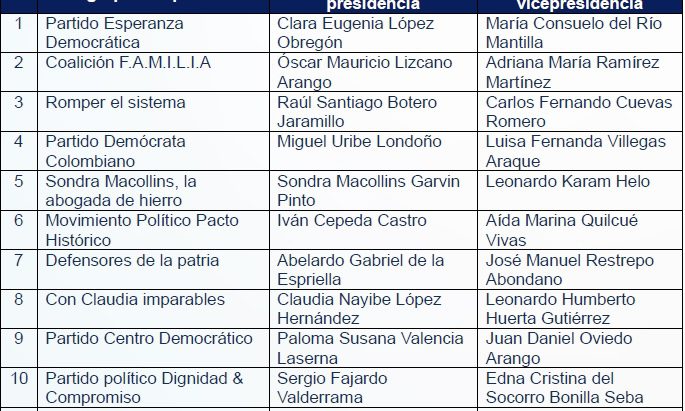
According to the electoral authority, the candidates represent a wide range of political perspectives, from left to right, including independent candidacies running through political movements. Here the list and brief profile of the candidates:

  1. Clara Eugenia López Obregón, currently a senator for the Esperanza Democrática She has served as Minister of Labor (2016–2017), acting mayor of Bogotá (2011–2012), and Bogotá’s secretary of government (2008–2010). She has been affiliated with left-wing parties and was Gustavo Petro’s vice presidential running mate in the 2010 election.
  2. Óscar Mauricio Lizcano, from the FAMILIA coalition. He served as Minister of Information Technologies (2023–2025), was a senator (2010–2018), and a member of the House of Representatives (2006–2010).
  3. Raúl Santiago Botero, candidate of the “Romper el Sistema” movement (Break the Establishment). An agronomist engineer and businessman from Medellín, he presents himself as an independent candidate with no prior political experience.
  4. Miguel Uribe Londoño, father of the slain presidential candidate Miguel Uribe Turbay. He is running under the Colombian Democratic Party and previously served as president of the Centro Democrático party founded by Álvaro Uribe Vélez.
  5. Sondra Macollins Garvin, from the movement “La Abogada de Hierro” (The Iron Lawyer) A criminal lawyer and psychologist, she presents herself as an independent candidate without political affiliations. She ran for the House of Representatives in 2022 and is known for her work in narcotrafficking and corruption cases.
  6. Iván Cepeda Castro, a senator since 2014 and the official candidate of the Pacto Histórico, the same party as President Gustavo Petro. Polls project he will receive the highest vote share in the first election round. He is aligned with left-wing political ideas.
  7. Abelardo de la Espriella, a lawyer with far-right positions, running for the first time under the Defensores de la Patria movement. Recent polls place him as a likely second or third contender in voter preference.
  8. Claudia López Hernández, former mayor of Bogotá (2020–2023) and former senator (2014–2018), running under the centrist movement “Imparables con Claudia.” She is known for her anti-corruption agenda and secured her candidacy with more than 570,000 votes (about 9%) in recent interparty primaries.
  9. Paloma Valencia Laserna, current senator and candidate of the Centro Democrático party led by Álvaro Uribe Vélez. She won the right-wing interparty primary on March 8 with more than 3 million votes. Polls place her among the top three contenders, and if she reaches a runoff, she would become the first woman in Colombia’s history to do so.
  • Sergio Fajardo Valderrama, an academic and mathematician running for the Dignidad y Compromiso He served as mayor of Medellín and governor of Antioquia and is running for president for the third time.
  • Roy Barreras, from the political party La Fuerza (The Force). He won the left-wing coalition primary on March 8 with the lowest vote total (257,000 votes, about 3.6%). Although currently aligned with left-wing movements and part of the Petro administration, he has previously been affiliated with right- and center-leaning parties.
  • Gustavo Matamoros Camacho, of the Colombian Ecologist Party. He served in the Colombian Army for 43 years. With no prior political experience, his campaign focuses on public security.
  • Luis Gilberto Murillo, who served as Minister of Foreign Affairs (2024–2025) and Colombia’s ambassador to the United States (2022–2024). A human rights advocate and Afro-Colombian leader from Chocó, he presents himself as an independent, moderate, centrist candidate.
  • Carlos Eduardo Caicedo, running under the independent movement “Con Caicedo.” He was mayor of Santa Marta (2012–2015) and governor of Magdalena (2020–2023), where he built a strong base as a left-wing political leader.

The RNEC also reported that “the draw to determine the position of presidential candidates on the ballot will take place on March 25 at the Ágora Bogotá Convention Center.”

This process marks the formal start of the final phase of the presidential campaign, during which candidates will seek to consolidate support ahead of the first round on May 31. If no candidate secures an absolute majority, a runoff between the two leading candidates will be held on June 21.

List of registered candidates for Colombia’s presidency. Photo courtesy of the Registraduría Nacional del Estado Civil.

List of registered candidates for Colombia’s presidency. Photo courtesy of the Registraduría Nacional del Estado Civil.

Headline photo: Polling station in Colombia during last Congress elections in March 8, 2026. Photo courtesy of the Registraduría Nacional del Estado Civil.

U.S. prosecutors probe Colombia’s Petro over alleged narco links, NYT reports

20 March 2026 at 20:10

U.S. federal prosecutors have opened preliminary criminal investigations into Colombian President Gustavo Petro over alleged links to drug traffickers and possible illicit financing of his 2022 campaign, according to a report by The New York Times.

The previously undisclosed probes are being conducted by federal prosecutors in Manhattan and Brooklyn and involve specialists in international narcotics trafficking, as well as agents from the Drug Enforcement Administration and Homeland Security Investigations, the newspaper said, citing people familiar with the matter.

Investigators are examining, among other issues, whether Petro held meetings with individuals connected to drug trafficking networks and whether his presidential campaign solicited or received donations from such actors. The two investigations are being carried out independently and remain in their early stages, with no certainty that they will lead to formal criminal charges.

There is no indication that the White House played any role in launching the investigations, according to the report. However, the inquiries emerge in a broader context of heightened tensions and fluctuating diplomacy between Bogotá and Washington.

Relations between Petro and U.S. President Donald Trump have been volatile, marked by sharp public exchanges, threats of tariffs that were never implemented, and the temporary revocation of Petro’s U.S. visa. Trump has repeatedly accused Petro of failing to curb narcotics production and has described him in highly critical terms, while Petro has denounced what he characterises as political pressure and interference.

The U.S. Treasury Department last year imposed sanctions on Petro, members of his family and senior officials, including Interior Minister Armando Benedetti, alleging links to narcotics activity. The measures, which included asset freezes and travel restrictions, were justified by Washington on the grounds that cocaine production in Colombia had reached record levels and that the government had offered concessions to armed groups involved in trafficking.

Petro has rejected those claims, insisting that his administration has strengthened seizures of cocaine and slowed the rate of expansion of coca cultivation. He has also denied any knowledge of illicit funds entering his campaign, dismissing the allegations as politically motivated attacks.

Colombia’s Attorney General  is examining charges that Petro’s son – Nicolás Petro – received money from individuals linked to illicit activities during the 2022 campaign. While his son acknowledged receiving funds that were not reported, no criminal charges have been filed against the president himself, and Petro has maintained he was unaware of the campaign “donations”.

According to the NYT, the U.S. investigations are taking place amid a broader strategy in which Washington has increasingly used legal and judicial tools to advance foreign policy objectives. Analysts say such actions could serve as leverage in bilateral relations or influence political dynamics in allied countries.

The timing of the probes is particularly sensitive, as Colombia prepares for presidential elections on May 31, with a potential runoff in June. Petro, the country’s first leftist president, is constitutionally barred from seeking re-election but has actively backed his political successor with hardleftist Iván Cepeda.

The allegations could reverberate through the electoral campaign, where relations with the United States remain a central issue. Candidates on the right have emphasised the importance of maintaining close ties with Washington, while figures on the left have framed U.S. actions as a challenge to Colombia’s sovereignty.

Despite months of tensions, diplomatic relations between the two countries have shown signs of stabilisation in recent weeks. Petro and Trump held a bilateral meeting at the White House earlier this year, which both sides described as constructive, and officials have since sought to rebuild communication channels.

Even so, uncertainty persists over the trajectory of the relationship, particularly as Washington continues to prioritise counternarcotics cooperation with Colombia, historically one of its closest partners in the region.

Petro has consistently denied any links to drug trafficking and has pointed to his government’s security strategy, which includes negotiations with armed groups and efforts to reduce violence, as evidence of a broader approach to the drug trade.

The start of U.S. investigations add a new layer of complexity to an already fraught political and diplomatic landscape, with potential implications not only for Petro’s post-presidential future but for Colombia’s ties with its most important security ally.

Colombia’s Top Prosecutor Charges Ecopetrol President in Alleged Influence-Peddling Case

18 March 2026 at 22:07

The charge adds to a separate investigation over alleged violations of campaign finance limits during President Gustavo Petro’s 2022 presidential campaign

Colombia’s Attorney General’s Office (Fiscalía General de la Nación – FGN) charged the president of the country’s state-controlled oil and energy company Ecopetrol (NYSE: EC’, BVC: ECOPETROL), Ricardo Roa Barragán, with the alleged crime of influence peddling by a public official. The charge was formally presented on March 11 during a public hearing.

According to the prosecutors press release, Roa “ordered that a specific person be assigned to a gasification project in exchange for a reduction in the price of an apartment” located in northern Bogotá. The Attorney General’s Office said the alleged intervention was related to the executive’s interest in acquiring the property below market value.

During the hearing, a prosecutor from the Specialized Anti-Corruption Directorate formally presented the charge. However, Roa did not accept the accusation.

The newspaper El Colombiano explained that “the filing of charges is a formal act within the criminal process through which the person under investigation is officially notified of their link to a judicial case and the facts attributed to them. However, this step does not imply a conviction or a final decision and maintains the presumption of innocence that protects the executive.”

After the judicial decision became public, Ecopetrol’s Board of Directors said Roa will remain in his position as president of the company. In a public statement, the company’s highest governing body said it respects “Ricardo Roa’s presumption of innocence and his right to due process.” It also said it will continue acting according to the company’s established protocols for evaluating this type of situation.

Roa pled innocent to the influence trafficking charges.

Context: political, legal, and corporate challenges

Ecopetrol is currently facing several political and economic challenges. These include judicial and disciplinary proceedings involving its president, as well as questions about the company’s institutional and financial stability.

For example, the company’s 2025 annual report sparked public debate after reporting the highest reserve replacement ratio in the last four years (121%). According to the document, “300 million barrels of oil equivalent (BOE) were added, guaranteeing an average reserve life of 7.8 years.”

The report also said, “net proven reserves reached 1.944 billion barrels of oil equivalent.” However, private firms such as the independent investment bank BTG Pactual questioned those figures due to a change in the methodology used to calculate them.

Another point of debate has been the presidency of the Board of Directors, currently headed by Ángela María Robledo Gómez, a psychologist and former member of Colombia’s House of Representatives for Bogotá. Robledo was a member of the Partido Alianza Verde between 2010 and 2018 and later ran as vice presidential candidate alongside Gustavo Petro in the 2018 elections.

Roa’s legal situation is also linked to another investigation related to alleged irregularities in the financing of the Pacto Histórico presidential campaign in 2022, which he managed and which resulted in Petro becoming president.

In February, the Attorney General’s Office said investigators had found evidence suggesting that the campaign exceeded the legal spending limits. A similar case had already been examined by Colombia’s elections regulator Consejo Nacional Electoral, which fined those responsible more than $5 billion Colombian pesos (over $1.4 million USD).

For his part, Colombian President Gustavo Petro has publicly defended Roa. During a public event broadcast by media outlets such as Blue Radio, the president said the accusations are politically motivated. “We did not exceed spending limits; I have reviewed that accounting up and down,” he said. He also argued that the opening of criminal proceedings could be interpreted as an attempt to politically target his government.

Headline photo: Colombian President Gustavo petro (left) with former campaign manager and current Ecopetrol CEO Ricardo Roa (photo courtesy Ecopetrol).

Colombia arrests “mastermind” of Ecuador candidate Villavicencio’s murder

18 March 2026 at 21:16

Colombian authorities on Wednesday arrested Ángel Esteban Aguilar Morales, alias “Lobo Menor”, an alleged senior figure in the Ecuadorian criminal group Los Lobos and suspected intellectual author behind the 2023 assassination of Ecuadorian presidential candidate Fernando Villavicencio.

The arrest took place at El Dorado International Airport, where Aguilar Morales arrived on a commercial flight from Mexico, according to Colombia’s migration authority.

Officials said the suspect attempted to evade detection using false identification as a Colombian citizen, but biometric verification and international intelligence-sharing mechanisms exposed his true identity. He was detained under an Interpol red notice and handed over to judicial authorities pending extradition proceedings.

Aguilar Morales is considered a high-ranking member of Los Lobos, an Ecuador-based criminal organization linked to narcotrafficking, contract killings, illegal mining, and broader transnational crime. Authorities allege he played a central role in planning the killing of Villavicencio, whose assassination during the 2023 campaign sent shockwaves across the region.

The arrest comes at a delicate moment in bilateral relations. Colombia and Ecuador are this week attempting to defuse a growing diplomatic and security crisis following the discovery of an unexploded device inside Colombian territory near the border between the departments of Nariño and Putumayo. The incident has triggered sharp exchanges between the governments of President Gustavo Petro and Ecuador’s leadership, amid mutual accusations over cross-border security threats.

Colombia’s migration chief Gloria Esperanza Arriero López said the capture underscores the country’s determination to confront transnational criminal networks, particularly as tensions with Ecuador highlight the porous and contested nature of the shared border.

“This result demonstrates that Colombia has strong institutions and coordinated security forces working to close the space for criminal organizations, regardless of their origin,” Arriero said.

Colombian officials said Aguilar Morales had been under surveillance following intelligence tracking his movements through Medellín and Itagüí before traveling to Mexico. Authorities credited close cooperation with Mexican counterparts for locating and intercepting him as part of a multinational operation referred to by Petro as “Jericó.”

Petro described the suspect as one of the most significant figures linked to the Villavicencio assassination and alleged ties to dissident Colombian armed factions, including networks associated with “Iván Mordisco,” as well as Mexican cartels — evidence, he said, of the expanding integration of regional criminal economies.

According to investigators, Aguilar Morales had previously been sentenced in Ecuador to 20 years in prison for murder in 2013, but was granted conditional release in 2022 after serving half his sentence. Authorities allege he used falsified documents to meet legal reporting requirements while continuing criminal operations across borders.

The arrest marks a major development in the Villavicencio case and comes as Ecuador grapples with escalating violence linked to organized crime and drug trafficking routes. The slain candidate had campaigned on an anti-corruption platform and vowed to dismantle criminal networks, placing him squarely in their crosshairs.

Colombian authorities said the capture also demonstrates the importance of trilateral coordination between Colombia, Ecuador and Mexico in dismantling organized crime structures. Aguilar Morales is expected to face extradition as Ecuador seeks to prosecute those responsible for orchestrating the assassination.

The timing of the arrest — against the backdrop of rising diplomatic tensions and border security concerns — is likely to reinforce calls for deeper regional cooperation to address increasingly interconnected criminal threats operating across the Andes.

Colombia – Ecuador rift widens over cross-border bombings

17 March 2026 at 19:40

President Gustavo Petro accused Ecuador on Monday of carrying out bombing raids inside Colombian territory, sharply escalating a diplomatic and trade dispute that has been simmering since January.

Petro said “27 charred bodies” have been found near the border and suggested the attacks could not have been carried out by illegal armed groups, though he presented no evidence to support the claim.

“Ecuador is bombing us, and these are not illegal armed groups,” Petro said during a televised cabinet meeting, warning of a serious breach of sovereignty.

Ecuador’s President Daniel Noboa swiftly rejected the accusation.

“President Petro, your statements are false; we are acting within our own territory,” Noboa said, adding that Ecuadorian forces were targeting “narco-terrorist structures” operating near the border.

Petro said a bomb believed to have been dropped from an aircraft had been discovered near the frontier, reinforcing what he described as a pattern of cross-border strikes.

“A bomb has appeared, dropped from a plane… very close to the border with Ecuador,” Petro said. “We must investigate thoroughly, but this supports my suspicion that Ecuador is bombing us.”

He added that “many explosions” had been reported and said his government would soon release an audio recording allegedly originating from Ecuador.

In a post on social media platform X, Petro said the bombings did not appear to come from Colombian armed forces or illegal groups, which he argued lack the capability to carry out aerial attacks. “The explanation (from Ecuador) is not credible,” he wrote, without specifying when or where the deaths occurred.

Ecuador doubles down

Noboa, facing a surge in organized crime violence at home, has adopted an aggressive military strategy that includes aerial bombardments of suspected cartel camps near the Colombian border.

His government says the operations are conducted strictly within Ecuadorian territory and are often aimed at groups with Colombian origins, including FARC dissidents. “Together with international cooperation, we continue this fight, bombing locations used as hideouts by these groups, many of them Colombian,” Noboa said in a statement.

He also accused Colombia of failing to control its side of the border, allowing criminal organizations to spill into Ecuador.

The latest confrontation comes against the backdrop of a worsening trade dispute that began in January when Ecuador imposed a 30% “security tariff” on Colombian imports, citing Bogotá’s alleged inaction against narcotrafficking.

The tariff was later increased to 50%.

Colombia retaliated with tariffs on 73 products, suspended electricity exports to Ecuador, and imposed restrictions on bilateral trade, deepening tensions between the neighboring countries.

Ecuador responded by raising fees on the transport of Colombian crude through one of its main pipelines.

Despite early attempts to contain the fallout, relations have steadily deteriorated, culminating in the current exchange of accusations.

Risk of escalation

Petro’s latest claims mark the most serious rupture yet, raising the specter of a cross-border military incident between the two countries, which share a long and porous frontier plagued by drug trafficking and illegal mining.

The Colombian president said he had appealed to Donald Trump to intervene diplomatically.“I asked him to act and call the president of Ecuador because we do not want to go to war,” he said.

The involvement of the United States adds another layer of complexity. Ecuador recently deepened security cooperation with Washington, including the establishment of a new FBI office and joint operations targeting organized crime. Earlier this month, Ecuadorian and U.S. forces conducted strikes on a camp linked to the Comandos de la Frontera, a dissident faction of the FARC guerrilla.

The Colombia–Ecuador border has long been a strategic corridor for cocaine trafficking, with armed groups exploiting weak state presence on both sides. While the border itself is not disputed, diverging security strategies have increasingly brought Bogotá and Quito into conflict.

Petro’s government has prioritized negotiations with armed groups under its “Total Peace” policy, while Noboa has pursued a hardline military crackdown.

For now, the allegations from Casa de Nariño remain unverified, but the political damage is done – and one further miscalculation could carry deep consequences far beyond the shared border.

Paloma Valencia surge reshapes Colombia race as election season begins

10 March 2026 at 17:51

Colombia’s presidential race entered a decisive new phase this week after Sunday’s inter-party primaries propelled conservative senator Paloma Valencia into the national spotlight and triggered a scramble among political factions to forge alliances ahead of the May 31 election.

Valencia’s commanding performance in the right-wing “La Gran Consulta” primary – where she secured roughly six million votes – has reshaped the political landscape, opening a contest within the conservative bloc while forcing candidates across the spectrum to recalibrate their strategies.

The vote effectively marks the start of Colombia’s election season, in which presidential hopefuls must broaden their appeal beyond ideological bases while navigating a fragmented political field.

For the right, the central challenge is whether it can attract moderate and centrist voters without alienating the hardline supporters who form the backbone of a political base – and party – associated with former president Álvaro Uribe.

Valencia, a senior figure in Uribe’s Democratic Center, emerged from the primaries as one of the leading conservative contenders after her vote total surpassed the turnout achieved by President Gustavo Petro and Vice President Francia Márquez in their coalition primaries ahead of the 2022 election.

For Uribe’s movement, which appeared weakened after the presidency of Iván Duque and several electoral setbacks, the result represents an unexpected demonstration of political resilience.

Yet the surge of security-focused Senator has also intensified competition from the far right.

Barranquilla-based lawyer Abelardo de la Espriella, who had previously dominated opposition to Petro, now faces a rival capable of consolidating support among traditional party structures while courting voters beyond the hard-right.

De la Espriella announced Tuesday that Ivan Duque’s former finance minister José Manuel Restrepo will join his presidential ticket as vice-presidential candidate, a move widely interpreted as an attempt to add economic credibility to a campaign largely driven by security rhetoric.

Political observers on the night of the consulations emphasized that Uribe will play a decisive role in shaping the outcome of any hard-right and center-right alliance.

The former president remains the most influential figure within Colombia’s right-wing political establishment and will act as “kingmaker” when negotiations begin over a possible understanding between Valencia and De la Espriella aimed at consolidating the anti-Petro vote.

Whether such an agreement materializes remains uncertain, as both candidates seek to position themselves as the principal challenger to the left in the first round scheduled for May 31.

Sunday’s primaries also produced a surprise showing from economist Juan Daniel Oviedo, the former head of Colombia’s national statistics agency (DANE), who secured more than one million votes and finished second in La Gran Consulta.

Oviedo has cultivated support among urban and younger voters, particularly in Bogotá, where his technocratic style and socially liberal positions have resonated with diverse constituencies, including large segments of the LGBTQ community.

Yet his unexpectedly strong performance now places him at a political crossroads.

Oviedo is expected to meet Valencia on Thursday to discuss a possible alliance that could include joining her ticket as a vice-presidential candidate.

Such a partnership could help Valencia reach voters beyond the traditional conservative base. But it also carries risks for Oviedo, whose supporters may question a close association with the Uribe-aligned political establishment that has dominated Colombia’s right for more than two decades.

The two politicians differ sharply on several issues, including the 2016 peace agreement with FARC  and role of the Special Jurisdiction for Peace (JEP), the transitional justice tribunal created to prosecute war crimes committed during Colombia’s internal conflict.

While Oviedo has defended Juan Manuel Santos’ peace agreement and role of the tribunal, Valencia has long criticized JEP and promoted reforms aimed at limiting its legal authority.

Despite the shifting dynamics on the right, the left retains an important institutional foothold following Sunday’s legislative elections.

Petro’s governing coalition, the Historic Pact, emerged as the largest force in the Senate with 25 of the chamber’s 102 seats, according to official results, though it fell short of an outright majority and will need alliances with other parties in the fragmented legislature.

Within the progressive camp, however, the primaries exposed clear divisions.

Former Senate president and former Ambassador to London Roy Barreras secured just over 200,000 votes in the left-wing primary and publicly blamed Petro for the weak turnout, accusing the president of discouraging supporters from voting on Sunday to cement the official candidacy of hard-left candidate Iván Cepeda.

The primaries also underscored the continued weakness of Colombia’s political center.

Former Bogotá mayor Claudia López won her coalition’s primary but attracted fewer than half a million votes, a disappointing result that leaves her entering the first round of the presidential race with reduced political momentum.

With nearly three months remaining before the first round of voting, the campaign that begins this week bears little resemblance to the one that existed before Sunday’s primaries.

The conservative opposition remains divided but newly energized, the left retains institutional strength despite internal tensions, and the political center faces an uphill battle to remain relevant.

In a race now expected to be decided in two rounds, Colombia’s presidential contest is once again wide open as candidates maneuver to build alliances and capture the pivotal voters who will ultimately decide the country’s political direction.

Colombian Voters Elect New Congress for 2026-2030 Legislative Term; Party With Largest Senate Block Still Only 26%

9 March 2026 at 22:29

The new members of Congress will take office on July 20, the official start of the new legislative term.

On March 8, Colombia elected the Congress that will exercise legislative authority during the 2026–2030 term. From more than 3,200 candidates, voters chose the 102 senators (upper house) and 182 members of the House of Representatives (lower house) who will make up the country’s legislative branch.

According to preliminary reports from the Registraduría Nacional del Estado Civil (RNEC), with 98.4% of polling stations counted, equivalent to 19,220,365 votes tallied, the new Congress has been defined electorally, however, it should be noted that these seat projections correspond to the official preliminary count, which still must go through several formal procedures before the final results are certified.

How the Senate Race is Shaping Up?

The Pacto Histórico, the party of current President Gustavo Petro, obtained around 22% of the vote (4,402,601), which would allow it to increase its representation from 20 senators in the current legislature to approximately 25 seats in the next term.

In second place is the Centro Democrático, the party of former President Álvaro Uribe, with about 15% of the vote (3,020,459), potentially increasing its representation from 13 to 17 seats.

The Partido Liberal would rank third with 13 seats (2,268,658 votes). It would be followed by the Alianza por Colombia, led by the Green Party, with 10 seats (1,899,096 votes), and the Partido Conservador, also with 10 seats (1,859,493 votes).

Other wins in the Senate include Party of La U (9 seats), Cambio Radical (7), the Ahora Colombia coalition (5), which backs presidential candidate Sergio Fajardo, and Salvación Nacional (4), the movement of presidential candidate Abelardo de la Espriella. The two remaining seats correspond to the special indigenous constituency.

In terms of losses in representation, the Partido Conservador would be the most affected, losing five of its current 15 seats. Cambio Radical would lose four, the Greens three, La U two, while Liberals and Ahora Colombia would each lose one seat.

Among the prominent figures who would be left out of the new Senate is former President Álvaro Uribe, who occupied position number 25 on his party’s list and would not obtain a seat if the Centro Democrático secures only 17 seats. Green Party senator Angélica Lozano, known for promoting legislation related to transparency, would also lose her seat.

Likewise, movements such as the coalition that supported Juan Daniel Oviedo and the Partido Oxígeno, led by former presidential candidate Ingrid Betancourt, who was kidnapped for years by the now-defunct FARC guerrilla group, would fail to surpass the minimum threshold required to obtain Senate representation (3% of the total vote).

On the other hand, the performance of the Salvación Nacional movement, led by presidential candidate Abelardo de la Espriella, stands out. In its first participation in a congressional election, the party would surpass the electoral threshold and secure four senators.

What About the House of Representatives?

The allocation of seats in the House of Representatives follows a different process from that of the Senate, making it difficult to project the final distribution in the early stages of the vote count.

This is because the calculation is conducted department by department, once the RNEC determines the seat allocation formula and electoral quotient in each of the 32 States and the Capital District of Bogotá.

According to report number 45 from the RNEC, with 99.03% of votes counted, the main parties have obtained the following preliminary nationwide results:

  • Centro Democrático: 2,551,706 votes.
  • Partido Liberal: 2,101,877 votes.
  • Partido Conservador: 1,967,996 votes.
  • La U: 1,044,778 votes.
  • Pacto Histórico: 913,990 votes.
  • Cambio Radical: 803,721 votes.
  • Alianza Verde: 654,071 votes.
  • Salvación Nacional: 436,365 votes.

Because the House of Representatives elections involve parties, movements, and coalitions with strong local and regional influence, several smaller political organizations are expected to win seats, as they must surpass regional thresholds rather than a national one.

The Highlight: a Fragmented Congress that Will Require Coalitions

With the preliminary distribution of seats in both the Senate and the House of Representatives, projections suggest that Colombia’s next president will need to govern through legislative coalitions, as has occurred under President Gustavo Petro and his predecessors.

Presidential candidates Iván Cepeda, of the Pacto Histórico, and Paloma Valencia, of the Centro Democrático, would begin the next political phase with the largest congressional blocs, although neither would have enough seats to govern alone.

Traditional parties such as the Liberal, Conservador, Cambio Radical, and La U, which together could account for more than 40% of the new congress, have not yet decided which presidential candidate they will support, a situation similar to what occurred in the previous election. These parties could therefore become kingmakers, capable of facilitating, or blocking, governability depending on the alliances and coalitions they choose to form.

For that reason, the coming weeks are expected to be marked by intense political negotiations, as presidential contenders attempt to build alliances that would allow them to secure legislative support.

For candidates such as Sergio Fajardo, whose Ahora Colombia coalition would obtain only five senators, or Abelardo de la Espriella, whose Salvación Nacional movement would have four, the challenge will be significantly greater.

Above photo: Polling station during Colombia’s congressional elections. Photo courtesy of the Registraduría Nacional del Estado Civil.

Colombian President Gustavo Petro Seeks To Restructure Colombian Health Care Despite Congressional Rejection

9 March 2026 at 22:00

Colombian President Gustavo Petro is continuing to make changes to Colombia’s health system through administrative measures, after two attempts to pass a legislative reform were rejected by Congress.

The latest decision is Decree 0182 of 2026, which centralizes the provision of health services in approximately 45% of the country under the administration of Nueva EPS, a mixed public-private company currently under government intervention. As part of the measure, the insurer would receive 2,84 million reassigned members.

According to the government, the decree seeks to modify the flow of resources within the system so that funds would be paid from the government directly to healthcare providers, such as hospitals and clinics. This change would limit the traditional role of the Entidades Prestadoras de Salud (EPS), the system’s intermediaries, whose reduction has been one of the Petro administration’s key policy goals.

President Petro has publicly defended this approach. In a message posted on the social media platform X, he said that EPS entities “devour 70 trillion pesos annually and demonstrably benefit the wealth of their owners.” The president has also blamed these institutions for the crisis affecting the health sector over the past decade, arguing that during that time “the theft of health resources multiplied, and 117 EPS were liquidated to avoid paying their debts.”

The decree has sparked debate in the media. Some reports, including those published by the outlet Infobae after reviewing the official document, described the measure as a “mass transfer of patients and territorial reorganization of the health system.” However, the Ministry of Health rejected that interpretation and clarified that the measure “does not involve an arbitrary transfer of users, but rather a technical step aimed at correcting structural failures in the insurance model”.

In a statement, the ministry explained that “when an EPS lacks operational or financial capacity in a given territory, the state is authorized to adopt temporary mechanisms to ensure healthcare access for users.” The ministry also stated that the goal of the decree is to guarantee effective, fair, dignified and continuous access to healthcare services across the country, particularly in regions where geographic dispersion and low population density have historically complicated service delivery.

Political and administrative context

The debate comes amid a broader process of administrative interventions within the system. According to reports cited by the newspaper El Colombiano, “over the past three years the government, through the Superintendencia Nacional de Salud, has intervened in seven EPS,” removing their management from private owners and placing them under state-appointed administrators.

The government has used this context to justify administrative measures such as those included in the decree, arguing that several insurers have demonstrated structural operational weaknesses. At the same time, the legislative debate over a comprehensive health reform has not been completely closed. According to the same outlet, the government is still exploring the possibility of reviving the reform bill through an appeal filed by Senator Fabián Díaz. In the meantime, the administration has moved forward with changes through decrees, regulatory resolutions and decisions by the health regulator.

Despite the publication of the decree, its implementation still requires additional administrative steps. According to analysis cited by Infobae, “the transfer of members will not occur automatically, as it depends on the Superintendencia Nacional de Salud issuing administrative acts that update the territorial scope of the EPS”. This means the reorganization of the system could unfold gradually once the required regulatory procedures are completed.

Over 3,200 Candidates to Run for 284 Seats in Colombia’s Legislative Elections This Sunday

6 March 2026 at 20:31

Seats are distributed using the D’Hondt method, known in Colombia as the cifra repartidora, which allocates seats proportionally according to the number of votes obtained.

A total of 3,231 candidates will compete for seats in Colombia’s congress in the legislative elections scheduled for March 8, according to the Registraduría Nacional del Estado Civil (RNEC), the authority responsible for organizing the country’s electoral processes. In total, 102 senators and 182 members of the House of Representatives will be elected.

According to the electoral authority, 1,124 candidates registered for the Senate and 2,107 for the House of Representatives, the two chambers that make up Colombia’s congress.

As the political analysis website Razón Pública explains, Colombia’s electoral system is based on proportional representation, which seeks to reflect the diversity of political opinions within society in the composition of Congress. For the Senate, or upper chamber, voters may cast their ballots for candidates anywhere in the country, as it operates under a national constituency. In contrast, the House of Representatives, or lower chamber, is elected through territorial constituencies by departments, including Bogotá as the Capital District.

According to the RNEC, 41,287,084 citizens are eligible to vote in the upcoming elections, a key figure because it influences how seats are allocated.

Senate elections

In this election, 102 senators will be chosen by popular vote. According to the Senate’s official website, 100 will be elected through a nationwide constituency and the remaining two seats are reserved for indigenous communities, a special constituency established by the 1991 Constitution to guarantee political representation for these groups.

Voters must choose between receiving the national ballot or the Indigenous constituency ballot, but they cannot vote in both.

House of Representatives elections

For the House of Representatives, 182 members will be elected, distributed as follows:

  • Territorial constituencies: 161 seats allocated to departments and the Capital District of Bogotá.
  • Special Transitional Peace Constituencies: 16 seats reserved for victims of the armed conflict, created by the Acto Legislativo 02 of 2021.
  • Afro-descendant communities: 2 seats.
  • Indigenous communities: 1 seat.
  • Community of San Andrés (Raizal): 1 seat.
  • Colombians living abroad: 1 seat.

Unlike the Senate, each department receives a specific number of seats based on its population, creating regional electoral dynamics in which local political leadership often plays a key role. In practice, more populous departments hold greater representation than smaller ones.

Both the Senate and the House of Representatives receive one additional seat after the presidential election, allocated to the candidate who obtains the second-highest number of votes.

How seats are allocated

Colombia’s electoral system is regulated by the Acto Legislativo 001 of 2003 and the Electoral Law, and operates under principles of proportional representation.

First, the valid votes obtained by each party list are counted. Only those lists that surpass a 3% threshold of total valid votes are eligible to participate in the distribution of seats. In the 2022 legislative elections, this threshold exceeded 509,000 votes.

According to projections by the Misión de Observación Electoral (MOE), the threshold for the Senate in the upcoming elections could reach around 600,000 votes.

This threshold is crucial because if, for example, a candidate obtains 450,000 votes but their party fails to pass the threshold, neither the candidate nor the party will secure a seat in Congress.

Among the lists that surpass the threshold, seats are distributed using the D’Hondt method, known in Colombia as the cifra repartidora, which allocates seats proportionally according to the number of votes obtained. In 2022, the seat-allocation quotient was 144,013 votes.

For the House of Representatives, the process is more complex because the threshold and D’Hondt method are applied separately within each department, producing different results across regions.

With closed lists, voters select only the political party or list as a whole, without choosing an individual candidate.

Open and closed lists

Under the Acto Legislativo 1 of 2003, political parties may register open lists or closed lists. With open lists, voters select a specific candidate within a party’s list. The vote counts both for the political party and for the individual candidate. Seats obtained by the party are then assigned to the candidates who received the highest number of votes, regardless of their initial position on the list.

With closed lists, voters select only the political party or list as a whole, without choosing an individual candidate. Seats are then allocated according to the order predetermined and registered at the start of the campaign by the party.

In the upcoming elections, two of Colombia’s most prominent political forces will present closed lists: the Pacto Histórico, the coalition led by current President Gustavo Petro, and the Centro Democrático, the right-wing party founded by former President Álvaro Uribe Vélez.

Photo courtesy of the National Civil Registry of Colombia,

Colombia set for inter-party primaries, presidential race gripped by apathy

3 March 2026 at 17:54

Colombians head to the polls on March 8 for what is, formally, a legislative election. In practice, it is something more consequential: a stress test of the country’s political coalitions ahead of the May 31 presidential race already defined by fragmentation – and by mounting security concerns for right-wing candidates.

The vote for Congress matters. But the country will be watching the consultas presidenciales—three parallel primaries that function as a de facto first round. In them, Colombians vote less for programs than for trajectories: continuity, rupture, or something in between.

On the right, Paloma Valencia is poised to dominate La Gran Consulta, a coalition spanning moderate conservatives, independent liberals, and slate of well-known political leaders. Polling places her far ahead of her rivals, with margins large enough not merely to win, but to define the bloc itself. In a pre-Petro era, such a coalition might have fractured under its contradictions, but today, it coheres around one single objective: opposition to the government of Gustavo Petro and the restoration of order- political, fiscal, and territorial.

Valencia’s strength is not only electoral; it is structural. She inherits the Centro Democrático machinery and the disciplined base loyal to former two-term president Álvaro Uribe, whose legacy continues to shape Colombia’s right. But her challenge begins the moment she wins. The right is not unified—it is merely aligned. To convert alignment into victory, she will need to reach out to Abelardo de la Espriella, a pro-Bukele, pro-Milei, lawyer whose mass appeal is rooted in a more visceral, anti-left electorate. If Valencia succeeds in clinching La Gran Consulta, the right could reach May 31 not only united, but energized. If she fails, she risks replaying a familiar Colombian pattern: ideological proximity undone by personal rivalries.

With “El Tigre” de la Espriella lurking in the shadows, the right looks ascendant. Uribe Vélez now faces the daunting challenge of fusing his CD base with Espriella’s fervent Defensores de la Patria.

A Spectral Center

Claudia López is expected to win her consultation comfortably, aided as much by the absence of strong rivals as by the presence of loyal supporters. Her likely vote total- perhaps around one million—will be spun as a comeback. In reality, it reflects the residual strength of her partisan mayoralty and Bogotá-based electorate.

The absence of Sergio Fajardo from the Consulta de las Soluciones underscores the fragmentation of Colombia’s center. A strong showing by López will force a choice: seek alliances quickly or face marginalization after March 8. Even a López–Fajardo ticket would face sharp criticism from within their respective bases, and risk a repeat of the 2022 election season in which Sergio Fajardo’s campaign imploded under the weight of Petrismo or Uribismo.

On the left, the situation is more fluid – and more revealing.

The exclusion of Iván Cepeda has transformed the Frente por la Vida into a contest between two practitioners of political adaptation: Roy Barreras and Daniel Quintero. Neither represents the ideological hardline of Petrismo. Both instead offer variations of what might be called continuity without commitment – a “Petrismo 2.0” calibrated for chaise-lounge socialists.

Barreras relies on organization, his tenure as a loyal Petro “insider”, and the quiet efficiencies of Colombia’s territorial elites. Quintero counters with a direct, anti-Uribe narrative amplified through social media. Each seeks not to replace Petro, but to reinterpret him. Yet the Barreras-versus-Quintero contest feels less like a continuation of an embattled political project than an attempt for both candidates to repackage their political futures.

The most important actor on the left may be Petro himself – precisely because of his absence. By declining to endorse the consultation, he has deprived it of coherence. The result is a referendum on his government without his direct participation, and turnout that may struggle to reach even one million voters. In political terms, that is not a mobilization. It is a warning.

What emerges from these three contests is not a country coalescing, but one sorting itself into sharper, more disciplined minorities. The right is concentrated and motivated. The left is divided and improvisational. The center is present, but peripheral.

Then there is the largest bloc of all: those who will not participate. Polling suggests that a majority of Colombians will abstain from the primaries altogether. This is not apathy in the conventional sense. It reflects something more structural –  a growing distance between citizens and political mechanisms that no longer seem to mediate power so much as ratify it.

In that respect, March 8 clarifies less about who will win than about how Colombia now conducts politics. Elections no longer aggregate a national will; they stage competitions between organized intensities. Victory belongs not to the broadest coalition, but to the most cohesive one.

By Sunday night, the candidates will claim momentum. Some will have earned it. Others will have inherited it. But all will confront the same reality: the path to the presidency no longer runs through the mythical Colombian center. It runs through blocs – disciplined, polarized, and increasingly unwilling to transcend partisan loyalties for the greater good.

Trade War Between Colombia And Ecuador Escalates, With 50% Tariffs Threatened

3 March 2026 at 02:39

Tensions between Colombia’s Gustavo Petro & Ecuador’s Daniel Noboa began last year when Petro refused to recognize Noboa’s election as legitimate.

Colombia and Ecuador are engaged in a tariff dispute that could affect both countries. At the beginning of February, Ecuador imposed 30% tariffs on products imported from its northern neighbor, and then Colombia responded with reciprocal tariffs at the same rate. Ecuador has now escalated the dispute by raising the tariff to 50%. Here is a summary of what is happening.

The most recent move by Ecuador was on February 26. “After confirming the lack of implementation of concrete and effective border security measures by Colombia, Ecuador is obliged to adopt sovereign actions. Starting March 1, the security fee on imports originating from Colombia will be increased from 30% to 50%,” the Servicio Nacional de Aduana said in a press release as retaliation for the announcement of reciprocal tariffs by Colombia.

Before that, the Colombian government had officially imposed a reciprocal 30% tariff on imports of goods originating from Ecuador, as established in Decree 170 of 2026, signed on February 24 by President Gustavo Petro and his ministerial cabinet.

The decree states that the measure responds to the 30% tariff previously imposed by Ecuador on Colombian products has generated “an estimated 97% drop in exports to that country, equivalent to an annual reduction of approximately $1.803 billion USD.”

Colombia has suspended electricity delivery to Ecuador in retaliation.

The Colombian decision came as a direct response to the so-called “security fee” introduced by Ecuadorian President Daniel Noboa on February 1, which applied the same rate to goods originating from Colombia.

At the time, the Secretaría General de Comunicaciones de Ecuador, announced the measure through the social media platform X, stating that the objective was to “protect national security and strengthen customs controls and security in the border area.” According to President Noboa, the decision was based on “a lack of reciprocity and the need for stronger security measures,” adding that the tariff would remain in place “until there is a genuine joint commitment to combat drug trafficking and illegal mining along the shared border.”

These actions mark an escalation in trade tensions between the two countries, which have faced growing political and diplomatic challenges in recent months. Colombia had already suspended electricity exports to Ecuador following the initial tariffs, while Quito increased fees for transporting Colombian petroleum through its pipelines.

Products affected by tariffs include beans, rice, fats and oils, unsweetened cocoa powder, fresh bananas, ethyl alcohol and denatured spirits, as well as insecticides, fungicides, and disinfectants, among others. Although the tariff is initially paid by importers at the border, these costs are typically passed on to end consumers through price adjustments.

Despite historically close trade relations, it remains unclear whether both countries will reach a short-term agreement, or move toward formal dispute resolution mechanisms. On February 6, foreign ministers from both nations held a negotiation meeting in Quito, though no formal agreement was reached. Ecuador, at the time, conditioned further decisions on progress in security and energy cooperation.

Additionally, according to Bogotá-based El Tiempo daily newspaper, both governments have filed formal complaints with the Comunidad Andina de Naciones (CAN), which must determine whether the claims will be accepted. Analysts generally agree that a diplomatic solution remains the most viable path to resolving the current trade dispute.

The Central Market in Tulcán, Ecuador, near the Colombian border, one of the most affected areas by the new tariffs. (photo: Jadin Samit Vergara)

The Central Market in Tulcán, Ecuador, near the Colombian border, one of the most affected areas by the new tariffs. (photo: Jadin Samit Vergara)

Headline photo: Border between Tulcán, Ecuador, and Ipiales, Colombia, at the Rumichaca International Bridge. (Photo Jadin Samit Vergara)

❌