
Normal view

Wingo Launches New Routes Between Medellín, Colombia & Jamaica, Guatemala

25 March 2026 at 22:05

Wingo expansion strengthens Medellín as a regional aviation hub

Wingo, a subsidiary of Copa Holdings (NYSE: CPA), has announced the launch of two new direct international routes from Medellín to Guatemala City, Guatemala, and Montego Bay, Jamaica. With this expansion, the carrier becomes the only airline to operate these specific nonstop segments from José María Córdova International Airport in Rionegro, which serves the Antioquia region.

The new service increases Wingo’s international portfolio to 10 destinations from the city, complementing its existing network of five domestic routes. According to data provided by the airline, Medellín has become a primary operational base in Colombia. In 2025, approximately 35% of the carrier’s total passenger traffic, representing 1.2 million travelers, originated from or arrived in the city.

“Medellín is a strategic city for Wingo, and these two new routes reflect our confidence in the potential of the city and the response of travelers.” — Jorge Jiménez, Commercial and Planning Vice President of Wingo.

The Alcaldía de Medellín, through the Secretaría de Turismo y Entretenimiento and the Bureau de Medellín y Antioquia, coordinated with airport concessionaire Airplan to facilitate the new frequencies. The Medellín to Guatemala City route is scheduled to begin operations on June 25, 2026, with three weekly frequencies on Tuesdays, Thursdays, and Saturdays. The airline expects to offer 30,000 seats annually on this route, with one-way fares starting at $108 USD, including taxes and fees.

The connection to Montego Bay is slated for a June 23, 2026, start date, also operating three times per week on Tuesdays, Thursdays, and Saturdays. Introductory fares for the Jamaican destination are positioned at $159 USD per trayect. This move follows a 2025 pilot program where Jamaica was marketed as a high-interest destination for Colombian travelers.

Jorge Jiménez, Commercial and Planning Vice President at Wingo, stated that these routes reflect confidence in the potential of the city and the response of travelers to direct, low-cost international options. Ana María López Acosta, Secretary of Tourism and Entertainment, noted that the collaboration between the public and private sectors continues to project the city as an attractive destination for tourism and investment.

The expansion comes as the Aeropuerto Internacional José María Córdova continues to increase its capacity as a logistical platform for the country. Javier Benítez, Manager of the airport, indicated that the arrival of these routes reaffirms the facility’s potential to facilitate international business and connection for the region.
Colombia Concludes Multilateral Diplomatic Event With African Nations

22 March 2026 at 21:15

New Africa initiative drives 112% growth in non-mining exports.

The Ministerio de Comercio, Industria y Turismo (Ministry of Trade, Industry, and Tourism) hosted the first Foro de Reencuentro Económico CELAC–África at the Ágora Convention Center in Bogotá on March 20, 2026. The event, held as part of a broader high-level forum, aimed to strengthen commercial and investment ties between Colombia and the African continent. During the proceedings, officials identified various sectors for potential growth, including jewelry, agricultural machinery, construction materials, software, digital marketing, and food and beverages.

Minister of Trade Diana Marcela Morales Rojas stated that the forum represents a strategic shift toward trade equity and shared economic opportunities. Over the past four years, the Colombian government has sought to diversify its market reach through economic diplomacy, trade missions, and the establishment of new logistical routes to Africa. Data from 2025 indicates that these efforts have resulted in a significant increase in non-mining and non-energy exports to the continent.

“We aim for this forum to mark the beginning of a new stage: one of strategic cooperation, trade with equity, and the construction of shared opportunities.” — Diana Marcela Morales Rojas, Minister of Trade, Industry, and Tourism.

According to ministry figures, non-mining exports to Africa reached $296.5 million USD in 2025, representing a 112% increase compared to 2024. In terms of volume, these shipments totaled 209,273 tons, a 226.8% rise over the previous year. These goods accounted for 46.6% of Colombia’s total exports to the continent, signaling a shift toward a more diversified export basket. Key products driving this growth include coffee, bananas, machinery, paper, and apparel.

The number of Colombian firms participating in this trade has also expanded. In 2025, 165 companies exported non-mining goods to Africa with values exceeding $10,000 USD, up from 145 companies in 2024. This 15.2% growth in participating firms underscores a transition toward higher value-added exports. Vice President Francia Márquez Mina noted that the economies of Latin America and Africa are complementary, offering potential for the development of new value chains and the utilization of strategic mineral reserves necessary for the global energy transition.

A central component of the forum was a business matchmaking event held on March 17 and 18. Preliminary results from the session show expected trade operations totaling $16 million USD. Nicolás Mejía, Vice President of Exports at ProColombia, characterized the results as a validation of the current market diversification plan. Since the beginning of the current administration, the government has implemented the Estrategia África 2022–2026 to strengthen socioeconomic relations with the region.

Through commercial intelligence analysis, the Colombian government has prioritized nine specific markets for its diplomatic and economic deployment: South Africa, Angola, Mozambique, Nigeria, Ghana, Senegal, Egypt, Tunisia, and Algeria. These nations serve as the primary focus for the continued implementation of the 2022–2026 strategy.

Above photo: MinCIT/Ricardo Báez.

Colombia Confirms 14 Candidates for 2026 Presidential Election

20 March 2026 at 22:26

Though surprises are possible, polling says the front runners are Iván Cepeda, Abelardo de la Espriella, and Paloma Valencia.

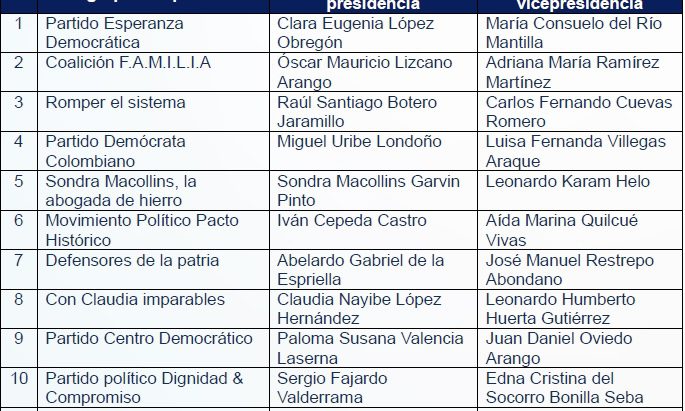
The Registraduría Nacional del Estado Civil of Colombia (RNEC), the entity responsible for organizing elections in the country, reported that a total of 14 candidates have officially registered to run in the country’s presidential elections, scheduled for May 31, 2026. In this vote, citizens will elect the President and Vice President of the Republic for the 2026–2030 term.

According to the electoral authority, the candidates represent a wide range of political perspectives, from left to right, including independent candidacies running through political movements. Here the list and brief profile of the candidates:

  1. Clara Eugenia López Obregón, currently a senator for the Esperanza Democrática She has served as Minister of Labor (2016–2017), acting mayor of Bogotá (2011–2012), and Bogotá’s secretary of government (2008–2010). She has been affiliated with left-wing parties and was Gustavo Petro’s vice presidential running mate in the 2010 election.
  2. Óscar Mauricio Lizcano, from the FAMILIA coalition. He served as Minister of Information Technologies (2023–2025), was a senator (2010–2018), and a member of the House of Representatives (2006–2010).
  3. Raúl Santiago Botero, candidate of the “Romper el Sistema” movement (Break the Establishment). An agronomist engineer and businessman from Medellín, he presents himself as an independent candidate with no prior political experience.
  4. Miguel Uribe Londoño, father of the slain presidential candidate Miguel Uribe Turbay. He is running under the Colombian Democratic Party and previously served as president of the Centro Democrático party founded by Álvaro Uribe Vélez.
  5. Sondra Macollins Garvin, from the movement “La Abogada de Hierro” (The Iron Lawyer) A criminal lawyer and psychologist, she presents herself as an independent candidate without political affiliations. She ran for the House of Representatives in 2022 and is known for her work in narcotrafficking and corruption cases.
  6. Iván Cepeda Castro, a senator since 2014 and the official candidate of the Pacto Histórico, the same party as President Gustavo Petro. Polls project he will receive the highest vote share in the first election round. He is aligned with left-wing political ideas.
  7. Abelardo de la Espriella, a lawyer with far-right positions, running for the first time under the Defensores de la Patria movement. Recent polls place him as a likely second or third contender in voter preference.
  8. Claudia López Hernández, former mayor of Bogotá (2020–2023) and former senator (2014–2018), running under the centrist movement “Imparables con Claudia.” She is known for her anti-corruption agenda and secured her candidacy with more than 570,000 votes (about 9%) in recent interparty primaries.
  9. Paloma Valencia Laserna, current senator and candidate of the Centro Democrático party led by Álvaro Uribe Vélez. She won the right-wing interparty primary on March 8 with more than 3 million votes. Polls place her among the top three contenders, and if she reaches a runoff, she would become the first woman in Colombia’s history to do so.
  • Sergio Fajardo Valderrama, an academic and mathematician running for the Dignidad y Compromiso He served as mayor of Medellín and governor of Antioquia and is running for president for the third time.
  • Roy Barreras, from the political party La Fuerza (The Force). He won the left-wing coalition primary on March 8 with the lowest vote total (257,000 votes, about 3.6%). Although currently aligned with left-wing movements and part of the Petro administration, he has previously been affiliated with right- and center-leaning parties.
  • Gustavo Matamoros Camacho, of the Colombian Ecologist Party. He served in the Colombian Army for 43 years. With no prior political experience, his campaign focuses on public security.
  • Luis Gilberto Murillo, who served as Minister of Foreign Affairs (2024–2025) and Colombia’s ambassador to the United States (2022–2024). A human rights advocate and Afro-Colombian leader from Chocó, he presents himself as an independent, moderate, centrist candidate.
  • Carlos Eduardo Caicedo, running under the independent movement “Con Caicedo.” He was mayor of Santa Marta (2012–2015) and governor of Magdalena (2020–2023), where he built a strong base as a left-wing political leader.

The RNEC also reported that “the draw to determine the position of presidential candidates on the ballot will take place on March 25 at the Ágora Bogotá Convention Center.”

This process marks the formal start of the final phase of the presidential campaign, during which candidates will seek to consolidate support ahead of the first round on May 31. If no candidate secures an absolute majority, a runoff between the two leading candidates will be held on June 21.

List of registered candidates for Colombia’s presidency. Photo courtesy of the Registraduría Nacional del Estado Civil.

List of registered candidates for Colombia’s presidency. Photo courtesy of the Registraduría Nacional del Estado Civil.

Headline photo: Polling station in Colombia during last Congress elections in March 8, 2026. Photo courtesy of the Registraduría Nacional del Estado Civil.

Arajet Seeks To Gain International Air Travel Market Share with Promotional Fare Campaign To & From Colombia

16 March 2026 at 22:28

Arajet seeks to become the dominant low-cost carrier connecting North & South America through its Caribbean hubs in the Dominican Republic.

Dominican airline Arajet has launched a “Hot Sale Colombia” promotion, offering discounted base fares for international travel originating from major Colombian hubs. The campaign targets passengers departing from El Dorado International Airport in Bogotá, José María Córdova International Airport in Medellín, and Rafael Núñez International Airport in Cartagena.

The promotional window is scheduled to run from March 16 through March 22, 2026. During this period, the airline is offering base fares starting at $1 USD. These rates apply to international routes within the carrier’s network and are available across all four of the airline’s service tiers: Basic, Classic, Comfort, and Extra.

Agressive fares through Q3 2026

According to the carrier, the travel window for tickets purchased under this promotion extends from April 15, 2026, to September 30, 2026. The availability of these fares is subject to seat capacity on specific flights. The initiative follows the carrier’s broader strategy to increase its market share in the Colombian aviation sector, which is regulated by the Unidad Administrativa Especial de Aeronáutica Civil (Aerocivil) under the Ministerio de Transporte.

Arajet commenced operations in September 2022 and currently maintains its primary hubs at Las Américas International Airport in Santo Domingo and Punta Cana International Airport. The airline utilizes an all-Boeing fleet, consisting of 14 Boeing 737 MAX aircraft (NYSE: BA). The carrier’s network connects the Dominican Republic with various destinations across North America, Central America, South America, and the Caribbean. In 2023, the airline was recognized as the “Best New Airline in the World” at the CAPA Aviation Trust Summit. The airline’s operations are overseen by the Instituto Dominicano de Aviación Civil (IDAC) in its home jurisdiction. Detailed pricing and baggage policies for the current promotion are available through the company’s digital booking platform.

Frontera To Sell Colombian Petroleum E&P Assets To Parex For $750 Million USD

14 March 2026 at 21:48

Frontera must pay a $25 million USD breakup fee to Geopark.

Frontera Energy Corporation (TSX: FEC) has entered into a definitive arrangement agreement to divest its Colombian upstream exploration and production (E&P) portfolio to Parex Resources Inc. (TSX: PXT) for a total firm value of approximately $750 million USD. The transaction follows the termination of a previous agreement with GeoPark Limited (NYSE: GPRK). Frontera opted for the Parex proposal after the Calgary-based independent producer offered $525 million USD in equity consideration, a $125 million USD increase over the prior GeoPark bid. As part of the transition, Frontera has paid a $25 million USD breakup fee to GeoPark.

The $525 million USD equity consideration includes an immediate $500 million USD cash payment upon closing and a $25 million USD contingent payment. The latter is dependent on the execution of a contractual amendment or binding agreement to extend the term of the Quifa Association Contract within 12 months.

Beyond the cash equity, Parex will assume $390 million USD in existing Frontera liabilities. This includes $310 million USD in 2028 Senior Unsecured Notes and an $80 million USD prepayment facility with Chevron Products Company, a subsidiary of Chevron Corporation (NYSE: CVX).

Following the close of the deal, Frontera intends to distribute approximately $470 million USD to its shareholders, which equates to roughly $9.18 CAD per share based on current exchange rates and outstanding share counts. This distribution is subject to shareholder approval and the successful completion of the transaction.

Frontera is retaining its exploration interests in Guyana.

Shift to Infrastructure Focus

Upon completion, Frontera will pivot its corporate strategy to focus exclusively on energy infrastructure. Its remaining portfolio will be anchored by two primary Colombian assets:

The company will also retain its exploration interests in Guyana. Frontera’s infrastructure division generated approximately $77 million USD in distributable cash flow in 2025. Post-transaction, Frontera expects to maintain $50 million USD in cash reserves to fund growth projects, including a potential Liquefied Natural Gas (LNG) regasification project in partnership with Ecopetrol S.A. (NYSE: EC; BVC: ECOPETROL).

Orlando Cabrales, CEO of Frontera, noted that Parex is currently the largest independent operator in Colombia and a pre-existing partner in the VIM-1 block, which suggests operational continuity for the assets and employees involved.

The independent members of Frontera’s Board of Directors have unanimously recommended the deal. Major shareholders The Catalyst Capital Group Inc. and Gramercy Funds Management LLC, who collectively hold approximately 53% of Frontera’s outstanding shares, have signed support agreements to vote in favor of the arrangement.

Timeline and Approvals

The transaction is structured as a plan of arrangement under the Business Corporations Act of British Columbia. It requires the approval of at least two-thirds of the votes cast by Frontera shareholders at a forthcoming special meeting.

The deal is also subject to approval by the Supreme Court of British Columbia and relevant regulatory bodies in both Canada and Colombia. Parex will fund the acquisition through existing cash, credit facilities, and an underwritten financing commitment from Scotiabank (TSX: BNS; NYSE: BNS). Closing is anticipated in the second quarter of 2026.

Citi (NYSE: C) served as the financial advisor to Frontera, while BMO Nesbitt Burns Inc. provided a fairness opinion. Legal counsel was provided by Blake, Cassels & Graydon LLP and McMillan LLP.

Above photo: Frontera Energy’s Quifa field Meta Colombia. Photo credit: Frontera Energy.

Over 3,200 Candidates to Run for 284 Seats in Colombia’s Legislative Elections This Sunday

6 March 2026 at 20:31

Seats are distributed using the D’Hondt method, known in Colombia as the cifra repartidora, which allocates seats proportionally according to the number of votes obtained.

A total of 3,231 candidates will compete for seats in Colombia’s congress in the legislative elections scheduled for March 8, according to the Registraduría Nacional del Estado Civil (RNEC), the authority responsible for organizing the country’s electoral processes. In total, 102 senators and 182 members of the House of Representatives will be elected.

According to the electoral authority, 1,124 candidates registered for the Senate and 2,107 for the House of Representatives, the two chambers that make up Colombia’s congress.

As the political analysis website Razón Pública explains, Colombia’s electoral system is based on proportional representation, which seeks to reflect the diversity of political opinions within society in the composition of Congress. For the Senate, or upper chamber, voters may cast their ballots for candidates anywhere in the country, as it operates under a national constituency. In contrast, the House of Representatives, or lower chamber, is elected through territorial constituencies by departments, including Bogotá as the Capital District.

According to the RNEC, 41,287,084 citizens are eligible to vote in the upcoming elections, a key figure because it influences how seats are allocated.

Senate elections

In this election, 102 senators will be chosen by popular vote. According to the Senate’s official website, 100 will be elected through a nationwide constituency and the remaining two seats are reserved for indigenous communities, a special constituency established by the 1991 Constitution to guarantee political representation for these groups.

Voters must choose between receiving the national ballot or the Indigenous constituency ballot, but they cannot vote in both.

House of Representatives elections

For the House of Representatives, 182 members will be elected, distributed as follows:

  • Territorial constituencies: 161 seats allocated to departments and the Capital District of Bogotá.
  • Special Transitional Peace Constituencies: 16 seats reserved for victims of the armed conflict, created by the Acto Legislativo 02 of 2021.
  • Afro-descendant communities: 2 seats.
  • Indigenous communities: 1 seat.
  • Community of San Andrés (Raizal): 1 seat.
  • Colombians living abroad: 1 seat.

Unlike the Senate, each department receives a specific number of seats based on its population, creating regional electoral dynamics in which local political leadership often plays a key role. In practice, more populous departments hold greater representation than smaller ones.

Both the Senate and the House of Representatives receive one additional seat after the presidential election, allocated to the candidate who obtains the second-highest number of votes.

How seats are allocated

Colombia’s electoral system is regulated by the Acto Legislativo 001 of 2003 and the Electoral Law, and operates under principles of proportional representation.

First, the valid votes obtained by each party list are counted. Only those lists that surpass a 3% threshold of total valid votes are eligible to participate in the distribution of seats. In the 2022 legislative elections, this threshold exceeded 509,000 votes.

According to projections by the Misión de Observación Electoral (MOE), the threshold for the Senate in the upcoming elections could reach around 600,000 votes.

This threshold is crucial because if, for example, a candidate obtains 450,000 votes but their party fails to pass the threshold, neither the candidate nor the party will secure a seat in Congress.

Among the lists that surpass the threshold, seats are distributed using the D’Hondt method, known in Colombia as the cifra repartidora, which allocates seats proportionally according to the number of votes obtained. In 2022, the seat-allocation quotient was 144,013 votes.

For the House of Representatives, the process is more complex because the threshold and D’Hondt method are applied separately within each department, producing different results across regions.

With closed lists, voters select only the political party or list as a whole, without choosing an individual candidate.

Open and closed lists

Under the Acto Legislativo 1 of 2003, political parties may register open lists or closed lists. With open lists, voters select a specific candidate within a party’s list. The vote counts both for the political party and for the individual candidate. Seats obtained by the party are then assigned to the candidates who received the highest number of votes, regardless of their initial position on the list.

With closed lists, voters select only the political party or list as a whole, without choosing an individual candidate. Seats are then allocated according to the order predetermined and registered at the start of the campaign by the party.

In the upcoming elections, two of Colombia’s most prominent political forces will present closed lists: the Pacto Histórico, the coalition led by current President Gustavo Petro, and the Centro Democrático, the right-wing party founded by former President Álvaro Uribe Vélez.

Photo courtesy of the National Civil Registry of Colombia,

Colombia’s Primary & Legislative Elections This Sunday Will Set The Tone For Upcoming Presidential Election

6 March 2026 at 18:59

Colombia’s presidential primaries are interparty, where broad coalitions decide on a candidate that the allied parties then agree to back.

This Sunday, March 8, 2026, Colombia will hold one of the most significant electoral events of the year’s political calendar. In addition to electing a new congress, voters will participate in the so-called Interparty Primaries, a mechanism through which political parties select their candidates for the presidential election scheduled for May 31.

According to the political analysis website Razón Pública, these consultations seek to “build broad coalitions composed of parties, movements, and independent candidacies.” In practice, they allow different political sectors to determine through open voting who will represent each coalition in the presidential race.

Political parties seek to boost their chances in the presidential race or strengthen their leverage in potential coalition negotiations.

In total, three separate primaries will take place, each with its own ballot. Citizens may participate in only one of them by requesting the corresponding ballot when voting for Congress.

The first is the “Solutions Primary: Healthcare, Security and Education,” made up of parties from the political center. In this contest, former Bogotá mayor Claudia López faces independent lawyer Leonardo Huertas. According to the latest Invamer poll, López is the clear frontrunner, with a projected 92.9% voting preference, compared with her only opponent.

The second consultation represents the political right and includes nine pre-candidates in the so-called “Grand Primary for Colombia.”

Among the contenders are former ministers of previous governments Juan Carlos Pinzón (Defense), Mauricio Cárdenas (Finance), and David Luna (Information Technologies); former Antioquia governor Aníbal Gaviria; former Bogotá mayor Enrique Peñalosa; journalist Vicky Dávila; and three senators representing their respective parties: Juan Manuel Galán (Nuevo Liberalismo), Juan Daniel Oviedo (Con Toda con Colombia), and Paloma Valencia (Centro Democrático).

Polls consistently identify Paloma Valencia as the favorite to win the primary. The Invamer poll projects her with 41.6% of the vote, Atlas Intel 44.4%, and Guarumo-EcoAnalítica 40.6%, while the firm Gad3 also places her first but with a lower estimated vote share of 17%. Valencia has been campaigning nationwide accompanied by former president Álvaro Uribe Vélez, the leading figure of the Centro Democrático, and previously won her party’s internal selection process through a member survey held on December 15.

The third primary corresponds to the coalition known as the “Front for Life,” made up of left-wing candidates, although without the official backing of current President Gustavo Petro, who under Colombian law is prohibited from participating in electoral politics or promoting candidates.

Candidates in this race include Héctor Elías Pineda, a former member of the M-19 guerrilla movement (the same group Petro once belonged to); Edison Lucio Torres of the Partido de los Trabajadores (Worker’s Party); and independent candidate Martha Viviana Bernal.

Former senator Roy Barreras; and embattled former mayor of Medellín Daniel Quintero Calle registered through the Movimiento de Autoridades Indígenas de Colombia. Polls by Guarumo-EcoAnalítica (47.6%) and Invamer (68.1%) place Daniel Quintero as the leading candidate of this Primary. However, the firm Atlas Intel did not measure this coalition, arguing that it did not surpass the statistical threshold required.

What comes next in the political landscape after the Primaries?

According to Razón Pública, “once the March 8 voting concludes, the political landscape will enter a phase of critical decisions. The results will determine alliances and realignments ahead of the presidential first round.”

Across the political spectrum, the winners of each consultation will attempt to consolidate support to compete against other candidates who registered directly without participating in the consultations. These include Abelardo de la Espriella, a conservative lawyer and businessman who registered through citizen signatures; Iván Cepeda, the official candidate of the Pacto Histórico coalition led by President Petro and currently leading voting-intention polls; and Sergio Fajardo, who registered with the party Dignidad y Compromiso.

Under Colombia’s electoral Law (1475 of 2011), political parties may still modify or withdraw candidates until March 20. After that date, the presidential campaign will move toward the first round scheduled for May 31. If no candidate secures an absolute majority of the vote (50% plus one), the two candidates receiving the highest number of votes will compete in a runoff election on June 21, where the candidate with a simple majority will be elected president.

Photos courtesy of the Registraduría Nacional del Estado Civil

Avianca Inks Sponsorship Deal With Miami FC Soccer Team

3 March 2026 at 01:25

Avianca has signed a multi-year agreement to become an official sponsor of Miami FC, a professional soccer club competing in the USL Championship. The partnership comes as the club initiates the construction of a new stadium facility in the south Miami-Dade area and seeks to align with corporate partners as part of a long-term growth strategy.

Under the terms of the deal, the airline will receive brand placement on the official team jerseys. Additionally, the club’s fan interaction area, previously known as the Fútbol305 Zone, has been rebranded as the Avianca Fútbol305 Zone. This activation is intended to provide fans with direct access to players and team events.

The move marks a strategic effort by Avianca to consolidate its presence in the Florida market, which serves as a primary hub for its North American operations. According to Rolando Damas, the airline’s sales director for North America and Europe, Miami is a critical gateway connecting the US with Latin America.

Data provided by the carrier indicates a period of growth in its US operations. In 2025, Avianca transported more than 4,900,000 passengers to and from the US, representing an increase of more than 6% compared to 2024 figures. During that same period, the airline operated 34,200 flights within its US network.

Currently, Avianca operates more than 400 weekly flights across 14 US cities. Its Florida operations specifically include more than 100 weekly flights departing from Miami, Orlando, Fort Lauderdale, and Tampa. These routes provide connectivity to destinations in Colombia, Ecuador, and Central America, as well as broader links to more than 80 destinations across 25 countries.

Miami FC executives noted that the partnership coincides with the development of world-class facilities in South Florida. Nathan Krum, the club’s chief marketing and revenue officer, stated that the collaboration is part of a broader vision to increase community accessibility and global connectivity.

Avianca is a member of the Star Alliance and is part of the Abra Group. The airline group includes several subsidiaries such as Aerovías del Continente Americano S.A., Taca International Airlines S.A., and Avianca Ecuador S.A.. In 2025, the consolidated group transported approximately 37,000,000 customers globally, operating a fleet of 140 aircraft including Airbus A320 and Boeing 787 Dreamliner models. Its loyalty program, LifeMiles, currently maintains a membership base of approximately 15,000,000 individuals.

The financial terms of the sponsorship were not disclosed, though it follows a trend of Latin American carriers increasing marketing spend within US professional sports to capture a larger share of the diaspora and tourism markets.


Ookla: Claro Fastest Mobile Carrier in Colombia, But Movistar Fastest Fixed ISP

2 March 2026 at 23:07

The survey also found that the Medellín suburb of Envigado is the city with the fastest internet connectivity.

According to the latest connectivity report for the second half of 2025 released by Ookla, the Colombian telecommunications market has seen specific performance leaders in both mobile and fixed broadband sectors. The data, which tracks network performance across the country, identifies Claro (NYSE: AMX, BMV: AMX) and Movistar (NYSE: TEF, BMEX: TEF) as the primary benchmarks for speed and user experience during this period.

In the mobile sector, Claro was identified as the provider with the highest network performance. The operator recorded a median download speed of 44.26 Mbps and a median upload speed of 14.03 Mbps. These figures contributed to the company securing the highest rankings for mobile connectivity metrics in the Colombian market for the latter part of the year.

The report also evaluated the fixed internet market, where Movistar maintained a significant lead in throughput. The Telefónica-owned provider registered a median download speed of 308.37 Mbps and a median upload speed of 291.3 Mbps. This performance distinguishes Movistar as the fastest Internet Service Provider (ISP) in the country for fixed line connections.

Colombian carriers continue to deploy fiber optic fixed internet, and 5G wireless throughout the country.

In terms of specific user applications, Claro led the gaming category. The provider recorded the highest metrics for mobile gaming and also achieved the top score for gaming experience among fixed internet providers. This metric typically accounts for latency, jitter, and packet loss, which are critical for real-time interactive applications.

Geographic analysis of the data revealed that Envigado, a municipality located just sout of Medellín in the Antioquia Department, outperformed other major urban centers. Among the most populous cities in Colombia, Envigado recorded the fastest median download speeds for both mobile and fixed connections, reaching 54.76 Mbps and 269.9 Mbps, respectively.

The findings from Ookla provide an objective overview of the infrastructure performance as the Colombian government and private entities continue to expand 5G and fiber optic deployment. While Claro leads in mobile and gaming, Movistar maintains the highest speed profile for fixed residential and business internet.

Candice Fast on the Hidden Beliefs That Shape Workplace Performance

20 February 2026 at 13:34

As Latin American companies confront slowing growth, talent churn and the demands of hybrid work, leadership effectiveness is being redefined. Strategy and charisma are no longer enough. Increasingly, performance hinges on something less visible: the assumptions leaders and employees hold about one another.

New doctoral research by Dr. Candice Fast suggests those hidden beliefs – often unconscious – can measurably shape engagement, productivity and service outcomes. Her study, Exploring Implicit Belief Alignment in Leaders and Followers, argues that leadership success depends not only on decision-making and execution, but on the mental models quietly governing workplace interactions.

The findings are particularly relevant for Colombia’s corporate sector, where hierarchical traditions often coexist with modern performance management systems.

After surveying 203 participants across North America, Dr.Fast applied validated psychological instruments and statistical modelling to examine how implicit beliefs influence workplace structures. The results indicate that misaligned assumptions between leaders and employees can account for up to 5% of passive behaviour within organizations. In financial terms, this margin is significant.

Why the 5% effect matters

In large corporations, even a 5% increase in engagement can translate into millions of dollars in productivity gains, improved customer satisfaction and lower operational friction. Applied studies cited alongside the research show that teams fostering collaborative belief structures recorded 5% to 10% higher engagement levels and measurable reductions in turnover costs.

For Latin American enterprises – where employee disengagement and retention are endemic challenges – such increments can determine whether performance targets are met or missed.

One of Dr.Fast’s more striking findings is that positive perceptions alone do not guarantee proactive performance. Companies must move beyond the catch phrasing of “positive thinking.” Leaders who unconsciously associate teams with traits such as conformity or passivity may inadvertently reinforce those behaviours, regardless of stated values.

In other words, culture is not shaped solely by policies or incentive systems, but by cognitive framing.

This has implications for multinational corporations operating across the region. Cultural and national variables were shown to influence how expectations are formed and interpreted within teams. In cross-border environments – from Bogotá to São Paulo to Mexico City – misalignment can quietly erode efficiency and collaboration.

As Latin American firms expand internationally and global groups deepen their regional footprint, leadership models that account for cognitive alignment may become a differentiating factor.

Unlike much academic work, Fast’s framework is designed for operational use. It emphasises structured self-assessment to surface subconscious assumptions, the use of 360-degree feedback to identify perception gaps, and the comparison of belief patterns with engagement data. It also encourages organisations to reframe limiting narratives through facilitated dialogue and to embed cognitive flexibility into leadership development programmes.

These tools align with a broader professionalisation of management practices across Latin America, where firms are increasingly adopting analytics-driven approaches to human capital strategy.

Fast’s corporate experience includes more than a decade at The Walt Disney Company, a global operator known for embedding service standards and behavioural alignment into its operational model. The relevance of belief alignment is evident in complex organizations where consistency, collaboration and innovation must scale across thousands of employees.

As an industry insider, Ursafe has publicly endorsed the groundbreaking research, describing it as a practical roadmap for measurable performance improvement. But the broader significance lies more in timing than endorsement. “The clarity it brings to the dynamics between leaders and employees makes it a benchmark for modern organizational development.”

Latin American businesses are navigating inflationary pressures, digital transformation and generational shifts in workplace expectations. In this environment, marginal gains in engagement and trust can compound quickly.

The study’s conclusion is clear: leadership success is not determined solely by strategic vision or authority, but by the invisible assumptions shaping daily interactions between managers and teams.

For companies willing to measure and recalibrate those assumptions, belief alignment may prove to be more than a theoretical construct. It may become a competitive lever – one capable of turning subtle cognitive shifts into tangible financial results.

In a hemisphere where growth increasingly depends on talent retention, innovation and cross-cultural agility, Dr.Candice Fast’s vision of leadership is grounded less on what organizations do — and more on how they think. “Beliefs, though invisible, are among the most powerful tools leaders possess,”  highlighted the data researcher.

Bancolombia: Colombia Inflation Rises to 5.3% Under Indexation Pressures

15 February 2026 at 03:02

The bank’s analysts say that the increase still doesn’t include the effects of Gustavo Petro’s 23% decreed increase in the country’s legal minimum wage.

According to a report by the Economic, Industry & Market Research Area of Bancolombia (BVC: BCOLOMBIA, NYSE: CIB), annual inflation in Colombia rose by 25 basis points to 5.35% in January 2026. This monthly increase of 1.18% represents the highest inflation level since October 2025.

The data, originally prepared by the National Administrative Department of Statistics (DANE), indicates that 70% of the January inflation print was concentrated in the services and regulated components. These two sectors contributed 83 basis points of the total 118-point monthly increase, largely driven by the initial stages of annual cost pass-throughs associated with high indexation.

Businesses should prepare for more intense inflationary pressures in February and March 2026 as the full impact of the minimum wage increase and renegotiated supplier contracts take effect.

Sectoral Impacts and Service Acceleration

Annual inflation in the services category accelerated by 40 basis points to reach 6.33% in January, its highest level since April 2025. The monthly variation of 1.18% in this sector was nearly double the historical January average of 0.63%.

Bancolombia analysts attribute this acceleration to early adjustments linked to the 23% minimum wage increase for 2026 and indexation to previous years’ inflation. Notable increases were observed in:

  • Full-service restaurant meals: 3.36%
  • Prepared meals consumed outside the home: 2.38%
  • Domestic services: 5.16%
  • Imputed rent: 0.43%

The regulated group also saw an acceleration, with annual inflation rising to 5.47% from 5.40%. This was primarily explained by adjustments in urban transportation, vehicle fuels, natural gas, and tolls.

Food and Goods Price Momentum

Annual food inflation edged up slightly to 5.10% from 5.06%. Perishable foods saw an acceleration to 4.69% due to seasonal and supply factors affecting products such as tomatoes, potatoes, and plantains. Processed foods, including beef, milk, and poultry, reflected early-year cost pass-throughs, though annual inflation in this sub-group eased to 5.23%.

The goods category reached its highest level since March 2024, at 2.93%. Price hikes in this segment were driven by new taxes on alcoholic beverages enacted under the economic emergency, as well as pharmaceutical products. Conversely, price declines were noted in personal hygiene products, vehicles, and appliances, benefiting from the recent appreciation of the exchange rate.

Monetary Policy Implications and Forecasts

The Central Bank of Colombia (Banco de la República) faces continued challenges in converging toward its 2% to 4% target range. Core inflation, excluding food and regulated items, reached its highest level since November 2024, indicating persistent upward pressure.

Bancolombia forecasts that year-end inflation will reach 6.4%. The analysts suggest that the full impact of the minimum wage increase has not yet been reflected in consumer prices, as many firms are still operating with inventories purchased at previous cost levels.

Consequently, the Central Bank is expected to continue raising its monetary policy rate to anchor inflation expectations. Bancolombia anticipates the policy rate could rise to 11%, noting that the challenging outlook introduces a hawkish bias to future decisions.

Photo courtesy Bancolombia

Colombia’s Petro Defies Court Suspension of Minimum Wage Hike

16 February 2026 at 16:13

Colombian President Gustavo Petro on Sunday mounted a forceful defence of his government’s 23.7% minimum wage increase for 2026, pledging to issue a temporary decree to keep the so-called “vital wage” in place after the Council of State provisionally suspended the original measure.

Speaking in a televised address on Feb. 15, Petro said that while he disagreed with the high court’s decision, he would respect the judicial process and comply by issuing a transitory administrative decree, pending a final ruling.

“The vital wage will remain in place until the new decree is issued,” Petro said, rejecting claims that the increase had triggered inflation or job losses and insisting that workers’ purchasing power must not be subordinated to shifting economic variables.

The Council of State questioned the technical justification and procedural basis of the December decree that lifted the monthly minimum wage to 1.75 million pesos ($470) – close to 2 million pesos including transport subsidies – forcing the government to revisit the measure barely six weeks after it took effect on Jan. 1.

Rather than retreating, Petro escalated the confrontation, calling for nationwide demonstrations on Feb. 19 to defend what he described as a historic social gain for Colombian workers.

“We’ll see each other in all public squares across Colombia,” the president wrote on social media, framing the dispute as a struggle over dignity and constitutional labour rights rather than a technical wage-setting debate.

Petro anchored his argument in Constitutional Court ruling C-815 of 1999, which he said obliges governments to consider not only inflation and productivity but — “with prevailing character” – the constitutional mandate to guarantee a minimum, vital and mobile wage.

Even higher wage not ruled out

In a move that further unsettled markets and business groups, the government signalled that the revised decree could maintain – or even exceed – the original 23.7% increase.

Labour Minister Antonio Sanguino said on Monday that “nothing is ruled out” as the government reconvenes the Permanent Commission on Wage and Labour Policy, bringing unions and employers back to the negotiating table.

The president himself suggested that a true “vital wage” should be closer to 2.15 million pesos, well above the current level.

Sanguino said the commission would review updated economic indicators from the national statistics agency DANE and the finance ministry, including inflation data for early 2026 and labour market trends from 2025.

Inflation and employment debate intensifies

Petro dismissed warnings that the wage hike could fuel inflation or unemployment, arguing that recent data contradict those claims. In a post on “X”, he said that even with Central Bank’s inflation forecasts near 6.4%, wage growth would remain strong and support domestic production and productivity. “It would be a national stupidity to lower the vital wage,”added  Petro, affirming also that the country’s first leftist administration would still listen to business leaders.

Economists and employers, however, remain sceptical. Financial analysts claim the suspension highlights institutional concerns over policy predictability, and fear the standoff could undermine investor confidence at a time when Colombia is grappling with deep fiscal debt and high labour informality.

The wage dispute has sharpened tensions between Colombia’s Executive, judiciary and private sector, just three months before first-round presidential elections in May 31.

The outcome of the Council of State’s final ruling – and whether the Executive succeeds in forging a late compromise with employers — will shape not only labour costs in 2026 but also a broader debate over economic governance and the autonomy of the Banco de la República.

For now, the minimum wage remains in legal limbo — enforced by decree, contested in court, and to be defended by his political base this week on the street.

Tropical storms batter Colombia’s Caribbean coast, flooding tens of thousands of homes

5 February 2026 at 00:02

Powerful storm surges and weeks of unusually intense rainfall have triggered widespread flooding across Colombia’s Caribbean coast, affecting more than 50,000 families, damaging homes and infrastructure, and placing hundreds of thousands of livestock at risk, authorities said.

The floods have hit the Magdalena River basin and large swathes of northern Colombia, forcing beach closures in major tourist hubs and leaving vast rural areas under water, particularly in the department of Córdoba, one of the country’s most productive cattle-raising regions.

In Cartagena, Colombia’s flagship Caribbean destination, six-foot waves driven by strong winds washed ashore this week, prompting authorities to close beaches and confine tourists to hotels as storm conditions intensified. Local officials warned that continued rough seas could further disrupt port operations and tourism activity.

Córdoba has borne the brunt of the emergency. According to local authorities, up to 70% of the department remains flooded after rivers burst their banks following sustained heavy rainfall. The National Federation of Cattle Ranchers (Fedegán) said losses to agriculture and livestock production were already “in the millions of dollars.”

Leonardo Fabio de las Salas, Fedegán’s coordinator in Córdoba, said 20 municipalities were flooded, with 4,778 rural properties submerged and more than 263,000 animals at risk. “Córdoba is the most severely affected department so far,” he said.

The floods have killed at least five people in Córdoba and left 24 of its 30 municipalities in a state of emergency, according to Colombia’s disaster management agency.

Carlos Carrillo, director of the National Unit for Disaster Risk Management (UNGRD), confirmed that the entity will oversee the delivery of emergency aid kits to affected families. The agency said more than 7,500 humanitarian kits — including food, hygiene products, cooking supplies and blankets — have already been distributed in municipalities such as Ciénaga de Oro, Montelíbano, Moñitos and Puerto Libertador.

Additional deliveries are being extended to Canalete, Cereté, San Pelayo and San Bernardo del Viento, while a new phase of assistance has been scheduled for towns including Lorica, Sahagún, Valencia and Puerto Escondido, some 6,000 families are expected to receive aid this week.

Córdoba Governor Erasmo Zuleta described the situation as one of the worst climate emergencies the department has faced in recent years. “The balance for Córdoba is very sad, very hard,” Zuleta said in a radio interview. “We have 23 of our 30 municipalities affected, 12 of them in critical condition. Around 20,000 families are currently displaced or severely impacted by the rains.”

The extreme weather has not been confined to Córdoba. In Santa Marta, a diesel tanker ran aground on Los Cocos beach on Tuesday morning near the city’s historic center after losing maneuverability amid strong currents and gale-force winds. The vessel remained stranded overnight, with authorities saying hazardous sea conditions continued to hamper efforts to remove it.

The incident also highlighted the scale of debris and waste washed ashore by the storm surge along Colombia’s Caribbean coastline. Local authorities in Santa Marta, echoing measures taken earlier in Cartagena, ordered the temporary closure of beaches as a cold front from the northern hemisphere intensified rainfall, winds and rough seas across the region.

Residents filmed the cargo vessel as it became lodged in the sand just meters from the shore, near the city’s marina. Officials have not yet said how long it will take to refloat the ship, citing ongoing maritime risks.

The first months of 2026 have been marked by persistent and unusually heavy rainfall across Colombia, from the Caribbean coast to central and western regions. Authorities say swollen rivers, landslides and flash floods have destroyed homes, killed people and animals, and caused widespread material losses.

Meteorological officials have warned that further rainfall is expected in the coming days, raising concerns that flooding could worsen in already saturated areas as emergency services struggle to reach remote communities.

❌