Reading view

Petro–Trump Phone Call Defuses U.S.–Colombia Tensions

It was a frustrating night for the roughly 6,000 supporters gathered in Bogotá’s Plaza de Bolívar to hear President Gustavo Petro deliver what many expected to be a fiery, anti-imperialist address.

After waiting for hours in cold, rainy conditions, demonstrators waved placards reading “Yankee Go Home,” “Out Trump,” and “Respect Colombia,” anticipating a confrontational speech aimed squarely at U.S. President Donald Trump following weeks of diplomatic tension.

Instead, when Petro finally took the stage, the tone of the rally shifted abruptly.

The Colombian president opened by announcing that he would not deliver his prepared speech. Rather than launching into the expected denunciation of Washington, Petro told the crowd that his delay was due to a lengthy phone call with Trump — a revelation that visibly stunned the audience.

As Petro spoke about the conversation, the plaza fell largely silent. Each mention of Trump appeared to drain the rally of its energy, replacing chants and applause with uneasy quiet. What had been billed as a mass show of resistance against U.S. pressure became an unexpected account of diplomatic rapprochement.

According to Petro, the call — conducted with simultaneous translation — lasted close to an hour and marked the first direct conversation between the two leaders since Trump’s return to office. “Today I came with one speech, and I have to give another,” Petro told supporters. “The first one was quite hard.”

A source at the presidential palace told El Colombiano that Petro appeared relaxed during the exchange, smiling several times as he spoke with Trump. A photograph of the moment, later shared by Petro, showed him seated at his desk mid-conversation.

Petro said the discussion focused primarily on drug trafficking, Venezuela and other bilateral disagreements. He acknowledged that significant differences remain but argued that dialogue was preferable to confrontation.

“I know that if anyone were to harm me — in any way — what would happen, given Colombia’s history and the level of support we have reached, is that the Colombian people would enter into conflict,” Petro said during the rally. “If they touch Petro, they touch Colombia.”

The remarks were a response to Trump’s recent comments suggesting that a military operation against Colombia, similar to the one carried out in Venezuela, “sounds good.” Petro, however, struck a notably more conciliatory tone on Wednesday, saying Trump “is not foolish,” even if he disagreed with him.

In a further surprise to supporters, Petro stated publicly that Nicolás Maduro was not his ally, claiming the Venezuelan leader had previously distanced him from Hugo Chávez by preventing him from attending Chávez’s funeral.

Shortly after the call, Trump issued a statement on his Truth Social platform confirming the conversation and signalling a thaw in relations.

“It was a Great Honor to speak with the President of Colombia, Gustavo Petro, who called to explain the situation of drugs and other disagreements that we have had,” Trump wrote. “I appreciated his call and tone, and look forward to meeting him in the near future.”

Trump added that Secretary of State Marco Rubio and Colombia’s foreign minister were already making arrangements for a meeting at the White House in Washington.

Petro confirmed that further discussions would be needed, particularly regarding drug trafficking figures, the role of the ELN guerrilla group along Colombia’s borders and Venezuela’s political future. “We cannot lower our guard,” Petro said. “There are still things to discuss at the White House.”

The president also revealed that he had spoken days earlier with Venezuela’s interim leader Delcy Rodríguez and had invited her to Colombia — a disclosure likely to further complicate regional diplomacy.

What was intended as a show of defiance against Washington ultimately became a public demonstration of Petro’s willingness to recalibrate his strategy, leaving his hardline supporters confused and critics questioning whether the president had overplayed the politics of mobilisation — only to pivot, unexpectedly, toward negotiation.

  •  

Petro temía un ataque de EE. UU. a Colombia. Entonces llamó Trump

La conversación habría apaciguado una crisis que estalló después de que el presidente de EE. UU. dijo que una acción militar contra Colombia “suena bien”. El mandatario colombiano habló con The New York Times justo antes de la llamada.
  •  

Colombia’s President Feared a U.S. Attack. Then Trump Called.

The conversation appeared to defuse a crisis that erupted after President Trump said military action against Colombia “sounds good.” President Gustavo Petro spoke to The New York Times just before the call.
  •  

Petro Calls Colombians to the Streets After Trump Raises Military Option

Colombian President Gustavo Petro has called on supporters to mobilise nationwide on Wednesday to defend “national sovereignty,” sharply escalating a diplomatic crisis with the United States after President Donald Trump said a U.S. military operation against Colombia “sounds good” to him.

The demonstrations are expected to take place in Bogotá’s Plaza de Bolívar, Parque Lourdes in the Chapinero locality, and outside the U.S. Embassy, with parallel protests planned in Medellín (Plaza Mayor), Cali (Plaza de Cayzedo), Bucaramanga (Plazoleta Cívica Luis Carlos Galán), Cartagena (Plaza de San Pedro Claver), Santa Marta (Parque de Bolívar).

The mobilisation follows Trump’s remarks aboard Air Force One on Sunday, when he described Petro as “a sick man” and appeared to endorse the idea of a U.S. military operation in Colombia — dubbed “Operation Colombia” by a journalist — comparable in scope to the operation that led to the arrest of Venezuela’s Nicolás Maduro and wife, Cilia Flores.

When pressed on whether he meant direct military action, Trump replied: “Sounds good to me,” before adding that Petro should “watch his ass.” The White House has not clarified whether the comments reflect official U.S. policy.

A Return to Arms?

Petro responded with a torrent of social media posts and public statements that have alarmed political opponents and business leaders . In some of his strongest language since taking office, the leftist president warned that U.S. military action would plunge Colombia back into armed conflict.

“If you bomb peasants, thousands of guerrillas will return to the mountains,” Petro said. “And if you arrest the president whom a good part of my people want and respect, you will unleash the popular jaguar.”

Petro, Colombia’s first leftist leader and a former militant of the M-19 guerrilla, said he had sworn under the 1989 peace pact never to take up arms again, but suggested that commitment could be reversed if Colombia’s sovereignty were threatened.

“Although I have not been a military man, I know war and clandestinity,” Petro wrote. “I swore not to touch a weapon again since the 1989 Peace Pact, but for the homeland I will take up arms again — even though I do not want to.”

He also warned Colombia’s armed forces against showing loyalty to Washington, saying any commander who prioritised U.S. interests over Colombia’s would be dismissed. The constitution, he said, required the military to defend “popular sovereignty.”

Diplomatic protest lodged in Washington

Colombia’s Foreign Ministry formally raised the dispute on January 4, issuing a diplomatic note of protest to the U.S. government through Ambassador Daniel García-Peña in Washington.

In the letter, the ministry said Trump’s remarks violated basic principles governing relations between sovereign states and amounted to “undue interference” in Colombia’s internal affairs.

“The President of the Republic of Colombia has been legitimately elected by the sovereign will of the Colombian people,” the statement said, adding that any attempt to discredit him was incompatible with international law and the United Nations Charter.

The Cancillería also cited principles of sovereign equality, non-intervention and mutual respect, saying threats or the use of force between states were “unacceptable.”

“Colombia is a democratic, sovereign state that conducts its foreign policy autonomously,” it said. “Its sovereignty, institutional legitimacy and political independence are not subject to external conditioning.”

The crisis has further polarised Colombia’s already fractured political landscape. Former president Álvaro Uribe, a vocal critic of Petro, said Colombia was drifting toward a Venezuela-style confrontation with the United States, though he stopped short of endorsing military intervention.

“What Colombia needs is a change of government,” Uribe told El Tiempo, adding that he trusted Washington’s strategy was “well conceived.”

Petro has cast Wednesday’s demonstrations as a defining moment for his presidency, portraying himself as the defender of national dignity against foreign aggression. He also reiterated the Colombian goverment’s position to cooperate fully with Washington on counter-narcotics and security issues. “You (Trump) took it upon yourself, in an act of arrogance, to punish my opinion — my words against the Palestinian genocide. Your punishment has been to falsely label me a drug trafficker and accuse me of running cocaine factories,” stated Petro hours after the Air Force One declations. “I don’t know whether Maduro is good or bad, or even whether he is a drug trafficker (…) so, stop the slander against me,” he said.

Petro’s critics accuse the president of instrumentalising public rallies to divert attention from Colombia’s deep internal security crisis, and to position himself politically alongside Venezuela’s ousted strongman. They argue that his language of “sovereignty” closely mirrors chavista narratives, warning that the protests risk morphing into an implicit show of solidarity with Nicolás Maduro rather than a defence of Colombia’s territorial integrity.

The White House has not walked back Trump’s remarks, and U.S. officials have so far declined to offer reassurances. On Wednesday morning, Secretary of State Marco Rubio and U.S. Secretary of War Pete Hegseth held a classified briefing with senators on Capitol Hill in which, according to Democratic leaders, their Republican counterparts refused to rule out sending U.S. troops to Venezuela or other countries.

Democratic Senate leader Chuck Schumer said he had asked for assurances that Washington was not planning operations elsewhere. “I mentioned some cases — including Colombia and Cuba — and I was very disappointed with their response,” Schumer said, adding that the meeting “left more questions than answers” and that the plan for the United States to govern Venezuela was “vague and based on illusions.”

As governments across Latin America closely watch the incoming chavista regime under interim president Delcy Rodríguez, the confrontation between Trump and Petro marks the most serious rupture in U.S.–Colombia relations in over two centuries. For Bogotá — long one of Washington’s closest allies in the region — the escalation has raised fears that incendiary rhetoric and mass mobilisation could push an already volatile situation into dangerous territory.

Editor’s Note: The U.S Embassy in Bogotá has issued a security alert, warning U.S. citizens to avoid large protests “as they have the potential to turn violent”.

  •  

Democracy Deferred: Did Washington Abandon María Corina Machado?

The extraction of Nicolás Maduro on Saturday was meant to signal the end of an era. Instead, it has exposed an uncomfortable truth that may loom over Washington weeks and months after the “shock-and-awe” attacks in central Caracas have waned from headlines: was Venezuela’s democratic opposition sidelined at the very moment it appeared closest to victory?

Just weeks earlier, María Corina Machado, the 2025 Nobel Peace Prize laureate and the symbolic leader of Venezuela’s opposition, had laid out her Freedom Manifesto — a sweeping blueprint for a Venezuelan-led democratic transition rooted in dignity, elections, free markets and the return of millions of exiles. She framed the coming moment not as an American intervention, but as a national rebirth steered by Venezuelans themselves.

That vision now appears to be colliding with a far more transactional reality.

Following Maduro’s capture in a U.S.-led operation, President Donald Trump declined to elevate Machado or her movement into any formal role. Instead, senior U.S. officials have coalesced around Delcy Rodríguez – Maduro’s longtime lieutenant and overseer of the oil sector — as Washington’s primary interlocutor in Caracas. Trump publicly praised Rodríguez’s cooperation while dismissing Machado as a “very nice woman” who “lacks the support” to lead the country.

On Monday, Delsy Rodríguez took the oath of office in the presence of the Ambassadors to China, Iran and Russia. The scene from the National Assembly recalls the sham investiture of Maduro on January 10, 2025,  and sends a dire signal to the internationl community:  Does oil security matter more than a secure democracy?

White House insiders told U.S. media that Trump had never warmed to Machado, “because his feelings got hurt”, reads the Daily Beast. According to an article on Monday in The Washington Post, the president declined to pick Machado because she committed the “ultimate sin” of offending his pride, after receiving the Nobel Peace Prize. “If she had turned it down and said, ‘I can’t accept it because it’s Donald Trump’s,’ she’d be the president of Venezuela today,” cites the newspaper’s sources.

Having lost the Oslo podium as the world’s “peace president,” personal grievance and strategic calculation have marked the White House’s decision to annoint a “moderate” in Miraflores. But Rodríguez is no moderate, and her penchant for state repression remains intact. A  recent article in the Wall Street Journal affirms that Washington is willing to tolerate a Maduro 2.0 — a Chavista continuity government — so long as it cooperates on oil, narcotics enforcement and geopolitical alignment.

On the ground in Caracas, the mood reflects that ambiguity. There have been no mass celebrations, no release of political prisoners, and no clear roadmap. Power remains concentrated within the same military-backed elites that have pillaged Venezuela for over three decades, even as Maduro himself awaits trial in New York on charges expected to exceed those once brought against Joaquín “El Chapo” Guzmán.

U.S. officials insist this is realism, not betrayal. Secretary of State Marco Rubio has argued that squeezing the regime economically and forcing compliance on security and oil will eventually produce leverage. But he has stopped short of demanding immediate elections — a notable omission given that the opposition already won one.

Machado’s Freedom Manifesto now reads less like a transition plan and more like a rebuke. It imagined a Venezuela where sovereignty flowed from the ballot box, not from foreign capitals; where dignity, not expediency, guided reconstruction; and where Venezuelans — not external powers — chose their leaders.

Instead, Trump has suggested that the United States will “run” Venezuela, even as it leaves the same repressive security apparatus intact. The contradiction is stark: maximum news coverage abroad, minimal transformation on the ground.

The question, then, is not only whether Trump sidetracked María Corina Machado, but whether the United States has traded a rare democratic opening for short-term gains. If Chavismo survives without Maduro — its prisons full, its generals untouched, its oil flowing under U.S management — the Nobel laureate’s blueprint may yet stand as the document of a revolution deferred.

And history may judge that Venezuela was not lost for lack of courage at home, but for lack of conviction abroad. In the words of Mexican historian Enrique Krauze, the end-game is inevitable: “If geopolitics seeks to turn Venezuela into a pawn on its chessboard, the people will take to the streets. They have chosen a legitimate president: Edmundo González. And they have a moral leader: María Corina Machado. Obstacles may arise, but Venezuela’s liberation is irreversible.”

  •  

Trump’s Threat of Force Against Colombia Draws Rebuke From Its Leader

President Gustavo Petro said that he had asked the Colombian people to defend him “against any illegitimate violent act.” His defense minister emphasized that security cooperation with Washington continued.
  •  

Trump floats U.S. military action against Colombia after Maduro capture

U.S. President Donald Trump escalated rhetoric toward Colombia on Sunday, suggesting that a U.S. military operation against the country — which he said could be dubbed “Operation Colombia” — was a possibility following Washington’s capture of Venezuelan dictator Nicolás Maduro.

Speaking to reporters aboard Air Force One, Trump described Colombian President Gustavo Petro as “a sick man” and accused him of overseeing cocaine production destined for the United States.

“Colombia is run by a sick man who likes making cocaine and selling it to the United States,” Trump said. “And he’s not going to be doing it very long. Let me tell you.”

When asked directly whether he meant a U.S. military operation against Colombia, Trump replied: “Sounds good to me.”

Trump’s remarks came a day after the United States announced it had captured Maduro in a military operation in Caracas, an unprecedented move that has sent shockwaves across Latin America and raised fears of further U.S. interventions in the region.

Trump said the United States could also consider military action against Mexico if it failed to curb the flow of illicit drugs into the country. He added that Venezuelan migrants in the United States were among the factors considered in the raid against Maduro.

Trump also warned that Cuba, a close ally of Venezuela, was “a failing nation” and said its political future was “something we’ll end up talking about.”

Maduro is currently being held in a New York detention center and is expected to appear in court on Monday on drug trafficking charges. Trump said his administration would seek to work with remaining members of the Venezuelan government to crack down on drug trafficking and overhaul the country’s oil sector, rather than push immediately for elections.

Despite Maduro’s capture, Venezuela’s Vice President and oil minister, Delcy Rodríguez, has assumed interim leadership with the backing of the country’s top court. Rodríguez has insisted that Maduro remains Venezuela’s legitimate president and has denied Trump’s claim that she is willing to cooperate with Washington.

In an interview published by The Atlantic on Sunday, Trump warned that Rodríguez could “pay a bigger price than Maduro” if she failed to cooperate with the United States. Venezuela’s communications ministry did not immediately respond to a request for comment.

Petro denounces U.S. threats

Trump’s comments prompted an immediate and forceful response from Petro, who accused the U.S. president of slander and warned that Latin America risked being treated as “servants and slaves” unless it united.

“Stop slandering me,” Petro said, calling on regional leaders to close ranks in the face of what he described as renewed U.S. imperial aggression.

In a series of lengthy posts on X, Petro said the United States had crossed a historic line by bombing Caracas during the operation to capture Maduro.

“The United States is the first country in the world to bomb a South American capital in all of human history,” Petro wrote. “Neither Netanyahu, nor Hitler, nor Franco, nor Salazar did it. That is a terrible medal, one that South Americans will not forget for generations.”

Petro said revenge was not the answer but warned that the damage would be long-lasting.

“Friends do not bomb each other,” he said, likening the attack on Caracas to the Nazi bombing of Guernica during the Spanish Civil War.

Instead, Petro urged deeper regional integration, arguing that Latin America must look beyond alignment with global powers.

“We do not look only to the north, but in all directions,” he said. “Latin America must unite or it will be treated as a servant and not as the vital center of the world.”

In a separate post, Petro issued a stark message to Colombia’s armed forces, ordering commanders to immediately remove any officer who showed loyalty to the United States over Colombia.

“Every Colombian soldier has an order from now on,” Petro wrote. “Any commander of the public forces who prefers the U.S. flag over the Colombian flag must immediately leave the institution.”

Petro said the armed forces were under orders not to fire on civilians but to defend Colombia’s sovereignty against any foreign invasion.

“I am not illegitimate. I am not a narco,” Petro wrote, rejecting Trump’s accusations. “I trust my people and the history of Colombia.”

Colombia’s first leftist president and a former member of the M-19 guerrilla movement also raised the spectre of a return to armed struggle, saying that while he had sworn under the 1989 peace pact never to take up weapons again, he would do so if Colombia’s sovereignty were threatened.

“I am not a military man, but I know war and clandestinity,” Petro wrote. “I swore never to touch a weapon again, but for the homeland I would take up arms once more, even though I do not want to.”

Rising fears of wider intervention

Trump’s warnings to Colombia were not his first. In the immediate aftermath of Maduro’s capture, he said Petro needed to “watch his ass” and suggested that Cuba’s political collapse was imminent.

The comments have heightened anxiety across the region, where governments are closely watching Washington’s next moves following the Caracas operation.

In Venezuela, a state of emergency has been in force since Saturday. A decree published on Monday ordered police to “immediately begin the national search and capture of everyone involved in the promotion or support for the armed attack by the United States,” according to the text.

Caracas remained largely quiet on Sunday, though residents reported a tense atmosphere as uncertainty mounted over the country’s political future and the possibility of further U.S. action.

For Colombia – a key U.S. ally that shares a 2,000-kilometre border with Venezuela, a country the Trump administration has said it will “run” in the aftermath of Saturday’s seizure of Maduro – the remarks mark the most explicit threat of U.S. military action in more than two centuries of diplomatic relations, and an ominous deterioration in already strained ties between Washington and Bogotá.

  •  

Trump praises “brilliant” military operation against Venezuela’s Nicolás Maduro

U.S. President Donald Trump has hailed as “brilliant” the U.S. military operation that resulted in the capture of Venezuelan dictator Nicolás Maduro, as explosions were reported in Caracas early Saturday. Governments across the Americas and Europe are reacting to the arrest of the Maduro and his wife Cilia Flores.

In a brief telephone interview with The New York Times hours after the strikes, Trump praised the planning and execution of the operation. “A lot of good planning and a lot of great, great troops and people,” Trump said. “It was a brilliant operation, actually.”

Trump said U.S. forces carried out a large-scale strike against military targets in Venezuela and captured Maduro and his wife, Cilia Flores, who were flown out of the country. He has not disclosed where they are being held. The U.S. administration claims there were no American casualties in the operation but declined to comment on Venezuelan casualties.

Venezuelan authorities have yet to confirm Maduro’s capture. Vice President Delcy Rodríguez said on state television that the whereabouts of Maduro and Flores were unknown and demanded “proof of life” from Washington.

Interior Minister and the regime’s henchman Diosdado Cabello urged calm, telling Venezuelans not to “make things easier for the invading enemy,” and alleged without evidence that civilian buildings had been hit.

In a separate statement broadcast on state television VTV, Venezuela’s Attorney General Tarek William Saab formally requested proof of life for Maduro and Flores. Saab condemned the U.S. action as a shift “from rhetoric to direct violence” and described the strikes as a premeditated act of terrorism. He said the operation left an unspecified number of people injured and killed, without providing figures or evidence.

Explosions were reported across Caracas in the early hours of Saturday, with power outages affecting several districts, according to witnesses and local media. Venezuelan state outlets reported strikes on major military and government sites, including Fuerte Tiuna, the country’s largest military base, and the La Carlota air base in heart of the capital.

According to sources inside Venezuela, pro-opposition supporters aligned with Venezuela’s legitimate president-elect Edmundo González and Nobel Peace Prize laureate María Corina Machado have begun mobilizing to secure government buildings and institutions and are preparing steps toward a political transition. Sources claim to be preparing the groundwork for what they describe as a interim administration, though no formal announcement has been made.

The U.S. embassy in Bogotá issued a security alert urging American citizens in Venezuela to shelter in place, citing “reports of explosions in and around” Caracas. The United States suspended operations at its embassy in Caracas in 2019.

Bogotá Mayor Carlos Fernando Galán called for calm and announced increased security measures near the U.S. and Venezuelan diplomatic missions in the Colombian capital.  “It is clear that a new stage is opening today for Venezuela, which should be oriented toward the return of democracy. That process must be peaceful and with full respect for the civilian population and international law. At this moment, the protection of Venezuelan citizens, both within their country and abroad, is a priority. Bogotá is home to hundreds of thousands of Venezuelan citizens, and our responsibility is to ensure their safety, their rights, and coexistence in the city,” he said.

Maduro was indicted in the United States in 2020 on corruption and drug trafficking charges, which he has repeatedly denied. The U.S. State Department has offered a $50 million reward for information leading to his arrest or conviction.

U.S. Attorney General Pamela Bondi said Maduro and Flores had been indicted in the Southern District of New York on charges including narco-terrorism conspiracy and cocaine importation conspiracy, adding that both would face U.S. justice.

Republicans react to Venezuela strikes

U.S House Representative María Elvira Salazar, a Florida Republican and outspoken critic of the Maduro government, said the strikes represented “the fall of a criminal structure masquerading as a government.” She said Maduro’s removal opened the door for “a real democratic transition led by Venezuelans who have resisted tyranny for years.”

Republican Senator Carlos Gimenez affirmed that “President Trump has changed the course of history in our hemisphere. Our country and the world are safer for it. Today’s decisive action is this hemisphere’s equivalent to the Fall of the Berlin Wall.”

Senator Rick Scott announced “A new day for Venezuela and Latin America. The United States and our hemisphere are safer because of President Trump’s leadership!”

U.S. Deputy Secretary of State Christopher Landau said in a social media post that Maduro had been removed from power and would be put on trial or punished, without providing further details.

Reactions from Latin America

Former Colombian President Álvaro Uribe Vélez defended the U.S. action as legitimate self-defense, arguing that Venezuela had for years harbored armed groups and facilitated drug trafficking. Uribe said that when a country becomes “a sanctuary for narco-terrorism,” it inevitably triggers consequences. He accused Venezuela’s leadership of destroying democratic institutions and fueling an exodus of millions across the region, urging Venezuelans to pursue freedom and institutional reconstruction.

Former Colombian President Iván Duque also welcomed the development, calling Maduro’s capture “the beginning of the end of the narco-dictatorship in Venezuela.” Duque said the moment opened a path toward democratic reconstruction with international support, while emphasizing the need to protect regional security.

Colombia’s current President Gustavo Petro took a sharply different view, rejecting what he called aggression against Venezuela’s sovereignty. Petro said Colombia had deployed security forces to its border and activated contingency plans in case of a mass influx of refugees, while seeking to convene the United Nations Security Council. “Internal conflicts between peoples are resolved by those same peoples in peace,” Petro said.

Argentina’s President Javier Milei struck a celebratory tone, posting on “X”: “Long live freedom, carajo!”

Ecuador’s President Daniel Noboa voiced support for Venezuela and the opposition. “To María Corina Machado, Edmundo González and the Venezuelan people, it is time to recover your country,” Noboa wrote, adding that what he called “narco-Chavista criminal structures” would continue to fall across the continent.

Colombian presidential candidate Paloma Valencia of the Centro Democrático party was among the first to react to the breaking news, stating: “Free Venezuela. The illegitimate dictator who usurped power, and subjugated Venezuela and the Venezuelans, has fallen. Democrats yearned for an opportunity for the return of democracy and freedom.”

Medellin Mayor Federico Gutiérrez also celebrated the arrest of the regime leader, saying: “Dictator Nicolás Maduro has been captured. Every tyrant’s time comes. Venezuela Free.”

Spain’s Prime Minister Pedro Sánchez has urged restraint and respect for international law, while Cuba’s President Miguel Díaz-Canel condemned the  “criminal attack” by the United States.

As of Saturday morning, no senior Venezuelan military official, including Defense Minister Vladimir Padrino, had appeared publicly, and it remained unclear who controlled key state institutions or how Venezuela’s armed forces would respond as the crisis continued to unfold.

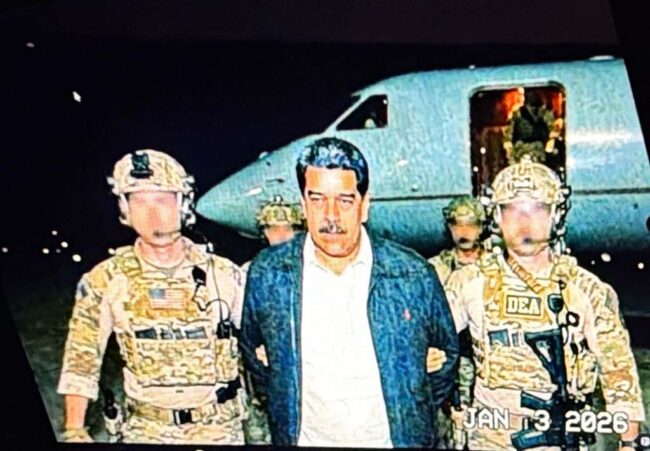
Screen capture from television shows DEA agents escorting Venezuela’s Nicolás Maduro.
  •  

BREAKING: Venezuela’s Maduro captured after U.S strikes Caracas

The United States has captured Venezuelan dictator Nicolás Maduro, along with his wife Cilia Flores, after a series of targeted military strikes on Caracas at 1:30 am on Saturday, January 3, 2026.

In a statement posted on his Truth Social platform, U.S President Donald J. Trump said U.S. forces, working with U.S. law enforcement, conducted a “large scale strike” that resulted in the capture of Maduro and his wife, Cilia Flores. Trump said both were flown out of Venezuela, without providing details on where they were taken or the legal basis for their detention.

“The United States of America has successfully carried out a large scale strike against Venezuela and its leader, President Nicolas Maduro,” Trump said, adding that more information would be released at a news conference scheduled for 11 a.m. ET at his Mar-a-Lago residence in Florida.

Explosions were reported across parts of Caracas in the early hours of Saturday, according to witnesses and videos posted on social media, which showed flashes in the sky, fires and power outages in several areas of the capital. One of the main targets appeared to be Fuerte Tiuna, the country’s largest military base and a key command center for Venezuela’s Bolivarian Armed Forces.

The extent of damage and possible casualties could not be independently verified. Venezuelan authorities did not immediately confirm whether senior military officials, including Defense Minister Vladimir Padrino, were injured or killed in the strikes.

In Washington, Republican lawmakers were quick to praise President Trump’s decisive action. Representative Mario Díaz-Balart praised the operation, saying it demonstrated decisive leadership against what he described as an illegitimate regime that posed a threat to U.S. and regional security. Other lawmakers raised questions about the legality of the strikes and whether Congress had authorized the use of force.

In Colombia, Medellín Mayor Federico Gutiérrez expressed support for Venezuelans living abroad, saying millions had fled repression and economic collapse under Maduro’s rule. Venezuelan migrants make up a significant share of Medellín’s population, local authorities say.

It remains unclear how Venezuela’s armed forces will respond or whether Maduro’s removal will lead to a peaceful transition of power with the return of President-elect Edmundo González and opposition leader Maria Corina Machado, both currently out of the country.

Developing News Story….

  •  

Daniel Giraldo of FTI Consulting Unpacks The Significance of Colombia Joining China’s Belt & Road Initiative

In an era of shifting global economic alliances, few countries find themselves more strategically positioned than Colombia. Caught between the massive state-backed investment initiatives of China and the established political and economic influence of the United States, Bogotá’s policy decisions have never held higher stakes for investors, the region, or especially, the country’s own citizens.

At the 2025 Colombia Gold Summit, Finance Colombia Executive Editor Loren Moss spoke with Daniel Giraldo, a Managing Director at FTI Consulting (NYSE: FCN), a global business advisory firm specializing in cross-border investment and corporate finance. Giraldo offered his perspective on the geopolitical chessboard, examining what Colombia’s recent decision to join the Belt and Road Initiative means for its future relationship with its largest long-standing ally, the United States.

Finance Colombia: I’m here with Daniel Giraldo of FTI Consulting. So we’re here at the 2025 CGS, Colombia Gold Summit, where we also talk about other precious metals, we talk about silver, we also talk about metals like copper, molybdenum, things like that. You gave an interesting talk yesterday, I don’t want to steal your thunder. Why don’t you summarize your discussion?

Daniel Giraldo: Well, if I could summarize my lecture yesterday, I think there’s a chessboard, a giant global chessboard right now. And there are two main players: US and China. And Colombia is one key figure, a key part of this chessboard. Right now, Colombia is in a key position with lots of opportunities between Chinese investment and the US investment. However, which decisions Colombia takes right now will shift the entire game for the coming years.

Finance Colombia: So we are in the last few months of a government that has been relatively friendly or biased towards China. And hostile might be too strong of a word, but relatively cold towards the United States, talking about the Petro government. Colombia, under Petro, just signed up for the Belt and Road Initiative. What is the significance of that for Colombia, not just in its relationship with the United States, but what does that do or change for Colombia?

Daniel Giraldo: Well, what we are seeing right now is that Colombia signed formally the Belt and Road Initiative earlier this year. And there’s been a lot of tensions with the Trump government. At the same time, the US is the main investor in Colombia. And what we’re seeing is how China, through different initiatives, wants to have a bigger long-term influence in the region. And Colombia is, in a soft way, saying, “We want that for us.” However, that’s not a shift that can be made automatically. That’s not made in a single signature by one president. It takes years and years to forge a relationship. And although the government of Petro, President Petro is showing how they’re very interested in the Chinese investment, and to have a strong relationship with the Chinese government, it’s not the way, to just step out of their major alliances throughout years with the US

Finance Colombia: The way that investment is done in China is fundamentally different than the way investment is done from places like the US or Canada or many European countries. In the US, if you’re going to attract investment in Colombia, it’s going to be with some company. And that company is going to do what it wants to do within the law but not really giving a damn about what Washington says or what Washington wants or what Ottawa says or wants. Whereas in China, it’s very much a government-to-government thing. You have state-owned enterprises, and Xi Jinping or the Communist Party says, “we’re going to invest in this,” whether it’s profitable or not, for whatever kind of geopolitical reasons that they want to do things. So it’s a fundamentally different thing.

If you do a deal with a company in the US, you’re doing a deal with that company. Now, yes, you have to make sure that regulatory things go through. Trump is a little bit more of a patronage type of president where he wants to get involved with things so he can find benefit for himself or his administration. But generally speaking, even still, if we look at investors, if you’re going to bring in someone to invest in one of these mining companies here or exploration, it’s a company. In China, it’s going to be a state-backed company. Now, what does that imply, then, for the way business would be done going forward, number one? And number two, Petro’s on his way out, and maybe there will be another left-wing government to continue his project, it doesn’t look like it at this point. But do you see continuity in that affinity or that participation in the Belt and Road Initiative? Like you mentioned, it’s not a treaty, it’s more of like a memorandum of understanding, like the diplomats like to call it. But what do you foresee over the next two or three years?

Daniel Giraldo: Yeah, I believe every tactic has been launched in a very moderate way somehow. So, of course, Belt and Road is just a framework, and every project that could be contemplated by Chinese government, depending on the feasibility of each one of these projects. So they’re not basically getting married yet, they’re just dating.

They’re just on their first dates. However, we’re married to the US We’ve had a long-standing marriage, and what we are seeing right now is that how investment works for both countries is different. However, for both countries, there are more and more, basically, things they require to be approved.

So in order to achieve this, the US is not being indirect about it. They require trusted partners. They require trusted allies, which get what’s at stake right now. So, Petro’s government has one year left. We are expecting a shift. However, even if Colombia gets a left-wing government or a right-wing government, it doesn’t change the fact that investment in the latest years has been in a rough place.

So Colombia requires this investment, and the country requires a very stable policy framework, regulatory framework, legal framework, in order to get investors feeling safer, with more appeal. And, yes, of course, it’s not the same as an SOE (State Owned Enterprise) Chinese company that wants to invest, that needs the approval of Beijing and all this. In contrast, we have the US. Of course, Washington can say whatever they want. They can say Petro is now on the Clinton list, and they can sanction him personally. But a company, a US company, can still invest here; it changes how they see Colombia in the long run.

Finance Colombia: I think one of the things that is very notable is that the Trump government sanctioned Petro, his son, his wife, and his interior minister personally, rather than imposing sanctions on the country or doing, like, I don’t know, tariff things. Actually, by the time we publish the video, we might know what happens, but right before the Supreme Court right now, actually as we speak, there is a challenge to Trump’s ability to circumvent congressional law. And so if we have a trade pact, like free trade agreement or something like that, a lot of businesses in the US have challenged Trump’s ability to just… you can’t just cancel a law. Congress passed a law, and it’s in effect, and you can’t just cancel it. Well, that’s what they’re arguing. And all of these kind of unilateral, discretionary tariff moves that affect entire economies and entire industries, there’s some uncertainty that is going to be settled there.

“However, we’re married to the US We’ve had a long-standing marriage, and what we are seeing right now is that how investment works for both countries is different.” – Daniel Giraldo

But it’s interesting because it seems that with them sanctioning Petro and Benedetti directly as individuals, they’re saying that they want to maintain some predictability and constancy in the bilateral economic relationship with Colombia. And I think that there have been a lot of missions. Fico, the mayor here in Medellin, some of the other mayors and Colombian congressional people have visited Washington and met with senators and met with people in the State Department and said, “Look, you know, we disagree with what the president’s doing. Wait a few months.” And it seems like Washington has heard that and is not acting too rashly towards Colombia as a country but rather decided to take their ire out directly on the president and his consigliere Armando Benedetti.

Daniel Giraldo: What I believe of this is that Trump’s government can say like, “We’re not afraid. We are not afraid of imposing sanctions. We’re not afraid of not conducting business in the way we used to do it anymore.” And it’s been shown, for example, in the relationship with China, for example, with the Chinese government, with Xi Jinping. And there’s been like an escalation of tariffs, for example, I think up to 130%. I can’t remember the exact number. And then last week they say, “let’s stop this. Let’s trade the sequels.” And it’s also their way of showing the carrot and then showing the mace or bat, this metaphor.

Finance Colombia: Yeah, the stick.

Daniel Giraldo: And with Colombia, I believe it is the same. It’s like we could, if we wanted, to give some sanctions and they will have great consequences in terms of our bilateral trade. However, they’re aware of their position. They’re our main investor. We have a very good relationship in bilateral trade. There’s been years and there’s been decades of both countries benefiting from each other. We have a great position in one of the closest countries to enter South America. And they know this government is just ending. So why would they give us, like give the left-wing parties an opportunity to just bash them and say, “Oh, Trump’s government can’t be trusted.” Whereas if you take another position and say, “Look, this is personal, this is just these individuals, not the whole country.” You still have ground to negotiate, to renegotiate, to benefit. So I believe it is quite tactical.

Finance Colombia: Another thing that you mentioned is the difference on the ground. When you look at, for example, if we talk about the mining sector, not just on the ground, but literally in the ground, the US right now, the Trump administration, and really just the US more broadly, is very concerned about rare earths. And Colombia, even though there’s not yet a lot of mining activity, Colombia does have rare earth potential. There’s already been illegal coltan, cobalt ore mining taking place down in the Amazon, things like that. But it would seem that further damaging relationships with Colombia right now would contravene the political strategy in the US to strengthen its rare earth mineral supply chain.

Daniel Giraldo: Yes, it is completely true. The US has shown how important it is for them to be less dependent on the supply chains of the Chinese government, specifically in terms of their rare earths and critical minerals refining processes. So the US has been in recent weeks signing lots of memorandums of understanding and bilateral agreements with Australia, with Japan, with Malaysia, with Thailand. And they already have very good deals with Argentina, with the Mineral Security Partnership, for example, Mexico, Peru, Argentina. And the Dominican Republic. And Colombia could be in the radar as well. And what Colombia requires to be here and to benefit with the US as well is just to be patient, to get the best and the highest standards of ESG, and to reassure the different governments that it is safe to trade minerals with Colombia. That if they purchase Colombian minerals, they explore the region and they trade with us, they will find quality, they will find high standards of minerals, without assuming lots of risks that these markets don’t want to assess anymore.

Finance Colombia: So longer term, looking out three to five years, are you optimistic or pessimistic about the bilateral relationship between the US and Colombia?

Daniel Giraldo: I feel optimistic, not only because it’s the most comfortable answer, but I do feel optimistic because I believe there is a lot of potential. And right now, the sector is not in its best place. But I believe that sometimes you just have to grit your teeth, take the punch, and then stand up again and do everything that’s in your power to just become better. And Colombia has a history of learning, and the sector will learn as well how to be more competent, how to attract investors, and how to get to the highest standard and quality of their bilateral trade with different countries.

Finance Colombia: Great. Well, Daniel Giraldo from FTI Consulting, you guys are one of the leading strategic consulting firms globally, especially when you look at things like cross-border investment. That seems to be your strong suit, even though you guys are a large firm and you guys do a lot of different things. Always great to see your presence here at CGS, at Colombia Gold Summit. And thanks for your insights.

Daniel Giraldo: It’s a pleasure, thanks for having me.

  •  

Trump floats drug strikes against Colombia, Petro warns of war

Donald Trump saluting soldiers. Image credit: @Potus via X

U.S. President Donald Trump said he would not rule out land attacks in any drug producing country on Tuesday, moments after criticizing cocaine production in Colombia.

“I hear Colombia, the country of Colombia, is making cocaine. They have cocaine manufacturing plants, OK, and then they sell us their cocaine. We appreciate that very much. But yeah, anybody that’s doing that and selling it into our country is subject to attack,” Trump told reporters at the White House on Tuesday afternoon.

In response, Colombian President Gustavo Petro warned that such an attack “would be a declaration of war,” telling Trump not to damage “two centuries of diplomatic relations.”

Trump’s comments come amid mounting tensions in the Caribbean, where the U.S. has amassed forces since September. While Washington has so far only attacked alleged drug boats, killing at least 80 people, Trump said on Tuesday he plans to expand the campaign to land strikes “very soon.”

While Venezuela and the Nicolás Maduro regime have been the primary focus of the pressure campaign, Petro’s criticism of the strikes aggravated already tense relations between Bogotá and Washington. In October, the White House sanctioned Petro after he alleged the U.S. had killed a Colombian fisherman in a September boat strike, accusing the South American leader of being “an illegal drug dealer.”

“I think the U.S. has been very clear that they have a problem with Petro, but that they have a very productive relationship with Colombian institutions and particularly the security forces,” explained Elizabeth Dickinson, Deputy Director for Latin America at International Crisis Group.

“For that reason, I think it would be extremely unlikely that there would be a strike on Colombian soil,” Dickinson told The Bogotá Post.

Today is not the first time Trump has floated strikes on Colombian territory, with the president in November saying he would be “proud” to destroy cocaine factories in Colombia.

Colombia is the world’s largest producer of cocaine and the United Nations recently estimated that potential cocaine production increased by 50% in 2023. Trump has personally blamed Petro for this increase but the Colombian president cites his government’s commitment to dismantling cocaine laboratories, often with U.S. cooperation.

But the White House has also shown its ability to distinguish between Colombia’s government and its security forces. When he decertified Colombia as a drug cooperation partner in September, Trump praised the country’s army and police and said “the failure of Colombia to meet its drug control obligations over the past year rests solely with its political leadership.”

For that reason, any strike in Colombia is likely to be done in cooperation with the country’s security and intelligence agencies, according to Dickinson.

“If there were to be a unilateral strike, I think that there would be a massive diplomatic fallout,” added the analyst, “but in practice, the relationship likely would survive.”

The post Trump floats drug strikes against Colombia, Petro warns of war appeared first on The Bogotá Post.

  •  

Stain on Hay: Should María Corina Machado Refuse the Literary Festival?

For a literary festival, silence can be more revealing than speech. The decision by three writers to withdraw from the 2026 Hay Festival in Cartagena over the presence of María Corina Machado, this year’s Nobel Peace Prize laureate and the most prominent figure in Venezuela’s democratic opposition, has exposed a paradox at the heart of contemporary literary culture: a professed devotion to free expression that falters when confronted with an inconvenient voice.

Hay Festival Cartagena, now in its 21st edition, is scheduled to take place from 29 January to 1 February 2026, with parallel events in Barranquilla, Medellín and a special edition in Jericó, Antioquia. Founded three decades ago in Wales and once described by Bill Clinton as “the Woodstock of the mind,” Hay has built its global reputation on the premise that literature flourishes in the presence of disagreement. Its stages have hosted figures as diverse – and divisive – as Salman Rushdie, Jonathan Safran Foer and David Goodhart, writers whose ideas have unsettled orthodoxies across continents.

Yet in Cartagena, dialogue has been recast as contamination.

The Colombian novelist Laura Restrepo, the Barranquilla-born writer Giuseppe Caputo and the Dominican activist Mikaelah Drullard announced they would not attend in protest at Machado’s invitation. Restrepo, winner of the 2004 Alfaguara Prize, had been scheduled to participate in several events, including a conversation with Indian novelist Pankaj Mishra and a session devoted to her most recent book, I Am the Dagger and I Am the Wound. In a public letter addressed to festival director Cristina de la Fuente, Restrepo described Machado’s presence as “a line” crossed.

“I must cancel my attendance at Hay Festival Cartagena 2026,” Restrepo wrote. “The reason is the participation of María Corina Machado, an active supporter of United States military intervention in Latin America.” Granting her a platform, Restrepo argued, amounted to facilitating positions hostile to regional autonomy.

Caputo echoed his reasoning on social media, announcing that “in the current context of escalating imperial violence, it is better to withdraw from a festival taking place opposite the bombarded waters of the Caribbean Sea.” Drullard, five days earlier, said she could not attend an event that “supports pro-genocide and interventionist positions through the mobilisation of those who promote them,” citing Machado’s proximity to the administration of US President Donald Trump.

What remains striking, however, is not merely the severity of these accusations but their selectivity. None of the boycott statements devotes comparable moral energy to denouncing the documented human rights abuses of Nicolás Maduro’s regime: arbitrary detentions, enforced disappearances, torture of political prisoners, or the systematic dismantling of democratic institutions. One is left to ask whether the authors’ moral outrage extends to the lived realities of Venezuelans themselves, or whether it finds expression only when filtered through the optics of geopolitics.

The irony is sharpened by the fact that the same US administration helped secure Machado’s escape from Venezuela on December 8, enabling her to arrive in Oslo hours after her daughter Ana Corina Sosa received the Nobel Peace Prize on her behalf. “When the history of our time is written, it won’t be the names of the authoritarian rulers that stand out – but the names of those who dared resist,” noted the Nobel Foundation. 

The arguments from Machado’s detractors  warrant scrutiny – and above all, debate. What they do not justify is refusal from Latin America’s self-entitled literati. A boycott replaces argument with absence, moral reasoning with pantomime. It is a gesture that confers ethical purity upon the boycotter while foreclosing the very exchange that literature has traditionally claimed to defend. This is the “line” that cannot be crossed.

The Hay Festival’s response has been characteristically diplomatic In a statement following the cancellations, organisers reaffirmed their commitment to pluralism: “We reaffirm our conviction that open, plural and constructive dialogue remains an essential tool for addressing complex realities and for defending the free exchange of ideas and freedom of expression.” They stressed that Hay “does not align itself with or endorse the opinions, positions or statements of those who participate in its activities,” while respecting the decisions of those who chose not to attend.

That insistence on neutrality, however, also reveals a deeper unease. If a literary festival must repeatedly assert its impartiality, it may be because neutrality itself has become suspect. Increasingly, festivals are asked to function as courts of moral arbitration, conferring legitimacy on some voices while quietly disqualifying others. The result is not a more just cultural sphere, but a narrower one—policed less by argument than by consensus.

The controversy has unfolded at a particularly volatile moment for Venezuela’s eight-million diaspora. Machado’s invitation coincides with a renewed escalation in US pressure in the Caribbean Sea. On Tuesday, President Trump ordered a “total and complete blockade” of all sanctioned oil tankers entering or leaving the country, targeting Caracas’s principal source of revenue. His administration also designated Maduro’s government a Foreign Terrorist Organization, accusing it of using “stolen US assets” to finance terrorism, drug trafficking and organised crime.

“Venezuela is completely surrounded by the largest armada ever assembled in the history of South America,” Trump wrote on Truth Social. “It will only get bigger, and the shock to them will be like nothing they have ever seen before – until such time as they return to the United States all of the oil, land and other assets they previously stole from us.”

Against this backdrop, Machado’s high-profile presence at Hay has acquired a symbolic weight that far exceeds literary stages. Yet it is precisely at such moments that intellectual forums are tested. Fiction, after all, teaches empathy, complexity and the capacity to hold contradiction without retreat. To boycott rather than engage is to abandon that lesson – and, with it, democratical ideals.

The reputational cost to Hay Festival Cartagena may prove lasting – not because Machado was invited, but because the limits of reason and tolerance have been publicly exposed. A gathering that once prided itself on hosting difficult conversations now finds itself unsettled by the very principle on which it was founded.

And there is a final inflection. If Hay’s commitment to dialogue is grounded in a leftist agenda – if certain voices render discussion impossible – then Machado herself should reasonably question the value of her remote participation at the festival on January 30, for a scheduled conversation with Venezuelan journalist and former minister Moisés Naím.

In Cartagena, it is not Machado’s words that should concern audiences, but the intellectual impoverishment by those who chose not to speak to her at all.

  •  
❌