 Login
Login
U.S. Prosecutors Are Investigating Colombia President Gustavo Petro
The Justice Department is examining whether President Gustavo Petro of Colombia has ties to drug traffickers.

Colombian President Gustavo Petro said on Tuesday that Nicolás Maduro should be returned to Venezuela to face trial in his home country, calling the U.S. military operation that captured the ousted leader in Caracas earlier this month a “kidnapping” that violated Venezuelan sovereignty.
“They have to return him and have him tried by a Venezuelan court, not a U.S. one,” Petro said during a public event in Bogotá, days before a scheduled meeting with U.S. President Donald Trump at the White House on Feb. 3.
Maduro and his wife, Cilia Flores, were captured by U.S. forces on Jan. 3 during a military incursion in Caracas and flown to New York, where they face federal charges including drug trafficking, weapons possession and conspiracy. Both pleaded not guilty at an initial court appearance on Jan. 5 and are being held under maximum-security conditions at the Metropolitan Detention Center in Brooklyn. A follow-up hearing is scheduled for March 17.
Petro said the operation lacked a legal basis and risked causing long-lasting damage across Latin America. “No one in their right mind would bomb the homeland of Bolívar,” he said, referring to Venezuelan independence hero Simón Bolívar. “No young man or woman in Latin America will forget that missiles fell on the land of Bolívar.”
The Colombian president framed his remarks as part of a broader critique of U.S. foreign policy and international institutions, reviving rhetoric he has used previously against Trump. He argued that the case should be handled within Venezuela’s judicial system, citing what he described as civilizational differences between Latin America and the Anglo-European world.
“The Latin American civilization is different,” Petro said. “That is why he must be judged there, not in the United States.”
Petro’s comments came during an event announcing the reactivation of Bogotá’s historic San Juan de Dios Hospital, where he appeared alongside Mayor Carlos Fernando Galán. Later in the day, Petro again urged Trump to grant Maduro his freedom or return him to Venezuela, while criticising the United Nations for failing to stop the war in Gaza.
“The way to overcome that failure is not with missiles over the poor,” Petro said. “It is not bombing Caracas.”
The remarks come at a sensitive diplomatic moment, as Petro prepares to travel to Washington after the U.S. government granted him a temporary, five-day visa allowing him to attend the Feb. 3 meeting with Trump. The visa will be valid from Feb. 1 to Feb. 5 and is limited exclusively to the official visit, according to Colombia’s presidency.
Petro’s U.S. visa was withdrawn in September following an unscheduled pro-Palestinian speech he gave in New York during the United Nations General Assembly. On Tuesday, he questioned the decision to reinstate it.
“They took away my visa, now they say they put it back,” Petro said. “Why did they take it away from me? I don’t know if it was for a while or permanently. We’ll know on Feb. 3.”
He described the upcoming meeting with Trump as “determinant,” not only for him personally but “for the life of humanity,” language that underscored both the political symbolism and unpredictability surrounding the encounter.
Colombia’s presidential palace confirmed that the bilateral meeting will take place at 11 a.m. on Feb. 3 inside the White House and said the agenda has been set by the U.S. administration. Officials said the talks aim to stabilise bilateral relations, which have been strained in recent months by disagreements over foreign policy and regional security.
Foreign Minister Rosa Villavicencio will also travel to Washington under the same short-term visa arrangement, ensuring her participation in the official programme, the presidency said.
U.S. authorities have accused Maduro and Flores of overseeing armed groups involved in kidnappings and killings and of receiving hundreds of thousands of dollars in bribes linked to narcotics trafficking. The Justice Department has declassified indictments related to weapons possession and conspiracy involving machine guns and destructive devices.
Although U.S. authorities had previously offered rewards of up to $50 million for information leading to Maduro’s capture, Washington said no reward would be paid because the arrest was carried out directly by U.S. forces under Trump’s renewed extraction orders.
Petro did not address the specific charges against Maduro, focusing instead on what he said were the broader legal and moral implications of the operation, as Colombia seeks to balance its relationship with Washington while maintaining its longstanding opposition to foreign military interventions in the region.
On Wednesday, U.S. Secretary of State Marco Rubio is due to meet with Venezuelan opposition leader María Corina Machado at the State Department. The meeting follows U.S. intelligence assessments raising doubts over whether Venezuela’s interim Chavista-run government would cooperate with the Trump administration by severing ties with close international allies such as Iran, China and Russia. Reuters has reported that CIA Director John Ratcliffe travelled to Caracas on Jan. 15 for talks related to Venezuela’s political future. “I want to be clear with you what I’ve shared publicly. We made multiple attempts to get Maduro to leave voluntarily and to avoid all of this because we understood that he was an impediment to progress. You couldn’t make a deal with this guy,” remarked U.S Secretary of State Marco Rubio.
Bogotá, Colombia — Thousands gathered in Plaza de Bolívar after answering Colombian President Gustavo Petro’s call to mobilize against threats to Colombia’s national sovereignty from the United States.
Petro called for people to take to the streets in every public square across the country after Trump said military action in Colombia “sounds good” on Sunday, January 4,, just a day after removing Nicolás Maduro from power in neighboring Venezuela.
While Petro was expected to deliver a rousing speech against U.S. intervention, he told the crowd that he had to make his remarks less “harsh” after a conciliatory call with Trump just minutes before addressing demonstrators.
Plaza de Bolívar, located in central Bogotá near Congress and the Casa de Nariño presidential residence and office, hosted over 20,000 demonstrators and was adorned with flags and protest signs from the afternoon into the night of January 7.
“And no, no, I do not feel like being a North American colony. And yes, yes, I do feel like being a free and sovereign Colombia,” protesters chanted.
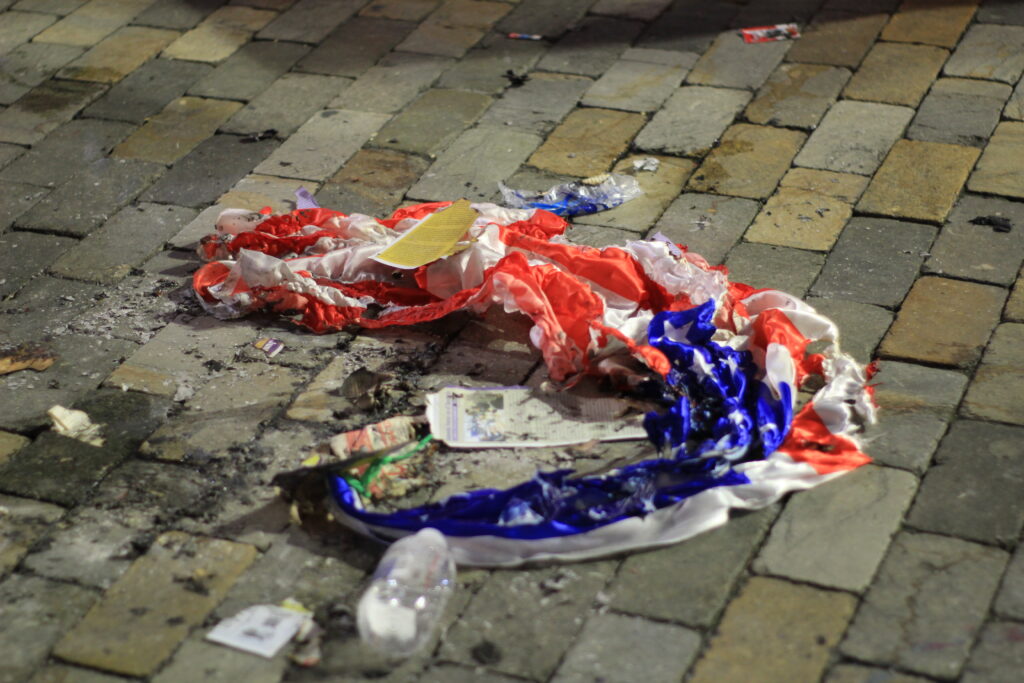
Many participants also used the demonstration to voice opposition to related issues, such as the exploitation of natural resources and the presence of foreign military bases.
“If we don’t defend our country, who will do it for us?” said one demonstrator. Other attendees stressed that the mobilization was not only about Colombia, but about Latin America as a whole.
Throughout the day, the rally featured musical performances and included the presence of labor and union representatives, public institutions, and a large portion of the presidential cabinet. The president and several ministers delivered speeches from the main stage.
President Petro presented some official data and concrete results from three years of his administration — including his fight against drug trafficking — many of them in comparison with the previous government. Among the achievements cited was the seizure of 2,800 tons of illegal substances by December 31, 2025.
“My goal was zero blows against Colombia’s peasantry, voluntary crop substitution; we are now at 30,000 hectares registered,” he explained.
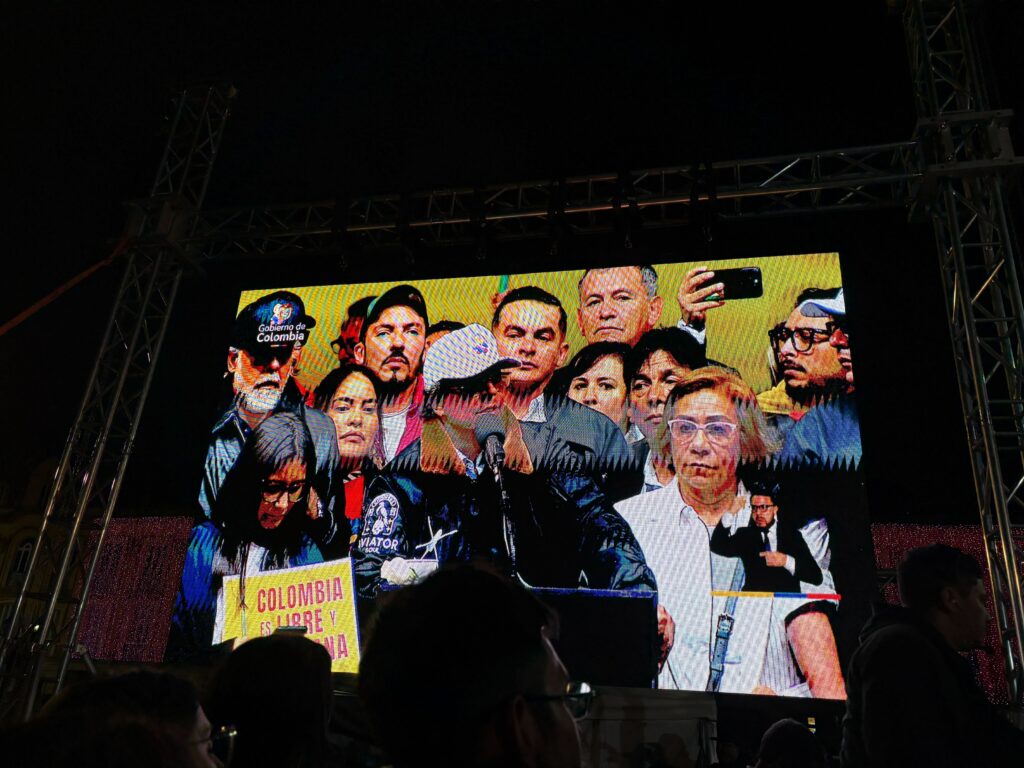
Petro publicly accused the U.S. far right and Colombian politicians of having convinced Trump that he “ran cocaine factories” and was a “front man for Maduro.” “We are not enemies of any people in the world,” he stated during his speech. Petro also said he spoke with Delcy Rodríguez, Interim President of Venezuela.
The phone call was later confirmed by Trump through his Truth Social account: “It was a great Honor to speak with the President of Colombia, Gustavo Petro, who called to explain the situation of drugs and other disagreements that we had. I appreciated his call and tone, and look forward to meeting him in the near future. Arrangements are being made between Secretary of State Marco Rubio and the Foreign Minister of Colombia. This meeting will take place in the White House in Washington, D.C..”
In closing, the Colombian leader reaffirmed his stance on national sovereignty, as well as his differences with Trump over events in Venezuela — which he described as “illegal” — and other issues.
“To the mothers of Colombia, I say that the country clearly stands up for the defense of national sovereignty, because [Álvaro] Uribe is wrong. If they touch Petro, they touch Colombia. And if they touch Colombia, Colombia responds as its history has taught it—plain and simple.”
Featured image: Demonstrators at Plaza de Bolívar in central Bogotá
Author: Cristina Dorado Suaza
This article originally appeared on Latin America Reports and was re-published with permission.
The post Thousands rally in Colombia’s Plaza de Bolívar following President Petro’s call with Trump appeared first on The Bogotá Post.
Colombian President Gustavo Petro has called on supporters to mobilise nationwide on Wednesday to defend “national sovereignty,” sharply escalating a diplomatic crisis with the United States after President Donald Trump said a U.S. military operation against Colombia “sounds good” to him.
The demonstrations are expected to take place in Bogotá’s Plaza de Bolívar, Parque Lourdes in the Chapinero locality, and outside the U.S. Embassy, with parallel protests planned in Medellín (Plaza Mayor), Cali (Plaza de Cayzedo), Bucaramanga (Plazoleta Cívica Luis Carlos Galán), Cartagena (Plaza de San Pedro Claver), Santa Marta (Parque de Bolívar).
The mobilisation follows Trump’s remarks aboard Air Force One on Sunday, when he described Petro as “a sick man” and appeared to endorse the idea of a U.S. military operation in Colombia — dubbed “Operation Colombia” by a journalist — comparable in scope to the operation that led to the arrest of Venezuela’s Nicolás Maduro and wife, Cilia Flores.
When pressed on whether he meant direct military action, Trump replied: “Sounds good to me,” before adding that Petro should “watch his ass.” The White House has not clarified whether the comments reflect official U.S. policy.
A Return to Arms?
Petro responded with a torrent of social media posts and public statements that have alarmed political opponents and business leaders . In some of his strongest language since taking office, the leftist president warned that U.S. military action would plunge Colombia back into armed conflict.
“If you bomb peasants, thousands of guerrillas will return to the mountains,” Petro said. “And if you arrest the president whom a good part of my people want and respect, you will unleash the popular jaguar.”
Petro, Colombia’s first leftist leader and a former militant of the M-19 guerrilla, said he had sworn under the 1989 peace pact never to take up arms again, but suggested that commitment could be reversed if Colombia’s sovereignty were threatened.
“Although I have not been a military man, I know war and clandestinity,” Petro wrote. “I swore not to touch a weapon again since the 1989 Peace Pact, but for the homeland I will take up arms again — even though I do not want to.”
He also warned Colombia’s armed forces against showing loyalty to Washington, saying any commander who prioritised U.S. interests over Colombia’s would be dismissed. The constitution, he said, required the military to defend “popular sovereignty.”
Diplomatic protest lodged in Washington
Colombia’s Foreign Ministry formally raised the dispute on January 4, issuing a diplomatic note of protest to the U.S. government through Ambassador Daniel García-Peña in Washington.
In the letter, the ministry said Trump’s remarks violated basic principles governing relations between sovereign states and amounted to “undue interference” in Colombia’s internal affairs.
“The President of the Republic of Colombia has been legitimately elected by the sovereign will of the Colombian people,” the statement said, adding that any attempt to discredit him was incompatible with international law and the United Nations Charter.
The Cancillería also cited principles of sovereign equality, non-intervention and mutual respect, saying threats or the use of force between states were “unacceptable.”
“Colombia is a democratic, sovereign state that conducts its foreign policy autonomously,” it said. “Its sovereignty, institutional legitimacy and political independence are not subject to external conditioning.”
The crisis has further polarised Colombia’s already fractured political landscape. Former president Álvaro Uribe, a vocal critic of Petro, said Colombia was drifting toward a Venezuela-style confrontation with the United States, though he stopped short of endorsing military intervention.
“What Colombia needs is a change of government,” Uribe told El Tiempo, adding that he trusted Washington’s strategy was “well conceived.”
Petro has cast Wednesday’s demonstrations as a defining moment for his presidency, portraying himself as the defender of national dignity against foreign aggression. He also reiterated the Colombian goverment’s position to cooperate fully with Washington on counter-narcotics and security issues. “You (Trump) took it upon yourself, in an act of arrogance, to punish my opinion — my words against the Palestinian genocide. Your punishment has been to falsely label me a drug trafficker and accuse me of running cocaine factories,” stated Petro hours after the Air Force One declations. “I don’t know whether Maduro is good or bad, or even whether he is a drug trafficker (…) so, stop the slander against me,” he said.
Petro’s critics accuse the president of instrumentalising public rallies to divert attention from Colombia’s deep internal security crisis, and to position himself politically alongside Venezuela’s ousted strongman. They argue that his language of “sovereignty” closely mirrors chavista narratives, warning that the protests risk morphing into an implicit show of solidarity with Nicolás Maduro rather than a defence of Colombia’s territorial integrity.
The White House has not walked back Trump’s remarks, and U.S. officials have so far declined to offer reassurances. On Wednesday morning, Secretary of State Marco Rubio and U.S. Secretary of War Pete Hegseth held a classified briefing with senators on Capitol Hill in which, according to Democratic leaders, their Republican counterparts refused to rule out sending U.S. troops to Venezuela or other countries.
Democratic Senate leader Chuck Schumer said he had asked for assurances that Washington was not planning operations elsewhere. “I mentioned some cases — including Colombia and Cuba — and I was very disappointed with their response,” Schumer said, adding that the meeting “left more questions than answers” and that the plan for the United States to govern Venezuela was “vague and based on illusions.”
As governments across Latin America closely watch the incoming chavista regime under interim president Delcy Rodríguez, the confrontation between Trump and Petro marks the most serious rupture in U.S.–Colombia relations in over two centuries. For Bogotá — long one of Washington’s closest allies in the region — the escalation has raised fears that incendiary rhetoric and mass mobilisation could push an already volatile situation into dangerous territory.
Editor’s Note: The U.S Embassy in Bogotá has issued a security alert, warning U.S. citizens to avoid large protests “as they have the potential to turn violent”.
U.S. President Donald Trump escalated rhetoric toward Colombia on Sunday, suggesting that a U.S. military operation against the country — which he said could be dubbed “Operation Colombia” — was a possibility following Washington’s capture of Venezuelan dictator Nicolás Maduro.
Speaking to reporters aboard Air Force One, Trump described Colombian President Gustavo Petro as “a sick man” and accused him of overseeing cocaine production destined for the United States.
“Colombia is run by a sick man who likes making cocaine and selling it to the United States,” Trump said. “And he’s not going to be doing it very long. Let me tell you.”
When asked directly whether he meant a U.S. military operation against Colombia, Trump replied: “Sounds good to me.”
Trump’s remarks came a day after the United States announced it had captured Maduro in a military operation in Caracas, an unprecedented move that has sent shockwaves across Latin America and raised fears of further U.S. interventions in the region.
Trump said the United States could also consider military action against Mexico if it failed to curb the flow of illicit drugs into the country. He added that Venezuelan migrants in the United States were among the factors considered in the raid against Maduro.
Trump also warned that Cuba, a close ally of Venezuela, was “a failing nation” and said its political future was “something we’ll end up talking about.”
Maduro is currently being held in a New York detention center and is expected to appear in court on Monday on drug trafficking charges. Trump said his administration would seek to work with remaining members of the Venezuelan government to crack down on drug trafficking and overhaul the country’s oil sector, rather than push immediately for elections.
Despite Maduro’s capture, Venezuela’s Vice President and oil minister, Delcy Rodríguez, has assumed interim leadership with the backing of the country’s top court. Rodríguez has insisted that Maduro remains Venezuela’s legitimate president and has denied Trump’s claim that she is willing to cooperate with Washington.
In an interview published by The Atlantic on Sunday, Trump warned that Rodríguez could “pay a bigger price than Maduro” if she failed to cooperate with the United States. Venezuela’s communications ministry did not immediately respond to a request for comment.
Trump’s comments prompted an immediate and forceful response from Petro, who accused the U.S. president of slander and warned that Latin America risked being treated as “servants and slaves” unless it united.
“Stop slandering me,” Petro said, calling on regional leaders to close ranks in the face of what he described as renewed U.S. imperial aggression.
In a series of lengthy posts on X, Petro said the United States had crossed a historic line by bombing Caracas during the operation to capture Maduro.
“The United States is the first country in the world to bomb a South American capital in all of human history,” Petro wrote. “Neither Netanyahu, nor Hitler, nor Franco, nor Salazar did it. That is a terrible medal, one that South Americans will not forget for generations.”
Petro said revenge was not the answer but warned that the damage would be long-lasting.
“Friends do not bomb each other,” he said, likening the attack on Caracas to the Nazi bombing of Guernica during the Spanish Civil War.
Instead, Petro urged deeper regional integration, arguing that Latin America must look beyond alignment with global powers.
“We do not look only to the north, but in all directions,” he said. “Latin America must unite or it will be treated as a servant and not as the vital center of the world.”
In a separate post, Petro issued a stark message to Colombia’s armed forces, ordering commanders to immediately remove any officer who showed loyalty to the United States over Colombia.
“Every Colombian soldier has an order from now on,” Petro wrote. “Any commander of the public forces who prefers the U.S. flag over the Colombian flag must immediately leave the institution.”
Petro said the armed forces were under orders not to fire on civilians but to defend Colombia’s sovereignty against any foreign invasion.
“I am not illegitimate. I am not a narco,” Petro wrote, rejecting Trump’s accusations. “I trust my people and the history of Colombia.”
Colombia’s first leftist president and a former member of the M-19 guerrilla movement also raised the spectre of a return to armed struggle, saying that while he had sworn under the 1989 peace pact never to take up weapons again, he would do so if Colombia’s sovereignty were threatened.
“I am not a military man, but I know war and clandestinity,” Petro wrote. “I swore never to touch a weapon again, but for the homeland I would take up arms once more, even though I do not want to.”
Trump’s warnings to Colombia were not his first. In the immediate aftermath of Maduro’s capture, he said Petro needed to “watch his ass” and suggested that Cuba’s political collapse was imminent.
The comments have heightened anxiety across the region, where governments are closely watching Washington’s next moves following the Caracas operation.
In Venezuela, a state of emergency has been in force since Saturday. A decree published on Monday ordered police to “immediately begin the national search and capture of everyone involved in the promotion or support for the armed attack by the United States,” according to the text.
Caracas remained largely quiet on Sunday, though residents reported a tense atmosphere as uncertainty mounted over the country’s political future and the possibility of further U.S. action.
For Colombia – a key U.S. ally that shares a 2,000-kilometre border with Venezuela, a country the Trump administration has said it will “run” in the aftermath of Saturday’s seizure of Maduro – the remarks mark the most explicit threat of U.S. military action in more than two centuries of diplomatic relations, and an ominous deterioration in already strained ties between Washington and Bogotá.
