Reading view
How $600 Drones Are Outsmarting Colombia’s Billion-Dollar Military
Exiled Venezuelans may well support regime change – but diasporas don’t always reflect the politics
Protest and military action raised the prospect of regime change in Iran and Venezuela, and the voices of both countries’ diasporas were heard loud and clear through the media of their host nations.
Venezuelan exiles in the U.S. were, according to the popular narrative, broadly behind President Donald Trump and his plan to “run Venezuela,” as the nickname “MAGAzuelans” suggests. Meanwhile, the Iranian diaspora rallied behind Prince Reza Pahlavi as he positioned himself as a leader-in-waiting, projecting an image of unified exile support.
Diasporas are often treated by media and policymakers as monolithic blocs — politically unified, ideologically coherent and ready to be mobilized for regime change. But as a scholar of migration and security in Latin America, I know this assumption misunderstands how diaspora communities form, evolve and engage politically.
Iranian and Venezuelan émigrés might broadly oppose their current governments — having left them, this is unsurprising. But they are far from unified on what should replace those governments, who should lead or how change should come about.
Migration waves shape politics
Diasporas are not uniform because their constituent populations did not arrive all at once, from the same places or for the same reasons. Each migration wave carries distinct political orientations shaped by the circumstances of departure.
The tendency of diasporas to become politically frozen at the moment of departure appears across contexts. El Salvador’s diaspora in the United States, which first left during the 1980s civil war, developed a reputation for being “stuck in the ’80s” — mentally still fighting battles that had long since ended at home.
This temporal displacement has consequences. Iranian-American sociologist Asef Bayat, writing about the Iranian diaspora, argues that exile opposition to the ruling government back home “suffers from a political disease, positioning itself against the movement it claims to support.”
In other words, diaspora activists may advocate positions that resonate with Western audiences but find little support among those actually living under authoritarian rule. This lack of accountability to political consequences back home can rankle the constituencies on whose behalf they seek to advocate.
Research on the Venezuelan diaspora reflects similar dynamics. A 2022 study found that Venezuelan exiles hold more extreme anti-government views than those who remained.
Despite this presumed disconnection, homeland politicians often devote disproportionate attention to those who have left. The logic is simple: emigrants send money home — accounting for as much as 25% of gross domestic product in some Central American and Caribbean countries. Politicians assume that this financial power translates into political influence over remittance-receiving relatives.
One party official in El Salvador told me: “If we get one Salvadoran in Washington to support us, that gives us five votes in El Salvador — and it doesn’t even matter if the one in Washington votes.”
My own research tested this assumption using polling and voting data across Latin America and found it to be exaggerated. Remittances and family communication mostly reinforce existing partisan sympathies rather than swing votes.
But the belief in diaspora influence matters politically — and diaspora voters can be weaponized by authoritarian leaders. El Salvadoran President Nayib Bukele, in his successful and plainly unconstitutional 2024 reelection bid, expanded external voting through online balloting, increasing diaspora votes by 87-fold over the previous election.
Diasporas can influence home-country politics through several channels: direct voting, financial support for opposition movements, lobbying host governments and transmitting democratic values through what sociologist Peggy Levitt calls “social remittances.” Other research has found that remittances can undermine dictatorships by helping fund opposition activities.
Yet authoritarian governments have developed sophisticated countermeasures. Freedom House recorded more than 1,200 incidents of physical transnational repression against dissidents — including assassinations, abductions and unlawful deportation — between 2014 and 2024 involving 48 governments.
The limits of exile politics
For Venezuela and Iran, these lessons counsel caution. Nearly 8 million Venezuelans have fled their homeland — the largest displacement crisis in the Western Hemisphere. Iranian emigration accelerated after the 2022 protests.
Both diasporas contain passionate activists, wealthy donors and would-be leaders positioning themselves for future rule. But passion does not equal unity, and visibility does not equal representation.
The loudest voices on social media — or those amplified by U.S. officials and media — may represent narrow slices of diverse communities. There may be consensus on opposing the government back home, but far less agreement on what should be done or how change should occur.
Nor does diaspora opposition necessarily translate into regime vulnerability. Authoritarian states have learned to insulate themselves from diaspora pressure while simultaneously using emigration as a safety valve, turning potential dissidents into remittance-senders.
Diasporas can contribute to democratic change through funding, advocacy and the transmission of democratic values. But ultimately, the path to democratic change in Venezuela, Iran and elsewhere will be determined by those who remain, not those who left. Diasporas can support that struggle; they cannot substitute for it.
About the author: Michael Paarlberg is Associate Professor of Political Science at Virginia Commonwealth University.
This article is reproduced from The Conversation under a Creative Commons licence.
Global airlines return to Venezuela, Avianca restores Bogotá–Caracas flight
International airlines are rapidly re-establishing services to Venezuela, signalling a cautious but commercially significant reopening of the country’s aviation market. On Thursday, February 12, Colombia’s Avianca resumed a daily direct flights between Bogotá and Caracas.
The move restores one of the most important air corridors in northern South America and comes amid a flurry of announcements from carriers across Europe, the Americas and the Middle East seeking to regain access to a market that has been largely closed since 2019.
The flagship carrier claims that this key route was restored after a “comprehensive evaluation of operational conditions and aviation safety,” carried out in coordination with Colombian and Venezuelan authorities.
Avianca’s daily round trip flight will operate with an A320 aircraft, departing Bogotá (AV142) at 07:40 a.m. and returning from Caracas (AV143) at 12:10 p.m.
The resumption reflects the strong commercial ties between Colombia and Venezuela, as well as growing confidence among airlines that operational, regulatory and security conditions now allow for a gradual return.
For Avianca, which has operated in Venezuela for more than 60 years, the route carries both symbolic and strategic weight. The carrier said the service would strengthen regional connectivity and support trade, tourism and business travel between the two countries, which share deep economic and social ties disrupted during years of political confrontation and border closures.
Avianca’s return is part of a broader recalibration by the global aviation industry following Venezuela’s political transition and the end of Nicolás Maduro’s rule. Airlines had largely withdrawn from the country after the suspension of international flights, currency controls, safety concerns and U.S. sanctions made operations increasingly unviable.
Now, with demand for travel surging among Venezuela’s large diaspora and regional business community, carriers are moving quickly to reclaim market share — albeit cautiously, with a close eye on regulatory approvals and security assessments.
In January, American Airlines said it was ready to resume daily service to Venezuela, positioning itself as the first U.S. carrier to formally announce plans to return after nearly seven years. The airline said flights would remain subject to U.S. government approval and security evaluations, and has not yet announced a launch date.
“We have a more than 30-year history connecting Venezuelans to the U.S., and we are ready to renew that relationship,” said Nat Pieper, American’s chief commercial officer, underscoring the airline’s focus on family reunification, business travel and trade.
Before suspending operations in 2019, American was the largest U.S. airline serving Venezuela, having entered the market in 1987. The carrier said it remains in close contact with federal authorities and is working with regulators, unions and internal teams to ensure a compliant return.
While direct U.S.–Venezuela flights remain pending, regional alternatives are already expanding. Panama-based Copa Airlines has enabled ticket sales since late January allowing passengers to travel between Caracas and Miami via Panama under a single reservation, restoring a key transit option for Venezuelan travellers.
European and Latin American airlines have moved faster, with firm restart dates announced over the next six weeks. Spain’s Air Europa will resume Madrid–Caracas flights on February 17, followed by Laser Airlines the next day. LATAM Airlines plans to restart flights from Bogotá on February 23, while Colombian low-cost carrier Wingo will relaunch Medellín–Caracas services on March 1.
Further afield, Turkish Airlines will begin flights between Istanbul and Caracas on March 3, marking the return of a long-haul intercontinental connection. Spain’s low-cost Plus Ultra will also start services that same day, while Brazil’s GOL plans to resume flights from São Paulo on March 8.
TAP Portugal is scheduled to restore Lisbon–Caracas flights by the end of March.
The pace of announcements reflects both pent-up demand and a race among carriers to secure early-mover advantage in a market that, while still fragile, offers long-term potential. Venezuela’s population of more than 28 million, combined with millions of citizens living abroad, represents a sizeable base for leisure, family and humanitarian travel.
Yet challenges remain. Airlines face currency risks, infrastructure constraints and the possibility of renewed political or regulatory instability. Industry executives say most carriers are returning with limited capacity and flexible schedules, allowing them to scale operations up or down as conditions evolve.
For now, the reopening of Venezuela’s airspace is being driven less by optimism than by calculated risk-taking. Airlines are betting that gradual political normalization and the easing of restrictions will allow them to rebuild routes profitably — without repeating the costly exits of the past decade.
Avianca’s daily Bogotá–Caracas service may therefore serve as an early test case. If demand proves resilient and operations remain stable, more capacity is likely to follow. If not, airlines may once again find themselves navigating turbulence in one of Latin America’s most complex markets.
Still, after years of near-total isolation, Venezuela’s reappearance on international departure boards marks a turning point — one that global airlines are keen not to miss
Trump califica a Petro de ‘genial’ luego de la reunión en la Casa Blanca
Colombian President Gustavo Petro Meets with Trump at the White House
Trump shows AI map with Canada, Greenland and Venezuela under U.S flag.
U.S. President Donald Trump said on Tuesday there was “no going back” on his goal to bring Greenland under U.S. control, refusing to rule out the use of force and escalating tensions with European allies already bracing for a renewed transatlantic trade dispute.
Trump’s remarks followed a series of social media posts featuring AI-generated images, including one depicting the president standing in Greenland holding a U.S. flag and another showing a map of North America with Canada, Greenland and Venezuela covered by the stars and stripes.
The imagery, shared without official explanation, has fuelled alarm among allies and raised questions about the blurring of political messaging and artificial intelligence at a moment of heightened geopolitical strain.
“As I expressed to everyone, very plainly, Greenland is imperative for National and World Security. There can be no going back — on that, everyone agrees,” Trump said after speaking with NATO Secretary General Mark Rutte.
Greenland, a vast Arctic island rich in minerals and strategically located between North America and Europe, is a self-governing territory of Denmark, a fellow NATO member. Trump’s renewed push to acquire it has revived a proposal he first floated during his previous term, but has now been accompanied by explicit warnings of tariffs and the possible use of force.
European leaders reacted with unease. Danish Prime Minister Mette Frederiksen told parliament in Copenhagen that “the worst may still lie ahead.”
“We can negotiate about everything — security, investments, the economy — but we cannot negotiate our most fundamental values: sovereignty, our country’s identity, our borders and our democracy,” Frederiksen said.
At the World Economic Forum in Davos, European Commission President Ursula von der Leyen urged the bloc to prepare for a more confrontational era.
“The seismic change we are going through today is an opportunity — in fact a necessity — to build a new form of European independence,” she said.
Trade war fears resurface
Trump has threatened steep tariffs on countries he says stand in the way of U.S. interests, including European allies involved in NATO exercises in Greenland. The European Union has warned it could retaliate with tariffs on up to €93 billion ($101 billion) of U.S. imports if trade measures are imposed.
One option under discussion is the EU’s Anti-Coercion Instrument, a powerful tool that could restrict access to public tenders, investment or services, including digital services where U.S. companies hold a surplus.
U.S. Treasury Secretary Scott Bessent sought to calm markets and dismissed fears of an escalating trade war.
“It’s been 48 hours. Sit back, relax,” Bessent told reporters in Davos. “Calm down the hysteria. Take a deep breath.”
Financial markets were less sanguine. U.S. stock index futures slid to one-month lows, global equities fell, and gold prices touched record highs as investors sought safety.
Canada and Venezuela react
The inclusion of Canada and Venezuela in the AI-generated map added to the controversy.
Canada, a close U.S. ally and NATO member, has previously been the subject of Trump’s rhetoric suggesting it could become the “51st state.” Canadian Prime Minister Mark Carney said he was “concerned” by the escalation and warned of the implications for North American and transatlantic security.
Canadian officials said Ottawa has drawn up plans to send a small contingent of soldiers to Greenland to participate in NATO military exercises, pending final approval from Carney. Canada already has aircraft and personnel deployed there as part of a NORAD exercise involving the United States.
Venezuela’s government condemned Trump’s post and called on citizens to share the country’s official map online in what officials described as a symbolic defence of sovereignty.
Russia weighs in
Russia, which has closely watched the growing rift between Washington and Europe, questioned Denmark’s sovereignty over Greenland. Foreign Minister Sergei Lavrov said the island was the result of “colonial conquest,” while denying Moscow had any designs on the territory.
Protesters also took to the streets in several European cities, including Zurich, where demonstrators carried banners opposing Trump’s appearance at Davos and denouncing what they called imperialist policies.
Despite pushback from allies and some members of Congress, Trump has shown no sign of softening his stance, leaving diplomats and markets braced for further escalation as NATO cohesion and global trade relations come under renewed strain.
Tras la llamada con Trump, Petro aumenta la presión sobre los rebeldes acusados de narcotráfico
After Trump Call, Colombia’s Petro Turns Up Heat on Far-Left Armed Group
Trump hace temblar la política de América Latina
Trump Shakes up Latin American Politics
Thousands rally in Colombia’s Plaza de Bolívar following President Petro’s call with Trump
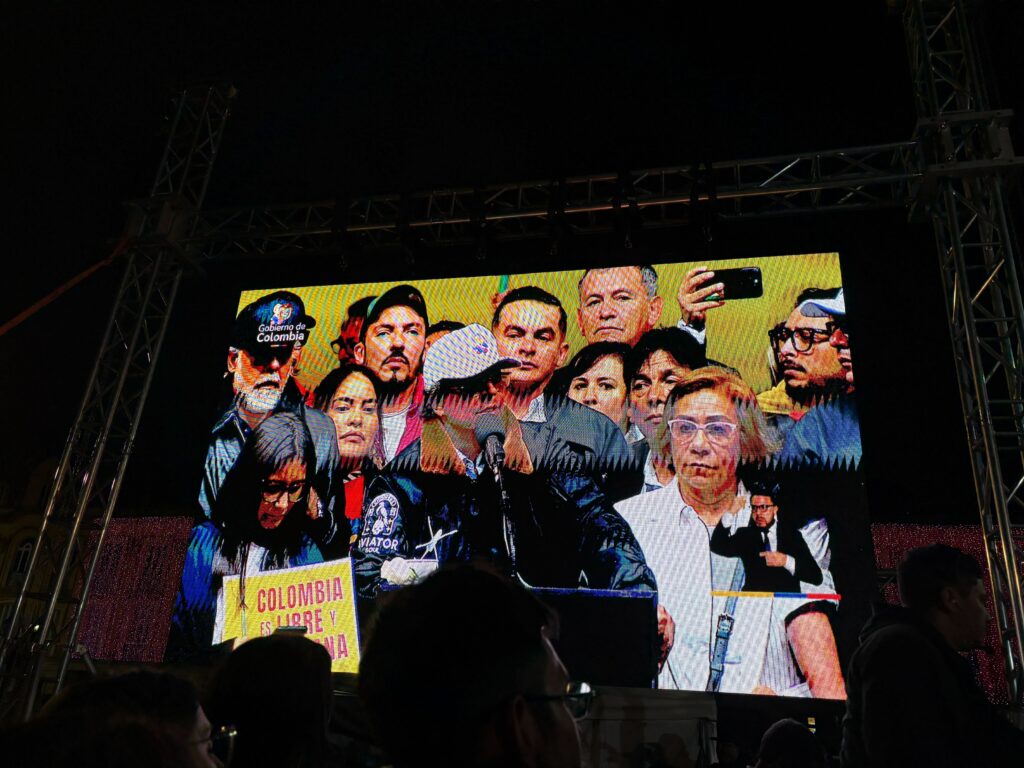
Bogotá, Colombia — Thousands gathered in Plaza de Bolívar after answering Colombian President Gustavo Petro’s call to mobilize against threats to Colombia’s national sovereignty from the United States.
Petro called for people to take to the streets in every public square across the country after Trump said military action in Colombia “sounds good” on Sunday, January 4,, just a day after removing Nicolás Maduro from power in neighboring Venezuela.
While Petro was expected to deliver a rousing speech against U.S. intervention, he told the crowd that he had to make his remarks less “harsh” after a conciliatory call with Trump just minutes before addressing demonstrators.
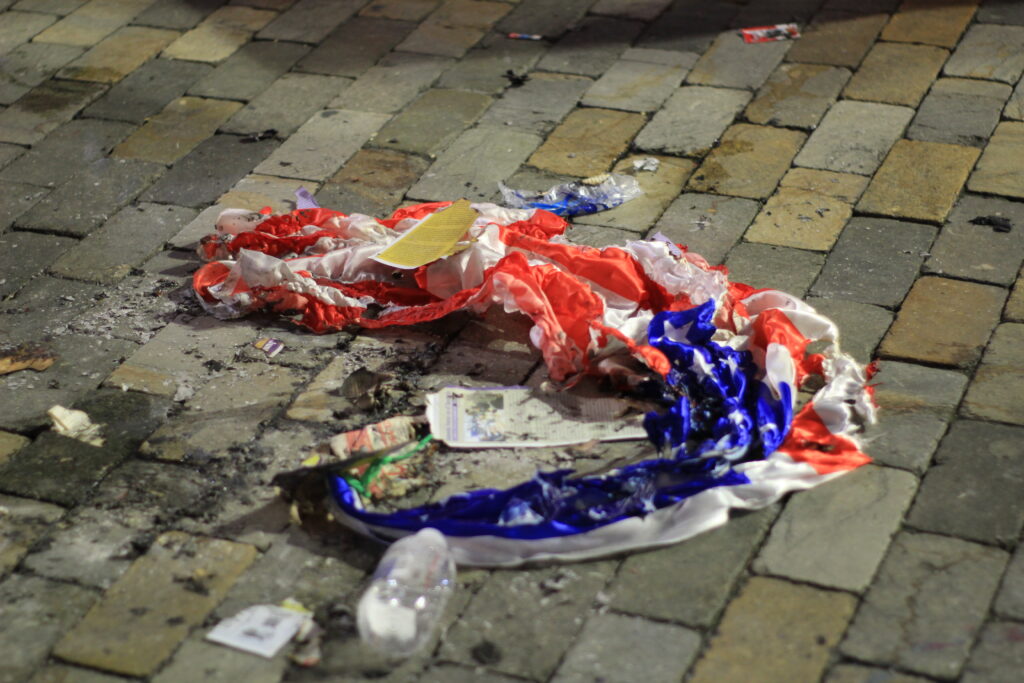
Plaza de Bolívar, located in central Bogotá near Congress and the Casa de Nariño presidential residence and office, hosted over 20,000 demonstrators and was adorned with flags and protest signs from the afternoon into the night of January 7.
“And no, no, I do not feel like being a North American colony. And yes, yes, I do feel like being a free and sovereign Colombia,” protesters chanted.

Many participants also used the demonstration to voice opposition to related issues, such as the exploitation of natural resources and the presence of foreign military bases.
“If we don’t defend our country, who will do it for us?” said one demonstrator. Other attendees stressed that the mobilization was not only about Colombia, but about Latin America as a whole.
Throughout the day, the rally featured musical performances and included the presence of labor and union representatives, public institutions, and a large portion of the presidential cabinet. The president and several ministers delivered speeches from the main stage.
President Petro presented some official data and concrete results from three years of his administration — including his fight against drug trafficking — many of them in comparison with the previous government. Among the achievements cited was the seizure of 2,800 tons of illegal substances by December 31, 2025.
“My goal was zero blows against Colombia’s peasantry, voluntary crop substitution; we are now at 30,000 hectares registered,” he explained.

Petro publicly accused the U.S. far right and Colombian politicians of having convinced Trump that he “ran cocaine factories” and was a “front man for Maduro.” “We are not enemies of any people in the world,” he stated during his speech. Petro also said he spoke with Delcy Rodríguez, Interim President of Venezuela.
The phone call was later confirmed by Trump through his Truth Social account: “It was a great Honor to speak with the President of Colombia, Gustavo Petro, who called to explain the situation of drugs and other disagreements that we had. I appreciated his call and tone, and look forward to meeting him in the near future. Arrangements are being made between Secretary of State Marco Rubio and the Foreign Minister of Colombia. This meeting will take place in the White House in Washington, D.C..”
In closing, the Colombian leader reaffirmed his stance on national sovereignty, as well as his differences with Trump over events in Venezuela — which he described as “illegal” — and other issues.
“To the mothers of Colombia, I say that the country clearly stands up for the defense of national sovereignty, because [Álvaro] Uribe is wrong. If they touch Petro, they touch Colombia. And if they touch Colombia, Colombia responds as its history has taught it—plain and simple.”
Featured image: Demonstrators at Plaza de Bolívar in central Bogotá
Author: Cristina Dorado Suaza
This article originally appeared on Latin America Reports and was re-published with permission.
The post Thousands rally in Colombia’s Plaza de Bolívar following President Petro’s call with Trump appeared first on The Bogotá Post.
Petro–Trump Phone Call Defuses U.S.–Colombia Tensions
It was a frustrating night for the roughly 6,000 supporters gathered in Bogotá’s Plaza de Bolívar to hear President Gustavo Petro deliver what many expected to be a fiery, anti-imperialist address.
After waiting for hours in cold, rainy conditions, demonstrators waved placards reading “Yankee Go Home,” “Out Trump,” and “Respect Colombia,” anticipating a confrontational speech aimed squarely at U.S. President Donald Trump following weeks of diplomatic tension.
Instead, when Petro finally took the stage, the tone of the rally shifted abruptly.
The Colombian president opened by announcing that he would not deliver his prepared speech. Rather than launching into the expected denunciation of Washington, Petro told the crowd that his delay was due to a lengthy phone call with Trump — a revelation that visibly stunned the audience.
As Petro spoke about the conversation, the plaza fell largely silent. Each mention of Trump appeared to drain the rally of its energy, replacing chants and applause with uneasy quiet. What had been billed as a mass show of resistance against U.S. pressure became an unexpected account of diplomatic rapprochement.
According to Petro, the call — conducted with simultaneous translation — lasted close to an hour and marked the first direct conversation between the two leaders since Trump’s return to office. “Today I came with one speech, and I have to give another,” Petro told supporters. “The first one was quite hard.”
A source at the presidential palace told El Colombiano that Petro appeared relaxed during the exchange, smiling several times as he spoke with Trump. A photograph of the moment, later shared by Petro, showed him seated at his desk mid-conversation.
Petro said the discussion focused primarily on drug trafficking, Venezuela and other bilateral disagreements. He acknowledged that significant differences remain but argued that dialogue was preferable to confrontation.
“I know that if anyone were to harm me — in any way — what would happen, given Colombia’s history and the level of support we have reached, is that the Colombian people would enter into conflict,” Petro said during the rally. “If they touch Petro, they touch Colombia.”
The remarks were a response to Trump’s recent comments suggesting that a military operation against Colombia, similar to the one carried out in Venezuela, “sounds good.” Petro, however, struck a notably more conciliatory tone on Wednesday, saying Trump “is not foolish,” even if he disagreed with him.
In a further surprise to supporters, Petro stated publicly that Nicolás Maduro was not his ally, claiming the Venezuelan leader had previously distanced him from Hugo Chávez by preventing him from attending Chávez’s funeral.
Shortly after the call, Trump issued a statement on his Truth Social platform confirming the conversation and signalling a thaw in relations.
“It was a Great Honor to speak with the President of Colombia, Gustavo Petro, who called to explain the situation of drugs and other disagreements that we have had,” Trump wrote. “I appreciated his call and tone, and look forward to meeting him in the near future.”
Trump added that Secretary of State Marco Rubio and Colombia’s foreign minister were already making arrangements for a meeting at the White House in Washington.
Petro confirmed that further discussions would be needed, particularly regarding drug trafficking figures, the role of the ELN guerrilla group along Colombia’s borders and Venezuela’s political future. “We cannot lower our guard,” Petro said. “There are still things to discuss at the White House.”
The president also revealed that he had spoken days earlier with Venezuela’s interim leader Delcy Rodríguez and had invited her to Colombia — a disclosure likely to further complicate regional diplomacy.
What was intended as a show of defiance against Washington ultimately became a public demonstration of Petro’s willingness to recalibrate his strategy, leaving his hardline supporters confused and critics questioning whether the president had overplayed the politics of mobilisation — only to pivot, unexpectedly, toward negotiation.
Petro Calls Colombians to the Streets After Trump Raises Military Option
Colombian President Gustavo Petro has called on supporters to mobilise nationwide on Wednesday to defend “national sovereignty,” sharply escalating a diplomatic crisis with the United States after President Donald Trump said a U.S. military operation against Colombia “sounds good” to him.
The demonstrations are expected to take place in Bogotá’s Plaza de Bolívar, Parque Lourdes in the Chapinero locality, and outside the U.S. Embassy, with parallel protests planned in Medellín (Plaza Mayor), Cali (Plaza de Cayzedo), Bucaramanga (Plazoleta Cívica Luis Carlos Galán), Cartagena (Plaza de San Pedro Claver), Santa Marta (Parque de Bolívar).
The mobilisation follows Trump’s remarks aboard Air Force One on Sunday, when he described Petro as “a sick man” and appeared to endorse the idea of a U.S. military operation in Colombia — dubbed “Operation Colombia” by a journalist — comparable in scope to the operation that led to the arrest of Venezuela’s Nicolás Maduro and wife, Cilia Flores.
When pressed on whether he meant direct military action, Trump replied: “Sounds good to me,” before adding that Petro should “watch his ass.” The White House has not clarified whether the comments reflect official U.S. policy.
A Return to Arms?
Petro responded with a torrent of social media posts and public statements that have alarmed political opponents and business leaders . In some of his strongest language since taking office, the leftist president warned that U.S. military action would plunge Colombia back into armed conflict.
“If you bomb peasants, thousands of guerrillas will return to the mountains,” Petro said. “And if you arrest the president whom a good part of my people want and respect, you will unleash the popular jaguar.”
Petro, Colombia’s first leftist leader and a former militant of the M-19 guerrilla, said he had sworn under the 1989 peace pact never to take up arms again, but suggested that commitment could be reversed if Colombia’s sovereignty were threatened.
“Although I have not been a military man, I know war and clandestinity,” Petro wrote. “I swore not to touch a weapon again since the 1989 Peace Pact, but for the homeland I will take up arms again — even though I do not want to.”
He also warned Colombia’s armed forces against showing loyalty to Washington, saying any commander who prioritised U.S. interests over Colombia’s would be dismissed. The constitution, he said, required the military to defend “popular sovereignty.”
Diplomatic protest lodged in Washington
Colombia’s Foreign Ministry formally raised the dispute on January 4, issuing a diplomatic note of protest to the U.S. government through Ambassador Daniel García-Peña in Washington.
In the letter, the ministry said Trump’s remarks violated basic principles governing relations between sovereign states and amounted to “undue interference” in Colombia’s internal affairs.
“The President of the Republic of Colombia has been legitimately elected by the sovereign will of the Colombian people,” the statement said, adding that any attempt to discredit him was incompatible with international law and the United Nations Charter.
The Cancillería also cited principles of sovereign equality, non-intervention and mutual respect, saying threats or the use of force between states were “unacceptable.”
“Colombia is a democratic, sovereign state that conducts its foreign policy autonomously,” it said. “Its sovereignty, institutional legitimacy and political independence are not subject to external conditioning.”
The crisis has further polarised Colombia’s already fractured political landscape. Former president Álvaro Uribe, a vocal critic of Petro, said Colombia was drifting toward a Venezuela-style confrontation with the United States, though he stopped short of endorsing military intervention.
“What Colombia needs is a change of government,” Uribe told El Tiempo, adding that he trusted Washington’s strategy was “well conceived.”
Petro has cast Wednesday’s demonstrations as a defining moment for his presidency, portraying himself as the defender of national dignity against foreign aggression. He also reiterated the Colombian goverment’s position to cooperate fully with Washington on counter-narcotics and security issues. “You (Trump) took it upon yourself, in an act of arrogance, to punish my opinion — my words against the Palestinian genocide. Your punishment has been to falsely label me a drug trafficker and accuse me of running cocaine factories,” stated Petro hours after the Air Force One declations. “I don’t know whether Maduro is good or bad, or even whether he is a drug trafficker (…) so, stop the slander against me,” he said.
Petro’s critics accuse the president of instrumentalising public rallies to divert attention from Colombia’s deep internal security crisis, and to position himself politically alongside Venezuela’s ousted strongman. They argue that his language of “sovereignty” closely mirrors chavista narratives, warning that the protests risk morphing into an implicit show of solidarity with Nicolás Maduro rather than a defence of Colombia’s territorial integrity.
The White House has not walked back Trump’s remarks, and U.S. officials have so far declined to offer reassurances. On Wednesday morning, Secretary of State Marco Rubio and U.S. Secretary of War Pete Hegseth held a classified briefing with senators on Capitol Hill in which, according to Democratic leaders, their Republican counterparts refused to rule out sending U.S. troops to Venezuela or other countries.
Democratic Senate leader Chuck Schumer said he had asked for assurances that Washington was not planning operations elsewhere. “I mentioned some cases — including Colombia and Cuba — and I was very disappointed with their response,” Schumer said, adding that the meeting “left more questions than answers” and that the plan for the United States to govern Venezuela was “vague and based on illusions.”
As governments across Latin America closely watch the incoming chavista regime under interim president Delcy Rodríguez, the confrontation between Trump and Petro marks the most serious rupture in U.S.–Colombia relations in over two centuries. For Bogotá — long one of Washington’s closest allies in the region — the escalation has raised fears that incendiary rhetoric and mass mobilisation could push an already volatile situation into dangerous territory.
Editor’s Note: The U.S Embassy in Bogotá has issued a security alert, warning U.S. citizens to avoid large protests “as they have the potential to turn violent”.
Democracy Deferred: Did Washington Abandon María Corina Machado?
The extraction of Nicolás Maduro on Saturday was meant to signal the end of an era. Instead, it has exposed an uncomfortable truth that may loom over Washington weeks and months after the “shock-and-awe” attacks in central Caracas have waned from headlines: was Venezuela’s democratic opposition sidelined at the very moment it appeared closest to victory?
Just weeks earlier, María Corina Machado, the 2025 Nobel Peace Prize laureate and the symbolic leader of Venezuela’s opposition, had laid out her Freedom Manifesto — a sweeping blueprint for a Venezuelan-led democratic transition rooted in dignity, elections, free markets and the return of millions of exiles. She framed the coming moment not as an American intervention, but as a national rebirth steered by Venezuelans themselves.
That vision now appears to be colliding with a far more transactional reality.
Following Maduro’s capture in a U.S.-led operation, President Donald Trump declined to elevate Machado or her movement into any formal role. Instead, senior U.S. officials have coalesced around Delcy Rodríguez – Maduro’s longtime lieutenant and overseer of the oil sector — as Washington’s primary interlocutor in Caracas. Trump publicly praised Rodríguez’s cooperation while dismissing Machado as a “very nice woman” who “lacks the support” to lead the country.
On Monday, Delsy Rodríguez took the oath of office in the presence of the Ambassadors to China, Iran and Russia. The scene from the National Assembly recalls the sham investiture of Maduro on January 10, 2025, and sends a dire signal to the internationl community: Does oil security matter more than a secure democracy?
White House insiders told U.S. media that Trump had never warmed to Machado, “because his feelings got hurt”, reads the Daily Beast. According to an article on Monday in The Washington Post, the president declined to pick Machado because she committed the “ultimate sin” of offending his pride, after receiving the Nobel Peace Prize. “If she had turned it down and said, ‘I can’t accept it because it’s Donald Trump’s,’ she’d be the president of Venezuela today,” cites the newspaper’s sources.
Having lost the Oslo podium as the world’s “peace president,” personal grievance and strategic calculation have marked the White House’s decision to annoint a “moderate” in Miraflores. But Rodríguez is no moderate, and her penchant for state repression remains intact. A recent article in the Wall Street Journal affirms that Washington is willing to tolerate a Maduro 2.0 — a Chavista continuity government — so long as it cooperates on oil, narcotics enforcement and geopolitical alignment.
On the ground in Caracas, the mood reflects that ambiguity. There have been no mass celebrations, no release of political prisoners, and no clear roadmap. Power remains concentrated within the same military-backed elites that have pillaged Venezuela for over three decades, even as Maduro himself awaits trial in New York on charges expected to exceed those once brought against Joaquín “El Chapo” Guzmán.
U.S. officials insist this is realism, not betrayal. Secretary of State Marco Rubio has argued that squeezing the regime economically and forcing compliance on security and oil will eventually produce leverage. But he has stopped short of demanding immediate elections — a notable omission given that the opposition already won one.
Machado’s Freedom Manifesto now reads less like a transition plan and more like a rebuke. It imagined a Venezuela where sovereignty flowed from the ballot box, not from foreign capitals; where dignity, not expediency, guided reconstruction; and where Venezuelans — not external powers — chose their leaders.
Instead, Trump has suggested that the United States will “run” Venezuela, even as it leaves the same repressive security apparatus intact. The contradiction is stark: maximum news coverage abroad, minimal transformation on the ground.
The question, then, is not only whether Trump sidetracked María Corina Machado, but whether the United States has traded a rare democratic opening for short-term gains. If Chavismo survives without Maduro — its prisons full, its generals untouched, its oil flowing under U.S management — the Nobel laureate’s blueprint may yet stand as the document of a revolution deferred.
And history may judge that Venezuela was not lost for lack of courage at home, but for lack of conviction abroad. In the words of Mexican historian Enrique Krauze, the end-game is inevitable: “If geopolitics seeks to turn Venezuela into a pawn on its chessboard, the people will take to the streets. They have chosen a legitimate president: Edmundo González. And they have a moral leader: María Corina Machado. Obstacles may arise, but Venezuela’s liberation is irreversible.”
Trump floats U.S. military action against Colombia after Maduro capture
U.S. President Donald Trump escalated rhetoric toward Colombia on Sunday, suggesting that a U.S. military operation against the country — which he said could be dubbed “Operation Colombia” — was a possibility following Washington’s capture of Venezuelan dictator Nicolás Maduro.
Speaking to reporters aboard Air Force One, Trump described Colombian President Gustavo Petro as “a sick man” and accused him of overseeing cocaine production destined for the United States.
“Colombia is run by a sick man who likes making cocaine and selling it to the United States,” Trump said. “And he’s not going to be doing it very long. Let me tell you.”
When asked directly whether he meant a U.S. military operation against Colombia, Trump replied: “Sounds good to me.”
Trump’s remarks came a day after the United States announced it had captured Maduro in a military operation in Caracas, an unprecedented move that has sent shockwaves across Latin America and raised fears of further U.S. interventions in the region.
Trump said the United States could also consider military action against Mexico if it failed to curb the flow of illicit drugs into the country. He added that Venezuelan migrants in the United States were among the factors considered in the raid against Maduro.
Trump also warned that Cuba, a close ally of Venezuela, was “a failing nation” and said its political future was “something we’ll end up talking about.”
Maduro is currently being held in a New York detention center and is expected to appear in court on Monday on drug trafficking charges. Trump said his administration would seek to work with remaining members of the Venezuelan government to crack down on drug trafficking and overhaul the country’s oil sector, rather than push immediately for elections.
Despite Maduro’s capture, Venezuela’s Vice President and oil minister, Delcy Rodríguez, has assumed interim leadership with the backing of the country’s top court. Rodríguez has insisted that Maduro remains Venezuela’s legitimate president and has denied Trump’s claim that she is willing to cooperate with Washington.
In an interview published by The Atlantic on Sunday, Trump warned that Rodríguez could “pay a bigger price than Maduro” if she failed to cooperate with the United States. Venezuela’s communications ministry did not immediately respond to a request for comment.
Petro denounces U.S. threats
Trump’s comments prompted an immediate and forceful response from Petro, who accused the U.S. president of slander and warned that Latin America risked being treated as “servants and slaves” unless it united.
“Stop slandering me,” Petro said, calling on regional leaders to close ranks in the face of what he described as renewed U.S. imperial aggression.
In a series of lengthy posts on X, Petro said the United States had crossed a historic line by bombing Caracas during the operation to capture Maduro.
“The United States is the first country in the world to bomb a South American capital in all of human history,” Petro wrote. “Neither Netanyahu, nor Hitler, nor Franco, nor Salazar did it. That is a terrible medal, one that South Americans will not forget for generations.”
Petro said revenge was not the answer but warned that the damage would be long-lasting.
“Friends do not bomb each other,” he said, likening the attack on Caracas to the Nazi bombing of Guernica during the Spanish Civil War.
Instead, Petro urged deeper regional integration, arguing that Latin America must look beyond alignment with global powers.
“We do not look only to the north, but in all directions,” he said. “Latin America must unite or it will be treated as a servant and not as the vital center of the world.”
In a separate post, Petro issued a stark message to Colombia’s armed forces, ordering commanders to immediately remove any officer who showed loyalty to the United States over Colombia.
“Every Colombian soldier has an order from now on,” Petro wrote. “Any commander of the public forces who prefers the U.S. flag over the Colombian flag must immediately leave the institution.”
Petro said the armed forces were under orders not to fire on civilians but to defend Colombia’s sovereignty against any foreign invasion.
“I am not illegitimate. I am not a narco,” Petro wrote, rejecting Trump’s accusations. “I trust my people and the history of Colombia.”
Colombia’s first leftist president and a former member of the M-19 guerrilla movement also raised the spectre of a return to armed struggle, saying that while he had sworn under the 1989 peace pact never to take up weapons again, he would do so if Colombia’s sovereignty were threatened.
“I am not a military man, but I know war and clandestinity,” Petro wrote. “I swore never to touch a weapon again, but for the homeland I would take up arms once more, even though I do not want to.”
Rising fears of wider intervention
Trump’s warnings to Colombia were not his first. In the immediate aftermath of Maduro’s capture, he said Petro needed to “watch his ass” and suggested that Cuba’s political collapse was imminent.
The comments have heightened anxiety across the region, where governments are closely watching Washington’s next moves following the Caracas operation.
In Venezuela, a state of emergency has been in force since Saturday. A decree published on Monday ordered police to “immediately begin the national search and capture of everyone involved in the promotion or support for the armed attack by the United States,” according to the text.
Caracas remained largely quiet on Sunday, though residents reported a tense atmosphere as uncertainty mounted over the country’s political future and the possibility of further U.S. action.
For Colombia – a key U.S. ally that shares a 2,000-kilometre border with Venezuela, a country the Trump administration has said it will “run” in the aftermath of Saturday’s seizure of Maduro – the remarks mark the most explicit threat of U.S. military action in more than two centuries of diplomatic relations, and an ominous deterioration in already strained ties between Washington and Bogotá.

Trump Says ‘We Need Greenland’ and Threatens U.S. Action in Colombia and Mexico
How Nicolás Maduro’s Capture Could Reshape the Global Order
Exiled Venezuelans Celebrate Maduro’s Downfall, but Are Wary
Trump: U.S. partnership to make Venezuelans “rich, independent and safe”
U.S. President Donald Trump said on Saturday that the United States would “run” Venezuela until a “safe, proper and judicious transition” of power is completed, following a U.S. military operation that resulted in the capture of Venezuelan dictator Nicolás Maduro and his wife, Cilia Flores.
Speaking at a press conference at his Mar-a-Lago residence in Florida, Trump described the operation as a “spectacular assault” and “one of the most stunning, effective and powerful displays of American military might and competence in American history.”
“This was overwhelming military power,” Trump said, praising U.S. forces for what he called their “breathtaking speed, power, precision and competence.” He said the operation involved close coordination between the U.S. military, intelligence agencies and law enforcement.
Trump said Venezuelan forces had been “waiting for us” and were in a “ready position,” but were “completely overwhelmed and very quickly incapacitated.” He said no U.S. servicemembers were killed and no equipment was lost.
According to Trump, U.S. forces struck what he described as a “heavily fortified military fortress” in the heart of Caracas, disabling Venezuelan military capabilities and temporarily cutting power to the capital. “The lights went out due to a certain expertise that America has,” he said.
U.S. military officials said the operation, dubbed “Operation Absolute Resolve,” relied on months of intelligence gathering and the deployment of more than 150 aircraft. General Dan Caine said the mission maintained “total surprise,” dismantling Venezuelan air defense systems before U.S. helicopters arrived at Maduro’s compound shortly after 1:00 a.m. Eastern Time.
The helicopters came under fire, Caine said, prompting a response with “overwhelming force.” One aircraft was hit, but all returned safely. Maduro and his wife “gave up” and were taken into custody by the U.S. Department of Justice, boarding the USS Iwo Jima at 3:29 a.m., he added.
Trump said Maduro and Flores are being taken to New York to face drug trafficking-related charges. Maduro has repeatedly denied U.S. accusations that he leads a drug cartel.
Trump said the United States was prepared to carry out a second wave of attacks if necessary, adding that Washington was “not afraid of boots on the ground” and that U.S. forces had operated “at a very high level” inside Venezuela.
Asked how the United States would govern Venezuela during the transition, Trump offered few specifics, saying only that officials were “designating people right now.” He gestured toward himself and Secretary of State Marco Rubio, saying that for a period of time “it’s largely going to be the people standing right behind me.”
Rubio described Maduro as a “fugitive of American justice” with a US$50 million reward on his head. “I guess we saved ourselves $50 million,” Rubio said, prompting Trump to add: “We should make sure nobody claims it.”
Rubio said Maduro had been given “multiple opportunities” to avoid confrontation but instead chose to “act like a wild man,” accusing him of inviting Iran into Venezuela and allowing criminal gangs to send migrants into the United States. “President Trump is not a game player,” Rubio said.
Trump also said U.S. companies would be allowed to enter Venezuela to repair its oil infrastructure and “start making money for the country,” framing the intervention as the beginning of a “partnership” that would make Venezuelans “rich, independent and safe.” He referred to Maduro as an “illegitimate dictator.”
Trump confirmed that Rubio had been in contact with Delcy Rodríguez, Venezuela’s vice president and one of Maduro’s closest allies. Rodríguez issued an audio statement after the strikes urging the United States to provide proof of life for Maduro and Flores, sparking speculation that she may no longer be in Venezuela.
Trump said Rodríguez had expressed a willingness to do “whatever the U.S. asks,” though analysts say she would struggle to gain credibility as an agent of political change after years of defending the Maduro’s regime.
Opposition leader and Nobel Peace Prize laureate María Corina Machado has hailed the operation as a turning point for the country.
“The hour of freedom has arrived,” Machado said in a statement, declaring that Maduro is now facing international justice for “atrocious crimes” committed against Venezuelans and foreign citizens. She said the time had come for “popular sovereignty and national sovereignty” to prevail.
Machado called for the immediate recognition of opposition-backed Edmundo González Urrutia as Venezuela’s legitimate president and commander-in-chief of the armed forces, urging military officers to recognize his authority.
“We are prepared to enforce our mandate and take power,” she said, calling on Venezuelans inside the country to remain organized and on those abroad to mobilize international support for rebuilding Venezuela.
“Venezuela will be free,” Machado said. “Hand in hand with God, until the very end.”