Reading view

Petro says he will sue Noboa for slander

Presidential spat intensifies after Ecuadorian leader revisits old rumors that Petro met with drug gang during state visit.

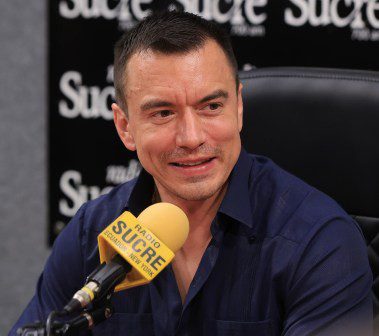
Relations between Noboa, left, and Petro, right, have hit rock bottom after a visit to Manta.

President Petro says he will sue Daniel Noboa over an interview in which the Ecuadorian president accused his Colombian counterpart of associating with feared drug baron Adolfo Macías Villamar, alias ‘Fito’, during a state visit to Ecuador.

“I have decided to file a criminal complaint against President Noboa for his slander,” wrote Petro on his X account, following statements made by Ecuador’s leader to Semana News.

In Sunday’s interview Noboa made references to Petro’s visit to Ecuador in May, 2025, as part of a state visit to attend the right-wing president’s own inauguration.

After the event Petro took a three-day visit to the coastal city of Manta to rest and write his book, the Colombian president later explained.

But this hiatus from the public eye – Petro is rarely out of the spotlight – and his choice of destination sparked rumors that the Colombian president was holding secret meetings with underworld figures. Manta is both a tourist destination with Pacific beaches and the ground zero for violent armed gangs that control Ecuador’s drug trafficking.

Rumors started with unfounded comments by Ecuadorian politicians that Petro was “holed up” in a luxury house on the coast, adding tantalizing details that officials “could not confirm or deny” that Fito or persons related to the gang leader were present.

“What we know is that Gustavo Petro was in Manta inside a house for his entire stay. We can’t confirm whether Fito was there. It’s been said that certain political figures were with him,” Ecuador’s Interior Minister John Reimberg stated to news media at the time.

“He arrived at a luxury house and stayed there for two days. He never left, not even to eat. He was locked inside. I can’t say who he met with.”

Manta on his mind

Noboa reinforced the slurs this week, stating without evidence that the house rented in Manta was “directly or indirectly linked to drug trafficking”.

The Colombian president “never has any real explanations for his actions”, pressed Noboa, suggesting the book writing was a cover for more suspicious motives. But he failed to provide any motive as to why Petro would want to meet with Fito or his associates from Los Choneros gang, Ecuador’s most violent armed group.

Fito has been likened to Mexico’s El Chapo, with a history of repeated prison breaks. The career criminal was re-arrested again in Manta in June last year – a month after Petro’s visit – hiding in a bunker, and has since been extradited to the U.S.

For his part, Petro hit back claiming the Ecuadorian president had been himself been well aware of his plans to holiday in Manta, a visit accompanied by the Ecuadorian army and a Colombian security detail. These and other witnesses could vouch for his book writing, he said.

“I don’t know if going anywhere in Ecuador raises suspicions of shady dealings. Manta is a beautiful place worth visiting.”

Petro stayed in a “wooden cabin with a sea view”, he said, and not the luxury condominium conjured up by Noboa.  

Petro linked Noboa’s verbal attacks on the recent trade war between Colombia and Ecuador and Petro’s request that Noboa released former Ecuadorian vice president Jorge Glas currently jailed for corruption.

See also: Ecuador doubles trade tariffs on Colombia to 100 per cent.

Both disputes have put relations between the two countries at rock bottom.

Behind those disagreements lie long-standing accusations by Ecuador that Colombia has exported violence and criminality over the shared border during Petro’s tenure, a claim supported by a recent report by Amazon Underworld.

Illegal drugs passing through Ecuador came mostly from Colombia, said the report, and Colombian armed groups like the Comandos de La Frontera had established a permanent presence on the Ecuadorian side of the border.

An abandoned Ecuadorian military post close to the Putumayo River. Cross-border incursions by Colombian armed groups have increased insecurity in a country once considered safe
An abandoned Ecuadorian military post close to the Putumayo River. Cross-border incursions by Colombian armed groups have increased insecurity in a country once considered safe.

Political prisoner

The high tariffs imposed by Ecuador, which seem out of U.S. President Trump’s playbook, seem designed to punish Colombia for its internal security policies and Petro’s left-wing government at political poles from the Noboa administration.

The spat over Jorge Glas stems from the former vice-president’s jailing after being found guilty of corruption in public office.

Glas was VP to left-wing leader and former president Rafael Correa, and accused of corruption in contracting cases. In 2017 he was jailed for six years. After his release was again accused of fresh crimes related to corruption.

Faced with these new accusations, in 2024 the politician took refuge in the Mexican Embassy in Quito but was quickly captured by Ecuadorian state forces who violated international protocols by invading the protected site, creating a diplomatic crisis with Mexico.

For his part, Petro conferred Colombian citizenship on Glas, declared him a ‘political prisoner’, and demanded his extradition to Colombia. Meanwhile Petro has been highlighting the former VPs stark prison conditions on social media.

“Just as I demanded the freedom of political prisoners in Venezuela and Nicaragua, I believe that Jorge Glas should be released,” he wrote, angering Noboa who recalled his ambassador from Bogotá earlier this month.

The rift between the two leaders also widened after announcements of joint military operations between the U.S. and Ecuador, with tension mounting after an air bombardment of the border left an unexploded bomb on Colombian territory.

In Sunday’s message Petro alluded to coordinated plots by political opponents in Ecuador, Colombia and “the extreme right in Florida” to drag up dirt from his Mantra trip.

Events this week should clarify if Petro has grounds to sue his Ecuadorian counterpart in a court of law, or if the battle continues on social media.

The post Petro says he will sue Noboa for slander appeared first on The Bogotá Post.
  •  

Colombia and Ecuador Escalate Trade Tensions with Tariffs Raised to 100%

President Gustavo Petro recalls Colombia’s ambassador and signals a potential withdrawal from the Andean Community of Nations (CAN)

Ecuador’s government announced an increase in the so-called “security tariff” applied to imports from Colombia, raising it from 50% to 100%, a move that has intensified trade tensions between the two countries.

In response, the Colombian government, through its Ministry of Commerce, Industry and Tourism, said it will match Ecuador’s measure by adjusting its tariffs to the same level, arguing the need to “maintain balance in bilateral trade conditions.”

The Ecuadorian decision was formalized through a resolution issued by the National Customs Service of Ecuador (Servicio Nacional de Aduana del Ecuador), which establishes that the new tariff will take effect on May 1, 2026.

According to Ecuador’s government, led by President Daniel Noboa, the measure is driven by concerns over border security. In an official statement, authorities said that “after confirming the lack of implementation of concrete and effective border security measures by Colombia, Ecuador is obliged to adopt sovereign actions.”

Colombia’s response and diplomatic measures

Amid the escalation, President Gustavo Petro announced immediate diplomatic actions, including recalling Colombia’s ambassador to Ecuador, María Antonia Velasco, whom he said “must return immediately” to Colombia. He also stated that “the next cabinet meeting will be held at a location along the border with Ecuador,” in a message posted on X.

Petro also criticized statements from Ecuador’s government, saying that “the president of Ecuador insults the Colombian government, which has seized more cocaine than at any point in world history.”

For her part, Minister of Commerce, Industry and Tourism, Diana Marcela Morales Rojas said Colombia “had maintained open diplomatic channels prior to Ecuador’s decision.”

“We have exhausted all diplomatic efforts and kept dialogue channels open with the Government of Ecuador, seeking a solution that benefits both countries, businesses, and above all, communities on both sides of the border. However, we have not received a positive response,” she said in a statement.

Economic impact and trade response

Colombia’s government, led by the Ministry of Commerce, Industry and Tourism, also announced it will amend Decree 170 to raise tariffs to 100%, in line with Ecuador’s measure. The proposal will be submitted to the Committee on Customs, Tariff and Foreign Trade Affairs (Triple A) for review, meaning that details and the effective date of the increase have yet to be determined.

According to the statement, Ecuador’s tariff hike distorts competitive conditions in the Andean market, negatively affecting Colombian producers competing with Ecuadorian goods.

The government also announced relief measures aimed at mitigating the impact on the productive sector, including favorable credit lines, expanded access to financing, and mechanisms to preserve employment.

Political escalation and questions over the Andean system

Amid the growing trade dispute, President Petro also signaled a potential shift in Colombia’s economic foreign policy, stating that Ecuador’s actions “mark the end of the Andean Pact for Colombia.”

“We have nothing left to do there. The foreign minister must begin the process of joining Mercosur as a full member and redirect our efforts toward the Caribbean and Central America,” he said.

The Andean Pact, also known as the Andean Community of Nations (CAN), established in 1969 by Colombia, Ecuador, Peru and Bolivia, has historically been a cornerstone of regional economic integration.

Both governments have filed formal complaints with the CAN, which will assess the admissibility of the claims and may mediate the dispute.

More information on the trade dispute between Colombia and Ecuador? Read Trade War Between Colombia And Ecuador Escalates, With 50% Tariffs Threatened by Finance Colombia.

Above photo: President Gustavo Petro of Colombia with President Daniel Noboa of Ecuador (photo courtesy Presidencia of Ecuador)

  •  

Indicted Ex-Foreign Minister Calls Colombian President Gustavo Petro “Mafia Boss”

Former Foreign Minister Álvaro Leyva releases another scathing attack on his former boss as he fights charges.

On April 10, former Colombian Foreign Minister Álvaro Leyva Durán released a formal statement responding to his indictment by the Fiscalía General de la Nación. Leyva faces charges related to his 2023 decision to declare a passport procurement tender void, a process that involved the private security printing firm Thomas Greg & Sons. The former official characterized the legal proceedings as a politically motivated maneuver orchestrated from the Casa de Nariño.

The indictment for prevarication centers on Leyva’s intervention in the bidding process, which the Fiscalía interprets as a deliberate breach of administrative law. In his defense, Leyva maintained that his actions were necessary to address irregularities and ensure the application of the Constitución Política de Colombia. He argued that the prosecuting body’s thesis would criminalize the conduct of any public servant who identifies unconstitutional terms in a government contract.

“If that argument is accepted, then any official who declares a bidding process void because they find the terms and conditions unconstitutional or illegal should go to jail.” — Álvaro Leyva Durán, former Minister of Foreign Affairs.

Leyva also directed accusations toward his successor at the Cancillería, Luis Gilberto Murillo. According to the statement, Murillo suspended a subsequent legal bidding process to justify a state of emergency, which Leyva claims led to an unnecessary markup of approximately $30 billion COP. Furthermore, Leyva alleged that software contracts exceeding $10 billion COP were improperly managed and that the funds remain unaccounted for under the current administration.

The former minister’s statement included severe personal and political criticisms of President Gustavo Petro. Leyva alleged a lack of moral conduct by the head of state during international state visits and questioned the president’s sobriety in public settings. The letter further asserted that US authorities are currently investigating potential links between the executive branch and narcotics trafficking organizations.

Regarding the domestic political landscape, Leyva warned of perceived risks to the Colombian electoral process. He alleged that the administration has engaged in the illegal interception of political candidates and intends to undermine the integrity of future vote counts. Leyva concluded by affirming his intention to defend his record and his legal decisions before the Corte Suprema de Justicia.

COMUNICADO pic.twitter.com/7YYhoHJD4B

— Álvaro Leyva Durán (@AlvaroLeyva) April 10, 2026

Finance Colombia translation of Leyva’s recent open letter dated April 10th

Some time ago, I denounced in a public communiqué that Gustavo Petro had woven against me an atrocious persecution, as retaliation for my denunciations of his closeness to the world of drugs—denunciations that have led to the United States having him cornered today. There I warned that, from within the government, intrigues were being made to throw me in prison and that attempts would be made against my life.

Now, months later, the Attorney General’s Office accuses me of malfeasance (prevaricato) because I declared void a passport tender that, according to that same institution, was based on a “catch-all specifications document” (pliego sastre). For the accusing entity, I should not have fulfilled the obligation of applying the Constitution that I myself helped draft and, by seeking equality, I acted with malicious intent. The world turned upside down.

Understand the gravity: if that thesis is accepted, any official who declares a tender void because they find unconstitutional or illegal specifications must go to prison. So, faced with such a thing, the trial is welcome. I will give the battle in the Supreme Court with all my strength. Because I trust its magistrates, because my life has been a permanent struggle for Colombia, and because justice, reason, and the law are with me.

The acquittal will be the logical consequence of the process in which I will prove, with official documents and among other things, the following: that I left in motion a new, clean, and legal tender, which Minister Luis Gilberto Murillo suspended. That he thus justified another manifest urgency, completely unnecessary, and added an overcharge of nearly 30 billion pesos to it. And that he contracted software for more than 10 billion additional pesos, which was pocketed. All by hand-picking. All murky. All without control. Thus, by brute force, the door was opened to the passport debacle of today. I warned Petro of what was coming down on the country. But he kept silent.

Today I feel the pride of having helped unmask the boss of the mafia that has plunged Colombia into its darkest hours. I took office as his Foreign Minister with the hope of change. But then I came to know his life of vice and decadence. I was slow to understand his vileness and, surely, also slow to denounce it. But from my father Jorge Leyva Urdaneta, exiled for opposing the dictatorship, I inherited courage and respect for institutions; from Álvaro Gómez Hurtado, I learned the necessity of a just order; and from Misael Pastrana Borrero, I learned to think about social peace. So, faithful to myself and to the spirit of my mentors, I denounced in various letters the moral, political, and personal degeneration that I came to know in Gustavo Petro. And time has proven me right.

The President is an infamous being: international human trafficking is a scourge of the poor girls of Colombia, and he, in the middle of a state visit, ends up as a customer of a brothel in Lisbon; he claims to be a champion of peace, but full of hatred he violently divides society with his stale, classist, and racist rhetoric; he claims to fight drug trafficking, but he goes out into the public square drugged, drunk on alcohol and sectarianism, to mistreat and insult those who contradict him, while in the United States his ties to narcos are being investigated. And so, from scandal to scandal, the horrible night does not cease: the homeland trampled by its own President is today the object of all the mockery abroad.

Petro knows that the upcoming electoral process resembles the one recently lived in Chile. And, to avoid the same result, he illegally intercepts candidates, seeks to destroy them, and is already trying to cast a mantle of doubt over the vote count. But Colombia deserves a new dawn. And the radical left, which—turned into the President’s hooligan squad—forgives him everything, seems condemned to the desert. We shall see whether, in the future, they also forgive him for being responsible for their possible defeat. For my part, I remain ready for all battles: always embracing justice against oppression, and with the law as my spear, shield, and banner.


  •  

Ecopetrol Announces Temporary Leave for President Ricardo Roa Amid Investigations by Colombia’s Attorney General’s Office

Ecopetrol’s board has approved a temporary leave for Ricardo Roa, keeping him out of office until Colombia’s presidential elections wrap up at the end of June 2026

Ecopetrol’s board of directors has approved an unpaid leave of absence for its president, Ricardo Roa Barragán, amid ongoing judicial investigations and growing pressure from unions, minority shareholders and political sectors.

In an official statement, the company said Roa “requested to use his accrued vacation days from April 7 to May 27, 2026,” and that the board also approved an unpaid leave requested by himself, “beginning on May 28 and lasting 30 calendar days.” This means he will be away from his duties for a continuous period extending through the end of June, after Colombia’s presidential elections scheduled for May 31 and June 21, if a runoff is required.

The decision comes in a context marked by two investigations led by the Attorney General’s Office. The first relates to an alleged case of influence peddling involving the purchase of an apartment in northern Bogotá, for which Roa has already been formally charged, although he has pleaded not guilty. The second concerns a possible breach of campaign finance limits during President Gustavo Petro’s 2022 presidential campaign, which Roa managed.

Both cases remain under review by judicial authorities, who will assess the evidence and issue a ruling (Colombia’s Top Prosecutor Charges Ecopetrol President in Alleged Influence-Peddling Case).

Roa’s temporary departure also follows pressure from some of the company’s main labor unions (Strike Threat Looms as Colombia Oil and Gas Union Calls for Ecopetrol President’s Removal), as well as minority shareholders (Ecopetrol Shareholders Loudly Heckle CEO Ricardo Roa at Annual Meeting as Leadership Dispute & Corruption Scandal Roils The Petroleum Company), and opposition political groups.

If this timeline holds, his potential return will coincide with the post-election period, ahead of the transition process with the new government set to take office on August 7, which is expected to appoint a new board and select a new president for the state-controlled oil and gas company.

Acting president appointed

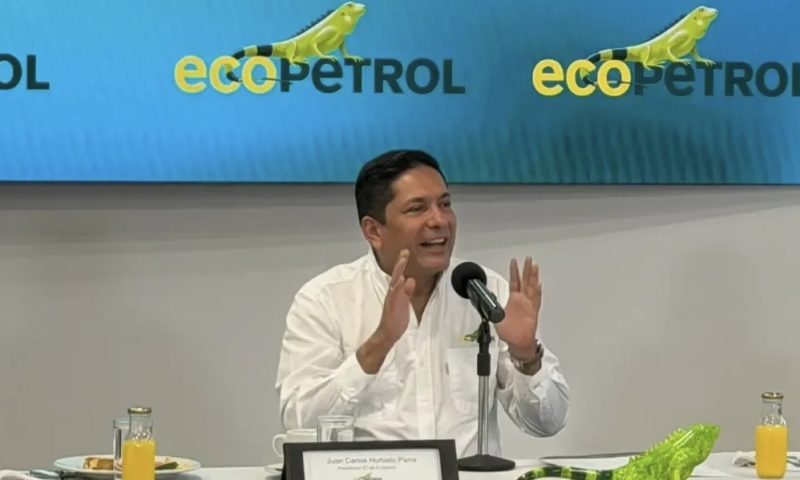
Photo 2: Juan Carlos Hurtado Parra, Acting President of Ecopetrol. Photo courtesy of Ecopetrol.

Juan Carlos Hurtado Parra, Acting President of Ecopetrol. Photo by of Ecopetrol.

During Roa’s absence, the board appointed Juan Carlos Hurtado Parra as acting president of Ecopetrol. According to the statement, Hurtado currently serves as executive vice president of hydrocarbons and has been the first alternate to the presidency since November 16, 2025.

He has “more than 28 years of experience in the energy sector, including roles as vice president of exploration, development, and production at Ecopetrol and has held executive positions focused on resource management and coordination. He is an electrical engineer, holds a specialization in Project Evaluation and Development, and has a Master of Business Administration (MBA) in International Oil and Gas.”

  •  

Colombian authorities highlight anti-drug efforts amid US pressure

Colombian police test illegal drugs. Credit: Colombian National Police

The Colombian National Police published a report this week summarizing the results of its counter-narcotics operations during the first quarter of 2026.

Authorities highlighted the results of their new anti-drug dubbed ‘Esmeralda Plus‘, which has led to the seizure of 124 tons of cocaine and 99 tons of cannabis.

The report comes as President Gustavo Petro faces pressure from the White House to prove his commitment to countering the illicit drug trade, which has been a source of dispute between the two administrations.

“We are delivering significant strikes against drug trafficking. Today we fulfill our duty to Colombia and the world with dignity,” said Brigadier General William Castaño Ramos, Director of the Anti-Narcotics Division, following the report’s publication.

In addition to the 124 tons of cocaine and 99 tons of cannabis confiscated, the police also seized over 450,000 gallons of liquid chemicals and 396,000 kilograms of solid ingredients used in drug production.

They also announced the destruction of 981 narcotics laboratories and the recovery of 99 ampoules of fentanyl.

The confiscation figures mark a significant increase in seizures compared to the first 100 days of 2025, which saw 104 tons of cocaine and 63 tons of cannabis confiscated. 

These figures serve as a response to the heavy tensions that preceded the White House meeting, when U.S. President Donald Trump personally attacked Petro, signaling him as a “man who likes to make cocaine” and claiming that Colombia was “very sick” under his leadership.

The report comes amid mounting pressure by Washington for the Petro administration to tackle drug production. 

Trump has accused Colombia of failing to cooperate in the fight against the narcotics trade and carried out a series of unilateral aerial strikes against suspected ‘narco-vessels’ off the coast of Colombia since September, actions condemned by the Petro as a violation of national sovereignty.

Furthermore, Colombia’s President is currently facing two preliminary criminal investigations in Brooklyn and Manhattan regarding his 2022 electoral campaign. U.S. prosecutors are examining alleged illicit donations from drug trafficking networks and meetings with traffickers intended to block extraditions.

“The United States has found a mechanism to pressure the government and extract the maximum amount of concessions regarding the fight against drugs,” Sandra Borda, Professor of Political Science at the University of the Andes, told The Bogotá Post

While the Colombian government appears to have stepped up its counter-narcotics operations amid U.S. pressure, some say this may not be enough to appease the White House.

“For Washington, these technical results are necessary, but they aren’t enough to fully restore trust,” Nelson Poveda, a political analyst and international affairs expert with experience in Colombia’s Ministry of Foreign Affairs, told The Bogotá Post. “Still, these reports act as a bridge for ‘technical diplomacy,’ allowing cooperation to continue even when the political relationship is tense.”

In the report, authorities stress that ‘Esmeralda Plus’ attacks narcotics trafficking as a holistic system rather than just seizing drugs.

“We are directly destabilizing the finances, logistics, and operational capacity of these criminal structures,” pointed out General William Rincón, Chief of the National Police Service.

But Colombia has been excluded from key regional counter-narcotics efforts, notably the “Shield of the Americas”, a new anti-drug alliance promoted by Donald Trump.

The White House has historically favored eradication – the destruction of drug crops – as a counter-narcotics strategy. 

But Petro has consistently defended his “Total Peace” policy, arguing that the war on drugs must move away from just persecuting farmers and shift toward dismantling the financial backbone of cartels and taking down criminal leaders.

However, authorities reported 40 arrests for extradition purposes and more than 17,000 arrests related to drug trafficking so far this year. Additionally, the manual eradication of around 2,000 hectares of illicit crops shows that the Colombian administration is maintaining a mixed offensive that combines social policy with high-impact law enforcement.

With the 2026 electoral cycle approaching in Colombia, Petro’s administration is under immense pressure to show that this humanitarian approach is not a sign of weakness before he leaves office.

The post Colombian authorities highlight anti-drug efforts amid US pressure appeared first on The Bogotá Post.
  •  

S&P Global Ratings Downgrades Colombia to BB- Amid Fiscal Concerns

Credit downgrade is an indictment of the Petro administration’s fiscal management, including suspension of the fiscal rule.

On April 8, 2026, S&P Global Ratings (NYSE: SPGI) lowered its long-term foreign currency sovereign credit rating on Colombia to BB- from BB and its long-term local currency rating to BB from BB+. The outlook for both ratings is stable, reflecting expectations that the Government of Colombia will gradually reduce its fiscal deficit while sustaining moderate growth in the national gross domestic product.

The rating action follows persistent fiscal imbalances and a policy environment that has become less predictable since the pandemic-related recession. The government decision to suspend the national fiscal rule in 2025 marked a significant shift in the policy framework. Pro-cyclical fiscal policies have provided marginal support for employment and consumption, but have also contributed to higher inflation expectations and a wider current account deficit. S&P expects the general government fiscal deficit to reach 5.6% of the national gross domestic product in 2026, compared to 5.3% in 2025.

“We expect Colombia to have consistently large fiscal deficits over the next few years.” — S&P Global Ratings

Institutional stability remains a key factor in the rating, though challenges persist. A fragmented legislature followed the March 2026 elections, where Pacto Histórico and Centro Democrático emerged with the largest minorities. The upcoming presidential election, scheduled for May 31, 2026, adds further uncertainty. Candidates such as Iván Cepeda of Pacto Histórico, Paloma Valencia, and Abelardo de la Espriella have proposed varying approaches to fiscal consolidation. The new administration will inherit spending pressures related to domestic security, rising healthcare costs, and pension payments linked to minimum wage increases.

The Banco de la República, the independent central bank of the country, has maintained a tight monetary policy to combat inflationary pressures. Annual inflation reached 5.3% in February 2026, prompting the bank to increase reference rates to 11.25%. S&P anticipates that inflation will not return to the target range of 3% +/- 1% until early 2029. While the independent status of the central bank provides a buffer against external shocks, high interest rates and lower-than-expected revenue collections have contributed to the widening deficit since 2024.

Economic growth is projected at 2.5% for 2026, slightly below the 2.6% recorded in 2025. Per capita growth is estimated at $9,900 USD for 2026, with real growth expected to average just above 2% through 2029. Despite being a net energy exporter, the performance of the US economy and international energy prices continue to influence national outcomes. Hydrocarbon exports declined to 35% of goods exports in 2025, down from 67% in 2013, showing some diversification even as the sector remains a primary source of volatility.

Net general government debt is forecast to approach 66% of the national gross domestic product by 2029, rising from 60.4% in 2025. S&P notes that the government interest burden will average 12.3% of general government revenue over the next three years. The shift toward issuing shorter-term debt instruments has reduced reported interest payments but increased vulnerability to interest rate fluctuations. External indicators remain a concern, with narrow net external debt expected to stabilize at 130% of current account receipts through 2029. Foreign direct investment is expected to be the primary source for funding the current account deficit, which is projected to stabilize around 2.6% of the national gross domestic product.

Vise photo credit © Loren Moss

  •  

Petro severs ties with Central Bank after Colombia rate rise

President Gustavo Petro has triggered a rare institutional confrontation with the Central Bank  after he ordered to “break relations” following an modest interest rate increase, raising concerns over economic policy independence just two months before the May 31 presidential election.

The board of Banco de la República voted on March 31 to raise its benchmark rate by 100 basis points to 11.25 per cent, defying government pressure for looser policy. Finance minister Germán Ávila denounced the move as “disproportionate” and withdrew from the board, accusing policymakers of privileging financial sector interests over economic growth.

The decision marks an unprecedented rupture in Colombia’s macroeconomic governance framework. By stepping away from the board, Ávila has effectively deprived it of the quorum required to meet under existing statutes, raising the prospect of a policy deadlock just as inflation remains above target.

At stake is more than a disagreement over rates. The confrontation exposes deeper tensions between a government focused on growth and redistribution and a technocratic central bank committed to price stability. It also risks undermining one of Colombia’s most respected institutions at a time of heightened global uncertainty.

Governor Leonardo Villar defended the rate hike, insisting the bank’s constitutional mandate to control inflation could not be subordinated to political considerations. He said the board remained focused on steering inflation back to its 3 per cent target, noting that price pressures — currently running at 5.29 per cent annually — remain elevated despite signs of moderation.

“The decisions are based on technical criteria,” Villar said, rejecting accusations of bias towards the financial sector. He also warned that the government’s withdrawal runs counter to institutional norms.

Markets are now watching whether the government intends to sustain its boycott. Under Colombian law, the presence of a Finance Minister is required for board meetings, meaning continued absence could paralyse rate-setting decisions in the coming months. Three key meetings — in April, June and July — are scheduled before the end of Petro’s term, with the latter two falling after a decisive first-round of the presidential elections.

Business leaders have reacted with alarm. Camilo Sánchez, head of utilities association Andesco, described the breakdown in coordination as “dire”, warning that permanent dialogue between fiscal and monetary authorities is essential for economic stability.

Analysts say the government may be using institutional leverage to halt further rate increases, given that a majority of board members had signalled a tightening bias to anchor inflation expectations. A prolonged standoff could, however, carry significant costs.

Colombia has long been viewed by investors as a regional outlier for its strong central bank independence. Any perception that political pressure is eroding that autonomy could weigh on the peso, increase borrowing costs and deter foreign investment.

The dispute comes against a complex macroeconomic backdrop. Inflation has been fuelled in part by a sharp increase in the minimum wage and higher public spending, while external risks — including rising energy prices linked to the war in the Middle East and closure of the Strait of Hormuz by Iran.

For Petro, the rate hike reinforces a long-standing critique that tight monetary policy is stifling growth and employment. Writing on social media, the president accused the central bank of pursuing a “suicidal” policy that harms the wider economy.

Yet economists warn that weakening institutional credibility could ultimately prove more damaging than high interest rates. “The risk is not just policy error,” one Bogotá-based analyst said. “It is the erosion of the rules of the game.”

The coming weeks will test whether the standoff is a negotiating tactic or the start of a more fundamental shift in Colombia’s economic governance. Either way, the episode has already injected a new layer of uncertainty into one of Latin America’s most closely watched economies.

  •  

Petro faces fresh political crisis after leaked audios link officials to alleged smuggler

Fresh audio revelations broadcast by Noticias Caracol have triggered a political storm in Colombia, implicating senior government-linked figures in alleged secret contacts with one of the country’s most notorious smugglers, Diego Marín Buitrago.

The recordings, aired late on April 5, appear to document meetings between intermediaries connected to President Gustavo Petro and the legal representative of Marín, widely known by the alias “Papá Pitufo.” The revelations come with just over four months remaining in Petro’s presidential term, intensifying scrutiny over his administration.

According to the report, the audios – lasting more than 90 minutes – capture conversations from early 2025 involving at least four individuals allegedly acting as emissaries of the government. Among them is Jorge Lemus, the former head of the National Intelligence Directorate (DNI), as well as other figures with links to the administration.

In the recordings, Lemus is heard holding closed-door meetings with Marín’s lawyer, Luis Felipe Ramírez, in which possible judicial benefits and guarantees are discussed in exchange for cooperation. Such proposals, if confirmed, would fall outside the remit of intelligence officials and raise questions about potential overreach and irregular negotiations.

The audios also suggest that these contacts occurred before any formal intervention by judicial authorities, with intermediaries allegedly presenting themselves as acting on behalf of the executive branch. Additional names mentioned include Catalan political figures Xavier Vendrell and Ramón Devesa, as well as former financial intelligence adviser Isaac Beltrán.

The revelations have revived a long-running controversy over alleged links between Marín and Petro’s 2022 presidential campaign. Previous reports indicated that the smuggler may have contributed 500 million pesos (approximately $130,000) to the campaign—funds Petro has said were returned upon discovery of their origin. However, opposition figures argue that no conclusive proof of that վերադարձ has ever been presented.

Opposition leaders, including senator and presidential hopeful Paloma Valencia, seized on the latest disclosures to demand an independent investigation. “This is an extremely serious institutional matter,” Valencia said in a video response, questioning the absence of evidence regarding the alleged վերադարձ of the funds and warning of a pattern of clandestine contacts.

Critics argue that the recordings point to “under-the-table” dealings with criminal actors, potentially undermining the government’s legitimacy at a critical political juncture.

President Petro responded by acknowledging that intelligence contacts with Marín’s circle had taken place but insisted they were authorized and aimed solely at securing the smuggler’s cooperation with Colombian justice.

“The purpose was to bring Marín to Colombia,” Petro said, framing the outreach as part of a broader strategy to dismantle criminal networks. However, the president went further, alleging that some intelligence agents may have exploited the situation by attempting to solicit money during the interactions.

According to Petro, these alleged irregularities led to dismissals within state agencies, suggesting internal misconduct rather than a coordinated government effort to negotiate with the smuggler.

The president also criticized the Fiscalía General de la Nación, accusing prosecutors of limiting the scope of investigations and pursuing what he described as a politically motivated campaign against his administration.

Marín, long considered one of Colombia’s most significant contraband operators, has been linked for decades to networks involved in smuggling and bribery. His arrest in Europe in 2024 triggered an ongoing extradition process, though legal challenges in countries including Spain and Portugal have complicated proceedings.

Prosecutors in Colombia have charged him with criminal conspiracy and bribery, alleging he led a sophisticated structure that penetrated state institutions.

The latest revelations add to mounting political pressure on Petro, whose administration has already faced a series of scandals and internal fractures. With the presidential term nearing its end, the emergence of recorded evidence – rather than testimony or second-hand accounts—marks a potentially decisive moment in a controversy that has shadowed his government for years.

Whether the audios lead to formal investigations or judicial consequences remains unclear. But politically, the damage appears immediate, reopening questions about the boundaries between state actors and criminal networks—and the extent to which those lines may have been blurred behind closed doors.

  •  

Colombia Intelligence Chief’s Resignation Exposes Instability and Possible Illegal Group Infiltration

Since the start of President Gustavo Petro’s administration, the intelligence agency has had four directors, highlighting instability within one of the institutions responsible for state security.

The resignation of Wilmar Mejía as chief of Colombia’s National Intelligence Agency has highlighted instability within the country’s main intelligence agency under the government of President Gustavo Petro, which has seen four leadership changes over the past three years.

Mejía confirmed his departure on April 1 in an interview with Canal 1. “When the Inspector General’s Office lifted my suspension, I went to sign my reinstatement document and within 15 minutes I submitted my resignation. I am no longer the director of intelligence,” he said.

The official had been suspended since December 23, 2025, by the Inspector General’s Office as part of a disciplinary investigation “for alleged links to and the provision of information to members of dissident factions of the former Revolutionary Armed Forces of Colombia (FARC).” The Inspector Office said at the time that the measure aimed to prevent possible interference with the process.

Investigation into alleged links to guerrilla dissidents

The case is related to the seizure of digital files belonging to Alexander Díaz Mendoza, known as “Calarcá Córdoba,” a leader of one of the dissident structures grouped under the Estado Mayor de Bloques y Frente (EMBF). Authorities say the documents point to possible contacts with the former intelligence chief.

Mejía has denied any involvement and has argued that the accusations are part of alleged “setups aimed at silencing reports of internal corruption.”

According to the Inspector Office, the investigation “includes possible acts such as the disclosure of military force communication frequency codes and support in the creation of security companies that could facilitate the legalization of weapons in the event of a breakdown in peace talks with the government.”

So far, neither the Inspector General’s Office nor the Attorney General’s Office has concluded its investigations, and no determination of responsibility has been made.

The case has raised concerns about state security and the institutional stability of the agency, considered a key body for the country’s strategic intelligence.

Local media outlets such as El Colombiano have reported that the situation has affected trust among international intelligence partners, suggesting that agencies such as the CIA (United States), MI6 (United Kingdom), and Mossad (Israel) have restricted the sharing of strategic information with Colombia.

Four directors in just over three years

Since Petro took office, the agency has had four directors, all of them close to the president through their past involvement in the M-19 guerrilla group, which signed a peace agreement in 1990.

The instability dates back to the beginning of Petro’s administration. Since August 2022, when Manuel Alberto Casanova Guzmán was appointed, the agency has undergone repeated leadership changes.

Casanova, who faced criticism over his lack of intelligence experience and background as a philosopher, was removed following allegations of involvement in a false extortion case linked to then-Foreign Minister Álvaro Leyva, as reported by Infobae.

He was succeeded by Carlos Ramón González, who later left the post amid investigations into his alleged role in the corruption scandal involving Unidad Nacional de Gestión de Riesgo y Desastres (UNGRD). He is currently in Nicaragua under political asylum, while Colombia has requested his extradition and Interpol has issued a red notice.

Finally, just before Mejía, the agency was led by Jorge Lemus, who served for nearly a year before resigning. He was subsequently appointed by Petro as director of the Unidad de Información y Análisis Financiero (UIAF), amid growing allegations of possible infiltration within the country’s security institutions.

  •  

Colombia’s Finance Minister Leaves Central Bank Meeting Over Rate Increase, Fueling Tensions

Finance Minister Germán Ávila walked out of a central bank board meeting, accusing it of going against Colombia’s national interests and deepening institutional tensions.

Colombia’s Finance Minister Germán Ávila abandoned a meeting of the board of the central bank (Banco de la República), on April 1 in protest over two decisions by the institution: the release of an internal document without prior consultation, and a 100-basis-point increase in the benchmark interest rate, which was raised to 11.25%.

According to the finance minister, the disclosure of the document, which involved both institutions and was linked to a draft government decree, constituted an “abuse.”

He also described the rate hike, the second so far this year, as “irresponsible and inconvenient,” arguing that it contradicts the government’s economic growth strategy.

The central bank said the decision was approved by a majority of its board: “four members voted in favor of the increase, two supported a 50-basis-point cut, and one proposed keeping the rate unchanged.”

The bank justified the move by noting that inflation stood at 5.4% in January and 5.3% in February, above the 5.1% recorded at the end of 2025. It also warned of external risks, including the impact of the conflict in Iran on the global economy, which could increase the cost of key imports such as gas and fertilizers and add to inflationary pressures later this year.

It remains unclear whether Ávila’s withdrawal from the board will be temporary or permanent, but the episode marks a new point of institutional tension that could influence the direction of monetary policy in Colombia in the coming months.

Clash between monetary policy and government strategy

Ávila criticized the decision, saying the central bank is overlooking the country’s economic progress. “The decision taken by the central bank is repetitive and continues to ignore the national government’s efforts to ensure fiscal stability and sustained economic growth,” he said.

He also argued that the increase is disproportionate compared with global trends. “There is not a single economy in the world proposing a 200-basis-point increase in the benchmark rate in the current global context,” he said, referring to the fact that the bank had already raised rates by 100 basis points in February, meaning a total increase of 200 basis points in just four months.

The government maintains that macroeconomic conditions remain stable, pointing to controlled inflation, a relatively stable Colombian peso (COP) against the dollar, declining unemployment and solid productive growth, and argues that tighter monetary policy is unnecessary.

Debate over central bank independence

The Finance Ministry said the minister’s decision to leave the meeting does not seek to challenge the independence of the central bank, but rather to highlight the need for its decisions to align with the country’s economic and social reality.

However, the move has raised legal and institutional concerns. Central bank chairman of the board, Leonardo Villar noted that the finance minister has a constitutional obligation to attend board meetings, as he “not only represents the government but also lead the meetings” said in a public interview broadcasted by media outlet like La República.

He warned that an indefinite absence could amount to a breach of legal duties and urged President Gustavo Petro to appoint an “ad hoc” delegate if the minister decides not to attend future meetings.

Experts say the minister’s absence could affect the board’s ability to make decisions. According to Andrés Pardo, former deputy finance minister and head of Latin America macro strategy at XP Investments, in an interview with Valora Analitik, “current regulations require at least five members, including the finance minister or a delegate, for the board to deliberate and decide”.

This could mean that, without his presence, the central bank may be legally unable to adopt monetary policy decisions.

Economic impact

The rate increase could have significant effects on the real economy. According to the Finance Ministry, a move of this magnitude could slow economic recovery, increase borrowing costs for households and businesses, and raise debt servicing costs.

Small and medium-sized companies, construction, retail and tourism are expected to be among the most affected sectors, along with households holding variable-rate loans.

Lower-income groups could face the greatest impact, as reduced purchasing power and tighter access to credit may deepen economic inequality.

  •  

Colombia Unemployment Drops to 9.2% in February, Lowest Since 2001

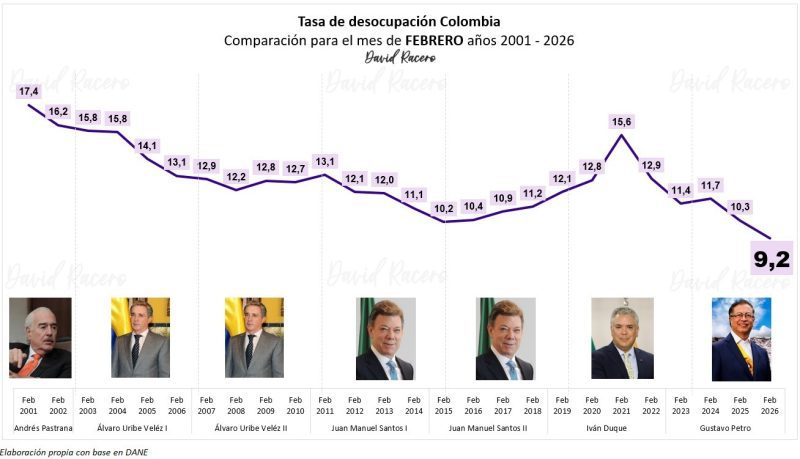
Colombia’s unemployment rate dropped to 9.2% in February from 10.3% a year earlier, marking the lowest level for the month since 2001, according to official data.

In February 2026, Colombia’s unemployment rate stood at 9.2%, a decrease of 1.1 percentage points compared with the same month in 2025 and the lowest figure for a February since 2001, according to the government through the National Administrative Department of Statistics (DANE).

According to the report, “at the national level, the employed population increased by 624,000 people compared with the previous year.” The sectors that contributed most to job creation were professional, scientific and technical activities, with 250,000 new positions, and the public sector (administration, education and health), with 244,000. In contrast, agriculture lost 363,000 jobs and the transportation sector 86,000 compared with February 2025.

President Gustavo Petro highlighted the result on his X account, stating that “we return to a single-digit unemployment rate, 9.2%, the lowest since 2018. More reasons not to accept the mistake of the right parties in claiming that raising the minimum wage to a living wage would bring an employment catastrophe. That was not true: we have the lowest unemployment of this century for the month of February.” The president also defended the minimum wage increase, which reached 23.7%, the highest recorded in the country.

Volvemos a un dígito de tasa de desocupación, 9,2%, la más baja desde el 2018.

Más razones para no aceptar la equivocación de la derecha al afirmar que el subir el salario mínimo al nivel del salario vital traería una catástrofe del empleo.

No fue cierto, tenemos el menor… https://t.co/vXz7Muv3f0 pic.twitter.com/Jx7RBeIWLb

— Gustavo Petro (@petrogustavo) March 30, 2026

Downward trend in unemployment

When analyzing the December–February rolling quarter, the unemployment rate stands at its lowest level in the past ten years, according to DANE reports. The figure rose from an average of 10.7% in 2017–2018 to a peak of 15.7% in 2020–2021, a period marked by the impact of the COVID-19 pandemic, before declining steadily to 9.2% in February 2026.

For the same period in 2025, the rate stood at 10.4%, representing a reduction of more than one percentage point.

These figures are consistent with estimates by the International Labour Organization (ILO) in Colombia, which had projected a gradual decline in unemployment from around 16% in 2020 to an estimated 8.3% for the previous year.

Chart showing unemployment in Colombia from February 2016 to February 2021, including the presidents in office during that period. Image shared by Pacto Histórico Representative David Racero.

Chart showing unemployment in Colombia from February 2016 to February 2021, including the presidents in office during that period. Image shared by Pacto Histórico Representative David Racero.

Gaps and challenges in the labor market

Despite the overall improvement, the DANE report also highlights challenges in terms of labor inclusion. In February 2026, the unemployment rate for men was 7.4%, while for women it reached 11.7%, representing a gender gap of 4.3 percentage points.

However, the government noted that this gap has been narrowing, as it stood at 5.2 percentage points in the previous month.

The data come from “The Great Integrated Household Survey” (La Gran Ecuesta Integrada de Hogares – GEIH), DANE’s statistical instrument that provides information on the labor market, income, monetary poverty and the sociodemographic characteristics of Colombia’s population.

  •  

U.S. Assures Colombian President Petro He Does Not Face Charges Right Now

The Justice Department is examining Gustavo Petro for possible ties to drug traffickers. U.S. officials have told him that for now he does not face criminal charges arising from the probes.
  •  

Border Crossing Between Colombia & Ecuador Reopens After 19 Day Blockade

While Colombia & Ecuador are at peace, the neighboring presidents have a sour relationship going back to when Colombian President Gustavo Petro initially refused to recognize Daniel Noboa’s election.

Traders and transport operators have suspended a 19-day blockade at the Rumichaca International Bridge, the primary land crossing between Colombia and Ecuador. The protest, catalyzed by a 50% tax imposed by the Ecuadorian government on Colombian goods, was lifted to accommodate travel and commerce during the Semana Santa holiday period. Despite the suspension of the strike, the regional business community reports that significant economic damage and diplomatic tensions persist.

Ecuador's President Daniel Noboa (photo: Carlos Silva/Presidencia de la República)

Ecuador’s President Daniel Noboa (photo: Carlos Silva/Presidencia de la República)

The closure of the border crossing created a substantial disruption in binational economic activity. Estimates from the Cámara de Comercio de Ipiales in Nariño, Colombia indicate that losses reached approximately $5 million USD per day due to freight remaining stationary in the border zone. The Comité Gremial de Trabajadores de la Frontera de Ipiales stated that while the reopening is a responsible gesture for the high-traffic holiday season, current tariff policies continue to threaten hundreds of direct and indirect jobs linked to foreign trade.

The Governor of Nariño, Luis Alfonso Escobar, criticized the trade barriers implemented by the administration of Ecuadorian President Daniel Noboa. Governor Escobar argued that such measures inadvertently encourage illicit activities in the region. He emphasized that instead of facilitating formal commerce, high tariffs drive trade toward illegality, undermining regional security efforts. To mitigate the conflict, the Comunidad Andina de Naciones (CAN) has initiated high-level dialogues. Diplomatic delegations led by Colombian Deputy Minister of Foreign Affairs Juana Castro and her Ecuadorian counterpart, Alejandro Dávalos, held a virtual working group to address pending issues in trade, transport, energy, and hydrocarbons.

“Decisions adopted without considering the reality of our communities have put at risk the livelihood of merchants, transporters, foreign trade workers, and thousands of people who live from binational exchange,” stated the Comité Gremial de Trabajadores de la Frontera de Ipiales.

Diplomatic friction has extended into the energy sector. President Noboa claimed that in 2017, Ecuador assisted Colombia during a potential blackout by charging 1.6 cents USD per kWh, whereas in 2024, Colombia charged an average of 28 cents USD per kWh during Ecuador’s hydroelectric crisis. In response, the Colombian Minister of Mines and Energy, Edwin Palma, clarified that prices during the 2023-2024 El Niño phenomenon reflected the actual costs of production and distribution, particularly when fossil fuel-powered thermoelectric plants using fuel oil and diesel were activated.

The ongoing trade dispute has impacted more than 5,500 companies over the past two months. Diana Marcela Morales, the Colombian Minister of Commerce, Industry, and Tourism, confirmed scheduled meetings with Ecuadorian officials to de-escalate the conflict and establish fair, transparent rules. Concurrently, the Ministerio de Comercio, Industria y Turismo has moved to protect domestic industries by implementing new tariffs on steel and ceramics from countries without existing free trade agreements. These measures aim to counter market distortions and protect a sector that employs more than 50,000 people while promoting circular economy practices and reducing CO2 emissions.

Above photo: Border between Ecuador & Colombia looking towards Ipiales, Colombia (Photo: Cancillería de Colombia)

  •  

Ecopetrol Shareholders Loudly Heckle CEO Ricardo Roa at Annual Meeting as Leadership Dispute & Corruption Scandal Roils The Petroleum Company

Governance concerns and profit drops dominate shareholder assembly.

The Ecopetrol (NYSE: EC, BVC: ECOPETROL) General Shareholders’ Meeting concluded at the Corferias convention center in Bogotá, marked by a decline in annual profits and an intensifying debate regarding the continuity of the company’s president, Ricardo Roa. During the assembly, shareholders approved a dividend of $121 COP per share for minority holders and a total payment of $4 trillion COP to the Colombian government, which serves as the majority shareholder. The government’s payout is scheduled for distribution in two installments, to be completed by June 30, 2026.

Click on above image to view shareholder meeting
Embattled Ecopetrol CEO Ricardo Roa was appointed to the position by Colombian President Gustavo Petro after managing his political campaign. (photo: Ecopetrol)

The financial results for the 2025 fiscal year revealed a significant contraction in net income, which fell to $9 trillion COP from the $14.9 trillion COP reported in 2024. Roa attributed this decline primarily to the volatility of international crude prices. He noted that the average price of Brent crude dropped from $80 USD per barrel to $68 USD per barrel over the period. According to company data, every $1 USD drop in the price of Brent corresponds to a reduction of approximately $500 billion COP in net profit and $700 billion COP in EBITDA. Despite the lower earnings, the company maintained a production level of 745,000 barrels per day and achieved a reserve replacement rate of 121%, the highest in five years.

Governance issues remained the primary focus of the assembly. Minority shareholders expressed concern over the legal challenges facing Roa, who is currently under investigation by the Fiscalía General de la Nación for alleged influence peddling. Additionally, the Consejo Nacional Electoral (CNE) has raised accusations regarding the alleged violation of spending caps during the presidential campaign of Gustavo Petro, which Roa managed. Angela Maria Robledo, Chair of the Board of Directors, defended the decision to retain Roa, stating that the board has activated a evaluation protocol while respecting the constitutional principle of the presumption of innocence.

Shareholders Erupt In Anger At CEO Ricardo Roa:

🚨Abuchean a Ricardo Roa en asamblea de Ecopetrol

“¡Fuera, fuera!”: Este es el momento del tenso abucheo de los accionistas al presidente de la empresa 🔽

Videos: Néstor Gómez pic.twitter.com/uyjh4chpl2

— EL TIEMPO (@ELTIEMPO) March 27, 2026

“Ecopetrol is listed on the New York Stock Exchange; we are governed by the strict regulations of US federal agencies. Agencies like OFAC and the SEC could intervene in the company and could even accelerate the payment of financial obligations, which would be extremely grave for Ecopetrol,” stated Martín Ravelo, President of the USO.

The Unión Sindical Obrera (USO), the primary labor union representing nearly one-third of the company’s workforce, has issued an ultimatum for Roa’s removal. Martin Ravelo, president of the USO, warned that the union will initiate a national strike and affect crude production if Roa is not aparted from his position by Monday, March 30. Ravelo expressed concern that Ecopetrol, which is subject to the regulations of the Securities and Exchange Commission (SEC) and the Office of Foreign Assets Control (OFAC), could face federal intervention. He highlighted that Ecopetrol’s current debt has reached $30 billion USD, exacerbated by rising interest rates, and warned that the company lacks the cash flow to respond to potential demands for early repayment of international obligations.

President Gustavo Petro responded to the union’s concerns via social media, stating that the executive branch will take measures to shield the company’s financial future. Petro emphasized the importance of maintaining investment during periods of high oil prices to prepare for future market downturns. He also criticized past administrations for failing to invest sufficiently in clean energy during previous price cycles. In contrast, Ravelo called for the board to maintain its independence from political influence, noting that four of the nine board members have already left formal records supporting Roa’s departure.

Ecopetrol also addressed the national gas supply, with Roa announcing that new regasification alternatives at Puerto Bahía and on the Pacific coast are expected to begin operations in the second half of 2026. These projects are intended to contribute between 186 and 430 Gbtud to the national grid. A third regasification facility in Coveñas is projected to start operations in 2029 with a capacity of 400 Gbtud. Despite these operational plans, the immediate focus of the international investment community remains fixed on the board’s upcoming meeting on Monday, where the leadership deadlock must be resolved to avoid a potential halt in national production.

Headline photo: Former Senator Jorge Robledo admonishes the Ecopetrol board of directors at the March 2026 shareholders’ meeting.

  •  

Strike Threat Looms as Colombia Oil and Gas Union Calls for Ecopetrol President’s Removal

The petroleum workers called for Ricardo Roa’s head following formal influence-peddling charges filed by Colombia’s Attorney General’s Office.

One of Colombia’s principal petroleum worker’s unions, the Unión Sindical Obrera (USO), has formally requested that Ecopetrol’s board of directors remove Ricardo Roa Barragán as president of the state-controlled oil company, amid ongoing investigations against him by the Attorney General’s Office. The union warned that it will call a nationwide strike if the request is not addressed.

The request was made in a letter dated March 24, sent after a meeting between union representatives and the company’s board. In the document, the USO stated that, “understanding the feelings of the Colombian people as reflected by the thousands of Ecopetrol workers, we immediately request that, within the framework of due diligence, the board of directors adopt the necessary measures to remove Dr. Ricardo Roa Barragán from his position as president of Ecopetrol.”

The union added that, if the request is not met, “this union will call for nationwide mobilization in defense of the most important asset of the Colombian people.”

On the same day, March 24, Ecopetrol’s board issued a public response, reported by outlets such as Caracol Radio, stating that it had reviewed requests from employees, the union and some minority shareholders.

In its statement, the board said it is “aware of its responsibilities within the framework of due diligence” and has been assessing the risks to the company stemming from reports related to Roa. However, it confirmed that Roa will remain in his position while the evaluation process continues.

The union’s request follows charges filed by the Attorney General’s Office on March 11 against Roa for alleged influence peddling. According to prosecutors, Roa is accused of favoring a third party in the allocation of a project in exchange for a reduction in the price of an apartment he purchased in 2023.

More details on the case can be found in the article “Colombia’s Top Prosecutor Charges Ecopetrol President in Alleged Influence-Peddling Case,” published by Finance Colombia.

At this stage, although the information has been publicly reported, judicial decisions remain under the authority of the Attorney General’s Office, which is leading the proceedings.

Roa’s legal situation is also linked to another investigation involving alleged irregularities in the financing of the Pacto Histórico presidential campaign in 2022, which he managed and which resulted in Gustavo Petro’s election as president.

In February, the Attorney General’s Office said investigators found indications that the campaign may have exceeded legal spending limits. A similar case had already been reviewed by Colombia’s elections authority, the National Electoral Council, which fined those responsible more than $5 billion Colombian pesos (over $1.4 million USD).

Photo by Ecopetrol.

  •  

Colombia’s Prosecutors Go After FARC Dissidents “Segunda Marquetalia” For Presidential Candidate Miguel Uribe Turbay Murder

So far, three people have been convicted in the killing of former presidential candidate Miguel Uribe Turbay, while arrest warrants target seven members of FARC dissident factions.

Colombia’s Attorney General’s Office is advancing its investigation into the assassination of Senator and presidential pre-candidate Miguel Uribe Turbay. On one hand, it sentenced alias “El Viejo” to more than 22 years in prison for acting as an intermediary between those who ordered the crime and the criminal network that carried out the attack; on the other, it issued arrest warrants for seven individuals belonging to a dissident faction of the FARC accused of ordering the killing.

The assassination of the Centro Democrático party senator and presidential candidate took place on June 7, 2025, in Bogotá while he was participating in campaign-related activities. The attack was carried out by a 14-year-old who fired multiple shots and was immediately captured after an exchange of gunfire with National Police officers and Uribe Turbay’s security team.

General attorney, Luz Adriana Camargo Garzón said the crime was not “an isolated act, but the result of a structured criminal operation that involved both an urban criminal network operating as outsourcing and an organized armed group” known as the “The Segunda Marquetalia.”

Miguel Uribe Londoño, a presidential candidate and the victim’s father, said in a tweet directed at President Gustavo Petro:President @petrogustavo You harassed Miguel with your verbal abuse, making him a target for assassination. Your government failed to protect him. Your government has been tolerant of drug trafficking, and the criminals who benefited from your total peace used the Second Marquetalia to assassinate Miguel. But the masterminds behind this must continue to be sought within the Colombian government. We cannot continue to accept this violence. This is why Miguel’s legacy needs to be upheld in the Presidency, and I will carry it until the last day of my life.”

Presidente @petrogustavo.

Usted hostigó a Miguel con su violencia verbal poniéndolo como carne de cañón para que lo asesinaran.

Su gobierno no le dio protección.

Su gobierno ha sido tolerante con el narcotráfico y los criminales beneficiados con su paz total utilizaron a la… pic.twitter.com/mPPvVYZgJv

— Miguel Uribe (@migueluribel) March 22, 2026

Judicial developments and convictions

According to the Attorney General’s report, three individuals have already been convicted through plea agreements:

  1. Simeón Pérez Marroquín, alias “El Viejo,” identified as the link between those who ordered the crime and the criminal network, was sentenced on March 20 to 22 years and four months in prison.
  2. Carlos Mora González, who conducted surveillance at the attack site and transported other suspects, was sentenced to 21 years in prison.
  3. Katherine Andrea Martínez, who took part in planning meetings and retrieved the weapon used (a Glock pistol), was sentenced to 21 years and two months in prison.

The 14-year-old who carried out the attack was sentenced under Colombia’s Juvenile Criminal Responsibility System.

Criminal network and FARC dissident involvement

After nine months of investigation, prosecutors established the involvement of the dissident FARC faction known as The Segunda Marquetalia as the group that ordered the crime and issued arrest warrants against several of its alleged leaders and members.

According to the statement, those targeted include Kendry Téllez Álvarez, identified as a possible mastermind; Iván Luciano Marín Arango, alias “Iván Márquez”; Géner García Molina, alias “Jhon 40”; Alberto Cruz Lobo, alias “Enrique Marulanda”; Jhon Jairo Bedoya Arias, alias “Rusbel”; Diógenes Medina Hernández, alias “Gonzalo”, and José Aldinever Sierra Sabogal, alias “Zarco Aldinever”.

They face charges of aggravated homicide, conspiracy to commit a crime, and the manufacture, trafficking, possession or carrying of firearms, accessories, parts or ammunition.

Additionally, according to El Colombiano, authorities are offering a reward of up to $5 billion Colombian pesos (around $1,4 million USD) for information leading to the capture of alias “Iván Márquez”, and $4 billion Colombian pesos ($1,2 million USD) for alias “Jhon 40” and “Zarco Aldinever”, identified as key leaders of the group.

“Wanted dead or alive”

According to El Colombiano, “the inclusion of ‘Zarco Aldinever’ on the most-wanted list has raised questions, as he had reportedly been killed in August 2025 in alleged clashes with the National Liberation Army (ELN) guerrilla group”

“He is alive; that is, we have no evidence that he is dead. For us, “Zarco Aldinever” is alive. There is no corroborated evidence regarding the rumor that he was killed by the ELN. It remains a rumor, which is why the arrest warrant was issued,” the attorney general said.

Meanwhile, the whereabouts of Iván Luciano Marín Arango, alias “Iván Márquez”, one of the former negotiators of the 2016 peace agreement who later returned to armed activity, remain unknown. He has been reported dead on several occasions, most recently in July 2023, when it was speculated he had died from gunshot wounds in Venezuela.

However, the government has not confirmed those reports. “Despite intelligence efforts by the security forces, there is no reliable information to determine his whereabouts or status,” Defense Minister, Major General (ret.) Pedro Arnulfo Sánchez said.

Photo above. Colombia’s Attorney General Luz Adriana Camargo during a presentation on progress in the Miguel Uribe Turbay case. Photo courtesy of the Attorney General’s Office.

Photo in social media. Miguel Uribe Turbay. Photo courtesy of the Senate of the Republic of Colombia.

  •  

At Least 66 Dead After Colombian Military Plane Crashes During Troop Mission

A C-130 Hercules aircraft crashed in Putumayo, southern Colombia, on March 23, killing 66 people, including soldiers, Air Force personnel and police. A total of 128 people were on board.

A Hercules aircraft operated by the Colombian Air Force (FAC) crashed shortly after takeoff from Puerto Leguízamo, in southern Colombia’s Putumayo department, in a tragedy on Monday, March 23, that left dozens of victims among members of the security forces.

According to Jhon Molina, governor of Putumayo, “58 soldiers, six members of the Air Force and two police officers were among the victims who died in the accident.” A total of 128 people were on board the aircraft. One survived unharmed, and four others remain unaccounted for.

The aircraft, a US-built C-130 Hercules used to transport troops and supplies, went down about one and a half kilometers from the airfield just minutes after takeoff.

Defense Minister, Major General (ret.) Pedro Arnulfo Sánchez, said the crash occurred as the aircraft “was taking off from Puerto Leguízamo (Putumayo, near the border with Peru and Ecuador) while transporting troops from our security forces.”

Investigation underway

The national government authorities said that, based on the information available so far, there is no evidence of an attack by illegal armed groups. According to the defense minister, “the fire triggered the detonation of part of the ammunition being transported, which explains the sounds heard in videos circulating on social media.”

The minister said that “all response protocols for the victims and their families have been activated, along with the corresponding investigation.” In a message posted on X, he added: “I extend my deepest condolences to the families of those affected and, out of respect for their grief, I urge people to avoid speculation until official information is available.”

President Gustavo Petro also addressed structural limitations within the armed forces, noting that bureaucratic processes have delayed modernization efforts. “Renewing the armed forces’ equipment has been a decision of my administration for years. Bureaucratic obstacles in military administration have prevented the approval of the Conpes/Confis (Colombia´s public policy instruments) for over a year since I requested it,” he said.

Statement from the Colombian Air Force

The Colombian Air Force (FAC) expressed its condolences following the crash. We “deeply regrets the tragic accident involving the C-130 Hercules, a loss that brings mourning to our military forces and National Police. The aircraft and its crew were in optimal condition to carry out the mission, with the professionalism that characterizes them.”

The institution added that “the pain and helplessness caused by the unexpected loss of our heroes in this tragic air accident are immense. But that pain is transformed into determination: to honor their memory and legacy with an even greater commitment to the nation, doing what we love: protecting Colombia.”

Gen. Carlos Fernando Silva of the Colombian Air Force said a technical investigation will be conducted with support from the US Air Force to determine the causes of the crash “with transparency and rigor.”

Photos courtesy of the FAC.

  •  

Colombia probes aging Hercules crash as Petro calls aircraft “scrap”

Colombian authorities are investigating whether mechanical failure, human error or excess weight caused the crash of a military C-130 aircraft that has now left at least 69 dead, as a political dispute intensifies over the condition of the country’s aging air fleet.

The aircraft, a Lockheed C-130 Hercules operated by the Colombian Aerospace Force (FAC), went down shortly after take-off on Monday near Puerto Leguízamo, in a remote jungle region bordering Peru and Ecuador.

The plane, identified as FAC 1016, was carrying 128 personnel when it crashed minutes after departure en route to Puerto Asís, roughly 200 kilometres away. Officials have confirmed dozens of survivors, though many remain hospitalised with injuries ranging from minor trauma to severe burns.

Emergency crews faced major challenges reaching the crash site due to the dense Amazonian terrain, while the impact and subsequent fire — compounded by detonations from ammunition on board — left many bodies severely damaged, complicating identification efforts.

Aging aircraft under scrutiny

The C-130H aircraft had been in service since 1983 and was donated to Colombia by the United States in 2020 as part of long-standing bilateral defence cooperation. It underwent a major maintenance overhaul in 2023, including structural inspections and system upgrades, before being returned to operation.

Despite its age, military officials insist the aircraft remained within operational limits. General Carlos Fernando Silva publicly contradicted President Gustavo Petro’s description of the aircraft as “scrap”, presenting detailed figures on its operational life during a televised cabinet meeting alongside Defence Minister Pedro Sánchez and senior military officials.

General Silva said the aircraft had flown 345 hours between 2021 and 2024, and 537 hours in 2025, broadly in line with standard annual usage of around 500 hours. Based on remaining flight capacity — estimated at up to 20,000 hours — he said the aircraft could theoretically continue operating for decades if strict maintenance protocols were followed.

Concerns have emerged from U.S. defence officials regarding maintenance standards and the availability of spare parts for aircraft supplied to Colombia, according to reports by El Tiempo. Sources cited by the newspaper said such aircraft can operate safely for around 10,000 hours, provided rigorous inspection and servicing regimes are maintained.

United States Southern Command has offered to support Colombia’s investigation with a technical team, underscoring the importance of determining whether maintenance, logistics or operational factors contributed to the crash.

Authorities reiterated there is no indication the crash was caused by hostile action, despite the aircraft going down in a region where dissident factions of the former FARC operate and where coca cultivation is widespread.

Investigators are focusing on three main hypotheses: mechanical failure, pilot error, or overloading at take-off. Officials said flight data, maintenance records and communications with air traffic control will be central to establishing the sequence of events.

The disaster has triggered a heated political exchange between President Gustavo Petro and his predecessor Iván Duque, exposing sharp divisions over defence policy and military procurement.

Petro described the aircraft as “scrap”, criticizing past administrations for accepting donated military equipment and arguing that such decisions have weakened Colombia’s operational capacity. “A country cannot defend itself with obsolete machines,” he said, pledging that his government would prioritize acquiring new equipment and strengthening domestic defence production.

He also questioned the long-term cost of maintaining aging platforms, suggesting that donated equipment can ultimately impose higher financial and operational burdens.

Duque strongly rejected the accusation, defending his administration’s handling of the armed forces and pointing to maintenance protocols carried out before the aircraft was delivered. He noted that C-130 aircraft continue to operate in dozens of countries worldwide and urged a technical investigation into factors such as aircraft weight, runway conditions and operational procedures.

Duque also accused Petro of callous social media statements in the hours after the tragedy, calling for restraint while investigations remain ongoing.

The crash adds to six previous military aviation accidents since 2022 and raises deep concerns about the readiness and sustainability of Colombia’s air fleet, much of which relies on aging platforms acquired through international cooperation.

Analysts say the incident could intensify scrutiny over budget-cuts in defence spending, maintenance capacity and the balance between acquiring new equipment and extending the life of existing assets.

As recovery operations continue in Putumayo’s dense jungle, authorities face the dual challenge of identifying victims and providing answers to families, while determining whether the disaster reflects isolated failure or deeper systemic issues within Colombia’s military aviation infrastructure.

  •  

66 militares y policías muertos en el choque del avión militar en Colombia

El avión militar, que transportaba a 128 soldados y miembros de la tripulación, se desplomó tras despegar del sur de Colombia, dijeron las autoridades militares.
  •  
❌