Reading view

Can Abelardo De La Espriella, a U.S. Citizen, Become Colombia’s President?

President Trump this week endorsed the right-wing candidate, Abelardo De La Espriella, a dual citizen of Colombia and the United States, in Colombia’s presidential runoff.
  •  

Colombia’s Yellow World Cup Jersey, Once a Symbol of Unity, Becomes a Political Statement

A presidential candidate endorsed by President Trump has been accused by some Colombians of co-opting their beloved national team’s yellow soccer jersey.
  •  

Bancolombia Analysts Show Colombia’s Economy Accelerating in Second Quarter 2026

Colombia growth tracker signals Q2 acceleration above first-quarter pace

Colombia’s economy showed signs of acceleration in the rolling quarter ended in May 2026, according to the latest NowCast Bancolombia report published June 3 by Grupo Cibest, the quantitative research arm of Bancolombia (NYSE: CIB, BVC: BCOLOMBIA). The proprietary economic activity index registered a year-over-year expansion of 2.9% on a three-month moving average basis for the March–May 2026 period, up from 2.2% recorded in the comparable period a year earlier and an improvement of 30 basis points over the prior month’s reading, which was itself revised upward by 30 basis points from an initial estimate of 2.3%.

The report’s authors describe the result as marking a shift in the growth trend, with second-quarter 2026 conditions appearing more favorable than those observed in the first quarter. On a seasonally adjusted month-over-month basis, however, the index showed no change from the prior month, registering 0.0%. On a year-over-year basis using the original, non-seasonally adjusted series, growth came in at 2.2% for May 2026.

For the full second quarter of 2026, the NowCast model projects year-over-year GDP growth of 2.6%, based on the May 31 reading. That estimate is slightly below the market consensus tracked by Latin Focus Consensus Forecasts, which has held steady at 2.7%. The NowCast estimate for 2Q26 was revised up from 2.4% as of April 30.

The NowCast Bancolombia index is constructed by Grupo Cibest using transaction data from the channels and payment methods of the Bancolombia group, processed through quantitative and analytical tools to generate high-frequency estimates of productive activity in Colombia. The index is designed as a complement to official statistics published by the National Administrative Department of Statistics (Departamento Administrativo Nacional de Estadística, DANE) and is not a substitute for official GDP figures.

“The data suggests that conditions in 2Q26 to date are more favorable than those observed in 1Q26.” — NowCast Bancolombia, June 3, 2026, Grupo Cibest

Sector Performance

At the sector level, the rolling quarter ended in May points to a broad consolidation of trends across Colombia’s productive sectors. Commerce (wholesales and retail) held growth near 3.3% year-over-year, continuing a trend that has been sustained through the first half of 2026. Public administration posted 4.7% year-over-year growth in May, maintaining steady expansion. Real estate services continued its stable trajectory at 2.0%, while financial services accelerated to 5.6% year-over-year in May, up from 2.8% in March.

Construction recorded 3.6% year-over-year growth in May after a period of deceleration that had brought the sector down from highs above 6% in mid-2025. Agriculture registered 3.5% year-over-year growth in May, also showing renewed momentum after a softer stretch earlier in the year. Manufacturing reached 2.4% in May, a modest acceleration from 0.9% in February. Entertainment posted the strongest reading in the heat map at 6.6% year-over-year in May, continuing a recovery that began in mid-2025. Mining remained in modest positive territory at 1.3% in May, though it has been volatile, dipping into negative readings as recently as February 2026 at -2.4%.

The information sector was the weakest performer, posting only 0.2% year-over-year growth in May after recording negative readings in the November 2025 through February 2026 period. Utilities registered 2.2% growth in May, and professional services came in at 1.9%.

The NowCast report was prepared by Arturo Yesid González Peña, Head of Quantitative and Analytics, and Sebastián Ospina Cuartas, Data Controller, within Grupo Cibest’s Economic, Industry and Market Research area. The index is available on Bloomberg under the ticker ALLX COBC<GO>. The report carries a standard disclaimer noting that its projections are subject to risks and uncertainties, and that actual results may differ materially from estimates contained in the document. It does not constitute investment advice.

Above photo: Leatherworking machinery on display at Colombia’s Leather Expo in Bogotá (photo: Loren Moss)

  •  

The ‘Era of the Tiger’ Begins: De La Espriella Responds to Trump’s Endorsement

In a lengthy post on Truth Social, U.S. President Donald Trump threw his support behind Colombian presidential candidate Abelardo “El Tigre” de la Espriella, describing him as a “Smart, Strong, and Tough Leader” and offering what he called his “Complete and Total Endorsement” ahead of Colombia’s June 21 presidential runoff.

Trump praised De la Espriella’s first-round victory and portrayed him as a future champion of economic growth, law and order, and closer ties with the United States.

“The results of this Election are very important to the future of Colombia and its relationship to the United States,” Trump wrote.

The endorsement was notable not only for its enthusiasm but also for its language. Trump attacked De la Espriella’s opponent, left-wing senator Iván Cepeda, as a “Radical Left Marxist” and suggested the runoff could shape the future direction of one of Washington’s closest allies in Latin America.

Then came the response.

Addressing Trump directly, De la Espriella published a lengthy open letter that read less like a campaign statement and more like a declaration of intent.

“With my head held high and a heart full of patriotic gratitude, I receive your words and your steadfast support,” he wrote.

“Thank you, Mr. President.”

The candidate praised Trump as “a leader of true strength and conviction” who had refused to surrender to ideological trends or enemies of freedom.

More importantly, he suggested that Colombia was now following a path similar to that taken by Trump’s political movement in the United States.

“You have paved the way for the people to defeat the entrenched powers that have long held sway,” De la Espriella wrote. “In Colombia, we have now begun to follow that same path.”

It was one of the clearest attempts yet by the conservative candidate to place his campaign within a broader political realignment taking shape across the Americas.

The letter repeatedly returned to the idea of a common destiny shared by Colombia and the United States.

“The United States and Colombia are sister nations, bound by the blood of heroes and by our shared destiny to defend Western civilization across the Americas,” he wrote.

“Together, we are unbreakable.”

For De la Espriella, the relationship extends beyond diplomacy. It is rooted in what he described as shared values, mutual respect and a common struggle against forces that threaten both nations.

The candidate outlined a vision of closer cooperation on security, trade and economic development while emphasizing that both countries face similar challenges from organized crime and drug trafficking.

“Our security policies are fully aligned,” he wrote.

“Narcoterrorism is the cancer destroying our societies, and we will confront it relentlessly, with iron resolve and without apology.”

The statement echoed themes that have defined much of De la Espriella’s campaign: security, economic growth, private enterprise and a promise to reverse what he views as the failures of the Petro administration.

“We stand together in the sacred defense of private property, free enterprise, productive growth, and the well-being of our citizens as the highest purpose of government,” he wrote.

The candidate also pledged resistance to what he called the advance of communism in the hemisphere and announced support for an “Alliance of the Shield of the Americas,” a regional initiative intended to strengthen cooperation among governments committed to security, democracy and economic freedom.

The exchange unfolded as another senior figure in the Trump administration weighed in on Colombia’s election. U.S. Secretary of State Marco Rubio said Washington would closely monitor the electoral process. “We will be very firm in guaranteeing free and fair elections in Colombia and will do everything within our power to achieve that,” he said.

The comments were interpreted by many as a sign of growing U.S. interest in the outcome of the June 21 runoff.

President Gustavo Petro responded without mentioning Trump directly.

“When one country intervenes in the decisions of another country, freedom dies,” he wrote on social media, before posting videos of anti-riot police on the streets of Santiago, Chile, accompanied by the text: “They chose (President) Kazt and once again the violent war against youth in Chile.”  Petro’s incoherence is palpable.

Yet it was the final image accompanying De la Espriella’s letter that perhaps captures the moment more effectively than any political statement.

Created using artificial intelligence, the illustration shows a bald eagle next to a fearless tiger. Behind them, the flags of the United States and Colombia under a turbulent sky.

The symbolism requires little explanation.

The eagle represents the United States. The tiger represents the firebrand “outsider”.

And together they illustrate the central message of De la Espriella’s response: that if voters elect him on June 21, relations between Bogotá and Washington will enter a new chapter.

“In this coming Era of the Tiger – which begins on June 21 – we look forward to the full normalization of relations between Colombia and the United States, built on mutual respect, sovereignty, and mutual benefit.”

Whether Colombians embrace that vision remains to be seen.

But for one extraordinary day in the campaign, the conversation was no longer only about Colombia’s future. It was about two flags, an eagle, a tiger and a political alliance that both supporters and critics believe could reshape relations across the hemisphere.

  •  

Cenco Malls Acquires 51% Stake in Bogotá’s Plaza Central for $125 Million USD

Chilean mall operator enters Bogotá with $125 million USD majority stake

Cenco Malls (BCS: CENCOMALLS), the shopping center arm of Chilean retail conglomerate Cencosud (NYSE: CNCO, BCS: CENCOSUD), has closed the acquisition of a 51% indirect stake in Plaza Central, one of Bogotá’s largest shopping centers, for $125 million USD. The transaction was completed June 3, 2026, following the fulfillment of all conditions established in the agreement between Cenco Malls’ Colombian subsidiary, Cencosud Col Shopping S.A.S., and Patrimonio Autónomo Estrategias Inmobiliarias (BVC: PEI), Colombia’s largest real estate investment vehicle, which retains a 49% stake in the asset.

Plaza Central, inaugurated in October 2016, is located in the Puente Aranda district of Bogotá, at the intersection of three major arterial roads — Avenida de Las Américas, Calle 13, and Avenida 68 — with direct access to mass transit. The mall serves a predominantly middle-income residential and commercial catchment area, within one of the city’s most active business corridors.

“We expect this acquisition to have a favorable effect on the consolidated results of the company, incorporating a relevant asset for the region into our portfolio.” — Sebastián Bellocchio, CEO, Cenco Malls

According to figures reported at year-end 2025, Plaza Central has 204,832 square meters of total built area and 76,520 square meters of gross leasable area (GLA), with occupancy of approximately 95%. The property generated revenues of 79,098 million COP in 2025. The mall holds LEED certification in both Design and Construction and Operations and Maintenance, and has approximately 1,000 solar panels installed.

“We expect this acquisition to have a favorable effect on the consolidated results of the company, incorporating a relevant asset for the region into our portfolio and strengthening the experience we offer visitors to this shopping center,” said Sebastián Bellocchio, CEO of Cenco Malls.

The deal adds a significant Colombian asset to Cenco Malls’ regional portfolio, which currently comprises 41 shopping centers and 1,450,560 square meters of GLA across Chile, Peru, and Colombia. The company was listed on the Santiago Stock Exchange in June 2019 in what was at the time the largest initial public offering in the Chilean market.

PEI, which will continue as a 49% partner in Plaza Central, is Colombia’s largest real estate investment vehicle, with stakes in more than 150 income-generating assets across more than 30 cities. Its equity securities trade on the Colombian Stock Exchange (Bolsa de Valores de Colombia) under the ticker PEI.

Headline Photo: Plaza Central in Bogotá (courtesy Cenco Malls)

  •  

EU and OAS Election Monitors Reject Petro’s Fraud Claims as Colombia Heads to June 21 Runoff

International observers certify Colombia’s first-round vote as transparent and credible

Two major international electoral observation missions have rejected claims of fraud in Colombia’s May 31 presidential first round, as outgoing President Gustavo Petro continued to press unsubstantiated allegations of irregularities in the days following the vote. The country heads to a June 21 runoff between right-wing candidate Abelardo de la Espriella and leftist senator Iván Cepeda.

The European Union Election Observation Mission (EU EOM) issued a preliminary statement Tuesday, June 2, describing the vote count as having been carried out in a “transparent, orderly and fluid” manner. Esteban González Pons, Vice President of the European Parliament and chief observer of the EU mission, told reporters in Bogotá that none of the 12 candidates who competed in the first round had brought claims of irregularities to his mission.

“We can discard any manipulation of data in the quick count and in the final count,” González Pons said. The mission selected a random sample of tally sheets from around the country and compared them to physical ballots cast, finding no inconsistencies.

“We can discard any manipulation of data in the quick count and in the final count.” — Esteban González Pons, Chief Observer, EU Election Observation Mission to Colombia

The EU EOM deployed 143 observers from 24 EU member states plus Norway, Switzerland, and Canada, covering 591 voting tables. The mission will also observe the June 21 runoff and issue a final report two months after the process concludes.

The Organization of American States (OAS) mission, headed by former Dominican Republic President Leonel Fernández, similarly described the May 31 election day as “civic, calm and participatory,” with high citizen turnout compared to previous electoral cycles. The OAS mission comprised 96 observers and specialists from 24 countries, covering 412 polling stations and 1,340 voting tables across 26 departments, the Capital District, and five cities abroad.

Official results from the National Civil Registry (Registraduría Nacional del Estado Civil) showed de la Espriella receiving 43.74% of the vote, a margin of more than 673,000 votes over Cepeda, who received 40.90%. More than 23 million voters participated. By Monday night, the Registry said it had completed its review of 99.98% of voting tables and found a variation of only 0.06% from the quick count issued on election night.

Presento las bases comprobadas del posible fraude. Que puedo entregar a autoridad competente.

Dije que no reconocí los datos del preconteo del software de los hermanos Bautista es porque tengo datos.

Mi compromiso con mi pueblo y el amor a mi país por el que he luchado toda mi…

— Gustavo Petro (@petrogustavo) June 2, 2026

Petro, who is constitutionally barred from seeking re-election, alleged on Sunday that 800,000 voters had been illegally added to voter rolls. He doubled down Tuesday in a post on X, claiming without evidence that 885,000 voters had been registered after a March 31 deadline, and pointing to alleged irregularities in the software used for vote counting and tabulation. The president said he could present his evidence to the relevant authorities.

Iván Cepeda (from Twitter)

Iván Cepeda (from Twitter)

Cepeda, who represents Petro’s Pacto Histórico, initially declined to acknowledge the quick count results on Sunday, saying he would wait for the official tally overseen by judges and notaries. By Monday, however, he softened his position, stating that monitors deployed by his party had not found “irregularities of a sufficient dimension to speak of fraud.” Cepeda also challenged de la Espriella to a debate ahead of the runoff.

Under Colombian law, election results are certified by judges, not the executive branch, typically within two weeks of the vote. González Pons noted that Colombia “has very strong democratic institutions, rooted in the people,” adding that the country “will find in democracy its principal ally, because of all the things that fail Colombia, democracy is one that has never failed it.”

Political analysts and observers have cautioned that Petro’s fraud allegations, made without supporting evidence, risk inflaming political tensions and contributing to a polarized climate in the lead-up to the June 21 runoff.

  •  

Grupo Éxito Names New Commercial and Technology Chiefs to Drive Digital Transformation

Retail giant fills two C-suite roles as it accelerates omnichannel strategy

Grupo Éxito (BVC: EXITO), Colombia’s largest retail operator, has appointed two senior executives to newly defined C-suite roles as part of a long-term strategy centered on commercial competitiveness and digital transformation. The company named Paula Sanabria as Chief Commercial Officer and Juan Camilo Suárez as Chief Digital and Technology Officer, effective immediately.

Sanabria holds a degree in business administration from the Universidad Internacional de las Américas in San José, Costa Rica, and brings 26 years of experience in the retail sector. Her background spans strategic category management, high-performance team development, and results-oriented commercial execution.

Suárez is an industrial engineer from Universidad EAFIT in Medellín, and has supplemented his academic preparation with studies at the Massachusetts Institute of Technology, Duke University, and Stanford University. He has more than 28 years of experience directing digital operations and enterprise transformation processes across Latin America, with a focus on strategic planning, innovation, customer experience, and business transformation.

The appointments come as Grupo Éxito continues reorganizing its senior leadership following the January 2024 acquisition of a controlling stake by Salvadoran conglomerate Grupo Calleja, which now holds approximately 86.84% of the company. The retailer operates stores under multiple banners in Colombia, Uruguay, and Argentina, including Éxito, Carulla, Surtimax, Super Inter, Surtimayorista, Devoto, and Disco, among others.

According to the company, the two appointments are intended to reinforce capabilities in commercial management, innovation, customer intelligence, and technological evolution — areas the company has identified as central to strengthening its regional position and generating greater operational synergies across the markets where it operates.

Grupo Éxito, formally known as Almacenes Éxito S.A., completed the process of delisting its American Depositary Shares from the New York Stock Exchange and deregistering from US securities reporting obligations in early 2026. The company’s shares continue to trade on the Colombian Stock Exchange (Bolsa de Valores de Colombia) under the ticker symbol EXITO, which remains its primary market.

Image courtesy Grupo Éxito

  •  

Colombia Launches English-Language Portal to Attract Foreign Portfolio Investors

New microsite gives foreign investors English-language access to Colombian capital markets

A new English-language microsite aimed at foreign portfolio investors in Colombia’s capital markets went live June 3, the product of a public-private working group that has been operating since late 2023. The platform, called “Foreign Portfolio Investor,” is accessible through the website of the Financial Superintendency of Colombia (Superintendencia Financiera de Colombia, SFC) at superfinanciera.gov.co.

The microsite offers information in English on the structure of the Colombian capital market, its participants, operating procedures covering enrollment, ongoing participation and divestment, issuers and issuances, links to statistical data, applicable regulations, and frequently asked questions. The initiative operates under the broader program titled Mercado de Capitales en Colombia, Colombia Destino de Inversión (Capital Markets in Colombia, Colombia Investment Destination).

The web page can be reached at: https://www.superfinanciera.gov.co/publicaciones/10115712/foreign-portfolio-investor/ 

“Historically, foreign investors have faced the challenge of understanding the functioning of the Colombian securities market,” said SFC Financial Superintendent César Ferrari (above photo). “The new microsite is a first step in addressing this challenge by offering, in clear English, information necessary to make foreign portfolio investments in Colombia.”

The working groups behind the project brought together several government bodies, including the Banco de la República, the Financial Regulatory Unit (Unidad de Regulación Financiera, URF) of the Ministry of Finance, and the National Tax and Customs Directorate (Dirección de Impuestos y Aduanas Nacionales, DIAN). From the private sector, the Securities Market Self-Regulator (Autorregulador del Mercado de Valores, AMV) and the Colombian Stock Exchange (Bolsa de Valores de Colombia, BVC: BVC) contributed to the platform’s development.

Carlos Emilio Betancourt Galeano, Director General of the DIAN, said the microsite addresses a core barrier to attracting foreign capital. “Providing clear and easily accessible information reduces barriers, improves understanding of the regulatory environment and strengthens the confidence of international investors,” he said.

URF Director Larisa Caruso said the platform addresses language as a structural obstacle to market participation. “This microsite represents an important milestone to strengthen the internationalization of the Colombian capital market and will allow foreign investors to better understand the regulation and the particularities of the local market, promoting greater transparency, trust and access to information, while contributing to reducing entry barriers associated with language,” she said.

AMV President Hernán Alzate described the launch as part of a longer-term positioning effort. “It represents a decisive step to position Colombia as an attractive and reliable destination for international investment,” he said. “Facilitating access to clear and timely information is critical to strengthening foreign investor confidence in an increasingly interconnected world.”

Andrés Restrepo Montoya, CEO of the BVC, framed the microsite as part of the exchange’s ongoing efforts to draw international capital. “To attract investment we must also facilitate access to clear and reliable information,” he said. “This is an important step to bring foreign investors closer to the Colombian capital market.”

The initiative comes as Colombia’s capital markets face scrutiny from international investors and ratings agencies over the country’s fiscal trajectory. The working group structure that produced the microsite has been active since late 2023, with the SFC serving as lead coordinator across multiple public and private stakeholders.

  •  

Fitch Analysis: Colombia’s High-Stakes Election Runoff to Shape Economic Policy

Fitch: June 21 Runoff Will Shape Colombia’s Fiscal Path

Colombia’s June 21 presidential runoff will have a significant bearing on the country’s economic policies and prospects, Fitch Ratings said in a commentary published this week.

In the first round of voting on May 31, right-wing candidate Abelardo de la Espriella — running under the Defensores de la Patria movement — received 43.7% of votes, defeating leftist senator Iván Cepeda of the governing Pacto Histórico, who received 40.9%. Neither candidate reached the absolute majority required to win outright, sending the election to a runoff.

De la Espriella’s stronger-than-expected first-round performance prompted a positive reaction in financial markets, reflecting expectations that he may be better positioned to address Colombia’s macroeconomic challenges that have intensified under outgoing President Gustavo Petro.

The next president will face the challenge of addressing Colombia’s wide fiscal imbalance. The central government deficit reached 6.4% of GDP in 2025, or 7.8% when net of a temporary reduction in interest costs from liability management operations. Fitch estimates that debt stabilization will require a fiscal adjustment equivalent to 4% of GDP. Higher global oil prices are expected to boost revenues via taxes and dividends in 2027, but Fitch cautioned that this support may not last.

“De la Espriella’s stronger-than-expected first-round performance prompted a positive reaction in financial markets, reflecting expectations that he may be better positioned to address Colombia’s macroeconomic challenges.” — Fitch Ratings

De la Espriella has pledged fiscal consolidation through a 40% reduction in the size of the state, while Cepeda has proposed restraining public-sector salaries and benefits. Budget rigidities and spending pressures tied to pensions, healthcare, and subnational transfers will make either adjustment difficult. Both candidates have also proposed higher spending — on defense and social welfare respectively. Capital spending could be trimmed as an adjustment variable, but only to a limited extent, with 2025 outlays of 2.7% of GDP.

The interest bill will be another source of pressure amid a higher local yield curve. Recent liability management operations have replaced lower-coupon bonds with higher-coupon ones, providing an up-front financial benefit while increasing future interest costs.

Given these spending constraints, durable fiscal consolidation is likely to require revenue-side measures. Colombia has a history of tax reforms, but new legislation is far from assured. De la Espriella has pledged to cut taxes, and while Cepeda supports revenue-raising measures, he could face obstacles in advancing reforms through Congress — as Petro’s administration found.

Uncertainties about Colombia’s trend growth persist. The economy expanded at an annual rate of 2.5% in 2019–2025, below the ‘BB’ median and below its own prior average of 3.5%–4%, supported by government transfers, a strong labor market, and minimum wage increases that kept private consumption buoyant at +4.2%. In contrast, investment contracted by an average of 1.6% annually, falling to 16% of GDP from 21%, affected in part by business concerns about the Petro administration’s more interventionist policy stance.

De la Espriella has pledged to boost growth through promotion of hydrocarbon development — including fracking — alongside tax cuts and steps to reduce administrative burdens on businesses. Cepeda has pledged continuity with Petro’s state-led development model, without concrete proposals to revive private investment.

Both agendas face implementation challenges. The next legislature will remain fragmented, requiring negotiation to pass any major legislation. As a political newcomer, de la Espriella could encounter difficulty advancing his program should he win. Social protests are a risk, particularly regarding his plans to cut spending and adopt a tougher security stance.

The election could also influence monetary policy, with implications for financial conditions and thus for public finances and growth. Despite rising inflation, the Banco de la República (Banrep) voted to hold its policy rate at 11.25% after swift prior increases of 200 basis points, amid explicit pressure from the executive branch for looser policy. The elections could influence Banrep’s next steps starting with its June 30 board meeting, and will also determine who fills two vacancies on its seven-member board in 2029.

Fitch’s downgrade of Colombia to ‘BB’/Stable in December 2025 reflected the agency’s view that the starting point for public finances had weakened considerably, and that improvement would take time regardless of the election outcome. Faster-than-expected fiscal adjustment, higher growth, and lower real rates that support debt stabilization could be positive for the rating. A worsening of these variables that steepens the debt trajectory could be negative.

Above image: Fitch Ratings

  •  

Trump Endorses De La Espriella, Calls Cepeda a “Radical Left-Wing Marxist”

U.S. President Donald Trump has thrown his unconditional support behind Colombian hard-right presidential candidate Abelardo “El Tigre” de la Espriella, offering what he described as his “complete and total endorsement” ahead of the country’s June 21 runoff election.

The endorsement, published Tuesday evening on Trump’s Truth Social platform, immediately injected an international dimension into Colombia’s presidential race and marked a rare intervention by a sitting U.S. president in support of a candidate during an active electoral campaign.

The U.S. president went on to congratulate the Barranquilla-based lawyer on his first-round victory and expressed confidence that he would become Colombia’s next president. Trump also used the post to attack De la Espriella’s rival, left-wing senator Iván Cepeda, describing him as a “radical left-wing Marxist.”

Drawing parallels between MAGA (Make America Great Again), and “The Tiger’s” Defensores de la Patria (Defenders of the Homeland) movement, the two-term Republican leader stated the following:

“Abelardo de la Espriella, fights tirelessly for, and loves, his Great Country and People, just like I do for the United States of America.”

He then went on to claim: “As President, Abelardo would be tremendously successful in leading Colombia to Grow the Economy, Create Jobs, Promote Trade, Stop Illegal Immigration, Crack Down on Crime and Drugs, and Restore LAW AND ORDER! (…) “EL TIGRE” ABELARDO DE LA ESPRIELLA WILL NOT THE WONDERFUL PEOPLE OF COLOMBIA DOWN!”

The comments came less than three weeks before Colombians return to the polls to choose a successor to President Gustavo Petro, who is constitutionally barred from seeking reelection.

The runoff has emerged as one of the most polarized presidential contests in recent Colombian history, pitting firebrand De la Espriella, a political “outsider” who has campaigned on restoring security and strengthening ties with Washington, against Cepeda, a veteran senator and one of Petro’s closest political allies.

De la Espriella welcomed Trump’s endorsement, describing it as a sign of confidence in his vision for Colombia and its future relationship with the United States.

“President Trump has my deepest gratitude,” De la Espriella said in a statement following the endorsement.

The candidate has spent much of the campaign positioning himself as a staunch defender of free-market policies and a critic of Petro’s administration, which has faced mounting public dissatisfaction over security, corruption and economic management.

Trump’s endorsement follows months in which De la Espriella cultivated ties with conservative political figures in Washington. As his campaign gained momentum, he received backing from prominent Republican lawmakers including Florida Representative Maria Elvira Salazar and Ohio Senator Bernie Moreno, both influential allies of the U.S. president.

The support from Republican circles comes as Colombia remains one of Washington’s closest partners in Latin America. The two countries maintain extensive cooperation on trade, security, counternarcotics operations and migration issues.

Although U.S. administrations have traditionally avoided direct involvement in Colombian electoral politics, Trump’s endorsement places the White House squarely into the political conversation during the final stretch of the campaign.

Political analysts say the endorsement could resonate among some conservative voters while reinforcing De la Espriella’s efforts to present himself as the candidate most capable of rebuilding a close relationship with Washington.

President Gustavo Petro responded on social media without mentioning Trump by name, framing the issue as one of national sovereignty and warning against foreign influence in Colombia’s democratic process.

“When one country intervenes in the decisions of another country, freedom dies,” Petro wrote.

“I invite all Colombians to vote in complete freedom and not become slaves or a colony of anyone.”

The president also invoked Colombia’s independence heroes, writing that “an entire generation of young men and women of New Granada fought alongside Bolívar and Nariño to give us freedom and sovereignty.”

“If the heart of the world loses its freedom and sovereignty, the hope of the world and of Colombia is extinguished,” Petro added.

The exchange between U.S President Donald Trump and his Colombian counterpart adds a new layer of tension to an election campaign already marked by heightened political polarization and security concerns. The assassination of presidential candidate Miguel Uribe Turbay in June last year shocked the nation and has revived memories of Colombia’s violent political past.

More than 41 million Colombians are eligible to vote in the June 21 election, including approximately 1.4 million citizens living abroad. Recent polling suggests a highly competitive race, although De la Espriella has gained momentum since emerging as the leading candidate in the first round.

The Colombian runoff is now attracting attention far beyond the country’s borders. Whether the U.S. president’s words manages to convince undecided voters in the center of the political spectrum, remains to be seem, but it has already ensured that the race between De la Espriella and Cepeda raises a high-stakes political gambit in Washington and Bogotá.

  •  

Trump Endorses Abelardo De La Espriella, Right-Wing Presidential Candidate in Colombia

Mr. Trump said that the candidate, Abelardo De La Espriella, was important for the U.S.-Colombia relationship and called his left-wing rival a “Radical Left Marxist.”
  •  

Analysis: In Sunday’s Election, Many Colombians Rejected The Political Status Quo. A Stark Right-Left Choice Remains

Colombia’s Runoff Could Reshape Investment, Energy, and Labor Policy

Colombia’s first-round presidential election, held Sunday, May 31, 2026, produced a result that crystallizes the country’s political exhaustion with both the governing left and the traditional right. Criminal defense attorney and political outsider Abelardo de la Espriella placed first with more than 10.3 million votes. Leftist Senator Iván Cepeda, a close ally of outgoing President Gustavo Petro and the lead architect of the administration’s Paz Total peace policy, finished second with just under 9.7 million votes. The two will face each other in a runoff election on June 21.

Senator Paloma Valencia, the candidate backed by former President Álvaro Uribe and the standard-bearer of his Uribismo movement, placed a distant third, receiving less than 7% of the vote — fewer than 1.7 million ballots. Former Medellín mayor and Antioquia governor Sergio Fajardo received just over one million votes, while former Bogotá mayor Claudia López finished below 1%, with approximately 225,000 votes. The remaining minor candidates combined for just over 1% of the total.

Under Colombia’s electoral system, the top two finishers advance to a runoff if no candidate surpasses 50% in the first round. The June 21 vote will determine who assumes the presidency on August 7.

Click above to watch the video!

The Candidates: Background and Context

Abelardo de la Espriella, 47, has never held elected office. He built a national profile over more than two decades as a high-profile defense attorney, founding De La Espriella Lawyers in 2002, with offices in Colombia and the United States. His client roster has included controversial figures: he represented Alex Saab, a Colombian-born businessman who became a close associate of Venezuelan President Nicolás Maduro and was implicated in a scheme to launder proceeds from Venezuela’s food-assistance program, the Comité Local de Abastecimiento y Producción (CLAP). Saab was extradited to the United States, convicted, and later granted clemency before being re-arrested in Venezuela in early 2026. De la Espriella also represented members of the Nule family in connection with the Carrusel de Contratos — a major contracting scandal tied to infrastructure works at Bogotá’s El Dorado airport corridor. He has additionally been reported to have represented individuals linked to organized crime.

De la Espriella has drawn comparisons to figures such as US President Donald Trump and El Salvador’s Nayib Bukele. His campaign has centered on hard-line security policy, including proposals for large-scale incarceration, expanded military operations against armed groups, and the rejection of negotiations with guerrilla organizations. He is reported to hold Italian and US citizenship in addition to his Colombian nationality, and is said to own property in Florida.

In a notable departure from his defense work, de la Espriella took the side of a victim in a high-profile acid-attack case, acting as a private prosecutor to secure a stronger sentence for the perpetrator — an episode that raised his public profile beyond the defense bar.

Iván Cepeda, 63, enters the runoff as the consolidated candidate of the Colombian left and Petro’s Pacto Histórico coalition. He is the primary legislative architect of Paz Total, the Petro administration’s policy of negotiating simultaneously with multiple armed actors, including the ELN and FARC dissident factions. Cepeda’s family background includes deep ties to the Colombian left: his father was secretary general of the Communist Party, and was assassinated. Cepeda himself studied in communist Bulgaria during the soviet era. The two finalists have an established legal and political history: Uribe attempted to bring criminal charges against Cepeda while both served in the Senate, but the Supreme Court determined that Uribe had fabricated the accusations and attempted to bribe witnesses — a case that resulted in Uribe’s criminal conviction.

“If nothing changes, Abelardo wins.” — Loren Moss, Finance Colombia

The Electoral Map

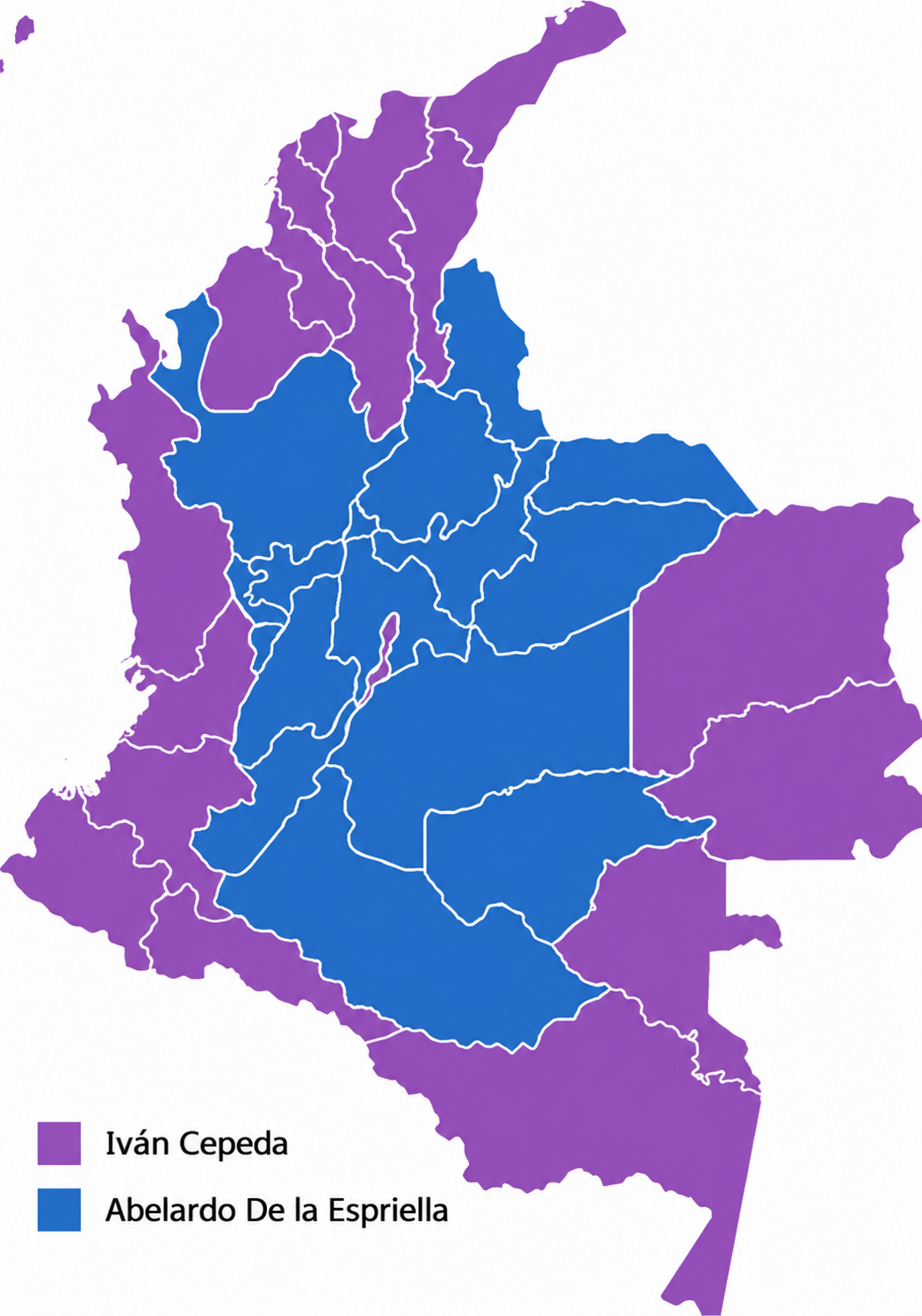
The geographic distribution of the vote reflects deep regional divisions. Cepeda carried Bogotá, which has trended left for years, particularly in lower-income districts on the city’s south and west sides. Antioquia — historically the heartland of Uribismo and home to Medellín, the country’s second-largest city — voted more than two to one for de la Espriella, a result that signals the weakening grip of Uribe’s movement even in its traditional stronghold.

The heart of coffee-growing country — the departments of Caldas, Risaralda, and Quindío also went to de la Espriella. Caquetá, a sparsely populated department in southern Colombia that has suffered sustained guerrilla violence from both the ELN and FARC dissident groups, voted for de la Espriella as well, a result we may interpret as a direct rejection of Petro and Cepeda’s Paz Total.

Cepeda carried Colombia’s Pacific coast, including the chronically neglected department of Chocó, as well as the sparsely populated Amazonas and Putumayo departments bordering Peru and Brazil, and the northern Caribbean coast. The Caribbean coast result is notable, as the region has historically suffered from underdevelopment, infrastructure deficits, and significant income inequality. Norte de Santander with its Catatumbo region on the Venezuelan border and experiencing severe armed-group activity — voted for de la Espriella, a result consistent with public exhaustion over security policy.

The Political Context: From Uribe to Petro and Beyond

Colombia’s current political trajectory is rooted in decisions made across the past two decades. President Uribe served two terms in the early 2000s and, together with then-Defense Minister Juan Manuel Santos, mounted a sustained military campaign against the FARC that significantly weakened the insurgency. Santos later broke from Uribe after assuming the presidency, governing independently and ultimately negotiating a peace agreement with the FARC — a deal that Uribe actively opposed. A plebiscite on the accord failed, but Santos used legislative maneuvering to implement it anyway.
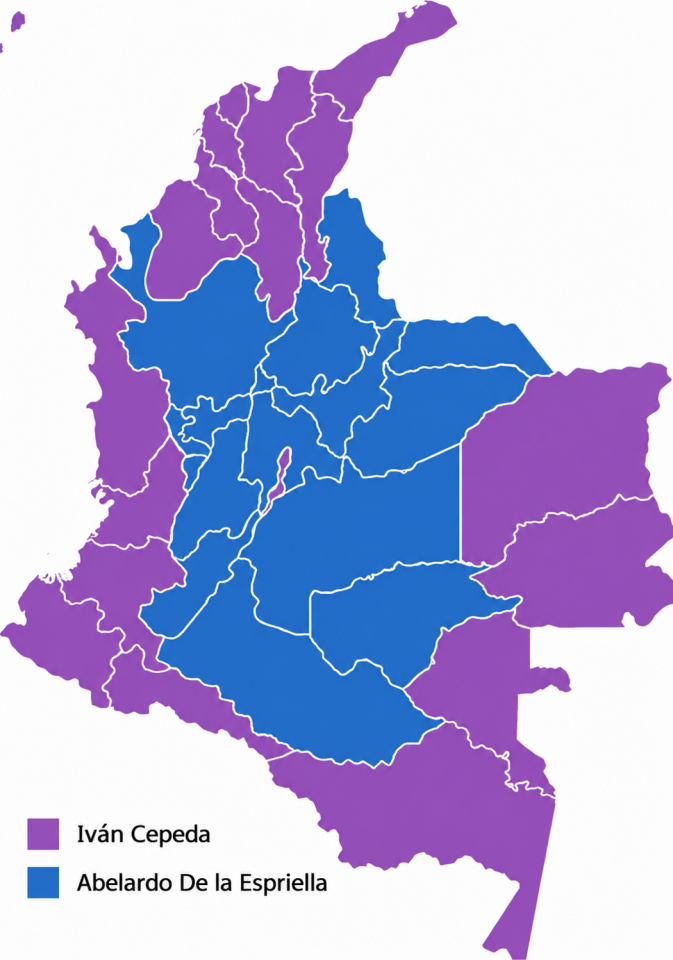
Colombia 2026 1st round top two (Graphic: Sofi Imfeld for Finance Colombia)

Colombia 2026 1st round top two (Graphic: Sofi Imfeld for Finance Colombia)

Uribe’s next handpicked candidate, Iván Duque, won the 2018 election but finished his term with approximately 30% approval. Members of his own party publicly distanced themselves from him — Senator María Fernanda Cabal, a staunch Uribista, called Duque a “mamerto” (leftist idiot) while he was still in office. Under his administration, indicators on crime and guerrilla activity worsened, and armed groups including the ELN rebuilt operational capacity that had been degraded under Uribe and Santos.

Petro’s administration has not met initial fears of a Venezuelan-style democratic breakdown: Congress has largely blocked the most radical components of his agenda, including attempts to nationalize the private pension system and convert the healthcare system to a single-payer model. However, crime has increased, armed groups have expanded their operational footprints, and the security situation in several regions has worsened. Paz Total is widely seen as having produced few tangible results.

Uribe himself was convicted of witness tampering and attempted bribery in the case he had brought against Cepeda. Though released from house arrest after conviction, the judges who authorized his release are now reportedly under investigation for judicial corruption. Valencia’s poor performance in the first round — despite being Uribe’s chosen standard-bearer — suggests that Uribismo as a political force is waning, with its core constituency aging and new generations of voters disengaged from the Uribe legacy.

What to Expect Before June 21

Both campaigns will intensify mobilization efforts over the coming three weeks. Cepeda’s movement — Colombia Humana and the broader Pacto Histórico coalition — has historically relied on organized mobilizations, including indigenous community-led mingas, labor unions, and allied social movements. Cepeda’s running mate Senator Aida Quilcué is an indigenous activist, a choice expected to energize those constituencies. FECODE, the Federación Colombiana de Trabajadores de la Educación (Colombia’s main teachers’ federation), is expected to align officially with Cepeda, though individual teachers may not follow union leadership in their voting choices.

On the right, Paloma Valencia issued a public endorsement of de la Espriella immediately following the first-round results. Business community organizations, including ANDI (the Asociación Nacional de Empresarios de Colombia) and Fenalco (the Federación Nacional de Comerciantes), do not formally endorse candidates, but their members are widely understood to favor a government that supports private enterprise and market-oriented policy. De la Espriella holds no congressional constituency, meaning whichever candidate wins will face the same dynamic Petro encountered: a fragmented Congress that is likely to act as a check on executive authority.

The question of centrist voter alignment remains open. Fajardo and López are not expected to formally endorse either finalist, and the direction of their combined approximately 1.2 million votes is uncertain.

Winners and Losers by Sector

For international investors and executives operating in Colombia, the policy differences between the two candidates are substantive across several key sectors.

Petroleum and Natural Gas: De la Espriella has stated unequivocally that he will restart petroleum exploration and licensing, which the Petro administration blocked. Ecopetrol S.A. (NYSE: EC; BVC: ECOPETROL), Colombia’s state-controlled oil company, which also holds producing assets in the US Permian Basin and Gulf of Mexico, has operated under a government that halted new drilling permits. The consequences have included a decline in future production capacity at a time when global oil prices have risen due to Middle East tensions. Colombia has been forced to import natural gas at elevated prices to meet existing domestic demand — including from transportation fleets that were converted to natural gas under government incentive programs. Cepeda would be expected to continue or deepen current restrictions on fossil fuel expansion.

Healthcare: The Petro-Cepeda platform favors a government single-payer model. The administration has already taken over several Entidades Promotoras de Salud (EPS) — Colombia’s managed-care intermediaries — placing the healthcare system in legal and financial uncertainty. Private clinics, hospitals, and physicians who wish to operate outside a government-controlled framework would benefit from a de la Espriella administration. Cepeda’s healthcare agenda would accelerate the shift toward government-managed care.

BPO, Tech, and Call Centers: The BPO sector — which provides large volumes of formal employment, particularly in Medellín, Bogotá, Cali, and Barranquilla — was significantly affected by Petro-era minimum wage increases of 16% and 23% in successive years. These increases created contract renegotiation pressures with international clients, some of whom have shifted or considered shifting operations to competing jurisdictions including Honduras, Jamaica, the Dominican Republic, Mexico, and Guatemala. At the CX Summit, the industry’s main annual event held in Cartagena, the son of Álvaro Uribe appeared as an invited keynote speaker — a gesture that could be interpreted within the industry as an implicit signal of political alignment. A de la Espriella government, with its orientation toward labor market deregulation and reduced regulatory burden, would be viewed more favorably by this sector. Current Colombian labor law prohibits part-time employment contracts and places significant restrictions on dual employment, making workforce flexibility difficult for businesses that operate outside traditional 40-hour weekly structures.

Mining: The Petro administration has been less aggressive toward mining than toward petroleum, but sector participants expect a more permissive regulatory environment under de la Espriella, and continued constraints under Cepeda.

Security and Tourism: Both candidates have stated support for tourism promotion, but the sector’s trajectory is more directly linked to security conditions. Under current policies, several regions that were accessible to domestic and international travelers several years ago have experienced increased armed-group activity, effectively closing them to tourism. A de la Espriella administration is expected to pursue a more aggressive military posture toward the ELN and FARC dissident factions; a Cepeda government would likely continue dialogue-first approaches. The outcome will directly affect which parts of Colombia’s territory remain accessible to investment and tourism.

Foreign Relations: A de la Espriella government is expected to restore a broadly cooperative relationship with the United States, which deteriorated under Petro following several high-profile diplomatic incidents. De la Espriella has expressed admiration for US President Donald Trump, and reports indicate he holds US citizenship and owns property in Florida. Relations with Ecuador, which have been strained by mutual tariff escalations between Petro and Ecuadorian President Daniel Noboa, would be expected to normalize. Relations with Venezuela under Cepeda would likely continue along the current allied trajectory, while a de la Espriella government would be expected to take a more critical posture toward Caracas. China and Russia would find a more receptive diplomatic environment under Cepeda, and a cooler one under de la Espriella.

The Poor and Informal Workers: Cepeda’s campaign argues that minimum wage increases and expanded state services benefit lower-income Colombians. Critics counter that elevated formal labor costs have pushed more employment into the informal sector — which currently accounts for approximately half the Colombian workforce — depriving those workers of pension contributions, health benefits, and job security. De la Espriella’s platform, which emphasizes business formation, security, and labor market deregulation, would be presented as generating more formal-sector job creation. The actual distributional effects of either approach remain contested.

The Outlook

Assuming current polling trends hold and Uribista voters consolidate behind de la Espriella as expected following Valencia’s endorsement, de la Espriella enters the runoff as the frontrunner. Cepeda’s path to victory depends on driving high turnout among his base, securing support from centrist voters who did not vote for either finalist in the first round, and potentially benefiting from any missteps by de la Espriella in the final three weeks of campaigning.

The first-round results produced no major electoral violence. The ELN announced a temporary halt to armed actions during the voting period. Authorities detained some individuals reportedly attempting to purchase votes in rural areas, but no large-scale incidents were recorded.

The incoming president will face a Congress with no natural majority aligned to the executive, a healthcare system in partial administrative disarray, a petroleum sector whose future production trajectory is in question, and regions where state presence remains contested by armed groups. The June 21 runoff will determine which vision — market-oriented restructuring or continuation of the Petro project — Colombia pursues for the next four years.

  •  

From Prose to Fabric: WHITMAN and the Art of Slow Made Fashion

In a city where fashion retail can often feel hurried, transactional and beholden to the churn of seasonal algorithms, WHITMAN builds its universe around a radically different proposition: that clothing should invite pause. Step inside one of the Colombian fashion house’s softly lit stores in Bogotá, Cartagena, Barranquilla, and Medellín, and there is an immediate sense that time has slowed by several degrees.

Harris Tweed jackets rest beside pastel-hued linen shirts, and Italian Merino wool jumpers hang near tailored overcoats fastened with tagua-nut buttons. A carefully curated playlist hums somewhere in the background. The experience resembles less a conventional boutique than the private library of a well-travelled aesthete.

Named after the great American poet Walt Whitman, whose seminal work Leaves of Grass celebrated the sacred beauty of the everyday and humanity’s intimate relationship with nature, WHITMAN has emerged over the past decade as one of Colombia’s most compelling premium lifestyle brands.

The label advances a philosophy its founders describe as “Slow Made”, though the phrase extends beyond tailoring or craftsmanship into a broader meditation on how people inhabit time itself. There is an unpretentiousness to the WHITMAN community — a quiet rejection of excess and spectacle — rooted instead in simplicity, permanence and a profound connection to the natural world.

Founded by brothers Felipe and Sebastián Falla, who hail from the southern Colombian city of Neiva, WHITMAN began modestly in 2014 designing outerwear for men. Colombia’s fashion industry at the time was still heavily associated with mass-market denim, fast-growing textile conglomerates and tropical resort wear. Menswear, particularly tailored menswear, often occupied a conservative and uninspired corner of the market. WHITMAN entered that landscape with something altogether more literary and contemplative.

“From a very young age we were curious about art and music,” Felipe Falla says of the brothers’ early influences, which ranged from cinema and gastronomy to the melancholic lyricism of Leonard Cohen. Before launching the label, Felipe worked in advertising campaigns for major brands while Sebastián studied gastronomy in Buenos Aires, another passion that would later shape the sensory universe surrounding WHITMAN stores. “Life gave us the opportunity to serve,” the brothers explain of the company’s mission, “and this project exists as a platform for growth and transformation.”

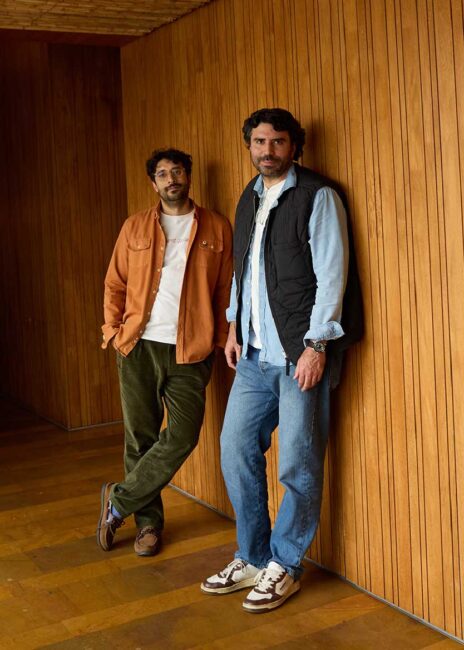
WHITMAN co-founders Felipe and Sebastián Falla. Photo: Courtesy WHITMAN

That language might sound grandiose were it not so carefully embodied in the garments themselves. WHITMAN’s tailoring is meticulous without becoming rigid. Jackets in Harris Tweed wool retain a reassuring weight and texture rarely encountered in contemporary ready-to-wear. Their made-to-measure suits, inspired by Savile Row traditions and constructed using top-tier textiles, favour timeless silhouettes over exaggerated cuts.

Each blazer is designed to age gracefully rather than remain pristine. Even their shirts — including guayaberas intended for that “magic hour” between afternoon and evening — are treated with near-ceremonial attention. Clients are encouraged to personalise collars, cuffs and fit through WHITMAN’s in-house tailoring service. Rather than pursuing relentless seasonal turnover, WHITMAN releases limited-edition “capsules” built around fabrics, textures and moods, reinforcing the brand’s philosophy that clothing should be collected slowly and lived in fully.

Increasingly, WHITMAN has evolved beyond clothing into a broader lifestyle proposition. Its “Home Collection” introduces visitors to hand-painted ceramics, artisanal candles and small-batch chocolate sourced from carefully curated cacao harvesters across Colombia. Guests visiting the stores are often offered cups of “La Molienda”, a Huila Arabica coffee that reflects the founders’ attachment to their Andean roots and tradition of hospitality. The atmosphere feels intentionally domestic rather than commercial — a place designed to make clients linger, converse and reconnect with slower rhythms of living.

The company’s commitment to craft extends deeply into Colombia’s artisanal traditions. WHITMAN works closely with women artisans from the department of Cauca, incorporating delicate embroidery into its women’s wear collections and preserving techniques passed through generations. In doing so, the brand positions craftsmanship not as decorative nostalgia but as a living cultural dialogue between fashion, territory and memory.

The company’s flagship boutique near Bogotá’s upscale Centro Andino shopping district has become something of a pilgrimage site for Colombia’s emerging creative class: architects, filmmakers, restaurateurs and musicians who regard clothing less as conspicuous consumption than as an extension of cultural identity. WHITMAN’s expansion to five stores in Bogotá, as well as boutiques in Cartagena, Barranquilla and Medellín, reflects how successfully the brand has tapped into a regional appetite for understated luxury rooted in authenticity.

Crucially, WHITMAN’s refinement does not exist in opposition to sustainability but alongside it. The brand works with organic cottons and Indian block prints while openly acknowledging the contradictions inherent in the fashion industry. “We do not believe sustainability is an absolute claim,” the company notes in its manifesto, “but a constant exercise of consciousness, revision and responsibility.” It is a refreshingly nuanced position in an era when many fashion houses deploy ecological language as little more than marketing varnish.

The WHITMAN approach instead suggests that sustainability begins with permanence: clothing designed not to be discarded after one season. In this respect, the label belongs to a wider international movement challenging the disposability of modern consumption. Its “Slow Made” philosophy prioritises craftsmanship over industrial repetition, quality over quantity and emotional attachment over instant gratification. To purchase a WHITMAN “Loretto” overcoat or dark-blue “Poet” blazer is, in some sense, to reject the accelerated rhythms of fast fashion altogether.

There are also echoes here of the old-world ateliers that once defined European tailoring culture. WHITMAN’s made-to-measure programme remains entirely hand-finished, preserving artisanal techniques passed from one generation of tailors to the next. The process unfolds deliberately: fabric selection, inner lining, structure, stitching and finishing all treated as rituals rather than stages of production. “The true value of bespoke tailoring,” WHITMAN argues, “lies in its capacity to reflect authenticity.”

WHITMAN blends tailoring, craftsmanship, music and slow living into a quietly elegant experience. Photo courtesy WHITMAN

That sensibility extends beyond clothing into cultural patronage. WHITMAN has positioned itself as an active supporter of Colombia’s artistic ecosystem, sponsoring emerging cultural initiatives and independent artists. At Bogotá’s prestigious ARTBO art fair, the company awards the annual Premio Whitman to emerging artists participating in the ArteCámara section, reinforcing the brand’s dialogue with contemporary art and design. The label has also forged close ties with Colombia’s film world, dressing the jury for the “Cine en los Barrios” category at the Festival Internacional de Cine de Cartagena de Indias, better known as FICCI, the oldest film festival in Latin America.

International expansion has followed organically. In 2024, WHITMAN announced its arrival in Mexico with two stores and hinted at ambitions extending towards the United States, Spain and wider European markets. Yet unlike many Latin American brands eager for overseas validation, WHITMAN appears less interested in aggressive scale than in cultivating a community united by shared values: appreciation for music, art, nature and intentional living.

That perhaps explains why WHITMAN feels distinct within Colombia’s increasingly sophisticated fashion landscape. The brand is not merely selling jackets or linen shirts. It is offering a slower tempo of life — one in which elegance is measured not by spectacle but by permanence, texture and thoughtfulness. And if WHITMAN represents a new kind of menswear energy emerging “from Colombia to all of Latin America”, it also channels something of the Scottish Highlands, the understated elegance of Bond Street and the urban edge of St Urbain Street in Cohen’s fabled Montreal.

For a label named after a poet who celebrated beauty in ordinary existence, that feels entirely fitting. Or, as WHITMAN’s Brand and Partnerships Lead, Laura González Saavedra, puts it with understated simplicity: “wearing a WHITMAN makes you feel at home.”

Follow WHITMAN at @WHITMAN_CO or visit WHITMANSTORE.COM

Or visit their flagship store at Paseo de la Cabrera, Carrera 11 No. 84A-09, Bogotá.

  •  

Petro Challenges Election Results as Colombia’s “Tiger” Clinches First-Round Victory

The hard-right presidential candidate Abelardo “El Tigre” de la Espriella emerged as the frontrunner in Colombia’s presidential election on Sunday, setting up a June 21 runoff against left-wing senator Iván Cepeda after a closely contested first round that was quickly overshadowed by President Gustavo Petro’s allegations of electoral irregularities.

According to the final bulletin (No.67) released by the National Registry Office, De la Espriella secured 43.74% of the vote, finishing ahead of Cepeda, who obtained 40.91%. Conservative senator Paloma Valencia followed with 6.92%, while centrist candidate Sergio Fajardo received 4.26%.

The outcome sets the stage for a high-stakes second round that could determine whether Colombia continues along the political path established by Petro’s administration or pivots sharply toward a more conservative agenda centered on security, economic growth and closer relations with the United States.

Within hours of the results being announced, Petro cast doubt on the preliminary count, stating on social media that he would not recognize the pre-count figures and would only accept the results produced through the official electoral scrutiny process conducted by judicial commissions.

The president argued that the election-day count “has no binding force” and raised concerns about alleged modifications to electoral software and inconsistencies in the voter registry. Petro further suggested that some 800,000 voter identification records may have been improperly added to the electoral census before the vote.

Petro’s allegations quickly became the dominant political controversy of election night. While the president suggested that software modifications and irregularities in the voter registry may have affected the process, he presented no public evidence to substantiate the claims. Electoral authorities, judicial officials and international observers subsequently defended the integrity of the vote, creating a sharp contrast between the president’s warnings and the assessments of institutions directly responsible for overseeing the election.

National Registrar Hernán Penagos responded forcefully to the allegations, rejecting claims that the software used in the electoral process handled voter identification records. Penagos emphasized that the electoral census had been closed since April 30, that all voting records were publicly available for review and that party witnesses had monitored voting and counting procedures throughout the country.

Attorney General Gregorio Eljach also challenged Petro’s assertions, publicly demanding evidence to support accusations that risked undermining confidence in the electoral process.

The controversy intensified briefly when Cepeda questioned apparent discrepancies in electoral databases and echoed concerns regarding the voter registry. However, the left-wing candidate later moderated his position after internal reviews by his campaign.

“We have found no evidence of facts that merit a statement regarding eventual irregularities,” Cepeda said, effectively distancing himself from Petro’s original claims.

The president’s fake narrative appeared to lose momentum after Cepeda’s own campaign acknowledged that it had uncovered no evidence of fraud or irregularities sufficient to challenge the outcome. The concession strengthened the position of election officials, who maintained throughout the day that Colombia’s voting system functioned normally and transparently.

Former Justice Minister Wilson Ruiz Orejuela was among those who condemned Petro’s statements, accusing the president of attempting to cast doubt on a legitimate electoral process. “Petro did not recognize last night’s results,” Ruiz said. “But he has been a complicit driver of the rigged elections that took place in Venezuela.”

International observers, meanwhile, offered a markedly different assessment of the electoral process. Scott Campbell, Colombia representative for the United Nations Human Rights Office, congratulated Colombians for what he described as a peaceful election day and praised the country’s institutions for overseeing the vote. “Today we have not documented significant violations or infringements of human rights,” Campbell said following the election.

Support for the integrity of the process also came from the United States.

Republican Senator Bernie Moreno, who participated as an international observer, described Colombia’s voting system as one of the most effective he had encountered.

“The beauty of democracy was fully displayed as the people of Colombia exercised their power to chart their future in their own hands and with their own voices,” Moreno wrote on social media.

Speaking later to Colombian media, Moreno said he had informed Secretary of State Marco Rubio and President Donald Trump that “the elections in Colombia were completely free and well done.”

Moreno went further, suggesting aspects of Colombia’s voting system compared favorably with those used in the United States. “They do it better here in Colombia than in the United States,” he said. U.S President Donald Trump directly endorsed De La Espriella ahead of Sunday’s vote, stating: “He has all my support.”

The controversy surrounding Petro’s claims also drew attention from Venezuela’s democratic opposition. President-elect Edmundo González praised Colombia’s institutions and warned of the fragility of democratic systems. “I look at Colombia with hope and with memory,” González wrote. “I know the value of what our Colombian brothers possess because we lost it. The right to choose, and the institutions that make it possible, are not easily recovered. Yours are still standing. Protect them.”

While election authorities sought to contain the controversy, De la Espriella’s victory triggered an immediate wave of support from conservative political leaders across Latin America and beyond.

Argentine President Javier Milei was among the first foreign leaders to congratulate the Barranquilla criminal defense lawyer. “This result reflects the desire for freedom and progress of the Colombian people, and an explicit willingness to say enough to the failed socialist model that has caused so much damage to our region and to Colombia in particular over the last four years,” Milei wrote on X.

The Argentine leader added that if the result is repeated in the runoff, “Colombia will once again join the community of free nations” before concluding with his trademark slogan: “Long live liberty, damn it.”

Ecuadorian President Daniel Noboa also congratulated De la Espriella and suggested Colombians were demanding political change after four years of left-wing government. “Being a bad loser is contagious,” Noboa wrote in an apparent reference to former president Rafael Correa, and his criticism of the 2025 election results, adding that Colombia needs “real change.”

Venezuelan opposition leader María Corina Machado likewise celebrated the outcome, saying the result would strengthen democratic institutions and regional security. “The Venezuelan people need a strong and united Colombia,” Machado said, arguing that democratic nations must work together against organized crime and authoritarianism.

In Washington, Republican Congresswoman María Elvira Salazar welcomed De la Espriella’s performance and interpreted the result as a repudiation of Petro’s administration. “The results send a powerful message,” Salazar wrote. “Millions of Colombians reject Gustavo Petro’s direction and want to recover security, prosperity and freedom.”

The Conservative Party formally endorsed De la Espriella following the first-round results, describing him as the candidate who best “represents Colombians demanding a firm direction” for the country.

The runoff campaign now enters a critical three-week stretch as De la Espriella and Cepeda compete for support from voters whose preferred candidates were eliminated in the first round.

For firebrand De la Espriella, victory on June 21 would represent a dramatic ideological shift following four years of Petro’s left-wing presidency and could usher in closer ties with Washington and key allied governments, among them, Israel.

For Cepeda, the challenge will be persuading voters to embrace continuity with Petro’s political project despite deep public dissatisfaction over security, economic mismanagement, corruption scandals and an increasingly polarized political climate.


  •  
❌