The United States has updated a “do not travel” warning for large parts of southwestern Colombia after a wave of terrorist attacks have left over 20 people dead, underscoring growing international concern over the country’s deteriorating security situation and prompting regional authorities to demand stronger support from the leftist government of President Gustavo Petro.
The U.S. Department of State maintained most of Colombia at Level 3 – “Reconsider Travel” – citing crime, terrorism, civil unrest, kidnapping and natural disasters, but reinforced its Level 4 advisory for several conflict-hit regions, including the departments of Arauca, Cauca, Valle del Cauca and Norte de Santander.
Under the latest guidance, Americans are advised not to travel to Cauca, excluding the departmental capital Popayán, and Valle del Cauca, excluding Cali, due to crime and terrorism.
Norte de Santander and Arauca remain under the same highest warning level, while travel within 10 kilometers of the Colombia-Venezuela border is also strongly discouraged because of kidnapping risks, armed conflict and the possibility of detention.
“Do not travel to these areas for any reason,” the State Department said in its advisory, adding that violent crime, armed robbery and murder remain common, while terrorist groups continue to operate in remote and rural zones.
The warning was reinforced by a U.S. Embassy security alert issued in Bogotá on April 27, following 26 separate attacks across southwestern Colombia during the weekend of April 25. The attacks targeted transportation corridors, military installations and police stations, with authorities confirming at least 20 deaths and dozens of injuries.
Police and military facilities are frequent targets of armed groups, and the State Department warned that attacks in Colombia have included car bombs, grenades, truck bombs, explosive devices placed on roads and buildings, and even drones carrying explosives.
Illegal armed groups, including dissident factions of the former Revolutionary Armed Forces of Colombia (FARC), narcotrafficking organizations and other insurgent groups, have expanded their territorial presence in recent years, particularly in remote areas where coca cultivation, illegal mining and strategic trafficking corridors overlap.
The deadliest recent attack occurred near the El Túnel sector in Cajibío, Cauca, along the Pan-American Highway, where an explosive device detonated against civilian vehicles, killing 20 civilians and injuring over 50 more. Authorities attributed the bombing to FARC dissidents under command of alias “Iván Mordisco”.
The attack shocked the country and intensified criticism of President Gustavo Petro’s “Total Peace” policy, which seeks negotiated settlements with illegal armed groups but has faced mounting scrutiny as violence worsens in several regions.
In response, the Cauca governor’s office declared three days of official mourning. Authorities described the bombing as an “atrocious and unjustifiable” act and ordered flags to be flown at half-mast across public institutions and schools as a tribute to the victims.
The government also called for national unity and a stronger institutional response to confront armed violence in one of Colombia’s most volatile departments.
In neighboring Valle del Cauca, Governor Dilian Francisca Toro said she respected the U.S. warning but urged foreign governments and the media not to define the entire region by recent attacks.
“We ask that our region not be stigmatized,” Toro said, insisting that Valle del Cauca remains open to visitors and that violence does not represent the department’s cultural, economic and social identity.
At the same time, she sharply criticized the national government’s security response after attacks in Cali and Palmira, calling for “real, sustained and effective support” through more troops, stronger intelligence operations and direct action against criminal structures operating in the region.
Following an explosion near the Agustín Codazzi Engineers Battalion in Palmira, Toro announced an investment of nearly 70 billion pesos ($17 million) to strengthen police communications infrastructure, expand surveillance camera networks and improve secure transport corridors across municipalities.
In Cali, Mayor Alejandro Eder said an attempted attack against the Pichincha Battalion involved explosive gas cylinders, one of which failed to detonate while another exploded inside a minibus.
Authorities activated a citywide security operation and Eder offered a reward of up to 50 million pesos for information leading to the capture of those responsible. “We cannot allow terrorism to regain ground in our city,” Eder said.
Colombia navigates fiscal challenges following S&P rating revision.
In Colombia’s local fixed-income market, the Títulos de Tesorería (TES) fixed-rate curve appreciated across its entire structure over the last month. As of March, the total balance of TES in circulation stood at 747.9 trillion COP. Despite this positive market valuation, macroeconomic headwinds remain a central concern for the Ministerio de Hacienda y Crédito Público. The fiscal balance of the Gobierno Nacional Central (GNC) reported an accumulated deficit of 1.7% of GDP through February.
These persistent fiscal imbalances were cited as the primary driver behind the recent decision by S&P Global (NYSE: SPGI) to downgrade Colombia’s sovereign credit rating. The administration continues to manage these debt instruments against a backdrop of tight monetary conditions, which remain a primary focus for institutional investors holding Colombian sovereign paper.
Colombian fixed-income markets show valuation gains despite a recent S&P credit downgrade linked to ongoing fiscal imbalances.
The international fixed-income landscape experienced notable shifts between March 25 and April 23, 2026. The yield curve for US Treasury bonds displayed mixed performance, defined by a decrease in short-term rates and an increase in long-term yields. Analysts attribute this volatility primarily to conflicting signals regarding the ongoing conflict in the Middle East.
Economic indicators released by the Bureau of Labor Statistics show that annual consumer inflation, measured by the Consumer Price Index (CPI), accelerated by 0.9 percentage points to reach 3.3% in March. This data triggered a rebound in short-term inflation expectations within the Treasury bond market, while medium and long-term outlooks remained stable. Consequently, the Intercontinental Exchange (NYSE: ICE) MOVE index—which tracks public debt market volatility—and the Cboe (NYSE: CBOE) VIX—which monitors S&P 500 equity volatility—both registered significant declines during the period.
Central bank hike aims to stabilize inflation amid global volatility.
The upcoming monetary policy meeting of the Banco de la República, scheduled for April 30, takes place as the balance of financial risks has shifted significantly compared to the first quarter of 2026. Analysts from Bancolombia (NYSE: CIB) expect the Junta Directiva to increase the benchmark interest rate by 75 basis points, bringing the policy rate to 12.00%.
The convergence of elevated inflation, recent reversal episodes, and misaligned market expectations has reinforced the perceived need for a restrictive monetary stance. This strategy aims to contain domestic demand while preserving the institutional credibility of the central bank. Unlike previous sessions, the current decision-making process is influenced by a shifting global environment where markets have moved toward a higher-for-longer interest rate scenario amid increased uncertainty.
Recent discussions regarding the participation of the Ministro de Hacienda in the Junta Directiva sessions have introduced an additional element of analysis. However, current assessments suggest this does not alter the fundamental policy diagnosis, and no disruptions to the decision-making process are anticipated. Monetary policy is expected to maintain consistency, with the strategic focus shifting from reaching a contractive level to determining the necessary duration of that posture.
Analysts project Banco de la República will raise rates to 12.00% to combat inflation despite slowing domestic economic growth.
The international economic context provides a mixed backdrop for the Colombian decision. Private sector activity in the US appeared to accelerate in April, following a 1.7% monthly increase in retail sales during March. In contrast, the Eurozone reported a contraction in economic activity during April. Energy markets have also seen volatility, with US crude inventories rising in the second week of April while gasoline stocks saw a significant decline. Furthermore, crude prices surged following reports of new security incidents in the Strait of Hormuz.
Domestically, the Departamento Administrativo Nacional de Estadística reported that the Índice de Seguimiento a la Economía grew by 1.6% in February. While imports maintained growth during the same month, the urban unemployment rate across the 13 primary metropolitan areas continued a downward trend through March 2026. In the fixed income market, the central government reported debt levels at 64.2% of GDP for the first quarter, with internal debt accounting for 71.2% of that total.
Market movements reflected these broader trends as the US Treasury curve saw valuation increases driven by investor caution. In the region, Colombia, Brazil, and Uruguay emerged as the primary beneficiaries of the J.P. Morgan (NYSE: JPM) GBI index rebalancing in March. Locally, fixed-rate Títulos de Tesorería experienced devaluations across the entire curve last week. According to the April Encuesta de Opinión Financiera, these devaluations are expected to persist in the coming months. In currency markets, the COP appreciated last week against a backdrop of global and local factors, while the Euro lost ground against the USD.
Headline photo: Bogotá headquarters of Banco de la República (Banrepublica). Photo credit Juan Enrique Rodríguez, courtesy Banrepublica
The U.S. Mint is legally required to sell only legal, domestic gold. Instead, it is the last link in a chain that launders foreign gold for an insatiable market. Our reporter Justin Scheck traced one such supply chain: from an illegal mine in Colombia all the way to the Mint’s facilities in West Point, N.Y.
Stronger peso and oil prices shift Colombian investment landscape.
The Colombian peso (COP) experienced a 2.1% appreciation during March 2026, driven by a recovery in global oil prices and key domestic developments. According to the latest analysis from Bancolombia (BVC: BCOLOMBIA / NYSE: CIB), the performance of the currency coincided with the results of national legislative elections and recent monetary policy adjustments by the Banco de la República.
Global energy markets recorded a significant increase in crude prices throughout the month. Brent crude rose 63% to end March at $118 USD per barrel, while West Texas Intermediate (WTI) increased 51% to close at $101 USD per barrel. These price movements have been largely attributed to geopolitical tensions in the Middle East, which continue to influence international commodity flows and investor sentiment.
On the domestic front, the Gran Coalición por Colombia primary election recorded a turnout of more than 5 million voters. Market analysts indicated that the high participation rate was viewed as a positive indicator of institutional stability. Simultaneously, the Board of Directors of the Banco de la República increased the national policy interest rate by 100 basis points, bringing the benchmark rate to 11.25%. This decision aligns with regional efforts to manage inflationary pressures through tighter monetary control.
International market conditions also reflect a shift in expectations regarding the Federal Reserve. Due to ongoing conflict in the Middle East and persistent economic indicators, markets currently anticipate that the US central bank will maintain existing interest rates without cuts for the remainder of the year.
Looking forward to April, the research team at Bancolombia—led by Chief Economist Laura Clavijo, Macroeconomic Manager Jose Luis Mojica, and International and FX Analyst Maria Paula Gonzalez—projects that the exchange rate will trade within a range of $3,625 COP to $3,725 COP. This forecast accounts for continued volatility and heightened uncertainty in both global and domestic financial markets.
Ecopetrol S.A. (BVC: ECOPETROL; NYSE: EC) has entered into a formal payment agreement with the Government of Colombia to settle outstanding balances from the Fuel Price Stabilization Fund, known in Spanish as the Fondo de Estabilización de Precios de los Combustibles (FEPC). The agreement, reached through the Ministerio de Hacienda y Crédito Público and the Ministerio de Minas y Energía, addresses $1.6 trillion COP owed for the first quarter of 2025.
Under the terms of Resolutions 00368 and 00369 issued by the Dirección de Hidrocarburos, the total amount is divided between Ecopetrol S.A., which is owed $1.2 trillion COP, and Refinería de Cartagena S.A.S. (Reficar), which is owed $0.4 trillion COP. The repayment schedule began with a cash transfer of $2.89 billion COP on April 1, 2026. The remaining balance of approximately $1.55 trillion COP is scheduled to be paid on December 15, 2026, through the issuance of Treasury Securities, or Títulos de Tesorería (TES). The Colombian state has acknowledged the financial costs associated with the time elapsed until the final December payment.
“The Ecopetrol Group continues to work in close coordination with the Ministries of Finance and Public Credit and of Mines and Energy — the authorities responsible for fuel pricing policy — in the implementation of payment mechanisms and the reduction of FEPC balances.” — Ecopetrol S.A.
Concurrent with the subsidy settlement, Ecopetrol received authorization from the Ministerio de Hacienda y Crédito Público via Resolution 0666 to execute an external public debt management transaction totaling $1.25 billion USD. The five-year loan was secured through a consortium of international lenders including BBVA (BME: BBVA; NYSE: BBVA), Bank of America (NYSE: BAC), JP Morgan Chase (NYSE: JPM), and Bank of China (HKG: 3988). The credit facility carries a floating interest rate indexed to the Secured Overnight Financing Rate (SOFR) and will be repaid in four equal installments.
The proceeds from the $1.25 billion USD loan are designated for the repayment of existing obligations. Specifically, $1.2 billion USD will be used to settle a 2024 loan previously authorized for the acquisition of the state’s interest in Interconexión Eléctrica S.A. E.S.P. (ISA), while the remaining $50 million USD will be applied to an outstanding balance from a 2025 credit agreement. The loan agreement is governed by the laws of the State of New York and includes standard covenants regarding the borrower’s payment capacity and financial integrity.
These financial maneuvers are intended to optimize the maturity profile of the Ecopetrol Group, which remains responsible for over 60% of hydrocarbon production in Colombia. The company continues to operate integrated systems in transportation, refining, and petrochemicals, with additional international operations in the US Permian basin, the Gulf of Mexico, Brazil, and Mexico.
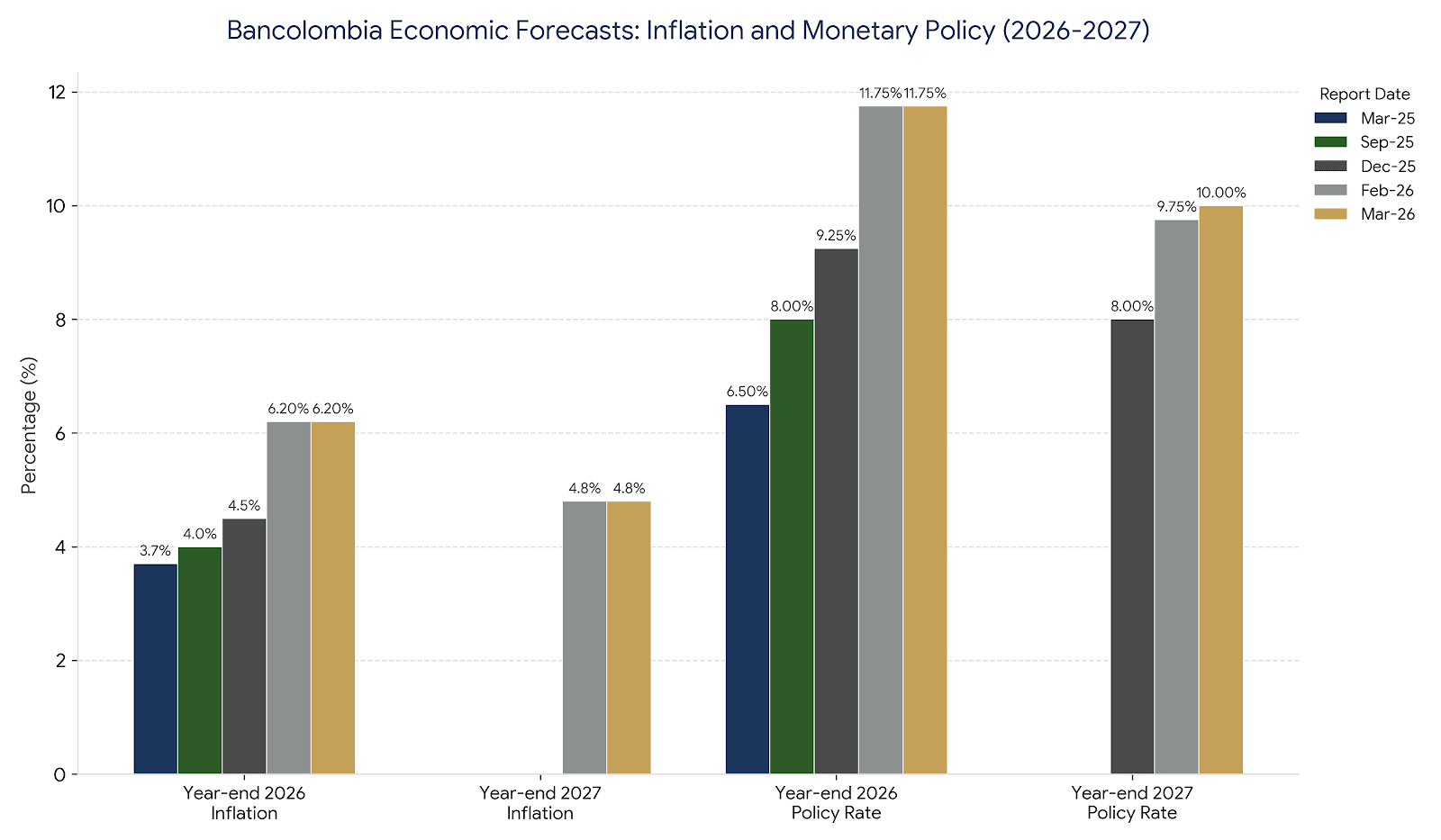
Bancolombia’s analysts expect the Junta Directiva of the Banco de la República to increase its policy interest rate by 100 basis points, bringing it to 11.25 percent. This forecast suggests that the first half of 2026 will be characterized by a more aggressive tightening cycle than previously anticipated, with the rate potentially reaching 12.75 percent.
The international landscape is playing an increasingly decisive role in these local policy configurations. A recent week of central bank decisions globally revealed a shift in tone among major financial institutions, primarily due to rising uncertainty stemming from the conflict in Iran. This geopolitical tension has directly impacted costs for energy, transportation, and agricultural inputs.
In the US, economic activity shows signs of moderation, yet producer price inflation in February exceeded expectations. The yield curve for US Treasuries, managed by the US Department of the Treasury, has shown mixed behavior as the conflict escalates, with the spread between 10-year and 3-month bonds reaching levels not seen since 2023. Inflation expectations in the US have rebounded in the short term, though they remain anchored over longer horizons.
Forecast Category
Mar-25
Sep-25
Dec-25
Feb-26
Mar-26
Year-end 2026 Inflation
3.7%
4.0%
4.5%
6.2%
6.2%
Year-end 2027 Inflation
—
—
—
4.8%
4.8%
Year-end 2026 Policy Rate
6.50%
8.00%
9.25%
11.75%
11.75%
Year-end 2027 Policy Rate
—
—
8.00%
9.75%
10.00%
Domestically, the business indices from think-tank Fedesarrollo showed mixed results for February. However, there are positive indicators in the labor market, as the urban unemployment rate across the 13 primary metropolitan areas continued its downward trend. Additionally, goods exports recorded an advance during the same period.
In the local fixed-income market, the TES fixed-rate curve saw a recovery last week. However, the March Financial Institutions Survey suggests that devaluations of TES may persist in the short term. Long-term TES Class B placements in the first quarter reached 1.0 percent of the GDP.
Chart based on data from Grupo Cibest & the Banco de la República.
Energy markets remain volatile as crude oil inventories in the US increased beyond expectations in the third week of March. Despite this, the price of Brent crude rose toward the end of the week, driven by skepticism regarding a potential ceasefire in the Middle East. The Colombian peso appreciated over the past week, tracking the intensity of the regional conflict.
The equity market results for the fourth quarter of 2025 remained neutral and aligned with market expectations. Global volatility continues to be shaped by energy shocks, geopolitical strife, and a cautious approach toward investments in artificial intelligence.
The projected rate hike by the Banco de la República is intended to send a definitive signal of commitment to price stability. This adjustment reflects not only recent inflation trends but also a strategic effort to prevent the further deterioration of expectations in a high-risk environment.
Headline image: Bogotá headquarters of Banco de la República (Banrepublica). Photo credit Juan Enrique Rodríguez, courtesy Banrepublica
If you’re the type of Mac, iPhone, or iPad user who likes to update their operating systems manually, you will want to pay attention to your devices after you have installed the latest iOS 26.4, iPadOS 26.4, and MacOS Tahoe 26.4 software updates, because installing those updates will enable automatic updates for system software. If ... Read More
Though surprises are possible, polling says the front runners are Iván Cepeda, Abelardo de la Espriella, and Paloma Valencia.
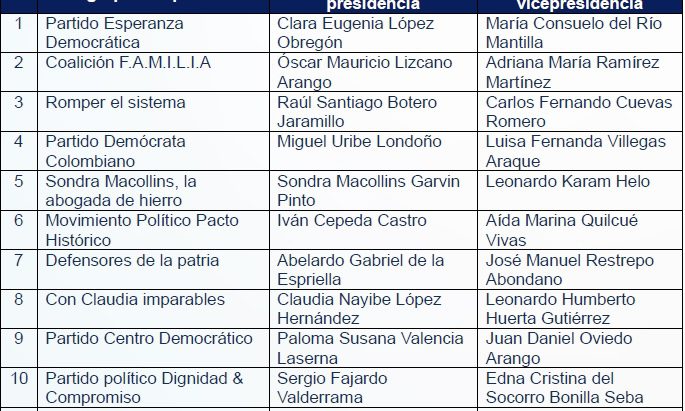
The Registraduría Nacional del Estado Civil of Colombia (RNEC), the entity responsible for organizing elections in the country, reported that a total of 14 candidates have officially registered to run in the country’s presidential elections, scheduled for May 31, 2026. In this vote, citizens will elect the President and Vice President of the Republic for the 2026–2030 term.
According to the electoral authority, the candidates represent a wide range of political perspectives, from left to right, including independent candidacies running through political movements. Here the list and brief profile of the candidates:
Clara Eugenia López Obregón, currently a senator for the Esperanza Democrática She has served as Minister of Labor (2016–2017), acting mayor of Bogotá (2011–2012), and Bogotá’s secretary of government (2008–2010). She has been affiliated with left-wing parties and was Gustavo Petro’s vice presidential running mate in the 2010 election.
Óscar Mauricio Lizcano, from the FAMILIA coalition. He served as Minister of Information Technologies (2023–2025), was a senator (2010–2018), and a member of the House of Representatives (2006–2010).
Raúl Santiago Botero, candidate of the “Romper el Sistema” movement (Break the Establishment). An agronomist engineer and businessman from Medellín, he presents himself as an independent candidate with no prior political experience.
Miguel Uribe Londoño, father of the slain presidential candidate Miguel Uribe Turbay. He is running under the Colombian Democratic Party and previously served as president of the Centro Democrático party founded by Álvaro Uribe Vélez.
Sondra Macollins Garvin, from the movement “La Abogada de Hierro” (The Iron Lawyer) A criminal lawyer and psychologist, she presents herself as an independent candidate without political affiliations. She ran for the House of Representatives in 2022 and is known for her work in narcotrafficking and corruption cases.
Iván Cepeda Castro, a senator since 2014 and the official candidate of the Pacto Histórico, the same party as President Gustavo Petro. Polls project he will receive the highest vote share in the first election round. He is aligned with left-wing political ideas.
Abelardo de la Espriella, a lawyer with far-right positions, running for the first time under the Defensores de la Patria movement. Recent polls place him as a likely second or third contender in voter preference.
Claudia López Hernández, former mayor of Bogotá (2020–2023) and former senator (2014–2018), running under the centrist movement “Imparables con Claudia.” She is known for her anti-corruption agenda and secured her candidacy with more than 570,000 votes (about 9%) in recent interparty primaries.
Paloma Valencia Laserna, current senator and candidate of the Centro Democrático party led by Álvaro Uribe Vélez. She won the right-wing interparty primary on March 8 with more than 3 million votes. Polls place her among the top three contenders, and if she reaches a runoff, she would become the first woman in Colombia’s history to do so.
Sergio Fajardo Valderrama, an academic and mathematician running for the Dignidad y Compromiso He served as mayor of Medellín and governor of Antioquia and is running for president for the third time.
Roy Barreras, from the political party La Fuerza (The Force). He won the left-wing coalition primary on March 8 with the lowest vote total (257,000 votes, about 3.6%). Although currently aligned with left-wing movements and part of the Petro administration, he has previously been affiliated with right- and center-leaning parties.
Gustavo Matamoros Camacho, of the Colombian Ecologist Party. He served in the Colombian Army for 43 years. With no prior political experience, his campaign focuses on public security.
Luis Gilberto Murillo, who served as Minister of Foreign Affairs (2024–2025) and Colombia’s ambassador to the United States (2022–2024). A human rights advocate and Afro-Colombian leader from Chocó, he presents himself as an independent, moderate, centrist candidate.
Carlos Eduardo Caicedo, running under the independent movement “Con Caicedo.” He was mayor of Santa Marta (2012–2015) and governor of Magdalena (2020–2023), where he built a strong base as a left-wing political leader.
The RNEC also reported that “the draw to determine the position of presidential candidates on the ballot will take place on March 25 at the Ágora Bogotá Convention Center.”
This process marks the formal start of the final phase of the presidential campaign, during which candidates will seek to consolidate support ahead of the first round on May 31. If no candidate secures an absolute majority, a runoff between the two leading candidates will be held on June 21.
List of registered candidates for Colombia’s presidency. Photo courtesy of the Registraduría Nacional del Estado Civil.
Headline photo: Polling station in Colombia during last Congress elections in March 8, 2026. Photo courtesy of the Registraduría Nacional del Estado Civil.
U.S. federal prosecutors have opened preliminary criminal investigations into Colombian President Gustavo Petro over alleged links to drug traffickers and possible illicit financing of his 2022 campaign, according to a report by The New York Times.
The previously undisclosed probes are being conducted by federal prosecutors in Manhattan and Brooklyn and involve specialists in international narcotics trafficking, as well as agents from the Drug Enforcement Administration and Homeland Security Investigations, the newspaper said, citing people familiar with the matter.
Investigators are examining, among other issues, whether Petro held meetings with individuals connected to drug trafficking networks and whether his presidential campaign solicited or received donations from such actors. The two investigations are being carried out independently and remain in their early stages, with no certainty that they will lead to formal criminal charges.
There is no indication that the White House played any role in launching the investigations, according to the report. However, the inquiries emerge in a broader context of heightened tensions and fluctuating diplomacy between Bogotá and Washington.
Relations between Petro and U.S. President Donald Trump have been volatile, marked by sharp public exchanges, threats of tariffs that were never implemented, and the temporary revocation of Petro’s U.S. visa. Trump has repeatedly accused Petro of failing to curb narcotics production and has described him in highly critical terms, while Petro has denounced what he characterises as political pressure and interference.
The U.S. Treasury Department last year imposed sanctions on Petro, members of his family and senior officials, including Interior Minister Armando Benedetti, alleging links to narcotics activity. The measures, which included asset freezes and travel restrictions, were justified by Washington on the grounds that cocaine production in Colombia had reached record levels and that the government had offered concessions to armed groups involved in trafficking.
Petro has rejected those claims, insisting that his administration has strengthened seizures of cocaine and slowed the rate of expansion of coca cultivation. He has also denied any knowledge of illicit funds entering his campaign, dismissing the allegations as politically motivated attacks.
Colombia’s Attorney General is examining charges that Petro’s son – Nicolás Petro – received money from individuals linked to illicit activities during the 2022 campaign. While his son acknowledged receiving funds that were not reported, no criminal charges have been filed against the president himself, and Petro has maintained he was unaware of the campaign “donations”.
According to the NYT, the U.S. investigations are taking place amid a broader strategy in which Washington has increasingly used legal and judicial tools to advance foreign policy objectives. Analysts say such actions could serve as leverage in bilateral relations or influence political dynamics in allied countries.
The timing of the probes is particularly sensitive, as Colombia prepares for presidential elections on May 31, with a potential runoff in June. Petro, the country’s first leftist president, is constitutionally barred from seeking re-election but has actively backed his political successor with hardleftist Iván Cepeda.
The allegations could reverberate through the electoral campaign, where relations with the United States remain a central issue. Candidates on the right have emphasised the importance of maintaining close ties with Washington, while figures on the left have framed U.S. actions as a challenge to Colombia’s sovereignty.
Despite months of tensions, diplomatic relations between the two countries have shown signs of stabilisation in recent weeks. Petro and Trump held a bilateral meeting at the White House earlier this year, which both sides described as constructive, and officials have since sought to rebuild communication channels.
Even so, uncertainty persists over the trajectory of the relationship, particularly as Washington continues to prioritise counternarcotics cooperation with Colombia, historically one of its closest partners in the region.
Petro has consistently denied any links to drug trafficking and has pointed to his government’s security strategy, which includes negotiations with armed groups and efforts to reduce violence, as evidence of a broader approach to the drug trade.
The start of U.S. investigations add a new layer of complexity to an already fraught political and diplomatic landscape, with potential implications not only for Petro’s post-presidential future but for Colombia’s ties with its most important security ally.
La izquierda de América Latina ha visto a la isla como su referente ideológico. Ahora, líderes de todo el espectro dudan en ayudar a una nación que está en la mira del gobierno de Trump.
En Colombia, la rápida proliferación de drones armados cada vez más sofisticados entre los grupos insurgentes se ha convertido en un inmenso reto para el gobierno.
Security officials say easy access by guerrilla groups to commercial drones, cheaply modified into deadly weapons, has put the nation’s army on its heels.
We analyse recent homicide figures in Colombia’s capital.
Anti-extortion police arrest a suspected member of the Satanás crime gang, linked to a rash of extortion and killings in Bogotá during 2025. Photo. Secretaria de Seguridad.
Last month we looked at the latest homicide data for the city: in 2025 violent deaths went down 3.4% on the previous year. These 1,165 killings gave Bogotá – with a population of around 8 million – a homicide rate of 14.8 deaths per 100,000 of the population.
This month we look deeper into this statistic. Why homicides? Though an imperfect indicator, murder rates do give an insight into insecurity in a zone as they are often the extreme outcome of robberies gone wrong, gang feuds, political violence, domestic violence, fights, targeted killings, drugging of victims and bungled kidnappings. Put simply, the number of bodies means the amount of crime.
Crime patchwork
Where are homicides happening? In our own analysis of Bogotá’s 20 districts (see map below) the gritty downtown area of Sant Fe has the highest rate of 54 killings per 100,000 inhabitants, followed by nearby Los Martíres with 47, and Ciudad Bolívar with 33.
Sant Fe, like many Bogotá districts, is a patchwork of agreeable barrios, such as the touristy Las Aguas for example, and historic La Candelaria (with just three homicides last year) juxtaposed with crime-ridden neighborhoods.
Heat map of current homicide rates adjusted for population size in Bogotá districts. Graphic: S. Hide
But in the southwest corner of Santa Fe lies San Bernardo, or ‘Samber’ as it is known locally, generally recognized as the most dangerous barrio in Bogotá, a hub for gangs selling drugs to street people and the scene of several fatal grenade attacks in 2025.
Santa Fe is a reminder that in Bogotá safer streets are often just a block away from no-go zones. Rolos and long-term residentslearn to navigate these invisible barriers.
To emphasize this point, Santa Fe, statistically the most dangerous district in the city, lies adjacent to the leafy district of Teusaquillo with a homicide rate of 5 per 100,000 in 2025 (amounting to nine deaths), which according to this metric makes it the safest district in Bogotá.
Less grim up north
Other districts registering less than 10 killings per 100,000 in 2025 are the more upmarket northern districts of the city: Chapinero, Usaquén, Suba, Fontibón and Engativá. And as in most years, there is a gradient towards safer barrios in the north, with the dividing line running roughly along the Avenida El Dorado (Av Calle 26).
But in terms of reducing crime, there are success stories in the south. While still the most dangerous district, Santa Fe has reduced its homicide rate by 28 per cent in 2025 alongside Bosa, Usme and Antonio Nariño, all with reductions in double digits.
These results are hard to assess; organized criminal gangs are present in all these areas, so the peace could be transitory and a result of rival gangs declaring a truce, or one gang leveraging control, rather than societal shifts or better policing.
Ciudad Bolívar, a southern city district with high rates of poverty and crime. There were 218 homicides reported in this sector of the city during 2025. Photo: S. Hide
In some cases, large-scale operations have had an impact, combing security and social services in a carrot and stick approach called megatomas. In Santa Fe, for example, following the grenade attacks, the Bogotá administration both militarized the barrio and flooded it with development programs to support the huge homeless population there. This approach seems to have worked, at least temporarily.
On the negative side, three central districts (Puente Aranda, San Cristóbal and Rafael Uribe Uribe) have seen a spike in killings, a reminder of the balloon effect; pushing down on crime in one zone just forces it to pop up somewhere else.
Sicario scenarios
What’s behind the killings? Police databases do not reveal motives, but media coverage and occasional analyses by Bogotá’s Secretaría de Seguridad give insights into the city’s mean streets.
Targeted killings, usually carried out by paid hitmen (sicarios), are for the city the visible tip of an underworld iceberg of organized crime. Hits are carried out often on the street or public spaces against identified victims by professional gunslingers sometimes recruited specifically for the job with promises of cash.
Clear-up rates are low: in June last year city councilors complained that in the first half of 2025 out of 521 homicides, 156 were targeted hits, for which only 16 people had been arrested. “In other words, 90 per cent of assassinations on Bogotá go unpunished,” pointed out councilor Julián Espinosa in one debate.
This was despite the city police’s vaunted Plan Candado – Padlock Strategy – of mobile rapid response teams and drones to quickly catch perpetrators by locking down zones within minutes of a major crime.
Vigil for Miguel Uribe, the young politician shot by a 15-year-old hitman in a Bogotá park in June 2025. He survived the initial attack but died from his wounds two months later. Photo: S. Hide.
The most high-profile killing was the gunning down of senator and presidential candidate Miguel Uribe, shot in the head during a walkabout in a Bogotá park. The police quickly apprehended the small-time gangsters behind the shooting in June 2025, including the 15-year-old shooter, but today despite nine arrests are no closer to revealing the paymasters behind the hit.
Another unsolved assassination was the targeted killing of emerald czar Hernando Sánchez, shot dead while walking with his family in a leafy northern suburb of Usaquén in April last year. The military-style killing, by a sniper hiding in nearby woodlands, was identical to the mysterious murder nine months before of a fellow emerald baron, known as Pedro Pechuga, also unresolved.
Weapons of choice
Despite Colombia having restrictions for private ownership of firearms, the majority of 2025 killings were with guns, at 703, according to the police database. Other weapons recorded were knives (304), blunt objects (84) and grenades (6).
This pattern has persisted for decades; Colombia, and its capital, are flooded with illegal firearms, many of them from the estimated 600,000 guns smuggled south across the border from the U.S. each year. Just in the first four months of 2025, police confiscated 8,466 illegal weapons across the country
According to Carolina Ortega, a political scientist at the National University, and quoted by UPI, illegal guns were used in 78 per cent of killings in Colombia.
Easy access to guns also raised the risk of spontaneous killings, according to data from the Secretaria de Seguridad which showed that40 per cent of Bogotá homicides followed a dispute, argument or scuffle.
Most of these happened outside on the street, late in the evening, and “amidst scenes of revelry and excessive alcohol consumption”, said the report, released as part of a media campaign called “Take a second before you shoot…”.
Violent machismo
Femicides went down on 2025, both in Bogotá and at national level, according to data released this week by the Observatorio de Mujeres y Equidad de Género de Bogotá.
In Bogotá during 2025 there were 97 females killed, around 8% of total violent deaths. Of these, 20 were classified as femicides. This was slightly less than in 2024 (22 deaths) and mirrored a similar reduction (7%) nationally. Nationally, approximately one killing in five of a female was later classified as a femicide, the “violent expression of machismo”, said the study.
A study by Bogotá’s Secretaria de la Mujer found that in 49 per cent of cases in the capital, the women had suffered physical violence in the weeks before the murder, and 40 per cent had previously sought help from the police.
According to observatory data, last year Secretaria staff supported 142,688 women, of which 48% were facing violence, a slight reduction on the previous years. The 2025 figures were a reminder that although more warning signs were being detected, timely intervention was not always possible, said the report.
“Femicide does not arise from nothing: it is foreshadowed, repeated, and often normalized before reaching its most tragic outcome,” it concluded.
Pay up – or pay the price
In 2025 many Bogotá murders were linked to extortion demands, with gangs ruthlessly gunning down small business owners if they failed to pay protection money. Sometimes shop staff or a passerby were also killed or injured, in some case with grenades or explosives.
Protection rackets are nothing new in the city, but cases and killings skyrocketed post-pandemic partly because of turf wars between gangs diversifying from the drug trade and Venezuelan gangs linked to the transnational group Tren de Aragua with names like Las Satanás and Los Coyotes.
Extortion reached epidemic proportions in 2024, with an average of 200 cases a month, and continued into 2025 with a rash of crimes such as the killings of informal minibus drivers in the south of Bogotá.
Overall, Bogotá in 2025 saw extortion go down by 20 per cent compared to 2024, though it was still higher than any year during the previous decade. And already in the first month of 2026 there have been several murders linked to extortion demands including a grenade attack on a nightclub in Los Mártires last week which killed one and injured a dozen more.
Millionaire’s ride
Another death last week, that of a university professor found dead and incinerated on the outskirts of the city, highlighted increased cases of Bogotá’s infamous Paseo Millonario, where armed gangs working with taxi drivers attack and extort passengers, often torturing them to reveal bank details while they empty their accounts.
Victims are often targeted late at night leaving bars or restaurants. In a chilling twist, recent cases pointed to victims being subdued with ketamine, with the drug either killing or severely incapacitating the victim.
According to data from the GAULA (Anti-Kidnapping and Extortion Group), 40 Paseo Millonario cases were reported in 2025, a rise of 207 per cent on the previous year. Even that figure was thought to be a huge underestimate since many victims were too scared to come forward. Hotspots were in Chapinero, Kennedy, Bosa, Ciudad Bolívar, and Fontibón.
In one case a taxi gang held a victim for 19 hours, prompting the Attorney General’s Office to reclassify such crimes as “kidnapping” with a potential 42-year prison sentence. In theory this prompted the police to start responding more robustly to a crime that has plagued Bogotá for decades.
Perpetrators of these high-impact crimes were also more likely now to get locked up, with 47 imprisoned last year out of the 52 captured, which was way above average jailing rate of 6 percent of criminals arrested, according to Bogotá police chief Giovanni Cristancho, talking to RCN News last week.
But he also admitted that the understaffed police force was struggling to keep up with constantly emerging kidnap gangs, usually small teams of four or five people which could easily move around the city.
“As soon as we reinforce one area, such as around Calle 85, the modus operandi shifts to other zones,” he told RCN.
It’s that randomness, and the risk of being drugged – or worse – that makes the Paseo Millonario one of the most feared crimes in Bogotá. And for 2026, the one to watch.
U.S. President Donald Trump said on Tuesday there was “no going back” on his goal to bring Greenland under U.S. control, refusing to rule out the use of force and escalating tensions with European allies already bracing for a renewed transatlantic trade dispute.
Trump’s remarks followed a series of social media posts featuring AI-generated images, including one depicting the president standing in Greenland holding a U.S. flag and another showing a map of North America with Canada, Greenland and Venezuela covered by the stars and stripes.
The imagery, shared without official explanation, has fuelled alarm among allies and raised questions about the blurring of political messaging and artificial intelligence at a moment of heightened geopolitical strain.
“As I expressed to everyone, very plainly, Greenland is imperative for National and World Security. There can be no going back — on that, everyone agrees,” Trump said after speaking with NATO Secretary General Mark Rutte.
Greenland, a vast Arctic island rich in minerals and strategically located between North America and Europe, is a self-governing territory of Denmark, a fellow NATO member. Trump’s renewed push to acquire it has revived a proposal he first floated during his previous term, but has now been accompanied by explicit warnings of tariffs and the possible use of force.
European leaders reacted with unease. Danish Prime Minister Mette Frederiksen told parliament in Copenhagen that “the worst may still lie ahead.”
“We can negotiate about everything — security, investments, the economy — but we cannot negotiate our most fundamental values: sovereignty, our country’s identity, our borders and our democracy,” Frederiksen said.
At the World Economic Forum in Davos, European Commission President Ursula von der Leyen urged the bloc to prepare for a more confrontational era.
“The seismic change we are going through today is an opportunity — in fact a necessity — to build a new form of European independence,” she said.
Trade war fears resurface
Trump has threatened steep tariffs on countries he says stand in the way of U.S. interests, including European allies involved in NATO exercises in Greenland. The European Union has warned it could retaliate with tariffs on up to €93 billion ($101 billion) of U.S. imports if trade measures are imposed.
One option under discussion is the EU’s Anti-Coercion Instrument, a powerful tool that could restrict access to public tenders, investment or services, including digital services where U.S. companies hold a surplus.
U.S. Treasury Secretary Scott Bessent sought to calm markets and dismissed fears of an escalating trade war.
“It’s been 48 hours. Sit back, relax,” Bessent told reporters in Davos. “Calm down the hysteria. Take a deep breath.”
Financial markets were less sanguine. U.S. stock index futures slid to one-month lows, global equities fell, and gold prices touched record highs as investors sought safety.
Canada and Venezuela react
The inclusion of Canada and Venezuela in the AI-generated map added to the controversy.
Canada, a close U.S. ally and NATO member, has previously been the subject of Trump’s rhetoric suggesting it could become the “51st state.” Canadian Prime Minister Mark Carney said he was “concerned” by the escalation and warned of the implications for North American and transatlantic security.
Canadian officials said Ottawa has drawn up plans to send a small contingent of soldiers to Greenland to participate in NATO military exercises, pending final approval from Carney. Canada already has aircraft and personnel deployed there as part of a NORAD exercise involving the United States.
Venezuela’s government condemned Trump’s post and called on citizens to share the country’s official map online in what officials described as a symbolic defence of sovereignty.
Russia weighs in
Russia, which has closely watched the growing rift between Washington and Europe, questioned Denmark’s sovereignty over Greenland. Foreign Minister Sergei Lavrov said the island was the result of “colonial conquest,” while denying Moscow had any designs on the territory.
Protesters also took to the streets in several European cities, including Zurich, where demonstrators carried banners opposing Trump’s appearance at Davos and denouncing what they called imperialist policies.
Despite pushback from allies and some members of Congress, Trump has shown no sign of softening his stance, leaving diplomats and markets braced for further escalation as NATO cohesion and global trade relations come under renewed strain.

 Login
Login