
Reading view

Apple CEO Tim Cook Explains His Relationship With Trump

Apple's CEO Tim Cook has maintained a working relationship with U.S. President Donald Trump, and he touched on that in a recent interview.
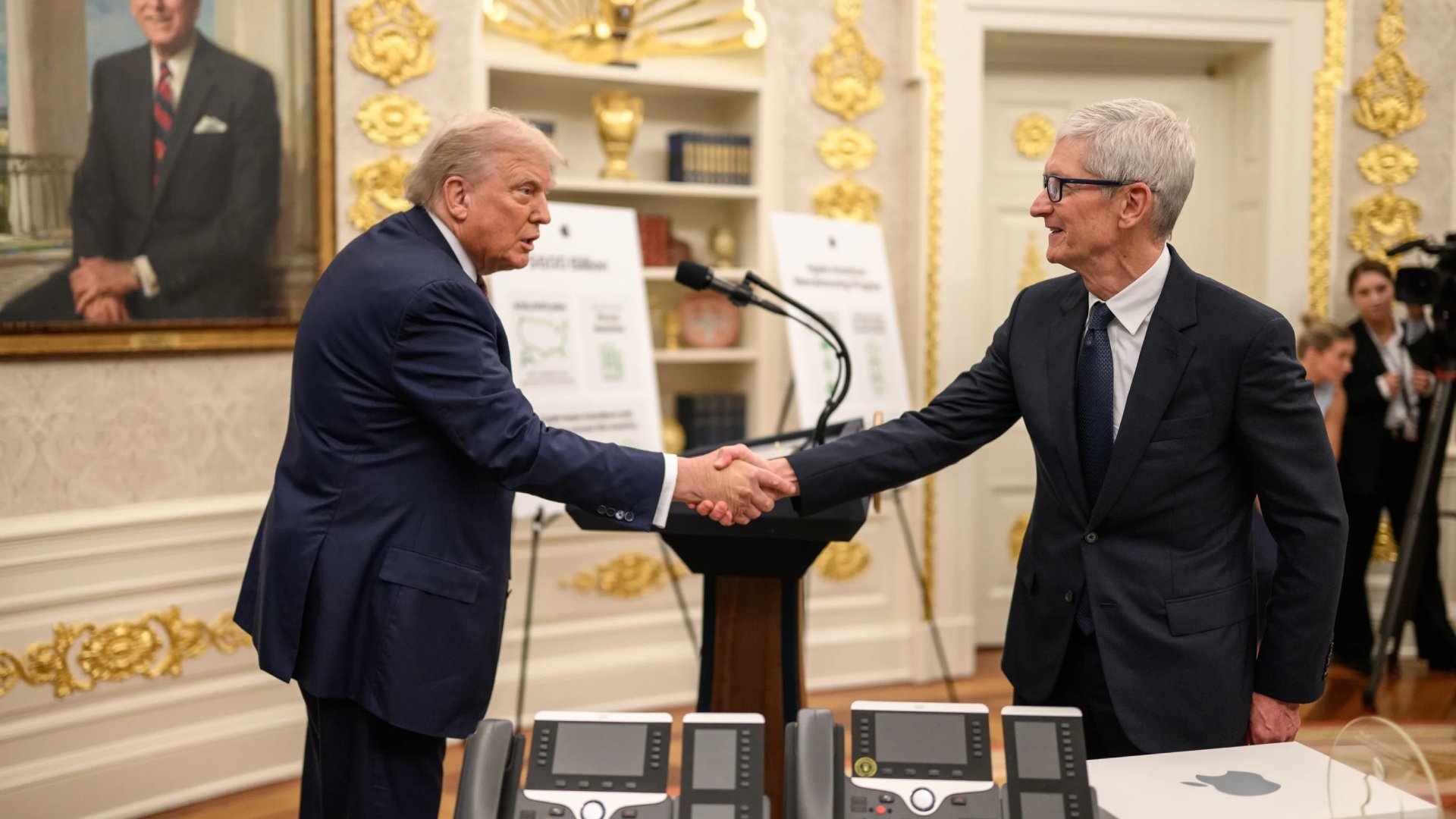

Cook sat down with Esquire's Ryan D'Agostino to discuss Apple's 50th anniversary, but he was also asked about how he navigates the Trump administration.

Cook responded by saying that "the Trump administration is very accessible."

"So you can talk with them about your point of view on things," said Cook. "They may not agree, but you can engage. You can be heard. You may not, in the end, be able to convince. But engagement for me, not just in the U.S. but around the world, is so important because it is very complex, working through local laws, local customs, local culture, local regulations. Every country is its own story. Everybody's looks at things differently."

"The only way you get a feel for that is to sit before someone and communicate and engage," he added. "If you went in my conference room, you would see the Teddy Roosevelt quote 'It is not the critic who counts.' I've never believed that just yelling from the sideline about plus or minus was a good strategy. Your voice just goes into the wind."

Cook went on to say that it is important to have "values that are consistent," and he assured that Apple's values and his own have not changed.

He emphasized Apple's focus on user privacy, the environment, accessibility, and education.

"So you'll see me everywhere, and you'll wonder 'oh, he's meeting with somebody that has a different view than him,'" Cook concluded. "I think that's good. I think it's good. I think a problem in the world right now is that it's so polarized and different views aren't shared or discussed. They just become hardened. And I don't think that's good."

In an interview last month, Cook said he is "not a political person."

"I interact on policy, not politics," he said.
This article, "Apple CEO Tim Cook Explains His Relationship With Trump" first appeared on MacRumors.com

Discuss this article in our forums

  •  

U.S. Assures Colombian President Petro He Does Not Face Charges Right Now

The Justice Department is examining Gustavo Petro for possible ties to drug traffickers. U.S. officials have told him that for now he does not face criminal charges arising from the probes.
  •  

U.S. prosecutors probe Colombia’s Petro over alleged narco links, NYT reports

U.S. federal prosecutors have opened preliminary criminal investigations into Colombian President Gustavo Petro over alleged links to drug traffickers and possible illicit financing of his 2022 campaign, according to a report by The New York Times.

The previously undisclosed probes are being conducted by federal prosecutors in Manhattan and Brooklyn and involve specialists in international narcotics trafficking, as well as agents from the Drug Enforcement Administration and Homeland Security Investigations, the newspaper said, citing people familiar with the matter.

Investigators are examining, among other issues, whether Petro held meetings with individuals connected to drug trafficking networks and whether his presidential campaign solicited or received donations from such actors. The two investigations are being carried out independently and remain in their early stages, with no certainty that they will lead to formal criminal charges.

There is no indication that the White House played any role in launching the investigations, according to the report. However, the inquiries emerge in a broader context of heightened tensions and fluctuating diplomacy between Bogotá and Washington.

Relations between Petro and U.S. President Donald Trump have been volatile, marked by sharp public exchanges, threats of tariffs that were never implemented, and the temporary revocation of Petro’s U.S. visa. Trump has repeatedly accused Petro of failing to curb narcotics production and has described him in highly critical terms, while Petro has denounced what he characterises as political pressure and interference.

The U.S. Treasury Department last year imposed sanctions on Petro, members of his family and senior officials, including Interior Minister Armando Benedetti, alleging links to narcotics activity. The measures, which included asset freezes and travel restrictions, were justified by Washington on the grounds that cocaine production in Colombia had reached record levels and that the government had offered concessions to armed groups involved in trafficking.

Petro has rejected those claims, insisting that his administration has strengthened seizures of cocaine and slowed the rate of expansion of coca cultivation. He has also denied any knowledge of illicit funds entering his campaign, dismissing the allegations as politically motivated attacks.

Colombia’s Attorney General  is examining charges that Petro’s son – Nicolás Petro – received money from individuals linked to illicit activities during the 2022 campaign. While his son acknowledged receiving funds that were not reported, no criminal charges have been filed against the president himself, and Petro has maintained he was unaware of the campaign “donations”.

According to the NYT, the U.S. investigations are taking place amid a broader strategy in which Washington has increasingly used legal and judicial tools to advance foreign policy objectives. Analysts say such actions could serve as leverage in bilateral relations or influence political dynamics in allied countries.

The timing of the probes is particularly sensitive, as Colombia prepares for presidential elections on May 31, with a potential runoff in June. Petro, the country’s first leftist president, is constitutionally barred from seeking re-election but has actively backed his political successor with hardleftist Iván Cepeda.

The allegations could reverberate through the electoral campaign, where relations with the United States remain a central issue. Candidates on the right have emphasised the importance of maintaining close ties with Washington, while figures on the left have framed U.S. actions as a challenge to Colombia’s sovereignty.

Despite months of tensions, diplomatic relations between the two countries have shown signs of stabilisation in recent weeks. Petro and Trump held a bilateral meeting at the White House earlier this year, which both sides described as constructive, and officials have since sought to rebuild communication channels.

Even so, uncertainty persists over the trajectory of the relationship, particularly as Washington continues to prioritise counternarcotics cooperation with Colombia, historically one of its closest partners in the region.

Petro has consistently denied any links to drug trafficking and has pointed to his government’s security strategy, which includes negotiations with armed groups and efforts to reduce violence, as evidence of a broader approach to the drug trade.

The start of U.S. investigations add a new layer of complexity to an already fraught political and diplomatic landscape, with potential implications not only for Petro’s post-presidential future but for Colombia’s ties with its most important security ally.

  •  

Trump convoca una coalición para ‘erradicar’ a los cárteles

En una reunión celebrada en Florida, el presidente pidió a los líderes de una decena de países latinoamericanos y caribeños que ayuden al ejército estadounidense a aplastar a los grupos de traficantes armados.
  •  
  •  
  •  

Petro and Trump: What next in U.S.–Colombia relations?

Nearly a week after Donald Trump hosted Colombia’s president, Gustavo Petro, at the White House, calm has returned to a bilateral relationship that only recently appeared headed for rupture. The insults have stopped. The social media theatrics have faded. Diplomacy, not spectacle, is back in charge.

This alone tells us that both governments have agreed to “disagree” and agree again.

The meeting itself produced no headline agreements. Instead, it marked something more consequential and less dramatic – a quiet end to illusions. In Washington, Petro’s flagship policy of “Total Peace” is now widely regarded as exhausted, if not outright discredited. What replaces it is a far more traditional, conditional partnership: security cooperation first, democracy under scrutiny, and patience in short supply.

The timing matters. Within days of the White House meeting, the U.S. State Department announced that John McNamara, Washington’s chargé d’affaires in Bogotá, will leave his post on February 13. McNamara arrived a year ago at a moment of open hostility between Trump and Petro, when the relationship was being tested not only by policy disagreements but by personal antagonism. His task was not to advance grand initiatives, but to prevent a collapse. That he succeeded says much about the value of professional diplomacy in an era of impulsive politics.

His departure now marks the end of a holding pattern. What comes next will be harder, more explicit, and less forgiving.

The Trump – Petro encounter was cordial, almost surprisingly so. Trump praised Petro as “terrific.” Petro shared a handwritten note from Trump declaring his affection for Colombia. The optics were deliberate. But the substance lay elsewhere.

According to officials and lawmakers briefed on the talks, Washington’s message was blunt: negotiations without consequences have failed. Petro’s Paz Total—a strategy built on ceasefires, open-ended negotiations, and the assumption that armed groups could be coaxed into disarmament—has not reduced violence. In many regions, it has coincided with territorial expansion by FARC dissidents, rising extortion, and a deepening humanitarian crisis. From Washington’s perspective, it has blurred the line between peace realpolitik and paralysis.

U.S. cooperation with Colombia is now explicitly conditioned on key demands. First, decisive military action against armed groups, especially the ELN along the Venezuelan border, where insurgents have long enjoyed sanctuary. Second, ironclad guarantees that Colombia’s upcoming electoral processes will be free, fair, and transparent ahead of a high-stakes 2026 presidential race.

This is not ideological hostility. It is strategic calculation – from Bogotá to Caracas, and ultimately, the Oval Office.

Colombia remains indispensable to U.S. interests: a capstone of regional security, a key counter-narcotics partner, and a democratic anchor in a hemisphere unsettled by authoritarian drift and Venezuelan instability. But indispensability does not mean indulgence. Washington’s conclusion is that leverage must now be used, not deferred.

The shift was visible almost immediately. Colombian forces bombed ELN encampments in the Catatumbo region near the Venezuelan border, killing several fighters and seizing weapons. The strikes signaled a return to military pressure after months of restraint under Paz Total.

Yet they also exposed the moral and political cost of the new course. According to Colombia’s forensic authorities and reporting by El Colombiano, one of those killed in Catatumbo was a child. Seven bodies were recovered after the operation, including that of a minor. The incident echoed last November’s bombing in Guaviare that killed seven minors, among them an 11-year-old girl.

Shift in tone and strategy

Petro, in the aftermath of the Trump encounter, has responded with a stark argument: armed groups recruit children precisely to deter military action. Halting airstrikes, he said, would reward a “cowardly and criminal” strategy and accelerate forced recruitment. It is a grim logic, but not an implausible one—and it illustrates the impossible trade-offs now confronting the Colombian state.

Peace negotiations have not been spared. The Clan del Golfo, one of the country’s most powerful criminal organizations, suspended talks with the government after reports that Colombia and the United States discussed targeting “high-value” leaders. From Washington’s perspective, this reaction only reinforces its skepticism: armed groups talk peace when it buys time, not when it requires surrender.

None of this suggests enthusiasm in Washington for a militarized Colombia. It suggests resignation. The United States has seen this cycle before – in Colombia and throughout the hemisphere. Negotiations without enforcement are a contradiction. Ceasefires without verification entrench armed actors. Elections held amid coercion corrode democratic legitimacy from within.

Which brings us to the second pillar of the new relationship: electoral transparency.

U.S. officials have made clear that Colombia’s democratic processes will now be watched closely – not as a moral abstraction, but as a strategic necessity. A Colombia that cannot guarantee free elections is not a reliable ally, no matter how aligned its security policies may be.

This is the bargain now on offer. Not a reset. No rupture. Conditional coexistence.

John McNamara’s departure symbolizes the transition. His tenure was about keeping the peace between governments. The next phase will be about enforcing terms.

For Petro, the challenge is severe. He must deliver security results demanded by Washington without losing legitimacy at home, where skepticism of militarization runs deep. He must demonstrate democratic integrity while navigating a polarized political landscape. And he must do so knowing that Total Peace, once his signature promise, no longer commands confidence abroad.

The calm in U.S.–Colombia relations is real- but it is not comfort. It is the quiet before accountability.

  •  

All That Glitters Isn’t Trump Nor Petro

Colombian President Gustavo Petro appeared on Tuesday to melt into the gilded woodwork of the Oval Office, wearing a gold tie and an uncharacteristically sober dark suit. Seated beside U.S. President Donald Trump, the two-hour meeting appeared—at least on the surface—to be a cordial encounter between political adversaries entrenched on opposite sides of the ideological divide.

After months of public insults, veiled threats and mutual distrust, both leaders emerged from their first face-to-face meeting keen to project warmth. “We got along very well,” Trump told reporters afterward. “I thought he was terrific.” Petro, speaking later at the Colombian embassy in Washington, described the encounter as “optimistic” and “constructive,” particularly on counter-narcotics cooperation.

Yet behind the gold accents, handshakes and flattering soundbites, the meeting revealed less of a breakthrough than a carefully choreographed de-escalation – one that stabilizes a fraught bilateral relationship without resolving its deepest contradictions.

The meeting defied expectations precisely because expectations were so low. Trump and Petro had spent months trading insults from afar. Trump had previously labeled the Colombian leader a “sick man” and an “illegal drug leader,” offering no evidence. Petro, a former left-wing guerrilla turned president, accused Trump’s administration of committing war crimes through strikes on suspected drug-smuggling vessels and denounced the U.S. operation that removed Venezuelan leader Nicolás Maduro as a “kidnapping.”

Analysts in Bogotá and Washington alike feared the encounter could spiral into confrontation—or worse, an unfiltered monologue. Instead, the Oval Office doors closed to the press, and when they reopened, both leaders spoke in unusually measured tones.

“There was more fear of what could go wrong than hope for what could go right,” wrote El País. “None of it happened.”

Trump hailed the talks as “terrific,” while Petro posted a photograph on X showing the two men smiling, accompanied by a handwritten note from Trump reading: “Gustavo – A great honor – I love Colombia.” For Petro, the optics alone mattered: after months of diplomatic frost, he had secured not only an invitation but public validation from the most unpredictable ally Colombia has.

Gilded optics for now

Despite the upbeat rhetoric, neither side announced concrete agreements. Trump said the two leaders were “working on” counter-narcotics efforts. Petro said he had urged Trump to cooperate in locating and capturing major drug traffickers living outside Colombia, including in the United Arab Emirates, Europe and the United States.

On Venezuela, Petro floated the idea of trilateral cooperation on oil and gas exports involving Caracas, Bogotá and Washington – an ambitious proposal that runs headlong into U.S. sanctions policy. He also claimed Trump agreed to mediate Colombia’s escalating trade dispute with Ecuador, whose president, Daniel Noboa, is a close Trump ally.

What emerged was less a roadmap than a reset: an agreement to keep talking.

That alone represents progress. Colombia’s security situation has deteriorated sharply, with armed groups such as the ELN expanding their reach. U.S. intelligence, technology and funding remain central to Bogotá’s counterinsurgency and counter-narcotics strategies—just as they were during the years that led the FARC to the negotiating table.

Petro’s political calculus

Domestically, the meeting strengthened Petro at a sensitive moment. As El País noted, Colombia is already edging toward a heated electoral cycle, and the prospect of a public clash with Trump had unnerved even some of Petro’s allies.

Instead, the Colombian president managed to appear pragmatic without abandoning his ideological posture. “He did not change his way of thinking on many issues, and neither did I,” Petro said. His quip about a “pact for life” to “make the America(s) great again” signaled both irony and accommodation – a rhetorical olive branch wrapped in Trump’s own slogan.

The presence of senior officials on both sides underscored the meeting’s importance. Petro was joined by Foreign Minister Rosa Yolanda Villavicencio, Defense Minister Pedro Sánchez and Ambassador Daniel García-Peña. Trump was flanked by Vice President J.D. Vance, Secretary of State Marco Rubio and Republican Senator Bernie Moreno.

The Clinton List

One issue loomed quietly in the background: Petro’s status on the so-called Clinton List. According to Colombian media reports citing sources close to the White House, Washington may reassess Petro’s inclusion only after Colombia’s 2026 presidential elections, with a decision expected no earlier than June.

If confirmed, the message is clear: Trump’s administration is willing to thaw relations—but not without leverage.

Trump also said he was working on lifting U.S. sanctions imposed on Petro last year over alleged links to the drug trade, accusations the Colombian president has repeatedly dismissed as “slander.” No timeline was offered.

Alliance restored

For the United States, Colombia remains indispensable: a key intelligence partner, a bulwark against narcotics flows, and a strategic player in a volatile region where Venezuela’s political and economic future remains uncertain. For Colombia, the relationship is existential – economically, militarily and diplomatically. Nearly 30% of Colombian exports go to the U.S., while remittances from more than three million Colombians living there exceed $13 billion annually.

What Tuesday’s meeting achieved was not reconciliation, but recalibration.

The gold tie, the flattering notes, the carefully chosen words – all that glittered. But neither Trump nor Petro abandoned their instincts, their ideologies or their mutual suspicion. The real test will come not in photographs or handwritten dedications, but in whether cooperation materializes once the optics fade.

  •  
  •  

Colombia’s President, an Outspoken Trump Critic, Heads to the White House

President Gustavo Petro of Colombia and President Trump have had a tense relationship that escalated into threats by Mr. Trump, before easing. Anything could happen at their Feb. 3 meeting.
  •  
❌